




Abstract
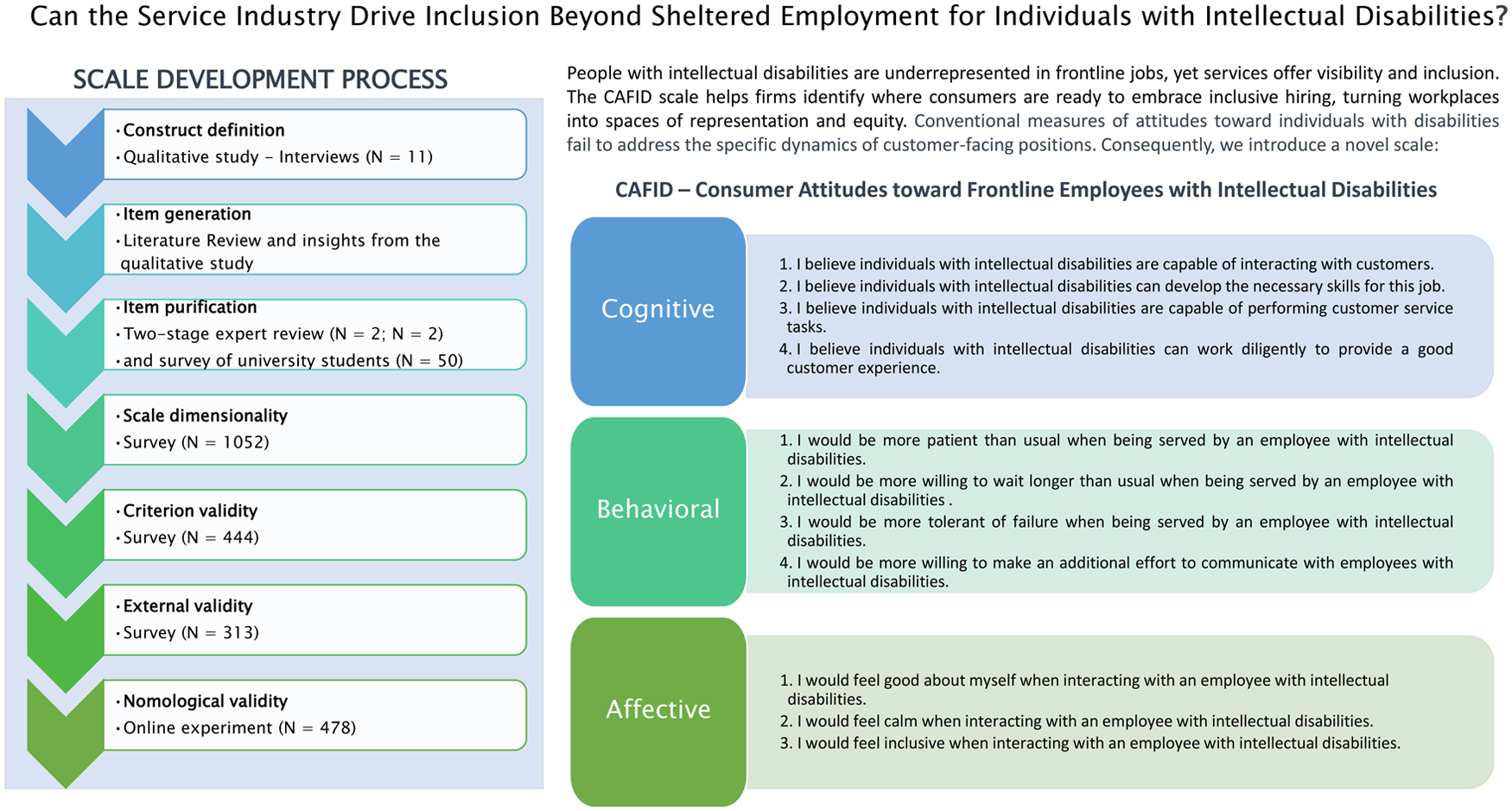
Employees with intellectual disabilities remain markedly underrepresented in frontline service roles, despite the social and economic benefits of inclusion. A key barrier is firms’ uncertainty about consumer reactions. To address this gap, we develop and validate the CAFID scale (Consumer Attitudes toward Frontline Employees with Intellectual Disabilities), designed specifically for the service sector—unlike existing, general disability attitude measures. Across multiple studies, we demonstrate the scale’s reliability, dimensionality, and validity. Results show that more favorable consumer attitudes not only support inclusive hiring but also buffer negative responses to service failures, improving repatronage and word-of-mouth intentions. With this practical tool, firms can assess customers’ readiness and support for inclusive hiring practices; policy makers can develop data-driven incentives to promote workplace equity; and researchers can explore dynamic consumer–employee interactions involving people with intellectual disabilities. Ultimately, the CAFID scale contributes to building more equitable, socially responsible service environments.
Keywords
Get full access to this article
View all access options for this article.
References
Supplementary Material
Please find the following supplemental material available below.
For Open Access articles published under a Creative Commons License, all supplemental material carries the same license as the article it is associated with.
For non-Open Access articles published, all supplemental material carries a non-exclusive license, and permission requests for re-use of supplemental material or any part of supplemental material shall be sent directly to the copyright owner as specified in the copyright notice associated with the article.
