




Abstract
Many empirical studies have focused on understanding the frontline role process, which reflects the chain of effects including the antecedents and outcomes of frontline employees’ in-role behavior and extra-role behavior. A close examination of past findings reveals discrepancies across cultures. This meta-analysis provides insights into the moderating effects of national culture on the frontline role process. We build on role theory to consolidate role behavior’s antecedents to reflect the expectations emanating from four stakeholders of the frontline role: the organization, manager, peers, and customers. We formulate hypotheses on the moderating effects of national culture dimensions (i.e., power distance, individualism, masculinity, and uncertainty avoidance) and meta-analyze 105 articles, including 100 independent samples with 32,364 participants from 35 different countries, to test our predictions. The results show that customer expectations are the strongest antecedent to both in-role and extra-role behavior and furthermore confirm that the frontline role process differs across cultures. We offer managers advice on how to adapt expectations for sales and service employees across countries to enhance frontline performance evaluations, customer satisfaction, and ultimately the firm’s competitiveness. We also link our results to new frontline trends (e.g., service robots, artificial intelligence, remote service technology) and provide a future research agenda.
Keywords
Over the past 25 years, many studies conducted around the globe have examined the behavior of frontline employees, namely, those workers in an organization who interact directly with customers. Providing the theoretical backdrop of these works, role theory recognizes in-role behavior as the expected behavior in serving the firm’s customers, such as bank tellers demonstrating accurate knowledge of policies and products, or customer service employees replying to emails within 24 hours (Schepers et al. 2012). There are also many examples of frontline employees “going the extra mile” for customers, such as financial service experts helping clients search for venues to celebrate big events (Chan and Wan 2012), or an airline ticket agent rushing ahead to hold an airplane for late-arriving passengers (DeWitt 2004). Such customer-directed extra-role behavior (here forward “extra-role behavior”) consists of discretionary acts that go beyond existing role expectations and directly benefit customers through better satisfying their needs (Bettencourt and Brown 1997).
With service firms continuously expanding their business globally, it is critical to understand what factors drive subordinates’ role behaviors across different cultures. The extant literature has advanced our understanding of how managers may control or stimulate role behavior in the frontline, yet Table 1 demonstrates major empirical discrepancies across cultures. Indeed, role theory states that expectations emanating from other actors are the major drivers of employee role behavior, and it holds that employees interpret these expectations vis-à-vis their cultural value system (Sluss, Van Dick, and Thompson 2011). However, the literature provides scholars and managers with no structured understanding of how national culture alters the frontline role process, defined as the chain of effects from others' expectations to frontline employees’ role behavior and from role behavior to customers’ and managers’ evaluations of employees’ performance. Without such guidance, global service firms will likely continue to suffer from suboptimal frontline performance.
Illustrative Discrepancies in Role Behavior Literature.
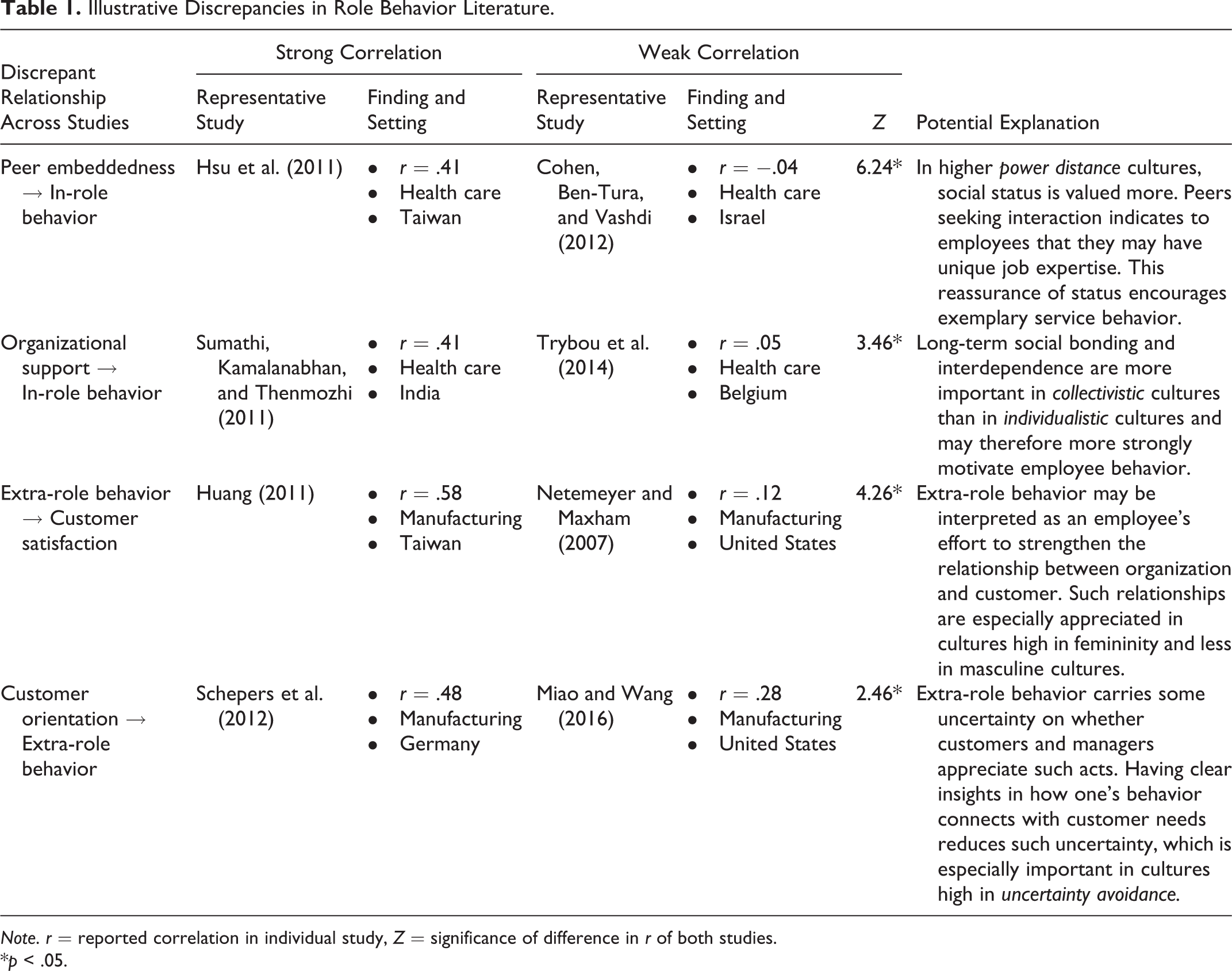
Note. r = reported correlation in individual study, Z = significance of difference in r of both studies.
*p < .05.
There are at least four reasons why this guidance cannot be grasped from the current state of the literature. First, typical studies on role behavior in the frontline focus on only one or a few antecedents at a time and consider either in-role behavior or extra-role behavior but not both. This divergence makes it difficult to compare the explanatory power of different antecedents. Second, studies have been published across a range of domains (e.g., marketing, psychology, health care) and employ diverging terminology to study the same phenomenon. This terminological variation has resulted in a scattered conceptual and empirical landscape in which it is hard to determine whether studies can be reliably compared. Third, virtually all studies on role behavior have been conducted in a single country. 1 This geographically restricted focus prevents us from identifying the true underlying mechanism of culture’s effects on role behavior. Finally, although Table 2 shows that there are a number of representative meta-analyses on employee behavior, none of these studies examine role behavior or the moderating effects of national culture in the frontline. The presented meta-analyses also consider only one category of expectations at a time and thus do not provide a full and reliable picture of frontline dynamics.
Comparison of Representative Meta-Analyses on Employee Behavior.
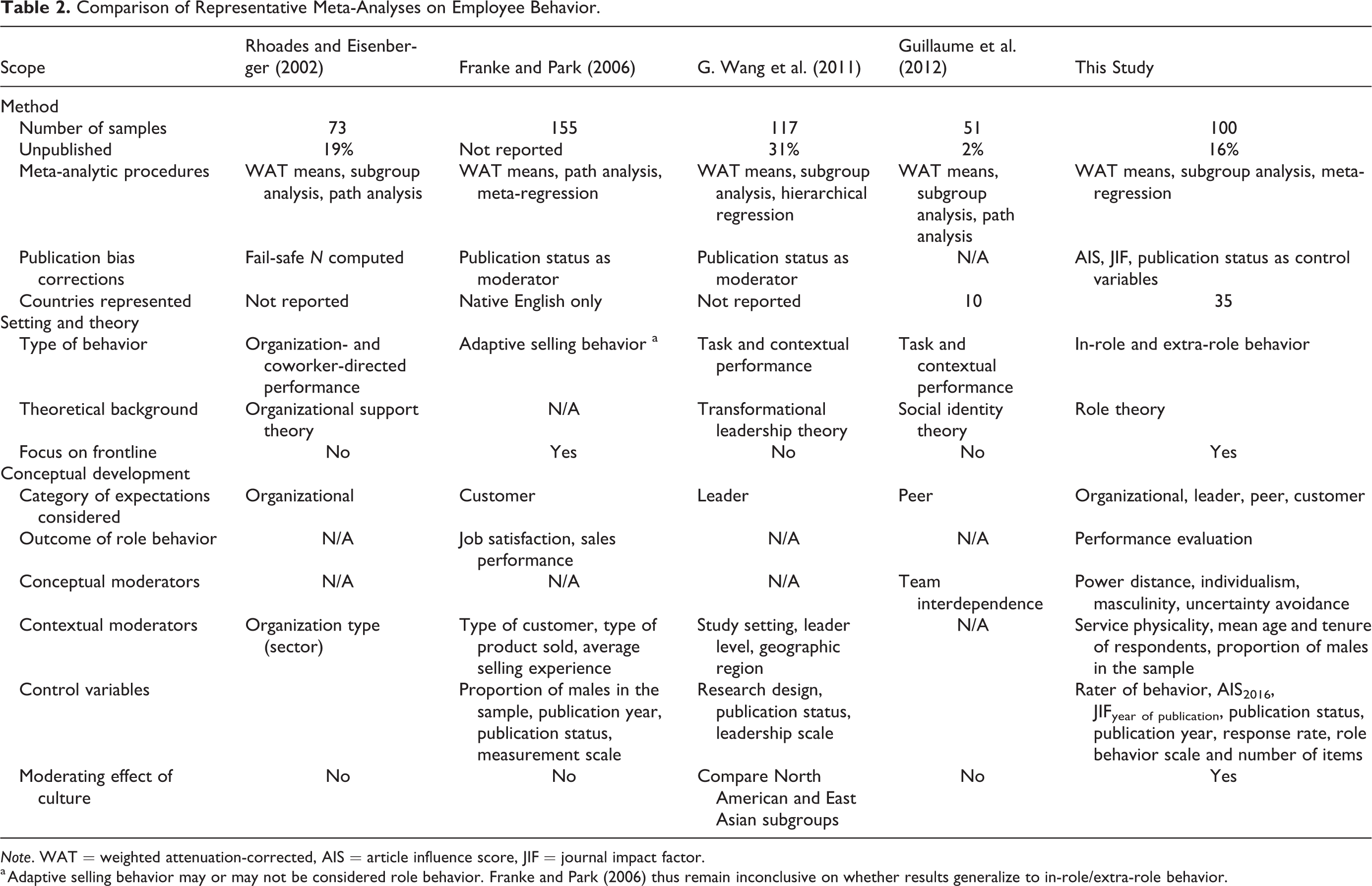
Note. WAT = weighted attenuation-corrected, AIS = article influence score, JIF = journal impact factor.
aAdaptive selling behavior may or may not be considered role behavior. Franke and Park (2006) thus remain inconclusive on whether results generalize to in-role/extra-role behavior.
In sum, there is a strong need for insights into how national culture affects the frontline role process. In response, we conduct a comprehensive meta-analysis that includes 105 articles, 100 independent samples, and 32,364 participants from 35 different countries. We adopt Hofstede, Hofstede, and Minkov’s (2010) four primary dimensions of culture (i.e., power distance, individualism-collectivism, masculinity-femininity, and uncertainty avoidance) as conceptual moderators of the frontline role process. These dimensions refer to enduring values that likely determine employees’ interpretations of others’ expectations and their consequent behavioral responses.
We make several contributions to the literature. First, using role theory as a filter, we synthesize the antecedents of role behavior into four distinct categories that reflect the actors which define a frontline employee's behavior through socially constructed cues or expectations. Jointly, the actors occupy positions in the social structure of the frontline role and define a frontline employee’s behavior through socially constructed cues or expectations. The results show that of the four categories, customer expectations are the strongest antecedent to both in-role and extra-role behavior. Expectations associated with the employee’s organization, leader, and peers are more strongly related to extra-role behavior than to in-role behavior. Moreover, in-role behavior is more strongly related to performance evaluation than extra-role behavior.
Second, we extend role theory by incorporating a national culture perspective. Recent work on role theory has focused on individuals’ traits for dealing with cultural differences (e.g., cultural intelligence; Rockstuhl and Van Dyne 2018), but it has not considered national culture dimensions as conceptual moderators in the frontline role process. We propose the theoretical foundation for integrating a national culture perspective into research on role behavior and find empirical evidence for how each of the four primary Hofstede dimensions affects these relationships.
Third, we explore the effects on the frontline role process of four contextual moderators and eight control variables. The contextual moderators feature characteristics of the underlying studies’ context and respondents. We find that in-role behavior is especially positively evaluated in settings with high service physicality—a new concept we introduce to reflect the extent to which services relate to the human body or feature close customer contact. The control variables reflect the characteristics of the outlet and methodology and displayed very few significant effects. This underlines the prominence of culture’s moderating effects on the frontline role process.
Finally, we observe that the frontline will change dramatically due to new trends in automation (e.g., service robots), digitalization (e.g., remote services), human capital (e.g., self-employed workers), and decision-support technologies (e.g., artificial intelligence, augmented reality, recommender systems). We link our research results to these trends and provide a future research agenda with questions that may inform and motivate further research in this area.
In what follows, we start with a primer on role theory and role behavior. We continue by formulating hypotheses on how culture affects the frontline role process and then describe our methodology, present our results, and discuss the implications of our work.
Conceptual Framework
Role Theory
Role theory provides an in-depth understanding of the process that underlies frontline employees’ display of role behavior. The theory began life as a theatrical metaphor (Biddle 1986), explaining how actors were constrained to act out scripts that were written to jointly address the expectations of the audience and the director. Over time, the theory generalized to describing a position in an organized set of social relationships, and its central premise became that a role is shaped by a cluster of socially constructed cues that guide and direct an individual’s behavior in a given setting (e.g., the frontline; Solomon et al. 1985). An actor’s role conduct must take into account the roles of others because expected behaviors are defined in relation to those actors occupying other positions in the social structure. In the frontline, this social dynamic includes the employee’s organization, manager, peers, and customers (cf. van der Borgh, de Jong, and Nijssen 2019).
These other actors perform a role evaluation to judge whether the frontline employee’s role enactment matches their expectations and behavior. Hence, an important part of successfully performing a role is the ability of an actor to predict the behavior of other actors that make up the so-called role set (Mead 1935). The process of anticipating others’ role enactment requires specific abilities and skills (e.g., empathy) from the actor (Solomon et al. 1985) and can “lead [role actors] to form expectations,” to “accept others’ norms as their own,” and to conform to these normative expectations “because they believe it ‘right’ to do so” (Biddle 1986, p. 79). Therefore, a role set not only reflects the expectations, contextual demands, and norms to be understood by the actor but also an actor’s related dispositional characteristics and attitudinal responses (Biddle 1986; Mead 1935; Sarbin and Allen 1968). The anticipatory process enables the actors to align their behavior with the predicted behavior of others (Rose 1962).
A substantial body of literature has provided examples of the role set expectations, norms, dispositional characteristics, and attitudes in a frontline employee’s anticipatory process. For instance, organizations may offer support through training programs or provide specific rewards to guide behavior (Welbourne, Johnson, and Erez 1998). In addition, transformational leaders help their employees internalize idealized role scripts through role modeling and vicarious socialization (Bass 1996; Solomon et al. 1985). Role theory has also been used to further the understanding of supervisor-subordinate relationships (Matta et al. 2015) and peer relationships (McCall and Simmons 1966). Role theorists have also conceived anticipatory role expectations as beliefs about actors’ own and others’ idealized behavior (Kelly 1955; Rotter 1954). These expectations are associated with attitudinal processes that drive preferences for behavior (Biddle 1986). For instance, salespeople become more effective when their behavior is contingent upon the needs and wants of the customer, therefore necessitating customer orientation (Solomon et al. 1985; Weitz 1981). Similarly, empathizing with customers’ emotional states makes it easier for employees to anticipate customer expectations (Wilder, Collier, and Barnes 2014).
Taken together, the frontline role process that describes how expectations from the role set translate to employee behavior, and ultimately role evaluation, may include many steps such as role set actors sending signals and employees “catching” those signals through their empathic abilities. Subsequently, the employee may construct a personal understanding of the expectations, build an interpretation of socially constructed norms, attitudinally respond to the norms and expectations, and enact role behavior. In the end, other actors in the role set evaluate the role performance. This meta-analysis takes a broad, inclusive approach toward role set expectations where we consider all manifestations of expectations (i.e., several steps in the anticipatory process) that shape and form role behavior. In the frontline, role set expectations thus include actual and perceived expectations such as institutional norms and values, managerial behaviors, attitudinal responses of frontline employees, customer requests, and organizational (control) systems. Although establishing the causality of manifestations is interesting, and future research may take up this challenge, data limitations prevent us from doing so in the present study.
Role Behavior
Frontline role behavior is typically described as either in-role or extra-role in nature. In-role behavior concerns all actions that employees need to conduct to fulfill the formally required tasks in their role. These tasks stem from the explicit responsibilities outlined in job descriptions and performance evaluations forms (Schepers et al. 2012). In past studies, conceptualizations of in-role behavior converge toward employees meeting organizational objectives or standards in customer interactions. Extra-role behavior consists of discretionary acts that go beyond existing role expectations and directly benefit customers through better satisfying their needs. Such behavior signifies the degree to which an employee “goes the extra mile,” “goes beyond job requirements,” “goes above and beyond the call of duty,” and “goes out of their way” to help customers.
Concepts such as organizational citizenship behavior (Organ 1988), prosocial organizational behavior (Brief and Motowidlo 1986), and contextual behavior (Borman and Motowidlo 1993) are related to extra-role behavior. However, these concepts consider the organization or its employees rather than the customer as the beneficiary of discretionary behavior. The focus on customers’ need satisfaction is also important to discriminate extra-role behavior from related “service-oriented” behaviors such as praising the organization to customers (Morhart, Herzog, and Tomczak 2009), making constructive suggestions, or implementing improvements in the service process (Schepers, Nijssen, and Van der Heijden 2016). Although these discretionary behaviors may lead to service enhancement over time, they do not directly satisfy current customer needs and are not extra-role behavior according to the definition we employ.
Conceptual Model
The literature on role behavior in the frontline features many constructs that have similar definitions but operate under different aliases, along with other constructs bearing similar labels but using different operationalizations. Following previous meta-analyses (e.g., Samaha, Beck, and Palmatier 2014), we use a single construct definition to code extant research. We group the identified constructs into four categories reflecting the expectations emanating from the stakeholders of the frontline role: the organization, leader, peers, and customers. Constructs that could not be matched with one of the categories in the frontline role set were not included in our framework. Furthermore, we included only those constructs for which at least six effects emerged to support our empirical analysis (cf. Fu et al. 2011).
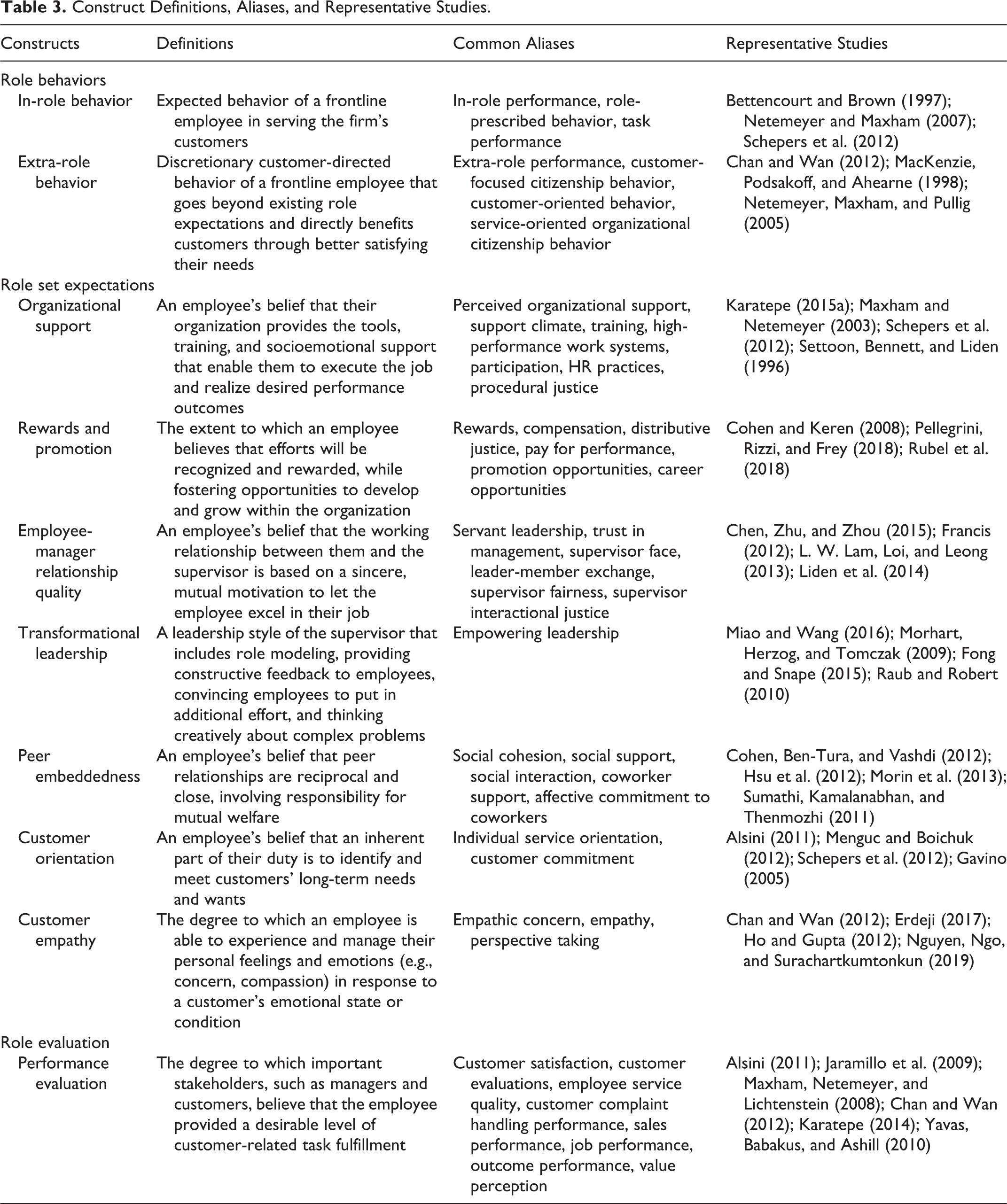
Figure 1 shows that our conceptual model features seven role set expectations and one outcome of role behavior: performance evaluation. Table 3 lists the definitions we used to code the constructs, the common aliases we encountered in the literature, and the representative studies for each category. To start, organizational support reflects expectations associated with the organization and denotes an employee’s belief that their organization provides the tools, training, and socioemotional support that enable them to execute the job and realize desired performance outcomes. Rewards and promotion refer to the extent to which an employee believes that efforts will be recognized and rewarded, while fostering opportunities to develop and grow within the organization. These organizational factors signal to employees an expectation to perform because employees likely realize that organizations do not invest in them without demanding something in return. Such investments thus motivate employees to reciprocate through role behavior (Blau 1986).
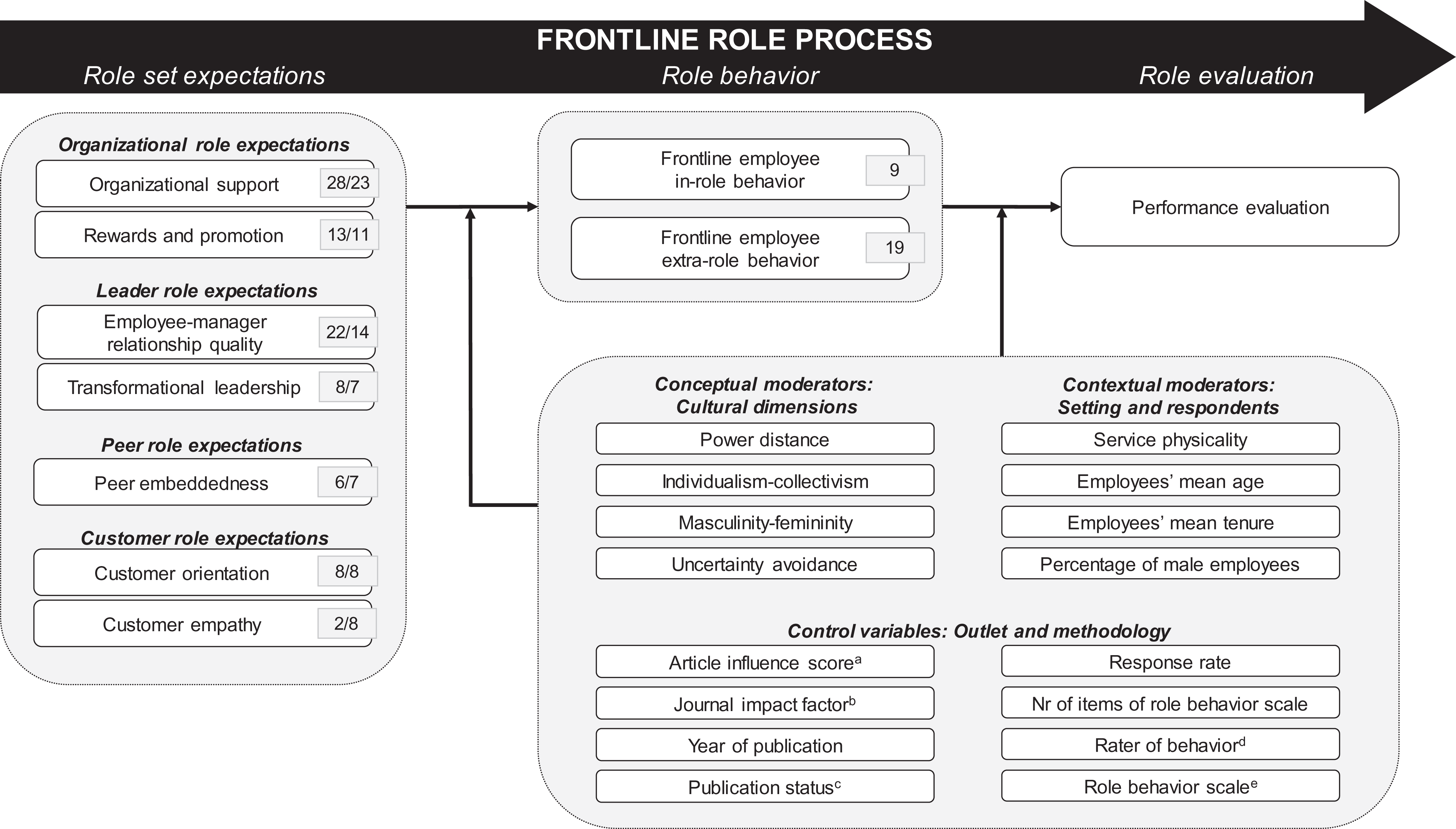
Conceptual relationships between role set expectations, role behavior, and role evaluation. Notes: Numbers in rectangular boxes indicate the number of effects per path. For expectations, the first number indicates the number of effect sizes toward in-role behavior, the second number indicates the number of effect sizes toward extra-role behavior. a Based on 2016 data. b Based on the publication year of the studies. c Dummy coded as published / unpublished. d Dummy coded as self-related behavior/other-rated behavior. e Dummy coded as the most common scale for in-role behavior (i.e., Williams and Anderson 1991) and extra-role behavior (i.e., Bettencourt and Brown 1997) versus other scales.
Construct Definitions, Aliases, and Representative Studies.
Employee-manager relationship quality represents expectations associated with the leader and refers to an employee’s belief that the working relationship between them and the supervisor is based on a sincere mutual motivation to let the employee excel in their job. A high-quality working relationship communicates a manager’s expectation of employees’ job dedication and commitment, which drives employees’ efforts to display role behavior (Kang et al. 2012). Transformational leadership also fits this category and is defined as a leadership style of the supervisor that includes role modeling, providing constructive feedback to employees, convincing employees to put in additional effort, and think creatively (Bass 1996). The vision and personalized attention of the leader accelerates the process of learning the ropes and stimulates employees to experiment with unscripted behaviors that benefit the customer.
For expectations associated with peers, we consider peer embeddedness, which refers to an employee’s belief that peer relationships are reciprocal and close, involving responsibility for mutual welfare (cf. Rindfleisch and Moorman 2001). Social support from peers alleviates identity dissimilarities between employees in the frontline (Henri 1978). This social dynamic carries the expectation to put the needs of the frontline team above one’s own needs. Role behavior serves this purpose because employees who do not follow service guidelines let down their colleagues who may have to address a customer’s complaint resulting from this lapse. Refraining from extra-role behavior also hampers the advancement of joint welfare.
Customer orientation represents a customer-related role expectation and refers to an employee’s belief that an inherent part of their duty is to identify and meet customers’ long-term needs and wants (Schepers et al. 2012). The ability to deeply understand customer perspectives makes role behavior more meaningful and thus more likely to be pursued by employees. Customer empathy captures the degree to which an employee is able to experience and manage their personal feelings and emotions (e.g., concern, compassion) in response to a customer’s emotional state or condition (Ho and Gupta 2012). Empathic employees are better able to place themselves in the customer’s position and thereby circumvent task-related obstacles or conflicts. This capacity allows employees to satisfy formal guidelines and go the extra mile simultaneously. Role behaviors enhance performance evaluation (i.e., the degree to which important stakeholders, such as managers and customers, believe that the employee provided a desirable level of customer-related task fulfillment) because these behaviors ensure that expectations are met or even surpassed.
Because the main effects described above are well-documented in previous literature, we do not offer formal hypotheses on these direct relationships. Instead, we hypothesize and formally test cultural contingencies as conceptual moderators. We focus on four primary dimensions of national culture proposed by Hofstede and colleagues: power distance, individualism-collectivism, masculinity-femininity, and uncertainty avoidance. Consistent with previous studies (e.g., Samaha, Beck, and Palmatier 2014), we do not anticipate that every cultural dimension moderates every relationship in the frontline role process. In each of the following sections, we first explain the theoretical tenets underlying the cultural dimension and then proceed to specify relevant hypotheses. The online Appendix provides further detail as to why we hypothesize these paths but not others.
Moderating Role of Power Distance
Power distance refers to the degree to which people accept that power is distributed unequally (Hofstede, Hofstede, and Minkov 2010). In high power distance cultures, employees closely follow and never challenge rules and guidelines set by power holders. Such employees respect for authority figures (Farh, Hackett, and Liang 2007) and feel comfortable in situations with clearly defined roles and positions such as in structural hierarchies (e.g., manager-employee dyad) or social hierarchies (e.g., high vs. low expertise; S. K. Lam, Kraus, and Ahearne 2010). Low power distance societies, in contrast, avoid the usage of prestige and status symbols. Subordinates are more likely to challenge power holders and provide suggestions on formal guidelines and mandated practices in work. Therefore, we propose that in high power distance cultures, role set expectations associated with hierarchical and social status will be more instrumental in fostering in-role behavior. Power distance may moderate the relationships between in-role behavior and three expectations related to hierarchical and social status: (1) organizational support, (2) employee-manager relationship quality, and (3) peer embeddedness.
Organizational support originates in the higher echelons of the organization and is more readily accepted and leveraged by frontline employees in high power distance cultures to realize their in-role behavior. Employees in low power distance cultures may be more likely to challenge support from the organization or question its contents, such that the expectation to reciprocate the support is less effective in driving adherence to organizational guidelines than would be expected for employees in high power distance cultures.
The employee-manager relationship is more paternalistic and hierarchical in higher power distance cultures. Employees are loyal and compliant to their supervisors in exchange for protection and support. In fact, personnel decisions in such societies depend on the personal bonds that supervisors have with their employees (Farh, Earley, and Lin 1997). As such, relationships with supervisors are more salient to employees in high power distance than in low power distance cultures (Oh et al. 2014; Robert et al. 2000), and the expectation of job dedication will therefore relate more strongly to employees’ decisions to display in-role behavior.
The exchange of best practices among peers is more difficult in higher than in lower power distance cultures because of the psychological distance between high- and low-ranked peers. However, peer embeddedness attenuates distance perceptions between peers (Hofstede, Hofstede, and Minkov 2010), thereby easing the exchange of norms and organizational guidelines. Thus, peer embeddedness is likely more strongly related to in-role behavior as power distance increases.
Finally, the effect of in-role behavior on performance evaluation is also likely to be stronger in high power distance societies because deviating from prescribed rules and activities is less readily accepted by power holders, while subordinates also acknowledge their lower standing. Complying with orders and directives is important to keep the hierarchy intact (Hofstede, Hofstede, and Minkov 2010). Hence, we hypothesize the following:
Moderating Role of Individualism-Collectivism
Individualism refers to the extent to which people feel independent and take care primarily of themselves (Hofstede, Hofstede, and Minkov 2010). We anticipate that individualism affects relationships involving both in-role behavior and extra-role behavior, though in a different way. We start with the former. People in individualistic societies emphasize personal identity and independence from any social collective (Shao et al. 2013). They tend to be self-reliant and self-motivated and to place more value on individual interests and personal qualities. Conversely, in collectivistic cultures, employees seek to belong and contribute to a collective and more readily contribute to organizational norms and rules. In sum, we posit that in individualistic cultures, people care less about expectations associated with complying to collective goals, norms, and values because addressing such expectations does not help to establish one’s personal identity and independence from the collective. Two expectations in our conceptual framework relate to this process: (1) organizational support and (2) rewards and promotion.
Organizational support revolves around the provision of tools, training, and socioemotional support to help employees execute the job. Such support signals a dependency of employees in executing their roles and reduces the possibilities for employees in individualistic societies to be self-reliant and self-motivated. Moreover, workers in such cultures may perceive organizational support as time-consuming and constraining. Employees in individualistic cultures are more motivated by personal control over their work assignments (Eisenberg 1999), which is less likely when rewards and career path opportunities are determined at the organizational level. Therefore, the organizational expectation of employee role behavior in return for investments such as support and rewards will be less effective in individualistic cultures.
Finally, because individualistic cultures place a premium on self-reliance and independence, others’ sensitivity to employees’ adherence to prescribed rules may be lower. In-role behavior lowers the potential for employees to show their ability to autonomously solve idiosyncratic and complex customer problems, while managers and customers evaluating a frontline employee’s performance in individualistic cultures may especially be looking for such qualities. Hence, we posit the following:
We now turn to the effect of individualism on relationships involving extra-role behavior. In individualistic cultures, employees are expected to take initiative, speak up, engage in exploratory behavior, and be creative. Moreover, workers in individualistic societies connect more easily to “outgroup” members who are different from themselves (e.g., new customers, customers with different backgrounds) because these interactions may bring opportunities for further personal development (Triandis et al. 1988). In contrast, employees in collectivistic societies are more motivated by upholding communal relationships, while expectations related to personal development are less effective in driving their extra-role behavior. We therefore propose that in cultures with high individualism, role set expectations associated with self-reliance, independence, and individual goal achievement are more instrumental in fostering extra-role behavior. Thus, we concentrate on (1) transformational leadership and (2) customer empathy.
Through displaying charisma and showing individualized attention for each employee, transformational leaders excite, arouse, and inspire their followers (Bass 1996). Transformational leaders also provide mentoring and one-to-one communication with the expectation of their followers becoming more self-reliant (Dubinsky et al. 1995). Such actions are focused on motivating employees to go the extra mile and clearly align more closely with the values of employees in individualistic cultures than those in collectivistic cultures. In the latter context, employees may feel confused or even uncomfortable when a leadership style is adapted to each individual because leaders are expected to promote collectivism.
Customer empathy may also be perceived differently in individualistic and collectivistic cultures. Empathy is associated with the ability to understand and share the feelings of others. Aaker and Williams (1998) demonstrate that empathy is more relevant in individualistic cultures because empathetic behavior in such societies is a relatively more unique phenomenon compared to collectivistic cultures. This factor leads individuals to experience an increased motivation to cognitively process and behaviorally act on others’ expectations derived through their empathic skills. Thus, customer empathy is likely a stronger driver for going the extra mile in individualistic cultures than in collectivistic cultures.
Finally, extra-role behavior is usually tailored to the individual customer (Chebat and Kollias 2000). The extra efforts of frontline employees therefore make others feel unique, which may be especially appreciated in individualistic cultures. In contrast, in collectivistic cultures, this uniqueness is appreciated less and highly customized extra-role behavior may contribute less to positive performance evaluations. In sum, we propose the following:
Moderating Role of Masculinity-Femininity
Masculinity is the degree to which a society values monetary achievement, ambition, heroism, and assertiveness. While masculinity may determine how others evaluate role behavior, previous studies suggest that masculinity is less germane to influencing the strength of role behavior’s antecedents (Chiang 2005; Hohenberg and Homburg 2016; Segalla et al. 2006). Masculine values associate with competitiveness, effectiveness, and efficiency, whereas femininity associates more with creativity, involvement, and long-term perspectives (Pakdil and Leonard 2017). Indeed, in masculine cultures, business exchanges are regarded not as enduring win-win situations but rather as short-term transactional events (Samaha, Beck, and Palmatier 2014). As a result, customers, managers, and peers may perceive the extra time spent on a task (e.g., providing “spontaneous delight,” spending extra time with customers) as unnecessary and something to avoid. Based on these factors, we formulate the following hypothesis:
Moderating Role of Uncertainty Avoidance
Uncertainty avoidance expresses the degree to which the members of a society feel uncomfortable with or threatened by uncertainty and ambiguity (Hofstede, Hofstede, and Minkov 2010). In high uncertainty avoidance cultures, employees prefer to reduce uncertainty in their work by planning activities upfront, working out scenarios, and using formal rules and explicit guidelines. People in low uncertainty avoidance cultures accept uncertainty more willingly, tend to take more risks, and value adaptability and flexibility. We thus expect that role set expectations associated with uncertainty reduction are more instrumental and salient in fostering role behaviors in high uncertainty avoidance cultures. The two expectations linked with uncertainty reduction are (1) rewards and promotion and (2) customer orientation, which together resemble the classic “planning versus learning” debate in decision-making under uncertainty (e.g., Wiltbank et al. 2006).
Rewards allow employees to exactly plan and choose the appropriate means (i.e., in-role behavior) to achieve desired outcomes (i.e., salary, bonuses). As such, incentivizing adherence to rules and procedures is especially valued by employees seeking to reduce levels of uncertainty. Rewards then act as clear organizational expectations, signaling to employees that if a target is achieved, then remuneration will be received. In contrast, employees in low uncertainty avoidance cultures cope with uncertainty more easily and tend to prefer more discretion (Schuler and Rogovsky 1998); these traits attenuate the effect of rewards and promotion on in-role behavior.
Customer orientation, in contrast, allows employees to learn by collecting more information about client needs and consequently to adapt their service (i.e., extra-role behavior) to move forward more quickly (i.e., better performance evaluations) than through planning. Unfortunately, in uncertainty avoidant cultures, customers are reluctant to provide information and are cautious in their decision-making (Donthu and Yoo 1998). The ability to understand customer needs then becomes very important for frontline employees to cope with uncertainty (Hüttel et al. 2019) and to establish a mutually beneficial relationship. Customers in low uncertainty avoidance cultures may be more open in communicating their problems, such that customer orientation is less influential as a motivator of extra-role behavior in employees’ anticipatory role process.
Finally, as individuals in high uncertainty avoidance cultures value order, rules, and structured situations, in-role behavior is especially positively evaluated in these cultures. For managers and peers, the predictability of adherence to rules and guidelines makes an employee a reliable colleague, while for customers, it facilitates a more fluent processing and understanding of the service (A. Y. Lee and Labroo 2004). Similarly, extra-role behavior may serve as a signal that employees have perfectly mastered their job and are even able to put in increased effort to understand customers and thoroughly address their needs. Such signals may be reassuring to individuals in uncertainty avoidant cultures. Thus, we propose the following:
Method
Literature Search
We performed a comprehensive search for studies that included in-role behavior and/or extra-role behavior. We first searched for articles published up to July 2019 in databases such as ProQuest, JSTOR, ScienceDirect, Web of Science, and Scopus, using keywords such as “in-role,” “role-prescribed,” “extra-role,” “prosocial,” “customer-oriented,” “customer-focused,” “customer-directed,” “discretionary,” “contextual,” and “citizenship.” We also manually searched works that cited seminal studies and scanned through articles in journals such as Journal of Service Research, Journal of Marketing, and Journal of Retailing. To discover any relevant unpublished work and minimize the file drawer problem, we searched ProQuest Digital Dissertations, Social Science Research Network (SSRN), and Google Scholar. We also personally contacted the 25 authors with the highest h-index in the field to inquire about any unpublished work.
Each study had to meet the following criteria for inclusion in our meta-analysis. First, the study had to report a correlation matrix or other information that could be converted into a correlation coefficient (e.g., F or d values). Second, it had to be an empirical investigation of behavior at the frontline employee level of analysis. Third, it had to consider employees with customer contact. We thus excluded, for instance, studies focusing on employees with administrative jobs. Fourth, when a study included extra-role behavior, the behavior needed to be customer directed. We excluded studies in which extra-role behavior represented, for instance, making suggestions for improvement to the organization. Fifth, a study had to consider in-role behavior or extra-role behavior as an independent concept. We excluded works that aggregated in-role behavior or extra-role behavior into a higher order construct and did not report first-order correlations. Finally, when a single sample was used in multiple articles, we only recorded the unique correlations from each article to prevent double-counting.
Study Descriptives and Coding of Variables
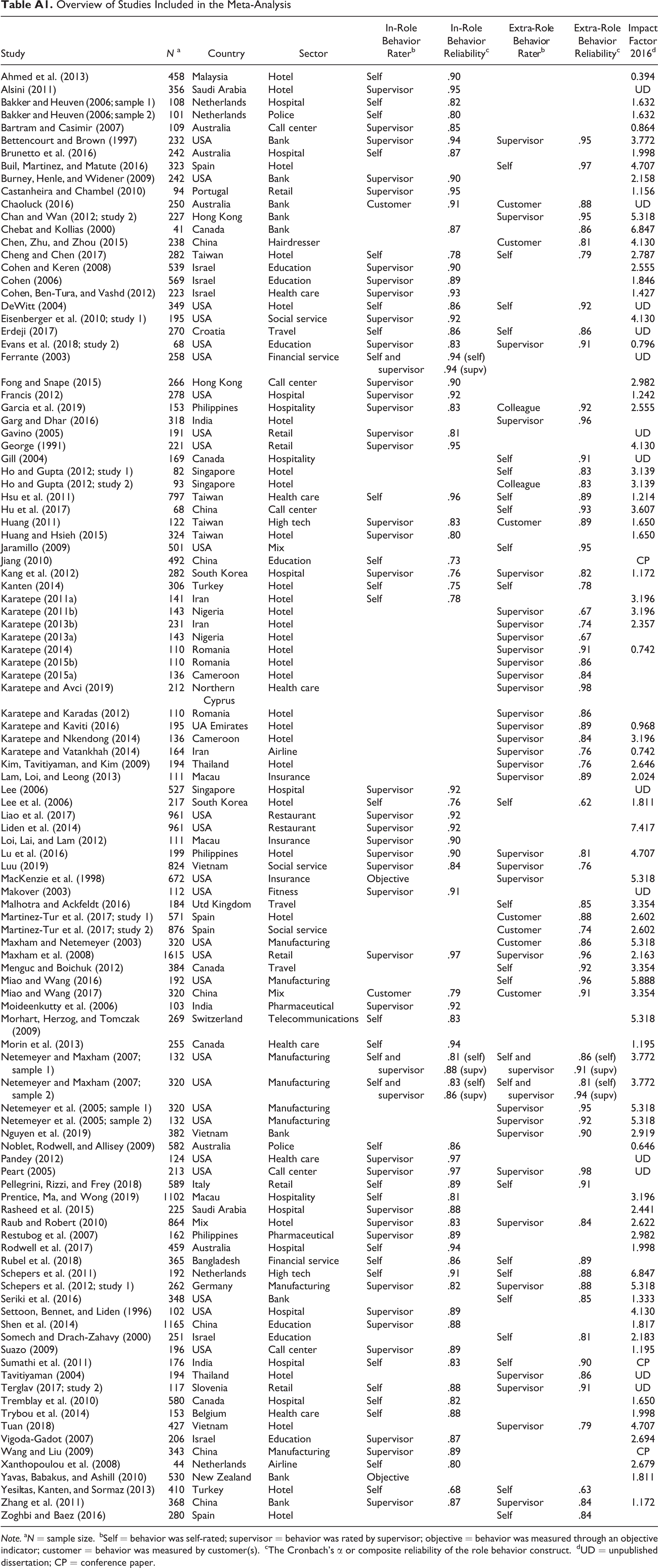
We identified 105 empirical articles, of which 16 are unpublished, including 100 independent samples (N = 32,364); Appendix A lists all the studies included in this meta-analysis. In addition to the correlations of interest, the sample size, and the reliability of the latent variables, we recorded from each study information on our contextual moderators, which included the industry, and the mean age, tenure, and percentage of male respondents in the sample. For each study, we also recorded information on our control variables: the year of publication, publication status (published/unpublished), response rate, the number of items employed in the role behavior scale, the source of the role behavior scale, and the rater of role behavior (e.g., self, supervisor, coworker, customer). We then collected for each publication the article influence score in 2016 and the journal impact factor in the publication year. Finally, on the basis of the country where the study was conducted, we coded power distance, individualism-collectivism, masculinity-femininity, and uncertainty avoidance according to the index provided by Hofstede, Hofstede, and Minkov (2010). While these four dimensions jointly establish the seminal model by Hofstede and colleagues, two other dimensions that have been suggested as an extension are long-term orientation and indulgence (Hofstede and Minkov 2010). Unfortunately, these dimensions have been not been mapped for every country in our data set, and their use would thus restrict our sample. However, we explored the effects of these dimensions and found mostly nonsignificant effects. For reasons of parsimony, we do not formally report the results of these additional analyses.
The authors clustered variables with different names into seven role set expectations by carefully considering each study’s theoretical definition and construct operationalization. The agreement rate was 95%. All remaining differences were reexamined and resolved. Apart from the seven expectations, we also identified demographics (i.e., age, gender, education, tenure) 2 and behaviors associated with role behavior: creativity (e.g., ideas for improvement, creative problem-solving), nonrole performance (e.g., shirking, social loafing, and job neglect), and organizational citizenship behavior toward the individual (e.g., helping colleagues with heavy workload) and the organization (e.g., participating in noncompulsory events). We included these behaviors in our analysis to provide evidence for the discriminant validity of in-role and extra-role behavior.
In addition, four concepts emerged that are frequently considered as antecedents of role behavior, but which do not represent stakeholder expectations. First, psychological empowerment reflects employees’ perceptions of their power to cope with events, situations, and problems in their job. Second, identification and commitment reflect the strength of an employee’s emotional attachment and belongingness to an organization. 3 Third, job involvement reflects employees’ positive state-of-mind toward and evaluation of their job. Finally, job demands reflect physical, social, or organizational aspects of the job that require sustained physical or mental effort. We consider these four concepts as role behavior covariates.
Meta-Analytic Calculation
We followed the statistical methods of random-effects models suggested by Schmidt and Hunter (2014) to conduct the meta-analysis. We first gathered the raw observed correlation scores (r) for each bivariate correlation. When a study included multiple measures or dimensions of a concept, a composite correlation was computed. We then adopted internal reliability as a means to correct for the measurement error of the raw correlations, leading to a reliability corrected rc. We corrected for sampling error by weighting each adjusted correlation according to the number of employees in the sample to determine the sample size weighted and reliability corrected correlation (r+c). The significance of the mean r+c across studies was computed as a Z value (Zr+c) and constructed a 95% confidence interval around r+c. We also employed Cochran’s Q statistic; a significant value suggests heterogeneity in a bivariate correlation and warrants a search for possible moderators. Finally, to explore the moderating effects, we employed meta-regression, where the study is the unit of analysis and the dependent variables are reliability corrected bivariate correlations. The moderators were entered in a sequential manner as predictors in weighted least squares (WLS) regression models, where each observation was weighted by the inverse of its variance (N-3). Although we only hypothesize the moderating effects supported by role theory, we test and report all potential moderating effects of our four cultural dimensions.
Results
Meta-Analytic Correlations
Table 4 displays the relationships in the frontline role process, while Table 5 reports the relationships between role behavior and the covariates. The results show that organizational role expectations (r+c_in-role = .31, r+c_extra-role = .35; Zdifference = 3.00, p < .01), leader role expectations (r+c_in-role = .27, r+c_extra-role = .36; Zdifference = 6.11, p < .01), and peer role expectations (r+c_in-role = .22, r+c_extra-role = .36; Zdifference = 4.88, p <. 01) are more strongly related to extra-role behavior than to in-role behavior. In contrast, customer role expectations (r+c_in-role = .57, r+c_extra-role = .50; Zdifference = 4.12, p <. 01) are more strongly related to in-role behavior, and in-role behavior is more strongly related to performance evaluation (r+c_in-role = .53, r+c_extra-role = .47; Zdifference = 3.81, p < .01) than its extra-role counterpart. 4
Meta-Analytic Correlations in the Frontline Role Process.
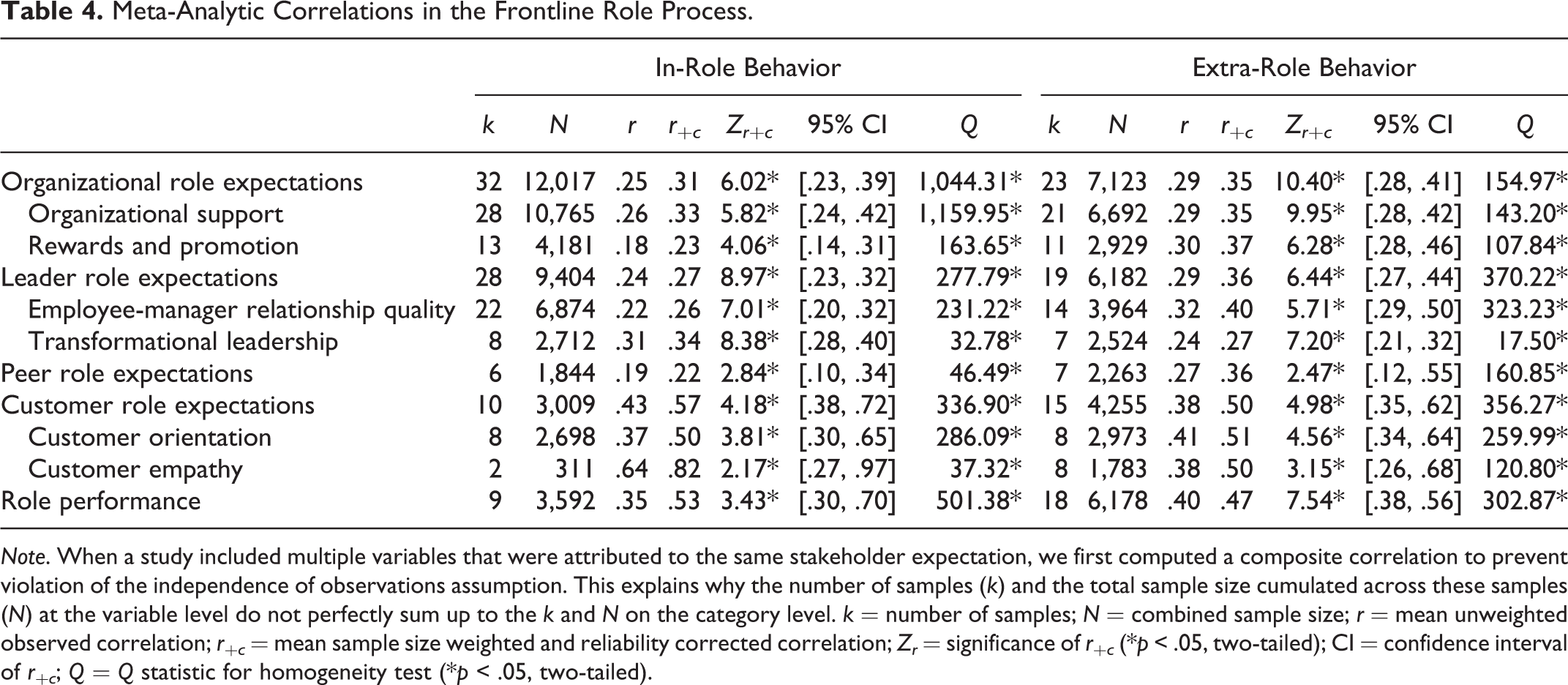
Note. When a study included multiple variables that were attributed to the same stakeholder expectation, we first computed a composite correlation to prevent violation of the independence of observations assumption. This explains why the number of samples (k) and the total sample size cumulated across these samples (N) at the variable level do not perfectly sum up to the k and N on the category level. k = number of samples; N = combined sample size; r = mean unweighted observed correlation; r+c = mean sample size weighted and reliability corrected correlation; Zr = significance of r+c (*p < .05, two-tailed); CI = confidence interval of r+c; Q = Q statistic for homogeneity test (*p < .05, two-tailed).
Meta-Analytic Correlations Between Role Behaviors and Covariates.
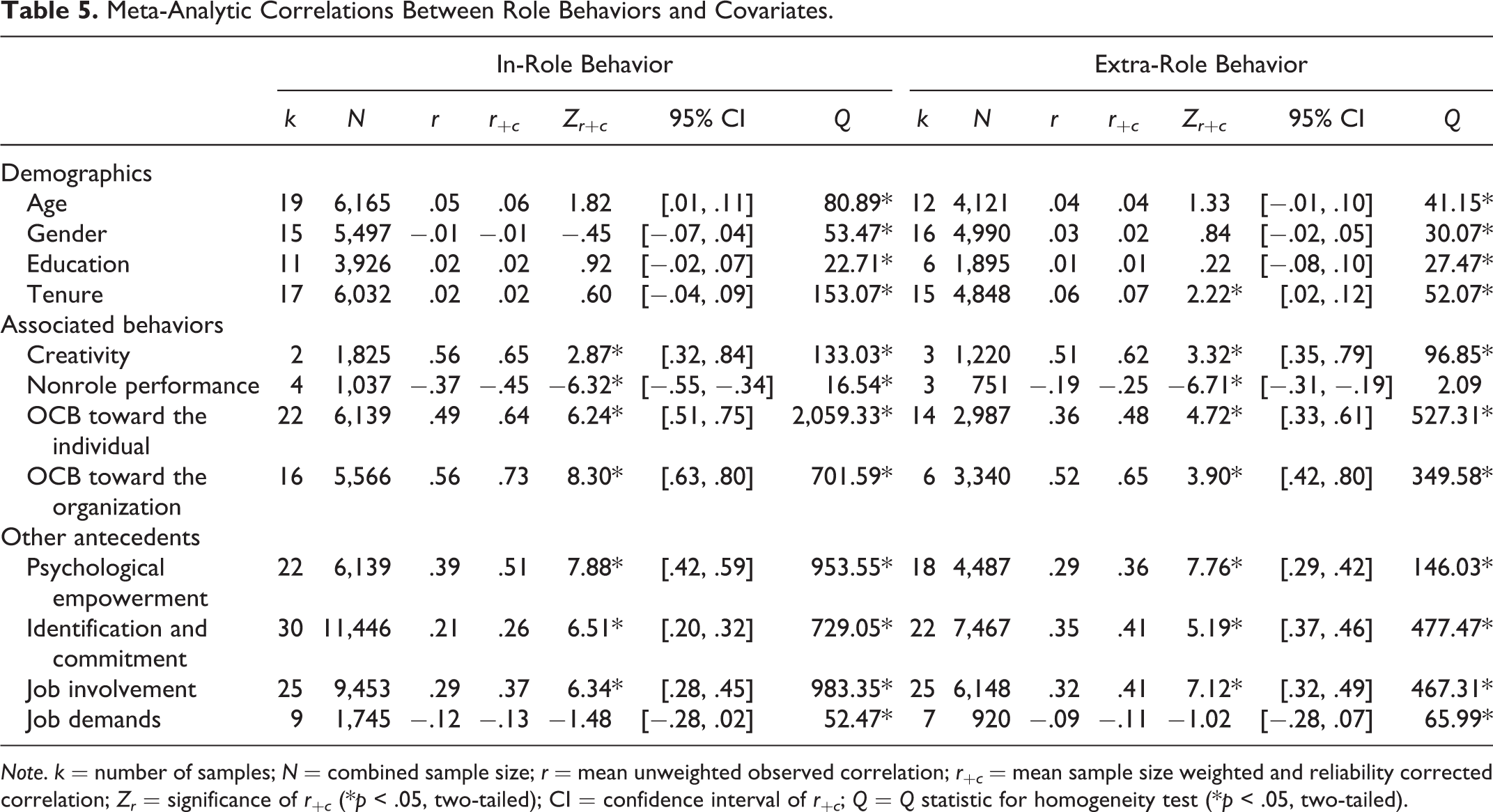
Note. k = number of samples; N = combined sample size; r = mean unweighted observed correlation; r+c = mean sample size weighted and reliability corrected correlation; Zr = significance of r+c (*p < .05, two-tailed); CI = confidence interval of r+c; Q = Q statistic for homogeneity test (*p < .05, two-tailed).
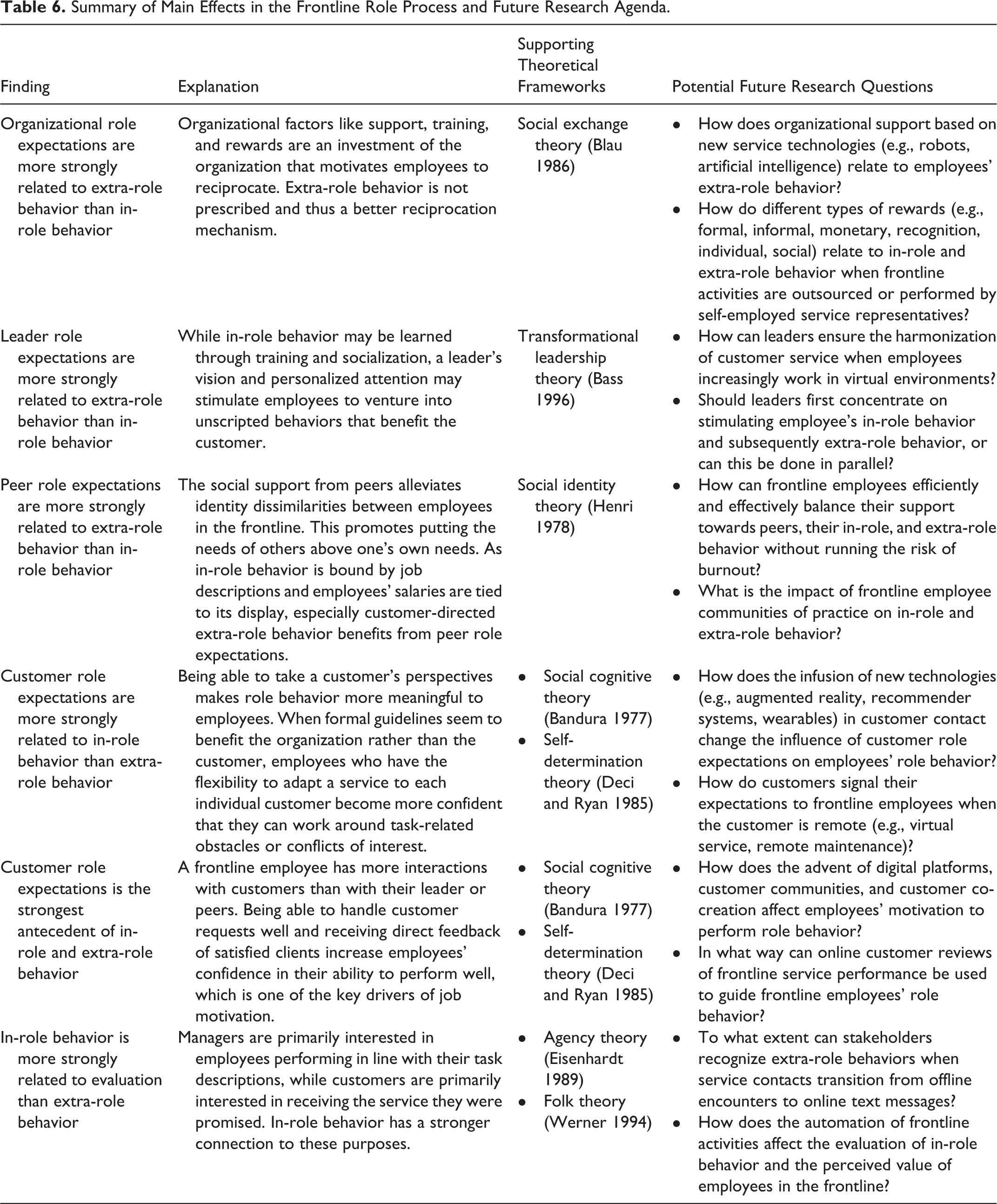
We also conducted a series of Fisher Z tests to establish the primary drivers of in-role and extra-role behavior, respectively. For in-role behavior, customer role expectations is a significantly stronger antecedent than organizational role expectations (r+c_customer = .57, r+c_organizational = .31; Zdifference = 16.03, p < .01), organizational role expectations is a stronger antecedent than leader role expectations (r+c_organizational = .31, r+c_leader = .27; Zdifference = 3.17, p < .01), and leader role expectations is a stronger antecedent than peer role expectations (r+c_leader = .27, r+c_peer = .22; Zdifference = 2.08, p < .05). For extra-role behavior, customer role expectations is a significantly stronger antecedent than the other antecedents (i.e., the lowest significance is r+c_customer = .50, r+c_peer = .36; Zdifference = 6.62, p < .01). Organizational, leader, and peer role expectations did not significantly differ in their magnitude of correlation with extra-role behavior. Table 6 summarizes these findings and provides conceptual explanations, supporting theoretical frameworks, and a future research agenda in the light of a rapidly changing organizational frontline.
Summary of Main Effects in the Frontline Role Process and Future Research Agenda.
Finally, the results on in-role and extra-role behavior’s relationships with other behaviors provide evidence for their discriminant validity. In-role behavior does not represent the inverse of nonrole behavior (e.g., shirking or social loafing) because the 95% confidence interval [−.55, −.34] neither contains unity (−1) nor the commonly applied and more stringent −.85 cut-off. Extra-role behavior can hence also be distinguished from organizational citizenship behavior toward the individual [.33, .61] and toward the organization [.42, .80], and from creativity [.35, .79].
Meta-Regression: Moderating Effects of National Culture
Table 7 displays the results of the meta-regression analysis to test our hypotheses, while Table 8 provides a textual summary. In support of Hypothesis 1a, the results show that the positive effect of organizational support on in-role behavior is stronger in high power distance cultures (β = .52, Z = 3.22, p < .01). Hypothesis 1b is not supported because power distance did not moderate the relationship between employee-manager relationship quality and in-role behavior (β = .34, Z = 1.64, ns). In contrast, the positive relationship between peer role expectations and in-role behavior is stronger in high power distance cultures (β = .89, Z = 3.53, p < .01) as is the relationship between in-role behavior and performance evaluation (β = .64, Z = 2.47, p < .05). These findings lend support to Hypotheses 1c and 2.
Influence of Conceptual and Contextual Moderators on the Frontline Role Process.
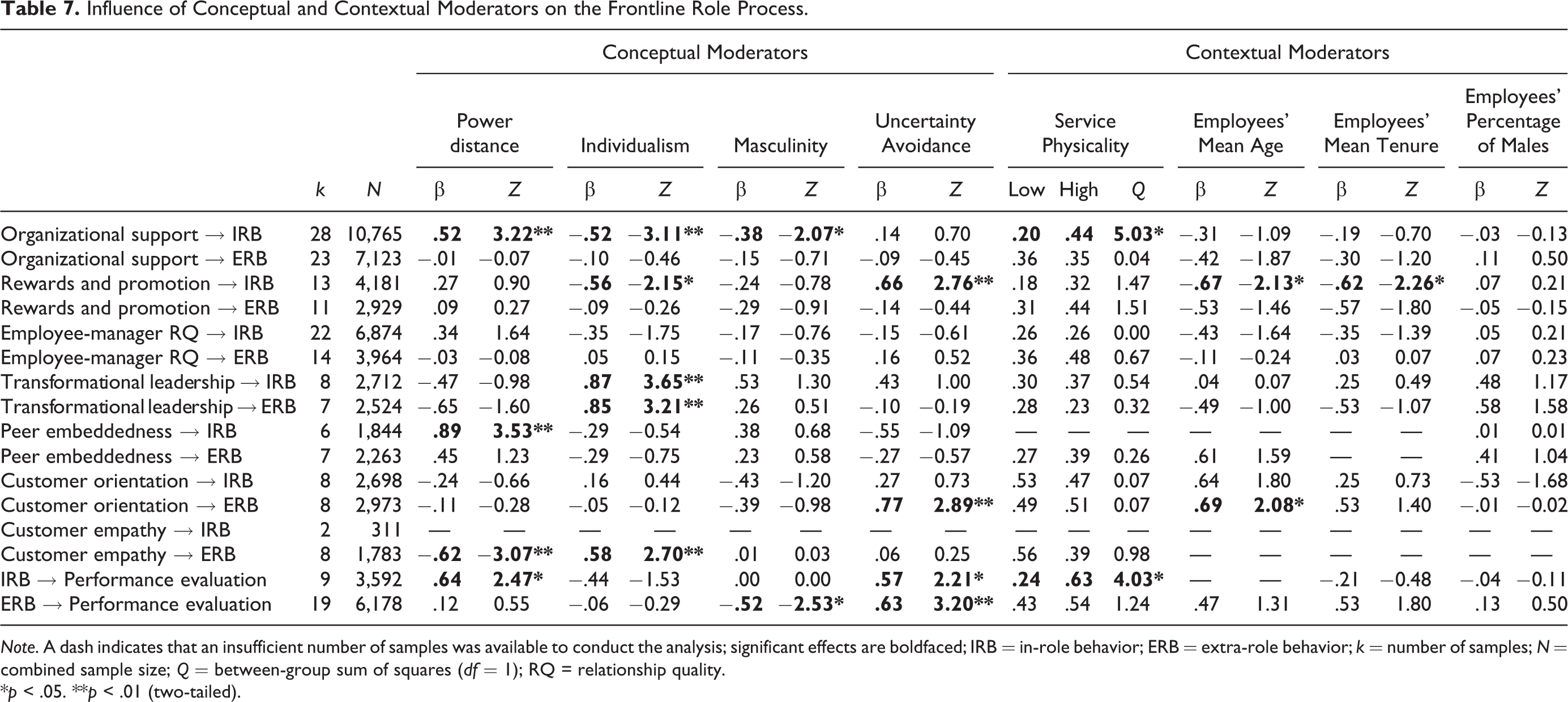
Note. A dash indicates that an insufficient number of samples was available to conduct the analysis; significant effects are boldfaced; IRB = in-role behavior; ERB = extra-role behavior; k = number of samples; N = combined sample size; Q = between-group sum of squares (df = 1); RQ = relationship quality.
*p < .05. **p < .01 (two-tailed).
Summary of the Results of Hypotheses Testing.
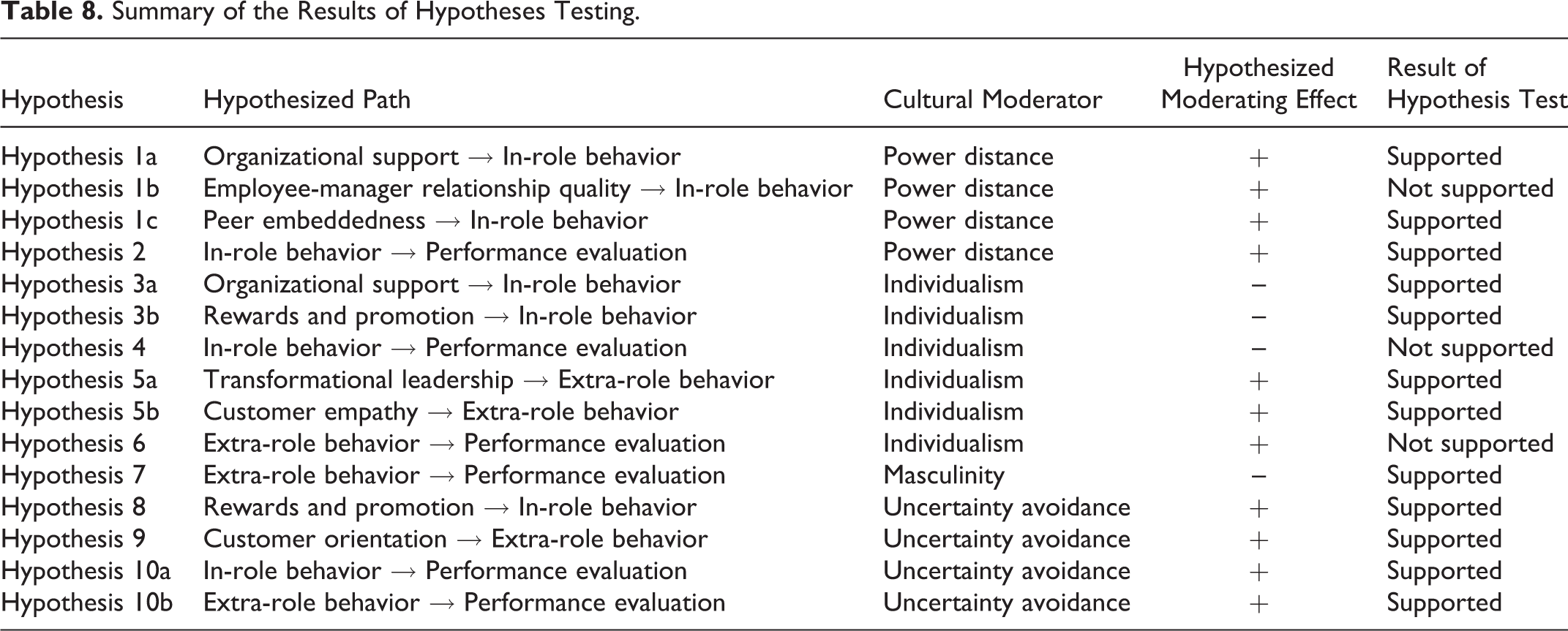
We also find that the positive effect of organizational support on in-role behavior is attenuated in individualistic countries (β = −.52, Z = −3.11, p < .01) as is the positive effect of rewards and promotion on in-role behavior (β = −.56, Z = −2.15, p < .05). These findings support Hypotheses 3a and 3b, respectively. The relationship between in-role behavior and performance evaluation was not significantly moderated by individualism (β = −.44, Z = −1.53, ns), providing no support for Hypothesis 4. We also find that transformational leadership and customer empathy become stronger drivers of extra-role behavior when individualism increases (β = .87, Z = 3.65, p < .01 and β = .58, Z = 2.70, p < .01, respectively). This finding lends support to Hypotheses 5a and 5b, but Hypothesis 6 was not supported because the strength of the relationship between extra-role behavior and performance evaluation did not depend on individualism (β = −.06, Z = −.29, ns).
In support of Hypothesis 7, the relationship between extra-role behavior and performance evaluation was moderated by the cultural dimension masculinity-femininity, such that the effect was weaker in masculine societies (β = −.52, Z = −2.53, p < .05). Furthermore, we find that the positive effect of rewards and promotion on in-role behavior is stronger when uncertainty avoidance increases (β = .66, Z = 2.76, p < .01). Moreover, the positive effect of customer orientation on extra-role behavior is strengthened by uncertainty avoidance (β = .77, Z = 2.89, p < .01). These findings support Hypotheses 8 and 9, respectively. Finally, in support of Hypotheses 10a and 10b, we find that in uncertainty avoidant cultures, in-role behavior (β = .57, Z = 2.21, p < .05) and extra-role behavior (β = .63, Z = 3.20, p < .01) become more important in establishing a desirable performance evaluation.
Moderating Effects of Contextual Moderators and Control Variables
We conducted an exploratory analysis that compared the effect sizes across settings, sample-level respondent characteristics, publication outlets, and methodological approaches. Continuous moderator variables were included as a predictor in WLS regression models, while categorical moderator variables were compared through subgroup analysis. Although it is possible to test whether the moderating effects of culture differ across publications, settings, and methodologies, this approach entails testing three-way interactions. For most of the relationships in our research framework, however, we do not have enough observations to test these types of moderation. Moreover, because information on contextual moderators and control variables cannot be retrieved for a sufficient number of studies (e.g., unpublished works do not have an impact factor, not every study reports the response rate, et cetera), we were unable to add them in our main analyses as the missing values would have strongly reduced our sample size. Thus, in line with Franke and Park (2006), we tested these moderators separately to maximize the number of usable observations.
Table 7 indicates the results for our analyses of the contextual moderators. First, we interpret the effects of service physicality, a new concept that we introduce to reflect the extent to which the service relates to the body or features close customer contact. We coded health care, hospitality, hairdressers, airlines, and retail settings that involved clothing and accessories as high in physicality because they all involve actions related to the human body (e.g., taking medicine, tasting food, or trying on clothing). Other settings were coded as low in physicality. We find that the relationships between organizational support and in-role behavior (rlow = .20, rhigh = .44; Q = 5.03, p < .05), and between in-role behavior and performance evaluation (rlow = .24, rhigh = .63; Q = 4.03, p < .05), are stronger in high physicality than in low physicality services. Physical services may be perceived as risky because of the relationship to one’s health (Jacoby and Kaplan 1972). In such situations, organizational support may make the potential consequences of rule violation especially salient, producing a stronger effect on in-role behavior. In turn, customers in such situations look for rule adherence, guidelines, and rituals to reduce or accept the risk (cf. Celsi, Rose, and Leigh 1993). In-role behavior may thus serve as a risk reduction mechanism.
Second, we find that rewards and promotion are less effective in stimulating in-role behavior among samples of older and more tenured workers. Perhaps such employees enjoy higher salaries or are no longer seeking career advancements, such that rewards and promotion become a less important expectation to respond to. However, customer orientation is a stronger driver of extra-role behavior in samples of older workers. Many frontline jobs have high turnover rates and older employees who “survive” in the system tend to be those who are motivated by forming mutually beneficial relationships with customers through extra-mile service (Di Mascio 2010).
Third, the online appendix B shows the results for our eight control variables. Most relationships are unaffected by article influence score, impact factor, or publication status. Of the subgroup contrasts, the relationship between customer empathy and extra-role behavior is stronger when the behavior was self-rated (rself = .48, rother = .25; Z = 6.48, p < .01). Perhaps frontline employees feel that some extra-role acts are very subtle and based on their deep understanding of customer emotions. For instance, a frontline employee may engage in conversations that are unrelated to the service, but which help to build rapport (e.g., about personal issues; Gremler and Gwinner 2000). This would be difficult to observe for managers, such that they miss out on some of the subtle acts displayed by the frontline employee. Finally, the Williams and Anderson (1991) scale generally produces more conservative correlations regarding in-role behavior. For extra-role behavior, the Bettencourt and Brown (1997) scale generally produces more pronounced correlations compared to other scales.
Discussion
Managing frontline employees’ role behavior is crucial for firms to enhance the firms’ competitiveness in global markets. Both the foundations of role theory and a comparison of empirical findings in frontline settings suggest that managers in different countries need to employ different tactics to stimulate employee role behavior. Our meta-analysis is the first to systematically hypothesize and test these differences. The results confirm that cultural dimensions fundamentally alter the way that frontline employees respond to role set expectations. Moreover, differences in the ways in-role and extra-role behavior are evaluated can be explained by cultural characteristics. Next, we discuss the implications of our findings.
Theoretical Implications
First, we create clarity for frontline scholars who are typically distributed across different fields and use different terminology to study similar phenomena. As a case in point, organizational support has been variously labeled as “support climate” (Schepers et al. 2012), “training” (Karatepe 2015a), “high-performance work systems” (Shen, Benson, and Huang 2014), “participation” (Rubel et al. 2018), “HR practices” (Sumathi, Kamalanabhan, and Thenmozhi 2011), “procedural justice” (Maxham and Netemeyer 2003), and “perceived organizational support” (Settoon, Bennett, and Liden 1996). All these constructs signal that employees believe that their organization provides the tools, training, and socioemotional support that enable successful job execution. We thus take a broad, inclusive approach to identify categories of expectations that guide and direct a frontline employee’s behavior. Consistent with recent work which stresses the importance for firms to manage the customer experience (e.g., Homburg, Jozić, and Kuehnl 2017), the results show that customer expectations are the strongest antecedent to both in-role and extra-role behavior. In turn, in-role behavior is more strongly related to performance evaluation than extra-role behavior. These findings also resonate with key conceptual frameworks in the service marketing field, which hold that frontline employees’ attitudes and predispositions such as customer orientation (Brady and Cronin 2001) and customer empathy (Wieseke, Geigenmüller, and Kraus 2012) are essential to ensure service performance, service quality, and customer satisfaction.
Second, we extend role theory with a national culture perspective. Although calls to explore the boundaries of the theory provided by the cultural context date back at least 15 years (Biddle 1986; Stone-Romero, Stone, and Salas 2003), little follow-up research has been conducted since. We propose the theoretical foundation for integrating a national culture perspective into research on role behavior and find empirical evidence for how each of the four primary Hofstede dimensions affects the frontline role process. Consistent with findings in other marketing meta-analyses (e.g., Samaha, Beck, and Palmatier 2014), we find that individualism-collectivism is the dimension displaying the most significant effects, especially in the front-end of the role behavior process. However, power distance, masculinity-femininity, and uncertainty avoidance emerge as important contingency variables in the relationship between role behavior and performance evaluation. The only relationships that are unaffected by cultural characteristics are those between employee-manager relationship quality and role behavior. This finding underscores the robustness of the effects of sincere working relationships and echoes insights from related meta-analyses (see, e.g., Dulebohn et al. 2012). Jointly, our results add to meta-analyses on employee behavior that do not consider extra-role behavior or the moderating effects of national culture in the frontline or which only examine one category of expectations at a time (see Table 2).
Third, our exploration of contextual moderators and control variables shows that older and more tenured frontline workers respond less to expectations provided by rewards and promotion but respond more to customer orientation. This evidence corroborates insights that employees who are motivated by forming mutually beneficial relationships with customers are more likely to thrive in the frontline over time (Di Mascio 2010). In addition, the relationships in our framework appear to be relatively unaffected by a publication outlet’s quality. This outcome nuances preconceptions about larger effect sizes in higher quality journals (Murtaugh 2002). Although there is relatively little evidence of rater effects, the relationship between customer empathy and extra-role behavior is stronger when the behavior was rated by the employee instead of a manager. This difference may suggest that employees perform very subtle extra-role acts such as rapport building (Gremler and Gwinner 2000) that may go unnoticed by the supervisor or which are considered as part of the job or even as in-role behavior.
Finally, we introduce the concept of service physicality to the literature. We find that in-role behavior is especially positively evaluated when services are characterized by high physicality. Services with more (physical) risk motivate customers to look for rule adherence, guidelines, and rituals to reduce or accept the risk (cf. Celsi, Rose, and Leigh 1993). In-role behavior represents such a risk reduction mechanism. This finding may stimulate researchers to further investigate employee behavior in services that differ in risk, for instance, by building on the perceived risk theory (Jacoby and Kaplan 1972).
Managerial Implications
With service firms continuously expanding their business globally, it is important for managers to know what expectations to “send” to their subordinates to ensure they realize desirable role behavior in the frontline. First, we advise managers across cultures to invest in a strong relationship with their subordinates. This mechanism is effective regardless of a society’s cultural characteristics. More specifically, being approachable to subordinates, “bailing out” employees in difficult situations within the organization, keeping promises to others, being open in communication, praising employees, and recognizing employees’ potential are all actions that help to build strong employee-manager relationships.
Additionally, several culture-specific recommendations can be provided. To start with, providing employees with organizational support seems especially effective in stimulating in-role behavior in collectivistic, feminine countries with a high power distance. For example, in Chile, Russia, and Slovenia, effective managers care about their employees’ well-being, involve them in service decision-making, keep them up-to-date on planned changes, design jobs that challenge workers, and provide adequate training to new hires before they enter the frontline.
Providing rewards and promotions is especially effective in stimulating in-role behavior in collectivistic, uncertainty avoidant cultures. Managers in countries such as Guatemala, Portugal, and South Korea are encouraged to tie incentives to achieving personal and team goals. The objectives should be attainable, and rewards should be fair, given an employee’s experience and degree of effort employed. A practice implemented by some leading service companies is to reward staff for realizing service improvement. Making improvement goals or criteria measurable and clearly observable on the job (e.g., a reduction of customer complaints) also enables staff to receive direct feedback on their performance, which may further stimulate role behavior.
Transformational leadership is especially effective in stimulating the in-role and extra-role behavior of frontline employees in individualistic countries. Managers in Australia, the Netherlands, and the United States should encourage employees to think about problems in new ways and should consider each employee to have different needs, abilities, and aspirations.
In low power distance, individualistic societies, an employee’s ability to experience and manage personal feelings (e.g., concern, compassion) as a result of a customer’s emotional state or condition is a strong driver of extra-role behavior. Accordingly, in countries such as New Zealand, Sweden, and the United Kingdom, managers should train their subordinates by, for instance, engaging in role play exercises that put employees “in the customers’ shoes.” Another option is to educate staff and discuss with them the service approaches that would best fit specific customers, based on the emotions recognized in the customers’ facial expressions.
Finally, strong role behavior is especially appreciated in countries high in uncertainty avoidance. Thus, in Belgium, Greece, and Uruguay, employees adhering to company guidelines and going the extra mile are highly valued since they provide many risk-reduction signals. In high power distance societies such as Romania, Panama, and the Philippines, in-role behavior is especially important because it signals frontline employees’ acceptance of hierarchical command. Extra-role behavior is more important in feminine countries such as Costa Rica, Denmark, and Latvia because going beyond the call of duty makes the customer feel cared for. Such behavior is less critical in a masculine society focused on core performance and efficiency.
Limitations and Future Research
As with every study, some limitations also apply to our research efforts. First, conceptions of what acts can be considered in-role or extra-role behavior may change over time. In particular, in services where a firm’s competitiveness thrives on memorable customer experiences, going the extra mile increasingly becomes the norm rather than the exception. We controlled for studies’ year of publication, but an approach other than a meta-analysis may provide more detail.
Second, an interesting future research avenue may be to disentangle the causality of expectations. We considered that all manifestations of expectations can shape and form role behavior, but it is likely that variables more proximal to role behavior have stronger effects on its execution. An alternative approach is to build on a different theory to substantiate how antecedents interact in shaping employee role behavior. For instance, according to job demands-resources theory (Bakker and Demerouti 2017), antecedents can reflect resources, hindrance job demands, or challenge job demands, and neglecting to consider their interactions provides an incomplete picture of employees’ motivational processes. Although we consider job demands as a covariate in Table 5, the theoretical and empirical focus of our study was not on uncovering its contingency effects.
Third, the Hofstede cultural dimensions may not account for the culture of minority groups in a country or for alternative explanations of discrepancies in previous literature, such as local labor pools, laws, regulations, and employment conditions. However, because the national-level Hofstede dimensions capture less variance than individual-level cultural values, we posit that the findings of our moderation analyses may be conservative. Future research could further explore moderating effects on the frontline role process by using an individual-level cultural values perspective.
In closing, role behavior in the frontline is an important and intriguing topic that deserves more attention in future research. The frontline will change dramatically due to new trends such as service robots, remote services, and artificial intelligence. Table 6 provides some research questions that may consequently inform and motivate future research in this area.
Supplemental Material
Supplemental Material, Role_Meta_Executive_summary - A Meta-Analysis of Frontline Employees’ Role Behavior and the Moderating Effects of National Culture
Supplemental Material, Role_Meta_Executive_summary for A Meta-Analysis of Frontline Employees’ Role Behavior and the Moderating Effects of National Culture by Jeroen J. L. Schepers and Michel van der Borgh in Journal of Service Research
Supplemental Material
Supplemental Material, Web_appendix_final - A Meta-Analysis of Frontline Employees’ Role Behavior and the Moderating Effects of National Culture
Supplemental Material, Web_appendix_final for A Meta-Analysis of Frontline Employees’ Role Behavior and the Moderating Effects of National Culture by Jeroen J. L. Schepers and Michel van der Borgh in Journal of Service Research
Footnotes
Appendix A
Overview of Studies Included in the Meta-Analysis
| Study | N a | Country | Sector | In-Role Behavior Raterb | In-Role Behavior Reliabilityc | Extra-Role Behavior Raterb | Extra-Role Behavior Reliabilityc | Impact Factor 2016d |
|---|---|---|---|---|---|---|---|---|
| Ahmed et al. (2013) | 458 | Malaysia | Hotel | Self | .90 | 0.394 | ||
| Alsini (2011) | 356 | Saudi Arabia | Hotel | Supervisor | .95 | UD | ||
| Bakker and Heuven (2006; sample 1) | 108 | Netherlands | Hospital | Self | .82 | 1.632 | ||
| Bakker and Heuven (2006; sample 2) | 101 | Netherlands | Police | Self | .80 | 1.632 | ||
| Bartram and Casimir (2007) | 109 | Australia | Call center | Supervisor | .85 | 0.864 | ||
| Bettencourt and Brown (1997) | 232 | USA | Bank | Supervisor | .94 | Supervisor | .95 | 3.772 |
| Brunetto et al. (2016) | 242 | Australia | Hospital | Self | .87 | 1.998 | ||
| Buil, Martinez, and Matute (2016) | 323 | Spain | Hotel | Self | .97 | 4.707 | ||
| Burney, Henle, and Widener (2009) | 242 | USA | Bank | Supervisor | .90 | 2.158 | ||
| Castanheira and Chambel (2010) | 94 | Portugal | Retail | Supervisor | .95 | 1.156 | ||
| Chaoluck (2016) | 250 | Australia | Bank | Customer | .91 | Customer | .88 | UD |
| Chan and Wan (2012; study 2) | 227 | Hong Kong | Bank | Supervisor | .95 | 5.318 | ||
| Chebat and Kollias (2000) | 41 | Canada | Bank | .87 | .86 | 6.847 | ||
| Chen, Zhu, and Zhou (2015) | 238 | China | Hairdresser | Customer | .81 | 4.130 | ||
| Cheng and Chen (2017) | 282 | Taiwan | Hotel | Self | .78 | Self | .79 | 2.787 |
| Cohen and Keren (2008) | 539 | Israel | Education | Supervisor | .90 | 2.555 | ||
| Cohen (2006) | 569 | Israel | Education | Supervisor | .89 | 1.846 | ||
| Cohen, Ben-Tura, and Vashd (2012) | 223 | Israel | Health care | Supervisor | .93 | 1.427 | ||
| DeWitt (2004) | 349 | USA | Hotel | Self | .86 | Self | .92 | UD |
| Eisenberger et al. (2010; study 1) | 195 | USA | Social service | Supervisor | .92 | 4.130 | ||
| Erdeji (2017) | 270 | Croatia | Travel | Self | .86 | Self | .86 | UD |
| Evans et al. (2018; study 2) | 68 | USA | Education | Supervisor | .83 | Supervisor | .91 | 0.796 |
| Ferrante (2003) | 258 | USA | Financial service | Self and supervisor | .94 (self) |
UD | ||
| Fong and Snape (2015) | 266 | Hong Kong | Call center | Supervisor | .90 | 2.982 | ||
| Francis (2012) | 278 | USA | Hospital | Supervisor | .92 | 1.242 | ||
| Garcia et al. (2019) | 153 | Philippines | Hospitality | Supervisor | .83 | Colleague | .92 | 2.555 |
| Garg and Dhar (2016) | 318 | India | Hotel | Supervisor | .96 | |||
| Gavino (2005) | 191 | USA | Retail | Supervisor | .81 | UD | ||
| George (1991) | 221 | USA | Retail | Supervisor | .95 | 4.130 | ||
| Gill (2004) | 169 | Canada | Hospitality | Self | .91 | UD | ||
| Ho and Gupta (2012; study 1) | 82 | Singapore | Hotel | Self | .83 | 3.139 | ||
| Ho and Gupta (2012; study 2) | 93 | Singapore | Hotel | Colleague | .83 | 3.139 | ||
| Hsu et al. (2011) | 797 | Taiwan | Health care | Self | .96 | Self | .89 | 1.214 |
| Hu et al. (2017) | 68 | China | Call center | Self | .93 | 3.607 | ||
| Huang (2011) | 122 | Taiwan | High tech | Supervisor | .83 | Customer | .89 | 1.650 |
| Huang and Hsieh (2015) | 324 | Taiwan | Hotel | Supervisor | .80 | 1.650 | ||
| Jaramillo (2009) | 501 | USA | Mix | Self | .95 | |||
| Jiang (2010) | 492 | China | Education | Self | .73 | CP | ||
| Kang et al. (2012) | 282 | South Korea | Hospital | Supervisor | .76 | Supervisor | .82 | 1.172 |
| Kanten (2014) | 306 | Turkey | Hotel | Self | .75 | Self | .78 | |
| Karatepe (2011a) | 141 | Iran | Hotel | Self | .78 | 3.196 | ||
| Karatepe (2011b) | 143 | Nigeria | Hotel | Supervisor | .67 | 3.196 | ||
| Karatepe (2013b) | 231 | Iran | Hotel | Supervisor | .74 | 2.357 | ||
| Karatepe (2013a) | 143 | Nigeria | Hotel | Supervisor | .67 | |||
| Karatepe (2014) | 110 | Romania | Hotel | Supervisor | .91 | 0.742 | ||
| Karatepe (2015b) | 110 | Romania | Hotel | Supervisor | .86 | |||
| Karatepe (2015a) | 136 | Cameroon | Hotel | Supervisor | .84 | |||
| Karatepe and Avci (2019) | 212 | Northern Cyprus | Health care | Supervisor | .98 | |||
| Karatepe and Karadas (2012) | 110 | Romania | Hotel | Supervisor | .86 | |||
| Karatepe and Kaviti (2016) | 195 | UA Emirates | Hotel | Supervisor | .89 | 0.968 | ||
| Karatepe and Nkendong (2014) | 136 | Cameroon | Hotel | Supervisor | .84 | 3.196 | ||
| Karatepe and Vatankhah (2014) | 164 | Iran | Airline | Supervisor | .76 | 0.742 | ||
| Kim, Tavitiyaman, and Kim (2009) | 194 | Thailand | Hotel | Supervisor | .76 | 2.646 | ||
| Lam, Loi, and Leong (2013) | 111 | Macau | Insurance | Supervisor | .89 | 2.024 | ||
| Lee (2006) | 527 | Singapore | Hospital | Supervisor | .92 | UD | ||
| Lee et al. (2006) | 217 | South Korea | Hotel | Self | .76 | Self | .62 | 1.811 |
| Liao et al. (2017) | 961 | USA | Restaurant | Supervisor | .92 | |||
| Liden et al. (2014) | 961 | USA | Restaurant | Supervisor | .92 | 7.417 | ||
| Loi, Lai, and Lam (2012) | 111 | Macau | Insurance | Supervisor | .90 | |||
| Lu et al. (2016) | 199 | Philippines | Hotel | Supervisor | .90 | Supervisor | .81 | 4.707 |
| Luu (2019) | 824 | Vietnam | Social service | Supervisor | .84 | Supervisor | .76 | |
| MacKenzie et al. (1998) | 672 | USA | Insurance | Objective | Supervisor | 5.318 | ||
| Makover (2003) | 112 | USA | Fitness | Supervisor | .91 | UD | ||
| Malhotra and Ackfeldt (2016) | 184 | Utd Kingdom | Travel | Self | .85 | 3.354 | ||
| Martinez-Tur et al. (2017; study 1) | 571 | Spain | Hotel | Customer | .88 | 2.602 | ||
| Martinez-Tur et al. (2017; study 2) | 876 | Spain | Social service | Customer | .74 | 2.602 | ||
| Maxham and Netemeyer (2003) | 320 | USA | Manufacturing | Customer | .86 | 5.318 | ||
| Maxham et al. (2008) | 1615 | USA | Retail | Supervisor | .97 | Supervisor | .96 | 2.163 |
| Menguc and Boichuk (2012) | 384 | Canada | Travel | Self | .92 | 3.354 | ||
| Miao and Wang (2016) | 192 | USA | Manufacturing | Self | .96 | 5.888 | ||
| Miao and Wang (2017) | 320 | China | Mix | Customer | .79 | Customer | .91 | 3.354 |
| Moideenkutty et al. (2006) | 103 | India | Pharmaceutical | Supervisor | .92 | |||
| Morhart, Herzog, and Tomczak (2009) | 269 | Switzerland | Telecommunications | Self | .83 | 5.318 | ||
| Morin et al. (2013) | 255 | Canada | Health care | Self | .94 | 1.195 | ||
| Netemeyer and Maxham (2007; sample 1) | 132 | USA | Manufacturing | Self and supervisor | .81 (self) |
Self and supervisor | .86 (self) |
3.772 |
| Netemeyer and Maxham (2007; sample 2) | 320 | USA | Manufacturing | Self and supervisor | .83 (self) |
Self and supervisor | .81 (self) |
3.772 |
| Netemeyer et al. (2005; sample 1) | 320 | USA | Manufacturing | Supervisor | .95 | 5.318 | ||
| Netemeyer et al. (2005; sample 2) | 132 | USA | Manufacturing | Supervisor | .92 | 5.318 | ||
| Nguyen et al. (2019) | 382 | Vietnam | Bank | Supervisor | .90 | 2.919 | ||
| Noblet, Rodwell, and Allisey (2009) | 582 | Australia | Police | Self | .86 | 0.646 | ||
| Pandey (2012) | 124 | USA | Health care | Supervisor | .97 | UD | ||
| Peart (2005) | 213 | USA | Call center | Supervisor | .97 | Supervisor | .98 | UD |
| Pellegrini, Rizzi, and Frey (2018) | 589 | Italy | Retail | Self | .89 | Self | .91 | |
| Prentice, Ma, and Wong (2019) | 1102 | Macau | Hospitality | Self | .81 | 3.196 | ||
| Rasheed et al. (2015) | 225 | Saudi Arabia | Hospital | Supervisor | .88 | 2.441 | ||
| Raub and Robert (2010) | 864 | Mix | Hotel | Supervisor | .83 | Supervisor | .84 | 2.622 |
| Restubog et al. (2007) | 162 | Philippines | Pharmaceutical | Supervisor | .89 | 2.982 | ||
| Rodwell et al. (2017) | 459 | Australia | Hospital | Self | .94 | 1.998 | ||
| Rubel et al. (2018) | 365 | Bangladesh | Financial service | Self | .86 | Self | .89 | |
| Schepers et al. (2011) | 192 | Netherlands | High tech | Self | .91 | Self | .88 | 6.847 |
| Schepers et al. (2012; study 1) | 262 | Germany | Manufacturing | Supervisor | .82 | Supervisor | .88 | 5.318 |
| Seriki et al. (2016) | 348 | USA | Bank | Self | .85 | 1.333 | ||
| Settoon, Bennet, and Liden (1996) | 102 | USA | Hospital | Supervisor | .89 | 4.130 | ||
| Shen et al. (2014) | 1165 | China | Education | Supervisor | .88 | 1.817 | ||
| Somech and Drach-Zahavy (2000) | 251 | Israel | Education | Self | .81 | 2.183 | ||
| Suazo (2009) | 196 | USA | Call center | Supervisor | .89 | 1.195 | ||
| Sumathi et al. (2011) | 176 | India | Hospital | Self | .83 | Self | .90 | CP |
| Tavitiyaman (2004) | 194 | Thailand | Hotel | Supervisor | .86 | UD | ||
| Terglav (2017; study 2) | 117 | Slovenia | Retail | Self | .88 | Supervisor | .91 | UD |
| Tremblay et al. (2010) | 580 | Canada | Hospital | Self | .82 | 1.650 | ||
| Trybou et al. (2014) | 153 | Belgium | Health care | Self | .88 | 1.998 | ||
| Tuan (2018) | 427 | Vietnam | Hotel | Supervisor | .79 | 4.707 | ||
| Vigoda-Gadot (2007) | 206 | Israel | Education | Supervisor | .87 | 2.694 | ||
| Wang and Liu (2009) | 343 | China | Manufacturing | Supervisor | .89 | CP | ||
| Xanthopoulou et al. (2008) | 44 | Netherlands | Airline | Self | .80 | 2.679 | ||
| Yavas, Babakus, and Ashill (2010) | 530 | New Zealand | Bank | Objective | 1.811 | |||
| Yesiltas, Kanten, and Sormaz (2013) | 410 | Turkey | Hotel | Self | .68 | Self | .63 | |
| Zhang et al. (2011) | 368 | China | Bank | Supervisor | .87 | Supervisor | .84 | 1.172 |
| Zoghbi and Baez (2016) | 280 | Spain | Hotel | Self | .84 |
Note. aN = sample size.
bSelf = behavior was self-rated; supervisor = behavior was rated by supervisor; objective = behavior was measured through an objective indicator; customer = behavior was measured by customer(s).
cThe Cronbach’s α or composite reliability of the role behavior construct.
dUD = unpublished dissertation; CP = conference paper.
Declaration of Conflicting Interests
The author(s) declared no potential conflicts of interest with respect to the research, authorship, and/or publication of this article.
Funding
The author(s) received no financial support for the research, authorship, and/or publication of this article.

Supplemental Material
The supplemental material for this article is available online.
Notes
References
Supplementary Material
Please find the following supplemental material available below.
For Open Access articles published under a Creative Commons License, all supplemental material carries the same license as the article it is associated with.
For non-Open Access articles published, all supplemental material carries a non-exclusive license, and permission requests for re-use of supplemental material or any part of supplemental material shall be sent directly to the copyright owner as specified in the copyright notice associated with the article.
