




Abstract
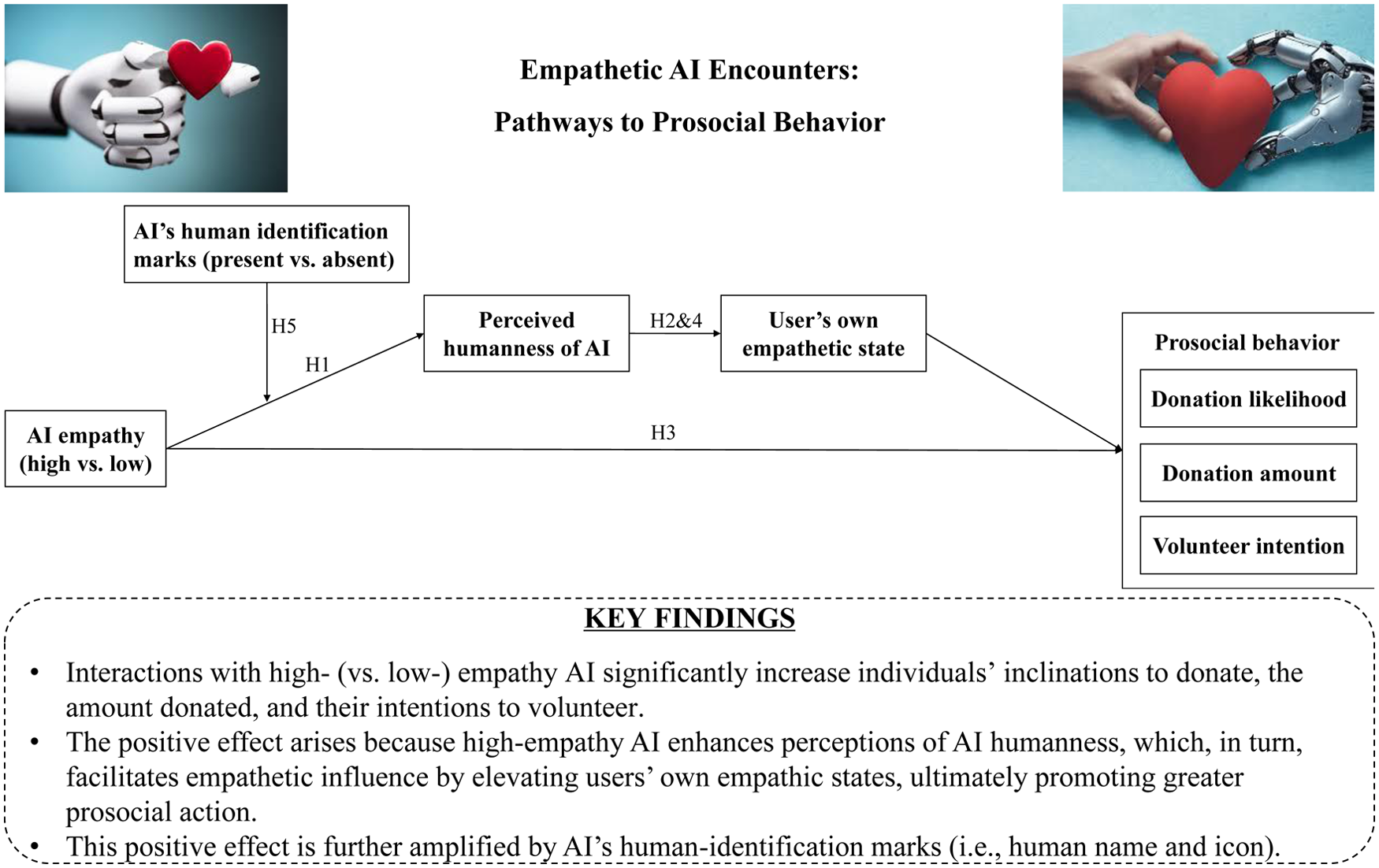
The latest advancements in artificial intelligence (AI) not only highlight exceptional intelligence quotient but also emphasize remarkable emotional intelligence or emotional quotient. The current research investigates how interactions with empathetic AI affect individuals’ propensity to engage in prosocial behavior. Across six experiments, including a real-time human-AI interaction study and an incentivized behavioral study, we demonstrate that interactions with high- (vs. low-) empathy AI significantly increase individuals’ inclinations to donate, the amount donated, and their intentions to volunteer. Drawing on observational learning theory, we show that this effect occurs because high-empathy AI enhances perceptions of AI humanness. This heightened humanness facilitates empathetic influence, whereby the AI’s modeled empathic behaviors elevate users’ own empathic states, ultimately promoting greater prosocial action. Furthermore, this positive effect of high-empathy AI is strengthened by AI’s human-identification marks (i.e., human name and icon). The research findings offer theory-based, actionable recommendations for effectively leveraging AI in service encounters to promote prosocial behaviors.
Get full access to this article
View all access options for this article.
References
Supplementary Material
Please find the following supplemental material available below.
For Open Access articles published under a Creative Commons License, all supplemental material carries the same license as the article it is associated with.
For non-Open Access articles published, all supplemental material carries a non-exclusive license, and permission requests for re-use of supplemental material or any part of supplemental material shall be sent directly to the copyright owner as specified in the copyright notice associated with the article.
