




Abstract
This research investigates how structured service environments can mitigate negative customer responses to service failures. We propose a proactive strategy that aims to preemptively manage customer expectations. Drawing on the meaning maintenance model, we theorize and find that heightened perceptions of predictability inherent in structured environments reduce customers’ need to make sense of discrepancies between actual and expected outcomes. In turn, customers are less likely to blame the firm and more likely to repurchase from it. Our research includes a field experiment and three online and lab experiments across various contexts. We identify key boundary conditions: structured environments are less effective when failures appear predictable due to recurring causes (stability attribution) or when the firm could have prevented them (controllability attribution). Furthermore, if the firm is merely associated with the failure but not directly involved, the mitigating effect of structured environments does also not occur. These insights offer managers a novel proactive strategy to buffer customer responses to service failures.
This is a visual representation of the abstract.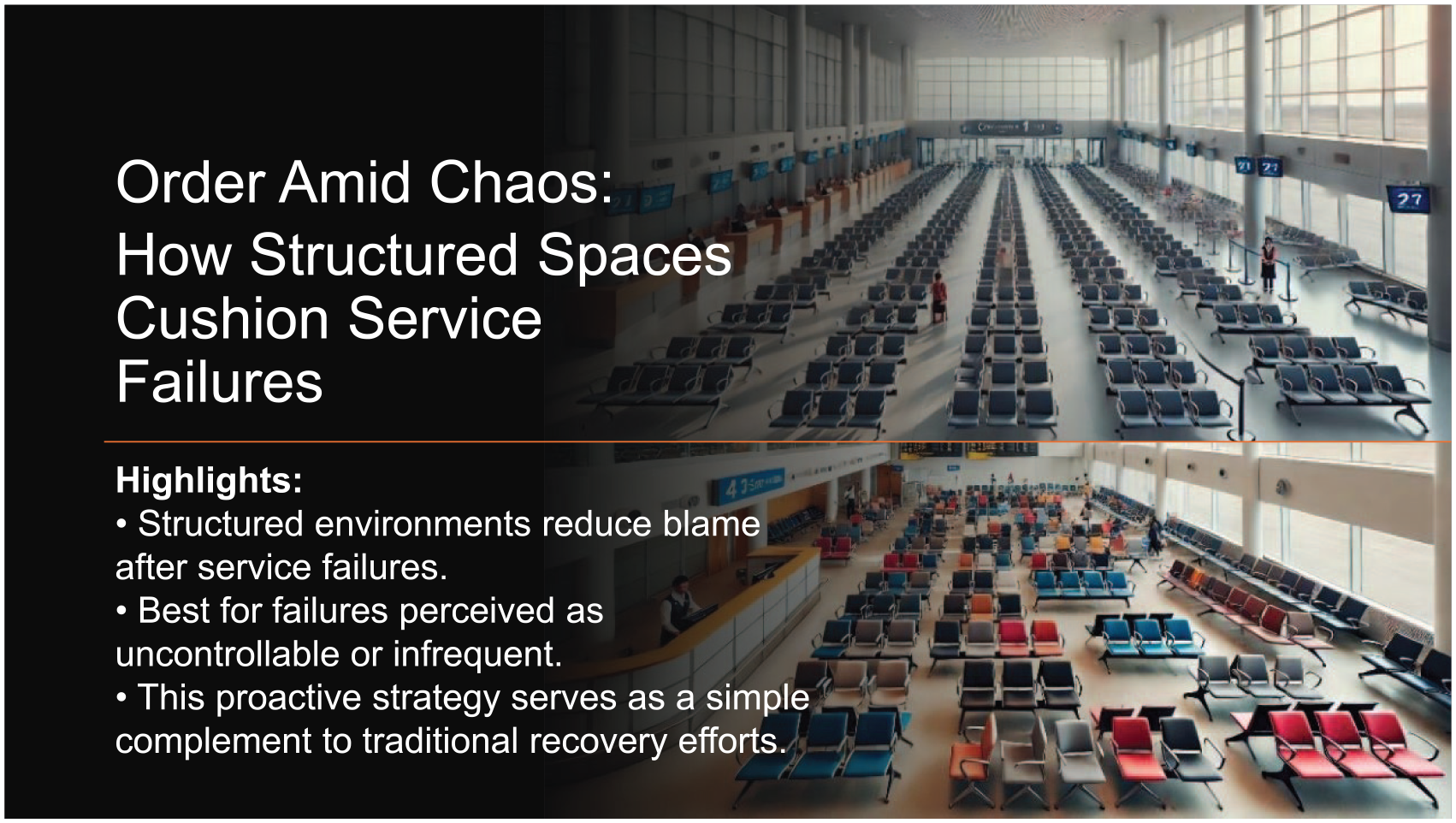
Keywords
Get full access to this article
View all access options for this article.
References
Supplementary Material
Please find the following supplemental material available below.
For Open Access articles published under a Creative Commons License, all supplemental material carries the same license as the article it is associated with.
For non-Open Access articles published, all supplemental material carries a non-exclusive license, and permission requests for re-use of supplemental material or any part of supplemental material shall be sent directly to the copyright owner as specified in the copyright notice associated with the article.
