




Abstract
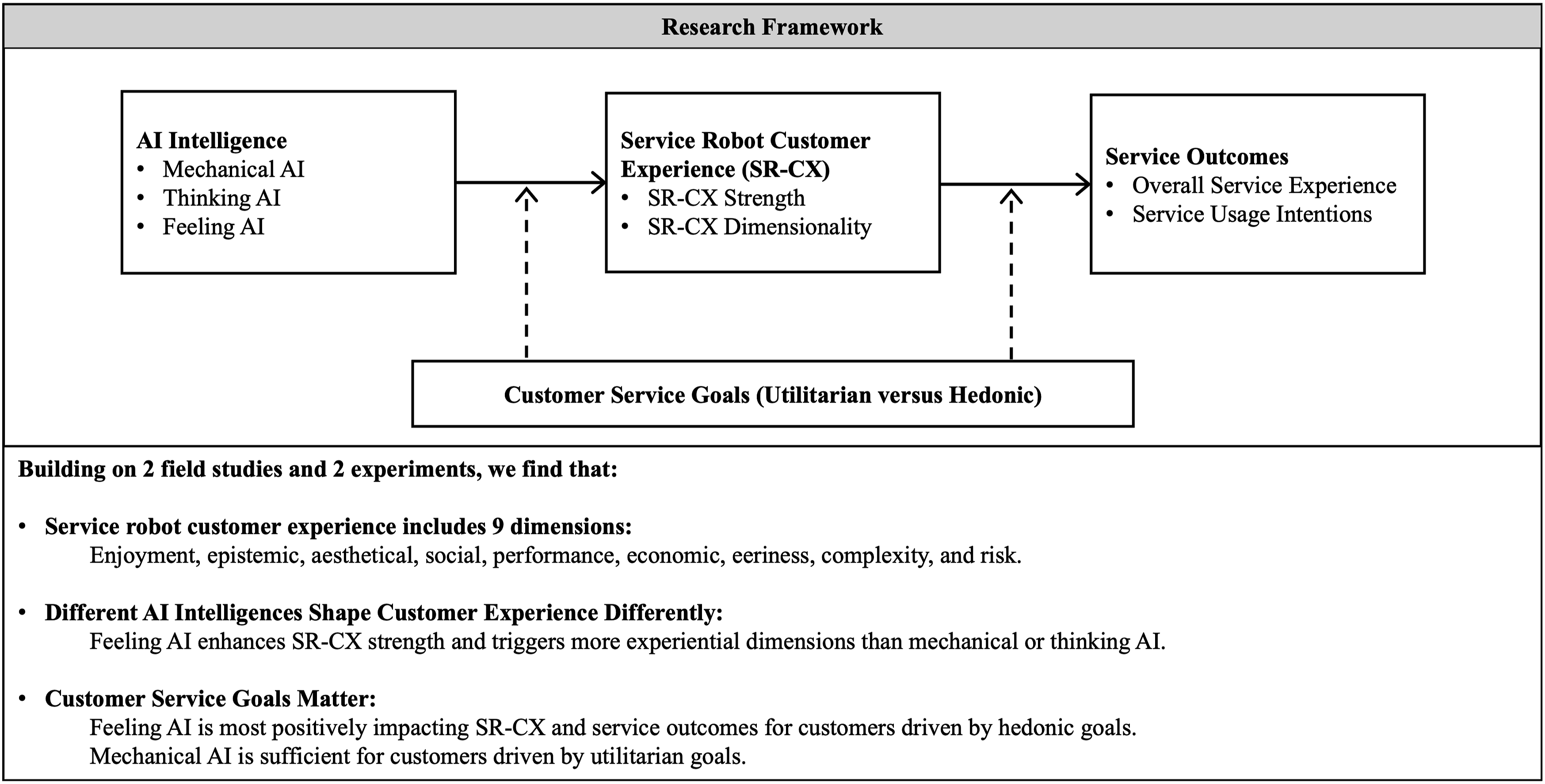
This research aims to generate a nuanced understanding of service robot customer experiences (SR-CX). Specifically, this work (1) empirically explores the impact of different AI intelligences (mechanical, thinking, and feeling AI) on SR-CX (i.e., SR-CX strength and SR-CX dimensionality) and its downstream impact on important service outcomes (i.e., overall service experience and service usage intentions), and (2) considers the moderating role of consumer service goals (hedonic versus utilitarian). Drawing on insights from two field studies and two online experiments, this research demonstrates that SR-CX—which is impacted differently by varying AI intelligences—affects service outcomes. Specifically, more sophisticated AI intelligences lead to enhanced service outcomes for customers with hedonic service goals across settings by strengthening SR-CX and triggering a more extensive set of SR-CX dimensions. This pattern, however, is less clear for customers driven by utilitarian service goals. For these customers, the role of SR-CX strength and SR-CX dimensionality varies across settings. These findings, which empirically support the importance of SR-CX, may help organizations to strategically leverage robots with different intelligence levels along service journeys of customers with different service goals.
Get full access to this article
View all access options for this article.
References
Supplementary Material
Please find the following supplemental material available below.
For Open Access articles published under a Creative Commons License, all supplemental material carries the same license as the article it is associated with.
For non-Open Access articles published, all supplemental material carries a non-exclusive license, and permission requests for re-use of supplemental material or any part of supplemental material shall be sent directly to the copyright owner as specified in the copyright notice associated with the article.
