




Abstract
Third places—communal or socializing places such as coffee shops—are confronted with a rising customer segment: customers who use them for work. Prior research is divided on this trend: customer-workers are seen either as a source of added value or a major threat to third places. Relying on a multimethod, qualitative study, we investigate the strategic implications of the rise of customer-workers in third places. We extend prior research by considering customer-workers as a new and valuable segment, with its specific motivations and practices. Building on the co-constitution of practices and places, we show that the rise of the customer-worker segment has fostered market differentiation. We identify four types of third places (archetypal, status quo, compromise, and productive) depending on their targeting strategy and their servicescape adaptation. We delineate how customer-workers transform third places’ value proposition and bring challenges to each type. Specifically, we show that status quo third places are most prone to customer conflicts while compromise third places generate managerial struggles. In contrast, productive third places adapt their servicescape to become work accelerators and a source of professional identity for customer-workers. We provide recommendations for managers to overcome conflicts and benefit from this growing customer base.
Introduction
We saw the change in the way people were working, people be[ing], you know, freelancers and creatives, particularly, which are a core audience for us. And we saw the way they were working, and that people were working from home and working at shared workspaces and the benefits of that. So, we thought a pub was one of the few areas where they would really fit the purpose. […] We open from nine until five exclusively for the workspace subscriptions and to be honest, it’s a commitment, but I think it’s one that over the long term will pay dividends. […] I think I might be a first mover, but I’ve already seen my competitors around me trying to replicate what we do.
Third places—traditional havens of communal socializing such as coffee shops (Rosenbaum 2006)—must now adapt to customers occupying their servicescape for work (Griffiths and Gilly 2012). Over a fourth of the UK working population are considered flexible workers, fueled by the rise of the gig economy and the liberalization of work contracts and schedules (Schor 2016). Flexible work comprises work where the organization lacks directional control, such as part-time work, flexible hours, contract work, and remote work (Cappelli and Keller 2013). With working from home not always possible or desirable, these workers increasingly need alternative workspaces (Manyika et al. 2016). We define customer-workers as customers who perform work-related tasks and activities in commercial places not primarily intended for work. News media report the rise of customer-workers in third places (Bearne 2016; Bowles 2018), a trend that the COVID-19 pandemic has accelerated (Bartholomew 2020). The emergence of the hashtags #pubdesking or #workfrombars evidences a normalization of customer-workers, that is, they have become a common sight and a greater part of third places’ business.
The presence of customer-workers in third places may become a source of conflicts (Christiaens 2017; Khan 2017) as two consumer segments compete for the use of the same servicescape: flexible customer-workers looking for a cheap place from which to work and traditional third-place consumers committed to leisure and socializing. Third places must balance these two segments while striving to maintain a certain atmosphere and margin of profitability. Faced with the rise of customer-workers, third places’ managers must consider the strategic implications of these new work practices for their value proposition, traditionally centered on socializing and leisure rather than work.
Prior research documents the development of new practices of working in third places like coffee shops, pubs, and hotel lobby bars and cafés (Griffiths and Gilly 2012; Murphy 2018). Griffiths and Gilly (2012) point to the value that third places have for customer-workers as a possible space for work. We argue that past literature has mainly considered third places as spaces for customer-workers while the traditional socializing customer remains the valuable consumer of third places. We analyze the practices, motivations, conflicts, and transformations that customer-workers bring to third places. We expand existing literature by examining how, for customer-workers, third places are evolving from third spaces (a space where they go against “traditional” practices) to third places (a place imbued with meanings where they are recognized as valuable customers; Tuan 1977). 1 Furthermore, we suggest that prior literature on third places has yet to acknowledge the extent to which the growing intrusion of customer-workers impacts third places at the market level. We view practices and places as co-constituted (Cnossen and Bencherki 2019); thus, we expect the nature of third places and of the third-place market to evolve as customers’ work practices become normal. To tackle these two gaps, we adopt a strategic perspective and ask: What are the implications of the normalization of customer-workers’ practices for third places at a servicescape and market level?
To answer our research question, we rely on a multimethod, qualitative approach. We engaged in participant observations in third places in London, UK, over the course of a year and interviewed customers, staff, and managers of third places. Our findings are organized into three parts. First, we define the rising segment of customer-workers and unpack its strategic value for third places. Second, we reveal that, by bringing new meanings and motivations to third places, customer-workers have transformed the market, encouraging its differentiation. We document the emergence of four types of third places—archetypal, status quo, compromise, and productive—that differ on the nature of their targeting strategy (undifferentiated versus differentiated) and the adaptation of their servicescape (to traditional customers vs. to customer-workers). We discuss the challenges that customer-workers bring to each type and the adaptations (or lack of) each type undertakes to face this new segment. Third, we focus on the productive third place (PTP) as the type of third place most fitted for customer-workers. From a servicescape viewpoint, PTPs are recognized by a hominess threshold, striking a balance between hominess and formality to accelerate work without becoming office-like. From a targeting viewpoint, PTPs meet customer-workers’ symbolic needs by providing them with meanings to inform their professional identity. In London, this professional identity relates to productive cosmopolitanism, as customer-workers see themselves as competent professionals and a legitimate part of the busy city life.
We contribute to the literature by providing a strategic perspective on the implications of customer-worker practices for third places. We examine with greater nuance the view that these practices cause the destruction of third places (Oldenburg 1989; Oldenburg and Brissett 1982; Rosenbaum 2006), proposing a more critical view than that taken by Griffiths and Gilly (2012). First, we show that customer-workers represent a growing, strategic, and valuable customer segment for some third places. Second, we demonstrate that this emergent segment is a source of transformations for the third-place market, which is now differentiated across four types from the archetypal third place, which preserves its social and community value proposition, to the emergent PTP, which caters directly to customer-workers. Third, we theorize a new type of third place, the PTP, which meets customer-workers’ functional and symbolic needs as a work accelerator and a source of professional identity.
Third Places in a Changing Work Landscape
Third Places: Definition and Value Proposition
Third places are social spaces that provide users with social experiences and relationships outside of their homes (first places) and workspaces (second places; Oldenburg and Brissett 1982). The bar or coffee shop is the prototype of the third place, a place buoyant with life (Lin 2012; Luca and Pegan 2014; C. J. Thompson and Arsel 2004). Other examples include community and religious centers (Hickman 2013; Mehta and Bosson 2010), museums (Slater and Koo 2010), pubs (Goode and Anderson 2015), bookshops (Laing and Royle 2013), and libraries (Montgomery and Miller 2011). Digital spaces such as online gaming, file-sharing communities, and social media (Ducheneaut, Moore, and Nickell 2007; Rao 2008) can also be seen as third places as they provide communal and emotional support.
Traditionally, third places’ value proposition is to bring people together (Mehta and Bosson 2010; Oldenburg 2001). They also create value for their customers by fostering communities and friendships and by providing health support and leisure (Glover and Parry 2009; Rosenbaum 2009; Rosenbaum et al. 2007). Third places create meanings of community by providing a setting for informal sociality transgressing the more stringent social norms and roles associated with hospitality at home and professionalism at work (Holt and Thompson 2004; Oldenburg and Brissett 1982). When visiting third places, customers can express their true selves as a result of the breaking down of constraining normative barriers. They become flaneurs, the typical third-place customers who look for a “space where they can linger in the moment, at least temporarily suspending the press to squeeze more productivity out of their day” (C. J. Thompson and Arsel 2004, p. 634). In conclusion, past literature shows that the value offered by third places is dependent on their ability to create meanings of community, localness, and belonging (Oldenburg and Brissett 1982; C. J. Thompson and Arsel 2004). Consumers internalize these meanings by visiting third places (McCracken 1986). In doing so, third places answer three types of customer needs: the functional need for a practical space outside of home and work with amenities (e.g., drinking coffee), the social need for a space in which to meet others, and the emotional need for a space that feels like home but is outside the home (Debenedetti, Oppewal, and Arsel 2014; Rosenbaum 2006).
Nonetheless, the value created by third places is fragile as they are socially constructed spaces (Oldenburg and Brissett 1982). If the place or its occupants change, third places can lose their significance and symbolic meanings and transform into a place of consumption (Slater and Koo 2010). For instance, as a third place, a farmers’ market is at once a community center and a consumption space (Tiemann 2008), but it can lose its communal dimension if it becomes overly commodified. In the next section, we discuss recent changes in the global workforce which are bringing waves of flexible workers to third places and the implications these changes have for third places.
The Contemporary Evolution of Third Places
The rise of officeless workers
Flexible working, once mostly concerning creative industries professionals, is now spreading to many industries as freelancing and independent contracting are seen as solutions adapted to the needs of contemporary organizations (Cappelli and Keller 2013). Remote working, where employees are encouraged to work away from the office (e.g., at home) on a part-time basis, is also rising as an answer to employees’ need for flexibility and growing rental costs in cities. Rising flexibility in schedules and workplaces (Schor 2016) is, thus, leaving a growing segment of workers in need of substitute workplaces (Spreitzer, Cameron, and Garrett 2017). This is significant due to the scope of the phenomenon as officeless workers represent a large and growing population—for instance in 2018, in the UK, 4.8 million workers are self-employed (Yuen et al. 2018).
Having a connection to a physical place or organization is essential for flexible workers to carve out their professional identity (Petriglieri, Ashford, and Wrzesniewski 2019; Press and Arnould 2011). Officeless flexible workers traditionally have two main options: working from home or renting an access-based office (Crosbie and Moore 2004). However, working from home is not possible for everyone as it requires specific arrangements (e.g., a personal workspace and a quiet environment) and a capacity to work alone (Petriglieri, Ashford, and Wrzesniewski 2019). This has led to the emergence of cohoming, whereby flexible workers invite other independent workers to their homes for the day to work (Gruen and Mimoun 2019). Those who cannot work from home and can afford it turn to renting offices directly or through coworking spaces (Gandini 2015). However, the prohibitive prices of coworking spaces leave many flexible workers by the wayside (Spreitzer, Cameron, and Garrett 2017). Thus, these workers look for alternative workplaces and means to get out of their own houses. The local coffee shop or pub appears more and more as an appealing option.
Implications for third places
Following the first cybercafés in the 1990s, third places started offering internet access in their eateries and cafés to attract a new customer base (Liff and Steward 2003). As flexible work becomes more mainstream, customer-workers’ presence in third places becomes so ubiquitous that it questions the nature of these places. Indeed, third places have provided a solution for freelancers, gig workers, flexible workers, students, and remote workers who are unable to work from home or an access-based office space. This trend is frequently reported in mainstream media, with newspaper headings such as “App directs freelancers to cafés and bars that will actually welcome them,” from a 2018 Forbes article (Clawson 2018), or “Coffee shop, home, co-working space…Where’s the most productive place to work?” from The Guardian (Bearne 2016). The multiple lockdowns and encouragements to work from home that resulted from the 2020 COVID-19 pandemic incredibly accelerated this trend. This is visible in how local third places adapted their offers to local workers and the hashtags #workfrombars or #pubdesking.
The growing accommodation of workers in third places may rejuvenate fears of seeing third places become office-like and silenced. Traditional conceptualizations of third places indeed argue that work-related practices are unsuitable for third places. Oldenburg and Brissett (1982) warn against the pervasiveness of business as detrimental to third places’ value: One opens a door to a bar, coffee shop, or sauna, and finds people at work, either at their job or at their leisure. There is no lively conversation in these places, no suspension of the usual and typical, no joy of association. The “ingredients” of [the] third place are simply not there. (p. 269)
While research on the topic remains limited, a few works provide an account of the impact of customers’ work practices in third places on customer experience (Griffiths and Gilly 2012; Trager 2005). Griffiths and Gilly (2012) report that the presence of customer-workers leads to conflicts as customers contest and protect their territory. They also see the accommodation of workers as an additional dimension to third places’ value proposition. Building on Rosenbaum’s (2006) framework, they propose that third places answer a need for customers seeking a place-as-work. The place-as-work provides functional benefits such as Wi-Fi and power sockets to answer the customer-worker’s needs. Such affordances, they argue, enable territorial behaviors of workers who spend longer hours in the third place (see also Trager 2005), creating utilitarian loyalty to the third places that offer Wi-Fi.
We find two limitations to this approach. First, we argue that prior research sees third places as spaces for customers who work, by opposition to the meaningful, emotional places they are for “traditional” customers (Rosenbaum 2006; Tuan 1977). Griffiths and Gilly’s (2012) key research indeed points to customer-workers as utility driven, looking for a space to sit with Wi-Fi and power sockets. Furthermore, nowadays, all cafés have Wi-Fi and power sockets, limiting these affordances’ ability to foster utilitarian loyalty to third places (cf., Griffiths and Gilly 2012). We argue that third places are evolving to recognize the importance of customer-workers at a strategic level beyond utilitarian loyalty and are adapting their servicescape and offering to them beyond utility affordances. In doing so, we directly answer Griffiths and Gilly’s (2012) call to understand “what is the right environment for customers who want to be alone among people” (p. 145).
Second, we advance that the rise of customers’ work practices in third place causes disturbances far greater than the territorial conflicts identified by Griffiths and Gilly (2012) and that the literature fails to address its strategic implications. Indeed, customer-workers blur boundaries between public and private, work and home, and professional and personal life (Gregg 2013): They challenge the raison d’être of the third place as a space in between work and home. Prior research tends to adopt a consumer experience–centric view on third places, focusing on the experiences of customers in third places (Griffiths and Gilly 2012; Oldenburg and Brissett 1982; Rosenbaum 2006) but failing to acknowledge the broader consequences brought by this customer segment. By adopting this viewpoint, prior works overlook the impact that a systematic change in customers’ practices may have on the market as a whole. We view customer practices and spaces as co-constituted. That is, “practice actively engages with space: the space where it takes place defines it as much as it defines space, both within organizations and outside” (Cnossen and Bencherki 2019, p. 1072). As a result, we expect that, as customers’ work practices become normalized, the nature of third places evolves and that these changes are reflected at the market level. We argue that we must consider how these new customer practices unfold and transform the third-place servicescape and market. To tackle these gaps, we ask: What are the implications of the normalization of customer-workers’ practices for third places at a servicescape and market level?
Method
To answer our research question, we followed well-established guidelines for meaningful and rigorous qualitative service research and combined three qualitative methods (Epp and Otnes 2020; Holmlund, Witell, and Gustafsson 2020). First, we used participant observation to map out third places’ reactions and adaptation to the emerging phenomenon of customer-workers. Second, we relied on semistructured interviews with third-place customers to explore their experiences and practices in third places and the meanings they attach to them. Third, we collected strategic data in the form of interviews with third-place service providers and media data. All the data were collected jointly by both authors in London, a cosmopolitan capital with a large and growing population of flexible workers.
First, we carried out participant observation to understand the third-place market with regard to customer-workers. We documented our observations with field notes and photos in 38 varied third places where customers work. These included coffee houses (nine), pubs (three), hotel lobby bars and cafés (three), churches (three), museums (six), shop cafés (five), libraries (three), train stations (four), a cinema, and a greenhouse. This allowed for a diverse range of third places to be observed and for saturation to be reached. As per established guidelines (Arnould and Wallendorf 1994), we selected sites to ensure diversity in notoriety, purpose, and customer population. Observations lasted between 25 minutes and 4 hours and were conducted by one or both authors. Some places were visited several times, resulting in a total of 52 visits (see Online Appendix 1). We recorded our observations using a semi-open observation grid to combine systematic recording with the ability to record unexpected observations (Dion and Borraz 2017). We organized the grid around three themes: characteristics and atmosphere of the space, practices and characteristics of individuals, and form and characteristics of social interactions. For triangulation purposes, we also collected marketing information online (e.g., website, social media pages) and on-site (e.g., brochures, flyers, loyalty cards) for each site.
Second, we conducted 27 semistructured interviews with customers who frequently visit third places including five disconfirming cases (see Table 1). While we focus on customer-workers due to our research question, we follow qualitative research’s best practice to search for disconfirming cases (i.e., “traditional” customers who visit third places but never work there) to strengthen the validity of our analysis (Miles, Huberman, and Saldaña 2014). We adopted a purposeful sampling approach and sought to interview participants who varied in terms of gender, age, and frequency of usage of sites. Sampled customer ages range from 19 to 41 years. While this might be a limit of our data set, it is also representative of the customers working in third places, according to our observation. The interviews followed a semistructured interview guide to facilitate comparison across sites and experiences while allowing for some flexibility and adaptation. We asked our participants to tell us about their usage and experience of third places. Except for the five traditional customers, our participants all had experience working from coffee shops. Several also reported working on trains and in train stations, museums, gym facilities, hotel lobbies and bars, pubs, and restaurants. They varied in how much time they worked from third places, from a few hours to several days a week (see Table 1).
Profile of Respondents: Customer Interviews.
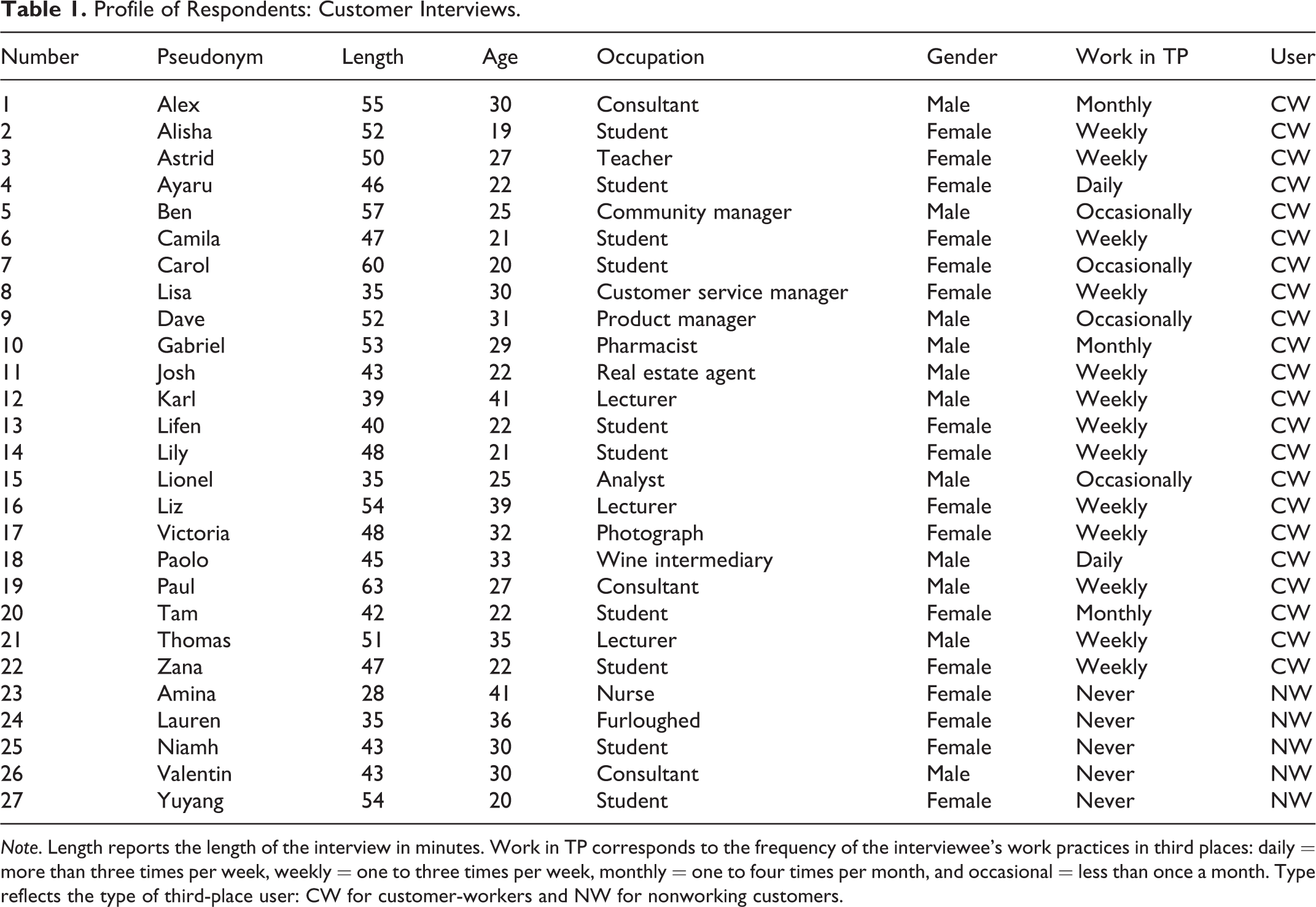
Note. Length reports the length of the interview in minutes. Work in TP corresponds to the frequency of the interviewee’s work practices in third places: daily = more than three times per week, weekly = one to three times per week, monthly = one to four times per month, and occasional = less than once a month. Type reflects the type of third-place user: CW for customer-workers and NW for nonworking customers.
Third, we collected managerial data to explore the strategic implications of the rise of customer-workers and triangulate managerial and customer perspectives. We conducted 12 semistructured interviews with service providers including owners, managers, staff members, and associated professionals (see Table 2). Adopting a purposeful sampling approach, we interviewed participants who varied in terms of the type of third place and role. Following a semistructured approach, we asked each participant to tell us about customers, their needs, and how these were answered. We probed on how they managed customer-workers when needed, but this customer segment often emerged naturally in the conversation. We complemented this data set with social media and British mainstream and specialized press data (N = 55) discussing third places, collaborative workplaces, and working outside of the office. We used these to contextualize third places’ evolution in marketplace and media discourses. Interviews and media data also helped us overcome the problematic tendency of ethnographic approaches to focus on what is easiest to observe.
Profile of Respondents: Service Provider Interviews.
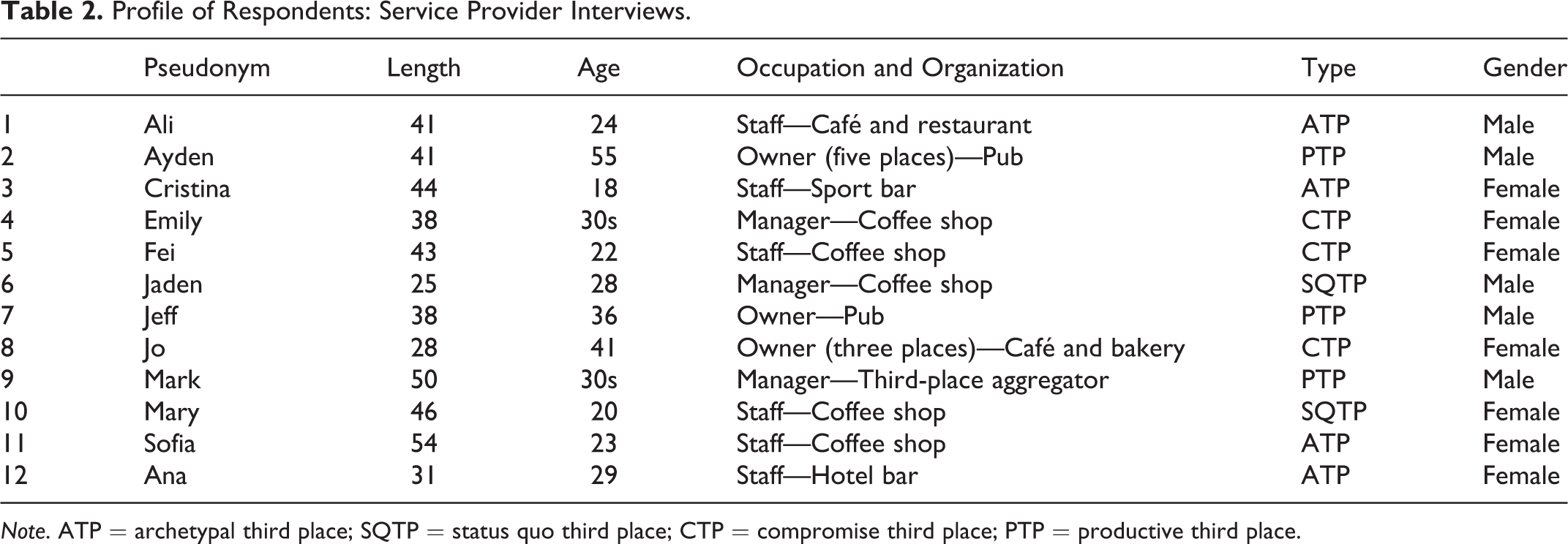
Note. ATP = archetypal third place; SQTP = status quo third place; CTP = compromise third place; PTP = productive third place.
Our methodological approach was underpinned by a commitment to ensure adherence to research standards (Epp and Otnes 2020; Wallendorf and Belk 1989). We prepared carefully for the data collection and worked together to establish a reliable interpretation (Fontana and Frey 1994; Wallendorf and Belk 1989). Triangulation across multiple data sources and methods and long-term engagement with contextual material helped establish robustness and dependability (Holmlund, Witell, and Gustafsson 2020). Following established guidelines, we handled the data ethically and transparently (Holmlund, Witell, and Gustafsson 2020; Miles, Huberman, and Saldaña 2014). We followed a hermeneutic approach to interpretive analysis (C. J. Thompson 1997). This approach was particularly relevant when answering the research question, which interrogates the interactions of customers’ motivations and practices with sociocultural narratives and marketplace ideologies. Through an iterative reconsideration of the textual and visual data and of the literature, themes were progressively identified, interpreted, and abstracted in order to develop theoretical inferences (C. J. Thompson 1997). We present quotes selected for their exemplarity in the next sections (Bansal and Corley 2011) and provide additional examples in Online Appendix 2.
The Customer-Worker
Our fieldwork documents the rise of a new segment for third places: customer-workers. In this section, we define customer-workers, highlight what value they bring to third places, and identify the motivations that bring these customers to third places.
Definition and Value of Customer-Workers
We define customer-workers as customers who perform work-related tasks and activities in commercial places not primarily intended for work. Customer-workers are primarily white-collar workers engaging in cognitive or creative tasks. We posit that whether the activity entails paid work does not enter in defining customer-workers. Students, for instance, qualify as customer-workers since they engage in similar consumption practices. In contrast, care work, for instance when a parent brings children to a third place, does not qualify as a customer-worker’s practice. According to our observations, the most common customer-worker’s practice is when a single customer sits with a laptop in a third place to perform cognitive work for a few hours. We also observed customer-workers having business meetings, typically characterized by the presence of one or several laptops and notebooks on the table where two or more customers discuss; taking professional phone calls, where customer-workers use headphones; and writing on notebooks (see Online Appendix 3).
Customer-workers constitute an emerging strategic segment for third places that are beginning to recognize their value. Our data challenge the typical image of the student who orders a single coffee and occupies a table for a day. Varying across types of third places, customer-workers can bring financial, marketing, and/or atmospheric value to businesses. The financial value is most important for third places, such as cafés or bars in hotel lobbies, which are mostly empty if not for customer-workers. Many of such places, such as the Ace Hotel or the Dial Arch in London, are actively communicating to attract customer-workers (see Online Appendix 4). We find that customer-workers often occupy third places during off-peak hours, thereby providing a steady source of income in otherwise quiet periods. They also tend to be regular and loyal customers: Most customer-workers we interviewed admitted going to the same third place on a weekly basis. Third places also benefit from the transfer of practices as customers working during the day stay or come back to socialize, eat, and drink in the evenings or at weekends. For the more traditional third places such as coffee shops, the financial value is less clear as managers admit that they do not want to see customers staying the day while only ordering one coffee. However, staff and managers acknowledge that during quiet hours, they play the role of fillers since “a busy café is better than an empty café” (Emily, 30s, manager). In these quiet times, customer-workers play an important role as they generate an appropriate and typical café atmosphere.
Furthermore, customer-workers bring to third places the image of a trendy, busy lifestyle that comes with independent work or freelancing, which third-place managers see as an opportunity: A lot of people on laptops are often bloggers, are often people who are quite social media active, or like gamers, or you know, doing interesting stuff. But you never know who’s going to be sat there, so that’s kind of the brief I say to [my staff], is they might be an opportunity, they might take an awesome picture that might be really beneficial. […] I don’t think [they] would ever be massively lucrative but I think it’s very good for sort of brand loyalty, it’s a marketing budget effectively. (Jo, 41, owner)
Customer work practices take place alongside a great variety of other consumption practices as we observed during our ethnographic inquiry. Traditional customers and customer-workers bring a diverse range of expectations and needs to the same third places. For instance, in the Barbican Centre, a performance and arts center, customer-workers typed on laptops while parents fed their toddlers and teens watched videos on YouTube, all sharing the same long tables. Similarly, Host Café in the City of London is situated within a church: during our visit, people prayed while, behind them, café customers worked on laptops and had loud business meetings or phone conversations. The spiritual practices of the former overlapped with the work-related practices of the latter, highlighting how the behavior of customer-workers can affect others (Griffiths and Gilly 2012). Such overlapping practices suggest that customer-workers can disturb traditional practices of third places (Goode and Anderson 2015; Trager 2005).
Customer-Workers’ Motivations
Our analysis of customer-workers’ discourses highlights two primary motivations for visiting third places beyond the taste of their coffee: enabling focused work and facilitating the social aspects of independent work.
First, third places appeal to customer-workers for their ability to enable focused work. Alex, a 30-year-old consultant, regularly works from third places to escape the distraction of his open-plan workplace and home. He explains: That is what I am looking for: a break from home. I have noticed that I can really focus during one continuous work session at Starbucks. If I have parts of my work that I can break down into 1-, 2-, 3-hour modules, it is easier for me to go to the Starbucks to do this specific task, then leave and go back home. And the Starbucks allows me to do that. Whereas at home it is difficult to start the day and be efficient and tackle a whole task from start to end. […] The people [in the coffee shop] are all the same—students, young workers, young professionals—with their laptops or their books, and they all seem to come here with the same purpose as I have, so…this kind of help[s] boost my productivity. On several occasions when I lacked the motivation to work, I started to watch series on my phone. And I felt a bit self-conscious doing so—even though nobody could hear me because I had my earphones on—but I felt a bit guilty. So I dived back into work. (Alex, 30, customer-worker)
The second key motivation driving customer-workers to third places is their ability to facilitate social aspects of independent work. Working among similar others, as Alex highlights, has an indirect social value. This function originates from the third place’s original purpose, as epitomized by Josh: Definitely places more like this for a business meeting, like meeting with a client, are good because it’s kind of more informal so you can get closer to the client and form like more of a social bond, because you want them to trust you. You don’t want it to be all set in stone, I guess, formal. […] I’ve found if you meet somebody in an office they might be less willing to share information, I guess, because you want to help them find the best place for them and they might not be as open if it’s like you’re in a suit and it’s all formal. (Josh, 22, customer-worker)
Another social aspect of work facilitated by third places is mitigating the social isolation which often threatens remote and flexible workers (Petriglieri, Petriglieri, and Wood 2018; Spinuzzi 2012). Lisa, for example, explains somewhat awkwardly: Things happen in coffee shops. I have never seen it happen because I might not be there long enough, but things happen in coffee shops. I am certain of it, even if I never saw it. There are so many people who are there alone. If you want to go talk to the person in front of you at the table, you could very well [do so]. (Lisa, 30, customer-worker)
In sum (see Figure 1), we find that customer-workers represent an emergent, strategic, and valuable customer segment for third places. Their practices and motivations differ from that of traditional customers highlighted in the literature. Importantly, our research reveals how normal these practices become alongside those of traditional customers. Next, we show how the rise of customer-workers’ practices led third places to evolve and differentiate.
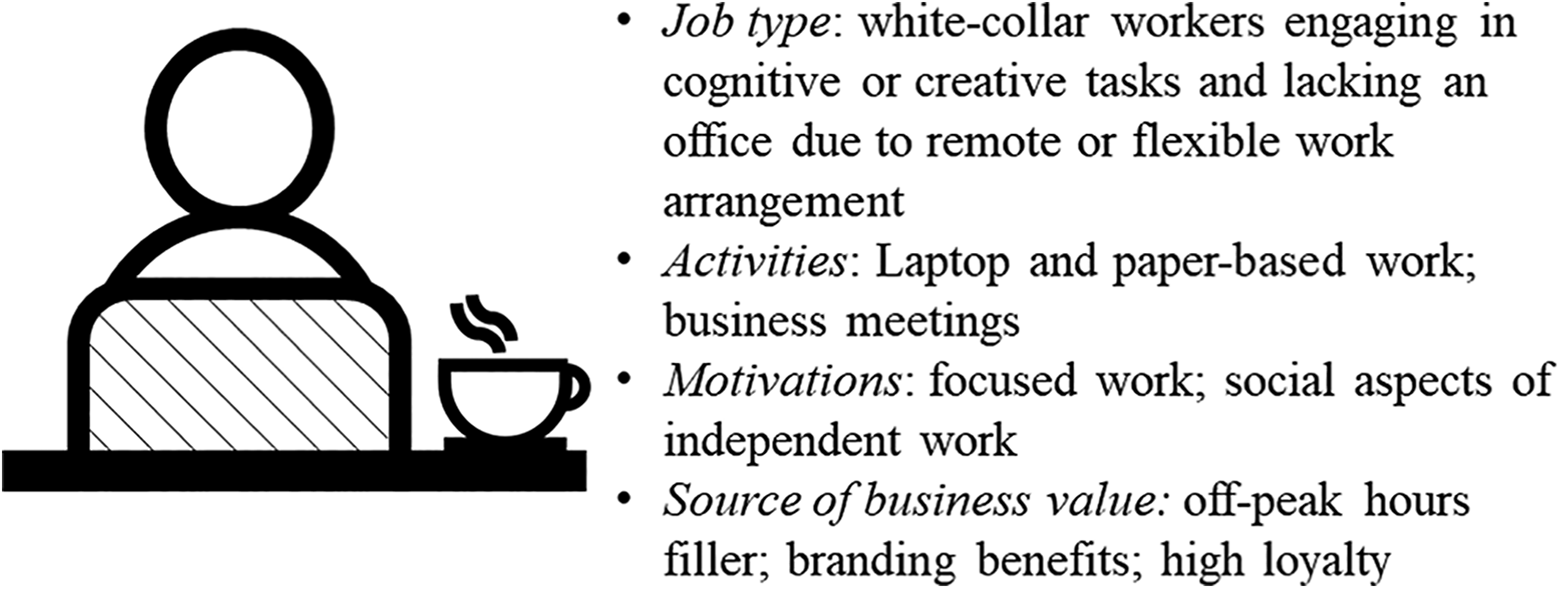
Customer-worker profile.
The Third-Place Market
Throughout our fieldwork, we observed how third places react to the rise of customer work practices. The analysis of the data collected led to a classification of the third-place market based on two characteristics: the type of targeting strategy they use (differentiated or undifferentiated) and the segment to which they adapt their servicescape (traditional customers or customer-workers). Our model identifies four types of third places (see Figure 2 and Online Appendix 5): (1) the archetypal third place, which targets specific traditional customer segments and adapts its servicescape to their needs; (2) the status quo third place, which does not target a specific segment but adapts its servicescape to traditional customers; (3) the compromise third place, which engages in some servicescape adaptation to suit customer-workers while not targeting any specific segment; and (4) the PTP, which targets customer-workers and adapts its servicescape to their needs. Importantly, we acknowledge that the boundaries between these different categories remain blurry, especially at a time when the market differentiation is still emerging.
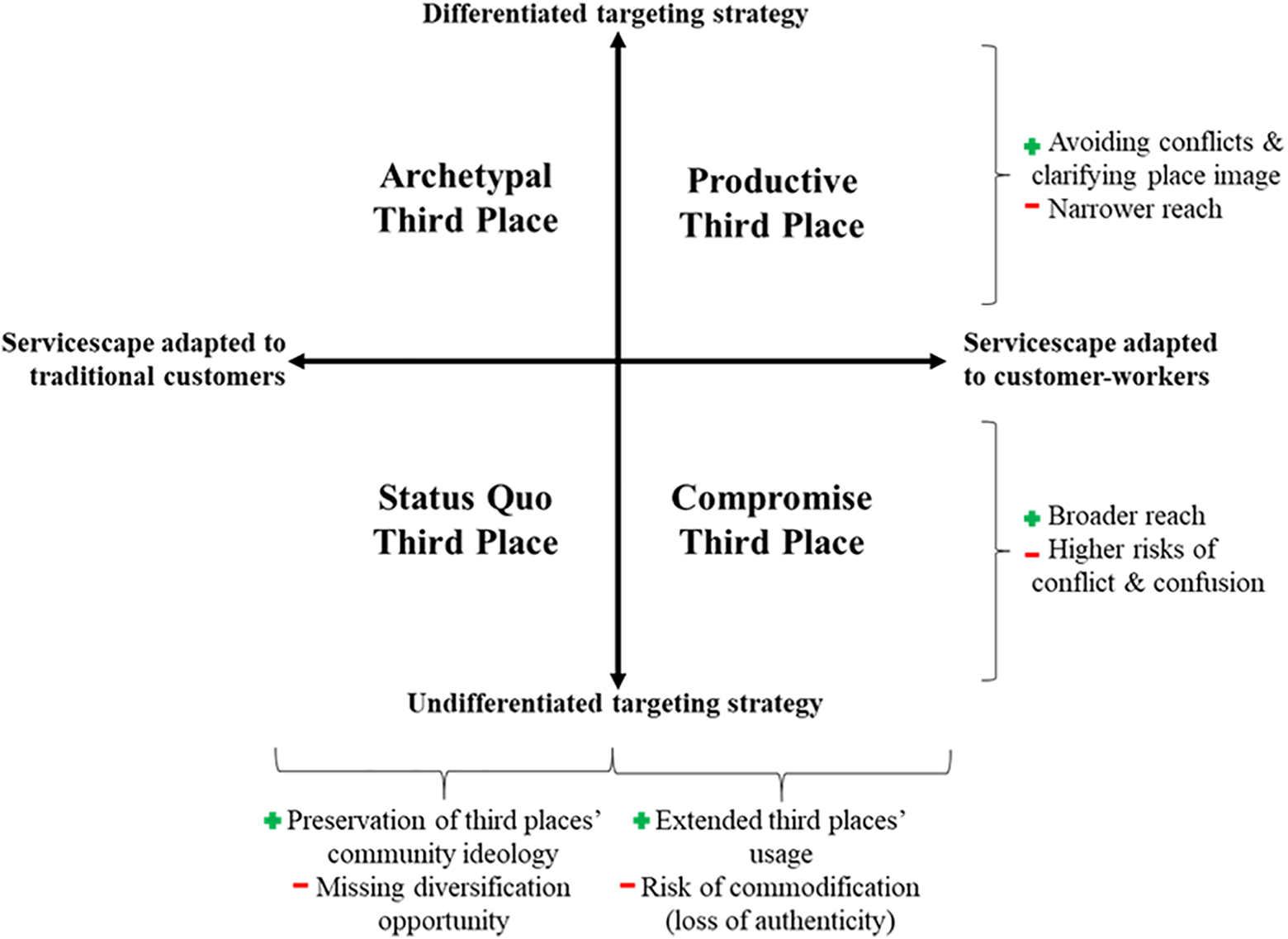
Impact of the customer-worker segment on third-place market differentiation.
Our service provider and customer interviews reveal that many are increasingly aware of this differentiation, like Zana: I think the café sector might be divided into some categories. Maybe some café[s] would want to be like a bar or a pub and others would want to offer a place to work and some cafés can offer a place to negotiate and chat, socialize with good music. Like Jo and the Juice®. You can’t work there because the music is really high and everyone is super energetic. Like before going to the gym you can prefer that instead of Starbucks®, but you can’t work there, everyone is shouting. It’s a nice place but the concept is different. So I think the coffee sector can divide itself in some categories where every coffee shop has a different mission, ha[s] a different goal. (Zana, 21, customer-worker)
Archetypal and Status Quo Third Places
Archetypal third places are places that target specific nonworking customer segments (e.g., urban flaneur, parents, people playing board games) and adapt their servicescape in consequence. They can be defined as public places outside the privacy of the domestic sphere and beyond the formality of the work sphere, with the primary purpose of allowing customers to enjoy each other’s company (C. J. Thompson and Arsel 2004). We do not extensively describe the value proposition of archetypal third places as they have been the focus of prior research on this topic (Oldenburg and Brissett 1982; Rosenbaum 2009; Rosenbaum et al. 2007; Rosenbaum 2006; C. J. Thompson and Arsel 2004). In our fieldwork, we have visited such places, characterized by a lack of work amenities such as Wi-Fi, the banning of laptops, and atmospheric cues that discourage workers (e.g., very loud music or low lights). Rather than working or having business meetings, the main practices we observed are chatting and socializing, eating and drinking, reading novels and magazines, and family practices (e.g., children playing, breastfeeding). These places—tearooms, museums, parent cafés, or trendy bars—have no issues with customer-workers, who are avoiding them. They are usually successful places that manage to attract socializing customers looking for a place to have a good time. They achieve business value through a higher customer turnover than places that welcome customer-workers (who often stay longer hours according to our observations) and food and drink purchases as social practices.
In contrast, customer-workers appear to be disruptive to status quo third places. These places do not target any specific customer nor adjust their servicescape to foster or discourage work practices. The service offering is unspecific and unregulated. Different customers’ needs and practices overlap, which generates conflicts. We highlight two types of conflicts that emerge mainly in status quo third places: territorial and atmospheric.
First, our data concur with prior literature on the disrupting effect of customer-workers’ practices, which result in spatial conflicts over territories (Goode and Anderson 2015; Griffiths and Gilly 2012). Territorial conflicts relate to the manner in which users appropriately occupy a space, including the space layout, function, and equipment. We also find that traditional customers and customer-workers compete for space, leading to territorial conflicts when space becomes a scarce resource (e.g., at peak hours).
Second, we find that customers’ work practices transform the atmosphere of third places. Atmospheric conflicts, related to ambient conditions such as temperature, noise, and odor (Rosenbaum 2006), emerge when work practices hinder the traditional flaneur experience of the third place (C. J. Thompson and Arsel 2004). Being an urban flaneur becomes more difficult when one is constantly reminded of work. Nor is it possible to overhear conversations when people around you are working on laptops and wearing earbuds instead of conversing. Such conflicts are evident in our interviews: I can remember that once I go to the coffee shop, so there is a girl sitting next to me and she’s working off her laptop and she’s typing something so quick, so I can hear the sound from the keyboard. And I think, please, it’s a coffee shop, not a library. And she typed, I think, so fast, so I think [that was] a little bit annoying. […] I don’t want to disturb her about her work, so I would search [for] another seat and just stay away from her. (Yuyang, 20, nonworking customer)
Our interviews with traditional customers reveal that customers are aware of an informal customer hierarchy. When no differentiated targeting strategy is in place, as in status quo places, nonworking customers see themselves as the “traditional customer”: I’m the traditional customer. The person that’s out there working is not. And therefore, if my child makes noise—I mean, if my child is screaming, I think anybody would complain—but if he’s just sat there making the usual standard noise for a 3-year-old or whatever then, that’s…you know, if that person turned around to me and said “Excuse me, making too much noise,” I would suggest that they go and find an office. (Lauren, 35, nonworking customer)
Compromise Third Place
Compromise third places choose undifferentiated targeting, in the sense that they do not tailor their offering to customer-workers or traditional customers per se. They do, however, implement some servicescape changes in order to regulate the different segments. First, we identify how most compromise third places struggle to put in place and enforce such regulations. Second, we analyze a successful case to highlight how a balance can be reached to benefit from customer-workers while reducing conflicts with traditional customers.
Customer-workers bring normative conflicts to compromise third places, mainly due to behavioral expectations and their symbolic associations. Evidence of conflicts between staff members and customer-workers regarding norms and acceptable practices is recurrent in our interviews, observations, and media data set. Managing conflicts and boundaries between types of customers is often described as a struggle. For instance, Cristina, who works as a waitress, points out that customer-workers do not meet the expectations described in her service scripts by overstaying their welcome and underconsuming: We had an issue with some customers who didn’t want to spend money, for example, the boy that used to come with the computer. [H]e could stay often 2 hours and he would only order one coffee and then we would have more customers coming in and they didn’t have a table to sit at because that boy was taking up the table and he wasn’t consuming anything. (Cristina, 18, staff)
Even if staff members express some frustration in our interviews (see Emily’s quote below), we never observed staff intervening explicitly to regulate conflicts in the entirety of our fieldwork despite managerial desire to regulate them. We observed that many third places engage in tentative ad hoc servicescape adaptations to prevent conflicts. For instance, the Southbank Centre in London presents itself as a social place, and its ground floor is always buoyant with life. To enforce its socially oriented value proposition while welcoming customer-workers, the Southbank Centre has instated technology-free times and spaces. This policy is made explicit through physical signs and notices on the center’s website, such as: “Thank you for respecting that the Queen Elizabeth Hall café is a gadget- and laptop-free area. You are welcome to use your laptop, tablet, e-reader or other equivalent device from 10 a.m.–5 p.m. in other areas.” Yet, these rules are unmonitored and thus unsuccessful: We saw many customers sitting with their tablets and laptop in those areas. Service provider informants describe how having to enforce such rules is difficult. For instance, for Emily, a café and building manager, this is mentally exhausting: So I’ve like I’ve tried signs as well saying “Please, Consume as fast as the Wi-Fi,” as in the Wi-Fi is good, please consume related to this or to say like we ask you to consume if you if you are working from here, please consume once every 2 hours or something like this but it doesn’t really work that well. […] I already have so many rules right now. We want to be also be a peaceful and relaxed place not somewhere where you’ re like “I have to do this and that,” and so I find that it’s hard to…yeah, it’s a bit of a struggle sometimes. (Emily, 30s, manager)
In our fieldwork, we find that the most successful compromise third places’ strategies do not rely on signs or explicit policies but rather on designing environmental cues to make social norms more salient and encourage customers’ self-regulation. This can be done implicitly by designing a servicescape that encourages socializing and discourages work at specific places or times. Jo, a café and bakery owner, describes how, from the onset, she and her husband carefully designed their servicescape to nudge customer-workers: We’ve been very clever about where we put plugs so where we don’t want people to spend too long we haven’t put plugs for laptops because actually that will limit people’s battery life to 2 or 3 hours and then they’ll get up and […] move to locations that we’ve allocated for laptop use. Five years ago, we were very clever to use plugs and power points as a way to persuade people spending too long in our cafés. Even the types of seating used, you know, none of our seats are particularly comfortable, we’ve got one window seat which is where you see into the kitchen and those are lovely sort of high back chairs. The rest are stools or wooden benches, the sort of seats purposely designed to not make you want to stay for too long. (Jo, 41, owner)
In summary, we describe the value proposition and consumption practices observed in the archetypal, status quo, and compromise third places. We discuss the transformations and challenges that customer-workers bring to each type of third place. Status quo third places are prone to frequent territorial and atmospheric conflicts damaging the customer experience, while most compromise third places struggle with the adaptation of their servicescape.
The PTP
PTPs are third places that focus on customer-workers as their core target while at the same time adapting their servicescape to them. They remain third places in the sense that nonworking customers are also welcome (i.e., they are not coworking spaces). We define the PTP as a public place that facilitates customers’ work practices while allowing for the simultaneous unfolding of socializing. PTPs provide customer-workers with a novel and differentiated value proposition, as a work accelerator from a functional viewpoint and a source of professional identity from a symbolic viewpoint. PTPs also implement this value proposition by adapting their servicescape and their targeting.
PTP Servicescape: The Work Accelerator
A PTP meets customer-workers’ functional needs when it acts as a work accelerator. That is, when it boosts their productivity, offers them an impetus to work, and allows for work to unfold along socializing practices. Jeff, who owns a pub in one of London residential suburbs, tells us how he has shifted his business to become a work accelerator: We decided to pivot the pub into a workspace. We always [felt] a little bit frustrated with the lack of facilities in pubs for people who do want to work. Yeah, in pubs, internet for instance is not known for being good. So, what we’ve done is we have three sets of superfast broadband across the entire site. We also redesigned the site in order to have plug and USB sockets everywhere, and put in boots everywhere. We just had to push the workspace [design] to accommodate the local customers’ needs. [.] We start off by offering a nine-till-five package where you get a table to yourself for 10 pounds. You don’t get bothered and you get a couple of cups of coffee free with that. So that’s a good deal! (Jeff, 36, owner)
To become a work accelerator, PTPs adapt their servicescape design to differ from archetypal third places (Oldenburg 1989; Rosenbaum 2006). Beyond the affordances highlighted above, we observed that PTPs are neither too homey nor too comfortable, as our respondents reveal a threshold above which hominess (McCracken 1989) becomes detrimental to focused work (see Figure 3). Take, for instance, Victoria’s ambivalent response when asked whether she felt that her favorite coffee shop was homey: A little bit, a little bit, because in some areas, they have small chairs, small tables, green plants, carpets, lots of carpet on the floor. It has a feel like “I am working on my mother’s kitchen table.” It’s not like “it’s my office,” but there is still a feel, you can spread out your things to work and put them away at the end, so there is this little ritual of “I work on the kitchen table’…Well, I can’t take my shoes off, but I’m still going to sit cross-legged, put on my headphones, my music, and relax; I can stay for a good while. (Victoria, 32, customer-worker)
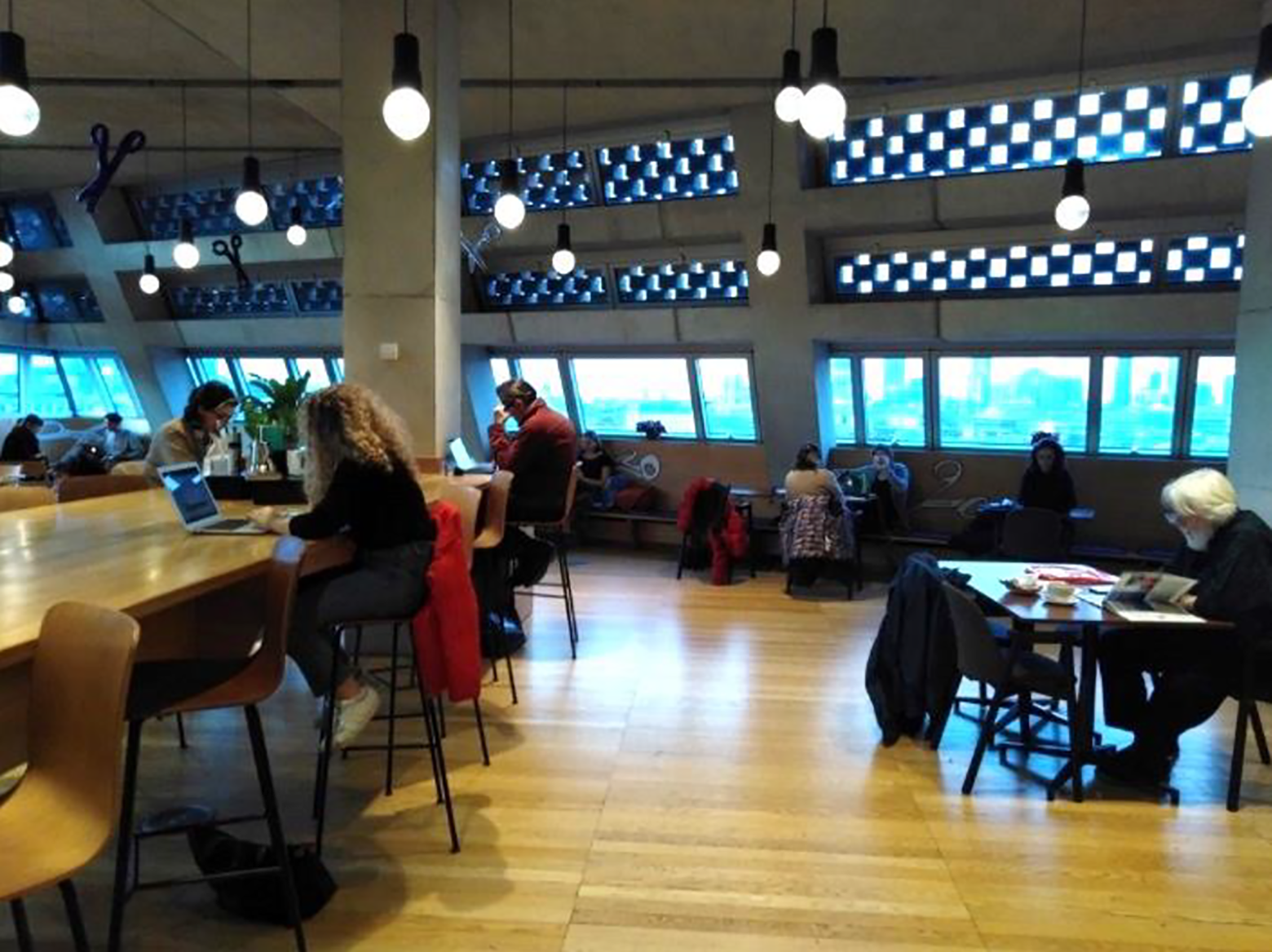
Evidence of hominess threshold in a productive third place (fieldwork).
Like Victoria, many respondents described their favorite PTP as a place where they feel at ease to work and where they do not have to behave as they would in an office. At the same time, they acknowledge the difference from working from home, where they may feel, by contrast, too comfortable to work. In third places, they cannot “take [their] shoes off.” As Victoria describes, the PTP feels not like her own kitchen where she is at home but like her mother’s where she is a guest. By meeting this hominess threshold, PTPs align their servicescape with customer-workers’ desire to engage in focused work. For instance, the music is never too loud in PTPs, and neither is the overall noise level. This atmospheric control discourages boisterous socializing among customers.
PTP Targeting: Productive Cosmopolitanism as Professional Identity
The second dimension of the PTP’s value proposition is symbolic, as visiting PTPs reinforces and manifests customer-workers’ professional identity. Professional identity is a fundamental source of meanings for contemporary customers (Bellezza, Paharia, and Keinan 2017; Press and Arnould 2011). By not having an office nor colleagues with whom they socialize in person on a daily basis, flexible and remote workers are deprived of an important source of meanings, fundamental for their well-being (Petriglieri, Ashford, and Wrzesniewski 2019). PTPs provide value to customer-workers by satisfying symbolic and identity needs.
In London’s PTPs, customer-workers’ professional identity takes the form of productive cosmopolitanism. By visiting PTPs, customer-workers can see themselves as busy, competent professionals belonging to the exciting city life (see Bellezza, Paharia, and Keinan 2017; C. J. Thompson and Tambyah 1999). Productive cosmopolitanism is one of the manifold professional identities that can be reinforced by PTPs. It is likely to emerge in global cities like the UK capital city and its suburbs we examined in our fieldwork. We observe the salience of this aspirational identity both in our interviews and in the marketing materials collected from PTPs. This is exemplified by the Ace Hotel, a well-frequented PTP, who explicitly targets customer-workers by promoting this aspirational professional identity. Fourteen photographs rotate on the hotel website’s landing page: Only one shows a bedroom; two show customer-workers. The great majority of the photos are of London’s busy streets: the canal walk on a sunny day, the culturally diverse spectacle of street artists and street food vendors, and an assortment of trendy shops. This highlights the connection between working from the hotel’s lobby or café/bar and experiencing the cultural effervescence of the city as a professional. This connection is reiterated throughout the hotel’s communication platform with statements such as “Every evening in our Lobby Bar from 7 p.m. onwards till late we have one of our resident DJs playing tunes whilst people work, wind down or socialize” (Ace Hotel website, last accessed April 4, 2020).
Through this meaning-making activity, PTPs offer customer-workers opportunities to build their professional identity as competent urban professionals. This, in turn, may help them overcome the vulnerabilities that come with their professional status such as loneliness or isolation (Petriglieri, Petriglieri, and Wood 2018; Spreitzer, Cameron, and Garrett 2017). Customer-workers have internalized productive cosmopolitanism in their justification of work practices in third places. The quote below is an extract from Liz’s interview, which took place in the Tate Modern Members Room, overlooking the City of London: I miss that life. I miss the part of me that used to go and walk into the City of London every morning. So this helps to keep my professional career a little bit more…like feeling connected to what’s going on, not just in the City but in London, in business, you know. So quite emotional […] coming here does make me feel like I’m more connected to my old life and part of something that’s going on in London, you know, even though I’m just sitting looking at it. I feel like I’m not on my own […] that it connects with me in terms of my identity. And I think the proximity to the City of London is quite an important thing, you know. It connects with my old work life, this was a really familiar area where I spent a lot of time and that connection with me as a person, I feel like that’s quite important, I feel the location is quite important. (Liz, 39, customer-worker)
In summary, we define the PTP as a public place that facilitates customers’ work practices while allowing for the simultaneous unfolding of socializing. The PTP has a twofold value proposition designed to meet customer-workers’ functional and symbolic needs. First, the PTP adapts its servicescape to customer-workers by meeting a hominess threshold and providing functional value as a work accelerator. This contrasts with the hominess and intimacy of the archetypal third place. Second, the PTP specifically targets customer-workers by promoting a valuable professional identity. In global cities like London and its suburbs, this professional identity takes the form of productive cosmopolitanism, where customer-workers are busy, competent professionals and a legitimate part of the exciting city life. This contrasts with the urban flaneur consumer identity promoted by the archetypal third place to build a sense of community and neighborhood belonging.
Discussion
Implications for Third-Place Literature
Our work contributes to the service literature on third places in three ways. First, we provide a strategic perspective on the implications of customer-worker for third places. We take a nuanced view toward the argument that customer-workers either silence third places (Oldenburg and Brissett 1982; Rosenbaum 2006) or have a marginal influence (Griffiths and Gilly 2012). We emphasize that customer-workers represent a growing, strategic, and valuable customer segment for some third places as they create financial, marketing, and atmospheric value. Because customer-workers can also cause conflicts, we note that the value brought by customer-workers is always situated within the type of third place. More research could be conducted to understand which other commercial spaces might be impacted by this customer segment (see Table 3, Topic 3). Our second contribution lies in highlighting the increasing differentiation of the third-place market, which evolves to answer the rise of customer-workers. We argue that customer-workers’ practices unveil new types of experiences and conflicts in third places that lead to a transformation of some third places. Our research thus extends prior literature that often considers third places as a homogenous market (Griffiths and Gilly 2012; Rosenbaum 2006; C. J. Thompson and Arsel 2004). As global trends (e.g., COVID-19 pandemic) keep encouraging flexible work, we encourage quantitative research to understand the market repartition across the four types. Third, we contribute to the literature by theorizing a new type of third place: the PTP. We show how the PTP meets customer-workers’ functional (e.g., hominess threshold) and symbolic needs (source of professional identity). This duality in the value proposition extends the instrumental value defined by the place-as-work framework advanced by Griffiths and Gilly (2012). By highlighting these different types of third places, our research also expands our understanding of what it means to be an in-between space. PTPs bring value to their customers by offering a flexible and permeable boundary space, which is not only neither home nor work but also both home and work. In that sense, PTPs do not only demarcate but also coordinate and integrate, thus facilitating efficient boundary spanning (Oldenhof, Stoopendaal, and Putters 2016) between home and work. The hominess threshold found in PTPs helps flexible workers reterritorialize their work practices (Gandini 2015; Griffiths and Gilly 2012) and differentiate between workspace and home space. The PTP, thus, plays the role of a flexible boundary space between the first place (home) and the second place (work). This is an interesting topic for future research to explore further.
Avenues for Future Research.
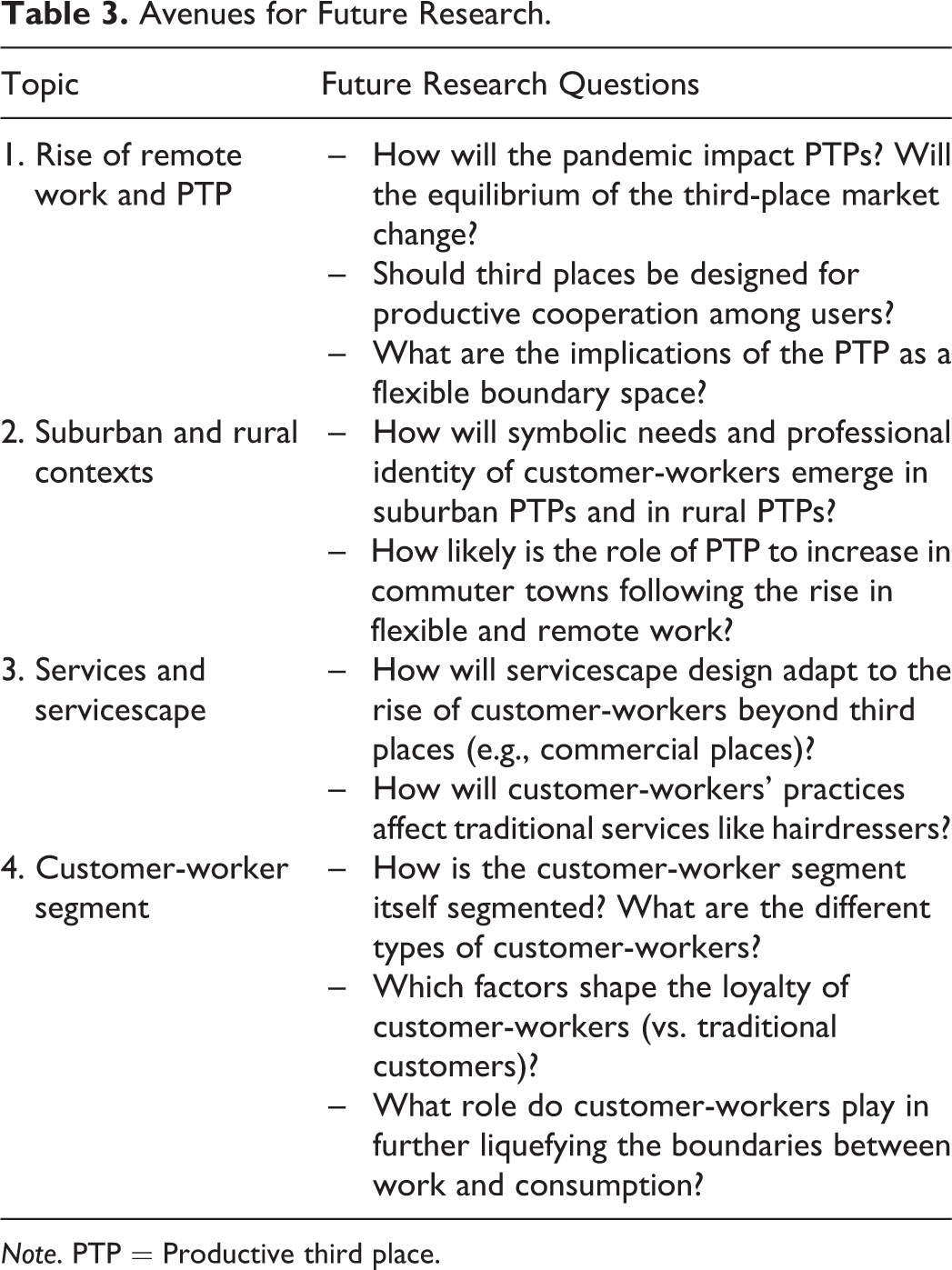
Note. PTP = Productive third place.
We extend consumer research that conceives third places as places of leisure (Debenedetti, Oppewal, and Arsel 2014; C. J. Thompson and Arsel 2004) or resistance (Kozinets 2002; Maclaran and Brown 2005) by showing how third places can also be places of production. We show that spaces of consumption enable practices of production, revealing the productive power of consumption. Conversely, productive work practices contribute to the creation of hybrid spaces of production and consumption in the form of PTPs. In doing so, our research shows the importance of fluid, alternative workspaces and adds to recent research on nondominant places of work (Shortt 2015). PTPs’ growth documents an incorporation of work and business organizations into public, commercial places. Cnossen, Vaujany, and Haefliger (2020, p. 13) note that the gig economy merges spaces of consumption with spaces of organization and “colonize[s]” the streets with work (e.g., when flexible workers use public parks and benches). Our research shows how third places adapt their servicescape and evolve to integrate (or reject) temporary work practices of customer-workers. In doing so, some third places permanently change their servicescape to accommodate transient customer practices. This dual dynamic unveils possible tensions between the solid nature of servicescape adaptation (i.e., new, comfortable chairs, tables, working Wi-Fi) and the liquid nature of customer-workers’ consumption in the space (Bardhi and Eckhardt 2017). Future research should continue to investigate the fluid, blurry relationships between work, consumption, and public places (see Table 3).
New Ways of Working and Service Marketing
Our research highlights the potentially transformative value (Blocker and Barrios 2015) of the PTP offering, thus contributing to understanding how service research can help address some of the challenges related to new ways of working (Kossek and Lautsch 2018; Petriglieri, Ashford, and Wrzesniewski 2019). Traditionally, third places have been found to be most important for populations who are not able to socialize through work (Hickman 2013). Such customers—for instance, young parents, unemployed individuals, or retirees—depend on third places to provide them with community and belonging benefits necessary to their well-being (Glover and Parry 2009; Rosenbaum 2009; Rosenbaum et al. 2007). Despite having meaningful employment, flexible workers may not be able to socialize or be around others through their work (Petriglieri, Petriglieri, and Wood 2018). We argue that the PTP plays a societal role by providing isolated workers with access to the health and well-being benefits of socializing. Thus, the PTP remains a key pillar of the community and follows what has long been conceived as third places’ mission by meeting the work needs of local customer-workers. PTPs bring flexible workers together physically, which can help customer-workers build a professional network crucial to professional success in contemporary society (Wittel 2001). More research should be conducted on how PTPs can foster productive cooperation among customer-workers (see Table 3).
We also suggest that PTPs provide opportunities for flexible workers to accumulate symbolic and identity benefits. Third places bring flexible workers “away from boredom and amidst the flow of public life, fresh encounters, and better coffee” (Cnossen, Vaujany, and Haefliger 2020, p. 18). We extend this idea by showing how, through meaning-making, PTPs offer a seat at the busyness lifestyle (Bellezza, Paharia, and Keinan 2017) table for otherwise (mostly) homebound workers. Eikhof and Haunschild (2006) argue that adopting a bohemian lifestyle helps creative entrepreneurs maneuver the tensions between creative work and necessary managerial work (marketing, promotion, etc.). Similarly, PTPs enable many flexible workers to adopt a cosmopolitan lifestyle (C. J. Thompson and Tambyah 1999) that helps them balance working alone with a sense of belonging to a professional, urban scene. Being able to work from anywhere allows them to perform the digital nomad lifestyle, if they so wish (B. Y. Thompson 2019), and add to their experiential curriculum vitae (Keinan and Kivetz 2011). It answers the desire of middle-class young adults to engage in novel experiences (Weinberger, Zavisca, and Silva 2017). However, the digital nomad lifestyle may only be accessible to a certain type of flexible worker—those who are young, affluent, and without caring duties. For less privileged workers, the PTP may be the only place they can get some work done. To evidence this diversity and its marketing consequences, more research could be carried out to examine the professional identities that emerge in suburban and rural areas as well as the different types of customer-workers and their role (see Table 3, Topics 2 and 4).
Managerial Implications
We believe our research to be of high relevance for managers of third places, who are facing the rise of customer-workers and are often unsure about how to deal with them. Customer-workers represent a significant population and have currently unmet needs for accessible servicescapes that welcome work practices. For instance, in digital work, 35% of workers state that they work remotely occasionally, while 16% do so full-time (Holst 2020). Table 3 identifies criteria to differentiate the four third-place types and proposes recommendations for each type to manage customers and capture their potential value.
Managerial Recommendations.
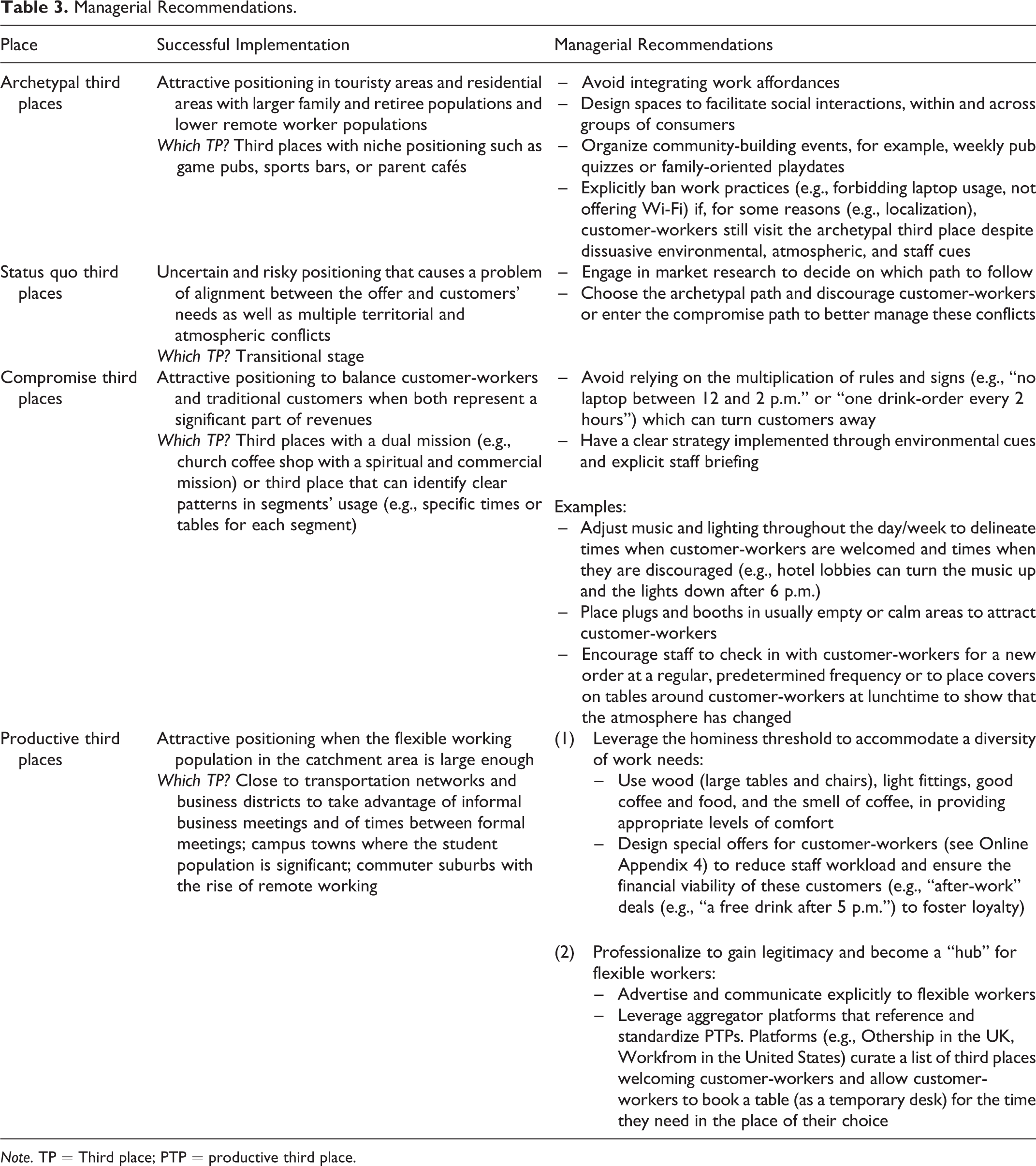
Note. TP = Third place; PTP = productive third place.
Supplemental Material
Supplemental Material, sj-docx-1-jsr-10.1177_10946705211014278 - Customer Work Practices and the Productive Third Place
Supplemental Material, sj-docx-1-jsr-10.1177_10946705211014278 for Customer Work Practices and the Productive Third Place by Laetitia Mimoun and Adèle Gruen in Journal of Service Research
Supplemental Material
Supplemental Material, sj-docx-2-jsr-10.1177_10946705211014278 - Customer Work Practices and the Productive Third Place
Supplemental Material, sj-docx-2-jsr-10.1177_10946705211014278 for Customer Work Practices and the Productive Third Place by Laetitia Mimoun and Adèle Gruen in Journal of Service Research
Supplemental Material
Supplemental Material, sj-docx-3-jsr-10.1177_10946705211014278 - Customer Work Practices and the Productive Third Place
Supplemental Material, sj-docx-3-jsr-10.1177_10946705211014278 for Customer Work Practices and the Productive Third Place by Laetitia Mimoun and Adèle Gruen in Journal of Service Research
Footnotes
Authors’ Note
Both authors collaborated equally on the article.
Declaration of Conflicting Interests
The author(s) declared no potential conflicts of interest with respect to the research, authorship, and/or publication of this article.
Funding
The author(s) disclosed receipt of the following financial support for the research, authorship, and/or publication of this article: This study was supported by City, University of London (Grant ID City Pump Priming 90634AL).

Supplemental Material
The supplemental material for this article is available online.
Note
Author Biographies
References
Supplementary Material
Please find the following supplemental material available below.
For Open Access articles published under a Creative Commons License, all supplemental material carries the same license as the article it is associated with.
For non-Open Access articles published, all supplemental material carries a non-exclusive license, and permission requests for re-use of supplemental material or any part of supplemental material shall be sent directly to the copyright owner as specified in the copyright notice associated with the article.
