




Abstract
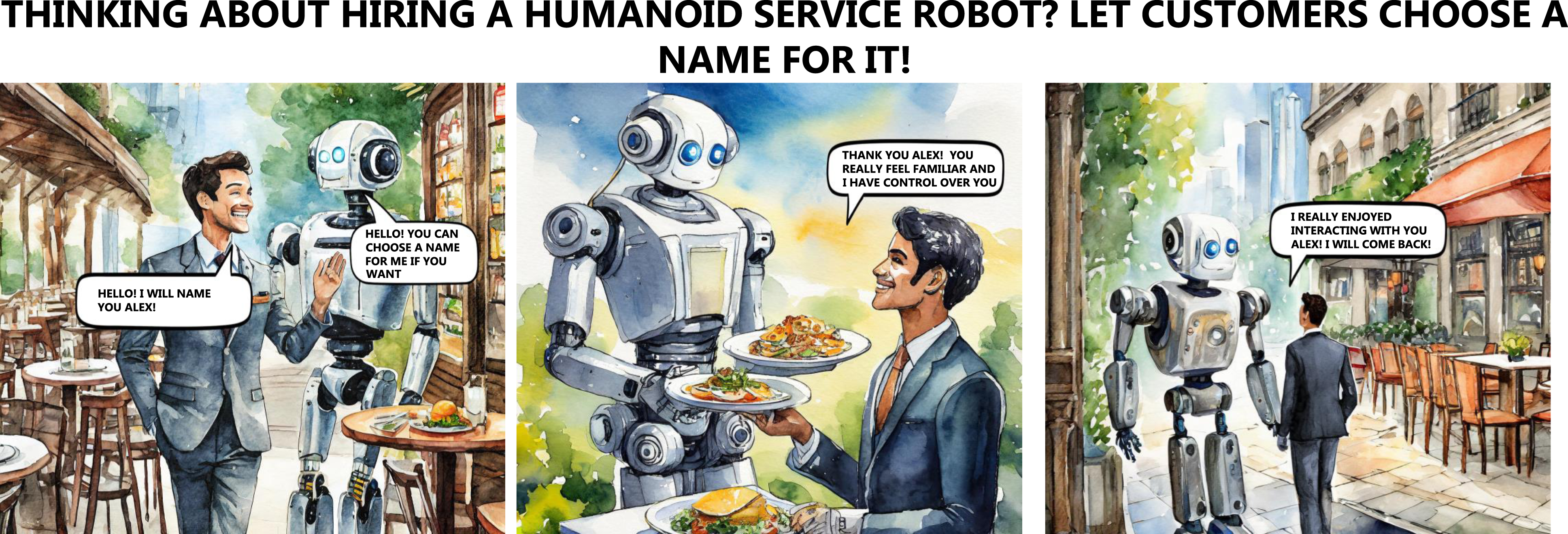
Though Humanoid Service Robots are the “holy grail” of robotics, the discomfort, specifically the feelings of eeriness, they elicit in consumers still raises concerns as to their successful implementation in service settings. From a firm’s point of view, the main question revolves around how to integrate humanoid service robots without hurting consumers' repurchase intent as a result of their perceived eeriness. The results of four experiments (including a study involving real interactions), using four distinct humanoid service robots and four different service settings, collectively examine a novel marketing solution which consists of consumers assigning a name to a humanoid service robot. We show that humanoid service robots with customer-assigned names versus no name or store-assigned names increase consumers' repurchase intent. This is because the act of naming simultaneously increases perceived familiarity of the humanoid service robot and control over it, which decrease its perceived eeriness and consequently increase consumers' interaction enjoyment. Altogether, our studies offer theoretical and managerial insights on how engaging consumers in the act of naming can facilitate technological infusion into service frontlines.
Get full access to this article
View all access options for this article.
References
Supplementary Material
Please find the following supplemental material available below.
For Open Access articles published under a Creative Commons License, all supplemental material carries the same license as the article it is associated with.
For non-Open Access articles published, all supplemental material carries a non-exclusive license, and permission requests for re-use of supplemental material or any part of supplemental material shall be sent directly to the copyright owner as specified in the copyright notice associated with the article.
