




Abstract
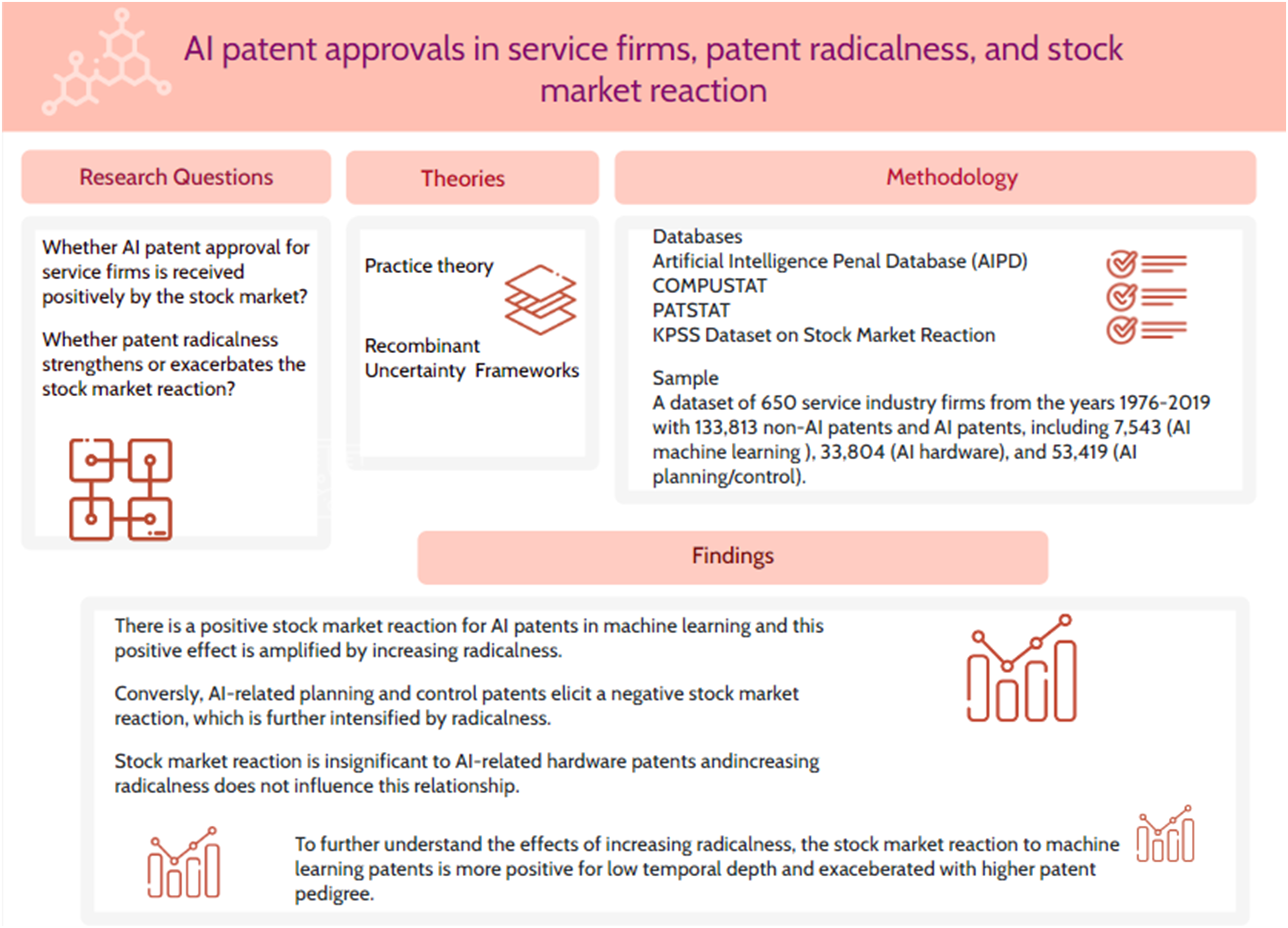
Artificial intelligence (AI)-driven automation is of growing interest in the service sector. Using practice theory in service innovation and recombinant uncertainty frameworks, we ask whether AI patent approval for service firms is received positively by the stock market and whether patent radicalness strengthens or exacerbates the stock market reaction. We draw on 650 service industry firms from the years 1976 to 2019 with 133,813 non-AI patents and AI patents, including 7,543 (AI machine learning), 33,804 (AI hardware), and 53,419 (AI planning/control). The results show that the stock market reaction is positive for machine learning AI patents, and increasing radicalness strengthens the positive relationship; however, the reaction is negative to AI-related planning and control patents and increasing radicalness exacerbates the negative reaction. In addition, stock market reaction is insignificant to AI-related hardware patents and increasing radicalness does not influence this relationship. The findings are robust to excluding large firms representing a significant portion of the AI patents. With increasing radicalness, the stock market reaction to machine learning patents is more positive for low temporal depth and exacerbates with higher patent pedigree. The findings have implications for AI patenting among firms in the service sector.
Get full access to this article
View all access options for this article.
References
Supplementary Material
Please find the following supplemental material available below.
For Open Access articles published under a Creative Commons License, all supplemental material carries the same license as the article it is associated with.
For non-Open Access articles published, all supplemental material carries a non-exclusive license, and permission requests for re-use of supplemental material or any part of supplemental material shall be sent directly to the copyright owner as specified in the copyright notice associated with the article.
