




Abstract
This article develops a decision model which enables service firms to optimize their productivity. Companies must efficiently determine the necessary resource input to increase service productivity to meet customer demand. In so doing, managers face service-specific challenges: They must select the appropriate type and quantity of limited resources to deliver services efficiently, consider the volatility of demand to provide services effectively, and integrate the interaction effects of resources in terms of substitution to utilize constraint resources optimally. In addressing these challenges, we develop an interdisciplinary approach by combining insights from service research and operations research to create a decision model that helps managers select the optimal type and quantity of resources available to overcome the abovementioned challenges. We validate our model in several case studies and further generalize our findings by applying it to different data settings. Ultimately, we prove that productivity can be increased significantly if firms optimize resource selection by considering stochastic demand, the effects of substitution among resources, and resource constraints.
Keywords
The growing importance of technology and artificial intelligence (Huang and Rust 2018, 2021) and the shortage of service employees (e.g., Bhattarai and Penman 2023; Horowitz 2021) in service encounters forces service firms to address a significant challenge: Companies must efficiently determine the necessary resource input (e.g., level of human resources and computer-aided support) to meet customer demand. This optimization of service productivity directly impacts the bottom-line profitability of service firms. However, while technological advancements progress and services became pivotal for economic growth, service productivity is declining in many developed countries, suggesting that productivity-enhancing approaches at the firm level have yet to materialize (Hofmeister, Kanbach, and Hogreve 2023a). Therefore, in his call for action, Andreasen (2021) highlights the necessity to research service productivity so service firms can achieve sustainable growth.
The managerial issue of obtaining high service productivity is present in nearly all industries. Healthcare industries further exemplify the productivity issues service firms face in input- and output-related decisions: The COVID-19 pandemic has shown that limited hospital resources such as nurses and beds must be used as efficiently as possible. At the same time, a sufficient level of patient care and service quality must be maintained. Therefore, hospital managers need to optimize the workload for medical staff, even in unexpected emergencies, while operating with specific capacities and limited idle times to ensure cost-efficient operations. These challenges in managerial practice are widely acknowledged in academic literature focusing on service productivity (e.g., Anderson, Fornell, and Rust 1997; Mittal et al. 2005; Rust and Huang 2012; Wirtz and Zeithaml 2018).
Optimizing service productivity requires strategic and efficient planning of capacities as resources cannot be scaled up or down on a short-term basis (Mittal et al. 2005; Rust and Chung 2006). Thus, our research develops a strategic decision support system to optimize service productivity based on the seminal work of Rust and Huang (2012). Adopting a profit-optimization perspective, Rust and Huang (2012) demonstrate how firms can obtain higher service productivity by optimizing resource selection. We add to this research by extending the optimization model by Rust and Huang (2012) and contribute in several ways. First, Rust and Huang (2012) are the first to research service productivity within a decision context. In their model, the authors show that productivity increases can be obtained by the optimal selection of two main resources: automation and labor. In managerial practice, however, firms usually deal with multiple resources. Furthermore, each resource type is available at different quality levels. For example, in a hospital, physicians with different seniority and qualification levels are essential for patient care; other resources include nurses, administrators, medical devices, and technologies. Thus, our model considers multiple resources and different resource qualities to increase managerial applicability. We deal with a strategic decision problem where managers need to make decisions in the long-term context. In this context, the decision-maker determines the resources on a longer planning horizon.
Second, customer demand for services is not fully known in advance and is subject to deviations. However, whenever customer demand exceeds the capacity of a service firm, profits are lost; the opportunity to sell a service will either disappear, or high investments will be needed to win back lost customers. An emergency room, for instance, must provide sufficient health care levels, even in unexpected emergencies. Therefore, patients must be transferred to other hospitals if demand exceeds capacity. We address this critical issue by considering stochastic demand, thus revealing how capacities can be managed strategically and on a long-term basis best in the face of demand volatility. The current state-of-the-art in the service literature is to model known deterministic demand. From a scientific perspective, we contribute to the literature by following a stochastic approach capable of handling uncertainties in the inputs applied.
Service managers must strategically select their resources in light of the constraints they face (e.g., labor shortage, budget constraints, flexibility of technological resources) and of different employee qualification levels (e.g., highly flexible and experienced workers, less experienced workers that can fulfill only specific tasks). These resources may be permanently or temporarily substituted. Again, in the hospital context, take surgery services as an example: robot-assisted surgery technologies partially substitute for the work of physicians, expediting a patient’s healing process and shortening expensive hospital stays. We extend previous work by considering resource constraints along with permanently and temporarily substitutable resources. This yields a more sophisticated sense of how service productivity can be optimized through resource allocation, capacity management, and substitution effects.
Finally, we test our model using case studies with industry applications and a general data set. This reveals how service productivity can be optimized across different industries and settings (e.g., resources with varying qualification and quality levels or high degrees of customer coproduction), as well as enhances current literature with general insights about optimizing service productivity given multiple resources, resources constraints, stochastic demand, and permanently or temporarily substitutable resources. We demonstrate that correctly considering stochastic demand enables firms to increase performance significantly, and we identify substituting resources as a significant lever of service productivity management.
The Service Productivity Challenges
Traditionally, productivity is defined as the ratio of inputs and outputs (Deming 1986). Services, however, inherently call for a broader understanding of productivity given that they involve several input- and output-related issues (Grönroos and Ojasalo 2004; Rust and Huang 2012; Wirtz and Zeithaml 2018). We address these issues and define service productivity as a strategic decision variable to optimize firms’ profits (Rust and Huang 2012).
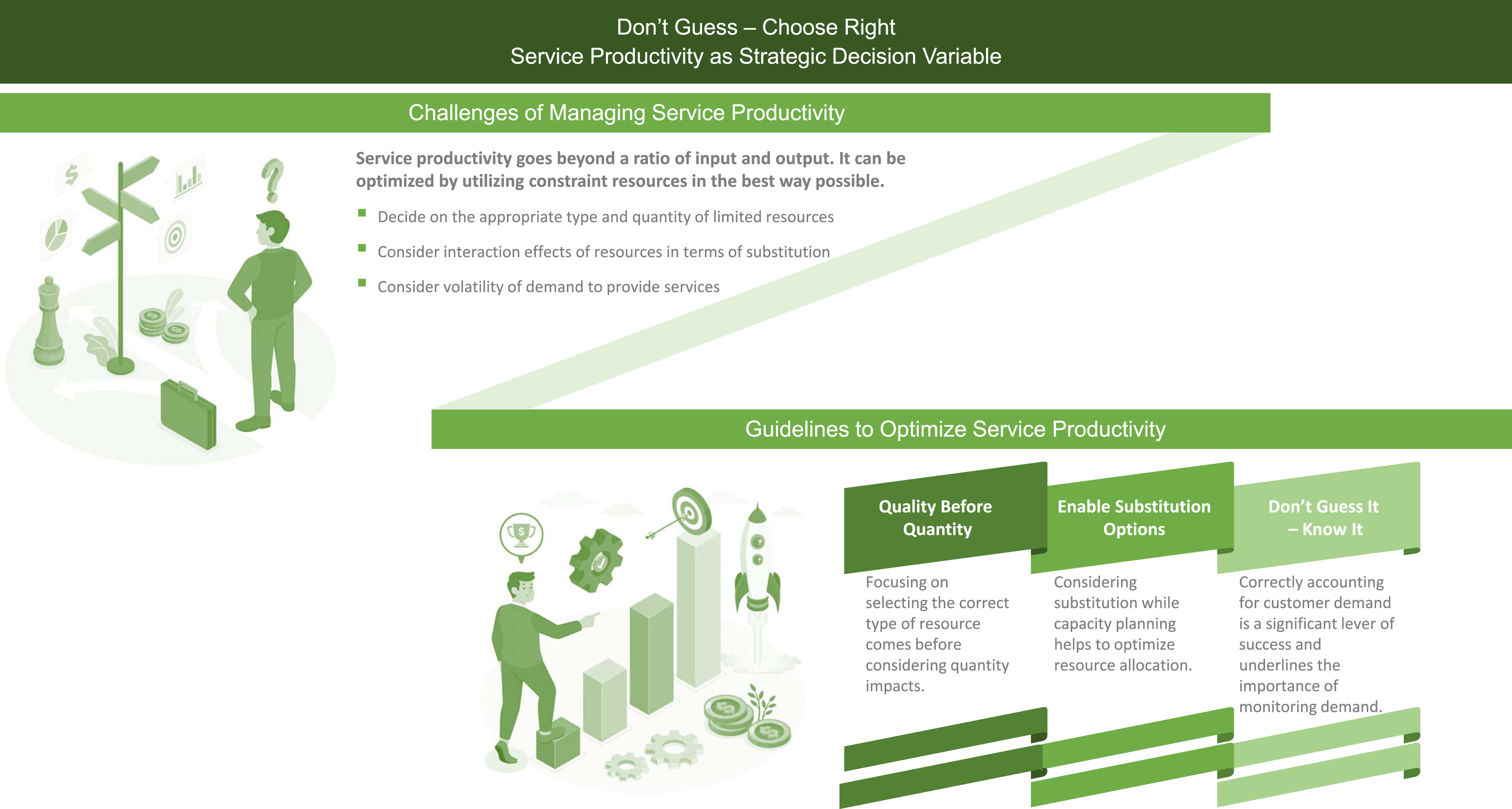
In managing service productivity, we identify three main challenges: First, firms need to balance long-term investments and generate a service output that creates external interest and meets operational objectives to get an optimal response for their resources at the same time (Anderson, Fornell, and Rust 1997; Grönroos and Ojasalo 2004; Mittal et al. 2005; Rust and Huang 2012; Rust, Moorman, Dickson 2002; Rust, Zahorik, and Keiningham 1995). Service productivity depends on various resources, including, for example, service employees and their ability as well as a willingness to deliver service quality (Marinova, Ye, and Singh 2008; Singh 2000), customers’ willingness to coproduce (Auh et al.2019; Nachum 1999, Xue and Harker 2002), and the information technology supporting the service delivery process (Hogreve and Beierlein 2023; Huang and Rust 2021; Rust and Huang 2012). Each resource adds to the quality of the service outcome and generates revenues. Still, each has its costs, for example, wages, training, and development, or ensuring the functionality of the technical infrastructure. Consequently, we delineate the first challenge firms are confronted with while optimizing their levels of service productivity:
1. To optimize service productivity, managers must determine on a strategic level the optimal type and quantity of resources from a set of multiple yet limited resources (e.g., due to labor shortage).
Second, service creation and consumption happen simultaneously (Zeithaml, Bitner, and Gremler 2017). As services cannot be stored, meeting the volatile and unknown customer demand is a powerful lever in obtaining high service productivity by efficient capacity utilization (Armistead and Clark 1994). This is relevant as the resources cannot be scaled up or down on a short-term basis. Companies need to provide these resources from a long-term perspective and can adjust capacities within longer planning periods. In the hospital, for example, other departments within the hospital could send physicians and nurses to compensate for capacity shortages. From a governmental planning perspective, the planners of an entire region could share resources across hospitals. Similarly, the resources of an entire company network (e.g., with different subsidiaries) can be shared across the different entities (e.g., different locations). Limited capacities might mean that certain resources are temporarily or permanently unavailable yet may be substituted; for example, service technologies might substitute for service employees, or customer input might replace employees’ input during coproduction (Mills and Morris 1986). This might happen due to manifold reasons, such as short-term breakdown of self-service devices, shortages of human resources, or demand exceeding management expectations. Such substitutions affect service outcomes in terms of quality and costs. For example, less experienced employees might be less costly than experienced employees, yet negatively affect service quality (Marinova, Ye, and Singh 2008; Meyer Goldstein 2003; Nachum 1999; Singh 2000). The same is true for customer coproduction and its effects on service outcomes depending on customers’ willingness and ability to coproduce (Auh et al. 2019; Bendapudi and Leone 2003).
Consequently, the decision problem in optimizing service productivity formulated in our first statement is increased as it cannot be done for each resource individually. Additionally, decisions about which type and quantity of resources to invest among a set of multiple, substitutable, and limited resources are required. We thus formulate the second challenge:
2. To optimize service productivity, managers must consider resources' limited availability and substitutability when deciding on the optimal selection of resources.
Third, resources might be temporarily or permanently unavailable and might be substituted, for instance, customer input, substituting employees’ input during coproduction processes (Mills and Morris 1986). Although we find incidents concerning these issues in current service research (e.g., Haumann et al. 2015), they are not fully addressed in the service management literature. In a service context, supply and demand are interrelated as service production and consumption happen simultaneously in real-time. Controlling service quality, for example, in terms of individualization or achieving economies of scale, are much more complex than products (Chase 1978, 1981; Wirtz and Zeithaml 2018) as demand cannot be backlogged, excess demand or capacity cannot be stored or transferred to another period, and hence the demand and profit of servicing these customers are lost. Customers usually arrive at a service provider and are either served within the period of their arrival or turned away (Armistead and Clark 1994; Armstrong, Morwitz, and Kumar 2000; McLaughlin and Coffey 1990; Wirtz and Zeithaml 2018). Consequently, managing service productivity requires accounting for highly volatile demand (Dobni 2004; Rust and Chung 2006). We thus phase the third challenge:
3. To optimize service productivity, unknown customer demand must be considered.
Current research on service productivity only partially addresses these challenges in combination. Instead, the focus has fallen on how single antecedents like human resources (Marinova, Ye, and Singh 2008; Singh 2000), technology (De Jong, De Ruyter, and Lemmink 2003; Huang and Rust 2021; Rust and Huang 2012), processes and service design (Melton & Hartline 2013; Nakata Cheryl & Hwang Jiyoug 2020), and customers (Frei and Harker 1999; Haumann et al. 2015; Xue and Harker 2002) influence efficiency and/or effectiveness of services and how these antecedents can be managed accordingly. In addition, substituting or interacting effects of resources generally are only partially considered for two resources (e.g., Rust and Huang 2012), whereas service firms usually have to choose from many substitutable resources.
Yet challenges in managing service productivity go beyond which resources to invest. Service managers must balance resource allocations and efforts to meet customers’ expectations (e.g., service quality) as well as internal operational objectives (e.g., budget constraints, costs) to get optimal economic results depending on actual demand (Marinova, Ye, and Singh 2008; Rust, Zahorik, and Keiningham 1995; Wirtz and Zeithaml 2018). To fully address the complexity of service productivity, we need a more nuanced understanding and a comprehensive decision model on how to select the right type and quantity of resources from a limited pool of multiple resources (such as human resources, technology, and customer coproduction) under given demand volatility and possible substitutions of resources.
Drawing on decision theory, Rust and Huang’s (2012) seminal work discusses service productivity as a strategic decision variable that allows firms to select their optimal level of service productivity and optimize their profits. Yet the practical applicability of this model could be expanded because the particularities of managing service productivity (like specific resource selection, stochastic demand, and substitutions) are only partially addressed. However, literature and managerial practice need more tools and methods to gain the optimal balance of efficiency and effectiveness through strategically optimizing resource selection (Mittal et al. 2005; Rust and Chung 2006). “What is needed is a method to help managers decide where they are likely to get the greatest response for their limited resources” (Rust, Zahorik, and Keiningham 1995, p. 59). With our proposed decision model and its application, we seek to fill this apparent gap in literature.
Decision Problem and Associated Model
We build on the work of Rust and Huang (2012) by developing a strategic decision model that helps managers to optimize service productivity by selecting resources and determining the quantity of substitutable and constrained resources required to deliver services under stochastic demand. We denote the decision problem as Capacitated Service Productivity Model with Substitutions (CSPMSUB).
Decision Model and Resource Constraints
As outlined in our first challenge, managers need to select resources



The objective function is quantified in equation (1). Equation (2) limits the available resources to the capacity constraint
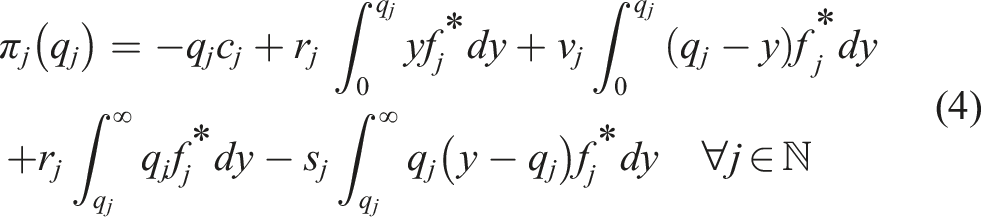
Beyond optimal resource selection, we further consider leftovers: Whenever resources remain unused, there are salvage values. In the best case, those remaining resources can be used for services with lower profitability or, in the worst case, perish fully without being consumed. For example, a senior worker can fulfill the jobs of a junior worker. Furthermore, demand cannot be backlogged, and if demand has been underestimated, shortage costs occur (e.g., costs to retain unsatisfied customers). To factor in stochastic demand, the estimated demand
Addressing these issues, the first term in equation (4) quantifies the total input costs for the resource
Demand Model and Substitutions
Beyond the challenge of optimized resource selection, we consider the challenge of substitution effects among resources (e.g., a higher qualified nurse may complete jobs of a lower qualified nurse during a peak period) and the dependence on a stochastic demand (e.g., demand is not per se known when defining the headcount for each qualification level). We consider demand depending on resource availability (e.g., care capacity in a hospital) and the associated quality of a resource (e.g., higher qualified doctors for certain surgeries). For example, consider a less experienced employee who might negatively affect service quality compared to a well-experienced employee and, in turn, negatively impact service demand. Thus, total demand for a selected resource
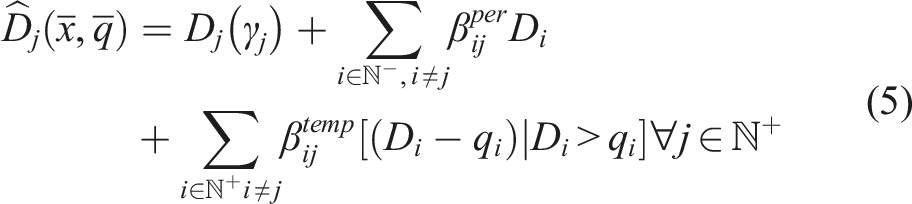
The first part of equation (5) denotes the volume that a customer initially prefers of resource j. The base demand is also impacted by the service quality
Given that demand is highly volatile, however, it might exceed the capacity of a service firm. Either demand cannot be satisfied, or it may be more profitable to force customers to switch to more profitable substitutes (e.g., if a lower qualified hairdresser is not available, the customer may choose hair cutting from the more qualified hairdresser). Hence, substitution effects are part of the decision-making process. We assume that if a resource is permanently unavailable (e.g., not provided at all due to changing constraints) or temporarily unavailable (perhaps already consumed by other customers during peak demand), it can potentially be replaced by another resource. The probability of replacing one resource with another is expressed as the substitution rate. Substitution effects are integrated into the demand function by combining the base demand for resource
The demand function of each resource j depends on the vector of the decision variables,
We assume that the probability density function
To summarize, the total demand for each selected resource
The underlying optimization problem is NP-hard and integer knapsack problem with a nonlinear and non-separable objective function. Solving the integer problem with a full enumeration or commercial solver (like CPLEX or Gurobi) is only possible for toy problems. We, therefore, develop a specialized heuristic built on a Lagrange derivation and a bi-section algorithm to determine optimal quantities under constraints and a rounding algorithm to find optimal integer quantities. Details of the solution approach, its detailed computation steps, and its algorithmical approach can be found in the Web Appendix.
Case Studies and Numerical Analysis
Overview of Case Studies.
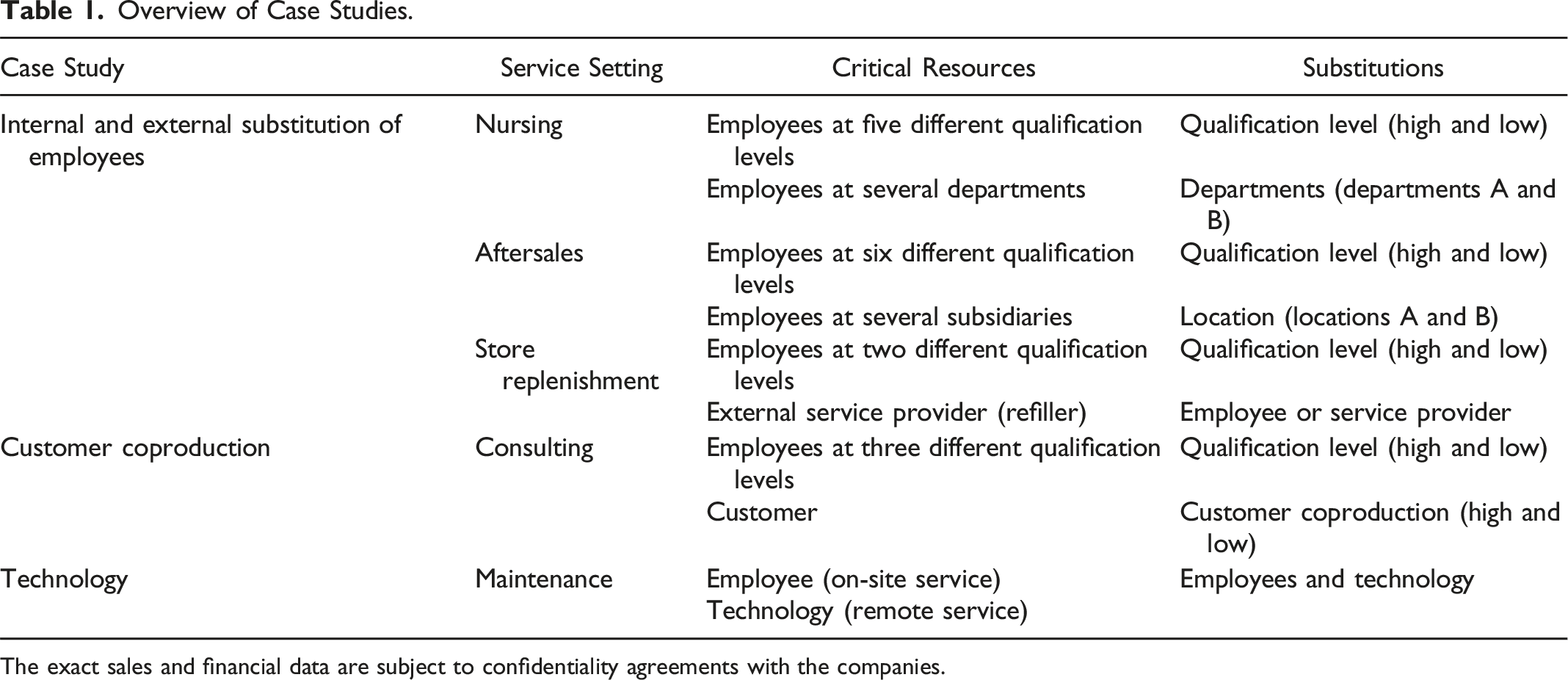
The exact sales and financial data are subject to confidentiality agreements with the companies.
Case Study Setting and Data Description
Internal and External Substitution of Employees
We conducted three case studies to analyze how employees in different settings impact service productivity from an internal and external substitution perspective.
Internal Substitution
For internal employee substitution, we consider substitutions among employees with varying levels of qualification in distinct departments and at distinct subsidiaries. We worked on the internal substitution with two different companies (see Table 1). First, we applied the model in a large maximum-care hospital with different clinical departments and nursing staff as critical resources. Nurses have different qualification levels (e.g., head of the nursing unit, senior nurse, junior nurse, assistant nurse, or transportation and assistance nurses) and specialize in one department. Yet nurses can partially execute jobs for other departments so that they can be substituted. Furthermore, nurses substitute themselves within a department; whereas all can execute standard treatments, for example, more complicated procedures are performed only by senior nurses. The substitution possibility is expressed in the substitution rate
Unit costs
Second, we apply our model to a manufacturing firm offering maintenance services to industrial customers. The main resources are engineers with distinct qualification levels (e.g., basic mechanics, advanced mechanics, and engineers with a university degree). The firm operates subsidiaries in different locations with various qualification levels and wages (i.e., costs for the resource) by location. The firm charges different revenue rates
External Substitution
To go beyond firm-internal substitution among employees, we conducted a case study considering the substitution of employees by external service providers. In a retail context, in-store logistics represent an expensive part of the supply chain, and retailers often engage external and dedicated shelf refillers to replenish the shelves. This regular shelf replenishment is scheduled, and the frequency is determined based on the weekly pattern of deliveries. Thus, refillers come on days with warehouse deliveries to execute shelf replenishment. In between the two warehouse deliveries, the regular sales staff restocks if the shelf inventory of a product is too low. Varying sales and delivery sizes result in varying demand for shelf replenishment jobs.
In our case study, the retailer had to determine the appropriate working hours of external refillers (
Revenue per resource
Customer Coproduction
To analyze the distinct resource of customer coproduction, we obtained data from a consulting firm focused on engineering and planning services for logistics systems. Joint planning teams of employees and customers coproduce the design of warehouse systems. Results are achieved in customer coproduction by partially or fully taking over the planning, operations, and maintenance of the logistics system. Each planner thus generates revenues
If planners engaged exceed requirements, they take over partially internal responsibilities or work part-time for other customers. This generates salvage values
Technology
Finally, we focus on technology as a lever of service productivity within a healthcare firm providing hospital maintenance services. The firm can either send employees to the customer’s site or use technology to deliver the service remotely. The decision problem is to optimally select the required service level (i.e., the resources
If technicians are not engaged in any customer service during idle times, they can complete other jobs resulting in revenues for alternative jobs, which are described as salvage value
Summary of the Case Study Results
Summary of Results Obtained From Case Studies (in % of Current Profit).
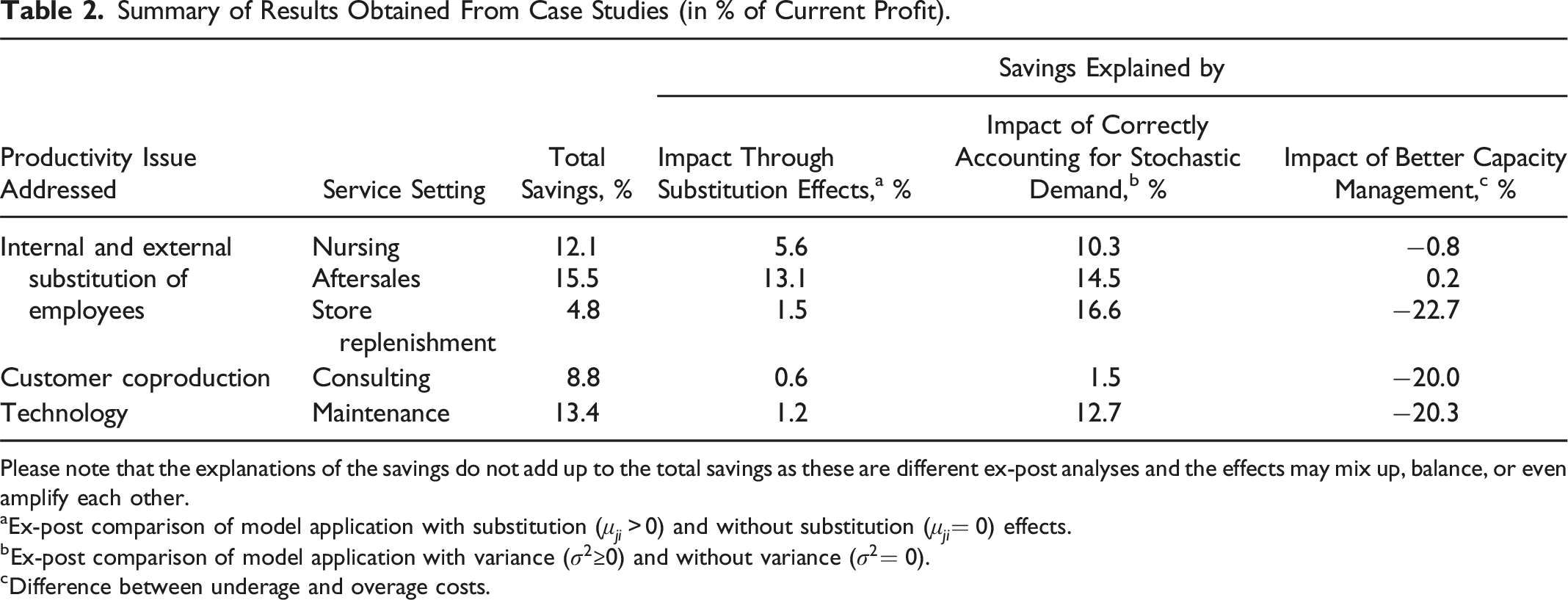
Please note that the explanations of the savings do not add up to the total savings as these are different ex-post analyses and the effects may mix up, balance, or even amplify each other.
aEx-post comparison of model application with substitution (
bEx-post comparison of model application with variance (
cDifference between underage and overage costs.
The insights gained in the five case studies reveal that the challenges of service productivity represent important issues. Firms must select resources from a mid- to long-term perspective and define the appropriate quantity of service when meeting varying customer demands. Choices are subject to capacity constraints. Each service setting analyzed faces a specific decision problem that can be solved using our proposed model. We further demonstrate the seminal potential of substitution effects and the importance of correctly accounting for demand to optimize service productivity. Although results confirm the appropriateness and functionality of our model in managerial practice to optimize service productivity, we cannot draw general conclusions or guarantee more general applicability. We apply our approach to simulated data and derive general rules to generalize our insights further and increase external validity. We generate several test cases and use different numerical analyses to prove the model’s general applicability and generalize the findings.
Generalization of Findings with Simulated Data
Approach, Test Problems, and Data Applied
Each test instance consists of 1,000 examples with randomly generated parameters. The simulation is informed by the data constellation that we obtained from the case studies with the industry partners. The examples adhere to the following rules: Each resource
The numerical tests investigate the effects of volatile demand (Test 1), substitution (Test 2), perishability of resources (Test 3), capacity constraints (Test 4), and joint resource selection and quantity (Test 5) on optimizing service productivity.
Test 1: Effect of Stochastic Demand
Figure 1 (Panel A) shows the impact of increasing stochastic demand (i.e., coefficients of variation, CV) on the solution structure considering different levels of substitution ( Panel A impact of stochastic demand and substitution level on solution structure. Panel B profit advantage of CSPMSUB over CSPM*SUB (assumed CV = 1 percent).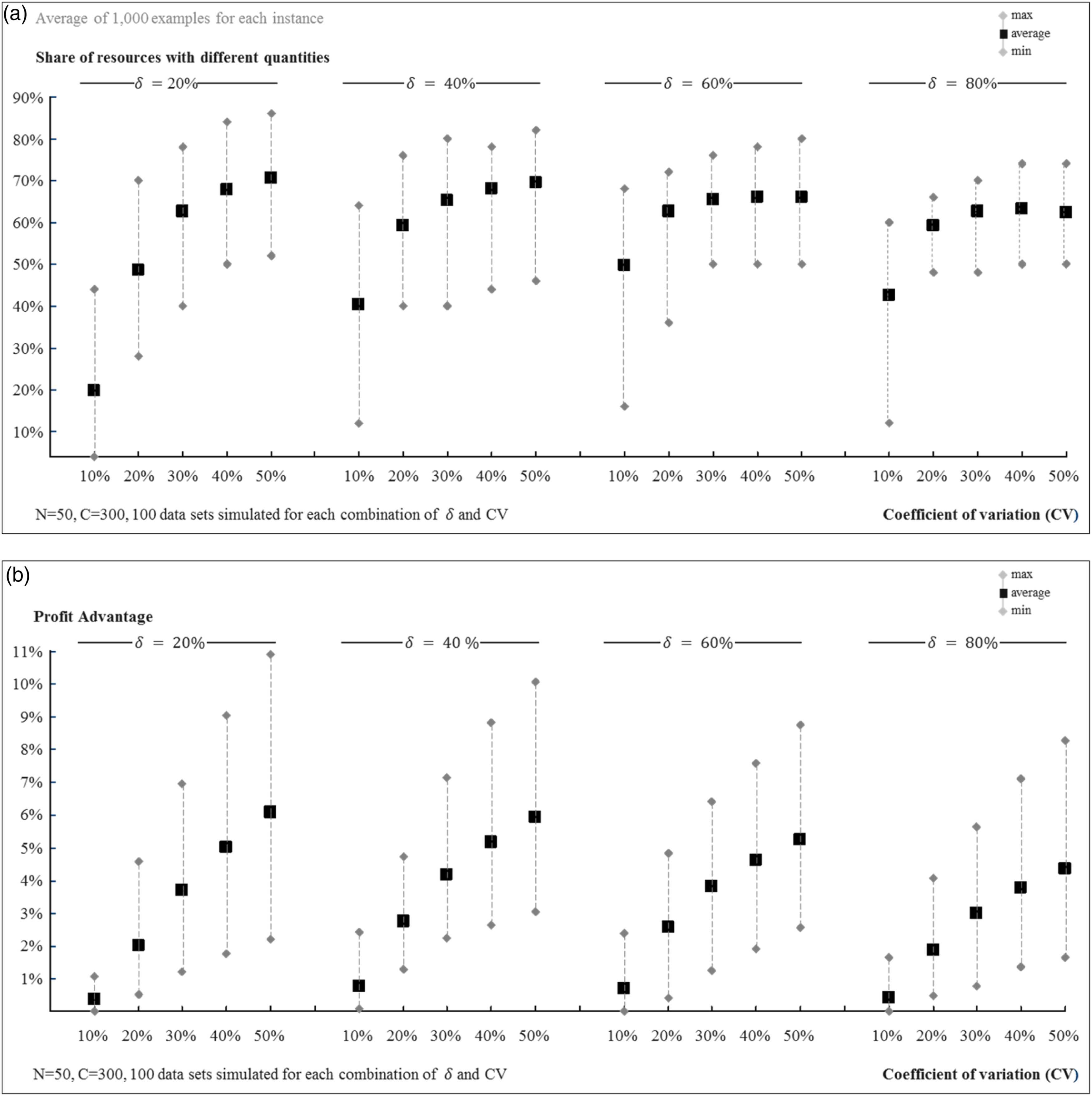
In summary, between 20 percent and 70 percent of the resources reveal different quantities when stochastic demand is considered correctly. These differences in optimal solutions always increase as CV increases for all
Figure 1 (Panel B) shows the impact on profits for the same setting. Here, a firm receives a profit advantage if it accounts for demand variation are considered correctly. Quantifying the profit advantage, we calculate (Profit of CSPMSUB/Profit of CSPM*SUB)-1, whereas CSPM*SUB denotes the solution obtained assuming CV = 1 percent, but where the profit is evaluated with the actual CV. Thus, it identifies the error firms make when not correctly accounting for the actual CV. Intuitively, we find that the more stochastic demand, the higher the advantage. For example, at
Our generalized data reveal that correctly considering stochastic demand results in 0.5 percent to 6.0 percent higher profits. If stochastic demand is considered correctly, profit differences increase with higher demand variation and lower substitution levels.
Test 2: Effect of Substitutions
To analyze the effect of substitution, we CSPMSUB considering substitution effects that are not reflected in CSPM. We add a posteriori substitution to the results of Change in required resources and profit when substitution effects are regarded.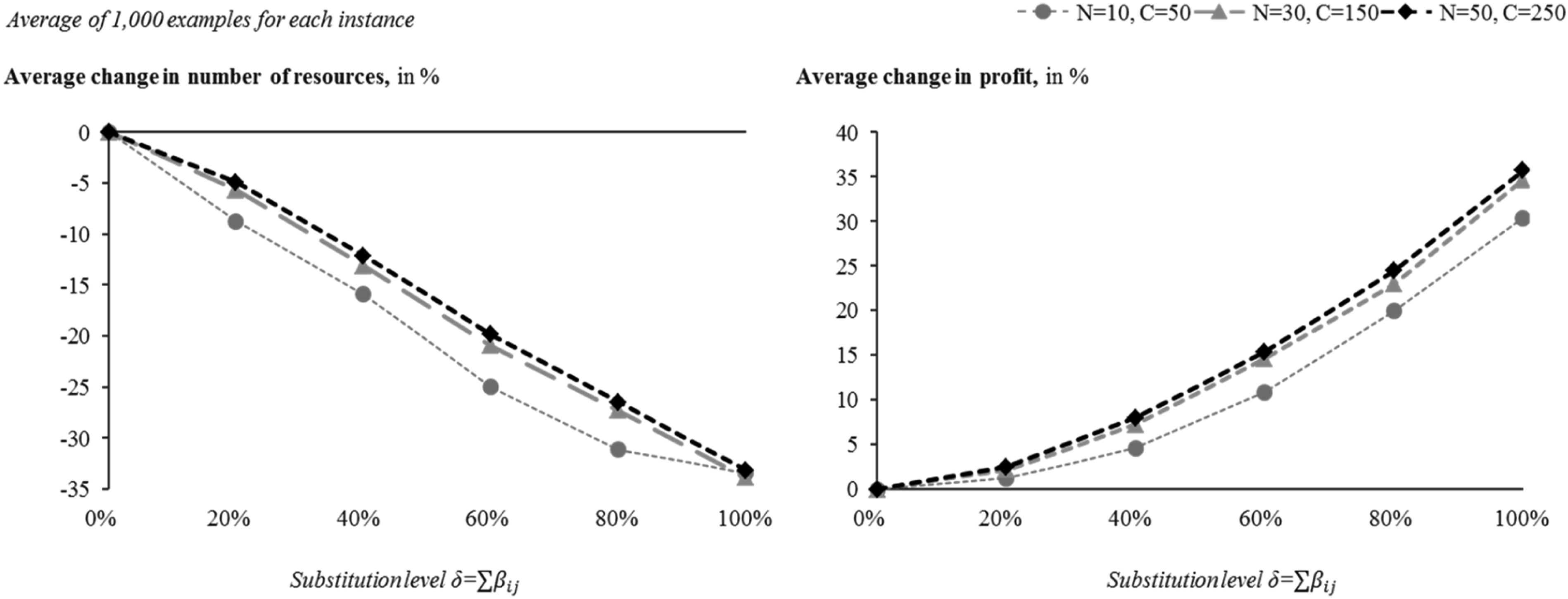
Test 3: Effect of Perishability of Resources
Change in Profits and Solution Structure due to Variations for

Note. Average of examples with N = 10, N = 30, and N = 50; reference
Change in Profits, Quantity, and Number of Resources by Integrating
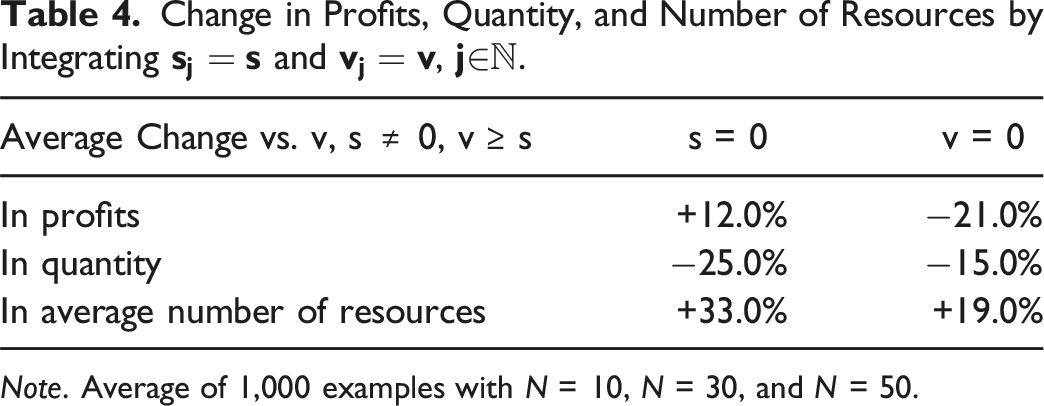
Note. Average of 1,000 examples with N = 10, N = 30, and N = 50.
Test 4: Effect of Capacity Constraints
Impact of Capacity Variations.

Note. Average of 1,000 examples with N = 10, N = 30, and N = 50.
Test 5: Effect of Integrated Resource and Quantity Planning
CSPMSUB can be treated as an integrated capacity management problem with resource selection and quantity determination. Therefore, we evaluate the effect of CSPMSUB over a sequential planning (SP) approach whereby the resources are selected, and then the quantities are determined. Comparing CSPMSUB and SP, the integrated planning results in up to 13 percent higher profits on average and up to 23 percent fewer resources (see Figure 3). The left part of Figure 3 shows that resources required in CSPMSUB are smaller compared to SP for Change in required resources and profit when resources and quantities are integrated planned (CSPMSUB vs. SP).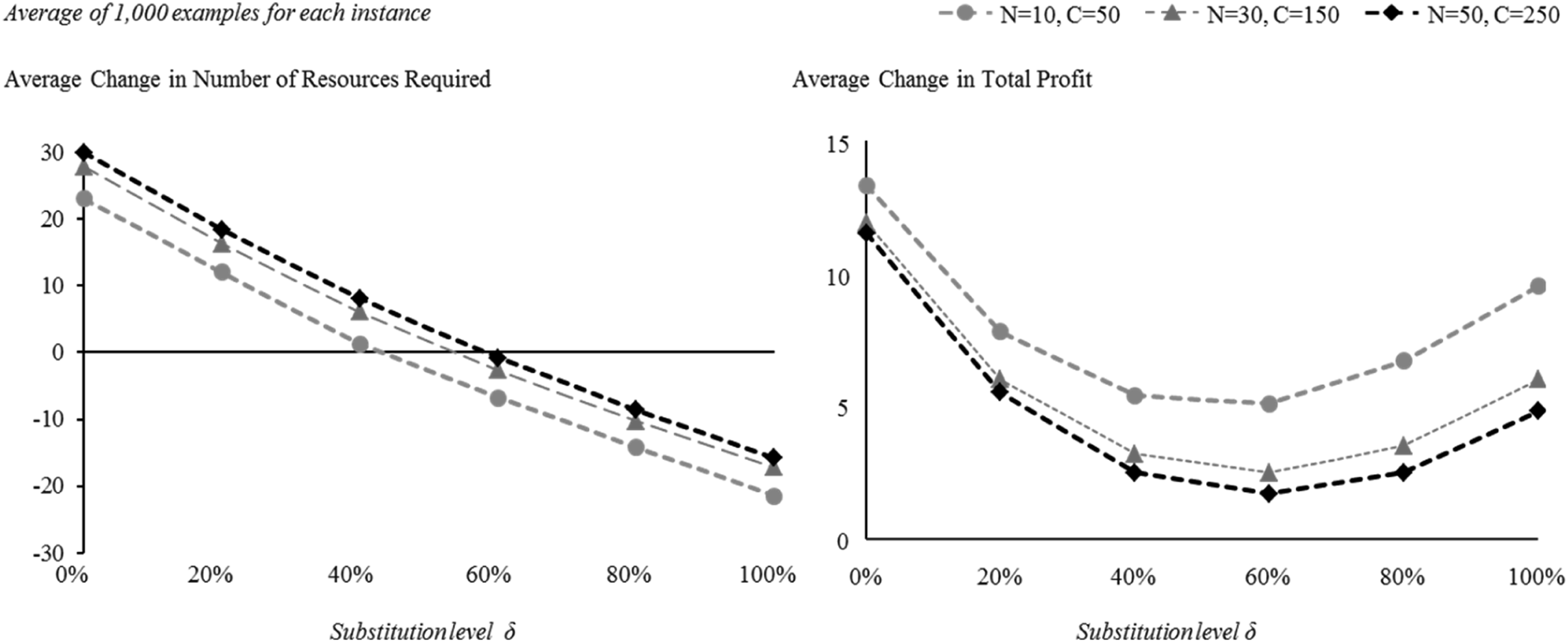
Discussion
Theoretical Implications
Managing productivity is a major challenge for service managers, as it requires an optimal selection from a limited and substitutable set of resources to meet productivity and profitability objectives. Technological advancements and shortage of labor call for an efficient engagement of resources to match the unknown customer demand, prompting calls from academia and managerial practice for comprehensive support systems (Mittal et al. 2005; Rust and Huang 2012; Rust, Zahorik, and Keiningham 1995; Wirtz and Zeithaml 2018). Building on the seminal work of Rust and Huang (2012), we develop such a decision support system and extend knowledge on service productivity. We demonstrate the functionality and applicability of the proposed decision model in multiple, distinct service settings and industries using five case studies. Moreover, to increase external validity, we draw on data simulation and generalize our insights through numerical examples.
First, we focus on optimizing the long-term resource selection and quantity determination as levers of service productivity management. The current literature examines how different resources—employees, customers, processes, and technology—influence how well services are delivered in terms of service productivity (e.g., Hofmeister, Kanbach, and Hogreve 2023a, 2023b; De Jong, De Ruyter, and Lemmink 2003; Marinova, Ye, and Singh 2008; Xue and Harker 2002). Rust and Huang (2012) show how resource investment decisions about either technology or labor as the major resource influence optimal service productivity. Yet, in managerial practice, firms usually apply multiple resources. Thus, we consider multiple resources within our proposed decision model, each generating revenues and costs. In so doing, we provide a decision support system that determines the optimal resource combination to invest in terms of type and quantity of resource available to optimize service productivity.
Our five case studies focus on internal and external substitution of employees, customer coproduction, and technology as major resources, revealing savings of up to 15.5 percent. Our generalized results demonstrate the importance of integrated resource and quantity planning compared to sequential planning (i.e., the selection of type comes before the determination of quantity). Our comprehensive approach results in up to 13 percent higher productivity and up to 23 percent lower number of resources needed. In addition, we reveal how applying our decision model makes resource planning more accurate and reduces the costs of over- and undersupply of resources. Furthermore, information gathered by a sensitivity analysis of the capacity constraint can be leveraged for hierarchical planning and be used to inform the overarching assignment of overall budgets per business unit that determine the overall capacities. Furthermore, our model can also be applied for an overarching network planning or for planning resources on a regional or governmental level.
Second, we are the first to consider substitution effects among resources available in managing service productivity. The literature and managerial practice prove that resources might be temporarily or permanently unavailable. To overcome resource shortages and/or demand peaks, substitutions among resources might work as a buffer; customers might settle for an alternative resource instead of switching the service provider. Customers who are partial employees in coproduction processes (Bowen 1986; Mills et al. 1983) or remote services using technology are ripe for substitutions (Rust and Huang 2012). Therefore, to get a finer-grained understanding of optimal resource allocation and, in turn, to optimize service productivity by either buffering exceeded demand or compensating exceeded capacities, we figure in permanent and temporary substitution.
Our case studies analyze substitution among employees of different qualification levels, distinct departments, and subsidiaries. We further consider substituting the internal and external workforce, the input of employees and customers (i.e., coproduction), and human workforce and technology. We find extraordinarily high savings for substitution among employees. The case studies and simulated data reveal the significance of substitution as a lever of service productivity. Considering substitution in capacity management results in lower resource requirements (up to 35 percent) and productivity improvements (up to 35 percent). Consequently, resources with higher profit margins benefit from substitution demand of unselected resources. We also examined how substitution among employees increases service productivity and discovered that considering substitution is especially relevant given stochastic demand. Substitutions are a buffer for non-optimal decisions (e.g., without a decision support system).
Third, we further enhance the deterministic decision model of Rust and Huang (2012) by considering stochastic demand that is more representative of actual customer behavior, especially for services. Demand and capacity cannot be backlogged, so capacity management must account for volatility (e.g., Armistead and Clark 1994; Armistead, Johnston, and Slack 1993; Chase and Apte 2007). Considering the volatility of demand, the applicability and usability of our model in managerial practice increases as costs for over- and undersupply of resources can be significantly reduced.
Our case studies and the generalization with simulated data further stress the importance of considering stochastic demand in service productivity management. Correctly accounting for demand volatility lowers the costs of oversupply and shortages and generates significant savings. Our data simulation further reveals that correctly considering demand increases profits by up to 6 percent. However, the solution structure significantly changes if demand volatility is not considered. In fact, the higher the demand volatility, the more it needs to be factored in to manage service productivity. Otherwise, up to 70 percent of resources may receive non-optimal levels.
Managerial Implications
Our research provides several insights on how to optimize service productivity successfully. We delineate and prove the relevance of three concrete challenges for service managers to consider while achieving cost efficiency and quality effectiveness. As outlined in further research, productivity in a service context goes beyond a ratio of input and output. Service productivity must be handled as a strategic decision variable enabling firms to choose their optimal service productivity level and optimize their profits. Service managers need to select the optimal type and quantity of multiple yet constraint resources while simultaneously considering the substitutability of resources. This decision problem is further increased as customer demand is highly volatile.
The insights gained in our studies allow for deriving several managerial implications in managing these three challenges. First, we showed that the optimal resource selection of multiple resources available in terms of type and quantity serves as a lever of success for service productivity. More concretely, we show that focusing on the right resource type before considering quantity aspects has a higher impact on service productivity. A comprehensive planning framework and hierarchy with feedback loops would thus facilitate decision-making accuracy. Consequently, we encourage managers to develop a comprehensive planning framework and hierarchy with iterative information flows. Doing so presupposes a clear understanding of the tasks to be done and customer expectations.
The second challenge formulated focuses on substituting effects among resources. We outline the outstanding importance of substituting resources in managing service productivity as it helps in overcoming resource shortages as well as it buffers not correctly accounted demand. Hereby, especially substituting among employees within a firm and substituting employees by technology shows high gains in service productivity. A further opportunity is to substitute resources within a network and coordinate the resource engagement across different entities (e.g., coordinating resources for health services of a region).
From a managerial perspective, these insights underscore the importance of enabling the substitution of these major resources. We assume that certain services or customer segments will accept substitution, so firms must carefully monitor their substituting activities and corresponding development of demand. We recommend that service managers invest in transparency and clarity in job requirements and customer expectations within a firm to enhance options for substitution among employees and other company entities. Furthermore, enabling job rotation, empowering employees in terms of self-organization, and investing in internal communication activities and knowledge transfer will further enhance the substitutability of employees. Doing so, our support system enables managers to optimize their resource investments and enhance flexibility. Regarding human resource management, we provide support for planning personnel deployment (within a department, across departments and locations), especially during peak times of demand or given personnel absence due to vacations or disease.
The third challenge signposts the importance of correctly accounting for customer demand, which is not always known beforehand. As outlined before, substituting effects among resources buffer wrong estimated demand and thus further outline the importance for service managers to consider our suggestions formulated above. Moreover, based on our findings, we strongly recommend that service managers consider stochastic demand to improve capacity management. Furthermore, investing in market research and monitoring demand will make capacity planning and decision-making more accurate.
Limitations and Directions for Further Research
Our theoretical decision support models significantly add to the research stream of service productivity. However, to provide a balanced discussion, we must recognize several limitations. Discussing these limitations raises avenues for further research. First, our insights are based on five case studies, their specific context (e.g., firm size, budget constraints, and employee qualification levels), and their current situation. We used simulated data to further generalizations the findings. Although we chose our case studies in an economic context that suffers from service productivity management like high coproduction, heterogeneity of the service outcome, and personnel-intense service environments (see Anderson, Fornell, and Rust 1997), service productivity might operate differently in other industries. Rust and Huang (2012) indicate that technology tremendously impacts optimal service productivity. Therefore, economic environments characterized by highly dynamic technological development might perform differently when it comes to service productivity. Also, no long-term effects of resources being unavailable are considered. We assume a constant service productivity among the workers and over time. Our model does not include incentives or other system changes (e.g., team structure, further technological support). We apply historical productivities and hence the average productivity of resources. We apply examples where substitutions among the team members are possible and necessary. We encourage researchers to conduct studies that take into account the longitudinal effects of resource optimization on service productivity. Doing so would require a multi-period model. For example, there might be long-term effects of substituting resources on demand and, in turn, on profitability. An extension could also include an analysis of seasonal effects or other variable demand patterns. Furthermore, as some of the data are based on expert estimations (e.g., substitution rates), objectivity might suffer. To further validate our approach, a more extensive dataset is needed.
Second, in formulating our substitution effects, we follow assumptions in ED models. The resulting model is cruder but has the advantage of being much easier to analyze and requires less data. However, more knowledge about substituting effects and their effects on productivity is needed.
Third, we develop a demand function wherein the demand depends on resources. We are aware, however, that there are further demand sources. For example, having higher quantities of one particular resource may also increase demand, for example, a certain type of service is offered in high quantity, thereby increasing demand due to higher visibility. Furthermore, the perceived quality of identical resource types might differ. We, therefore, encourage further research to explore additional opportunities to represent service quality and to show how service quality impacts optimal resource selection and service performance. We also assume that demand follows a normal distribution. Our modeling and solution approach is capable of coping with different demand distributions that include any positive demand. Further research is needed into how this impacts decisions and profits.
Finally, interdisciplinary research on service productivity is at an early stage. As discussed, using quantitative and modeling methods for service productivity-related problems can be beneficial. We would welcome more empirical research addressing the managerial challenges of service productivity from an interdisciplinary perspective.
Supplemental Material
Supplemental Material - Optimizing Service Productivity With Substitutable and Limited Resources
Supplemental Material for Optimizing Service Productivity With Substitutable and Limited Resources by Jens Hogreve, Alexander Hübner, and Mirjam Dobmeier in Journal of Service Research
Supplemental Material
Supplemental Material - Optimizing Service Productivity With Substitutable and Limited Resources
Supplemental Material for Optimizing Service Productivity With Substitutable and Limited Resources by Jens Hogreve, Alexander Hübner, and Mirjam Dobmeier in Journal of Service Research
Footnotes
Acknowledgements
Jens Hogreve and Mirjam Dobmeier thank the German Federal Ministry of Education and Research (grant 01FL12002) for the financial support.
Declaration of Conflicting Interests
The author(s) declared no potential conflicts of interest with respect to the research, authorship, and/or publication of this article.
Funding
The author(s) disclosed receipt of the following financial support for the research, authorship, and/or publication of this article: This work was supported by the Bundesministerium für Bildung und Forschung (grant 01FL12002).

Supplemental Material
Supplemental material for this article is available online.
Author Biographies
References
Supplementary Material
Please find the following supplemental material available below.
For Open Access articles published under a Creative Commons License, all supplemental material carries the same license as the article it is associated with.
For non-Open Access articles published, all supplemental material carries a non-exclusive license, and permission requests for re-use of supplemental material or any part of supplemental material shall be sent directly to the copyright owner as specified in the copyright notice associated with the article.
