




Abstract
We conduct a systematic exploratory investigation of the effects of firms’ existing service productivity on the success of their new service innovations. Although previous research extensively addresses service productivity and service innovation, this is the first empirical study that bridges the gap between these two research streams and examines the links between the two concepts. Based on a comprehensive data set of new service introductions in a financial services market over a 14-year period, we empirically explore the relationship between a firm’s existing service productivity and the firm’s success in introducing new services to the market. The results unveil a fundamental service productivity-service innovation dilemma: Being productive in existing services increases a firm’s willingness to innovate new services proactively but decreases the firm’s capabilities of bringing these services to the market successfully. We provide specific insights into the mechanism underlying the complex relationship between a firm’s productivity in existing services, its innovation proactivity, and its service innovation success. For managers, we not only unpack and elucidate this dilemma but also demonstrate that a focused customer scope and growth market conditions may enable firms to mitigate the dilemma and successfully pursue service productivity and service innovation simultaneously.
Keywords
Over the past two decades, service productivity (Brown and Dev 2000; Rust and Huang 2012) and service innovation (Ordanini and Parasuraman 2011; Storey and Kahn 2010) have evolved into crucial priorities within service research (see Ostrom et al. 2015). Despite extensive interest in each topic individually, previous research has thus far neglected to study the relationships between these two success factors for service firms. In particular, it remains unclear whether firms are able to successfully pursue service productivity and service innovation simultaneously and which conditions may favor such a dual-emphasis strategy. This is surprising, considering the managerial challenges involved in providing existing services to customers efficiently while successfully bringing new services to the market. This tension between productivity and innovation “is bedeviling CEOs everywhere” (Hindo 2007).
Hence, the primary objective of this article is to bridge the gap between the research streams of service productivity and service innovation, by exploring how a firm’s productivity in existing services influences the firm’s success in innovating new services. Due to a lack of existing theory regarding this relationship, we adopt an exploratory empirical study approach. We first explore the direct main effect of current service productivity (i.e., the efficiency of a firm’s current service operations) on new service success and develop theoretical insights into the underlying mechanisms. To identify the mechanism underlying the effect of existing service productivity on new service success, we then conduct further empirical analyses of interaction effects between the firm’s service productivity and proactivity in introducing the new service to the market. We also control for alternative explanations related to market-level and managerial variables. As key mechanisms, we consider that service productivity may affect the firm’s willingness to proactively innovate new services in the first place and the firm’s capabilities in introducing new services to the market successfully (Ordanini and Parasuraman 2011).
To explore the effect of service productivity on service innovation success, we analyze a comprehensive census data set of service introductions by all firms in one financial services market over a 14-year period: the mutual funds market in Finland. We employ data envelopment analysis (DEA) to calculate service productivity from multiple inputs and outputs related to the mutual fund services of all the firms operating in the market. Moreover, we combine the mutual funds data set with additional data sources of firm-level variables to address potential moderating effects and to control for alternative mechanisms.
Our key theoretical contribution is to bridge the literatures on service productivity and service innovation. Specifically, we provide the first empirical study on the links between a firm’s productivity in existing services, the firm’s proactivity in innovating new services, and the eventual market success of these new services. Our findings highlight a fundamental—yet thus far unidentified dilemma—between service productivity and service innovation success: A firm’s productivity in existing services (i) decreases the firm’s success in bringing new service innovations to the market (ii) but increases the firm’s tendency to innovate proactively. (iii) However, the increased innovation proactivity further aggravates the negative effect of service productivity on service innovation success. These results not only shed new light on the determinants of service innovation success in general but also underline the need to coordinate the links between existing service operations and new service innovations in particular.
Explicitly differentiating between a firm’s willingness and a firm’s capability to innovate, the results reveal that it is not a lack of willingness to innovate proactively but a lack of innovation capabilities that undermines service innovation success of highly productive firms. Thus, productivity in existing services leads to a gap between managers’ expectations for innovation proactivity and managers’ actual capability to create and introduce successful service innovations. This discrepancy is akin to service quality gaps that can exist between management’s understanding of the market’s service expectations and the actual organizational capabilities of service delivery (Parasuraman 2010; Zeithaml 1988). Thus, the second contribution of the present research is to identify this new gap for the service gap literature. Third, we provide insights for the strategic marketing literature on the challenges of “dual emphasis” strategies (Mittal et al. 2005; Rust, Moorman, and Dickson 2002; Swaminathan et al. 2014). To this literature, our contribution is to identify mitigating factors that can enable firms to achieve the dual combination of existing service productivity and successful service innovation simultaneously. The results indicate that such factors include a focused customer scope and the targeting of growth rather than mature markets.
Conceptual Background
As our primary objective is to explore the effects of a firm’s productivity in existing services on the success of the firm’s new service innovations, we briefly define and review these key concepts. Subsequently, we specify our research questions in light of the existing literature.
Service Productivity
Service productivity refers to the efficiency of a firm’s services in its ongoing business operations (Brown and Dev 2000; Rust and Huang 2012). Originating from production and operations research, the term productivity generally describes the ratio of output yielded by a certain activity to the input resources consumed by that activity. Coinciding with the service-dominant logic, however, we go beyond traditional productivity theory by adopting the customer’s perspective on productivity (Parasuraman 2010; Vargo and Lusch 2004). Therefore, as the output implicated in service productivity, we consider the customer-valued outputs of the firm’s service production (e.g., the financial returns of an investment fund service)—rather than the simple quantity of goods/services produced. In other words, we define the firm’s service productivity as the efficiency with which the firm converts service input resources into customer-valued service outputs in its current service offerings (Grönroos and Ojasalo 2004).
Service Innovation
Within the realm of service innovation, we differentiate between two key factors related to the firm’s willingness versus its capability to successfully innovate new services: (i) the firm’s proactivity in introducing a new service to the market versus (ii) the eventual market success of such a new service innovation (Ordanini and Parasuraman 2011).
Innovation proactivity
As an important indicator of a firm’s willingness to innovate new services, innovation proactivity describes the degree to which a firm seeks a given new service market opportunity before competitors (Narver, Slater, and MacLachlan 2004; Ordanini and Parasuraman 2011). In practical terms, innovation proactivity is operationalized as the earliness with which the firm brings a given new service to the market relative to competitors (López and Roberts 2002). That is, innovation proactivity is a measure of being an early mover in innovating a new type of service (Lumpkin and Dess 1996).
New service success
The market success of the new service is the key outcome measure of service innovation (Melton and Hartline 2013; Van Riel, Lemmink, and Ouwersloot 2004). This success reflects the firm’s capability to successfully develop and introduce to the market the new services the firm decides to innovate. We consider the market success of an individual new service the main outcome variable in our empirical research framework. In contrast to firm-level innovativeness measures (e.g., Eisingerich, Rubera, and Seifert 2009), the service-level measure of new service success enables us to directly measure the market success of a given service innovation and to study the link between a firm’s service productivity, the firm’s proactivity in introducing a new service innovation, and the eventual market success of that new service.
Effects of Service Productivity on Service Innovation
Despite extant speculations that managing existing service productivity and new service innovations in isolation from each other is likely to be suboptimal (Parasuraman 2010), thus far, no academic study has empirically investigated the effects of service productivity on the success of the new service innovation. Existing research on service productivity mainly focuses on investigating the use of organizational resources to achieve higher service productivity (Brown and Dev 2000) and considers service productivity a strategic decision variable vis-à-vis service quality to maximize profit from current services (Rust and Huang 2012). In other words, literature on service productivity has concentrated on the optimization of existing services and has not considered the effects of service productivity on innovating new services. Conversely, previous research on service innovation is predominantly concerned with organizational processes (Hull 2004; Van Riel, Lemmink, and Ouwersloot 2004) and interorganizational resources (Eisingerich, Rubera, and Seifert 2009; Melton and Hartline 2013; Storey and Kahn 2010) as the key determinants of innovation success. Thus, research on service innovation also neglects the potential influence of existing service productivity on the success of the new service innovation.
Given the lack of previous research and theory on the influence of service productivity on the success of the new service innovation, the objective of the present research is not to develop and test a priori hypotheses pertaining to this influence. Instead, we seek a new understanding of the role of service productivity on service innovation success through empirical exploration. Using an exploratory approach, we shed further light on the nature of the links between a firm’s productivity in existing services, the firm’s willingness to innovate new services proactively, and the eventual market success of these new services. Specifically, we utilize a systematic empirical exploration to answer two research questions:
Empirical Research Context and Data: Financial Services
Research Context
The empirical research context is the financial services market. Specifically, we focus on the mutual funds market. A mutual fund is a professionally managed financial service that raises money from investor-customers and invests the pooled money in a structured portfolio of securities. Because financial services are intangible, they are inherently risky from a customer’s point of view (Avlonitis, Papastathopoulou, and Gounaris 2001; Blazevic and Lievens 2004). Thus, the liability of newness (i.e., customers’ hesitance to buy new products) is even more pronounced in financial services than in many other services. At the same time, the technical development costs of new financial services are low. This makes intangible firm capabilities, rather than the firm’s tangible resources, the most likely determinants of the success of new innovation for firms in this market (see Vorhies, Morgan, and Autry 2009). The mutual funds market is particularly suited for our exploratory empirical investigation, as the homogeneity of existing services and the market’s competitive landscape increase the relevance of successful service introductions for a firm’s overall strategy and performance (Makadok 1998).
Overview of Data
We conduct our empirical exploration on a unique data set about one national, financial services market in Europe: the mutual funds market of Finland. The data are sourced from Mutual Fund Reports (1997 to 2010), a monthly report on all mutual funds marketed in Finland published by the Federation of Finnish Financial Services and produced by Sijoitustutkimus (Investment Research Ltd.). Along with basic information about the funds (e.g., fund’s name, type, and fees), the report includes performance variables, such as fund returns, total assets, and number of customers. We collected the relevant data by manually going through each month’s report between 1997 and 2010. Overall, this review resulted in 165 reports, each 10 to 25 pages long in printed form. Additionally, we obtained data on the yearly marketing communications expenditures of each firm from the market research agency TNS Gallup. Finally, we combined this data set with data pertaining to other firm-level covariates obtained from each firm’s accounting reports. The number of firms in the data between 1997 and 2010 varied between 10 and 30 and the number of funds in the market from about 100 to 600.
As our focal unit of analysis is the introduction of a new service, that is, a new mutual fund, we extracted all new fund introductions that occurred during the study period. This resulted in an initial data set of 619 introductions. Of these, we eliminated introductions by entirely new firms (due to nonavailable data on service productivity in existing services), observations with missing values, and introductions by firms in special circumstances (i.e., firms in the process of merging with other firms). The resulting final data set included 504 new service introductions. This data set approximates a comprehensive census of all new service introductions by incumbent firms in the market over a 14-year period.
Focal Variables and Measures
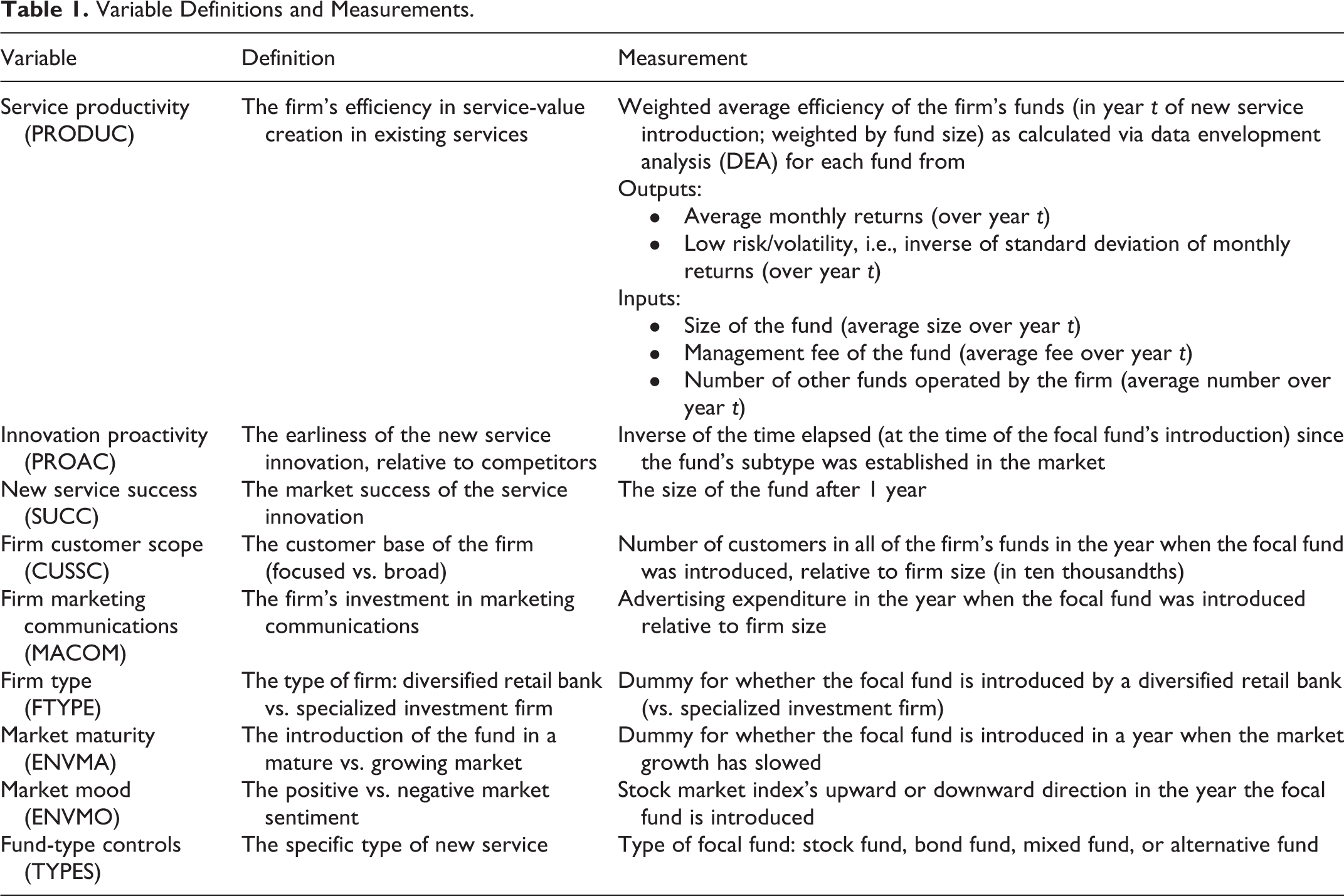
Table 1 provides an overview of the variables and their measurement.
Variable Definitions and Measurements.
Service productivity
We measure a firm’s service productivity through DEA. DEA is a mathematical programming technique that calculates an organization’s efficiency in converting multiple inputs into multiple outputs—relative to the most efficient (best-practice) rival organizations (Banker, Charnes, and Cooper 1984; Charnes, Cooper, and Rhodes 1978). While simple input-output efficiency ratios do not account for heterogeneity between firms, DEA efficiency scores estimate the productivity of a service based on comparisons with the most efficient services in the market (Luo and Homburg 2007).
To measure the service productivity of a firm’s existing services when it introduces a new service, we first calculate the fund-level efficiencies for all the funds in the market in a given year using DEA. The fund-level efficiency is a conversion ratio of outputs to inputs, ψ = outputs/inputs over a year. As DEA outputs, we include two key customer-value metrics from the financial services literature (Sharpe 1994): (1) the average monthly returns of the fund during the year (RET) and (2) the low volatility or risk (i.e., inverse of the standard deviation) of these monthly returns (RSK). As DEA inputs, we use variables that reflect the administrative costs and complexity of managing the fund: (1) the management fee percentage of the fund (FEE), (2) the size of the fund (SIZ), and (3) the number of other funds operated by the firm (NUM). We calculate the service productivity for each fund by solving the DEA programming task. The objective of DEA is to maximize the conversion ratio for fund w by fitting the data with different weights for outputs (u1, u2) and inputs (v1, v2, v3), subject to the efficiency of all other funds k being ≤1:

subject to
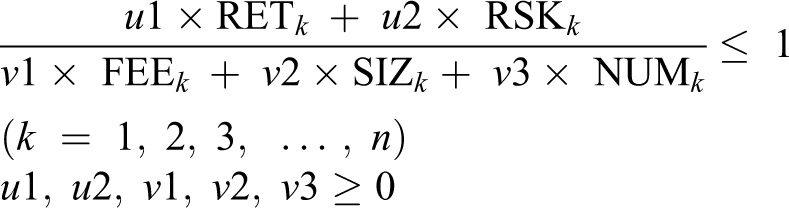
The most efficient funds obtain a value of 1 (100% efficient), and all other funds have values between 0 and 1. In our data, the mean fund-level efficiency over all funds and years is .41.
To aggregate the fund-level efficiencies to the firm level, we calculate the weighted average of the efficiencies of all the funds that the firm operates in a given year. To account for the fact that being efficient in large funds is more important for firms from a profitability perspective, we use the size of the funds as weights to calculate the firm-level efficiencies. This weighted average is our focal measure for a firm’s service productivity in our analyses.
Innovation proactivity
A firm’s innovation proactivity of introducing a service innovation to the market is measured at the fund level, relative to the point in time when the type of fund introduced by a firm became commonplace in the market. This measure reflects the earliness with which a firm introduces a specific fund type compared to competitors. The data were obtained from the Mutual Fund Reports: For a fund that was introduced t years before (after) its type (e.g., a stock fund investing in Eastern European stocks) became an established fund type in the market (i.e., other stock funds investing in Eastern European stocks appearing in the Mutual Fund Reports), innovation proactivity is assigned a positive (negative) value of +t years (−t years).
New service success
We directly assess the market success of the individual service innovation at the fund level. We calculate the size of the new fund (i.e., assets under management in euros) 1 year after its introduction. The size of the fund reflects the popularity of the new fund among customers and determines its revenues for the firm, as the revenue for a fund—the management fee—is a percentage of the fund size. One year after the introduction is a relevant time perspective for assessing market success, as during 1 year, customers have had a realistic time window to evaluate the new fund and to invest in it.
Control Variables and Measures
Fund- and firm-level control variables
At the fund level, we control for the broad class of the new fund introduced as it appears in the basic classification of the Mutual Fund Reports: a stock fund, bond fund, mixed fund, or alternative investment fund (hedge fund). At the firm level, we also control for firm type, that is, whether the firm introducing the new fund is a diversified banking corporation or a specialized investment firm.
Managerial control variables
The firm’s customer scope indicates whether the firm has a focused or broader customer base. This variable is a relevant control variable, as the firm’s success in selling the new fund may depend on whether the firm readily has a small number of (large) customers or a large number of (small) customers in the firm’s existing funds. We measure customer scope as the total number of customers the firm has in its existing funds, relative to the size of the firm (i.e., to the total assets under management in the firm’s funds) in the year when the focal fund is introduced. 1
As another relevant managerial control variable, we consider a firm’s marketing communications intensity. The firm’s general marketing communications intensity may influence the success of new service introductions by increasing the reach of potential customers. We use a commonplace measure for marketing communications intensity: A firm’s advertising expenditure in the focal market relative to the size of the firm’s business in the year when the focal fund was introduced. The advertising expenditure data are from the TNS Gallup market research agency.
Market-level control variables
At the market level, we control for market maturity. We use a dummy variable that is assigned a value of 0 if the country’s overall mutual funds market was on a growth trend (1997 to 2004) at the time of the new service introduction. In turn, the market maturity dummy is assigned a value of 1 if the mutual funds market had reached a mature state at the time of the new service introduction (2005 to 2010). This market growth-maturity pattern was identified from the Mutual Fund Reports and verified with industry experts.
As an additional market-level variable, we measure the market’s overall sentiment, or market mood, at the time when a new service is introduced. This measure was included because industry experts indicated that innovation proactivity is likely to be influenced by the overall sentiment in the stock market. Market mood is measured as the upward or downward direction of the country’s main stock market index in the year when the new fund was introduced (i.e., the percentage change in the index during that year). The stock index data were obtained from NasdaqOMX Finland.
Analyses and Results
In line with the exploratory nature of the study, we pursue empirical evidence for the research questions in a staged manner using stepwise model development. First, reflecting Research Question 1, we explore whether the main effect of existing service productivity on new service success is positive or negative. We specifically check whether this effect holds independent of managerial and market factors. Second, reflecting Research Question 2, we estimate another set of hierarchical models to unveil the role that innovation proactivity (vs. market and other managerial factors) plays in the link between existing service productivity and new service success. We simultaneously estimate innovation proactivity and new service success as a function of existing service productivity via three-stage least squares (3SLS) regression. In this second step, we also examine the interaction effects of service productivity and innovation proactivity on new service success as well as with the other managerial and market variables.
Stage 1: The Main Effect of Service Productivity Versus Alternative Factors on New Service Success
To explore Research Question 1 regarding the main effect of existing service productivity on new service success, we first examine model-free evidence. Table 2 reports the descriptive statistics and bivariate correlations. The correlation between service productivity and new service success is negative (r = −.22, p < .001). This negative correlation between service productivity and new service success is greater in magnitude than the correlation of any other variables with new service success, including the managerial variables: innovation proactivity (r = .04), customer scope (r = .09), and marketing communications intensity (r = −.08); the market-level variables: market maturity (r = .13) and market mood (r = −.05); and the firm-type variable being a diversified banking corporation (r = .18). This model-free evidence gives the first indication of the relevance of existing service productivity as a (negative) determinant of new service success, compared to other managerial, market, and firm factors.
Descriptive Statistics and Correlations.
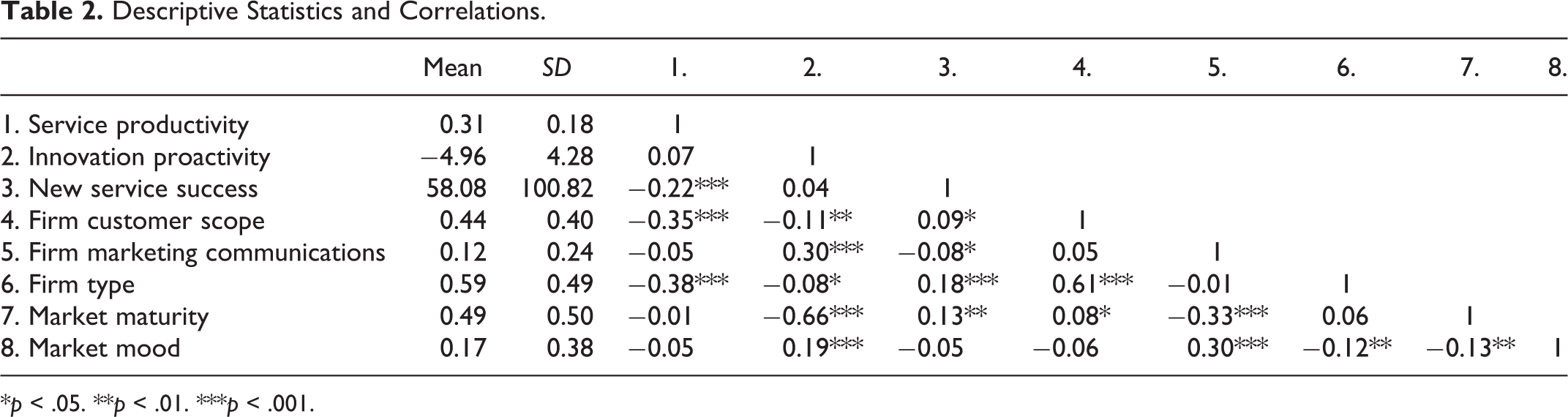
*p < .05. **p < .01. ***p < .001.
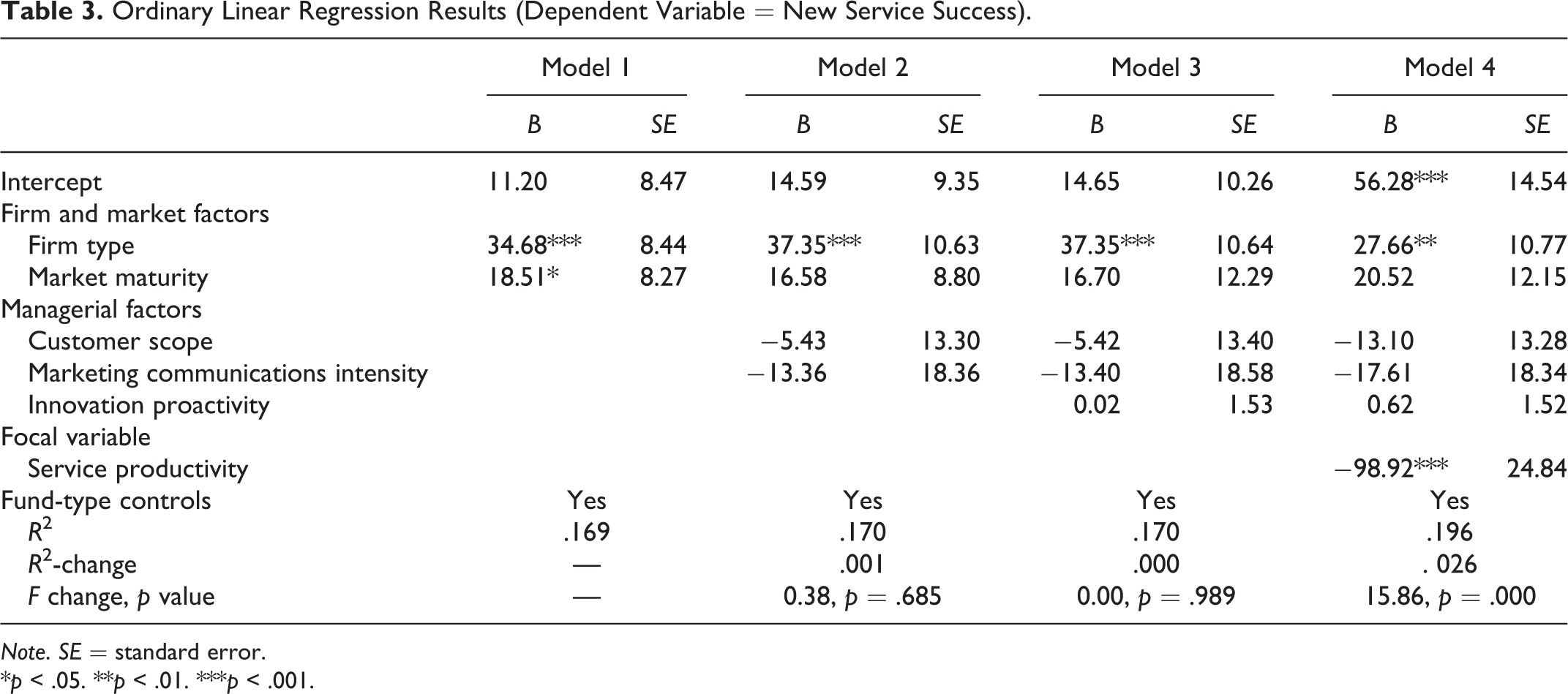
To rule out the possibility that the correlation between service productivity and new service success is spuriously caused by the other managerial, market, or firm factors, we estimate a nested set of ordinary linear regression models. We enter the control variables as blocks in the regression model in a stepwise manner. Table 3 reports the results of this series of nested models. In Model 1, only the market, firm type, and fund-level variables are included to explore the extent to which only the market and contextual conditions explain the success of new services. In line with the bivariate correlations mentioned earlier, the firm’s type being a diversified bank (vs. specialized investment company) has a positive effect on new service success (B = 34.7, p < .001) as does the market’s mature conditions (B = 18.5, p < .05).
Ordinary Linear Regression Results (Dependent Variable = New Service Success).
Note. SE = standard error.
*p < .05. **p < .01. ***p < .001.
Model 2 adds the managerial control variables of customer scope and marketing communications intensity, in addition to the market and firm type variables. However, neither the firm’s customer scope nor the firm’s general marketing communications intensity has a statistically significant main effect on the new service success (p > .05). The coefficient of determination does not significantly increase from Model 1 (R 2 = .17) to Model 2 (R 2 = .17), either. Thus, a firm’s customer scope and marketing communications intensity do not explain the success of the firm’s new services.
In addition to these managerial control variables, in Model 3, we enter the first focal managerial variable, innovation proactivity. Innovation proactivity alone has neither a statistically significant effect on new service success (B = .02, p > .5) nor does it increase the explanatory power of the model significantly (R 2 = .17). In contrast, when we add the second focal variable, service productivity, in Model 4, the explanatory power of the model significantly improves to R 2 = .20 (F-test p = .000). 2 Consistent with the negative bivariate correlation reported above, we find a significant negative effect of service productivity on new service success (B = −98.92, p < .001).
In summary, regarding Research Question 1, the results of this first stage of analysis suggest that a firm’s existing service productivity has a negative effect on the market success of the firm’s new services. The results also show that this negative effect is unlikely to be merely a result of a spurious correlation, as the effect explains a significant portion of new service success beyond market factors, firm type, fund type, innovation proactivity, and other relevant managerial factors.
Stage 2: The Interplay of Service Productivity and Innovation Proactivity on New Service Success
Addressing Research Question 2, we further consider two aspects of the interplay of service productivity and innovation proactivity of new service success. First, as innovation productivity and new service success pertain to the new service itself, they can be mutually or simultaneously affected by existing service productivity. Without further analyses, we do not know whether the negative effect of service productivity on new service success is direct or whether service productivity potentially affects innovation proactivity, which, in turn, affects new service success. To account for this, we employ a simultaneous 3SLS regression model in which we estimate the effect of service productivity on innovation proactivity and new service success simultaneously.
Second, in a further stage of this analysis, we explore the interaction effects between service productivity and innovation proactivity as well as between service productivity and the control variables. Specifically, we include two- and three-way interaction effects in the simultaneous 3SLS equation model. Taken together, these models respond to Research Question 2 by addressing the interplay of service productivity and innovation proactivity and answering whether service productivity increases or decreases the effect of innovation proactivity (vs. other managerial factors) on new service success.
Simultaneous estimation of innovation proactivity and new service success
As service productivity might affect not only new service success but also the firm’s proactivity to innovate in the first place, we need to simultaneously estimate a system of two equations: one with innovation proactivity and one with new service success as the dependent variable. To this end, we estimate the following system of equations:
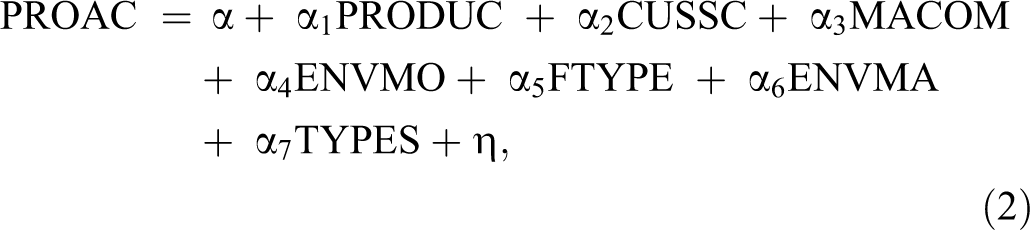

where SUCC is the market success of the new service, PRODUC is the service productivity in existing services, PROAC is innovation proactivity, CUSSC is the customer scope, MACOM is marketing communications, FTYPE is a dummy indicating whether the firm introducing the fund is a diversified retail bank or a specialized investment firm, ENVMA is a dummy indicating whether the market is in a growth or mature state, ENVMO is the market mood at the time of launch of the new service, TYPES is a vector of dummies indicating the service type (i.e., stock, bond, mixed, or alternative fund), and η and ζ are the error terms.
To estimate the system of Equations 2 and 3, we employ a 3SLS model. A 3SLS regression is a simultaneous-equation, instrumental-variable approach by which we can account for endogeneity of innovation proactivity and potential correlations between error terms η and ζ across equations. 3 That is, the 3SLS estimation allows the simultaneous regression of innovation proactivity and new service success through innovation proactivity as an endogenous regressor. The predicted values of innovation proactivity from Equation 2 are substituted when estimating new service success (SUCC) in Equation 3. Beyond accounting for correlations of errors across equations, the 3SLS estimation does not assume a specific distribution of the error terms (Zellner and Theil 1962).
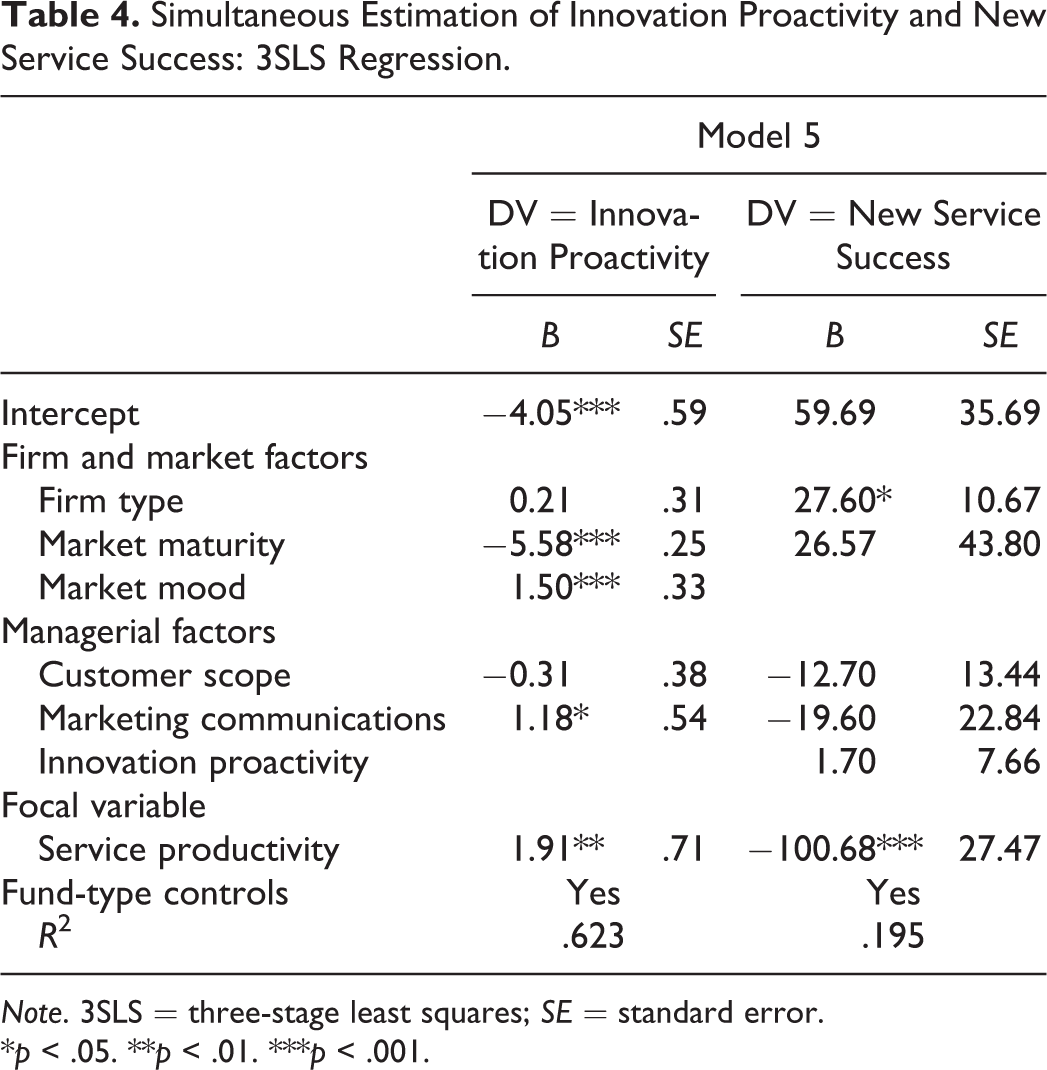
The 3SLS estimation results for innovation proactivity and new service success are reported in Table 4. The results show that productivity in existing services has a statistically significant positive effect on innovation proactivity (B = 1.91, p < .01). In contrast, service productivity has a statistically significant negative effect on new service success (B = −100.68, p < .001) as in the ordinary regression models (Table 3). There is no statistically significant main effect of innovation proactivity on new service success (B = 1.70, p > .10). Overall, considering the complex interrelationship between service productivity (PRODUC), innovation proactivity (PROAC), and new service success (SUCC), we find that the net effect of service productivity on new service success is negative. 4 These findings essentially provide evidence that the negative effect of existing service productivity on new service success is not due to a highly productive firm’s lack of innovation proactivity. Instead, firms with high productivity in existing services also have higher proactivity to innovate than firms with lower productivity. However, this proactivity does not lead to new service success. The underlying reason for the negative effect of existing service productivity on new service success is not a highly productive firm’s lack of willingness to innovate, but the firm’s lack of capability to innovate successfully. Taken together, these findings indicate a service productivity-service innovation dilemma: Highly productive firms are more willing to innovate proactively but are less successful in introducing innovative new services to the market.
Simultaneous Estimation of Innovation Proactivity and New Service Success: 3SLS Regression.
Note. 3SLS = three-stage least squares; SE = standard error.
*p < .05. **p < .01. ***p < .001.
Interaction effects
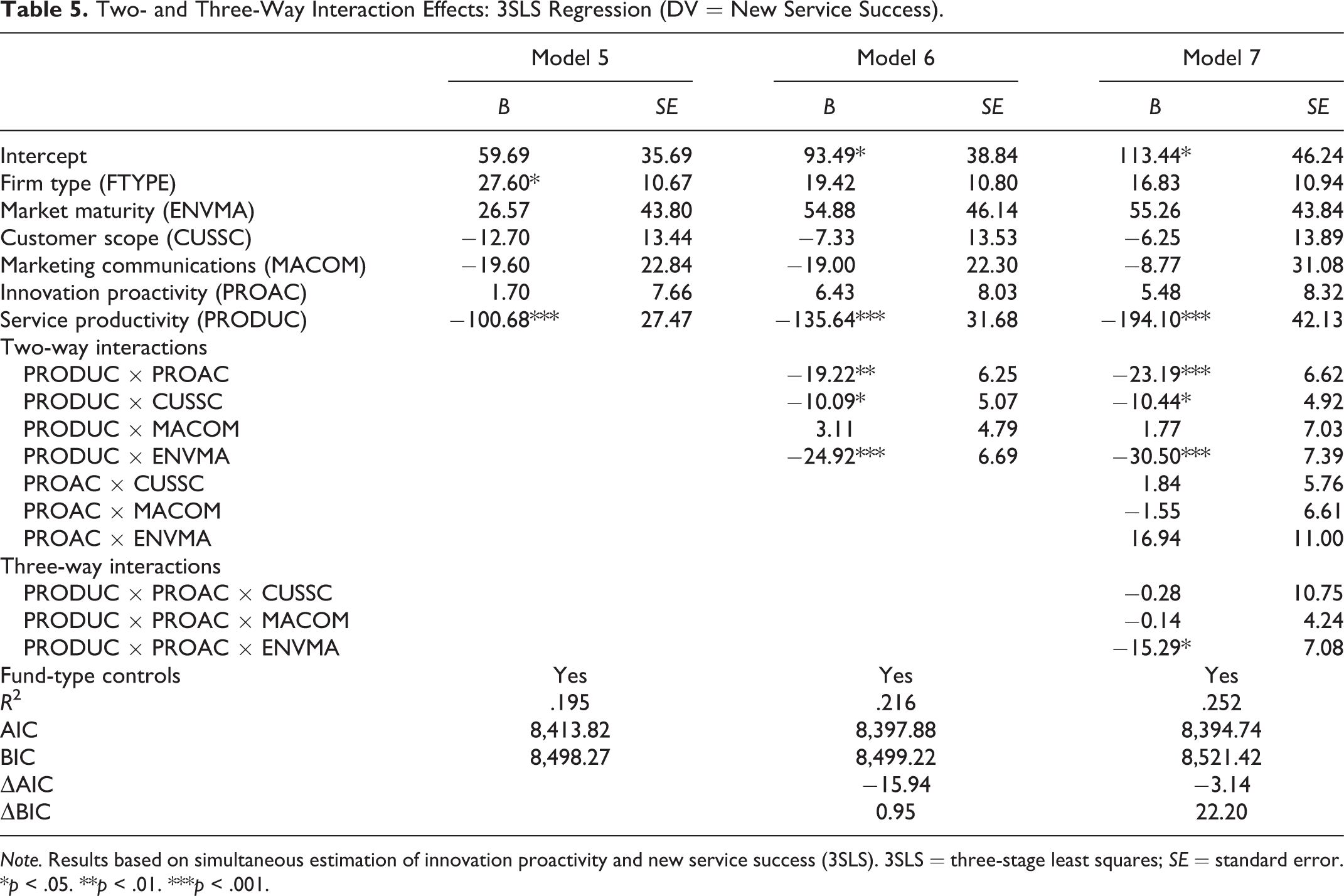
In the last step of the analysis, we explore the effect of interactions between key variables on the dependent variable of new service success: (i) the two-way interaction effects between service productivity and innovation proactivity, (ii) the two-way interaction effects between service productivity and the other managerial and market variables (i.e., customer scope, marketing communications, and market maturity), and (iii) the three-way interaction effects between service productivity, innovation proactivity, and managerial as well as market variables. We include the two- and three-way interaction effects in the 3SLS model (Models 6 and 7). Variance inflation factors are estimated for each model and do not indicate multicollinearity concerns. Table 5 reports the results of the series of nested models.
Two- and Three-Way Interaction Effects: 3SLS Regression (DV = New Service Success).
Note. Results based on simultaneous estimation of innovation proactivity and new service success (3SLS). 3SLS = three-stage least squares; SE = standard error.
*p < .05. **p < .01. ***p < .001.
The series of nested models shows the robustness of the negative effect of service productivity on new service success and its interactions across models. Model 6 adds a substantive improvement in the Akaike information criterion (AIC) over Model 5, while having a negligible difference in the Bayesian information criterion (BIC). As the BIC increases substantively in Model 7 while the AIC remains similar, we decide to opt for the more parsimonious Model 6 to discuss the key results. 5
First, we find a statistically significant negative interaction between service productivity and innovation proactivity (B = −19.22, p < .01). This means that the statistically insignificant baseline effect of innovation proactivity on service success (B = 6.43, p > .10) becomes, in net effect, significantly negative among firms that have high existing service productivity and positive among firms that have low existing service productivity. This result suggests that highly productive firms especially lack the capability to successfully market new services when innovating proactively (i.e., introducing services to the market ahead of competitors).
Second, we find a statistically significant negative interaction effect between a firm’s service productivity and the firm’s customer scope (B = −10.09, p < .05). This result suggests that the negative correlation between existing service productivity and new service success is also partly explained by the lowered (heightened) new service success of highly productive firms that have a broad (focused) customer scope.
Third, we find a negative interaction effect between the firm’s service productivity and market maturity (B = −24.92, p < .001). This result suggests that in addition to the effects of innovation proactivity and customer scope, the negative correlation of existing service productivity and new service success is partially explained by the lowered (heightened) new service success of highly productive firms in mature (emerging) market conditions.
Fourth, we do not find a statistically significant interaction effect between service productivity and the intensity of the firm’s marketing communications (B = 3.11, p > .10).
In summary, as a response to Research Question 2, Figure 1 summarizes the results for the interplay between service productivity and innovation proactivity versus other managerial and market factors in explaining the effect of service productivity on new service success.
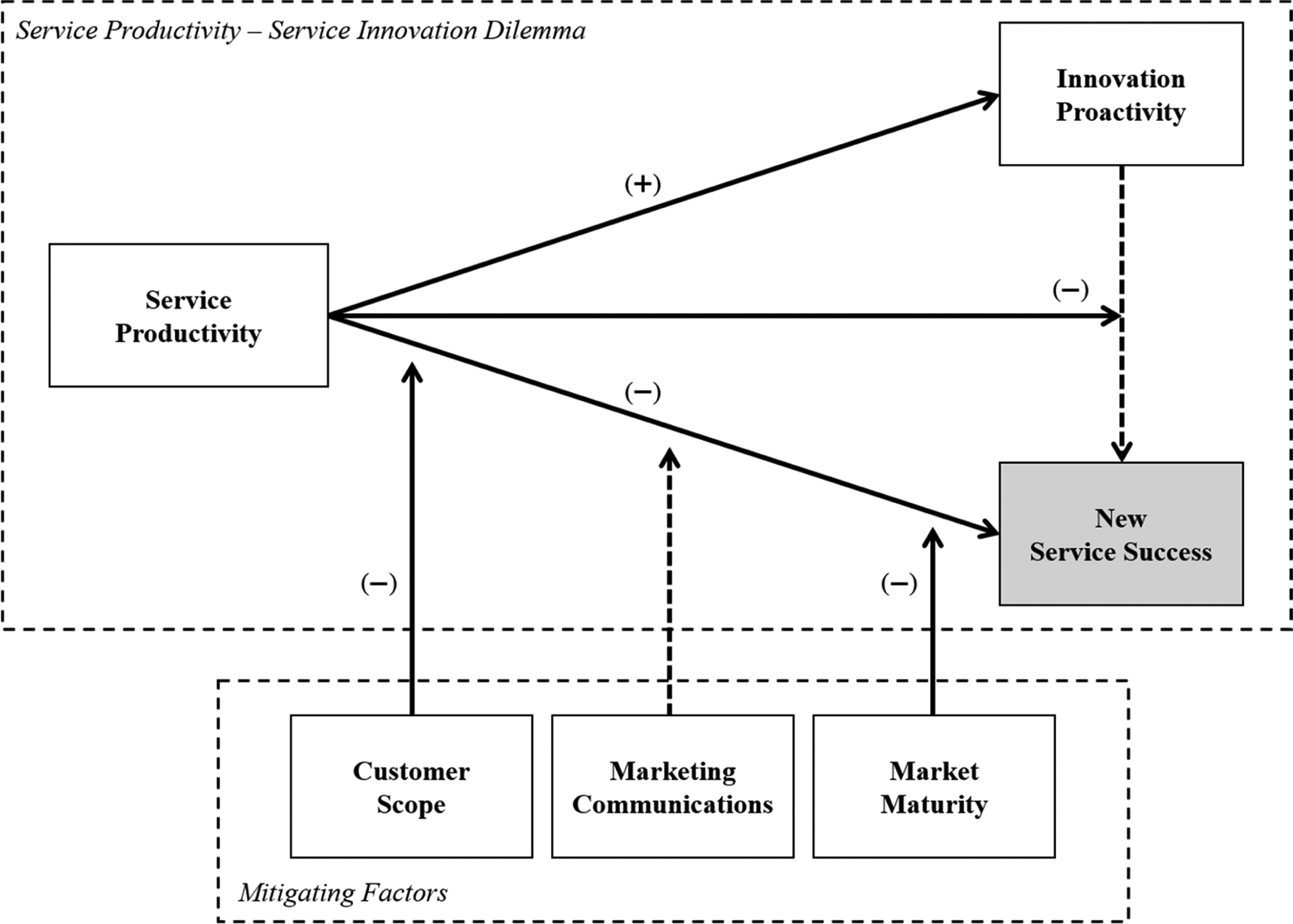
Results: Interrelationship between service productivity, innovation proactivity, and new service success. Dotted lines indicate nonsignificant effects.
Robustness Checks
We conduct several additional analyses to ensure the robustness of the results. Specifically, we consider alternative specifications for the three main constructs: service productivity, innovation proactivity, and new service success. First, instead of a weighted average, we use a simple average of service productivity as obtained with DEA. The results remain the same, such that all statistically significant effects are consistent independent of whether a weighted or simple average of service productivity is utilized as the focal measure. Second, we use a censored measure of innovation proactivity to eliminate the effects of potential outliers. We assign the value of 1 SD below (above) the mean of innovation proactivity to all observations that have a value of more than 1 SD below (above) the mean. The results for the relationships between service productivity, innovation proactivity, and new service success remain the same. Third, we estimate the series of nested models using a longer term market success measure: the size of the fund after 2 years since its introduction (instead of 1 year). Even with this longer term performance measure, the effects of service productivity on new service success remain the same. Thus, the results are robust for several alternative model specifications and variable operationalizations.
Discussion
We conduct a systematic exploratory investigation of the effects of existing service productivity on the success of new service introductions in a financial services market. Although previous research extensively addresses service productivity (Brown and Dev 2000; Rust and Huang 2012) and service innovation (Ordanini and Parasuraman 2011; Storey and Kahn 2010), to our knowledge this is the first empirical study that bridges the gap between these two research streams. Specifically, we provide insights into the mechanism underlying the complex relationship between a firm’s productivity in existing services and success in innovating new services. As the main contribution to the existing literature, the present results newly identify and unpack an important strategic dilemma between service productivity and service innovation: Being productive in existing services increases the firm’s tendency to innovate proactively but decreases the firm’s actual success in bringing the new service innovations to the market. Further, the increased, or excessive, innovation proactivity of highly productive firms aggravates the negative effect of service productivity on service innovation success.
Theoretical Implications
How does service productivity influence the market success of new services?
A firm’s productivity in existing services has a negative effect on the firm’s market success with new service innovations. On average, the more productive the firm is with existing services, the less successful it is in bringing new services to the market. This baseline result identifies a firm’s productivity in existing services as an important negative determinant of new service innovation success (see Ostrom et al. 2015). Although the literature paid attention to service development processes (Hull 2004; Van Riel, Lemmink, and Ouwersloot 2004) and interorganizational resources and cooperation (Eisingerich, Rubera, and Seifert 2009; Melton and Hartline 2013; Storey and Kahn 2010), the present result adds existing service productivity to the set of factors that influence the market success of a firm’s service innovations. Firms with higher productivity in existing services will, on average, achieve lower market success for new service innovations. This finding thus generally underlines the importance of attending to the interrelations between existing service operations and new service innovations (Parasuraman 2010).
Why does service productivity reduce service innovation success?
In addition to identifying the negative baseline effect of existing service productivity on new service success, we explore mechanisms that may explain this negative effect. At the outset, the reduction in new service success with increasing service productivity could be rooted in (1) market-level and firm-type factors, (2) managerial factors, or (3) factors related to existing service productivity per se. Regarding the last, a highly productive firm might (3a) lack the willingness to proactively innovate in the first place, (3b) lack the capabilities to introduce successful service innovations, or (3c) lack both.
The results indicate that neither (1) market-level and firm-type factors (e.g., market mood) nor (2) managerial factors (e.g., marketing communications intensity) account for the negative effect of existing service productivity on new service success. More importantly, the results demonstrate that it is not (3a) the highly productive firms’ lack of willingness to proactively innovate that drives their compromised new service innovation success but (3b) the lack of capability to successfully innovate. In essence, this result is related to the theory of the capability-rigidity paradox (Atuahene-Gima 2005), suggesting that firms that are highly capable in current activities have reduced capabilities to introduce new innovations. In contrast to the original idea of the capability-rigidity paradox, we do not find a crowding-out effect such that the exploitation of existing capabilities (∼productivity) automatically undermines the pursuit of exploration activities (∼innovation) on the input side. Instead, we find that firms with high existing service productivity actually tend to be more proactive in innovation activities. However, these highly productive firms lack the capability to successfully introduce these innovative services, especially when seeking to innovate proactively. That is, firms with high existing service productivity are excessively proactive in exploring new service innovations while being unable to turn this innovation proactivity into market success.
An underlying explanation for these overall effects might be rooted in managerial overconfidence. Managers at firms with high existing service productivity might be blinded by their achievements in existing service operations when introducing new services. In making decisions about new offerings, managers may tend to rely on their firm’s existing productivity track record, akin to success bias (see Barnett and Pontikes 2008). Thus, managers might not attend carefully enough to the needs of the market and customers in introducing the firms’ new service innovations. This interpretation is in line with Kyriakopoulos and Moorman (2004) who suggest that the exploitation of current capabilities and the exploration of new capabilities tend to constitute a trade-off for firm performance, unless the firm has a particularly strong market- and customer-oriented organizational culture. Thus, productivity in existing services leads to a gap between managers’ expectations when innovating proactively and their actual (market-oriented) capabilities to create and introduce these innovations successfully. As a result, a crucial discrepancy seems to arise between managers’ expectations for new services, the managers’ proactivity in introducing these new services to the market, and the eventual market success of these service innovations. This discrepancy between managers’ expectations and customers’ perceptions is also akin to service quality gaps that have been identified to exist between customers’ expectations for a service and the customers’ perception of the eventual service delivery by the firm (Parasuraman, Zeithaml, and Berry 1985). The present research suggests a previously unidentified service performance gap: Service productivity in existing services may make managers excessively proactive (i.e., overconfident in expectations) in introducing new services, vis-à-vis customers’ perceptions of the service as represented by its eventual market success.
Can other managerial or market factors explain the effects of service productivity on new service success?
We further examined the interaction effects of service productivity with other managerial (i.e., customer scope, marketing communications intensity) and market factors (i.e., market maturity). In addition to excessive innovation proactivity, we find that the negative effect of existing service productivity on new service success is further driven by the compromised new service success of such highly productive firms that (i) have a broad customer base scope or (ii) introduce their new services under mature market conditions. This finding suggests that a broad base customer scope and mature market conditions, especially, may prevent highly productive firms from matching their innovations to specific customer needs and carefully developing the innovations instead of relying on the demand of an already established market.
Importantly, these interaction effects did not fully nullify the negative effect of existing service productivity on new service success or the negative interaction effect with innovation productivity. Thus, instead of being alternative mechanisms, a firm’s broad customer scope and mature market conditions are rather additional moderating factors that partly explain the negative effect of existing service productivity on new service success.
Managerial Implications
This study provides three important implications for managers: (i) existing service productivity tends to hinder the market success of service innovations. (ii) The problem is aggravated by excessively proactive innovation efforts, but (iii) a focused customer base and market growth conditions can enable a dual-emphasis strategy of combining existing productivity with new service innovation.
Service productivity threatens the success of service innovation
For executives who are concerned about the success of their innovation strategy, the present study unveils a fundamental dilemma between the firm’s existing productivity in service operations and the firm’s service innovation activities. For firms that are highly productive in existing services, service innovation efforts will often not be successful, despite managers’ willingness to proactively innovate. This is a problem of capabilities and not of willingness to innovate proactively. On the contrary, for firms that are not highly productive in their current service operations, the present research suggests a fruitful opportunity to innovate new services proactively. Namely, firms with lower service productivity in their existing services enjoy, on average, higher market success when the firms introduce innovative new offerings.
The problem is aggravated due to excessive innovation proactivity
For highly productive firms, the problem is aggravated: Managers tend to be proactive in bringing innovative services to the market before competitors, but the firms experience less market success with these innovations. In fact, managers at highly productive firms might be overconfident due to the firms’ existing service productivity track record. These managers might be excessively eager to introduce new services to the market without assuring that the services are actually needed or well received by their customers. As a result, the managers’ excessive innovation proactivity undermines their new service success. To avoid this discrepancy, executives at highly productive firms should caution their organization against being excessively optimistic or overconfident in proactively innovating and introducing new services too early to the market.
Focused customer base and market growth can enable a dual emphasis strategy
Despite the baseline negative effect of existing service productivity on new service success, managerial and market factors may enable a “dual emphasis” strategy of achieving successful new service innovations while retaining high existing service productivity. Specifically, according to the present results, having a more focused (vs. broad) customer base scope and targeting growing (vs. mature) market conditions decrease the negative effect of existing service productivity on new service success. Considering that firms with a more focused customer scope have more successful service innovations, a worthwhile approach for firms with a broad customer scope could be to forge and ensure a more careful match of their innovations with specific customer needs via an elaborate customer segmentation strategy. Additionally, managers at highly productive firms should be more careful in targeting their new services to specific customer needs in mature markets, instead of assuming that all new services will “sell themselves” to existing customers.
In summary, executives who wish to simultaneously pursue high productivity in existing services and success in innovating new services should consider the following. First, the executives should ensure that the firm has a focused customer scope, for example, via an elaborate and focused customer segmentation strategy. Second, they should target and capitalize on growing market conditions and be specifically cautious, or careful, in their innovation activities when the market enters a mature state. In contrast, intensifying the firm’s marketing communications efforts does not seem to mitigate the dilemma or to facilitate a dual emphasis strategy of existing service productivity and new service innovation.
Limitations and Avenues for Further Research
In this article, we bridge the gap between research on service productivity and service innovation and unveil a service productivity-service innovation dilemma. It is in the nature of an exploratory study that many interesting questions remain to be answered in future research. We consider the present empirical exploration as the first step to make managers aware of a fundamental dilemma and to provide researchers with a foundation for systematic further research.
In contrast to many previous studies on service innovation, we did not rely on self-reports of service innovation success (e.g., Melton and Hartline 2013; Storey and Kahn 2010; Van Riel, Lemmink, and Ouwersloot 2004). Instead, we used a census data set of mutual funds to objectively measure the market success of service innovations and to obtain a market benchmark measure for service productivity. Although this method ensured objective identification of empirical effects, it also limited our perspective to an external view on the relationship between service productivity and service innovation. Obtaining an internal view on organizational culture, structural factors, and learning processes would provide further understanding of the service productivity-innovation dilemma. Related questions for further research include the following: What are the internal processes and organizational structures that lead to less successful service innovations in highly productive firms? Do firms learn to be more effective in combining service productivity and service innovation activities over time and from competitors?
We find that innovation proactivity aggravates the negative effect of service productivity on service innovation success. Further research might shed more light on the role of innovation proactivity in highly productive firms, specifically looking at it from an internal company perspective and the customer perspective. Relevant questions include the following: What are further organizational factors that might aggravate the negative effect of service productivity on service innovation success? How can gaps between managers’ expectations when innovating proactively and their actual capabilities to create and introduce these innovations be narrowed down through customer-oriented activities?
Market and managerial factors emerge as interesting factors of influence on the effect of service productivity on new service success. Specifically, the study results imply that a focused customer scope and growth market conditions can facilitate a dual emphasis strategy of existing service productivity and new service innovation success. Future research might pursue identification of additional mitigating factors that may enable managers to compensate for the baseline service productivity-service innovation dilemma. Potential avenues for future research are the following: Are there additional managerial or market factors that will facilitate a dual emphasis strategy of high service productivity and successful service innovation? What are productive firms with a focused customer scope doing differently to increase service innovation success? How could companies combine productivity and innovativeness in mature market conditions?
Finally, this study focuses on service innovations in the financial services industry. In this industry, and particularly in the mutual funds market, the success of service innovations is vital for firms due to homogeneity of existing services and the market’s competitive landscape. However, we encourage further research to extend this study and to generalize our findings beyond the financial services industry.
In conclusion, this article presents the first empirical exploration of the effects of firms’ productivity in existing services on firms’ success in innovating new services. We unveil a previously unidentified strategic dilemma between service productivity and service innovation. We highlight several research avenues to further bridge the gap between the service productivity and service innovation literature and to guide managers to achieve high productivity in existing services and success in introducing new services simultaneously.
Footnotes
Acknowledgments
The authors would like to thank Jukka Luoma and Anssi Keloharju for assistance with the preparation of the data at different stages of the research project.
Declaration of Conflicting Interests
The author(s) declared no potential conflicts of interest with respect to the research, authorship, and/or publication of this article.
Funding
The author(s) received no financial support for the research, authorship, and/or publication of this article.
Notes
References
Supplementary Material
Please find the following supplemental material available below.
For Open Access articles published under a Creative Commons License, all supplemental material carries the same license as the article it is associated with.
For non-Open Access articles published, all supplemental material carries a non-exclusive license, and permission requests for re-use of supplemental material or any part of supplemental material shall be sent directly to the copyright owner as specified in the copyright notice associated with the article.
