




Abstract
The effectiveness of service recovery initiatives has primarily been explained by exchange theories implicitly assuming that the customer desires beneficial relationships. The present research extends studies in this tradition by emphasizing the crucial role of the customer’s vulnerability. Drawing on crisis theory, we argue that the effectiveness of service recovery initiatives is contingent on customer relationship vulnerability (CRV), which is defined as a customer predisposition to psychological harm in relationships with service firms. The findings show that a full-service recovery is not always possible among vulnerable customers. We discuss the implications for theory and service management practice.
Introduction
Service research has long devoted significant attention to service recovery (Davidow 2003), as “service failures are inevitable even in the best run service organizations” (Mattila 2001, p. 91). Firms can spend billions on service recovery; yet, many customers are dissatisfied with how firms handle complaints. The National Customer Rage Survey reported that only 32% of complainants are completely satisfied with firms’ responses (CCMC 2020). Hence, it is crucial for service providers to understand why some customers are inherently impervious to service recovery initiatives and what providers can do to serve these customers.
Research on the effectiveness of service recovery often draws on exchange theories, such as social exchange theory (i.e., justice theory), resource exchange theory, or social resource theory (Roschk and Gelbrich 2014; Smith, Bolton, and Wagner 1999; Van Vaerenbergh et al. 2019). A leading argument is that customers view service failures as losses that should be offset (e.g., by monetary compensation or apology). This argument is based on the implicit assumption that customers desire beneficial relationships (see Danaher, Conroy, and McColl-Kennedy 2008), and thus, it overlooks customers’ vulnerability. Overlooking the vulnerability aspect might limit our understanding of the degree to which customers are affected by crisis and how their vulnerability impacts the effectiveness of service recovery. Although several scholars have suggested that companies should assess customer relationships beyond the desire assumption (e.g., Bendapudi and Berry 1997), service research has rarely explored this phenomenon.
The present research addresses this gap in three ways. First, we conceptualize such vulnerability as a customer trait called customer relationship vulnerability (CRV)—a customer predisposition to psychological harm in relationships with service firms. This research begins with the argument that CRV is crucial for understanding customer attitudes in relationships, such as other customer traits emerging from early childhood (e.g., attachment anxiety and attachment avoidance; Mende and Bolton 2011) and customer characteristics impacting marketing initiatives in general (e.g., psychological reactance, consumer relationship proneness; Chang 2006; De Wulf et al. 2001).
Second, we draw on crisis theory (Caplan 1964; Hill 1949; Silverman 1977) to theoretically ground the concept of CRV and its impact on the effectiveness of service recovery. A key assumption of the theory is that a perceived lack of resources renders individuals vulnerable to stress events, impairing their ability to adapt to these events (Baldwin 1979; Silverman 1977). The present research connects this assumption with the service literature to explain the degree to which customers are affected by crisis situations (e.g., service failures) and how their vulnerability (i.e., CRV) impacts the effectiveness of service recovery. Third, to gain additional insights into the moderating role of CRV in service recovery, we explore whether the moderating effects of CRV are linked to coping processes. We discuss the implications for research and practice.
In addressing the above research gap, we contribute to the theory and practice of service relationship marketing in three ways. First, the current research lays the foundation for a new approach to understand the effectiveness of service recovery that goes beyond the desire- and exchange-based views. We extend these views of service recovery by introducing a trait (i.e., CRV) that renders customers immune to most recovery initiatives. Second, the current research provides evidence for service recovery initiatives that are likely to be effective among customers with higher CRV. We demonstrate that vulnerable customers are more responsive to service recovery that facilitates their adaptation to crises. In this regard, this paper responds to a recent research call on how service firms should support customers who experience deep suffering from service failures (Grégoire and Mattila 2021). Third, the current research develops and validates a measure of CRV enabling scholars and practitioners to measure customers’ vulnerability to crises and to adapt their service recovery accordingly.
Theoretical Background and Hypotheses
We theoretically ground the present research in crisis theory (Caplan 1964; Hill 1949). Early research acknowledged that crisis theory “is interchangeably applied to various levels of analysis” (Schulberg and Sheldon 1968, p. 554). Although the theory has been applied to the functioning of families, organizations, and communities, crisis theory has been considered most frequently regarding the response of an individual to a difficult situation (Schulberg and Sheldon 1968). One of the assumptions of crisis logic is that a perceived lack of resources renders individuals vulnerable to stress events, impairing their ability to deal with these events (Baldwin 1979; Silverman 1977). Pearlin and Schooler (1978) explained that resources do not refer to what people do but to what is available to them when they encounter crises. These resources reside within individuals and consist of personal characteristics on which they rely to cope with crises (Pearlin and Schooler 1978). In crisis logic, these events are viewed as emotionally hazardous situations (Caplan 1964).
The current research investigates the degree to which customers are affected by crises and the impact of their vulnerability on the effectiveness of service failure recovery. In a service context, we argue that vulnerable customers are less responsive to marketing initiatives and preemptive actions that offset service failures. Service research categorizes these initiatives into three types of organizational response: compensation, organizational procedures, and favorable employee behavior (Gelbrich and Roschk 2011; Van Vaerenbergh et al. 2019). During the recovery stage, compensation—which is “the most powerful way to offset a company failure” (Roschk and Gelbrich 2014, p. 195)—involves apology, monetary compensation, and new/exchanged (reperformed) goods (services). Favorable employee behavior consists of courtesy, effort, empathy, and justification, while organizational procedures involve customer participation, employee empowerment, flexibility, and recovery time (Van Vaerenbergh et al. 2019). Research has also investigated other preemptive actions, such as reputation or firm equity, that are not recovery initiatives per se but, if present, can offset service failures (Brady et al. 2008; Sengupta, Balaji, and Krishnan 2015). For instance, research has viewed brand- and reputation-building strategies as potential allies in firms’ efforts to offset service failures (Brady et al. 2008; Sengupta, Balaji, and Krishnan 2015). In this paper, we connect these preemptive actions and the most powerful recovery initiative (i.e., compensation) with crisis logic to develop broad and generalizable insights into the extent to which customers with CRV are immune to different service recovery actions and initiatives.
Moreover, we consider recovery initiatives that facilitate the adaptation of vulnerable customers to service failures. This is consistent with crisis theory, which suggests that adaptation plays a key role in crises (Baldwin 1979; Caplan 1964; Schulberg and Sheldon 1968). Adaptation to crises may involve the alteration of relationship roles and rules as well as tremendous effort (Pearlin and Schooler 1978). In a recovery context, customer participation, flexibility, and employee effort reflect adaptation. Customer participation (i.e., opportunity for customers to shape or personalize the recovery through joint collaboration with the organization) is essential for adaptation since it involves the alteration of the customer’s role in the relationship. Moreover, flexibility (i.e., treatment of customers that ranges from similar treatment according to organizational policies and procedures to treatment on a case-by-case basis) and employee effort (i.e., amount of energy the service employee puts into solving problems) also reflect adaptation. While flexibility allows for changes in the relationship rules, employee effort consists of necessary actions that are part of the adaptation process.
As for outcome variables, we investigate customer responses occurring after the firm’s attempt to recover from the service failure (Valentini, Orsingher, and Polyakova 2020)—see Figure 1. This includes the likelihood of switching, which is the degree to which a customer considers a replacement for a current service or product firm (Ping 1993); vindictive word-of-mouth (Vindictive WOM), which is unfavorable communication with other customers aiming at denigrating a firm (Gelbrich 2010); and recovery satisfaction, which is the “customer’s satisfaction with a particular transaction involving a failure and recovery” (Maxham and Netemeyer 2002, p. 240). Conceptual framework. Note. The figure only displays hypothesized effects. The post hoc mediators are not shown to ease the figure’s readability.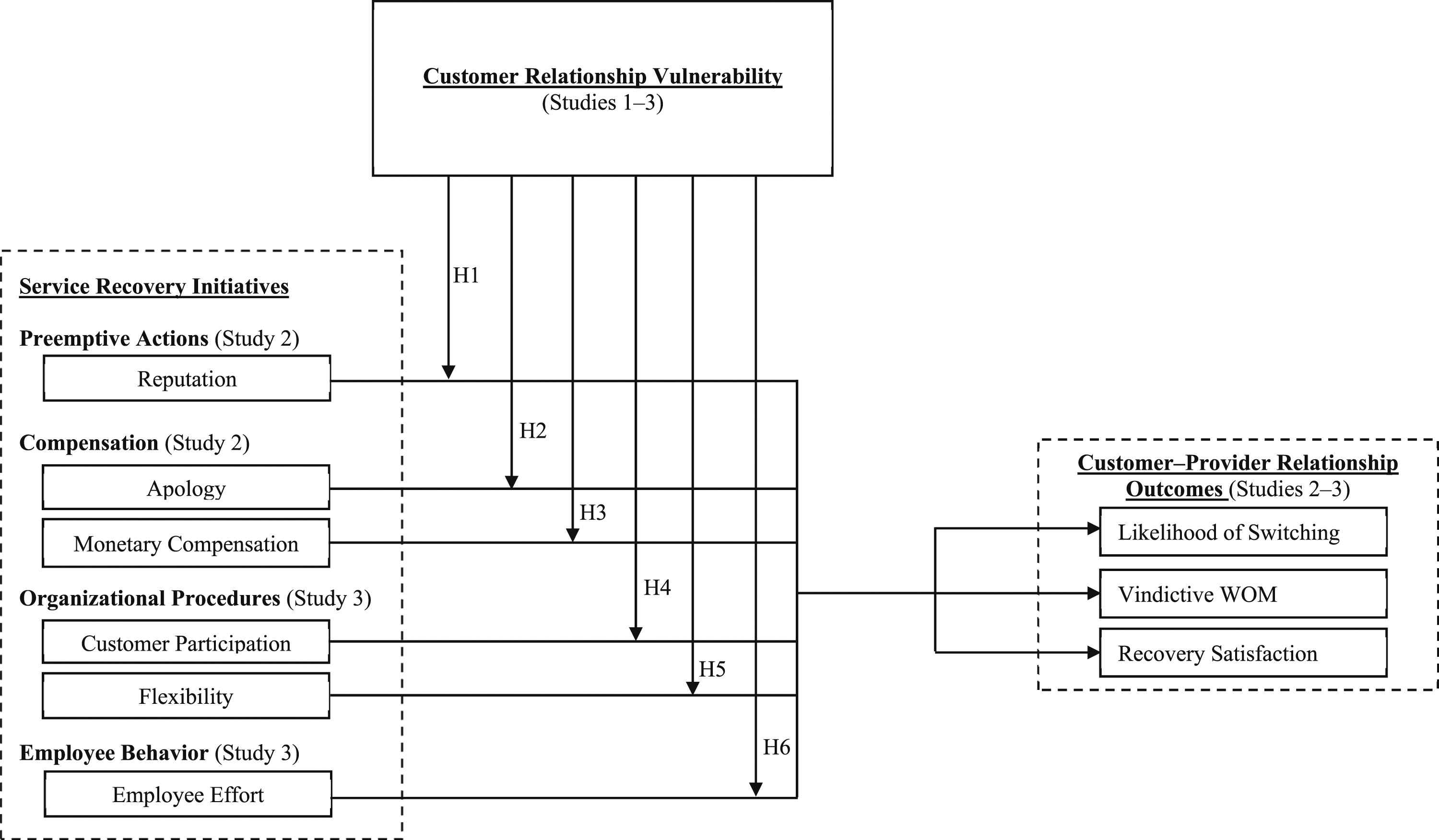
Customer Relationship Vulnerability
Vulnerability is a term that frequently appears in the risk and hazard literature (Wisner Ben et al., 2004). However, management, marketing, and psychology have also employed this notion (Web Appendix A).
Previous Definitions and Common Themes
The notion of vulnerability has been discussed in business-to-business (B2B), business-to-consumer (B2C), and psychology research. In the B2B domain, studies on relationship dependencies understand vulnerability as a consequence of the dependencies created by complex relationships (Christopher and Peck 2004). Accordingly, Svensson (2002, p. 323) defined vulnerability as a “condition that is caused by time- and relationship-dependencies in a company’s business activities in marketing channels.” The term “vulnerable” has also been used in several studies to explain the process of relationship failure. Doyle et al. (1980, p. 18) identified vulnerability as an antecedent to relationship failure, and they advanced the idea that relationship failure is “a process of ‘creeping disenchantment’ preceded by clear signals of vulnerability.” In B2C, studies have interpreted vulnerability as the extent to which consumers are susceptible to harm in an economic transaction (Craig and Elizabeth 1997; Hill and Sharma 2020). Vulnerability has also been viewed as the consumer’s exposure to future harm given their current access to various financial resources (Salisbury et al. 2023). In the era of information technology, research has addressed consumers’ vulnerability in terms of data vulnerability (Martin, Borah, and Palmatier 2017) and limited self-control (Liu, Sockin, and Xiong 2021), which expose them to harm.
Research in psychology offers a similar view of vulnerability. Karney and Bradbury (1995) used the concept of enduring vulnerabilities to refer to the personal characteristics on which partners rely to handle conflicts and disagreements in relationships. The conceptualizations of enduring vulnerabilities have been derived from a wide variety of concepts, including negative affectivity and educational attainment (Woszidlo and Segrin 2013). The psychological components of enduring vulnerabilities are known to severely hamper interpersonal relationships (Karney and Bradbury 1995; Woszidlo and Segrin 2013).
Studies across disciplines have approached vulnerability from different levels of analysis. Nonetheless, vulnerability has commonly been understood as a characteristic that predisposes individuals to a particular outcome or reaction when hazardous events occur.
Conceptual Definition
We define CRV as a customer predisposition to psychological harm in relationships with service firms. Our definition of CRV follows three categories of scope conditions: values (e.g., implicit assumptions), space (e.g., application of the concept), and time (e.g., temporal boundaries; Suddaby 2010). First, the definition of CRV assumes that customers differ in the extent to which they can psychologically be affected by crises. This assumption aligns with crisis theory, which explains why certain individuals can adapt to stress events (i.e., emotionally hazardous situations; Baldwin 1979; Silverman 1977). The use of predisposition to psychological harm in the definition underlines that CRV describes a customer trait rather than a mere predisposed behavior. This predisposition implies insufficient internal resources to adapt to disturbances created by crises. To illustrate, while customers with lower levels of CRV are less disturbed and affected by crises, those with higher levels of CRV feel emotional strain and are overwhelmed by crisis situations. Overall, our approach to CRV as a predisposition to psychological harm is consistent with the view of Marco and Suls (1993), who noted that personality traits are associated with experiencing life events as more stressful and overwhelming.
Second, in terms of applicability, CRV serves as a domain-specific concept (as opposed to, for instance, negative affectivity) and focuses on a specific assessment of the customer’s predisposition to psychological harm in B2C relationships. CRV is applicable to crisis situations that occur in B2C relationships. Crises imply service failures, data leaks involving customers’ personal information, etc. The concept of CRV is less relevant in B2B service relationships, as it assumes customers’ differences in terms of the extent to which they are predisposed to psychological harm from crises. As Van Doorn (2008, p. 135) noted, “service satisfaction might be more central in consumers’ ego defensive system than in that of a business customer.” Moreover, CRV is not dependent on the goals that different relationships ought to satisfy, and it should work similarly, regardless of the importance of the relationship. For instance, customers who are predisposed to psychological harm from crises in relationships with financial service firms should show the same vulnerability in relationships with hotels.
Finally, the approach to CRV as a trait implies that the concept is stable over time. Prior marketing research has used the term “psychological predisposition” to describe stable customer tendencies in relationships (e.g., Christy, Oliver, and Penn 1996; De Wulf, Odekerken-Schröder, and Iacobucci 2001). Similarly, CRV should remain stable and show only minor changes across a person’s lifetime.
Dimensionality, Source, and Delineation of CRV
Earlier conceptual frameworks in marketing have approached vulnerability as a multidimensional concept consisting of a mix of internal and external factors (Web Appendix B). Some conceptualizations have focused on characteristics within consumers, while others have emphasized external conditions or an interaction of internal and external factors. For instance, prior conceptualizations have involved factors such as race and education (e.g., Craig and Elizabeth 1997); consumers’ internal influences, external social influences, competence, and marketing contexts (e.g., Baker, Gentry, and Rittenburg 2005). Such an approach does not distinguish between the concept, its antecedents, and its consequences. Following the definition of CRV as a predisposition to psychological harm, we employ a unidimensional perspective. Our approach is consistent with the conceptualization of negative affectivity, with which CRV intersects.
Regarding the influencing sources and development of CRV as a personality trait, CRV reflects the accruing influences of socialization agents, such as parents and peers, and contexts across development (see Fox and Walker 2015). Karney et al. (1994, p. 6) noted that “the nature of [the] first close relationship determines a child’s internal working model of what close relationships are like, so it should determine the nature of an individual’s close relationships throughout the life course.” Such learning shapes their personalities as customers, making them more or less vulnerable to crises in relationships with providers.
CRV and Related Concepts.
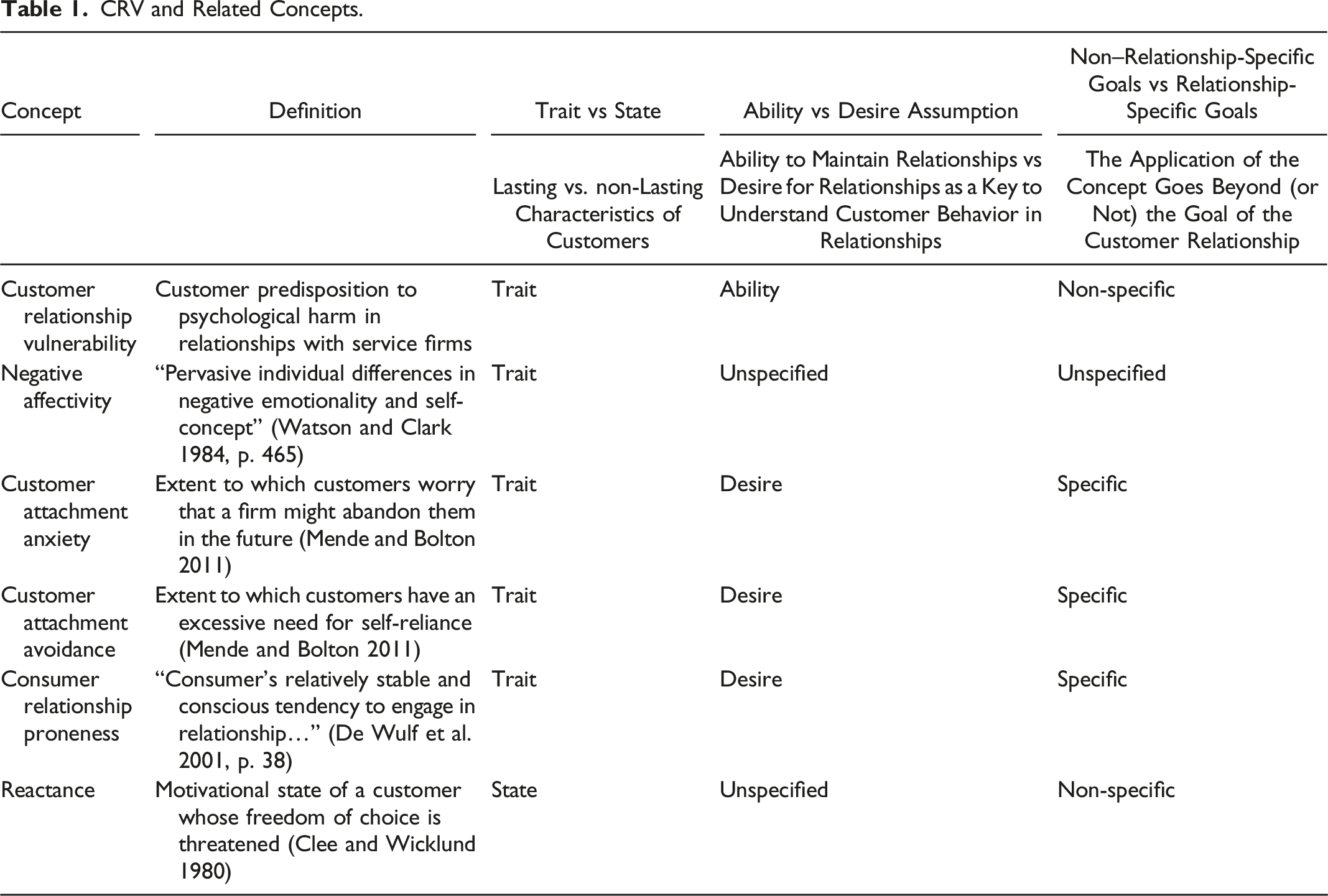
Finally, CRV is conceptually distinct and related to other customer traits that emerge from early childhood and explain attitude and behavior in customer relationships. In particular, CRV differs from attachment styles (Mende and Bolton 2011), such as anxious attachment (i.e., the extent to which customers worry that a firm might abandon them in the future) and avoidant attachment (i.e., the extent to which customers have an excessive need for self-reliance). Unlike attachment styles, which are relationship goal-specific constructs (Shaver, Collins and Clark 1996), the application of CRV goes beyond the specific goals that different B2C relationships ought to satisfy. For instance, consumers may be more worried about being abandoned by a health insurance firm than by a food delivery service. Their CRV should relate to any kind of relationship. Moreover, attachment styles assume that the desire for relational intimacy (see, Mikulincer and Shaver 2007) is central to understanding relationship maintenance, while CRV assumes that certain customers are predisposed to psychological harm from crises, inhibiting them from maintaining relationships. Customers with higher CRV, nevertheless, should score higher for attachment anxiety, as they may perceive service failures as a sign of abandonment. In addition, attachment avoidance should be associated with a lower predisposition to psychological harm from service failures because individuals with high attachment avoidance tend to respond to relationship problems by discounting the severity of their emotions (Wei et al. 2005).
The Moderating Role of CRV in Service Recovery Effects on Outcome Variables
The concept of CRV assumes that customers differ in the extent to which they are predisposed to psychological harm in relationships with service providers. Customers who are deeply affected by crises may not be receptive to service firms’ actions or initiatives to recover service failures because such initiatives do not necessarily translate into adequate support that vulnerable customers need to deal with service failures. Here, we elaborate on how CRV makes customers less responsive to reputation, apology, and monetary compensation.
Reputation
Reputation is interpreted as “a global perception of the extent to which an organization is held in high esteem or regard” (Weiss et al. 1999, p. 75). This perception refers to the image and consumers’ impression of the service or product provider (Goldberg and Hartwick 1990). Being perceived as reliable, service firms with good reputations are buffered against the negative consequences of service failures (e.g., switching; Hess 2008). Failures elicit significant causal attributions, leading to anger and vindictive WOM. Hess (2008) argued that reputation has the potential to limit the attributions of causality, which buffers the service firm from vindictive WOM. Moreover, reputation offsets the deleterious effect of service failure by pulling post-failure evaluations toward the more positive value-added characteristics of the service firm. As Brady et al. (2008, p. 153) noted, “prior positive associations provide favorable data points for consumers to integrate with the new evidence observed in a failure.” Hence, reputation positively influences recovery satisfaction.
However, this buffering effect is ineffective at reducing the likelihood of switching and vindictive WOM or enhancing recovery satisfaction among the most vulnerable customers. Higher levels of CRV mean that customers feel fed up with crisis situations. This feeling implies an unpleasant and uncomfortable effect and indicates that a critical point (i.e., in terms of tolerance for stress) has been reached (Baldwin 1979). At this point, vulnerable individuals rely on adequate and substantial support to overcome the crisis (Baldwin 1979; Price et al. 2020). Although reputation conveys reliability, it does not help overcome the actual crisis, and therefore is not adequate for the most vulnerable customers. Following this logic, we expect the buffering effect of reputation to be less effective among customers with higher CRV. Hence:
The negative effect of reputation on (a) the likelihood of switching and (b) vindictive WOM and its positive effect on c) recovery satisfaction become weaker with increasing CRV.
Apology
Apologies are common marketing interventions in times of service failures (Boshoff 1999). They refer to acknowledgements of blameworthiness for service failures and show empathy toward customers affected by service failures (Gelbrich and Roschk 2011). Apologies redistribute esteem in relational exchanges. This redistribution provides an important reward to the victim. Apologies reflect the perception of fairness, which is essential for the success of service failure recovery. By issuing apologies, service firms demonstrate their ability to understand customers’ feelings and pledge that the failure will not persist, which reduces the likelihood of switching and vindictive WOM and enhances recovery satisfaction.
Although apologies signal the acknowledgement of blameworthiness and empathy, this initiative is less effective at placating customers with higher levels of CRV. Following crisis logic (Baldwin 1979; Caplan 1964), service failures are emotionally hazardous situations for vulnerable customers. Higher levels of CRV imply that customers are easily affected by these failures and cannot ignore them. The inability to ignore service failures indicates a negative focus on the offense and the offender—making apologies less effective. Hence:
The negative effect of an apology on a) the likelihood of switching and b) vindictive WOM and its positive effect on c) recovery satisfaction become weaker with increasing CRV.
Monetary Compensation
Monetary compensation refers to a quantifiable amount of money provided by the service firm to recompensate customers for their loss (Smith, Bolton, and Wagner 1999). Monetary compensation constitutes an effective service recovery initiative (Wei, Liu, and Tat Keh 2020). It signals justice and enhances recovery satisfaction while reducing negative WOM and customer switching (Gelbrich and Roschk 2011; Smith, Bolton, and Wagner 1999).
However, monetary compensation is less effective when customers are deeply affected and disturbed by service failures. Although compensation signals justice and fairness, it does not facilitate vulnerable customers to overcome the emotional disturbance associated with service failures. This is crucial for successful adaptation in crisis situations (Olson, Russell, and Sprenkle 1980). As Baldwin (1979) suggested in the context of vulnerability, crisis resolution should include the enhancement of psychological resources in order to be effective. Rooted in the notion of justice, monetary compensation does not guarantee such enhancement. Hence:
The negative effect of monetary compensation on (a) the likelihood of switching and (b) vindictive WOM and its positive effect on (c) recovery satisfaction become weaker with increasing CRV. Thus far, the hypotheses suggest that compensation (e.g., apology and monetary compensation) and preemptive actions (e.g., reputation) are less effective among highly vulnerable customers. Next, we consider recovery initiatives that support vulnerable customers in their adaptation. This aligns with the crisis logic suggesting that adaptation plays a key role in crises (Baldwin 1979; Schulberg and Sheldon 1968). Adaptation involves the alteration of the relationship roles and rules, and it requires tremendous effort (Pearlin and Schooler 1978). In line with these ideas, we investigate the degree to which the alteration of relationship roles and rules (i.e., customer participation and flexibility) and employee effort are effective in terms of decreasing the likelihood of switching and vindictive WOM and increasing recovery satisfaction among customers with higher CRV.
Customer Participation
Van Vaerenbergh et al. (2019, p. 106) viewed customer participation as “an opportunity for customers to shape or personalize the recovery through joint collaboration with the organization.” Customer participation is associated with their repurchase intentions (Roggeveen, Tsiros, and Grewal 2012). This is because customers participating in this process view the outcome of the recovery as more equitable (Roggeveen, Tsiros, and Grewal 2012). Customers also experience higher self-esteem by awarding themselves more credit for their “hard work” when participating in the recovery process (Dong, Evans, and Zou 2008). They likely assess their own work more positively and become more satisfied with the outcomes (Dong et al. 2008), which reduces vindictive WOM.
Customer participation becomes more effective at higher levels of CRV. Individuals draw on changes in their roles to mitigate the negative impacts of crises (Pearlin and Schooler 1978). The involvement of vulnerable individuals in crisis resolution is essential. Such involvement facilitates them to clarify and make sense of the issues involved (Hobbs 1984; Jacobson 1979). Unlike their peers with lower CRV, customers with higher CRV feel agitated when crises occur. Their participation in service recovery has the potential to help them “build fences” (see Jacobson 1979, p. 5) around service failures that may seem to be unmanageable before their involvement. Following this logic, we anticipate that customers with higher levels of CRV will benefit more from their participation in service recovery compared to those with lower CRV. Hence:
The negative effect of customer participation on (a) the likelihood of switching and (b) vindictive WOM and its positive effect on (c) recovery satisfaction become stronger with increasing CRV.
Flexibility
Flexibility, also known as the opposite of neutrality, refers to “the treatment of customers that ranges from similar treatment according to the organizational policies and procedures to treatment on a case-by-case basis” (Van Vaerenbergh et al. 2019, p. 106). Prior research has shown that neutrality has a negative influence on satisfaction (Sparks and McColl-Kennedy 2001), suggesting that flexibility plays a considerable role in the success of service recovery (Davidow 2003) in terms of reducing the likelihood of switching and vindictive WOM and enhancing recovery satisfaction. As suggested by Sparks and McColl-Kennedy (2001), customers may be more satisfied when service firms do them a special favor rather than follow organizational policies during the service recovery stage.
In comparison to customers with lower CRV, highly vulnerable customers benefit more from flexibility. Flexibility can minimize the negative impact of stress events and reduce disruptiveness in relationships after a crisis (Olson, Russell, and Sprenkle 1980; Pearlin and Schooler 1978). In a service context, this implies that employees may decide to bend the firm’s policy to facilitate the service recovery. This is particularly critical when the service failure involves customers with higher levels of CRV. Unlike those with lower CRV, higher-CRV customers rely on service employees’ ability to treat their cases in ways that consider the emotional disturbances caused by the service failure. In the crisis framework, flexibility is an important approach to stress events involving vulnerable individuals (Baldwin 1979). The treatment of customers with higher levels of CRV on a case-by-case basis is, thus, essential for service recovery. Hence:
The negative effect of flexibility on (a) the likelihood of switching and (b) vindictive WOM and its positive effect on c) recovery satisfaction become stronger with increasing CRV.
Employee Effort
Employee effort refers to the “amount of energy the service employee puts into solving problems” (Van Vaerenbergh et al. 2019, p. 106). Service employees’ efforts to address service failures are essential to the success of the recovery effort. Mattila and Patterson (2004) explained that the recovery effort is a crucial component of post-recovery satisfaction. This is because customers use effort to infer motivation, and the latter signals the concrete dedication of the service employee to achieving a new level of balance in the relational exchange that was affected by the service failure.
The effort put in by the service employee is particularly effective among customers with higher levels of CRV. These customers need employees’ support most to deal with the disturbances caused by service failures. Unlike their peers with lower CRV, higher-CRV customers are more affected by service failures. Hence, they view employee effort as additional resources/support brought by the service firm to protect them from the psychological impact of service failures and to facilitate their adaptation or recovery after a service failure. This is consistent with Baldwin (1979)’s suggestion that the adequacy of help received by vulnerable individuals in periods of crisis constitutes one of the primary determinants of crisis resolution. To illustrate in the context of a hospitality service failure (e.g., overbooking), employees’ efforts are reflected in their persistence and time/energy allocation in trying to resolve the problem. Such concrete effort convinces vulnerable customers that the service failure is manageable, thus facilitating their adaptation to the emotionally hazardous situation. Hence:
The negative effect of employee effort on a) the likelihood of switching and b) vindictive WOM and its positive effect on c) recovery satisfaction become stronger with increasing CRV.
Empirical Studies
Development of Measures
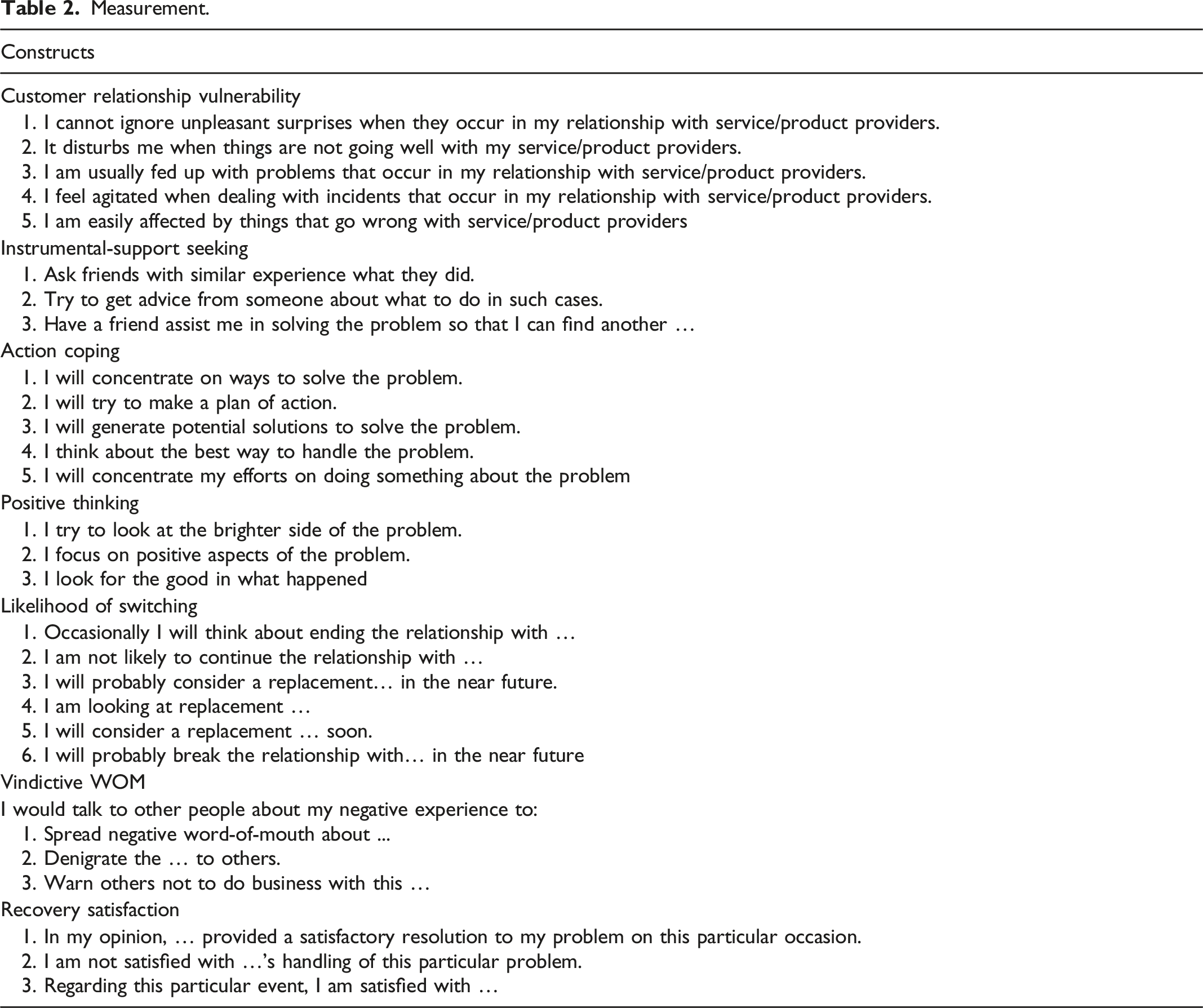
Measurement.
Study 1a: Item Generation and Face Validity for CRV
To develop a set of items for a CRV scale, 107 items were initially generated based on focus group discussions informed by extensive literature searches. We drew on definitions found in 21 papers from diverse fields (e.g., psychology, marketing, risk and hazard management, and supply chain management). Three focus group sessions were conducted to interview a total of 15 consumers (three to seven participants in each session). The sessions were facilitated by a researcher and lasted 45–60 minutes. To assess face validity, the initial items were given to a panel of five experts (marketing faculty). We shared the definition of CRV with the experts and asked them to examine the items independently and determine whether each item was clearly representative, somewhat representative, or not representative of CRV. Only items assessed as being clearly representative and at least somewhat representative were retained. From the initial set, 65 items were removed. This was followed by the removal of 27 additional items that were ambiguous, redundant, and/or constituted a consequence of CRV rather than an inherent characteristic. Such subsequent removal is not an unusual procedure in scale development (Netemeyer, Bearden, and Sharma 2003). Hardesty and Bearden (2004, p. 106) asserted that “simply judging items may not guarantee the selection of the most appropriate items for a scale… expert judging should not be used as a substitute for the scale development process.” Fifteen items were retained for the factor analysis in the next part of Study 1.
Study 1b: Exploratory Factor Analysis
The underlying structure of the CRV items was examined via a survey of 289 consumers (average age: 24 years; 66.4% female). Data were collected from students on Facebook. We distributed the survey to interest groups that students joined to discuss matters related to their studies. Student (convenience) samples were sufficient at this early stage of the scale development (Netemeyer, Bearden, and Sharma 2003; Papadas, Avlonitis, and Carrigan 2017). As incentives, we organized a lucky draw to reward several participants with Amazon gift certificates (worth USD 30). Participants were given a questionnaire containing 15 CRV items. They indicated their level of agreement with each item on a 7-point scale (1 = strongly disagree to 7 = strongly agree). A set of exploratory factor analyses was conducted using varimax rotation, with an item loading criterion greater than 0.40 (Brakus, Schmitt, and Zarantonello 2009). Five items were removed under this criterion. Next, we used item-to-total correlation techniques to examine the 10 remaining items for reliability. Items with an item-to-total correlation of less than 0.40 were removed. The six remaining items were loaded on a single factor.
Study 1c: Confirmatory Factor Analysis
We then collected data from university students to confirm the unidimensionality of the CRV scale. A total of 309 students completed the online survey (average age: 22 years; 57.9% female). The model fit revealed indices that were above acceptable thresholds: χ2 = 22.45, df = 9, p = .008; goodness-of-fit index (GFI) = 0.97; comparative fit index (CFI) = 0.95; root mean square error of approximation (RMSEA) = 0.07 (see Netemeyer et al. 2003). The factor loadings ranged from 0.37 to 0.65. The item with a loading of 0.37 was removed from the model, as such items tend to be unreliable indicators. A second confirmatory factor analysis of the five remaining items showed acceptable fit: χ2 = 11.62, df = 5, p = .04; GFI = 0.98; CFI = 0.97; RMSEA = 0.06. The chi-squared difference test (Δχ2 = 10.83; Δdf = 4; p = .03) and the improvement of the CFI, GFI, and RMSEA indicated that the model fit improved after dropping the item. The loadings on all the indicators exceeded 0.57 (except for one item with a loading of 0.46); they all had a p value of less than 0.001.
Study 1d: Evaluation of the CRV Measurement
Finally, before testing our conceptual framework, we assessed the quality of the CRV measurement by examining its discriminant validity and the extent to which it operates within a set of related constructs (Netemeyer, Bearden, and Sharma 2003). Discriminant validity was tested by comparing the correlation between related constructs and the square root of the average variance extracted (AVE) for CRV (Fornell and Larcker 1981). We also explored the possible effects of CRV and its related constructs on commitment. Our theoretical argument suggests that CRV has major implications for relationship maintenance. We selected commitment as the relationship outcome of interest since the concept “has been shown to be essential to the creation and preservation of marketing relationships” (Lacey, Suh, and Morgan 2007, p. 244). Committed customers hold feelings of attachment to maintain relationships that are valuable. Based on our assumption that customers with higher scores on CRV struggle to maintain relationships, we anticipated a negative effect of CRV on commitment. An independent sample of 259 consumers was recruited via MTurk (average age: 37 years; 42.9% female). The results, listed in Web Appendix C, showed that all correlations with CRV were smaller than the square root of the AVE for CRV, indicating discriminant validity. The findings indicated that CRV is significantly and positively related to reactance (r = 0.17, p < 0.05) and negative affectivity (r = 0.20, p < 0.01). The positive association between CRV and attachment anxiety (r = 0.12, p < 0.10) was marginally significant. As expected, CRV was negatively associated with attachment avoidance (r = −0.17, p < 0.05). Unexpectedly, we found a positive relationship between CRV and consumer relationship proneness (r = 0.26, p < 0.001). Furthermore, to position CRV within these constructs, we ran a regression analysis to test their different effects on commitment. We first tested the effects of the related constructs (Model 1) and then added CRV to estimate the R-squared change (Model 2). The results indicated a significant change in R-squared (ΔR2 = 0.01, p < 0.05) and showed that CRV significantly explains commitment (b = −0.11, SE = 0.05, p < 0.05) that goes beyond its related constructs (Web Appendix D).
Study 2
Our goal in Study 2 was to probe the effectiveness of reputation, apology, and monetary compensation at different levels of CRV (α = 0.91). In a post hoc analysis, we tested three coping mechanisms as process explanations to explore whether CRV moderates the indirect effects of service recovery on the likelihood of switching (α = 0.94), vindictive WOM (α = 0.90), and recovery satisfaction (α = 0.72).
Method
We used a scenario-based design in which participants read about a service failure. To elicit a strong response, we provided details of a failure episode to enable participants to visualize themselves in the situation and guide their blame toward a financial service organization. Study 2 used a between-subjects design with reputation, apology, and monetary compensation as manipulated factors (2 × 2 × 2) and CRV as the measured variable (see Web Appendix E). We recruited 251 consumers from the United States via Mturk (average age: 38 years; 45.4% women). Participants were randomly assigned to one of eight experimental conditions. The scenarios for reputation, apology, and monetary compensation were adopted from Goldberg and Hartwick (1990) and Smith and Ruth (1998) and revised to suit the financial services context. For the manipulation check, we asked participants, “What sort of reputation do you think MyBank Inc. has?” They responded to this question on a 7-point scale (−3 = negative reputation to 3 = positive reputation). To check the monetary compensation manipulation, we asked participants to indicate, on a 7-point scale (1 = strongly disagree to 7 = strongly agree), their level of agreement with the following statement: “MyBank Inc. gives me a monetary compensation for the transfer delay.” For apology, we asked the participants to rate, on a 7-point scale (1 = strongly disagree to 7 = strongly agree), the following statement: “The bank employee apologizes for the transfer delay.”
We used process macro for the analysis (Hayes 2013) and did a spotlight analysis (Spiller et al. 2013) wherein the conditional effects of reputation and the recovery initiatives were examined at five different levels of CRV. We split CRV into low (10th percentile), relatively low (25th percentile), moderate (50th percentile), relatively high (75th percentile), and high (90th percentile) levels. We included the Johnson–Neyman test results (Johnson and Fay 1950) in the web appendices for more insights into the significance region of the margins.
Manipulation Check. The manipulation check variables and the dependent variables were subjected to a regression analysis with reputation; apology; monetary compensation; CRV; and the interactions between reputation and CRV, apology and CRV, and monetary compensation and CRV as predictor variables. Reputation affected the corresponding manipulation check variable in line with our expectations (b = 1.52, SE = 0.23, p < 0.001). Apology also affected the corresponding manipulation check variable in line with our expectations (b = 2.30, SE = 0.22, p < 0.001). The results showed that the manipulation of monetary compensation significantly affected the corresponding manipulation (b = 1.32, SE = 0.25, p < 0.001). The interactions were not significant (Web Appendix F).
Results
To alleviate collinearity concerns, we assessed multicollinearity by computing the variance inflation factor (VIF) and the conditional indices (see Hair et al. 2019; Jindal 2020) in two separate models: a model without the interaction terms (Model 1) and the hypothesis model (Model 2; see Web Appendix G). The results showed that the estimates from both models were largely consistent; the main effects coefficients maintained their sign and significance levels, except for the CRV main effect after the interaction term including CRV was added. The R-squared values were improved in Model 2. In Model 1, the VIF for all variables was 1.00 and the maximum condition index 4.02. In Model 2, the VIF ranged between 1.00 and 4.92 (for CRV). While the latter value was slightly higher than the recommended cut-off (Hair et al. 2010), the maximum condition index was 4.53, which was below the conservative threshold of 15 (Belsley, Kuh, and Welsch 1980; Hair et al. 2019)—suggesting no multicollinearity concerns.
Regression Analyses.
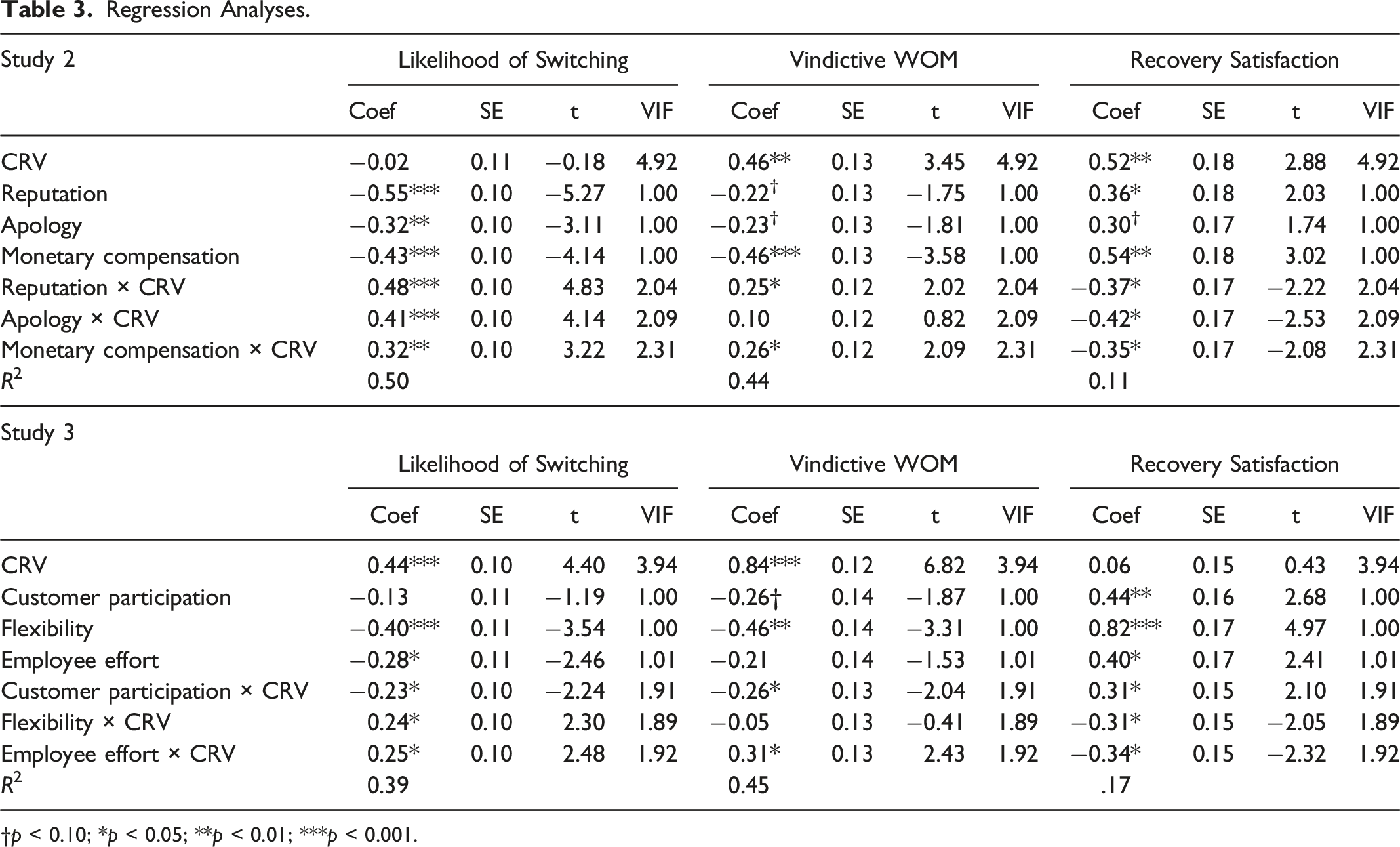
†p < 0.10; *p < 0.05; **p < 0.01; ***p < 0.001.
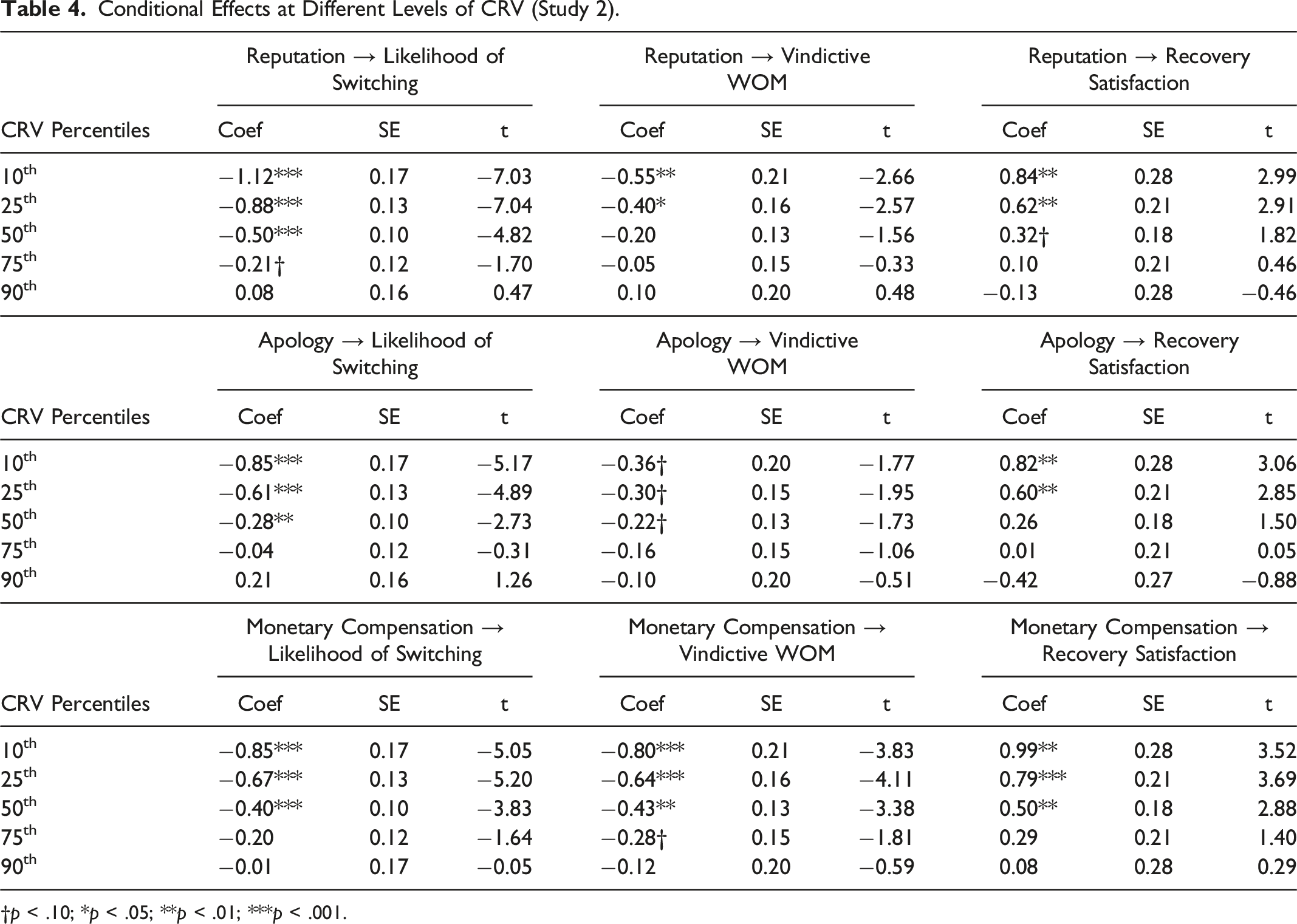
Conditional Effects at Different Levels of CRV (Study 2).
†p < .10; *p < .05; **p < .01; ***p < .001.
Apology. CRV moderated the effects of apology on the likelihood of switching (b = 0.41, SE = 0.10, p < 0.001) and recovery satisfaction (b = −0.42, SE = 0.17, p < 0.05). The impact of apology on these outcomes was contingent on CRV. In support of H2a and H2c, the spotlight analysis showed that the effect of apology on the likelihood of switching and recovery satisfaction became weaker and non-significant with increasing CRV (Table 4 and Web Appendices H4, H5, and H6). There were no significant interactions between apology and CRV in relation to vindictive WOM, rejecting H2b.
Monetary Compensation. CRV moderated the effects of monetary compensation on the likelihood of switching (b = 0.32, SE = 0.10, p < 0.01), vindictive WOM (b = 0.26, SE = 0.12, p < 0.05), and recovery satisfaction (b = −0.35, SE = 0.17, p < 0.05). The impact of monetary compensation on these outcomes was also contingent on CRV. We ran three spotlight analyses to estimate the conditional effects of monetary compensation at different levels of CRV (Table 4). The negative effects of monetary compensation on the likelihood of switching and vindictive WOM became weaker, then non-significant, as CRV became higher, supporting H3a and H3b. There was a significant decrease in recovery satisfaction among customers with higher CRV. The impact of monetary compensation became weaker and non-significant with increasing CRV, supporting H3c (Web Appendices H7, H8, and H9).
Post Hoc Analysis: Moderated Mediation Effects
Our above moderating effects were consistent with the argument that CRV mitigates the effects of service recovery on relationship outcomes such as the likelihood of switching, vindictive WOM, and recovery satisfaction. To gain additional insights into the moderating role of CRV in service recovery, we explored three coping mechanisms as process explanations: instrumental-support seeking, action coping, and positive thinking. Our selection of these constructs aligns with the three types of coping responses emphasized by Price et al. (2020), who argued that coping involves attempts to find social support. This implies “[talking] to someone who could do something concrete about the problem” (Folkman and Lazarus 1988, p. 468). In a service failure context, affected customers may engage in instrumental-support seeking, that is, the seeking of advice from friends with similar experiences (Duhachek 2005; Sengupta, Balaji, and Krishnan 2015). Moreover, Price et al. (2020) reckoned that coping responses involve direct actions. Following this type of response, individuals try to generate potential solution to address the problem while making a plan of action (Folkman and Lazarus 1988; Lazarus and Folkman 1984). Customers, affected by service failures, may concentrate their efforts on dealing with the failure (Sengupta, Balaji, and Krishnan 2015; Strizhakova, Tsarenko, and Ruth 2012), which describes action coping. In addition to instrumental-support seeking and action coping, Price et al. (2020) argued that coping includes an intrapsychic process that involves attempts to reconstrue strenuous experiences. This implies positive thinking (McCrae 1984). In a marketing context, “consumers who have negative experiences may try to see something positive in what has happened and regarded the situation as an opportunity to learn from the experience” (Yi and Baumgartner 2004, p. 305). Overall, these responses reflect both problem- and emotion-focused coping emphasized by seminal research (e.g., Lazarus and Folkman 1984).
We explored the proposition that instrumental-support seeking, action coping, and positive thinking might underlie the effect of service recovery on relationship outcomes and that CRV might moderate this mediating process. Gabbott, Tsarenko, and Mok (2011) argued that customers adopt coping mechanisms to reinstate emotional balance after the occurrence of service failures. In line with this argument, research acknowledges that initiatives that offset the negative impact of service failure (e.g., service recovery and reputation) may influence customers’ coping—which, as a result, affect relationship outcomes (Sengupta, Balaji, and Krishnan 2015; Wang et al. 2020). Considering that CRV implies insufficient internal resources to deal with disturbances created by crises, we explored whether CRV moderates the indirect effects of service recovery on relationship outcomes.
We used a bootstrapping procedure with 5000 samples 3 to explore these effects (PROCESS Model 8; Hayes 2013). The results are illustrated in Web Appendices K1-K3. The index of moderated mediation showed that CRV marginally moderated the indirect effects of reputation on the likelihood of switching, (bindex = 0.04, 90% CI [0.001, 0.12]) and vindictive WOM (bindex = 0.10, 90% CI [0.01, 0.22]). We found no significant moderated mediation in relation to recovery satisfaction. None of the remaining moderated mediations involving instrumental-support seeking were significant. The moderated mediation effects involving action coping were not significant either. Furthermore, CRV marginally moderated the indirect effects of reputation on the likelihood of switching (bindex = 0.05, 90% CI [0.01, 0.11]) and recovery satisfaction (bindex = −0.29, 90% CI [−0.56, −0.04]) through positive thinking. We found that these indirect effects decreased with increasing CRV and disappeared among customers with medium to higher CRV. Similarly, the results showed that the indirect effect of monetary compensation on the likelihood of switching (bindex = 0.04, 90% CI [0.003, 0.09]) was marginally moderated by CRV. We observed a decrease of this indirect effect with increasing CRV—which disappeared among customers with medium to higher CRV. None of the remaining moderated mediations were significant.
Study 3
Our goal in Study 3 was to investigate the extent to which customer participation, flexibility, and employee effort are effective among customers with higher CRV scores. As in Study 2, we explored in a post hoc analysis whether CRV moderates the indirect effects of service recovery on relationship outcomes.
Method
We used a between-subjects design with customer participation, flexibility, and employee effort as manipulated factors (2 × 2 × 2) and CRV as the measured variable. We recruited 264 U.S. consumers from MTurk (average age: 45 years; 39% female). Participants were randomly assigned to one of the eight experimental conditions. The scenarios were adapted to suit the hotel context (Mohr and Bitner 1995; Roggeveen, Tsiros, and Grewal 2012)—see Web Appendix L. To check for customer participation manipulation, we asked the participants to indicate the extent “to which [they] were involved in finding the new hotel room.” For the manipulation check of flexibility, we asked the participants whether “the employee at the front desk showed adequate flexibility in dealing with the problem.” For employee effort, we asked the participants to rate the extent to which “the employee at the front desk spent much time and effort on this situation.” All three questions were responded to on a 7-point scale (1 = strongly disagree to 7 = strongly agree). We used the same techniques as in Study 2.
Manipulation Check. The manipulation check and dependent variables were subject to a regression analysis with customer participation; flexibility; employee effort; CRV; and the interactions between customer participation and CRV, employee effort and CRV, and flexibility and CRV as predictor variables. Customer participation influenced the corresponding manipulation check (b = 0.92, SE = 0.20, p < 0.001). As expected, the results showed that the manipulation of employee effort significantly affected the corresponding manipulation check variable (b = 0.99, SE = 0.21, p < 0.001). Flexibility also affected the corresponding manipulation check variable in line with our expectations (b = 0.96, SE = 0.23, p < 0.001). The interaction terms were non-significant (Web Appendix M).
Results
As in Study 2, we assessed multicollinearity by computing the VIF and the conditional indices in the base (Model 1) and the hypothesis (Model 2) models to alleviate multicollinearity concerns. The results are illustrated in Web Appendix N. They showed that the estimates were largely consistent in both models; the coefficients maintained their sign and significance levels (except for the CRV main effect after the interaction term including CRV was added), and the R-squared values were improved in Model 2. In Model 1, the VIF for all the variables was 1.00, and the maximum condition index was 4.04. In Model 2, the VIF ranged from 1.00 to 3.94, and the maximum condition index was 4.12 (below the threshold of 15; Belsley, Kuh, and Welsch 1980; Hair et al. 2019), indicating no multicollinearity concerns.
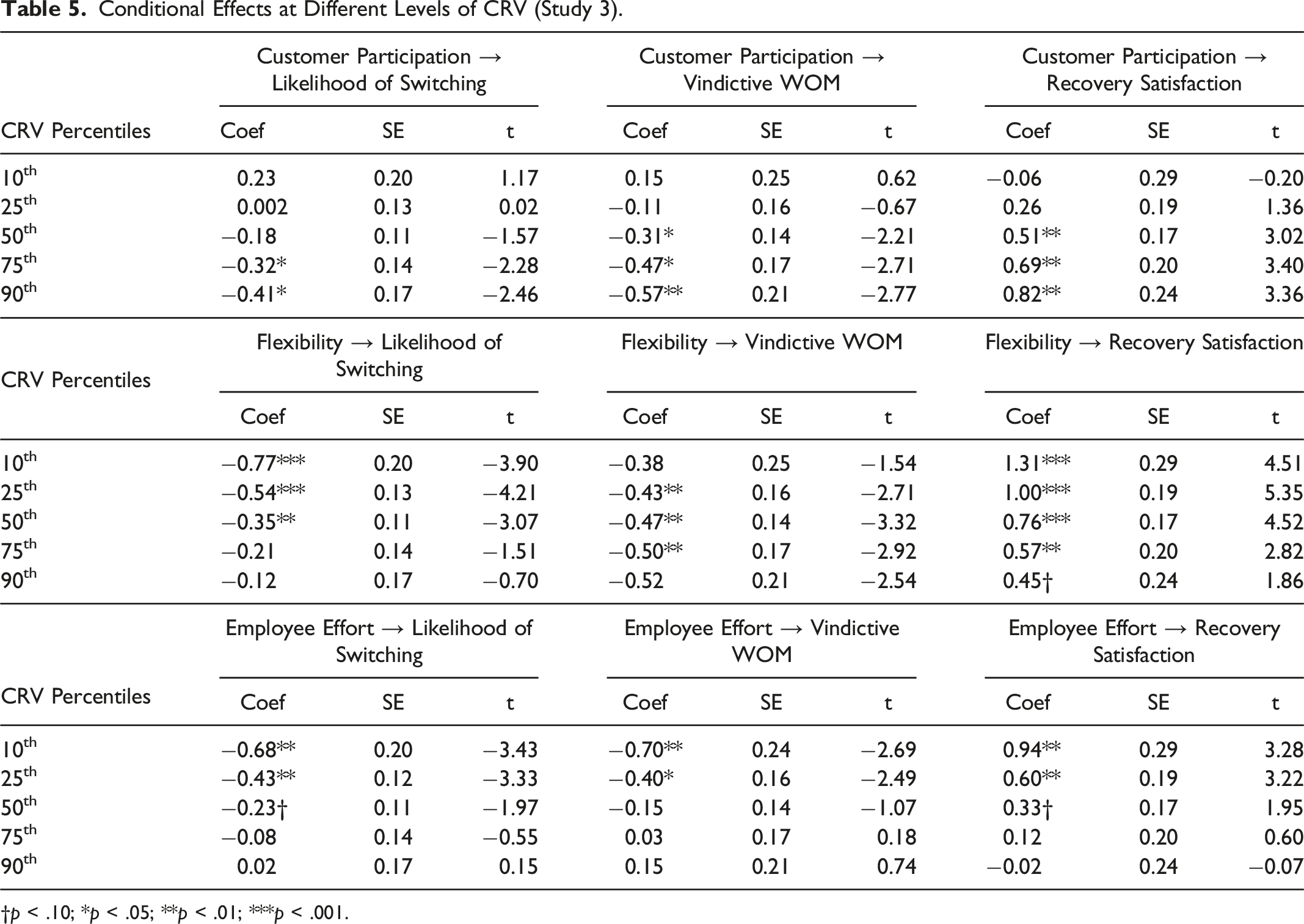
Conditional Effects at Different Levels of CRV (Study 3).
†p < .10; *p < .05; **p < .01; ***p < .001.
Flexibility. The results also showed that CRV moderated the effects of flexibility on the likelihood of switching (b = 0.24, SE = 0.10, p < 0.05) and recovery satisfaction (b = −0.31, SE = 0.15, p < 0.05). Our spotlight analysis, illustrated in Table 5, showed that the impact of flexibility on the likelihood of switching and recovery satisfaction decreased with increasing CRV. The moderating effect of CRV on the relationship between flexibility and vindictive WOM was non-significant (b = −0.05, SE = 0.13, p > 0.05). We found no support for H5a–c (see Web Appendices O4, O5, and O6 for the floodlight analysis).
Employee Effort. CRV moderated the effects of employee effort on the likelihood of switching (b = 0.25, SE = 0.10, p < 0.05), vindictive WOM (b = 0.31, SE = 0.13, p < 0.05), and recovery satisfaction (b = −0.34, SE = 0.15, p < 0.05). As illustrated in Table 5, the negative effect of employee effort on the likelihood of switching decreased with increasing CRV and became non-significant at higher values of CRV. Likewise, the negative effect of employee effort on vindictive WOM decreased and became non-significant as CRV increased. The effort effect on recovery satisfaction became weaker and non-significant with higher CRV, rejecting H6a–c (see Web Appendices O7, O8, and O9 for the floodlight analysis).
Post Hoc Analysis: Moderated Mediation Effects
As in Study 2, we developed a series of post hoc analyses to explore the moderating impact of CRV on the indirect effects of service recovery on relationship outcomes through instrumental-support seeking, action coping, and positive thinking. We used a bootstrapping procedure with 5000 samples 5 (PROCESS Model 8; Hayes 2013). As illustrated in Web Appendix Q1-Q3, the index of moderated mediation showed that CRV marginally moderated the indirect effect of employee effort on the likelihood of switching through action coping (bindex = −0.08, 90% CI [−0.17, −0.01]). The indirect conditional effects were not significant. None of the other indirect effects were significantly moderated by CRV.
Discussion and Conclusion
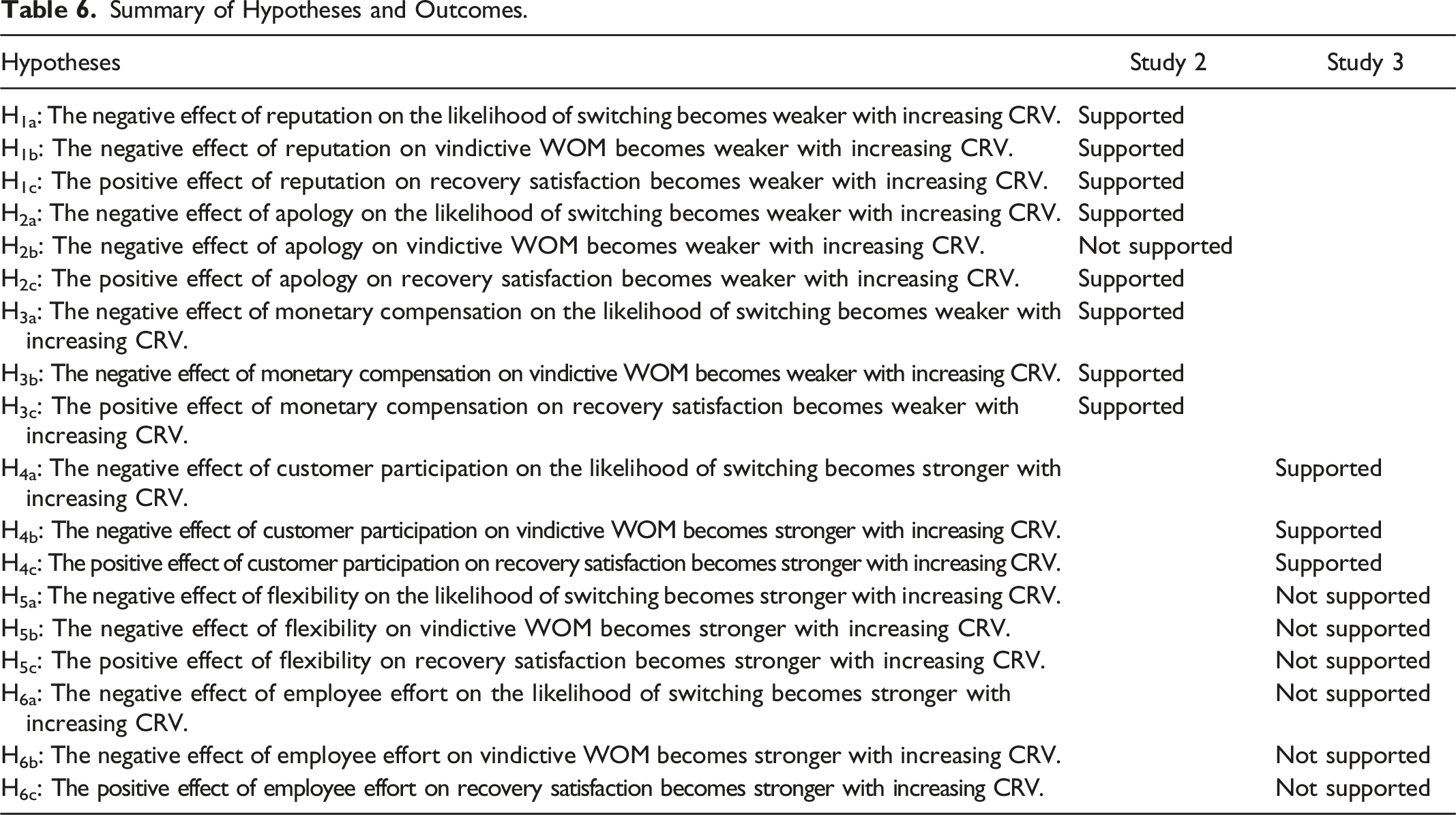
Summary of Hypotheses and Outcomes.
Implications for Research
First, we introduced the concept of CRV and provided new insights into customers’ receptiveness to marketing initiatives in a crisis context. We provided a measure for CRV that scholars can use to investigate customer attitude and behavior in relationships—during and after a crisis. The scale development followed a comprehensive and rigorous process. We collected consistent empirical evidence for the validity of CRV, and its reliability remained constant across studies and industries. The concept of CRV, through the lens of the crisis perspective, offers a complementary view of the effectiveness of service recovery. Prior research on service recovery has mainly built on exchange theories (Van Vaerenbergh et al. 2019). That is, loss in forms of service failures should be offset with similar resources (i.e., compensation; Roschk and Gelbrich 2014). Drawing on the perception of equity, research has also argued that firms’ preemptive actions, such as brand- and reputation-building, can offset the deleterious impact of service failure (Brady et al. 2008). We found that compensation (e.g., apology and monetary compensation) and reputation were less effective or even ineffective for customers who scored higher for CRV. This implies that customers’ predisposition to psychological harm in relationships constitutes a boundary condition to prior perspectives on service recovery. CRV repeatedly acted as a moderator of such effectiveness (with only one exception: CRV did not moderate the relationship between apology and vindictive WOM). A possible explanation for the non-significant interaction between apology and CRV in relation to vindictive WOM could be that apology relates to the reduction of negative emotions across customers (which reduces desire for vengeful behavior, such as denigrating the service provider).
Second, adaptation plays an important role in service recovery that involves vulnerable customers. Customer participation decreases the likelihood of switching and vindictive WOM, while enhancing recovery satisfaction among higher-CRV customers. Following crisis logic, these results imply that the alteration of the relationship roles paves the way for effective service failure recovery. One may alternatively argue that customer participation may lead to frustration—causing more harm to vulnerable customers. As customers with higher CRV feel agitated when dealing with service failures, their participation in the service recovery may feel strenuous, especially when both parties struggle to find a solution. However, it should be noted that the participation of vulnerable customers in the recovery process helps them clarify and make sense of service failures, which might have been perceived as unmanageable before their participation. This also suggests that effective service recovery goes beyond offsetting service failures with similar resources; the customer’s participation in the process is critical. Employee effort and flexibility, however, remain ineffective among customers who score higher on CRV. One explanation could be that customers who are predisposed to psychological harm experience higher levels of irritation, which they need to vent in order to deal with service failures. In addition, it could be that these initiatives are not sufficient to convince the vulnerable customer that he or she can resolve the crisis. We elaborate on these issues in the research agenda below.
The findings also suggest that the investigated moderated mediations are complex. The post hoc analyses provide only marginal evidence for the moderated mediations. Overall, they imply that the moderating effects of CRV are largely unrelated to coping processes. The lack of coping process explanations seems consistent with the argument that vulnerable individuals facing crises struggle to cope effectively since their “previously learned coping behaviors [may be] found inadequate or ineffective as responses to the crisis situation” (Baldwin 1979, p. 44). Coping itself may serve as a source of stress (Price et al. 2020; Roskies and Lazarus 1980). While service recovery or reputation might impact coping (Sengupta, Balaji, and Krishnan 2015; Wang et al. 2020), such impact remains unclear in the context of CRV. We included the issue of CRV and coping in the research agenda.
Managerial Implications
The findings of this study have several managerial implications. The findings showing the degree to which some customers are immune to certain marketing initiatives can inform service firms about what will happen to customer relationships after service failures if they ignore CRV. They should proactively identify their most vulnerable customers and set in place recovery initiatives that are tailored to their needs. Specifically, service managers are advised to use the CRV scale to assess their customers’ vulnerability. Such an assessment could be stored in their customer relationship management systems to facilitate customer contact and to enable frontline employees to tailor recovery initiatives that support their most vulnerable customers. The assessment of customers’ CRV can also be used to estimate the percentage of their customers who are “at risk.”
Moreover, service managers should recognize that customers can be predisposed to psychological harm in relationships with service firms and bear in mind that such vulnerability renders them immune to certain service recovery initiatives. For instance, managers should overcome the tendency to simply rely on monetary compensation and apology or on the reputation of their firms when dealing with service failures involving their most vulnerable customers. Instead, managers should prioritize customer participation. Customer participation is effective among customers with higher CRV. As such, managers should design and implement recovery initiatives that specifically encourage vulnerable customers to participate actively in the service recovery process. For instance, our hotel scenario shows that vulnerable customers collaborated with the service employee to look for available rooms in nearby hotels. Such collaboration led to favorable outcomes in terms of reduced switching likelihood, vindictive WOM, and higher recovery satisfaction. Thus, even if the service failure cannot be resolved immediately, managers should encourage service employees to collaborate with their most vulnerable customers to find solutions, for instance, through other service providers—service partners or even competitors.
Service employees need to be trained to collaborate with the most vulnerable customers during crises. Customers with higher CRV feel more agitated and are more psychologically affected when dealing with service failures. Service employees should utilize their active listening and communication skills and show compassion toward vulnerable customers as they co-create possible solutions. Service providers can create and implement a CRV policy to foster a culture that supports service employees in co-creating solutions with vulnerable customers after service failures.
Finally, we explored whether CRV moderates the impact of service recovery on relationship outcomes through instrumental-support seeking, action coping, and positive thinking. Although the inclusion of these mediators appears to dampen some moderating effects of CRV on direct paths between service recovery and relationship outcomes, the post hoc analyses provided little to no evidence for the proposition that CRV moderates the indirect relationships between service recovery and relationship outcomes through the three mediators of instrumental-support seeking, action coping, and positive thinking. While the dampening effect may be due to opposite signs in the direct and mediated path and its moderation, the lack of evidence for the moderated mediation implies that CRV should be considered and interpreted for direct effects. This implies that addressing customer coping is unlikely to help with the challenges posed by CRV in the service recovery context.
Research Agenda
As an early step toward investigating the CRV phenomenon and its role in service recovery, this study acknowledges some limitations that provide opportunities for future research. Our research agenda emphasizes (a) further research on CRV and coping (more generally on recovery mechanisms in which CRV plays a role), (b) potentially related concepts, and (c) contextual factors. In line with the service failure and recovery literature, we suggest that future research explore the extent to which CRV intersects with the customer tolerance zone, customer rumination, and customer forgiveness. For future research on potential moderators, we emphasize contexts or situations—such as customer tenure, customer inertia, switching costs, and use of technology—that may mitigate the impact of CRV and external resources (i.e., external to the dyadic B2C relationship) and are available to managers seeking to retain and guarantee the well-being of higher-CRV customers.
Research on CRV and Coping
It is worthwhile to further investigate how customers with high levels of CRV cope. The concept of CRV assumes that customers differ in the extent to which they can be affected by crisis situations. They become agitated in times of crisis. While individuals adopt coping mechanisms to manage the stress created by crises, coping mechanisms may themselves serve as a source of stress (Price et al. 2020; Roskies and Lazarus 1980). When encountering situations in which there is significant psychological harm, customers with high CRV may be unable to effectively utilize previously learned coping responses, or to reduce stress by utilizing novel problem-solving behaviors. Future research should investigate circumstances under which different coping mechanisms suit higher-CRV customers, and which one dominates.
Related Concepts
To further position the concept of CRV in the literature, future research should investigate its association with the customer tolerance zone (Zeithaml, Berry, and Parasuraman 1993). The tolerance zone describes the level of service that the customer deems acceptable (Zeithaml, Berry, and Parasuraman 1993). Customers with higher CRV are deeply hurt by service failures; it is worthwhile to investigate whether they have a narrower tolerance zone. Moreover, customer rumination is another concept of interest. Rumination involves a negative focus on a critical incident (Strizhakova, Tsarenko, and Ruth 2012). Because rumination is pertinent to the stress-and-coping mechanism, it may well intersect with CRV. Research should explore this link. Finally, it would be worthwhile to investigate the extent to which customers with higher levels of CRV are forgiving. Customer forgiveness is an “internal act of relinquishing anger and the desire to seek revenge against a firm that has caused harm as well as the enhancement of positive emotions and thoughts toward this harm-doing firm” (Joireman, Grégoire, and Tripp 2016, p. 77). Because higher-CRV customers are overwhelmed by service failures, it is sensible to test their forgiveness of firms.
Contextual Factors
Research should investigate contexts relevant to CRV. Of particular interest are contexts that not only mitigate or moderate the ramifications of CRV but are also under the control of service managers. Customer tenure is probably the most obvious area to investigate. Our analysis is based on cross-sectional data that do not control for the customer’s history with the service firm. Because longer-tenure customers are more likely to continue to use the services of their providers (Dawes 2009), it is worthwhile to investigate whether CRV interacts with customer tenure.
Second, research should investigate CRV and customer responses to marketing initiatives by considering customer inertia. A key tenet of inertia is the elimination of customers’ consideration of consumption changes that are neither detrimental nor beneficial to the firm (Henderson et al. 2021). Customers with inertia disregard marketing initiatives (Henderson et al. 2021). It is worthwhile to investigate whether CRV interacts with customer inertia and the implications of such interactions for the effectiveness of service recovery.
Third, switching cost emerges as another potential area for the further development of an understanding of CRV’s impact. The results imply that firms run a high risk of losing customers with a higher CRV when a service failure occurs. Further knowledge about this could be important for service managers in terms of switching costs. It is worthwhile to investigate the effects of CRV on the likelihood of switching when associated costs are high.
Fourth, future research should test our theoretical argument in the context of service failure and recovery involving robots instead of service personnel. Our scenarios described a physical interaction between the customer and service personnel. Nowadays, services have expanded their use of technology. Scholars have increasingly devoted more attention to consumers’ responses to robot service failures and recovery (Choi, Mattila, and Bolton 2021). It is worthwhile to investigate the implications of CRV on such responses.
Finally, it is worthwhile to investigate CRV in other crisis contexts than service failure. Reports show that 2.7 billion identity records (consumer data) have recently been leaked and posted for sale (Song 2019). This can ferment a crisis in customer relationships. Further research should investigate vulnerable customers’ responses to data privacy and security breaches.
Supplemental Material
Supplemental Material - The Role of Customer Relationship Vulnerability in Service Recovery
Supplemental Material for The Role of Customer Relationship Vulnerability in Service Recovery by Sadrac Cenophat, Martin Eisend, Tomás Bayón, and Alexander Haas in Journal of Service Research.
Footnotes
Declaration of Conflicting Interests
The author(s) declare no potential conflicts of interest with respect to the research, authorship, and/or publication of this article.
Funding
The author(s) received no financial support for the research, authorship, and/or publication of this article.

Notes
Author Biographies
References
Supplementary Material
Please find the following supplemental material available below.
For Open Access articles published under a Creative Commons License, all supplemental material carries the same license as the article it is associated with.
For non-Open Access articles published, all supplemental material carries a non-exclusive license, and permission requests for re-use of supplemental material or any part of supplemental material shall be sent directly to the copyright owner as specified in the copyright notice associated with the article.
