



Abstract
The demand for mediation, in which a neutral third party offers advice to resolve a customer–firm conflict, continues to increase steadily in Europe. This article is the first to consider the recourse to mediation as a stage of the service recovery journey and empirically examine how the intervention of a mediator affects customer relationship quality in the post-recovery stage. The results indicate that the mediation outcome affects customers’ loyalty intentions toward the firm through the mediating effect of distributive justice. Considering neutrality as the foundational element of the mediation process, this research reveals a moderating impact of the mediation type (internal vs external) on the relationship between the mediation outcome and customers’ loyalty intentions toward the firm. The findings highlight the efficiency of the internal mediation over the external one after a favorable outcome and encourage firms to leverage mediation strategically to maintain customers, because it represents the last chance for firms to recover from the service failure.
Introduction
The recovery stage of the service recovery journey (Van Vaerenbergh et al., 2019) is critically important, because service failures followed by failed recoveries (i.e. double deviation) are likely to lead to highly dissatisfied customers who seek revenge (Bechwati and Morrin, 2003; McColl-Kennedy et al., 2009). Because retaliatory behaviors can be very costly for firms, existing research mainly emphasizes how to prevent relationship breakdowns (Joireman et al., 2013) and stop customers’ revenge or boycotts (Cissé-Depardon and N’Goala, 2009; Grégoire et al., 2018). While the service recovery literature dramatically focuses on organizational responses to service failures (e.g. Davidow, 2003; Gelbrich and Roschk, 2011), the pre-recovery and post-recovery phases remain neglected (Van Vaerenbergh et al., 2019). Therefore, this research focuses on the post-recovery stage of the customer recovery journey, and specifically examines the role of third-party dispute resolution mechanisms such as mediation.
After experiencing a failed service recovery, customers can turn to third parties, such as consumer agencies or attorneys to restore justice (Bacile et al., 2020; Lichtlé et al., 2018; Schoefer and Diamantopoulos, 2008). In Europe, Alternative Dispute Resolution (ADR) Directive 2013/11/EU (hereafter, ADR Directive), transposed in France by Ordonnance 2015-1033 of 20 August 2015, entitles consumers to mediation if they need to resolve disputes with firms after a failed service recovery. Accordingly, the interest in mediation mechanisms by both firms and customers has steadily increased in recent years in Europe. For example, in France in 2020, mediation cases increased by 18% for insurance services (17,355 cases; Insurance Services Mediation Report, 2020), 20% for energy services (27,203 cases; Energy Services Mediation Report, 2020), and 111% for tourist and travel services (18,332 cases; Tourism and Travel Services Mediation Report, 2020).
Contrary to a consumer agency that advocates for the customer (Lichtlé et al., 2018), mediation implies the intervention of a neutral third party that gives advice about how to resolve a problem (LaTour et al., 1976; Lind et al., 1997). A mediator is neither judge nor advocate (Jacobs, 2002), but instead functions to first evaluate the fairness of customers’ requests, and second, suggest potential conflict settlement options if applied (ADR Directive). In practice, two types of mediation services exist: public/external mediation and in-house/internal mediation. 1 Public/external mediators are appointed by the government in all economic sectors. In-house/internal mediation is a peculiar case in the French ADR sector when mediators are appointed by firms (e.g. Mediation services of SNCF, La Poste, HSBC Bank or Engie Group). They have the same obligations as public mediators (e.g. provide free of charge services for consumers within a period of 90 days) or sometimes even stricter requirements strengthening their autonomy and independence (Biard, 2019). Despite an increasing occurrence of mediation services in customer service recovery journeys though, there are limited insights about how interventions by mediators, as third parties, affect the customer–firm relationship quality.
This research is the first to empirically examine “customer–mediation–firm” triadic design and the role of mediation in the service recovery journey. Using justice theory (Gelbrich and Roschk, 2011; Orsingher et al., 2010) and specifically the “fair process effect” (Greenberg and Folger, 1983; Van den Bos et al., 1999) as theoretical anchors, we state that the mediation is a procedural effort to reconsider the failed service recovery by reexamining the firm’s service recovery outcome through a fair process and providing justice to the customer. The literature on the fair process effect suggests that people tend to respond more favorably to outcomes when they are treated with higher degrees of procedural fairness (Greenberg and Folger, 1983; Van den Bos et al., 1997). They are prone to react more favorably in situations of fair procedures when they appreciate, for example, the attitude and behavior of the exchange partner (e.g. Brockner, 2002; Liao, 2007) or the neutrality of the decision maker (e.g. Lind et al., 1997; Tyler and Lind, 1992). Considering the differences between internal and external mediations in terms of their independence from the firm, we study thus to what extent this procedural effort of mediation interacts with its outcome to affect the perceived justice and customer–firm relationship quality. Previous research in service recovery shows that the distributive dimension of justice is the main predictor of customers’ behavioral intentions toward the firm (e.g. Orsingher et al., 2010). Therefore, in this article, we focus on the distributive justice of mediation and use the fair process effect to examine the impact of mediation on customer–firm relationship quality (see the conceptual model in Figure 1).
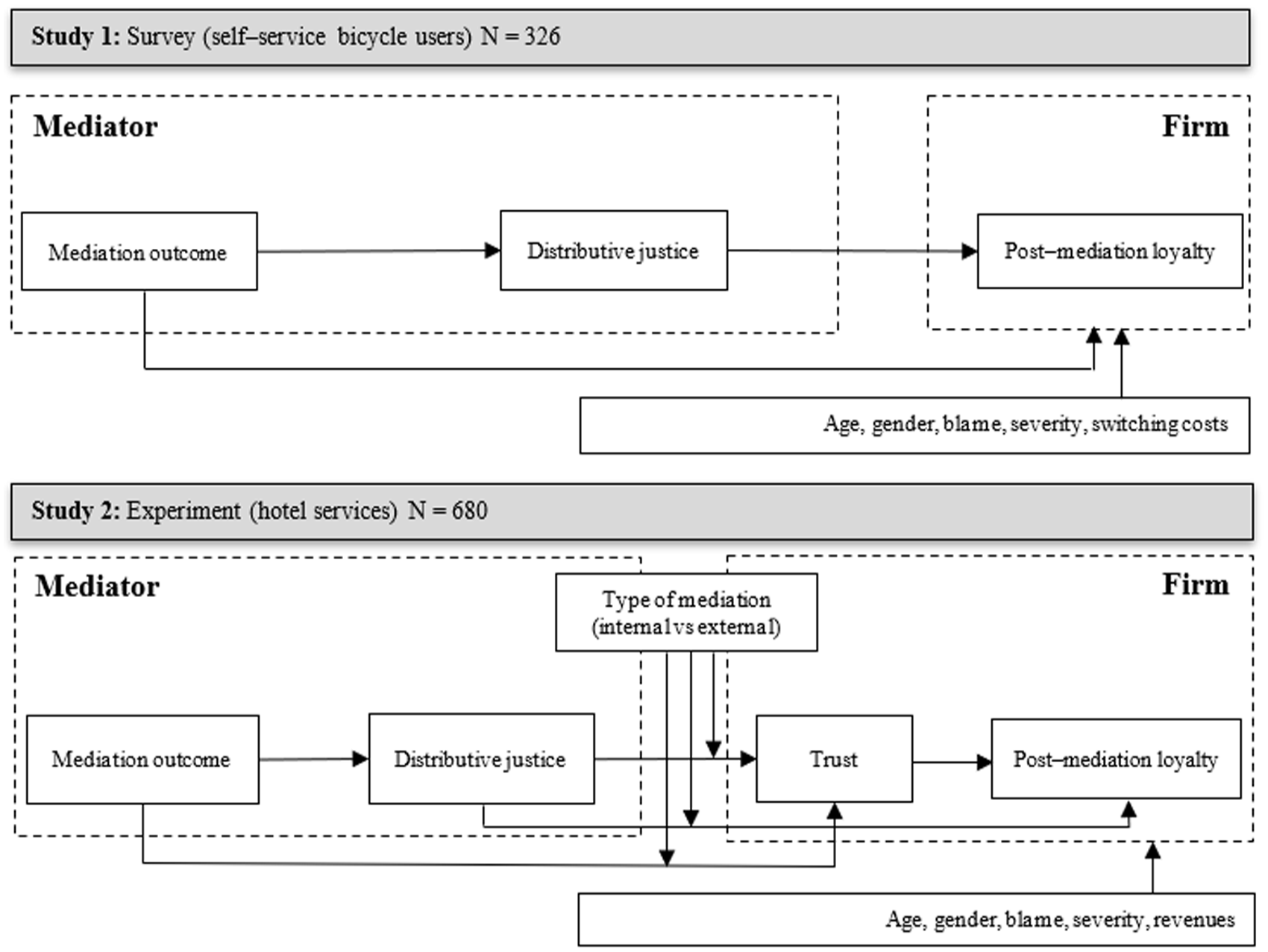
Conceptual framework.
With one field and one experimental study, we make three contributions to the literature on service failure and recovery. First, we contribute to the limited research on the post-recovery stage of the service recovery journey (Van Vaerenbergh et al., 2019). As a mandatory service recovery option that firms must suggest to dissatisfied customers in situations of failed service recoveries, mediation implies the intervention of a third party to evaluate the fairness of a customer’s request and a firm’s service recovery outcome. Therefore, we consider the recourse to mediation as a part of the post-recovery phase of a customer’s service recovery journey and examine its impact on the customer–firm relationship quality. This study addresses the role of mediation in a double deviation context and offers explanations for how the use of mediation can improve organizational responses in the post-recovery stage. In the extensive literature highlighting the detrimental effect of double deviation, we are part of the few works considering the opportunity for firms to address customer dissatisfaction after a double deviation (Joireman et al., 2013). We demonstrate that mediation is an opportunity for firms to maintain a relationship after a failed service recovery.
Second, we test the theory of the fair process effect in the post-recovery stage of the customer service recovery journey. We consider the effectiveness of firms’ practices for suggesting internal/in-house mediation and compare it to external/public mediation (Biard, 2019) in terms of the perceived neutrality. We provide evidence of a moderating effect of the mediation type (i.e. internal vs external) on the relationship between the mediation outcome and customers’ post-mediation trust toward a firm. We show that when an external mediator (more neutral) provides a favorable outcome, it decreases customers’ trust toward the firm and, consequently, loyalty intentions. This result specifically highlights the ineffectiveness of the fair process effect in the context of external mediation compared to the internal one, and the subsequent risk that firms can encounter in terms of customer–firm relationship quality following the intervention of a highly neutral third party. Hereby, we underline the interest of internal mediation for firms.
Third, we respond to the call of Grégoire and Mattila (2021) to expand the examination of static “customer–firm” dyads and integrate the perspective of third entities (e.g. Bacile et al., 2018, 2020). As such, we study the “customer–mediation–firm” triad and reveal that the mediation outcome has an impact on customers’ post-mediation trust and loyalty intentions toward the firm through the perceived distributive justice of the mediation outcome. Accordingly, we test the robustness of theories in a new triadic design and contribute to the scarce research in service recovery involving multiple entities.
Mediation: A third-party action
If a firm is unable to appropriately restore service after a failure, a double deviation situation occurs (Gelbrich et al., 2016; Johnston and Fern, 1999; Joireman et al., 2016), causing customers to feel violated twice and focus their attention no longer on the complaint and the recovery efforts but on their future relationship with the firm (Basso and Pizzutti, 2016). This severe breach of customers’ trust increases their anger and revenge intentions (Grégoire et al., 2009; Sembada et al., 2016) and might even lead to customer rage (Surachartkumtonkun et al., 2015) or exit (Haj-Salem and Chebat, 2014).
In situations of failed service recovery, customers can turn to third parties (e.g. Bacile et al., 2020), such as consumer agencies, attorneys, or legal advisors (Baker et al., 2013; Lichtlé et al., 2018). According to article L612-2 of the French Consumer Code, under some conditions 2 customers can access the mediation in order to have their dispute cases examined by the mediator. Article L612-1 of the French Consumer Code defines firms’ obligation to allow any consumer to have recourse to a consumer mediation system. 3 Therefore, when a customer has a problem with the service provider (i.e. service failure), and the latter is not able to fix it (i.e. failed service recovery), the service providers must signpost consumers toward a mediation service. Despite legally founded mediation outcomes, firms are not obliged to follow them, and every firm decides whether to follow a mediator’s recommendations or not.
Mediation differs from other third parties in two ways. First, whereas in legal actions, judges can impose solutions, mediation entails the intervention of a third party that provides advice about how to solve the problem but has no authority to mandate participants to follow those suggestions (Lind et al., 1997). Unlike a consumer agency or a lawyer, the mediation does not intervene following a relationship breakdown, and its services are generally free of charge (Grégoire et al., 2015). The purpose of mediation is to reconsider a customer’s complaint in order to give advice and encourage disputing parties to find a solution, enhancing therefore the likelihood of continuing the business relationship. Moreover, mediation outcomes are not binding, which is consistent with the logic of fostering dialogue and the relationship between the two parties. Therefore, we assume that mediation takes part in the post-recovery stage of the service recovery journey (Van Vaerenbergh et al., 2019) to avoid the relationship breakdown.
Second, building on conflict resolution and social psychology literature (Lind et al., 1994, 1997; Tyler and Lind, 1992), mediation differs from other third-party interventions in its foundational promise of neutrality and freedom from bias (Hale and Nix, 1997; Szejda Fehrenbach and Ebesu Hubbard, 2014). It entails the impartial consideration of the interests of disputing parties with balanced participation and representation for all parties (Fuller et al., 1992). Accordingly, it differs from a consumer agency that tends to constantly support the customer’s point of view (Lichtlé et al., 2018). As a multidimensional concept, neutrality refers to independence, impartiality, a lack of bias and prejudice (McCorkle, 2005), no prior knowledge of the parties or conflict, lack of judgment (Cohen et al., 1999), or equidistance, such that the contesting parties participate “equally” in the process (Cobb and Rifkin, 1991). In this research, we refer to neutrality in terms of a mediator’s independence from a firm (Astor, 2007; Biard, 2019) rather than in terms of an impartial and equidistant decision-making process to investigate the differences between internal versus external mediation services.
The French ADR landscape contains two types of mediation: external/public and internal/in-house. An external mediator is a sectorial or public mediator appointed by public authority (government or a ministry), whose competencies extend to all firms of a business sector (e.g. mediator for electronic communications or national mediator of energy). In comparison with the external mediation services that are mandatory for all activity sectors, internal mediators are not mandatory. Internal/in-house mediators are appointed by firms that set up their own mediation services but are independent from the operational trader bodies with separate and adequate budgets to carry out their missions (Biard, 2019). Customers are allowed to have recourse to an external mediation if they remain unsatisfied with the internal mediation outcome.
Mediating role of distributive justice
Mediation is a part of the service recovery journey tending to repair the relationship that represents a positive mechanism for restoring justice (Grégoire and Fisher, 2008). Justice theory strongly informs research on dispute resolution (Lind et al., 1997; Tyler, 1989) and service recovery (Gelbrich and Roschk, 2011; Khamitov et al., 2020; Orsingher et al., 2010), because perceptions of justice can explain customers’ post-complaint satisfaction, repurchase intentions (Blodgett et al., 1997), and positive word-of-mouth (Maxham and Netemeyer, 2003). Researchers commonly consider a three-dimensional concept that includes the (1) fairness of the decision-making outcome (i.e. distributive justice), (2) fairness of recovery procedures (i.e. procedural justice), and (3) interpersonal communication during service recovery (i.e. interactional justice; Gelbrich and Roschk, 2011; Tax et al., 1998). In our research, we consider only the distributive dimension of justice for two reasons. First, previous literature finds that distributive justice is the dominant dimension of justice (e.g. Gelbrich and Roschk, 2011; Homburg and Fürst, 2005). A meta-analysis by Orsingher et al. (2010) shows that distributive is the most important dimension driving recovery satisfaction and customer–firm relationship. Second, although the mediator may examine interactional and procedural elements of the firm’s service recovery process, the main role of mediation remains the reconsideration of the firm’s service recovery outcome, that is, its distributive dimension. For example, a major part of customers’ requests to the Energy mediator relates to the provided service quality or the billing (Energy Services Mediation Report, 2020). Accordingly, mediation outcomes can consist of recommending or not some reimbursements that represent the distributive dimension of a customer’s request. By giving an opinion about the fairness of the firm’s service recovery, the mediator provides an outcome that supports one side, and, consequently, is favorable either to the customer or the firm. Outcome favorability is different from distributive justice (Van den Bos et al., 1999) since distributive justice refers to the violation of a moral standard (Folger, 1994) while outcome favorability refers to whether or not an outcome is personally beneficial. Accordingly, an outcome can be favorable, even if it is ultimately unfair (Krehbiel and Cropanzano, 2000). In the service recovery context, outcome favorability refers to customers’ perception of the preferred outcomes (Oliver and Swan, 1989), which benefit them in that specific situation (Adams and Freedman, 1976). The favorability of the third party’s outcome, in turn, should determine customers’ perception of the fairness of the outcome (Oliver and Swan, 1989; Tyler, 1989).
In “customer–firm” dyadic relationship context, perceived service recovery fairness positively influences customers’ satisfaction and post-complaint behavioral intentions toward the firm, such as loyalty (Blodgett et al., 1997; Chebat and Slusarczyk, 2005). Multidimensional loyalty is one of the most important constructs that involves a collection of customer attitudes and purchase behaviors that prioritize the firm, relative to competing entities (Brady et al., 2012; Watson et al., 2015). Literature on service recovery reports the predominant positive role of distributive justice in predicting customer loyalty (e.g. Palmatier et al., 2006; Schoefer and Diamantopoulos, 2008).
In “customer–mediation–firm” triadic relationship context, customers turn to third parties for reviewing the firm’s service recovery outcome. Given firms’ legal obligation to suggest mediation services after a failed service recovery (Directive 2013/11/EU), the mediation represents a new step in the customer service recovery journey. Accordingly, the mediation outcome can be interpreted as the new decision of the firm on the matter of the same service failure. This is especially the case when the firm funds the internal mediation, despite the mediator’s legal independence. Based on the theoretical framework on perceived justice (e.g. Gelbrich and Roschk, 2011; Orsingher et al., 2010), we suggest that the perceived justice of mediation, as a new step in customers’ service recovery journey, should positively impact customers’ behavioral intentions toward the firm. A favorable outcome for the customer can be perceived as the firm’s ability to question itself and its benevolence toward the customer. On the contrary, an unfavorable outcome could be perceived as a confirmation of the firm’s untrustworthiness and inability to take into account the customer’s point of view and, as such, its lack of reliability as a partner. Specifically, the perceived justice of the mediation outcome should mediate the relationship between the outcome favorability and customers’ loyalty intentions toward the firm, such that a more favorable mediation outcome enhances the perceived distributive justice, which then increases customers’ post-mediation loyalty intentions. Formally,
Hypothesis 1: The positive indirect effect of the mediation outcome on customers’ post-mediation loyalty toward a firm is mediated by the distributive justice of a mediator.
Study 1
With Study 1, we sought to test Hypothesis 1, related to the potential mediating effect of the perceived distributive justice of the mediator between the mediation outcome and customers’ post-mediation loyalty toward the firm.
Research design and procedure
Study 1 is a field study with 326 self-service bicycle users (response rate = 35%), 52% of whom were men, with an average age of 35.82 years (SD = 12.03). According to the ADR Directive, firms have no obligation to follow a mediator’s recommendations or to mention their intentions to implement those recommendations. However, we conducted the field study using the data of a firm that commits to always follow a mediator’s recommendations. Participation was voluntary, and we assured all respondents of the anonymity of their responses. We sent the questionnaire to all self-service bicycle users who registered a complaint with an internal/in-house mediator between December 2015 and December 2016. The internal mediation is clearly positioned as a next step in a firm’s service recovery journey. We checked the mediator’s independence from the firm with a construct of five items (e.g. “With the mediator, the information has been analyzed in an independent way”) with a 7-point Likert-type scale (MPerceived Neutrality = 5.45, SD = 1.62, α = 0.92). All registered complaints were related to the penalties due to the poor and/or incorrect hang-up of the bike. We invited potential respondents to visit Qualtrics to complete the questionnaire.
Measures
To measure distributive justice (α = 0.94, construct reliability (CR) = 0.94, average variance extracted (AVE) = 0.85), we used 7-point Likert-type scale adapted from the study by Joireman et al. (2013) (1 = “completely disagree,” 7 = “completely agree”). We adapted a 7-point scale from the study by Watson et al. (2015) to measure loyalty (α = 0.97, CR = 0.96, AVE = 0.93). For the favorability of the mediation outcome, we used a one-item, 7-point scale (1 = “unfavorable,” 7 = “favorable”). We controlled for customers’ age, gender, blame attribution, severity, and switching costs.
Harman’s one-factor test (Podsakoff et al., 2003) was used to test the common method bias. It showed that a single factor accounted for 36.15% of the total variance, confirming that the common method bias was not present. Furthermore, we conducted the confirmatory factor analysis (CFA) test using SPSS AMOS v28 (Fuller et al., 2016). The CFA model with all items’ loading on a single factor (χ2 = 855.148, df = 19) was compared with the proposed CFA model (χ2 = 27.408, df = 18). The chi-square difference test was used to compare the two models (p < 0.01) revealing that the proposed measurement model fits better than the model with the common factor. Accordingly, these results indicate that the data are free of common method bias. Finally, we tested the multicollinearity among the proposed constructs with variance inflation factor (VIF) values, using linear regression in SPSS v28. The collinearity diagnostics in each stance found the VIF values (2.93 for both mediation outcome and distributive justice) to be less than the recommended maximum value of 10 (Hair et al., 2010), indicating that multicollinearity is not evident.
The CFA revealed acceptable fit with the data, including χ2/df = 1.52, confirmatory fit index (CFI) = 0.99, root mean error of approximation (RMSEA) = 0.04, and standardized root mean square residual (SRMR) = 0.03. The CR values ranged from 0.94 to 0.96, above the recommended threshold of 0.7 (Bagozzi and Yi, 2012), as has been detailed in Appendix 1. The AVE for each construct is greater than 0.5, in support of the convergent validity of the measure of each construct. For each pair of constructs, we assessed discriminant validity using the criterion by Fornell and Larcker (1981) (see Table 1) and the chi-square difference test (Bollen, 1989). The results indicate no problems with respect to discriminant validity.
Descriptive statistics and correlation matrix for key constructs (Study 1).
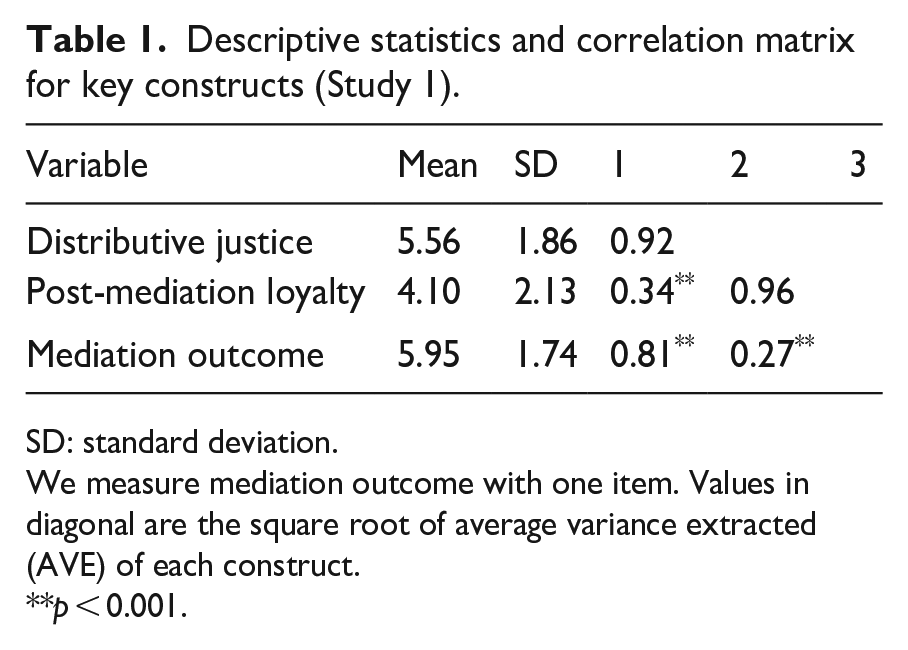
SD: standard deviation.
We measure mediation outcome with one item. Values in diagonal are the square root of average variance extracted (AVE) of each construct.
p < 0.001.
Results
We estimated the mediation Model 4 (Hayes, 2013) using the PROCESS macro with 5,000 bootstrapped samples. We calculated a mediation model with loyalty as the dependent variable; mediation outcome is the independent variable; distributive justice is the mediating variable.
In Table 2, in which we summarize the results, the first column contains the regression results from predicting the mediating variable, that is, perceived distributive justice. The consecutive column presents the regression used to predict the dependent variable, that is, customers’ post-mediation loyalty toward the firm. The higher values of distributive justice are at higher levels of the favorability of the mediation outcome (b = 0.84, p < 0.01).
Mediation results (Study 1).
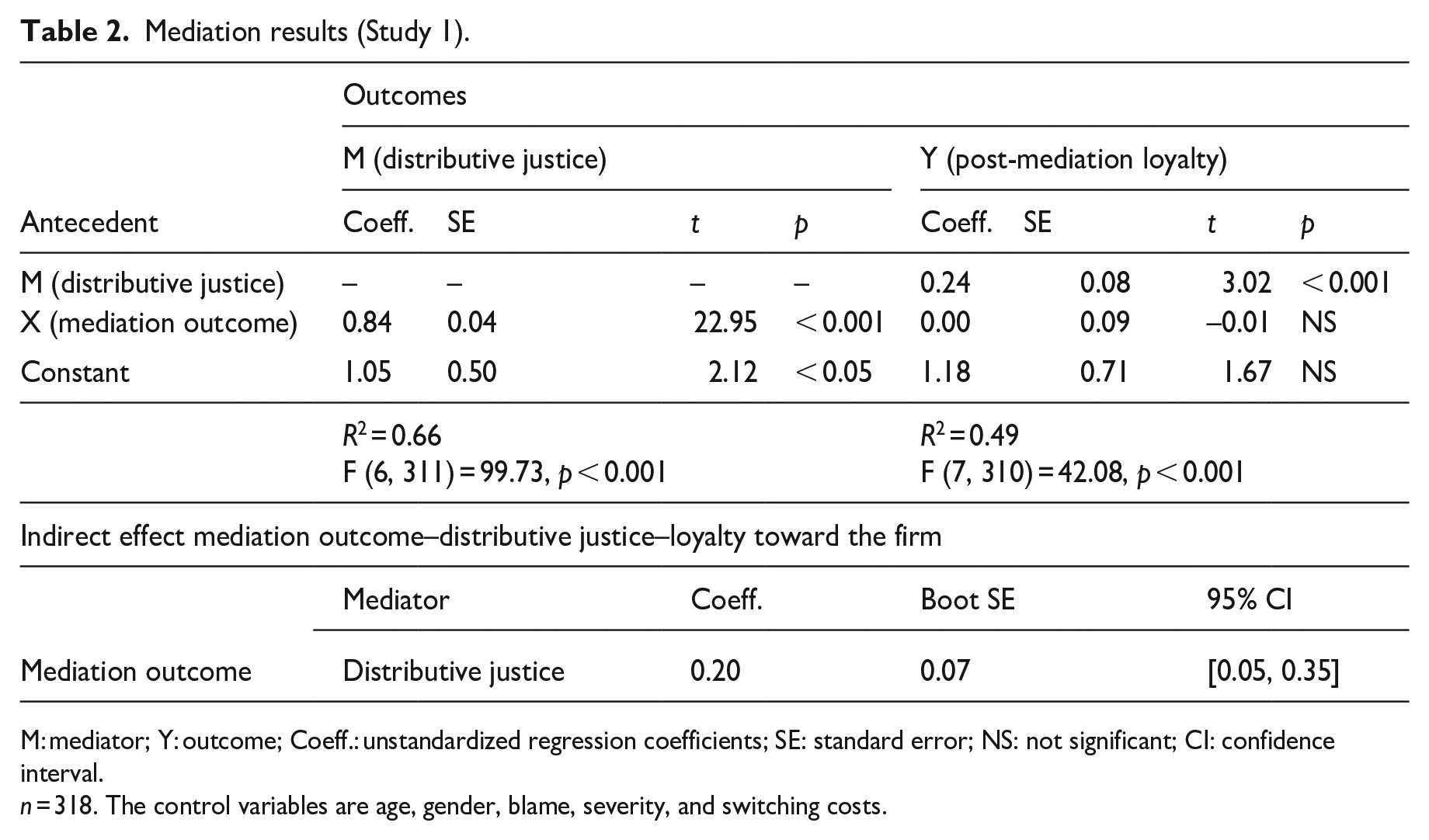
M: mediator; Y: outcome; Coeff.: unstandardized regression coefficients; SE: standard error; NS: not significant; CI: confidence interval.
n = 318. The control variables are age, gender, blame, severity, and switching costs.
Results show that even after a favorable mediation outcome customers’ loyalty level (MFav after = 4.33) is lower compared to the loyalty before the intervention of a mediator (MBefore = 5.58, p < 0.05) by underlining the deleterious effects of a double deviation (Basso and Pizzutti, 2016). The regression model explains significant variance in the outcome variable, with R2 value of 0.49 (p < 0.01). To determine the mediation effect, we present the indirect effect of the perceived favorability of the mediation outcome on post-mediation loyalty intentions according to the distributive justice in the lower part of Table 2. In support of Hypothesis 1, the results confirm the mediating effect of distributive justice in the relationship between the mediation outcome and customers’ post-mediation loyalty intentions toward the firm (b = 0.20, 95% confidence interval (CI) = [0.05, 0.35]).
Discussion
Findings confirm the detrimental effect of a double deviation even when the outcome of the mediation is favorable to the customer. Nevertheless, we provide evidence that the distributive justice of the third party mediates the effect of mediation outcome on customers’ post-mediation loyalty intentions toward the firm. Particularly, a favorable outcome provided by the mediator demonstrates a recognition of the fairness of a customer’s request, and, consequently, exerts a strong, positive and indirect effect on post-mediation loyalty intentions toward the firm through the distributive justice of the third party. The impact of the perceived distributive justice of mediation on customers’ loyalty intentions toward the firm highlights the benefit of the mediation in the service recovery journey. The intervention of a third party, the mediation, offers thus the firm an opportunity to maintain its relationship with customers despite the deleterious effects of double deviation. To further the examination of the impact of mediation, in Study 2, we consider the mediating role of customers’ trust toward the firm in the relationship between the mediation outcome and customers’ loyalty intentions toward the firm.
In Study 1, we refer to a specific case of mediation, which is internal/in-house (i.e. the firm appoints the mediator). As explained previously, firms can guide customers toward two types of mediation (internal or external) that differ in terms of their independence from the firm (Astor, 2007; Biard, 2019). Hence, in Study 2, we also investigate the impact of the mediation type on the relationship between the mediation outcome and the customer–firm relationship. Indeed, the perceived neutrality of mediation defines its place in the firm’s service recovery process. In other words, the internal mediator (less neutral) is more integrated into the firm’s service recovery process, whereas the external mediator (more neutral) is completely out of it. Accordingly, a favorable mediation outcome, depending on the mediation type, can receive different interpretations of customers concerning the firm’s ability and willingness to preserve the relationship.
Mediating role of trust toward the firm
Trust is defined as the “expectation that the service provider is dependable and can be relied upon to deliver on its promises” (Sirdeshmukh et al., 2002: 17). Therefore, in a “customer–firm” dyadic relationship context, service failure (Tax et al., 1998; Xie and Peng, 2009) and double deviation situations (Basso and Pizzutti, 2016) can lead to a breach of customers’ trust. Indeed, following a failure, “complaint handling embodies the acid test of a firm’s customer orientation” (Homburg and Fürst, 2007: 95), and accordingly, it demonstrates a firm’s willingness to satisfy the customer and continue the relationship. Prior studies suggest that successful recovery efforts increase customers’ trust (Tax et al., 1998), and their readiness to patronize the service providers (Maxham and Netemeyer, 2002). Moreover, literature shows that trust is a key determinant of customer behavioral intentions, such as loyalty (Palmatier et al., 2006; Sirdeshmukh et al., 2002), by mediating the relationship between justice and customers’ post-recovery loyalty intentions (DeWitt et al., 2008). Specifically, service recovery justice positively influences customers’ trust (Basso and Pizzutti, 2016) and consequently customers’ post-recovery behavioral intentions (Sajtos et al., 2010). Hence, we assume the following for the “customer–mediation–firm” triadic relationship:
Hypothesis 2: The positive indirect effect of the mediation outcome on customers’ post-mediation loyalty toward a firm is mediated by the distributive justice of a mediator and customers’ post-mediation trust toward a firm.
Moderating role of mediation type
Third-party disputing procedures generally carry some assurance of neutrality (Lind et al., 1997). However, as explained previously, despite the obligation to fulfill the same requirements, the two types of mediation differ in terms of the level of their neutrality. While external mediators are highly neutral as they are appointed and funded by the government or a ministry, internal mediators’ neutrality is moderated because they are appointed and remunerated by firms (Biard, 2019). The literature on procedural justice largely addresses the question of the neutrality of third parties involved in the dispute resolution process and suggests that neutrality is a key determinant of procedural justice (Lind et al., 1994, 1997). It refers to mediator’s independence from a firm and lack of bias (Astor, 2007; Biard, 2019) and is shown to reinforce procedural fairness (Lind et al., 1997; Tyler and Lind, 1992).
Neutrality implies a fair review of the service recovery processes and appropriate outcomes for customers (Grégoire et al., 2015). This assertion is grounded on the fair process effect suggesting that people tend to respond more favorably when they are treated with higher degrees of procedural fairness (Greenberg and Folger, 1983; Van den Bos et al., 1999). According to the fair process effect, customers tend to tolerate unfavorable outcomes after a service failure when the process of service recovery is perceived as fair (Gelbrich, 2010). This is because the negative effects of unfavorable outcomes may be offset by a fair exchange process (Worsfold et al., 2007). The distributive and procedural dimensions of justice interact thus to influence individuals’ reactions. We assume that in a “customer–mediation–firm” triadic relationship context, the type of mediation – more or less neutral – can influence the intensity of the fair process effect. In other words, the impact of the distributive justice of the mediation outcome on customers’ behavioral intentions toward the firm should depend on the type of mediation.
Given the high level of the perceived neutrality of external mediation, a favorable mediation outcome confirming the fairness of a customer’s request from an independent point of view should reinforce the customer’s perception that the firm is unable to reconsider itself. That is why a favorable outcome could positively influence perceived distributive justice of the mediation outcome. However, the influence of the distributive justice on customers’ trust and loyalty toward the firm, and the indirect impact of the mediation outcome on customers’ loyalty intentions should be negative with a highly neutral third party, that is, external mediation. Similarly, an unfavorable outcome of external mediation should reinforce the firm’s position, showing its accuracy and benevolence in the service recovery process. Consequently, the unfavorable outcome of external mediation might positively influence customers’ post-mediation trust and loyalty intentions toward the firm via perceived distributive justice.
Internal mediation represents a specific case of third-party intervention: while, on one hand, it is a less neutral third party; on the other hand, it can be perceived as a new step in the firm’s service recovery process unlike the external mediation, which is positioned outside that process. The internal mediation can be seen as a new service recovery option proposed by the firm besides the customer service involved in the double deviation situation. The suggestion of internal mediation can thus demonstrate a firm’s willingness and efforts to satisfy customers in a failed service recovery situation. The results of Study 1 also confirm that the favorability of the internal mediation outcome strengthens customers’ post-mediation loyalty intentions via the perceived justice of the outcome.
In the case of internal mediation, a favorable outcome should positively impact the customer–firm relationship, as proof of the firm’s ability to challenge itself. Hence, the favorability of the mediation outcome should positively influence customers’ post-mediation trust and loyalty intentions toward the firm, indirectly via perceived distributive justice. On the contrary, internal mediation outcomes that are unfavorable to customers might be perceived as a firm’s confirmation of its initial position. Hence, we expect that mediation type (more and less neutral) has a mitigating effect on the indirect relationship between the mediation outcome and post-mediation loyalty. We, therefore, hypothesize for the “customer–mediation–firm” triadic relationship as follows:
Hypothesis 3: The type of mediation moderates the indirect relationship between mediation outcome and the post-mediation loyalty via distributive justice and trust toward a firm, such that the relationship between the distributive justice and trust is lower (higher) for external (internal) mediation.
Hypothesis 4: The type of mediation moderates the indirect relationship between mediation outcome and the post-mediation loyalty toward a firm via distributive justice, such that the relationship between the distributive justice and loyalty is lower (higher) for external (internal) mediation.
The impact of mediation outcome should not only be founded on the justice perceptions. As explained previously, outcome favorability is somewhat different from distributive justice (Krehbiel and Cropanzano, 2000). Despite this, the impact of mediation outcome favorability on customers’ behavioral intentions should also be direct and moderated by the type of mediation. Specifically, the direct impact of the mediation outcome on customers’ trust should be negative with a highly neutral third party, that is, external mediation. A favorable outcome of external mediation should weaken customers’ trust toward the firm, showing its unwillingness to recognize its mistakes. Simultaneously, an unfavorable outcome of a highly neutral third party that highlights a firm’s benevolence should strengthen the customers’ trust toward the firm.
On the contrary, a favorable outcome provided by the internal mediation should generate higher customers’ trust toward the firm, as proof of the firm’s ability to challenge itself. The unfavorable outcome of internal mediation could be viewed as a triple deviation and deeply damage customers’ trust, increasing the feeling of betrayal that customers experience after the double deviation (Grégoire and Fisher, 2008). Formally,
Hypothesis 5: The type of mediation moderates the indirect relationship between mediation outcome and the post-mediation loyalty via trust toward a firm, such that the relationship between the mediation outcome and trust is lower (higher) for external (internal) mediation.
Study 2
In Study 1, we discussed internal mediators who are appointed by firms, but must remain neutral. Firms can suggest internal mediation services or guide customers to a “more neutral” third party, such as an external mediator. Thus, in Study 2, we focus on the role of the perceived neutrality of the mediator by comparing the efficiency of firms’ strategies of proposing internal vs external mediations. Furthermore, Study 1, being a field study, limited the conceptual model we were able to test. Therefore, in the experimental design of Study 2, we include the role of trust as part of the process to restore the customer–firm relationship (Basso and Pizzutti, 2016).
Research design and procedure
To test our research model, we conducted a scenario-based experiment, in which we manipulated the type of mediation (internal vs external) and the outcome provided (favorable vs unfavorable). We randomly assigned a total of 680 participants, recruited through Toluna (women = 56%, Mage = 47 years, SD = 16.8), to one of the four conditions. Toluna is a leading provider of on-demand consumer insights with a community of over 14 million consumers around 70 countries (Confente et al., 2020). The scenario described a service failure and failed service recovery situation in a hotel context (Appendix 2). The hotel context is popular in marketing studies (e.g. Gelbrich, 2010; Wilson et al., 2017). After reading the scenario, respondents completed the questionnaire, which included manipulation checks, items to measure the moderation effect, and demographic questions.
Realism and manipulation checks
To assess the realism of the scenario, we asked the participants to indicate how realistic they found the situation on a 7-point scale (1 = “very unrealistic,” 7 = “very realistic”) and how likely it was that an incident like this could occur (1 = “very unlikely,” 7 = “very likely”). The realism index (M = 5.13) was significantly above the midpoint for both the overall sample (p < 0.001) and within each experimental condition (p < 0.001), supporting the validity of our scenarios. We find no difference in the means of the realism index across the scenarios (p < 0.001).
The manipulation checks used 7-point scales. For the manipulation of the mediation type (internal vs external), we controlled for the perceived neutrality of the mediator in terms of the mediator’s independence from the firm with a three–item scale (α = 0.87, M = 4.91, SD = 1.14), adapted from the studies by Benjamin and Irving (2005) and Astor (2007). After manipulating the mediation outcome type (favorable vs unfavorable), we checked the perceived favorability of the outcome with a five-item scale (α = 0.91, M = 3.99, SD = 1.64), based on the studies by Oliver and Swan (1989) and Guo et al. (2016).
An independent sample t-test revealed that all the manipulations were successful. Participants in the internal mediation condition reported a significantly lower score for perceived neutrality (M = 4.74) than participants in the external mediation condition (M = 5.12, t = –4.24, p < 0.01). Furthermore, participants in the favorable outcome condition reported a significantly higher favorability score (M = 4.95) than participants in the unfavorable outcome condition (M = 3.15, t = 17.14, p < 0.01). We conducted an orthogonality test of the manipulation to ensure there was no undesired cross-effect. We checked the existence of differences in the means of mediation outcome favorability, depending on mediation type, and in the perceived neutrality, depending on the mediation outcome type. We did not observe a difference in means, so the results are not affected by the mediation type or outcome manipulation.
Measures
We measured all items using 7-point Likert-type scales (Appendix 3). We used a 7-point scale from the study by Watson et al. (2015) to measure loyalty (α = 0.96, CR = 0.96, AVE = 0.88). To measure distributive justice (α = 0.93, CR = 0.93, AVE = 0.81), we used three-item measures adopted from the study by Joireman et al. (2013). To measure trust toward the firm (α = 0.96, CR = 0.96, AVE = 0.87), we used a four-item measure adopted from the study by Grégoire and Fisher (2006).
Harman’s single-factor method (Podsakoff et al., 2003) revealed that a single factor represented 38.09% of the total variance suggesting that the common method bias was not present. Furthermore, we compared the CFA model with all items’ loading on a single factor (χ2 = 2,069.402, df = 35) with the proposed CFA model (χ2 = 157.177, df = 32). The chi-square difference test (p < 0.01) suggests that the common method bias is very unlikely. The VIF values for constructs are all below the limit of 10 (Hair et al., 2010), suggesting the absence of multicollinearity.
The CFA revealed acceptable fit with the data, including χ2/df = 4.91, CFI = 0.99, RMSEA = 0.07, and SRMR = 0.02. The AVE values are greater than 0.90, in support of the convergent validity of the measure of each construct. The results reveal no problems with regard to discriminant validity according to the criterion by Fornell and Larcker (1981) (see Table 3).
Descriptive statistics and correlation matrix for key constructs (Study 2).
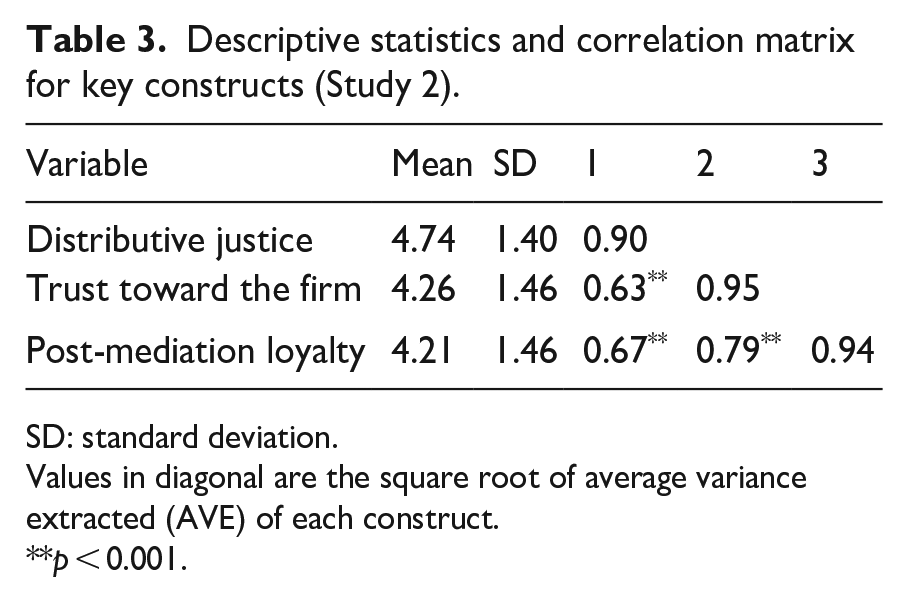
SD: standard deviation.
Values in diagonal are the square root of average variance extracted (AVE) of each construct.
p < 0.001.
Results
To test our research model, we estimated the customized moderated mediation using the PROCESS macro of Hayes (2013) with 5,000 bootstrapped samples. Specifically, we customized a model to measure the moderating effects of mediation type on the indirect relationship between mediation outcome and loyalty intentions toward the firm via distributive justice of mediation and trust toward the firm. Table 4 summarizes the results.
Moderated mediation results (Study 2).
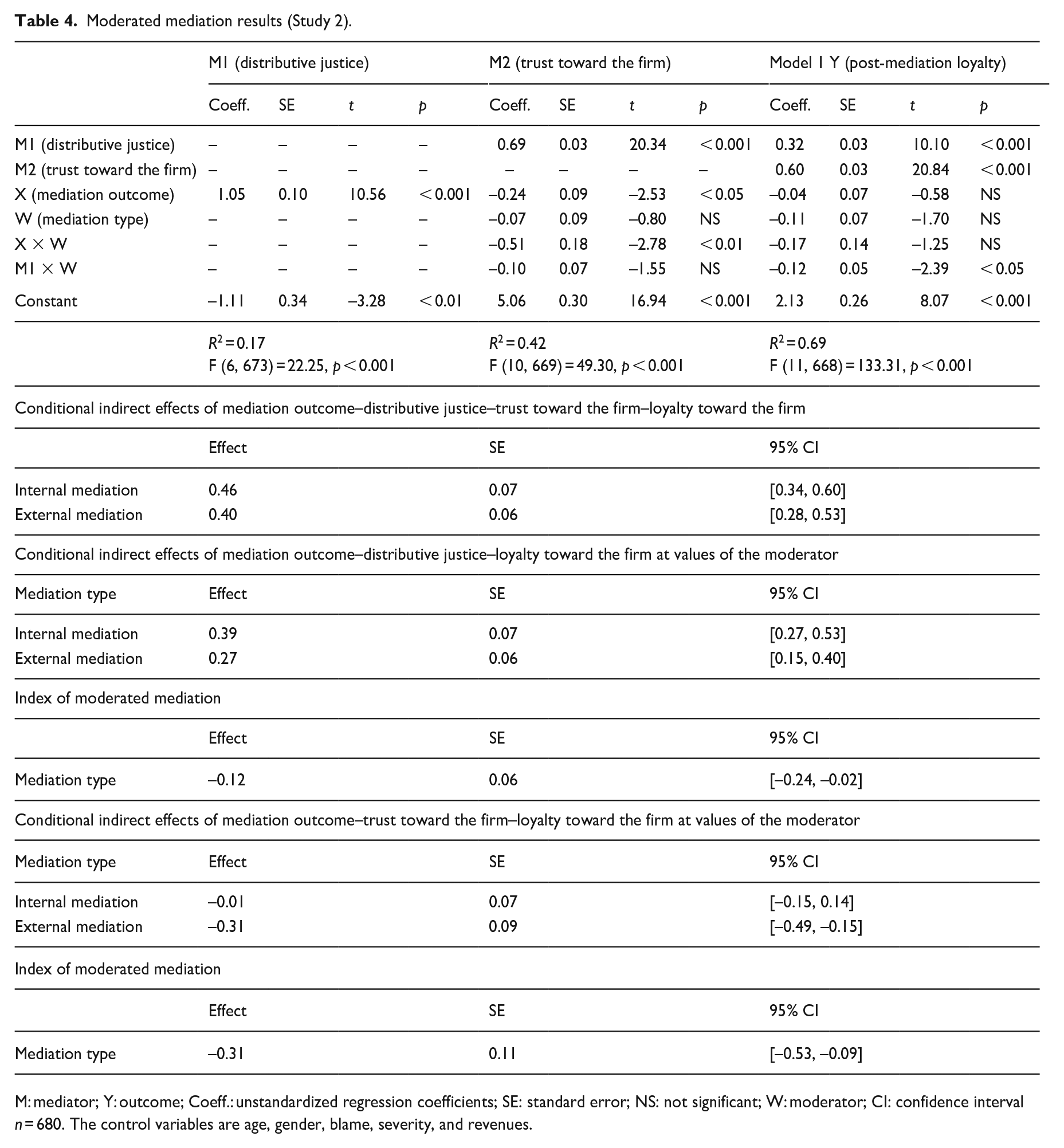
M: mediator; Y: outcome; Coeff.: unstandardized regression coefficients; SE: standard error; NS: not significant; W: moderator; CI: confidence interval
n = 680. The control variables are age, gender, blame, severity, and revenues.
The regression Model 1 explains significant variance in the outcome variable (loyalty), with an R2 value of 0.69 (p < 0.01). The results confirm Hypothesis 2 and indicate the mediating effect of distributive justice and trust toward the firm in the relationship between the mediation outcome and customers’ loyalty intentions toward the firm. The serial mediation considering the role of trust toward the firm is significant whatever the type of mediation (see the lower part of Table 4). The relationship between the distributive justice of mediation and trust toward the firm is positive (b = 0.69, 95% CI = [0.62, 0.75]). However, the moderating effect of the mediation type in this relationship is not significant (b = –0.10, 95% CI = [–0.24, 0.03]). We therefore reject Hypothesis 3. However, as expected in Hypothesis 4, we find a significantly weaker indirect effect of the mediation outcome on post-mediation loyalty intentions through distributive justice (index of moderated mediation: b = –0.12, 95% CI = [–0.24, –0.02]) for external mediation (b = 0.27, 95% CI = [0.15, 0.40]) than for internal mediation (b = 0.39, 95% CI = [0.27, 0.53]). Figure 2 shows the interaction effects of the mediation outcome (unfavorable vs favorable) and mediation type (internal vs external) on post-mediation loyalty: when mediation is external, the favorable outcome has a weaker effect on post-mediation loyalty toward the firm.
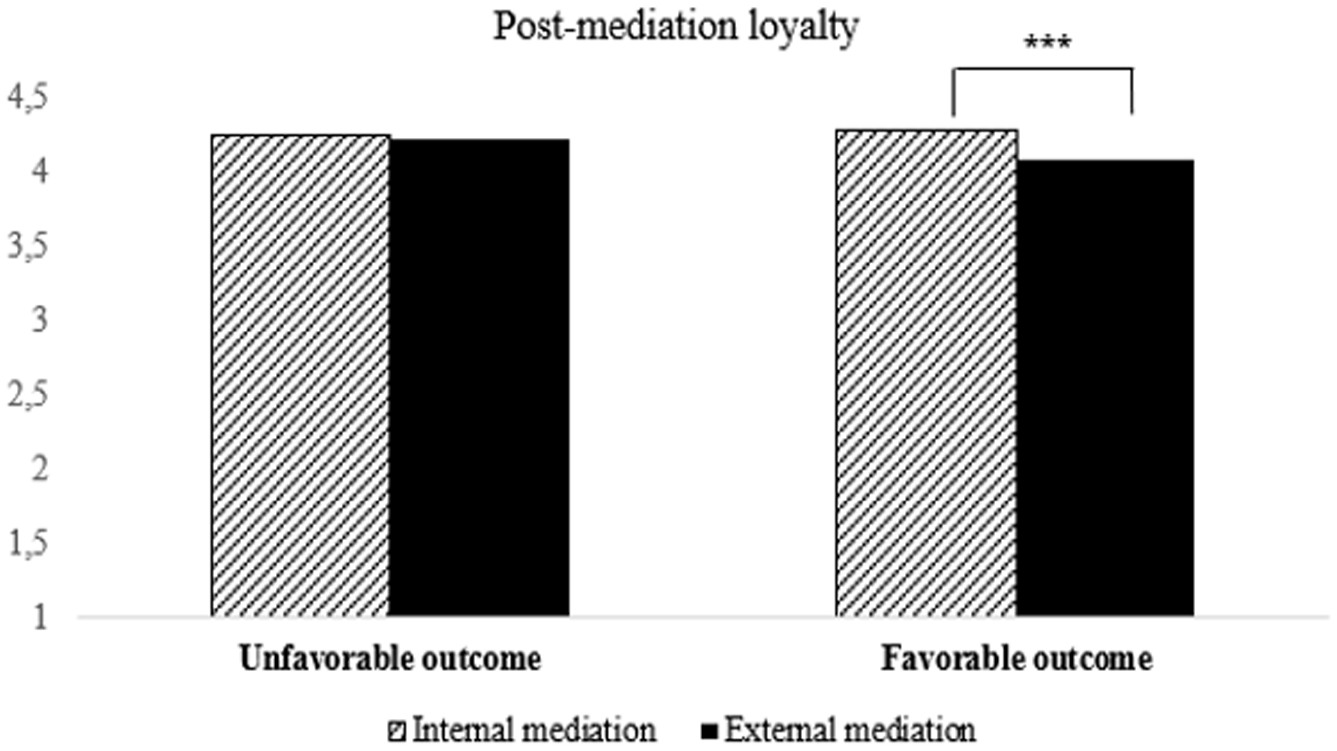
Interaction effect of the mediation outcome and mediation type on customers’ post-mediation loyalty toward the firm (Study 2).
A moderating effect of the mediation type emerges in the indirect relationship between the provided outcome and post-mediation loyalty intentions toward the firm through the trust toward the firm (index of moderated mediation: b = –0.31, 95% CI = [–0.53, –0.09]), as predicted in Hypothesis 5. Specifically, we find a significantly negative direct effect of the mediation outcome on post-mediation trust, and consequently on loyalty, for external mediation (b = –0.31, 95% CI = [–0.49, –0.15]) and no significant effect for internal mediation (CI = [–0.15, 0.14]). Figure 3 shows the interaction effects of the mediation outcome (unfavorable vs favorable) and mediation type (internal vs external) on post-mediation trust: when mediation is external, the favorable outcome decreases post-mediation trust toward the firm (MFav = 3.95 vs MUnfav = 4.47, p < 0.05).
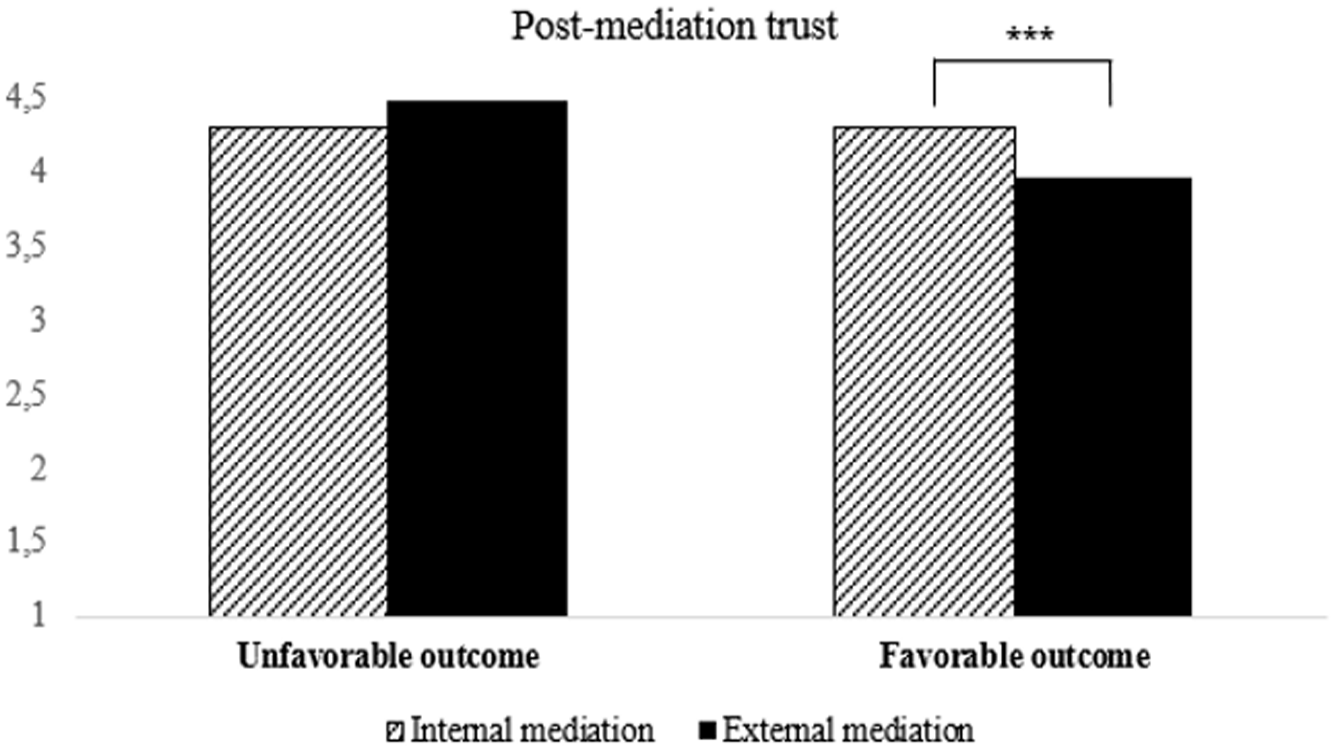
Interaction effect of the mediation outcome and mediation type on customers’ post-mediation trust toward the firm (Study 2).
Discussion
The results of Study 2 are consistent with the results of Study 1 and confirm the positive indirect route between the mediation outcome and customers’ loyalty intentions toward the firm via distributive justice. We show that a favorable outcome for customers is perceived as being fairer than an unfavorable one, and perceived distributive justice of mediation outcome positively impacts customers’ loyalty intentions toward the firm. This positive route is robust regardless of the mediation type. Moreover, we reveal that trust toward the firm makes part of the psychological process through which the third-party intervention affects the customer firm–relationship. Specifically, perceived distributive justice of the mediation outcome positively influences trust toward the firm, which is a critical element in determining the quality of the relationship in the context of a triadic interaction.
The findings do not confirm the indirect negative route suggesting that the type of mediation mitigates the relationship between the distributive justice of mediation and trust toward the firm. In other words, the impact of perceived justice of third-party intervention on the trust toward the firm does not depend on the mediation type. However, the results highlight the negative indirect routes between the mediation outcome and customers’ loyalty intentions toward the firm via distributive justice and via trust for external mediation. We demonstrate thus the relative inefficiency of the fair process effect (Greenberg and Folger, 1983; Van den Bos et al., 1999) in the context of a triadic relationship, specifically in the case of external mediation. A favorable outcome of external mediation reveals the firm’s previous mistakes and might be considered as proof that the customer was right, and the firm was wrong by threatening to damage relationships. A favorable outcome thus disconfirms a firm’s previous position showing a firm’s unwillingness to accept mistakes and leads to a decrease in customers’ post-mediation trust and loyalty. Therefore, there is a backfire effect of the intervention of a neutral third party when it rules in favor of the customer. Simultaneously, an unfavorable external mediation outcome confirming the firm’s position does not significantly change customers’ trust, and consequently, loyalty level. Accordingly, the highly neutral external mediation represents a risk for customer relationship quality. On the contrary, this negative relationship disappears for the internal/in-house mediation. When going through the distributive justice, mediation outcome has a stronger positive impact on post-mediation loyalty intentions in case of the internal mediation highlighting its efficiency compared to external mediation (b = 0.39, 95% CI = [0.27, 0.53]). Indeed, the mediator’s position, in or out of the service recovery process, shapes the influence of its outcome on the customer–firm relationship.
General discussion
We have sought to demonstrate that mediation offers a viable tool to support firms’ service recovery strategies. With two studies, using different research methods (i.e. scenario-based and field) and distinct service settings (i.e. hotel services and self-service bicycles), we confirm this assessment. With Study 1, we confirm that the favorability of the outcome provided by a mediator has a strong, positive effect on the perceived distributive dimension of justice. We find a total mediating effect of distributive justice in the relationship between the mediation outcome and customers’ post-mediation loyalty intentions. Our results from Study 2 support reasoning, which predicts that the type of mediation has a crucial effect on customers’ post-mediation loyalty. On one hand, we show that mediation offers firms an opportunity to maintain their relationships with customers. On the other hand, we highlight that the effects of external mediation, perceived as less closely related to the firm, are riskier. For external mediation, a favorable mediation outcome can decrease customers’ trust toward the firm and, consequently, loyalty intentions. Moreover, the unfavorable external mediation outcome, confirming the position of the firm, will not generate more trust and loyalty than the favorable outcome of internal mediation.
Theoretical implications
This study makes several important theoretical contributions. First, it sheds new light on the role of mediation as a third party involved in the service post-recovery stage that has received little attention in the service recovery literature. Van Vaerenbergh et al. (2019) introduce the idea of the service recovery journey distinguishing three phases of service recovery: pre-recovery, recovery, and post-recovery phases. They underline that past research mainly focuses on pre-recovery and post-recovery phases of the service recovery journey. Specifically, previous works show that customers do not fully regain trust after an effective recovery (Basso and Pizzutti, 2016) and many firms fail to recover after a service failure (i.e. double deviation; Joireman et al., 2013), leading to serious negative implications for the customer–firm relationship (Grégoire et al., 2009; Surachartkumtonkun et al., 2015). Those observations highlight the need for better understanding of which recovery procedures are critical for recovering from a double deviation. The recourse to mediation can be considered as a part of the post-recovery stage of service recovery journey, and this study on the role of mediation in the failed service recovery context addresses this shortcoming.
Second, in line with justice theories (Gelbrich and Roschk, 2011; Oliver and Swan, 1989; Orsingher et al., 2010), the findings show that the distributive justice of a mediator has a mediating role in the relationship between the favorability of the outcome provided by the mediator and customers’ behavioral intentions toward the firm. Furthermore, we investigate the relevance of the fair process effect in a triadic relationship context. The fair process effect suggests that people are likely to be satisfied when they interact with third parties who are procedurally fair, make inferences about how much to trust the other party, and respond more favorably when procedural fairness is relatively high (Lind et al., 1994; Tyler and Lind, 1992). Therefore, we examine whether the mediator’s positioning in or out of the firm’s service recovery journey shapes the fair process effect. Contrary to the fair process effect theory (e.g. Lind et al., 1997), we show that a highly neutral process (external mediation) as a minimum does not protect the firm in case of an unfavorable outcome for the customer, as a maximum, it harms the firm in case of a favorable outcome. Results reveal a moderating impact of the mediation type on the relationship between the mediation outcome and post-mediation trust and loyalty intentions toward the firm. Hence, we show a negative direct route in the external mediation condition highlighting that the independence of the external mediation services from the firm can lead to the deterioration of relationship quality when external mediator provides a favorable outcome for customers. These findings strongly confirm the importance of mediation, specifically the internal one, as a potential contributor to the firm’s service recovery process. We also highlight that neutrality, as a fundamental element of the mediation process (Cohen et al., 1999), might mitigate the effects of outcomes on the claiming party’s perceptions (Goldman et al., 2008).
Third, we expand the scope of third-party organizations’ role for marketing contexts (e.g. Baker et al., 2013; Russell-Bennett et al., 2010; Yu et al., 2017) and contribute to the call of Grégoire and Mattila (2021) suggesting a switch from dyadic to triadic relationship examinations. This study is the first to address the role of third parties in defining the customer–firm relationship quality, particularly through mediation. In this sense, we introduce mediation as a key element for strategic service recovery and consider a new triadic “customer–mediation–firm” relationship. Past research partially covered the subject by considering “other–consumers” or “observers” in service recovery contexts (Bacile et al., 2018) or showing how uncivil third-party customers can affect complainers’ experience during service recovery (Bacile et al., 2020). In this work, we bring to light a new form of “customer–mediation–firm” triadic relationship. We draw attention to the role of third parties in customer–firm relationships and bring a more balanced focus that gives similar attention to all three entities (i.e. customer, firm, mediation).
Managerial implications
Failures are inherent in services sectors, consumer dissatisfaction is widespread, and complaining is an important part of social life. This research thus should be of great interest to service managers. Despite the increasing requests for mediation services by consumers (e.g. 20% increase for energy services in France in 2020; Energy Services Mediation Report, 2020), managers are not always aware of the consequences of these third-party actions. Our findings reveal that the choice of the mediation type becomes a crucial strategic decision for firms, and therefore, offer some important implications and recommendations.
First, firms should leverage the availability of mediation services to win back customers. We identify recourse to a mediator as a final chance that customers actively offer firms, hoping to find an amicable solution. Unlike a consumer agency (e.g. the Better Business Bureau) that tries to resolve customers’ complaints against firms, mediation implies a dispute resolution method that engages both the customer and the firm. Even if relationship quality has been harmed, the mediator’s intervention offers some promise to save it. Therefore, managers should encourage customers to engage in mediation processes following any double deviation event.
Second, our results suggest that mediation outcomes affect customers’ post-mediation trust and loyalty differently, depending on whether the mediation is internal or external. Paradoxically, an outcome favorable to the customer deteriorates trust toward the firm when it comes from an external mediator. Indeed, a favorable decision by an external mediator highlights the failed service recovery and signals the firm’s inability to challenge itself. This result should raise concerns for managers in terms of the mediation outcomes. For example, in 2020, 90% of opinions issued by tourist and travel services (i.e. external) confirm customers’ position (Tourism and Travel Services Mediation Report, 2020), whereas only 19% of outcomes provided by insurance mediator (also external) are favorable (Insurance Services Mediation Report, 2020). On the contrary, we reveal that the unfavorable outcome of external mediation does not significantly boost customers’ trust and consequently loyalty levels compared to the internal mediation outcome. Accordingly, in situations of double deviation, the direct recourse to the external mediation does not represent any advantage. On the contrary, we point out a major threat related to the suggestion of external mediation.
Third, this research provides practical insights to firms on how they can benefit from adding internal mediation services to their service recovery strategies. While the Consumer Code (article L613-2) has stricter requirements for internal/in-house mediation services aiming to ensure their neutrality, any firm is allowed to implement this type of mediation as an ADR scheme after a double deviation if all requirements are respected. The list of firms suggesting in-house mediation includes former public institutions having public obligations (e.g. SNCF, La Poste, EDF, and so on) and private firms (e.g. HSBC Bank, Auchan Group and so on). Specifically, the findings of Study 1 examining the case of internal mediation offered by a private firm show that internal mediation (less neutral) can strengthen customers’ post-mediation behavioral intentions toward the firm.
Fourth, results suggest that the high risk of customer–firm relationship breakdown after a double deviation disappears in case of internal/in-house mediation. Despite the internal mediators’ obligations to comply with the same, or even stricter requirements that external mediators (specifically in terms of neutrality), Study 2 demonstrates that internal mediation is still perceived as being less neutral. Therefore, while developing internal mediation services, we encourage firms to communicate efficiently about internal mediators and their neutrality. Firms can win from suggesting the services of internal mediation knowing that external mediation can deteriorate the customer–firm relationship quality. We reveal that the external mediation worsens customers’ post-mediation relationships with firms, which can be potentially related to the assumption that the external mediator is not considered as a firm’s stakeholder but as a totally external actor. Therefore, a firm’s decision to highlight the inclusion of the mediation process into its service recovery process (i.e. internal mediation) can demonstrate a firm’s willingness to respect the future mediation outcome. Whereas mediators tend to emphasize their neutrality with the aim of giving credibility to their actions, we encourage firms to position mediation as a new step in their complaint-handling strategies.
Limitations and further research
As with most studies, this research has several limitations that must be acknowledged. First, we used two different service contexts in the experimental study and a field study, but continued research should expand our findings to other contexts (e.g. airline, energy, communication services). We encourage replications, especially in longitudinal studies that explore how the length of time between the complaint lodged with a mediator and the outcome received from the mediator exerts an influence. Second, this study did not extend to firms’ reactions to the outcome of the mediation. We hope further research takes this perspective to investigate the interaction of the mediation outcome and the firms’ reactions. According to the ADR Directive and French Consumer Code, firms are not obliged to follow the mediation outcomes. However, some firms explicitly agree to implement the mediator’s suggestions. Therefore, we find it interesting to study whether it is useful or not for firms to announce that they regularly follow the mediator’s recommendations. Moreover, future research can study the post-mediation negative word-of-mouth effects to identify the way firms can emphasize the mediation recommendations to preserve their image and reputation among other customers. Third, a regulation imposed in February 2016 in Europe requires traders that sell online to grant customers access to an online dispute resolution platform; continued research thus might study the role of online mediation for customer–firm relationships. Fourth, continued research might investigate the desires that push customers to turn to mediation and determine whether the primary desire is reconciliation or revenge (Joireman et al., 2013). Grégoire et al. (2019) show how vigilante complainers seek revenge and are more likely to post on complaint websites in a confrontational manner. In contrast, reparation complainers want to “fix a mistake,” and so frame the problem as a task by focusing on resolving the conflict with a firm. Therefore, reparation complainers should be more inclined to contact third parties, which can facilitate a discussion with firms (Grégoire et al., 2019), such as mediation, because it typically takes place as a complaining alternative aiming to maintain customers’ relationship with the firm. Fifth, the literature distinguishes the typology of problems based on ethical vs competence-based issues and suggests that trust might be repaired in the aftermath of a violation depending on the nature of the problem (e.g. Kim et al., 2004). Therefore, a research avenue consists of verifying the robustness of our results depending on the type of the encountered problem. Sixth, while our work mainly focused on distributive and procedural dimensions of mediation services, future research might examine the role and the importance of interactional justice, that is, how customers perceive the way they are treated (Gelbrich and Roschk, 2011). We call future research to examine the interactions between the perceived justice of the mediation process and the three dimensions of the firm’s service recovery process. Those relationships should be stronger when the mediation is embedded in the firm’s service recovery process. Seventh, attribution theory suggests that causal attributions are related to customers’ post-failure emotions and cognitive reactions (Van Vaerenbergh et al., 2014). Therefore, it seems relevant to focus on the role of blame attribution in customers’ post-mediation relationships with the firm. The mediation outcome is supposed to help customers in understanding if the firm can be considered as responsible for their dissatisfaction. A favorable mediation outcome assumes that the third party recognizes the responsibility of the firm for the failed service recovery and should lead customers to reinforce their negative feelings about the firm. Accordingly, the consideration of the impact of perceived responsibility on the customer relationship quality (Van Vaerenbergh et al., 2014) and the way firms can manage that blame attribution are avenues of research. Eight, findings suggest that high neutrality associated with external mediation does not amplify customers’ post-mediation behavioral intentions in the case of a favorable mediation outcome. Accordingly, we find it interesting to further our results by examining the optimal level of neutrality that could lead to higher post-mediation behaviors and the strategies of communication about a mediator’s neutrality. Finally, our research is the first step in the consideration of the interactions between the mediation, as a third party, and the firm’s service recovery process. It calls thus future research to focus on the further examination of those interactions, including the study of the impacts of customer–brand relationship quality before the mediation. The role of the relationship strength is still subject to debate (Meyer-Waarden and Sabadie, 2023). On one hand, strong relationships can buffer firms from the damage caused by service failure and poor recovery efforts (Hess et al., 2003). On the other hand, Grégoire and Fisher (2006) report that “as a relationship gains in strength, a violation of the fairness norm was found to have a stronger effect on the sense of betrayal experienced by customers” (p. 247). Therefore, the examination of the impact of the relationship with the brand before the recourse to mediation on customers’ post-mediation attitudes and behaviors is a relevant research avenue.
Footnotes
Appendix 1
Scales (Study 1).
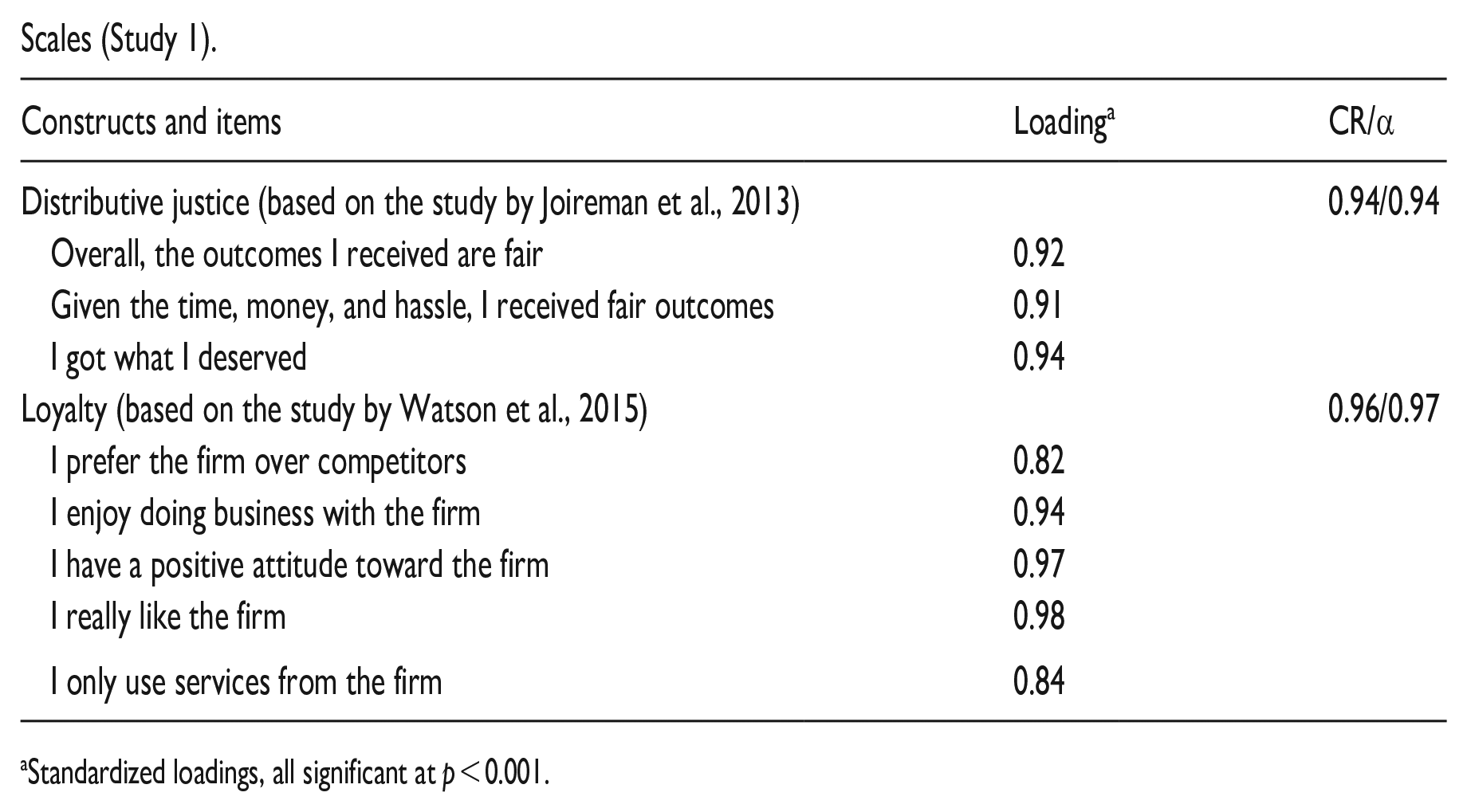
| Constructs and items | Loading a | CR/α |
|---|---|---|
| Distributive justice (based on the study by Joireman et al., 2013) | 0.94/0.94 | |
| Overall, the outcomes I received are fair | 0.92 | |
| Given the time, money, and hassle, I received fair outcomes | 0.91 | |
| I got what I deserved | 0.94 | |
| Loyalty (based on the study by Watson et al., 2015) | 0.96/0.97 | |
| I prefer the firm over competitors | 0.82 | |
| I enjoy doing business with the firm | 0.94 | |
| I have a positive attitude toward the firm | 0.97 | |
| I really like the firm | 0.98 | |
| I only use services from the firm | 0.84 |
Standardized loadings, all significant at p < 0.001.
Appendix 2
Appendix 3
Scales (Study 2).
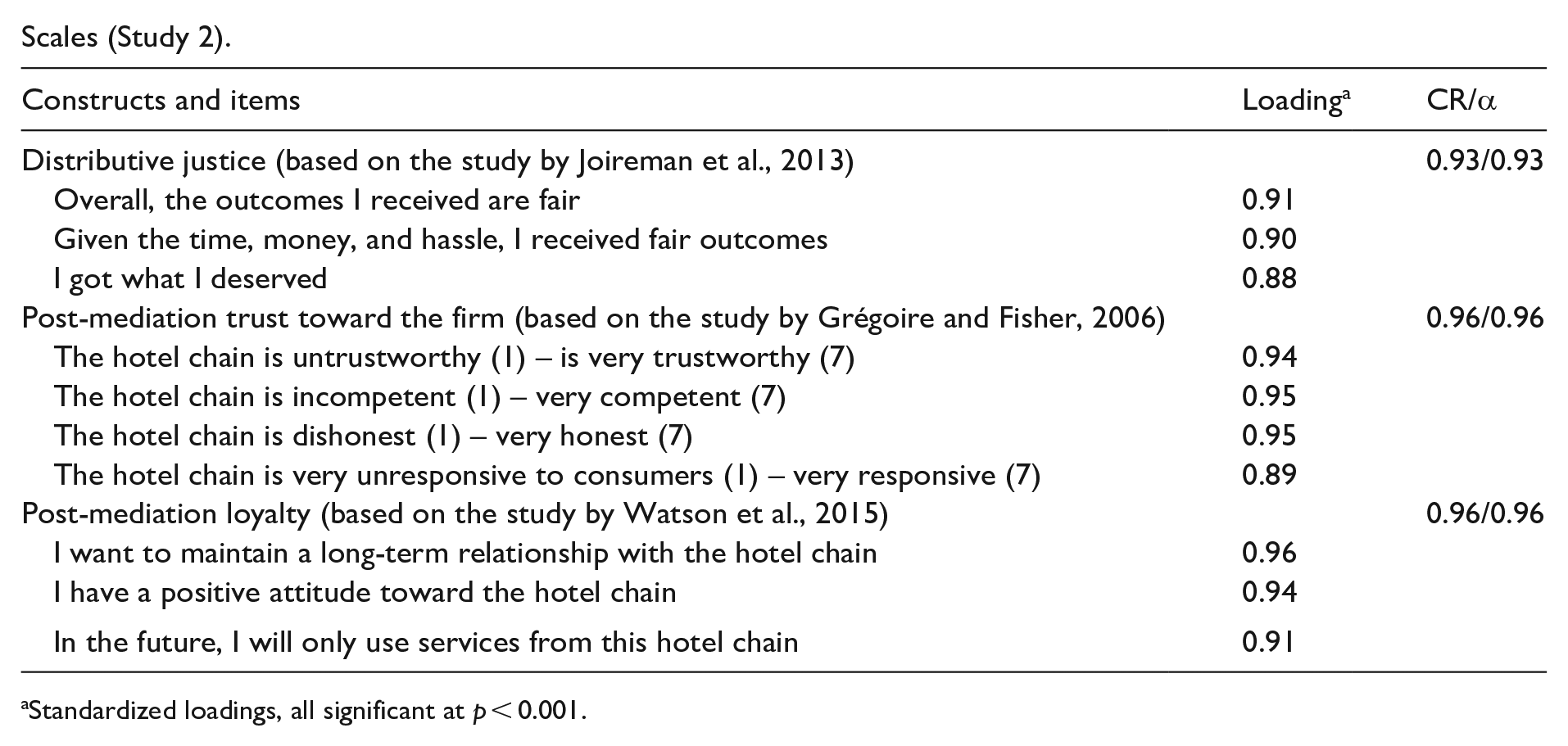
| Constructs and items | Loading a | CR/α |
|---|---|---|
| Distributive justice (based on the study by Joireman et al., 2013) | 0.93/0.93 | |
| Overall, the outcomes I received are fair | 0.91 | |
| Given the time, money, and hassle, I received fair outcomes | 0.90 | |
| I got what I deserved | 0.88 | |
| Post-mediation trust toward the firm (based on the study by Grégoire and Fisher, 2006) | 0.96/0.96 | |
| The hotel chain is untrustworthy (1) – is very trustworthy (7) | 0.94 | |
| The hotel chain is incompetent (1) – very competent (7) | 0.95 | |
| The hotel chain is dishonest (1) – very honest (7) | 0.95 | |
| The hotel chain is very unresponsive to consumers (1) – very responsive (7) | 0.89 | |
| Post-mediation loyalty (based on the study by Watson et al., 2015) | 0.96/0.96 | |
| I want to maintain a long-term relationship with the hotel chain | 0.96 | |
| I have a positive attitude toward the hotel chain | 0.94 | |
| In the future, I will only use services from this hotel chain | 0.91 |
Standardized loadings, all significant at p < 0.001.