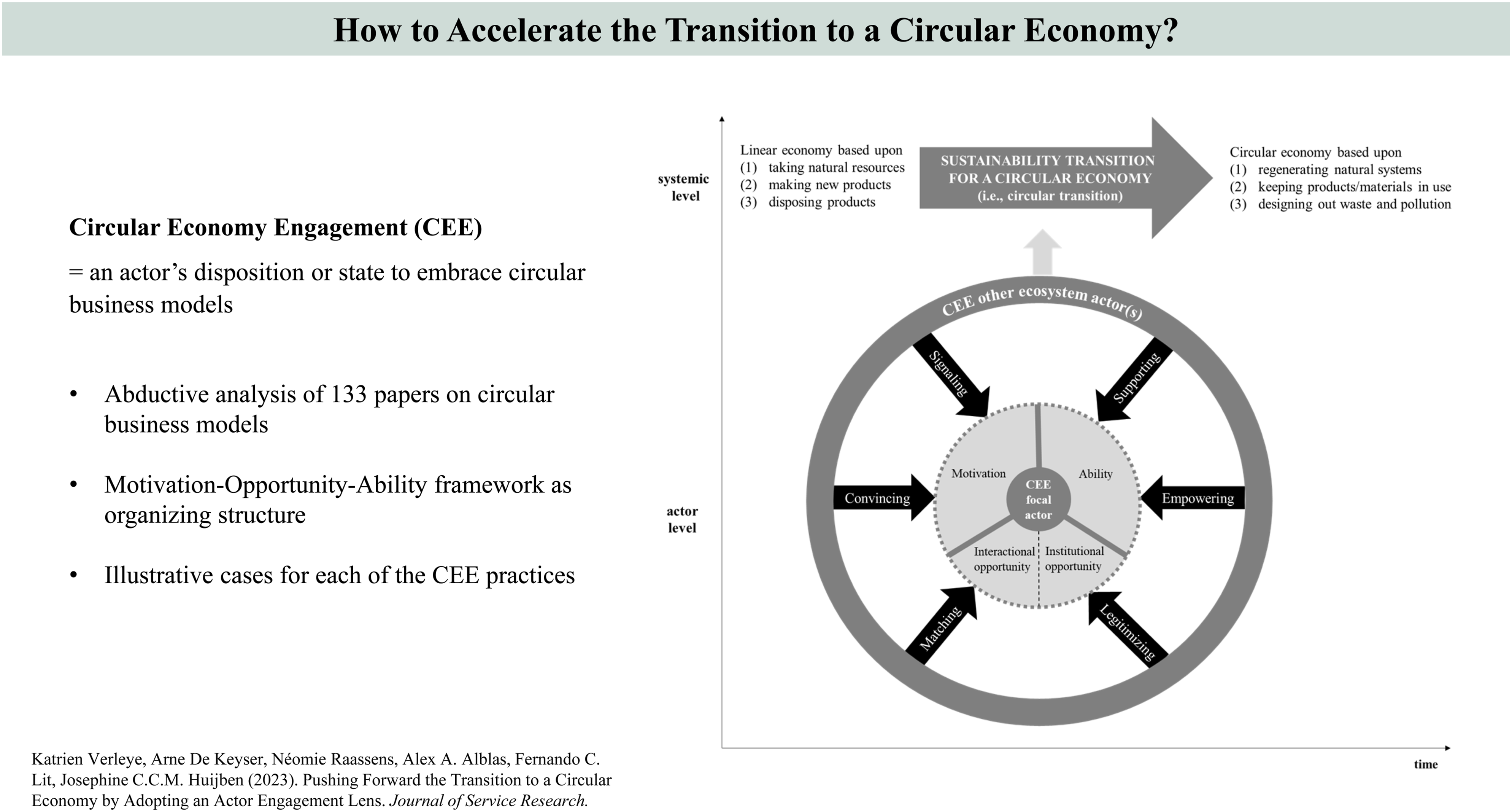
Circular business models (CBMs), such as product-service systems, are rapidly gaining traction in light of a transition to a more circular and sustainable economy. The authors call for a new approach to inform and guide the development and adoption of these CBMs. The main reason is that different actors in the service ecosystems or networks linked to these business models—such as firms, customers, and governmental bodies—may be reluctant to join or even impede the transition to a circular economy. Based upon an abductive analysis of 133 CBM papers with the Motivation-Opportunity-Ability (MOA) framework as organizing structure, the authors theorize about how to achieve “circular economy engagement” (i.e., an actor’s disposition to embrace CBMs). Specifically, they highlight and illustrate the role of (1) signaling and convincing as motivation-related practices, (2) matching and legitimizing as opportunity-related practices, and (3) supporting and empowering as ability-related practices. The authors provide illustrative cases for each of these practices along with a discussion of the theoretical and practical implications and the remaining challenges—all with the key aim to push the transition to a circular economy forward.
Product-service systems in manufacturing (e.g., Signify’s circular lightning service), rental services in the fashion industry (e.g., Rent the Runway), and sharing platforms in the equipment industry (e.g., Peerby)—all of these represent circular business models (CBMs). Researchers, practitioners, and policymakers agree that these CBMs—which are oriented toward slowing down, narrowing, or closing resource loops and reducing the burden on limited natural resources—contribute to a transition to a more circular and sustainable economy. They do so by balancing economic, social, and environmental value creation, capture, and delivery (Bidmon and Knab 2018; Böcker and Meelen 2017; Fehrer and Wieland 2021). The transition toward a circular economy—which is linked to a 12% higher GDP growth and a potential to reduce CO2 emissions by 83% in Europe by 2050 (EMF, 2015)—is one of the key building blocks of the 2020 European Green Deal, a key pillar in China’s 14th Five-Year plan (2021–2025), and central to the initiatives of the USA’s Environmental Protection Agency. It immediately opposes the current linear “take-make-waste” models of production and consumption, which are no longer sustainable in a world marked by massive environmental, social, technological, economic, and geo-political challenges and a population that will exceed 9.5 billion people by 2050 (Lacy, Long, and Spindler 2020).
The transition to a circular model, however, is not an easy one and includes a high degree of uncertainty—not in the least because of the large number of actors that need to be engaged (Köhler et al. 2019). Different actors in the service ecosystems or networks linked to CBMs— such as firms, customers, and governmental bodies—may be reluctant to join or even impede the circular transition (Elzinga et al. 2020). Some actors, for instance, experience difficulties changing their habits (i.e., lack of behavioral engagement—think of customers not willing to pay for circular alternatives), while others may hold detrimental attitudes toward CBMs and their implementation (i.e., lack of non-behavioral engagement—think of firms being hesitant to abandon their traditional linear production and delivery processes). As the negative repercussions of delaying the transition from a linear to a circular economy have become increasingly apparent in recent years, accelerating actor engagement in the circular economy is a pressing issue. Yet, the road toward pushing the circular transition through actor engagement is not clear (Bocken, Weissbrod, and Antikainen 2021; Fehrer and Wieland 2021; Lewandowski 2016). The goal of this paper, therefore, is to understand how to boost actors’ “circular economy engagement,” which we define as the disposition or state of actors to embrace CBMs with behavioral and non-behavioral manifestations (Hollebeek, Kumar, and Srivastava 2022; Storbacka 2019). To this end, we conduct a systematic literature review of 133 CBM papers, using the Motivation-Opportunity-Ability (MOA) framework—a framework developed to understand how individual and organizational actors behave (Argote, McEvily, and Reagans 2003; Hewett et al. 2022; MacInnis, Moorman, and Jaworski 1991)—as an organizing structure. By applying the MOA framework, we synthesize the conditions under which different actors—firms, customers, and governmental bodies—engage in the circular economy and propose a conceptual framework with motivation-related practices (i.e., How to ensure that the focal actor is willing to engage with CBMs?), opportunity-related practices (i.e., How to ensure the circumstances are right for the focal actor to engage with CBMs?), and ability-related practices (i.e., How to ensure that the focal actor is capable to engage with CBMs?). For each of these practices, we provide illustrative cases along with a discussion of the theoretical and practical implications and remaining challenges that are subject to further research.
This research contributes to the extant literature in multiple ways. First, we provide a better understanding of the sustainability transition toward a circular economy by adopting an actor engagement lens. Surprisingly, actor engagement is an underexplored phenomenon in circularity research to date, yet a key challenge for any circular initiative in practice (Khitous et al. 2020). In fact, no circular transition is likely to happen without circular economy engagement (Elzinga et al. 2020). The financial and circular potential of new business models like CBMs can only emerge when multiple actors simultaneously embrace CBMs (e.g., Geissdoerfer, Vladimirova, and Evans 2018; Keiningham et al. 2020; Köhler et al. 2019). Providing insights into what circular economy engagement entails is therefore of critical importance to both academics and practitioners concerned with the circular transition.
Second, by relying upon the MOA framework, this research offers a new approach to inform and guide researchers and practitioners concerned with developing, supporting, and/or adopting CBMs, which represent important facets of circular economy engagement. Specifically, our circular economy engagement framework proposes a set of six practices—signaling, convincing, matching, legitimizing, supporting, and empowering—tailored to boosting the motivation, opportunities, and abilities of actors to engage in the circular economy. Doing so, this work may not only advance actor engagement theory (Brodie et al. 2019; Hollebeek, Kumar, and Srivastava 2022), but also help different actors—such as firms, customers, and governmental bodies—pinpoint the necessary practices to increase circular economy engagement in practice and, ultimately, boost the highly needed sustainability transition to a circular economy (United Nations 2018).
Finally, looking at how different actors can be engaged in the circular transition is important given that actors with distinct roles—such as firms, customers, and governmental bodies—may engage differently (Hollebeek, Kumar, and Srivastava 2022), also when it relates to business models (Field et al. 2021). By showing that all six practices—even though their implementation may vary—contribute to engaging multiple types of actors in relation to specific types of business models (here, CBMs), this research not only extends the service ecosystems perspective on business models (Fehrer and Wieland 2021), but also responds to calls to examine how systemic change (here, a circular transition) is shaped by multi-actor engagement (Brodie et al. 2019).
Conceptual Background
Circular Business Models
CBMs, conceptualized as “holistic descriptions of how organizations create value for their stakeholders, optimize material loops, and thereby capture value” (Fehrer and Wieland 2021, p.611), have become a hot topic in understanding the transition toward a circular economy. CBMs represent—like any business model—a set of decision variables that allow organizations to use and coordinate their resources to create, capture, and deliver value (Zott, Amit, and Massa 2011). However, unlike other business models, CBMs build upon value creation logics inspired by the circular economy principles of (1) regenerating natural systems, (2) keeping products and materials in use, and (3) designing out waste and pollution (e.g., Centobelli et al. 2020; Urbinati, Chiaroni, and Chiesa 2017). As such, the circular economy principles contrast with the idea of taking natural resources out of the earth and turning them into products before disposing them, which represents the “take-make-waste” principle in the linear economy (Vijverman, Henkens, and Verleye 2019). By incorporating circular rather than linear economy principles in their value creation logic, CBMs are believed to enable a sustainability transition and even systemic changes to the way in which business is done (e.g., Bocken, Schuit, and Kraaijenhagen 2018; Fehrer and Wieland 2021).
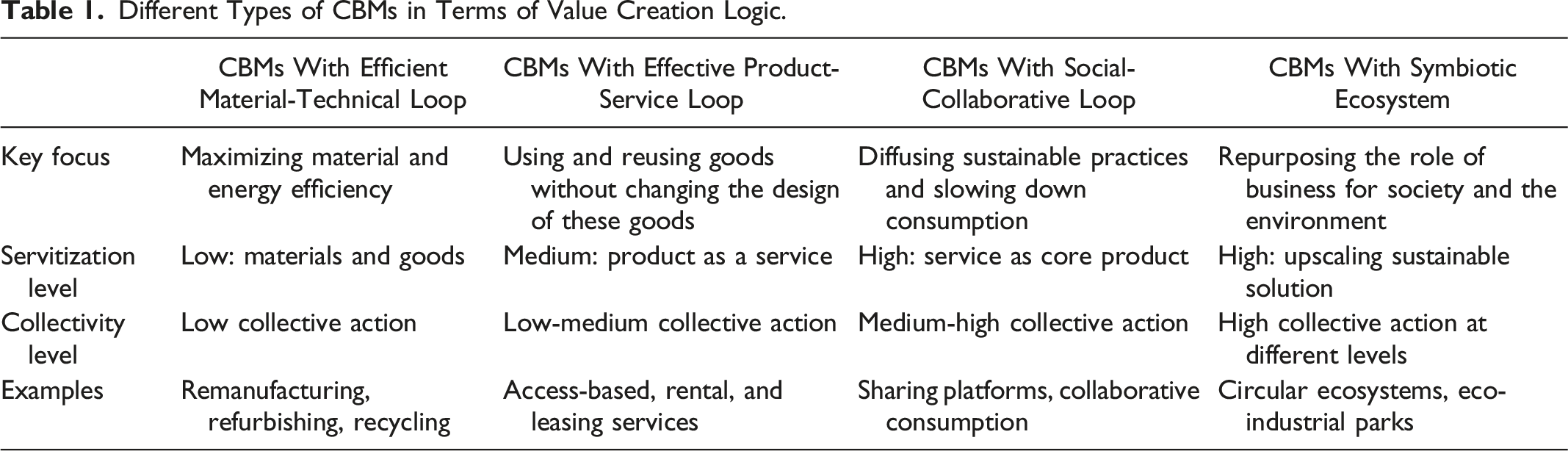
Fehrer and Wieland (2021) contend that CBMs typically build upon one of four value creation logics, namely: (1) efficient material-technical loops, (2) effective product-service loops, (3) social-collaborative loops, and (4) symbiotic ecosystems. Efficient material-technical loops focus on maximizing material and energy efficiency, for instance, by developing and building products for durability and/or recycling and (re-)collecting materials. Think about the attempts of automobile manufacturer Renault to reduce the use of raw materials in its manufacturing processes by using recycled plastics in vehicles (Urbinati, Chiaroni, and Chiesa 2017). Materials and goods are fundamental units of exchange in these types of CBMs. Effective product-service loops, in turn, emphasize the use and reuse of goods without changing their design, as exemplified by leasing, renting, and pay-for-use systems. Think about Grover letting consumers rent technology products like smartphones rather than buying them. Here, materials and goods are still important units of exchange, but they are complemented with service, that is, the application of specialized knowledge and skills in terms of using and reusing (Hollebeek, Srivastava, and Chen 2019). For service to exist, consumers need to collaborate with firms; for instance, by returning products. In social-collaborative loops, where collaborative action is of high importance, service represents a fundamental unit of exchange, even though the role of materials and goods cannot be ignored. Here, businesses encourage actors to slow down their consumption by offering collaborative platforms and hence reducing their demand for new manufacturing. Think about the clothing swap events of the Swap Society (www.swapsociety.co) or the Too Good To Go app, which allows restaurants and stores to share their unsold food surplus to customers (www.toogoodtogo.org/en/).
Finally, for CBMs that adopt a symbiotic ecosystems logic, the focus is on re-purposing the role of business for society and the environment, thereby upscaling sustainable solutions. To achieve this end, symbiotic ecosystems build on collective action and collaboration between various actors. Here, actors are—in contrast with effective product-service and social-collaborative loops CBMs—not only operating at the micro-level (e.g., individual customers and firms) but also at the meso-level (e.g., professions, social movements, and industries) and the macro-level (e.g., societal institutions). In other words, this logic recognizes that “the success of sustainable innovations depends to a large part on the structure and dynamics of their environment” (Fehrer and Wieland 2021, p.612). Illustrative for this value creation logic is Circular Flanders—a partnership between governments, companies, civil society, and the knowledge community in Flanders (Belgium)—that set up a Green Deal Circular Procurement. Here, over 150 organizations committed themselves to jointly apply a circular procurement method of purchasing over a 2-year window (https://aankopen.vlaanderen-circulair.be/en).
Taken together, CBMs—as summarized in Table 1—may be organized along two dimensions, that is their level of servitization (i.e., the extent to which service acts as a fundamental unit of exchange) and their level of collectivity (i.e., the extent to which collective action and collaboration is required).
Different Types of CBMs in Terms of Value Creation Logic.
CBMs With Efficient Material-Technical Loop
CBMs With Effective Product-Service Loop
CBMs With Social-Collaborative Loop
CBMs With Symbiotic Ecosystem
Key focus
Maximizing material and energy efficiency
Using and reusing goods without changing the design of these goods
Diffusing sustainable practices and slowing down consumption
Repurposing the role of business for society and the environment
Servitization level
Low: materials and goods
Medium: product as a service
High: service as core product
High: upscaling sustainable solution
Collectivity level
Low collective action
Low-medium collective action
Medium-high collective action
High collective action at different levels
Examples
Remanufacturing, refurbishing, recycling
Access-based, rental, and leasing services
Sharing platforms, collaborative consumption
Circular ecosystems, eco-industrial parks
Circular Economy Engagement
Circular economy engagement reflects an actor’s disposition or state to embrace CBMs with behavioral and non-behavioral manifestations (Brodie et al. 2011; Storbacka et al. 2016; Vijverman, Henkens, and Verleye 2019). This state of mind—like other types of actor engagement—takes place in an interactive or relational context (Pansari and Kumar 2017). Actor engagement is typically viewed as a process while it can—as a disposition or state—remain relatively stable without being an innate trait per se (Hollebeek, Kumar, and Srivastava 2022). In the transition to a circular economy, actor engagement with CBMs can manifest itself in behavioral and non-behavioral (cognitive and affective) ways (Brodie et al. 2013; Henkens, Verleye, and Larivière 2021; Van Doorn et al. 2010). Behavioral manifestations relate to investing time, money, energy, and effort in developing, supporting, and/or adopting CBMs, while non-behavioral manifestations refer to active mental processing of CBMs (cognitive engagement) and emotional bonding with CBMs (affective engagement) (Loureiro, Romero, and Bilro 2020). The engagement literature suggests that behavioral and non-behavioral engagement with an object, such as brands/firms and their offerings, are triggered by various factors. We apply the Motivation-Opportunity-Ability (MOA) framework to consolidate evidence from the actor engagement literature. The MOA framework, which finds its origins in psychology, is applied in various management disciplines at both the individual and firm level (Hewett et al. 2022; Siemsen, Roth, and Balasubramanian 2008). While motivation, opportunity, and ability are related, the causal relationship between these MOA constructs are theoretically difficult to justify. That is why we conceptualize them as correlated but distinct constructs (cf. Siemsen et al. 2008).
First, the actor engagement literature suggests that actor engagement with an object is—in line with social exchange theory (Blau 2017)—motivated by expected benefits, which entail economic, pragmatic, personal, social, cognitive, and hedonic benefits (Etgar 2008; Hoyer et al. 2010). In other words, an important condition for investing time, money, energy, and/or effort into an object is the actors’ motivation—that is, their willingness to engage with an object considering the expected benefits. Therefore, actor engagement is described as a motivationally driven, volitional resource investment (Hollebeek, Srivastava, and Chen 2019). Second, actor engagement is shaped through opportunities—that is, contextual factors that enable actor engagement—in the ecosystems in which actors are embedded. Indeed, service-dominant logic (S-D logic) suggests that actor engagement occurs through interactions with other actors that lead to resource investments (Hollebeek, Kumar, and Srivastava 2022). In other words, interactions with other connected actors in a service ecosystem create opportunities for engagement (Brodie et al. 2019; Hollebeek, Srivastava, and Chen 2019), which we denote as interactional opportunities. Further building on S-D logic, actor engagement also occurs within specific institutional contexts, including individuals, groups, firms, competitors, and regulators (Edvardsson et al. 2014; Koskela-Huotari and Vargo 2016). More particularly, S-D logic proposes that actors’ resource investments in interactions with other actors are enabled and/or constrained by sets of institutions, which are sets of humanly devised rules and norms (Brodie et al. 2019; Hollebeek, Kumar, and Srivastava 2022). In other words, the institutions in the ecosystem in which actors are embedded create opportunities for actor engagement, which represent institutional opportunities. This view is adopted by Fehrer and Wieland (2021), who contend that institutional work is necessary when making a sustainability transition—not in the least by allowing actors to balance tensions between economic growth and environmental goals. Here, institutional work refers to “the purposive action of individuals and organizations aimed at creating, maintaining, and disrupting institutions” (Lawrence and Suddaby 2006, p.215). Finally, research finds that engagement emerges when the demands on an actor and their resources to deal with these demands are well-balanced—i.e., jobs demands-resources model (Bakker and Demerouti 2007). S-D logic confirms that actor engagement reflects motivationally driven investments of specific operant and operand resources in interactions with an object in a service ecosystem (Hollebeek, Srivastava, and Chen 2019). For actors to engage with an object, they need the resources. Indeed, actors’ knowledge and skills—and hence their ability—were found to have a substantial impact on their engagement, not in the least when these actors are confronted with change and transformation (Lariviere et al. 2017).
To date, circular economy engagement is still low, with firms being slow to develop, customers being reluctant to adopt, and governmental bodies struggling to support CBMs (e.g., Bocken, Boons, and Baldassarre 2019; Khitous et al. 2020). Therefore, a core challenge revolves around how to boost this multitude of actors to engage with CBMs. While initial research provides ad-hoc illustrations on how to engage actors in the circular economy through business cases from Philips, H&M, Fairphone, and Starbucks (e.g., Fehrer and Wieland 2021; Vijverman, Henkens, and Verleye 2019), a systematic overview of the conditions under which motivation, opportunities, and ability for circular economy engagement among different actors emerge is lacking.
Methodological Approach
Over the past 5 years, literature focusing on CBMs and the circular economy has grown at a tremendous pace (e.g., Guldmann and Huulgaard 2020; Milios 2021; Urbinati, Franzò, and Chiaroni 2021; Vermunt et al. 2019). To explore the conditions for circular economy engagement, the research team engaged in a systematic process to identify, select, analyze, and synthesize relevant literature, which is detailed below.
Identifying and Selecting Relevant Literature
To ensure a transparent, structured, and replicable approach, we followed—as detailed in Web Appendix 1—(a) four-step procedure inspired by Kranzbuhler et al. (2018) to identify and select relevant articles in Scopus and Web of Science (WoS) as two of the largest databases of more recent academic papers (Abrizah et al. 2013).
First, we developed a combination of keywords best suited for creating a comprehensive list of conditions for circular economy engagement. The first part of the search string (“circular economy” OR “circular business model*”) provided enough flexibility to cover a wide range of relevant terms, including circular business models, circular economy business models, business models for the circular economy, and circular business model innovation. Meanwhile, the second part of the search string—inspired by other studies (Aloini et al. 2020; Cantú, Aguiñaga, and Scheel 2021; Guldmann and Huulgaard 2020)—covered terms related or equivalent to conditions for circular economy engagement (e.g., driver, enabler, trigger, barrier, challenge, obstacle). After running the queries on Scopus and WoS and filtering out duplicates, we found 11,939 articles.
Second, to increase the quality and relevance of our results, we limited our selection to peer-reviewed academic journals in English only. Also, the results were refined with respect to subject categories “business & management,” “economics,” “environmental sciences” on Scopus and “management,” “business,” “economics,” “environmental sciences,” “environmental studies” on WoS. This resulted in 5538 articles. We did not apply exclusion criteria regarding the number of citations or journal ranking. Given the nascence of the field, this helps to avoid excluding relevant papers published very recently.
Third, we performed a thorough screening of all remaining articles based on title, abstract, and full text (when necessary). Specifically, to be included in the final set, a paper needed a discernible research focus on conditions for circular economy engagement, resulting in the exclusion of 5407 articles (e.g., papers focusing on specific technical applications in a circular context, corporate sustainability, environmental management, manufacturing practices, digital technology for the circular economy). Finally, this process led to the identification of two additional papers based on cross-references and a final set of 133 articles. Web Appendix 2 provides the full references for these articles, while Web Appendix 3 provides descriptive characteristics of this final set of articles.
Analysis and Synthesis of Selected Articles
The content of the selected articles in our sample was—in line with the approach of Moeller et al. (2013) and De Keyser et al. (2020)—analyzed in five steps (see Web Appendix 1). In the first step, the research team got acquainted with the material by reading the selected articles. Second, these researchers selected relevant passages in the articles and developed in vivo codes or paraphrased descriptions. Third, the researchers in the team engaged in independently grouping these codes and descriptions into more abstract categories.
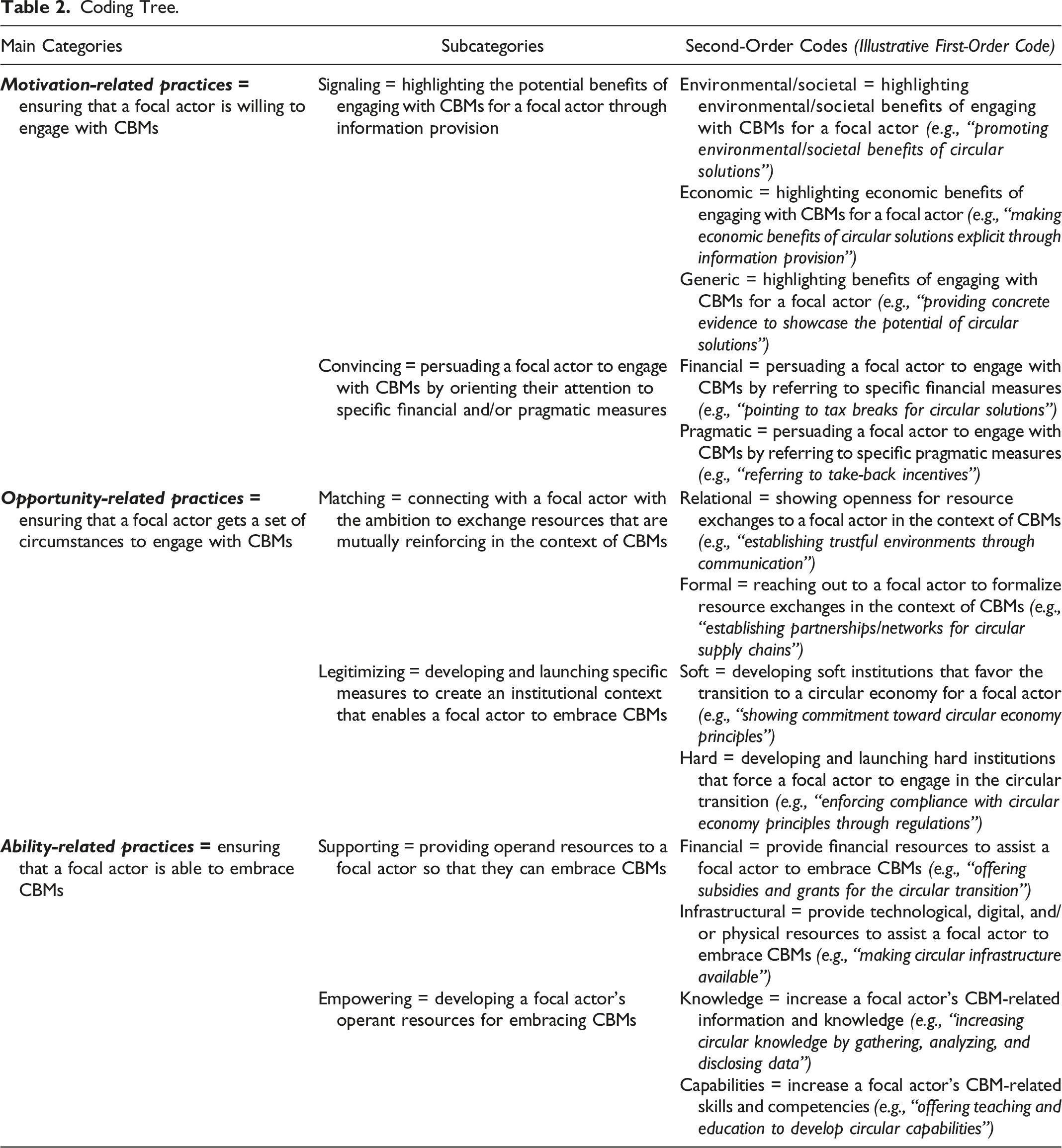
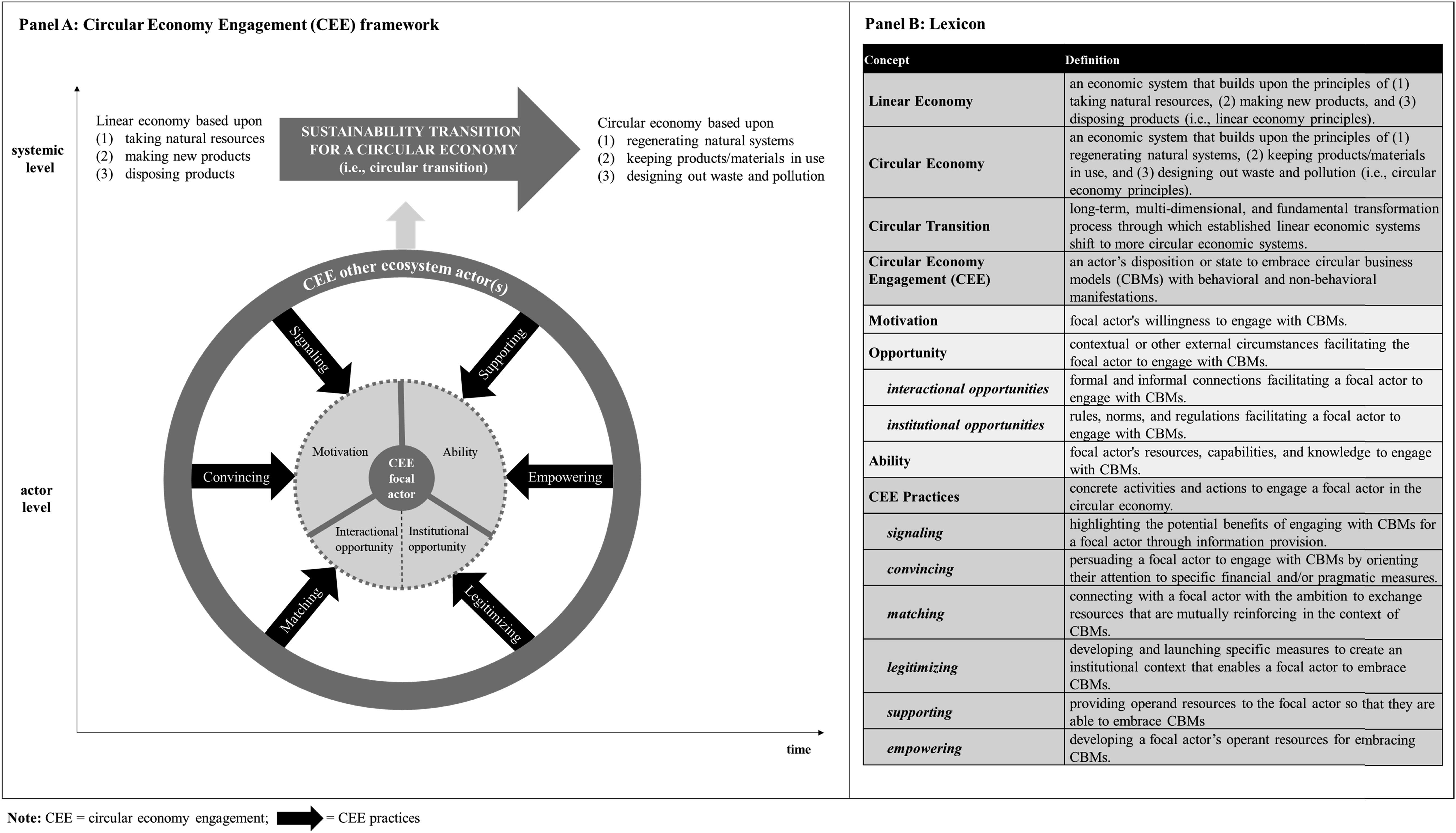
After inductively coding all material and subsequently comparing emerging insights and categorizations during a meeting, the research team noted that the MOA framework (Hewett et al. 2022; MacInnis, Moorman, and Jaworski 1991) could be used to organize the findings. By going back-and-forth between the MOA framework, the original coding, and the data, the research team developed a code tree with six practices that could be grouped into three main categories: (1) motivation-related practices, (2) opportunity-related practices, and (3) ability-related practices. To ensure the trustworthiness of this abductive coding process in which theoretical insights and data were systematically combined (Verleye 2019), all researchers in the team went back to the data in a fifth step and double coded all material based upon the six practices and further detailed the code tree. After this double coding round, the inter-coder reliability was 82%. All discrepancies, however, were discussed within the research team until a full consensus was reached (Saldaña 2015). Table 2 synthesizes the final code tree structured around the practices for circular economy engagement while Web Appendix 4 and 5 detail, respectively, the coding and the link between circular economy engagement practices and the type of CBM and the region. Figure 1 visualizes the emerging circular economy engagement framework put forth in this paper and stemming from the abductive coding process.
Motivation-related practices = ensuring that a focal actor is willing to engage with CBMs
Signaling = highlighting the potential benefits of engaging with CBMs for a focal actor through information provision
Environmental/societal = highlighting environmental/societal benefits of engaging with CBMs for a focal actor (e.g., “promoting environmental/societal benefits of circular solutions”)
Economic = highlighting economic benefits of engaging with CBMs for a focal actor (e.g., “making economic benefits of circular solutions explicit through information provision”)
Generic = highlighting benefits of engaging with CBMs for a focal actor (e.g., “providing concrete evidence to showcase the potential of circular solutions”)
Convincing = persuading a focal actor to engage with CBMs by orienting their attention to specific financial and/or pragmatic measures
Financial = persuading a focal actor to engage with CBMs by referring to specific financial measures (e.g., “pointing to tax breaks for circular solutions”)
Pragmatic = persuading a focal actor to engage with CBMs by referring to specific pragmatic measures (e.g., “referring to take-back incentives”)
Opportunity-related practices = ensuring that a focal actor gets a set of circumstances to engage with CBMs
Matching = connecting with a focal actor with the ambition to exchange resources that are mutually reinforcing in the context of CBMs
Relational = showing openness for resource exchanges to a focal actor in the context of CBMs (e.g., “establishing trustful environments through communication”)
Formal = reaching out to a focal actor to formalize resource exchanges in the context of CBMs (e.g., “establishing partnerships/networks for circular supply chains”)
Legitimizing = developing and launching specific measures to create an institutional context that enables a focal actor to embrace CBMs
Soft = developing soft institutions that favor the transition to a circular economy for a focal actor (e.g., “showing commitment toward circular economy principles”)
Hard = developing and launching hard institutions that force a focal actor to engage in the circular transition (e.g., “enforcing compliance with circular economy principles through regulations”)
Ability-related practices = ensuring that a focal actor is able to embrace CBMs
Supporting = providing operand resources to a focal actor so that they can embrace CBMs
Financial = provide financial resources to assist a focal actor to embrace CBMs (e.g., “offering subsidies and grants for the circular transition”)
Infrastructural = provide technological, digital, and/or physical resources to assist a focal actor to embrace CBMs (e.g., “making circular infrastructure available”)
Empowering = developing a focal actor’s operant resources for embracing CBMs
Knowledge = increase a focal actor’s CBM-related information and knowledge (e.g., “increasing circular knowledge by gathering, analyzing, and disclosing data”)
Capabilities = increase a focal actor’s CBM-related skills and competencies (e.g., “offering teaching and education to develop circular capabilities”)
Circular economy engagement framework with lexicon.
In the next sections, we discuss the motivation-, opportunity-, and ability-related practices underlying the circular economy engagement framework. Specifically, we synthesize current knowledge on each, complemented with tables that include illustrative evidence from the academic literature and—in line with the recommendations of Verleye (2019)—illustrative cases to strengthen theory development.
Motivation-Related Practices for Circular Economy Engagement
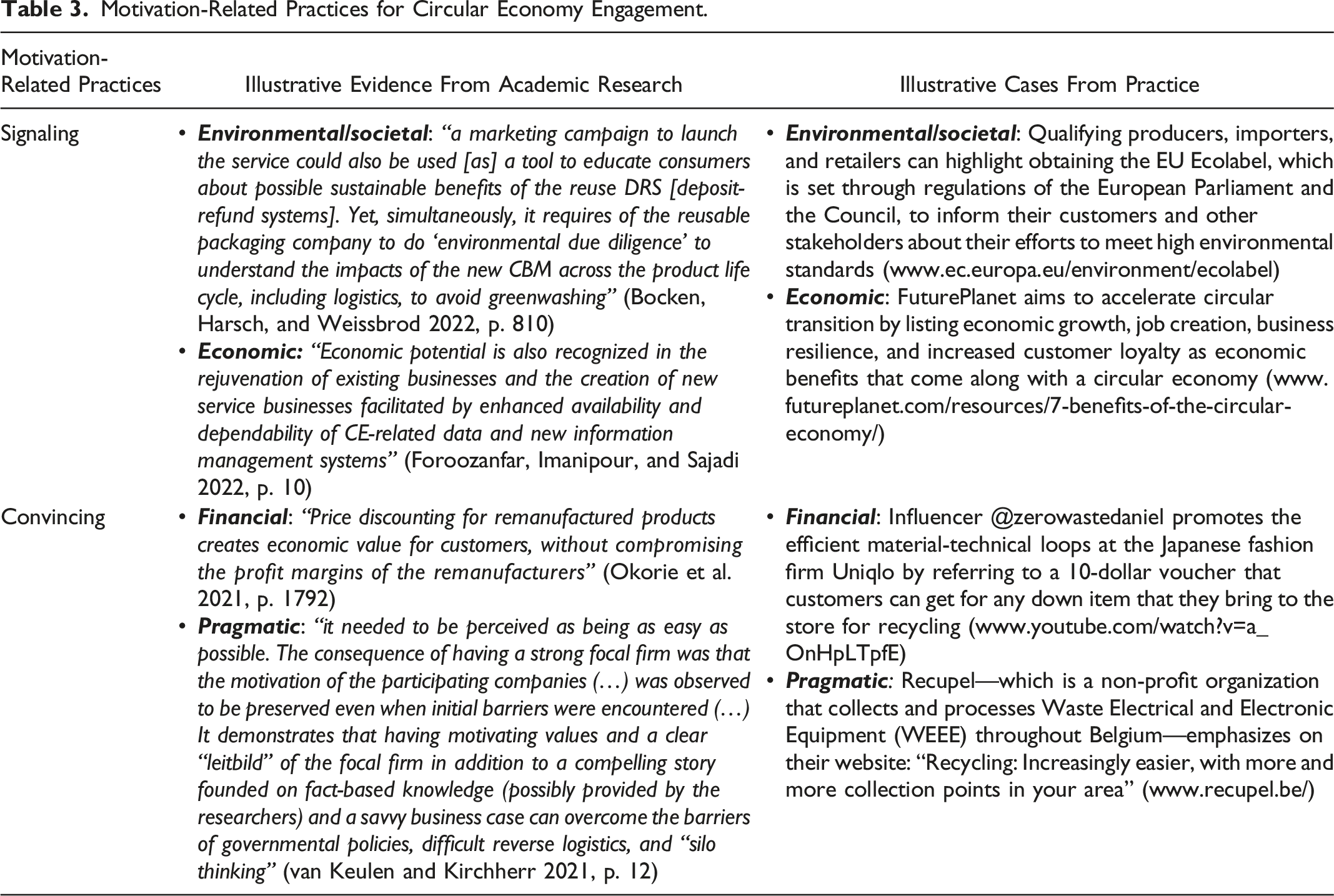
To motivate a focal actor to embrace CBMs, our research uncovers the importance of two motivation-related practices in which other actors in the ecosystem can engage: (1) signaling—that is, highlighting potential benefits of engaging with CBMs to focal actors through information provision (here, environmental, societal, and economic benefits) and (2) convincing—that is, persuading focal actors to engage with CBMs by orienting their attention to specific financial and/or pragmatic measures that boost their engagement. Web Appendix 5 shows that these practices matter for CBMs with different value creation logics across regions. To date, more focus is put on convincing in research on CBMs with social-collaborative loops, while research focused on a European setting puts somewhat more emphasis on signaling. In what follows, we detail these findings (see also Table 3).
Motivation-Related Practices for Circular Economy Engagement.
Motivation-Related Practices
Illustrative Evidence From Academic Research
Illustrative Cases From Practice
Signaling
• Environmental/societal: “a marketing campaign to launch the service could also be used [as] a tool to educate consumers about possible sustainable benefits of the reuse DRS [deposit-refund systems]. Yet, simultaneously, it requires of the reusable packaging company to do ‘environmental due diligence’ to understand the impacts of the new CBM across the product life cycle, including logistics, to avoid greenwashing” (Bocken, Harsch, and Weissbrod 2022, p. 810)• Economic:“Economic potential is also recognized in the rejuvenation of existing businesses and the creation of new service businesses facilitated by enhanced availability and dependability of CE-related data and new information management systems” (Foroozanfar, Imanipour, and Sajadi 2022, p. 10)
• Environmental/societal: Qualifying producers, importers, and retailers can highlight obtaining the EU Ecolabel, which is set through regulations of the European Parliament and the Council, to inform their customers and other stakeholders about their efforts to meet high environmental standards (www.ec.europa.eu/environment/ecolabel)• Economic: FuturePlanet aims to accelerate circular transition by listing economic growth, job creation, business resilience, and increased customer loyalty as economic benefits that come along with a circular economy (www.futureplanet.com/resources/7-benefits-of-the-circular-economy/)
Convincing
• Financial: “Price discounting for remanufactured products creates economic value for customers, without compromising the profit margins of the remanufacturers” (Okorie et al. 2021, p. 1792)• Pragmatic: “it needed to be perceived as being as easy as possible. The consequence of having a strong focal firm was that the motivation of the participating companies (…) was observed to be preserved even when initial barriers were encountered (…) It demonstrates that having motivating values and a clear “leitbild” of the focal firm in addition to a compelling story founded on fact-based knowledge (possibly provided by the researchers) and a savvy business case can overcome the barriers of governmental policies, difficult reverse logistics, and “silo thinking” (van Keulen and Kirchherr 2021, p. 12)
• Financial: Influencer @zerowastedaniel promotes the efficient material-technical loops at the Japanese fashion firm Uniqlo by referring to a 10-dollar voucher that customers can get for any down item that they bring to the store for recycling (www.youtube.com/watch?v=a_OnHpLTpfE)• Pragmatic: Recupel—which is a non-profit organization that collects and processes Waste Electrical and Electronic Equipment (WEEE) throughout Belgium—emphasizes on their website: “Recycling: Increasingly easier, with more and more collection points in your area” (www.recupel.be/)
Signaling
Our research refers to the importance of environmental and societal signaling, that is, highlighting the environmental and/or societal benefits of embracing CBMs. More particularly, several studies call for making these benefits explicit through information provision (e.g., Urbinati, Franzò, and Chiaroni 2021). Firms that see benefits from an environmental (e.g., reduced ecological impact—Karman 2020) and/or societal (e.g., improved well-being in society - Suchek et al. 2021) perspective are more likely to embrace different types of CBMs. Customers equally are found to engage with CBMs with different value creation logics if they associate the resulting offerings—such as remanufactured/refurbished products (cf. efficient material-technical loops) or rented/leased products (cf. effective product-service loops)—with environmental and/or societal benefits (Frishammar and Parida 2019). To ensure that different actors are informed about these benefits, a number of studies also call for promoting environmental/societal benefits (e.g., marketing campaigns about sustainability benefits—Bocken, Harsch, and Weissbrod 2022) and/or by providing concrete evidence to showcase the environmental/societal potential of CBMs (e.g., storytelling of circular economy achievements—Ünal, Urbinati, and Chiaroni 2019).
Economic signaling—that is, providing information about economic benefits—is also emphasized. Customers, for instance, show more circular economy engagement when they anticipate price discounts, which was observed across the different CBM types (Okorie et al. 2021; Tura et al. 2019). Firms, in turn, may only embrace CBMs when they expect to benefit financially, for instance by reducing their energy consumption when opting for CBMs with efficient technical-material loops (Okorie et al. 2021) or having new opportunities to create and capture value with other types of CBMs (Todeschini et al. 2017). To increase circular economy engagement in relation to these CBMs, extant research calls for making their economic benefits explicit and promoting them (Veleva and Bodkin 2018) and/or providing concrete evidence about their economic potential—for instance, with the help of information management systems (Foroozanfar, Imanipour, and Sajadi 2022).
Convincing
In light of the circular transition, several actors—not in the least startups and SMEs—anticipate financial risks due to low profit margins when customers associate CBMs with low prices and sales cannibalization (Hopkinson et al. 2018). In a similar vein, uncertainty about the revenue model also discourages firms from engaging with CBMs (Oghazi and Mostaghel 2018), and the same goes for uncertainty about the demand for circular offerings among customers (Okorie et al. 2021). Customers, in turn, may anticipate lower value-for-money and hence a lower willingness-to-pay when it relates to circular offerings (Munaro et al. 2021). When actors anticipate financial risks, providing information about the economic benefits does not suffice. Instead, other actors need to convince focal actors like customers and firms that these risks are limited or even absent by orienting their attention to specific measures that are available to them, which we denote as financial convincing.
To financially convince a focal actor, other actors in the ecosystem can refer to financial measures to invest in developing or scaling up circular solutions (e.g., offering interest-free loans—Wang and Li 2006), tax breaks or bonuses (e.g., special income tax regime when buying recycled materials—Neves and Marques 2022), and price discounts or at least competitive pricing that covers the significant cost of—among others—reverse logistics (Okorie et al. 2021). While these measures could ease a focal actor’s financial risk perception, alternatively, it may also pay off to hint to punitive measures that deter undesirable behavior and promote circular economy engagement (Tan, Tan, and Ramakrishna 2022). Examples include pointing to taxes for non-circular solutions (e.g., landfill taxes—Sarja, Onkila, and Mäkelä 2021), the charging of additional fees (e.g., disposal fee system—Ilić and Nikolić 2016), and/or the setting of higher prices for raw materials (Urbinati, Franzò, and Chiaroni 2021).
A focal actor, however, may also anticipate various pragmatic risks, which calls for pragmatic convincing. A first type of pragmatic risk includes unreliable input flows due to—among others—low quantity of returned products (Urbinati, Franzò, and Chiaroni 2021) and low quality of recovered used parts (Shao et al. 2019). The impossibility of turning products into circular ones due to their complexity and/or design represents another pragmatic risk that affects firms’ willingness to engage with CBMs (Cantú, Aguiñaga, and Scheel 2021). Customers will also have to be convinced that CBMs—especially those with effective product-service loops and even more those with social-collaborative loops—do not come with further pragmatic risks, such as the lack of proper take-back programs (Chen 2020) and hygiene issues (Martínez-Cabrera and López-del-Pino 2021).
Opportunity-Related Practices for Circular Economy Engagement
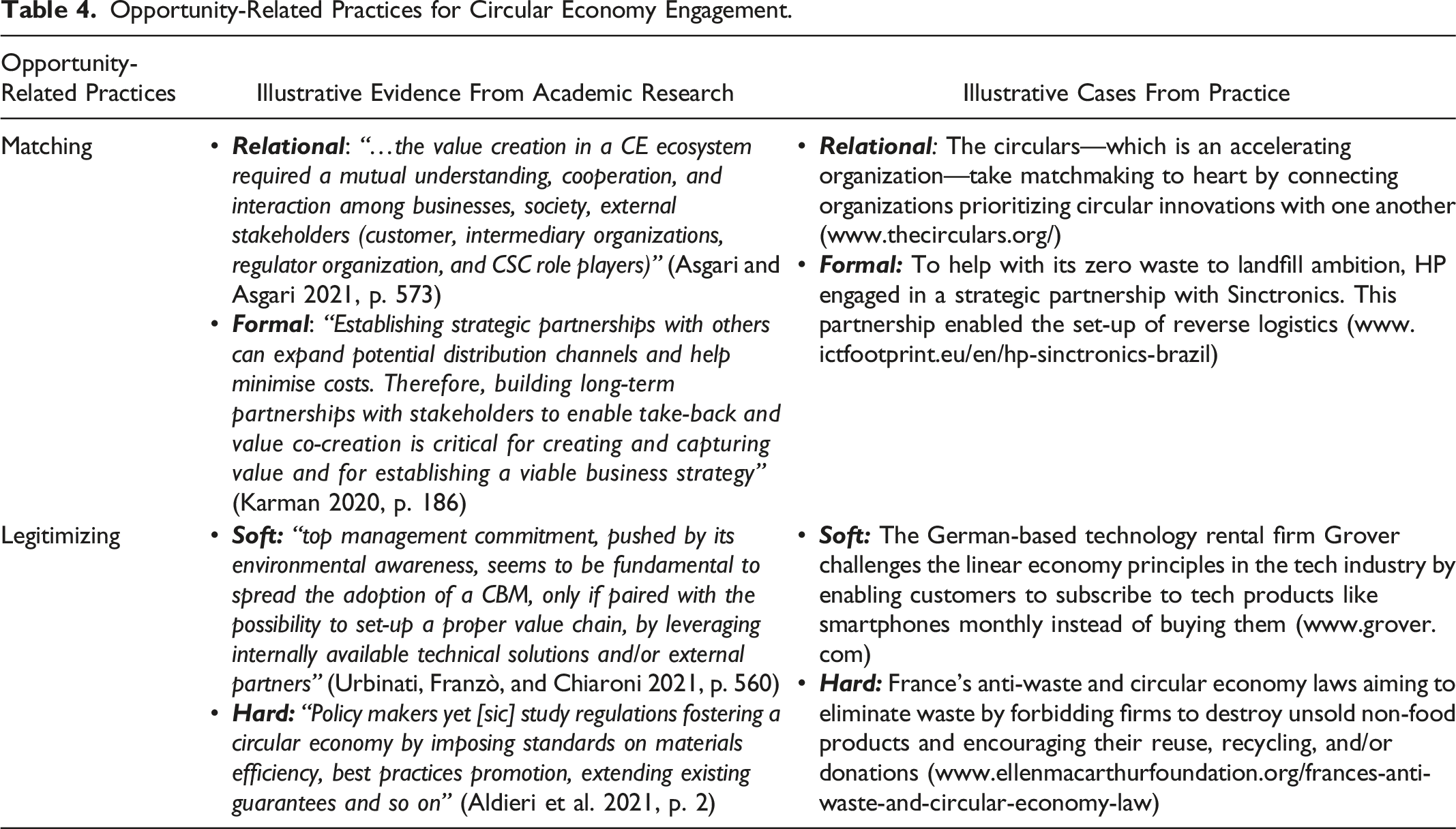
Motivation to engage in the transition to a circular economy is not sufficient and is necessarily complemented with opportunities that allow focal actors to engage. This research highlights that other actors in the ecosystem can create interactional and institutional opportunities by respectively: (1) matching—that is, connecting with the focal actor with the ambition to exchange resources that are mutually reinforcing in the context of CBMs, and (2) legitimizing—that is, developing and launching specific measures to create an institutional context that enables a focal actor to embrace CBMs. As shown in Web Appendix 5, both practices are strongly emphasized in research on CBMs with different value creation logics across regions, but legitimizing gets more attention than matching in research on all types of CBMs across regions. In what follows, we detail these practices (see Table 4).
Opportunity-Related Practices for Circular Economy Engagement.
Opportunity-Related Practices
Illustrative Evidence From Academic Research
Illustrative Cases From Practice
Matching
• Relational: “…the value creation in a CE ecosystem required a mutual understanding, cooperation, and interaction among businesses, society, external stakeholders (customer, intermediary organizations, regulator organization, and CSC role players)” (Asgari and Asgari 2021, p. 573)• Formal: “Establishing strategic partnerships with others can expand potential distribution channels and help minimise costs. Therefore, building long-term partnerships with stakeholders to enable take-back and value co-creation is critical for creating and capturing value and for establishing a viable business strategy” (Karman 2020, p. 186)
• Relational: The circulars—which is an accelerating organization—take matchmaking to heart by connecting organizations prioritizing circular innovations with one another (www.thecirculars.org/)• Formal: To help with its zero waste to landfill ambition, HP engaged in a strategic partnership with Sinctronics. This partnership enabled the set-up of reverse logistics (www.ictfootprint.eu/en/hp-sinctronics-brazil)
Legitimizing
• Soft:“top management commitment, pushed by its environmental awareness, seems to be fundamental to spread the adoption of a CBM, only if paired with the possibility to set-up a proper value chain, by leveraging internally available technical solutions and/or external partners” (Urbinati, Franzò, and Chiaroni 2021, p. 560)• Hard:“Policy makers yet [sic] study regulations fostering a circular economy by imposing standards on materials efficiency, best practices promotion, extending existing guarantees and so on” (Aldieri et al. 2021, p. 2)
• Soft: The German-based technology rental firm Grover challenges the linear economy principles in the tech industry by enabling customers to subscribe to tech products like smartphones monthly instead of buying them (www.grover.com)• Hard: France’s anti-waste and circular economy laws aiming to eliminate waste by forbidding firms to destroy unsold non-food products and encouraging their reuse, recycling, and/or donations (www.ellenmacarthurfoundation.org/frances-anti-waste-and-circular-economy-law)
Matching
Several studies emphasize that focal actors’ engagement in the circular economy depends on their opportunities to exchange resources with other actors. These actors include local communities (e.g., Cullen 2021), customers, startups and small entrepreneurs (e.g., De Mattos and De Albuquerque 2018), firms and suppliers (e.g., Ünal, Urbinati, and Chiaroni 2019), circular finance organizations (e.g., Okorie et al. 2021), the government (e.g., Munaro et al. 2021), and civil society groups (e.g., Hofmann and Jaeger-Erben 2020). Each of these actors may create interactional opportunities for a focal actor through relational and formal matching, as outlined below.
Relational matching occurs when actors show their openness to exchange resources with the focal actor in the context of CBMs (Asgari and Asgari 2021; Reim, Sjödin, and Parida 2021). This practice can occur when actors—such as customers and suppliers—express their demand or readiness to engage with CBMs to the focal actor (Fuchs and Hovemann 2022). Next, relational matching can happen when focal actors are involved in the design and/or implementation of CBMs with different value creation logics (e.g., De Mattos and De Albuquerque 2018; Hankammer et al. 2019), or when other actors reorganize their relationship with them (Hofmann and Jaeger-Erben 2020), or show respect for different expectations, visions, and goals (Bertassini et al. 2021; Hofmann and Jaeger-Erben 2020). In symbiotic ecosystems, third parties—like industrial associations and governmental bodies—often engage in relationally matching focal actors with other actors through orchestration (Ünal, Urbinati, and Chiaroni 2019), for instance, by organizing workshops (van Keulen and Kirchherr 2021), or fostering geographical proximity of different actors (Donner et al. 2021). Finally, each and every actor in an ecosystem can contribute to establishing mutual understanding and trust when collaborating (Ada et al. 2022; Agarwal, Tyagi, and Garg 2021). When actors perceive each other as understanding and trustworthy partners without experiencing power imbalances and/or conflicts of interest, they may engage in sharing operand (e.g., infrastructure) and operant resources (e.g., knowledge—Moggi and Dameri 2021).
The opposite, however, may happen when there is no mutual understanding and/or distrust among actors. One example would be when customers are not confident that a firm is offering a quality solution or when they doubt that other actors—such as suppliers or customers—take care of the quality of materials/products that move from one actor to another (Arekrans et al. 2022). In those situations, a focal actor may benefit from formalized resource exchanges with other actors in its ecosystem. When other actors reach out to the focal actor to formalize resource exchanges in the context of CBMs, we refer to formal matching. This practice manifests itself when actors establish strategic alliances/partnerships (e.g., Donner et al. 2021; Karman 2020; Urbinati, Franzò, and Chiaroni 2021), networks/clusters (e.g., Hofmann 2019), or geographical hubs/eco-industrial parks (e.g., Wang and Li 2006). These formal arrangements can enable actors—such as firms and universities—to share knowledge about circularity (Bolger and Doyon 2019). Furthermore, formal arrangements facilitate circular supply chain management and the establishment of reverse supply chains when actors’ interests are not connected (Urbinati, Franzò, and Chiaroni 2021). Here, we distinguish between CBMs with efficient material-technical loops with their focus on dealing with waste collection and disposal costs (Ilić and Nikolić 2016) and CBMs with effective product-service loops with their focus on developing partnerships to enable take-back (Karman 2020). Next, actors may set up formal arrangements to fund the circular transition (Okorie et al. 2021) and expand the scope of CBMs. This is, for instance, illustrated by partnerships between fashion-rental entrepreneurs and upcoming designers and luxury brands to give visibility to this CBM with effective product-service loops (Bodenheimer, Schuler, and Wilkening 2022) and partnerships to scale up reusable packaging models so that symbiotic ecosystems emerge (Bocken, Harsch, and Weissbrod 2022). In the aforementioned situations, actors may systematically select focal actors to collaborate with (Ada et al. 2022), sign formal agreements like a “green deal” (Giorgi et al. 2022), and/or set up initiatives to coordinate multi-actor collaborations across regions (Jaeger and Upadhyay 2020).
Legitimizing
Extant studies refer to a wide range of soft institutions (i.e., shared norms/values or common habits and routines) and hard institutions (i.e., laws and regulations) in focal actors’ ecosystems that affect their engagement in the circular economy (Vermunt et al. 2019). In terms of soft institutions, a focal actor may be embedded in an ecosystem characterized by no sense of urgency or inertia (Urbinati, Franzò, and Chiaroni 2021) when it relates to embracing circular economy principles. In a similar vein, a focal actor may face hard institutions that disfavor a circular transition in its ecosystem, such as laws and regulations that remain silent about how to deal with waste, what remanufacturing entails, and how to engage in other circular practices (Hopkinson et al. 2018).
To establish an institutional context that creates opportunities for circular economy engagement among focal actors, other actors in their ecosystem may opt for soft legitimizing—that is, developing and launching measures that contribute to the emergence of soft institutions that favor the transition to a circular economy. Research about CBMs with different value creation logics refers to the importance of developing an innovative and collaborative culture that embraces the circular economy principles with a long-term orientation (Suchek et al. 2021). Here, the work of Bertassini et al. (2021) is notable, as they propose a framework to develop a circular economy culture within organizations. Key aspects include (1) the definition of a clear and unified vision toward the circular economy by organizational leaders while integrating stakeholders’ perspectives and (2) sharing and embedding the circular economy-oriented culture within the organization by providing employees with circular economy values and principles. Other studies confirm that actors—not in the least organizational leaders—can contribute to developing soft institutions by showing their commitment toward circular economy principles through their behaviors (Cantú, Aguiñaga, and Scheel 2021). Meanwhile, extant research also calls for giving time to set up and get used to CBMs, which is particularly relevant when sectors/industries—such as the automobile sector in Pakistan—are in early stages of the circular transition (Agyemang et al. 2019).
Alternatively, a focal actor may also get opportunities for circular economy engagement when other actors in the ecosystem develop and launch hard institutions that favor the transition to a circular economy—a phenomenon that we denote as hard legitimizing. This can happen when governmental bodies launch circular policies, laws, and regulations (Urbinati, Franzò, and Chiaroni 2021) and enforce them (Ezeudu et al. 2021). Several studies point out that actors are coerced to contribute to circularity by hard institutions like revised waste tax laws, regulations that impose the implementation of take-back and recycling systems, and policies that make collaboration across the value chain obligatory (Moggi and Dameri 2021; Levänen, Lyytinen, and Gatica 2018). Several studies, especially those focusing on CBMs with efficient material-technical loops and symbiotic ecosystems, also call for developing circular standards, certifications, and awards. This type of hard legitimizing is often initiated by governmental bodies or sector and industry federations (van Keulen and Kirchherr 2021) and associated with showcasing sustainable material usage (Cantú, Aguiñaga, and Scheel 2021), refurbishment quality (Govindan and Hasanagic 2018), or achievement of waste-recycling targets (Sarja, Onkila, and Mäkelä 2021).
Ability-Related Practices for Circular Economy Engagement
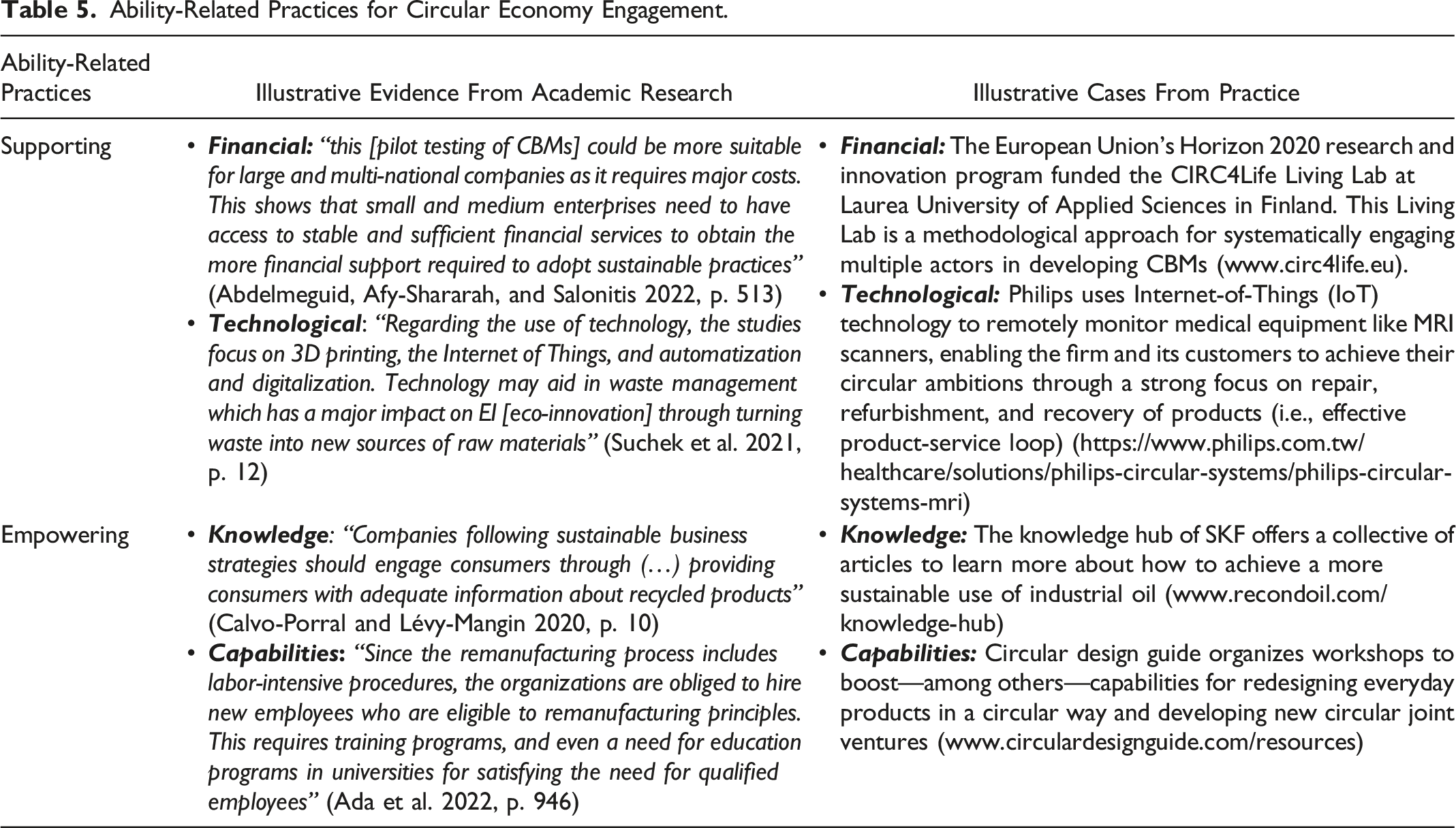
To ensure that a focal actor is able to engage in the circular transition, several studies emphasize the importance of (1) supporting—that is, providing operand resources to the focal actor through the implementation of specific measures so that they are able to embrace CBMs (here, financial and infrastructural resources) and/or (2) empowering—that is, developing a focal actor’s operant resources so that they are able to embrace CBMs (here, knowledge and capabilities). Because these practices increase a focal actor’s ability to embrace CBMs, we refer to these as ability-related practices. Web Appendix 5 shows that these practices are stressed in research on CBMs with different value creation logics across different regions. However, there is more emphasis on empowering than supporting actors in research across the four types of CBMs in all regions, except Asia. In what follows, we detail these practices (see Table 5).
Ability-Related Practices for Circular Economy Engagement.
Ability-Related Practices
Illustrative Evidence From Academic Research
Illustrative Cases From Practice
Supporting
• Financial:“this [pilot testing of CBMs] could be more suitable for large and multi-national companies as it requires major costs. This shows that small and medium enterprises need to have access to stable and sufficient financial services to obtain the more financial support required to adopt sustainable practices” (Abdelmeguid, Afy-Shararah, and Salonitis 2022, p. 513)• Technological: “Regarding the use of technology, the studies focus on 3D printing, the Internet of Things, and automatization and digitalization. Technology may aid in waste management which has a major impact on EI [eco-innovation] through turning waste into new sources of raw materials” (Suchek et al. 2021, p. 12)
• Financial: The European Union’s Horizon 2020 research and innovation program funded the CIRC4Life Living Lab at Laurea University of Applied Sciences in Finland. This Living Lab is a methodological approach for systematically engaging multiple actors in developing CBMs (www.circ4life.eu).• Technological: Philips uses Internet-of-Things (IoT) technology to remotely monitor medical equipment like MRI scanners, enabling the firm and its customers to achieve their circular ambitions through a strong focus on repair, refurbishment, and recovery of products (i.e., effective product-service loop) (https://www.philips.com.tw/healthcare/solutions/philips-circular-systems/philips-circular-systems-mri)
Empowering
• Knowledge: “Companies following sustainable business strategies should engage consumers through (…) providing consumers with adequate information about recycled products” (Calvo-Porral and Lévy-Mangin 2020, p. 10)• Capabilities:“Since the remanufacturing process includes labor-intensive procedures, the organizations are obliged to hire new employees who are eligible to remanufacturing principles. This requires training programs, and even a need for education programs in universities for satisfying the need for qualified employees” (Ada et al. 2022, p. 946)
• Knowledge: The knowledge hub of SKF offers a collective of articles to learn more about how to achieve a more sustainable use of industrial oil (www.recondoil.com/knowledge-hub)• Capabilities: Circular design guide organizes workshops to boost—among others—capabilities for redesigning everyday products in a circular way and developing new circular joint ventures (www.circulardesignguide.com/resources)
Supporting
Two types of resources are particularly relevant when it relates to circular economy engagement: financial resources (i.e., capital and funding) and infrastructural resources (i.e., technological, digital, and physical infrastructure). In terms of financial resources, several studies highlight how important it is for firms with different types of CBMs to have self-financing capital and debt for circular economy engagement. Customers, in turn, may benefit from initiatives that increase their purchase power (Neves and Marques 2022). In this regard, different actors may benefit from financial support from governmental bodies (e.g., funding for sustainable industrial development—Feng and Lam 2021), customers (e.g., revenue flows from different target segments—Suchek et al. 2021), and other stakeholders (e.g., fundraising—Hina et al. 2022). In fact, a number of studies emphasize that a combination of private and public funding paves the way for circular economy engagement, for instance by financially supporting eco-innovation (Aldieri et al. 2021). Other studies confirm that financial support allows actors to invest in operant (e.g., knowledge on second use for CBMs with effective product-service loops—Wrålsen et al. 2021; CBM-related knowledge—Arekrans et al. 2022) and operand resources (e.g., cleaner production technologies for CBMs with efficient material-technical loops—Wang and Li 2006) that serve the circular transition. These practices are considered more important for small and medium-sized enterprises as compared to large and multi-national companies, as they do not have the means to test CBMs before launching them to customers and other stakeholders (Abdelmeguid, Afy-Shararah, and Salonitis 2022).
To boost circular economy engagement, extant research also refers to the importance of infrastructural support, that is making technological (e.g., remanufacturing and repairing technology—Shao et al. 2019), digital (e.g., Internet-of-Things for predictive maintenance and reuse—Ingemarsdotter, Jamsin, and Balkenende 2020), and physical resources (e.g., recycling station—Neves and Marques 2022) available to the focal actor. Infrastructural support may, for instance, allow the focal actor to convert waste into raw materials or use waste to make goods of equal or higher value than the original, which serves circular economy engagement with CBMs with efficient material-technical loops (Suchek et al. 2021). In these and other CBMs, infrastructural support also enables focal actors to track and/or monitor materials and products. Think about material passports, RFID tags, and blockchains that promote traceability of products and materials (Iacovidou, Hahladakis, and Purnell 2021; Ingemarsdotter, Jamsin, and Balkenende 2020; Munaro et al. 2021). Finally, circular economy engagement is fostered when infrastructural support enables actors to communicate with one another, for instance, by offering tools for sharing best practices in terms of circularity (Moggi and Dameri 2021) and online sharing platforms (Foroozanfar, Imanipour, and Sajadi 2022).
Empowering
For circular economy engagement to emerge, extant research emphasizes the importance of circular knowledge and capabilities (Hina et al. 2022). Circular knowledge entails awareness and a good understanding of the circular economy principles along with circular solutions like remanufacturing, repair, and reuse (Aldieri et al. 2021; Veleva and Bodkin 2018). To empower a focal actor in terms of circular knowledge, several studies call for launching awareness training programs (Aycin and Kaya 2021) and educating customers, suppliers, employees, and other actors about the circular economy principles and solutions (Gedam et al. 2021). One path to this end involves incorporating circular economy education into national curricula (Zhang et al. 2019). Alternatively, a focal actor’s circular knowledge can increase when other actors provide them with circular assessment frameworks/tools (e.g., product lifecycle assessment tool—Munaro et al. 2021) and/or accessible, transparent, and reliable data about circularity (e.g., product tag with QR code linked to percentage of recycled inputs—Neves and Marques 2022). Finally, circular knowledge emerges through research and development (Okorie et al. 2021) and by combining emergent knowledge from multiple domains (Munaro et al. 2021).
Relatedly, several studies refer to the relevance of circular capabilities, which encompass the ability to implement circular economy principles like remanufacturing, upcycling, and recovery approaches and the ability to innovate and collaborate with other actors (Cantú, Aguiñaga, and Scheel 2021). These circular capabilities can—like circular knowledge—be nurtured through training and education (Ayati et al. 2022), but several studies emphasize the importance of experimenting with CBMs and learning from these experiments to improve or develop new CBMs (Frishammar and Parida 2019). During these experiments, focal actors may benefit from making use of circular tools, methods, and frameworks developed by third parties, such as Design for X (DfX) practices (Ünal, Urbinati, and Chiaroni 2019) and business model transformation frameworks (Benz 2022). Pooling operand and operant resources through collaboration is another powerful way for the focal actor to increase its circular capabilities (Moggi and Dameri 2021). Finally, several studies point out that the availability of strategies, action plans, and performance indicators that incorporate the circular economy principles along with a sound change management process that explicitly addresses inertia pave the way for developing and nurturing a focal actor’s circular capabilities (Santa-Maria, Vermeulen, and Baumgartner 2021).
Implications and Challenges
The circular economy engagement framework that emerged from this research has important implications for theory and practice while also posing challenges for researchers and practitioners. In what follows, we outline these implications and challenges.
Theoretical Implications
In terms of theoretical implications, the circular economy engagement framework—which is visualized in Figure 1—advances the CBM and circular economy literature by providing insight into the circular transition from an actor engagement perspective—a lens largely ignored to date. Indeed, several scholars call for a better understanding of ways to engage different actors—such as customers, firms, and governmental bodies—in the circular transition, but the specific practices to achieve this end get little research attention (e.g., Khitous et al., 2020). In fact, extant research has merely investigated the way in which specific actor characteristics—such as one’s sustainability orientation—and/or characteristics of the CBM—such as the level of servitization—affect actors’ engagement (e.g., De Bruyne and Verleye, 2022).
Next, our circular economy framework advances the actor engagement literature by presenting (1) signaling and convincing as practices to motivate focal actors to embrace CBMs, (2) matching and legitimizing as practices to ensure that focal actors get opportunities to embrace CBMs, and (3) supporting and empowering as practices to enable focal actors to embrace CBMs. By identifying these motivation-, opportunity-, and ability-related practices, this research also extends the application of the MOA framework (Argote, McEvily, and Reagans 2003; Hewett et al. 2022; MacInnis, Moorman, and Jaworski 1991) to the domain of circular economy engagement. The MOA-inspired practices that emerged from this research may even apply in other contexts than the circular transition, although further inquiry is warranted to investigate their generalizability.
Finally, our circular economy engagement framework demonstrates that motivation-, opportunity-, and ability-related practices—which can be implemented simultaneously in a wide variety of ways—matter for engaging any type of focal actor with CBMs that have different value creation logics and operate in diverse regions (cf. Web Appendix 5). Once engaged, focal actors can subsequently enact these practices in interactions with other actors in their ecosystem. As a result, more and more actors get engaged in the circular economy. As such, the circular economy engagement framework shows that different actors have—as acknowledged in the actor engagement literature (Brodie et al. 2019)—agency to induce systemic change (here, the circular transition in their ecosystem) through their practices. By detailing the practices through which a dynamic process of circular economy engagement beyond dyads unfolds over time, this research contributes to validating and updating actor engagement theory in complex networks/ecosystems (Brodie et al. 2019).
Practical Implications
From a practical perspective, the circular economy engagement framework can serve as a diagnostic tool for any actor involved in the transition to a circular economy. More particularly, governmental bodies, industry/sector federations, firms, and customers can urge other actors in their ecosystem to reflect upon their motivation (i.e., Do the benefits of circular economy engagement outweigh the costs?) and ability (i.e., Are operand and operant resources available to engage in the circular economy?). Additionally, they can stimulate these actors to reflect upon their interactional opportunities (i.e., Do other actors in the ecosystem create circumstances for circular economy engagement?) and institutional opportunities (i.e., Do the soft and hard institutions that govern other actors in the ecosystem create circumstances for circular economy engagement?). Based upon the circular economy engagement conditions that may or may not be met, a corresponding set of motivation-, opportunity-, and ability-related practices can be put forward.
Next, this research gives inspiration to implement motivation-, opportunity-, and ability-related practices. On the one hand, this research elaborates upon the different ways in which actors can enact signaling, convincing, matching, legitimizing, supporting, and empowering (see our findings in combination with Web Appendix 4). On the other hand, this research also specifies the context in which these motivation-, opportunity-, and ability-related practices are implemented in a particular way (see our findings in combination with Web Appendix 5). Here, contextual factors include the specific actors that implement these practices, the type of CBMs in which they are engaged, and the regional context in which they operate.
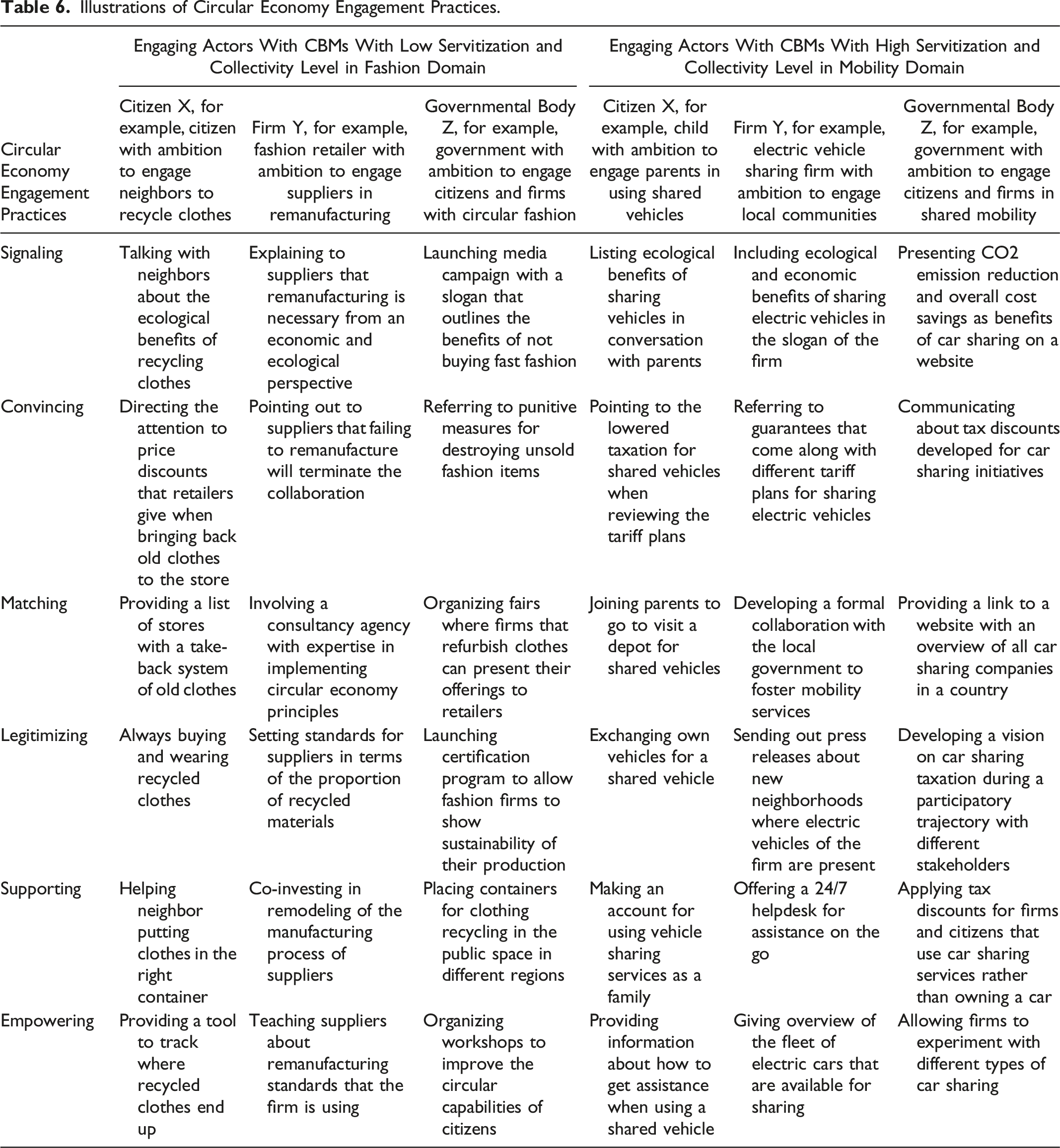
Finally, it is important to note that different actors can—as illustrated in Table 6—combine multiple practices when engaging other actors in their ecosystem with different CBM types. Moreover, combining motivation-related, opportunity-related, and ability-related practices is—as suggested by the MOA framework—a condition to elicit circular economy engagement among actors, as actors need motivation, opportunities, and ability to engage in a circular economy. The illustrations in Table 6—which may be used for teaching purposes (including workshops)—also demonstrate the close connection between different practices. Governmental bodies, for instance, may develop circular policies through new funding schemes (cf. legitimizing) of which firms need to be made aware (cf. convincing) before they can apply, and which may result in—if firms acquire funding—the actual deposit of money (cf. supporting).
Illustrations of Circular Economy Engagement Practices.
Circular Economy Engagement Practices
Engaging Actors With CBMs With Low Servitization and Collectivity Level in Fashion Domain
Engaging Actors With CBMs With High Servitization and Collectivity Level in Mobility Domain
Citizen X, for example, citizen with ambition to engage neighbors to recycle clothes
Firm Y, for example, fashion retailer with ambition to engage suppliers in remanufacturing
Governmental Body Z, for example, government with ambition to engage citizens and firms with circular fashion
Citizen X, for example, child with ambition to engage parents in using shared vehicles
Firm Y, for example, electric vehicle sharing firm with ambition to engage local communities
Governmental Body Z, for example, government with ambition to engage citizens and firms in shared mobility
Signaling
Talking with neighbors about the ecological benefits of recycling clothes
Explaining to suppliers that remanufacturing is necessary from an economic and ecological perspective
Launching media campaign with a slogan that outlines the benefits of not buying fast fashion
Listing ecological benefits of sharing vehicles in conversation with parents
Including ecological and economic benefits of sharing electric vehicles in the slogan of the firm
Presenting CO2 emission reduction and overall cost savings as benefits of car sharing on a website
Convincing
Directing the attention to price discounts that retailers give when bringing back old clothes to the store
Pointing out to suppliers that failing to remanufacture will terminate the collaboration
Referring to punitive measures for destroying unsold fashion items
Pointing to the lowered taxation for shared vehicles when reviewing the tariff plans
Referring to guarantees that come along with different tariff plans for sharing electric vehicles
Communicating about tax discounts developed for car sharing initiatives
Matching
Providing a list of stores with a take-back system of old clothes
Involving a consultancy agency with expertise in implementing circular economy principles
Organizing fairs where firms that refurbish clothes can present their offerings to retailers
Joining parents to go to visit a depot for shared vehicles
Developing a formal collaboration with the local government to foster mobility services
Providing a link to a website with an overview of all car sharing companies in a country
Legitimizing
Always buying and wearing recycled clothes
Setting standards for suppliers in terms of the proportion of recycled materials
Launching certification program to allow fashion firms to show sustainability of their production
Exchanging own vehicles for a shared vehicle
Sending out press releases about new neighborhoods where electric vehicles of the firm are present
Developing a vision on car sharing taxation during a participatory trajectory with different stakeholders
Supporting
Helping neighbor putting clothes in the right container
Co-investing in remodeling of the manufacturing process of suppliers
Placing containers for clothing recycling in the public space in different regions
Making an account for using vehicle sharing services as a family
Offering a 24/7 helpdesk for assistance on the go
Applying tax discounts for firms and citizens that use car sharing services rather than owning a car
Empowering
Providing a tool to track where recycled clothes end up
Teaching suppliers about remanufacturing standards that the firm is using
Organizing workshops to improve the circular capabilities of citizens
Providing information about how to get assistance when using a shared vehicle
Giving overview of the fleet of electric cars that are available for sharing
Allowing firms to experiment with different types of car sharing
Challenges to Push the Circular Transition Forward
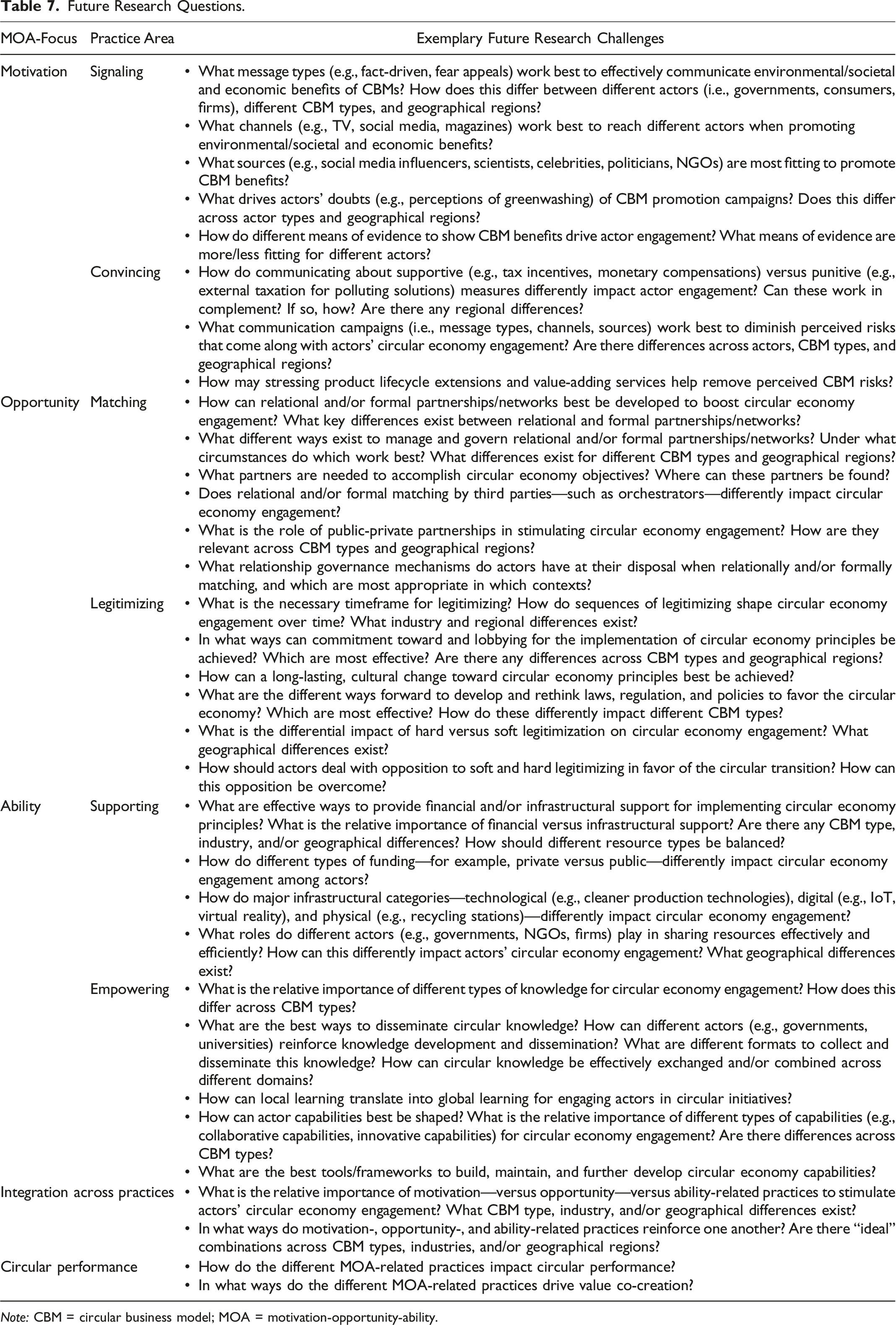
Taking insights about practices to boost circular economy engagement into consideration, we identify three remaining challenges. First, while our research identifies a set of circular economy engagement practices, we encourage scholars to investigate how to effectively implement these practices. Signaling, for example, is mainly about information provision, thus research is needed to explore how firms can design an effective communication strategy to signal environmental/societal and economic benefits of CBMs. Table 7 lists exemplary questions for motivation-, opportunity-, and ability-related practices.
Future Research Questions.
MOA-Focus
Practice Area
Exemplary Future Research Challenges
Motivation
Signaling
• What message types (e.g., fact-driven, fear appeals) work best to effectively communicate environmental/societal and economic benefits of CBMs? How does this differ between different actors (i.e., governments, consumers, firms), different CBM types, and geographical regions?• What channels (e.g., TV, social media, magazines) work best to reach different actors when promoting environmental/societal and economic benefits?• What sources (e.g., social media influencers, scientists, celebrities, politicians, NGOs) are most fitting to promote CBM benefits?• What drives actors’ doubts (e.g., perceptions of greenwashing) of CBM promotion campaigns? Does this differ across actor types and geographical regions?• How do different means of evidence to show CBM benefits drive actor engagement? What means of evidence are more/less fitting for different actors?
Convincing
• How do communicating about supportive (e.g., tax incentives, monetary compensations) versus punitive (e.g., external taxation for polluting solutions) measures differently impact actor engagement? Can these work in complement? If so, how? Are there any regional differences?• What communication campaigns (i.e., message types, channels, sources) work best to diminish perceived risks that come along with actors’ circular economy engagement? Are there differences across actors, CBM types, and geographical regions?• How may stressing product lifecycle extensions and value-adding services help remove perceived CBM risks?
Opportunity
Matching
• How can relational and/or formal partnerships/networks best be developed to boost circular economy engagement? What key differences exist between relational and formal partnerships/networks?• What different ways exist to manage and govern relational and/or formal partnerships/networks? Under what circumstances do which work best? What differences exist for different CBM types and geographical regions?• What partners are needed to accomplish circular economy objectives? Where can these partners be found?• Does relational and/or formal matching by third parties—such as orchestrators—differently impact circular economy engagement?• What is the role of public-private partnerships in stimulating circular economy engagement? How are they relevant across CBM types and geographical regions?• What relationship governance mechanisms do actors have at their disposal when relationally and/or formally matching, and which are most appropriate in which contexts?
Legitimizing
• What is the necessary timeframe for legitimizing? How do sequences of legitimizing shape circular economy engagement over time? What industry and regional differences exist?• In what ways can commitment toward and lobbying for the implementation of circular economy principles be achieved? Which are most effective? Are there any differences across CBM types and geographical regions?• How can a long-lasting, cultural change toward circular economy principles best be achieved?• What are the different ways forward to develop and rethink laws, regulation, and policies to favor the circular economy? Which are most effective? How do these differently impact different CBM types?• What is the differential impact of hard versus soft legitimization on circular economy engagement? What geographical differences exist?• How should actors deal with opposition to soft and hard legitimizing in favor of the circular transition? How can this opposition be overcome?
Ability
Supporting
• What are effective ways to provide financial and/or infrastructural support for implementing circular economy principles? What is the relative importance of financial versus infrastructural support? Are there any CBM type, industry, and/or geographical differences? How should different resource types be balanced?• How do different types of funding—for example, private versus public—differently impact circular economy engagement among actors?• How do major infrastructural categories—technological (e.g., cleaner production technologies), digital (e.g., IoT, virtual reality), and physical (e.g., recycling stations)—differently impact circular economy engagement?• What roles do different actors (e.g., governments, NGOs, firms) play in sharing resources effectively and efficiently? How can this differently impact actors’ circular economy engagement? What geographical differences exist?
Empowering
• What is the relative importance of different types of knowledge for circular economy engagement? How does this differ across CBM types?• What are the best ways to disseminate circular knowledge? How can different actors (e.g., governments, universities) reinforce knowledge development and dissemination? What are different formats to collect and disseminate this knowledge? How can circular knowledge be effectively exchanged and/or combined across different domains?• How can local learning translate into global learning for engaging actors in circular initiatives?• How can actor capabilities best be shaped? What is the relative importance of different types of capabilities (e.g., collaborative capabilities, innovative capabilities) for circular economy engagement? Are there differences across CBM types?• What are the best tools/frameworks to build, maintain, and further develop circular economy capabilities?
Integration across practices
• What is the relative importance of motivation—versus opportunity—versus ability-related practices to stimulate actors’ circular economy engagement? What CBM type, industry, and/or geographical differences exist?• In what ways do motivation-, opportunity-, and ability-related practices reinforce one another? Are there “ideal” combinations across CBM types, industries, and/or geographical regions?
Circular performance
• How do the different MOA-related practices impact circular performance?• In what ways do the different MOA-related practices drive value co-creation?
Note: CBM = circular business model; MOA = motivation-opportunity-ability.
Second, our research shows that motivation-, opportunity, and ability-related practices all matter for circular economy engagement. The interplay between these practices both within each MOA dimension (e.g., signaling and convincing as motivation-related practices) and across MOA dimensions (e.g., legitimizing as opportunity-related practice and convincing as motivation-related practice) is, however, complex and promises several ways to boost circular economy engagement. Further research examining how these practices affect one another and how they need to be combined is warranted.
Finally, further research could build upon our framework and investigate how motivation-, opportunity-, and ability-related practices affect circular economy engagement and their corresponding implications for circular performance (i.e., the extent to which resource loops are slowed down, narrowed, or closed and the burden on limited natural resources is reduced). We hope that our findings encourage other scholars to pursue these possibilities in further research.
Supplemental Material
Supplemental Material - Pushing Forward the Transition to a Circular Economy by Adopting an Actor Engagement Lens
Supplemental Material for Pushing Forward the Transition to a Circular Economy by Adopting an Actor Engagement Lens by Katrien Verleye, Arne De Keyser, Néomie Raassens, Alex A. Alblas, Fernando C. Lit, and Josephina C. C. M. Huijben in Journal of Service Research
Footnotes
Acknowledgments
We would also like to thank the guest editors and the associate editor for their support and clear guidance during the review process.
Declaration of Conflicting Interests
The author(s) declared no potential conflicts of interest with respect to the research, authorship, and/or publication of this article.
Funding
The author(s) disclosed receipt of the following financial support for the research, authorship, and/or publication of this article: One of the authors who was involved in selecting and coding papers received funding from the European Union’s Horizon 2020 research and innovation programme under the Marie Sklodowska-Curie grant agreement No 859885.
ORCID iDs
Katrien Verleye
Arne De Keyser
Alex A. Alblas
Fernando C. Lit
Supplemental Material
Supplemental material for this article is available online.
Author Biographies
Katrien Verleye is Assistant Professor of Service Innovation and Research Coordinator at the Center for Service Intelligence—Ghent University (). Her main research interests relate to actor engagement and value co-creation in networks/ecosystems. She published her research in service, innovation, and marketing journals.
Arne De Keyser is Associate Professor of Marketing at EDHEC Business School. His research focuses on customer experience, service recovery and frontline service technology. Arne published articles in Journal of Service Research, International Journal of Research in Marketing, Journal of Business Research, and Journal of Service Management, among others.
Néomie Raassens is Associate Professor of Marketing at Eindhoven University of Technology. Her research focuses on interorganizational relationships, circular economy, and food waste. She has published papers in Journal of Marketing Research, International Journal of Research in Marketing, Journal of Service Research, Marketing Letters, and Industrial Marketing Management, among others.
Alex A. Alblas is Assistant Professor of Product and Process Innovation at Eindhoven University of Technology. Alex’s research focuses on managing the development and launch of innovations. He has published articles in Journal of Operations Management, Organization Studies, Decision Sciences, and International Journal of Operations and Production Management, among others.
Fernando C. Lit is an early stage researcher of the Circular Plastics Network for Training (C-PlaNeT), an EU-funded project aiming to bring plastics into the circular economy. He is a PhD candidate conducting research on the design and development of circular business models for both start-ups and incumbents.
Josephina C.C.M. Huijben is Assistant Professor in Sustainable Business Model Innovation (SBMI) at Eindhoven University of Technology. She is passionate about the development of new strategies for sustainable business, combining insights from different disciplines and working with academics as well as practitioners in the field of AgroFood, Energy, and Logistics.
References
1.
AbdelmeguidAyaAfy-ShararahMohamedSalonitisKonstantinos (2022), “Investigating the Challenges of Applying the Principles of the Circular Economy in the Fashion Industry: A Systematic Review,” Sustainable Production and Consumption32: 505-18.
2.
AbrizahAbdullahNgah ZainabAwangKaurKiranGopal RajRam (2013), “LIS journals scientific impact and subject categorization: a comparison between Web of Science and Scopus,” Scientometrics94 (2): 721-740.
3.
AdaErhanSagnakMuhittinUzelRuhan AşkinBalcıoğluİrem (2022), “Analysis of Barriers to Circularity for Agricultural Cooperatives in the Digitalization Era,” International Journal of Productivity and Performance Management71 (3): 932–51.
4.
AgarwalSomeshTyagiMohitRajivKGarg (2021), “Conception of Circular Economy Obstacles in Context of Supply Chain: A Case of Rubber Industry,” International Journal of Productivity and Performance Management, forthcoming.
5.
AgyemangMartinKusi-SarpongSimonovKhanSharfuddin A.ManiVenkateshTahaur RehmanSyedKusi-SarpongHorsten (2019), “Drivers and Barriers to Circular Economy Implementation,” Management Decision57 (4): 971–994.
6.
AldieriLuigiBrahmiMohsenBrunoBrunaPaoloConcetto Vinci (2021), “Circular Economy Business Models: The Complementarities with Sharing Economy and Eco-Innovations Investments,” Sustainability, 13 (22), 12438.
7.
AloiniDavideDulminRiccardoMininnoValeriaStefaniniAlessandroZerbinoPierluigi (2020), “Driving the transition to a circular economic model: A systematic review on drivers and critical success factors in circular economy,” Sustainability12 (24): 10672.
8.
ArekransJohanSopjaniLiridonaLaurentiRafaelRitzénSofia (2022), “Barriers to Access-Based Consumption in the Circular Transition: A Systematic Review,” Resources, Conservation and Recycling184: 106364.
9.
ArgoteLindaMcEvilyBillRayReagans (2003), “Managing knowledge in organizations: An integrative framework and review of emerging themes,”Management Science49(4) 571-582.
10.
AsgariAmirAsgariReza (2021), “How circular economy transforms business models in a transition towards circular ecosystem: the barriers and incentives,” Sustainable Production and Consumption28 (October): 566-579.
11.
AyatiSayed M.ShekarianEhsanMajavaJukkaVejrum WæhrensBrian (2022), “Toward a Circular Supply Chain: Understanding Barriers from the Perspective of Recovery Approaches,” Journal of Cleaner Production359: 131775.
12.
AyçinEjderKayaSema Kayapinar (2021), “Towards the Circular Economy: Analysis of Barriers to Implementation of Turkey's Zero Waste Management Using the Fuzzy DEMATEL Method,” Waste Management & Research39 (8): 1078–1089.
13.
BakkerArnold B.DemeroutiEvangelia (2007), “The job demands‐resources model: State of the art,” Journal of Managerial Psychology22 (3): 309-328.
14.
BenzLukas A. (2022), “Critical Success Factors for Circular Business Model Innovation from the Perspective of the Sustainable Development Goals,” Sustainability14 (10): 5816.
15.
BertassiniAna C.OmettoAldo R.SeverengizSemihGerolamoMateus C. (2021), “Circular Economy and Sustainability: The Role of Organizational Behaviour in the Transition Journey,” Business Strategy and the Environment30 (7): 3160–3193.
16.
BidmonChristina M.KnabSebastian F. (2018). “The three roles of business models in societal transitions: New linkages between business model and transition research,” Journal of Cleaner Production178: 903-916.
17.
BlauPeter M. (2017). Exchange and power in social life. New York: Routledge.
18.
BockenNancy M.P.SchuitCheyenne S.C.KraaijenhagenChristiaan (2018), “Experimenting with a circular business model: Lessons from eight cases,” Environmental Innovation and Societal Transitions28 (September): 79-95.
19.
BockenNancy M.P.FrankBoonsBaldassarreBrian (2019), “Sustainable business model experimentation by understanding ecologies of business models,” Journal of Cleaner Production208: 1498-1512.
20.
BockenNancy M.HarschAlisaWeissbrodIlka (2022), “Circular Business Models for the Fastmoving Consumer Goods Industry: Desirability, Feasibility, and Viability,” Sustainable Production and Consumption30: 799–814.
21.
BockenNancy MPWeissbrodIlkaAntikainenMaria (2021), “Business model experimentation for the circular economy: definition and approaches,” Circular Economy and Sustainability1 (1): 49-81.
22.
BöckerLarsMeelenToon (2017), “Sharing for people, planet or profit? Analysing motivations for intended sharing economy participation,” Environmental Innovation and Societal Transitions23 (June): 28-39.
23.
BodenheimerMiriamSchulerJohannesWilkeningThekla (2022), “Drivers and Barriers to Fashion Rental for Everyday Garments: An Empirical Analysis of a Former Fashion-Rental Company,” Sustainability: Science, Practice and Policy18 (1): 344–356.
24.
BolgerKathleenDoyonAndréanne (2019), “Circular Cities: Exploring Local Government Strategies to Facilitate a Circular Economy,” European Planning Studies27 (11): 2184–2205.
25.
BrodieRoderick JIlicAnaJuricBiljanaHollebeekLinda (2013), “Consumer engagement in a virtual brand community: An exploratory analysis,” Journal of Business Research66 (1): 105-114.
26.
BrodieRoderick JFehrerJulia A.JaakkolaElinaConduitJodie (2019), “Actor engagement in networks: Defining the conceptual domain,” Journal of Service Research22 (2): 173-188.
27.
BrodieRoderick JJurićLinda DHollebeekBiljanaJurićBiljanaIlićAna (2011). “Customer engagement: Conceptual domain, fundamental propositions, and implications for research,” Journal of Service Research14 (3): 252-271.
28.
Calvo-PorralCristinaLévy-ManginJean-Pierre (2020). “The Circular Economy Business Model: Examining Consumers’ Acceptance of Recycled Goods,” Administrative Sciences10 (2): 28.
29.
CantúAndreaAguiñagaEduardoScheelCarlos (2021), “Learning from failure and success: the challenges for circular economy implementation in SMEs in an emerging economy,” Sustainability13 (3): 1529.
30.
CentobelliPieraCerchioneRobertoChiaroniDavidePasquale Del VecchioUrbinatiAndrea (2020), “Designing business models in circular economy: A systematic literature review and research agenda,” Business Strategy and the Environment29 (4): 1734-1749.
31.
ChenChong-Wen (2020), “Improving Circular Economy Business Models: Opportunities for Business and Innovation: A new framework for businesses to create a truly circular economy,” Johnson Matthey Technology Review64 (1): 48-58.
32.
CullenUfuk Alpsahin (2021), “Exploring a circular business model: Insights from the institutional theory perspective and the business model lens,” The International Journal of Entrepreneurship and Innovation24: 58-69. DOI: 10.1177/14657503211055574
33.
De BruyneMarie-JulieVerleyeKatrien (2022), “Realizing the economic and circular potential of sharing business models by engaging consumers,”Journal of Service Management34: 493-519. DOI: 10.1108/JOSM-08-2021-0318
34.
De KeyserArneVerleyeKatrienLemonKatherine N.KeininghamTimothy L.KlausPhilipp (2020), “Moving the customer experience field forward: introducing the touchpoints, context, qualities (TCQ) nomenclature,” Journal of Service Research23 (4): 433-455.
35.
De MattosClaudia AparecidaDe AlbuquerqueThiago Lourenço Meira (2018), “Enabling factors and strategies for the transition toward a circular economy (CE),” Sustainability10 (12): 4628.
36.
DonnerMechthildVerniquetAnneJanBroezeKayserKatrinDe VriesHugo (2021), “Critical success and risk factors for circular business models valorising agricultural waste and by-products,” Resources, Conservation and Recycling165 (February): 105236.
ElzingaRemiReikeDeniseNegroSimona O.BoonWouter P.C. (2020), “Consumer acceptance of circular business models,” Journal of Cleaner Production254 (May): 119988.
40.
EtgarMichael (2008), “A descriptive model of the consumer co-production process,” Journal of the Academy of Marketing Science36 (1): 97-108.
41.
EzeuduObiora B.EzeuduTochukwu S.UgochukwuUzochukwu C.AgunwambaJonah C.OraelosiTochukwu C., et al. (2021), “Enablers and Barriers to Implementation of Circular Economy in Solid Waste Valorization: The Case of Urban Markets in Anambra, Southeast Nigeria,” Environmental and Sustainability Indicators12: 100150.
42.
FehrerJulia A.WielandHeiko (2021), “A systemic logic for circular business models,” Journal of Business Research125 (March): 609-620.
43.
FengKeyouLamChun-Yin (2021), “An Overview of Circular Economy in China: How the Current Challenges Shape the Plans for the Future,” The Chinese Economy54 (5): 355–371.
44.
FieldJoy M.FotheringhamDarimaSubramonyMaheshGustafssonAndersOstromAmy L.LemonKatherine N.HuangMing-HuiMcColl-KennedyJanet R (2021). “Service research priorities: Designing sustainable service ecosystems.” Journal of Service Research, 24 (4), 462-479.
45.
ForoozanfarMohammad H.ImanipourNargesSajadiSeyed M. (2022). “Integrating Circular Economy Strategies and Business Models: A Systematic Literature Review,” Journal of Entrepreneurship in Emerging Economies14: 678-700. forthcoming.
46.
FrishammarJohanParidaVinit (2019), “Circular business model transformation: A roadmap for incumbent firms,” California Management Review61 (2): 5-29.
47.
FuchsMichaelHovemannGregor (2022), “The Circular Economy Concept in the Outdoor Sporting Goods Industry: Challenges and Enablers of Current Practices Among Brands and Retailers,” Sustainability14 (13): 7771.
48.
GedamVidyadhar V.RautRakesh D.Lopes de Sousa JabbourAna B.TanksaleAjinkya N.NarkhedeBalkrishna E. (2021), “Circular Economy Practices in a Developing Economy: Barriers to Be Defeated,” Journal of Cleaner Production311: 127670.
49.
GeissdoerferMartinVladimirovaDoroteyaEvansSteve (2018), “Sustainable business model innovation: A review,” Journal of Cleaner Production198: 401-416.
50.
GiorgiSerenaLavagnaMonicaWangKeMohamedOsmaniLiuGangCampioliAndrea (2022), “Drivers and Barriers Towards Circular Economy in the Building Sector: Stakeholder Interviews and Analysis of Five European Countries Policies and Practices,” Journal of Cleaner Production336: 130395.
51.
GovindanKannanHasanagicMia (2018), “A Systematic Review on Drivers, Barriers, and Practices Towards Circular Economy: Supply Chain Perspective,” International Journal of Production Research56 (1–2): 278–311.
52.
GuldmannEvaHuulgaardRikke Dorothea (2020), “Barriers to circular business model innovation: A multiple-case study,” Journal of Cleaner Production243 (January): 118160.
53.
HankammerStephanBrenkSebastianFabryHannahNordemannAnnePillerFrank T. (2019), “Towards Circular Business Models: Identifying Consumer Needs Based on the Jobs-to-Be-Done Theory,” Journal of Cleaner Production231: 341–58.
54.
HenkensBiekeVerleyeKatrienLarivièreBart (2021), “The smarter, the better?! Customer well-being, engagement, and perceptions in smart service systems,” International Journal of Research in Marketing38 (2): 425-447.
55.
HewettKellyHultG. Tomas M.MantralaMurali K.NimNandiniPedadaKiran (2022), “Cross-border marketing ecosystem orchestration: A conceptualization of its determinants and boundary conditions,” International Journal of Research in Marketing39: 619–638. https://doi.org/10.1016/j.ijresmar.2021.09.003
56.
HinaMaryamChauhanChetnaKaurPuneetKrausSaschaDhirAmandeep (2022). “Drivers and Barriers of Circular Economy Business Models: Where We Are Now, and Where We Are Heading,” Journal of Cleaner Production333: 130049.
57.
HofmannFlorianJaeger‐ErbenMelanie (2020). “Organizational transition management of circular business model innovations.” Business Strategy and the Environment29 (6): 2770-2788.
58.
HofmannFlorian (2019). “Circular Business Models: Business Approach as Driver or Obstructer of Sustainability Transitions?” Journal of Cleaner Production224: 361–374.
59.
HollebeekLinda D.SrivastavaRajendra KChenTom (2019), “SD logic–informed customer engagement: integrative framework, revised fundamental propositions, and application to CRM,” Journal of the Academy of Marketing Science47 (1): 161-185.
60.
HollebeekLinda D.KumarV.SrivastavaRajendra K. (2022), “From Customer-to Actor-to Stakeholder Engagement: Taking Stock, Conceptualization, and Future Directions,” Journal of Service Research25 (2): 328-343.
61.
HopkinsonPeterZilsMarkusHawkinsPhilipRoperStuart (2018), “Managing a complex global circular economy business model: opportunities and challenges,” California Management Review60 (3): 71-94.
62.
HoyerWayne D.ChandyRajeshDoroticMatildaKrafftManfredSinghSiddhardt S.. (2010), “Consumer Cocreation in New Product Development,” Journal of Service Research13 (3): 283-296.
63.
IacovidouEleniHahladakisJohn N.PurnellPhil (2021), “A Systems Thinking Approach to Understanding the Challenges of Achieving the Circular Economy,” Environmental Science and Pollution Research International28 (19): 24785–24806.
64.
IlićMarinaNikolićMagdalena (2016), “Drivers for Development of Circular Economy – a Case Study of Serbia,” Habitat International56: 191–200.
65.
IngemarsdotterEmiliaJamsinEllaBalkenendeRuud (2020), “Opportunities and challenges in IoT-enabled circular business model implementation – A case study,” Resources, Conservation and Recycling162 (November): 105047.
66.
JaegerBjoernUpadhyayArvind (2020), “Understanding Barriers to Circular Economy: Cases from the Manufacturing Industry,” Journal of Enterprise Information Management33 (4): 729–745.
67.
KarmanAgnieszka (2020), “Towards crystallizing circular business models: A critical analysis of literature,” Journal of Sustainability Science and Management15 (6): 175-194.
68.
KeininghamTimothyAksoyLerzanBruceHelen L.CadetFabienneClennellNatashaHodgkinsonIan R.KearneyTreasa (2020), “Customer experience driven business model innovation,” Journal of Business Research116 (August): 431-440.
69.
KhitousFatimaStrozziFernandaUrbinatiAndreaAlbertiFernando (2020), “A systematic literature network analysis of existing themes and emerging research trends in circular economy,” Sustainability12 (4): 1633.
70.
KöhlerJonathanGeelsFrank W.KernFlorianMarkardJochenOnsongoElsieWieczorekAnnaAlkemadeFloortjeAvelinoFlorBergekAnnaBoonsFrank (2019), “An agenda for sustainability transitions research: State of the art and future directions,” Environmental Innovation and Societal Transitions, 31 (June), 1-32.
71.
Koskela-HuotariKaisaVargoStephen L (2016), “Institutions as resource context,” Journal of Service Theory and Practice26 (2): 163-178.
72.
KranzbuhlerAnne-MadeleineKleijnenMirella H. P.MorganRobert E.TeerlingMarije, et al. (2018). “The Multilevel Nature of Customer Experience Research: An Integrative Review and Research Agenda.” International Journal of Management Reviews20 (2): 433-456.
73.
LacyPeterLongJessicaSpindlerWesley (2020). The circular economy handbook. London: Palgrave Macmillan.
74.
LarivièreBartBowenDavidAndreassenTor W.KunzWernerSirianniNancy J.VossChristopherWunderlichNancy V.De KeyserArne (2017), “Service Encounter 2.0: An investigation into the roles of technology, employees and customers,” Journal of Business Research79 (October): 238-246.
75.
LawrenceThomas B.SuddabyRoy (2006), “1.6 institutions and institutional work.” In Handbook of Organization Studies, 2nd edition, edited by CleggStewart R.HardyCynthiaLawrenceThomas B.NordWalter R., 215-254. London: Sage Publications.
76.
LevänenJarkkoLyytinenTatuGaticaSebastian (2018), “Modelling the interplay between institutions and circular economy business models: A case study of battery recycling in Finland and Chile,” Ecological Economics154 (December): 373-382.
77.
LewandowskiMateusz (2016), “Designing the business models for circular economy—Towards the conceptual framework,” Sustainability8 (1): 43.
78.
LoureiroSandra Maria CorreiaRomeroJaimeGodinho BilroRicardo (2020), “Stakeholder engagement in co-creation processes for innovation: A systematic literature review and case study,” Journal of Business Research119 (October): 388-409.
79.
MacInnisDeborah J.MoormanChristineJaworskiBernard J. (1991), “Enhancing and measuring consumers' motivation, opportunity, and ability to process brand information from ads,”Journal of Marketing55(4): 32-53.
80.
Martínez-CabreraJuliaLópez-del-PinoFrancisco (2021), “The 10 Most Crucial Circular Economy Challenge Patterns in Tourism and the Effects of COVID-19,” Sustainability13 (9): 4940.
81.
MiliosLeonidas (2021), “Towards a circular economy taxation framework: Expectations and challenges of implementation,” Circular Economy and Sustainability1 (2): 477-498.
82.
MoellerSabineCiuchitaRobertMahrDominikOdekerken-SchröderGabyFassnachtMartin (2013), “Uncovering collaborative value creation patterns and establishing corresponding customer roles,” Journal of Service Research16 (4): 471-487.
83.
MoggiSaraDameriRenata Paola (2021), “Circular business model evolution: Stakeholder matters for a self‐sufficient ecosystem,” Business Strategy and the Environment30 (6): 2830-2842.
84.
MunaroMayara Reginado Carmo Duarte FreitasMariaFernando TavaresSergioBragançaLuís (2021), “Circular Business Models: Current State and Framework to Achieve Sustainable Buildings,” Journal of Construction Engineering and Management147 (12): 04021164.
85.
NevesSónia A.MarquesAntónio C. (2022), “Drivers and Barriers in the Transition from a Linear Economy to a Circular Economy,” Journal of Cleaner Production341: 130865.
86.
OghaziPejvakMostaghelRana (2018), “Circular business model challenges and lessons learned—An industrial perspective,” Sustainability10 (3): 739.
87.
OkorieOkechukwuCharnleyFionaRussellJenniferTiwariAshutoshMorenoMariale (2021), “Circular business models in high value manufacturing: Five industry cases to bridge theory and practice,” Business Strategy and the Environment30 (4): 1780-1802.
88.
PansariAnitaKumarVera (2017), “Customer engagement: the construct, antecedents, and consequences,” Journal of the Academy of Marketing Science45 (3): 294-311.
89.
ReimWiebkeDavidSjödinParidaVinit (2021), “Circular business model implementation: A capability development case study from the manufacturing industry,” Business Strategy and the Environment30 (6): 2745-2757.
90.
SaldañaJohnny (2015). The Coding Manual for Qualitative Researchers. Thousand Oaks: Sage Publishing.
91.
Santa-MariaTomasVermeulenWalter J. V.BaumgartnerRupert J. (2021), “Framing and assessing the emergent field of business model innovation for the circular economy: A combined literature review and multiple case study approach,” Sustainable Production and Consumption26 (April): 872-891.
92.
SarjaMillaOnkilaTiinaMäkeläMarileena (2021), “A Systematic Literature Review of the Transition to the Circular Economy in Business Organizations: Obstacles, Catalysts and Ambivalences,” Journal of Cleaner Production286: 125492.
93.
ShaoJingHuangShuoLemus-AguilarIsaacÜnalEnes (2019). “Circular business models generation for automobile remanufacturing industry in China: Barriers and opportunities,” Journal of Manufacturing Technology Management31 (3): 542-571.
94.
SiemsenEnnoRothAleda V.BalasubramanianSridhar (2008), “How motivation, opportunity, and ability drive knowledge sharing: The constraining-factor model.” Journal of Operations Management26(3): 426-445.
95.
StorbackaKaj (2019), “Actor engagement, value creation and market innovation,” Industrial Marketing Management80 (July): 4-10.
96.
StorbackaKajBrodieRoderick J.BöhmannTiloMaglioPaul P.NenonenSuvi (2016), “Actor engagement as a microfoundation for value co-creation,” Journal of Business Research69 (8): 3008-3017.
97.
SuchekNathaliaFernandesCristina I.KrausSaschaFilserMatthiasSjögrénHelena (2021), “Innovation and the circular economy: A systematic literature review,” Business Strategy and the Environment30 (8): 3686-3702.
98.
TanJovanTanFabien J.RamakrishnaSeeram (2022), “Transitioning to a Circular Economy: A Systematic Review of Its Drivers and Barriers,” Sustainability14 (3): 1757.
99.
TodeschiniBruna VillaNogueira CortimigliaMarceloCallegaro-de-MenezesDanielaGhezziAntonio (2017), “Innovative and sustainable business models in the fashion industry: Entrepreneurial drivers, opportunities, and challenges,” Business Horizons60 (6): 759-770.
100.
TuraNinaHanskiJyriAholaTuomasStåhleMatiasPiiparinenSiniValkokariPasi (2019), “Unlocking circular business: A framework of barriers and drivers,” Journal of Cleaner Production212: 90-98.
101.
ÜnalEnesUrbinatiAndreaChiaroniDavide (2019), “Managerial practices for designing circular economy business models: The case of an Italian SME in the office supply industry,” Journal of Manufacturing Technology Management30 (3): 561-589.
UrbinatiAndreaChiaroniDavideChiesaVittorio (2017), “Towards a new taxonomy of circular economy business models,” Journal of Cleaner Production168: 487-498.
104.
UrbinatiAndreaFranzòSimoneChiaroniDavide. 2021. “Enablers and Barriers for Circular Business Models: an empirical analysis in the Italian automotive industry.” Sustainable Production and Consumption27 (July): 551-566.
105.
Van DoornJennyLemonKatherine N.MittalVikasNassStephanPickDoreénPirnerPeterVerhoefPeter C. (2010), “Customer engagement behavior: Theoretical foundations and research directions,” Journal of Service Research13 (3): 253-266.
106.
van KeulenMaartenKirchherrJulian (2021), “The implementation of the Circular Economy: Barriers and enablers in the coffee value chain,” Journal of Cleaner Production281 (January): 125033.
107.
VelevaVeselaBodkinGavin (2018), “Emerging drivers and business models for equipment reuse and remanufacturing in the US: lessons from the biotech industry,” Journal of Environmental Planning and Management61 (9): 1631-1653.
108.
VerleyeKatrien (2019), “Designing, writing-up and reviewing case study research: an equifinality perspective,” Journal of Service Management30 (5): 549-576.
109.
VermuntDorith A.NegroSimona O.VerweijPita A.KuppensDeborah V.HekkertMarko P. (2019), “Exploring barriers to implementing different circular business models,” Journal of Cleaner Production222: 891-902.
110.
VijvermanNicholasHenkensBiekeVerleyeKatrien (2019), “Engagement and technology as key enablers for a circular economy.” In Handbook of Research on Customer Engagement, edited by HollebeekLinda D.SprottDavid A., 97-113. Northampton: Edward Elgar Publishing.
111.
WangJun F.LiHui M. (2006), “The Development of Circular Economy in China,” Aquatic Ecosystem Health and Management9 (1): 99–103.
112.
WrålsenBenediktePrieto-SandovalVanessaMejia-VillaAndresO'BornReynHellströmMagnusFaesslerBernhard (2021), “Circular Business Models for Lithium-Ion Batteries - Stakeholders, Barriers, and Drivers,” Journal of Cleaner Production317: 128393.
113.
ZhangAbrahamVenkateshVenkatasmany G.LiuYangWanMingQuTingHuisinghDonald (2019), “Barriers to Smart Waste Management for a Circular Economy in China,” Journal of Cleaner Production240: 118198.
114.
ZottChristophAmitRaphaelMassaLorenzo (2011), “The business model: recent developments and future research,” Journal of Management, 37 (4), 1019-1042.
Supplementary Material
Please find the following supplemental material available below.
For Open Access articles published under a Creative Commons License, all supplemental material carries the same license as the article it is associated with.
For non-Open Access articles published, all supplemental material carries a non-exclusive license, and permission requests for re-use of supplemental material or any part of supplemental material shall be sent directly to the copyright owner as specified in the copyright notice associated with the article.