




Abstract
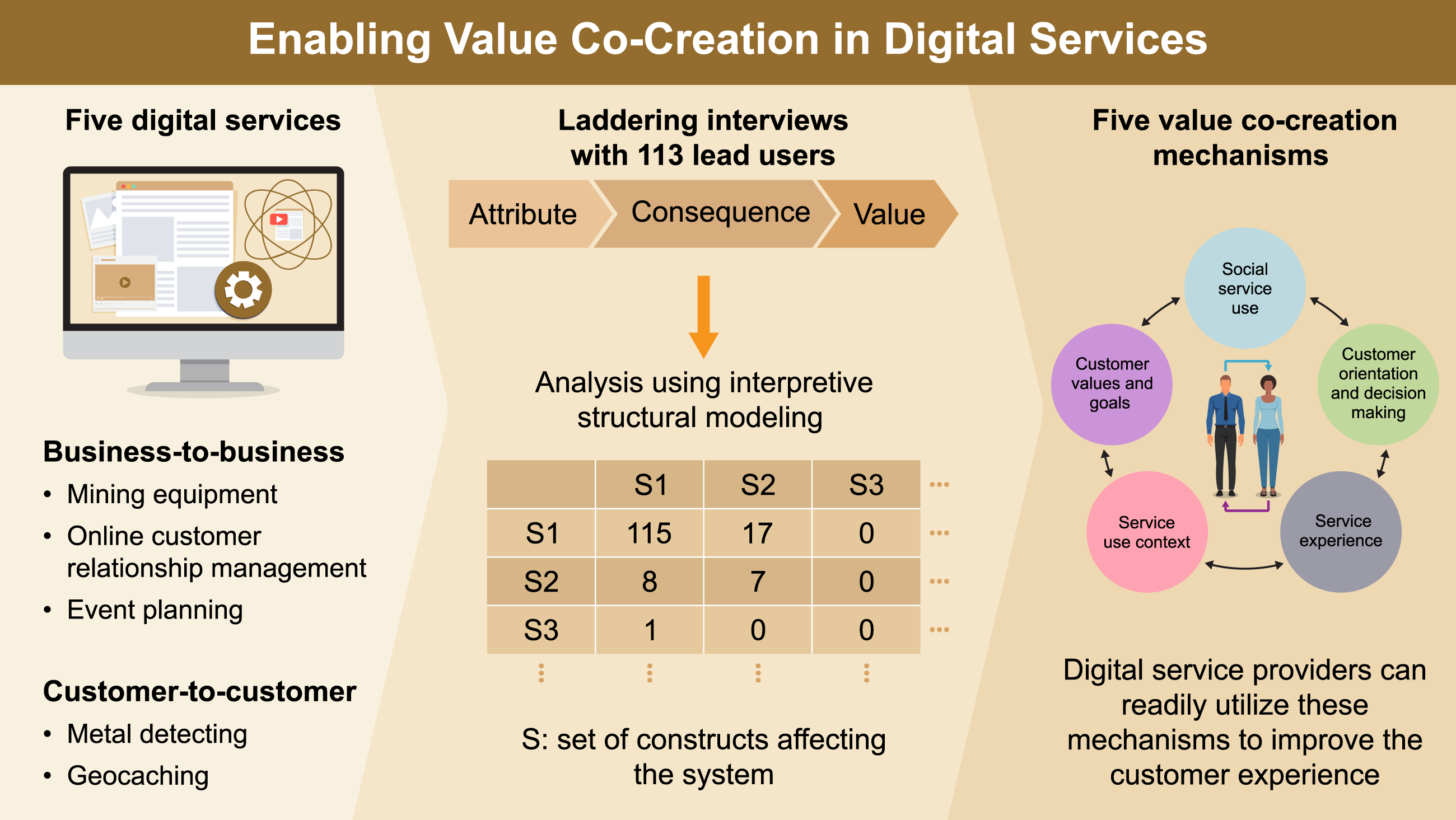
This study identifies micro-level value co-creation mechanisms that support the design of digital services. As services are now becoming digital—or at least digitally enabled—how to design digital services that enable value co-creation between a service provider and customers has become an increasingly important question. Our qualitative research study provides one answer to this question. Based on 113 in-depth laddering interviews analyzed using interpretive structural modeling, our study shows that value co-creation mechanisms differ between business-to-business and customer-to-customer digital service types. We identify five mechanisms to support value co-creation in the design of digital services: (1) Social use, (2) Customer orientation and decision making, (3) Service experience, (4) Service use context, and (5) Customer values and goals. We claim that firms can readily utilize these mechanisms to improve their customers’ service experiences.
Keywords
Introduction
Most services are now digital—or at least digitally enabled. This is because of a fundamental change in the nature of our world—a world that has been described as digital first (Baskerville, Myers, and Yoo 2020). In this digital-first world, digital services have become just as, if not more important than, traditional services. As digital services differ significantly from traditional services, there is an urgent need to understand how design may help digital services reach their full value co-creation potential (Čaić, Odekerken-Schröder, and Mahr 2018).
We propose that a way to understand the design of digital services is to focus on how the value received by the service customer is co-created with the service provider and customer (Vargo, Maglio, and Akaka 2008). Although much research has investigated aspects such as resource integration, roles in value co-creation, value outcomes in different contexts, engaging customers in value co-creation, and its managerial implications (see, for example, Alves, Fernandes, and Raposo 2016; Vargo, Koskela-Huotari, and Vink 2020), we do not yet understand the micro-level mechanisms of value co-creation that enable and constrain the design of a service (Storbacka et al. 2016; Vargo, Koskela-Huotari, and Vink 2020). Whereas the activity, process, or practice of service design has been the subject of inquiry in the literature, the design of a service has not. The design of a service refers to “a collection of elements or components that are organized for a common purpose as a system.” 1
Given the current digital-first nature of our world (Baskerville, Myers, and Yoo 2020), we believe there is a need to understand how to enable—and enhance—value co-creation between a service provider and its customers through the design of digital services. Therefore, this study focuses on micro-level value co-creation mechanisms in the design of digital services by investigating the perspective of customers interacting with the service. We define digital services (plural) as a particular type of output of service (singular) (Vargo, Koskela-Huotari and Vink 2020) that are “obtained and/or arranged through a digital transaction (information, software modules, or consumer goods) over Internet Protocol” (Williams, Chatterjee, and Rossi 2008, 506).
Most previous research on value co-creation in service design has focused on the activity, process, and practice of service design. The literature often focuses on involving customers in the service design process (cf., Yu and Sangiorgi 2018). Others have looked at value co-creation activities by different actors in service systems (cf., Vargo et al. 2008) or service platform ecosystems (cf., Storbacka et al. 2016). However, researchers have called for research on the “black box” 2 design of services (see, for example, Tuunanen et al. 2018), especially when technological innovations are constantly changing the digital services landscape (Leimeister, Österle, and Alter 2014). Thus, we are interested in the opaque nature of the design of a service, and how we can apply the concept of micro-level mechanism to “white box” 3 the design to understand how we can enable value co-creation between a service provider and a customer.
Consequently, this study adopts a qualitative research approach and identifies micro-level mechanisms for explaining the value co-creation process between digital service providers and their customers. More specifically, we follow Grönroos and Voima (2013) and argue that value co-creation happens in a joint sphere where customers use a digital service provided by a service provider. We define mechanisms as “entities and activities organized such that they are productive of regular changes from start or set-up to finish or termination conditions” (Machamer, Darden, and Craver 2000, 3). We build on the earlier work of Tuunanen, Myers, and Cassab (2010), who presented a framework consisting of two key aspects for the design of digital services to support value co-creation: (1) value propositions offered by the digital service—that is, the designed features, and (2) value drivers of customers. Thus, the actors in this joint sphere (Grönroos and Voima 2013) are the service provider and their customers. Consequently, this study seeks to answer the following research question: What micro-level mechanisms of value co-creation support the design of digital services and how can they be identified?
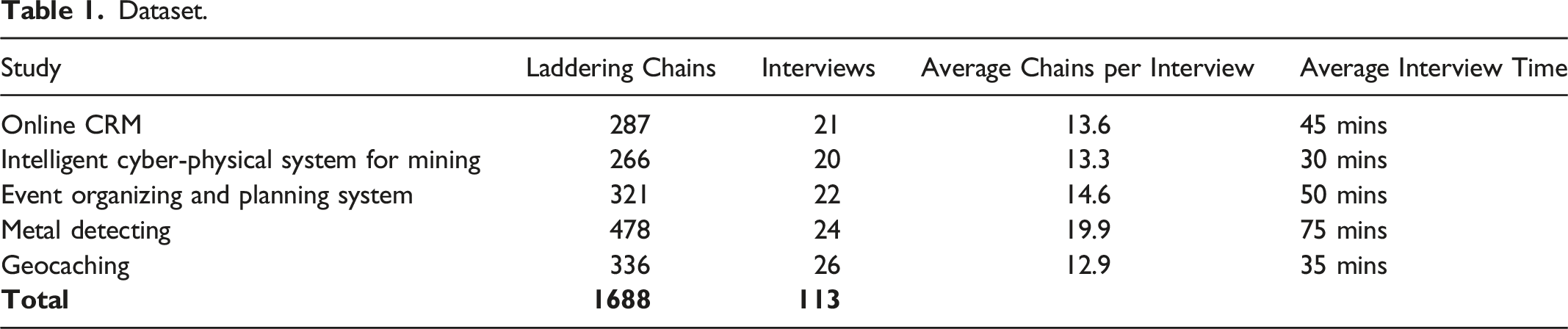
Our study contributes to the literature by identifying micro-level value co-creation mechanisms for the design of digital services: (1) Social use, (2) Customer orientation and decision making, (3) Service experience, (4) Service use context, and (5) Customer values and goals. We believe our research findings are relevant to managers in all kinds of industries who are trying to figure out how their organizations can be digitally transformed. We suggest that practitioners can use the identified mechanisms and the depicted research approach to better design digital services that enable value co-creation between a service provider and customers. Furthermore, our findings show how the mechanisms differ between business-to-business (B2B) and customer-to-customer (C2C) digital service types. This finding has implications for the design of digital services if a service provider desires to leverage the value co-creation potential between its customers and the digital service offered. The proposed mechanisms were identified based on our analysis of 113 laddering interviews (Reynolds and Gutman 1988). The resulting dataset was analyzed using the interpretive structural modeling approach (Guo, Li, and Stevens 2012) to develop linkages between the model constructs.
The structure of this paper is as follows. First, we review the literature, explaining different approaches to conceptualize value co-creation. We then argue that there is a need to enable value co-creation between customers and the digital service offered to improve the design of digital services. Next, we describe our research methodology, data collection, and analysis methods. This is followed by the presentation of our findings. We then discuss the implications of our study for future research. For service managers and designers, we exemplify the use of the findings in a scenario that applies the developed conceptual model for designing a digital service for the mining industry. We conclude by acknowledging some limitations of the research and suggesting future research avenues.
Toward Micro-Level Value Co-Creation Mechanisms
Traditionally, value creation has been viewed as an action in which firms sacrifice resources by exchanging value with customers (Grönroos 2006) to pursue benefits (Zeithaml 1988). This firm-centric view of service orchestration considers that companies ultimately determine what is of value to customers (Prahalad and Ramaswamy 2004b). Accordingly, the literature often focuses on creating business value for a firm (Kohli and Grover 2008) and measuring value as value-in-exchange. However, divergent measures have emerged that define value, for instance, through an extrinsic-intrinsic or hedonic-utilitarian division (see, for example, Holbrook 1999; Van der Heijden 2004) and service experience (see, for example, Helkkula 2011; Prahalad and Ramaswamy 2004a). Customer-centric views see value as being cooperatively produced by customers in firms’ processes (Prahalad and Ramaswamy 2002; 2004b). Service-Dominant (S-D) logic, in turn, posits that value co-creation emerges from the use of service offerings (Vargo and Lusch 2004; Vargo, Koskela-Huotari, and Vink 2020). Consequently, firms should consider customer interactions as key to value co-creation (Prahalad and Ramaswamy 2004b). In the same vein, Vargo and Lusch (2004) suggest that firms merely offer customers value propositions and that customers derive value-in-use through such service exchange.
Vargo and Lusch (2004) position service as the foundation for all exchange between firms and customers, where customers as beneficiaries determine value in using the service. S-D logic holds that the value of a service or a good does not exist by itself but is rather derived from the customers’ perceived contextual experiences that it enables (Flint and Woodruff 2014; Prahalad and Ramaswamy 2004b). Companies are regarded as offering value propositions to customers who may accept the propositions by integrating their resources, thus co-creating value. Accordingly, service is explained as applying possessed resources to benefit the entity or another entity, and value co-creation is regarded as a collaborative process (Prahalad and Ramaswamy 2004a) of resource integration between benefit-pursuing entities (Vargo and Lusch 2004). Evolving toward a general theory of value co-creation (Vargo and Lusch 2017), S-D logic captures generic actors (entities taking part in the co-creation process) connected by value propositions. Accordingly, Vargo and Lusch (2004) and Lusch and Nambisan (2015) emphasize the importance of incorporating different actors in value co-creation to facilitate the generation of value-in-use (Vargo and Lusch 2004; Vargo, Koskela-Huotari, and Vink 2020).
The literature has attempted to make sense of the value co-creation process in various contexts, such as B2B (e.g., Lenka, Parida, and Wincent 2017), business-to-consumer (B2C) (e.g., Echeverri and Skålén 2011), and networks of consumers and businesses (e.g., Singaraju et al. 2016). For instance, Lenka, Parida, and Wincent (2017) explicate how digitalization capabilities provide mechanisms for a company to co-create value with customers through an improved ability to perceive customers’ needs and changing demands. Alexander and Jaakkola (2015), in turn, construct an understanding of resource integrations occurring between network actors and depict four prerequisites for a successful value co-creation process, namely, the provision of access and the nature of that access, the level of ownership taken by adopters, user empowerment, and an increased level of support from other actors.
While a plethora of research has examined the effects of value co-creation, such as for economic gain (Ostrom et al. 2010), only a few studies have considered the underlying structures, mechanisms, and relationships of a value co-creation process (Vargo, Koskela-Huotari, and Vink 2020). Drawing from a systematic literature review, Saarijärvi (2012) outlines “value co-creation mechanisms” as those that support the focal firm in delivering its value propositions to customers.
Saarijärvi’s (2012) value co-creation mechanisms manifest as particular ways in which value co-creation is initiated to customers, such as co-production (e.g., Etgar 2008), co-development (e.g., Payne, Storbacka, and Frow 2008), and co-design (e.g., Sanders and Stappers 2008). However, the conceptual understanding of value co-creation and its process should not be limited solely to the co-production or co-development of the core offering, which is involved in the design or development phases (Cova, Dalli, and Zwick 2011). Such approaches often focus on the implementation of customers’ labor and related value implications (Etgar 2008) and on the labeling conditions that lead to such benefits (Kristensson, Matthing, and Johansson 2008).
Delving deeper, the value co-creation process is linked to the individual customer’s service experience (Helkkula 2011; Vargo and Lusch 2008) and the intangible nature of services—that is, the service occurs at a certain time, in a designated place, and cannot be stored in situ (Bitner 1990; Shostack 1977). According to Heinonen et al. (2010), value-in-use may emerge at three temporal points: prior to, during, and after a purchase. Thus, the co-creation of value stems not merely from consumption but also from the experience of the process (Frow and Payne 2007). Thus, customers’ past, present, and future experiences with multiple actors in multiple service occurrences influence the co-creation of value and thus should be considered when making sense of the value co-creation process (Heinonen et al. 2010).
Grönroos and Voima (2013) state that value can only be co-created in a joint co-creation sphere between the involved parties, indicating that the initiative to co-create value stems from the customer’s rather than the company’s side. Here, the customer is seen as the value creator who invites the service provider into direct interaction with them to co-create value. Thus, the service provider may be offered an opportunity to become an active co-creator of value. Such value co-creation activities may strengthen customers’ motivations for further engaging in similar processes and foster engagement (Hsieh and Chang, 2016). In a similar vein, Storbacka et al. (2016) identify particular social mechanisms that connect micro-, meso-, and macro-level analytical concepts, complementing the micro-level foundational understanding of how the value co-creation process unfolds.
However, although there is an emerging strand of research investigating how customers take part in value co-creation, such as Payne, Storbacka, and Frow (2008) and McColl-Kennedy et al. (2012), the literature has tended to focus on enterprises as service providers (actors) interacting with similar entities. Less attention has been paid to other types of networks, such as those in which customers interact with other customers. The structures underlying the described value co-creation events and the nature of the entire process remain largely unknown. We argue that to understand value co-creation between a digital service provider and customer(s) in a joint sphere (Grönroos and Voima 2013), we need to understand the interaction mechanisms of such behavior at a design level. To provide such an understanding, an in-depth inspection at the micro-level of the individual end customer needs is required. Hence, in this paper, we intend to focus on the micro-level mechanisms involved in the design of digital services.
Enabling Value Co-Creation for Design of Digital Services
Today, as new digital technologies emerge, distributed service exchange networks are created and entered by multiple actors (Blaschke et al. 2019; Breidbach and Maglio 2016). Along with the shift from “co-located contexts into dynamic, distributed, and technology-enabled ones” (Breidbach and Maglio 2016, 83), a shift is also needed in designing digital services. Although user interaction has been underscored as an important aspect of digital service design processes (Williams, Chatterjee, and Rossi 2008), supporting value co-creation is still poorly understood (Lusch and Nambisan 2015).
Previous research has mostly focused on selecting suitable service design methods and techniques for involving customers in the design process in certain situations (see, for example, Maguire 2001; Zomerdiik and Voss 2010; Tuunanen and Peffers 2018). Such studies tend to take a unilateral view, focusing on specific design objectives rather than holistically on co-creating value with or among individual customers throughout the life cycle of the developed digital service (Grönroos and Voima 2013). Such approaches usually do not focus on the design of digital services. Grotherr, Semmann, and Böhmann (2018) argue for a need to understand value co-creation in the process of designing digital services by different actors involved in their design. Grenha Teixeira et al. (2017) offer another approach to modeling a service using different service design methods. Others have studied how to involve different actors in a service design process (Pinho et al. 2014; Yu and Sangiorgi 2018), service systems (Vargo et al. 2008; Jaakkola and Alexander 2014), or service platform ecosystems (Storbacka et al. 2016; Hein et al. 2019) enabling value co-creation. The literature has, therefore, examined different actors in a service design process, service systems, or service platform ecosystems and their context and social practices, translating these into service design knowledge of activities, processes, and practices.
Morelli (2002) highlights the importance of understanding the customers’ service experience and the interactions between the customer and the service provider. A need to understand customers’ perceived service experiences has also been emphasized (Flint and Woodruff 2014; Prahalad and Ramaswamy 2004b), as without active customer participation, value-in-use cannot emerge (Grönroos and Voima 2013). While we agree that interaction with customers is particularly important for the design of digital services, where transactions are technology-mediated (Williams, Chatterjee, and Rossi 2008), we also see that the literature currently lacks guidance on the design of a digital service so that it supports the co-creation of value for customers. There is a need to investigate the “black box”2 design of digital services, not only the activities, processes, and practices of service design when considering value co-creation.
Thus, we follow Ostrom et al.’s (2015) argument that we should consider the ideas from the design of information systems to better accommodate the design that enables value co-creation for digital service customers. Lusch and Nambisan (2015) state that digital technologies can be catalysts for co-creating value by the customer(s) and the service provider. Consequently, paying attention to individual customers’ needs and wants becomes important in facilitating value co-creation in digital services.
Digital services are constantly updated and continuously maintained. New features often become available weekly or monthly, which increases the challenges that firms and customers experience. Sjödin et al. (2020) call this a digitalization paradox, where increasing revenues from digital services fail to deliver greater profits because of rising costs. Facebook, for example, updates its digital services several times a day (e.g., Savor et al. 2016). Such progressiveness, which is virtually impossible with physical services, is enabled by the digital delivery of services (Yoo, Henfridsson, and Lyytinen 2010).
Tuunanen, Myers, and Cassab (2010) have proposed a way to enable value co-creation with the design of digital services. They propose taking an individual customer perspective to investigate value co-creation, arguing that value co-creation is an interplay of at least two different kinds of micro-level interaction mechanisms with the digital service by the individual customer. First, the system offers value propositions to customers, and second, the customers possess values or goals that drive their behavior. Lamb and Kling (2003) argue that customers can potentially have an identity (e.g., Creed, Scully, and Austin 2002) attached to their systems and that actors use these systems to form and construct identities. Orlikowski et al. (1995) also suggest that the context of system use is important, as is the cultural context for influencing customer needs (Myers and Tan 2003; Tuunanen and Kuo 2015).
Tuunanen, Myers, and Cassab (2010) further posit that value is co-created and determined by customers’ three key value drivers: (1) customer participation (e.g., co-production activities, Von Hippel and Katz 2002); (2) service process experience, such as hedonic benefits (Kahneman, Diener, and Schwarz 2003), and the experience of flow (Agarwal and Karahanna 2000; Csikszentmihaly 1991); and (3) customers’ goals for use, such as desired features (Jacobs and Ip 2003) and perceived usefulness (Venkatesh et al. 2003). Customers’ goals may be hedonic (i.e., the use itself as aspired to) or utilitarian (i.e., productivity-oriented) (Tuunanen, Myers, and Cassab 2010), and they may vary between different and similar types of systems (i.e., work vs. leisure-oriented), which should be considered in the design of such services (Tuunanen, Lintula, and Auvinen 2019).
Consequently, we argue that the dynamic service characteristics unleashed by digital technologies may be harnessed to create engagement between the service provider and the customers, enabling the digital service to retain and gain new customers. We posit that digitally enabling and enhancing a joint sphere of value co-creation (Grönroos and Voima 2013) between a service provider and its customers is key to leveraging the value co-creation potential of digital services. Accordingly, our study aims to identify micro-level mechanisms that can enable and enhance value co-creation through the design of digital services.
Research Methodology
This study adopts a qualitative research approach. In a field study of five digital services, we attempted to identify the mechanisms that enable value co-creation in the design of digital services. We used the interpretive structural modeling (ISM) approach to analyze the relationships among the identified constructs. We employed system value propositions and customer value drivers (Tuunanen, Myers, and Cassab 2010) as lenses for deriving constructs for value co-creation. The ISM method is particularly suitable for extracting structures within complex relationships among system elements and for developing a graphical representation of a given network of pairwise connections (Malone 1975). We employed the constructs emerging from the ISM analysis to derive mechanisms that can be regarded as enablers of events (Wynn and Williams 2012). Scrutinizing the emerging mechanisms and their interdependencies helped explain how the value co-creation process unfolds in digital services.
Data Collection
We used the laddering interview technique to collect data based on personal construct theory (PCT) (Kelly 1955). Personal construct theory enables us to understand how and why people see the world differently. Kelly (1955) argues that by understanding the relationships between the states of the universe, the consequences of the states, and the impact of the consequences on individuals’ values, we can infer how individuals observe and interpret things and events in life. Personal constructs describe the properties and operation of the connected things and events, their consequences, and their effect on the individual’s values. These personal constructs (Pervin 1993) result from individuals’ observations and interpretations of events. Individuals have multi-dimensional constructs that describe the attributes and behavior of objects and events, their consequences, and their effect on their personal values. The laddering interviewing technique operationalizes PCT by providing a means to investigate people’s values and/or goals that drive their use of technology (Peffers, Gengler, and Tuunanen 2003; Reynolds and Gutman, 1988).
The laddering technique can be used to study participants’ means-end structures of a product (Reynolds and Gutman 1988). A complete description of a sequence of attribute–consequence–value associations is referred to as a means-end chain. In laddering, the interview participants are typically given a choice or decision task within a service or product category. They are then asked to describe what service or product attributes were the basis for their decisions (Modesto Veludo-de-Oliveira, Akemi Ikeda, and Cortez Campomar 2006). Subsequently, participants are questioned to uncover the relevant consequences derived from the service or product use (Reynolds and Gutman 1988). Probing questioning continues until the participants describe their final personal values when consuming the service or product. We followed the examples of Reynolds and Gutman (1988), Peffers, Gengler, and Tuunanen (2003), and Tuunanen and Peffers (2018) for our laddering interview process. The data collection process is further described in Online Appendix 1.
Sample Description
Our study is based on analyzing interview data collected in a study of five different digital services. We used an identical research methodology for collecting and analyzing the data, applying theoretical sampling to both B2B and C2C digital services. The rationale for choosing both B2B and C2C digital services was twofold. First, we aimed to adapt Tuunanen, Myers, and Cassab’s (2010) framework to different digital service contexts. The original framework was developed for targeted digital services for business to consumer (B2C). Second, we hypothesized that having the contrasting perspective of having either business-only oriented digital services or customer-only oriented digital services would enable us to identify differences more easily between the value co-creation mechanisms.
For each digital service, we sought lead user representatives (von Hippel 1986) of the target user population (Tuunanen and Peffers 2018). The participants in each study were chosen to represent the key stakeholders for each study. The demographics of the study participants are described in Online Appendix 2. For example, to study an intelligent cyber-physical system for mining, we worked with the client company to find an initial set of 10 lead users of the system. Subsequently, the snowball sampling technique was adopted to recruit additional participants. The recruitment of people continued until the required number of individuals was achieved; see, for example, Tuunanen and Peffers (2018) for further details on how to apply this technique in non-representative sample generation. Similar participant recruitment processes were used for each study.
The study contexts were (1) an intelligent cyber-physical system for mining, (2) an online customer relationship management (CRM) system, (3) an online event organizing and planning system, (4) an online system for supporting a metal detecting hobby, and (5) an online system for the geocaching hobby. We provide short descriptions of the study contexts below. The intelligent cyber-physical system for mining is discussed in more detail in Section Implications for the Service Design Practice. • Intelligent cyber-physical system for mining: The company is a part of a global engineering group specializing in high-technology equipment. The company provides tools, equipment, and components, such as drills and crushers, for the mining and construction industry. The manufactured equipment and tools of the company represent high technology and are industry-specific (Hänninen, Tuunanen, and Vartiainen 2015). • Online CRM: The company is a specialized pulp and paper production firm and consists of three business divisions: services, pulp, and energy and papers. The technology offerings include pulp mills, tissue, board, and paper production lines, and power plants for bioenergy production. The study focused on the services division, including product life-cycle management and related services. Its service portfolio includes everything from individual spare parts to complete maintenance outsourcing solutions. • Event planning and organizing system: The company is a start-up in the business event industry. The company focuses on how event organizers can digitalize the business by applying networking tools, video and picture materials, newsletter subscriptions, and an organizer dashboard to update the digital materials conveniently. Their objective is to develop a marketplace with search functionality that uses different event categories, areas, or cities where the events are being held, similar to the way in which Ticketmaster.com has digitalized the purchase of concert tickets. • Metal detecting: Metal detecting is a hobby where people search for buried metallic objects and artifacts using a metal detector. Our study focused on a Nordic country with an estimated one to two thousand hobbyists who submit several thousand finds to the local authority that handles archeological finds (https://www.kulttuuriymparistomme.fi). • Geocaching: Geocaching is an outdoor treasure hunting game that combines physical activity and technology. Geocachers use global position system (GPS)-enabled devices, and they navigate to specific GPS coordinates to find the geocache (container) hidden at that location. In 2021, there were over five million active geocachers worldwide (www.geocaching.com).
Dataset.
Data Coding
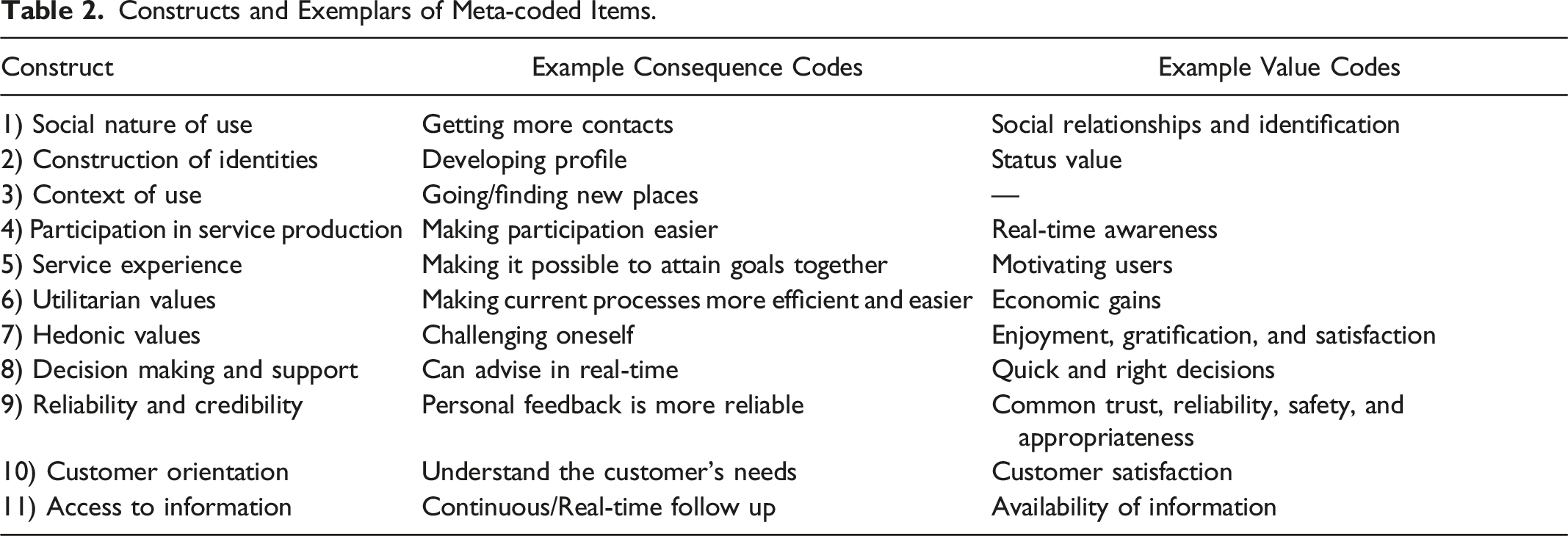
After the data collection phase of each study, the laddering interview chains were aggregated into matrices. The researchers developed codes one by one for the attribute, consequence, and value/goal items of the chains (Peffers, Gengler, and Tuunanen 2003). Emerging attribute (A), consequence (C), and value (V) codes were transcribed. In cases where multiple meanings emerged from a single chain, the chains were divided into multiple threads for coding. Although most chains were coded with all three codes (A, C, and V), in some chains, no A and/or C and/or V codes emerged from the chain in question. Once all studies were coded, the entire dataset totaled 1038 codes: 440 A codes represented the triggering system features or circumstances, 317 C codes represented the reasons for customers’ perceptions, and 281 V codes represented customers’ personal goals or values.
The derived codes were later used for clustering analysis in each study, as depicted in Tuunanen and Peffers (2018). For the meta-analysis for this study, we did not employ the previous clustering analysis results of the individual studies. Instead, we revised and meta-coded the original coding of each study in two phases. Previous laddering researchers have advocated using multiple coders to reach a high degree of agreement (Klenosky, Gengler, and Mulvey 1993; Peffers, Gengler, and Tuunanen 2003; Reynolds and Gutman 1988). Therefore, two researchers first revised all codes of the dataset and the coherence of the laddering chains’ A, C, and V codes. Thus, we aimed to ensure consistency and a suitable level of precision and abstraction without an excess loss of detail. In cases of conflicting assessments between the two researchers, conflicts were resolved via consensus. Both coders mutually suggested most of the concluded changes (64–79%).
Subsequently, the paper’s first author evaluated the final codes, concluding that the differences between the propositions of the two individual coders were insubstantial and that the final codes were consistent and representative. In total, 196 changes were made in the original dataset, but only 48 of the changes were proposed by a single coder. The high agreement level reflects the overall high quality of the dataset, the coding process, and the protocol used.
Constructs and Exemplars of Meta-coded Items.
Data Analysis – Interpretive Structural Modeling
We adopted the interpretive structural modeling (ISM) approach to analyze the data. ISM is a qualitative method used to reveal the structure of complex relationships among elements of a system (Malone 1975). A structural model of the elements emerges within the context of the ISM, depending on the connections of the elements to each other (Warfield 1994). In recent years, ISM has been widely adopted in various contexts. The studies vary from assessing information systems quality (Kanungo and Bhatnagar 2002) and the agility of the supply chain (Singh et al. 2003), to web interface design (Lee, Chao, and Lin 2010). ISM constructs can be derived by combining a literature review and expert interviews or can be solely based on a literature review. The steps involved in the ISM approach are depicted in Online Appendix 3.
We derived the ISM constructs from previous literature and a meta-analysis of our laddering interviews (Guo, Li, and Stevens 2012), that is, the meta-coded constructs (cf. Table 2). We established contextual relationships between each of these constructs by performing a pairwise comparison between each construct and developing adjacency matrices with multiple thresholds. After analyzing the meta-coded dataset, we identified 3006 relationships between the consequence and value codes. Preparing an ISM structure involves many steps and details, as described in Online Appendix 3. The final set of constructs in the ISM analysis was as follows: (1) social nature of use, (2) construction of identities, (3) context of use, (4) service experience, (5) customer participation, (6) utility values and goals, (7) hedonic values and goals, (8) decision making and support, (9) reliability/credibility, (10) customer orientation, and (11) access to information. These were labeled as S1 to S11, respectively.
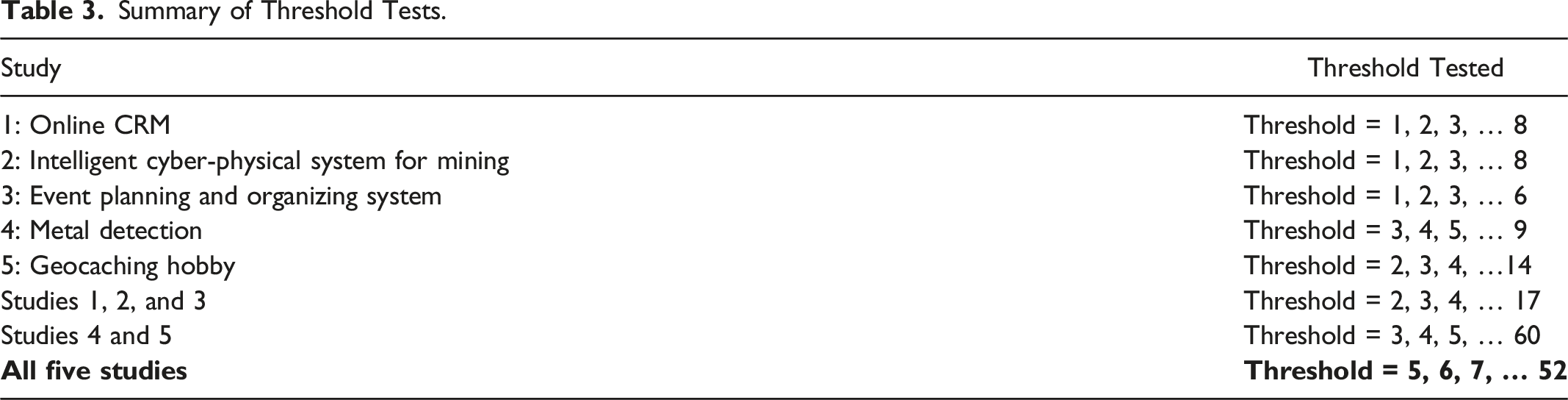
Summary of Threshold Tests.
We then performed the calculation for the reachability matrix in RStudio, calculating (A + I)≠ [(A + I)] ^ 2≠(A + I)^ 3≠…≠(A + I) ^ (n-1)=(A + I) ^ n, and we get (A + I) ^ 3 = (A + I) ^ 4, and produced the reachability matrix. Lastly, a level partition is performed based on the reachability matrix. Here, four iterations of four levels were derived: level 1 contains constructs 6 and 7; level 2 contains constructs 3, 4, 8, and 9; level 3 contains constructs 2 and 10; and level 4 contains constructs 1, 5, and 11. The ISM graphs were then derived. All the above matrixes are available in Online Appendix 4.
Findings
Key Findings of the Study.
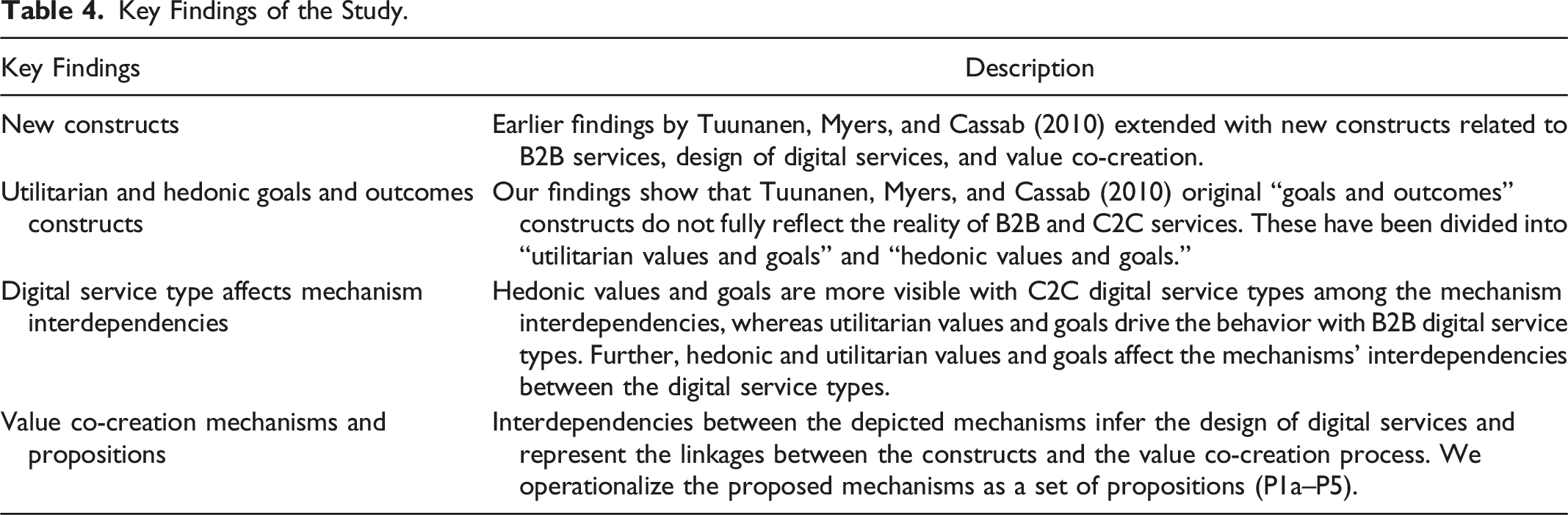
Our study reveals new constructs related to B2B digital services, contrary to the findings of Tuunanen, Myers, and Cassab (2010). These are (1) access to information, (2) customer orientation, (3) decision making and support, and (4) reliability/credibility. We define “access to information” as related to the availability of information and the ability to follow up on the information continuously; “customer orientation” pertains to customer satisfaction and understanding the customer’s needs; “decision making and support” are related to making prompt and correct decisions; and “reachability and credibility” are associated with the digital service’s trust, reliability, safety, and appropriateness, which enable reliable personal feedback.
Value Co-creation Mechanism Pathways, Propositions (Prop.), Interdependencies, Weights, and Total Hits.
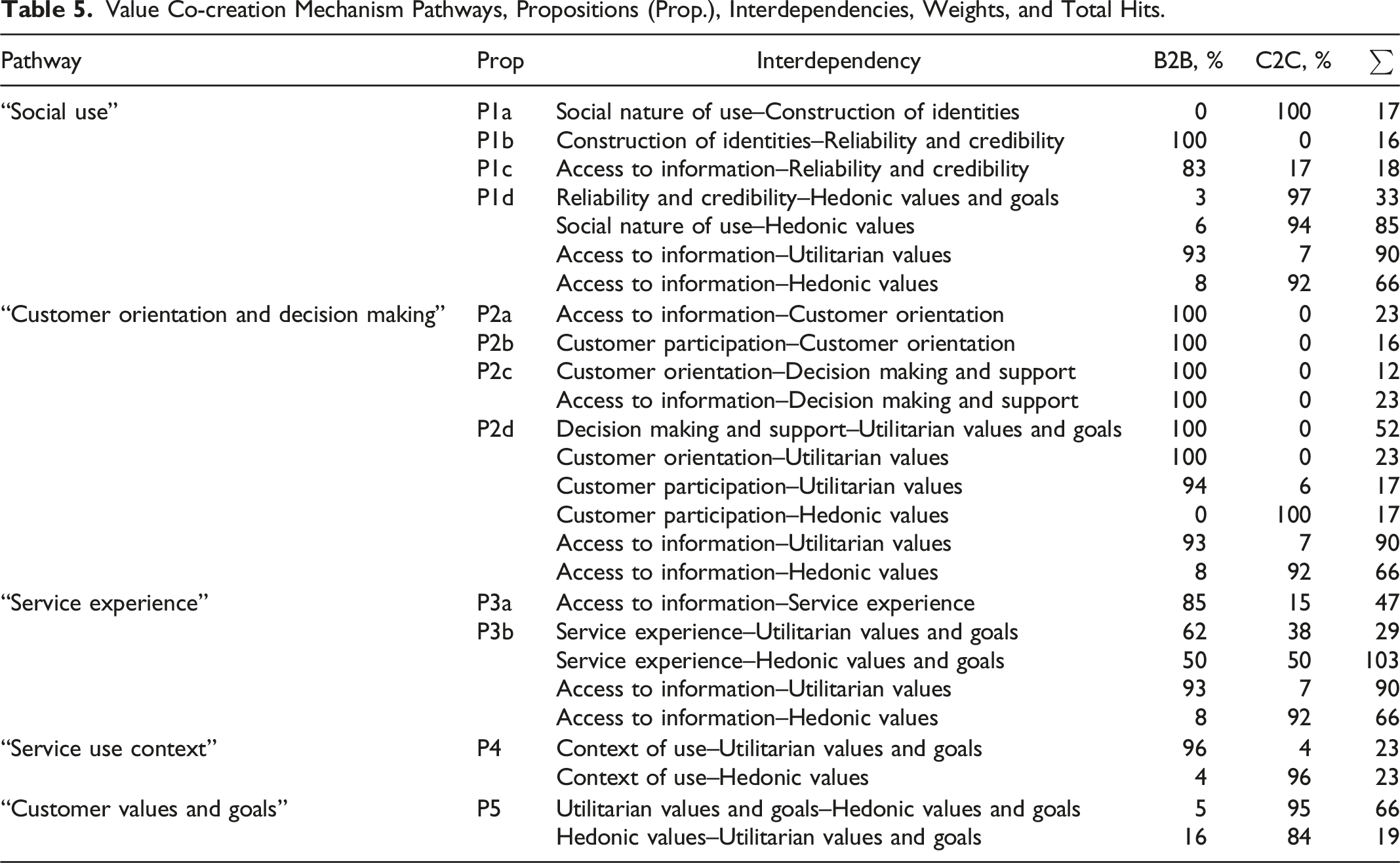
The findings show how the digital service type (B2B or C2C) affects mechanism interdependencies and how the weights differ. We analyzed the complete dataset to assess the interdependencies between mechanisms and how these vary between B2B and C2C digital service types. These findings are summarized in Table 5, including a description of the generated event. More specifically, whereas interdependencies such as the “social nature of use–construction of identities” or “access to information–customer orientation” are straightforward and emphasized in B2B or C2C digital service types, the interdependencies are more mixed. An example is “access to information–service experience,” which shows a heavier emphasis on B2B but still holds a 15% weight on C2C.
We also observe that hedonic values and goals are more visible with C2C digital service types among the mechanism interdependencies; conversely, utilitarian values and goals drive behavior in B2B digital service types. However, the results are interesting when hedonic and utilitarian values and goals affect the interdependencies of the mechanisms. First, there are interdependencies between the two values. Second, the mechanism interdependencies related to the service experience construct are reported with either a balanced weight of 50/50 (service experience–hedonic values and goals) or a nearly balanced weight of 62/38 (utilitarian values and goals–service experience). Figure 1 depicts the pathways that we identified and how these interdependencies are organized. Value co-creation mechanisms and propositions.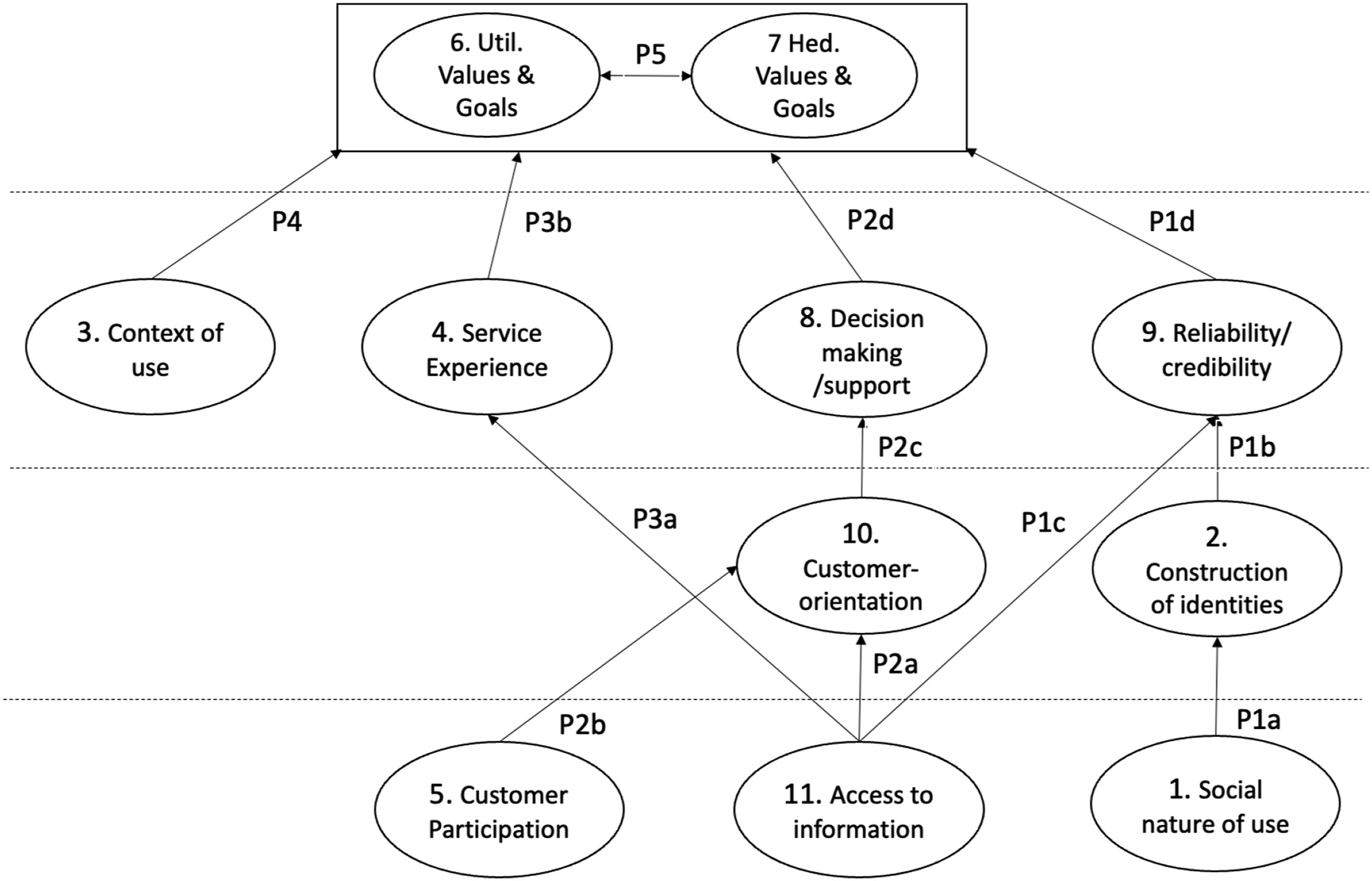
Figure 1 conceptualizes our findings regarding micro-level value co-creation mechanisms and the propositions listed in Table 5. The figure presents the interdependencies between the depicted mechanisms and how these infer the design of digital services. It also shows the linkages (arrows between constructs in the figure) between the constructs and the value co-creation process (a sequence of value co-creation activities). In what follows, we operationalize the proposed mechanisms as a set of propositions.
First, we recognize value co-creation mechanisms related to the sociality of digital service use and access to information (P1a–d). We define this as the “social service use” pathway. We propose that the social nature of use is linked to the construction of identities (P1a) in C2C digital services. Furthermore, the construction of identities is linked to reliability/credibility (P1b) in B2B digital services, and access to information is linked to reliability/credibility (P1c) in B2B and C2C services. The P1a–c mechanisms are linked to values and goals constructs (P1d). Reliability/credibility is linked to utilitarian value and goals with B2B digital services and C2C digital services. Reliability/credibility is linked to hedonic values and goals in C2C digital services. Access to information is linked to utilitarian values and goals in B2B digital services and hedonic values and goals in C2C digital services. Lastly, the social nature of use is linked to hedonic values and goals in C2C digital services.
Second, we identify value co-creation mechanisms related to access to information, customer participation, and decision making and support (P2a–d). We define this as the “customer decision-making” pathway. Here, we propose that “access to information” is linked to customer orientation (P2a) in B2B digital services, such as customer participation (P2b). Customer orientation, in turn, is linked to decision making/support (P2c) in B2B digital services. The P2a–c mechanisms are linked to values and goals constructs (P2d). Decision-making support links to both utilitarian and hedonic values and goals in B2B digital services. Customer orientation similarly links to both utilitarian and hedonic values and goals in B2B digital services. Customer participation and access to information are linked to utilitarian values and goals in B2B digital services. However, customer participation and access to information are also linked to hedonic values and goals in C2C digital services. Access to information is linked to utilitarian values and goals in B2B digital services and hedonic values and goals in C2C digital services.
Third, we recognize value co-creation mechanisms related to access to information and service experience (P3a-b). We define this as the “service experience.” Namely, access to information is linked to the service experience (P3a) in B2B and C2C digital services. Service experience is strongly linked to utilitarian and hedonic values and goals (P3b) in both B2B and C2C digital services. We also identify a value co-creation mechanism related to the context of use and its linkage to the values and goals construct (P4). We define this as the “service use context” pathway. Here, utilitarian values and goals are linked to B2B digital services and hedonic values and goals to C2C digital services. Lastly, we identify a linkage between utilitarian and hedonic values and goals, as well as between hedonic values and goals and utilitarian values goals in C2C digital services (P5), which we define as the “customer values and goals” pathway.
Next, we discuss the implications of the findings for both research and practice.
Implications for Research and Practice
Our study contributes to the literature in several ways. First, our study is one of the first to focus on the micro-level mechanisms that support the co-creation of value in the design of digital services. Given the digital-first world in which we now live in, digital services have become just as, if not more important than, physical services. With digital transformation being the priority for many managers, we need to better understand how to leverage the value co-creation potential of digital services through their design. Our findings provide a concrete way to analyze how different aspects of digital service use may impact customers’ value co-creation behavior.
Our primary theoretical contribution is the identification of a set of micro-level value co-creation mechanisms (Figure 1) and propositions (Table 5). Our findings explicate the connection between high-level digital service features—that is, the ISM constructs (cf. Table 5). Furthermore, the depicted mechanisms and interdependencies indicate how value co-creation may be enabled and enhanced for digital services. Furthermore, we propose a set of pathways for the interdependencies between the recognized mechanisms and how these affect the co-creation of value for B2B or C2C digital services. Some of these pathways are more impactful for B2B digital services than for C2C. For example, the customer decision-making pathway affects only B2B digital services. However, the affiliated customer participation–hedonic values and goals interdependency has an impact only on C2C digital services. Access to information–hedonic values and goals interdependency similarly leans toward a C2C emphasis, although there is some impact on B2B digital services.
Although the emerging mechanisms vary across digital service types (B2B and C2C), our analysis reveals that access to information is a foundational mechanism for co-creating utilitarian and hedonic values and goals, particularly in the B2B context. Each distinct interdependency between mechanisms emerging across digital service contexts is depicted and described in Table 5. With the depicted interdependencies between mechanisms, we investigated the empirical phenomenon of value co-creation from the perspective of digital service users. We argue that by exploring such processes and activities, the mechanisms and interdependencies we have identified reveal how and why digital service customers experience the emergence of value in the joint digital co-creation sphere with the service provider. This offers a new approach to studying and understanding value co-creation, which builds on the joint co-creation sphere argument by Grönroos and Voima (2013).
Our findings also suggest that, for the service experience pathway, utilitarian and hedonic values and goals have nearly an equal impact on B2B and C2C digital services. This finding contrasts with what was previously proposed in the literature (e.g., Prebensen and Rosengren 2016). In other words, we argue that when considering how to enable value co-creation with/among digital service customers, biases toward either a focus on hedonic or utilitarian values and goals are not supported. Instead, the impact of these two is nearly equal for both digital service types, contrary to many of the other interdependencies between the emerging mechanisms. Here, we see a difference compared to what, for example, Sandström et al. (2008) propose, with a filtering effect of situational factors affecting how digital service customers perceive value outcomes. We do not argue that the context of digital service is irrelevant—as our findings also show that it does have an impact—but instead, we posit that both hedonic and utilitarian values and goals of digital service customers should receive equal focus in the design of both B2B and C2C digital services.
Second, instead of taking a service design process, service systems, or platform ecosystem perspective, which is common in the extant literature (see, for example, Vargo et al. 2008; Yu and Sangiorgi 2018; Vargo, Koskela-Huotari, and Vink 2020), our study has examined value co-creation mechanisms at the micro-level (Storbacka et al. 2016) that have an impact on using digital services at a design level. Specifically, we examined the level of groups or types of digital services or a single service, that is, how customers derive value from digital service interactions. Hence, we have not focused on the firm perspective in service exchange but on the customers’ perspective of using the service. The depicted mechanisms and their interdependencies explain how value co-creation occurs in digital service contexts. The implications of the derived mechanisms are linked to the implementation of value co-creation, as enforcing and improving the highlighted mechanisms through the design of digital services may continuously enhance and enable value co-creation with customers.
Finally, our study offers a methodological contribution. We identified the mechanisms that generate value co-creation events using the ISM analysis of the laddering interview data. Focusing on how the occurrence of mechanisms varies across different digital service contexts, we demonstrated that the type and context of a digital service impact the mechanisms of value co-creation. Our findings underscore that customers’ hedonic and utilitarian values and goals are connected to the other emerging constructs via the three lower hierarchical levels. In their ISM study, Guo, Li, and Stevens (2012) describe such emerging high-level constructs as outcome constructs or dependent variables, which we describe as hedonic and utilitarian values and goals. In the next section, we illustrate how service managers and designers can use this methodology to support the practice of service design.
Implications for the Service Design Practice
Our study provides applicable tools for service designers and managers to improve the design of their digital services. Below we provide a scenario of using value co-creation mechanisms to design a digital service and use one of the digital services included in the study as an exemplar: an intelligent cyber-physical system for mining (Hänninen, Tuunanen, and Vartiainen 2015).
We used the same recruitment protocol for the study participants, as reported earlier in the research methodology section. We recruited 20 industry experts (demographic information is available in Online Appendix 2). The data collection followed the approach described earlier of first developing a stimuli list that fits the study context, and then laddering interviews were conducted with the study participants. The full dataset included 1420 individual statements by the interviewees. The data analysis included coding the laddering interview data and a thematic cluster analysis (Hänninen, Tuunanen, and Vartiainen 2015), which followed Tuunanen and Kuo’s (2015) procedure.
The outputs of the data analysis were several thematic maps (Hänninen, Tuunanen, and Vartiainen 2015) that depicted how different service features (attributes) were connected to the values and goals (values) of the system users and the reasoning behind the connections (consequences). Service designers and managers can, therefore, use these thematic maps to understand how the service is perceived by their customers. Figure 2 depicts an exemplar map of the “sharing and receiving information related to intelligent equipment” theme. The numbers on the map indicate the frequency of a code in the dataset. For example, the attribute code “data collection” was mentioned 41 times. From the map, we observe that the “data collection” attribute (including features related to “Equipment health,” “User,” “Process,” and “Environment”) is linked to several reasons, for example “Interpret conditions real-time,” and why it was considered important for the “Real-time awareness” and “Reliability” goals of the company. The map also shows that several reasonings can be connected to an attribute, like in the case of “data collection,” and the reasonings can be connected. Similarly, values and goals may be interconnected as described in the example chain of attributes–consequences–values. Sharing and receiving information related to intelligent equipment, adapted from Hänninen, Tuunanen, and Vartiainen (2015).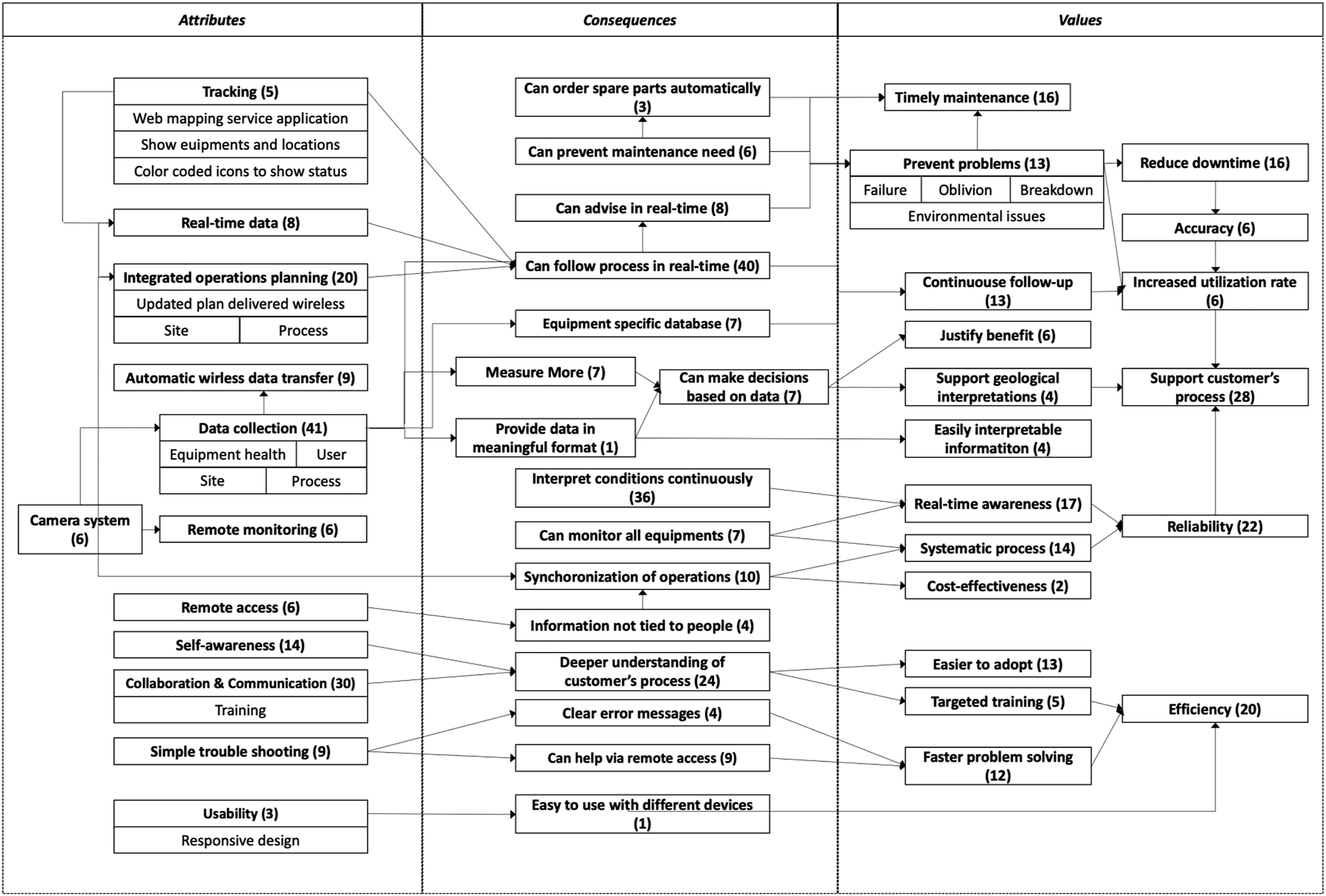
The number of times a code is mentioned in the data can be used for prioritizing service features as suggested by Tuunanen and Kuo (2015). Tuunanen and Peffers (2018) later reported that a daily newspaper, at the time the largest Newspaper in the Nordic countries, developed a 3-year development roadmap for their digital service based on similar thematic maps and prioritization information of service features. The firm successfully followed the roadmap to develop the digital service operating the newspaper’s ad trafficking system. This showcases the utility that service managers and designers can achieve with laddering interviews and analysis of the data. Based on our experience with undergraduate and graduate students, the approach can be taught with two 2-hour workshops. The first workshop focuses on the laddering interviewing technique, and the second on the coding and thematic analysis of the data. We have trained hundreds of students to use the approach over the past 15 years.
While these maps inform the company regarding important service features and their rationales, they do not explain how their customers co-create value with the digital service. Therefore, in this study, we developed several ISM graphs with different thresholds by performing an ISM analysis. Note that the earlier thematic maps are not required for the ISM analysis or vice versa, but both offer additional utility for the practice of service design. Figure 3 shows the value co-creation mechanisms and their interdependencies for the intelligent cyber-physical system for mining with a threshold of 7. The figure also includes references to the propositions (see Table 5 for the interdependencies). We recognize that the “customer orientation and decision making” mechanism is fully presented in the intelligent cyber-physical system for mining (propositions P2a-d); similarly, we see that “service use context” is present (proposition P4). However, “service experience” is only partly impacting the use of this digital service (proposition P3a). Value co-creation mechanisms and their interdependencies for the intelligent cyber-physical system for mining (threshold 7).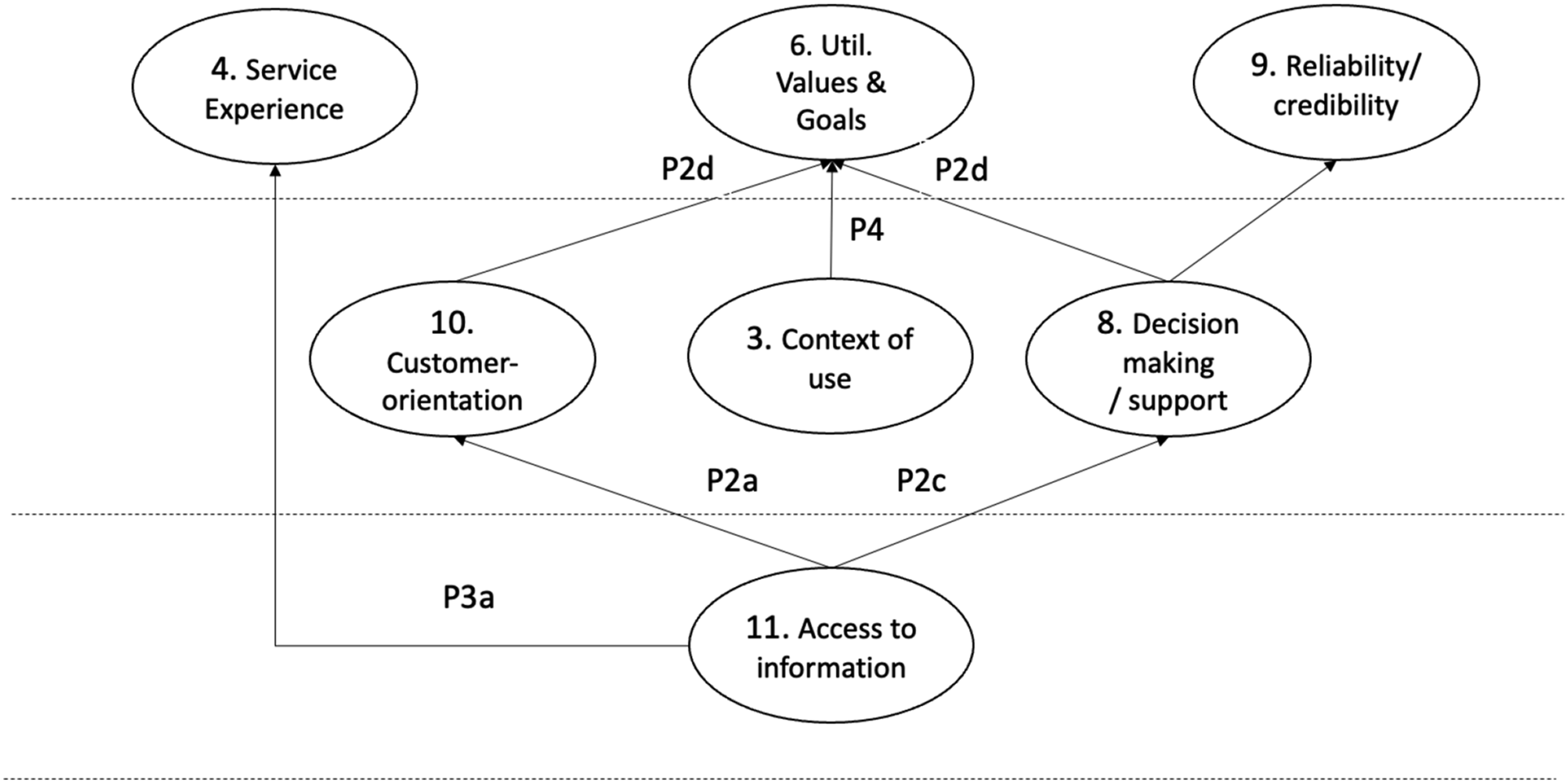
Consequently, based on the model, the company can now visualize which laddering interview chains, corresponding values and goals, and service features are affecting the micro-level value co-creation mechanisms for its customers. For example, by studying Figure 2, we observe that laddering chains, including “camera system” and “remote monitoring,” link to the system’s reliability. The full interview dataset, in turn, includes detailed descriptions of the service features under each attribute code, such as the “camera system.” Tuunanen, Salo, and Li (2022) provide further insights into how laddering interview data can be used to design modular digital services. By applying this approach, service designers and managers of the company can understand the value the system provides to their customers and how they co-create value while using the system.
We suggest the proposed micro-level value co-creation mechanisms can guide design efforts to support new service development and to revise or update extant digital service offerings. Although this higher-level view may be sufficient for the practice of service design, the insights may be complemented by a more detailed analysis of inherent value co-creation mechanisms and their interdependencies through a research endeavor, as described above. The custom-made study with data laddering and the ISM analysis approach provides a more detailed view. However, although the higher-level view offered by the theory may be sufficient for the practice of digital service design, Figure 3 shows an interdependency between decision making/support and reliability/credibility that is not explained by our theory. This finding is not unexpected, as the threshold for analyzing a single digital service differs from the threshold used to analyze the entire dataset. In other words, the interdependency between these two mechanisms is important for this digital service, but this was not the case for the entire dataset. This finding was specific only to the intelligent cyber-physical system in the mining context in our dataset.
This alternative result shows the importance of understanding the context in which digital services are used. Although most of the interdependencies are explained by the theory, we recommend that designers and managers use existing data or collect new data to understand how value is co-created by their customers while using their digital services. We expect that the theory will explain most interdependencies for other digital services, but not all of them. Applying the obtained insights should lead to better design of digital services while not adding significant new resource needs or costs to the company.
Concluding Remarks and Limitations
Given that most services are now digital—or at least digitally enabled—this study has focused on identifying micro-level value co-creation mechanisms to support the design of digital services. Our findings show that the context of a digital service significantly impacts the value co-creation mechanisms of digital services. We propose a set of micro-level value co-creation mechanisms and their interdependencies, showing how value co-creation may be enabled and enhanced for designing digital services (see Figure 1). We also depict a set of propositions for conceptualizing the mechanisms (see Table 5).
As with any study, the findings of this study are subject to certain limitations. We acknowledge that our study is based on five digital services only. Hence, our findings might not be fully generalizable to the design of all digital services. Further, the threshold we used in the analysis of our results impacts the generalizability of the findings. However, as our exemplar digital service describes (Figure 3), the theory explains most of the interdependencies. We suggest that more research is needed to understand why and whether new mechanisms emerge from studying other digital services and their interdependencies. This will most likely suggest new propositions to depict the value co-creation mechanisms. Our findings offer a foundation for such research.
Additionally, we acknowledge that we did not include B2C-type digital services in our study. We suggest that future studies could investigate the applicability of the proposed theory to B2C digital services. Another limitation is that our dataset included respondents from only one European country. Thus, further studies in other regions and cultural settings should be considered. Lastly, although we think that a laddering interview with an ISM analysis approach provides a robust way to understand value co-creation mechanisms and their interdependencies in the design of digital services, other research methods could be considered in the future.
Despite these limitations, we believe that this study offers a novel contribution to the literature regarding the design of digital services. We contribute to the conceptualization and theorization of value co-creation (Breidbach and Maglio 2016; Grönroos and Voima 2013; Grotherr, Semmann, and Böhmann 2018; Lusch and Nambisan 2015; Payne, Storbacka, and Frow 2008; Prahalad and Ramaswamy 2004b; Vargo, Maglio, and Akaka 2008; Vargo and Lusch 2017; Vargo, Koskela-Huotari, and Vink 2020). In contrast to previous contributions that have focused on value co-creation at the ecosystem level (see, for example, Vargo, Koskela-Huotari, and Vink 2020), we have focused more narrowly on individual and micro-level service customer perspectives (Storbacka et al. 2016). This said, we recognize the need to study value co-creation mechanisms at a meso-level. When considering value co-creation for designing services, Ghotherr et al. (2018) define the meso-level as the service platform where resource integration is done by different actors. Consequently, based on our findings, we argue that studying meso-level value co-creation mechanisms can offer novel insights, especially on how to design a digital service platform (De Reuver, Sørensen, and Basole 2018).
Finally, we believe our findings should be of interest to researchers and practitioners in designing and developing digital services. A better understanding of the micro-level value co-creation mechanisms of their customers may lead firms to design better service experiences and, consequently, increase their revenues. Firms may utilize the proposed theory and methodological insights to enhance their current digital services and/or the design of new services. We suggest future research should consider how to use micro-level value co-creation mechanisms in the service design process and/or specific service design activities, especially in designing digital services. This research can lead to the development of new digital service design methods that would incorporate tool-level support for the application(s) of the value co-creation sphere (Grönroos and Voima 2013).
Supplemental Material
Supplemental Material - Micro-Level Mechanisms to Support Value Co-Creation for Design of Digital Services
Supplemental Material for Micro-Level Mechanisms to Support Value Co-Creation for Design of Digital Services by Tuure Tuunanen, Juuli Lumivalo, Tero Vartiainen, Yixin Zhang, and Michael M. Myers in Journal of Service Research
Supplemental Material
Supplemental Material - Micro-Level Mechanisms to Support Value Co-Creation for Design of Digital Services
Supplemental Material for Micro-Level Mechanisms to Support Value Co-Creation for Design of Digital Services by Tuure Tuunanen, Juuli Lumivalo, Tero Vartiainen, Yixin Zhang, and Michael M. Myers in Journal of Service Research
Footnotes
Declaration of Conflicting Interests
The author(s) declared no potential conflicts of interest with respect to the research, authorship, and/or publication of this article.
Funding
We thank Foundation for Economic Education for the financial support for this research.

Supplemental Material
Supplemental material for this article is available online.
Notes
Author Biographies
References
Supplementary Material
Please find the following supplemental material available below.
For Open Access articles published under a Creative Commons License, all supplemental material carries the same license as the article it is associated with.
For non-Open Access articles published, all supplemental material carries a non-exclusive license, and permission requests for re-use of supplemental material or any part of supplemental material shall be sent directly to the copyright owner as specified in the copyright notice associated with the article.
