




Abstract
Managing customer experiences has become a key strategic priority for service research and management. Yet researchers and managers lack a customer experience (CX) measure that applies to the different experience partners, touchpoints, and journey stages in the omnichannel environments of today’s service industries. Without such a common measure, empirical research on CX remains fragmented, and service companies continue to struggle to improve customer interactions in customer journeys. To address this shortcoming, this article proposes an omnichannel-capable measurement of CX that applies to different customer interactions in the omnichannel environment. With seven studies, the authors develop and validate a six-dimensional, 18-item CX scale. The proposed CX scale overcomes the fragmentation of existing scales in service research and provides a valid measure that can be used consistently for various customer interactions in omnichannel environments. This article details how the proposed CX scale can monitor and compare CX for different interactions in customer journeys (i.e., pain-point analysis), as well as improve CX features and their marketing outcomes (i.e., CX profiling). By overcoming the existing fragmentation in available scales and providing a common omnichannel CX measure, this CX scale establishes an empirical foundation for developing CX knowledge and advancing related service research.
Providing superior customer experiences across multiple channels and touchpoints is essential to achieving competitive advantages in today’s service landscapes; it also represents a fundamental basis of service management (Becker and Jaakkola 2020; McColl-Kennedy et al. 2019). In turn, it constitutes a key strategic priority for service research and management (Ostrom et al. 2021). Service managers seek guidance regarding how they should evaluate and manage the customer experience (CX), especially in their customer-centric omnichannel management efforts. Managing the CX is not straightforward though, due to the growing complexity of customer interactions in omnichannel environments, which feature various experience partners and touchpoints across customer journeys (De Keyser et al. 2020; Lemon and Verhoef 2016). This struggle to improve CX management also is hindered by a lack of an omnichannel-capable CX measure that applies to different customer interaction contexts and allows for comparisons of CX, especially in service sectors (CMO Survey 2019; Qualtrics 2021).
In efforts to support effective CX management, vast research on CX in the service domain emphasizes the importance of monitoring and designing the CX of every type of customer interaction in omnichannel environments (Becker and Jaakkola 2020; McColl-Kennedy et al. 2019; Ostrom et al. 2021; Zomerdijk and Voss 2010). Conceptual studies highlight the need to address CX from a customer perspective and to adopt omnichannel approaches to support empirical investigations and comparisons of the CX of different interactions (De Keyser et al. 2020; Lemon and Verhoef 2016). First, a customer perspective requires a measure or scale that collects subjective CX data from customers. Second, an omnichannel approach demands that the measure allows for sound comparisons of CX across customer interaction contexts. A CX measure is omnichannel-capable if it can measure CX in the same way in different interaction contexts that feature distinct experience partners (brand, employee, other customers), touchpoints (offline, online), and customer journey stages (prepurchase, purchase, postpurchase) that make up the omnichannel domain. Such an omnichannel-capable CX measurement from the customer perspective is still missing. Instead, service and marketing research offers experience scales for specific customer interaction contexts (e.g., brands, Brakus et al. 2009; online, Bleier et al. 2019) that cannot guarantee meaningful comparisons; the items are developed and validated for single experience contexts and contents only. Nor can the findings from prior research be compared easily. This fragmentation hinders overarching CX knowledge creation in service research or monitor and design CX in service practice (Bain & Company 2018; Lemon and Verhoef 2016).
Against this backdrop, we propose an omnichannel-capable measurement of CX that is based on the methodological approach of a “traveling” construct (Osigweh 1989). A traveling construct covers the few but defining features that constitute its domain (i.e., context features) and its connotation (i.e., content features), so its content can apply to different contexts in the same way. To conceptualize a traveling CX construct, we build on the fundamental theory of the conscious mind (Chalmers 1996, 2010), which conceptualizes experiences according to their elementary commonalities in content across contexts. Our CX construct is not limited to a specific interaction context; it applies to different customer interaction contexts, covering different experience dimensions for varying experience partners, touchpoints, and customer journey stages as elementary features that make up the construct’s omnichannel domain and connotation (De Keyser et al. 2020). With this conceptualization, we derive six CX dimensions and an 18-item scale, which we validate in various customer interaction contexts in omnichannel environments. Using this scale, users can monitor and benchmark CX in customer journeys (i.e., CX pain-point analysis) or design specific service interactions (i.e., CX profiling). In seven studies, involving 3,523 participants, we leverage written descriptions, in-depth interviews, item screening and sorting, surveys in two service industries (retail and hotel), a known group test, and an online experiment with interactive videos in a service setting (restaurant) to establish two main contributions to extant service and marketing research.
First, our omnichannel-capable measure of CX differs from experience scales that focus on a specific customer interaction context and that cannot support empirical investigations or comparisons of CX in different customer interaction contexts (e.g., Arnould and Price 1993; Bleier et al. 2019; Brakus et al. 2009). In developing a common CX measure, we overcome scale fragmentation by identifying relevant CX dimensions in the omnichannel domain and reduce measurement ambiguity by making items applicable to different interaction contexts. These properties enable meaningful comparisons of CX across customer interactions rather than simply extending existing scales in ways that raise validity concerns. This effort also responds directly to calls for a CX scale that applies to omnichannel environments (Lemon and Verhoef 2016; MSI 2018) and adds to recent service literature that aims to consolidate CX research to offer a common basis for CX management in service domains (Becker and Jaakkola 2020; De Keyser et al. 2020).
Second, having developed a scale that provides a basis for a comparison of CX for different customer interaction contexts, we illustrate how researchers and managers can apply the proposed CX scale. Because it can capture and compare CX across the omnichannel domain with a single measure, this scale is well suited to help service managers prioritize and improve relevant customer interactions (De Keyser et al. 2020; McColl-Kennedy et al. 2019). In line with recent service research priorities (Ostrom et al. 2021), we establish a means to identify and monitor crucial pain points (i.e., significant negative deviations of CX ratings for a customer interaction compared with a relevant benchmark from a manager’s perspective). As required by service-design initiatives (Zomerdijk and Voss 2010), the scale also can guide service and CX design by profiling customer interactions and identifying the marketing activities and CX dimensions that offer the greatest opportunities for improving CX and its outcomes. Thus, the CX scale contributes to both service research and practice (Keiningham et al. 2020; McColl-Kennedy et al. 2019).
Conceptualization of Customer Experience
Before we can develop an omnichannel-capable CX measure, we need to establish the conceptual basis of the CX construct, namely, that the construct must deal with complex omnichannel environments to cover each type of customer interaction in the same way, regardless of the interaction. To enable this omnichannel capability, we draw on the methodological approach of a traveling construct (Osigweh 1989). A profound conceptualization also requires a theoretical foundation to define the features, dimensions, and boundaries of the traveling CX construct. We build on Chalmers’s (1996, 2010) theory of the conscious mind as a theoretical fundament. Then, we derive implications of each defining feature for the CX measure.
Toward a Traveling Customer Experience Construct
A traveling construct covers the few but defining features that constitute its domain (i.e., context features) and its connotation (i.e., content features) so that its content can be applied to different contexts in the same way. Thus, a traveling construct retains its precision while maintaining its broad application (Osigweh 1989). Based on this methodological approach, we develop a CX construct that is not limited to a specific customer interaction; instead it applies to several interaction contexts, covering different experience dimensions (content features) for varying experiences partners, touchpoints, and customer journey stages (context features). Like a traveler who keeps a backpack ready with critical belongings (content), ready to be pulled out for the next trip to different destinations (context), a user can use the traveling CX construct to “travel” from one interaction context to another in different customer journeys and cover the experience content of these interaction contexts in the same way. For example, it can be applied to an online interaction with a brand before purchase (e.g., searching for information on the brand’s website) similarly to an offline interaction with an employee during or after purchase (e.g., buying or reclaiming a product in store). By definition, it is omnichannel-capable, because it applies to different customer interaction contexts in the omnichannel domain in the same way, which enables meaningful comparisons of experience contents across these contexts.
A Fundamental Theory of Experiences
To conceptualize a traveling CX construct from the customer perspective, we need a mind-focused theory that analyzes experiences based on their elementary commonalities in content across different contexts. Chalmers’s (1996, 2010) theory of the conscious mind—a comprehensive and representative theory from the dualist school of the philosophy of mind—seeks to discover fundamental laws of conscious experiences and challenges the prominent view that they can be understood only through the study of specific, narrow, experience-related phenomena such as neural correlates or psychological processes. Instead, Chalmers’s (1996, 2010) theory conceptualizes the “what is” of conscious experiences (i.e., experience content) based on the elementary commonalities found in experiences across different experience contexts. It provides a systematic structure to analyze experiences at a higher but still precise abstraction level, as needed to conceptualize a traveling CX construct, and it outlines the elementary features of experience context and content.
Experience Context
Conscious experiences emerge from the experience context, which comprises four essential elements: An individual experiences an event (i.e., action) through a specific medium at a certain point in time (Chalmers 1996). These elements are fundamental, meaning a change to any element results in a different experience (Chalmers 2010). For example, drinking sparkling water versus sparkling wine (event) at home versus at a beach (medium) at night versus in the morning (point in time) represent different experiences for a person who prefers water or wine (individual). In omnichannel environments, various customer interaction contexts represent different experience contexts. Each customer interaction context is defined by a customer (individual) interacting with an experience partner (event) at a specific type of touchpoint (medium) during a certain customer journey stage (point in time). The experience partner can be a brand (e.g., corporate, product), employee (e.g., call-center agent, salesperson), or other customers (e.g., friends, others). 1 The type of touchpoint might be online (e.g., e-mail, online shop) 2 or offline (e.g., billboard, store). The customer journey stages are prepurchase (need recognition, search, consideration), purchase (choosing a product or service), and postpurchase (usage and consumption, engagement, service request; De Keyser et al. 2020; Lemon and Verhoef 2016). Thus, CX can be conceptualized and measured in various customer interaction contexts.
Experience Content
People make sense of input from the experience context and integrate their mental responses into different experience dimensions to form a conscious experience (Chalmers 1996) such that they store the content of an experience in their minds (Chalmers 2010). According to a dualist view of the philosophy of mind (e.g., Brentano 2014/orig. 1874; Husserl 1982/orig. 1913; Nagel 1974) on which Chalmers (1996, 2010) draws, there are three defining features of experience content: subjective, directed, and multidimensional (Figure 1). We base our conceptualization of CX and its implications for CX measurement on these defining features. Conceptual framework.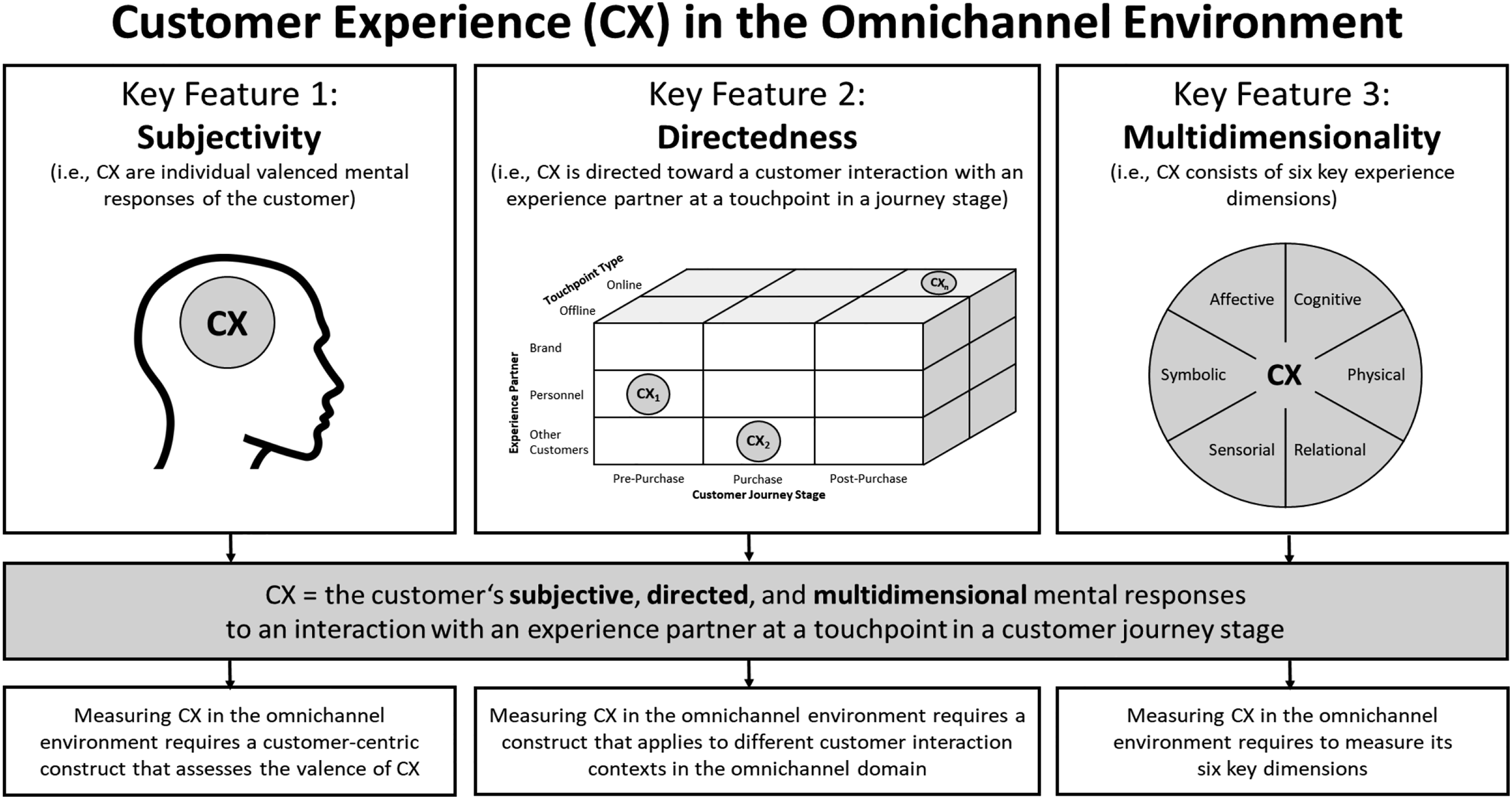
First, experiences are subjective. Only the individual knows what it is like to experience the focal situation while in it (Nagel 1974). Only that person can report on the content and valence of the experience (i.e., how negative versus positive it is; Chalmers 1996, 2010; Husserl 1982/orig. 1913). Thus, a CX and its valence are fully comprehensible only from a single customer’s point of view, and measuring experiences requires collecting subjective data that can then be analyzed individually or aggregated for a sample (e.g., surveys; Chalmers 1996, 2010).
Second, experiences are directed toward inputs (i.e., are about, in, of, or with someone or something; Landgrebe 1973) and entail mental reactions to those inputs (e.g., emotions; Brentano 2014/orig. 1874; Chalmers 2010). Experience content emerges through the person’s subjective processing and sense-making of inputs. Inputs have a beginning and an end; experiences also have a limited temporal duration (Kim 1992; Lee 2014). Experiences originate and exist in the moment of an input, so they are distinct from attitudes (i.e., general, stable beliefs and evaluations) and behaviors (i.e., how a person acts), both of which follow after an input (Chalmers 2010; Dretske 1993). For example, the experience of riding a roller coaster (“What it is like for me to ride a roller coaster”) differs from the rider’s attitude (“I like riding roller coasters”) or related behaviors (“I recommend that others ride roller coasters”). CX comprises the mental responses that occur during a single interaction with an experience partner at a touchpoint during the customer journey, which drive subsequent attitudinal and behavioral consequences.
Third, experiences are multidimensional, covering different mental responses. The philosophy of mind literature suggests six key experience dimensions, which cover the content of individual mental responses: affective, cognitive, physical, relational, sensorial, and symbolic (e.g., Chalmers 1996; Montague 2016). People develop mental responses to each dimension (Bayne and Chalmers 2003). Metaphorically, an experience is like a movie playing in the individual’s mind. The individual is the lead character, and various content facets (e.g., emotions, insights) stem from the experience context. This lead character assesses each part of this inner movie separately (“How do I feel?” “How do I perceive the new insights I gained?”). Furthermore, the inner movie might differ from experience to experience, such that a specific piece of content might have varying importance. Experience dimensions are not equally important across contexts a person might experience, and each person stores content for each dimension separately and can distinguish its importance. In turn, assessing CX accurately requires a scale that can measure all key CX dimensions in each specific customer interaction and distinguishes their relevance—that is, a measurement model that treats each dimension as a single factor of experience assessment.
Customer Experience: Definition and Dimensions
Definition
Using the theory of the conscious mind as a theoretical foundation, we define CX as a customer’s subjective, directed, and multidimensional mental responses to an interaction with an experience partner at a touchpoint in a customer journey stage. These mental responses are subjectively valenced, so customers differentiate how positive their responses are for the different CX dimensions (De Keyser et al. 2020).
Dimensions
To determine whether the six dimensions identified in the theory of the conscious mind and the related philosophy of mind literature apply to customer interactions in an omnichannel environment, we conducted a systematic review of the literature on CX and related experience constructs (e.g., brand experience, service experience). To identify relevant articles, we used a procedure similar to De Keyser et al.'s (2020) and extended the list, in line with our research goal, to focus on articles pertaining to experience dimensions. We gathered 186 CX articles (Web Appendix W1). They use the terminology linked to the philosophy of mind literature (e.g., affective: emotional, feel; physical: behavioral, bodily). Accordingly, we identify and define six CX dimensions—affective, cognitive, physical, relational, sensorial, and symbolic.
Affective Dimension
The affective dimension refers to the emotions, feelings, and moods a customer experiences during an interaction with a brand, employees, or other customers (Holbrook and Hirschman 1982; Richins 1997). These responses can reflect experiences of different content, but essentially, the customer distinguishes between pleasure (e.g., happiness, love) and displeasure (e.g., anger, sadness; Russell 2003). This core form of affect indicates to the customer whether the experienced situation is helpful or harmful (“How do I feel?”).
Cognitive Dimension
The cognitive dimension refers to the customer’s intellectual stimulation and learning during an interaction (Brakus et al. 2009; Hoch and Ha 1986). Driven by curiosity, both intellectual stimulation (from minimal insights to great) and learning result from cognitive processes that go beyond basic thinking; they involve classifying, (dis)confirming, and synthesizing information gained from an interaction with prior knowledge (Cacioppo and Petty 1982). These cognitive processes generate or consolidate knowledge (“How do I perceive the new insights I gained?”) as important attention control mechanisms and valenced reflections of CX during customer interactions (Hoch 2002).
Physical Dimension
This dimension refers to a customer’s perception of bodily movement and body positions during an interaction (Brakus et al. 2009; Joy and Sherry 2003). Such perceived behavioral responses are evoked by so-called proprioceptors, defined as mechanosensory neurons within muscles, tendons, and joints (Tuthill and Azim 2018). The physical experience is a part of CX (“How do I perceive my body movements?”), in that an interaction requires physical perception and coordination, which customers perceive as more or less positive, even if it features little or no physical movement, such as when sitting (Joy and Sherry 2003; Tuthill and Azim 2018).
Relational Dimension
This dimension refers to perceptions of relationships with someone (employees, other customers) or something (brands) during the customer interaction (Arnould and Price 1993; Brakus et al. 2009). Customers experience various relationship forms, from loose connections to strong bonds with experience partners, which define the social context of the customer interaction (Tumbat and Belk 2011). Customer interactions are grounded in social contexts, each of which may have different valence for a customer (“How do I perceive my relationship with this interaction partner?”).
Sensorial Dimension
This dimension refers to the sensory qualities of a customer interaction (Brakus et al. 2009) that reflect uses of the five external senses: visual (e.g., color), auditory (e.g., sounds), tactile (e.g., texture), olfactory (e.g., fragrant), or gustative (e.g., sweet). 3 Human senses work continuously, and customer interactions generally evoke valenced sensory perceptions (e.g., “How do I perceive the color I see?”; Bleier et al. 2019; Joy and Sherry 2003).
Symbolic Dimension
The symbolic dimension refers to a customer’s self-affirmation and self-expression during the interaction (Gentile et al. 2007; Hoffman and Novak 2018). The symbolic meaning of an interaction is situated in customers’ self-concept (Thompson et al. 1989), based on which they process whether the interaction represents their individual beliefs and values (Arnould and Price 1993; Lemke et al. 2010). Customers strive to affirm and express their beliefs and values in interactions to ensure a stable self (“How does this correspond to who I am?”), so the symbolic dimension represents a mental reflection of CX that has inherent valence (Thompson et al. 1989).
Boundaries of the Customer Experience Construct
The CX construct focuses on experiences based on customer interactions in omnichannel environments. It does not cover experiences people have outside their customer roles, such as in their work or private lives (Lemon and Verhoef 2016). Also, CX emerges during single customer interactions in particular stages of the customer journey—that is, the CX construct does not cover a customer’s overall perception of the customer journey but instead assesses the experience of an individual customer interaction during the customer journey.
Resulting Requirements for Customer Experience Measurement
To develop a measure that captures this CX conceptualization, we translate its three key defining features into CX measurement requirements (MacKenzie 2003; MacKenzie et al. 2011).
Customer Experience Subjectivity
Because CX consists of subjective mental responses, its measurement requires a customer-centric approach that assesses responses in terms of how negative, indifferent (neutral), or positive they perceive the experience to be, expressed along the CX dimensions (De Keyser et al. 2020; McColl-Kennedy et al. 2019). Our proposed CX scale captures how positively a certain CX dimension is experienced by each customer in a specific customer interaction context; a higher score corresponds to a more positive experience. Identifying whether a customer interaction context results in positive or negative responses among customers is fundamental to customer management efforts to identify pain points along the customer journey. Managers also can use such insights to guide customers toward interaction contexts in which they previously had a positive CX or improve interactions that led to a negative CX. Thus, scales developed from the customer’s point of view that include valence are well suited to measure CX.
Customer Experience Directedness
Because customer experiences emerge in different customer interactions, their measurement requires a construct that applies to the various contexts of its domain. The domain is the omnichannel environment, which represents a three-dimensional space spanning experience partners, touchpoints, and customer journey stages (De Keyser et al. 2020). With these elements, the construct becomes broad enough to be used and empirically tested in different customer interaction contexts. Simultaneously, the CX construct enables precise measures of single experiences in different contexts, because experience content is measured in the same way, which allows for meaningful comparisons across contexts. The omnichannel capability of the CX construct also differentiates our conceptualization from existing experience constructs that focus on specific interaction contexts—such as customer experiences with brands (Brakus et al. 2009), online environments (Bleier et al. 2019), or service providers (Arnould and Price 1993)—and that thus cannot capture the variety of interaction contexts in omnichannel domains. Developing an omnichannel-capable CX measure requires addressing this omnichannel domain by conceptualizing a traveling construct from the very beginning, by ensuring the developed scale’s content fits distinct customer interaction contexts (e.g., items, placeholders), and by validating the scale in each of these contexts (e.g., with cross-sectional or longitudinal studies).
Customer Experience Multidimensionality
Because CX consists of multidimensional mental content, measuring CX in omnichannel environments requires the measurement of the six key CX dimensions. Customers should be allowed to assess each dimension separately in terms of how negative or positive their experience is on that dimension. A specific dimension might be less important in certain customer interaction contexts, but a measure that covers all six is critical for three reasons: to determine which dimensions are important in each situation, how marketing activities perform on each dimension, and how each dimension influences customer attitudes and behaviors. To derive these insights from a CX measure, our multidimensional CX construct needs to be treated as a multivariate model in the scale development and validation process, with six experience dimensions as separate yet correlated factors. Thereby, we gain an accurate view of CX on the level of its six experience dimensions, which ensures that service researchers and managers can investigate and compare mental responses in and across different customer interaction contexts, facilitating knowledge creation about CX (Becker and Jaakkola 2020; De Keyser et al. 2020).
Existing Experience Scales and the Customer Experience Scale Development Process
As is required for an omnichannel-capable CX measure, we seek to develop a CX scale that (1) takes the customer’s point of view to assess the valence of the CX (CX subjectivity); (2) can be used in the omnichannel environment for different experience partners, touchpoint types, and customer journey stages (CX directedness); and (3) measures the six key dimensions of CX (CX multidimensionality). We also note the extent to which existing scales fulfill these requirements.
Existing Experience Scales
Existing Experience Scales.
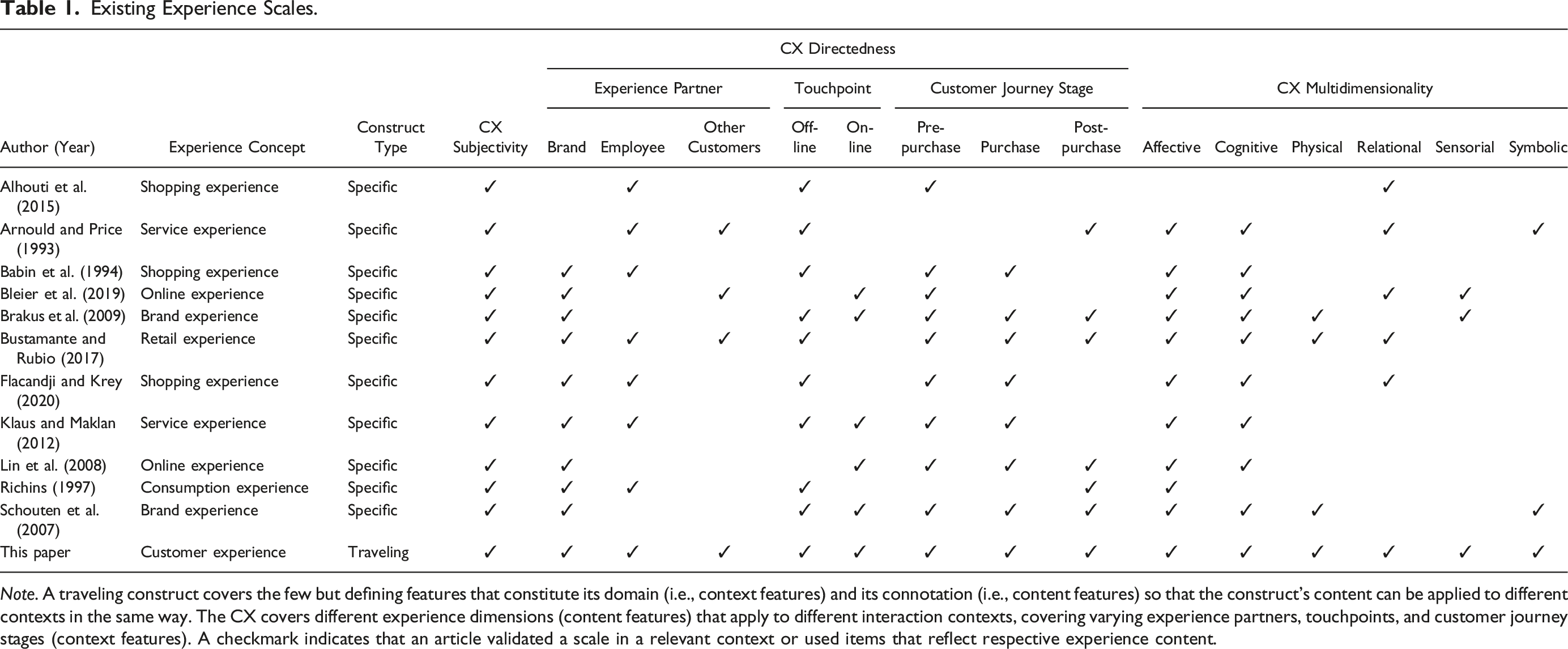
Note. A traveling construct covers the few but defining features that constitute its domain (i.e., context features) and its connotation (i.e., content features) so that the construct’s content can be applied to different contexts in the same way. The CX covers different experience dimensions (content features) that apply to different interaction contexts, covering varying experience partners, touchpoints, and customer journey stages (context features). A checkmark indicates that an article validated a scale in a relevant context or used items that reflect respective experience content.
First, the scales are context specific. They pertain to specific interaction contexts, such as brands or online environments only. Unfortunately, they cannot be easily or validly applied to contexts outside their original domain (e.g., brand to employee; online to offline), so they are not omnichannel-capable. For example, an experience scale for brands, as the construct’s domain, uses brand-specific item formulations (e.g., “This brand results in bodily experiences”; Brakus et al. 2009), which are not well-suited to assessing experiences with employees or other customers. Similarly, the wording of an online experience scale (e.g., “There is a sense of human contact in the webpage”; Bleier et al. 2019) cannot describe offline experiences, even if different placeholders (e.g., “employee” instead of “webpage”) were used. 4 Simply “stretching” existing scales to apply to new customer interaction contexts generally results in imprecise items, which may even lead to invalid measures (MacKenzie 2003). Instead of context-specific scales, omnichannel environments require a traveling construct that can validly measure CX in the multiple customer interaction contexts that constitute the omnichannel domain (CX directedness). Such a construct can be used and subjected to empirical testing in a variety of contexts, including those in which no experience measures yet exist, and it can support comparisons across contexts (e.g., brand vs. employee, offline vs. online).
Second, existing scales exclude some key dimensions of CX. As Table 1 illustrates, they tend to focus on some subset of CX dimensions; physical, sensorial, and symbolic CX dimensions, despite being inherent to CX (Web Appendix W1), are often excluded. If a measure excludes relevant CX dimensions, it might lead to incomplete, imprecise outcomes and a lack of scale validity (MacKenzie 2003). We need a measure that covers all six key CX dimensions (CX multidimensionality), so that the scale can apply to different customer interaction contexts (e.g., offline and online) and avoid the risk of ignoring relevant CX dimensions.
In terms of these two requirements, existing scales are insufficient, because they are fragmented and do not establish an omnichannel-capable CX measure. Fragmented measures also prevent knowledge development related to the CX construct in research and practice (Lemon and Verhoef 2016; Osigweh 1989). Therefore, we proceed to develop our CX measure in omnichannel environments; its underlying goal is to quantify how negatively versus positively customers assess the six CX dimensions in different customer interaction contexts.
Overview of the Scale Development Process
To overcome the limitations of existing scales, we propose a CX scale that (1) takes the customer’s point of view in assessing the valence of CX, (2) is applicable to different customer interaction contexts in the omnichannel environment, and (3) measures the six key CX dimensions. Following established procedures (MacKenzie et al. 2011; Netemeyer et al. 2003), we start by developing and initially validating the CX scale. Then we validate it in a different sample and omnichannel environment and establish both measurement invariance and validity in various customer interaction contexts. Researchers and managers thus can leverage the omnichannel-capable scale to monitor and benchmark customers’ experiences across customer interaction contexts (i.e., conduct CX pain-point analyses). As we show, such analyses can rely on the single CX measure, which should streamline monitoring and benchmarking efforts and avoid measurement fragmentation. We conduct further validity checks (i.e., discriminant, nomological, and predictive validity) too. With an experimental setting, we show how the scale can improve customer interactions by revealing which CX dimensions drive attitudinal and behavioral outcomes and how managers can apply marketing interventions to drive them (i.e., CX profiling).
Scale Development Process.
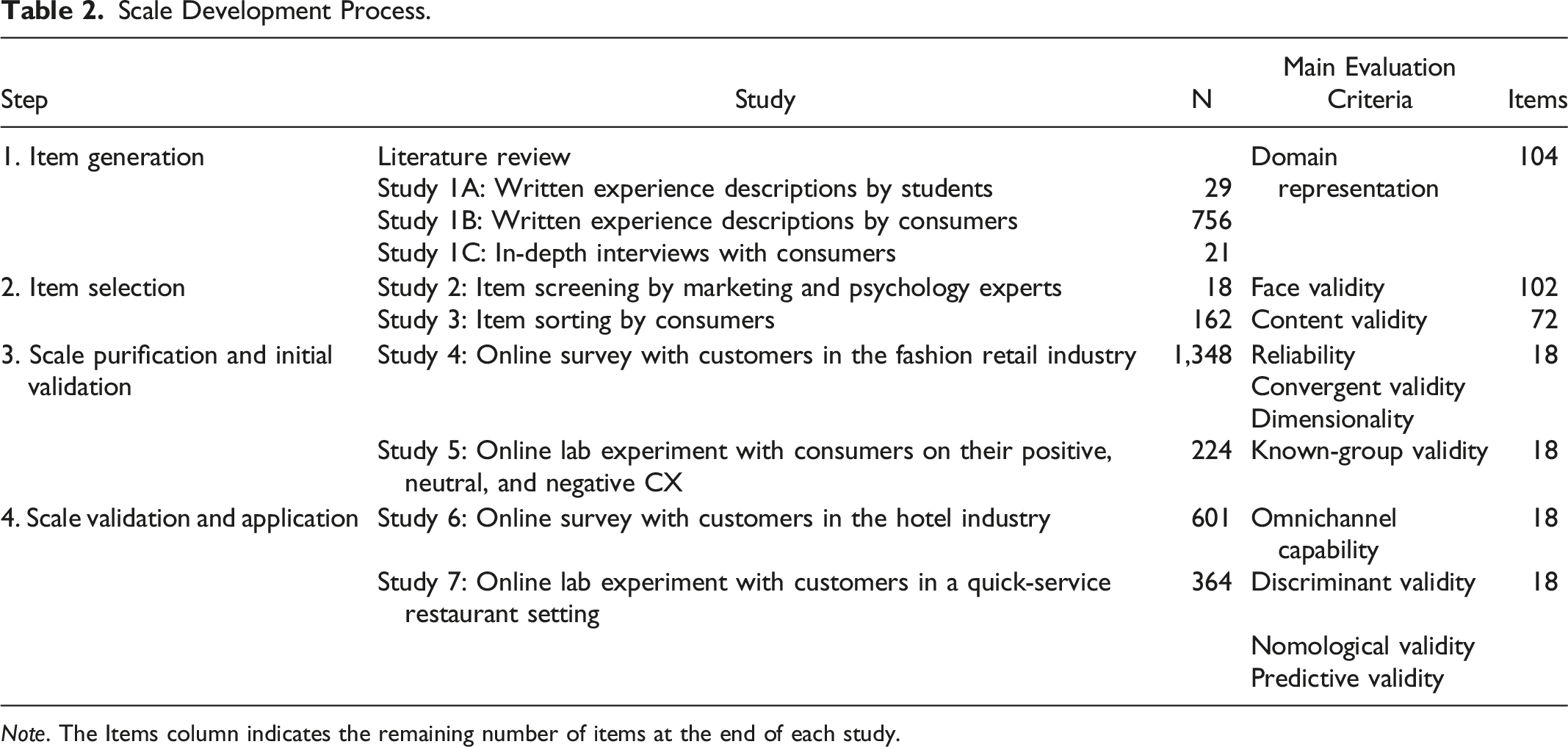
Note. The Items column indicates the remaining number of items at the end of each study.
Developing a Customer Experience Scale
We follow established procedures for scale development (Churchill 1979; MacKenzie et al. 2011; Netemeyer et al. 2003). In this section, we describe how we develop and initially validate the CX scale in line with our conceptualization and measurement requirements.
Step 1: Item Generation
To generate an initial pool of items that represents the domain of the construct, we conducted three qualitative studies to assess customers’ perceptions of CX, in line with recommendations on scale development (Netemeyer et al. 2003) and recent scale development procedures (e.g., Boettger et al. 2017; Kuehnl et al. 2019). First, we asked 29 business students (55% women; Mage = 24.71 years; SDage = 4.91) to describe CX in an open-ended way (Study 1A), indicating that they should detail their experiences in different customer interactions during a self-selected customer journey. Second, to ensure the robustness of the item generation for a larger sample and across multiple industries, we obtained short CX descriptions from 756 participants in an online consumer panel (45% women; Mage = 36.54 years; SDage = 10.83). They answered a grand-tour question about a recent CX (“What are the essential aspects that you remember from your recent experience?”) in one of six industries (nEducation = 119; nEvents = 101; nHealthcare = 138; nHospitality = 137; nRetail = 125; nTravel = 136) (Study 1B). Third, we interviewed 21 consumers (57% women; Mage = 30.52 years; SDage = 11.59) about their CX in depth (Study 1C). To gain deeper information, we asked questions related to all six dimensions for every customer interaction. The interviews lasted 50 min on average; we audiotaped and transcribed them, resulting in a transcript of 208 single-spaced pages.
We applied text coding to identify and analyze these participants’ descriptions. We coded both the CX descriptions and interviews, resulting in 3,077 coded customer statements, and we applied a constant comparative method (Glaser 1965). The participants consistently described their CX by noting various mental responses that pertained to one or more key CX dimensions. Notably, they described positive and negative experiences (e.g., affective: happiness vs. sadness) related to each dimension. With respect to the customer interaction context, in all three studies, participants described experiences with various experience partners (brand, employee, other customers) at different touchpoints (offline, online) along stages of the customer journey (prepurchase, purchase, postpurchase). Web Appendix W2 provides sample descriptions. Taken together, these qualitative insights support our conceptualization of CX.
To develop an initial item pool, we combined items adapted from the 11 existing experience scales (Table 1) with frequent customer statements available from the three qualitative studies. In line with the CX subjectivity requirement, we worded the items to assess the valence of CX from the customer’s point of view. Specifically, we use personal pronouns (e.g., I, me, my) to put the participant in the center of the depicted experience situation (i.e., to measure subjective mental responses). Furthermore, the positive wording of the items and the Likert response format follows scale development recommendations for experience-related constructs (e.g., Brakus et al. 2009). A higher (lower) score on the CX scale corresponds to a more positive (negative) CX.
The traveling character of CX also requires scale items that reflect different customer interaction contexts in the omnichannel domain (CX directedness). Therefore, the developed scale items include placeholders for the experience partner (e.g., “The contact with the [experience partner] induced good emotions,” where “experience partner” can be a brand, employee, or other customers). Although the items are independent of the touchpoint type and customer journey stage, we refer to them in the introductory text of the CX scale. The placeholders are defined a priori by the customer interaction contexts that constitute the construct’s domain (we subsequently validate them for those contexts). Moreover, the item pool spans all six key CX dimensions (CX multidimensionality). This process resulted in an initial item pool of 104 items.
Step 2: Item Selection
From this initial item pool, we seek to select items that fit the CX dimensions best, in terms of their face and content validity. To assess face validity, we asked 18 marketing and psychology academic experts to evaluate the applicability of each item to each CX dimension (3-point scale, 1 = “not applicable,” 3 = “very applicable”; Study 2). If fewer than 60% of the experts rated an item applicable or very applicable (21 items), we adapted it. We deleted 2 items due to strong overlap with other items. To check for content validity, 162 participants (59% women; Mage = 44.93 years; SDage = 14.52) of an online consumer panel performed an item-sorting task (Study 3). Having read definitions of the six CX dimensions, they assigned the remaining 102 items to the one dimension they thought it best reflected. We discarded all items for which the proportion of substantive agreement was less than 50% or the substantive validity coefficient was below .3 (Anderson and Gerbing 1991), resulting in a reduced pool of 72 face- and content-valid items.
Step 3.1: Purification and Convergent Validity
Using this reduced pool of 72 items, we purified the scale and assessed its reliability, convergent validity, and dimensionality (Study 4). In line with our conceptualization, we assess CX according to a six-factor model with correlated dimensions (CX multidimensionality).
Participants and Procedure
We recruited 1,348 customers of fashion retailers (52% women; Mage = 52.91 years; SDage = 17.13) through a German online panel. With the reduced pool of 72 items, the participants evaluated their CX in a single customer interaction context in the fashion retailing industry, reflecting an interaction with one experience partner (brand, employee, other customers) at a certain touchpoint type (online, offline) in a customer journey stage (prepurchase, purchase, postpurchase). Participants then rated each of the 72 items on a 7-point Likert scale (“Please indicate how much you agree or disagree with each of the following statements”). 5
Scale Purification
In purifying the scale, we deleted 16 items due to their relatively low representativeness for their dimension (i.e., corrected item-to-total correlations < .60; Cronbach 1961). We conducted confirmatory factor analyses (CFA) based on the six-dimensional conceptualization of CX; that is, we use a reflective six-factor model with correlated dimensions (Arnold and Reynolds 2003; Boettger et al. 2017). 6 In the first step, we specified a six-factorial confirmatory model with all 56 items. Its fit indices failed to reach acceptable thresholds (confirmatory fit index [CFI] = .90; Tucker-Lewis index [TLI] = .89; root mean square error of approximation [RMSEA] = .055; square root mean residual [SRMR] = .059). We refined the scale by deleting 15 items with relatively low indicator reliabilities (< .50) and performed a second CFA on the remaining 41 items. To improve model fit further, we inspected the modification indices, which resulted in the deletion of 8 items involved in more than 15 significant modification indices (>3.84; Arnold and Reynolds 2003). The remaining 33 items revealed good model fit (CFI = .96; TLI = .96; RMSEA = .046; SRMR = .039). However, a 33-item scale would be too extensive for practical use. We followed existing recommendations for developing parsimonious scales and selected the three items with the highest loadings for each CX dimension (Boettger et al. 2017; Kuehnl et al. 2019). This process eliminated semantically similar items but did not diminish the content validity (see Web Appendix W4). Thus, we obtained an 18-item, six-dimensional CX scale.
Convergent Validity and Dimensionality
Psychometric Properties of the CX Scale.
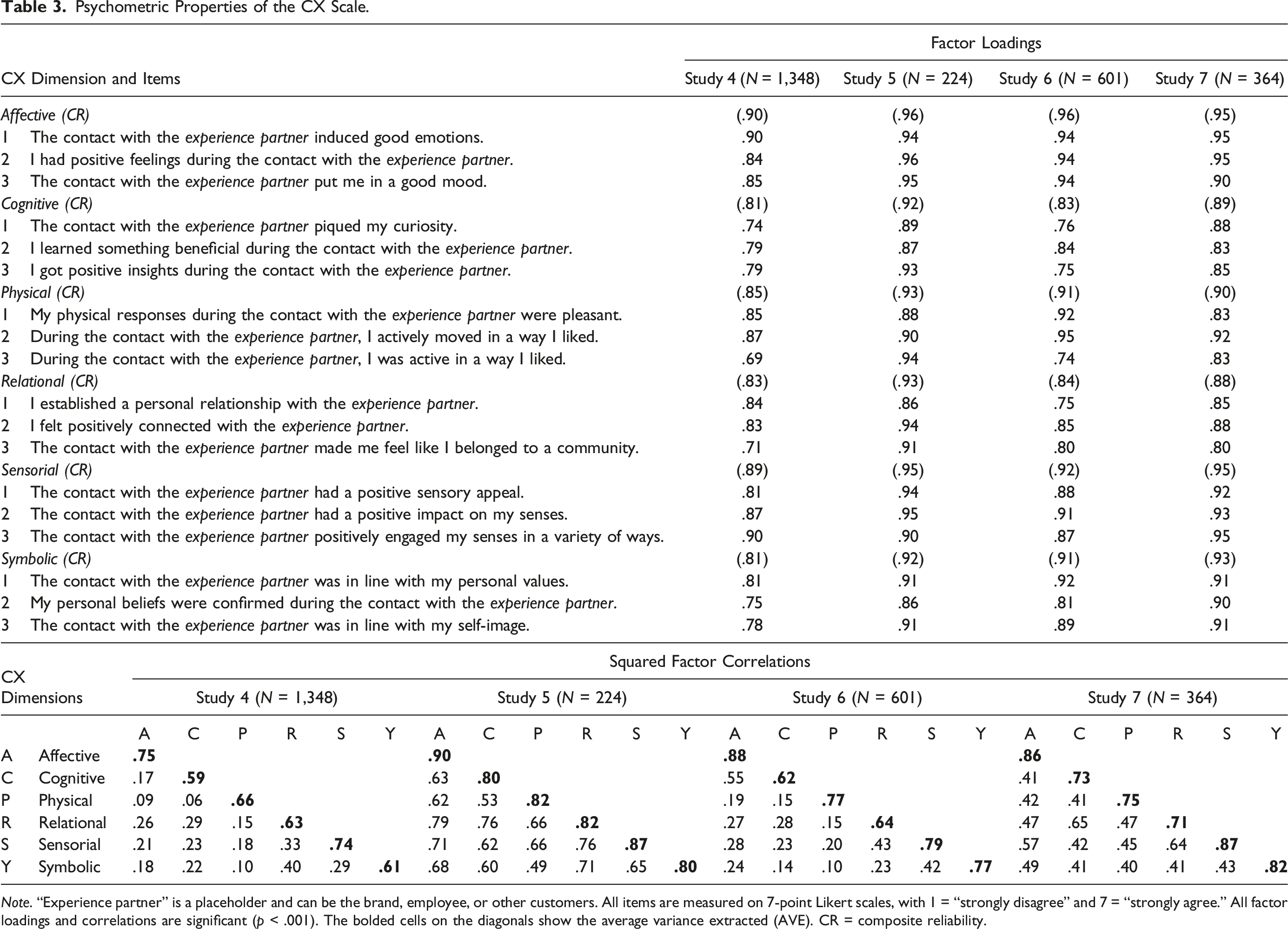
Note. “Experience partner” is a placeholder and can be the brand, employee, or other customers. All items are measured on 7-point Likert scales, with 1 = “strongly disagree” and 7 = “strongly agree.” All factor loadings and correlations are significant (p < .001). The bolded cells on the diagonals show the average variance extracted (AVE). CR = composite reliability.
Step 3.2. Known-Group Validity
Because the CX scale aims to provide insights into the nature of an experience in terms of how negative, indifferent (neutral), or positive that experience is for a customer (De Keyser et al. 2020), we need to test if it can discriminate along a continuum from negative over indifferent (neutral) to positive (CX subjectivity). Thus, we conduct a known-group validity test (Study 5).
Participants and Procedure
This experiment included 224 participants (46% women, Mage = 35.92 years; SDage = 10.76) obtained from a U.S. consumer online panel. We randomly assigned them to one of three conditions that asked them to recall a recent CX that was positive, neutral, or negative (between-subjects design). Participants wrote a short description of their CX, then rated their CX using the scale. In support of its convergent validity, the 18-item scale (CFI = .98; TLI = .97; RMSEA = .062; SRMR = .025) showed good model fit and convergent validity (see Table 3).
Known-Group Validity
To test whether our valence manipulation was successful, we coded the participants’ experience descriptions. In support of our manipulation, 88.4% (84.7%, 92.1%) of participants in the positive (neutral, negative) valence conditions described their experience in line with the respective task to recall a positive, neutral, or negative CX (p < .001). Across the three valence conditions, we performed a known-group validity test (Churchill 1979). We expected participants reporting on positive (negative) experiences to have significantly higher (lower) average scores on the CX scale and for each dimension. In support of known-group validity, participants scored on the scale in the expected direction (Mpositive = 5.31, Mneutral = 4.14, M negative = 2.70, F (2,221) = 84.43, p < .001) and in the expected ranges for Likert scales regarding positive (>4.5), neutral (3.5–4.5), and negative (<3.5) scores. All pairwise comparisons of means were significant (p < .001). We also found support for known-group validity for each CX dimension separately, as detailed in Web Appendix W7. Thus, the CX scale can discriminate a range from negative to positive experiences.
Customer Experience Scale Validation and Application
We further seek to validate it in different service contexts. By assessing its measurement invariance and validity in different customer interaction contexts in the hotel industry, we can empirically illustrate the CX scale’s omnichannel capability (Study 6). We also conduct checks of discriminant, nomological, and predictive validity in a quick-service restaurant setting (Study 7).
Building on these validation studies, we illustrate the application of our CX scale for service firms. For the application of a CX scale in the omnichannel environment, we can either focus on using cross-sectional or longitudinal data. Both applications can provide interesting insights. On the one hand, cross-sectional studies in which customers assess only a single experience for a certain interaction with our scale allow us to derive insights from the efficient comparison of different CX measurements across multiple customer interactions and customers. On the other hand, longitudinal studies in which customers use our CX scale several times to evaluate multiple single experiences for different successive interactions enable us to understand CX developments and changes in individual customers and journey paths. Although longitudinal applications are beneficial for considering the temporal order of customer interactions to justify how the effects of CX carry over from one interaction to another, we focus on the cross-sectional application of our scale, for three reasons: As customers only need to evaluate a single interaction with our CX scale, it (i) provides an easy to manage form of CX measurement and benchmarking, (ii) reduces response biases due to avoiding questionnaire fatigue and panel conditioning, and (iii) is less time consuming and cheaper due to smaller samples, faster data collections, and no panel attrition (cf. longitudinal studies; Hair et al. 2021). Thus, we test a simple, powerful application of the CX scale, in line with common data collection practices (e.g., HappyOrNot 2021; Qualtrics 2020).
To apply the CX scale to benchmark customer interactions, typically, service managers should follow a two-step approach. First, they should leverage the CX scale to monitor and benchmark their customers’ experiences in the omnichannel domain and identify crucial pain points as significant negative deviations of CX ratings across customer interactions. With a pain-point analysis, service managers can identify opportunities for and focus initiatives on improving customer interactions with specific experience partners, touchpoints, or customer journey stages. Second, they can use the scale to engage in CX profiling and inform their efforts to improve the CX design of customer interactions according to the marketing activities and CX dimensions that offer the greatest opportunities for improving the CX and its outcomes.
Step 4.1: Validation in the Omnichannel Environment
To test the validity of our 18-item CX scale with a new sample, we conducted a CX survey with an international hotel chain. In this context, we pay particular attention to testing the scale’s measurement invariance and validity across different customer interaction contexts (Study 6).
Participants and Procedure
We first conducted interviews with three hotel managers to identify focal customer interactions of interest for the chain. These interviews revealed a list of key customer interactions in the omnichannel environment (Web Appendix W8), which consistently include the three experience partners (brand, employee, other customers), two touchpoint types (online, offline), and three journey stages (prepurchase, purchase, postpurchase). We sampled 601 U.S. hotel customers (52% women; Mage = 35.23 years; SDage = 11.15) and asked them to evaluate their CX during one customer interaction, after we randomly assigned them according to the 3 experience partners × 2 touchpoints × 3 customer journey stages design. This procedure mimics common CX monitoring practices 8 and also limits the risk of respondent fatigue; customers do not have to evaluate every interaction within their customer journey. Furthermore, this design enables validity tests across different interaction contexts. By programming the survey questionnaire, we ensured that the textual placeholders in the CX scale and its introductory text specified the corresponding experience partner (e.g., employee), touchpoint (e.g., local travel agency), and customer journey stage (e.g., before booking) for the customer interaction we asked the respondent to report; Web Appendix W9A contains an example. Participants reported their CX on a 7-point Likert scale (1 = “strongly disagree,” 7 = “strongly agree”), using all 18 items.
Measurement Invariance
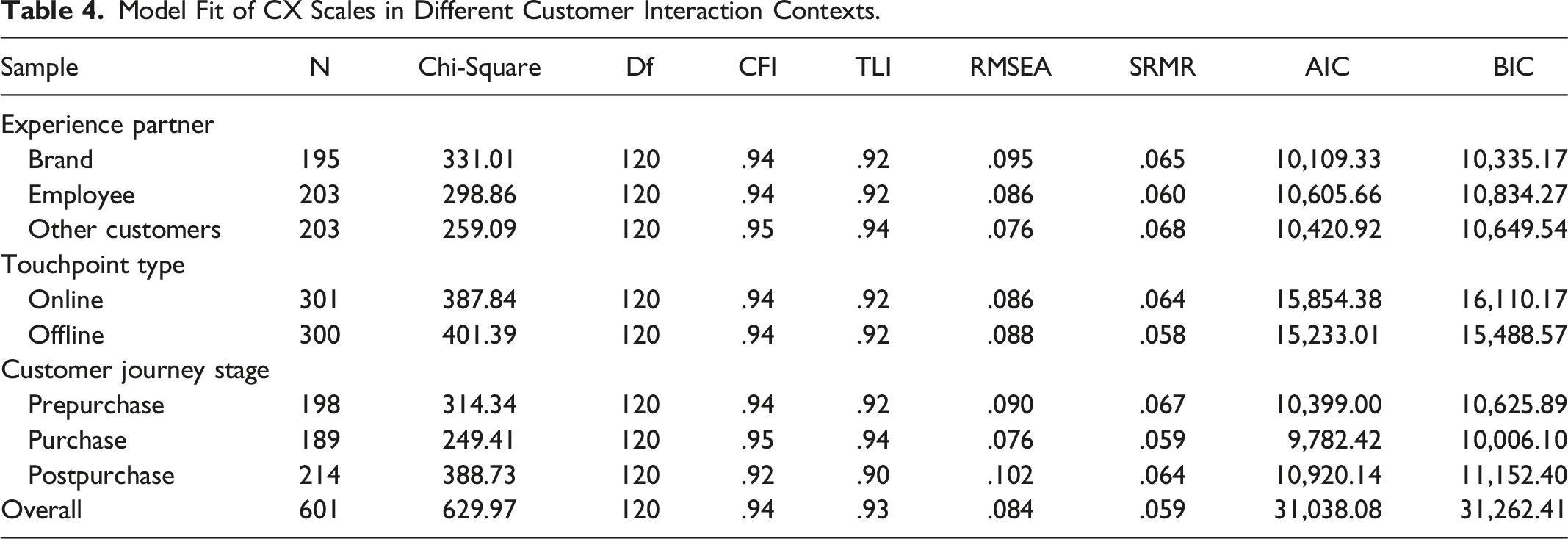
To check whether comparisons between different interaction contexts are meaningful, we conducted separate measurement invariance tests for experience partners, touchpoint types, and journey stages. Using a multigroup CFA (Jöreskog 1971), we find configural, metric, and scalar invariance for experience partners (
Scale Performance across Customer Interaction Contexts
Model Fit of CX Scales in Different Customer Interaction Contexts.
Step 4.2: Application in Pain-Point Analyses in Customer Journeys
Having established the measurement invariance of our CX scale and validity across different customer interaction contexts in the omnichannel environment, we proceed with our first application. The preceding validation allows us to compare means meaningfully between different customer interaction contexts, such that we can monitor and benchmark CX to identify CX pain points (i.e., significant, negative deviations of CX ratings across all customers for a customer interaction compared with a relevant benchmark from a manager’s perspective such as another experience partner, touchpoint, and/or customer journey stage). Customers often interact with experience partners and touchpoints during a journey stage for the same main reasons. For example, gaining information (prepurchase), booking the hotel (purchase), and giving feedback (postpurchase) are the main reasons for the customer interactions in our hotel case. Companies aim to address these similar customer needs by designing the relevant interactions at the same performance level, but they might result in different CX performances from customers’ perspectives. Benchmarking different experiences across customers helps managers and researchers identify which customer interactions perform worse than others and thus should be improved or removed to increase overall CX performance. By identifying pain points, companies can investigate critical customer interactions to determine if they can be improved or if a different interaction in the omnichannel environment might be a better choice to fulfill the same customer need, then design customer journeys to steer customers in that direction. For example, if the online booking process with employees results in comparatively more negative experiences than an offline booking process with employees or online booking processes alone on the brand’s website, the company might implement new service guidelines for employees responsible for the online booking process or close this service and direct customers to use the offline interaction with employees or the online process alone on the brand’s website. The pain-point analysis reveals potential roadblocks raised by specific interactions from customers’ point of view and prioritizes certain interactions in customer journeys (McColl-Kennedy et al. 2019).
In a pain-point analysis, service managers have different options to benchmark customers’ CX ratings, namely, across experience partners, touchpoints, and customer journey stages. Building on Study 6, we provide an example of how to conduct a pain-point analysis with our CX scale. Figure 2(a) and (b) show the results, using the relational CX dimension as an example. Exemplary visualizations for CX dashboards.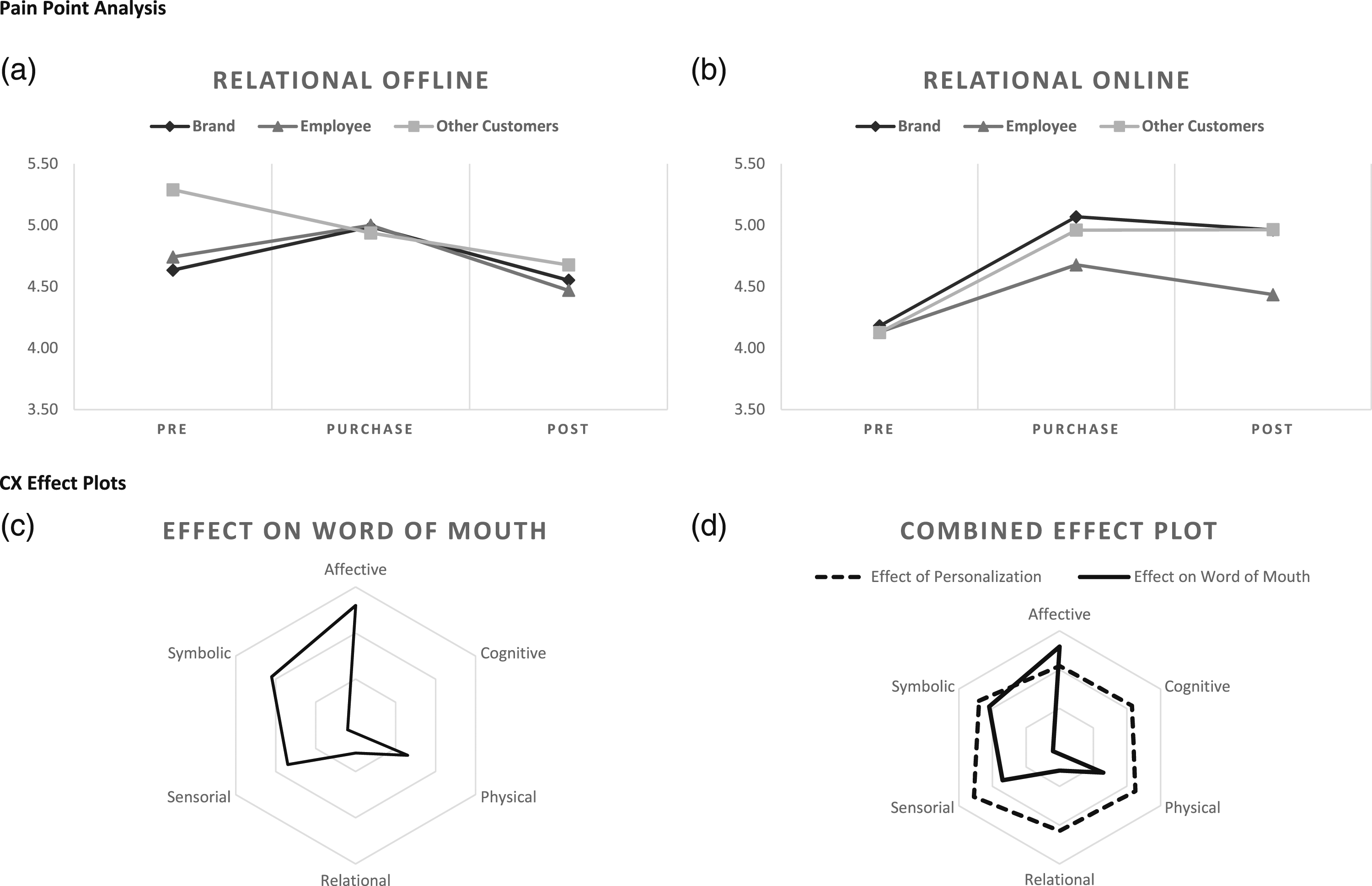
Benchmarking of Experience Partners
In online environments, the relational experience with employees represents a pain point, compared with the CX performance of the other experience partners. When we zoom in on CX ratings across customer journey stages for online touchpoints, we find that the ratings for brands (MPre = 4.18, MPurch = 5.07, MPost = 4.96; F (96,2) = 4.72, p = .011) and other customers (MPre = 4.12, MPurch = 4.96, MPost = 4.96; F (102,2) = 6.18, p = .003) recover significantly from the low prepurchase experience rating to the postpurchase stage, but relational CX ratings for employees do not (MPre = 4.13, MPurch = 4.68, MPost = 4.44; F (94,2) = 1.17, p = .314). This pattern and trend across journey stages indicates a pain point and potential need to improve relational experiences with employees online (live chats with hotel employees during various journey stages in our hotel case). However, further improvements of employees’ performance might not be possible (e.g., further guidelines or training will not increase CX). Then, to improve the company’s online CX performance, service managers can deliberately manage customer journeys by steering customers to interactions with the brand or other customers in the prepurchase stage (i.e., providing information on the brand’s website and online customer ratings).
Benchmarking of Touchpoints
The prepurchase stage online evokes low relational CX for customers across all three experience partners. This CX pain point is particularly evident when we compare this journey stage with the equivalent prepurchase stage but offline (MOff = 4.87; MOn = 4.15; F (196,1) = 15.11, p = .000), as well as with other journey stages that entail online touchpoints (MPre = 4.15, MPurch = 4.90, MPost = 4.78; F (298,2) = 9.96, p = .000; post hoc comparison pre versus purch/post significant at p = .000). That is, all comparisons indicate a significant dip and (assuming the manager considers it relevant) a CX pain point for relational CX in the prepurchase stage online. In our hotel setting, this pain point pertains to interactions when customers browse for information on the website (brand), ask questions via live chats (employee), or read customer ratings (other customers; see Web Appendix W8). Service managers should investigate how to improve these customer interactions or steer customer interactions towards better performing, offline touchpoints.
Benchmarking of Customer Journey Stages
Among offline touchpoints, we find a significant dip in the relational experience from the prepurchase to postpurchase stage for all experience partners (MPre = 4.87, MPurch = 4.97, MPost = 4.56; F (297,2) = 3.05, p = .048; post hoc comparison post versus pre/purch significant at p = .073/.019). This decline is particularly prevalent for relational experiences with other customers (MPre = 5.29, MPost = 4.68, t (59,1) = 4.06, p = .049). For the hotel, it implies a dip in the relational experience, from customers’ participation in travel talks with other customers (prepurchase) to after-travel events (postpurchase). To remove this pain point, managers should try to align the after-travel events better with the prepurchase travel talks.
These insights provide a basis for further investigations into ways to improve CX for these customer interactions. When managers conduct pain-point analyses for all relevant CX dimensions, they can gain a comprehensive picture of their CX performance and a roadmap for where to invest. This example represents one option for applying the scale; managers also might benchmark different branches or gauge their performance relative to competitors’ or industry standards. Yet this application also effectively illustrates an important advantage of our scale: Its purposeful omnichannel capability facilitates comparisons of CX means across customer interactions in omnichannel environments. Rather than using multiple scales, researchers and managers can use this common measure to benchmark CX ratings across experience partners, touchpoints, and customer journey stages in omnichannel environments.
Step 4.3: Validation in the Nomological Net
We also seek to assess the scale’s discriminant, nomological, and predictive validity (Study 7). In line with our conceptualization, CX occurs during customer interactions and drives subsequent attitudinal and behavioral consequences (Becker and Jaakkola 2020). Thus, it takes a unique position in the nomological network of antecedents and consequences.
Antecedents
The antecedents of CX mainly involve experience partners’ actions. Companies design and manage marketing activities to influence CX through interactions (Grewal et al. 2009; Puccinelli et al. 2009). The list of potential marketing activities is vast; for the purposes of our empirical study, we focus on personalization, a common CX driver, in both research (Lemon and Verhoef 2016) and practice (McKinsey 2020).
Customer Experience Dimensions as Mediators
Because CX originates and exists due to the interaction of a customer with an experience partner, the six dimensions may mediate the link between actions by an experience partner and its consequences (Becker and Jaakkola 2020). In line with our conceptualization, each customer evaluates CX dimensions separately and distinguishes their importance (CX multidimensionality). Thus, CX dimensions do not have to be equally important across contexts (i.e., not all CX dimensions must mediate every customer interaction). For example, in transactional, quick-service restaurants, cognitive and relational CX dimensions may be less relevant than other CX dimensions (Solomon et al. 1985; Yim et al. 2008). 10
Consequences
Both attitudinal and behavioral consequences result from CX. Attitudinal consequences reflect customers’ beliefs about and evaluations of their interactions with an experience partner; they form after the interaction has taken place (Fishbein and Ajzen 1975). Prior research identifies customer attitudes (e.g., toward a brand) and customer satisfaction (e.g., with an employee) as attitudinal consequences of CX (Brakus et al. 2009; Lemon and Verhoef 2016). Furthermore, CX may drive customers’ behavioral outcomes. For example, many customers like to share their experiences with others and repeat positive experiences, so CX should lead to word of mouth (WOM) and loyalty (Lemon and Verhoef 2016).
To assess the discriminant, nomological, and predictive validity of the CX scale, we use an experimental design in which customers evaluate an interaction in a quick-service restaurant, following an interaction with an employee during the purchase stage. The interactions between employees and customers are short transactions based on standardized scripts (Bowen 1990). We manipulate personalization as an experience partner action and assess the effects of the CX.
Participants and Procedure
The sample consists of 364 participants (43% women; Mage = 35.76 years; SDage = 12.59) from an online panel in Germany. We first randomly assigned them to an interactive video with either high or low personalization that depicted a scene in which they order a salad from an employee at the counter of the restaurant (i.e., between-subjects design). To manipulate personalization, we used interactive videos based on greenscreen technology (Web Appendix W10). The employee asked the participant to choose from different ingredients and dressings for a made-to-order salad in the high personalization condition; in the low personalization condition, the employee simply listed the ingredients of a standard salad without asking questions, then asked the participant to pick a dressing. To ensure a realistic depiction, a waiter from a representative quick-service restaurant assisted us in preparing a script and played the employee. After this interactive video, participants completed a survey that included measures of personalization (manipulation check), CX (Web Appendix W9B), attitudes toward the employee, satisfaction with the service, WOM intentions, and loyalty (i.e., revisit behavior).
Measures and Manipulation Check
We measured personalization, CX, attitude, satisfaction, and WOM using 7-point Likert scales (1 = “strongly disagree,” 7 = “strongly agree”) and customer loyalty using a binary measure (“Would you visit the restaurant again?”; 1 = yes, 0 = no) (Web Appendix W11). 11 In line with our previous results, the CX scale shows good model fit and convergent validity (CFI = .96, TLI = .95, RMSEA = .073, SRMR = .049; see also Table 3). The manipulation check for personalization worked as intended (Mhigh = 5.76, Mlow = 4.53, t (362) = 8.25, p < .001).
Discriminant Validity
To check for discriminant validity, we assessed whether the CX construct is empirically distinct from its antecedents and consequences; the CX dimensions affirm low squared correlations (< .4) with the related constructs (Bergami and Bagozzi 2000). We also compared the squared correlations of all five constructs and the CX dimensions with their AVEs (Fornell and Larcker 1981). In support of discriminant validity, the AVEs for each construct exceeded all squared correlations with the CX dimensions (Web Appendix W12).
Nomological Validity
Results of Mediation Analysis for CX Dimensions (Study 7).
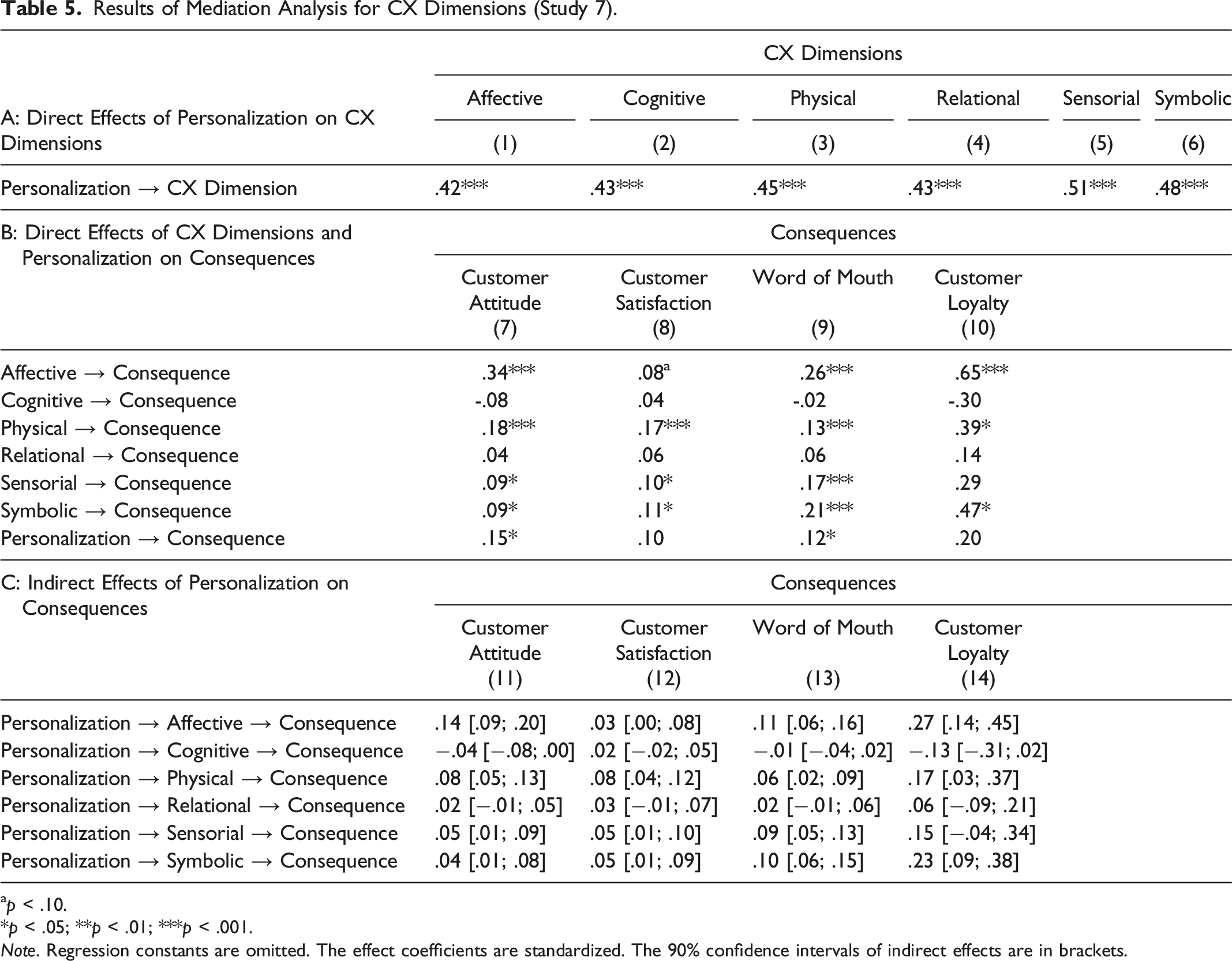
ap < .10.
*p < .05; **p < .01; ***p < .001.
Note. Regression constants are omitted. The effect coefficients are standardized. The 90% confidence intervals of indirect effects are in brackets.
Predictive Validity
In a confirmatory factor model (CFI = .97; TLI = .96; RMSEA = .058; SRMR = .041), the six CX dimensions are independent constructs, and the three latent CX consequences are dependent constructs. The variance in customer attitudes explained by the CX dimension is 80.92%. The CX dimensions predict satisfaction well, with a variance explained of 82.39%. For WOM, the CX scale explains more than 82.96% of the variance. These results exceed recommended thresholds and support the predictive validity of the CX scale (Hair et al. 2021).
Step 4.4: Application for Customer Experience Profiling
Having validated the CX scale in its nomological net, we illustrate how service managers can use the scale for CX profiling and in turn devise better CX designs for their services (Keiningham et al. 2020). For managers, CX profiling is of particular interest; it indicates how the company is performing on each CX dimension and how each dimension translates into consequences (e.g., WOM). By investigating key CX drivers, service managers can identify which marketing activities increase CX (e.g., personalization) and steer investments toward improving these antecedents. For researchers, similar analyses could provide nuanced insights into the role of distinct CX dimensions for specific customer interactions. We consider a couple of exemplary research questions and, in line with Study 7, include WOM as a focal outcome to illustrate the application.
Which CX Dimensions are Most Relevant for Creating Desired Outcomes?
For managers of the quick-service restaurant from Study 7, Figure 2(c) reveals that the greatest potential for driving positive WOM involves affective, sensorial, and symbolic CX dimensions. Cognitive and relational CX dimensions do not contribute to WOM—which is not to suggest they are not important, but, according to this fine-grained result, they are not key drivers of WOM for this type of customer interaction. We also note the significant, strong influence of the symbolic CX dimension on the consequences of customer interactions in this restaurant (Figure 2(d), Table 5), whereas symbolic CX dimensions rarely get included in existing experience scales (Table 1). This finding reiterates the importance of capturing all six CX dimensions so that managers do not skip vital experiences that drive important, influential customer outcomes.
To What Extent can CX Dimensions be Improved Using Marketing Activities?
Considering its importance for managerial practice (McKinsey 2020), we investigate personalization of the service offering as a key driver of CX. Depending on the industry or specific interest of service managers, other marketing activities also might be tested, but in the combined effect plot in Figure 2(d), we determine that personalization can improve CX for each of the experience dimensions, even if not all dimensions are relevant for evoking WOM. Consider the cognitive dimension: Using personalization to increase this dimension would be in vain if the goal were to increase WOM, because more positive cognitive CX does not increase this outcome. With spider plots, managers can identify which marketing activities are useful for increasing specific CX dimensions and whether a change in each CX dimension improves relevant marketing outcomes.
Because our CX scale is a measure with six correlated dimensions that are not unified under a higher-order construct, it can provide detailed insights into how marketing activities influence single experience dimensions and how the effects on different CX dimensions lead to marketing outcomes. Thereby, it offers diagnostic information about which marketing activities actually drive CX consequences, which is crucial for research and managerial practice (McColl-Kennedy et al. 2019). Applications of the scale can provide nuanced insights into how marketing actions, CX, and firm outcomes connect, as well as their implications for customers and firms that serve them.
Discussion
Monitoring, designing, and managing customer experiences is a fundamental basis for service firms’ competitiveness and thus a key strategic priority for service managers. To enable effective CX management in complex omnichannel environments, we develop an omnichannel-capable CX scale. To ensure omnichannel capability, we conceptualize CX as a traveling construct and develop the scale in accordance with the defining features of conscious experiences (subjective, directed, and multidimensional). We validate the scale across customer interaction contexts in the omnichannel environment, spanning different experience partners, touchpoints, and customer journey stages, and we also illustrate its viable application for CX monitoring (i.e., pain-point analysis) and CX design (i.e., CX profiling) efforts by service firms.
Implications for Marketing Research
Our scale addresses calls for a common CX measure that applies to complex omnichannel environments (MSI 2018) and concerns that “current experience scales are not as well developed as the high-impact measures in other domains, such as service quality (SERVQUAL) and market orientation (MARKOR)” (Lemon and Verhoef 2016, p. 88). Because we consider the omnichannel capability of the CX construct from the start of our scale development process, we ensure that the scale and its dimensions fit different customer interaction contexts. Then, we validate the scale in each of these contexts and identify measurement invariance across contexts. As such, this contribution differs notably from existing experience scales that focus on a specific customer interaction context, which cannot provide a CX measure for the omnichannel domain (e.g., Arnould and Price 1993; Bleier et al. 2019; Brakus et al. 2009). Thereby, our CX scale overcomes the fragmentation of existing experience measures, which is crucial to enabling comparisons of CX across customer interaction contexts: It reduces measurement ambiguity, identifies all relevant CX dimensions in the omnichannel domain, and avoids simply extending existing scales to new customer interaction contexts. In turn, a common CX measure supports comparisons of CX without involving potentially invalid efforts to stretch existing scales to new applications (MacKenzie 2003). It also provides a way to measure CX in contexts in which no scale currently exists. Thus, we provide a common empirical basis for understanding CX in omnichannel environments (Lemon and Verhoef 2016). Our empirical efforts complement recent conceptual approaches in service literature that propose consolidating CX research to offer a common basis for CX management in service domains (Becker and Jaakkola 2020; De Keyser et al. 2020).
On a general level, the omnichannel capability of our scale reveals the appeal of traveling constructs and provides an example of how to develop scales for them (Osigweh 1989). If scale development processes take traveling constructs into account from the start, they can produce valid scales that are precise enough to measure the focal construct consistently in terms of its content and broad enough to be used and tested empirically across contexts throughout the entire domain, not just specific parts of it. Such traveling constructs and their scales are particularly interesting for high-impact measures designed to be used across contexts, because they avoid fragmentation, provide meaningful comparisons, and establish generalizable research findings (Osigweh 1989).
With its omnichannel capability and six key dimensions, the proposed CX scale also provides a foundation for continued empirical research. The ability to capture and compare CX throughout the omnichannel domain using a single measure addresses calls for a new metric that facilitates CX monitoring and CX design across customer interactions (Ostrom et al. 2021). It also is well-suited to help managers identify, prioritize, and improve crucial customer interactions along customer journeys in omnichannel domains (Zomerdijk and Voss 2010). For example, when we applied our CX measure for a pain-point analysis of a hotel chain, we found that employees in online interactions, and particularly in the prepurchase stage, were not performing up to par when it comes to achieving sufficient relational CX performance. This and similar empirical results can offer a starting point for further investigations of how service employees, the brand, or other customers can create more positive CX for service firms (Bock et al. 2016; Colm et al. 2017).
Similarly, our CX scale provides nuanced insights into drivers and consequences of distinct CX dimensions, such as the role of different CX contents (Keiningham et al. 2020). In the quick-service restaurant example we provide, the symbolic dimension has an important role as a driver of WOM. Empirical investigations of this largely neglected symbolic CX dimension appear particularly crucial, considering that companies appear increasingly devoted to providing services and marketing activities that reflect customers’ personal values and self-images, such as sustainability, social justice, and other sociopolitical polarized considerations (MSI 2021). This finding reiterates the importance of capturing all six CX dimensions for customer interactions to identify all the vital experiences that drive customer outcomes.
Implications for Service Practitioners
The CX scale addresses critical needs related to the monitoring and design of CX in service firms (Ostrom et al. 2021; Qualtrics 2021): It provides a common CX measure for various customer interactions in the omnichannel environment. The availability of a single CX metric is vital for reducing the complexity of dashboards. As such, the scale enables faster identification of opportunities for CX improvements and important quick wins to strengthen service management (De Keyser et al. 2020). A common measure can facilitate two critical applications that help firms improve their CX management and outcomes: pain-point analysis and CX profiling.
Pain-Point Analysis
Due to the omnichannel capability of the scale, service managers can use it to monitor and benchmark CX in omnichannel domains. Because it can benchmark CX with a single metric for the key building blocks of customer interactions (i.e., experience partners, touchpoints, and journey stages), the scale can be used to identify crucial pain points across customer interactions. Service managers can then conduct a closer investigation to check if these interactions can be improved or if a different customer interaction in the omnichannel environment might be the better choice, such that they should design customer journeys to steer customers toward this interaction. For example, a comparison of online versus offline customer experiences allows service managers to detect when a CX might be better when taking place digitally (e.g., service chat with an employee online) versus more traditionally offline (service contact with a frontline employee in store). As technologies and non-human brand interactions advance (Ostrom et al. 2021), the CX scale also might help establish the relevance of frontline employees in complex omnichannel environments. For example, comparisons of experiences with brands versus employees can support data-driven decisions about employee integration into service delivery processes. Together with insights from a pain-point analysis, managers can develop initiatives to improve customer interactions with specific experience partners, at specific touchpoints in specific customer journey stages, and nudge them along journey paths that avoid poor CX performance.
Customer Experience Profiling
For each customer interaction, service managers also might use the scale for CX profiling purposes. By identifying which marketing activities and CX dimensions offer the greatest opportunities, the scale can guide the CX design of customer interactions in service industries. For example, with a key driver analysis, managers might learn that addressing sustainability factors can increase the symbolic experience—and signal that the service provider embraces customers’ values. As such, service managers can investigate whether the service provided is in line with the personal values of their customers, then confirm that the symbolic experiences created by their service offering actually have a bottom-line impact on customer behavior, such as WOM. Based on these results, they can investigate the performance consequences of improving each CX dimension. Spider-effect plots provide an easy-to-use visualization of CX insights that can be added to marketing dashboards. Thus, the CX scale contributes to recent initiatives to provide more profound CX recommendations for practice and conduct more nuanced investigations of different CX dimensions (Keiningham et al. 2020; McColl-Kennedy et al. 2019).
Avenues for Further Research
Because it overcomes the fragmentation of existing CX measurements and provides a common measure for empirical CX research, we regard the CX scale as a viable foundation for further empirical research and knowledge creation. First, the ranges of possible marketing activities and firm outcomes are vast; we consider only a few. With the proposed scale, researchers could address the dearth of research into antecedents and consequences of CX (Lemon and Verhoef 2016). Second, we asked customers to rate their CX for one specific customer interaction in our cross-sectional studies. This approach mimics managerial practice and provides a simple way to benchmark CX (e.g., HappyOrNot 2021; Qualtrics 2020), but it is also limited in that it does not measure all experiences of a single customer along an entire journey. Applying our CX scale in a longitudinal study in which single customers evaluate the CX at each interaction of their journey could improve our understanding of how the effects of CX carry over from one customer interaction to another, provide novel insights on individual differences of single journey paths, and enhance the 360° view of customers. Such an approach has its own challenges; it requires more complex, time-consuming forms of data collection (e.g., mobile diaries), the treatment of within-person and multilevel analysis, and guarding against questionnaire fatigue, panel conditioning, and attrition (Lovett & Peres, 2018). We thus encourage further research on how our CX scale can be applied in longitudinal applications and used to advance research on the development of experiences of single customers across their individual customer journeys. Third, our scale can provide additional insights into pain points in customer journeys. For example, studies might compare CX in technology-mediated environments that use artificial intelligence, rather than human employees, as experience partners (Ostrom et al. 2021). Fourth, further investigations of the predictive and mediating roles of the six CX dimensions would be helpful. Specifying which dimensions are most relevant for specific interaction contexts and industries, as well as comparing how the actions of different experience partners enhance each dimension, would provide vital, detailed insights for service research and managerial practice.
Supplemental Material
Supplemental Material - Customer Experience: Conceptualization, Measurement, and Application in Omnichannel Environments
Supplemental Material for Customer Experience: Conceptualization, Measurement, and Application in Omnichannel Environments by Markus Gahler, Jan F. Klein, and Michael Paul in Journal of Service Research
Footnotes
Acknowledgments
The authors thank Marnik G. Dekimpe, Tomas Falk, Inge Geyskens, Rob Smith, and Niels van de Ven for helpful comments on a previous version of this article.
Declaration of Conflicting Interests
The author(s) declared no potential conflicts of interest with respect to the research, authorship, and/or publication of this article.
Funding
The author(s) disclosed receipt of the following financial support for the research, authorship, and/or publication of this article: The authors gratefully acknowledge a Marketing Science Institute Customer Experience Grant (#4000054), which helped support this research.

Supplemental Material
Supplemental material for this article is available online.
Notes
Author Biographies
References
Supplementary Material
Please find the following supplemental material available below.
For Open Access articles published under a Creative Commons License, all supplemental material carries the same license as the article it is associated with.
For non-Open Access articles published, all supplemental material carries a non-exclusive license, and permission requests for re-use of supplemental material or any part of supplemental material shall be sent directly to the copyright owner as specified in the copyright notice associated with the article.
