




Abstract
For service researchers, contributing to academic advancement through academic publications is a raison d’être. Moreover, demand is increasing for service researchers to make a difference beyond academia. Thus, service researchers face the formidable challenge of writing in a manner that resonates with not just service academics but also practitioners, policy makers, and other stakeholders. In this article, the authors examine how service research articles’ lexical variations might influence their academic citations and public media coverage. Drawing on the complete corpus of Journal of Service Research (JSR) articles published between 1998 and 2020, they use text analytics and thereby determine that variations in language intensity, immediacy, and diversity relate to article impact. The appropriate use of these lexical variants and other stylistic conventions depends on the audience (academic or the public), the subsection of this article in which they appear (e.g., introduction, implications), and article innovativeness. This article concludes with an actionable “how-to” guide for ways to increase article impacts in relation to different JSR audiences.
The impact of service research articles defines their contribution to science, economy, society, the environment, and culture. Research article impact, typically proxied through citations and media coverage, matters for service researchers’ field recognition, career prospects, and funding. It also defines the prestige of institutions, journal editors, and entire scientific disciplines. But how can service researchers increase the impact of their articles?
Many service research articles achieve modest impact both in academia and with the general public. Within the service discipline, Journal of Service Research (JSR) articles are among the most well-cited, high-impact publications (see Web Appendix 1 for an overview of service journals’ journal impact factor and H indexes; Bitner 2014). Yet approximately 28% of its articles have 10 cites or fewer (measured July 2020). In addition, approximately 36% have yet to receive a single media mention (Altmetric 2020). The research topics could be a reason, but rigorous and conscientious review processes are in place to ensure the quality of content. The articles’ impact, or lack thereof, instead might depend on how they are written and who is reading them (Crosier 2004). Even academics frequently suggest that articles are written in an overly complicated manner, and journal review teams commonly ask authors to improve their writing style. Chief marketing officers similarly attribute their relative lack of interest in academic articles to the dense, impersonal, and emotionless writing style (Bennett 2007), noting that the knowledge is “lost in translation” (Shapiro, Kirkman, and Courtney 2007, p. 249). Other than an unfounded suggestion to mimic stylistic conventions of current or award-winning academic articles (Baron 2018), little guidance is available for service researchers on how to write for impact.
Prior research offers valuable insights on the influence of university reputation, author affiliation, and journal rankings on article impact (Stremersch, Verniers, and Verhoef 2007). Extant studies also relate the general readability of marketing articles to citations and best-paper awards (Sawyer, Laran, and Xu 2008). However, these factors are largely beyond the control of individual scholars, especially junior researchers, or are straightforwardly solved with the help of a copy editor. Several stylistic conventions (e.g., framework illustrations, explicit statement of contributions) might improve impact (Ortinau 2011), though we lack any empirical proof of such effects. Accordingly, new, actionable insights on how to write for impact may derive from conceptualizations about lexical variations (Bradac, Bowers, and Courtright 1980), which posit that intensity, immediacy, and diversity might influence the impact of written texts. Critically, however, the appropriate uses of lexical variants may depend on the articles’ target readership (academia or the public), the subsections in which the variants appear (Baron 2018), and the relative innovativeness of the topics discussed (Chandy 2003).
With this study, we aim to offer three primary insights for service researchers that might help them increase the academic and public impact (i.e., citations and media coverage) of their articles. First, we systematically derive and empirically assess the influence of lexical variations (intensity, immediacy, and diversity) and stylistic conventions on article impact, across all JSR articles published before 2020. We thereby extend previous research on nontextual (e.g., author, institution) and general readability impact factors. Second, we show that the appropriate use of the lexical variants depends on the article subsection in which they are used and the article’s relative innovativeness. Third, we offer an expansive set of actionable propositions, pitfalls, and challenges related to how to write articles to achieve greater academic and public impact.
Conceptual Background
Research article impact relates to the extent to which an article’s ideas or findings influence subsequent academic research, as well as public and managerial stakeholders (Franke, Edlund, and Oster 1990). An article’s academic impact is typically proxied using citation counts (Thelwall 2012). The general public’s uptake of scholarly works can be assessed by tracing an article’s influence on organizations and actors that transcend the university sector (Wilsdon et al. 2015). Impact measures pertaining to public uptake, such as Alternative metrics (Altmetrics), often take the sum of article-related press releases, case studies, public policy documents, and patents, as well as public, social, and alternative media (Altmetric 2017; Bornmann, Haunschild, and Adams 2019; Costas, Zahedi, and Wouters 2015; Gumpenberger, Glänzel, and Gorraiz 2016; Mukherjee, Subotić, and Chaubey 2018; Ozanne et al. 2017; Thelwall et al. 2013). Prior research into what influences research articles’ academic impact shows that university reputation, affiliation, and journal ranking matter (Li, Sivadas, and Johnson 2015; Stremersch, Verniers, and Verhoef 2007). The impact of service research articles also is fundamentally driven by their content and style. These influences are inextricably related; great ideas resonate if they are communicated in a style that makes them accessible (Rynes, Bartunek, and Daft 2001).
With regard to content, for example, articles’ academic impact depends on the degree to which they build on existing knowledge bases (Stewart and Zinkhan 2006). Impact may further depend on generalizability, and many editors seek studies with insights across sectors (De Ruyter, Wetzels, and Van Birgelen 1999). Although impact does not seem to depend on whether researchers use a qualitative or quantitative approach (Mingers and Xu 2010), the use of mixed methods is often suggested to boost resonance with academic readers (Creswell and Clark 2017).
Stylistically, common suggestions to increase impact include using (1) explicit outlines or enumeration of contributions for the reader (Reinartz 2016), (2) a diagram to illustrate the conceptual framework, (3) short titles (Baron and Russell-Bennett 2016), (4) more key words (Stremersch, Verniers, and Verhoef 2007), and (5) quantifications to illustrate relevance (e.g., “few studies,” “little research”; Swales 1990). Such style features are common to academic convention and may have positive potential for citation impact, yet may not necessarily influence the media coverage the article receives. In addition, writing style serves as a quality proxy of content that can influence impact (Judge et al. 2007). According to communication and linguistics research, the manner of reasoning, rather than the strength of the reasons given, predicts impact (Seibold, Lemus, and Kang 2010). Therefore, writing style can influence readers’ article evaluations both directly and indirectly (Bornmann and Daniel 2009), which should be critical to article impact (Baron and Russell-Bennett 2016). Advising researchers to practice lexical entrainment and adapt their own writing style to those of existing publications may be too generic or abstract though. Which elements should be mimicked?
To address specific lexical variants that might improve audience resonance and impact, we turn to the theory of lexical variation (Bradac, Bowers, and Courtright 1979, 1980), which proposes that lexical variations in intensity, immediacy, and diversity are pivotal in producing audiences’ inferences. These lexical variations encapsulate the semantic, syntactic, and pragmatic levels of writing, respectively (Mick 1986). Their relative use naturally varies across people, groups, and communication contexts. By purposefully varying their use, speakers can guide impression formation (Bradac, Bowers, and Courtright 1979). Studies emphasize the importance of lexical variation to direct audiences’ attention (Hamilton and Hunter 1998), trigger attitude change (Hamilton, Hunter, and Burgoon 1990), and elicit relational perceptions (e.g., similarity; O’Sullivan, Hunt, and Lippert 2004). For example, variation in language intensity influences attitude change indirectly by enhancing message clarity (Hamilton, Hunter, and Burgoon 1990) and perceived message strength (Hamilton and Stewart 1993). O’Sullivan, Hunt, and Lippert (2004) find that more immediate language (e.g., first- and third-person pronouns) increases the perceived psychological closeness, competence, and credibility of the speaker. Tausczik and Pennebaker (2010) further suggest that lexical diversity may affect the perceived credibility of message content. Therefore, varying intensity, immediacy, and diversity in service research articles may influence their impact. We present our expectations about the association between lexical variations, lexical variation in different subsections of an article, the innovativeness of the topic, which moderates this effect, and article impact (summarized in Tables 1 and 2).
The Influence of Lexical Variants on Impact
Intensity is defined as “language indicating the degree and direction of distance from neutrality” (Burgoon and King 1974, p. 241). It manifests through the use of positive or negative affect words (Berger and Milkman 2012). As an example of a service research article with high levels of intensity (e.g., 30% higher than the average), many citations, and extensive media coverage, Hennig-Thurau et al. (2010) open with the statement: “The ways consumers communicate with each other have been changing dramatically over the last decade, and the same is true for how consumers gather and exchange information about products and how they obtain and consume them” (p. 311, emphasis added). Research on affect suggests a relationship between the increased use of affective language and impression formation, attitudes, and behavior (Hamilton and Hunter 1998). Intensity enhances the dynamism of a message, which increases attention to it (Hamilton and Stewart 1993; Hong and Li 2017). The mere presence of affective words in written text increases cognitive involvement, which enhances the likelihood of behavioral response (Peters, Kashima, and Clark 2009). Higher intensity communication styles also make factual information more accessible to readers (Zajonc 1980). Therefore, articles that appear interesting and stimulate desire, through some emotional connection, are more likely to be read and downloaded by the public (Baron and Russell-Bennett 2016). Research in marketing further shows that intensity increases intentions to forward emails (Eckler and Bolls 2011) and share news articles (Berger and Milkman 2012), the likelihood of rating a message as helpful (Li and Zhan 2011), and customer reviews’ impact on purchase decisions (Ludwig et al. 2013). Milkman and Berger (2014) similarly find that emotionally intense language enhances social media sharing of scientific synopses among members of the public. Therefore, articles with greater intensity likely attain more academic citations and more media coverage than less intensely written articles, and we posit:
P1: Generally, a greater degree of intensity is associated with more citations.
P2: Generally, a greater degree of intensity is associated with more media coverage.
Immediacy pertains to the degree to which language creates a psychological sense of closeness or distance. Greater immediacy is linked to the increased use of the present tense, first-person singular pronouns (e.g., “I,” “me,” “my”), and discrepancies (e.g., “should,” “would,” “could”), as well as the reduced use of articles and long words (Pennebaker and King 1999). Such language marks engaging social interactions and implies awareness of the message recipient (Borelli et al. 2011; Mehrabian 1967). Immediacy has been associated with positive communicative outcomes of academic and public discourses (e.g., März, Schubach, and Schumann 2017), including enhanced affective and cognitive learning from educational messages (Allen, Witt, and Wheeless 2006) and perceptions of websites’ source competence, trustworthiness, and credibility (O’Sullivan, Hunt, and Lippert 2004). By using immediate language such as “we find that,” rather than “it was found that,” authors can strengthen their implied ownership of the arguments and findings (Gilbert, Gilbert, and Mulkay 1984). Societal and managerial audiences then may tend to link such verbal ownership (e.g., “my findings”) to greater content credibility. However, in academic articles, impersonality and stylistic anonymity are considered desirable features, seemingly because less immediate language signals more objective, convincing reporting of academic findings (Hyland 2002) and less psychological or personal involvement by the researcher (Borelli et al. 2011). In service research, as an example of low levels of immediacy (e.g., 28% lower than the average), we note Brady and Cronin (2001), which has been cited extensively but has attracted no media coverage; the article’s opening statement reads: “It is widely acknowledged that successful organizations need to have a customer-oriented business culture” (p. 241). We expect that greater immediacy in service research articles reduces subsequent academic citations. However, articles written with greater immediacy should resonate better with the general public and garner more media coverage. Accordingly:
P3: Generally, a greater degree of immediacy is associated with fewer citations.
P4: Generally, a greater degree of immediacy is associated with more media coverage.
Diversity, which refers to the range or “richness” of the vocabulary used, also may have a decisive influence on a service research article’s impact. In service research, for example, Collier and Bienstock (2006) use moderate diversity, with an illustrative opening statement that reads: “Delivering quality in services has been shown to be an important strategy for marketers who are trying to differentiate their service offerings by establishing customer value and satisfying customer needs” (p. 260). None of these words is unique within the article; each of them is repeated (some several times). When it comes to diversity though, academic researchers and societal or managerial audiences have widely divergent preferences. As determined by the number of unique words, relative to the total number of words in a text, diversity affects the perceived credibility of message content (Tausczik and Pennebaker 2010). Some studies argue that academic readers and peer reviewers prefer complexity and evaluate less readable articles more favorably (Bauerly, Johnson, and Singh 2006; Stremersch, Verniers, and Verhoef 2007). Diversity also appears positively associated with academic readers’ judgments of the authors’ intellectual competence (Armstrong 1980). Such factors might partially explain why Collier and Bienstock’s (2006) paper is cited so heavily. In contrast, among societal and managerial audiences, a general consensus is that the diverse language is challenging to read and unnecessarily hinders understanding (Crosier 2004). Comprehension of a text might depend on the extent to which readers know the words used (Pressley and Wharton-McDonald 1997), and a more lexically diverse text imposes greater demands on readers’ vocabulary knowledge. To the extent that reading lexically diverse texts requires more cognitive effort, it may deplete cognitive resources and push readers to seek familiar, easily processed texts, which they find more enjoyable to read (Alter and Oppenheimer 2009). Considering the link between enjoyment and engagement with texts (Berger and Milkman 2012), we anticipate that complex articles, which are processed less fluently and enjoyed less, may be less likely to have societal and managerial impacts. That is, lexically diverse language might improve academic audiences’ quality judgments but reduce general readership. Formally:
P5: Generally, a greater degree of diversity is associated with more citations.
P6: Generally, a greater degree of diversity is associated with less media coverage.
The Asymmetric (Nonlinear) Influence of Lexical Variants on Impact
When examining the theoretical and analytical importance of the link between the use of lexical variants and overall article impact, we also recognize that the relationship could be asymmetric or nonlinear. Rather than straightforward predictors, lexical variants might function better at moderate levels of use. For example, emotionless framing may reduce engagement with academic articles, even among academic readers (Holbrook 1986; Ladik and Stewart 2008), but extremely intense articles also might violate academic communication norms and conventions and prompt questions about reliability and scientific neutrality (Giles et al. 1987). Similarly, the broader public likely interprets excessive intensity as a persuasion attempt (Rocklage, Rucker, and Nordgren 2018), which could invoke their resistance (Friestad and Wright 1994) or negative attitudes (Campbell and Kirmani 2000). An overt use of immediacy could lead academic readers to worry about objectivity of the author and reduce credibility for societal and managerial audiences (Burgoon and Le Poire 1993), likely reducing the article’s impact. Diverse language also may be necessary to express research ideas rigorously, evoking greater credibility, though past some level, even academics might find the writing too complicated (Clayton 2015). Relatedly, journal review teams frequently request reducing complexity (Bagchi et al. 2017). Extreme diversity also can exclude general readers (Badley 2019). So, excessive diversity likely reduces article impact among academic, societal, and managerial readers (Scharrer et al. 2012). Therefore, we predict that the effects of intensity, immediacy, and diversity on article citations diminish (or reverse) with excessive use. At high levels, increasing the use of each lexical variant should not affect article impact as dramatically as it does at lower levels.
P7: Intensity, immediacy, and diversity have an inverted U-shaped effect on citations.
For general readers, the effects of the lexical variants also should diminish (or reverse) with relatively excessive use:
P8: Intensity, immediacy, and diversity have an inverted U-shaped effect on media coverage.
The Moderating Effect of Subsections on Impact
Academic papers tend to adhere to a well-established schematic structure, as reflected in the main sections of each manuscript. The structures may vary with the nature of the research, but common sections include the abstract, introduction, conceptual background, theoretical implications, managerial implications, and further research. Each section serves a unique purpose, which may alter the influence of the lexical variants on article impact (Biber, Connor, and Upton 2007). For example, the introductory section delineates the appropriate frame of reference, argues for research relevance, identifies potential gaps, and outlines the contributions. Intensity in this section thus might serve to capture readers’ attention (Day 2017). Even if the effectiveness of intensity may taper off for the research audience, general readers find very intense language engaging in introductions (Crosier 2004). The conceptual background section provides a matter-of-fact discussion of existing evidence pertaining to each key construct and the relationships among them (Ortinau 2011). Authorial suppression and impersonality conveyed through phrases such as “the authors argue…” and “previous studies conclude that…” is advised in the conceptual background to communicate appropriate integrity to the academic and general reader and enable them to focus on the conceptual underpinnings (Hyland 2002). In the implications sections, authors elaborate on inferences and the relevance of their findings for academic and societal and managerial readers (Thelwall 2019). Due to their diverse target readers, it is suggested that the theory and managerial implications sections should feature intense, lively language that engages readers and underscore the relevance of the research (Ortinau 2010), with moderate complexity to resonate across audiences (Tapp 2004). Finally, most articles contain a limitations and further research section (Ortinau 2010). Summers (2001) suggests intensity in these sections is counterproductive; rather, limitations and suggestions for research should be presented objectively (nonimmediate verbiage) and rationally (emotionless language). Therefore, we propose that the effects of intensity, immediacy, and diversity on academic citations are not only curvilinear but are also differentially moderated by the subsection of the article.
P9: The relation of the (a) inverted U-shaped use of intensity, (b) U-shaped use of immediacy, and (c) inverted U-shaped use of diversity with citations varies differentially by article subsection.
1
However, we expect the direction of the curvilinear effects of intensity, immediacy, and diversity on media coverage may be reversed. Therefore, we propose:
P10: The relation of the (a) U-shaped use of intensity, (b) inverted U-shaped use of immediacy, and (c) U-shaped used of diversity with media coverage varies differentially by subsection.
The Moderating Effect of Article Innovativeness
The innovativeness of an article’s ideas likely influences subsequent citations and media coverage (Johnson 2003). Articles that are diverse in their references and draw from a “variety of disciplinary perspectives” (Tellis, Chandy, and Ackerman 1999, p. 121) might confer an impact advantage by providing new perspectives on a topic that are conceptually distant from the article’s discipline (Bettencourt and Houston 2001). However, innovative content is relatively unfamiliar and more complicated to process, so the appropriate use of lexical variants may be even more important for relatively radical articles (Chandy 2003). The inherent inseparability of content and style dictates an investigation of their joint effect. Intensity, for example, tends to boost engagement more with relatively complex information (Duhan et al. 1997) because affective information is easier to represent and access from memory (Ortony, Clore, and Foss 1987). Immediacy allows researchers to emphasize and seek support for their innovative contributions but may dissuade academic and general readers by sending a clear indication of the perspective from which the content should be interpreted (Hyland 2002). With limited prior knowledge though, simple message framing enhances the likelihood that a message is understood (Wagner, Baccarella, and Voigt 2017). Lexical diversity may not affect academic readership as considerably (Bauerly, Johnson, and Singh 2006), but innovative perspectives might best be presented straightforwardly, to facilitate wider understanding and exert greater societal and managerial impact (Gray, Grundvåg Ottesen, and Matear 2005). In summary, the influence of the lexical variants on academic citations and media coverage should vary with the relative innovativeness of the article.
P11: Relative innovativeness of the article’s topic moderates the impact of the lexical variants, such that (a) the use of intensity increases citations even more, (b) the use of immediacy reduces citations even more, and (c) the use of diversity increases citations even more.
P12: Relative innovativeness of the article’s topic moderates the impact of the lexical variants, such that (a) the use of intensity increases media coverage even more, (b) the use of immediacy reduces media coverage even more, and (c) the use of diversity reduces media coverage even more.
Empirical Study
Setting and Sample
We collected all JSR articles published prior to July 2020, along with information about citations from Web of Science and Google Scholar. We also account for information about the publishing authors and publication dates from the Institute for Scientific Information’s Social Sciences Citation Index (ISI-SSCI). All articles and article information were collected through downloading and parsing. Three coders, independent of the study, separated each article into conventional subsections (i.e., abstract, introduction, conceptual background, theoretical implications, managerial implications, and future research suggestions); because other sections (e.g., data, results) are not consistently included in every article (e.g., conceptual articles, qualitative research), we excluded them from our analysis, to ensure comparability. The initial sample contained 467 articles. Similar to Stremersch, Verniers, and Verhoef (2007), we excluded editorials, conceptual reviews, and published calls for research (82 in total).
Measurement Development
Academic citations and media coverage
The number of Web of Science citations offers a common measure of academic impact (Gruber 2014). To measure media coverage, we retrieved the Altmetric impact score, available at Altmetric.com (Davis and Ozanne 2019; Repiso, Castillo-Esparcia, and Torres-Salinas 2019; Thelwall and Nevill 2018). The Altmetric attention score (AAS; Ortega 2020) also tracks academic articles listed in ISI-SSCI using a digital object identifier, which enables researchers to monitor online attention to their research outputs (Holmberg and Vainio 2018). A proprietary, composite score, the AAS is calculated by adding multiple, weighted metrics, which assign value to various events and sources (Altmetric 2019). Some authors raise concerns about the arbitrariness of AAS weightings, its validity, and the shortcomings associated with combining different metrics in the same count (Gumpenberger, Glänzel, and Gorraiz 2016; Mukherjee, Subotić, and Chaubey 2018). However, Altmetric.com also offers wider coverage of alternative metrics than providers such as PlumX or Impact Story (Ortega 2018), and the AAS correlates strongly with media-related indicators of impact (Ortega 2020). Therefore, we believe the AAS, calculated using count data, provides valuable insights into article impact when used as a complement (cf. alternative) to traditional citation metrics (Gruber 2014; Haustein, Costas, and Larivière 2015). Bornmann, Haunschild, and Adams (2019) also affirm the convergent and discriminant validity of the AAS for mentions of research in news media, Facebook, blogs, Wikipedia, and policy documents. Furthermore, we assert that studies that indicate a weak correlation of the AAS with citation-based impact indicators (Costas, Zahedi, and Wouters 2015; Thelwall et al. 2013) actually indicate the AAS captures attention to research articles, as a dimension of societal impact (Bornmann, Haunschild, and Adams 2019). Accordingly, various studies use the AAS to measure awareness and engagement with research articles beyond academia (Davis and Ozanne 2019). We had access to scores for 298 of the JSR articles in our data set.
Lexical variation measures
Following Hamilton and Stewart (1993), we operationalized language intensity as a composite score of the proportion of positive and negative affect words (e.g., “good,” “surprising,” “struggle”). In line with previous research in marketing (e.g., Berger and Milkman 2012), we use the Linguistic Inquiry and Word Count (LIWC) dictionary to calculate the proportion of affect words in each article and subsection. For immediacy, we follow März, Schubach, and Schumann (2017) and obtain a composite measure of the proportion of first-person singular pronouns (e.g., “I,” “we”) and present-tense verbs (e.g., “get,” “use”), as well as inverse proportions of discrepancies (e.g., “should,” “would”), words with more than six letters and articles (e.g., “a,” “an,” “the”). A higher score indicates a more personal, immediate communication style. We calculate lexical diversity using a type-token ratio (Chamblee et al. 1993) or the ratio of the number of unique (i.e., distinct) words in the document (types) to its total number of words (tokens). The resulting proportion of vocabulary size for each article indicates its degree of diversity.
Article innovativeness is defined as the reliance on knowledge sources that are less traditional and more conceptually distant from current service research and marketing thought (Bettencourt and Houston 2001; Johnson 2003). To measure article innovativeness, we count the total number of references in a given article and measure the percentage of these references that derive from outside service and marketing research. Articles that are less diverse in their sources of knowledge, and presumably less innovative, would have a large number of references to other marketing research studies which are the proximal disciplines for service research (Johnson 2003).
Control measures
We account for several stylistic features that may influence impact, according to previous research. Coders, independent of the study, dummy coded each article as 1 if it includes an explicit contribution statement (e.g., “thereby we contribute,” “against this backdrop we study”) and 0 otherwise. Similarly, they coded articles as 1 if a conceptual framework was included and 0 otherwise (Ortinau 2011). We note the number of words in articles’ titles (title words; Baron and Russell-Bennett 2016), the number of key words used, and the number of references (excluding self-citations), all gathered from Web of Science (Stremersch, Verniers, and Verhoef 2007). To account for the length of each article and subsection, we use the total word count. A composite measure reflects the proportion of numbers and quantifier words (derived using LIWC), indicating articles’ degree of quantification (Swales 1990). As a measure of readability, we use the Dale-Chall Readability Score (Sawyer, Laran, and Xu 2008). Coders noted whether each article (1) presented findings across service sectors (De Ruyter, Wetzels, and Van Birgelen 1999), (2) was based exclusively on quantitative results, or (3) included both quantitative and qualitative results (coded 1) or not (coded 0; Creswell and Clark 2017; Mingers and Xu 2010). Some subjects of study may be more cited than others. To control for the general subject areas covered in an article, we mined the articles for any mention of any of the 1,150 topic identifier key words derived by Stremersch, Verniers, and Verhoef (2007). We then classified for each article whether it discussed any of the nine subject areas (coded 1; i.e., product management and branding, business-to-business, relationship marketing, marketing communications and sales, strategy and international marketing, pricing, methods, consumer behavior, and retailing and e-commerce) or not (coded zero). We include these dummy variables across all our models.
We controlled for several external features of the articles that previous research has linked to their impact: the number of authors, whether the first author has a U.S. affiliation (i.e., employed by a U.S. university or institution = 1 or not = 0), whether (= 1) or not (= 0), the article was a JSR Best Paper award winner, and the age of the article as the number of years since its publication (e.g., Li, Sivadas, and Johnson 2015; Stremersch and Verhoef 2005). Third, in line with Humphreys (2010) and Trusov, Bucklin, and Pauwels (2009), we include a press release measure of the number of press releases containing the full title and journal information within a year of the article’s publication date, obtained from the Dow Jones Factiva database (https://global-factiva-com). Web Appendix 3 offers greater detail about each measure operationalization, and Web Appendix 4 includes the means, standard deviations, and correlations for 385 JSR articles.
Modeling Approach
To assess impact in terms of academic citations, we specified a series of Poisson models that account for the negatively skewed number of academic citations (27.6% of articles have 10 citations or fewer, skewness = 8.922; Cameron and Trivedi 2013). For media attention, we accounted for the number of null media mentions (36.34% with no mentions [July 2020], skewness = 9.71), then conducted negative binomial and zero-inflated Poisson regression analyses. Because the zero-inflated Poisson regression was a better predictor of observed articles without mentions, we only report its outcomes. The general regression model results indicate the effects of article style, content, and external features, which we summarize for academic citations in Table 1 and media coverage in Table 2 (see also Figure 1), along with specific effects for each subsection. In Table 3, we reveal how the effects depend on the relative innovativeness of the article. For interpretability, we standardized all predictor variables.
Results for Lexical Variation on Citations.
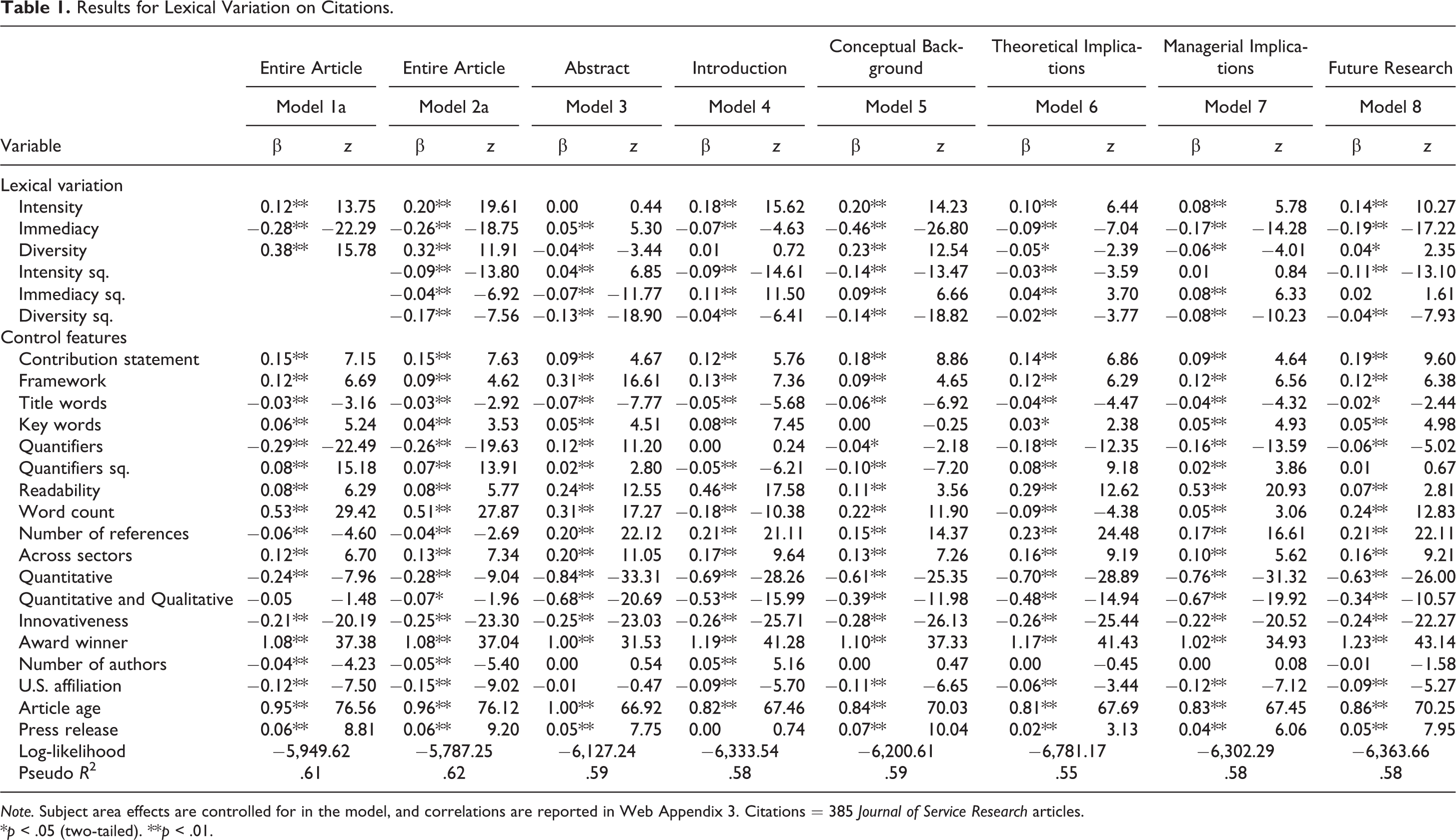
Note. Subject area effects are controlled for in the model, and correlations are reported in Web Appendix 3. Citations = 385 Journal of Service Research articles.
*p < .05 (two-tailed). **p < .01.
Results for Lexical Variation on Media Coverage.
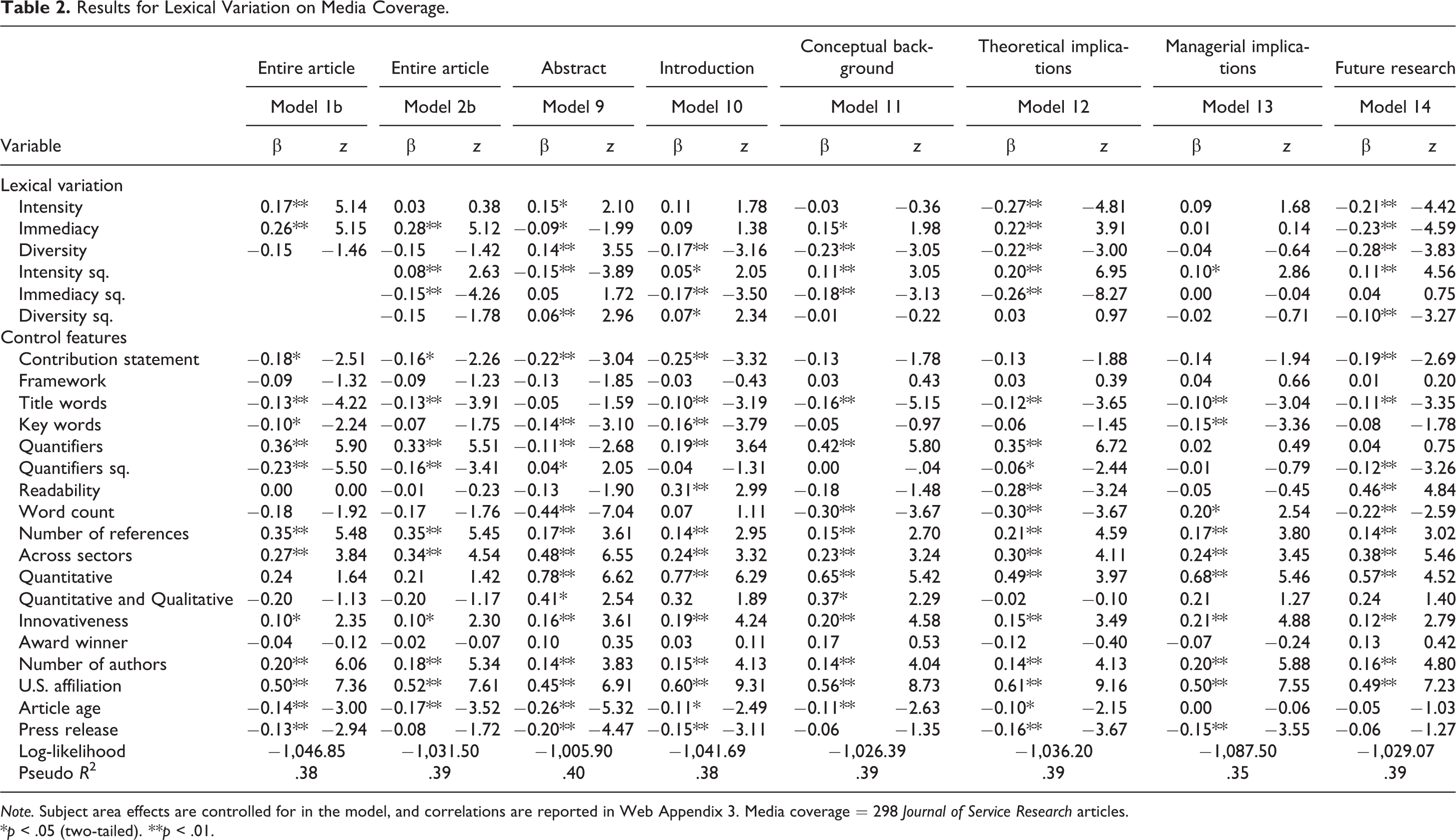
Note. Subject area effects are controlled for in the model, and correlations are reported in Web Appendix 3. Media coverage = 298 Journal of Service Research articles.
*p < .05 (two-tailed). **p < .01.
Results for Lexical Variation and Innovativeness on Citations and Media Coverage.
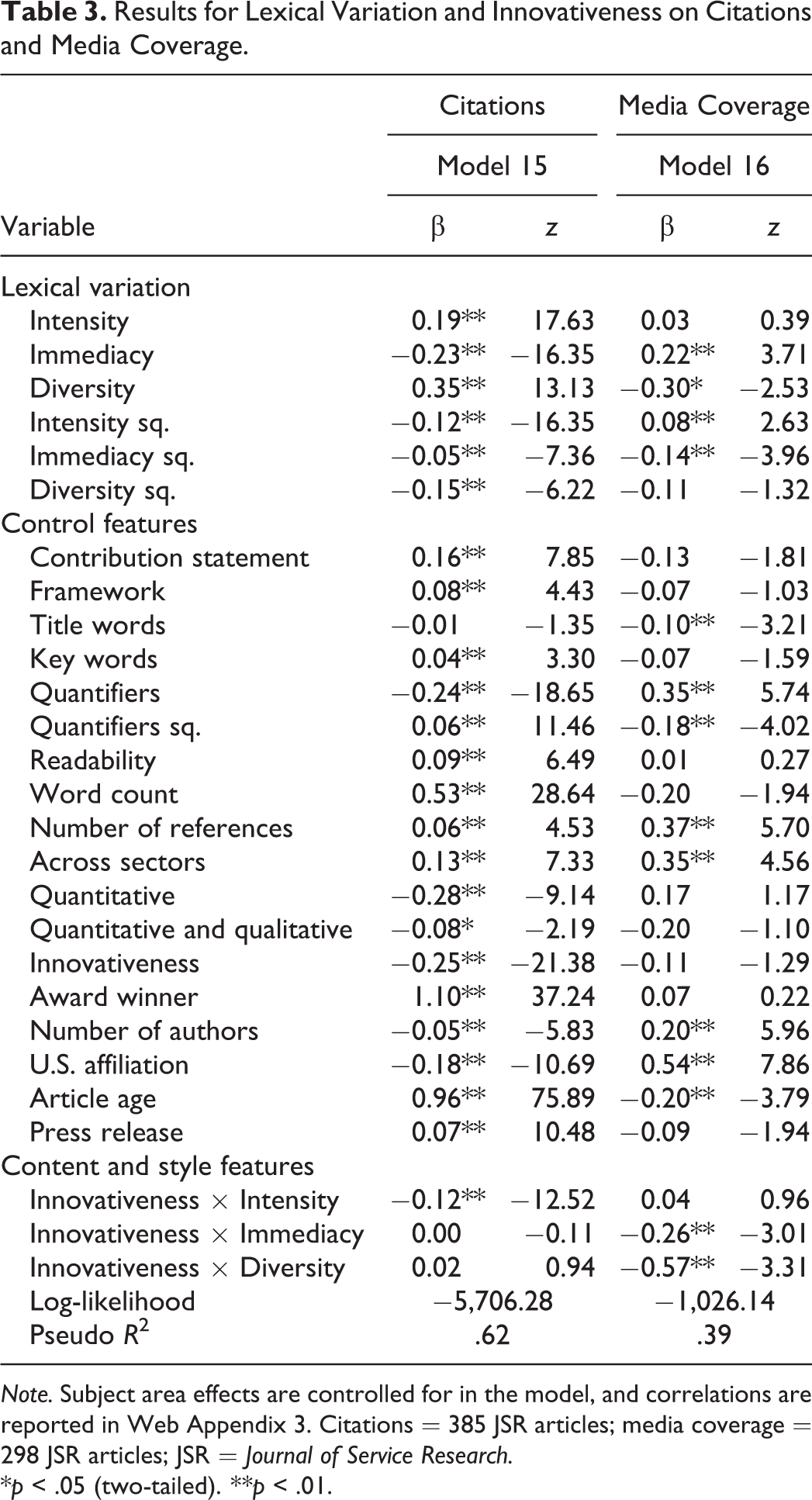
Note. Subject area effects are controlled for in the model, and correlations are reported in Web Appendix 3. Citations = 385 JSR articles; media coverage = 298 JSR articles; JSR = Journal of Service Research.
*p < .05 (two-tailed). **p < .01.
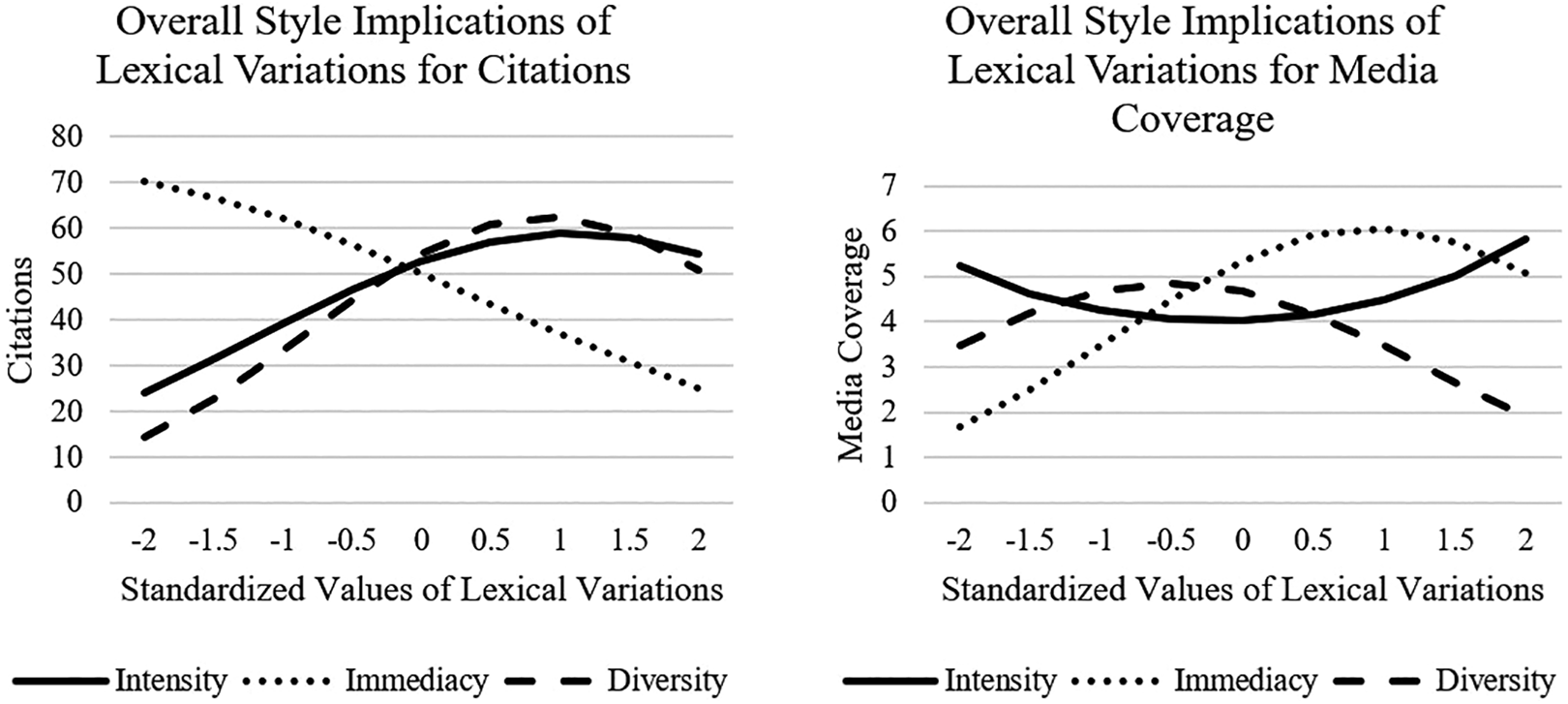
Overall style implications of lexical variations for citations and media coverage.
Results
We organize this discussion by lexical variant, starting with the overall results (P1–P6), then the nonlinear impact (P7 and P8), and finally the different subsections (P9 and P10) and relative topic innovativeness (P11 and P12).
Intensity
Considering the overall implications for citations of articles in JSR (Table 1, Model 1a), we find that more intensity in writing increases citations (βIntensity = 0.12, p < .01) and media coverage (βIntensity = 0.17, p < .01; Table 2, Model 1b), in line with P1 and P2, respectively. As we anticipated in P7, the effect of intensity on citations is nonlinear and follows an inverted U shape, tapering off at greater values (βIntensity = 0.20, p < .01; βIntensity Sq. = −0.09, p < .01; Table 1, Model 2a). The positive relation between intensity and media coverage is linear, contrary to P8 (βIntensity = 0.03, p = .70; βIntensity Sq. = 0.08, p < .01; Table 2, Model 2b). With regard to the relation between articles’ use of intensity and citations, we find they vary across the respective subsections (Table 1, Models 3–8; see also Web Appendix 5, in line with P9. For the introduction (βIntensity = 0.18, p < .01; βIntensity Sq. = −0.09, p < .01), conceptual background (βIntensity = 0.20, p < .01; βIntensity Sq. = −0.14, p < .01), theoretical implications (βIntensity = 0.10, p < .01; βIntensity Sq. = −0.03, p < .01), and future research (βIntensity = 0.14, p < .01; βIntensity Sq. = −0.11, p < .01) sections, greater intensity relates to more citations until it becomes excessive, where the effect follows an inverted U shape. The use of intensity in abstracts (βIntensity = 0.00, p = .66; βIntensity Sq. = 0.04, p < .01) follows a U shape, such that using either very little or a great deal of intensity relates positively to citations. In the managerial implications section, more intensity is always better (βIntensity = 0.08, p < .01; βIntensity Sq. = 0.01, p = .40). For intensity across subsections and media coverage, we also find differences, in line with P10 (Table 2, Models 9–14; Web Appendix 6). Specifically, the use of more intensity in the introduction (βIntensity = 0.11, p = .07; βIntensity Sq. = 0.05, p < .05) and managerial implications sections (βIntensity = 0.09, p = .09; βIntensity Sq. = 0.10, p < .05) increase media coverage. Intensity in the abstract (βIntensity = 0.15, p < .05; βIntensity Sq. = −0.15, p < .01) relates positively to media coverage until it becomes excessive, following an inverted U shape. The relations of the use of intensity in the conceptual background (βIntensity = −0.03, p = .72; βIntensity Sq. = 0.23, p < .01), theoretical implications (βIntensity = −0.27, p < .01; βIntensity Sq. = 0.20, p < .01), and future research (βIntensity = −0.21, p < .01; βIntensity Sq. = 0.11, p < .01) subsections with media coverage all follow a U shape. Noting the actual distribution of observations (Web Appendix 6), that the maximum impact of intensity on media coverage is at the lowest level of intensity; therefore, less intensity in these subsections relates to more media mentions, but increased use relates increasingly negatively to it. Contrary to P11, the use of more intensity in articles providing innovative perspectives relates negatively to citations (βIntensity and Innovativeness = −0.12, p < .01; Table 3, Model 15). With regard to P12, we find no significant effect of intensity on media coverage (βIntensity and Innovativeness = 0.04, p = .34) of articles that feature innovative perspectives (Table 3, Model 16).
Immediacy
For the overall implications of citations of articles in JSR (Table 1, Model 1a), in line with our expectations (P3), more immediacy in writing decreases citations (βImmediacy = −0.28, p < .01). Moreover, as predicted by P4, greater immediacy relates positively to subsequent media coverage (βImmediacy = 0.26, p < .01; Table 2, Model 1b). Contrary to P7, the effect of immediacy on citations is linear; excessive immediacy leads to even fewer citations (βImmediacy = −0.26, p < .01; βImmediacy Sq. = −0.04, p < .01; Table 1, Model 2a). The positive relation between immediacy and media coverage is also nonlinear, as predicted by P8. The positive effect of using more immediacy on media coverage follows an inverted U shape, where excessive use reduces media coverage even more (βImmediacy = 0.28, p < .01; βImmediacy Sq. = −0.15, p < .01; Table 2, Model 2b). For the relation between articles’ use of immediacy and citations (Table 1, Models 3–8; Web Appendix 5), we find hardly any variation across subsections (partial support for P9). Only in abstracts is a moderate use of immediacy associated with the greatest impact on citations, following an inverted U shape, where using too little or too much reduces them (βImmediacy = 0.05, p < .01; βImmediacy Sq. = −0.07, p < .01). Although we find a nonlinear U-shaped relation between immediacy and citations, our observations in Web Appendix 5 clarify that the use of more immediacy in the introduction (βImmediacy = −0.07, p < .01; βImmediacy Sq. = 0.11, p < .01), conceptual background (βImmediacy = −0.46, p < .01; βImmediacy Sq. = 0.09, p < .01), theoretical implications (βImmediacy = −0.09, p < .01; βImmediacy Sq. = 0.04, p < .01), and managerial implications (βImmediacy = −0.17, p < .01; βImmediacy Sq. = 0.08, p < .01) sections relates negatively to citations, following a U shape (each negative effect tapers off slightly with greater immediacy). In the future research section, more immediacy relates negatively to citations (βImmediacy = −0.19, p < .01; βImmediacy Sq. = 0.02, p = .11). We find differences in the relation between the use of immediacy across subsections and media coverage, as anticipated by P10 (Table 2, Models 9–14; Web Appendix 6). Specifically, immediacy in the introduction (βImmediacy = 0.09, p = .17; βImmediacy Sq. = −0.17, p < .01), conceptual background (βImmediacy = 0.15, p < .05; βImmediacy Sq. = −0.18, p < .01), and theoretical implications (βImmediacy = 0.22, p < .01; βImmediacy Sq. = −0.26, p < .01) has the greatest effect on media coverage at moderate use, following an inverted U shape, but the positive effect tapers off at very high uses. In the abstract (βImmediacy = −0.09, p < .01; βImmediacy Sq. = 0.05, p = .09) and future research sections (βImmediacy = −0.23, p < .01; βImmediacy Sq. = 0.04, p = .45), immediacy negatively relates to media coverage. Its use does not relate significantly to media coverage for the managerial implication subsection (p > .10 for both main and squared effects). In contrast with P11, increased use of immediacy does not relate significantly to citations of articles that provide innovative perspectives (βImmediacy and Innovativeness = 0.00, p < .91; Table 3, Model 15). As predicted by P12, increased use of immediacy relates negatively to subsequent media coverage of articles with greater innovativeness (βImmediacy and Innovativeness = −0.26, p < .01; Table 3, Model 16).
Diversity
More diversity increases citations (βDiversity = 0.38, p < .01), in line with P5 (Table 1, Model 1a), but it has no significant effect on media coverage (βDiversity = −0.15, p < .15), contrary to P6 (Table 2, Model 1b). In line with P7, the effect of diversity on citations is nonlinear. The positive relation to citations is greatest at a moderate to high use of diversity, following an inverted U shape and tapers off at excessive use (βDiversity = 0.32, p < .01; βDiversity Sq. = −0.17, p < .01; Table 1, Model 2a). With regard to P8, diversity has no significant nonlinear impact on media coverage (Table 2, Model 2b; βDiversity = −0.15, p = .16; βDiversity Sq. = −0.15, p = .08). Considering the distribution of diversity uses across JSR articles (Figure 1), the impact of diversity on media coverage is highest at moderate use. For diversity and citations (see Table 1, Models 3–8; Web Appendix 5), we find variation across subsections, in support of P9. In the introduction (βDiversity = 0.01, p = .47; βDiversity Sq. = −0.04, p < .01), conceptual background (βDiversity = 0.23, p < .01; βDiversity Sq. = −0.14, p < .01), and future research (βDiversity = 0.04, p < .05; βDiversity Sq. = −0.04, p < .01) subsections, the relationship follows an inverted U shape; that is, moderate uses of diversity in these sections relate to the greatest number of citations, whereas the use of a little or a great deal of diversity reduces them. In the abstract (βDiversity = −0.04, p < .01; βDiversity Sq. = −0.13, p < .01), theoretical implications (βDiversity = −0.05, p < .01; βDiversity Sq. = −0.02, p < .01), and managerial implications (βDiversity = −0.06, p < .01; βDiversity Sq. = −0.08, p < .01) subsections, greater use of diversity relates negatively to citations. Considering the relation between the use of diversity across the subsections and media coverage, we find differences that are in line with P10 (Table 2, Models 9–14; Web Appendix 6). In abstracts, diversity’s relation to media coverage is exponentially positive (βDiversity = 0.14, p < .01; βDiversity Sq. = 0.06, p < .01), such that coverage increases especially with exceedingly diverse word use. But greater diversity in the conceptual background (βDiversity = −0.23, p < .01; βDiversity Sq. = −0.01, p = .83), theoretical implications (βDiversity = −0.22, p < .01; βDiversity Sq. = −0.03, p = .33), and future research (βDiversity = −0.28, p < .01; βDiversity Sq. = −0.10, p < .01) subsections relates negatively to subsequent media coverage. Diversity in the introduction (βDiversity = −0.17, p < .01; βDiversity Sq. = 0.07, p < .05) relates negatively to media coverage (Web Appendix 6), following a U shape. We find no significant relation between the use of diversity in the managerial implications section and media coverage (βDiversity = −0.04, p = .52; βDiversity Sq. = −0.02, p = .47). In contrast with P11, we find no significant effect of diversity on citations for innovative articles (βDiversity and Innovativeness = 0.02, p = .35). However, in line with P12, the use of diversity relates positively to media coverage (βDiversity and Innovativeness = −0.57, p < .01) of articles that discuss rely on innovative and conceptually distant perspectives (Table 3, Models 15 and 16).
Control Features
The use of contribution statements increases academic citation rates (βContribution Statement = 0.15, p < .01), as do conceptual frameworks (βFrameworks = 0.12, p < .01) and the number of key words (βKey words = 0.06, p < .01; see Table 1, Model 1a). Longer titles (βTitle words = −0.03, p < .01) reduce citations. Quantifying tactics follow a U-shaped curve (βQuantifiers = −0.29, p < .01; βQuantifiers Sq. = 0.08, p < .01). As expected, articles that are written in a more readable manner (βReadability = 0.08, p < .01) and longer articles (βWord Count = 0.53, p < .01) receive more citations. Similar to their effect on citations, longer titles decrease subsequent media coverage (βTitle words = −0.13, p < .01). Contrary to expectation, the use of contribution statements (βContribution Statement = −0.18, p < .05) and more key words (βKey words = −0.10, p < .05) decreases subsequent media coverage (Table 2, Model 1b). We find no significant effect of the inclusion of conceptual frameworks (βFrameworks = −0.09, p = .19), readability (βReadability = 0.00, p = .10), or article length (βWord Count = −0.18, p = .06) on media coverage. Quantifiers, which follow an inverted U shape, should be employed moderately for optimal impact on media coverage (βQuantifiers = 0.36, p < .01; βQuantifiers Sq. = −0.23, p < .01) as their effect tapers off with excessive use.
To boost citations, researchers should aim to limit citation of prior work (βNumber of References = −0.06, p < .01). Incorporating insights across more than one service sector increases citations (βAcross Sectors = 0.12, p < .01). In general, purely quantitative articles (βQuantitative = −0.24, p < .01) receive fewer citations than purely qualitative ones. We find no significant effect of using mixed methods on citations (βQuantitative and Qualitative = −0.05, p = .14). Incorporating more outside marketing references, hence being more innovative is negatively associated with citations (βInnovativeness = −0.21, p < .01). In line with prior research, we find that articles that win awards garner more citations (βAward Winner = 1.08, p < .01). Increasing the number of authors negatively influences citations (βNumber of Authors = −0.04, p < .01), and U.S.-affiliated authors get cited less (βU.S. Affiliation = −0.12, p < .01). Older articles have more time and thus accumulate more citations (βArticle Age = 0.95, p < .01), and press releases increase citations (βPress Release = 0.06, p < .01)
To boost media coverage, researchers should embed their work in prior research (βNumber of References = 0.35, p < .01) and advance relatively innovative perspectives (βInnovativeness = 0.10, p < .05). Articles that examine multiple sectors also achieve greater media coverage (βAcross Sectors = 0.27, p < .01). Whether the study uses quantitative (βQuantitative = 0.24, p = .10), mixed (βQuantitative and Qualitative = −0.20, p = .26) or qualitative approaches makes no difference. Larger author teams (βNumber of Authors = 0.20, p < .01) and U.S.-affiliated authors (βU.S. Affiliation = 0.50, p < .01) receive greater media coverage. Interestingly, winning a Best Paper Award (βAward Winner = −0.04 p = .91) has no effect on media coverage. We find that older articles (βArticle Age = −0.14, p < .01) and articles with associated press releases (βPress Release = −0.13, p < .01) are covered less in public media. We acknowledge that the online-based scraping mechanism of Altmetric might miss earlier (nondigital) media coverage.
Robustness Checks
In line with prior research (e.g., Costas, Zahedi, and Wouters 2015; Mingers and Xu 2010), we used the Web of Science citation count measure as an indicator of academic impact. As a robustness check, we confirm that the Google Scholar citation count correlates with the Web of Science citation count at r = .983 (Web Appendix 4).
Discussion
These analyses offer insights into how service researchers can increase the impact (citations and media coverage) of their articles in JSR. Beyond corroborating previous findings about nontextual aspects (e.g., author institution), we demonstrate that both stylistic and content considerations influence academic impact and media coverage. Our findings contrast with prevalent literature on the drivers of article impact, which tends to emphasize the role of content in shaping article outcomes (Stremersch, Verniers, and Verhoef 2007). We must emphasize that it is not our intention to be prescriptive with regard to writing style; there must always be room for service researchers to develop their own approaches to writing for impact and for these styles to evolve dynamically as the journal matures. What we have tried to do in this article, however, is to make some of these writing practices more transparent and some of the lexical variations more explicit. In exploring Bradac, Bowers, and Courtright (1979), we have shown how lexical variation can play a major role in enhancing the citations and media coverage of a JSR article. The results suggest guidelines for using primary lexical variants (intensity, immediacy, and diversity), which authors can follow to boost their articles’ impact. The effectiveness of these lexical variants varies across audiences and article subsections. There is no “one-size-fits-all” approach to academic citations and media coverage. That said, we identify several drivers specific to each type of impact, for the benefit of researchers, journal editors, and publishers.
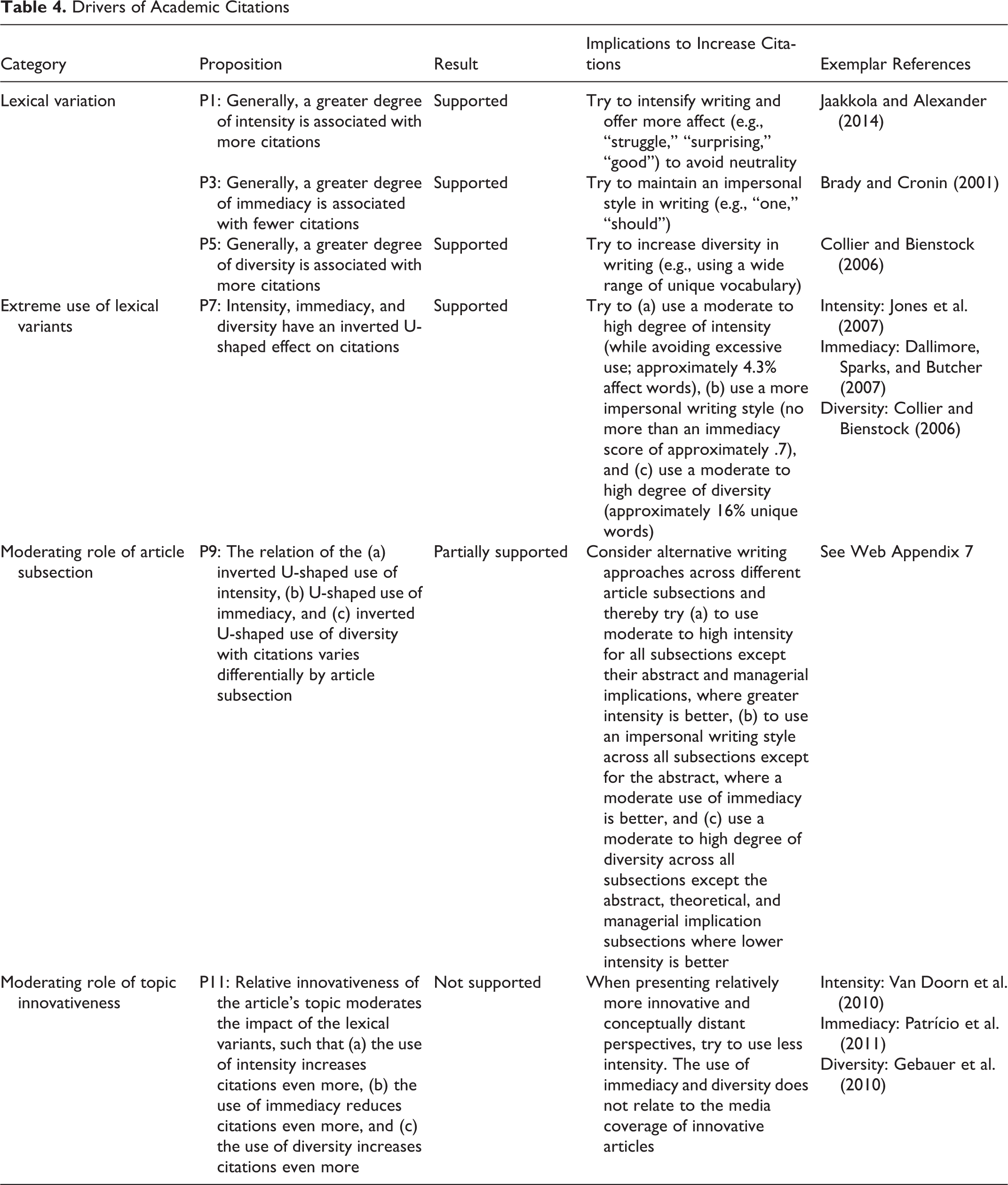
Drivers of Academic Citations
Intensity enhances the dynamism of verbatim content, and this dynamism then increases attention and readers’ responsiveness (Berger and Milkman 2012; Ludwig et al. 2013). Building on this finding, our results suggest that a moderate to high use of intensity inspires interest among academic readers. Consider the following writing style example: Consumers generally expect good service, and when service providers fail to deliver on their promises, consumers may express their disappointment in many different ways, ranging from simply “swallowing it” to switching to a different service provider…to retaliating verbally and physically (Komarova Loureiro, Haws, and Bearden 2018, p. 184, emphasis added).
Although immediacy enhances the communicability and actionability of texts, service researchers aiming for academic impact are advised to limit it. Our analysis of JSR articles shows that less immediacy is better, except in abstracts where articles with a moderate degree of immediacy receive more citations (e.g., Collier and Bienstock 2006). This result aligns with a convention that defines impersonality as a desirable feature for academic writing (Hyland 2002). Authors should use an impersonal style and increase the use of discrepancies (e.g., “should,” “would,” “could”) to make their writing and presentation of viewpoints more probabilistic.
Finally, service researchers should use a moderate degree of diversity in their vocabulary (approximately 16% of all words in an article should be unique). Readers tend to regard a diverse vocabulary as an indicator of competence (O’Sullivan, Hunt, and Lippert 2004). In line with Stremersch, Verniers, and Verhoef’s (2007) suggestions, we find that lexical diversity increases citations, except for the abstract, theoretical, and managerial implications subsections. In these sections, toward the end of their articles, service researchers should strive to reduce diversity and instead relay their implications using familiar, nonunique wording.
Citations also relate to stylistic conventions and article content. In contrast with prior research, we find that JSR articles receive more citations when they are written in a readable manner (according to the Dale Chall readability index; Stremersch, Verniers, and Verhoef 2007). Citing more references is negatively related to article citations which suggests that service research relies on prior work in a different way to other fields. In addition, JSR articles that expand their focus across multiple service sectors are cited more, perhaps due to their broader relevance and generalizability; we also find more citations for JSR papers that are based on qualitative (cf. quantitative) methods.
Contrary to expectations, we do not find that innovative JSR articles that extensively draw on sources external to marketing and service research receive more citations. Peter and Olson (1983) suggest that researchers may be more inclined to perspectives and theories drawn from familiar domains. However, service research is a relatively young, interdisciplinary domain and the integration of innovative (outside) perspectives contribute to valuable advancement (Gustafsson et al. 2016). To increase citations, authors of more innovative articles should consider reducing the intensity of their writing. Table 4 summarizes our specific findings and implications, including some exemplary articles for service researchers.
Drivers of Academic Citations
Drivers of Media Coverage
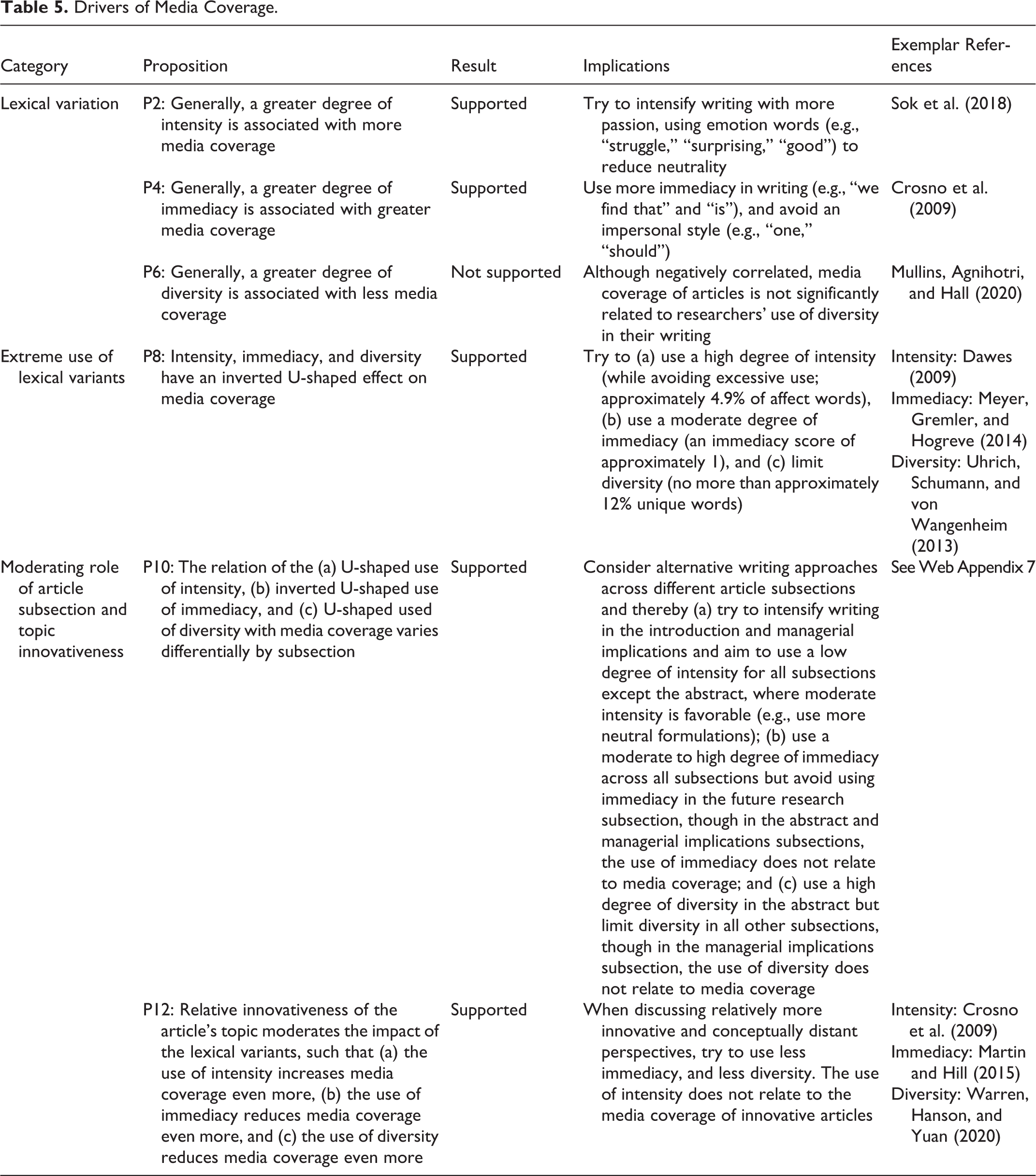
As a general observation, a greater degree of intensity drives more attention to JSR articles among popular media. Ideally, about 4.9% of all words in an article should be affect words. Yet intensity decreases the probability of extended media coverage when used in the conceptual background, theoretical implications, and future research subsections. In composing these parts of their articles, service researchers should refrain from using intensity and instead might adopt a more matter-of-fact style. A moderate to high use of immediacy in all article subsections except the abstract and future research relates positively to media coverage (e.g., Sok et al. 2018). For example, using “we find that” rather than “it was found that” enables authors to strengthen their ownership of the arguments and findings they present (Gilbert, Gilbert, and Mulkay 1984). However, excessive uses of immediacy can diminish media coverage. This finding is in line with prior research that suggests affinity-seeking cues increase communication effectiveness only up to a point, beyond which immediate language negatively influences perceptions of objectivity (Burgoon and Le Poire 1993). It appears that the use of relatively more diverse vocabulary in the conceptual background, theoretical implications, and future research section of the article reduces media coverage. This finding aligns with previous research that argues for an accessible writing style to engage nonacademic audiences (Crosier 2004; Stremersch, Verniers, and Verhoef 2007). Contrary to expectations, we find that diversely written abstracts gain attention in popular press. Therefore, researchers should leverage diverse wording in their article abstracts as a mechanism to encourage public stakeholders to read further.
Across subsections, a moderate use of quantifiers to support claims and arguments relates positively to media coverage. General readability and article length, in contrast, have no significant effect. If JSR articles contain more references, they get mentioned more in the popular press, as do articles that address multiple service sectors and those presenting innovative perspectives. Editors and reviewers might consider that innovative articles that create buzz and have a higher premium for sharing serve core functions of science: discovery, dissemination, and discussion. Therefore, crowd-sourcing attention fosters the journal’s primary goal of sharing science. We do not find significant effects for the type of methodology used. Detailed suggestions for using lexical variants to drive media coverage, as well as exemplar JSR articles, are given in Table 5.
Drivers of Media Coverage.
Implications for Journals and Editors
Our results suggest considerable divergence in the impacts of writing styles on citations and media coverage. A clear implication, which requires continued research consideration, is that trying to appeal to different audiences may yield conflicting stylistic choices and ultimately a lower overall impact across all audiences. Many journals proactively offer advice to authors about how to promote their research, including guidelines for search engines, podcasts, teaching slides, research identifiers (e.g., ORCID), abstract databases (e.g., Scopus), and social media hashtags and feeds (e.g., Facebook, Twitter). Another emerging trend seeks to broaden the reach of research by publishing chapters in handbook series (e.g., Edward Elgar Publishing), executive summaries, or informed commentaries in web-based outlets (e.g., the Conversation and LinkedIn). Our findings related to the impact of writing style on nonacademic outlets can help guide service researchers in expanding the impact of their work. Such efforts are meaningful because institutions increasingly adopt more diverse performance indicators of impact, and because evidence also suggests a positive association between traditional academic citation metrics and (social) media metrics (Lamb, Gilbert, and Ford 2018). Jordan (2019) shows that research coverage on social media has a positive impact on impact factors, citation counts, and a wider set of research rankings, for example. By tuning research articles and adapted versions to contain appropriate levels of intensity, immediacy, and diversity through collaborative efforts, journals, editors, and researchers reach wider audiences and inspire greater interest in service research.
Limitations and Future Research
Although our results offer a range of how-to-write suggestions and extends an emerging body of scholarship on the impact of academic research, our study also is subject to several limitations that offer opportunities for continued research. First, we examine the effect of three primary, conceptually supported lexical variations on two types of article impact. Their relative use naturally varies across people, groups, and communication contexts. JSR, its articles, reader preferences, and impact indices are evolving “participants.” Any substantial changes to any of these entities will inevitably alter some findings of our study and will certainly influence findings across the subsections. Therefore, future research may well find different nuances as audiences and impact measures evolve. These, as well as other style and content factors could provide further predictive insights, moderate or mediate the effects of these lexical variants. Scholarship on message processing (Meyers-Levy and Malaviya 1999) and persuasiveness (Shu and Carlson 2014) offers a treasure trove of lexical and rhetorical ideas, which might deepen understanding of how to write for impact. Second, we based our approach on what Berger et al. (2020) refer to as “entity extraction.” Various other methods on impact analysis exist though; for example, future research might apply topic modeling (e.g., latent Dirichlet allocation [LDA]) or relation extraction (e.g., supervised machine learning). Relatedly, whereas we rely on topic identifier words derived by Stremersch, Verniers, and Verhoef (2007), additional research could use LDA to identify, classify, and model specific and upcoming service topic categories and their impacts. Such studies also might address content or stylistic cooccurrences among different articles to investigate ongoing relationships between subtopics or subgroups within and across service research journals. Only two algorithms for media coverage of academic articles have been applied in prior research: the Dow Jones Factiva database and Altmetric.com. Both indicators continue to undergo refinement and development to increase their robustness. As interest in impact measures of academic research across nonacademic domains increases, we need to continue to assess and compare alternative impact indicators. Third, we study key academic article conventions. We find that longer articles, explicit contribution statements, a framework (conceptual or otherwise), shorter titles and more key words increase citations. As for media impact, we find that shorter titles, less key words, and no contribution statements increase media coverage. The length of the article and the inclusion of a framework are not significantly related to media coverage. While our focus is the use of lexical variants, the differential and partially unexpected effects of these stylistic conventions should be further investigated in future research across journals and disciplines. Fourth, our analysis exclusively includes published papers. It does not account for the developmental stages of publishing research, such as during the journal review process or for methods of writing for social media. Future research should investigate differences in writing style preferences across these different situations and contexts.
Supplemental Material
Supplemental Material, sj-pdf-1-jsr-10.1177_10946705211024732 - Writing for Impact in Service Research
Supplemental Material, sj-pdf-1-jsr-10.1177_10946705211024732 for Writing for Impact in Service Research by Chahna Gonsalves, Stephan Ludwig, Ko de Ruyter and Ashlee Humphreys in Journal of Service Research
Supplemental Material
Supplemental Material, sj-pdf-2-jsr-10.1177_10946705211024732 - Writing for Impact in Service Research
Supplemental Material, sj-pdf-2-jsr-10.1177_10946705211024732 for Writing for Impact in Service Research by Chahna Gonsalves, Stephan Ludwig, Ko de Ruyter and Ashlee Humphreys in Journal of Service Research
Footnotes
Acknowledgment
The authors thank Professor Stefan Stremersch for his helpful comments.
Declaration of Conflicting Interests
The author(s) declared no potential conflicts of interest with respect to the research, authorship, and/or publication of this article.
Funding
The author(s) received no financial support for the research, authorship, and/or publication of this article.

Supplemental Material
The supplemental material for this article is available online.
Note
Author Biographies
References
Supplementary Material
Please find the following supplemental material available below.
For Open Access articles published under a Creative Commons License, all supplemental material carries the same license as the article it is associated with.
For non-Open Access articles published, all supplemental material carries a non-exclusive license, and permission requests for re-use of supplemental material or any part of supplemental material shall be sent directly to the copyright owner as specified in the copyright notice associated with the article.
