




Abstract
Intentional service failures (e.g., overbooking or overcharging) have received little scholarly attention, despite their regular occurrence and immense costs. Using a multi-method approach combining experimental and field data from online reviews, it was found that intentional (vs. unintentional) failures lead to greater negative word of mouth (nWOM) and patronage reduction. This research extends these findings by demonstrating that intentional failures are less harmful when the failure is reversible (vs. irreversible) and occurs at an employee (vs. firm) level. Further, while either psychological (e.g., apology) or monetary compensation is effective in mitigating the consequences of intentional failures at an employee level, a combined service recovery (psychological and monetary) is the best solution when the failure is at a firm level. Drawing on attribution theory, the article unveils the key role of trust (as opposed to justice) as the mechanism to explain the effects of intentionality on customers’ nWOM and patronage reduction.
Introduction
Service failures by travel providers are more harmful now than ever because of the broadcasting effect of tourist-generated content (Sparks and Browning 2011; Phillips et al. 2017). For example, United Airlines’ share price dropped $1 billion (4%), after an overbooking crisis led to footage of a passenger being forcibly removed from a flight in April 2017 (BBC 2017). Though many failures, such as flight cancelations and delays, are likely perceived as unintentional arising from external environmental factors or human error (see Migacz, Zou, and Petrick 2018; Xu, Liu, and Gursoy 2019), various other common failures in the tourism sector are expected to be ascribed as (at least somewhat) intentional by travelers.
At a firm level, overbooking of flights (Bejou, Edvardsson, and Rakowski 1996), hotels (Perdue 2002), and restaurants (Tse and Poon 2017) is an everyday practice that customers perceive as an intentional attempt of the firm to maximize revenue (Nazifi, Gelbrich, et al. 2021). Overbooking is just one example of a broader phenomenon that is considered as an intentional failure, in which consumers might attribute a certain degree of intentionality to a failure (Howlett 2012). The COVID-19 pandemic is also forcing many tourism providers to impose failures, such as significant delays in giving refunds for canceled bookings (Beard and Williams 2020), speculated by tourists as an intentional means for firms to balance their finances (McNeill 2020).
Besides firm-level transgressions, individual employees may also account for failures ascribed with intentionality such as revenge in response to customer misbehavior (L. C. Harris and Ogbonna 2002), and overcharging customers (L. C. Harris 2012). Based on the practical relevance of intentional failures within the broader service industry, managers need to understand their consequences as well as the buffering effects of situational factors (e.g., failure reversibility and failure level) and organizational responses (e.g., service recovery) to manage their negative consequences.
After a negative encounter, attribution theory has been found valuable to explain that people evaluate the cause of failures (i.e., causal attributions) on three dimensions: locus of causality, stability, and controllability (Chung and Petrick 2013; Hwang and Mattila 2019). Recently, research within psychology and public policy has indicated the importance of a fourth dimension, intentionality, defined as how deliberate an action is enacted by an agent as perceived by the recipient (Howlett 2012). This research puts forward that intentionality ascribed by the sufferer of the failure to the perpetrator is the dimension of causal attributions with the strongest effect on people’s responses (Ames and Fiske 2013; Howlett 2012; Reeder 2009). Despite the importance of service failures in general (Swanson and Hsu 2009; Javornik, Filieri, and Gumann 2020), research on intentionality associated with service failures is very limited and has yet to be addressed by tourism scholars. While some studies on failures (e.g., overbooking or service termination) have implied intentionality (e.g., Nazifi, Gelbrich, et al. 2021; Nazifi, El-Manstrly, and Gelbrich 2019; Chung and Petrick 2013), research that has directly examined failure intentionality is scarce. Initial findings suggest that attributing intentionality to service failures (1) increases switching behavior (Varela-Neira, Vázquez-Casielles, and Iglesias 2014) and (2) moderates the effectiveness of recovery strategies (apology and redress) on switching behaviors (Iglesias, Varela-Neira, and Vázquez-Casielles 2015).
While these studies provide valuable insight for the conceptualization of intentionality, their focus has been on a utilitarian context (banking), thus limiting generalizations to tourism services which are largely hedonic (Wong, Law, and Zhao 2018; Jiang 2020). Moreover, research is lacking on how situational factors moderate the effects of intentionality that are important for deepening understanding and guiding managers on how to handle intentional failures (Marder et al. 2021; Suess et al. 2020), and on the effectiveness of monetary and psychological recovery tools for intentional failures. Based on the aforementioned managerial needs and research gaps, the current study addresses four research objectives:
examining the effects of intentional (vs. unintentional) failures on customers’ negative behavioral reactions within tourism;
assessing the mediating role of trust as opposed to perceived justice as the dominant theoretical lens in the service failure and recovery literature;
exploring the boundary conditions under which intentional failures are less (or more) harmful by investigating the moderating effects of failure reversibility and failure level;
examining the differential effects of recovery tools (monetary compensation, promise, apology, and combined recovery) after employee- and firm-level intentional failures.
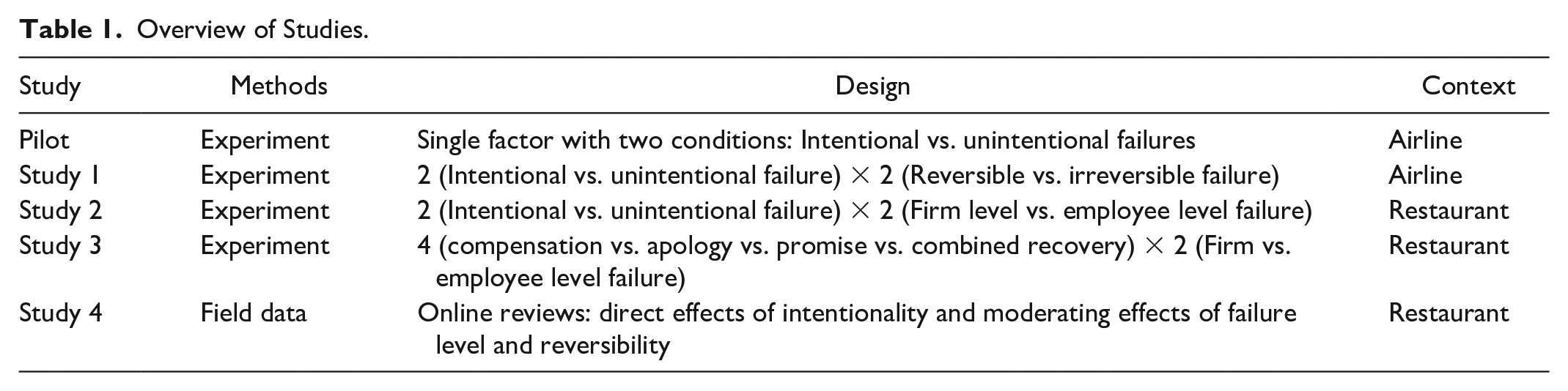
To address these objectives, three main experiments and a field study (using online reviews in different tourism settings [airline and restaurant]) were conducted (see Table 1 for an overview of the studies). Prior to main studies, a pilot tested the manipulation of intentionality and the positive effects of failure intentionality on negative word of mouth (nWOM; hypothesis 1a) and patronage reduction (hypothesis 1b) through trust. Studies 1 and 2 examined the moderating effects of failure reversibility (hypotheses 2a and 2b) and failure level (hypotheses 3a and 3b). Study 3 analyzed the effectiveness of different recovery strategies following intentional failures (hypotheses 4a to 4c). Study 4 used field data from online reviews to provide real-life validity for the positive effect of failure intentionality on nWOM (hypothesis 1a) and the moderating effects of failure reversibility (hypothesis 2a) and failure level (hypothesis 3a).
Overview of Studies.
It is believed this study makes three contributions. Drawing on attribution theory, it extends prior research on service failure and recovery in the tourism literature by examining the effects of intentional failures on customers’ negative behavioral reactions as follows:
Examining intentional failures in more hedonic tourism rather than utilitarian banking contexts to broaden the scope of covered industries, and directly contrasting intentional (vs. unintentional) failures by using experimental designs and a field study to strengthen the causal claims of prior survey-based work and expand the methodological base for the findings on intentional failures;
Analyzing trust (relative to justice perceptions) as mechanisms for the effects of intentional failures to provide evidence for a theoretically relevant but not yet analyzed mediator in this context and deepen insight on process explanations for intentional failures;
Identifying yet unexplored situational factors (i.e., failure reversibility and failure level) and buffering conditions (i.e., service recovery) when addressing firm and employee intentional transgressions to provide novel evidence into customers’ differentiated judgment toward intentional failures.
Conceptual Background And Hypotheses
Attribution Theory and Intentionality
In the following, different dimensions along which individuals form their causal explanations are discussed with a special focus on intentionality, and then the relevance and consequences of intentionality are outlined, where it is maintained that this inference presents a trust violation, leading to heightened negative tourist reactions.
Causal attributions in the service domain are widely examined as customers’ inferred cause of the failure and have traditionally comprised three dimensions (Folkes, Koletsky, and Graham 1987; Weiner 1986; Chung and Petrick 2013; Lee and Cranage 2018). Blame attribution (or locus of causality) refers to whether customers believe a failure (missed flight) was caused by themselves (internal; late gate arrival for own reasons) or by another party, such as the firm or someone else (external; denied boarding from an overbooked flight by the airline) (Weiner 2000). Controllability refers to whether the failure is seen as preventable by a focal party (controllable; a mechanical problem) or not (uncontrollable; bad weather) (Folkes, Koletsky, and Graham 1987; Nguyen and McColl-Kennedy 2003). Stability refers to whether individuals see the cause of the failure (flight delay) as temporary (unstable; temporary staff shortage) or permanent (stable; permanent understaffing) (Folkes, Koletsky, and Graham 1987; Iglesias, Varela-Neira, and Vázquez-Casielles 2015). People have been found to react differently based on the attributions they make and, for example, are particularly likely to complain, if they blame the firm (Van Vaerenbergh et al. 2014). People have also been found to experience more negative emotions if failures are considered controllable (Valentini, Orsingher, and Polyakova 2020; Weiner 2000) and are less satisfied with the firm’s recovery effort and the firm in general if they attribute the failure as stable (Van Vaerenbergh et al. 2014). Moreover, attributions may depend on the context, where for example it is found that customers blame themselves more if service failures occur online vs. offline (K. E. Harris, Mohr, and Bernhardt 2006).
While the traditional dimensions provide distinctive insight, research has suggested intentionality as a fourth dimension, maintaining that consumers may also ask if a failure (or some parts of it) was on purpose (Ames and Fiske 2013; Reeder 2009). Intentionality is distinct from the other dimensions in two ways. First, while the traditional attribution dimensions refer to causal properties, intentionality refers to the motives of a person or reasons for an action (Weiner 2006). Second, although intentionality and controllability share some overlap, they are distinct. Specifically, intentionality and controllability are related to the extent that an uncontrollable failure (e.g., flight delay due to bad weather) is perceived as unintentional. Yet, they differ as controllable failures can be perceived as either intentional or unintentional (Weiner 2006): Intentionality attributions ascribe that providers are aware of the purpose to compromise service delivery; unintentionality ascribes that providers may not intend to fail, but do so; nonetheless, the failure cause is controllable as, for example, one has not exercised the necessary effort (Weiner 2006). Thus, intentional failures are defined as those transgressions that reflect “thoughts, desires, and motives of an actor” (Reeder 2009, p. 2) rather than negligence or an honest mistake.
Understanding intentionality is important for different reasons. From a service perspective, intentionality may be ascribed to various operational (e.g., cost reduction, productivity, company policies, crisis events) and employee constraints (limited emotional, attentive, and time capacities), halting the meeting of customer needs (Iglesias, Varela-Neira, and Vázquez-Casielles 2015; Varela-Neira, Vázquez-Casielles, and Iglesias 2014). From a (social) psychological perspective, research corroborated its relevance for negative events in social interactions (Hesse et al. 2016; Malle and Knobe 1997). Research has shown that individuals exhibit an implicit bias inferring intentionality in most behaviors, rendering it salient even when no intent was meant (Rosset 2008). Moreover, research has found that individuals overestimate intentional harm (known as the harm magnification effect), assigning more punishment and moral condemnation to perpetrators ascribed with intentionality (Ames and Fiske 2013; Hesse et al. 2016; Rosset 2008). In sum, intentionality presents a distinct attribution dimension to which individuals are more sensitive.
After making causal inferences (i.e., attributions), tourists have been found to use them to calibrate their behavior (Chung and Petrick 2013). Hereby, perceptions of intentionality are of special interest given they link to inferences regarding responsibility and moral judgments (Weiner 2006). Thus, when assigning intent to a failure, tourists likely attribute the negative outcome as an occurrence the firm could have prevented. Hence, tourists can consider intent as a breach of the moral code of conduct in the relationship between them and the provider (Weiner 2000). Breaks in relational norms have been conceptualized as trust violations (e.g., Basso and Pizzutti 2016). A trust violation is perceived when an individual (i.e., the tourist) realizes that the receiver of that trust (i.e., the firm) acts in conflict with the individual’s expectations (Tomlinson, Dineen, and Lewicki 2004). Accordingly, a tourist ascribing intentionality reflects the awareness that the firm is not acting in their interest (i.e., creating a failure to some extent on purpose from which the tourist suffers). Related research showed that trust is pivotal in rebuilding loyalty following a service failure (La and Choi 2012), overcoming travel avoidant behaviors spurred by COVID-19 (Zheng, Luo, and Ritchie 2021).
In terms of behavioral consequences, research conceptualized intentionality as a specific cause of retaliation, because it increases perceptions of a harm-doer’s responsibility for their offenses, therefore making revenge more likely (Jackson, Choi, and Gelfand 2019). A desire for revenge often coexists with a desire for avoidance, because both reflect a lack of forgiveness (Finkel et al. 2002). Both are at the origin of different specific customer reactions. While a desire for revenge is associated with punishments directed at the firm and is so, for example, displayed in nWOM, desire for avoidance is associated with an escape from the relationship and is so, for example, displayed in a decrease in repatronage (Grégoire, Tripp, and Legoux 2009).
Both nWOM, that is, advising others not to use a specific provider (Bougie, Pieters, and Zeelenberg 2003) and decreased repatronage, that is, reducing the frequency of interaction with a specific provider (Grégoire and Fisher 2006), are two commonly assessed outcomes by service scholars, widely known to be negatively associated with trust (Bavik and Bavik 2015; Grégoire and Fisher 2008) and that travel managers endeavor to minimize (Filieri, Raguseo, and Vitari 2021; Kim, Kim, and Kim 2009). Additionally, scholars provided evidence that causal attribution associated with locus and stability impacts WOM intentions (Swanson and Hsu 2011; Swanson and Kelley 2001). Further, speaking to the relevance of nWOM, recent work has shown that extreme nWOM for quality hotels can be particularly damaging when it mentions specific attributes (e.g., hospitality, price/quality ratio) and reviews are longer and easier to read (Filieri, Raguseo, and Vitari 2021).
To summarize, it is expected that intentional failures represent an attributional norm violation that leads to a loss of trust, which in turn facilitates negative customer responses (nWOM and decreased repatronage). Employees in organizational interactions tend to see intended transgressions as worse than unintended ones (Ames and Fiske 2013) and people in social interactions tend to react stronger to failures perceived as deliberate (Baumeister, Hutton, and Cairns 1990). Further, Varela-Neira, Vázquez-Casielles, and Iglesias (2014) found that intentional failures increase customers’ desire to change providers. Thus, it is hypothesized:
Hypothesis 1: Intentional compared to unintentional failures lead to higher levels of (a) nWOM and (b) patronage reduction through organizational trust.
Failure Reversibility
The distinction between reversible (e.g., account overcharge, incorrect restaurant order) and irreversible losses (e.g., missed sports or other events, wrong haircut) from failures is important for different reasons. Prior meta-analytic evidence, although being indicative for its explanatory value, has revealed this only in tendency (p < .10), thus leaving uncertainty of this moderator for failure situations (Roschk and Gelbrich 2014). With specific regard to intentional failures, it is yet unclear to which extent intentionality fosters or inhibits the consideration of situational factors. Moreover, information about the suffered loss seems accessible by tourism providers for a context contingent approach to handling the situation (Khamitov, Gégoire, and Suri 2020>).
Theoretically, the reversible versus irreversible distinction can be made by conceptualizing a service failure as a loss of resources that a customer experiences (Foa and Foa 2012; Smith, Bolton, and Wagner 1999). Given that failures often involve losing a bundle of resources (Smith, Bolton, and Wagner 1999), a distinction should be made about whether the loss is reversible or not. From a service recovery perspective, reversible (vs. irreversible) failures may be viewed less negatively since the loss itself can be restored in kind (e.g., a re-performed service for a failed service), which is shown to be the customers’ preferred option compared with an in-kind substitute (e.g., a monetary compensation) (Roschk and Gelbrich 2014). While under normal circumstances, tourists may be more forgiving toward an in-kind substitute (i.e., a nonmatching resource) after unintentional failures, arguably they would be less forgiving following intentional failures. The irreversible consequences of the latter may compound the perceived trust violation resulting in further erosion of faith in the provider. Thus, it is hypothesized:
Hypothesis 2: When the failure is irreversible (reversible), failure intentionality leads to a larger (smaller) increase in (a) nWOM and (b) patronage reduction through organizational trust.
Failure Level
Intentional failures may occur on firm-wide (systematic) or employee (non-systematic) levels. Failures on a firm level refer to transgressions that due to their systematic character are ascribed globally to the organization (e.g., overcharging in restaurants considered as tourist traps). Employee level failures refer to transgressions ascribed to specific individuals and so carry a non-systematic character (e.g., overcharging for opportunistic/retaliatory reasons or due to an honest mistake).
Folkes and Patrick (2003) argued that when customers have a negative experience with a specific service employee, they are less likely to generalize this negative experience to the firm or its other employees, believing the transgressive employee as an outlier. In consequence, Folkes and Patrick (2003) proposed a “positivity bias” denoting customers’ tendency to generalize the positive (as opposed to the negative) performance of one employee to others in the organization. This positivity bias is because customers generally expect to have positive and neutral (rather than negative) service encounters (Gershoff, Mukherjee, and Mukhopadhyay 2006) and that “firms do not intend that employees behave in a negative way toward customers” (Folkes and Patrick 2003, p. 136). Hess, Ganesan, and Klein (2007) provided further support arguing that negative perceptions stemming from an individual’s deviance have little contagion to the organization.
Accordingly, it is proposed that when customers perceive the failure to be intentionally caused by an employee rather than the firm, they are less likely to doubt the trustworthiness of the entire firm or other employees (Porath, MacInnis, and Folkes 2010). Therefore, positivity (rather than negativity) bias will prevail reducing the negative effect of failure intentionality on trust and its positive effect on nWOM and patronage reduction. Thus, it is hypothesized:
Hypothesis 3: When the failure occurs on the firm (vs. employee) level, failure intentionality leads to a larger (smaller) increase in (a) nWOM and (b) patronage reduction through organizational trust.
Service Recovery following Intentional Failures
Companies can use different recovery strategies to reduce the negative consequences of service failures (Smith Bolton, and Wagner 1999; Weber and Hsu 2020; Nazifi, Murdy, et al. 2021). These strategies can be broadly divided into economic (i.e., monetary compensation) and psychological (e.g., apology and promise) recovery (Basso and Pizzutti 2016). For intentional failures, initial results come from Iglesias, Varela-Neira, and Vázquez-Casielles (2015), finding that monetary compensation and apology can be effective. An important, yet unexplored, recovery tool is a promise by the provider not to repeat the failure in the future, which can be effective in restoring trust in the provider following competence and integrity violations (Basso and Pizzutti 2016). Moreover, prior research has suggested combining monetary compensation with psychological recovery (i.e., apology and promise), yielding to a multipronged recovery effort (Goodwin and Ross 1992). Thus, research on the differential effects of recovery strategies following intentional failures is lacking, especially taking failure level (i.e., employee vs. firm) into account.
Monetary compensation should be effective for intentional failures at employee level, given the low perceived globality of the failure (Iglesias, Varela-Neira, and Vázquez-Casielles 2015; Hess, Ganesan, and Klein 2007). Following a firm-level intentional failure that results in high perceived globality of the failure (Hess, Ganesan, and Klein 2007), customers are likely to hold high recovery expectations. Here, monetary compensation, which is a concrete gesture by the firm (Basso and Pizzutti 2016), should still reduce the negative consequences of such intentional failures. Nazifi, El-Manstrly, and Gelbrich (2019) and Lepthien et al. (2017) found support for the effectiveness of monetary compensation following firm-initiated service terminations, which are considered to be intentional failures (Haenel, Wetzel, and Hammerschmidt 2019). Further, drawing on positivity bias (Folkes and Patrick 2003), customers may respond more favorably to apology or promise issued by a firm when the failure is caused by an individual employee. However, the same may not hold true when customers find out the failure is caused systematically by the firm. The latter can be perceived as less sincere and convincing, which have been found to be key attributes for these recovery strategies to be effective (Roschk and Kaiser 2013; Schweitzer, Hershey, and Bradlow 2006). With regard to a combined monetary and psychological compensation that presents a particularly strong recovery effort (Goodwin and Ross 1992), no differences are expected regardless of the failure level. Thus, it is hypothesized:
Hypothesis 4: Following an intentional failure, different recovery strategies (monetary, psychological, and combined recovery) are effective in reducing (a) nWOM and (b) patronage reduction, and increasing (c) organizational trust to differing extents depending on the failure level.
Figure 1 below illustrates our conceptual model and the effects to be tested by our hypotheses.
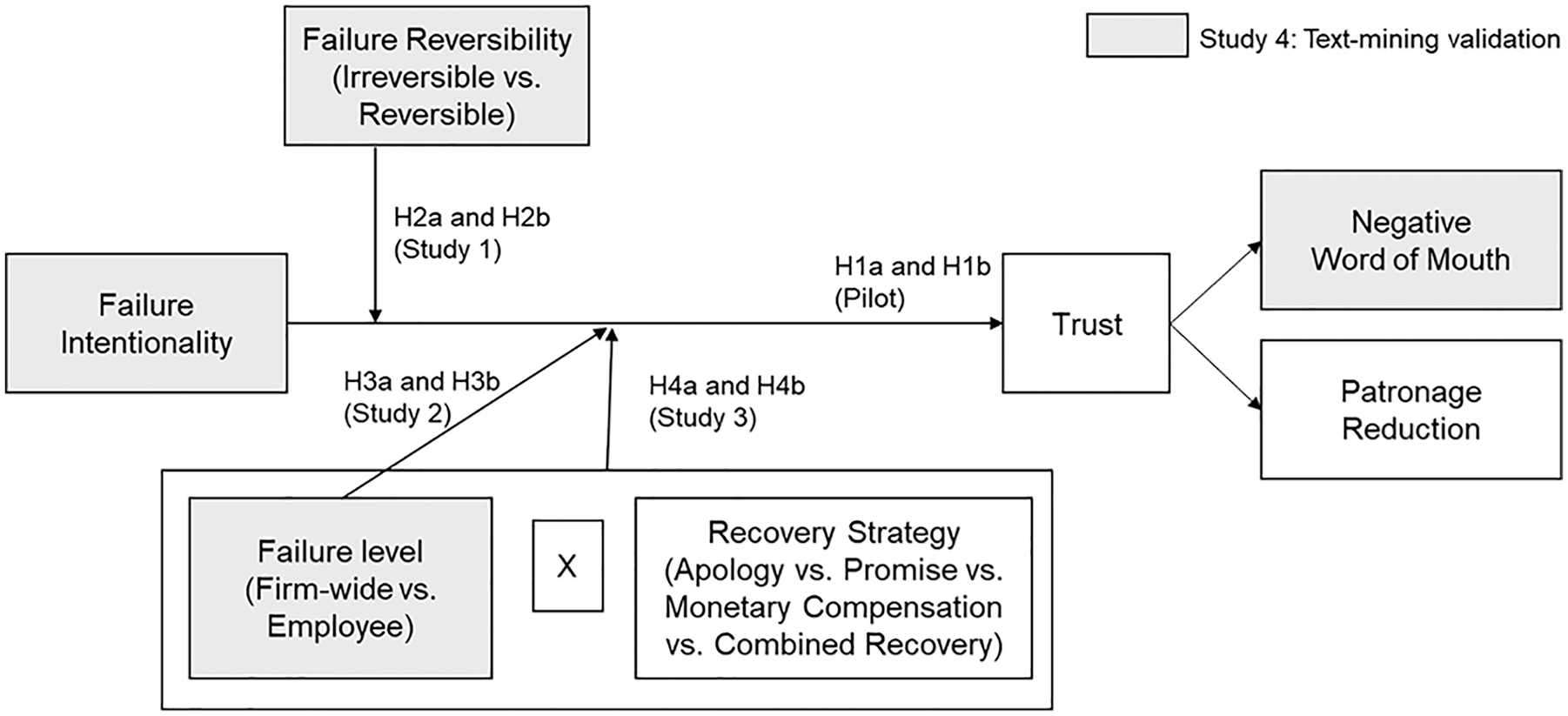
Conceptual model.
Pilot
Sample and Procedure
The pilot used a single-factor between-subjects design (failure intentionality: intentional vs. unintentional), with random assignment to conditions. In total, 81 US respondents (Mage = 35.17, SD = 11.83; male = 55.6%) were recruited from Clickworker, a reputable crowd-based panel used in prior research (e.g., Ettinger et al. 2020; Nazifi, Murdy, et al. 2021).
Participants imagined an air travel experience through watching a professionally made video clip, illustrating a scenario. An airline context was used because consumers were familiar with it and anecdotal reports suggested that intentional failures are salient in this context. The scenario described a passenger who is traveling to attend his friend’s wedding. At the airport, the passenger is denied boarding. An airline agent announces that the passenger must travel at a later time. Then, the failure type was manipulated by varying the cause of failure. In the intentional (unintentional) condition, an airline agent announces that the flight is overbooked (due to a mechanical problem, the airline needs to use a smaller aircraft) (see Appendix 1 for the full scenarios).
After watching the scenario, the participants responded to six items measuring the intentionality manipulation (The airline disrupted your travel plans intentionally/willingly/deliberately/purposefully/knowingly/consciously; α = .97). They also reported their nWOM on three items (α = .97) from Bougie, Pieters, and Zeelenberg (2003), patronage reduction on five items (α = .98) from Grégoire, Tripp, and Legoux (2009), and trust on four items (α = .96) from Morgan and Hunt (1994) adapted to fit the context. All items were measured on 7-point Likert-type scales anchored at 1 (strongly disagree) and 7 (strongly agree). A list of all measures can be seen in Table 3.
Manipulation Check and Results
The mean values of the intentionality manipulation check differed across the two conditions, in the intended direction (MInt/Unint = 5.33/2.05, F[1, 79] = 153.51, p < .01, η² = .66). The respondents also perceived the scenario as realistic (M = 6.33), with no differences across the conditions (p > .05). Three ANOVAs were conducted, using failure intentionality as the independent variable (IV) and nWOM, patronage reduction, and trust as the dependent variable (DV), respectively (see Appendix 2 for cell means). As expected, results showed that respondents in the intentional (vs. unintentional) condition reported higher ratings in nWOM (MInt/Unint = 5.78/3.84, F[1, 79] = 33.89, p < .01) and patronage reduction (MInt/Unint = 5.86/4.05, F[1, 79] = 27.53, p < .01) and lower levels in trust (MInt/Unint = 2.11/3.86, F[1, 79] = 45.82, p < .01).
Mediation analyses (model 4) were conducted based on Hayes and Preacher (2014), selecting failure intentionality as the IV, nWOM (hypothesis 1a) and patronage reduction (hypothesis 1b) as the DVs, and trust as the mediator. The indirect effects of intentionality on nWOM (b = 0.71, SE = 0.13, 95% CI = 0.47, 0.99) and patronage reduction (b = 0.72, SE = 0.13, 95% CI = 0.48, 0.99) through trust were significant and positive, supporting hypotheses 1a and 1b. In addition, the direct effects of intentionality were nonsignificant for nWOM and patronage reduction, indicating indirect-only mediation according to Zhao, Lynch, and Chen (2010).
Discussion
The pilot pretested a scenario for subsequent use, which supported the distinction between intentional and unintentional failures in a realistic setting. The results also provided the first indication that compared with an unintentional failure, an intentional failure leads to higher levels of nWOM and patronage reduction. Further, it also showed that trust is the mechanism that explains customers’ negative reactions mediating the effects of failure intentionality on nWOM and patronage reduction, supporting hypotheses 1a and 1b.
Study 1
Sample and Procedure
Study 1 tested the moderating effects of failure reversibility on the positive effects of failure intentionality on nWOM (hypothesis 2a) and patronage reduction (hypothesis 2b) through trust. A 2 (failure intentionality: intentional vs. unintentional) by 2 (failure reversibility: reversible vs. irreversible) between-subjects design was employed. The sample comprised 120 US participants (Mage = 37.81, SD = 10.99; female = 63%) recruited from Clickworker.
The airline vignette was used from the pilot and the manipulation of failure reversibility was incorporated by extending the video clips to provide the following information (see Appendix 1 for full scenarios). For the reversible condition, it was added: “Later on, you are informed that the next available flight is not until tomorrow early morning. But you will still get to your final destination in time to attend the wedding.” For the irreversible condition, it was added: “Later on, you are informed that the next available flight is not until tomorrow afternoon. Even with alternative transportation, you will not get to your final destination in time to attend the wedding.”
For nWOM, patronage reduction, and trust, the same measures were used as in the pilot (α’s > .90). As controls, service importance (single-item) and failure severity (three-item, α = .92) were measured based on Hess, Ganesan, and Klein (2003). For blame and controllability attributions, single items were used from Gelbrich, Gäthke, and Grégoire (2015). A full list of all items is shown in Table 3.
Manipulations Checks
The failure intentionality manipulation was checked with the same six items from the pilot (α = .96) and failure reversibility with six items (this was a permanent/irreversible/irrecoverable/long-lasting/irreplaceable incident, this was an incident that cannot be made up for; α = .98). A multivariate analysis of variance (MANOVA) with the two manipulation check scales as DVs and the two experimental factors as IVs showed group means in the intended direction for failure intentionality (MInt/Unint = 5.54/2.68, F[1, 118] = 142.20, p < .01, η² = .55) and failure reversibility (MIrreversible/Reversible = 5.85/2.70, F[1, 118] = 160.60, p < .01, η² = .58). There were no cross effects at the .05 level for either intentionality or reversibility. Further, the mean values for blame (MInt/Unint = 5.98/5.55, p > .05) and controllability attributions (MInt/Unint = 5.94/5.50, p > .05) as well as severity (MInt/Unint = 5.06/4.60, p > .05) did not differ across the intentionality conditions, indicating the successful manipulation of intentionality. The respondents perceived the scenarios as realistic (M = 6.19), with no differences across the conditions (p > .05).
Results
Direct effects
Three analyses of covariance (ANCOVAs) were conducted with intentionality and reversibility as IVs, nWOM, patronage reduction, and trust as the DVs and service importance, failure severity, blame, and controllability attributions as controls. 1 Results showed significant main effects of intentionality and reversibility for all DVs. Importantly, the intentionality by reversibility interaction was significant for nWOM (F[1, 112] = 7.90, p < .01, η² = .07), patronage reduction (F[1, 112] = 9.81, p < .01, η² = .08), and trust (F[1, 112] = 6.58, p < .05, η² = .06), qualifying the respective main effects.
Figure 2 shows the interactions. Post hoc comparisons for nWOM indicated that respondents in the intentional (vs. unintentional) condition reported higher levels in nWOM, when the failure was irreversible (MInt/Unint = 5.98/4.24, p < .01) but not when it was reversible (MInt/Unint = 4.31/3.93, p > .05). Similarly, failure intentionality caused heightened patronage reduction, when the failure was irreversible (MInt/Unint = 6.25/4.80, p < .01) than when it was reversible (MInt/Unint = 4.81/4.70, p > .05). Finally, failure intentionality yielded a reduction in trust when the failure was irreversible (MInt/Unint = 1.75/2.91, p < .01), but not when it was reversible (MInt/Unint = 3.17/3.38, p > .05). In sum, the results provided preliminary support for hypotheses 2a and 2b. For an exact test, the mediational structures were examined.
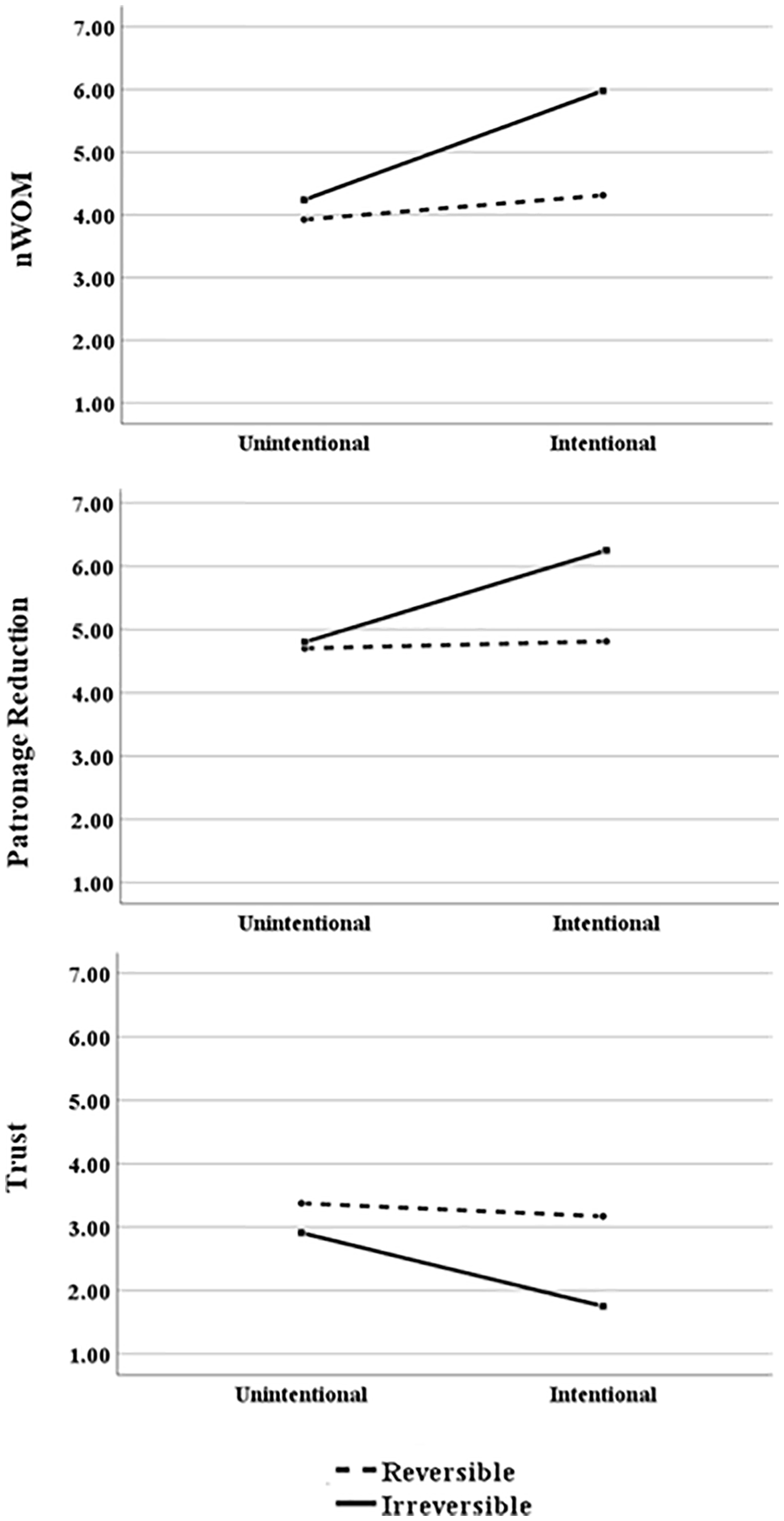
Estimated means for DVs and mediator in Study 1.
Indirect effects
Moderated mediation analyses (model 8) were performed based on Hayes and Preacher (2014), selecting failure intentionality as the IV, failure reversibility as the moderator, nWOM (hypothesis 2a) and patronage reduction (hypothesis 2b) as the DVs, and trust as the mediator.
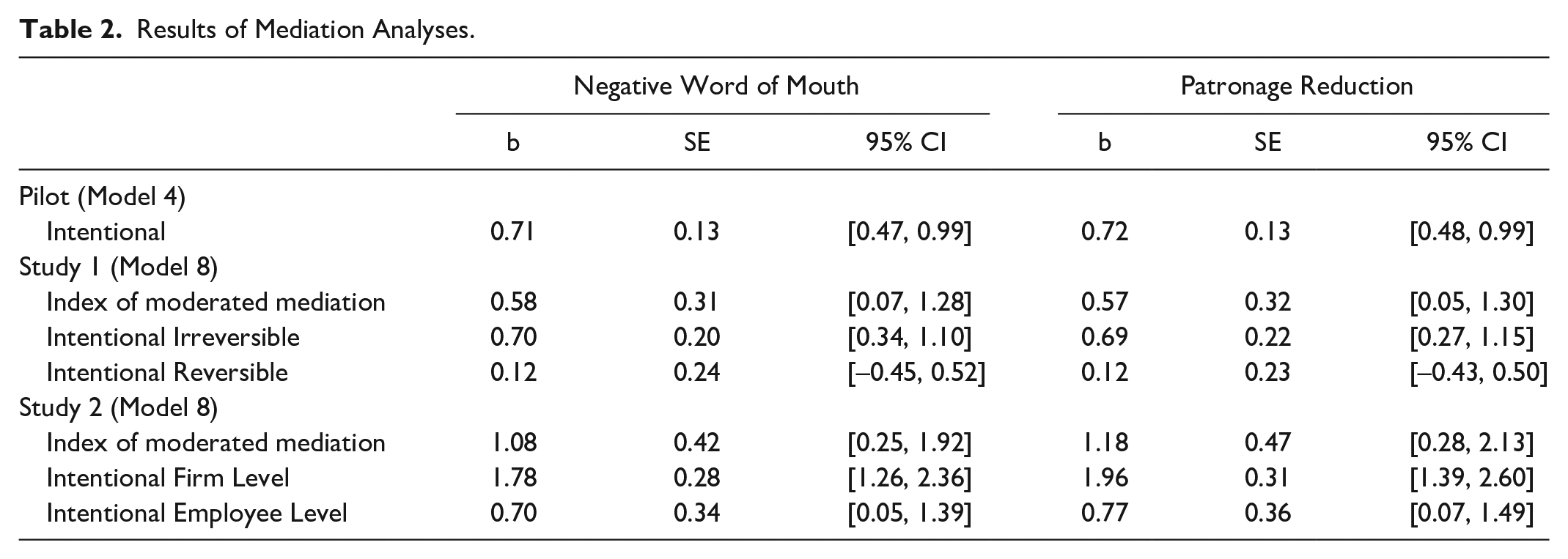
Table 2 (left side) depicts the mediation results for nWOM. The data indicated a significant index of moderated mediation (b = 0.58, SE = 0.31, 95% CI = 0.07, 1.28). The intentional (vs. unintentional) condition yielded higher levels of nWOM indirectly via trust for an irreversible failure (b = 0.70 SE = 0.20, 95% CI = 0.34, 1.10) but not for a reversible failure (b = 0.12, SE = 0.24, 95% CI = −0.45, 0.52), thus supporting hypothesis 2a. Since the direct effect of failure intentionality remained significant (b = 1.04, p < .01), the mediation can be classified as complementary. Table 2 (right side) shows the results for patronage reduction, exhibiting a similar pattern. The index of moderated mediation was significant (b = 0.57, SE = 0.32, 95% CI = 0.05, 1.30) and the intentional (vs. unintentional) failure condition yielded higher levels of patronage reduction via trust for an irreversible (b = 0.69, SE = 0.22, 95% CI = 0.27, 1.15) but not for a reversible failure (b = 0.12, SE = 0.23, 95% CI = −0.43, 0.50), supporting hypothesis 2b. Since the direct effect of failure intentionality was significant (b = 0.76, p < .05), the mediation can be classified as complementary.
Results of Mediation Analyses.
Alternative mediational structures
Although not directly hypothesized, perceived justice was also measured to rule it out as an alternative process explanation. Participants responded to seven items (e.g., “The outcome I received was fair.”; α = .87), capturing justice as an overall perception as advocated by prior research (Roschk and Gelbrich 2017). Two alternative models were tested in which justice was entered as (1) a parallel (i.e., competing) mediator to trust, and (2) as the antecedent to trust in a serial mediation by assessing the “failure intentionality → justice → trust → nWOM/patronage reduction” sequence.
In the first model, the parallel mediation with trust and justice indicated a nonsignificant index of moderated mediation through justice for nWOM (b = −0.06, 95% CI = −0.29, 0.10) and patronage reduction (b = 0.04, 95% CI = −0.06, 0.30), while the index for the moderated mediation through trust remained significant for nWOM (b = 0.63, 95% CI = 0.06, 1.38) and patronage reduction (b = 0.53, 95% CI = 0.05, 1.30). In the second model, the serial mediation with justice as antecedent to trust showed again a nonsignificant index of moderated mediation for nWOM (b = 0.10, 95% CI = −0.09, 0.38) and patronage reduction (b = 0.09, 95% CI = −0.07, 0.33). Thus, the results did not suggest that justice contributes explanatory power to the found effects via trust.
Discussion
Study 1 supported that failure reversibility moderates the negative indirect effects of intentional failures on customers’ negative reactions, supporting hypothesis 2a and hypothesis 2b. Specifically, an irreversible failure can amplify the negative consequences of an intentional failure whereas a reversible failure can dampen its negative effects. Further, trust was shown to mediate the interaction effect of failure intentionality and reversibility on customers’ nWOM and patronage reduction. In addition, analyses of alternative models revealed that in intentional failures, trust rather than justice is a better predictor of customers’ reactions.
Study 2
Sample and Procedure
Study 2 tested the moderating effects of failure level on the positive effects of failure intentionality on nWOM (hypothesis 3a) and patronage reduction (hypothesis 3b) through trust. A 2 (failure intentionality: intentional vs. unintentional) by 2 (failure level: employee vs. firm) between-subjects design was used. The sample comprised 161 US participants (Mage = 36.94, SD = 10.13; female = 50.3%) recruited from Clickworker.
To enhance generalizability, participants imagined a different but common tourism setting, a restaurant encounter (Vu et al. 2019). To illustrate the scenario, video clips were used similar to study 1 (see Appendix 1 for full scenarios). The scenario, which was inspired by reviews from TripAdvisor, described a couple who goes out for dinner and gets shortchanged by their waiter, Mike, who insists on receiving a $50 rather than a $100 note.
The two intentional failure conditions were manipulated as follows: Mike refuses to acknowledge receiving a $100 note, but later on, the customer finds out from TripAdvisor reviews that other people had similar issues. In the firm-level condition, it was added that other people were shortchanged by different waiters, and this seems to be orchestrated systematically by the restaurant. In the employee-level condition, it was added that other people were shortchanged by the same waiter named Mike, although this does not seem to be orchestrated systematically by the restaurant. The two unintentional failure conditions were manipulated as follows: Mike later acknowledges receiving a $100 note, but because the manager is not available to authorize this, the customer needs to wait until the next day. In the firm-level condition, it was added that there is a problem with the cash register system and later this is confirmed from other TripAdvisor reviews. In the employee-level condition, it was added that Mike acknowledges making a mistake and other TripAdvisor reviews indicate that this may happen during busy times.
The same measures as in previous studies (α’s > .90), as shown in Table 3, as well as the same set of controls as in study 2 (i.e., severity, service importance, blame, controllability, and stability attributions) were used. To avoid ambiguity and confusion, 2 blame attribution as a control variable was adapted in this study, using a different single item (1: the failure was my fault, 7: the failure was someone else’s fault).
Constructs, Measures, and Sources for Pilot / Study 1 / Study 2 / Study 3.
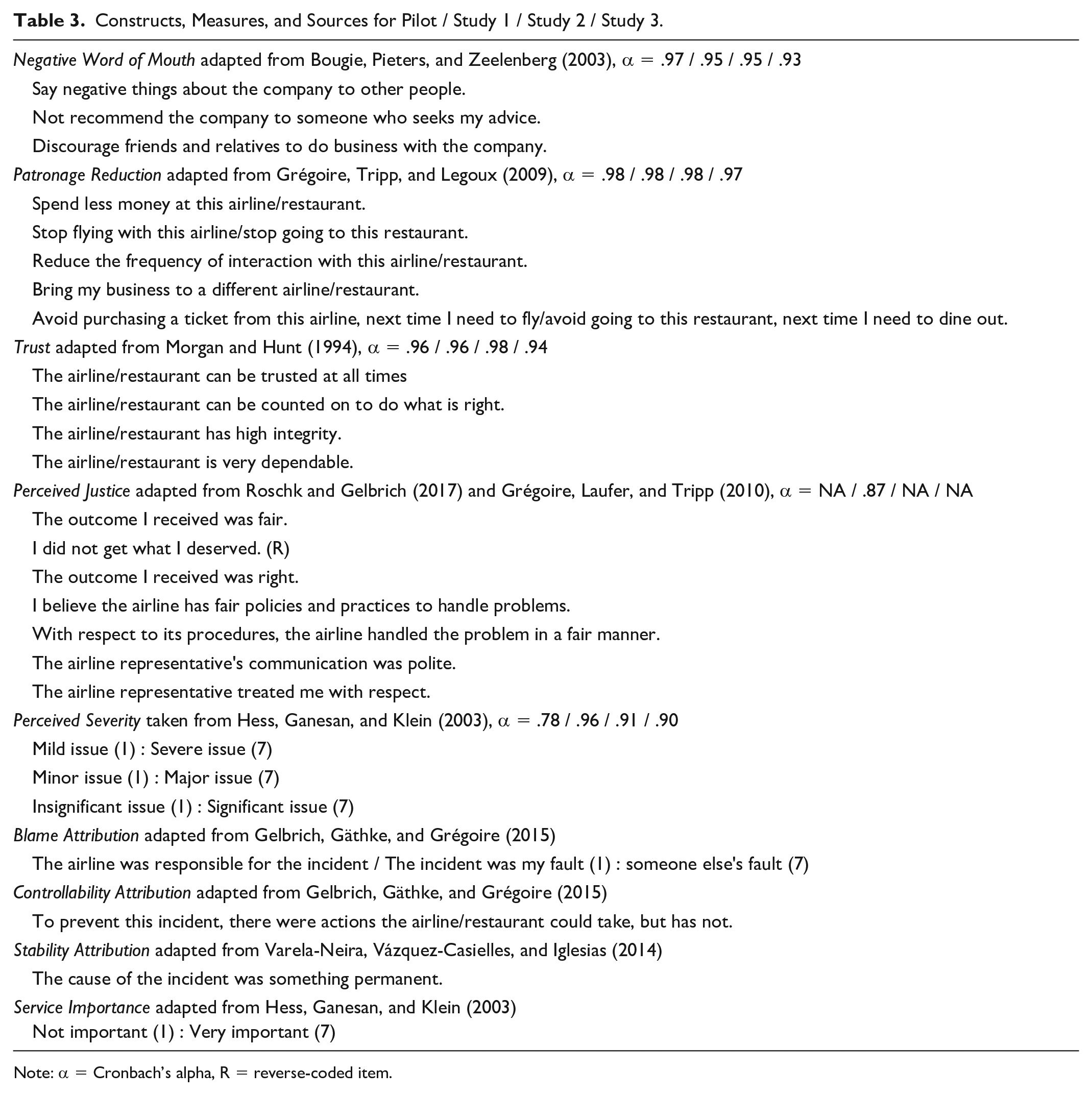
Note: α = Cronbach’s alpha, R = reverse-coded item.
Manipulations Checks
The failure intentionality manipulation was checked as before (α = .99) and perceived failure level was checked using a semantic differential scale with two items. (The incident was the fault of the. . . 1: waiter/individual employee, 7: the owner/entire firm; α = .93.) A multivariate analysis of variance (MANOVA) with the two manipulation check scales as DVs and the two experimental factors as IVs showed group means in the intended direction for failure intentionality (MInt/Unint = 6.10/3.03, F[1, 157] = 195.96, p < .01, η² = .56) and failure level (MFirm/Employee = 4.94/1.75, F[1, 157] = 187.13, p < .01, η² = .54). No significant cross effects emerged (at p < .05), with one exception, which was minor in scope (η² =.03). Further, the mean values for blame (MInt/Unint = 6.34/6.19, p > .05), controllability (MInt/Unint = 5.35/5.66, p > .05), and stability attributions (MInt/Unint = 3.29/3.08, p > .05) as well as severity (MInt/Unint = 6.39/6.11, p > .05) did not differ across the intentionality conditions, indicating the successful manipulation of intentionality. The scenarios were perceived realistic (M = 5.61), with no differences across the conditions (p > .05).
Results
Direct effects
Three ANCOVAs were conducted with intentionality and failure level as IVs; nWOM, patronage reduction and trust as the DVs; and service importance, failure severity, blame, controllability, and stability attributions as controls. Results revealed significant main effects of intentionality and failure level for all DVs. Importantly, the intentionality by failure-level interaction was significant for nWOM (F[1, 152] = 5.00, p < .05, η² = .03), patronage reduction (F[1, 152] = 7.70, p < .01, η² = .05), and trust (F[1, 152] = 7.47, p < .01, η² = .05), qualifying the respective main effects. Figure 3 shows the interactions. Post hoc comparisons for nWOM indicated that the difference in the level of nWOM between intentional and unintentional failure was more pronounced when the failure was at firm level (MInt/Unint = 6.28/3.99, p < .01), compared with employee-level failure (MInt/Unint = 4.40/3.25, p < .01). Similarly, failure intentionality caused heightened patronage reduction, when the failure was at firm level (MInt/Unint = 6.96/4.68, p < .01) compared with employee level (MInt/Unint = 4.69/3.93, p < .05). Finally, failure intentionality yielded a larger reduction in trust when the failure was at firm level (MInt/Unint = 1.27/3.42, p < .01) compared with employee level (MInt/Unint = 3.34/4.18, p < .05). In sum, the results provided preliminary support for hypotheses 3a and 3b. For an exact test, the mediational structures were examined.
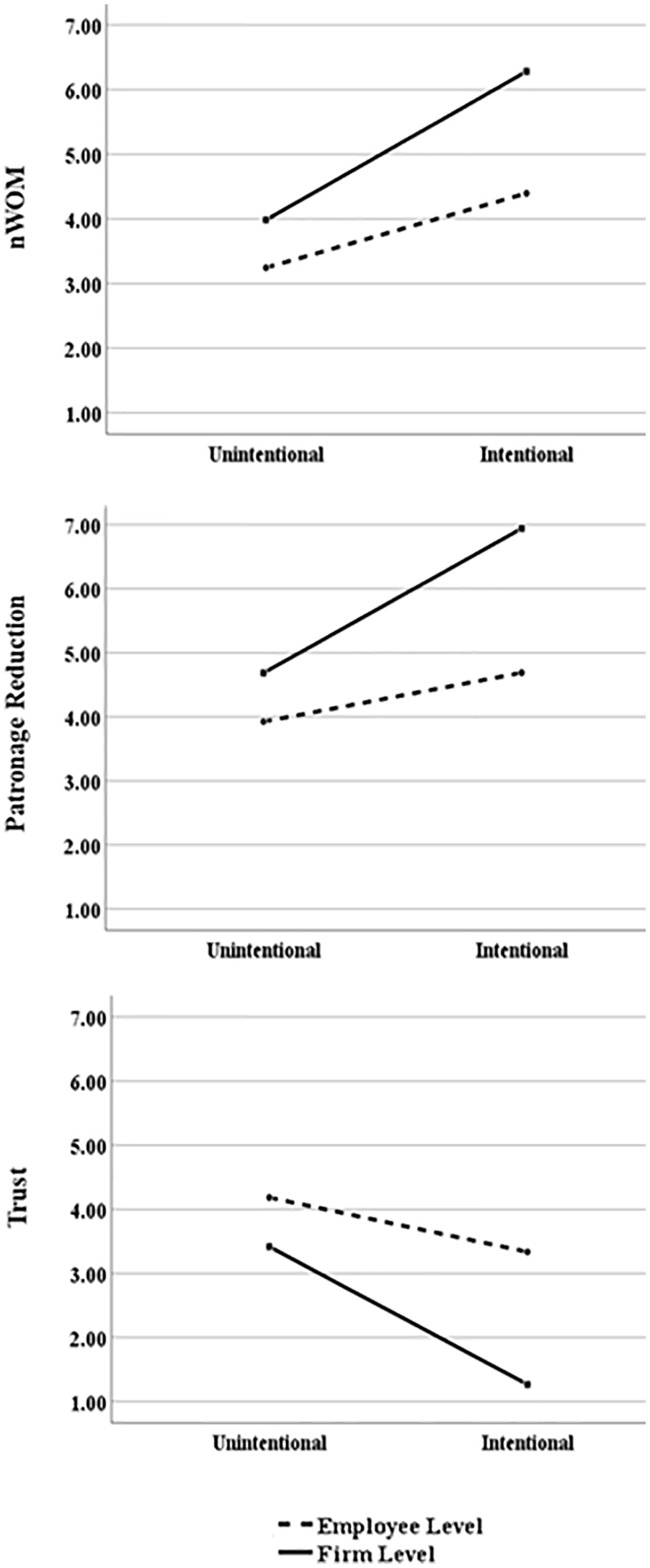
Estimated means for DVs and mediator in study 2.
Indirect effects
Moderated mediation analyses (model 8) were performed based on Hayes and Preacher (2014). Failure condition was selected as the IV, failure level as the moderator, nWOM (hypothesis 3a) and patronage reduction (hypothesis 3b) as the DVs, and trust as the mediator. Table 2 (left side) depicts the mediation results for nWOM. The data indicated a significant index of moderated mediation (b = 1.08, SE = 0.42, 95% CI = 0.25, 1.92). The intentional (vs. unintentional) condition yielded significantly higher levels of nWOM indirectly via trust for a firm-level failure (b = 1.78 SE = 0.28, 95% CI = 1.26, 2.36) compared with an employee-level failure (b = 0.70, SE = 0.34, 95% CI = 0.05, 1.39), thus supporting hypothesis 3a. Table 2 (right side) shows the results for patronage reduction, exhibiting a similar pattern. The index of moderated mediation was significant (b = 1.18, SE = 0.47, 95% CI = 0.28, 2.13), and the intentional (vs. unintentional) failure condition yielded significantly higher levels of patronage reduction via trust for a firm level (b = 1.96, SE = 0.31, 95% CI = 1.39, 2.60) compared with an employee-level failure (b = 0.77, SE = 0.36, 95% CI = 0.07, 1.49), supporting hypothesis 3b. Further, the direct effects of failure intentionality on nWOM and patronage reduction became nonsignificant, suggesting indirect-only mediation.
Discussion
The results of study 2 showed that failure level moderates the positive indirect effects of intentional failures on customers’ nWOM and patronage reduction, supporting hypotheses 3a and 3b. Specifically, the results revealed that a firm-level failure can amplify the negative consequences of an intentional failure whereas an employee-level failure can dampen its effects. Further, trust mediated the interaction effect of failure intentionality and failure level on customers’ nWOM and patronage reduction.
Study 3
Sample and Procedure
Study 3 tested the effects of different recovery strategies across intentional failures at firm and employee levels on nWOM, patronage reduction, and trust. A 4 (service recovery strategy: apology, promise, monetary compensation, and combined recovery) by 2 (intentional failure level: employee vs. firm) between-subjects design was used. The sample comprised 393 US participants (Mage = 36.13, SD = 10.76; female = 71%) recruited from Clickworker.
The first part of the scenario described the same intentional failure condition as in study 2, manipulating the failure at employee and firm level. In the second part of the scenario, the service recovery strategies were manipulated as follows: In the baseline, the manager called the next day and stated that they would refund the $50. In the apology condition, the manager took full responsibility and expressed a sincere apology for the problem. In the promise condition, the manager stated that their operational procedures are modified (i.e., a camera will be placed above the cash register to record how much money is received from the customer) and promised that such failures would not happen again in the future. In the monetary compensation group, the manager offered an additional 50% discount on the bill on the next visit to the restaurant. In the combined recovery group, all three recovery strategies were offered together. The DVs and mediator were measured two times in line with Basso and Pizzutti (2016): first after the service failure before being exposed to one of the recovery strategies (T1) and again after being exposed to one of the recovery strategies (T2). The same measures as in the previous studies (α’s > .90; shown in Table 3) and the same control variables as in study 2 were used.
Manipulations Check
Perceived failure level was checked as before (α = .85), with group means differing in the intended direction (MFirm/Employee = 4.76/2.10, F[1, 391] = 253.85, p < .01, η² = .39). Further, the mean values for intentionality (MFirm/Employee = 5.90/5.97, p > .05), blame (MFirm/Employee = 6.50/6.34, p > .05), controllability (MFirm/Employee = 6.03/5.96, p > .05), and stability attributions (MFirm/Employee = 3.37/3.18, p > .05) as well as severity (MFirm/Employee = 6.39/6.24, p > .05) did not differ across the failure level conditions. The scenarios were perceived realistic (M = 5.50), with no differences across the conditions (p > .05).
Results
Initially, three ANCOVAs were conducted with recovery strategy and failure level as IVs, nWOM, patronage reduction and trust as the DVs (in T2), and service importance, failure severity, blame, controllability, and stability attributions as controls. Results revealed significant main effects of recovery strategy on nWOM (F[3, 372] = 8.38, p < .01, η² = .06), patronage reduction (F[3, 372] = 7.27, p < .01, η² = .06), and trust (F[3, 372] = 7.50, p < .01, η² = .06). Results also showed significant main effects of failure level on nWOM (F[1, 372] = 7.97, p < .01, η² = .02), patronage reduction (F[1, 372] = 6.44, p < .05, η² = .02), and trust (F[1, 372] = 8.08, p < .01, η² = .02). Further, the recovery strategy by failure level interaction was marginally significant for nWOM (F[3, 372] = 2.04, p = .10, η² = .02) and trust (F[3, 372] = 2.39, p = 07, η² = .02) but not for patronage reduction (F[3, 372] = 0.90, p = .44, η² = .01).
Next, akin to Nazifi, Gelbrich, et al. (2021), each failure level (firm and employee) was examined separately, and nWOM, patronage reduction, and trust levels were compared at T2 versus T1 for the four recovery groups using repeated ANCOVAs (see Figure 4). At employee level, all four recovery strategies significantly reduced nWOM at T2 compared to nWOM at T1 (see Supplementary Material S3 for cell means). Post hoc tests were conducted to see if there was a significant difference in nWOM at T2 following different recovery strategies. At employee level, apology (M = 5.00) was significantly less effective than promise (M = 4.04), monetary compensation (M = 4.01), and combined recovery (M = 3.87) in reducing nWOM (all p < .01), with no significant difference among the latter three recovery groups (all p > .05). At firm level, all four recoveries significantly reduced nWOM at T2 compared to T1 (see Supplementary Material S3). Post hoc tests revealed that within the firm-level intentional failure condition, combined recovery (M = 3.95) was significantly more effective than apology (M = 5.03), promise (M = 4.89), and monetary compensation (M = 4.83) in reducing nWOM (all p < .01), with no significant difference among the latter three recovery groups (all p > .05). Thus, the results supported hypothesis 4a.
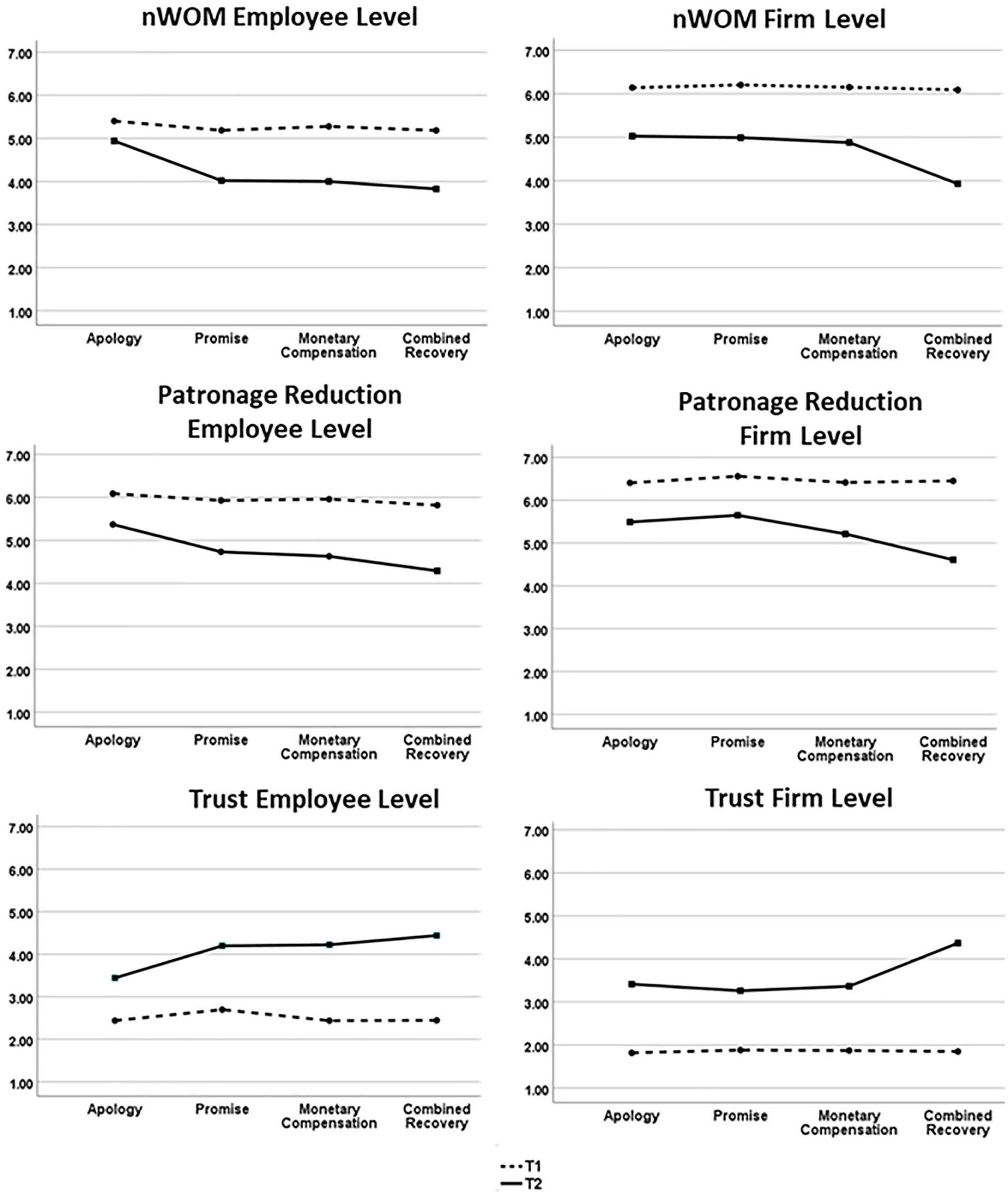
Estimated means for DVs and mediator in study 3.
The results for trust and patronage reduction were consistent with the depicted pattern for nWOM (see Figure 4) with only one note of caution, that for patronage reduction in the firm-level condition, the improved response of combined recovery compared with the monetary compensation group was marginally significant (p = .06), but still significantly more effective than apology and promise (p < .05), providing support for hypotheses 4b and 4c. In addition, while hypotheses 4a–4c tested a simplified version of the conceptual model, Supplementary Material S4 provides the results for the recoveries based on mediations via trust, which are in support of the reported pattern, yet should be seen with some caution, given the limitations of this analysis as discussed in the appendix.
Discussion
The results of study 3 showed that all four recovery strategies can be effective in reducing nWOM and patronage reduction and improving trust, supporting hypotheses 4a–4c. However, for an intentional failure at employee level, apology was the least effective strategy. Among the other three strategies, given that a promise was as effective as monetary compensation or combined recovery, yet more cost-effective, it qualified as the optimal solution. For an intentional failure at firm level, combined recovery was the most effective strategy, deemed as the preferred strategy.
Study 4
Purpose and Setting
The final study aimed to validate the main effects found in the experiments on eWOM valence with real-world data scraped from TripAdvisor, a novel technique used by tourism scholars to understand attitudinal and emotional cues of services, as well as the helpfulness of reviews (e.g., see Alaei, Becken, and Stantic 2019). Two major cities in the United States were selected, and reviews from more than 5,617 restaurants in the cities of Philadelphia and San Francisco were scraped from 2014 to December 2019 (data are available on request). The selection of these cities had two main benefits. First, language cues were similar (American English), which helped facilitate text analysis, and second, both cities offered different attractions relative to gastronomic culture (e.g., Philly steak and New York–style bagels), which contributes to generalizability. This approach to data scraping and analysis was similar to the one described by Melumad, Inman, and Pham (2019). Python programming language with the scraping modules Selenium and Requests was used to collect the reviews.
Method
Using the restaurant reviews data set, a regular expression code (REGEX; Villarroel Ordenes et al. 2019) was developed to retrieve online reviews indicating a potential intentional failure. The focus on intentional failures referring to overcharge was because anecdotal evidence rendered it as one of the focal cases of intentional failures and it was also successfully used in study 2. Furthermore, focusing on a single case of intentional failure makes this field study more parsimonious around a single type of intentional failure. The following REGES was used:
.*(over charge|over[-]charge|overcharge|double charge|double[-]charge|misbill|mis[-]bill|misbill|incorrect bill|stealing|hidden fees|hidden fee|shortchange|short[-]change|short change|bogus charge|gouge|gouging).*
All searched words were between brackets and separated by a “|”; the command “.*” indicated that any string sequence in the review can precede these words and the command “.*” indicated that any string sequence can follow. The regular expression led to the identification of 301 reviews, 3 which were scrutinized by a research assistant and resulted in the identification of 168 cases of an intentional failure (examples of excluded cases were “We did not get overcharged”). The following review is one of the examples including an intentional failure about overcharge: “I dined there with my friends recently, and days later found that I was charged double for my orders on my credit card. The restaurant doesn’t answer their phones or response to emails. If you eat there and get over charged, good luck getting your money back.”
To achieve greater insight concerning the intentional failures, two additional independent coders annotated the failure level in a range from 1 (employee driven) to 7 (firm driven) (Krippendorff’s alpha = 0.77), and failure irreversibility, where 1 represented surely reversible and 7 surely irreversible (Krippendorff’s alpha = 0.72). (See Appendix 5 for annotation rules.) In line with prior research, the average between the two annotators was used as final measurements (Villarroel Ordenes et al. 2019).
Modeling and Results
The analyses included two models. Model 1 aimed to assess the negative effect of intentional failures (relative to a random sample of failures that matched the restaurants and the star rating distribution of the focal intentional failure sample) on eWOM valence. Model 2 delved into reviews with intentional failures and assessed the effects of failure level and irreversibility on eWOM valence. It was not possible to infer trust from the online review data; therefore, the mediation effect could not be assessed.
To operationalize consumers' eWOM valence, the sentiment valence embedded in the text of the review was measured. Sentiment valence can be portrayed as a conceptually rigorous variable about eWOM valence because it represents naturalistic expressions of positive and negative evaluations about a service experience, with implications for review readers (Berger et al. 2020; Rosario et al. 2020). Valence was measured and validated in line with previous research using two dictionaries, LIWC and the Evaluative Lexicon (Rocklage and Fazio 2015 ). As previously done in marketing research (Berger and Milkman 2012), the measurement of review sentiment was carried out using LIWC dictionaries by subtracting the negative affect dictionary from the positive one (M = 1.98, SD = 3.73). A higher number indicated more positive valence, and a lower number indicated more negative valence. In addition, using the Valence Average (M = 4.52, SD = 2.01), the measure was validated from the Evaluative Lexicon, a well-known sentiment mining tool, and results followed the same pattern (rLIWC-Evaluative Lexicon = .70).
To test the hypothesis related to model 1, this study followed the approach by Reich and Maglio (2020) and equated the sample of reviews with intentional failure (N=168) with a randomly selected sample of 168 reviews without intentional failure. This random sample was from the same restaurants with intentional failures and it had the same star rating distribution as the intentional failure sample. Matching the star rating distribution allowed to create a sample with a comparable failure degree and so for a fair comparison of intentional failures with a random sample that also represented service failures. Otherwise, the random sample may have been biased comprising 5-star reviews which did not include failure conditions (Chevalier and Mayzlin 2006). This resulted in a final sample of 336 reviews. In line with previous research and to avoid potential omitted variables (Berger et al. 2020), the following controls were added: number of helpful votes (Van Laer et al. 2019), review star rating (Ludwig et al. 2013), number of reviews from the author (Reich and Maglio 2020), mobile versus PC review (1 = Mobile, 0 = PC; Melumad et al. 2019), review length measured as word count (Villarroel Ordenes et al. 2017), and the city where the review took place (1 = San Francisco, 0 = Philadelphia).
The second model focused only on reviews with an intentional failure (N = 168) and aimed to provide external validity to the negative effects of failure level and irreversibility on eWOM valence. The same control variables as in model 1 were used. All variables were standardized before regression across the models (see Table 4 for study 4 results).
Results of Field Study.
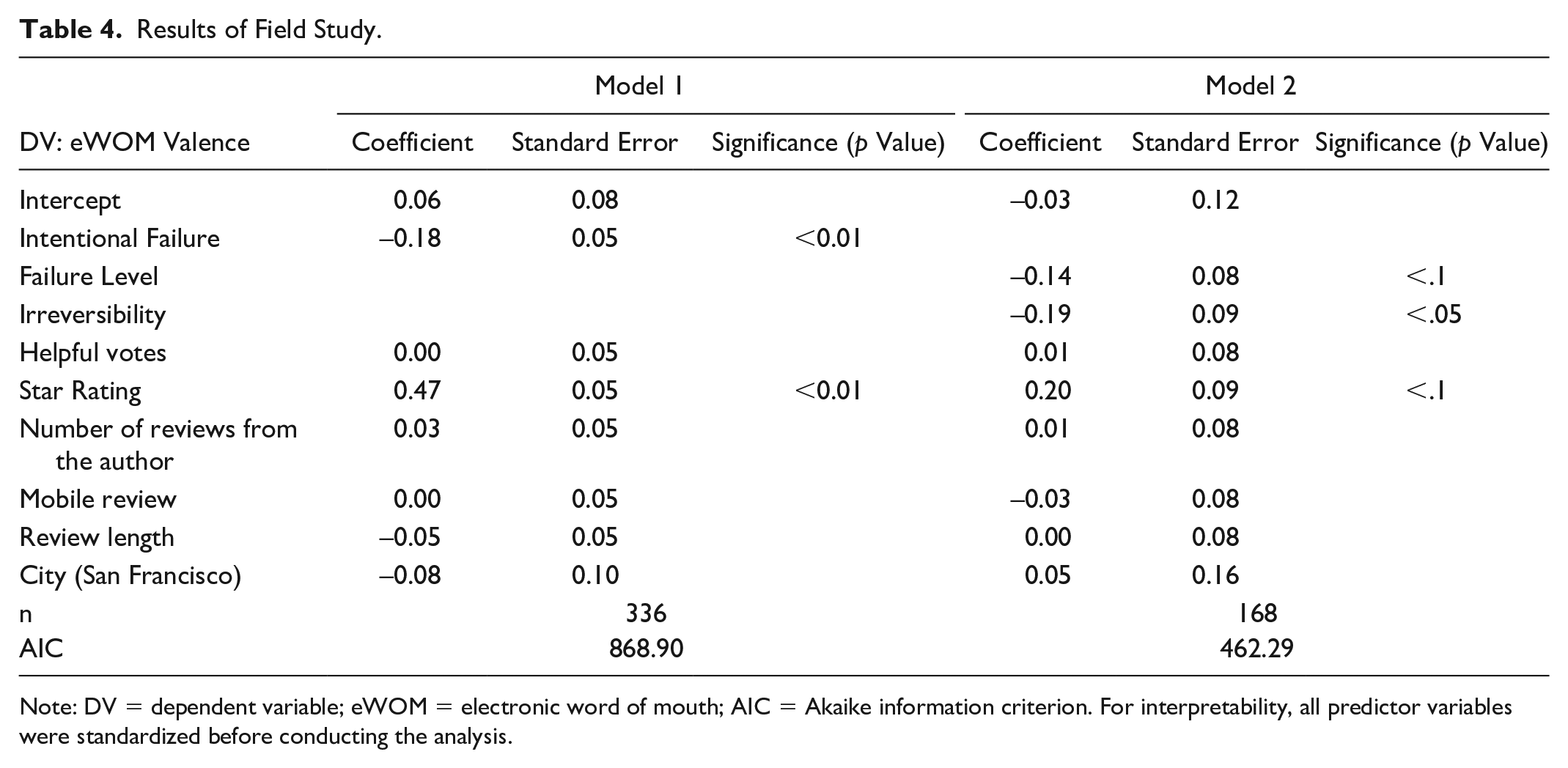
Note: DV = dependent variable; eWOM = electronic word of mouth; AIC = Akaike information criterion. For interpretability, all predictor variables were standardized before conducting the analysis.
First, the regression revealed that reviews referencing intentional failures (vs. those not referencing intentional failures) resulted in more negative eWOM valence (βIntentional Failure = −0.18, SE = 0.05, p < .01). Second, the study found a marginally significant negative effect of the failure level on eWOM valence (βFailure level. = −0.14, SE = 0.08, p = .08). Further evidence might be needed to determine the consistency of this finding. This suggested confirmation of the hypothesis that intentional failures result in more negative eWOM valence when they are perceived as systematic failures performed at a firm rather than employee level. Finally, support was found for the hypothesis that intentional failures perceived as more irreversible result in more negative eWOM (βFailure Irreversibility. = −0.19, SE = 0.09, p < .05).
Discussion
The results of study 4, which were based on online reviews field data, validated the experimental findings. The results revealed that intentional failures result in higher negative customer reactions, supporting hypothesis 1a. The results also indicated that irreversible failures and firmwide failures lead to higher negative reactions, providing support for hypotheses 2a and 3a.
General Discussion
Theoretical contributions
This study provides three contributions that deepen the understanding of intentional failures, their processes and consequences, and buffering conditions, contributing to tourism literature and services research.
First, the results show that perceived intentionality leads to increased negative reactions, thus providing a rationale for studying failures in tourism contexts where intention is expected to be ascribed by travelers (e.g., overbooking) as particular harmful events (e.g., Bejou, Edvardsson, and Rakowski 1996; Nazifi, Gelbrich, et al. 2021; Perdue 2002). By looking at tourism contexts that are more hedonic in nature and including nWOM, the present research complements utilitarian banking contexts of prior work, thus expanding the scope and generalizability of the effects of intentional failures. Further, by directly contrasting unintentional and intentional failures through experiments in addition to text mining, the present findings strengthen the causal claims of prior survey-based results and also broaden the methodological basis with which results were gathered for more robust findings, as called for by recent service recovery research in general (e.g., Van Vaerenbergh et al. 2019; Grégoire and Mattila 2020). The findings concur with prior work from psychology, marketing, and public policy that intentionality should be considered as a separate dimension of causal attribution (Howlett 2012; Ames and Fiske 2013) and extend Chung and Petrick (2013) by suggesting intentionality as a fourth dimension of causal attribution within tourism research.
Second, the article provides novel insight into the pathways following intentionality transgressions. The results revealed trust as a mediator for the indirect effects of intentionality. While prior tourism research explained travelers’ reactions to service failures via justice perceptions (e.g., Migacz, Zou, and Petrick 2018; Xu, Liu, and Gursoy 2019), they did not explain the observed effects beyond the explanatory power of trust—neither in form of a parallel mediation nor as the antecedent to trust in a sequential mediation. This suggests trust as the salient theoretical anchor in the context of intentional failures, thus supplementing the justice-based view with trust-based frameworks. Interestingly, trust also turned out as the mediating mechanism for failure incidents followed by a failed recovery (i.e., double deviation; Basso and Pizzutti 2016), suggesting that among strong transgressions trust may play a more pronounced role than in traditional failure situations.
Third, responding to the call by Xu, Liu, and Gursoy (2019) for highlighting the buffering effects of situational factors in tourism failures, this research examines yet unexplored contextual factors governing intentional failures and provides novel insights under which conditions such failures were less (vs. more) harmful. Folkes and Patrick (2003) proposed a positivity effect in services suggesting that customers do not generalize negative encounters with an individual employee to the entire organization. By finding that intentional failures are less harmful when they occur on employee (vs. firm) level, the article provides the first evidence for (parts of) the positivity effect among intentional failures. It is noteworthy that the sentiments were yet more negative than for the unintentional condition. Interestingly, the findings showed that less pronounced negative sentiments (similar to the unintentional condition) occurred when the failure was reversible (vs. irreversible), rendering failure type as another important situational factor for tourists in calibrating their reaction. Taken together, it seems that tourists do not necessarily prejudge firms but consider situational factors, thus exhibiting a differentiated judgment about intentional failure incidents.
Building on initial work on service recovery following intentional failures (Iglesias, Varela-Neira, and Vázquez-Casielles 2015), the article extends knowledge providing the first contrast of recovery effectiveness following intentional failures at employee vs. firm levels. It was found that all four recovery strategies (monetary compensation, promise, apology, and combined recovery) were effective in reducing negative tourist outcomes (nWOM, repatronage reduction, and trust); however, important comparative advantages emerged dependent on the failure being at a firm vs. an employee level. At employee level, psychological compensation in form of a promise was as effective as monetary or combined recovery. Apology was, however, found to be the least effective, potentially because an apology following an intentional failure appears less genuine or credible when unaccompanied by a concrete action such as monetary compensation or a promise.
At a firm level, monetary compensation promoted as an important recovery tool by prior research was best combined with psychological compensation for optimal results. This resonates with the high expectations assumed by customers, following the perceived globality of intentional firm-level failures (Hess, Ganesan, and Klein, 2007). Therefore, this research supports a shift away from “one size fits all” thinking around recovery strategies for intentional failures, toward more nuanced options based on whom the intentionality is ascribed.
Managerial Implications
Intentional failures are managerially relevant for different reasons. The findings indicated that they lead to increased negative reactions, and they are often inevitable because of external pressures and rogue employee behavior. Thus, given their salience, advice can be offered for tourism managers handling intentional failures. It is of note that the findings should not be considered as a legitimation for compromising the tourism service delivery, given the risks entailed by that. Consumers often do not voice their dissatisfaction about failures, but leave quietly or, in a more extreme case, loudly with a chance of going viral with intentional failures providing an exceptional situation and, thus, the hotbed for failures going viral.
For handling intentional failures, advice can be given based on conditions under which intentional failures were found less harmful. First, reflecting on the positivity effect, service employee transgressions were less aggravating than when the provider, in general, was held responsible. Thus, if an intentional failure occurs at employee level, providers should endeavor to reinforce the positivity effect, for example, by explaining that it is an isolated incident that does not represent the intentions of the firm. Second, less pronounced negative sentiments were found for reversible failures. Thus, following a contingency approach, tourism providers can calibrate their recovery by gauging this information from the tourist (e.g., asking what the travel purpose was) and also indirectly from available records (e.g., holiday travel destination).
Advice can further be given based on the exploration of recovery strategy effectiveness following intentional failures. Specifically, following an employee-level intentional failure, a promise alone should provide an equivalent satisfactory recovery compared with monetary compensation or a combination, however, without additional cost implications. For firm-level failures, which create heightened negative responses for tourists, a combined approach (monetary compensation plus promise and apology) is considered more appropriate. Yet, a cautionary note seems warranted about the adaptation of the recovery efforts to firm- and employee-level failures, given that these results are preliminary, thus pending robustness through further research. Furthermore, managers should beware of tourists’ reactions to intentional failures during times of crises (e.g., the COVID-19 pandemic), which can have major implications on tourists’ well-being (Raki et al. 2021) and should hence tailor their recovery strategies to such specific occasions.
Limitations and Future Research
The study has some limitations, which offer potential for future research. First, to improve the understanding of intentionality, future research could explore what kind of trust violation(s) intentionality represents. Second, given that external factors were assumed to drive firms into potentially harmful practices, subsequent studies may focus on the organization side, exploring for example the reasons behind such conduct (e.g., crises, price wars) and how employees perceive it and are impacted by it (e.g., reduced job satisfaction from role conflicts). Third, further research may expand the set of situational factors, analyzing whether relationship quality buffers or inflicts the situation (Grégoire, Tripp, and Legoux 2009) and to which extent the number of affected individuals (group vs. individuals) plays a role in the negative repercussions from intentional failures (Rasoulian et al. 2017). Fourth, with regard to the experiments, the wedding scenario for the pilot and study 1 was a high involvement situation. While the core scenario in the subsequent experiments avoided this situation, future research should replicate these findings in low-involvement conditions. In addition, scenarios differ from real-world settings and not all effects could be assessed via text mining data. Thus, future research is encouraged to provide external validity beyond the present results.
Lastly, it must be acknowledged that some data (Study 3) were collected during the COVID-19 pandemic (after January 2020). Tourists’ responses may differ, potentially becoming more or even less sympathetic to intentional transgressions during or after the pandemic (Loureiro et al. 2021). Though this may limit the immediate generalizability of the findings, it is argued that the pandemic has increased the importance of introducing the notion of intentionality to the tourism literature as intentional failures stemming from the pandemic are being widely discussed (Beard and Williams 2020; McNeill 2020). This can also be showcased using overbooking in air travel. After past crises (e.g., MERS and SARS), it has been observed that carriers recommenced overbooking more intensely than before as a response to damaged balance sheets (Nazifi, Gelbrich, et al. 2021).
Supplemental Material
sj-pdf-1-jtr-10.1177_00472875211044221 – Supplemental material for Bad Intentions: Customers’ Negative Reactions to Intentional Failures and Mitigating Conditions
Supplemental material, sj-pdf-1-jtr-10.1177_00472875211044221 for Bad Intentions: Customers’ Negative Reactions to Intentional Failures and Mitigating Conditions by Amin Nazifi, Holger Roschk, Francisco Villarroel Ordenes and Ben Marder in Journal of Travel Research
Footnotes
Declaration of Conflicting Interests
The author(s) declared no potential conflicts of interest with respect to the research, authorship, and/or publication of this article.
Funding
The author(s) received no financial support for the research, authorship, and/or publication of this article.

Supplemental Material
Supplemental material for this article is available online.
Notes
Author Biographies
References
Supplementary Material
Please find the following supplemental material available below.
For Open Access articles published under a Creative Commons License, all supplemental material carries the same license as the article it is associated with.
For non-Open Access articles published, all supplemental material carries a non-exclusive license, and permission requests for re-use of supplemental material or any part of supplemental material shall be sent directly to the copyright owner as specified in the copyright notice associated with the article.
