




Abstract
The rise of augmented reality (AR) technology, which overlays digital content to alter customers’ views of a physical service setting, using mobile and wearable computing, drives the digital automation of physical services. In particular, it promises to achieve tangibility even in service encounters delivered in digital formats. However, customer engagement with AR is falling short of expectations. Managers lack an integrated framework of AR service automation and therefore tend to focus on the technology rather than on the process of customer engagement with AR service automation. To address this problem, the current study proposes a technology-enabled engagement process that integrates multiple stages of customer engagement, as a service-centric process. To establish that engagement with AR service automation requires the inclusion of service tangibility, as part of the process, the authors decompose the steps of interactive service engagement, the spatial presence of the service, customers’ emotional and cognitive engagement with the service, and perceived value-in-use, which lead to emergent behavioral forms of engagement.
Keywords
Many firms have adopted augmented reality (AR) to enhance both off-line and online service delivery (Heller et al. 2019a; Hilken et al. 2017). AR technology realistically embeds digital content in users’ perceptions by providing composite views of the physical and digital worlds. Fueled by rapid advances in wearable and mobile computing, such as Google’s ARCore, Snapchat’s Lens Studio, Apple’s ARKit, and Microsoft’s HoloLens (Barfield 2015), AR also can automate services by integrating digital forms of service content (e.g., product or service images, information, instructions) into customers’ perceptions of physical service environments.1 Such digital automation redefines service encounters and promises to enhance engagement with goods and services. For instance, Converse’s Sampler app allows shoe-shopping customers to use their mobile phones to see (virtually) how the shoes would look on them. Such technology increases service efficiency by replacing some physical tasks with virtual replica; it also supports entire service cycles, from decision making to transaction completion and resolution of after-sales problems (Cooper and Budd 2007). For example, with the Kabaq app, restaurant owners can provide customers with visual representations of menu items to help them make a choice, and companies such as VodafoneZiggo enhance after-sales service with AR platforms that help buyers assemble or repair their products.
Although investments in AR by major technology companies are set to exceed US$83 billion globally by 2021 (Merel 2017)—and despite the brief euphoria associated with Pokémon Go—anecdotal evidence indicates that customer engagement with AR service automation is plateauing at levels well below initial expectations (Merel 2017; Rauschnabel and Ro 2016). For example, the eyewear retailer Mister Spex reports that only a minority of the visitors to its web store engage with its AR mirror, even those who do find it valuable, prompting more purchases and fewer returns (Paroubek 2016).
Because customers’ failure to embrace AR service automation can be attributed partly to the focus on AR as a technology rather than a service enabler, we argue that managers need an in-depth, conceptual understanding of how AR can be redefined, in a service-centric context, to achieve valued outcomes for both customers and service providers. Even if the digitization of physical aspects of services engages customers in novel forms of self-service, it inherently poses challenges (De Keyser et al. 2019). In particular, service automation removes some physical aspects of a service, which might result in reduced perceptions of service tangibility and adverse effects on customers’ service evaluations (Childers et al. 2002). However, extant literature has yet to offer integrated insights into how to manage these competing forces. Moreover, though AR can digitally simulate “touch and feel” aspects of service (Hilken et al. 2017, 2018), researchers have not yet conceptualized AR service automation. Furthermore, previous research has largely focused on technology acceptance (Rese et al. 2017), user experience (Poushneh and Vasquez-Parraga 2017), or expected gratifications (Rauschnabel 2018) of using AR software and hardware. Despite initial work on customer engagement with AR as a technology (Scholz and Smith 2016), there is no comprehensive explanation of customer engagement with AR automated services. In our view, this research gap may intensify the underperformance of AR service automation; it also indicates the need for a broader, service-centric understanding of technology-enabled engagement with automated services (Hollebeek et al. 2019).
To conceptualize customer engagement with AR automated services, we invoke scholarship on both customer engagement and user engagement (Breidbach et al. 2014; Brodie, Hollebeek, and Conduit 2015). While customer engagement enhances customer relationships, builds competitive advantages, and drives revenue growth (Kumar et al. 2010), a process view that integrates distinct perspectives on customer engagement is currently lacking. There is a consensus that such a process needs to include the cognitive, affective, and behavioral dimensions that reflect a person’s willingness to invest in interactions with the objects of their engagement, such as an automated service (Groeger, Moroko, and Hollebeek 2016). Recent conceptualizations of user engagement also highlight the need to separate user adoption or interactions with a technology from user engagement with a service (Oh, Bellur, and Sundar 2018). Studies of emerging technologies often rely on technology adoption as a metric of market success (Lee, Kozar, and Larsen 2003), which might be myopic in the sense that it prioritizes technologies’ features over their applications for service delivery. From a conceptual perspective, customer engagement offers a better framework for informing service managers’ (rather than technology developers’) design of AR automated services. Customer engagement also is a pivotal predictor of the success of automated services (Scholz and Smith 2016); service technologies that fail to initiate and sustain customer engagement are likely to be commoditized, suffer from “shiny new object syndrome” (Hilken et al. 2017), or forfeit the initial advantages of their novel technology. The precise delineation of technology-enabled engagement with automated services remains “scholarship-in-progress,” especially with regard to emerging technologies such as AR, such that apart from generic usability guidelines (Scholz and Smith 2016), little is known about how engagement with AR services emerges and whether the process results in marketing-relevant outcomes.
To address these gaps, we thus draw on marketing, services, and human-computer interaction (HCI) literature to conceptualize customer engagement as a process. We propose a multistage conceptual framework, the technology-enabled engagement process (TEEP). By decomposing this process into its constituent stages, we explain the structure of customer engagement with AR automated services. In particular, we identify the interactive qualities of AR services that enable a unique form of service automation, in which customers are able to still perceive service tangibility. Notably, while AR enables tangible service automation, customers perceive tangibility as a feeling of spatial presence. In turn, we conceptualize how these benefits of AR service automation might propagate through the TEEP, to result in cognitive and emotional engagement with the service, perceptions of the value-in-use of the service, and subsequent behavioral outcomes.
The TEEP framework establishes three main contributions. First, we identify the unique interactive qualities of AR service automation. Functionally, service qualities aim to support customers at the service frontline by automating subject-object information processing, such that AR service automation should be both appealing to customers and relevant to the service activities it is designed to support. On the one hand, we identify information fit-to-task as a pertinent quality of AR service automation. On the other hand, we acknowledge that AR automated services should enhance customers’ experiences by presenting information that is visually attractive (Huang and Liao 2015). Therefore, it is important that AR automated services have high visual appeal. In this way, we conceptually shift the focus from technology features to qualities of the service experience.
Second, the two service qualities contribute to the perceived tangibility of automated services by eliciting feelings of spatial presence, that is, a realistic blending of digital content with a customer’s view of a physical setting (Schubert 2009). Spatial presence is a necessary condition for customers to develop positive emotions and cognitions toward AR services (Hilken et al. 2017). Accordingly, we examine how the interactive qualities of AR service automation might enable customers to perceive tangibility in otherwise digitally automated services, resulting in greater cognitive and emotional engagement with those services.
Third, we interpret customer engagement as a process aimed at enabling customers to realize value, in the form of value-in-use (Jaakkola and Alexander 2014). We contend that users of AR automated services integrate their resources (i.e., time, skills, and knowledge) to cocreate value with service providers. Value cocreation is contextual; it is contingent on a person’s ability to succeed at the task at hand. Accordingly, we propose a process that (1) propagates customers’ psychological engagement with services to perceptions of value-in-use, (2) drives behavioral engagement in the form of reuse likelihood (i.e., repeated engagement using AR automated services), and (3) increases word-of-mouth (WOM) intentions (i.e., engagement by spreading the word about AR service automation). We base our proposal on the contention that AR service automation raises customers’ perceptions of their abilities to accomplish (challenging) tasks (i.e., through performance, productivity, or effectiveness), which in turn influences both their re/use (Rese et al. 2017) and sharing intentions (Hilken et al. 2017). This process view can help managers understand both the dimensions of engagement and the sequence of stages that integrate those dimensions into the AR service context.
The remainder of our article is structured as follows: First, we synthesize literature on AR and service automation to define AR service automation. Second, we develop the TEEP framework, composed of five sequentially linked stages. Third, we draw on the TEEP to offer theoretical and managerial implications for enabling customer engagement with AR automated services. Fourth, we provide a future research agenda.
AR Service Automation
Firms increasingly seek to automate service delivery, partly or entirely (De Keyser et al. 2019; Larivière et al. 2017), through self-service (e.g., ATMs, check-in/checkout kiosks; Dabholkar and Bagozzi 2002; Meuter et al. 2000) and remote service (e.g., telehealth, online banking; Green, Hartley, and Gillespie 2016; Paluch and Blut 2013) technologies. In addition to increased service efficiency, a key feature of “high-tech, low-touch” service automation is that previously tangible service elements (e.g., physical check-in counters) become digitized (e.g., online check-in), and active service inputs previously performed by customers or employees (e.g., taking a restaurant order) are taken over by technology (e.g., ordering through a tablet; Schumann, Wünderlich, and Wangenheim 2012). However, the digitization of service sometimes introduces spatial separation between service production and consumption (Keh and Pang 2010), which can reduce the perceived tangibility of the service experience. For instance, online customers often indicate that they cannot evaluate offerings in a personal way (Childers et al. 2002). Although some service researchers discount the value of service tangibility, both historical and recent research converges on the importance of offering tangible service experiences to customers, arguing that “services marketers should be focused on enhancing and differentiating ‘realities’ through…tangible clues” (Shostack 1977, p. 78). According to Ding and Keh (2017), perceived tangibility, together with vivid imagery, is particularly important when customers are psychologically close to services, as occurs during typical frontline service encounters. In turn, service intangibility, including a blurred mental image of service elements, increases evaluation difficulty and perceived risk (Laroche et al. 2004). The loss of tangibility due to service automation thus poses a services marketing challenge and might threaten customer engagement.
Although recent literature acknowledges AR’s impact on buying intentions and sales (Heller et al. 2019a, 2019b; Hilken et al. 2017), it has not closed the gap between engagement literature and AR service automation. Furthermore, it has largely overlooked how AR can enable service automation without sacrificing tangible aspects of services. Because AR technology enables customers and frontline employees to see digital content that is relevant to service encounters (e.g., product or service images, information, instructions), it integrates with physical environments in interactive and visually appealing ways (Heller et al. 2019a; Hilken et al. 2018). It replaces or assists human roles and active inputs into service encounters by visually integrating interactive digital content into the physical environment (De Keyser et al. 2019). Thus, AR allows firms to replace physical aspects of their services with digital elements while still offering customers the tangible “touch and feel” sensory richness associated with physical service experiences (Hilken et al. 2017).
Furthermore, recent advancements in AR can support novel service automation that promises to balance the seemingly competing forces of “high-tech, low-touch” service efficiency through automation with “high-tech, high-touch” enhanced customer engagement through service tangibility. For instance, Timberland’s in-store AR mirror offers customers the optic simulation of virtually trying on fashion products from the company’s entire online assortment, without requiring the firm to keep physical stock. The tool also frees up the capacities of sales assistants, who can focus on personally advising customers on the best-fitting style. Using the Kabaq AR menu, coffee shop owners can help customers identify which cheesecake will go best with their coffee, by showing them product bundles that simplify their decision-making processes and enabling baristas to focus on preparing customers’ orders. The Dutch telecommunications provider VodafoneZiggo uses AR to automate after-sales inquiries about Wi-Fi connectivity without sacrificing the tangibility of having service technicians visit customers’ homes; using their smartphone cameras, customers can visualize the Wi-Fi signal strength in their homes and receive visual recommendations for where to position their routers or repeaters.
By drawing on the application examples in Table 1 and synthesizing key insights from service research on AR (e.g., Heller et al. 2019a; Hilken et al. 2017) and automation through frontline service technologies (De Keyser et al. 2019; Larivière et al. 2017; Marinova et al. 2017), we offer a definition of AR service automation as the partial or full replacement of tangible service elements, including human input, in a service encounter through the visual integration of interactive digital content into the physical environment while maintaining customers’ perception of service tangibility. The first part of this definition refers to AR’s ability to automate tangible aspects of the service, including physical cues (e.g., offerings, servicescape) and specific activities performed by customers and employees in service encounters; AR can assist or substitute for employee roles and activities that usually are physical, such as carrying boxes of products to customers. It is important to differentiate partial and full replacement of tangible service elements: Partial replacement occurs, for example, when customers preview items on a restaurant menu or gather additional information in service encounters (e.g., pointing their camera at physical items to receive additional information). In these settings, frontline employees still perform activities such as taking orders, serving food, and bringing products to customers. In contrast, full replacement substitutes the tangible service elements completely, for example, by replacing the physical try-on of shoes at home or in store with virtual try-on and after-sales inquiries to call centers with AR-based self-service. Because the substitution of employee input has the potential to improve overall service quality and efficiency (Lariviére et al. 2017), AR-assisted frontline employees need enhanced abilities to learn about and engage with customers at a deeper level (Marinova et al. 2017). For customers, AR can replace tedious activities (e.g., imaging how a product would look when worn, understanding how to service a Wi-Fi router) or assist in decision making (e.g., visualizing key facts about a menu item). Such AR assistance may result in both greater engagement and increased benefits for customers, including convenience and improved decision making (Heller et al. 2019a).
Examples of AR-Enabled Service Automation.
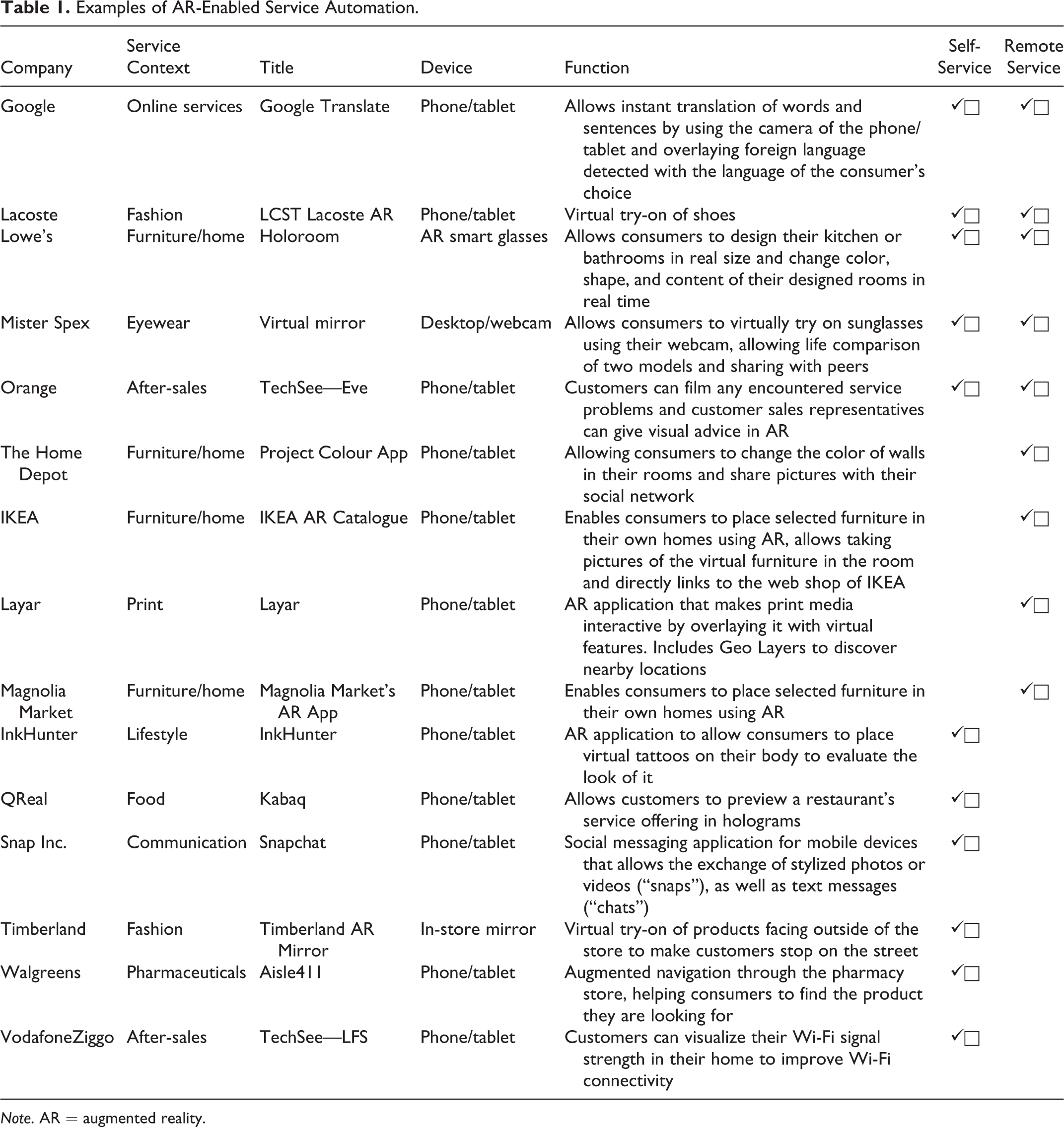
Note. AR = augmented reality.
The second part of the definition describes how AR service automation still maintains a perception of service tangibility, in that AR seamlessly integrates interactive digital content that is both appealing and relevant to customers’ physical environments. When customers interact with these features, they perceive the digital content as “real” (Hilken et al. 2017) and experience increased mental perceptions of the tangibility of service offerings (Heller et al. 2019a). This sensibility has positive effects on relevant service outcomes, including customers’ perceived effectiveness and enjoyment of service experiences (Hilken et al. 2017), decision comfort (Heller et al. 2019a, 2019b), and overall satisfaction (Poushneh and Vasquez-Parraga 2017). Thus, for firms that pursue service automation, AR offers the ability to deliver on the service imperative of saving customers time and money across the service cycle (Berry 2016) while maintaining the tangibility that customers value (Panda and Das 2014). Using technology to provide such relevant benefits to customers increases engagement and culminates in favorable behaviors toward service providers and their enabling technologies (Chen, Yen, and Tsai 2014).
In this work, we therefore explore the TEEP for AR automated services, to offer fine-grained insights into the steps involved in engaging customers with digitized and automated services. Rather than viewing engagement as a single-stage, multidimensional construct, we argue for a process of service engagement which differentiates the specific engagement dimensions that occur at sequential steps. Furthermore, and crucially, our proposed TEEP describes customer engagement with a service enabled by an underlying technology. Thus, we conceptually position the TEEP to take place between the customer and service “layer,” where AR technology acts as an underlying “layer” that enables an automated service, with which the customer can engage (Figure 1).
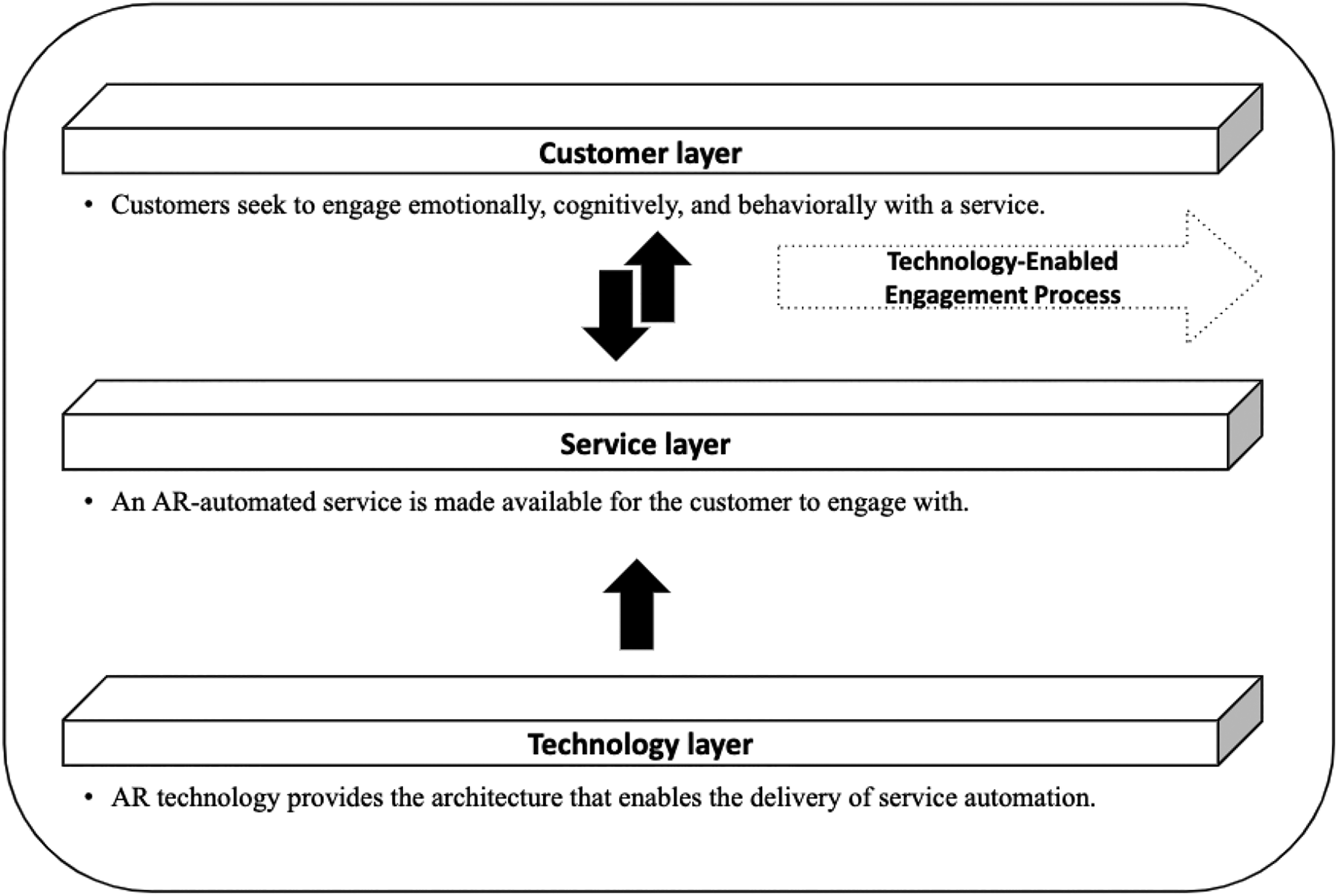
The TEEP positioned between the customer and service layer.
Customer Engagement with AR Service Automation: A Process View
In parallel streams, researchers in services and HCI domains have grappled with definitions of customer and user engagement, as they relate to technology (Breidbach et al. 2014; O’Brien and Toms 2008; Oh, Bellur, and Sundar 2018). Table 2 provides an overview, revealing that though these conceptualizations are advanced, we still lack theoretical clarity and integration across divergent perspectives on technology-enabled engagement. Researchers have approached the construct of customer engagement using lenses as varied as customer participation (Vivek, Beatty, and Morgan 2012), engagement as a psychological state (Brodie et al. 2011), or value to the firm (Kumar et al. 2010). In HCI literature, the dominant focus has been on interaction with technology rather than user engagement (Hoffman and Novak 2009; Rogers, Sharp, and Preece 2011). However, both service and HCI research communities are moving away from solely addressing usability, acceptance, and enhancement of service efficiencies to consider how technology might facilitate customers’ active role in achieving outcomes of value (Keeling et al. 2019; Marinova et al. 2017). There is a growing need for an integrative process framework that describes how technology can enable customer engagement with services.
Conceptualizations of Engagement in Service and HCI Literature.
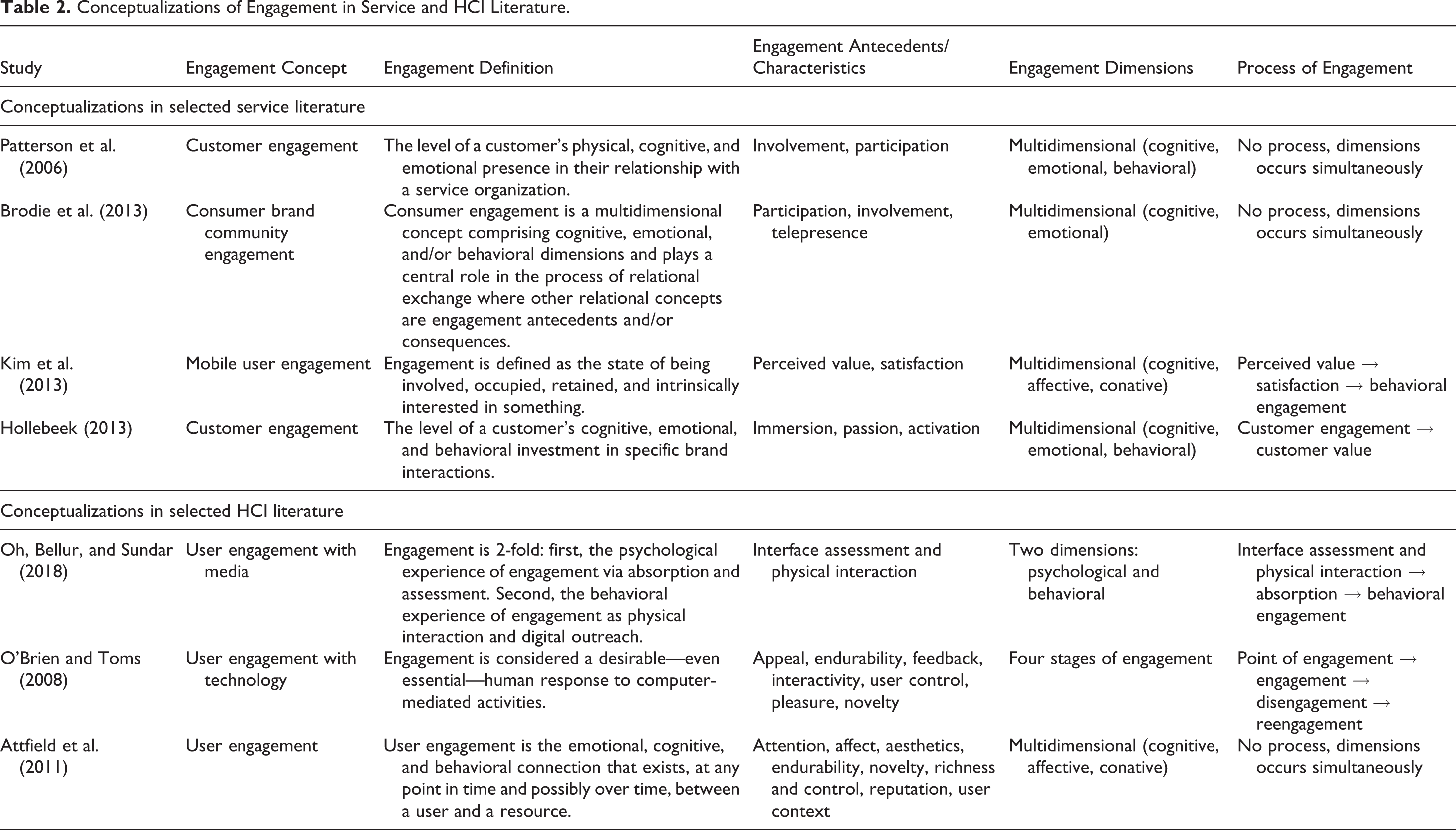
Despite these parallels between the HCI and service streams, the demonstrable links between their specific theories have not been fully explored, making inter-study and practical application comparisons challenging (Napoli 2011). We begin by noting the growing agreement that engagement is multidimensional, incorporating cognitive, affective, and behavioral dimensions (Brodie et al. 2011; Hollebeek, Conduit, and Brodie 2016). However, in an integrative framework, these dimensions represent a process rather than an entity (Bowden, Gabbott, and Naumann 2015; O’Brien and Toms 2008). We further argue that the framework should go beyond established technology acceptance models that tackle technology features—such as ease of use—but neglect the connections of technology usage, service engagement, and value creation (Huang and Liao 2015; Rauschnabel and Ro 2016; Venkatesh, Thong, and Xu 2012). In self-service and automated service contexts in particular, the iterative nature of customer engagement continues to complicate thinking because it emerges over multiple encounters and channels (Lloyd and Luk 2011), thereby confounding any identification of multiple dimensions within a single construct. For example, attempts to define technology-enabled engagement often conflate the interactive qualities of technology with the engaging qualities of the services (Oh, Bellur, and Sundar 2018), making it difficult to distinguish outcomes from antecedents of a psychological experience of service engagement. Interactive qualities, as defined in HCI literature, describe qualities that emerge only during technology interaction experiences (Rullo 2008), whereas engaging qualities follow such interactions and describe reactions to (technology-enabled) service experiences (Bolton and Saxena-Iyer 2009).
In a service automation context, current technology engagement models thus may distort customer service engagement by overlooking the potential effects on service tangibility. According to O’Brien and Toms (2008, p. 938), “Successful technologies are not just usable; they engage users.” Thus, we need to distinguish between interaction-based engagement (Oh, Bellur, and Sundar 2018) and value-based engagement. In this context, engagement is a fundamental driver of action in value creation, which follows the delivery of services rather than technology (Jaakkola and Alexander 2014). Such action may also extend beyond customer–service provider interactions to include customer-customer interactions (e.g., WOM; Oh, Bellur, and Sundar 2018). In an AR context, only few studies investigate customer-customer interactions and suggest a social value dimension of technology for service engagement (Carrozzi et al. 2019; Hilken et al. 2020). Yet digitization through emerging technologies demands an updated view of service engagement in situations in which the physical features of services are digitized through service automation. Today’s technologies not only complement the efforts of frontline employees but even fully automate services, negating the need for physical and human interactions (Marinova et al. 2017). We posit that AR’s ability to enable customer engagement with digitized and automated services distinguishes it from other technologies. Our proposed TEEP views engagement as a process rather than as different dimensions; it thus offers a distinct perspective on engagement within the context of service automation.
By merging service and HCI perspectives, the TEEP also features linked stages (Figure 2) that account for the multidimensional and iterative natures of engagement (Brodie et al. 2011; Hollebeek 2011; O’Brien and Toms 2008; Oh, Bellur, and Sundar 2018). Different dimensions of engagement emerge and exert influences at different parts of the process. In constructing the integrative framework and acknowledging the necessary boundaries of the application of this process to AR service automation, we specifically consider the effects of digitization on perceived tangibility and the role of such tangibility in engagement. Relatedly, we consider the active role of customers within AR automated services. Our approach contrasts with more general technology models that focus on technology-led interaction. The TEEP framework helps unpack the key elements of engagement in service automation by identifying distinct stages that capture customers’ attention and then engage them with the service. To explicate these stages and their relations, we consider specific manifestations of customer engagement with a service at each stage. Furthermore, in this framework, AR not only acts as a stimulus to interact but also initiates and sustains customer service engagement (Bardzell et al. 2008; Oh, Bellur, and Sundar 2018). Thus, we identify (1) the interactive qualities of AR automated services (i.e., information fit-to-task and visual appeal) that capture attention as antecedents of (2) the perceived tangibility of AR service automation, which manifests itself as a feeling of spatial presence, and then note that emerging from these stages is (3) the psychological service engagement, in the form of emotional and cognitive engagement, which influences (4) customers’ realization of value as value-in-use. Finally, this process results in (5) specific, provider-relevant engagement behaviors (i.e., WOM and intentions to reuse the AR service automation; Douglas and Hargadon 2000; Hollebeek 2011; Smith and Taylor 2017). We describe each stage in the following sections.
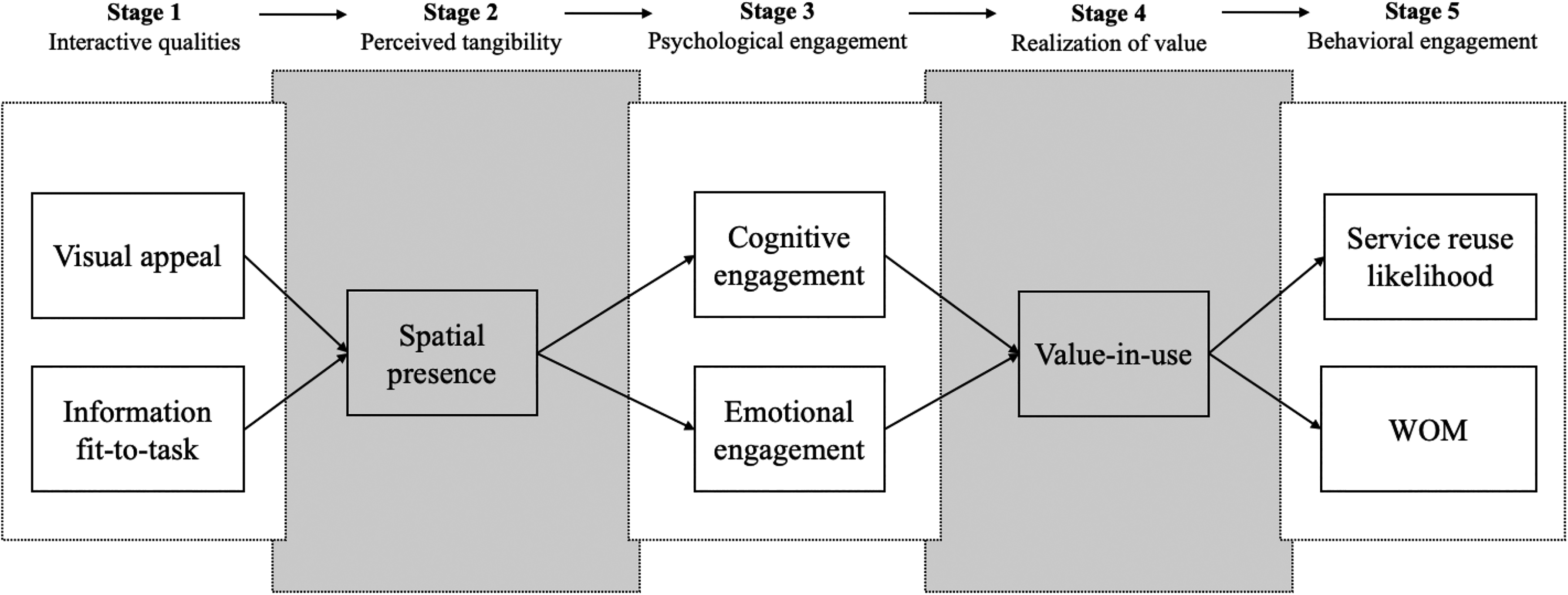
Overall framework: Technology-enabled engagement process.
Stages of the TEEP in Relation to Service Automation
Stage 1: Interactive Qualities of AR Service Automation
Although previous research (see Table 3) suggests that interactivity is an important antecedent of engagement, we know little about the interactive qualities of AR service automation that initiate customer engagement with automated services. The aim of AR service automation is to simulate tangible service elements that have been replaced by self-digitization or remote service digitization. We contend that this simulation at the service layer is based on a class of image-processing algorithms2 at the technology layer that define two interactive qualities pertinent to AR service automation, namely visual appeal and information fit-to-task. First, current applications of AR rely heavily on contextual image recognition, which ensures that the focal content of a service automation, such as the AR image of a sofa in Amazon’s AR view or a dessert in Kabaq’s restaurant menu, is visually integrated into the service environment in an appealing manner. In the AR service automation context, visual appeal describes the degree to which the aesthetic (Huang and Liao 2015), rich (Javornik 2016), vivid (Yim, Chu, and Sauer 2017), or visually stimulating (Poushneh and Vasquez-Parraga 2017) nature of an AR automated service offers customers a greater appreciation of the visual properties of physical service elements that are digitally replaced (Rauschnabel, Felix, and Hinsch 2019). Different AR applications vary in the level, type, and quality of the visual features they offer, but research demonstrates that visually appealing experiences in AR heighten customers’ motivation to invest and maintain relationships with technologies and their providers (Huang and Liao 2015). This makes visual appeal an important prerequisite for ensuring not only perceived tangibility but also customer initiation of engagement with an AR automated service.
Interactivity as Enabler for Engagement.
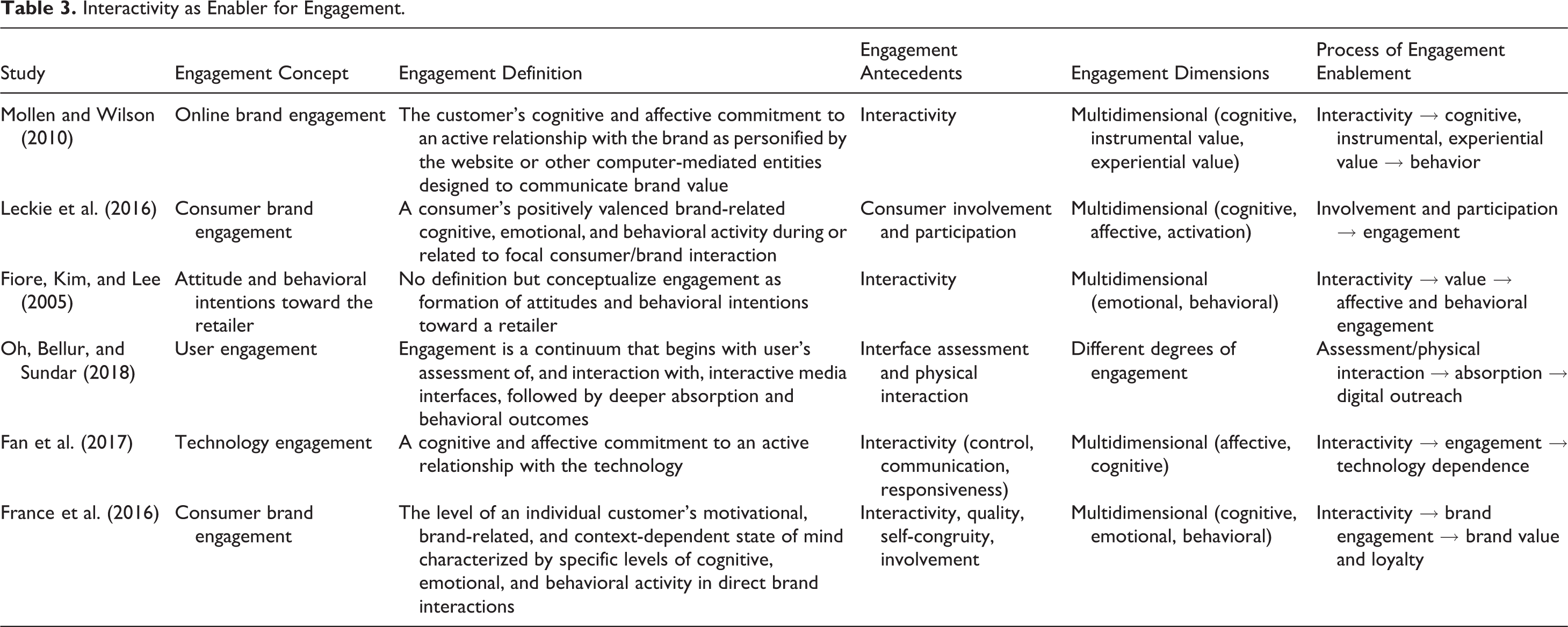
Second, because AR relies on the adaptation of content to fit the physical environment, the extent to which an AR automated service provides contextually task-relevant information is a further important interactive quality. The concept of information fit-to-task describes both the quality of the information and how well it meets a customer’s dynamic informational needs (Kim and Stoel 2004). Previous research shows that information fit-to-task not only improves customers’ abilities to assess digital service quality (Xu, Benbasat, and Cenfetelli 2013) but also increases service providers’ credibility (Gupta, Yadav, and Varadarajan 2009). In an AR service automation context, information fit-to-task is reflected in how well the AR automated service elements are embedded into the physical service environment, how they respond to changes in that environment in a service-relevant manner, and how they allow for natural forms of service-related interaction (Heller et al. 2019b; Hilken et al. 2017). AR technology features different modalities (e.g., text, image, video), allows for different forms of interactivity (Javornik 2016), and integrates into a customer’s physical environment in various ways (Scholz and Smith 2016). AR service automation with high information fit-to-task allows customers, for example, to project new sofas seamlessly into their living rooms, intentionally move them to their bedrooms, and also customize the sofas’ styles, colors, or fabrics (Carrozzi et al. 2019), thus providing relevant information for a well-automated service experience. As such, information fit-to-task as an interactive quality of the AR automated service rather than the underlying technology extends beyond previous conceptualizations of specific technological features, which, for example, solely refer to AR’s technical abilities to project digital content into a user’s environment (e.g., “environmental embedding”; Hilken et al. 2017).
In summary, customers expect technologies to allow them to visualize service elements in an appealing manner and better assess the functional, cognitive, and logical attributes of services (Edvardsson, Enquist, and Johnston 2005). Therefore, fulfilling the needs for visual appeal and information fit-to-task should engender perceptions of tangibility and also serve as a crucial initiator of customers’ willingness to engage with AR automated services. Accordingly, we propose:
Stage 2: Perceived Tangibility of AR Service Automation
It is important to achieve a perception of tangibility with regard to service automation technologies because tangibility acts as a gateway between their interactive features and the initiation of deeper levels of engagement (Van Doorn et al. 2017). Consistent with an emerging research stream (Hilken et al. 2017; Huang and Liao 2015), we posit that in the context of AR service automation, tangibility is reflected in customers’ feeling of spatial presence, which captures how well the AR automated service is able to simulate the “real” (physical) service experience and thus maintain customers’ perception of service tangibility. A feeling of spatial presence arises when a user’s perception neglects the technology-mediated nature of an experience and, in an AR context, feels that digital service elements are actually “here” and can be interacted with using the same physical movements as real counterparts (Hilken et al. 2017; Schubert 2009). For example, AR service automation allows users to feel that they can physically try out new furniture items in their homes, sample desserts in restaurants, or follow the steps involved in servicing their own cars. Accordingly, AR spatial presence is the manifestation of a customer’s perceived tangibility in service automation, where digital content (e.g., product or service images, information, instructions) is physically present and can be interacted with in the physical service environment (Hilken et al. 2017; Schubert 2009).
Feelings of presence arise when customers have sensory-rich, highly interactive experiences (Hopkins, Raymond, and Mitra 2004; Klein 2003). Consistent with previous research, we propose that the interactive qualities of visual appeal and information fit-to-task are important antecedents of spatial presence. Presence requires a minimum level of sensory stimulation, such that users allocate their attention to digital content and accept it as part of their view of the physical reality (Wirth et al. 2007). Because AR provides an intuitive, playful experience in which the predominant modality is visual (Huang and Liao 2015), the visual appeal of AR service automation should promote a feeling of spatial presence. Previous research shows that AR experiences that are more vivid (Yim, Chu, and Sauer 2017) or include personal imagery (Scholz and Duffy 2018) allow customers to contextualize and perceive the presence of service aspects that are simulated through AR. Spatial presence is also determined by how well users can interact with digital content and how these interactions fit with users’ expectations and needs (e.g., in a service encounter) in a meaningful manner (Carassa, Morganti, and Tirassa 2004). Accepting digital content as part of reality is key to achieving spatial presence; such acceptance becomes more likely when the provided information realistically integrates into users’ views of physical environments (Wirth et al. 2007). Prior research indicates that AR excels at providing such personal- and context-relevant information (Scholz and Duffy 2018; Yaoyuneyong et al. 2016), such as by allowing customers to assess the tangible features of sunglasses, clothing, or makeup virtually. Consistent with this notion, Heller et al. (2019a) demonstrate that AR-based restaurant menus facilitate processing of relevant product or service information, and Hilken et al. (2017) show that AR applications that automate online product trials provide customers with information about product fit, equivalent to that obtained from actual physical product trials—all resulting in high levels of spatial presence. Thus, along with the effect of visual appeal, we expect AR services, compared with other automated services, to provide greater information fit-to-task and promote greater feelings of spatial presence in an automated service.
Stage 3: Psychological Engagement in AR Service Automation
According to both service and HCI literature, immediate psychological engagement incorporates cognitive and emotional forms of engagement with the objects—in our case, AR automated services (Brodie et al. 2013; O’Brien and Toms 2008; Oh, Bellur, and Sundar 2018). The cognitive dimension of engagement is based on an information-processing perspective, which according to Kahn (1990) includes intellectual vigilance and a sense of heightened perception and rationality. Accordingly, and drawing on contemporary views of psychological engagement (Hollebeek et al. 2014; Hollebeek and Macky 2019), we consider cognitive engagement in AR service automation as the customer’s heightened thought processing and mental elaboration about an AR automated service. Hollebeek and Macky (2019) posit that cognitive engagement emanates from customers’ functional needs (e.g., in a service encounter). It is thus important to realize a propagation of influence between the stages of our framework, in which information fit-to-task enables improved processing of information about an engagement object (i.e., the automated service)—for example, through real-time monitoring, information from multiple sources, immediate and relevant feedback, and interpretive and learning opportunities (Marinova et al. 2017; O’Brien and Toms 2008). Furthermore, customers’ interactions with services’ content and information, provided by technology, should be cognitively challenging (O’Brien and Toms 2008). The integration of cognitively stimulating resources heightens customers’ awareness and allows them to be active, thereby maintaining their cognitive engagement (Douglas and Hargadon 2000; O’Brien and Toms 2008; Oh, Bellur, and Sundar 2018; Shernoff et al. 2014). It is the challenging—and therefore conscious—awareness of aspects of cognition that distinguish psychological engagement from those of immersion or absorption (Douglas and Hargadon 2000).
The second component of psychological engagement is a customer’s emotional engagement with objects, and in our case AR automated services (Kahn 1990; Oh, Bellur, and Sundar 2018). In line with Hollebeek et al. (2014) and Hollebeek and Macky (2019), we describe emotional engagement in AR service automation as the customer’s positively valenced affect toward an AR automated service. Several authors identify (positive) emotions as key to sustained engagement (Kumar et al. 2010; Pansari and Kumar 2017; Shernoff et al. 2014), and AR is well placed to enable emotional connections due to its visual appeal quality, which propagates through the TEEP to foster emotional engagement. Specifically, AR service automation allows for the replacement of physical aspects of services in a visually appealing manner, thereby offering novel opportunities for deeper emotional engagement. Accordingly, research has shown that visual appeal is important for not only initiating but also sustaining engagement, such that visual appeal offered by technology can sustain enjoyment and pleasure throughout service encounters (Oh, Bellur, and Sundar 2018) as well as let customers identify themselves with the engagement object over multiple encounters (Hollebeek and Macky 2019).
We propose, according to the TEEP framework, that there are two reasons spatial presence (i.e., AR’s ability to offer customers a perception of service tangibility) promotes psychological engagement with automated services. First, spatial presence has informative value and positive valence; the opposite state of not feeling present (e.g., lack of perceived tangibility in an automated service) is reflected in a state of disorientation (Schubert 2009). Therefore, spatial presence should engender perceptions of ecological validity and tangibility related to how AR content is integrated into and enhances the service environment. Second, according to Schubert (2009), spatial presence is an affect-generating cue, so users likely feel greater positive emotion toward the technology-enabled experience of feeling presence as a result of AR service automation. Taken together, these two aspects should stimulate the cognitive and emotional dimensions of engagement with AR automated services. In support of our conjecture, prior research indicates that cognitive and emotional engagement is based on sense of authenticity in digital experiences (Hollebeek and Macky 2019); and spatial presence has been empirically linked to outcomes that signal both cognitive and emotional forms of engagement, including stronger and more positive product-, firm-, and brand-related beliefs and attitudes (Fiore, Kim, and Lee 2005; Hopkins, Raymond, and Mitra 2004; Klein 2003). Therefore:
Stage 4: Realization of Value in AR Service Automation
In line with contemporary theorizing in services literature (Vargo and Lusch 2004), we contend that the value of AR service automation is determined at the time of use. In our proposed TEEP, we consider the customer’s realization of value to manifest itself in the form of value-in-use, which occurs when the benefits of the AR’s interactive qualities and perceptions of service tangibility propagate through the psychological engagement with an automated service, to enable customers to form overall value judgments about services. Because customers’ value-in-use perceptions determine their willingness to continue to embrace technology-enabled or automated services (Meuter et al. 2005), value-in-use is not only an outcome of psychological engagement with services (Hollebeek 2013) but also a necessary precondition for subsequent forms of behavioral engagement.
Value-in-use judgments are inherently idiosyncratic; they describe customers’ abilities to use services in pursuit of relevant goals (Grönroos 2006). We propose that by automating some or all service elements while maintaining perceived tangibility, AR service automation helps customers realize value by integrating customer and provider resources (Marinova et al. 2017). Whereas provider goals in automated service settings tend to relate to increased service efficiency, customer goals generally pertain to effective, enjoyable service delivery and also can include social aspects such as improved self-expressiveness or smoother social interactions (Sweeney and Soutar 2001). Therefore, when customers judge the value of AR service automation, they likely consider the extent to which automation enhances their ability to find what they really want (Dholakia, Bagozzi, and Pearo 2004), offers comfort in service interactions (Spake et al. 2003), helps them express themselves, or facilitates better interactions with frontline employees or other customers (Marinova et al. 2017). Thus, our perspective on value-in-use within the TEEP is distinct because it accounts for the technology-enabled service, service providers, and customers. It differs from technology adoption research by focusing on value-in-use as a consequence of psychological engagement in AR service automation.
There is growing evidence that AR service automation affects value-in-use by enabling customers to realize their goals. For example, Hilken et al. (2017) find that fully automated AR online services that allow consumers to try on products virtually positively affect their utilitarian and hedonic value perceptions. Similarly, Heller et al. (2019a) find that customers perceive AR retail and service experiences more comfortable when they use interactive AR applications in off-line and online scenarios. Partial automation through AR also offers value-in-use related to customers’ social goals. For example, Carrozzi et al. (2019) demonstrate that using AR to replace physical products (or service elements) with digital product holograms allows customers to fulfill their social identity goals because they can readily customize holograms according to their personal tastes (i.e., differentiate themselves from others) or in collaboration with others (i.e., assimilate with other customers).
A key premise of the TEEP is that customers’ value-in-use is influenced by their cognitive and emotional engagement, which arises from heightened spatial presence. Customers’ cognitive engagement manifests in two ways. First, the provision of relevant information, realistically positioned in the consumption environment—such as a visual representation of a restaurant menu item in AR—increases customers’ beliefs in their abilities to decide on and execute their goals (Van Beuningen et al. 2009). Second, a richer information base reduces uncertainty and increases feelings of decision control (Venkatesh, Thong, and Xu 2012). Both these cognitive effects improve perceptions of value-in-use according to the notion that people are more likely to perform tasks they think they can accomplish and avoid those they cannot. Because the emotional aspect of psychological engagement renders the service process more enjoyable and entertaining, it provides the emotional rewards necessary for customers to realize value from AR service automation (Meuter et al. 2005; O’Brien and Toms 2008). Therefore:
Stage 5: Behavioral Engagement in AR Service Automation
Customer engagement behaviors describe actions that extend beyond transactions, such as purchases; they are driven by value creation (Smith and Taylor 2017; Van Doorn et al. 2010). We follow Brodie et al. (2011) to define behavioral engagement as customer actions taken toward a service or service provider, either by actively and repeatedly using the service or recommending the service to peers. Our proposed TEEP structures the multidimensional nature of engagement as a process, in which behavioral manifestations occur (possibly with some time lag) after cognitive and emotional engagement. We distinguish these behaviors from interaction behaviors (i.e., interacting with the technology), which are necessary for using the technology-enabled service but do not represent states of purposeful engagement.
Manifestations of behavioral engagement include customer actions that can benefit service providers. Whether customers repeat their use of automated services likely depends on their prior experiences of value-in-use from AR service automation. Customers who realize value-in-use from an AR service are more likely to return to the service in the future and tell others about it. That is, the time-delayed effects of customer engagement in AR service automations include not only repeated uses but also positive WOM about service providers (Heller et al. 2019b). Positive AR service automation experiences can increase the likelihood of positive WOM for service providers in both off-line and online service landscapes (Hilken et al. 2017). Therefore, we propose:
Theoretical Implications
Recent advances in technology have caused a shift toward the digital automation of physical services. As the functionality of AR improves, it has potential to offer tangible service automation, and major technology companies such as Apple, Samsung, and Microsoft already have invested heavily in their AR infrastructure. This infrastructure means that AR service automation is poised to transform physical service encounters by redefining service roles, replacing human interactions, and offering personalization across entire service cycles, bringing perceived tangibility back to an increasingly digitized and automated servicescape. We address the conceptual challenge of relatively low engagement with AR services (Merel 2017; Rauschnabel and Ro 2016) by conceptualizing technology-enabled engagement as a process and decomposing the TEEP for AR service automation. Specifically, the TEEP maps multiple stages that translate the interactive qualities of AR service automation into psychological and behavioral manifestations of engagement with a focal service. In developing this framework, we address how parallel work on user engagement in HCI literature and customer engagement in services literature can be integrated to offer a better understanding of both the distinctions and the links between interaction and engagement. We further enrich existing process models (e.g., O’Brien and Toms 2008; Oh, Bellur, and Sundar 2018) by incorporating the multidimensionality of engagement over time, explicitly addressing the translation of interaction into engagement, and incorporating customers’ active roles.
Conceptually, we contribute to growing literature on customer engagement in technology-rich service settings (Hollebeek, Juric, and Tang 2017; Hollebeek and Macky 2019; Keeling et al. 2019) by distinguishing two interactive qualities of AR service automation. We propose that visual appeal and information fit-to-task represent the pertinent interactive qualities of AR service automation and are the starting point of the engagement process. Only through AR do the elements of an automated service become so visually appealing and task-relevant that customers perceive tangibility in the form of spatial presence. We thus distinguish and define spatial presence in an AR service automation context as the specific manifestation of perceived tangibility in digitized service encounters; accordingly, we specify how the interactive qualities of AR service automation translate into the necessary antecedents of customer engagement (Oh, Bellur, and Sundar 2018).
We also describe a novel path to psychological engagement, in the form of customers’ emotional and cognitive engagement with services. This path is mediated by the perceived tangibility of AR service automation that is manifested in customers’ feeling of spatial presence. To the best of our knowledge, previous researchers have not proposed or demonstrated spatial presence as a driver of customers’ psychological engagement. Accordingly, we contribute by identifying spatial presence as an important variable in AR service automation. Furthermore, we distinguish spatial presence from social presence or telepresence. This distinction adds to growing evidence regarding the necessary conditions of AR-based value creation in service contexts (Hilken et al. 2017).
Relatedly, additional conceptual contributions stem from our integration of the TEEP with value-in-use. Because AR service automation supports customers in achieving their goals in a service encounter, thus providing value-in-use, we follow Breidbach et al. (2014) and regard AR as an engagement platform between customers and service providers. By depicting engaged customers as partners who integrate resources during AR service interactions, the TEEP framework identifies their emotional and cognitive engagement as a critical pivot point for value-in-use that leads to behavioral engagement with services or service providers.
We further incorporate the possibility of iterative engagement through time-lagged behavioral engagement, thereby acknowledging its multidimensionality (Van Doorn et al. 2010). Consistent with current thinking that technology must enable automation of not only service provider–customer interactions but also customer-customer interactions (Marinova et al. 2017; Oh, Bellur, and Sundar 2018), the TEEP’s conceptual integration outlines sustained behavioral engagement according to both individual use intentions (i.e., provider-customer behavioral engagement) and as a key social factor in the wider adoption of AR service technologies, such as positive WOM (i.e., customer-customer behavioral engagement).
In sum, the TEEP framework represents a first attempt to conceptualize customer engagement with (partially and fully) AR automated services, by incorporating different but parallel theoretical perspectives. Therefore, the framework is open to elaboration and future development—and perhaps most importantly, empirical validation. Empirical testing with controlled experiments, field studies, and longitudinal studies is needed to establish the effects of AR service automation on the engagement process in various service encounters. It is premature to conclude that the TEEP is a general process. Although a few studies (Hilken et al. 2017; Javornik 2016) offer causal evidence of the value-generating aspects of AR service automation, there is substantial room for more experimental work to validate links in the TEEP framework, particularly in relation to spatial presence as a driver of emotional and cognitive engagement.
Managerial Implications
For managers, the TEEP framework describes how emerging AR technology can support service automation. By digitizing aspects of physical service interaction, AR creates a rapidly scalable approach to service automation. The deployment and replication of AR services can be achieved at near-zero marginal cost, suggesting that managers who overcome the “shiny new object syndrome” of purely technology-driven applications can engage mass markets by offering personalized services. Conversely, the TEEP implies that potential points of disengagement can be “plugged” by strategic planning and implementation, leading to several actionable implications.
First, the integrative approach advanced by TEEP outlines how managers can use AR to initiate and sustain customer engagement with automated services; its stages reflect points of intervention relevant to AR service design and management. Notably, engagement is not a variable but a process to be managed. It identifies aspects of AR service automation, such as interactive qualities and spatial presence, and it distinguishes psychological engagement from behavioral expressions of engagement. Integration within TEEP, focused on any one aspect of AR service automation, requires consideration of the aspect’s upstream effects and the downstream drivers within the process. Any identification of the performance of an aspect of AR service automation, such as its interactive quality, should be in reference to the relevant components, as described by the TEEP. The successful implementation of interactive qualities requires the effect of spatial presence, and the resulting tangibility of spatial presence is indicated by the emotional and cognitive engagement it produces. In turn, by using the TEEP framework, managers gain a structure for troubleshooting the nonperforming aspects of service automation. It also demonstrates the underlying process of technology-enabled engagement, allowing managers to anticipate the pitfalls of AR service design.
Second, a key implication of the TEEP framework is that AR service automation is driven by the core value propositions of services rather than technologies. The link between customers’ psychological engagement and value-in-use is a necessary stage in developing a meaningful core value proposition (Smith and Taylor 2017). Moreover, focusing the TEEP on value-in-use constrains the design of AR service automation by services’ core value propositions, such that customer relevance moves to the forefront of AR service automation. In the past, too many AR applications have fallen by the wayside because they failed to offer customer relevance through core value propositions, relying instead on the novel or purely interactive qualities of the AR technology itself (Dunleavy, Dede, and Mitchell 2009). Although many current AR service solutions are technology-driven and heavily focused on interactive qualities, the TEEP allows managers to anticipate service automation by its outcomes; an appraisal of the value a service can deliver must be signaled by its interactive qualities to become a focus for the psychological engagement in the TEEP. Managers can interpret the interactive qualities toward a core value proposition of the service. We highlight two such qualities that are relevant to AR.
Third, by facilitating customers’ value expectations, managers can apply AR service automation with a focus on sustained engagement. Behavioral engagement such as repeated usage intentions and WOM depends on the drivers defined in the TEEP framework. With investments in AR technology approaching the critical threshold for mass-market adoption, the constraints on AR service automation are quickly becoming managerial rather than technical. Managers should consider the TEEP as a foundation for sustained engagement in AR service innovations. Within the framework, an ordered chain of causes and effects facilitates engagement with automated AR. By understanding that chain, managers can identify strategic objectives at each stage of the TEEP. They can set objectives (and evaluation metrics) for interactivity, spatial presence, psychological engagement, and value-in-use as intermediate steps toward behavioral engagement. By identifying coefficients in the TEEP model, managers can get a sense of the conversion rates from one stage to the next.
Research Agenda
As Figure 2 shows, AR service automation under the TEEP framework advances a specific view of engagement using a series of progressively linked stages. Although the TEEP framework synthesizes HCI and services perspectives on user versus customer engagement, its sequential nature is necessarily a conceptual simplification. Applications of the TEEP framework require broader understanding of possible boundary conditions that can affect and influence each stage in the process. These boundaries offer opportunities for research aimed at understanding service automation through other technologies such as virtual reality (VR), customer characteristics, additional service contexts, cultural and social dimensions of automated service engagement, and risks to the customer. We formulate those boundaries as calls for further research and an agenda to guide researchers.
Related Technologies
In our conceptual development of the TEEP framework, we focus on AR as an enabling technology that uniquely addresses a shortcoming of digital service automation, that is, the loss of physical tangibility. However, in light of the rapid advancement of other forms of “extended reality” (Accenture 2018), researchers might extend (or adapt) the TEEP framework to related technologies that also enable service automation. In particular, VR is often presented as closely related to but distinguishable from AR, and it represents a promising technology along this spectrum. However, current research on VR has focused mainly on identifying its interactive features (Cowan and Ketron 2019) rather than exploring how those features give rise to a unique TEEP. There is a clear need for further research in service domains that delineate between an AR- and a VR-based TEEP. In our view, these domains can be classified by spatial presence dimensions. In this sense, the TEEP framework could be extended by a better understanding of the dimensions of spatial presence during service automation. Whereas AR service automation simulates tangibility by bringing digital service content into the customer’s physical environment, VR-enabled service automation would transport customers into virtual service settings (e.g., a 360° tour of the Tokyo Shangri-La Resort; Bogicevic et al. (2019). Accordingly, the dimensions of spatial presence should distinguish transportation of digital service content into a physical environment from transportation of customer experience into virtual service environments. Such understanding would help firms pursue service automation through a more holistic, extended reality marketing strategy, in which different technologies affect customer engagement at various touchpoints throughout the customer service journey.
In the future, the TEEP might move beyond AR and VR to include algorithms that not only interact passively with customers and their physical surroundings but also acquire some degree of autonomy through convergence with artificial intelligence (AI) decision-making systems. These research directions might distinguish between interactive and engaging qualities of AR service automation in a realm of active service automation. Currently, Amazon relies on customers to search, evaluate, and order products through the AR View function in its Shopping app. In the near future, Amazon may anticipate a customer’s needs and deliver products without the customer having to search or evaluate (e.g., “dash buttons”; Grewal, Roggeveen, and Nordfält 2017); AR interfaces then may become critical to enabling AI systems to rapidly try products in customer service settings, allowing them to learn and adjust to changes in customers’ preferences while economizing on the costs of delivery and logistics. It is intriguing to consider research directions that delineate between the effects of engagement and interaction of actively automated services that may differ substantially from the service settings that gave rise to the TEEP framework in our conceptual model.
Customer and Situational Characteristics
Although we argue that visual appeal and information fit-to-task are conceptual prerequisites of the TEEP framework (and likely apply beyond AR), customers also respond very differently to AR service automation, depending on their chronic and situational characteristics, which often play out in unexpected ways. For example, Hilken et al. (2017) show that verbalizers (vs. visualizers) derive more (vs. less) utilitarian value from spatial presence in AR settings. An important direction for future research is a consideration of the role of customer heterogeneity in the TEEP. For example, customers likely differ in their need for tangibility during automated service interactions, and they have distinct abilities to imagine or mentally represent the digitized aspects of service content. This factor may have effects similar to those described by Hilken et al. (2017), such that visual processing styles could substitute for the benefits of AR automation. In addition, customer trust and attitudes toward AR service automation inevitably affect the perceived value-in-use of services and the resulting degree of behavioral engagement. Similarly, customers’ goal pursuit strategies (e.g., regulatory mode, regulatory focus, or goal persistency paradigm) should be included in considerations of customer heterogeneity (Kruglanski et al. 2000). Customers’ chronic characteristics likely interact with the specifics of the service content, such as the complexity of services, substitutability of service offering(s) with digital content, and whether services are hedonic or utilitarian (e.g., Keeling et al. 2019). Focusing on customer and situational characteristics is an important direction for AR research (de Ruyter et al. 2020; Jessen et al. 2020) because it may reveal how customers respond to AR as an enabler of service automation under the TEEP.
Transformative Services
The role of service automation in promoting customer well-being is also critical to customer engagement (Anderson et al. 2013). Our TEEP framework highlights the importance of value-in-use. An important extension is a focus on the transformative use of AR service automation. For example, AR can transform customer decision making related to grocery purchases; in situations in which self-control and decision complexity make it challenging for customers to make healthy food choices, AR can alter customer behavior. Services such as AR-based coaching are personal, location-specific, and perceptually interactive with physical service environments (e.g., visually highlighting low-sugar food options on a supermarket shelf, depicting portion sizes in food delivery contexts); such a service may encourage healthier lifestyles. According to the TEEP framework, we argue that engagement is a function of core service design and service content, which highlights the role of value through the conscious use of automated services. Applications of transformative AR service design include search and decision making, medical contexts, and support for vulnerable customer segments. These contexts represent critical research directions, in that they can enhance understanding of sectors of the population that are poorly researched in marketing, can easily become disenfranchised, and include vulnerable groups and customers who struggle in everyday life (Keeling et al. 2019). Because AR service automation has the potential to lower the costs of service delivery, it could democratize a wider range of services to people in need; however, it needs to actively engage such communities. Understanding the impact of transformative uses of AR services and how they can be made more accessible thus forms an important research direction.
Future research might also start investigating whether AR has greater potential than bringing back perceived tangibility. Specifically, it would be interesting to identify when, why, and how AR outperforms face-to-face service encounters. Scholars should investigate how AR creates completely new and situated customer experiences (Chylinski et al. 2020) and elevates services beyond what was possible before service automation.
Expanded Social Scope of AR
Our proposed TEEP departs from the interactive qualities of current AR automated services, ranging from virtual try-ons in the prepurchase phase to after-sales support in the postpurchase phase. However, recent research has identified an emerging class of “social AR” (Carrozzi et al. 2019; Hilken et al. 2018), which may offer additional interactive qualities beyond those identified by current practice and research. Current AR apps enable value-in-use related to social goals in partial automation settings (e.g., AR-based menu replaces part of a waiter’s responsibilities but also opens new opportunities for enhanced social interactions and service scripts). Instead, social AR offers new qualities related to shared and digitally enhanced points of view (Hilken et al. 2020) that promise value-in-use across partially and fully automated service settings. For example, AkzoNobel’s Visualizer offers home decorators a means to share photos or videos to invite purchase advice from friends and family; within the shared visuals, peers can experiment with color designs and directly convey recommendations in the AR-enhanced visuals. Although such uses of social AR for service automation are nascent, we call on researchers to study the underlying engagement process. Extant research has established optimal configurations of social AR in terms of sharing formats and content modalities, identified customers’ sense of social empowerment as an underlying metric of success (Hilken et al. 2020), and linked social empowerment to increased engagement (Hollebeek, Juric, and Tang 2017). By extending the TEEP to account for not only socially interactive qualities (e.g., sharing a virtually enhanced point of view in a service experience) but also the resulting engagement process (e.g., engagement with services, frontline employees, and other customers), continued research could offer fruitful insights.
Cultural Perspectives
A related direction for research pertains to the role of culture in service automation engagement under TEEP. Whereas prior AR literature has focused on individual or dyadic interactions with AR service automation, the role of culture is relevant in terms of mass service automation. A key advantage of digital services is their near-costless replication; AR service automation seems likely to follow patterns of adoption that match those of the winner-take-all trajectories of Uber, Amazon, or Facebook. By researching the global relevance of service automation in the context of AR, the TEEP framework inevitably encounters cultural boundaries, and cultural differences can affect the delivery of AR service automations. Whereas some cultures may value the physical presence of frontline employees highly, other cultures likely place more trust in automated services. We urge researchers to extend AR research to the cultural effects of automated service engagement, beyond simple cultural differences, and thereby derive deep insights across varied cultural groups and subgroups, through each stage of the TEEP framework, using ethnographic approaches.
Customer Protection
Finally, the TEEP has the potential to improve and democratize service delivery on a mass scale while improving levels of service engagement, using AR to generate spatial presence during digital service delivery. However, insufficient research addresses the potential risks of service automation, especially with regard to customer sovereignty (Waldfogel 2005), privacy, data protection, and the potential exploitation of vulnerable segments (e.g., children, the elderly, the disabled) through sophisticated engagement techniques. To guide policy makers, managers, and customers in ethical applications and uses of the technology, research in this area must balance the engaging properties of service automation with customer protection efforts.
Footnotes
Declaration of Conflicting Interests
The author(s) declared no potential conflicts of interest with respect to the research, authorship, and/or publication of this article.
Funding
The author(s) received no financial support for the research, authorship, and/or publication of this article.
