




Abstract
This research examines the extent to which proactivity in handling flight overbooking reduces negative electronic word-of-mouth (NeWOM) and the required costs of compensation, thus increasing firm profitability. It answers recent calls to use a multimethod approach (i.e., we include archival data, qualitative interviews, seven experiments, and a Monte Carlo simulation for a total of 10 studies) and to adapt recovery to specific contexts (i.e., airlines) and heterogeneous customers (i.e., voluntary/involuntary bumping or offloading). The preliminary studies indicate that overbooking and offloading are pervasive and that a proactive approach is both feasible and desirable. The experiments show that, compared to the default reactive approach (informing passengers at the gate), a proactive approach (informing them before they leave for the airport) substantially reduces NeWOM and the sought compensation. Further, a very reactive approach (informing them in the plane) significantly increases NeWOM and the sought compensation, especially when offloading occurs involuntarily. We also unveil the mechanism explaining the effects of proactivity on NeWOM, through the serial mediation of justice and betrayal. Finally, the results of a Monte Carlo simulation show that offering reduced compensation through a proactive approach allows more aggressive overbooking, higher capacity utilization, and increased net revenue of up to 1.3%.
Flight overbooking (i.e., selling more tickets than available seats) is pervasive 1 in the airline industry (Amaruchkul and Sae-Lim 2011). It is a legal practice to account for no-shows and cancellations (Phillips 2005) to allow airlines to improve their load factors and reduce revenue losses (Guo, Dong, and Ling 2016). Yet, it is difficult to forecast no-shows and cancellations, leaving an uncertain number of surplus customers needing to be offloaded or bumped (Wehner, López-Bonilla, and Santos 2018). Affected customers may feel treated unfairly and potentially vent their anger on social media, which can result in viral crises. A widely covered offloading incident involved a doctor being dragged off an overbooked United Airlines plane. It received around 4 million views on Facebook, bestowing unwanted notoriety on the airline and a decline of US$1.4 billion in market capitalization (Benoit 2018). Hence, it appears crucial to prevent such incidents and the resulting negative electronic word-of-mouth (NeWOM).
A common remedy for offloading is to provide monetary compensation (Pizam 2017). If passengers are offloaded voluntarily, a mutually agreed amount is offered; but when they are denied boarding involuntarily, the compensation regulations apply. For instance, U.S. customers are entitled to receive 200% of their one-way fare (up to US$675) for minor delays, and 400% of their one-way fare (up to US$1,350) for major delays, according to the U.S. Department of Transportation (USDOT 2019). From a managerial perspective, this practice is problematic because the compensation paid is substantial and reduces profitability in an industry where margins are tight. From a theoretical perspective, overbooking is also critical, as compensation should reimburse customers not only for their missed flight but also for the hassle associated with their eviction (Wirtz and Mattila 2004). Equity theory (Oliver 2014) suggests that customers are dissatisfied not only by a concrete service failure but also by a broader sense of inequity, involving humiliation and other negative perceptions. Perceived inequity may be particularly high for customers who are involuntarily offloaded, given their monetary input (e.g., ticket price), added effort and inconvenience (e.g., required rebooking, check-in, and lost time), and psychological distress (e.g., confrontation, stress, and potential embarrassment). Hence, it is questionable whether the legal compensation is effective at restoring a broader sense of equity and preventing NeWOM.
We address this problem by showing that proactive handling of flight overbooking restores equity and prevents NeWOM at only a fraction of the cost of offloading reactively. In broad terms, proactivity is defined as anticipating and preventing problems before they materialize (Bateman and Crant 1999). In the current context, we refer to proactivity (vs. reactivity) as bringing forward (vs. delaying) the moment when passengers are informed about being offloaded to reduce the potential negative consequences. Here, we distinguish between three approaches on the proactivity-reactivity continuum: a default reactive approach (informing customers at the gate), a proactive approach (informing them before they leave for the airport, hereafter referred to as at home), and a very reactive approach (informing them after boarding).
Specifically, the current research makes four key contributions to the service literature. First, we introduce the concept of proactivity to the service recovery literature and apply it to the airline industry. In doing so, we respond to recent literature reviews that have identified a lack of research on the prerecovery phase and adaptive recovery (Khamitov, Grégoire, and Suri 2020; Ringberg, Odekerken-Schröder, and Christensen 2007; Van Vaerenbergh et al. 2019). This research addresses both gaps by presenting a new, preemptive recovery tool (i.e., proactively offering a specific compensation) that needs to be adapted depending on the type of offloading (i.e., voluntary or involuntary) and the communication timing (e.g., at home, at the airport or in the plane). Specifically, we find that a highly proactive approach (at home) makes travelers accept minimal compensation—about 5% of the legal amount. In turn, a very reactive approach, when the traveler is in the plane, requires up to 500% of the legal amount.
Second, we further enrich adaptive recovery research by distinguishing between involuntary and voluntary offloading as different contexts. Involuntary offloading refers to customers being forced to give up their seat, whereas voluntary offloading refers to customers agreeing to give up their seat amicably in exchange for compensation. The examination of these two contexts is important because most offloading situations occur on a voluntary basis (although involuntary offloading remains frequent). We show that when passengers are voluntarily offloaded, the compensation can be reduced by 50% compared with involuntary offloading. These findings enrich prior research, which shows that complainers report higher fairness when having a choice over the recovery offered by firms (Mattila and Cranage 2005).
Third, we unveil the mechanism explaining the effects of proactivity on NeWOM through the serial mediation of justice and betrayal (Noone 2012; Wangenheim and Bayón 2007). Indeed, more reactive approaches tend to be viewed as acts of betrayal because the airline has intentionally violated an implicit promise (e.g., see Grégoire and Fisher 2008). Hence, we argue for the serial sequence “proactivity → justice → betrayal → NeWOM” in most situations.
Fourth, we demonstrate the effects of different compensation levels on firm profitability at different proactivity degrees. Here, a Monte Carlo simulation shows that proactive handling of overbooking can simultaneously reduce NeWOM and increase profitability. Specifically, we found that net revenues increase from 0.1% to 1.3% for flights with excess demand through reduced compensation with a proactive approach. Thus, we address an important gap in the service literature: showing the effects of recovery tools on financial metrics (Khamitov, Grégoire, and Suri 2020; Van Vaerenbergh et al. 2019).
Theoretical Development
Flight Overbooking as an Intentional Service Failure
A service failure occurs when customers perceive that the initial service delivery falls below their expectations or “zone of tolerance” (Holloway and Beatty 2003). In this regard, Hirschman (1970) states that apart from accepting a service failure and remaining loyal, customers have two options: exit the relationship or communicate their dissatisfaction (i.e., voice). Typically, voice refers to a complaint to the firm, but Hirschman (1970) acknowledges that customers may not do so when they believe complaining is futile. Hence, another form of voice has been added: Communicating one’s dissatisfaction by spreading negative WOM, which can be more detrimental as it occurs beyond a firm’s control. Further, it can seriously damage a firm’s image and prevent other customers from using its services (Hogan, Lemon, and Libai 2003).
The mass adoption of social media has empowered customers to electronically share their negative feelings with many others (Balaji, Khong, and Chong 2016). Accordingly, our key outcome of interest is NeWOM defined as disgruntled people promoting negative information about a firm on various online platforms (Wilson, Giebelhausen, and Brady 2017). NeWOM has significant detrimental impacts on other customers’ product evaluation, decision making, and loyalty because of its reach and persuasive intent (Chevalier and Mayzlin 2006; Vermeulen and Seegers 2009).
The airline industry is particularly prone to service failures (Palmer and Bejou 2016) including, for example, delays, lost luggage, or unfriendly service. In contrast to these service flaws, we consider flight overbooking to be an intentional service failure. It is a deliberate operational act with a clear probability—that is, the number of booked passengers exceeding the number of available seats. Firms actively implement overbooking to optimize capacity utilization and maximize profit. Thus, airlines are unlikely to eliminate overbooking, even though it affects hundreds of thousands of passengers annually (Noone 2012). As a result, airlines need to deploy tactics to mitigate the negative consequences of overbooking, and we propose that proactivity could be an effective tactic to pursue.
Proactivity in Handling Flight Overbooking
Bateman and Crant (1999, p. 2) state that proactive behavior in an organization is “to anticipate and prevent problems” before they arise. Accordingly, we define proactivity in a service failure and recovery context as firms anticipating potential service failures and acting prior to customer reactions to control or minimize the impact of these failures. As such, a proactive approach represents a forward-focused action, which allows firms to focus on preventing negative customer responses to a service failure rather than correction (Challagalla, Venkatesh, and Kohli 2009). Examples include informing customers about potential problems, actively seeking customer feedback regardless of the success or failure of past interactions (Voorhees et al. 2017), and assisting customers before they encounter service failures. These approaches tend to be beneficial for customers because they can signal a firm’s sense of caring at an early stage and thereby mitigate a potential crisis. Further, by recognizing potential conflicts earlier, firms can offer a faster resolution (Challagalla, Venkatesh, and Kohli 2009) and, as a result, ensure superior service quality (Pomirleanu, Mariadoss, and Chennamaneni 2016). Indeed, there is growing empirical evidence that a proactive (vs. reactive) interaction increases favorable customer outcomes and reduces negative customer attitudes and behaviors (Mikolon, Quaiser, and Wieseke 2015; Pomirleanu, Mariadoss, and Chennamaneni 2016).
Aviation experts also believe that proactively handling overbooking could help reduce its negative consequences such as NeWOM (Powley 2017). Airlines often wait until passengers arrive at the airport and offload them at the gate or, even worse, when they are in the plane (a very reactive approach). In contrast to these approaches, airlines could inform passengers in advance, before they leave for the airport (a proactive approach). The default reactive approach at the gate is not ideal because it causes much inconvenience. Customers have to return home or, when accepting to be booked on a later flight, have to wait for several hours at the airport. Compared to this default reactive approach, a proactive approach avoids this stress and hassle. For example, customers learn at home that the flight is overbooked, and they can rearrange travel plans from the comfort of their home. A very reactive approach comprises even more hassle than the default reactive situation. Here, customers have already boarded and are “ready to go.” Hence, they may feel humiliated and be reluctant to give up their seat. Overall, we expect that, compared to the default reactive approach, a proactive (very reactive) handling of overbooking will decrease (increase) NeWOM.
We draw on equity theory (Adams 1965)—which is influenced by the theory of social exchange (Homans 1958)—to explain the effects of proactivity. Equity theory highlights the “rule of justice” as a social norm, which prescribes that people who engage in social interactions expect the rewards for both parties to be proportional to their investments. If people perceive that they benefit less than their counterparts, they feel entitled to proportionally reduce their investments or require an ex post increase in their rewards (Homans 1961). In case of a service failure, customers feel disadvantaged because their reward is decreased since they cannot (fully) use the service they paid for. They perceive that their relationship with the firm becomes unbalanced, as their reward-investment ratio is smaller. However, firms can restore perceived justice when providing an appropriate recovery (e.g., compensation) to increase customers’ rewards ex post. Indeed, the service failure literature presents justice as the dominant theory in this context (Wirtz and Mattila 2004), and justice perceptions are shown to mediate the effect of organizational strategies on customer reactions (Gelbrich and Roschk 2011).
Grégoire and Fisher (2008) further articulate this link, arguing that when perceived justice is low, customers may feel betrayed. Perceived betrayal is a “belief that a firm has intentionally violated what is normative in the context of their relationship” (Grégoire and Fisher 2008, p. 250). Customers think that the firm did not comply with the norm to provide a seamless service in exchange for the price paid (Van Vaerenbergh, Larivière, and Vermeir 2012). This belief, in turn, ultimately drives customers’ retaliatory behaviors, such as NeWOM.
We apply this reasoning to the current context, where affected customers may not only perceive injustice (as they are offloaded from a particular flight they paid for) but also feel betrayed (as offloading is an intentional violation of the norm to deliver the promised service). This is where proactivity comes into play. In the case of a very reactive approach (offloading in the plane), the hassle for customers is extremely high. First, they are escorted out of the airplane as if they were undesirable customers. Then, they need to rearrange their travel plans and wait at the airport. Accordingly, a very reactive approach should further increase injustice perceptions and, thus, perceived betrayal, which then facilitates NeWOM. In contrast, a proactive approach (informing customers at home) enables customers to conveniently adjust their travel plans. This behavior may help to restore a more balanced “reward to investment” ratio for customers because they benefit from a more convenient process (an increased reward to investment ratio). Hence, firms will have complied with the norm of providing the best service in the given overbooking situation. Thus, a proactive approach reduces injustice perceptions as well as perceptions of betrayal, ultimately decreasing NeWOM. Formally:
Compensation Levels at Different Degrees of Proactivity
Service recovery research shows that monetary compensation for a service failure has positive effects on customer responses (Roschk and Gelbrich 2017). These effects are also explained by justice perceptions, as compensation can restore equity through an improvement of the reward to investment ratio (Andreassen 2000; Mostafa et al. 2015). A core question in this context is to identify an effective (but not excessive) level of compensation (Gelbrich, Gäthke, and Grégoire 2015; Roggeveen, Tsiros, and Grewal 2012). Some studies suggest that even small amounts can be effective (Davidow 2003; Wirtz and Mattila 2004), while others suggest that overcompensation may be required to improve perceived justice and reduce NeWOM (Migacz, Zou, and Petrick 2018; Wangenheim and Bayón 2007). Overall, the effect of compensation tends to be stronger with increasing levels, but at declining incremental rates (Gelbrich, Gäthke, and Grégoire 2015). Building on this literature, what could be an effective compensation strategy in an airline overbooking context?
We argue that some form of adaptive compensation is needed (Khamitov, Grégoire, and Suri 2020), depending on the proactivity level displayed by the airline. In other words, there is no universal amount of compensation that would fit all situations. We argue that the more proactive an airline is, the lower the compensation could be. Specifically, proactivity should play a key role in moderating the effectiveness of compensation on NeWOM. Here, proactivity represents a key divider of compensation, whereas reactivity is a key multiplying factor. Compared to denying boarding at the gate (i.e., default reactive-gate approach), informing passengers before leaving their homes (i.e., proactive-home approach) demonstrates that an airline is sincere, empathetic, and just. In this context, a much lower level of compensation—a small fraction of what would be required at the gate—would restore the reward to investment ratio, resulting in minimal NeWOM. By contrast, when passengers need to leave the plane because of overbooking (i.e., very reactive-plane approach), high amounts of compensation—many times the amount required at the gate—would be needed to rebalance the equity ratio (restore justice) and reduce NeWOM. Formally:
The Moderating Role of Voluntariness
We also propose that the voluntary or involuntary context of offloading moderates the effect of compensation on NeWOM. Theoretically, voluntary offloading can take place at any stage, from a proactive home approach to a very reactive offloading situation in the plane. However, in real life, passengers may only be involuntarily offloaded in the reactive-gate or very reactive-plane conditions. Offloading passengers at home is typically voluntary; there is enough time to find volunteers even if some passengers refuse to be offloaded. Hence, we pay special attention to the two reactive situations (i.e., at the gate and in the plane) in this section.
The Civil Aeronautics Board introduced the “voluntary auction scheme” in 1978 to reduce involuntary offloading. According to this regulation, at times of overbooking, airlines must ask for volunteers for the next flight in exchange for incentives at the airline’s discretion. To do so, airlines first try to identify volunteers; and, if more offloading is still needed, they proceed with involuntarily offloading by following certain rules (Garrow, Kressner, and Mumbower 2011).
When a flight is overbooked and customers are denied boarding involuntarily, airlines in the United States are legally required to pay up to US$1,350 in compensation (subject to some conditions). However, passengers can voluntarily agree to be offloaded at a much lower compensation level. For example, United Airlines and American Airlines allow passengers to volunteer to reschedule their flights and to state their desired compensation in case of overbooking.
Voluntary offloading means that customers are offered a choice: forfeiting their seat in exchange for compensation or insisting on being boarded. Having a choice is generally associated with self-responsibility, and this heightened self-control can improve perceptions of justice (Mattila and Cranage 2005). Indeed, Wittman (2014) finds that voluntary offloading does not increase complaints, although involuntary denying does. Further, customers perceive different levels of acceptable service—due to personal circumstances—that result in fluctuations in their zone of tolerance (Zeithaml, Berry, and Parasuraman 1993). That is, customers voluntarily accepting to be offloaded may be flexible to travel at a later time, may perceive the inconvenience as less severe, and view the rewards as attractive (e.g., compensation, free meals, and accommodation), which restores the equity ratio and reduces NeWOM. As such, the compensation necessary to significantly reduce NeWOM should be much lower when customers step back voluntarily rather than involuntarily. Formally:
Overview of Studies
The empirical section comprises 10 studies. First, we conducted two preliminary studies to justify our research by using archival data and airline expert interviews. Study 1 then experimentally tests the effects of proactive versus reactive offloading on NeWOM and the mechanism explaining this effect (Hypothesis 1). Studies 2a, 2b, and 2c experimentally test the compensation levels required to reduce NeWOM at different degrees of proactivity-reactivity (Hypothesis 2). Studies 3a, 3b, and 3c further refine the proactivity-reactivity approaches. Study 3a explores different intervention times for the proactive-home strategy; whereas studies 3b and 3c examine the effect of voluntariness for the reactive-gate and very reactive-plane situations (Hypothesis 3). Finally, Study 4 is a Monte Carlo simulation that analyzes the impact of the compensation levels derived from our prior studies on an airline’s net revenue.
Preliminary Studies
Archival Data Analysis
This preliminary study was used to show that overbooking is an ongoing and common practice. It was based on archival data from the Air Travel Consumer Report published by the USDOT (2019). It contains information on the number of enplaned passengers, expressed in terms of voluntary and involuntary denied boarding, and we analyzed the frequencies of denied boarding by the four largest U.S. airlines (American, Delta, Southwest, and United) from 2008 to mid-2019 (see Web Appendix B1). The results show that denied boarding occurs frequently with values ranging from about 45,000 passengers (about 3 per 10,000 passengers for Southwest Airlines in 2017) to almost 150,000 passengers (almost 12 per 10,000 passengers for Delta in 2015). Most offloading was voluntary (despite frequent involuntary instances).
These results show that overbooking in the U.S. airline industry occurs continually. At first glance, the relative values (per 10,000 passengers) seem low. Yet large providers like American Airlines handle more than 100 million customers per year; and as a result, absolute values of denied boarding are high, with hundreds of thousands of customers affected every year. Hence, offloading is a pervasive issue that warrants further investigation. Although airlines follow the “voluntary auction scheme,” involuntary offloading still affects thousands of passengers every year. Although the frequency of this practice is relatively low, its effects on individuals and airlines are consequential. To examine the reasons for and practices of offloading, we next interviewed industry experts.
Airline Expert Interviews
We conducted six interviews with industry experts across three continents (see Web Appendix A1 for details). We used theoretical sampling and conducted interviews until we reached saturation at the sixth interview (Glaser and Strauss 2017). A semistructured interview guide was used to explore the (1) frequency of overbooking, (2) accuracy of no-show predictions, (3) timing and selection criteria for offloading, (4) voluntary versus involuntary offloading, and (5) compensation offered.
Overbooking frequency
All experts agreed that overbooking is a common practice around the world. There are differences between airlines (e.g., high-end airlines tend to be less aggressive in their policies) and booking classes (e.g., overbooking is most prevalent for economy class). Furthermore, all experts agreed that overbooking leads to offloading.
Accuracy of no-show predictions
There seem to be vast differences between airlines’ ability to predict no-shows. Best practice airlines use sophisticated algorithms, increasingly supported by artificial intelligence (AI), to predict no-shows. These algorithms include a large variety of factors, such as departure time, day of the week, school holidays, peak times for business travel, and destinations. Furthermore, early check-in and booking information help to enhance prediction accuracy. For instance, passengers who check in early and families and groups are less likely to be no-shows. However, better predictive capabilities do not eliminate offloading. Rather, they allow airlines to achieve load factors closer to 100% without increasing offloading. In addition, flight disruptions are frequent (e.g., due to bad weather, technical issues, and delayed connecting flights) and can also lead to overbooking. Consequently, offloading will remain part of the airline business, regardless of prediction capabilities.
Timing and selection criteria
The timing of offloading depends on the technical sophistication of an airline and its customer orientation. Most offloading happens at check-in or at the gate. However, a few leading airlines have already introduced proactive offloading, which occurs 24–48 hours before departure. These are viewed as best practices, and the interviewed experts believe that proactive offloading will become more common in the future. Importantly, most airlines do not offload customers with high loyalty status. The more passenger-oriented airlines are also careful not to offload certain passengers, such as families, groups, and customers with connecting flights.
Voluntary versus involuntary offloading
Both are common. However, the airlines with the best reputations strive to minimize involuntary offloading. Airlines that still use a lot of involuntary offloading are reputed—at least among our experts—to be less customer oriented. These airlines tend to have fewer and less well-trained employees at the airport to handle voluntary offloading.
Compensation
All interviewees agreed that the compensation offered varies according to several factors. For example, compensation tends to be higher for offloading that is close to departure time (vs. earlier), involuntary (vs. voluntary), long-haul (vs. short-haul) flights, and without a convenient alternative. Furthermore, a few airlines experiment with reservation and online check-in systems that allow customers to opt in for potential offloading. Here, travelers can specify the amount they would accept for a certain delay period (e.g., up to a few hours or next day departure). These systems allow airlines to offload passengers when needed at the lowest cost, while still ensuring passenger satisfaction.
Discussion
The two preliminary studies show that overbooking is pervasive and affects hundreds of thousands of customers in the United States. Although voluntary offloading is considered best practice, involuntary offloading still occurs and is particularly detrimental to customers and airlines. Importantly, a proactive handling of overbooking seems both beneficial and feasible, especially for progressive airlines with AI-based predictive models. Finally, it seems that informing passengers at an early stage reduces NeWOM and the amount of sought compensation.
Study 1: Proactivity in Offloading
Purpose, Sample, and Procedure
Study 1 tests if proactivity (reactivity) reduces (increases) NeWOM explained by a serial mediation through justice and betrayal (Hypothesis 1) and rules out alternative explanations. We conducted a scenario-based experiment using audiovisual stimuli. In total, 108 U.S. participants (M age = 31.9, female = 50.9%) were recruited via Clickworker that is a crowd-based consumer panel in different countries including the United States. We used a one-factor between-subjects design with three proactivity degrees (proactive-home, default reactive-gate, very reactive-plane), and respondents were randomly assigned to one of the conditions (here and also in all subsequent studies). The core scenario describes a passenger who plans to go on holiday but is informed that the flight is overbooked. He/she is now on a waiting list to be rebooked later (see Web Appendix A2 for vignettes).
The proactivity-reactivity dimension was manipulated by varying the point in time when the passenger learns about the overbooking. In the default reactive-gate condition, the passenger has checked in and passed the security check and is waiting at the boarding gate when he/she is informed that the flight is overbooked. In the proactive-home condition, the passenger is still at home when he/she is contacted by the airline 8 hours before the flight. Eight hours was determined as a starting point for our research on the basis of having to be at the airport 3 hours before the departure and up to 2 hours travel time to the airport. But, for someone who needs to take an early morning flight (e.g., at 6 a.m.), a 5-hour window may not be practical. Therefore, we chose the 8-hour intervention time to ensure that people can be contacted in advance regardless of the time of the flight. While our interview experts suggested earlier intervention times (i.e., 24–48 hours)—which is tested in Study 3a—this study uses a conservative time that enables better prediction of no-shows. For the very reactive-plane condition, the passenger has already boarded the plane; but after being informed about the overbooking, he/she is escorted off the plane. The core scenario continues by stating that the next available flight is tomorrow afternoon. After reading the scenario, the respondents were asked to imagine themselves in the situation before answering a series of questions.
The dependent variable NeWOM was measured by 3 items adapted from Grégoire, Laufer, and Tripp (2010; e.g., I would complain about the issue through social media to make public the behaviors and practices of the airline; α = .94). The mediator-perceived justice was measured by 7 items taken from Roschk and Gelbrich (2017) and Grégoire, Laufer, and Tripp (2010; e.g., The outcome I received was fair; α = .92). Perceived betrayal was captured by 5 items taken from Grégoire and Fisher (2008; e.g., Because of this incident, I would feel betrayed; α = .93). As controls, we measured service importance (single item) and failure severity (3 items, α = .92) with semantic differential scales adapted from Hess, Ganesan, and Klein (2003) and blame attributions (3 items, α = .91) adapted from Gelbrich, Gäthke, and Grégoire (2015). Unless otherwise stated, items were measured on 7-point Likert-type scales anchored at 1 = strongly disagree and 7 = strongly agree (see Web Appendix A3).
Manipulations Check
The proactivity manipulation was checked using six self-developed items on a semantic differential scale of 1–11 (e.g., I believe the airline’s efforts in dealing with the overbooking incident was reactive [1]…proactive [11]; α = .95). The mean values differed significantly across the three conditions in the desired direction, M home = 8.31 > M gate = 6.21 > M plane = 3.49, F(2, 97) = 30.18, p < .001. As an attention check, crosstabs for the three experimental conditions and the manipulation check of proactivity showed that 97.1%, 94.1%, and 87.2% of the subjects correctly indicated that they received the overbooking information at the gate, at home, or in the plane, respectively. The manipulation worked as intended, and we removed respondents with incorrect answers, resulting in a net sample of n = 100. Respondents perceived the scenario as realistic (M Realism = 5.86 vs. scale midpoint 4.00, p < .001).
Results
Prior to formally testing Hypothesis 1, we examined the main effects of proactivity-reactivity on the dependent variable and mediators. Three analyses of covariance (ANCOVAs) were conducted, using the proactivity-reactivity manipulation as the independent variable and NeWOM, justice, and betrayal, respectively, as the dependent variables. All ANCOVAs included service importance, severity, and blame as controls. Results for NeWOM indicate a significant main effect of proactivity-reactivity, F(2, 94) = 14.33, p < .001, η 2 = .23. Post hoc tests reveal that compared to the default reactive-gate condition (M gate = 4.42), the level of NeWOM is significantly lower in the proactive-home condition (M home = 3.23, p < .01), but significantly higher in the very reactive-plane condition (M plane = 5.27, p < .05).
A mirror-inverted pattern can be observed for the mediator perceived justice. Results indicate a significant main effect of proactivity, F(2, 94) = 16.57, p < .001, η2 = .26. Post hoc tests show that compared to the default reactive-gate condition (M gate = 4.51), justice is significantly higher in the proactive-home condition (M home = 5.13, p < .05), but significantly lower in the very reactive-plane condition (M plane = 3.44, p < .001). For the mediator perceived betrayal, the main effect of proactivity is also significant, F(2, 94) = 10.39, p < .001, η2 = .18. Post hoc tests indicate the same pattern as for NeWOM: Compared to the default reactive-gate condition (M gate = 4.00), the level of betrayal is significantly lower in the proactive-home condition (M home = 3.13, p < .01), but higher in the very reactive-plane condition (M plane = 4.64, p = .05). The controls are significant at the 5% level in all analyses, except for failure severity in the ANCOVA for NeWOM (p = .24).
Test of Hypothesis 1
The sequential processing “proactivity-reactivity → justice → betrayal → NeWOM” was tested using PROCESS Model 6 (Hayes 2017). As the independent variable proactivity-reactivity dimension is multicategorical, the first group (default reactive-gate) served as a baseline, which was tested against the two other conditions (Hayes 2017). Again, service importance, severity, and blame were used as controls.
Figure 1 (Panel A) shows the mediation results for a proactive-home approach (vs. the default reactive-gate approach). Regression analyses show a significant positive effect of proactivity on justice (b = .62, p < .05), a significant negative effect of justice on betrayal (b = −.46, p < .001), and a significant positive effect of betrayal on NeWOM (b = .57, p < .001). Further, the direct effect of the proactivity-reactivity on NeWOM is nonsignificant at the 5% level when the two mediators are conjointly included (b = −.64, p = .06), compared to a model without the mediators (b = −1.19, p < .01). Consistent with Hypothesis 1, the serial indirect effect is negative and significant, as indicated by the 95% confidence interval excluding zero (−.16, 95% confidence interval [CI] = [−.39, −.02]). The simple mediations going through justice or betrayal alone are nonsignificant (see indirect effects at the upper left side of Panel A).
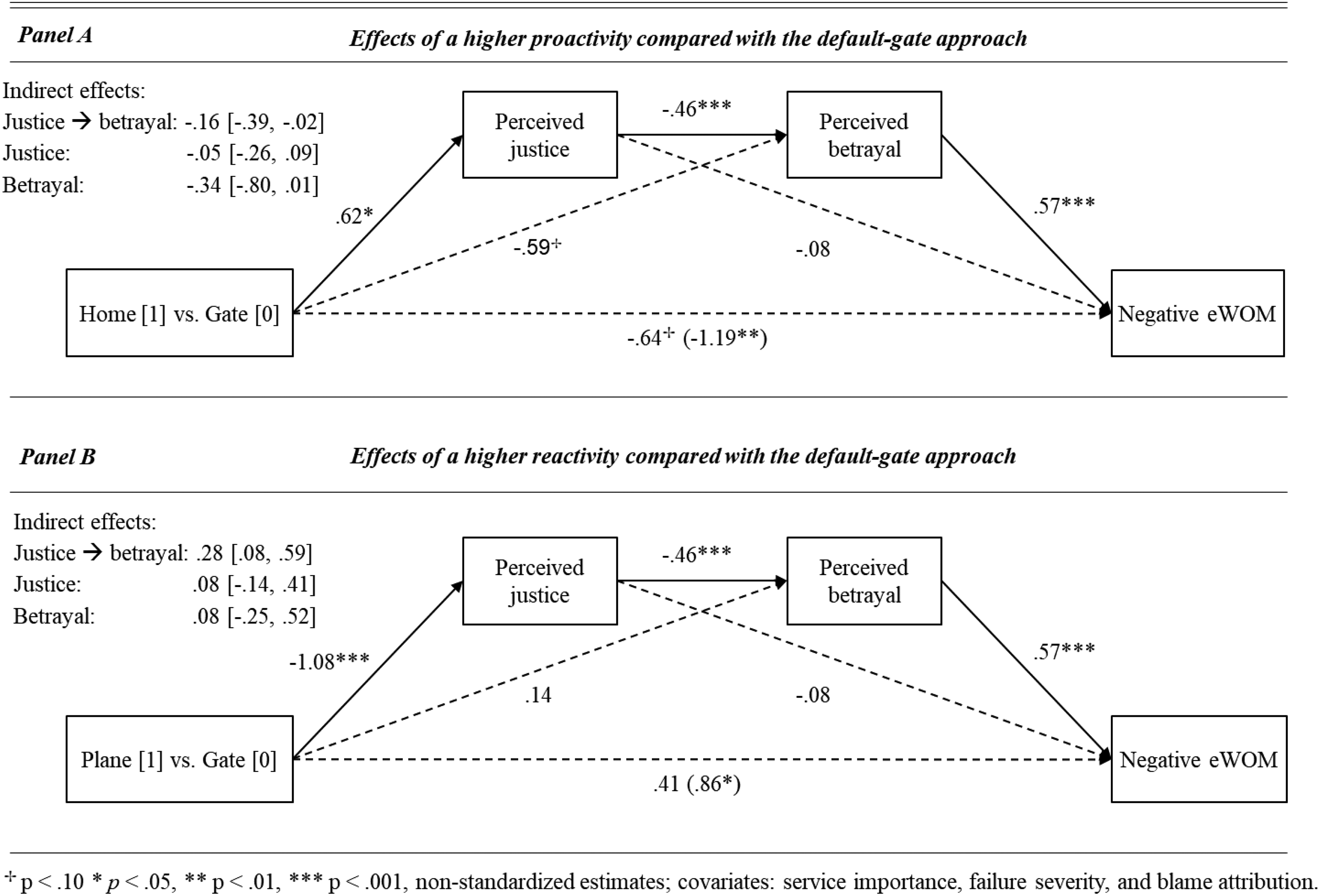
Results of serial mediation analyses (Study 1). (Panel A) Effects of a higher proactivity compared with the default-gate approach. (Panel B) Effects of a higher reactivity compared with the default-gate approach.
Figure 1 (Panel B) depicts the mediation results for a very reactive-plane approach (vs. the default reactive-gate approach). Regression analyses show a significant negative effect of proactivity on justice (b = −1.08, p < .001), a significant negative effect of justice on betrayal (b = −.46, p < .001), and a significant positive effect of betrayal on NeWOM (b = .57, p < .001). Further, the significant direct effect of proactivity on NeWOM (b = .86, p < .05) becomes nonsignificant when the two mediators are conjointly included (b = .41, p = .24). Importantly, the serial indirect effect is positive and significant, as indicated by the 95% confidence interval excluding zero (b = .28, 95% CI [.08, .59]), while the simple mediations going through justice or betrayal are nonsignificant. In sum, the results support Hypothesis 1.
Ruling Out a Reversed Causal Effect
Another mediation analysis was conducted to rule out a reversed causal effect for the two mediators by testing the following sequence: “proactivity-reactivity → betrayal → justice → NeWOM.” The corresponding indirect effects for default reactive-gate versus proactive-home (b = −.03, 95% CI [−.13, .05]) and default reactive-gate versus very reactive-plane (b = .02, 95% CI [−.04, .10]) are nonsignificant.
Discussion
Study 1 supports Hypothesis 1 and shows that a proactive approach decreases and a very reactive approach increases NeWOM mediated by justice and betrayal. While it is common practice to inform passengers at the gate that their flight is overbooked, informing customers earlier (i.e., at home) significantly reduces NeWOM, whereas informing them later (i.e., in the plane) further increases NeWOM. These results support the view that informing passengers early about overbooking—at best at home, at least at the boarding gate, but not in the plane—reduces NeWOM. This effect can be explained by a serial mediation: Proactivity increases justice perceptions, which, in turn, reduce feelings of betrayal and thus reduce NeWOM. A reversed reasoning (betrayal → justice) can be ruled out.
Study 2a: Compensation Levels
Purpose, Sample, and Procedure
Study 2a tests how much compensation is effective in reducing NeWOM at different degrees of proactivity-reactivity (Hypothesis 2), with Studies 2b and 2c refining the compensation amounts. We used a 3 (proactivity: proactive-home, default reactive-gate, and very reactive-plane) × 4 (compensation: low, medium-legal, high, excessive) between-subjects design with 12 conditions. The sample comprised 413 U.S. participants (M age = 34.2, female = 67.3%) recruited via Clickworker.
The first part of the scenario describes the same overbooking situation as in Study 1, manipulating proactivity-reactivity at the same three degrees: proactive-home, default reactive-gate, and very reactive-plane. Compensation level was manipulated in the second part of the scenario at four different levels: US$675, US$1,350, US$2,700, and US$10,000. The medium-legal level of US$1,350 for involuntary offloading with a major delay (USDOT 2019) served as a 100% reference point. Accordingly, 50% (US$675) and 200% of this value (US$2,700) were used as low and high levels of compensation, respectively. Further, in response to the rise in customers’ awareness, many airlines such as United and Delta have now increased their compensation up to US$10,000 for passengers who are willing to give up a seat (Hankel 2017). Therefore, US$10,000, which is roughly 700% of the legally required compensation level, was included as an excessive compensation level. In line with Basso and Pizzutti (2016), we measured NeWOM after the first (i.e., after the overbooking incident and before receiving compensation, T1) and the second part of the scenario (i.e., after receiving compensation, T2), which allowed us to examine the effectiveness of each compensation level compared to the baseline. We used the same scales for NeWOM (α in T1 = .91, α in T2 = .94), the controls, and manipulation checks as in Study 1 (the latter two measured at T1).
Manipulation Checks
Of the respondents, 97%, 89%, and 82% correctly indicated that they received the overbooking information at the gate, at home, and in the plane, respectively. Hence, the manipulation was successful. For further analyses, we removed respondents with incorrect answers, yielding a net sample of 364 participants. As the different compensation levels are a direct and observable form of manipulation, a manipulation check was not deemed necessary (Perdue and Summers 1986). The respondents perceived the scenarios as realistic (M Realism = 5.82 > 4.00, p < .001).
Results
As in Study 1, an ANCOVA was conducted with proactivity-reactivity and compensation as independent variables, NeWOM as the dependent variable, and service importance, severity, and blame as controls. The results show significant main effects of proactivity-reactivity, F(2, 349) = 7.76, p < .01, η2 = .04, and compensation level, F(3, 349) = 4.93, p < .01, η2 = .04. Importantly, the proactivity-reactivity by compensation interaction is significant, F(6, 349) = 2.14, p < .05, η2 = .04. To probe the interaction, we looked at each proactivity-reactivity degree (proactive-home, default reactive-gate, and very reactive-plane) separately, and then we compared the NeWOM levels at T2 versus T1 for the four compensation levels (see Figure 2).
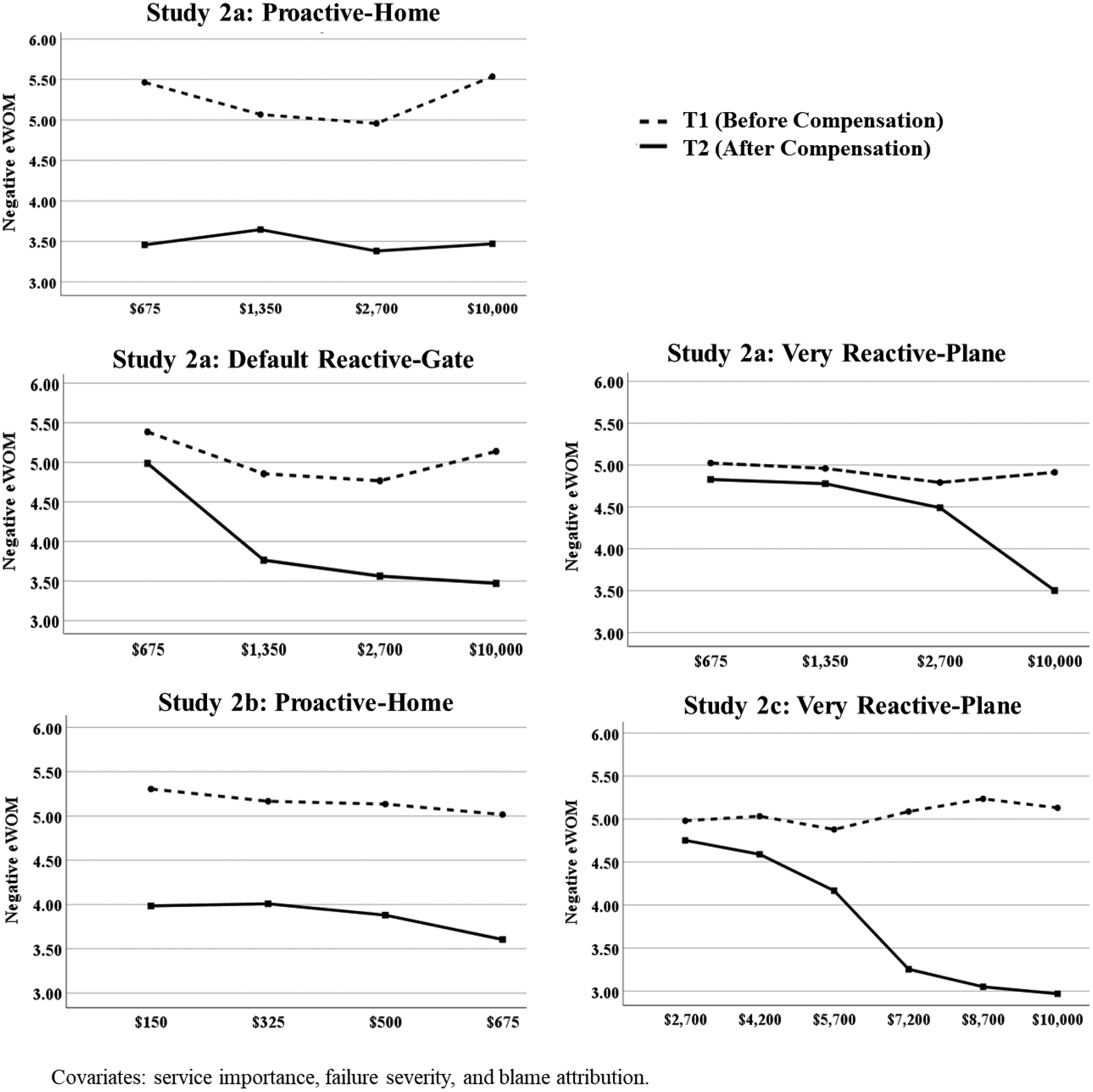
Negative electronic word-of-mouth estimated means in Study Set 2.
For the proactive-home condition, all four levels of compensation significantly reduce NeWOM at T2 compared to the NeWOM at T1 (see Web Appendix A5). Post hoc tests were conducted to see if there was a significant difference in NeWOM at T2 following different compensation levels at each proactivity-reactivity degree. The results show that for the proactive-home condition, there is no significant difference in NeWOM between the four compensation levels in T2, M US$675 = 3.46, M US$1,350 = 3.65, M US$2,700 = 3.38, M US$10,000 = 3.47; F(3, 349) = 0.14, p = .94, indicating that compensation lower than the reference level of US$1,350 is sufficient. For the default reactive-gate condition, only three compensation levels, medium (US$1,350), high (US$2,700), and excessive (US$10,000) significantly reduce NeWOM, but low compensation (US$675) does not. Post hoc tests reveal that there is no significant difference on NeWOM between US$1,350 (M US$1,350 = 3.76) and higher levels (M US$2,700 = 3.56, p = .81; M US$10,000 = 3.47, p = .58), suggesting that US$1,350 is the best level. For the very reactive condition, only excessive compensation (US$10,000) reduces NeWOM (M = 3.50), and it differs significantly from the other levels (M US$675 = 4.83, p < .01; M US$1,350 = 4.78, p < .01; M US$2,700 = 4.90, p < .05).
Discussion
Study 2a supports Hypothesis 2: The more proactive (reactive) the firm is, the less (more) compensation is required to reduce NeWOM. Our results reveal that when firms offload passengers proactively (i.e., at home), any compensation level (as low as 50% of the legal requirement) equally reduces NeWOM. When passengers are offloaded at the gate, firms must offer US$1,350 (100% of the legal requirement) to reduce NeWOM. A very reactive approach (in the plane) requires as much as US$10,000 compensation (700% of the legal requirement).
Study 2b: Proactive-Home Offloading
Purpose, Sample, and Procedure
Study 2b refines the appropriate compensation level in the proactive-home condition. As all compensation levels were effective in Study 2a, we looked at compensation levels below US$675 to find a level that is still effective but imposes the lowest monetary expense. To cover the entire range, we divided the range into equally distant groups each roughly US$175 apart from the top (US$675 from the previous Study) and bottom of the range (US$0), yielding four groups for Study 2b (a zero compensation group was not needed, as it was being measured at T1).
Using the core scenario of the proactive-home condition from Study 2a, we employed a single factor experimental design with four compensation levels (US$150, US$325, US$500, US$675). In total, 143 U.S. participants (M age = 32.7, female = 63.6%) from Clickworker completed the questionnaire. Again, NeWOM was measured before (T1: α = 88%) and after (T2: α = 94%) being exposed to the compensation. The same scales for NeWOM, the control variables, and manipulation check as in Study 2a were used.
Manipulation Check
Of the respondents, 99% correctly indicated that they received the overbooking information at home. Removing the respondents with incorrect answers yielded a final sample of 141 participants; they perceived the scenario as realistic (M Realism = 5.80 > 4.00, p < .001).
Results and Discussion
Figure 2 depicts the mean values of NeWOM at T1 and T2 across different compensation levels. A repeated measure ANCOVA revealed that all four compensation levels significantly reduce NeWOM at T2 compared to NeWOM at T1 (Web Appendix A5). A post hoc test showed no significant difference between the four compensation levels at T2, M US$150 = 3.98, M US$325 = 4.01, M US$500 = 3.88, M US$675 = 3.61; F(3, 134) = 0.45, p = .72.
These results show that when firms proactively handle overbooking by informing customers at home, any compensation as low as US$150 (about 10% of the legal amount) can be effective in reducing NeWOM. This finding further highlights that proactive management of overbooking can minimize customers’ negative reactions to offloading while reducing costs of compensation.
Study 2c: Very Reactive-Plane Offloading
Purpose, Sample, and Procedure
This Study refines the required compensation level in the very reactive-plane situation.
As in Study 2b, we sought to cover the entire range and also have large enough groups to detect differences; thus, we divided the range into equally distant groups between the lower bound (US$2,700 from Study 2a) and the upper bound (US$10,000) with roughly 100% increments over the legal requirement (US$1,350). This resulted in six roughly equally spaced groups with US$2,700 (200%), US$4,200 (300%), US$5,700 (400%), US$7,200 (500%), US$8,700 (600%), and US$10,000 (700%).
Using the core scenario of the plane condition from Study 2a, we employed a single factor design with six compensation levels as above. In total, 207 U.S. participants (M age = 33.3, female = 67.6%) from Clickworker completed the questionnaire. NeWOM was measured before and after the manipulation, using the same usual scale (α at T1 = 86%, α at T2 = 91%).
Manipulations Check
Overall, 99% of the respondents correctly indicated that they received the overbooking information in the plane, indicating a successful manipulation. Removing respondents with incorrect answers yielded a final sample of 204 participants, who perceived the scenario as realistic (M Realism = 5.85 > 4.00, p < .001).
Results and Discussion
Figure 2 depicts the mean values of NeWOM at T1 and T2 across different compensation levels for the very reactive-plane situation. Results of a repeated measure ANCOVA show that only the top four compensation levels (i.e., US$5,700 or higher) significantly reduce NeWOM at T2 compared to T1 (Web Appendix A5). A post hoc test revealed that while US$5,700 significantly reduces NeWOM (T2 = 4.17 < T1 = 4.88, p < .05), the next highest level of compensation (US$7,200) still yields a significantly lower NeWOM level at T2 (M US$5,700 = 4.17 > M US$7,200 = 3.25, p < .05). Beyond US$7,200, the two remaining compensation levels do not yield significantly lower NeWOM at T2 compared to the preceding level (M US$8,700 = 3.05, p = .61; M US$10,000 = 2.97, p = .47).
These results reveal that the appropriate compensation level when offloading passengers in the plane is US$7,200 (about 500% of the legal amount). While offering US$5,700 can also significantly reduce NeWOM, airlines can still benefit by offering higher compensation; but overcompensating beyond US$7,200 would not be worthwhile. Given that airlines have recently increased the highest compensation for offloading passengers to US$10,000 (Hankel 2017), this finding can lead to major cost savings for airlines.
Study 3a: Voluntary Proactive-Home Offloading
Purpose, Sample, and Procedure
The set of Studies 3 complements Studies 2 by examining the most effective compensation level in the specific context of voluntary offloading. Accordingly, while Studies 2 implied voluntary offloading for home and involuntary offloading for gate and plane, we now make explicit that the travelers volunteered at home (Study 3a) and did or did not volunteer at the gate (Study 3b), or in the plane (Study 3c). In addition, Study 3a focuses on the necessary compensation level at different intervention times in the proactive home condition.
Using the core scenario of the proactive-home situation from Study 2a, we employed a 3 (intervention time: 48, 24, and 5 hours) × 2 (compensation level: US$150 vs. US$75) experimental design. The intervention times were based on the expert interview results. Here, 5 hours represent the last opportunity to inform passengers proactively; it conservatively estimates that passengers are expected to be at the airport 3 hours before departure and may need 2 hours to get to the airport. Regarding compensation, we examined US$150 (10% of the legal amount, the lowest level from Study 2b which was still shown to be effective) and US$75 (5% of the legal amount) to explore whether a lower compensation level is still effective.
In total, 209 U.S. participants were recruited from Qualtrics (M Age = 38.9, female = 51.2%). NeWOM (α = 93%) and controls were measured using the same scales as in the previous studies. We also added complaint intention as the second form of voice according to Hirschman (1970), measured with 5 items (e.g., I would ask to speak to the manager on duty; α = 89%; Maute and Forrester 1993).
Manipulation Check
As intervention time was manipulated directly, an explicit manipulation check was not deemed necessary. The scenarios were perceived as realistic (M Realism = 5.66 > 4.00, p < .001). We also checked that participants perceived the interventions as proactive using the proactivity scale from Study 1 (α = .93). The results indicate proactivity in all three conditions with a score higher than the scale midpoint (all ps < .05), and differences across conditions were minimal.2
Results and Discussion
Figure 3 depicts the mean values of NeWOM across the experimental conditions. An ANCOVA showed that the main effects of proactivity (p = .23) and compensation level (p = .63) as well as their interaction (p = .91) are insignificant. Furthermore, we examined the effects of compensation at different proactivity levels through simple main effect analyses. Again, we found no significant differences between the two compensation levels for 48 hours (M US$150 = 3.02, M US$75 = 2.90, p = .78), 24 hours (M US$150 = 3.43, M US$75 = 3.44, p = .97), or 5 hours (M US$150 = 3.37, M US$75 = 3.16, p = .57). We observed a similar pattern of results when using complaint intention as a dependent variable (Web Appendix B2).
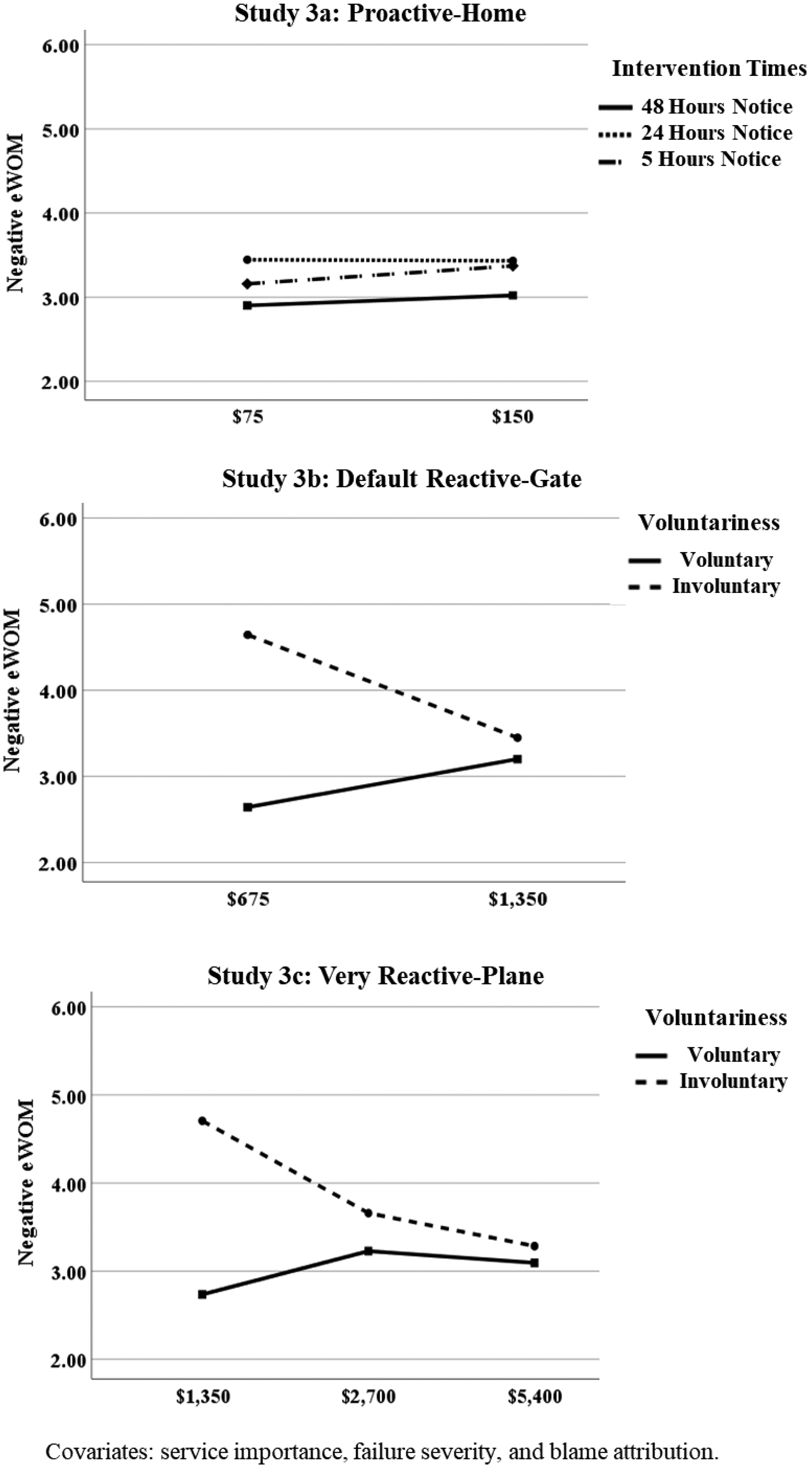
Negative electronic word-of-mouth estimated means in Study Set 3.
The results show that as long as airlines proactively ask customers to volunteer to be offloaded, they can mitigate the negative consequences at low levels of compensation. This is an important finding as airlines could delay contacting their passengers until 5 hours before a flight. This shorter notice enables airlines to fine-tune their estimate of no-shows and minimize offloading while securing high load factors. In addition, when firms proactively handle offloading a compensation as low as US$75 (5% of the legal requirement) can be effective.
Study 3b: Voluntary Reactive-Gate Offloading
Purpose, Sample, and Procedure
Study 3b tests Hypothesis 3 and the amount of compensation needed to reduce NeWOM and complaint intentions, depending on whether offloading at the gate happens voluntarily or not. We used a 2 (voluntary vs. involuntary) × 2 (compensation: US$1,350 vs. US$675) between-subjects design. The sample comprised 134 U.S. participants recruited via Qualtrics (M age = 41.3, female = 55.2%).
As in Study 1, the first part of the scenario describes a passenger planning to leave for a holiday who is approached by an airline representative at the gate. Next, voluntariness and compensation level were manipulated. In the voluntary condition, the passenger is informed that the flight is overbooked and that they are looking for volunteers to travel on a later flight. In the involuntary condition, the passenger is informed that the flight is overbooked and they have been selected to be offloaded and, therefore, must travel on a later flight. Monetary compensation is offered in both conditions: the levels were US$1,350 (100% of the legal requirement, which also was an effective level based on involuntary offloading in Study 2) and US$675 (50% of the legal requirement). The same scales as in the earlier studies were used for NeWOM (α = .92), complaint intention (α = .90), and the controls.
Manipulation Check
The manipulation of voluntariness was checked using 4 items (e.g., I volunteered to be bumped and travel with a later flight; α = .94) on a 7-point Likert-type scale. The mean values differed significantly between the groups in the desired direction (M Voluntary = 5.71 > M Involuntary = 2.02, p < .001), indicating successful manipulation. The respondents perceived the scenarios as realistic (M Realism = 5.81 > 4.00, p < .001).
Results and Discussion
Figure 3 depicts the mean values of NeWOM across conditions. As in Study 3a, an ANCOVA was conducted with voluntariness and compensation level as independent variables, NeWOM as the dependent variable, and the same control variables. The ANCOVA revealed that the effect of voluntariness is significant, F(1, 127) = 15.84, p < .001, η2 = .11, but the effect of compensation level is not (p = .25). Importantly, the interaction of compensation level with voluntariness is significant (F = 10.28, p < .01, η2 = .08). To probe the interaction, we examined the simple main effects. There is no significant difference between the two compensation levels for voluntary offloading (M US$1,350 = 3.20, M US$675 = 2.64, p = .13), but the difference is significant for involuntary offloading (M US$1,350 = 3.45, M US$675 = 4.64, p < .01). The results for complaint intention are similar (see Web Appendix B2).
Consistent with Hypothesis 3, these results show that voluntariness moderates the effects of compensation on customers’ responses. Specifically, when passengers are involuntarily offloaded, 100% of legal requirement (i.e., US$1,350) is needed to reduce negative customer responses (note, this finding is consistent with Study 2a, which also did not give passengers a choice). However, if offloading is done voluntarily, Study 3b shows that 50% less compensation is still effective in reducing NeWOM and complaint intentions.
Study 3c: Voluntary Very Reactive-Plane Offloading
Purpose, Sample, and Procedure
Study 3c further tests Hypothesis 3 and how much compensation is effective in reducing NeWOM and complaint intentions when offloading in the plane is done voluntarily or not. We used a 2 (voluntariness: voluntary vs. involuntary) × 3 (compensation level: US$1,350, US$2,700, and US$5,400) between-subjects design. The sample comprised 162 U.S. participants from Qualtrics (M age = 39.5, female = 46.9%).
As in Study 1, the first part of the scenario described a passenger who is going on a holiday but has already boarded the plane when approached by a representative. The voluntariness manipulations were almost identical to Study 3b (but adapted to the plane context). Unlike what was done in Studies 1 and 2c, the phrase escorting out of the plane was avoided because it could imply some form of aggression. The three compensation levels were determined as follows: US$5,400 (400% of the legal requirement), which was the lowest compensation level that was effective in reducing customers’ negative responses in Study 2c: US$2,700 (200% of the legal level) and US$1,350 (100% of the legal level). We used the same scales as in Study 3a.
Manipulation Check
The manipulation of voluntariness was checked by the same 4 items as in Study 3b (α = .90). The mean values differed significantly between the two groups in the desired direction (M Voluntary = 5.81 > M Involuntary = 2.28, p < .001), indicating successful manipulation. The subjects perceived the scenarios as realistic (M Realism = 5.38 > 4.00, p < .001).
Results and Discussion
As in Study 3b, an ANCOVA was conducted with voluntariness and compensation level as the independent variables, NeWOM as the dependent variable, and our controls (see Figure 3). The ANCOVA shows that the effect of voluntariness is significant, F(1, 153) = 12.37, p < .01, η2 = .08; the effect of compensation level is not (p = .19); but their interaction is significant, F(2, 153) = 5.23, p < .01, η2 = .06.
Simple main effect analyses show no significant difference between the three compensation levels for voluntary offloading (M US$5,400 = 3.09, M US$2,700 = 2.23, M US$1,350 = 2.74, p = .48), but the difference is significant for involuntary offloading (M US$5,400 = 3.28, M US$2,700 = 3.66, M US$1,350 = 4.71, p < .01). Pairwise comparisons among involuntary conditions reveal that compared with the US$1,350 compensation, both US$2,700 (p < .05) and US$5,400 (p < .01) are more effective in reducing NeWOM; but the difference between the US$5,400 and US$2,700 groups is not significant (p = .35). The results for complaint intention are generally consistent with the depicted pattern (Web Appendix B2).
Our results show that voluntariness also moderates the effects of compensation on customers’ reactions in the plane offloading condition. Specifically, while the results of Study 2c show that involuntarily (and forcibly) offloading passengers in the plane would require at least 400% (but ideally 500%) of the legal compensation level to reduce NeWOM, the current results indicate that if offloading is done voluntarily, 100% of the legal requirement would be sufficient to reduce NeWOM and complaint intentions. However, when passengers are involuntarily (but not aggressively) offloaded, they should be offered around 200% of the legal requirement to significantly reduce NeWOM.
Study 4: Modeling the Profitability Impact
Purpose and Approach
Study 4 examines the impact of compensation on an airline’s profitability in various scenarios using Monte Carlo simulations and prototypical models for airplane capacities and ticket pricing. The models are based on five compensation levels identified in our previous studies. Specifically, we use the minimal effective compensation for the five following situations: the home condition, the voluntary gate condition, the involuntary gate condition, the involuntary plane condition without aggression, and the involuntary plane condition with aggression. As the “involuntary gate” and “voluntary plane” conditions share the same basic compensation parameter, we present only one model for these two situations.
We focused on an airline’s achievable net revenue from ticket sales regarding a single flight with excess demand. As cancellations and no-shows are stochastic, we sought to simulate the expected net revenue E[Net Revenue] for representative combinations of ticket price and flight capacity together with the required compensation levels identified in Studies 3. E[Net Revenue] is the difference of expected revenue E[Revenue] due to ticket sales and expected denied boarding costs E[Costs] due to offloading an uncertain number of passengers: E[Net Revenue] = E[Revenue] − E[Cost]. To estimate revenue, denied boarding costs, and net revenue, we applied a static overbooking model to the sales process for a given flight.
The idea behind a static model is to replace the physical capacity with a fictitious overbooking level, that is, the maximum number of reservations the airline would be willing to accept. In doing so, the overbooking process can be separated from the actual booking control (i.e., dynamic pricing or availability control), while a proxy for the latter can be used to assess the impact of overbooking decisions. Thus, on the downside, static models simplify the temporal dynamics of reservations, no-shows, and cancellations. Yet airlines often use static models because of their robustness and simplicity and because they can reasonably approximate far more complex dynamic models (Aydın et al. 2012). Further, these models impose mild assumptions on the sales and offloading process and are less restrictive than dynamic models. Hence, the assumptions of Study 4 are in line with standard revenue management models as well as with those of the experiments conducted in Studies 1–3.
We made the following standard assumptions regarding the sequence of events (Talluri and Van Ryzin 2006). First, customers book the flight and pay a ticket price, until the overbooking level is reached. Because of the separation of the overbooking process and dynamic booking control, we can use an average ticket price paid by customers. Second, a random number of booked customers decide to cancel the flight or simply not to check-in. The corresponding ticket prices are not refunded. The remaining customers, called show ups, “survive” the booking process. When working with a static overbooking model, we can use a binomial distribution with an average show-up probability. Third, if the number of show ups exceeds the flight capacity, the airline has to offload the excess demand. It should be noted that the point of time when the airline informs customers about being offloaded is assumed to be after the decision to take the flight (i.e., it belongs to show ups). This assumption is mild, because even in the proactive-home condition, most customers often decide whether or not to take a flight. They even check in online more than 5 hours before departure—the latest point in time when the airline informs customers at home (see Study 3a). Even if not all customers have checked in, reliable predictions about the number of show ups are possible at this late point in time. A bumped customer receives a refund of the ticket and an extra compensation, which depends on whether offloading occurs at the gate, at home, or in the plane.
The airline wants to determine the optimal overbooking level (denoted by b*) to maximize net revenue. We analyzed the implications when using the five compensation levels considered as sufficient across the three proactivity conditions: US$75 (5% of legal requirement for home, Study 3a), US$675 (50% for gate-voluntary, Study 3b), US$1,350 (100% for gate-involuntary/plane voluntary, Study 3b and 3c, respectively), US$2,700 (200% for plane-involuntary without aggression, Study 3c), and US$7,200 (500% for plane-involuntary with aggression, Study 2c).
We simulated six scenarios, varying two levels of plane capacity
Results
In all scenarios, the expected values were approximated as averages over 10,000 simulations of the sales process. We start by analyzing the expected number of bumped customers E[Bumped], since it is required to compute the net revenue E[Net Revenue]. Only when the overbooking level is significantly greater than the capacity may the airline need to offload customers. For example, in scenarios with capacity c =200, for overbooking levels of 210 or lower with a show-up probability of 95%, the airline needs to offload at most one customer (see Web Appendix B3). The accumulated probability that fewer customers than the capacity will show up is still rather high for overbooking levels lower than 210.
From E[Bumped], we can analyze the monetary impact of the considered compensation levels (Figure 4, Panel A). Each subgraph refers to one of the six considered scenarios (capacity c, ticket price p), where the expected revenue E[Revenue], the expected denied boarding costs E[Costs] for the five compensation levels, and the resulting net revenue E[Net Revenue] for the five compensation levels are plotted according to overbooking level b. Thereby, E[Net Revenue] is given by the difference of E[Revenue] (dashed line) and E[Costs] (gray lines). The optimal overbooking level can be deduced from the maximum value of the E[Net Revenue]-plots. For example, in the scenario (c = 200, p = 100), the optimal overbooking levels are b* = 207, b* = 206, b* = 205, b* = 204, and b* = 203 for compensation levels 5% (proactive-home), 50% (gate-voluntary), 100% (default gate-involuntary), 200% (plane-involuntary without aggression), and 500% (plane-involuntary with aggression), respectively.
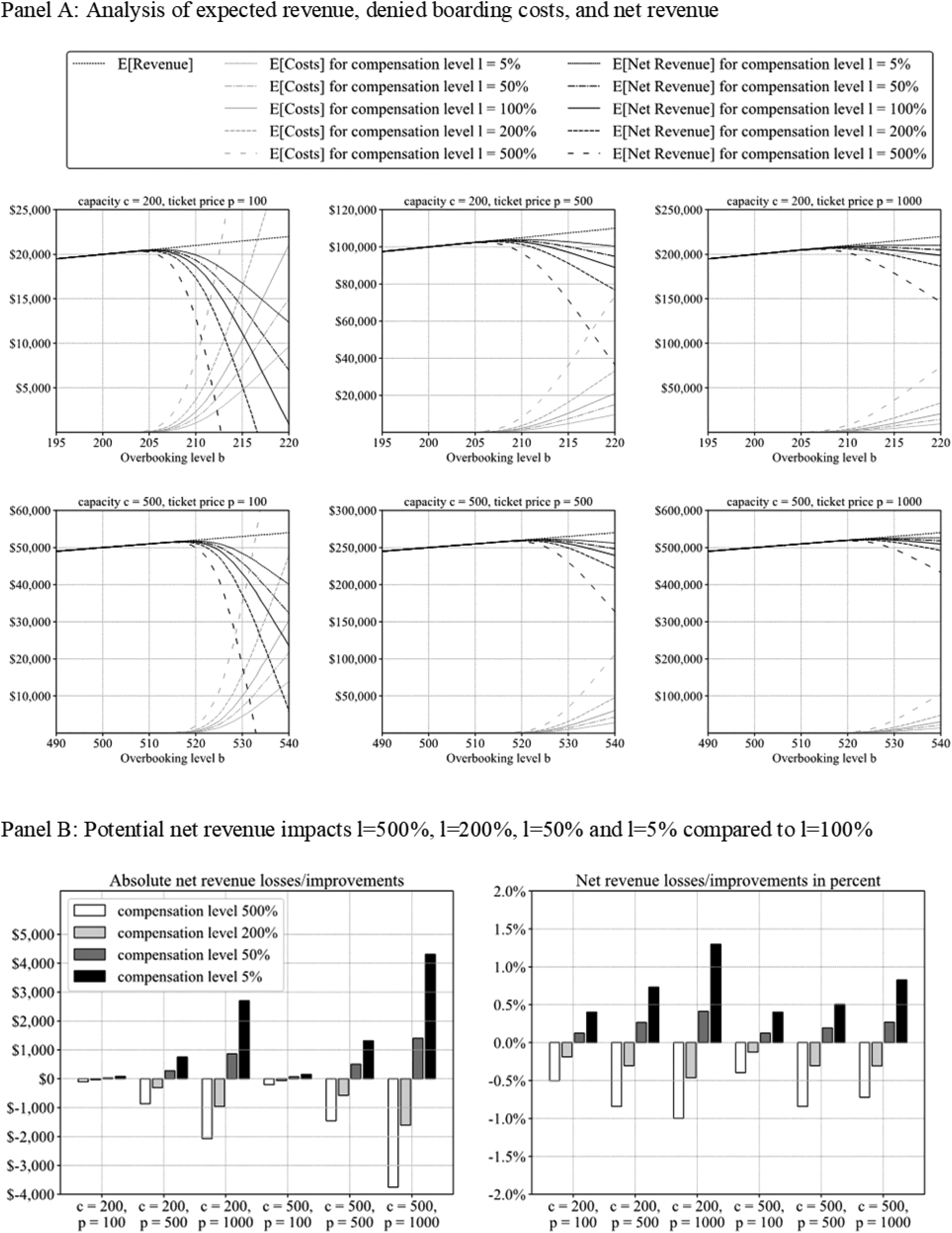
Simulation results (Study 4). (Panel A) Analysis of expected revenue, denial boarding costs, and net revenue. (Panel B) Potential net revenue impacts l = 500%, l = 200%, l = 50%, and l = 5% compared to l = 100%.
It can be seen that a higher compensation level leads to a more conservative overbooking level and, vice versa, a lower compensation level leads to more aggressive overbooking. A lower compensation level of 5% (the appropriate amount for the home condition) has three important effects on the operational planning of the flight (compared to a compensation level of 100%). First, the airline may allow a higher number of customers to book a ticket, which contributes to the expected revenue. Second, a slightly higher number of customers are likely be offloaded. Third, these bumped customers get a lower compensation. As can be observed from Figure 4 (Panel A), in total, these three effects turn out to be profitable in all six scenarios.
Finally, in Figure 4 (Panel B), we use the compensation level of l = 100% (default reactive-gate condition) as the reference point to further quantify the observed potential net revenue losses along with compensation levels l = 500% or l = 200% as well as the observed potential net revenue improvements for compensation levels l = 5% or l = 2%. For this purpose, we use the optimal overbooking levels and the corresponding optimal expected net revenue along with different compensation levels (as they can be deduced from Figure 4, Panel A). The left subgraph of Figure 4 (Panel B) refers to absolute values, the right subgraph to values in percentages. For example, in a given scenario (c = 200, p = 500), using a compensation level of l = 5% (or l = 500%) instead of l = 100% may lead to an absolute improvement (loss) of expected net revenue of around +US$760 (−US$870) for this flight. The corresponding relative improvements (losses) are around +.75% (−.85%). Considerable differences resulting from the different compensation levels are observed for ticket prices of p = 500 upward. This is because the impact of prohibiting or allowing more reservations on the expected revenue is higher than the impact on the expected denied boarding costs. Regarding the capacity c, the absolute net revenue differences are naturally higher for a higher flight capacity, and the relative net revenue differences are higher for a lower flight capacity.
Discussion
Study 4 relies on a common static overbooking model that allows us to simplify the inherent dynamics, for example, regarding the process and point of time by which customers are informed about being offloaded. The results support our prior findings about using higher proactivity with a lower compensation level. Specifically, feeding the overbooking tools of airlines’ software systems with a low compensation (i.e., 5% of legal amount), when informing customers before they head to the airport, may result in additional net revenue (up to 1.3%). In contrast, a rather high compensation (i.e., c. 500% of legal amount), which would be necessary for a significant reduction of NeWOM when offloading customers in the plane (aggressively), may lead to considerable net revenue losses (up to −1.0%). In addition to the lower compensation costs, net revenues are boosted by higher load factors and related ticket sales.
General Discussion and Theoretical Implications
Flight overbooking is pervasive and offers benefits to both firms (i.e., higher revenue) and their customers (i.e., lower prices and more available capacity; Powley 2017), but research on its dark side is limited. Prior studies show that overbooking can reduce customer satisfaction (Wehner, López-Bonilla, and Santos 2018), perceived justice, and loyalty (Wangenheim and Bayón 2007). Dissatisfied customers often share their negative emotions on social media, and this can damage firms’ image and financial performance (Benoit 2018). Further, firms end up paying hefty compensation to involuntarily bumped customers. Hence, identifying appropriate compensation amounts to decrease NeWOM by proactively offloading passengers is an important topic for service research, and the current research makes four key contributions.
First and foremost, we introduce proactivity as a novel recovery tactic, thus filling an important research gap regarding the prerecovery phase, which is addressed in less than 5% of recovery studies (Khamitov, Grégoire, and Suri 2020; Van Vaerenbergh et al. 2019). The two extant tactics in this phase—that is, encouraging customers to file complaints (i.e., facilitation) and initiating a cocreated recovery (i.e., initiation)—are relevant and insightful. We complement these tactics by arguing that proactivity starts the prerecovery phase even earlier. Indeed, proactivity brings forward the moment when firms address a foreseeable failure.
This tactic is not only a novel remedy. It also responds to a recent call made in favor of adaptive recovery, which proposes that “one size does not fit all” and that service recovery should be adapted according to contexts and types of customers (Khamitov, Grégoire, and Suri 2020; Van Vaerenbergh et al. 2019). Proactivity fits particularly well the context of the airline industry, in which overbooking is an intentional service failure that can be predicted with a reasonable level of precision, especially with the development of AI. We specifically address the notion of adaptiveness by identifying different compensation levels for diverse degrees of proactivity.
Prior research does not agree on the amount most suitable for bumped customers. Noone (2012) shows that there is no significant difference between different levels of compensation (e.g., 50%, 100%, and 200%), whereas Wangenheim and Bayón (2007) suggest that airlines should offer higher than the legal compensation to minimize the negative effects of overbooking. We shed new light on these conflicting results by showing that both recommendations can apply, depending on the situation. On the one hand, for a highly proactive approach (at home), monetary compensation as low as 5% of the legal requirement can significantly reduce NeWOM; and overcompensation (as high as 700%) does not have any added benefit. On the other hand, in a very reactive approach, substantial overcompensation is necessary to appease bumped travelers. Our results reveal that, for a very reactive approach, 200% of the legal requirement seems sufficient although offering up to 500% may be needed. When offloading occurs at the gate, offering the legal requirement is advisable.
The second contribution refers to adapting compensation amount according to the context of voluntary versus involuntary offloading. While proactive offloading at home is inherently voluntary, this question becomes crucial in reactive (at the gate) or very reactive (in the plane) situations. Here, our research indicates that offering customers a choice—letting them step back on a voluntary basis—can significantly reduce both NeWOM and compensation. For voluntary offloading at the gate, 50% of the legal requirement would be sufficient, while in the plane, the required compensation can be reduced to 100% of the legal prescription. These findings extend prior research, which argues that giving customers a choice increases perceived justice (Mattila and Cranage 2005). We show that adaptive recovery again pays off, as firms can considerably save by identifying customers who are willing to wait for another flight.
As a third contribution, we confirm the relevance of equity theory and Homans (1961) law of justice in the context of adaptive recovery. Prior studies show that perceived justice explains customers’ reactions to overbooking (e.g., see Hwang and Wen 2009; Wangenheim and Bayón 2007). We take the extra step by revealing that justice can be restored by informing passengers early; yet, this same perception is decreased when they are informed late. Accordingly, simple precautions related to timing can easily increase the “rewards to investments” ratio as perceived by customers. Furthermore, we show that overbooking is also closely linked to the notion of betrayal because denying boarding is perceived as a norm-breaking violation (e.g., Grégoire and Fisher 2008). Overall, we show that customers’ reactions to overbooking are best explained by the sequence: proactivity-reactivity → justice → betrayal → NeWOM.
Our fourth contribution is to quantify how appropriate compensation levels—as determined in the experiments—impact airlines’ net revenues by accounting for different levels of ticket price and plane capacity (e.g., see Hwang and Wen 2009; Wangenheim and Bayón 2007). Unlike most recovery research—which is mostly experimental with a main focus on customers’ reactions—we examine the effects of our predictions on profitability. By doing so, we answer recent calls urging recovery researchers to incorporate financial metrics (Khamitov, Grégoire, and Suri 2020; Van Vaerenbergh et al. 2019). Although the estimated net revenue improvements (up to 1.3%) are seemingly small, they are substantial for airlines because they are achieved with limited additional fixed costs. Therefore, such improvements directly contribute to operating profit. Importantly, we highlight that being very reactive and handling overbooking after boarding (e.g., offloading travelers “aggressively”) requires much more compensation (up to 500%), fosters negative customer reactions, and leads to net revenue losses (up to 1.0%).
Managerial Implications
Here are three representative quotes from three of our interviewed experts: “Overbooking is a mandatory practice for virtually all airlines,” “Some can be highly aggressive and overbook by 10%–20%,” and “You better offload two customers rather than leaving one seat empty.” Overbooking is pervasive and is here to stay. In that respect, this research offers valuable recommendations on how to implement offloading and improve profitability.
Predicting the Number of No-shows
While some airlines predict the number of no-shows using stochastic models or rules of thumb, others have already embraced the merits of AI. We recommend that airlines use AI-based models, feed them with historical data, such as peak travel times, destination, and time of departure, and refine predictions with booking information and booking pace. Airlines are advised to reintroduce reconfirmation of flights from 48 hours up to 8 hours before departure to improve the accuracy of their predictions.
Choosing Customers to Be Offloaded
All airline experts emphasized that nobody should be offloaded involuntarily. Instead, airlines should follow a “hierarchy of passengers” as one expert put it, by first approaching customers who are likely to give up their seat voluntarily. Indeed, these passengers tend to be more flexible and are satisfied with lower compensation. For example, these travelers may be economy class passengers, students, or solo travelers. As summarized by one expert, firms should “not touch premium passengers, frequent flyers, families with young children, groups, and those with connecting flights.” Selecting customers most amenable for offloading requires analysis of a vast amount of data from different systems and under time pressure. Consequently, relying on personnel at the gate to do this effectively and efficiently is unlikely to work. However, using AI in the backroom to highlight potentially suitable passengers and then let front-line staff contact them to discuss potential offloading and the related compensation seems to be the most effective approach for such a complex analytical as well as an interpersonal and emotional task (cf. Wirtz et al. 2018). Another expert confirms that it is common practice for airlines to keep selling very expensive last minute tickets to enhance their revenue, even though they do not have the capacity. Here, they can offload people with low-price tickets who are happy to volunteer with minimal compensation (as low as US$75).
Proactive Offloading
When flights are overbooked, airlines often wait until passengers are at the gate to select those to be offloaded. One expert described this process as “still highly manual for many airlines.” This approach can be problematic, particularly in an age when such treatments can attract attention on social media (Kim and Lowrey 2015). We recommend that airlines should inform passengers several hours before departure and before they get to the airport. When doing so, airlines can increase net revenues by up to 1.3%. At this early stage, customers will give up their seats voluntarily for a very small amount.
It seems logical to increase the “compensation package” (as an expert named it) as the departure time is getting closer. Yet our results do not show differences regarding intervention time for proactive measures. Regardless of informing customers 48, 24, or only 5 hours before departure, the required compensation did not differ. Hence, airlines have some leeway regarding the intervention time and may conduct offloading in batches, depending on the severity of overbooking. It may be optimal to offload passengers who are almost certain not to be able to get a seat early (e.g., 48 hours in advance to allow them to more easily make an alternative booking), and then fine-tune again 24 and 5 hours before departure.
Proactive offloading can be implemented by sending emails or mobile notifications. A majority of airlines now have apps through which people can check in, receive updates about any delays, gate changes, and so on. Airlines could send notifications to selected customers offering them compensation and the opportunity to rebook on another flight. They can stop sending these messages when enough passengers have accepted the offer of being voluntarily offloaded. Two experts mentioned that some airlines have already started to incorporate proactive offloading into their online systems. They ask passengers at online check-in if they would be willing to give up their seat should there be a need for offloading. Passengers can then specify, at check-in, the compensation for which they would be willing to give up their seat. These proactive measures are economical and give airlines increased flexibility; passengers are also satisfied with the received compensation.
Offloading at the Gate and in the Plane
Offloading at the gate is a common practice in the airline industry. However, we recommend that it should only be applied if proactive offloading is not sufficient, or if the airline has insufficient capabilities to predict the number of no-shows. Again, airlines should first ask customers if they volunteer to be offloaded and then offer these customers 50% of the legal compensation prescription. Some people (e.g., college students) may even wait for such opportunities to reduce their travel costs. For involuntary offloading at the gate, we advise paying 100% of the legally required amount.
Offloading in the plane should be avoided at all costs, as it considerably fosters NeWOM and requires the highest level of compensation. When airlines have boarded too many passengers, they should first ask for volunteers and offer the legal compensation. If nobody volunteers at this stage, firms should increase compensation payout to about 200%. If there are still no volunteers, they can increase the offer further but eventually may need to select passengers to leave the plane in exchange for up to 500% compensation to minimize NeWOM and other complaints for involuntary offloading in the plane.
Using Creative Ticket Strategies
We also suggest that airlines could combine the suggested proactive approach with creative ticket designs. For instance, airlines could design tickets in a way that passengers with nonrefundable tickets are motivated to inform the airline about changes in their travel plans. Currently, passengers with nonrefundable tickets simply do not show at the gate. These customers could be offered a small refund if they inform the airline early about changes in their travel plans (Gallego and Şahin 2010) and thereby improve predictions of offloading requirements. Further, airlines could offer callable and flexi tickets (Gallego, Kou, and Phillips 2008). Callable tickets could be sold at discounted prices but come with a prespecified recall price which is higher than the original ticket price paid but lower than a full fare ticket. Flexi tickets enable airlines to rebook passengers on a different flight within a prespecified period (e.g., 48 hours). Both ticket types allow airlines to offer seats to last minute business travelers at high ticket prices at a predetermined cost of offloading.
Limitations and Future Research
This research has some limitations that offer avenues for future research. First, we examined overbooking in the airline context. This focus is intentional, as it is an important industry with an estimated revenue of US$2.7 trillion (Gitto and Mancuso 2019); it is highly regulated and compensation for bumped passengers is obligatory. As overbooking can be desirable in any service with fixed capacity and uncertain demand, it is promising to examine proactive and adaptive recovery in denied service situations in other industries such as hotels, restaurants, and car rentals (Wirtz et al. 2003).
Second, we used monetary compensation in the form of cash. Prior research has also used vouchers although they may not be as effective as cash compensation (Noone 2012). Further, newer forms of payment (e.g., cryptocurrencies) are gaining popularity. Some airlines (e.g., Taiwanese Airlines and AirBaltic) and even airports, such as Brisbane International Airport, now accept cryptocurrencies as a regular payment (Wu and Chang 2019). Given the potential advantages of cryptocurrencies over voucher (i.e., the ability to convert to cash or spend at various retailers rather than being tied to one retailer with a limited validity period) and even cash (i.e., the potential rise in value due to major fluctuations), it would be useful to examine the moderating role of compensation type (i.e., cash vs. voucher vs. cryptocurrencies) on the effects of proactive offloading on customers’ reactions.
Third, our research is a first step in better dealing with overbooking. Specifically, the scenarios in our experimental studies used outbound passengers (i.e., those leaving their home to go on a trip), but it would also be interesting to examine whether our findings are replicated for inbound passengers (i.e., those who are coming back home from a trip). Other moderating factors, such as cabin class (e.g., business vs. economy), time of flight (e.g., night vs. day), type of flight (e.g., short vs. long haul), the purpose of flying (e.g., work vs. holiday), and group size (e.g., solo vs. group passengers), may also warrant further examination.
In sum, enabling airlines to operate at 100% load factors offers key stakeholders several benefits (e.g., lower cost per passenger, higher revenue, making capacity available to more travelers, and lower ticket prices). Our research examines novel strategies of how to deal with overbooking cost-efficiently with reduced negative customer responses. We hope to encourage more studies on how airlines and other fixed-capacity industries can more effectively use proactive and adaptive recovery to help them operate at higher levels of capacity utilization.
Supplemental Material
Supplemental Material, Executive_Summary - Proactive Handling of Flight Overbooking: How to Reduce Negative eWOM and the Costs of Bumping Customers
Supplemental Material, Executive_Summary for Proactive Handling of Flight Overbooking: How to Reduce Negative eWOM and the Costs of Bumping Customers by Amin Nazifi, Katja Gelbrich, Yany Grégoire, Sebastian Koch, Dahlia El-Manstrly and Jochen Wirtz in Journal of Service Research
Supplemental Material
Supplemental Material, Web_Appendix_NEW - Proactive Handling of Flight Overbooking: How to Reduce Negative eWOM and the Costs of Bumping Customers
Supplemental Material, Web_Appendix_NEW for Proactive Handling of Flight Overbooking: How to Reduce Negative eWOM and the Costs of Bumping Customers by Amin Nazifi, Katja Gelbrich, Yany Grégoire, Sebastian Koch, Dahlia El-Manstrly and Jochen Wirtz in Journal of Service Research
Footnotes
Acknowledgments
The authors would like to sincerely thank the editor, associate editor, and three anonymous reviewers for their helpful and constructive comments on this article. Further, the authors gratefully acknowledge the generous contribution in terms of time and feedback provided by Sachin Goel, Founder and CEO, Optiontown, USA; Nicola Lange, Senior Director First Class Service and Lounges, Hub Frankfurt, Lufthansa, Germany; L. U. Chung Yuan, Divisional VP Operations Control, Singapore Airlines; Shashank Nigam, CEO & Founder, SimpliFlying, Canada; and Joe Ooi, Vice President Network Revenue Management, Singapore Airlines.
Declaration of Conflicting Interests
The author(s) declared no potential conflicts of interest with respect to the research, authorship, and/or publication of this article.
Funding
The author(s) disclosed receipt of the following financial support for the research, authorship, and/or publication of this article: Prof. Wirtz has received a research grant from the Ministry of Education, Singapore; Project: Service Productivity and Innovation Research, MOE2016-SSRTG-059.

Supplemental Material
Supplemental material for this article is available online.
Notes
References
Supplementary Material
Please find the following supplemental material available below.
For Open Access articles published under a Creative Commons License, all supplemental material carries the same license as the article it is associated with.
For non-Open Access articles published, all supplemental material carries a non-exclusive license, and permission requests for re-use of supplemental material or any part of supplemental material shall be sent directly to the copyright owner as specified in the copyright notice associated with the article.
