




Abstract
Service providers often use minimum increments and billing increments to charge for higher usage than customers’ true usage. Despite their popularity in business practice, research has largely ignored these increments and assumed that charged usage always equals true usage. We develop an overcharging index that represents the extent to which a customer is charged for units that she or he did not use and identify situations in which the overcharging index is particularly high. In three empirical studies in the highly competitive telecommunication market, we demonstrate that providers are increasingly using longer minimum and billing increments. These increments yield an average overcharge of true usage of 43.79% for customers with long increments. These increments generate additional revenues that are responsible for almost two thirds (66.2%) of the operating profits of the main providers in Germany and the United States. Customers, particularly those who are less educated, seem to not understand minimum and billing increments well, do not adjust their behavior to different increments, and often make tariff choice errors unsystematically.
As digital technologies have made it easier to measure all kinds of service usage, defining an adequate pricing metric has become a key element of service providers’ pricing strategy. The pricing metric is the unit the provider uses for measuring usage. For example, the pricing metrics of car-sharing service providers are often the time of renting a car (e.g., $10 per hour), sometimes in combination with the number of kilometers driven (e.g., $.15 per km). Thus, service providers use the pricing metric to derive how much a customer uses the service, and choosing it properly is important because it ultimately determines billing rates. Ideally, it should be linked to the utility that the service provides to the customer.
These pricing metrics can also change. For example, car-sharing services currently do not separately price the number of passengers, but technological developments would easily allow for doing so in the future. As the willingness to pay for car sharing is likely to increase with the number of passengers, the use of such a pricing metric, in addition to a pricing metric that captures the duration of usage, could enable providers to better align their prices with the utility that their services provide.
Providers use minimum and billing increments to translate the true usage captured by the pricing metric into the usage for which the provider charges. The minimum increment (some providers refer to this as “unitization”) specifies the minimum usage that the provider will charge. The billing increment is used to determine customers’ full charges, found by rounding up true usage to a multiple of this increment.
Prior literature implicitly assumes that true usage equals charged usage (e.g., Iyengar and Gupta 2009; Lambrecht et al. 2012; Schlereth and Skiera 2012), but this assumption only holds if no minimum or billing increments are employed. Indeed, the usage of minimum and billing increments in tariffs leads to situations in which charged usage is substantially higher than true usage. For example, if a car-sharing service bills for usage of the car per hour, but a customer uses the car for just 40 minutes, then the customer will be charged for 60 minutes and, thus, also the 20 minutes the customer did not use the car. Stated differently, charged usage is 50% higher than true usage, as reflected in our newly developed overcharging index (=60/40 − 1).
Historically, these increments have been popular, particularly in the telecommunication industry. In the United States, for example, most residential long-distance providers, such as AT&T and Sprint, billed by the minute (i.e., 60/60, where the first number refers to the minimum increment of 60 seconds and the second number to the billing increment of 60 seconds), though others used an 18/6 charge (i.e., a minimum increment of 18 seconds and a billing increment of 6 seconds, e.g., EDC, Touchtone), and a few used 1/1 increments (3U Telecom).
Nowadays, the use of increments is also popular in many other service industries. Attorneys, tax advisors, and freelancers commonly use quarter-hour increments, car parks charge per hour, and public swimming pools often have a minimum increment of 2 hours and billing increments of 15 or 30 minutes. Infrastructure as a service (IAAS) cloud providers, such as Amazon EC2 and Microsoft Cloud, even use multiple pricing metrics: They charge separately for time using the cloud service, data storage volume, and upload and download volumes and employ different billing increments for each aspect (e.g., per second vs. per hour; per KB vs. per MB).
Despite the prominent use of minimum and billing increments in business practice, no prior academic literature has examined them to date. Customers’ understanding of these increments is related to the pricing literature on flat-rate bias (e.g., Goettler and Clay 2011; Lambrecht and Skiera 2006; Nunes 2000; Uhrich, Schumann, and von Wangenheim 2012), on choice confusion and information overload (Haucap, Heimeshoff, and Lange 2016; Scheibehenne, Greifeneder, and Todd 2010), and on financial literacy (e.g., Lusardi and Mitchell 2007; Martin and Hill 2015). Essentially, these streams of literature argue that pricing managers purposely use techniques that lead customers into making pricing decisions under which they will eventually pay more compared with other alternatives.
However, in contrast to the mechanisms studied in previous literature, minimum and billing increments enable service providers to gain flexibility in their pricing such that they can communicate lower prices in return for charging a higher minimum usage, which is helpful especially in highly competitive market settings. Yet, the gap in the literature makes it difficult to evaluate how minimum and billing increments impact customers’ behavior, their billing rates, and service providers’ revenue. The aim of this research is to fill this gap by (1) outlining theoretically and empirically how minimum and billing increments impact usage and billing rates and, thus, the provider’s revenue; (2) examining how well customers understand these increments; and (3) exploring potential reasons for tariff choice errors when customers wrongly choose among services with different increments.
To derive our results, we use multiple data sources, namely, tariff offerings on the market across many providers (Study 1), transactional data (Study 2), and survey data (Study 3). The results show that minimum and billing increments increase charged usage by, on average, 43.79% over true usage for customers using long increments. Moreover, customers are unlikely to adjust their behavior to different increments. Most customers do not know their billing increments, and especially less educated customers make errors in choosing tariffs with different increments. Providers increasingly use longer minimum and billing increments to price their service, which underlines the attractiveness of longer billing increments.
The remainder of this article is structured as follows. First, we outline the relevance of minimum and billing increments for the pricing of services. Then, we provide a formal model to determine charged usage and outline its impact on usage and tariff choice. Subsequently, we present the three empirical studies. Finally, we conclude with a summary and discuss the implications of the results for pricing services.
Relating Increments to Pricing of Services
Services are characterized by customers whose usage differs widely. For example, some people use public transportation often, whereas others hardly use it at all. The pricing metric enables providers to capture those differences in usage and willingness to pay, and the tariff offers flexibility to charge them differently. Essentially, a tariff is a mechanism that describes how to use prices and other pricing components (e.g., minimum and billing increments) to transfer usage into a billing rate. Although the term “tariff” is popular in the nonlinear pricing literature (e.g., Oi 1971; Schlereth, Stepanchuk, and Skiera 2010), researchers also use labels such as “pricing schedules,” “pricing menus,” “pricing structures,” “pricing schemes,” “pricing policy,” “metered pricing plan,” and “pricing plan” (e.g., Fruchter and Rao 2001; Moser et al. 2018; Schlereth, Skiera, and Wolk 2011).
There are many types of tariffs (Table 1) that differ in the kinds of prices that are used to derive the billing rate. Tariffs might contain prices that occur once (then also called “fees,” e.g., Fruchter and Rao 2001) or repeatedly. Typical examples for prices that occur once are a setup or an installation price. Prices that occur repeatedly can be independent of or dependent on usage. An allowance describes the number of units that can be used free of charge and that is covered through the usage-independent price (Lambrecht, Seim, and Skiera 2007). Sometimes, a tariff even offers a certain number of free units (i.e., an allowance), even without charging a usage-independent price. For example, Harvard Business Publishing allows readers to read up to six free articles each month and only requires paying a monthly subscription price for reading additional articles.
Most Popular Types of Tariffs.
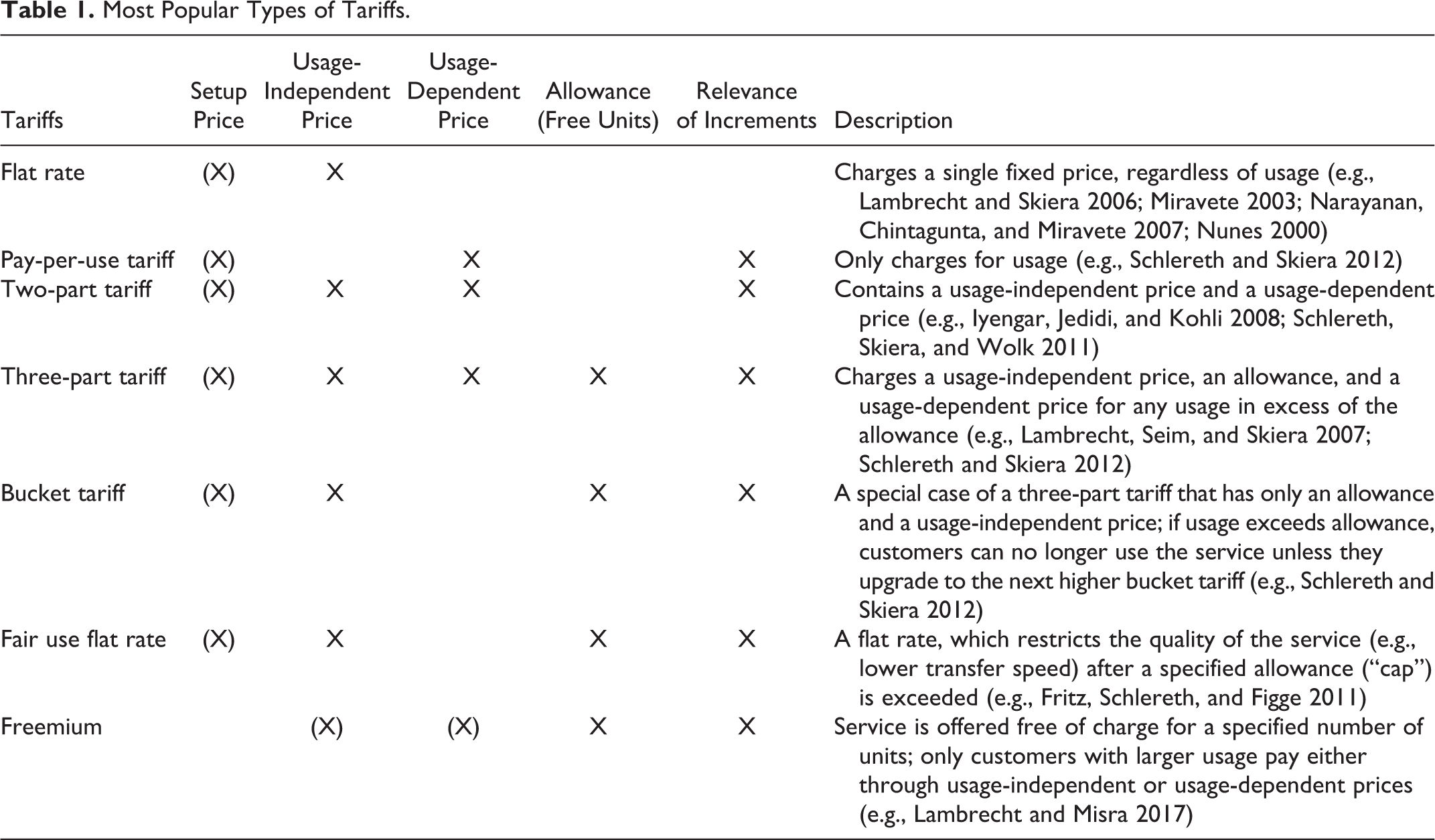
Many of the tariffs listed in Table 1 are popular in the telecommunication industry, ranging from flat rates that are popular in the United States to pay-per-use tariffs that are more popular in Europe. Other examples for services that employ a large variety of tariffs are digital services such as software or IAAS. In addition, renting instead of selling physical goods, combined with advances in digital technology, has facilitated the use of new pricing metrics to charge for the usage of physical goods. For example, Rolls Royce no longer sells jet engines; rather, it sells thrust as a service and recoups the costs of its engines through an hourly fee under its total care program. Thus, customers pay only when the airplane is in the air. Michelin follows the same path for truck fleets and charges a fee on its tires for each mile driven (Ramanujam and Tacke 2016, p. 81). Similarly, insurance firms have begun using telematics devices to offer “pay how you drive” auto insurance, a usage-based insurance concept that assesses premiums on the basis of time of usage, distance driven, and driving behavior (Reimers and Shiller 2018).
Interestingly, research is rather silent on the pricing metric decision—that is, the decision about how to best measure usage. The consensus is to use a pricing metric that reflects how customers perceive a product’s benefits in relation to its price, an idea often referred to as value-based pricing (Monroe 2003; Nagle and Müller 2018). For example, if a certain software enables firms to reduce employees needed in a call center because it increases the productivity with which calls could be handled, then pricing the software via the pricing metric “per user” is certainly the wrong way to go. Instead, the pricing metric should be more closely linked to the call center’s productivity (e.g., by pricing per call). Lahiri, Dewan, and Freimer (2013) emphasize that deciding on the right pricing unit is often more important than setting prices in a tariff.
Research is also silent about the use of minimum and billing increments that build on the pricing metric. Only Friesen and Earl (2015) use increments as an example of how telecommunication providers attempt to confuse customers. Yet, minimum and billing increments link true usage to charged usage so that they affect the billing rate in almost all types of tariffs, as outlined in Table 1. The only exception is a flat rate: The usage does not impact the respective billing rate, so measuring usage is irrelevant.
Historically, the ability to measure usage often was the main reason for choosing certain minimum and billing increments. For example, until about 1990, telecommunication providers were technically restricted in that the mechanical wheel used to measure the duration of a phone call could only measure the number of times the wheel turned around and not the exact number of seconds. While more precise measuring is feasible today, it still might involve additional costs that prevent service providers from implementing such a measure.
Formal Model of Minimum and Billing Increments
As a prerequisite for a theoretical understanding of the impact of minimum and billing increments on usage and tariff choice decisions, we must formally outline how increments impact the billing rate and, in particular, the relationship between true and charged usage. We also propose an overcharging index that captures differences between true and charged usage.
Relationship between Charged Usage and Billing Rate
Table 1 outlines the wide range of existing tariffs. Two popular tariffs are a pay-per-use tariff and a two-part tariff. Equation 1 shows how the two-part tariff relates the charged usage to the billing rate. The pay-per-use tariff is a special case of the two-part tariff in which the fixed fee is 0 (i.e.,

where
Thus, the billing rate of a two-part tariff is simply the fixed fee Fj plus the product of per-unit price and the sum of the number of charged units across all service uses k. The service uses are, in our empirical setting, mobile calls. The charged units
Determination of Charged Usage
Minimum and billing increments impact the billing rate because they lead to a charged usage,
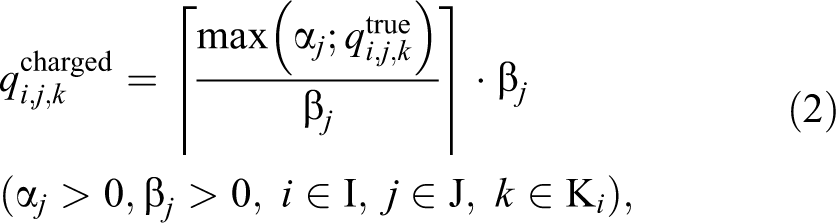
where
In our empirical studies, the service use k refers to each call, and the true usage,
Equation 2 formally describes how minimum and billing increments impact true usage and accounts for two special cases. First, if
Determination of Overcharging Index
With the overcharging index, we introduce a new measure that represents the extent to which a customer is charged for units that she or he did not use. We obtain the overcharging index
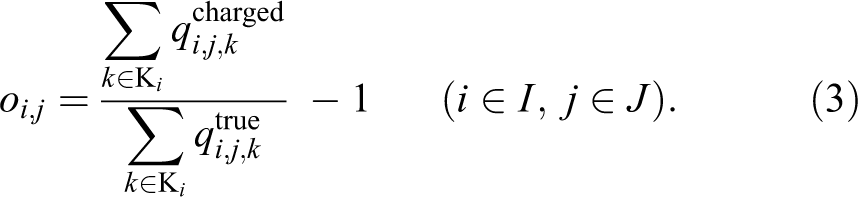
The overcharging index ranges between 0% and infinity. It is only 0% if
In Figure 1, we visualize the charged and true usage across the three increments 1/1, 60/1, and 60/60. For 1/1 increments, the overcharging index is always 0%. For 60/1 increments, the index monotonically decreases for longer calls and is 0% if the usage exceeds 60 units. For 60/60 increments, it is constantly decreasing for longer calls with upward spikes, right after the beginning of the next billing increment. For example, an average usage of 20 units yields an overcharging index of 200% (i.e., = 60/20 − 1); that is, the charged usage is 200% higher than the true usage.
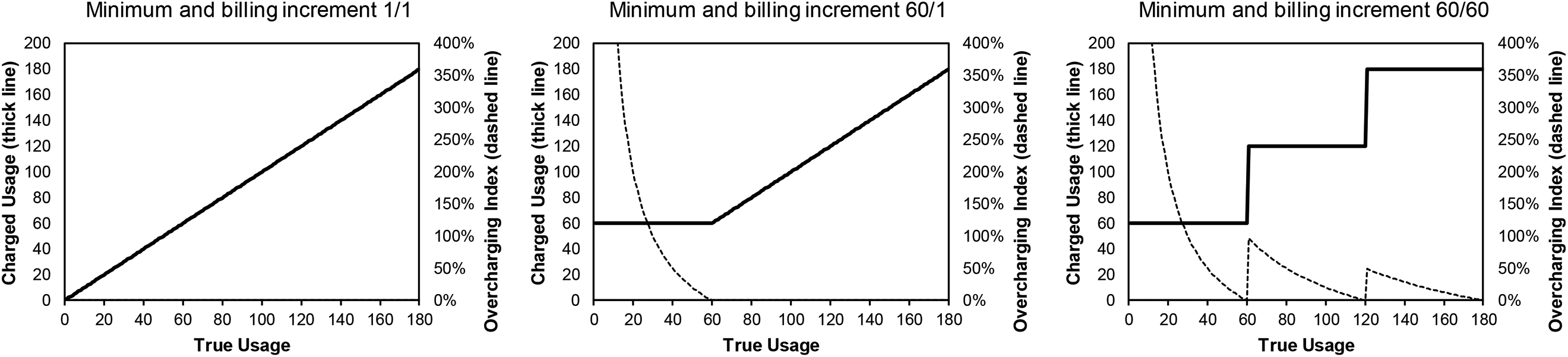
Charged usage (thick line) and overcharging index (dotted line) under different minimum and billing increments.
Often, the minimum increment
Overcharging Index for One Service Use with a True Usage of Four Units (q = 4).
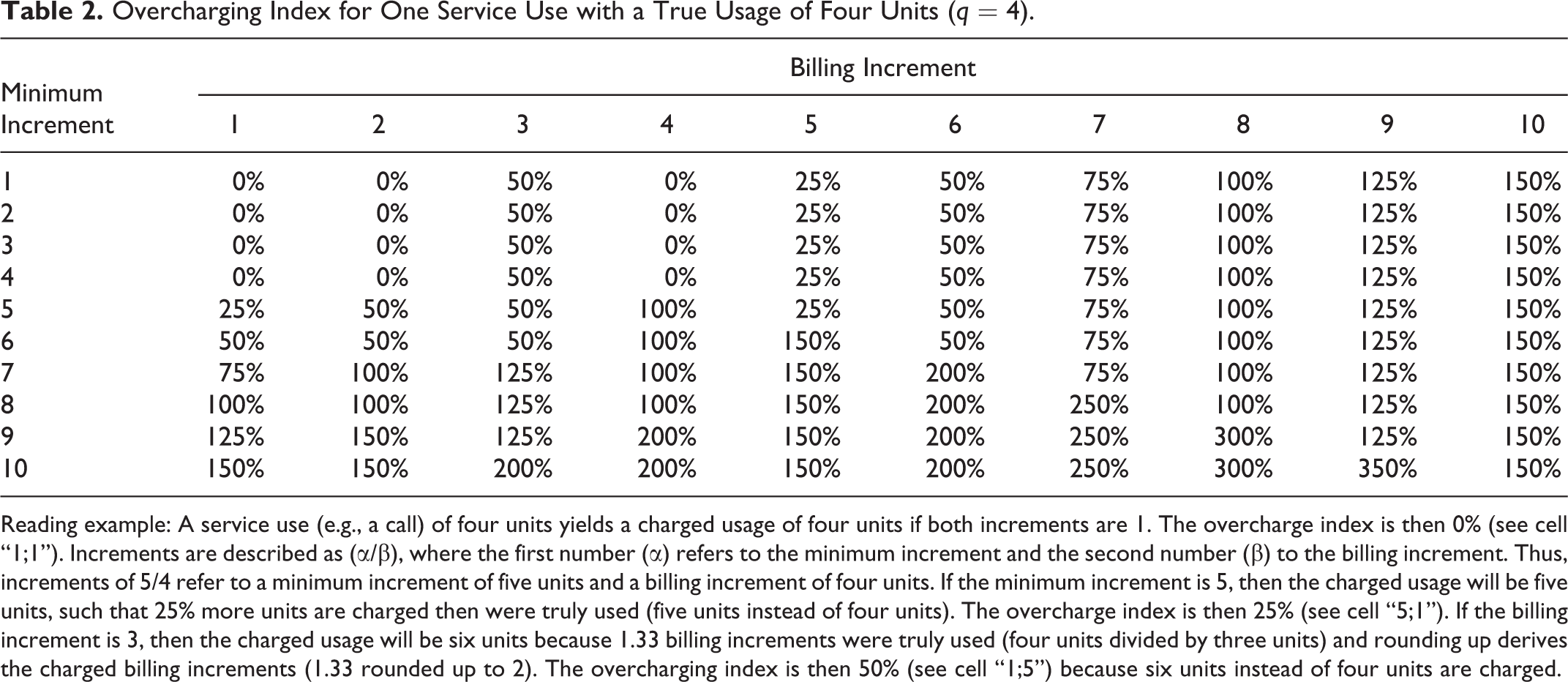
Reading example: A service use (e.g., a call) of four units yields a charged usage of four units if both increments are 1. The overcharge index is then 0% (see cell “1;1”). Increments are described as (α/β), where the first number (α) refers to the minimum increment and the second number (β) to the billing increment. Thus, increments of 5/4 refer to a minimum increment of five units and a billing increment of four units. If the minimum increment is 5, then the charged usage will be five units, such that 25% more units are charged then were truly used (five units instead of four units). The overcharge index is then 25% (see cell “5;1”). If the billing increment is 3, then the charged usage will be six units because 1.33 billing increments were truly used (four units divided by three units) and rounding up derives the charged billing increments (1.33 rounded up to 2). The overcharging index is then 50% (see cell “1;5”) because six units instead of four units are charged.
Increasing the minimum increment up to four units has no impact on the overcharging index, but any other increase beyond four units does. These increases are particularly sharp for all combinations of increments in which the minimum increment is just one unit higher than the billing increment. For example, offering 5/4 increments yields an overcharging index of 100%, and offering 6/5 instead of 5/5 increases it from 25% to 150%. Increases in minimum increments never lead to situations with a lower charged usage, but they do not always increase it.
Table 2 also demonstrates the unintuitive finding that an increase in the billing increment can lower the overcharging index and consequently charged usage. For example, offering 4/4 instead of 4/3 increments or 5/5 instead of 5/4 increments substantially lowers the difference. Thus, increasing the billing increments frequently but not always yields higher charged usage and, thus, higher billing rates. For some constellations, the charged usage even decreases with larger billing increments.
Impact of Minimum and Billing Increments on Usage
Theory about consumer behavior is concerned with how customers make consumption decisions, that is, how customers adapt their usage to changing prices in tariffs. In particular, a higher price yields less usage—in a telecommunication setting, that means customers make fewer and shorter calls (Danaher 2002; Iyengar, Jedidi, and Kohli 2008; Lambrecht, Seim, and Skiera 2007; Narayanan, Chintagunta, and Miravete 2007; Schlereth and Skiera 2012; Schlereth, Stepanchuk, and Skiera 2010; Train, McFadden, and Ben-Akiva 1987).
If no minimum or billing increments are used, then each additional second of true usage will lead to a higher charged usage and, thus, a higher billing rate. This instant increase in the charged usage for every second that is used no longer occurs under tariffs with minimum and billing increments. Equation 2 exemplifies this phenomenon by showing that the ceiling function prevents the situation in which not all units of the true usage always increase the charged usage.
For example, under a billing increment of 60 seconds, only the first second is charged; that is, the first second instantly yields a charged usage of 60 seconds. The next 59 seconds are not charged. A similar logic holds for a minimum increment and the usage of the 61st second and the next 59 seconds.
Thus, customers under tariffs with longer increments often face situations (in our example, a call duration between 1 and 59 seconds) in which an increase in usage will not be charged. Compared with customers under tariffs with no (or shorter) increments, long-increment customers have less incentive to shorten a call than short-increment customers. Thus, if customers understand the economics behind increments, then we should expect that the calls of long-increment customers are longer than those of short-increment customers.
Impact of Minimum and Billing Increments on Tariff Choice
Customers aim to select the tariff that leads to the highest utility, usually measured by consumer surplus (Lambrecht, Seim, and Skiera 2007). Thus, all else equal, customers are better off when choosing tariffs with shorter increments because the charged usage, and thus the billing rate, is lower than for longer increments, and it better matches the value they receive.
Usually, tariffs with shorter increments contain higher prices—for example, a higher fixed fee. Thus, customers must trade-off between (1) the savings that result from a smaller difference between charged and true usage and (2) a higher fixed fee. Heavy-use customers with a high number of calls are likely to have a higher difference between charged and true usage, such that tariffs with shorter increments should be more attractive to them. In contrast, the difference between charged and true usage is likely to be small for customers with a low number of calls, such that these customers benefit less from shorter increments.
It is, however, well known that customers make errors in selecting their tariff and that those errors are often not random but systematic. For example, customers suffer from a flat rate bias (e.g., Goettler and Clay 2011; Lambrecht and Skiera 2006; Miravete 2003; Mitchell and Vogelsang 1991; Moser et al. 2018; Narayanan, Chintagunta, and Miravete 2007; Nunes 2000). Customers with a flat rate bias tend to choose a tariff with a rather high fixed fee and a low marginal price, although their usage behavior is too low to justify that choice (Lambrecht and Skiera 2006).
Thus, flat rates provide value that goes beyond just minimizing the monthly billing rate. They offer the joy and independence of using a flat rate (taxi meter effect) or the reliability of the billing rate (insurance effect; Lambrecht and Skiera 2006). Independent of the interpretation, Lambrecht and Skiera (2006) observe systematic and large errors, especially that customers tend to pick a larger tariff than needed. The authors interpret this tendency as a strong preference for these specific tariffs.
Another source of tariff choice error is due to the complexity of tariff structures. The research stream on choice confusion is linked to the bounded rationality theory (Friesen and Earl 2015; Simon 1984), and a number of studies show strong instances of information overload (Haucap, Heimeshoff, and Lange 2016; Scheibehenne, Greifeneder, and Todd 2010). Thus, if consumers must choose between many tariffs with many attributes (e.g., price for the subsidized hardware, usage prices per minute, fixed fee, as well as minimum and billing increments), then they will be more likely to suffer. This greater suffering yields less effective decisions (Lee and Lee 2004).
Providers may purposely set the order of the presented price information such that customers may be disadvantaged from choice confusion; for example, they may employ an availability heuristic, also known as “familiarity bias” (Ofir et al. 2008). Hereby, people tend to put more weight on information that is most readily available because information that is more easily recalled will have a stronger effect on the purchase decision.
Providers may also benefit from customers’ limited understanding of basic mathematical concepts when analyzing the impact of tariffs on their billing rate. In a different context, namely, evaluating retirement investment or health insurance options (e.g., Lusardi and Mitchell 2007; Martin and Hill 2015), the research stream on financial literacy addresses the problem that many households lack certain numeracy skills and, as a consequence, often pick the wrong plan. According to Lusardi and Mitchell (2007), the population subgroups with low income and low education were the most financially illiterate and were most vulnerable to economic hardship.
As in the case of a flat rate bias, systematic and large errors in choosing among tariffs that differ in their minimum and billing increments would indicate that customers have a strong preference for particular increments (e.g., longer increments but lower fixed fees). Unsystematic and large errors, in contrast, would indicate that customers simply make errors in selecting the best increments due to their limited understanding of basic mathematical concepts when analyzing the impact of tariffs on their billing rates. Thus, unsystematic and large errors mean that customers are unlikely to react strongly to differences in increments.
Empirical Studies
The best approach to measure customers’ reactions to various increments is to observe the same customer’s behavior under different increments, ideally in an experimental setting. Such data, however, are difficult to obtain. Instead, we pursue several other approaches that use insights from tariff offerings across a large number of providers in the market (Study 1), transactional data (Study 2), and survey data (Study 3). All three studies focus on telecommunication services, an industry that has a long history of using increments for its services.
The market data in Study 1 enable us to examine whether providers have taken advantage of the gain in flexibility from minimum and billing increments. With the transactional data, we exploit the fact that consumers had the choice to upgrade to shorter increments for a higher (monthly) fixed fee. Therefore, we can quantify the monetary impact of tariff choice errors on the consumer as well as on the provider’s profitability of the service. Finally, with the survey data, we dig deeper into the potential causes of tariff choice errors and identify those respondents who are most prone to such errors.
Study 1: Analysis of Development of Distribution of Minimum and Billing Increments in Tariffs
Aim
In Study 1, we examine indicators that service providers systematically try to take advantage of minimum and billing increments. In the context of a highly competitive market in which price per usage was significantly dropping due to higher competition, we look at the share of providers who switched to larger increments.
Data and Setup
We analyze the development of the distribution of minimum and billing increments in the German telecommunication industry from 2008 to 2014, before flat rates became the dominant type of pricing plan. We examine 1,329 voice tariffs (excluding flat rates and roaming tariffs) and 733 data tariffs with restricted full-speed data transfer volume between 2008 and 2014. These tariffs constitute nearly the whole market in voice and data services. We collected all increments over the years (summarized in Figure 2). On average, we observed 58 voice service providers and 66 data service providers per year.
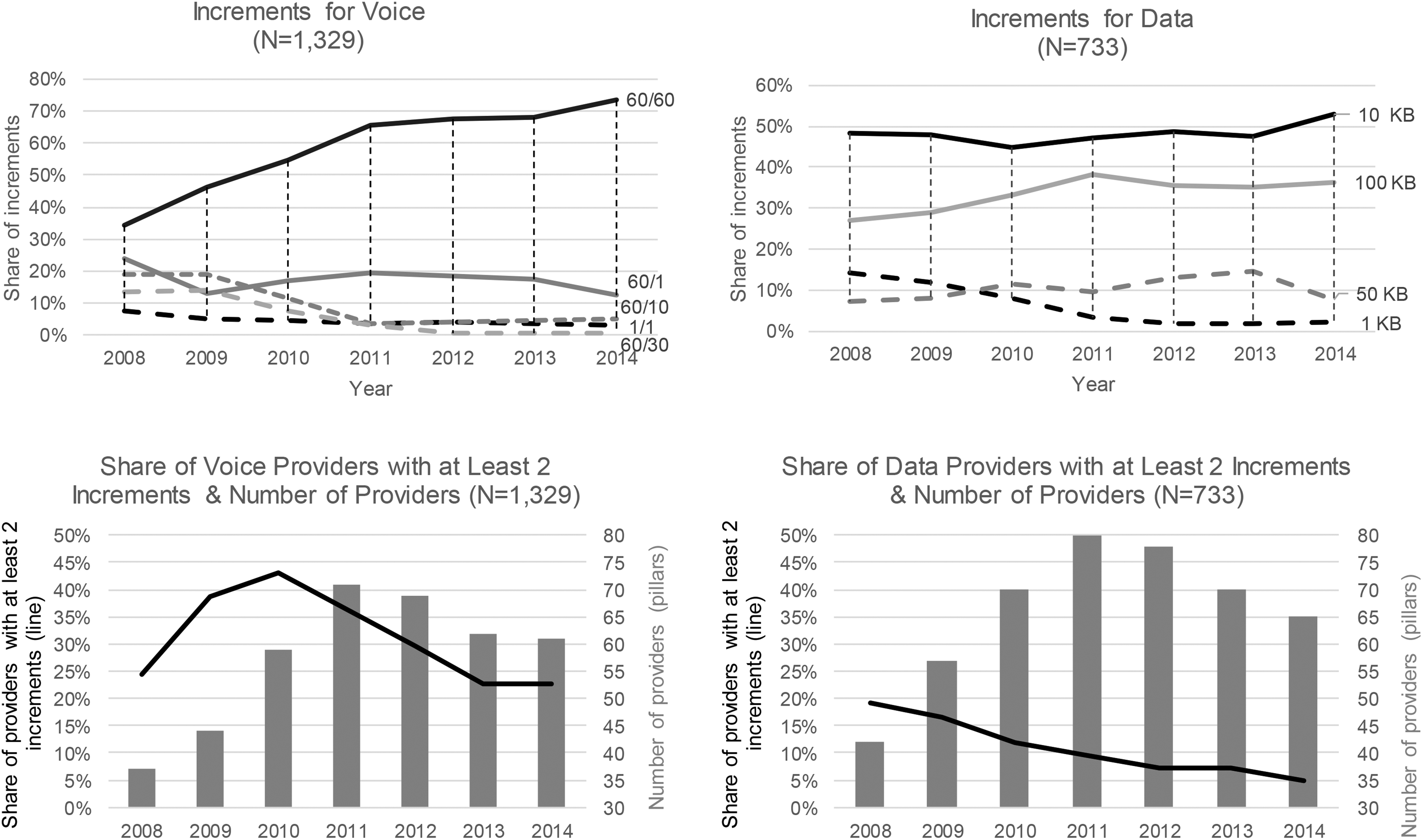
Study 1: Minimum and billing increments for voice and data services.
Results
Figure 2 shows that only a few tariffs offer the lowest possible increment (1/1 for voice and 1 KB for data 2 ) and that longer increments are most common. Particularly for voice services, the long increment 60/60 is the most widely used: From 2008 to 2014, its share rose from 34% to 74%. The penetration of the lowest possible increments, namely, the 1/1 increments, never exceeded 8% of the market. For data services, while the share of providers using the lowest possible increment of 1 KB fell from 14% to 2% over the observed time period, use of 10 KB increments increased (+5 percentage points from 48% to 53%), and use of 100 KB increments increased by an even higher margin (+9 percentage points from 27% to 36%).
The lower half of Figure 2 shows that between 22% and 44% of all voice service providers use at least two types of increments in their tariffs. The share of providers with at least two types of increments peaked in 2010, 1 year before the market reached its apex, with respect to the number of providers operating on the market. In contrast, despite the fact that many providers were operating in both markets simultaneously, the tariff landscape for data services shows a different pattern: the U-shaped pattern, with respect to the number of providers operating on the market, was about the same as for voice services, but the share of providers with more than one type of increment decreased consistently throughout the time frame. This observation indicates that minimum and billing increments worked better as a price differentiation technique for voice than for data services.
Summary of Results
The results support the notion that telecommunication providers took advantage of flexibility in using minimum and billing increments because we observed a trend toward a more intensive usage of longer increments. Consequently, in Study 2, we focus on customers’ decision-making.
Study 2: Analysis of Transactional Data
Aim
Study 2 analyzes transactional data to examine how minimum and billing increments impact (1) customers’ usage, (2) customers’ choice of tariff, (3) customers’ billing rate, and (4) the profitability of such increments for service providers. First, we examine whether customers’ calling behavior differs across tariffs with different minimum and billing increments. As outlined previously, longer increments should yield longer calls. No differences in the usage between tariffs with different increments would provide support for the conclusion that customers do not react to different increments (although we cannot rule out that customers systematically differ across the three analyzed tariffs).
Second, we examine tariff choice errors for those customers who had the opportunity to switch to a tariff with different increments. Systematic and large errors, as in the case of a flat rate bias, would indicate that customers have a strong preference for tariffs with specific increments (e.g., longer increments but lower fixed fees). Unsystematic and large errors, in contrast, would indicate that customers simply make errors in selecting the best increments. One reason for making such an error could be a lack of understanding of what minimum and billing increments mean. Third, we monetize the relevance of tariff choice errors for customers and providers. Thereby, our analysis benefits from the ability of the customers in our study to select between different increments that came with different fixed fees.
Data
The transactional data consist of 298 customers of a large German cellular phone service provider with market shares exceeding 10%. The data set covers 702 billing rates and 37,867 calls. For each call, the data contain its exact duration, the increments, the price per minute, and the cost per call. Regarding the billing rates, 41.6% use 10/10 increments, 34.5% employ 60/10 increments, and 23.9% charge at 60/1 increments. Customers with 60/10 increments could switch to 10/10 increment for €3 per month. Customers in the sample made 53.9 calls per month on average, with an average call duration of 118.9 seconds (standard deviation: 259.1 seconds), and 57.1% of all calls were shorter than 60 seconds. The overcharging index is, on average across customers, 5.05% for 10/10 increments and 43.79% for 60/10 increments. The mean billing rate is €40.94, of which €11.79 is allotted to the fixed fee, €25.89 to the calling costs, and €3.26 to non-voice-related services.
Results on Interdependence between Increments and Usage
When comparing the distribution of call durations under different billing increments, we find that call durations for shorter increments (here, 10/10) are, on average, slightly shorter (116.65 seconds, standard deviation = 227.30) but not significantly different from longer increments (60/10; 121.34 seconds, standard deviation = 288.49).
We use a gamma regression with the duration of a call as the dependent variable and control for type of increments, price per minute, a dummy for landline call (vs. to a more expensive mobile phone network), and a dummy for prime time as independent variables. We chose a gamma regression because it is particularly useful for continuous, positive, and right-skewed data (Faraway 2005), which is the case for duration data. We assume that our dependent variable “duration of a call” has a gamma distribution with shape parameter s, which is constant, and a scale parameter 1/r. For the estimation of the model, we used the inverse link function
We applied gamma regression to all calls and the subset of calls within the duration interval [10; 60], where we would expect the largest differences for longer (60/10) and shorter (10/10) increments (see Table 3). We find that increments have no significant effect on the call duration, which indicates that customers with longer (60/10) increments do not adjust their calling behavior compared with customers with shorter (10/10) increments (p > .1).
Study 2: Results of Gamma Regression with Determinants on Duration of a Call.
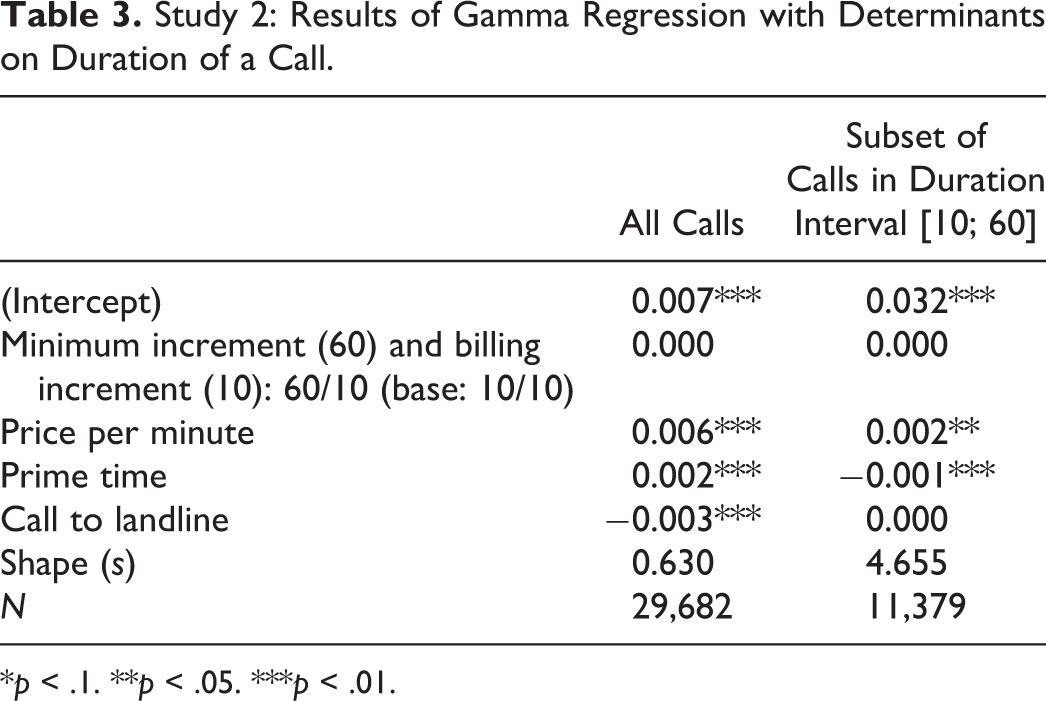
*p < .1. **p < .05. ***p < .01.
Results on Tariff Choice Errors
We use three criteria to distinguish errors in the choice of tariff: percentage of (1) billing rates that would have been lower in the considered period under a different increment (taking into account a possible additional fixed fee; “wrong in period”), (2) customers who do not minimize their billing rate in any period (“always wrong”), and (3) customers who do not minimize their billing rate in sum over all billing periods analyzed (“overall wrong”). In Table 4, we summarize these results. The diagonal represents customers who have chosen a tariff with increments that minimize their billing rate. Customers in the lower left-hand corner have chosen a tariff with increments that are too long, and those in the upper right-hand corner have chosen a tariff with increments that are too short.
Study 2: Analysis of Tariff Choice Errors.
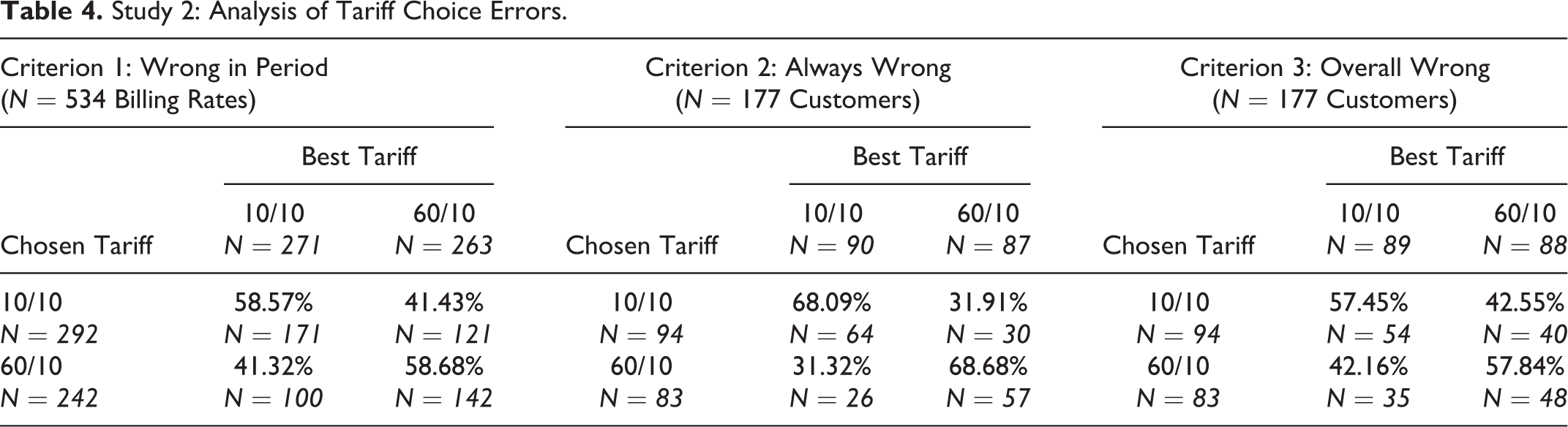
According to Criterion 1 (“wrong in period”), among the 292 billing rates that feature shorter (10/10) increments, 121 (41.43%) exhibit a tariff choice error. Among the 242 billing rates with longer (60/10) increments, 100 (41.32%) suffer from a tariff choice error. Their billing rate would decrease if they switched to shorter (10/10) increments.
The share of customers who make tariff choice errors decreases under Criterion 2 (“always wrong”), though they remain rather high. According to Criterion 2, among the 94 customers who used shorter (10/10) increments, 30 (31.91%) made a tariff choice error each period. According to Criterion 3 (“overall wrong”), among the 83 customers with longer (60/10) increments, 35 (42.16%) suffer from a poor tariff choice.
The results indicate that the tariff choice errors are large (as a random choice would yield an error of 50%) and occur regularly and persistently. If a systematic error in choosing among tariffs with different minimum and billing increments occurred, then it would indicate that customers have a strong preference for particular increments. Instead, for all three criteria, the fraction of billing rates with overly long increments is almost identical to the fraction of billing rates with overly short increments. We thus conclude that a rather high share of customers makes errors, but customers are almost equally likely to suffer from increments that are too long and too short. This finding indicates that they do not fully evaluate the consequences of these increments and their choices.
Results on Monetary Relevance for Customers
The average tariff choice error with increments that are too long is approximately €3.54 (standard deviation = €4.76), which is significantly higher (p < .01) than the average tariff choice error that involves increments that are too short (mean = €1.39; standard deviation = €.83). Customers who made an error could save approximately 5.06% of their overall billing rate if they changed the increments of their tariff.
Results on Relevance of Minimum and Billing Increments for Service Providers
To further examine the relevance of increments, we determined their contribution to providers’ profit by calculating average monthly savings that customers would achieve if, all else being equal, providers offered 1/1 increments instead of their current increments. We recognize that providers were likely to adjust prices in such a setting. Nevertheless, this assessment still provides information about the importance of increments. We include the four most important providers (as identified by Merrill Lynch’s Global Wireless Matrix report) in two countries, Germany and the United States, respectively, the largest cellular phone markets in Europe and North America.
Figure 3 outlines the setup of our analysis. For each provider, using the respectively offered billing increment, we determine the relative savings for customers if they used very short (1/1) increments but everything else (e.g., fixed fee, price per unit) remained constant. For each customer, we used the transactional data to simulate the related billing rates under 1/1, 60/10, and 60/60 increments and obtained averages of €37.64, €43.86, and €46.56. Consequently, the average percentage savings are 19.16%
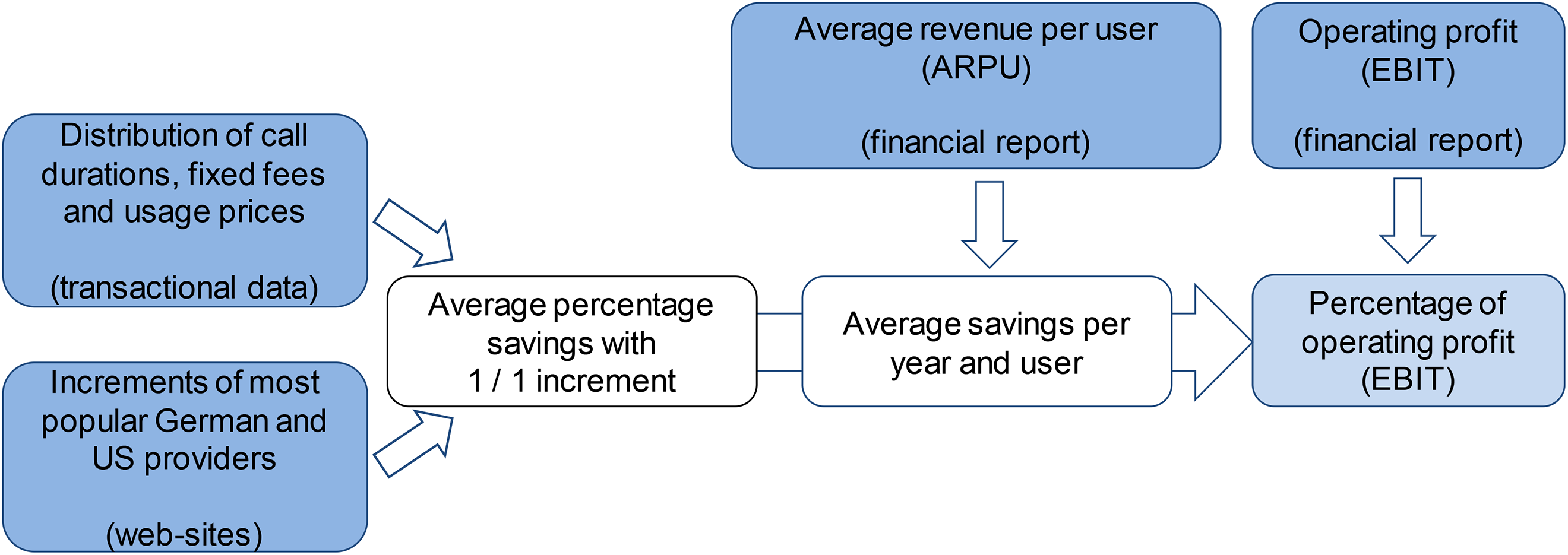
Study 2: Setup of analysis to test for relevance of minimum and billing increments for providers.
To calculate the average savings per customer and year for each provider, we multiply these numbers by the average revenue per customer, which we obtained from the financial report of the respective provider. In some cases, we derived this value by dividing revenues by the number of customers. Multiplying this number by the number of customers of each provider, listed in the annual report, indicates the total savings. Finally, we directly relate the yearly savings to the operating profit (earnings before interest and taxes [EBIT]). Thereby, we assume the costs of generating revenues through longer increments are zero for the provider.
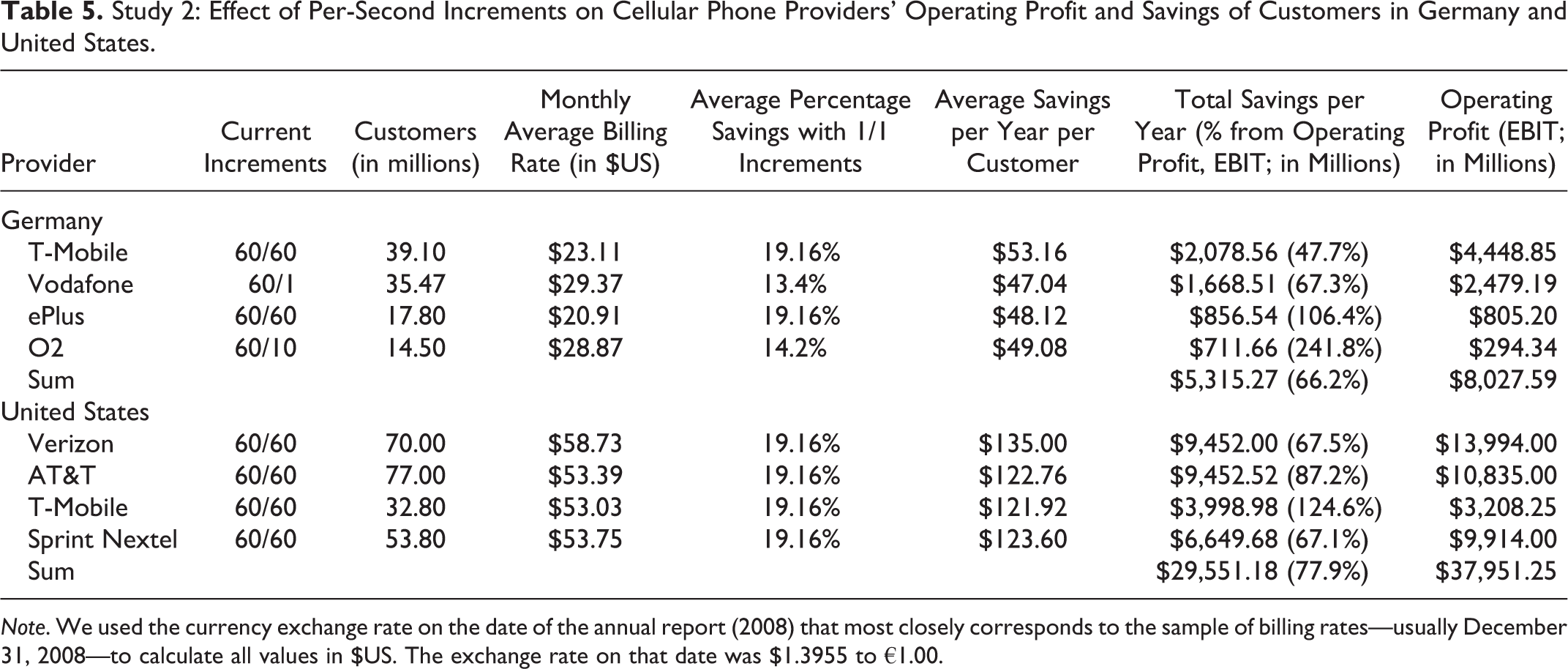
The results for Germany appear in the upper part of Table 5. For example, T-Mobile, the largest provider in the German market, mostly uses longer (60/60) increments to charge its 39.10 million customers with a monthly average billing rate of $23.11. Each customer would save 19.2% on average per month if T-Mobile offered 1/1 increments. The total savings per provider and year fall in the range of $711 million–$2,078 million. When we compare these values to the operating profit (EBIT) in the companies’ annual reports, we find that for ePlus and O2, the savings would be greater than their operating profit. The results in Table 5 also reveal that the combined savings ($5,315 million) correspond to almost two thirds (66.2%) of the operating profits of all providers.
Study 2: Effect of Per-Second Increments on Cellular Phone Providers’ Operating Profit and Savings of Customers in Germany and United States.
Note. We used the currency exchange rate on the date of the annual report (2008) that most closely corresponds to the sample of billing rates—usually December 31, 2008—to calculate all values in $US. The exchange rate on that date was $1.3955 to €1.00.
We also provide the results for the U.S. telecommunications industry in the lower part of Table 5. The combined savings for all U.S. customers amount to $29,551 million per year or 77.9% of the total operating profits of the providers.
Revenue-Neutral Price Increase Equivalents in the Fixed Fee due to Shorter Increments
If regulation (e.g., Regulation [EU] No. 531/2012 of June 13, 2012, for roaming calls) interferes with business practice and restricts the use of minimum and billing increments, then providers will increase prices of either the fixed fee or the per-unit usage price. To determine the size of these increases, we calculate the relative increase in fixed-fee and per-unit usage price for each customer to break even, if providers were forced to change from the most commonly offered long increments (i.e., 60/60) to the shortest possible (i.e., 1/1).
The increases in the fixed fee average €8.99 (which corresponds to 24.30%; median €5.85) with a rather high standard deviation of €10.02. For 26.12% of the billing rates in the sample, the companies could adopt fixed fees that are twice as high as their current ones.
Summary of Results
Our data show that customers’ call duration is similar even if increments differ, which indicates that customers are unlikely to adjust their calling behavior. In addition, customers make unsystematic errors in choosing the tariff with the right increments, which implies that they do not prefer longer or shorter increments. On average, they could save 5.06% of their overall billing rate by choosing the correct increments. These errors are also quite large, which indicates that customers do not understand the effects of different increments. We examine these consumer errors in the next study in further detail.
Study 3: Analysis of Survey Data
Aim
Study 3 analyzes the drivers that influence customers’ understanding of minimum and billing increments. Identifying these drivers can help providers target segments with specific increments.
Data and Setup
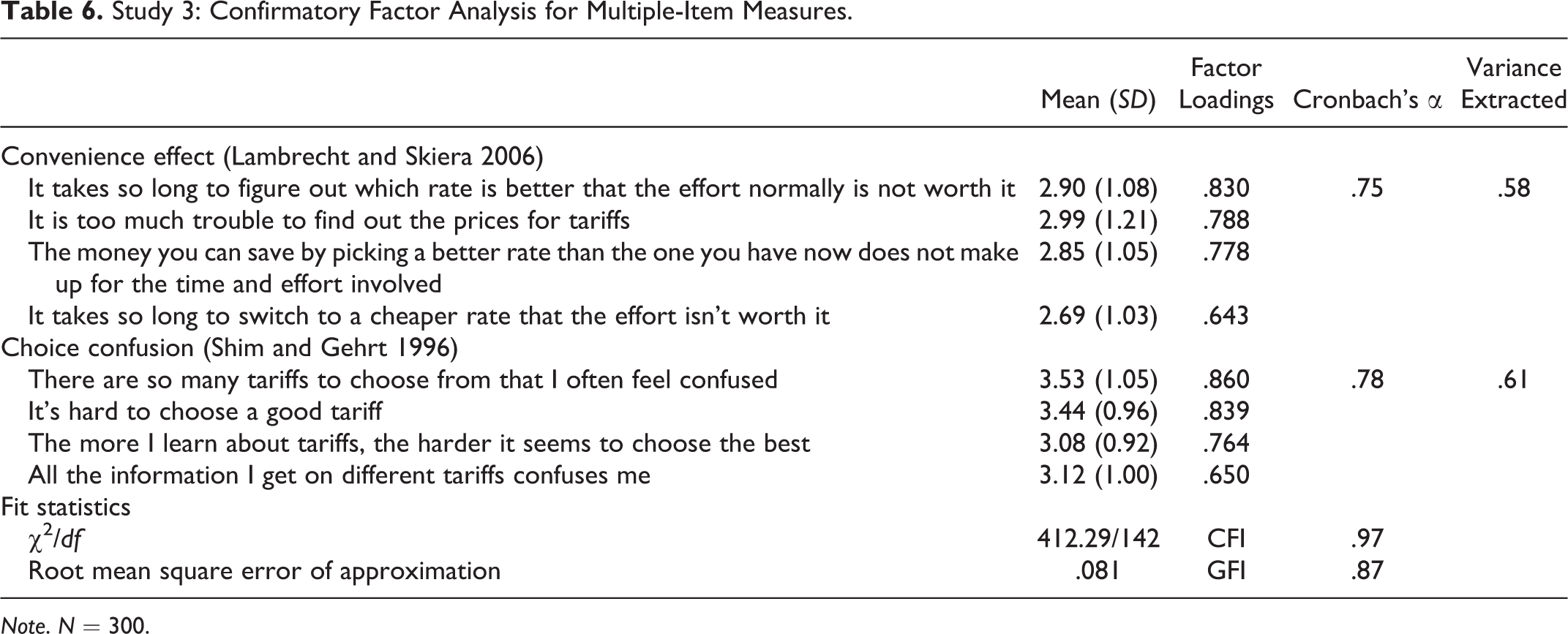
Using an online survey, we tested respondents’ ability to identify the least expensive tariff in two hypothetical tariff choice scenarios. Before the scenarios, we introduced respondents to the minimum and billing increments and carefully explained their meaning. 3 After respondents answered the questions about the two scenarios, we measured convenience and choice confusion using the scales proposed in the flat rate bias literature (Lambrecht and Skiera 2006; Shim and Gehrt 1996). In Table 6, we present the measurement items for the two constructs, convenience effect and choice confusion, and the results of a confirmatory factor analysis of the multiple items. All Cronbach’s α values exceeded the critical values of .75 (variance of extracted values > .5).
Study 3: Confirmatory Factor Analysis for Multiple-Item Measures.
Note. N = 300.
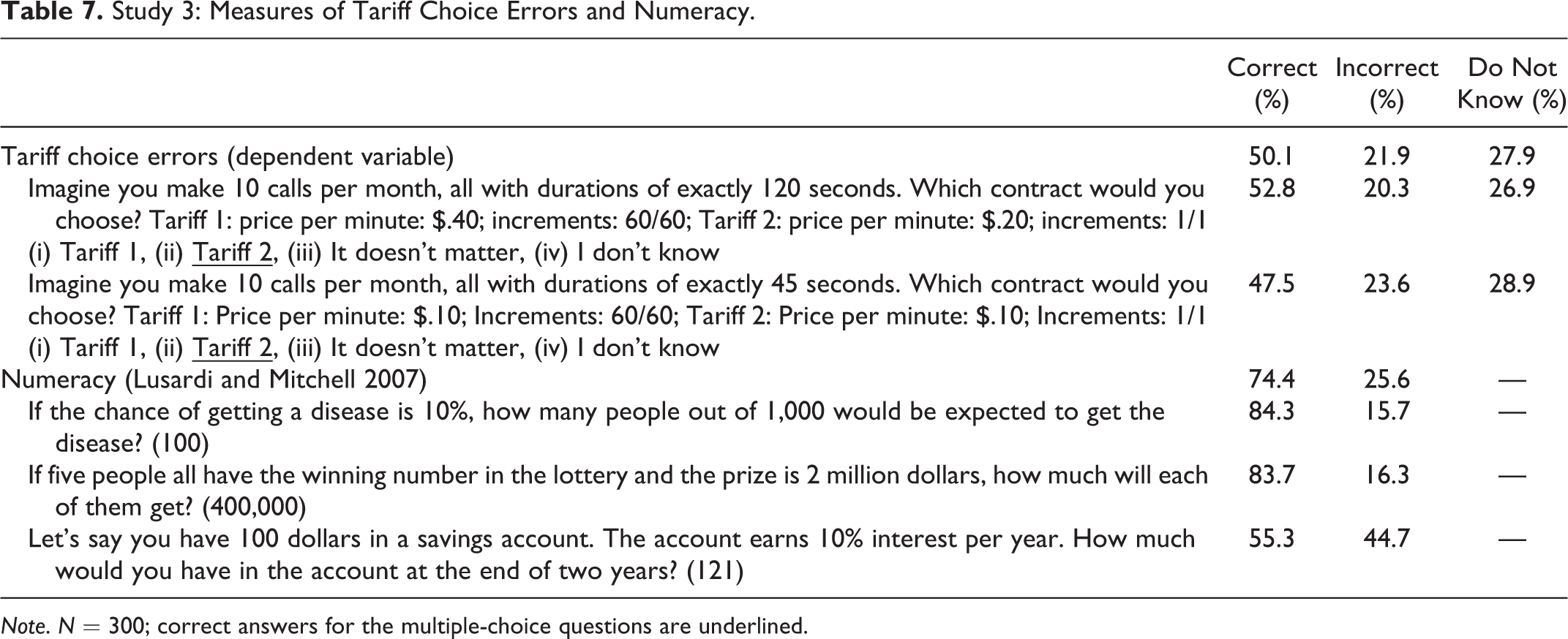
We employed three numeracy questions, as in Lusardi and Mitchell (2007), which are listed in Table 7. Then we asked respondents whether they knew the increments in their current contract plan and, if so, what the increments are. We concluded the questionnaire with demographic and socioeconomic questions.
Study 3: Measures of Tariff Choice Errors and Numeracy.
Note. N = 300; correct answers for the multiple-choice questions are underlined.
Results on Knowledge about Minimum and Billing Increments and Tariff Choice Error
The data consist of 300 respondents from a German panel provider. In total, 155 of our 300 respondents (51.7%) answered that they did not know the increments of their current tariff. This result indicates that respondents are not aware of, or at least do not care much about, increments and are likely to perceive them as irrelevant. In the two hypothetical tariff choice scenarios, 50.1% of the answers were correct (Table 7).
Potential Drivers of Tariff Choice Error
For minimum and billing increments, we identified three potential causes that might affect tariff choice errors: convenience effect, numeracy, and choice confusion. Subsequently, we summarize them and outline our expectations about the direction of the effect of each cause.
Convenience Effect
According to the convenience effect, which is frequently linked to the flat rate bias (e.g., Lambrecht and Skiera 2006), customers believe that choosing among tariffs is inconvenient and, therefore, not worth the effort of finding a cheaper tariff and calculating the respective expected billing rate. To minimize search costs, customers might choose the tariff that seems to be the standard (i.e., the default) option (Train 1991) or the tariff with the lowest price per minute. The error can result from the inconvenience of having to calculate the billing rate for different prices per minute and different minimum and billing increments. Past empirical findings are inconsistent. Kling and van der Ploeg (1990) observe a significant impact of the convenience effect on tariff choice error, though other studies show that it is not significant (Krämer and Wiewiorra 2012; Lambrecht and Skiera 2006). Despite these diverging results, we predict that if the convenience effect is sufficiently strong, a “convenient customers” segment will not place much emphasis on minimum and billing increments and, consequently, make more tariff choice errors.
Numeracy
Research on the failure to plan for retirement, lack of participation in the stock market, and poor borrowing behavior can all be linked to financial illiteracy (Lusardi and Mitchell 2007). Although Lusardi and Mitchell (2007) label the construct “financial literacy,” the relevant questions show that it actually assesses numeracy, so we adopt this term. As we show in the formal description, minimum and billing increments can have strong effects on costs per usage, and the respective monetary effects are rather difficult to process. We expect that customers with greater numeracy are more likely to choose the right tariffs.
Choice Confusion
If one accepts that customers suffer from bounded rationality, then it is easy to see why they do not always make the tariff choice that would reduce the consequent billing rate optimally: They typically face a large array of options that are often difficult to rank, as these plans require a good understanding of future usage patterns. Furthermore, the mobile phone market is a good example of a market in which providers intentionally try to confuse customers (Friesen and Earl 2015) by offering multiple combinations of usage prices per minute, fixed fees, increments, and other features, such as data resets, after the data volume threshold has been exceeded. The rather complicated tariff structures push customers to minimize search costs and to choose rather randomly a tariff, for example based upon the name they like most or a heuristic, such as the smallest usage price per minute. Consequently, we expect that higher choice confusion should result in more tariff choice errors.
Sociodemographic Characteristics
We also control for gender, age, and education because these variables are observable. They can help firms better target customers.
Results on Drivers of Tariff Choice Error
Large tariff choice errors are indicators of a poor understanding of the effects of increments. We therefore examine the influence of three potential drivers (convenience effect, choice confusion, and numeracy) together with sociodemographic characteristics. Table 7 summarizes the percentage of correct answers in the tariff choice error and numeracy tasks.
We ran ordinary least squares (OLS) regressions to test the influence of the three potential drivers of tariff choice errors: convenience effect, numeracy, and choice confusion. The variance inflation factors range between 1.08 and 2.18 (see Table 8) and indicate no multicollinearity problems within the independent variables. We also ran structural equation models and ordinal regression models (due to the ordered dependent variable), but their results were of the same substantive nature.
Study 3: Regression Results of Drivers of Tariff Choice Errors.
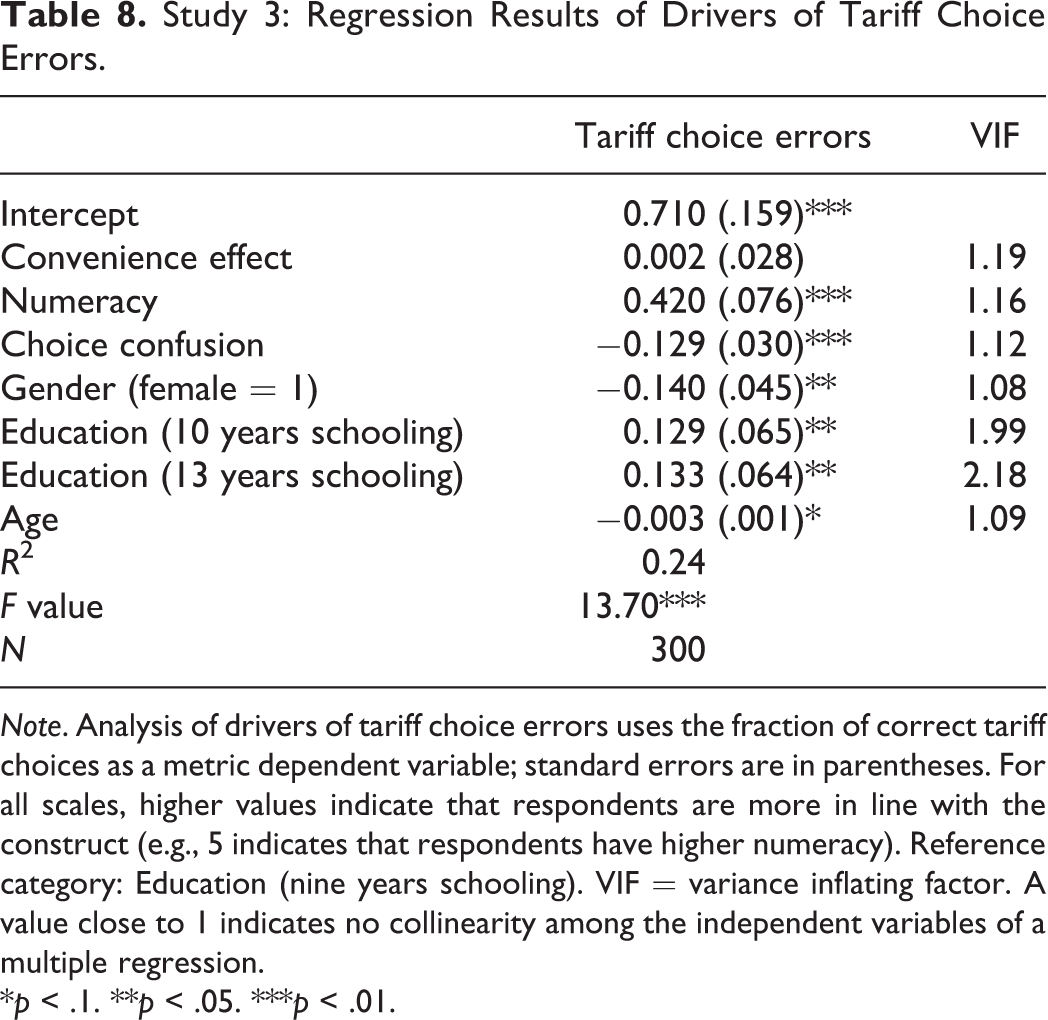
Note. Analysis of drivers of tariff choice errors uses the fraction of correct tariff choices as a metric dependent variable; standard errors are in parentheses. For all scales, higher values indicate that respondents are more in line with the construct (e.g., 5 indicates that respondents have higher numeracy). Reference category: Education (nine years schooling). VIF = variance inflating factor. A value close to 1 indicates no collinearity among the independent variables of a multiple regression.
*p < .1. **p < .05. ***p < .01.
According to Table 8, numeracy is the most important driver for tariff choice errors. Numeracy is strongly and positively associated with the fraction of correct tariff choices, and the results are statistically significant. That is, respondents who give wrong answers to the numeracy questions and therefore exhibit lower numeracy skills suffer from a weaker ability to choose the best tariff. As expected, choice confusion significantly increases tariff choice errors. The effect is negatively associated with the fraction of correct tariff choices. Those respondents who are confused by too many tariff options are more likely to make wrong tariff choices. The parameter of the convenience effect is not significant.
We also find that sociodemographic characteristics influence the results. That is, women and older people are more likely to make a mistake when choosing among different tariffs with minimum and billing increments. Higher education is positively associated with the fraction of correct tariff choices.
In Table 9, we examine links between sociodemographic characteristics and the three potential drivers using OLS. Higher education (i.e., 13 years of schooling) reduces the convenience effect and choice confusion. Education strongly correlates with numeracy—that is, respondents with higher education possess better numeracy skills.
Study 3: Analysis of Impact of Sociodemographic Characteristics on Constructs.
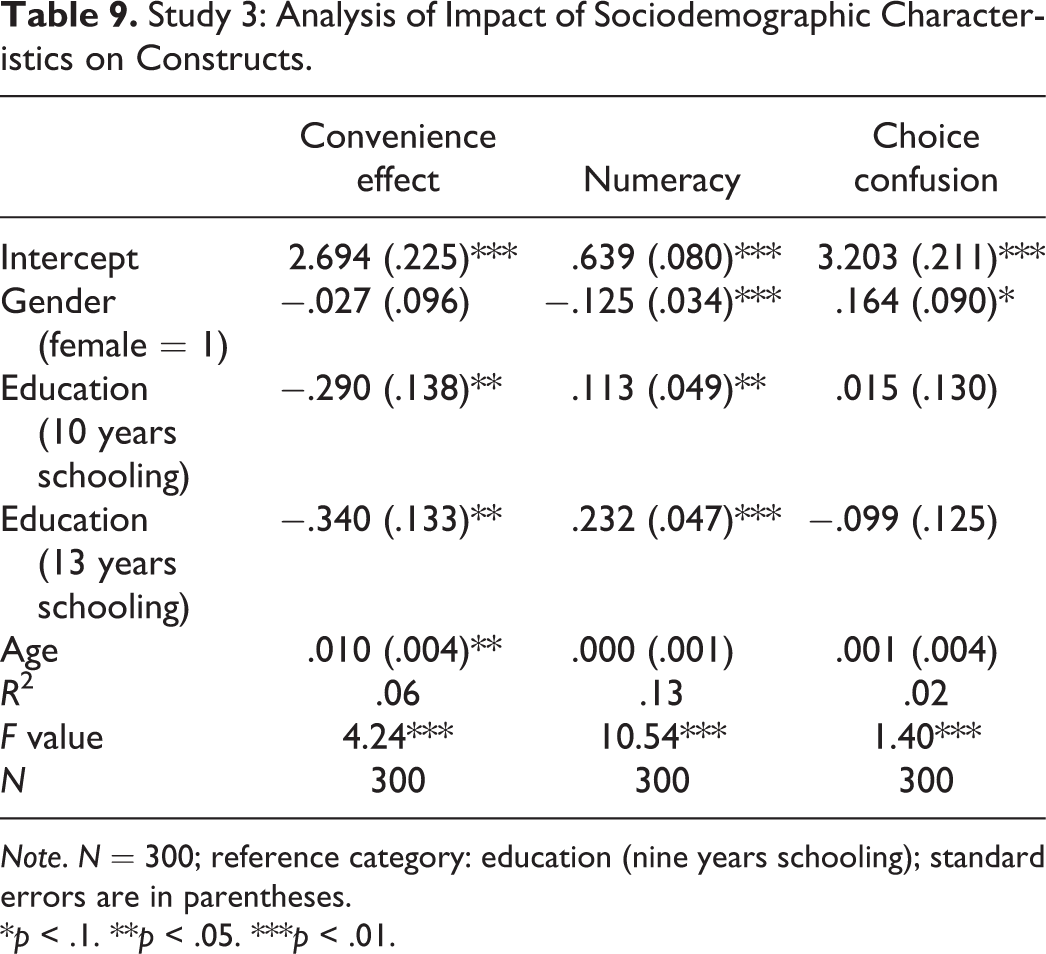
Note. N = 300; reference category: education (nine years schooling); standard errors are in parentheses.
*p < .1. **p < .05. ***p < .01.
Summary of Results
The results indicate that many respondents are either not aware of or do not pay much attention to the increments of their current tariffs. Numeracy is the most important driver for tariff choice errors. Respondents who exhibit lower numeracy skills suffer from a weaker ability to choose the best tariff with different increments. As in the transactional data setting, respondents made large errors in choosing the tariff with the right increments, which supports our assertion that customers are unlikely to react to different increments.
Summary, Implications for Service Pricing, and Suggestions for Further Research
Summary
Considering the rise of services in the Internet-of-things (IOT) and product-as-a-service business models, service pricing will become even more important. This article identifies the importance of the pricing metric and the minimum and billing increments in the service provider’s pricing decision, outlines how minimum and billing increments impact the usage that is charged and billing rates, and examines how well customers understand these increments. Figure 4 summarizes the key findings of our empirical analysis.
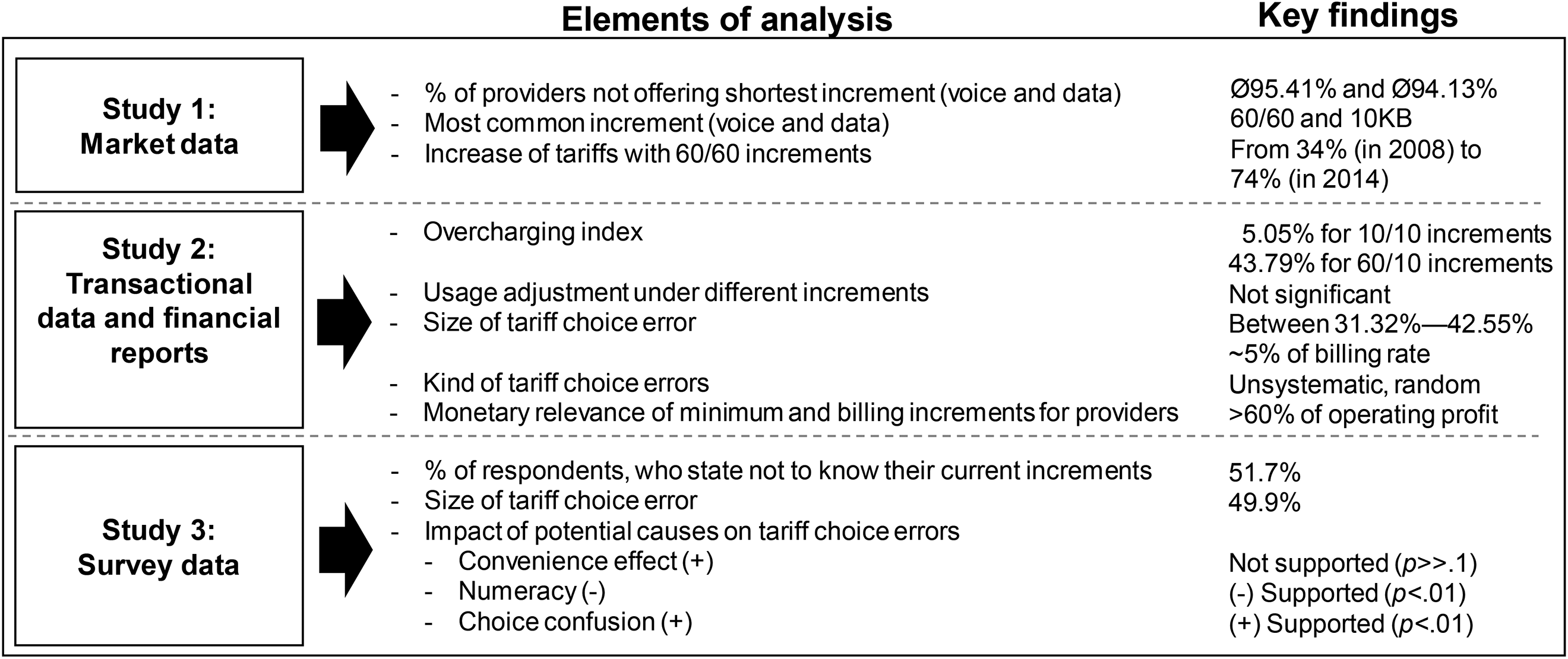
Elements of analysis and key findings.
Study 1 examines whether providers make use of the potential gains in flexibility due to the increments. An analysis of 1,329 voice tariffs and 733 data tariffs over 7 years in the telecommunication market documents that providers are increasingly using longer increments, indicating that providers are becoming increasingly aware of their advantages.
In Study 2, we observe that long (60/10) increments increase the charged usage by on average 43.79% compared with the true usage for customers using long increments. This finding means that customers pay a substantial portion of their bill for usage that has not been consumed. Generalizing the transactional data of one provider to other providers and using information from financial reports indicate that the increments contribute to more than 60% of the operating profit. Study 2 demonstrates that customers are unlikely to adjust their behavior to different increments, which serves as an indication that customers do not understand billing increments well.
Furthermore, tariff choice errors are large and occur in 31.32–42.55% of all cases, which we consider high given that a random choice would have led to a tariff choice error of 50%. In addition, this tariff choice error occurred unsystematically, meaning that customers were equally likely to wrongly choose increments that are too short or too long. This unsystematic error indicates that customers do not prefer either long or short increments, further supporting the notion that they probably do not understand billing increments.
Study 3 supports the findings of Study 2, showing that many customers do not know their billing increments and make large tariff choice errors. The most important driver for tariff choice errors is numeracy, which strongly correlates with education. As a result, less educated customers suffer the most from those errors.
Overall, this article outlines that service providers and customers should carefully consider minimum and billing increments. Service providers benefit because increments offer them more flexibility in their pricing, yielding higher revenues as charged usage is typically higher than true usage. Customers’ current ignorance of increments yields to many tariff choice errors and behaviors that are not in line with the benefits that increments provide.
Implications for Service Pricing
This research contributes to service and pricing theory, methods, and practice. We outline the practical importance of minimum and billing increments for many exemplary industries that use this concept today. However, for many other services, it is still an untapped opportunity for profitable growth. We consider increments a powerful pricing instrument for providers to better charge users. With the transactional data, we demonstrate that for the studied telecommunication service, customers do not seem to react to different increments.
A combination of prominently communicated cheaper fixed fees or usage prices combined with larger increments could make a service more attractive to customers and lead to significantly higher profits for the provider. For example, in Study 2, we determined the revenue-neutral fixed fee equivalent with the increments changed to 1/1, which is, on average, 24.30% higher than the charged fixed fee.
One potential reason for the increments’ opportunity in increasing profitability, not explicitly tested in this research, is the familiarity bias and the use of availability heuristics (Ofir et al. 2008): People tend to put more weight on information that is most readily available. In our empirical setting, usage prices and fixed fees are communicated more prominently than information on the increments, which is often presented in small print. Consequently, these details are more difficult for consumers to recall from memory and thus have a weaker effect on the purchase decision.
Yet the results in Study 3 show that the availability bias alone cannot explain customers’ tendency to make unsystematic tariff choice errors. In this study, when the increments were prominently communicated to respondents in the tasks, the percentage of wrong tariff choices was about the same as in the transactional data. This finding means that potential customers still were not able to select the billing-minimizing tariff, even though the minimum and billing increments were prominently communicated.
In addition, our research underscores the difficulty of choosing the right pricing metric for services. For example, in the early days of Internet use, providers measured usage by the time that customers were connected to the Internet. Later, providers replaced that measurement unit with the transferred data volume. Digital service providers currently use a multitude of measurement units such as time, outgoing and ingoing volume, and number of customers.
Implications for Public Policy
Public policy makers may be concerned that providers are using minimum and billing increments to create an unfair market price for a service that increases their profits but harm customers. Any fairness argument eventually depends on customers’ understanding on how billing rates are derived but also on the business context, the measurability of usage, and the setup costs for providing the service (Schlereth, Skiera, and Schulz 2018). For example, attorneys’ history of billing in increments for their service can be justified by the substantial setup and disruption costs that occur even when working only a short time on a client’s project.
For digital services such as telecommunication services, cloud computing services, or services related to IOT, usage is measurable in seconds or small data units such as bytes. The provision of the service generates setup costs that are very close to zero, but the initial development cost of, for example, the software was extremely high. Consequently, the provider must cover the high development cost. Our analysis shows that longer minimum and billing increments allow for doing so but in a way that customers do not fully understand. Thus, policy makers need to find the right balance between providing freedom to the service providers (i.e., by allowing use of increments as an opportunity to differentiate their service offer and to cover high development cost) and the protection of consumers to avoid misleading prices. Ultimately, this trade-off partly depends on how the increments are communicated, that is, whether they are easily accessible or hidden in small print. To support this trade-off, this article provides detailed insights on the mechanism and relevance of minimum and billing increments.
Suggestions for Further Research
Given the importance of minimum and billing increments, we recognize several avenues for future research. First, previous models of subscription pricing have ignored minimum and billing increments, which raises the question about the best way to incorporate increments in those models. Second, most previous models of subscription pricing investigate only one measurement unit. It remains unclear how to implement changes in measurement units in those models (e.g., volume instead of time; cf. Lahiri, Dewan, and Freimer 2013). Third, we document customers’ poor understanding of these increments and show that less educated customers make more tariff choice errors than better educated customers. These results raise ethical concerns (see also Suri, Monroe, and Koc, 2013, in a different pricing context).
Future research might therefore examine the robustness of our results and elaborate on ethical concerns. It would also be worth examining whether requiring service providers to inform customers about the overcharging index in their billing rates that reflects how much larger the charged usage is than the true usage would help customers make better decisions (e.g., by reducing their tariff choice errors) and reduce ethical concerns. Investigating the boundary conditions under which customers will no longer accept minimum and billing increments could also be enriching. Finally, our empirical studies focus on the telecommunication industry. Future research should examine the external validity with respect to other industries. Important open research questions include the following: Under which circumstances are increments appropriate for consumers in other industries? How do these increments relate to price fairness, or in other words, when do policy makers need to protect customers?
Footnotes
Acknowledgments
The authors thank Mathias Doenitz, Beatrice Martin, and Thomas Schlenkhoff for their support and valuable suggestions.
Declaration of Conflicting Interests
The author(s) declared no potential conflicts of interest with respect to the research, authorship, and/or publication of this article.
Funding
The author(s) received no financial support for the research, authorship, and/or publication of this article.
