




Abstract
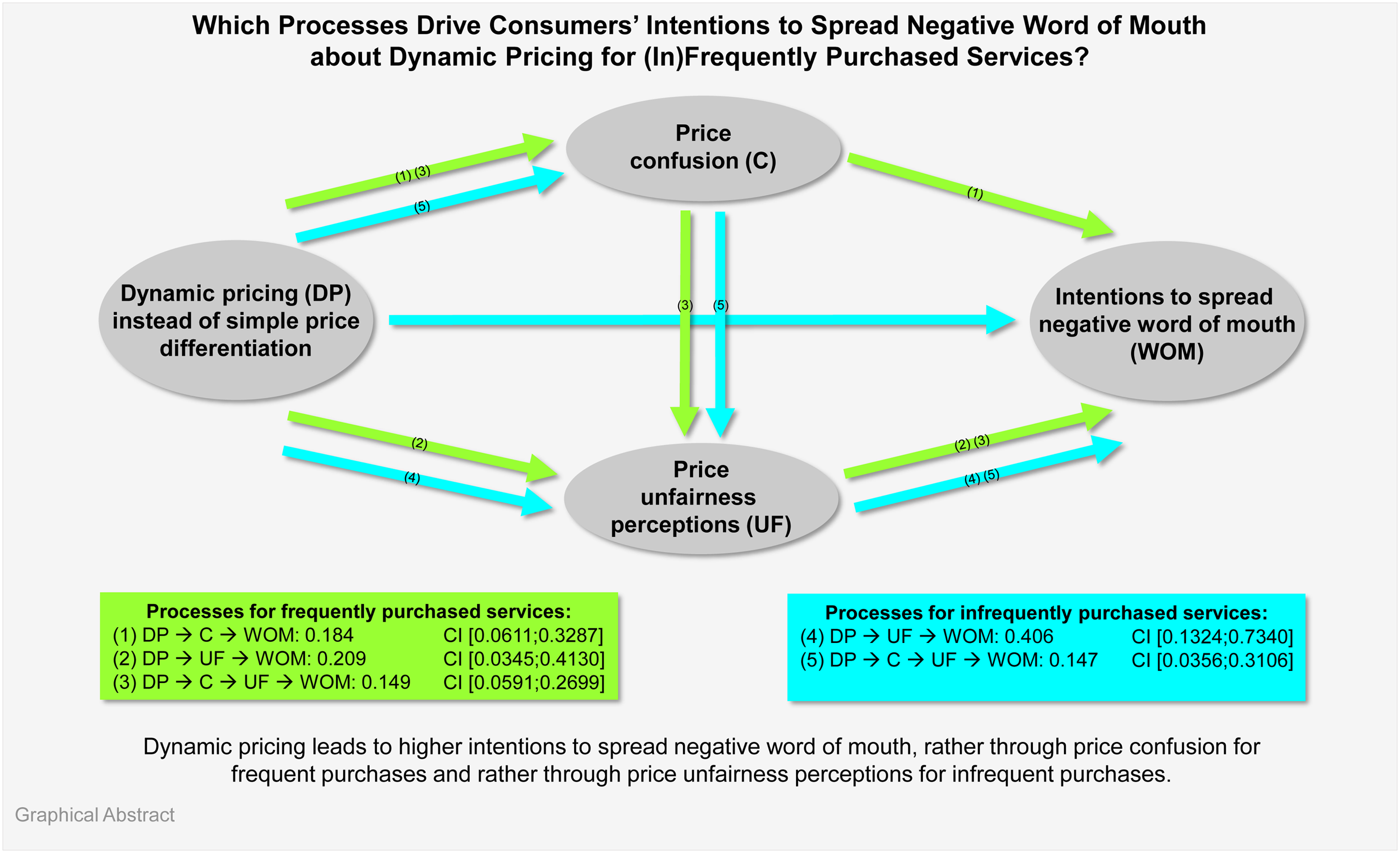
This paper examines the effects of dynamic pricing versus simple price differentiation for services through price confusion and price unfairness perceptions on price-disadvantaged consumers’ intentions to spread negative word of mouth (WOM); we additionally differentiate between these customers based on specific service purchase frequency. To test our hypotheses regarding price confusion as an important driver of undesirable consumer reactions to differential pricing for services and as a precedent of price unfairness perceptions, we conduct one qualitative study and three quantitative studies. The findings provide key theoretical insights indicating that 1) dynamic pricing leads to more price confusion than simple differential pricing and 2) price confusion triggers price unfairness perceptions that increase consumers’ intentions to spread negative WOM. For frequently purchased services, the pricing tactic’s effects on intentions to spread negative WOM are based mainly on price confusion; for infrequently purchased services, the intentions to spread negative WOM are based primarily on unfairness perceptions. The major managerial insight of our findings is that dynamic pricing should be avoided or limited when there is a high likelihood of reputation damage through negative WOM among price-disadvantaged customers.
Keywords
Introduction
Service customers face the phenomenon of increasingly complex price structures such as dynamic prices, which vary continuously based on algorithms. Continuous price variation leaves many customers in a price-disadvantaged position compared to others who pay lower prices. While price-advantaged customers are likely to react positively, particularly when a price difference is framed as a discount (Keller, Vogelsang, and Totzek 2022), the negative reactions of price-disadvantaged customers, such as negative word of mouth (WOM), are worth studying from a services marketing perspective (Nguyen and Simkin 2013). Although service price discrimination is not new, social networks now allow consumers to debate pricing mechanisms and learn from one another. Recently, fans of pop music artists flooded Twitter with outrage about dynamic pricing for ticket sales and created multiple viral firestorms (Sairam 2022). The users perceived dynamic pricing to be unfair (“There’s an EXTRA special place in hell for whoever decided dynamic pricing should be a thing”) and confusing (“… Did I see people get floor tickets for $250 and then others for $900? Yes. Do I believe my friends when they say pricing changed in front of their eyes? Yes. At the end of the day, (the online ticket shop) is the problem, did some shady stuff, and ripped off fans”).
The use of dynamic pricing can create problems and have serious consequences. First-degree price discrimination, which differs from second-degree (quantity-based) and third-degree price discrimination (customer segmentation; Caroll and Coates 1999), was previously only possible in monopoly situations but is now used in the form of dynamic pricing by sellers to set prices based on individual customers’ willingness to pay (Caroll and Coates 1999; Garbarino and Lee 2003). Service firms must be aware of the pitfalls of the increased use of dynamic pricing, as price-related consumer confusion, referred to henceforth as price confusion (including ambiguity, overload, and similarity confusion), and perceptions of higher price complexity lead to adverse consumer reactions such as lower purchase intentions (Bertrandie and Zielke 2019; Homburg, Totzek, and Krämer 2014; Xue, Jo, and Bonn 2020). Another problem is that price-disadvantaged customers likely perceive dynamic prices as unfair and engage in negative WOM or public complaints to exact revenge for their monetary and emotional losses (Hufnagel, Schwaiger, and Weritz 2022; Xia, Monroe, and Cox 2004) and to seek social support. Other consumers’ WOM is a credible and common information source that service customers consider during purchase decisions (Murray 1991). The recent online firestorms about dynamic pricing for different services clearly illustrate the multiplier effects of negative WOM, leading to brand reputation damage and customer boycotts. Despite such negative consequences, many service firms are shifting from simpler differential pricing to more complex algorithms that combine multiple criteria. For example, many ski resorts are moving away from seasonal passes and student discounts in favor of algorithms that include weather conditions, day of the week, and demand (Malasevska et al. 2020). Dynamic pricing’s spread to new service contexts and the ensuing firestorms underscore the need for service providers to better understand the negative consequences of this pricing tactic.
Although the literature has addressed some of the problems described above, there is a lack of research on the effects of dynamic pricing on WOM. Mitchell, Walsh, and Yamin (2005) mention WOM as a consequence of consumer confusion in their framework, but no study has examined the role of price confusion resulting from firm-driven price complexity in dynamic-pricing-related WOM, which represents an important research gap. Previous research on consumer confusion suggests that the extent of a consumer’s experience within a product category has a moderating role, with inexperienced customers being more susceptible to confusion (Foxman, Mueling, and Berger 1990; Mitchell, Walsh, and Yamin 2005), as learning from past experiences reduces complexity (Huffman and Kahn 1998). Moreover, previous research on pricing norm violations has demonstrated that lower product familiarity gained through product experience (Park and Lessig 1981) engenders higher unfairness perceptions and negatively impacts purchase intentions (Shehryar Omar and Hunt, 2005). Nevertheless, no study has examined the link between price confusion and price unfairness perceptions and possible moderator effects of purchase frequency.
Based on these research gaps, we expand the literature on the negative consequences of dynamic pricing by going beyond purchase intentions and willingness to pay and exploring a more devastating outcome, WOM, through two objectives: 1) Deepen the field’s knowledge of negative WOM related to dynamic pricing by analyzing real online comments on a review platform. 2) Empirically examine whether price-disadvantaged service customers faced with dynamic pricing (compared to simpler forms of price differentiation) develop price confusion and price unfairness perceptions, and determine how these perceptions trigger intentions to spread negative WOM. We additionally explore the role of purchase frequency and focus on price-disadvantaged customers’ reactions, as negative reactions signal a need for action from a marketing perspective.
Our studies make four important theoretical contributions. First, we extend the service (pricing) literature by applying Mitchell, Walsh, and Yamin’s (2005) consumer confusion framework, which looks at the consequences (e.g., WOM) of broader consumer confusion resulting from different types of information, to the new context of service price differentiation, and subsequently develop a theoretical basis for our studies. From this framework on consumer confusion, we derive the more specific concept of price confusion and demonstrate its role in the context of effects of the pricing tactic on WOM intentions—two important variables, which have been overlooked in service pricing research. The second theoretical contribution is that, through our qualitative study, we provide a deep understanding of the structure and content of consumers’ negative WOM about dynamic pricing. The qualitative results indicate that this negative WOM often consists of several parts such as an explanation of the purchase behavior, answer-seeking (including price confusion) and venting behavior (including price unfairness perceptions), and warnings to other consumers. Interestingly, confusion is articulated in the earlier parts of the comments (and sometimes repeated later on), while unfairness perceptions are mentioned in the later parts. Building on these insights, the third contribution concerns integrating price unfairness perceptions into the framework of consumer confusion. The fourth contribution is to illustrate that the levels of purchase frequency influence the salience of the effects running through price confusion and unfairness perceptions on WOM. The derived new links between the variables under consideration are tested empirically in the context of the effects of dynamic pricing on intentions to spread negative WOM. With our mixed-methods approach, we offer rich insights from different angles in the area of interest.
The studies presented here also contribute to marketing practice. Through a valuable analysis of real online WOM, our qualitative study illustrates that commenters express price confusion and price unfairness perceptions that managers need to consider when implementing dynamic pricing and act on to minimize further negative WOM. The results of our quantitative studies remind service pricing managers who are often too enthusiastic about dynamic pricing that they should be aware of adverse consumer reactions to dynamic service pricing, such as stronger price confusion, perceptions of higher price unfairness, and stronger intentions to spread negative WOM. Service firms should consider the fact that their expected profits could be outweighed by reputational damage and customer attrition caused by negative WOM. Consequently, marketers may choose other pricing tactics or develop strategies to reduce consumer price confusion and retaliatory behavior, or improve price fairness perceptions linked to dynamic pricing.
Literature Review
Conceptualization of Dynamic Pricing in Previous Research
Companies use differential pricing to extract customer surplus. General criteria such as quantity, service benefits, or purchase timing, in line with second- and third-degree price discrimination (Caroll and Coates 1999), will change the prices equally for all customers based on their individual purchase decisions. Personalized pricing based on demographic information and geographic location criteria is more discriminatory as customers cannot influence these elements (e.g., Iyer et al. 2002). Individually tailored prices based on multiple criteria extract as much customer surplus as possible and increase profitability (Carroll and Coates 1999; Garbarino and Lee 2003). Brick-and-mortar service providers are often technically restricted to simpler forms of differential pricing. For example, hairdressers set different prices based on gender (Liston-Heyes and Neokleous 2000), and restaurants differentiate prices based on age and time of day (Susskind, Reynolds, and Tsuchiya 2004).
However, online pricing algorithms allow companies to combine more criteria (Kannan and Kopalle 2001). Examples are differentiated prices for plane tickets based on operating systems on Windows versus Mac (Krämer, Friesen, and Shelton 2018) or discrimination by travel retailers based on purchases made on mobile phones versus computers (Hannak et al. 2014). Theoretically, service providers can include any data into a dynamic pricing algorithm, including weather forecasting for outdoor activities such as skiing (Malasevska et al. 2020) and data collected from their competitors (Kannan and Kopalle 2001; Sahay 2007). At times, companies may not fully control the criteria they implement, yet the criteria may affect profitability (e.g., weather for skiing or golf). Applying dynamic pricing in the form of sinking prices in the case of bad weather might increase profitability but can also adversely affect customers who booked in advance at higher prices.
Our definition of dynamic pricing follows the conceptualization of Haws and Bearden (2006), according to which dynamic prices vary continuously based on multiple discriminatory pricing criteria combined in an algorithm. As dynamic price variations are automatic, permanent, and rapid, each customer can receive a different price based on a combination of many different criteria (e.g., purchase history, day and time of purchase, general supply and demand, and the device used to make the purchase). Compared to simple forms of differential pricing, dynamic pricing pushes the extraction of customer surplus to extremes by determining optimal prices based on exceedingly detailed market information and personal data from potential customers (Grewal et al. 2011). Consequently, dynamic pricing represents a much more complex pricing tactic than simple price differentiation that relies on one criterion or a combination of very few criteria.
Pricing Strategies That Overlap With Dynamic Pricing
Yield and revenue management overlap with our conceptualization of dynamic pricing because they are also based on algorithms that lead to price variation that is automatic, rapid (Meng et al. 2018; Zhao and Zheng 2000), and permanent. However, yield and revenue management algorithms use general pricing criteria based on inventory levels (Kimes 1994) and demand (seasonality, for example). Thus, we do not consider yield and revenue management completely synonymous with dynamic pricing, as the latter can also include personalized pricing criteria (e.g., demographic information, purchase history, or the device used for the purchase) and is usually based on a much higher number of criteria used in the algorithm. Nevertheless, given the similarities between these pricing strategies, we apply the research insights from yield and revenue management to dynamic pricing.
Moreover, surge pricing has gained popularity with the emergence of peer-to-peer business models such as Uber. From the company perspective, surge pricing differs from the above-presented definition of dynamic pricing as its primary purpose is to manage capacity (i.e., drivers available at a particular time) or even to disincentivize customers at times from taking an Uber, by making it more expensive during surge pricing. When prices increase during a surge, firms such as Uber or Lyft take the same fixed percentage from the sale, thus leaving the increase to the driver (Bikhchandani 2020). Nevertheless, even if a company does not directly benefit from the customer surplus, the customer still experiences fluctuating prices. To conclude, there are conceptual differences between dynamic pricing (as defined above), revenue management, and surge pricing from an insider’s perspective. However, consumers might not recognize the exact strategy behind the prices that they perceive to fluctuate often based on an opaque set of criteria. However, our paper does not aim to examine whether consumers can recognize a concrete pricing tactic. Instead, we are interested in examining consumer reactions to rapidly fluctuating prices (as compared to simple price differentiation). Therefore, possible overlaps and similarities between the pricing tactics are not problematic for our research.
Role of Price Confusion
We start from the notion that price confusion is closely related to price complexity (e.g., Xue, Jo, and Bonn 2020) as it results from complex pricing mechanisms companies use. Therefore, we first discuss the research on complexity, and then focus on price confusion that results from firm-driven price complexity. In psychology and marketing, complexity refers to the number of elements and the diversity in a stimulus pattern and increases with the number of distinct elements and heterogeneity of those elements (Berlyne 1960; Estelami 2003; Homburg, Totzek, and Krämer 2014). For prices of energy services, high volumes of pricing components, prices ending in odd numbers, and discounts presented in percentages rather than absolute numbers lead to higher price complexity perceptions, thereby influencing purchase intentions (Layer, Feurer, and Jochem 2017). Through high volumes and heterogeneity of pricing criteria, dynamic pricing creates price complexity that negatively affects perceived price transparency, which, in turn, impacts fairness perceptions and purchase intentions (Homburg, Totzek, and Krämer 2014). Higher price complexity also increases consumer confusion (Xue, Jo, and Bonn 2020).
Three types of price confusion can result from firm-driven price complexity. Ambiguity confusion occurs from consumers processing unclear, misleading, or incomplete product information (Walsh, Hennig-Thurau, and Mitchell 2007). In a dynamic service pricing context, ambiguity confusion is likely because the criteria used in a pricing algorithm are complex and unclear to consumers. Overload confusion results from the customer making purchase decisions based on an overwhelming number of elements (Walsh, Hennig-Thurau, and Mitchell 2007; Xue, Jo, and Bonn 2020) and can lead to lower repurchase intentions (Xue, Jo, and Bonn 2020). Overload confusion related to dynamic pricing can occur if consumers are aware of at least several criteria used in the pricing algorithm and try to consider them to obtain the best price when making their purchase decision. Similarity confusion can arise when consumers receive vastly different pricing structures for similar products (Xue, Jo, and Bonn 2020). In a dynamic pricing context, similarity confusion can occur when consumers realize that the service provider has generated a dynamic and completely different price for more or less the same service for them, than for another consumer.
Our paper extends the existing research on consumer confusion by deriving the concept of price confusion resulting from firm-driven price complexity, and examining it in the context of dynamic pricing, where it has not been considered hitherto. We argue that dynamic service pricing with an infinite number of possible combinations of criteria is more complex than differential pricing with one criterion or a combination of a few criteria, consequently leading to further price confusion. Moreover, we extend the literature by investigating the relationship between price confusion and price (un)fairness perceptions, and between price confusion and intentions to spread negative WOM.
Role of Price (Un)Fairness Perceptions
According to Bechwati, Sisodia, and Sheth (2009), consumers’ inability to understand prices regarding underlying costs to the company, product benefits, or causes of price fluctuations leads to higher price unfairness perceptions. Kimes and Wirtz (2002, 2003a, 2003b) tested simple price differentiation criteria and found that temporal or benefit-based criteria were often perceived to be rather fair, while servicescape-related criteria (table location in a restaurant) seemed unfair and were deemed unacceptable. Similar results were found for cinema tickets (Choi, Jeong, and Mattila 2015). Choi and Mattila (2004, 2005, 2006) examined consumers’ fairness perceptions depending on the extent of information provided on demand-based pricing and found that full disclosure of the relevant information often resulted in the highest levels of fairness perceptions, particularly for disadvantaged customers. Beldona and Namasivayam (2006) found that women perceive demand-based pricing as less fair than men, and Beldona and Kwansa (2008) added that fairness perceptions of demand-based pricing could depend on culture. In similar research, Heo and Lee (2011) found that customer-related aspects (e.g., income or education levels) can affect fairness perceptions of variable pricing. Wirtz and Kimes (2007) examined revenue management based on simple differentiation criteria, and demonstrated that consumers unfamiliar with revenue management reported comparatively low levels of fairness, particularly when faced with a surcharge, rather than with a discount. These studies of the simple price differentiation forms’ effects on price fairness perceptions demonstrate that the perceptions can differ depending on the type of criterion used, and that perceived price fairness is higher with higher transparency regarding the criteria used. These findings suggest that fairness perceptions related to dynamic pricing will be rather low as the criteria used for dynamic pricing are complex and opaque.
Social norms, the tacit rules consumers expect companies to follow (Kahneman, Knetsch, and Thaler 1986), also form fairness perceptions. Consumers will determine whether a pricing strategy aligns with social and common pricing norms. For example, cost-based pricing is intuitive and uniformly accepted (Bolton and Alba 2006), while differential pricing based on loyalty is considered unfair and discriminatory, and violates community norms (Maxwell and Garbarino 2010). Several studies have demonstrated that consumers expect prices for the same product and retailer to be equal across customers (Darke and Dahl 2003; Grewal, Hardesty, and Iyer 2004; Haws and Bearden 2006; Lee, Illia, and Lawson-Body 2011). Dynamic service pricing violates this norm as customers pay very different prices for (more or less) the same service depending on many criteria. However, research on the effects of continuously varying prices using a complex combination of criteria is limited. Grewal, Hardesty, and Iyer (2004) examined consumer reactions to fluctuating prices in the context of Internet-enabled buyer identification compared with that of purchase time discrimination, and found that fairness perceptions and purchase intentions are higher for differentiation based on purchase timing than for loyalty-based differentiation. According to the authors, these differences in perceived fairness are linked to customers perceiving temporal discrimination as a norm but not discrimination based on Internet-enabled buyer identification. Schmidt, Bornschein, and Maier (2020) analyzed consumer reactions to different browser cookie authorization levels and demonstrated that customer approval of browser cookies leads to higher self-attribution of price change than cookie refusal. Higher self-attribution leads to higher fairness perceptions, offer satisfaction, and purchase intentions. These studies indicate that dynamic pricing based on personally discriminating criteria leads to lower price fairness perceptions, trust, and purchase intentions, particularly for price-disadvantaged customers. However, the latter two studies do not compare extreme forms of price differentiation, such as dynamic pricing, to simpler forms of price differentiation; they only link fairness perceptions to consumer reactions, such as satisfaction or purchase intention that are limited to individual customers, while negative WOM has harmful multiplier effects. Subsequently, we investigate these relationships in a qualitative study and build on the qualitative results to form our final hypotheses.
Qualitative Study: Analysis of Consumer Comments on a Review Platform
Objective
With the qualitative study, we aim to develop a deep understanding of the mental states and perceptions expressed in real WOM after exposure to dynamic pricing. We applied content analysis to extract the most common states and perceptions.
Sample and Procedure
We collected online comments from the English-speaking forums of the review platform tripadvisor.com that broached the subject of dynamic prices. We conducted comprehensive searches for key terms such as dynamic pricing, fluctuating prices, and varying prices to pinpoint threads on dynamic pricing for services in the hospitality and entertainment industries. In the initial collection process, we reviewed comments posted from January 2010 to September 2021. During this first selection round, we collected all forum threads (n = 270) where an original poster expressed concerns about fluctuating prices.
The second selection round excluded all comments where a scenario involving dynamic pricing was not mentioned in the thread’s original post. For example, if the original poster was asking for hotel recommendations, and another forum user answered by recommending a hotel but warning the original poster about dynamic pricing, we chose to abandon the thread. Focusing on dynamic pricing within the original post ensured similarity and comparability between the analyzed posts and our qualitative and quantitative studies. We also discarded service categories with too small sample sizes, such as excursions (12 comments), parking lots (3 comments), or restaurants (2 comments), and original posts with a positive experience of dynamic pricing (3 comments). After the two selection rounds, 86 comments remained and could be categorized into three service categories: hotels (n = 48), shows including concerts and sports games (n = 21), and rental cars (n = 17).
It is impossible to say that we extracted all the comments that meet our requirements from the Tripadvisor forums. In qualitative research, there is no set volume at which a sample size can be considered reliable or representative. The main goal is to achieve information saturation, meaning no new information is gained by collecting additional data (Gummesson 2005). We believe that our sample size achieved saturation of information that can be extracted from tripadvisor.com. As we collected data from anonymous online threads, the demographic data were unavailable but contextual cues in the comments (such as locations of trip departure) indicated that most respondents resided in the US. As all comments were public, informed consent was not required, and as names and pseudonyms were excluded, the data were exempt from subject review and should not pose any ethical issues (Creswell 2013).
Content Analysis and Coding
Content Analysis of Tripadvisor Forum Comments on the Topic of Dynamic Pricing.
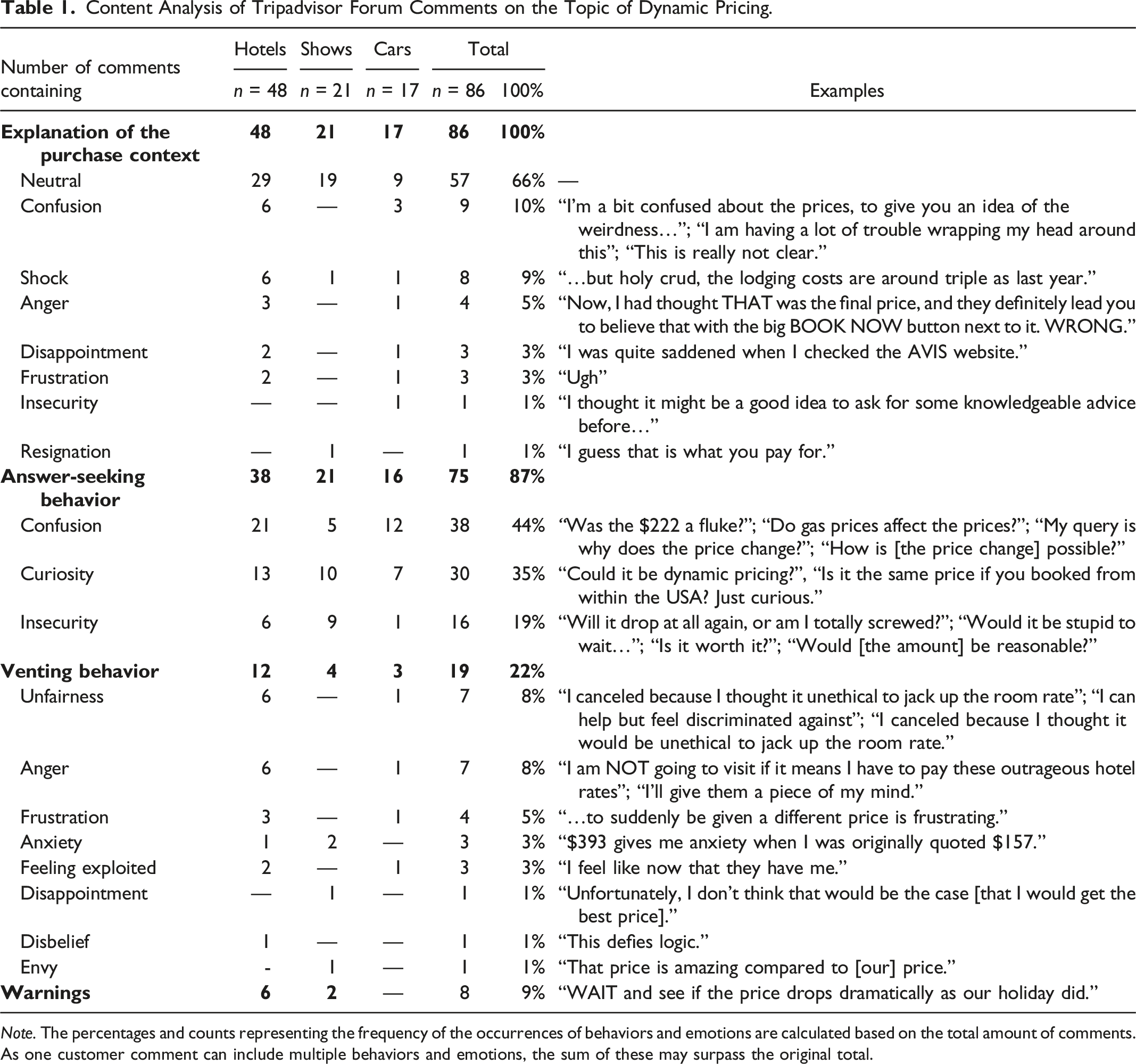
Note. The percentages and counts representing the frequency of the occurrences of behaviors and emotions are calculated based on the total amount of comments. As one customer comment can include multiple behaviors and emotions, the sum of these may surpass the original total.
Interpretation and Discussion
First Comment Component: Explanation of the Purchase Context
In the subsequent interpretation, we concentrate on the most frequently observed aspects. In the first part of the comment, all posters described their respective purchases or pricing contexts, and stated either seeing prices fluctuate or suspecting that prices might fluctuate. At this stage, 66% of the comments aggregated across all service categories did not indicate any emotion (“neutral” line in Table 1) and described the situation very matter-of-factly. Interestingly, some of the remaining descriptions of the purchase situation contained expressions of confusion (10% of the aggregated comments) by explicitly stating that the purchase situation was unclear to them.
Second Comment Component: Answer-Seeking Behavior
Most Tripadvisor comments (87% aggregated across all services) linked to dynamic service pricing included some form of answer-seeking behavior. Writers voiced feelings of insecurity, confusion, curiosity, or a combination of all the three. Most comments expressed confusion related to dynamic pricing. We categorized confusion as the consumers trying to resolve questions about the price variation by asking other forum members whether certain factors lead to price variation, why the price had changed, or whether the price variation was due to the service provider’s mistake. In alignment with Mitchell, Walsh, and Yamin’s (2005) framework of consumer confusion, these questions demonstrated that the customers experienced overload and ambiguity confusion.
Most commenters who expressed confusion also linked it to their experiences, prior knowledge of pricing within the specific service, and expectations regarding pricing norms. This response suggests that customers who frequently purchase a service can experience price confusion when a price fluctuates, as in the following example: I was looking at my desired dates last night and found a price of $222. Tonight, I go back to [company name], put in everything the same, and now the price is $341/night...Does this seem strange to anyone? Was the $222 a fluke? Could it be because I’m searching on a Friday night where more people might be looking at [company name]? I travel a lot and have never seen such a fluctuation in a hotel’s price in less than 24 hours.
This comment demonstrates that even customers who purchase frequently and are familiar with a service category can experience similarity confusion, as described by Xue, Jo, and Bonn (2020), particularly when they observe fluctuating prices of service providers they frequently use. After they expressed their confusion, some frequent users also expressed their concerns about fairness, which suggests that frequent service users will first experience confusion and then form unfairness perceptions, for instance: I’ve encountered high and low season pricing, but I’ve never come across a hotel that will apparently adjust their pricing by the hour depending on what they think they can get. Is this normal for hotels in Bangkok? [...] this policy legal or not makes it very difficult for those of us who for one reason or another don’t find it convenient to book in advance but now can no longer rely on a consistent price range at hotels we have used several times before.
This writer first demonstrates answer-seeking behavior related to experienced confusion, leading to perceptions of unfairness. This customer, who prefers a consistent price range, aligns with the findings of previous research suggesting that customers expect prices to be consistent across customers for the same product from the same retailer (Darke and Dahl 2003; Grewal, Hardesty, and Iyer 2004; Haws and Bearden 2006; Lee, Illia, and Lawson-Body 2011) and experience similarity confusion when different prices are given for identical or similar services (Xue, Jo, and Bonn 2020). A few inexperienced customers also expressed confusion, but the orientation of their questions differed. The questions were asked to confirm that the price was reasonable or if there were strategies to obtain a lower price, for example: So last week the minivan I wanted to rent was under $600. I go to rent it this week and it is closer to $900. Ugh. Do gas prices affect the prices? I have never rented a car before. Should I book one now? Or will the price go back down?
This comment illustrates how customers express ambiguity confusion when information necessary for a purchase decision is unclear, misleading, or incomplete, as described by Walsh, Hennig-Thurau, and Mitchell (2007). These examples demonstrate that individuals are spreading WOM as they have experienced confusion due to the complexity of the pricing algorithm and, in some cases, have then developed price unfairness perceptions. Experienced customers appear to be even more confused than others when price fluctuations differ from what they are used to, whereas inexperienced customers try to understand the price fluctuations more superficially.
Third Comment Component: Venting Behavior
Some comments included content aligning with venting behavior (22% of the aggregated comments). We define venting behavior as any shared communication relieving negative emotions. Venting is a common part of negative WOM. In the current sample, the most common type of venting was the expression of unfairness perceptions (8% of the aggregated comments) by mentioning that they were a victim of discrimination or that the pricing practice was unethical. This was particularly true when the pricing algorithms included discriminatory personalized pricing criteria: When I checked the website for car rentals and found that foreigners are charged more for the exact same rentals, with Singaporeans incurring the highest foreigner surcharges. [...] I can’t help but feel discriminated against [...] I’m voting with my wallet till they fix their grossly unfair practice.
These comments illustrate how identifying different dynamic pricing criteria can influence unfairness perceptions. They add to previous research demonstrating that personalized pricing criteria lead to higher unfairness perceptions than temporal criteria (Grewal, Hardesty, and Iyer 2004). Moreover, how some commenters described perceived unfairness was in line with the general assumption that companies are entitled to a fair profit but that customers are entitled to a fair price (Kahneman, Knetsch, and Thaler 1986): Most expect pricing higher for oceanfront, view, etc. ... but it feels penalizing in a way. I believe in capitalism and [the] free market. I know last year was a tough year but also was tough for the consumer. Anyone else find holiday rental pricing take[s] larger than normal price increases?
These qualitative insights add to the knowledge from previous quantitative research on price fairness perceptions (such as Bolton, Warlop, and Alba 2003). Expressions of price unfairness perceptions were often coupled with negative emotions such as anger (mainly expressed through punctuation and capitalization; 8% of the aggregated comments): I wanted a three-day booking (over a busy period), but the middle night was sold out. I booked a queen room for night 1 at about $104 and for night 3 at the same rate. I asked to be notified if there was a cancellation. The hotel came back saying a room had opened up and it was available at the manager’s rate of $527.99. THIS IS A 500% INCREASE. The manager said such rates were based on supply and demand. Sorry, but as I said, I have never experienced such a blatant increase before!
These cases illustrate how perceived price unfairness influences customers’ intentions to spread negative WOM. By adding to previous research that demonstrates how unfairness perceptions of dynamic prices can influence purchase intentions (Grewal, Hardesty, and Iyer 2004; Schmidt, Bornschein, and Maier 2020), this qualitative analysis highlights that unfairness perceptions are among the leading causes of WOM and online venting behaviors.
Fourth Comment Component: Warnings to Other Consumers
Among the aggregated comments, 9% explicitly mentioned warnings not to purchase from a company due to their use of dynamic pricing and hint at how other consumers can use dynamic pricing algorithms to their advantage. The mentioned pricing criteria are differential pricing based on browsers (“all the properties had a difference in price between browsers, so maybe worth checking your reservation”), temporal price differentiation (“WAIT and see if the price drops dramatically as our holiday did”) and price variations based on the day of the week (“You might find a variation in ticket prices from day to day”).
To conclude, the content analysis of real WOM on a service review platform demonstrates that dynamic service pricing causes price confusion, thus leading to higher price unfairness perceptions. A careful examination of the comments suggests that price confusion is the consumer’s conscious manifestation of price complexity associated with dynamic pricing. The qualitative analysis also suggests that price confusion might be more salient for customers familiar with a service than those who are unfamiliar. This analysis helps managers to better understand the types of price confusion found in negative WOM about dynamic pricing, and reminds them that they should take such negative effects into account when using dynamic pricing and develop strategies to mitigate both price confusion and unfairness perceptions to reduce the damaging effects of negative WOM. Based on these insights from the qualitative study, we developed our theoretical framework and hypotheses.
Theoretical Framework and Hypotheses Development
Effects of Dynamic Versus Simple Differential Service Pricing on Intentions to Spread Negative WOM Through Price Confusion and Price (Un)fairness Perceptions
The overarching theoretical framework for our hypotheses development is the framework of consumer confusion proposed by Mitchell, Walsh, and Yamin (2005); that explains consumer confusion in general and suggests that too similar, too much, or too ambiguous information causes similarity, overload, and ambiguity confusion, which, in turn, trigger coping strategies such as seeking additional information, thus leading to negative WOM, dissatisfaction, and decreased trust. By applying this framework to our research context, we argue that the pricing strategy used reflects product-related information that can cause similarity and overload, but mainly ambiguity confusion (which is stronger for dynamic pricing than for simple price differentiation) and finally leads to negative WOM. We extend the initial framework of consumer confusion by integrating price unfairness perceptions as a mediator between price confusion and WOM intentions. We first discuss the relations between the pricing tactic and price confusion, then between price confusion and price unfairness perceptions, and finally between price unfairness perceptions and WOM intentions.
As complexity increases with higher numbers of heterogeneous pricing criteria (e.g., Homburg, Totzek, and Krämer 2014), dynamic pricing (compared to simple forms of price differentiation) increases price complexity, which goes along with increased ambiguity and incongruity. As consumers feel uncomfortable from information ambiguity and incongruity (Cox 1967), for consumers faced with dynamic pricing, this uncomfortable feeling is likely to manifest in the form of price confusion. In addition, complex pricing tactics such as dynamic pricing reduce consumers’ access to price-related information, and through this lack of pricing information lead to ambiguity confusion (Walsh, Hennig-Thurau, and Mitchell 2007). This tendency is illustrated well in the qualitative study, as 87% of the analyzed Tripadvisor comments comprised answer-seeking behavior, including expressed concerns and confusion about pricing criteria. Thus, confusion is likely to be higher when consumers are faced with dynamic pricing:
We now discuss the link between price confusion and price unfairness perceptions. According to Bertrandie and Zielke (2019), confusion mediates an online promotion’s effect on fairness perceptions and abandonment intentions. In addition, customers’ inability to understand prices leads to higher price unfairness perceptions (Bechwati, Sisodia, and Sheth 2009). As choice can lead to overload and result in less consumer control (Wathieu et al. 2002), we argue for our research context that complex price information, such as in the case of dynamic pricing, can lead to overload confusion and leave consumers with the feeling of losing control over the price they are paying to a company. The feeling of losing control will likely cause perceptions of price unfairness, as customers may resent the cognitive effort required to process the information overload (Bertrandie and Zielke 2019; Garaus and Wagner 2016) and maintain control of the situation. Ambiguity confusion can also lead to higher perceived price unfairness as ambiguity leaves more room for the customer to speculate on the company’s intent. Without transparent pricing criteria, customers may experience lower self-attribution and infer malicious or greedy intent on behalf of the company. Examples of overload and ambiguity confusion can also be identified in the quotes related to our second comment component in the qualitative study. Similarity confusion may result from price norm violations, for example, violating the customer’s expectation that a company provides equal prices to all customers and lead to price unfairness perceptions (Darke and Dahl 2003; Grewal, Hardesty, and Iyer 2004; Haws and Bearden 2006; Lee, Illia, and Lawson-Body 2011). In our qualitative study, similarity confusion was often addressed with very explicit expressions of unfairness in the third comment component. Thus, we argue that price confusion resulting from a very complex service pricing tactic will lead to higher perceived price unfairness:
Customers confronted with an unfair price discrepancy experience monetary, and emotional sacrifices (Xia, Monroe, and Cox 2004) such as regret, disappointment, frustration, and anger (De Matos and Rossi 2008; Pizzutti dos Santos and Basso 2012; Xia, Monroe, and Cox 2004). When confronted with such intense emotions and adverse situations, individuals seek support from their social group through empathy and solace (Cohen and Wills 1985). Thus, price-disadvantaged service customers who are confused about a price discrepancy due to differential or dynamic pricing might develop unfairness perceptions and spread WOM to seek social support and assistance. Our qualitative study points to this aspect, as 22% of the analyzed online WOM cases included venting behaviors and expressions of price unfairness. Thus, we propose:
The Moderating Role of Service Purchase Frequency
Various levels of familiarity with a product category lead to different levels of required cognition and price confidence (Park and Lessig 1981). Thus, familiarity with a service is likely to influence the effects of pricing tactics on price confusion, unfairness perceptions, and intentions to spread negative WOM. Product familiarity was previously operationalized in three ways: the self-reported perception of what customers know about the product, the actual knowledge stored in the customer’s memory, or the frequency of use within a product category (Brucks 1985). As service purchase frequency can be regarded as an objective indicator of subjectively experienced familiarity with pricing tactics used for the considered service category, and as purchase frequency can vary considerably for services, we focus on purchase frequency. Some researchers (e.g., Marks and Olson 1981; Monroe 1976) have earlier employed purchase frequency as a proxy of product familiarity.
High Purchase Frequency and Related Familiarity
Heo and Lee (2011) demonstrated that frequent hotel patrons perceive revenue management as fairer than infrequent guests (Heo and Lee 2011). Wirtz and Kimes (2007) suggested that as consumers become familiar with revenue management (which has common characteristics with dynamic pricing), they adjust their transaction and price references, thus lessening the impact on perceived price fairness. Consequently, we argue that the more frequently customers purchase a service, the more familiar they become with dynamic pricing within a service category and the less important unfairness perceptions will be. Customers familiar with a product category have more category knowledge and, therefore, consider multiple attributes when making a purchase decision (Shehryar and Hunt 2005). Thus, for them, the complexity of dynamic service prices and their resulting confusion likely become more salient. In our qualitative study, the more familiar customers asked more detailed questions about the pricing algorithm. Thus, more familiar customers may spread WOM while comparing their prior experiences to cope with their ambiguity confusion. If so, intentions to spread negative WOM would be primarily influenced by price confusion. Thus, we propose:
Low Purchase Frequency and Related Familiarity
Consumers who are less familiar with a product (category) rely heavily on available cues to determine if the company is upholding the pricing norms defined by the society (Shehryar and Hunt 2005). These unfamiliar consumers are likely to attach more importance to the adherence to social norms as they otherwise have few or no cues upon which to base their purchase decision. Our qualitative analysis also demonstrates that unfamiliar customers only superficially questioned dynamic pricing, which indicates low mental loads. Consequently, unfamiliar customers facing dynamic pricing perceive more pricing norm violations, thus resulting in higher price unfairness perceptions than familiar customers and creating intentions to spread negative WOM. These arguments lead to the following hypothesis:
The following sections describe the quantitative studies testing the hypotheses.
Quantitative Studies
We conducted three studies to test our hypotheses and replicate our basic effects (Preliminary Study, Study 1, and Study 2). As the content analysis highlighted the role of price confusion as an immediate reaction to dynamic service pricing, we examined the basic effects of dynamic pricing (compared to simple price differentiation) on price confusion and intentions to spread negative WOM in a preliminary study (Web Appendix 1). The preliminary study results demonstrate that, for hotel rooms, dynamic pricing leads to stronger price confusion and higher intentions to spread negative WOM than simple price differentiation. Subsequently, we present the results of our two main studies.
Study 1: Dynamic Pricing Effects Through Price Confusion and Unfairness Perceptions on Intentions to Spread Negative WOM
Objective
Study 1 includes price unfairness perceptions as a mediator after price confusion, in the relationship between dynamic service pricing (compared to simple price differentiation) and intentions to spread negative WOM.
Method
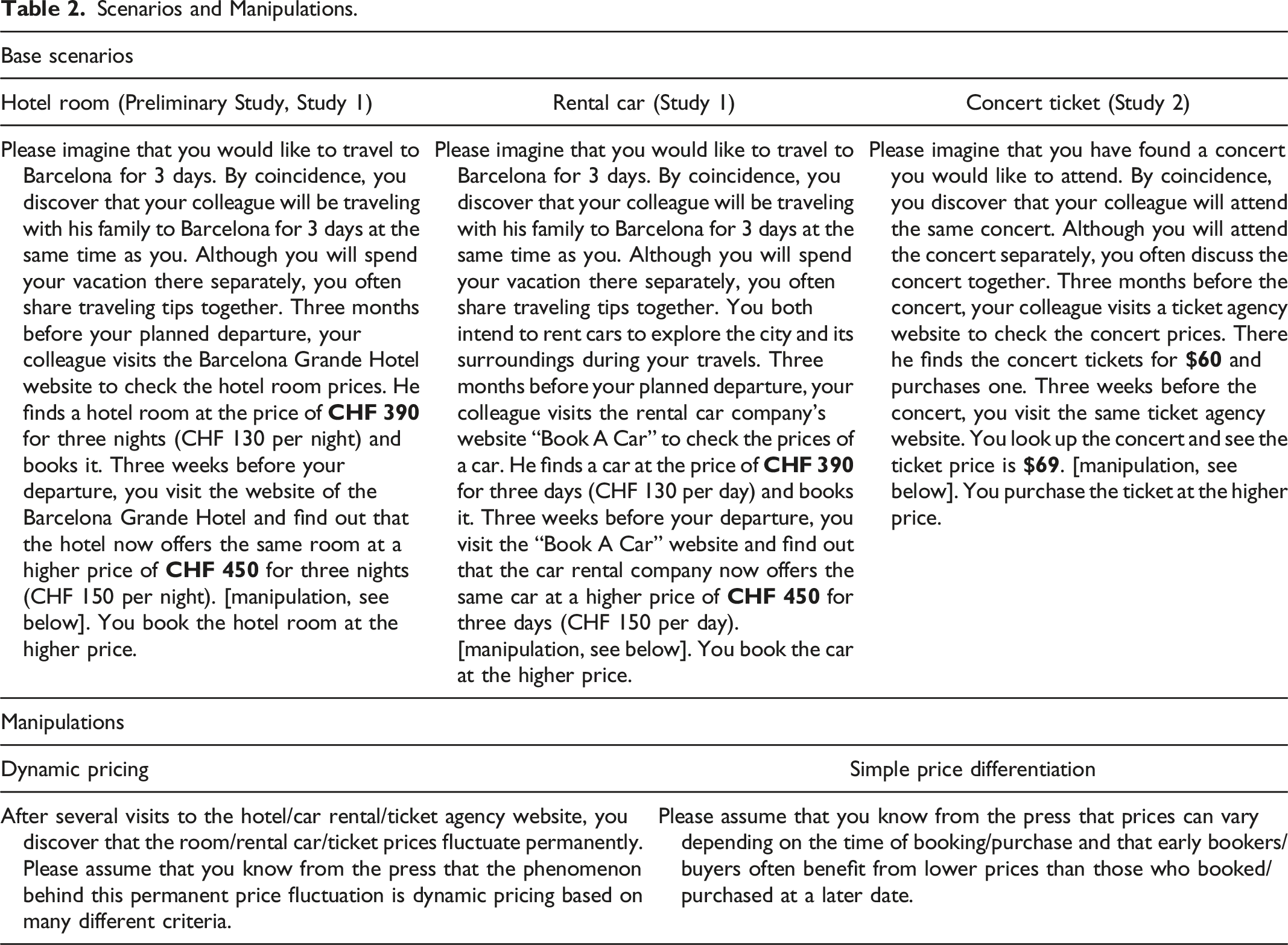
Scenarios and Manipulations.
Measurement Quality
Results of the Confirmatory Factor Analyses With LISREL (Study 1 and Study 2).
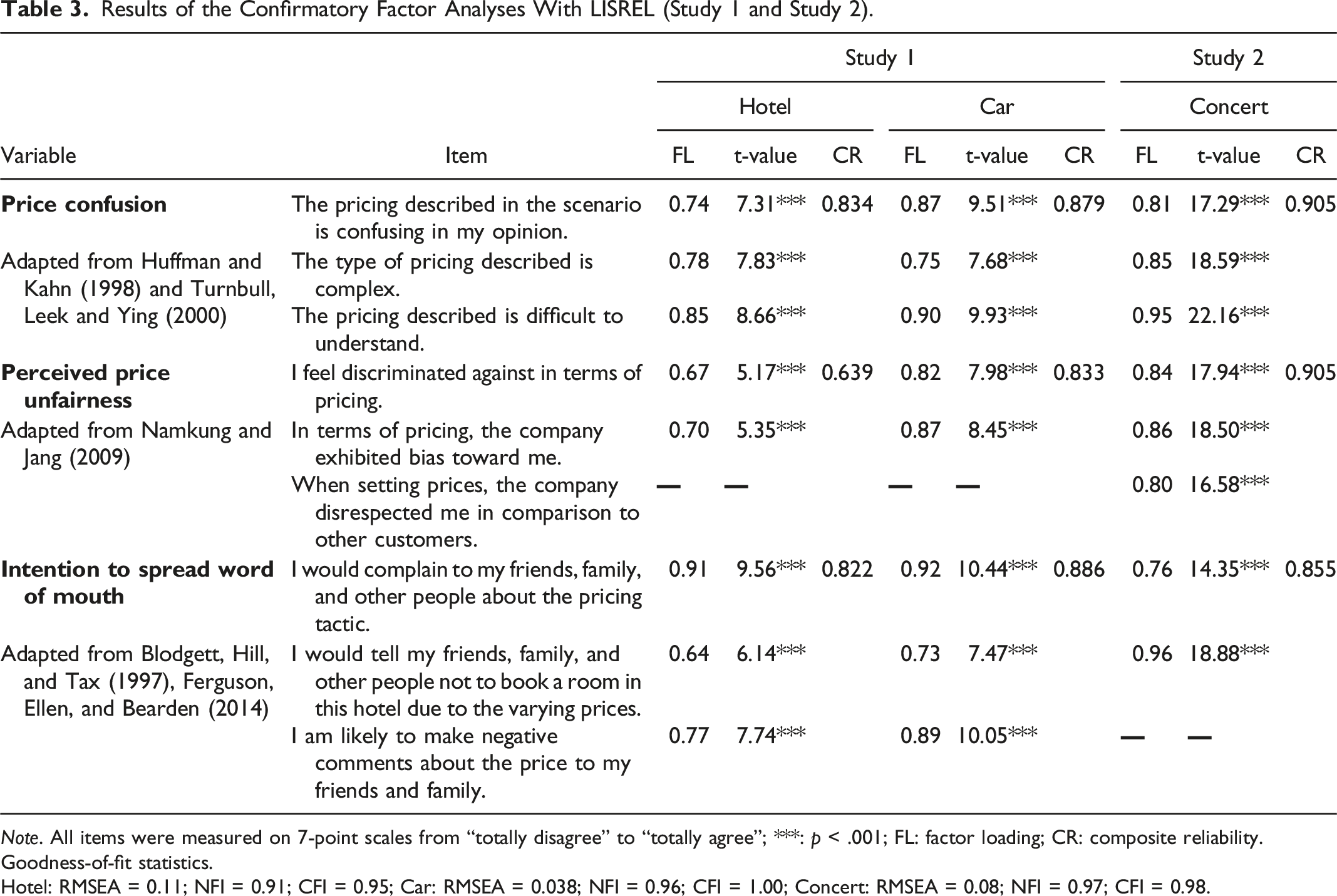
Note. All items were measured on 7-point scales from “totally disagree” to “totally agree”; ***: p < .001; FL: factor loading; CR: composite reliability.
Goodness-of-fit statistics.
Hotel: RMSEA = 0.11; NFI = 0.91; CFI = 0.95; Car: RMSEA = 0.038; NFI = 0.96; CFI = 1.00; Concert: RMSEA = 0.08; NFI = 0.97; CFI = 0.98.
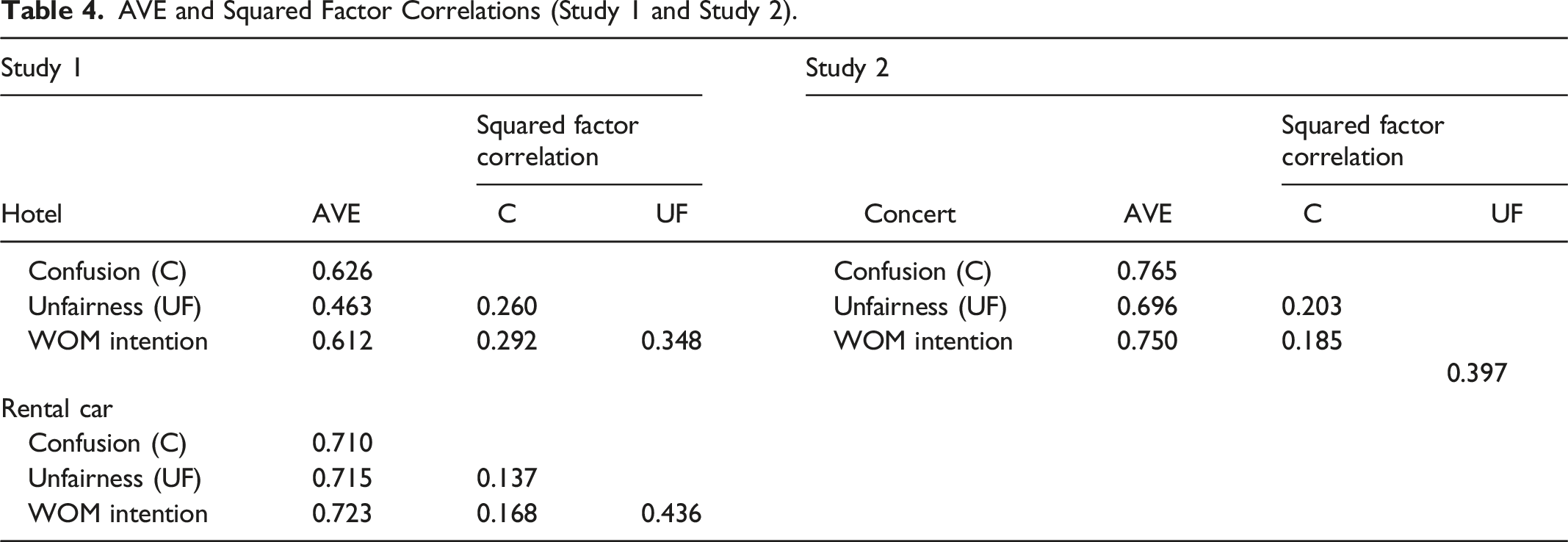
AVE and Squared Factor Correlations (Study 1 and Study 2).
Results and Discussion
Figure 1 illustrates that, for hotel rooms, dynamic pricing compared to simple price differentiation affects price confusion and intentions to spread negative WOM, but not perceived price unfairness. For rental cars, differential effects were found on price confusion, but not on perceived price unfairness or intentions to spread negative WOM. We tested the whole model in PROCESS (model 6) separately for the two service categories considered (see Figure 2). As a precaution, we also tested the model by reversing the two mediators (first price unfairness perceptions and then price confusion), which did not yield a better fit. Effects of the pricing tactic on price confusion, price unfairness perceptions, and intentions to spread negative WOM. Test of the theoretical framework: effects of the pricing tactic (PT) through price confusion (C) and price unfairness perceptions (UF) on intentions to spread negative WOM.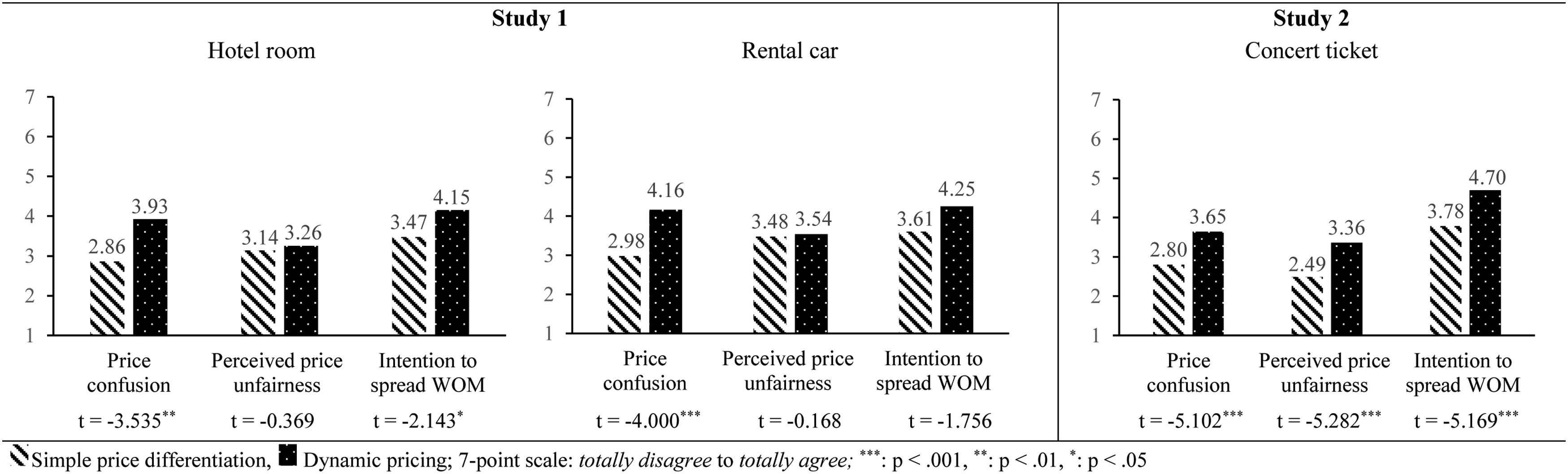
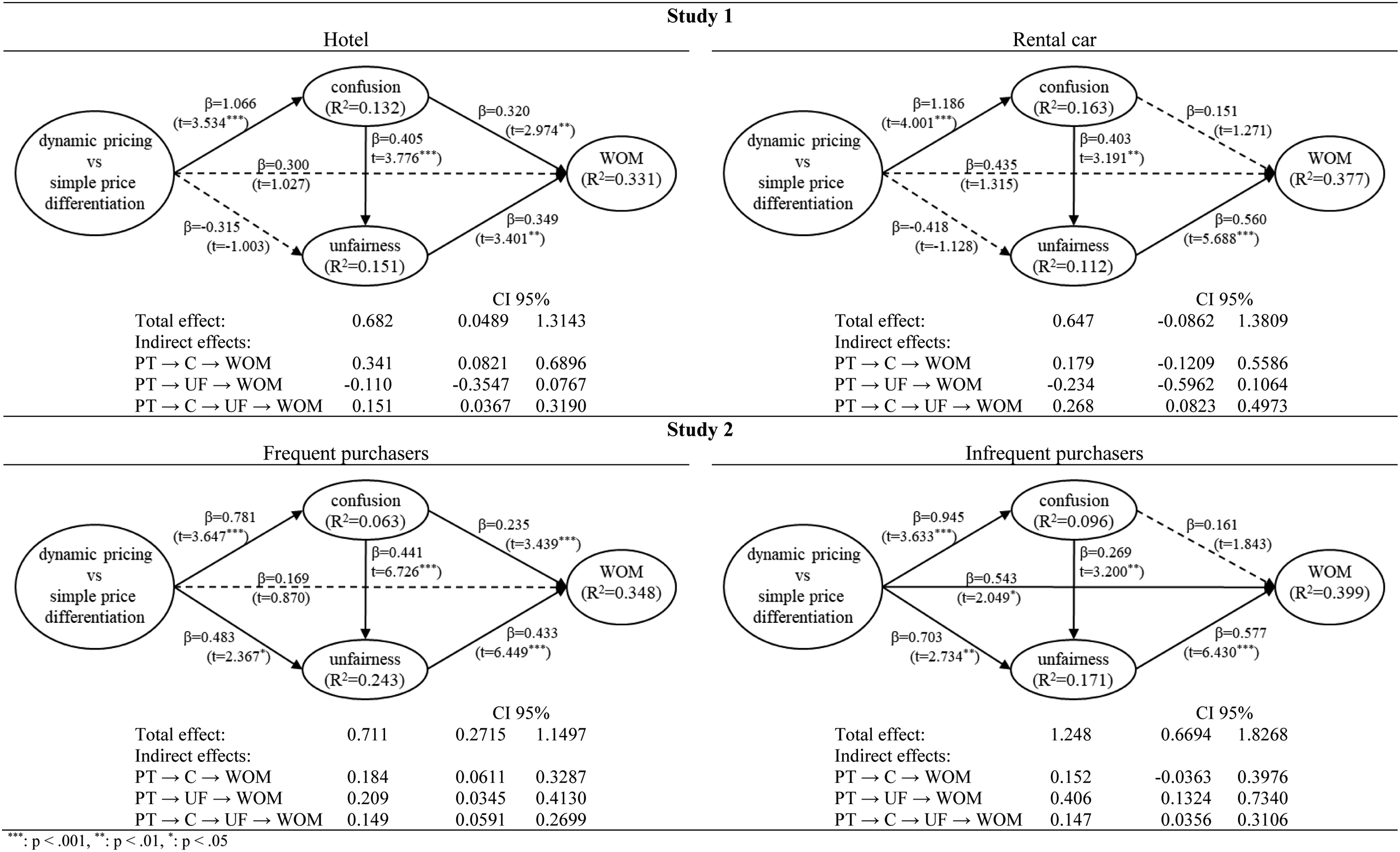
Figure 2 illustrates that two significant paths exist for hotels. The first path runs from pricing tactic through price confusion to intentions to spread negative WOM. The second path runs from pricing tactic through price confusion, then perceived price unfairness to WOM intentions. For rental cars, only one path exists, running from pricing tactic through price confusion, then perceived price unfairness to intentions to spread negative WOM. These results support H1, H2, and H3 for both services and provide interesting insights into the mechanisms underlying the effects of dynamic pricing versus simple price differentiation. Price confusion and unfairness perceptions play an important mediating role, as customers faced with dynamic pricing experience stronger confusion, leading to higher price unfairness perceptions, resulting in higher intentions to spread negative WOM. Interestingly, for hotels, the effect path running through confusion alone is stronger than the path running through confusion and then unfairness perceptions. For rental cars, only the latter path exists, which may well reflect that many customers book hotel rooms more frequently than rental cars, and thus are more familiar with pricing tactics for hotels than for rental cars. Higher purchase frequency and related familiarity with pricing tactics seem to make price confusion more salient, while lower purchase frequency and less familiarity with pricing tactics seem to put forward price unfairness perceptions in addition to experiencing confusion.
Study 2: The Role of Purchase Frequency in the Context of Dynamic Pricing Effects Through Price Confusion and Unfairness Perceptions on Intentions to Spread Negative WOM
Objective
Study 2 used low and high purchase frequency as a moderator and replicated the previous studies’ findings examining another service category. Concert tickets were chosen, as the observed Twitter firestorms and content analysis indicated that customers are regularly confronted with dynamic pricing for concert tickets.
Method
The online survey conducted on Prolific provided a sample of 326 respondents (USA residents, average age: 27.2 years, 87% women). The respondents answered anonymously and were provided a small compensation. The study was based on a 2-group between-subjects design (dynamic pricing vs. simple temporal price differentiation). The two groups were comparable regarding age (t = 0.439, p > .10) and gender (Χ2 = 2.672, p > .10). The scenarios are described in Table 2. We also introduced purchase frequency based on a median split of the self-reported purchase frequency values.
Measurement Quality
The measures and results of confirmatory factor analyses are presented in Tables 3 and 4. Convergent (factor loadings above 0.5, significant t-values) and discriminant (AVE values exceed the squared factor correlations) validity is given, the goodness of-fit-measures indicate acceptable model fit, and the alpha values for price confusion (α = 0.900), perceived price unfairness (α = 0.871), and the bivariate correlation for intention to spread negative WOM (r = 0.730) indicate that the items reliably measure the respective variables.
Results and Discussion
Figure 1 illustrates that dynamic pricing, compared to simple price differentiation for concert tickets, affects price confusion, perceived price unfairness, and intentions to spread negative WOM. The effects found on price confusion and intentions to spread negative WOM replicate the findings of Study 1. We see an effect of the pricing tactic on perceived price unfairness in Study 2, which we did not find in Study 1. A possible explanation for this finding could be that dynamic pricing for concert tickets is generally much less common—even for frequent purchasers of concert tickets—than for hotels or rental cars, which seems to make price unfairness perceptions more salient.
We again used PROCESS (model 6), differentiated for purchase frequency, after running precautionary tests by reversing the two mediators, which did not yield a better model fit. Figure 2 illustrates three significant effect paths for frequent concert ticket purchasers. The first path runs from pricing tactic through perceived price unfairness to intentions to spread negative WOM. The second path runs from pricing tactic through price confusion and then perceived price unfairness to WOM intentions (support for H1, H2, and H3). The third path runs from pricing tactic through price confusion directly to WOM intentions. These results widely replicate the findings of Study 1 for hotel rooms, except for the additional path from pricing tactic through unfairness perceptions to intentions to spread negative WOM. For customers who infrequently purchase concert tickets, two paths are significant. The first path runs from pricing tactic through price confusion, and then perceived price unfairness to intentions to spread WOM (support for H1, H2, and H3). This finding is consistent with the findings for rental cars in Study 1. The second path runs directly from pricing tactic through perceived price unfairness to WOM intentions. This additional path occurred for both frequent and infrequent purchasers of concert tickets. For infrequent purchasers, the pricing tactic has an additional direct effect on intentions to spread negative WOM. An explanation for these additional paths might be, as mentioned above, that price unfairness perceptions play a more salient role for concerts (for which it is generally less common to use dynamic prices than for hotels and rental cars).
Overall, the results demonstrate that in the case of high purchase frequency, the effects of dynamic pricing (compared to simple price differentiation) on intentions to spread negative WOM work mainly through price confusion. In the case of lower purchase frequency, the strongest path runs through price unfairness perceptions. Thus, H4a and H4b are supported.
Conclusions
Major Insights
The objective of combining one qualitative and three quantitative studies was to acquire a rich understanding of the processes underlying price-disadvantaged service customers’ intentions to spread negative WOM, when faced with dynamic pricing (as compared to simpler forms of price differentiation). The content analysis of customer comments on dynamic pricing in various service categories highlights the role of confusion in the first part of the customer comments. The results of this study add to the findings of Xue, Jo, and Bonn (2020) by providing qualitative evidence that high levels of price confusion can be found in online WOM about dynamic pricing. These results extend the knowledge from previous research that price complexity perceptions negatively influence other types of consumer behavior, such as purchase intentions (e.g., Layer, Feurer, and Jochem 2017), by demonstrating that price confusion is a consequence of complex prices and mediates consumers’ WOM intentions.
As the content analysis further brought up that, in later parts of their comments, customers mention price unfairness perceptions, Study 1 explored the mediating role of price unfairness perceptions in addition to price confusion in the relationship between the service pricing tactic and intentions to spread negative WOM. The results indicate that for services such as hotels and rental cars, dynamic pricing (compared to simple price differentiation) leads to stronger price confusion and, in turn, higher price unfairness perceptions, which trigger higher intentions to spread negative WOM. These results extend previous research, which found that price complexity perceptions lead to higher unfairness perceptions that lower purchase intentions (e.g., Bertrandie and Zielke 2019; Homburg, Totzek, and Krämer 2014), by demonstrating that complex prices can additionally lead to higher negative WOM intentions through price confusion and price unfairness perceptions.
The results of Study 2, which differentiated for purchase frequency, demonstrate that, for frequent and infrequent purchasers of concert tickets, price confusion and price unfairness perceptions mediate the effects of dynamic pricing as compared to simple price differentiation on intentions to spread negative WOM, but for frequent purchasers, price confusion is more salient, while for less frequent purchasers, price unfairness perceptions play a more important role. This research goes beyond the scope of previous studies on the role of unfairness perceptions in the context of dynamic pricing (e.g., Haws and Bearden 2006; Homburg, Totzek, and Krämer 2014) by providing a new framework to explain unfairness perceptions through price confusion related to firm-driven price complexity.
Theoretical and Managerial Contributions
Our mixed-methods approach, combining a qualitative and three quantitative studies, provides valuable contributions to marketing theory and practice. Our paper’s first important theoretical contribution is applying a framework initially developed for consumer confusion to the specific context of price differentiation tactics. This application enabled us to develop a theoretical framework for the negative effects of dynamic service pricing, including two important variables, consumers’ price confusion and intentions to spread negative WOM, which have been overlooked in service pricing research so far, and to prove their importance empirically. The second contribution concerns increasing the understanding of consumers’ negative WOM about dynamic pricing through our qualitative study. The qualitative analysis demonstrates that price confusion manifests immediately and price unfairness perceptions then follow in negative WOM about dynamic pricing. The third important theoretical contribution is extending the initial theoretical framework by integrating price unfairness perceptions that play an important role in the context of the effects of dynamic pricing on intentions to spread negative WOM. Our three empirical studies successfully test the derived relations among the variables and provide valuable insights into the process underlying the negative effects of dynamic pricing on intentions to spread negative WOM in a service context. The fourth contribution to theory is to demonstrate that the level of purchase frequency plays an important role in the context of negative WOM about dynamic pricing. High purchase frequency makes price confusion more salient, while low purchase frequency puts forward price unfairness perceptions.
We also provide important contributions to marketing practice. Our qualitative analysis of real customer reactions to dynamic pricing demonstrates that negative WOM about dynamic pricing incorporates expressions of answer-seeking (including price confusion) and subsequent venting behaviors (including expression of perceived price unfairness) that service managers need to acknowledge. In addition, the qualitative study illustrates how customers warn their peers about dynamic pricing, share their knowledge about dynamic pricing criteria, and explain how to obtain lower prices. This information is relevant to all service firms that implement dynamic pricing, as growing customer awareness and circumvention of dynamic pricing might mean that dynamic pricing could ultimately be of disservice to service firms. The qualitative analysis provides service managers with cues on mitigating negative emotions that lead to answer-seeking or venting behavior, thus avoiding negative WOM. Even though consumers may be accustomed to dynamic pricing in certain service categories such as tourism and hospitality (e.g., Kimes and Noone 2002), service managers should be aware that price-disadvantaged customers are likely to react with negative WOM due to their confusion and perceptions of unfairness. Thus, in their decision to use dynamic pricing, service managers should carefully weigh possible positive and negative effects by comparing the additional revenue to the losses linked to negative WOM on dynamic pricing.
Our quantitative studies offer the insight that dynamic pricing triggers more negative WOM than simpler forms of price differentiation, which is mainly mediated by price confusion for frequent purchases, and by perceived price unfairness for infrequent purchases. The recommendation that we can derive from this finding is that simpler forms of differential pricing enable service firms to profit from customer surplus more transparently and clearly, while avoiding the reputational damage that dynamic pricing is more likely to entail. To avoid losing price-disadvantaged customers while continuing with their dynamic pricing approach, service firms should act on the existing negative WOM to minimize further damaging WOM. Service firms could also consider implementing communication strategies that might attenuate price confusion and unfairness perceptions, and thus, reduce intentions to spread negative WOM. Proactive communication about dynamic service pricing will become vital for service firms as customers are increasingly aware of dynamic pricing tactics, and thus, are more likely to discover that they are in a price-disadvantaged position and desire more agency over the prices they pay in the future. Communication strategies might include price-framing and transparent communication about service pricing criteria or price fluctuation history or emphasize that customers can be in a price-advantaged position.
Our results, and the fact that consumers are increasingly aware of ever-changing prices and related confusion, lead us to derive the managerial recommendation to avoid dynamic pricing, or limit its use when there is a high likelihood of reputation damage through negative WOM. Consumers can easily spread negative WOM, which can have an impressive reach and negative consequences for service firms. The rationale behind our recommendation is that service providers risk losing not only price-disadvantaged customers who had very negative experiences of dynamic pricing but also those affected by the negative WOM, and for lost customers, profiting from any customer surplus is no longer possible.
Limitations and Directions for Future Research
The studies presented here have some limitations that open up several directions for future research. A limitation of our quantitative studies is using student samples (Preliminary Study, Study 1), as students usually have more limited resources on average than working adults. However, using student samples poses less of an issue for observing WOM than it would for purchase intention or willingness to pay, and we replicate our findings in Study 2 using a sample from a broader population. Therefore, sample validity should not be problematic.
Another limitation of our quantitative studies is the use of scenarios to simulate the study context. Laboratory experiments in the form of website simulations to illustrate price changes would be more realistic. Although laboratory simulations may be slightly more authentic than scenarios, they both do not necessarily achieve the realism that can be obtained through natural settings, which, in turn, are characterized by many uncontrollable and biasing factors (Davis et al. 2013). Furthermore, scenario-based research is commonly used in the field of dynamic pricing (e.g., Hufnagel, Schwaiger, and Weritz 2022; Keller, Vogelsang, and Totzek 2022; Wamsler, Natter, and Algesheimer 2022).
Another limitation is that we have focused on price-disadvantaged customers. Hence, we recommend that future studies examine both price-advantaged and price-disadvantaged customers and compare their reactions to dynamic pricing. As we did not survey companies directly, a broader limitation is the exclusion of a comparison of the revenue generated by dynamic pricing and the losses caused by negative WOM on dynamic pricing.
Moreover, studying possible mitigating strategies for companies and avoidance strategies of consumers once they are aware of dynamic pricing could be an interesting area for future research. As our studies highlight the role of price confusion in differential pricing contexts, and as there is a lack of research on price confusion, future studies can examine other effects of this variable on consumer reactions apart from the intentions to spread negative WOM. Although intentions to complain directly to the company may not directly cause customer attrition or reputation damage, they are still costly to companies and important to manage in service industries that apply dynamic pricing (tourism and hospitality), and high levels of price confusion may aggravate the customers’ desire to complain.
Furthermore, the relationship between price confusion and perceptions of price unfairness is also an interesting topic, and future research could explore this relationship’s concrete functioning. In this context, examining whether price unfairness perceptions related to dynamic prices additionally depend on the extent to which dynamic pricing is used in a specific service category would also be interesting.
Moreover, detailed examinations of the threshold above which combinations of differential pricing criteria have the same negative effects as dynamic pricing, could generate further insights. Finally, future research could examine how other customers react to negative WOM on dynamic pricing and how this affects their attitudes toward companies.
Supplemental Material
Supplemental Material - Consumers’ Intentions to Spread Negative Word of Mouth About Dynamic Pricing for Services: Role of Confusion and Unfairness Perceptions
Supplemental Material for Consumers’ Intentions to Spread Negative Word of Mouth About Dynamic Pricing for Services: Role of Confusion and Unfairness Perceptions by Silke Bambauer-Sachse and Ashley Young in Journal of Service Research.
Supplemental Material
Supplemental Material - Consumers’ Intentions to Spread Negative Word of Mouth About Dynamic Pricing for Services: Role of Confusion and Unfairness Perceptions
Supplemental Material for Consumers’ Intentions to Spread Negative Word of Mouth About Dynamic Pricing for Services: Role of Confusion and Unfairness Perceptions by Silke Bambauer-Sachse and Ashley Young in Journal of Service Research.
Footnotes
Declaration of Conflicting Interests
The author(s) declared no potential conflicts of interest with respect to the research, authorship, and/or publication of this article.
Funding
The author(s) received no financial support for the research, authorship, and/or publication of this article.

Supplemental Material
Supplemental material for this article is available online.
Author Biographies
References
Supplementary Material
Please find the following supplemental material available below.
For Open Access articles published under a Creative Commons License, all supplemental material carries the same license as the article it is associated with.
For non-Open Access articles published, all supplemental material carries a non-exclusive license, and permission requests for re-use of supplemental material or any part of supplemental material shall be sent directly to the copyright owner as specified in the copyright notice associated with the article.
