




Abstract
Autologistic actor attribute models (ALAAMs) provide new analytical opportunities to advance research on how individual attitudes, cognitions, behaviors, and outcomes diffuse through networks of social relations in which individuals in organizations are embedded. ALAAMs add to available statistical models of social contagion the possibility of formulating and testing competing hypotheses about the specific mechanisms that shape patterns of adoption/diffusion. The main objective of this article is to provide an introduction and a guide to the specification, estimation, interpretation and evaluation of ALAAMs. Using original data, we demonstrate the value of ALAAMs in an analysis of academic performance and social networks in a class of graduate management students. We find evidence that both high and low performance are contagious, that is, diffuse through social contact. However, the contagion mechanisms that contribute to the diffusion of high performance and low performance differ subtly and systematically. Our results help us identify new questions that ALAAMs allow us to ask, new answers they may be able to provide, and the constraints that need to be relaxed to facilitate their more general adoption in organizational research.
Keywords
Following a more general trend in the study of human behavior, contemporary organizational research has been progressively eroding the categorical boundaries conventionally separating the “individual” and the “social” level of analysis. In consequence, it is now less clear that explanations cast exclusively in individual terms are sufficient to understand individual outcomes and behavior (Christakis & Fowler, 2013; Tsvetkova & Macy, 2014). Social networks ideas have been frequently relied upon to derive the empirical implications of this general theoretical reorientation both within, as well as between organizations (Padgett & Powell, 2012).
In studies of organizations, actor-specific characteristics traditionally considered as correlates of individual behavior such as emotions (Barsade, 2002), personality (Kleinbaum et al., 2015), attitudes (Erickson, 1988), empathy (Hatfield et al., 2009), preferences (Kilduff, 1990), and, ultimately, individual performance and achievements (Morrison, 2002; Podolny & Baron, 1997; Seibert et al., 2001) are increasingly being reinterpreted as consequences of social contagion—a process of diffusion sustained by social contact (Ugander et al., 2012).
While the tendency of social networks to act as vehicles for social influence within organizations has been long recognized in empirical organizational research (Krackhardt & Porter, 1985), the underlying mechanisms of social contagion linking the individual and social remain poorly understood. This is due, at least in part, to the lack of a satisfactory modeling framework capable of connecting hypotheses about possible social contagion mechanisms to data on social networks routinely collected in empirical organizational research (Kilduff & Krackhardt, 2008; Robins, 2015). In this article, we introduce autologistic actor attribute models (ALAAMs)—a new class of statistical models that promise to narrow the gap between theoretically grounded mechanisms of social contagion, and empirical data on organizational networks. 1
Originally derived as a variant of undirected exponential random graph models (ERGMs) for social selection (Robins et al., 2001), the autologistic actor attribute model offers a principled analytical framework for modeling social contagion that predicts the presence of an individual attribute (or behavioral outcome) based on patterns of social relations linking the actors (Robins et al., 2001). Like ERGMs, ALAAMs are models for the analysis of cross-sectional data (Snijders et al., 2006). While ERGMs are used to model the probability of observing network ties conditional on individual attributes (Amati et al., 2018; Kalish, 2020), ALAAMs are used to model the probability of observing individual attributes (including behavioral outcomes) conditional on existing network ties. 2 From a theoretical perspective, the difference between ERGMs and ALAAMs aligns with Borgatti and Halgin’s (2011) conceptualization of theories of networks, which examine networks as the outcome, and network theories, where networks predict a behavioral outcome. Examples of individual attributes and propensities that are increasingly understood in the context of more general social contagion processes include happiness (Fowler & Christakis, 2008), employment preferences (Snijders et al., 2013), adoptions of social norms (Friedkin, 2001), and the tendency to collaborate (Fowler & Christakis, 2010). Examples of outcomes that have been typically treated as individual but that extant research has found to be contagious include academic performance (Stadtfeld et al., 2019), and an increasingly wide range of choice (Salganik et al., 2006) and adoption behaviors (Aral & Walker, 2011; Cool et al., 1997). In addition, contagion has been a central concern in organizational research on social movements for almost a quarter of a century now (Centola, 2015; Hedström, 1994; Soule, 2013).
ALAAMs offer two major advantages that distinguish them from alternative modeling frameworks for the empirical analysis of social contagion. The first is that ALAAMs avoid the theoretically constraining assumptions of statistical independence among the observations (Snijders, 2011). ALAAMs afford direct modeling of a variety of dependencies that may be of general theoretical interest or contextual empirical relevance. Examples of dependencies created by social mechanisms include reciprocity, that is, the tendency for an individual to give advice or affect to those that give to them; and closure, that is, the tendency of individuals sharing acquaintances to become directly connected by social relations. This feature makes ALAAMs uniquely appropriate for modeling social contagion—a diffusion process sustained by a system of interdependent social relations. Unlike generic statistical models for independent observations, some of the defining analytical properties of ALAAMs map onto specific micro-structural features of empirical behavioral data typically produced by processes of social contagion.
According to Ugander et al. (2012, p. 5962), “Traditional models of social contagion have been based on physical analogies with biological contagion, in which the probability that an individual is affected by the contagion grows monotonically with the size of his or her ‘contact neighborhood’—the number of affected individuals with whom he or she is in contact.” ALAAMs enable empirical studies of social contagion to go beyond the useful, but generic “contact neighborhood” hypothesis by specifying complex forms of dependence, such as those, for example, inherent in jointly occupied network positions (Burt, 1978), and frame them as competing theoretical predictions about the mechanisms that sustain social contagion. Unlike more traditional network autocorrelation models where contagion is associated with a single parameter (Doreian et al., 1984; Leenders, 2002; see Stivala, Gallagher, et al., 2020 for a discussion of the differences between traditional autocorrelation models and ALAAMs), ALAAMs are able to characterize social contagion in more complex, detailed and nuanced ways through multiple parameters possibly representing competing hypotheses of social contagion. This is the second major advantage of ALAAMs over competing models.
ERGMs are now well-established models in organizational and strategic management research (Kim et al., 2016; Lomi et al., 2014; Lomi & Pattison, 2006). While the original derivation of ALAAMs is not new—at least in their undirected version (Robins et al., 2001)—their full empirical potential remains largely unexplored (Stivala, Gallagher, et al., 2020). Empirical applications are recent and still relatively infrequent, particularly in studies of organizations and organizational behavior (Kashima et al., 2013). The case study that we develop in the empirical part of the article is a first attempt to address this concern by examining how behavioral outcomes diffuse among individuals within an organizational setting where performance is typically measured at the individual level.
Using original data that we have collected on interpersonal advice relations among students enrolled in a graduate management program, and information on their individual academic performance, we specify and estimate ALAAMs to examine the contagiousness of academic performance. Educational settings are organizational settings where the interdependence of socialization and individual achievement is particularly relevant and transparent (Akerlof & Kranton, 2002; Baldwin et al., 1997). For this reason, educational settings are particularly useful empirical contexts for illustrating how individual goal-oriented behavior and social relations interact to produce observable outcomes (Kilduff, 1990, 1992; Lomi et al., 2011). This is the objective of the illustrative case study that we develop in the empirical part of this article.
More specifically, we illustrate how ALAAMs may ameliorate our understanding of how individual performance spreads between organizational participants connected by contextually meaningful advice relations. We focus on advice relations because extant research has argued and shown that in educational settings knowledge sharing and social influence both travel through advice networks (Lomi et al., 2011). The empirical analysis that we present is guided by the following orienting question: Are students who seek advice from high-performing peers more likely to achieve high levels of academic performance? We also explore the direction of social contagion and examine differences in patterns of diffusion of high and low academic performance. Therefore, we also ask: How do social contagion mechanisms sustaining the diffusion of high and low academic performance differ? The results of the analysis demonstrate the unique ability of ALAAMs to tease out subtly complex social processes, and provide a rich and nuanced qualitative insight about the mechanisms that drive social contagion.
The article is organized as follows. In the next section, we discuss the theoretical and empirical motivation for models of interdependent behavior and outcomes that explicitly consider the structure of social networks in which individuals in organizations are embedded. In the third section, we define autologistic actor attribute models and establish the basic notation needed to identify their analytical components and define their basic properties. In the fourth section, we summarize a study that we have designed to illustrate the empirical value of the model, and describe briefly the empirical setting and the data. In the fifth section, we report the empirical results of the analysis and discuss their contextual interpretation and qualitative implications. We adopt a computational approach to model fit that reveals subtle differences in social contagion mechanisms across outcomes (high and low performance). In the final section, we use the empirical results of the study to launch a more general discussion on the value and limitations of ALAAMs for future research on social contagion within and between organizations.
Motivation and Background
General recognition that individual behavior is affected by nonindividual components is clearly revealed by the proliferation of terms used in organizational and management research to identify the effects of social influence processes on individual attitudes, cognitions and behaviors (Cialdini & Goldstein, 2004). An incomplete list of such terms includes contagion (Burt, 1987; Tsvetkova & Macy 2014), diffusion (Fiss et al., 2012), assimilation (Torlò & Lomi, 2017), propagation (Aral & Walker, 2011), imitation (Ross & Sharapov, 2015), adoption (Greve, 1998), behavioral cascades (Friedkin, 2010), and herding (Raafat et al., 2009; Welch, 2000). Bandwagon effects (Abrahamson & Rosenkopf, 1993), neighborhood effects (Brock & Durlauf, 2002), and peer effects (Erez et al., 2015; Manski, 1993) are also terms often used to acknowledge that individual behavioral orientations may be influenced by the majority of others, or by others who may be closer, or perceived as similar along contextually meaningful dimensions, respectively (Lomi et al., 2011).
Teasing out the subtle differences in these various ways to characterize social influence is not one of our objectives in this article. Excellent discussions and reviews of various strands of research on social influence may be found in An (2011), Centola (2015), Flache et al. (2017), Friedkin and Johnsen (2011), Marsden and Friedkin (1994), and Mason et al. (2007), among others. More important for our current purpose is to emphasize their broad convergence to a generic notion of social contagion—a process of diffusion sustained by social contact. Social contagion is the term that we will be using henceforth as a generic term to denote not only social influence, but also the informal social infrastructure of interpersonal relations that makes social influence concretely possible.
The need for a purpose-built statistical modeling framework arises, almost by definition, from the lack of independence among the actors involved in processes of social contagion. Dependence mechanisms lie at the heart of diffusion processes. Generic statistical models based on assumptions of independence among the observations are ill-suited to an analysis of social contagion (Robins, 2015; Snijders, 2011). To be truly useful as a model for data, a model for social contagion has to be based on explicit dependence assumptions (Pattison & Robins, 2002), and be at the same time specific and flexible.
It has to be specific, because it is not sufficient to observe that social contagion spreads through social relations so that connected actors are more likely to exhibit similar attributes, attitudes, and behavioral orientations. Specific mechanisms responsible for social contagion have to be identified and framed as alternative hypotheses. For example, social contagion may operate through cohesion which is a direct connection between two individuals or through structural equivalence which occurs when two individuals have a tie to the same person (Burt, 1987). Cohesion may appear in many empirical guises ranging from direct connections to membership in cliques, that is, three or more people who all have ties with each other (Pallotti & Lomi, 2011). Structural equivalence may or may not involve the presence of direct connections. Also, to the extent that social contagion travels only through ties embedded in more complex network configurations (Uzzi, 1996), observations of actors connected only through direct relations—i.e., a dyadic relationship between one person and another (which is the simplest form of cohesion)—might prove insufficient to sustain predictions of behavioral contagion.
To be useful, a model for data produced by social contagion also has to be flexible, that is, applicable to contagion processes involving actors that may be defined at any level of analysis, and identified in multiple empirical settings—at least in principle. Flexibility is necessary because social contagion may diffuse mood among individuals sharing membership in experimental social groups (Barsade, 2002), just as easily as it can diffuse reputation of performance among managers connected by informal social relations (Kilduff & Krackhardt, 1994), preferences among users connected through social media (Aral & Walker, 2011), corporate practices among organizations connected by interlocking directorates (Shropshire, 2010), knowledge among companies connected by R&D alliances (Powell et al., 1996), and implementation of public health treaties among countries connected by trade relations (Valente et al., 2019).
Originally proposed by Robins et al. (2001) as a variant of undirected ERGMs for social selection, autologistic actor attribute models (ALAAMs) satisfy the criteria of specificity and flexibility needed for a model of social contagion to be useful as a model for data. ALAAMs are specific because they allow the identification and estimation of configurations representing alternative hypotheses about mechanisms of social contagion. By allowing potential contagion mechanisms to interact with individual attributes of the actors involved, ALAAMs encourage development and testing of hypotheses about how actor-specific characteristics affect the individual susceptibility to social contagion (Daraganova & Robins, 2013). ALAAMs are flexible because they are indifferent to the level at which the actors are defined, and to the empirical setting that generates the observations.
Despite their considerable potential, empirical experience with ALAAMs is very recent and relatively limited. Empirical studies of the adoption/diffusion of health-related practices and behavior have been the primary, even if by no means the only, beneficiaries of ALAAMs (Fujimoto et al., 2019; Song et al., 2019). In the original statement of the undirected model, Robins et al. (2001) illustrate the use of ALAAMs in an analysis of contagion of individual attitudes about a training program in a major Australian government business company. Daraganova and Pattison (2013) examined the spread of unemployment through social and discussion networks. Kashima et al. (2013) applied the model to the acquisition of descriptive behavioral norms using survey data collected on members of a regional community in New South Wales, Australia. In a more recent empirical study of scientific productivity, Letina (2016) adopted ALAAMs to examine how individual scientific productivity diffuses through networks of coauthorships in the academic fields of sociology and psychology. Bryant et al. (2017) adopted ALAAMs to study the role of social networks in the diffusion of mental health outcomes taking the form of posttraumatic stress disorder produced by natural disasters. In addition, ALAAMs have been used to examine whether the contagion of communicating in a second language is based upon structural characteristics of an individual’s position in the network (Gallagher, 2019). Stivala, Gallagher, et al. (2020) explore the statistical properties of ALAAMs in a simulation study and in the analysis of two datasets well-known in studies of public health: the Colorado Springs (Klovdahl et al., 1994), and the National Longitudinal Study of Adolescent Health (“Add Health”) datasets (Harris & Udry, 2015). Finally, Koskinen and Daraganova (2020) have recently derived a Bayesian inference framework for the estimation of ALAAMs that admits the presence of missing data.
As detailed earlier, ALAAM models have a potentially broad applicability in management and organization research. Whenever individual behavior responds to the behavior of others who are connected by social relations to the focal actor—as is frequently the case in organizations (Borgatti & Foster, 2003; Brass et al., 2004) it is conceivable that some form of social contagion will be at work (Christakis & Fowler, 2013). Examples of questions related to research in organizational and management theory, organizational behavior, and leadership that a social contagion framework might help to illuminate include—but are not limited to—the following: Does the individual propensity to leave an organization depend on the social ties with former members who have left (Krackhardt & Porter, 1985)? Are individual perceptions of wellbeing in organization contagious (Chancellor et al., 2017)? To what extent is absenteeism from work determined by relational, rather than dispositional, factors (Miraglia & Johns, 2021)? Are members of venture capital syndicates more likely to invest in a company if many others do (Sorenson & Stuart, 2008)? Are managers connected by interpersonal relations more likely to express similar evaluations of opportunities (Galaskiewicz & Burt, 1991)? Are organizational participants connected by social relations more likely to adopt similar organizational vocabularies? (Tasselli et al., 2020)?
In the empirical part of the article, we specify and estimate models inspired by what these empirical experiences have taught us about the network mechanisms that drive social contagion. However, we also go beyond current experiences by examining how contagion mechanisms may operate differently for different kinds of contagion processes. Before moving on to the discussion of the empirical case study, however, we need to define ALAAMs unambiguously, identify their core analytical features, and establish the notation that we will rely upon in the discussion and interpretation of the empirical results. We do so in the next section.
Formalizing Competing Hypotheses about Social Contagion: Autologistic Actor Attribute Models
The autologistic actor attribute model was first derived by Robins et al. (2001) as an extension and generalization of p* (p-star) models formalized by Wasserman and Pattison (1996) five years earlier—and later known as exponential random graph models, or ERGMs (Snijders et al., 2006). ALAAMs contribute to a time-honored line of research on network autocorrelation—how social networks in which actors are embedded make individual behavior susceptible to social influence by adopting similar behaviors to those around them (DiMaggio & Powell, 1983; Doreian et al., 1984; Erbring & Young, 1979; Friedkin, 2006; Granovetter, 1985).
ALAAMs represent the probability of observing an actor-specific attribute (y) given a network (x) connecting the actors. The model assumes that the attribute of interest takes the form of a binary vector recording, for each actor, the presence or absence of the attribute of interest. In ALAAMs “attribute” should be understood as a generic term: any actor-specific feature like, for example, opinions, attitudes, or behavioral expressions can be coded as an “attribute.” The network (x) is represented by a binary adjacency matrix recording the presence or absence of connections between each pair of actors (Robins, 2015). The network is assumed to be nonstochastic (i.e., it has a structure that can be modelled), and observed prior to the actor-specific attribute y. Daraganova and Robins (2013) propose the following formalization for ALAAMs:

Where
As an empirical illustration, consider Daraganova and Pattison’s (2013) study on the contagiousness of unemployment in a regional community around Melbourne, Australia. In their study, the behavioral variable of interest (y in equation 1) is employment status, 0 = employed and 1= unemployed. Unemployment contagion is assumed to travel through social proximity in personal discussion networks—having a direct tie with someone who is unemployed—and geographical proximity—living close by someone who is unemployed (x in equation 1). Individual-specific covariates (w in equation 1) include gender, age, level of education, unemployment history, and years lived in the area. The study finds that the probability of being unemployed is greater for individuals who have direct network ties with others who are themselves unemployed and who live close to others who are unemployed. In addition, those with a history of unemployment and who did not have a university degree were more likely to be unemployed. Hence, the configuration of interest (zI ) includes the presence of direct network ties and geographical closeness (x), and unemployment history and education (w), with regard to unemployment (y).
In models of contagion, it is important to account for Incidence, the presence of the attribute in the sample (and in the population) regardless of connectivity considerations. The Incidence effect is similar to the intercept value in a logistic regression: it simply tell the baseline diffusion (or presence) of the attribute of interest in the sample. When selecting configurations to be included in a model two main factors deserve special attention: the context within which actors are forming ties, and the theoretical question that is being addressed. When taking into account the context, network-attribute configurations (zI ) afford considerable flexibility in specifying principles of social contagion embodying competing hypotheses about the mechanisms controlling the distribution of attributes observed in the data. For example, when networks are directed, network-attribute configurations of recurrent empirical interest include Popularity (the tendency of an attribute to be associated with incoming network ties), and Activity (the tendency of an attribute to be associated with outgoing network ties). Reciprocity is the tendency of an attribute to be associated with reciprocated (bidirectional) social relations and is frequently of substantive interest in studies of organizations and management (Caimo & Lomi, 2015).
When the attribute of interest is not present in every member of the population, Contagion captures the tendency of directly connected actors to share the attribute. Mutual contagion is a stronger form of contagion that involves the presence of the attribute of interest in actors that are connected by a reciprocated relation. Particularly important when modeling social contagion, is to entertain the possibility that the direct social connection between two actors sustaining social contagion be embedded in more complex (i.e., extra-dyadic) local structures. For example, contagion may operate more strongly between connected individuals when they also share common contacts. This happens because closed structures reinforce norms, and strengthen reputational effects and tendencies toward conformity (Coleman, 1988). In consequence, contagion may be more likely to be observed in closed clusters of individuals sharing attributes (Flynn et al., 2010). In the empirical part of the article we will refer to this behavioral consequence of network closure as Contagion clustering. As we will see, when social relations are directed (i.e., they involve clearly distinguishable roles where one individual is the sender, of for example advice, and the other individual is the receiver) contagion clustering may present itself in a number of empirical guises like, for example, Contagion cycles.
Equally important when modeling contagion is to account for rival mechanisms that do not assume direct contact, but are capable of producing observationally similar outcomes. Perhaps the nonsocial contagion mechanism with the strongest theoretical roots is Structural equivalence (Boorman & White, 1976; Burt, 1987; Lorrain & White, 1971; White et al., 1976). If diffusion is driven by structural equivalence, then actors who may not be directly connected, but are connected to the same individuals, will be more likely to be similar, that is, share the same attributes, perceptions, interests, and behavioral orientations (Burt, 1980; Padgett & Ansell, 1993). Structural equivalence represents a testable hypothesis about contagion not driven by direct contact. As such, the possibility of testing for structural equivalence is particularly valuable in empirical research.
Table 1 provides an intuitive summary of the network-attribute configurations that we have outlined and that are a good starting point for modeling contagion with ALAAMs. We included each of them in the empirical model specification discussed in the next section. Each configuration summarizes a testable hypothesis about the mechanisms that may be driving social contagion. In Table 1, circles (or “nodes”) represent actors and arrows indicate the presence of a social relation between them. Gray nodes indicate that the actor possesses the attribute of interest (y)—a term that in ALAAMs is used to indicate a variety of potential actor-specific characteristics that may or may not be directly observable. White nodes are actors who do not possess that attribute. For structural equivalence, the vertex node is patterned to indicate a node that may or may not possess the attribute of interest.
Configurations (zI ) Used in ALAAMs to Represent Actor-Attribute Effects and Alternative Mechanisms of Social Contagion.
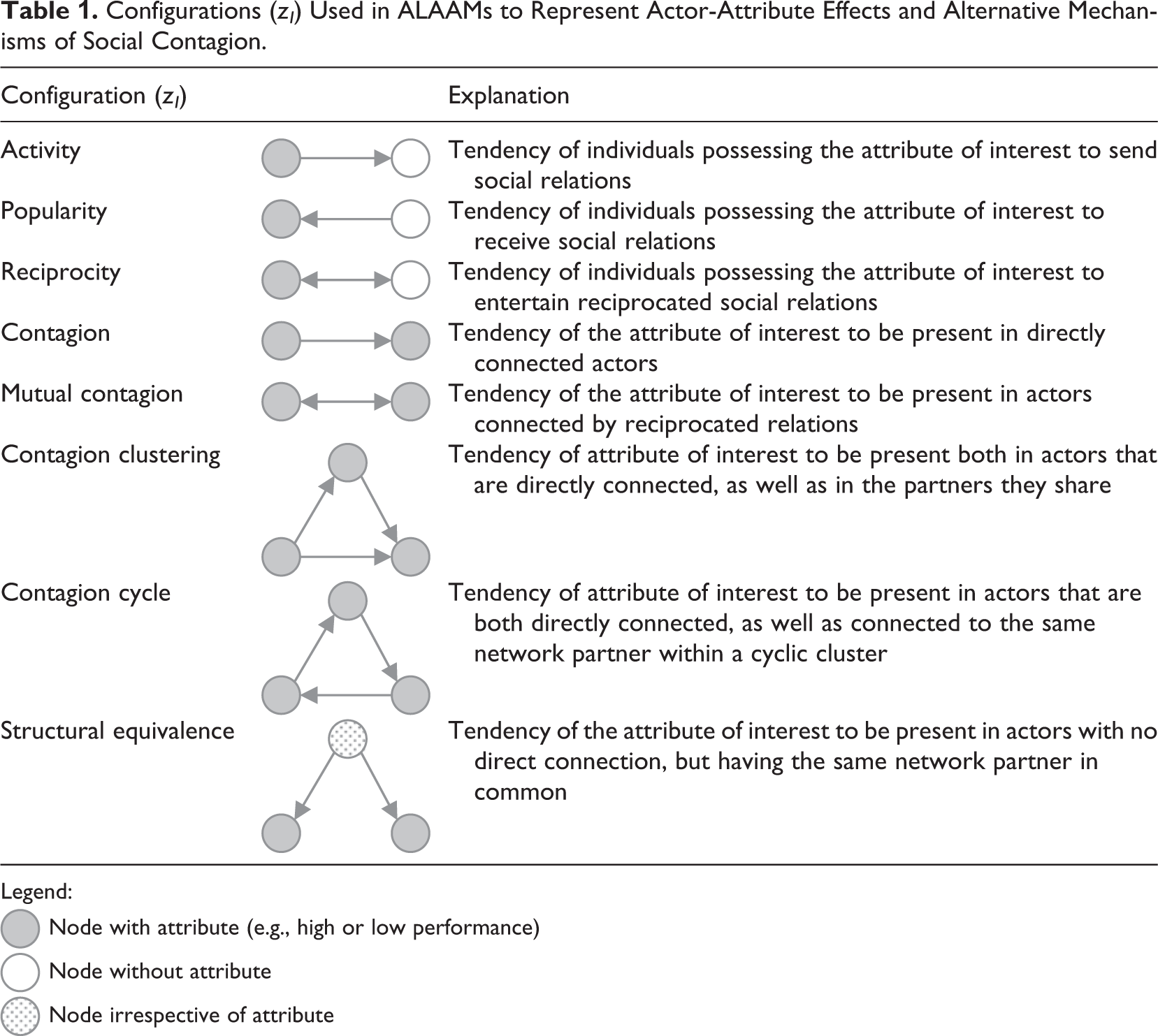
Legend:
 Node with attribute (e.g., high or low performance)
 Node without attribute
 Node irrespective of attribute
When developing ALAAMs we suggest including parameters, such as the configurations outlined above, based upon theoretical considerations. In addition, descriptive statistics and visualizations of the network may provide useful guidance as they reveal the extent to which there are isolated nodes, reciprocal ties and distinctive degree distributions, such as certain actors having a high number of incoming (Popularity) or outgoing ties (Activity). Where these are notable, it is useful to include them as starting parameters. Furthermore, it is important to take into account covariate effects that are an important part of the relational social setting within which contagion of behaviors might occur. For example, there are demographics of individuals such as gender, age or organizational tenure that might influence the extent to which actors exhibit a behavior. Likewise, covariate matching variables should be included if ties that might influence behavior are likely to form, for instance, between individuals being in the same location (Reagans, 2011) or instances of homophily such as having the same gender (McPherson et al., 2001).
Empirical Illustration
Educational Settings as Organizational Settings
Educational settings are organizational settings where students are core organizational participants. Their performance and the social relations they develop with peers significantly affect their career choices (Kilduff, 1990; Robertson & Symons, 2003). Their academic performance, and their participation depend on a complex mix of individual achievement, collaboration with others, and status emerging from social interaction (Coleman et al., 1966; Stadtfeld et al., 2019; Torlò & Lomi, 2017). In the empirical illustration that we develop, we do not examine a random sample of students, but a cohort of graduate students in management. In other words, we examine a convenience sample of managers-in-training. Claiming that the results of the illustrative analysis we present extend immediately to work settings would probably be overstating our case. However, it is not unrealistic to think that management students will eventually bring with them to their jobs at least part of what they have learned during their academic experience about patterns of socialization with their peers and potential competitors.
With their distinctive tension on individual achievement and socialization (Akerlof & Kranton, 2002), educational settings are particularly appropriate for developing and testing hypotheses about social contagion. Academic performance has been shown to be partly based on an individual’s peers (Coleman et al., 1966; Robertson & Symons, 2003). There has been a tendency to examine whether average test scores of people in the same dormitory influence a student’s own test scores, or whether introducing high or low achievers into a classroom influences average test scores (Sacerdote, 2011). These studies, however, do not explicitly model how contagion of performance can occur through an individual’s network. We draw from research in organizations to examine how the people an individual goes to for advice can influence their performance (Cross & Cummings, 2004; Sparrowe et al., 2001). While most studies focus on the contagion of high performance we suggest that there may be differences between the contagion of high and low performance through advice networks. In the specific context of educational settings, Rambaran et al. (2016) have argued and shown that peer influence may be positive as well as negative. In organizations, diffusion of positive as well as negative influences is routinely produced by superstitious learning—a kind of dysfunctional subjective learning experience taking place when “connections between actions and outcomes are misspecified” (Levitt & March, 1988, p. 325).
We focus on advice relations because extant research has consistently shown that both in educational as well as organizational settings knowledge sharing and social influence both travel through advice networks (Borgatti & Cross, 2003; Cross et al., 2001; Lomi et al., 2011). We examine four types of contagion: direct dyadic contagion, direct triadic contagion, reciprocal contagion, and contagion through structural equivalence. While existing research suggests that contagion of performance through advice networks is likely to occur, we have no a priori reason to hypothesize which contagion configuration is most likely to occur, therefore we include each of the configurations.
Setting
We collected data on 139 graduate students enrolled in a two-year, full-time Master in Management program. The class consisted of a highly international group of students, with different academic backgrounds, and a variety of prior work experiences. The data were collected during a first year course in the two-year graduate program. The students completed an on-line survey instrument designed to elicit information on their advice relations. The response rate and the quality of the information provided were carefully monitored during the data collection process. General and personal reminders were sent to respondents when inconsistencies, duplications, or missing data in the questionnaires were discovered during the data collection process. Students were fully informed about the nature and objectives of the study, and could decide freely whether to participate. The response rate was 100%. Six students eventually dropped out from the master program and were excluded from the analysis. The final sample includes 133 students.
The questionnaire included sections on demographics and network questions. Information was also collected on students’ academic performance in the midterm exam, final exam, and overall course grade. The age range was 21-38 years (M = 23.71) with 67.7% women. The students came from 32 countries and had varied academic backgrounds with 38.3% having undergraduate degrees in arts and humanities, 59.4% in the social sciences and management, and 2.4% in sciences and engineering.
The primary goal of the analysis reported in this article is to ascertain whether and how network-based contagion occurs for high levels of performance as well as for low levels of performance. We compare the two models for high and low performance, with the purpose to identify similarities and differences in social contagion mechanisms. Previous research on peer effects in education has tended to focus on assimilation toward group average outcomes (Lomi et al., 2011), and to identify peers based on random assignment of students to a-priori groups, such as classmates or roommates (Sacerdote, 2011), rather than on the basis of deliberate social selection choices (Arcidiacono et al., 2012). ALAAMs are not models for social selection, hence they do not model network formation. The network preexists behavioral outcomes. Therefore, the effects of contagion mechanisms are conditional on a network that is nonstochastic, that is, already observed when individual behavioral outcomes are recorded. Data used in previous studies using ALAAMs has tended to be collected at one point in time. We suggest that it is preferable that data used in ALAAMs be based on a research design that allows observation of the independent variable (the network) to precede observation of the dependent behavioral variable (the attribute of interest).
Data
In the empirical illustration that we present, the individual behavioral outcome—or more generically, the “attribute” of interest is academic performance, as measured by the student’s overall grade in the course they attended. The grade was based upon a midterm exam and a final exam held at the end of the course, and was calculated by computing the weighted average of the two grades. Information on social relations among the students was collected one week before the midterm exam. 4 We focus on advice relations among the students because prior research instructed us of the instrumental value of knowledge and information shared and exchanged thorough advice relations—and the implications of these knowledge flows for individual task performance (Gibbons, 2004). Prior research has also shown the specific relevance of advice relations in educational settings (Kilduff, 1990; Torlò & Lomi, 2017), and their impact on the academic performance of individual students (Baldwin et al., 1997; Smith & Peterson, 2007).
We collected social networks data through the well-established roster method (Kilduff & Krackhardt, 2008). Participants were asked to answer the following question: “Please indicate the names of your classmates to whom you would go for help and advice on course-related issues. Examples of possible issues for which you might seek help and advice from your classmates include the need for notes about a class you have missed, help with course material that you find unclear or hard to understand, or borrowing books and other course-related materials.” Respondents were presented with a complete list of names in alphabetical order (by last name) and asked to check the box next to the classmates they went to for advice. Figure 1 shows a graphical representation of the resulting advice network.
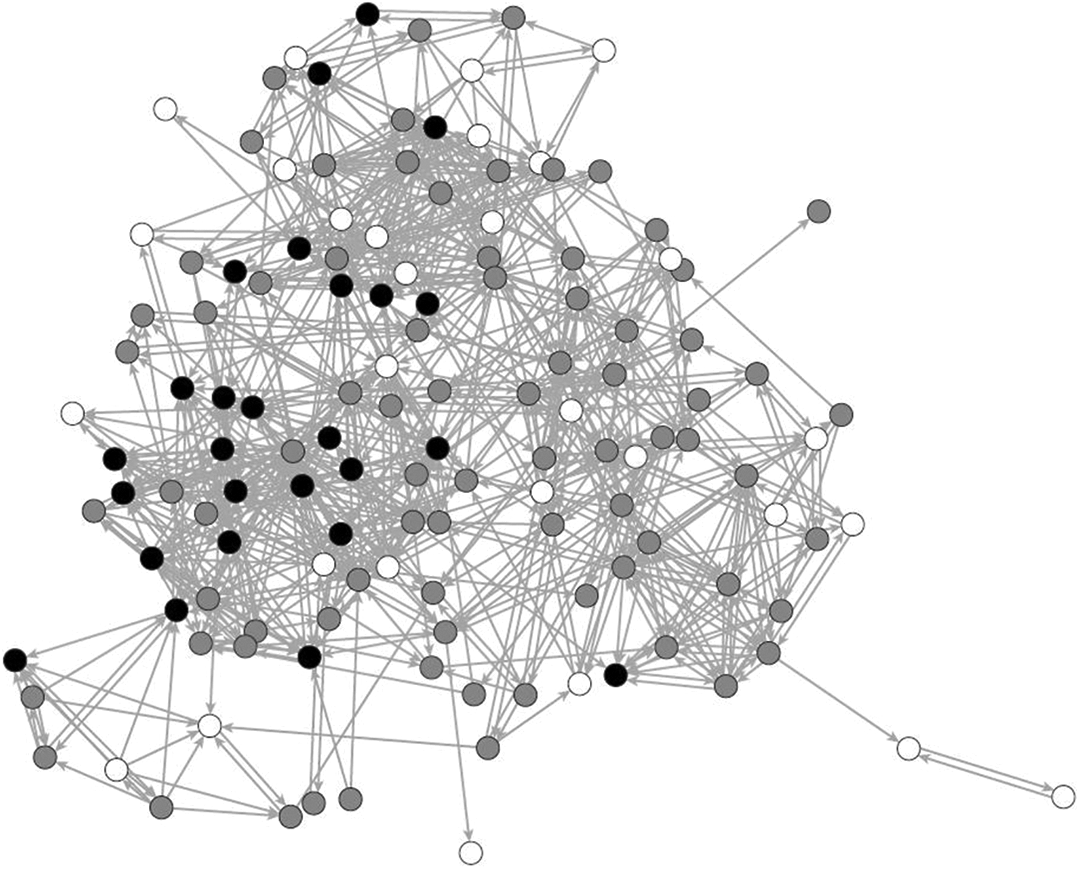
Network of Advice Relations.
The color of the nodes indicates performance levels, with high-performing students represented by black nodes, low-performing students by white notes, and the remaining students by grey nodes. The advice network has 817 advice ties, 53% of which were reciprocated. The density of the network (i.e., proportion of existing ties relative to the total possible ties) is .05, a value consistent with those reported in similar studies (e.g., Torlò & Lomi, 2017). On average, students ask for advice to six of their classmates. The standard deviation of the number of outgoing ties from a student (4.83) is greater than that of the number of incoming ties to a student (3.79), suggesting that asking for advice is common, but being asked for advice is more selective, that is, confers centrality to a more restricted set of students (nodes in the network). In other words, many students ask advice, but fewer students are being asked. The clustering coefficient suggests that in 29% of the cases, two students who have an advice tie with the same student are also directly connected to each other. The measure of geodesic distance, that is, the average number of links between any two students, indicates that students are, on average, four steps away from each other. In other words, any two students in the network selected at random are expected to be connected through three intermediaries. While the extent to which the students are embedded in the network of advice relations varies, no student is an isolate, that is, disconnected from the network.
Finally, Figures 2a and 2b show the networks of advice relations among high-performing (Figure 2a) and low-performing students (Figure 2b). The network of the high-performing students is denser and more clustered, whereas the network for the low-performing students is sparser and significantly more fragmented.
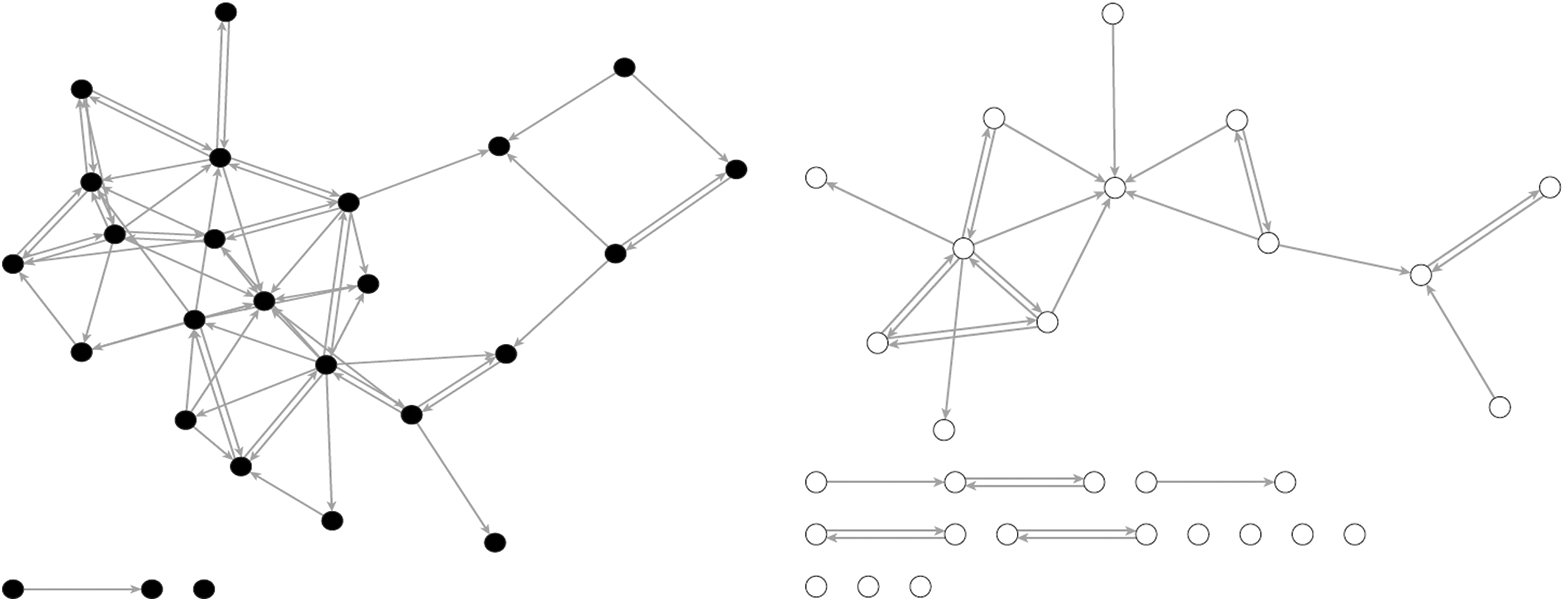
Networks of Advice Relations Among High-Performing Students (Figure 2a, Left) and Low-Performing Students (Figure 2b, Right).
Variables and Measures
ALAAMs specify how network ties and actor attributes jointly affect an outcome variable (more generally, the individual “attribute”) of interest through relational and positional mechanisms that may be driving social contagion. The dependent variable of interest is the probability of observing the presence of an attribute in actors directly or indirectly linked by the relevant network ties. The models estimated in the next section involves specifications that include both network effects and actor-specific attribute effects.
Dependent Attribute of Interest
We started by constructing a binary indicator variable for high performance, which assigned the value 1 to students with grades greater than one standard deviation above the mean (9.19 out of 10 or above), and 0 otherwise. For the illustrative purposes of the application we present, this cut-off point seems to capture well the qualitative differences among students based on the distribution of the measure of their performance. This is the attribute that we use to identify high-performing students. As we were interested in explaining contagion for both high and low performance, we constructed a similar binary indicator variable for students whose grade was less than one standard deviation below the mean (6.71 out of 10 and below). This attribute is used to identify low-performing students. There were 26 high- and 29 low-performing students in the sample. In the empirical part of the study, we examine the propensity of high and low performance to spread through social contact among the students.
Incidence, Network-Attribute Configurations, and Actor-Specific Attributes
Incidence simply reflects the distribution of the attribute of interest in the sample, in our case high or low performance. Network-attribute configurations include Activity and Popularity which indicate the tendency of students possessing the attribute of interest respectively to be senders or receivers of social relations (i.e., to ask or be asked for advice, in our case). Reciprocity indicates the tendency of students with high or low performance to entertain reciprocated advice relations.
Our network-attribute configurations of interest specify alternative, but not mutually exclusive, diffusion mechanisms, including social contagion. The empirical model specification that we estimate includes five different network-attribute contagion configurations that are the focus of our analysis. The first is Contagion proper, included to reveal the tendency of nodes (students) with the same attribute (high or low performance) to be directly connected. When significant, it provides evidence of “epidemiological” diffusion, that is, diffusion through direct social contact. The second is Mutual contagion, included to reveal the association between the presence of the attribute and the presence of reciprocated social relations (advice). The third and fourth types of contagion included in the models capture the possibility that contagion may spread beyond pairs of connected students (dyads). Contagion clustering indicates the tendency of connected students sharing the same alters to attain a similar level of (high or low) performance. Contagion cycle indicates the tendency of directly connected students who are connected to the same alters in a cyclic cluster to attain a similar level of (high or low) performance. In both contagion clustering and contagion cycle, all members of the closed triangles have the same level of performance. Finally, the last type of contagion is Structural equivalence, included to entertain the hypothesis that academic performance spreads between students occupying the same network position with respect to sources of advice, regardless of the presence of direct connections. Structural equivalence may operate independently, or over and above Contagion sustained by direct personal contact (Burt, 1987).
The most distinctive feature of ALAAMs is their ability to incorporate detailed configurations of network ties and the attribute of interest that may reveal specific aspects of social contagion. In actual empirical research, however, it is typically necessary to control for a variety of actor-specific factors that may affect the distribution of the attribute of interest—as demanded by theory, or suggested by prior empirical research. For example, extant research instructs us that academic performance of students in graduate business programs may be affected by a number of sociodemographic characteristics of the students (Eddey & Baumann, 2009; Lomi et al., 2011; Ren & Hagedorn, 2012). Descriptive statistics of the control factors are included in Table 2.
Variables, Descriptive Statistics, and Correlations (N = 133).
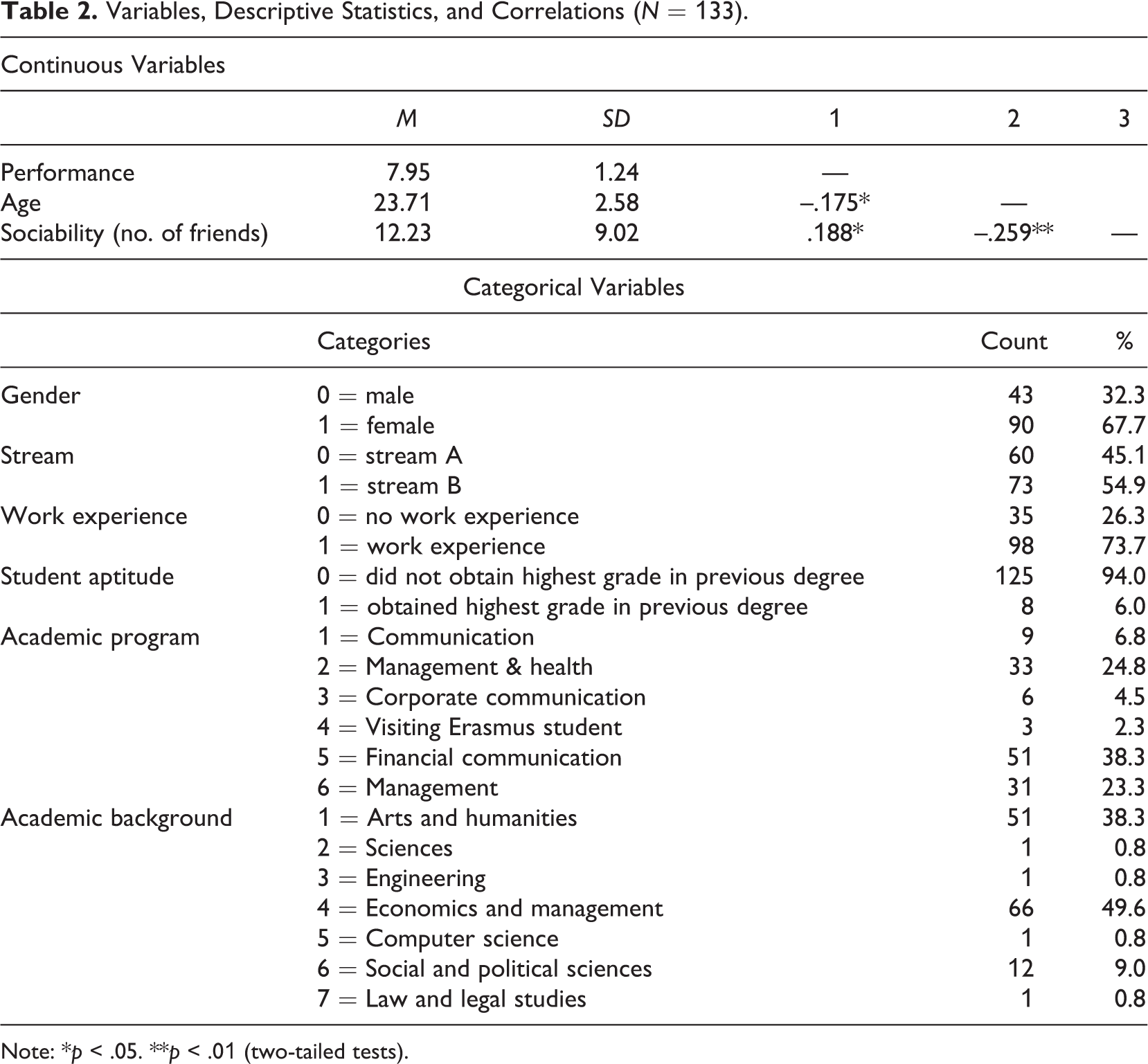
Note: *p < .05. **p < .01 (two-tailed tests).
We control for the Age of the students measured in number of years, and for Gender—an indicator variable coded as 1 for females, and 0 for men. At the beginning of the class, students were randomly assigned to two streams. We created a binary variable to control for membership to Stream A = 0 and B = 1. We control for whether a student has Work experience. This is a binary variable coded as 1 for students with work experience and 0 otherwise. We control for prior academic performance at undergraduate level by creating the variable Student aptitude taking the value 1 if the student graduated with the highest possible grade, and 0 otherwise. 5
We also include three control factors that allow us to account for characteristics of network partners that could be associated with academic performance. First, we control for Same academic program as a matching variable for both outgoing ties (sender) and incoming ties (receiver) to take into account the likelihood of people on the same academic program having advice ties that influence their academic performance. Same academic program = 1 when there is a match and = 0 when the programs do not match. The academic programs students are enrolled in are Communication, Management & Health, Corporate Communication, Visiting Erasmus student, Financial Communication, and Management. Second, we include Same academic background as a matching variable for both outgoing ties (sender) and incoming ties (receiver). This controls for the likelihood of people with the same academic background seeking or receiving advice from each other. The students’ academic backgrounds are Arts and Humanities, Sciences, Engineering, Economics and Management, Computer Science, Social and Political Sciences, and Law and Legal Studies. Finally, we also control for the possibility that Sociability affects academic performance by creating a variable recording the number of friends that each student identified among their classmates.
As mentioned previously, in the absence of any network effect, an ALAAM model specified to include only actor-specific covariates (e.g., age, gender, stream, work experience, and student aptitude) is equivalent to a standard logistic regression model for independent observations. The observation that logit models assuming independent observations (i.e., with no network effects) are nested in ALAAMs allows us to treat the former as null models for the latter.
Model Estimation and Evaluation
Like ERGMs from which they derive, ALAAMs parameters may be estimated only by stochastic approximation methods based on Markov chain Monte Carlo (MCMC) maximum likelihood (Kalish, 2020; Koskinen & Snijders, 2013; Snijders, 2002; Snijders et al., 2006). Recourse to stochastic approximation algorithms is necessary because the model contains an intractable normalizing constant that prevents exact computation of the likelihood (Amati et al., 2019).
To produce the results reported in the next section we relied on MPNet (Wang et al., 2014), a specialized software for the analysis of multilevel ERGMs that may also be used to estimate parameters of ALAAMs. 6 Stochastic approximation in MPNet is based on the Robbins-Monro algorithm (Robbins & Monro, 1951). If statistically significant, a possible interpretation of parameter estimates is as a probabilistic tendency of the corresponding configuration of network ties and attributes to occur in the data more frequently (if the estimate is positive) or less frequently (if negative) than it would otherwise be expected by chance alone. For consistency, it is important to note that the interpretation of parameter estimates in ALAAMs should adhere to the interpretation of tie-oriented models like ERGMs from which they derive (Block et al., 2019). This is the line we follow in our discussion of the effect of competing mechanisms of social contagion embodied in the configurations introduced earlier in the text and summarized in Table 1.
When we ran our models in MPNet (Wang et al., 2014) we attained convergence relatively quickly. Acceptable convergence of the Robbins-Monro algorithm occurs when the expected values of a parameter are close to the observed values. Acceptable convergence for a parameter occurs when the difference between the expected and observed values when divided by the variation gives a convergence statistic (t-ratio) of less than 0.1. In the model all parameters need to converge. If they do not then updating the model with the previous parameter estimates and rerunning can often bring about convergence. This can be automated by setting the maximum number of estimation runs to more than one. Other options include increasing the multiplication factor, especially for larger networks (see Wang et al., 2014, for additional details). Lack of convergence can also be due to poor model specification. Degeneracy in both ERGMs and ALAAMs occurs when the model cannot be fitted to the observed data, for example when a model includes an effect that is not observed in the data, such as including an effect for isolates when there are no isolates (Koskinen & Snijders, 2013).
When convergent estimates can be obtained, it is possible to use their numerical values to simulate the distribution of networks implied by the model. Any feature of the data that are expressible as a network statistic may be compared to the estimated distribution of that feature that is implied by the model. If a network statistic measured on the data is sufficiently close to the corresponding mean value of the statistic produced by simulation, then we can conclude that the estimated model reproduces the observed data reliably. Parameters not included in the model play the role of auxiliary variables. Comparison of observed and simulated data can reveal the extent to which the fitted model is able to reproduce the effects corresponding to the omitted auxiliary variables. The Mahalanobis distance is used as a summary measure of fit. Smaller distances indicate better fit (Wang et al., 2009).
In the empirical part of the article, we follow this simulation-based analytical strategy to examine the ability of our models to reproduce salient features of the observed data. This simulation-based approach to the goodness of fit of statistical models for networks was originally introduced for ERGMs by Hunter et al. (2008). More recent discussions may be found in Robins and Lusher (2013), Koskinen and Snijders (2013) in the context of ERGMs, and Lospinoso and Snijders (2019) and Wang et al. (2020) in the context of stochastic actor-oriented models (SAOMs). Zappa and Lomi (2015) present a practical example of this general simulation-based approach to model assessment in the context of multilevel ERGMs.
Analysis
Results
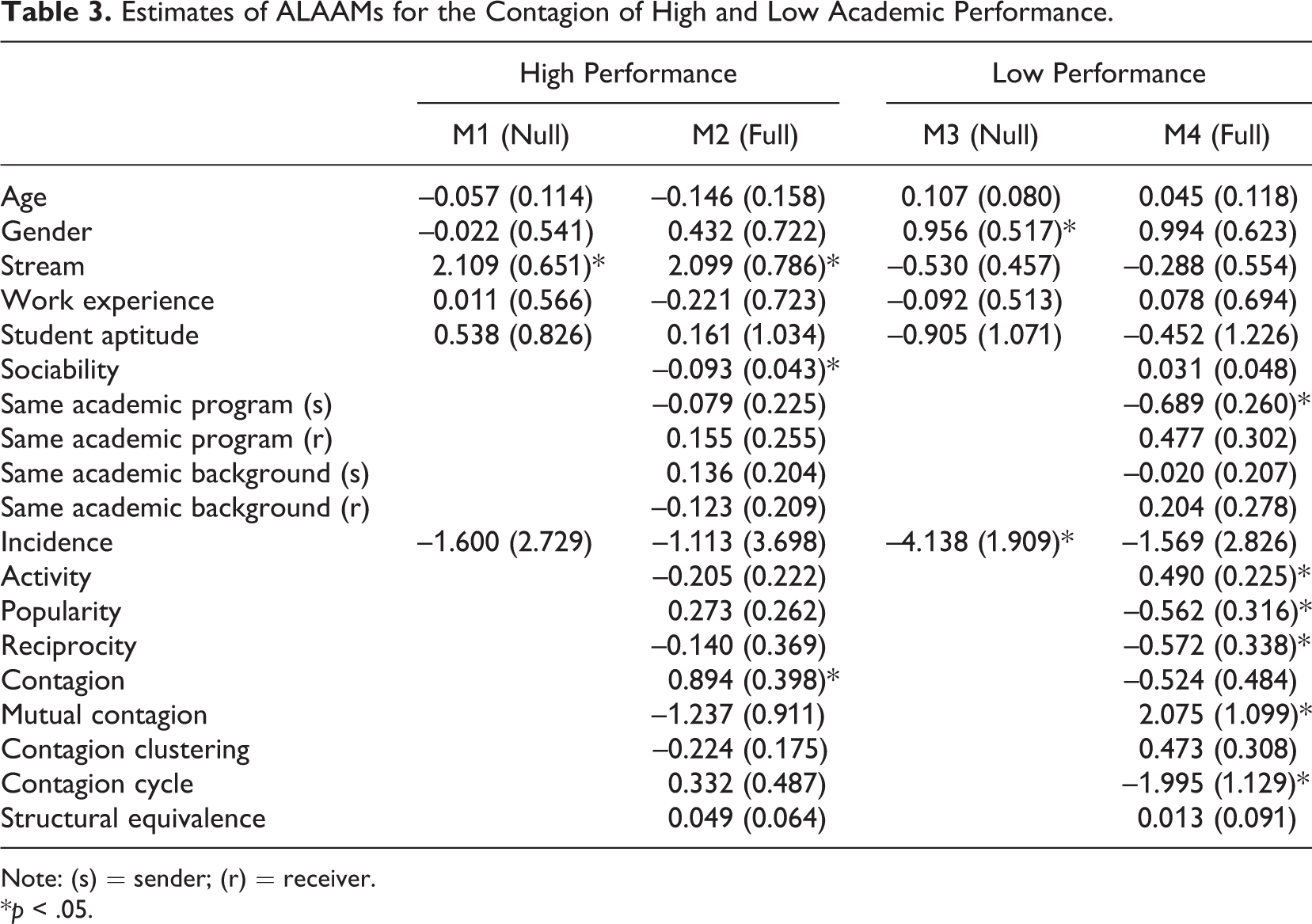
The results are reported in Table 3. Models M1 and M3 represent the baseline models controlling only for attribute Incidence, and the set of student-specific attribute covariates described above. These logit models serve the useful function of “null models” because, unlike ALAAMs in which they are nested, they are based on assumptions of independent observations. Thus, comparing goodness of fit diagnostics (see model evaluation below) allows assessment of the empirical value of relaxing assumptions of independence among the observations in the sample. Our discussion is organized around M2 and M4 (Table 3) which represent the full models for high and low performance, respectively.
Estimates of ALAAMs for the Contagion of High and Low Academic Performance.
Note: (s) = sender; (r) = receiver.
*p < .05.
In both models for the contagion of high performance (M2) and low performance (M4), the Incidence effect is negative as a consequence of the relative rarity of the attribute in the sample. For high performance, there is no significant association between the tendency to ask advice (Activity), to be asked for advice (Popularity) or mutuality (Reciprocity) and academic performance. For low performance, however, students are significantly more likely to ask for advice (Activity): other conditions being equal, low-performing students are approximately 60% more likely to ask for advice (because exp[0.490] = 1.63). In addition, low-performing students are approximately 40% less likely to be asked for advice (Popularity) (exp[–0.562] = 0.57). Low-performing students are also significantly less likely to have a reciprocal tie (Reciprocity).
The estimates provide evidence that high performance diffuses through direct advice relations (Contagion): on average the odds for a student to have high performance increase by over 140% when they receive advice from a high-performing peer (because exp[0.894] = 2.44). High performance does not spread through reciprocated relations (Mutual contagion), and does not seem to spread beyond direct personal interaction through clusters involving more than two students (Contagion clustering and Contagion cycle). Contagion through direct social contact dominates contagion through jointly occupied advice network positions (Structural equivalence).
The contagion of low performance happens through a distinctively different mechanism (M4 in Table 3). Individual performance is dragged down by relations with low-performing peers, but only when such relations are reciprocated. In other words, low performance spreads through Mutual contagion: on average, a student entertaining mutual advice relations with low-performing peers sees his or her odds of having low performance increase by approximately a factor of seven (because exp[2.075] = 7.96). No such effect was found in the model for the diffusion of high performance, so it seems that contagion of high and low performance is associated with detectably different social structures. Finally, there is a significant negative effect for Contagion cycle, indicating that contagion of low performance does not occur within closed triangles (or “clusters”).
The estimated parameters of control variables are generally statistically weak. Exceptions include individuals in Stream B who are significantly more likely to attain higher levels of performance than those in Stream A. A significantly negative association is found between high-performance and Sociability, as measured by the self-reported number of friends, and between low performance and Same academic program for outgoing ties. We note that Gender is significant in the null model (M3) but not in the full model (M4). Female students are more likely to have a low level of performance only if their embeddedness in the network of advice relations with peers is not accounted for (M3 vs M4).
Model Evaluation
In our commentary so far, we have focused the attention on individual parameters because we wanted to learn about potential differences in how social contagion mechanisms work both “upward” (for students with high performance), as well as “downward” (students with low performance). Now we need to probe the model further by examining its ability to reproduce important features of the data. Specifically, we compare the full models (M2 and M4) with null models (M1 and M3). The null models include the attribute Incidence and student-specific attribute covariates and are logit models based on assumptions of independent observations. We use goodness of fit to examine how well the model explains the “incidence” of the attribute in both the null and final models. The test for goodness of fit is critical in the evaluation of whether a model is appropriately specified.
For a set of selected statistics, Tables 4a and 4b report the observed (measured) sample values, and their estimates based on a sample of datasets simulated based on the empirical estimates. Our discussion of goodness of fit follows the simulation-based general model evaluation procedure proposed by Hunter et al. (2008) for ERGMs from which ALAAMs derive. A goodness-of-fit (GOF) t-ratio is computed to assess the ability of the models to reproduce salient features of the observed data.
The GOF t-ratios are calculated for differences between the statistics describing the observed data and the mean value computed on the sample of simulated data. There is some debate in the literature as to the appropriate t-ratio value for unfitted parameters. Robins and Lusher (2013) suggest the t-ratio should be less than two in absolute value for unfitted parameters (i.e., for parameters corresponding to auxiliary variables not included in the model). Kashima et al. (2013) and Daraganova and Pattison (2013) use one instead of two as a threshold for parameters of auxiliary variables. We have opted to use 1.645 as this signifies statistical significance at the 5% level (one-tailed test). When the t-ratio of an unfitted parameter is below 1.645, the null hypothesis that the observed data and the data simulated based on empirical estimates are the same cannot be rejected. The conclusion would be that the observed statistic is not unusual in the simulated distribution or, in other words that the model reproduces with accuracy the specific feature of the data summarized by the statistic. The model fit would not improve by fitting the excluded parameter. For fitted parameters (i.e., for parameters corresponding to variables included in the model) a GOF t-ratio smaller than 0.1 is typically considered as a reliable sign of good fit (Robins et al., 2009).
Table 4a reports the GOF diagnostics needed to assess the fit of the model for the contagion of high performance (M2 in Table 3). The auxiliary statistics are selected for illustrative purposes to demonstrate the ability of the fitted model both to capture and to miss the effects of auxiliary variables omitted from the model specification. In-2 star and Out-2star are associated with the tendency of high-performing students to entertain nonexclusive advice relations with their peers (receive from, and ask to multiple others, respectively). Brokerage is associated with the tendency of the best students in class to occupy intermediary positions in the network of advice relations, that is, to be connected to peers who are not themselves directly connected. Finally, Balance captures the tendency of the best students in the class to provide advice to the same peers. Thus defined, Balance may be viewed as a form of structural equivalence in outgoing ties that complements the effect of Structural equivalence in incoming ties already included in the model.
Contagion of High Performance: Goodness-of-Fit (GOF) Diagnostics and Model Comparison (shaded cells highlight problems of fit).
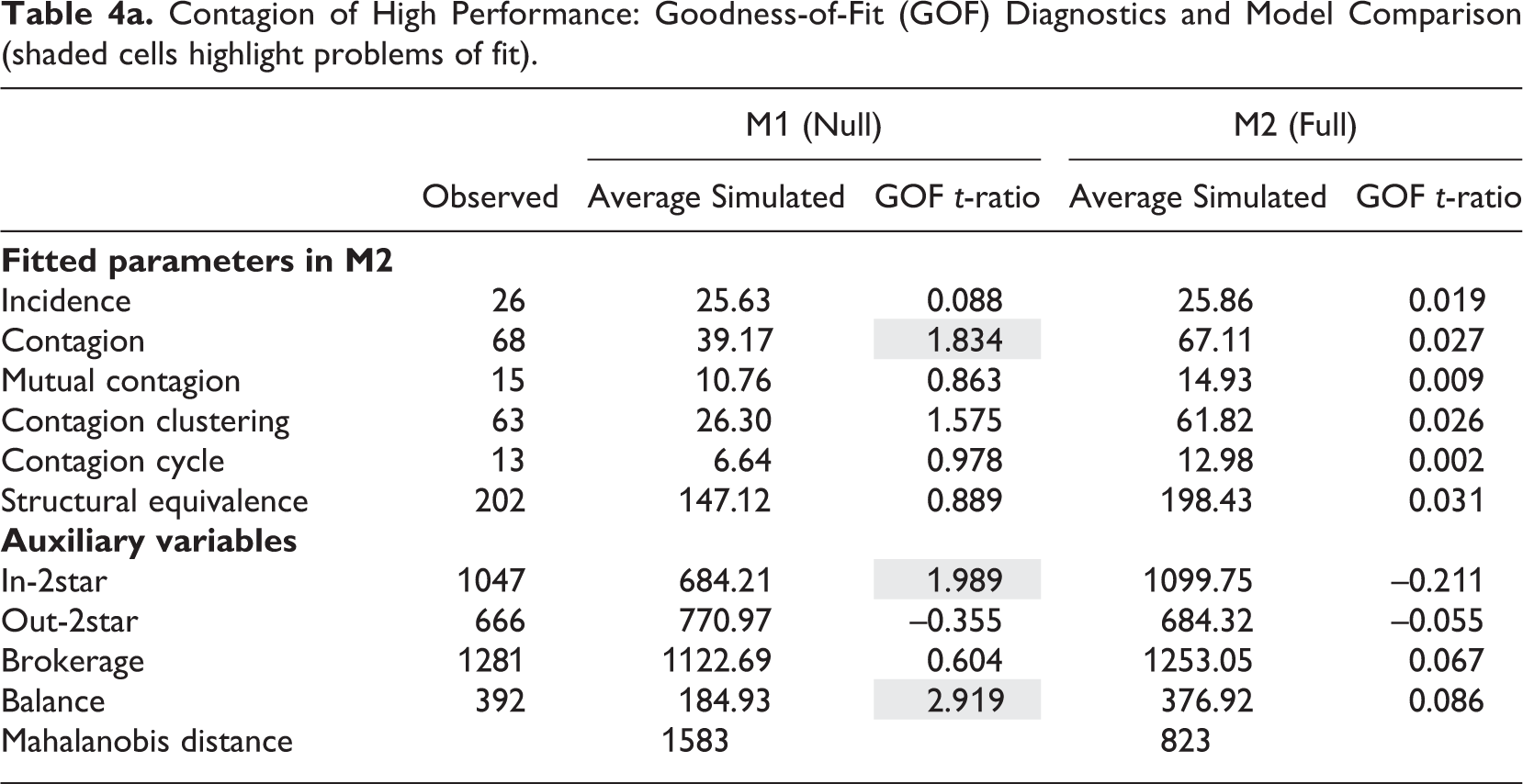
In Table 4a, the shaded cells highlight the parameters that are not well captured in the model in its current specification and that suggests specific opportunities to improve the ability of the current model to reproduce the data accurately. For example, in the null model (M1) the GOF t-ratio for the Contagion parameter is above 1.645, which suggests that the null model is not capturing these effects. In addition, the t-ratio for Contagion clustering parameter is also very close to 1.645. The ALAAM specification in the full model (M2) seems to fit the data reasonably well. The GOF t-ratios associated with the covariates included in the full model (M2) are below the 0.1 threshold. The In-2 star and Balance auxiliary variables not included in the model have GOF t-ratios above 1.645 in the null model (M1), but they are well below 1.645 in the full model (M2), suggesting that the model for the diffusion of high performance fits all the auxiliary effects.
Table 4b reports the GOF diagnostics needed to assess the fit of the model for the contagion of low performance among the students (M4 in Table 3). The GOF t-ratios for all the parameters included in the full model (M4) are comfortably below the recommended 0.1 threshold indicating reliable fit. We note, however, that the null model (M3) already seems to fit the contagion parameters omitted from the model with none of the GOF t-ratios above 1.645. However, two of the auxiliary variables in the null model (M3) are more than 1.645. In the full model, the parameters associated with the auxiliary variables omitted from the model are all well below 1.645 indicating that the full model does a good job at capturing the effect of mechanisms that are not explicitly fitted. This could happen because these mechanisms (nonexclusivity and brokerage) operate at least in part through the mechanisms that are already represented explicitly in the model.
Contagion of Low Performance: Goodness-of-Fit (GOF) Diagnostics and Model Comparison (shaded cells highlight problems of fit).
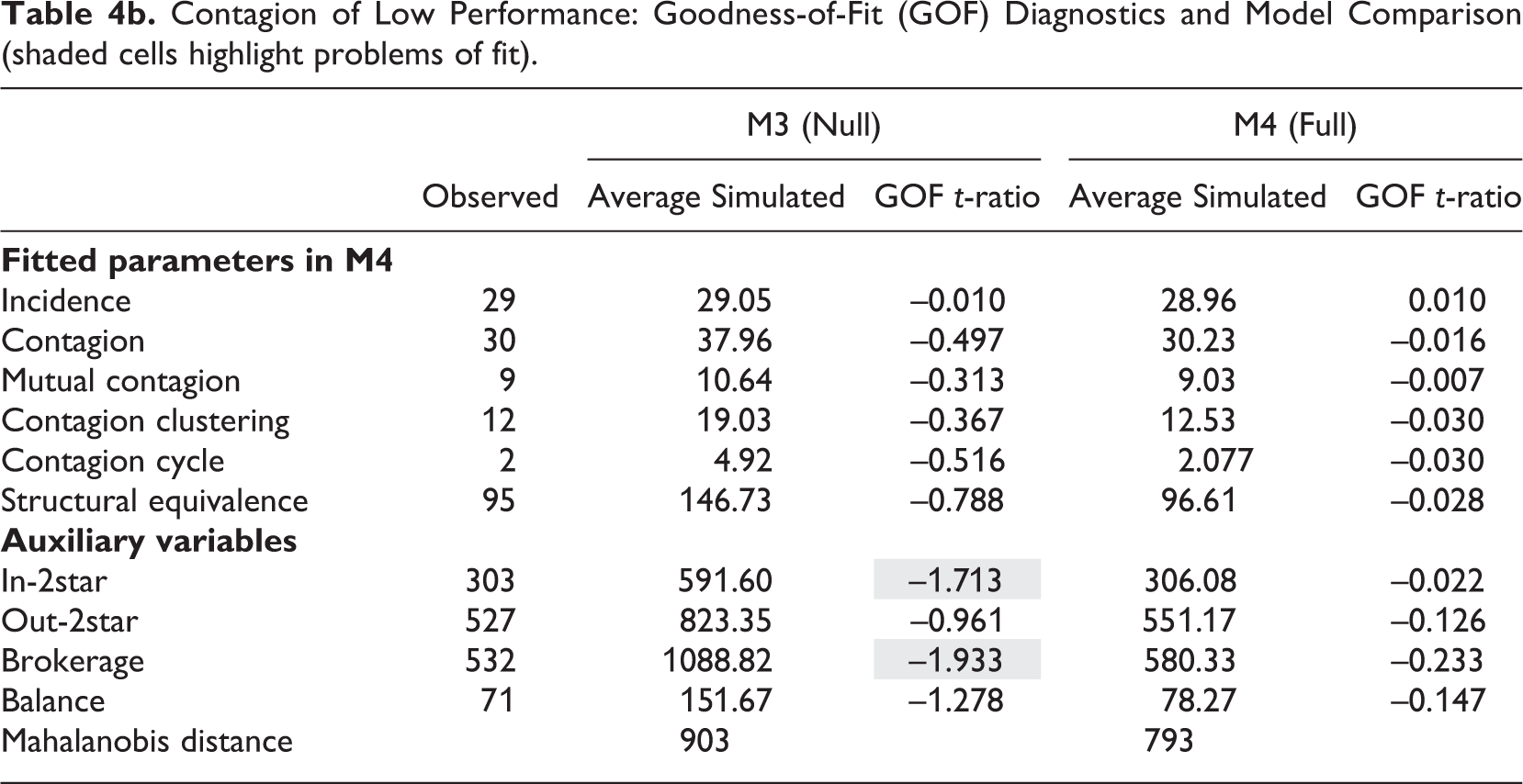
In closing, we again attract attention to the fact that the full models for contagion accounting for some of the complex dependencies present in the data systematically outperform their baseline models that assume independence of the observations. In the specific case we are examining, the full models do not significantly outperform the corresponding null models over all possible dimensions. For example, null and full models produce similarly accurate estimates of the baseline incidence parameters for high and low performance among the students in the sample. Mechanism-oriented models like ALAAMs, however, require and afford more detailed comparison. As the figures reported in Tables 4a and 4b clearly demonstrate, estimates of models assuming independence among the observations (M1 and M3) can systematically fail to reproduce some of the most important features of the data. The null and full models for the contagion of low performance (Table 4b) make comparably accurate predictions for the attributes of interest in the sample. However, the null model that assumes independent observations in the case of high performance (Table 4a) grossly underestimates the strength of contagion in the sample (68 Contagion configurations observed, and only approximately 39 predicted by the null model). On average, however, the full model accounting for patterns of network dependence predicts virtually the same number (67) of Contagion configurations that are observed in the sample—configurations involving two high-performing students linked by a direct advice relation.
The Mahalanobis distance estimate reported as a global measure of goodness of fit at the bottom of Tables 4a and 4b provide a heuristic summary measure of fit of the models (lower values represent a better goodness of fit). These global measures of fit provide qualitative support to the claim that (full) models accounting for network dependencies present in the data outperform their corresponding (null) models assuming independence among the observations.
Discussion and Conclusions
The concept of contagion has long transcended the narrower boundaries of its epidemiological origins (Ugander et al., 2012), to be adopted more generally to examine a wider range of social phenomena involving diffusion through networks of social contacts (Berry et al., 2019). In organizational and management research, the notion of social contagion has found broad application, from studies of how social networks affect individual intentions, perceptions and behavior within organizations (Felps et al., 2009; Kilduff & Krackhardt, 1994; Krackhardt & Porter, 1985; Tröster et al., 2019), to studies on the allocation of attention (Rao et al., 2001), and the role that interorganizational networks play in the emulation, adoption, diffusion, and abandonment of strategies, technologies, practices, organizational forms, performance, and institutional logics (Fligstein, 1985; Gibbons, 2004; Greve, 1995; Pallotti & Lomi, 2011; Shipilov et al., 2010; Strang & Meyer, 1993). However diverse are the empirical guises in which they appear, contagion processes share the same set of conceptual difficulties inherent in the statistical modeling of data characterized by complex dependencies linking the observations (Robins & Pattison, 2005).
Autologistic actor attribute models that we have discussed in this article are a class of cross-sectional network models specifically engineered for the analysis of social contagion—or diffusion through social contact. The main objective of ALAAMs is to characterize the distribution of an individual outcome (or attribute) while accounting for the possibility that the outcome (or attribute) may have nonindividual components, that is, may be affected by the network of social relations that individuals construct—and in which they are embedded.
The unique analytical advantage offered by ALAAMs is the flexibility they afford in specifying multiple mechanisms of social contagion that may then be framed as rival hypotheses to be tested on appropriate data. This feature distinguishes ALAAMs from alternative social influence models based on network autocorrelation that have one single generic parameter to represent social influence (Doreian et al., 1984; Leenders, 2002). ALAAMs are probabilistic models and, unlike mathematical models for social influence (Friedkin, 2006), they may be linked naturally and directly to empirical data.
In an illustrative study of social networks and academic performance in a cohort of graduate management students, we found that the diffusion of high and low performance involves different mechanisms of social contagion. Specifically, we found that high performance diffuses through direct contact among the students. As such, contagion of high performance does not propagate beyond a narrow range of direct contacts. Diffusion of low performance is encouraged by strong ties (mutual contagion). We think these results illustrate well the new analytical possibilities that ALAAMs offer not only to model social contagion within and between organizations, but also to distinguish among rival hypotheses about the mechanisms driving contagion, and to document asymmetries in contagion processes.
However innovative and potentially promising, ALAAMs are not without limitations. Three, in particular, deserve mention in this concluding section. The first is that, for the moment at least, ALAAMs are only available for binary attribute variables. This is a constraint that ALAAMs inherited from ERGMs from which they derive (Robins et al., 1999). The extent to which this constraint is an actual limitation depends on the possibility of mapping observed behavioral outcomes onto a binary indicator variable. Outcomes of interest may be naturally binary. This happens when actors occupy discrete and mutually exclusive states like, for example, change or remain in the current residential neighborhood (Schelling, 1971), leaving a job or keeping it (Krackhardt & Porter, 1985), wearing or refusing to wear protective gear (Schelling, 1973). Binary outcome variables are also common in studies of diffusion, where actors decide whether to adopt or abandon technologies, practices, norms, or strategies. More generally, ALAAMs are directly applicable whenever individual preferences may be reasonably assumed to be defined over binary outcomes. When behavior is continuously measured, assumptions have to be made about how to partition a continuous measure into discrete classes, and this may limit the applicability of the model. We see this limitation as transient, however. Statistical models for networks capable of analyzing valued (Krivitsky, 2012) and continuously measured behavioral variables (Niezink et al., 2019) are progressively becoming available. Extending these results to ALAAMs is possible, at least in principle (Daraganova & Robins, 2013), but it will require a larger community of scholars convinced of the value of ALAAMs as models for social contagion. One objective of this article was to contribute to making ALAAMs more generally known within the diverse community of organizational scholars.
A second limitation of ALAAMs is inherent in their cross-sectional nature. As models for a single observation in time—and similarly to ERGMs—ALAAMs hinge on implicit equilibrium assumptions about the underlying contagion process. However, processes of social contagion are, almost by definition, disequilibrium processes that involve endogenous change and multiple feedback connections between networks and behavior. At most, parameters in empirical ALAAMs may be interpreted as being qualitatively consistent with the underlying mechanisms of social contagion that they represent. As the length of the observation period increases, assumptions that contagion processes unfold while network structures are frozen in time and never change become untenable. SAOMs for the coevolution of networks and behavior have been available for at least a decade now (Steglich et al., 2010). These models are now very well established (Snijders, 2017; Snijders et al., 2017), and are becoming increasingly popular in organizational and management research both in studies of intra (Tröster et al., 2019) as well as interorganizational networks (Amati et al., 2019). One important point to note is that in ALAAMs the network is fixed (exogenous), whereas in SAOMs the network coevolves with behavior (and is therefore endogenous). Because ALAAMs are models for social influence and cannot be adopted to model network change, it is important that the network of social relations assumed to diffuse social contagion be observed at a suitable time before individual behavior is recorded. The amount of time between observation of the network and its effect on some aspect of individual behavior is not well researched and deserves greater attention. Our view is that the credibility of future empirical applications of ALAAMs will be strengthened in studies where observed social networks may be reliably interpreted as proxies for longer-range, enduring relations among actors (Freeman et al., 1987).
A third limitation of ALAAMs deserving consideration is their current inadequacy for the analysis of very large samples—a limitation once again inherited from ERGMS. Progress in snowball sampling methods for networks on the one hand (Stivala et al., 2016; Stivala, Gallagher, et al., 2020), and algorithmic innovation on the other (Byshkin et al., 2016; Stivala, Robins, & Lomi, 2020), represent future directions that promise to alleviate this specific constraint, and contribute to make ALAAMs more generally applicable to large datasets obtained from sampling open populations of interdependent social actors.
Footnotes
Notes
Declaration of Conflicting Interests
The author(s) declared no potential conflicts of interest with respect to the research, authorship, and/or publication of this article.
Funding
The author(s) received no financial support for the research, authorship, and/or publication of this article.

References
Supplementary Material
Please find the following supplemental material available below.
For Open Access articles published under a Creative Commons License, all supplemental material carries the same license as the article it is associated with.
For non-Open Access articles published, all supplemental material carries a non-exclusive license, and permission requests for re-use of supplemental material or any part of supplemental material shall be sent directly to the copyright owner as specified in the copyright notice associated with the article.
