




Abstract
Most interpretive experiences occur in the leisure sector suggesting interpreters must provoke future engagement rather than compel future engagement. Consequently, the potency of the ending of interpretive presentations seems critical to motivating future and ongoing engagement among heritage site visitors. The quality of the conclusion of an interpretive program is likely to play a disproportionate role in whether audience members continue to explore their ongoing or developing interest. Yet conclusions are probably not equally effective. There are several known, and many more yet unrecognized methods for designing conclusions. A preliminary typology of novel designs well suited for constructing conclusions to heritage interpretation programs is presented.
Keywords
This paper argues that the conclusion of a heritage interpretive experience is the key strategic component in personal interpretation. A conclusion’s effectiveness can be partially judged by whether it motivates audience members to continue thinking, discussing with others, and acting after the program. This article extends textbook descriptions of conclusion strategies and provides a theory-informed justification for the importance of conclusions. Illustrated in this article is the value of making explicit the theoretical why-how explanations for interpretive techniques.
Developing Defensible Professional Judgment
By using psychology and related fields to argue why the ending of an interpretive experience is the critical part of a traditional interpretive experience, we challenge ourselves and other interpreters to invest creative energies in developing provocative conclusions. Our approach recognizes that the practice of interpretation at any given moment is a complex phenomenon with varying and often unpredictable outcomes. In conducting programs, interpreters apply implicit (tacit) and explicit strategies based on differences in audiences, settings, unpredictable situations, varied personal and professional experiences, type(s) of formal education, personality, motivations, philosophies, goals, etc. (Powell & Stern, 2013). Elucidating the why and how of conclusions is presented here to motivate diversity of practice by interpreters rather than prescribe a rote method (Patton, 2017; Pfeffer & Sutton, 2000). Our goal is to help interpreters explicitly articulate to themselves, peers and bureaucrats why they choose specific approaches.
Interpretation is Provocation not Education
Interpretation is not an educational service although it certainly provides opportunities for informal learning. Tilden (1957/2009), the William James of Interpretation, penned an entire chapter entitled “Not Instruction but Provocation” in his seminal work “Interpreting Our Heritage.” He carefully makes the distinction between education and provocation. The National Association for Interpretation carefully avoided the term “education” in its social psychology-based definition, instead referring to interpretation as a “. . .communications process. . .” (Brochu & Merriman, 2008). Unlike environmental/conservation and formal education lessons that are typically designed with specific quantifiable learning objectives, interpretation respects if not champions the autonomy of visitors to create their own meanings from program content (Brochu & Merriman, 2008). As leisure activities, interpretive programs do not require, nor could they require of attendees any of the assignments associated with formal education such as readings, term papers or tests based on specific learning objectives. Audiences arrive at public interpretation programs with a variety of goals, none of which involve passing a test (Stern et al., 2011). Consequently, interpretation must pay special attention to developing communication strategies that provoke spontaneous thought, discussion, surprise, rumination and action within and between audience members. Unlike simple emotional responses such as awe sometimes used to describe outcomes of interpretation, provocation is a cognitive/emotional response that is future oriented (Ham, 2016). The North American textbooks on interpretive methods are in consensus that provocation is the outcome of heritage interpretation (Beck & Cable, 2011; Buchholz et al., 2015; Ham, 1992, 2016; Knudson et al., 1995, 2003; Lewis, 1980; Ward & Wilkinson, 2006). In the most extensive treatment that we found, Ham (2016) informally observed three clusters of motivations reported by interpreters about what they believe is the goal of interpretation. Education, provocation or entertainment were all reported as desired outcomes, but Ham concludes that realistically the “end game” of interpretation is provocation.
Interpretation is Often a Leisure Activity
Except for school programs, visitors freely choose to visit parks and special places. Freely chosen, intrinsically interesting activities are by definition leisure activities regardless of where or when they occur (Stebbins, 2005). Unlike work and school, almost no one involves themselves in activities they disdain during their leisure time, although there are potential exceptions such as romantic dates or parent(s)-child outings. Most people choosing to visit a heritage place have already developed interest in, if not attachment/love for that special place. A subset of these visitors to parks and special places then choose to attend interpretive presentations. While a majority of audience members do not have the sophistication of the interpreters about the special place they are visiting, their mere presence at an interpretive program is behavioral evidence of some sort of existing interest (Stebbins, 2005; Tinsley & Tinsley, 1986). Unlike formal education, audiences at interpretive programs are rarely homogeneous in age, often composed of multi-age family and friendship groups. Goals for activities during leisure are established by the participants themselves within their informal social group. This is a primary argument for why the learning/meaning-making outcomes of interpretive programs is firmly in control of audience members in terms of what they learn and conclude. Tilden seemed to implicitly understand this distinction and this may be why he referred to the outcome of interpretation as provocation rather than instruction associated with the external control typical of formal educational settings (Tilden, 1957/2009).
Interpretive Experiences can Provoke Future Ruminations and Experiences
Based on research of the life histories of natural history-oriented professionals and hobbyists, no single leisure or educational experience is sufficient to solidify a person’s robust involvement with some aspect of heritage resources. Participants in these studies reported varied, frequent and evolving play, recreation, educational, and vocational experiences from early childhood well into adulthood (James et al., 2010). This socialization scenario relegates any one interpretive program to being just one of many varied and frequent formative experiences that eventually shape a life-long interest in heritage resources. Even when a person has a transformative or peak experience at an interpretive program, that epiphany is a function of a mental re-integration of the current experience with many meaningful previous experiences (Guynn, 2021).
Through the lens of interpretive experiences as part of ongoing socialization, interpreters may choose to design programs that provoke a desire in their audiences to continue their involvement with heritage resources. While Bixler et al. (2011) recommended that interpretive programs include a program-to-program-transition (PPT) to encourage further attendance at upcoming programs, this recommendation seems too narrow. Any casual, informal, nonformal or formal play/recreation/learning/work/volunteer experience with heritage resources can serve to further nurture a person’s growing and expanding interest. What visitors may be attracted to and able to participate in after an interpretive experience is likely to be almost as varied as the meanings they make of an interpretive program. Within the structure of a traditional interpretive program, a strategically designed program conclusion seems well suited for inspiring audience members to continue exploring their interests in ways they choose.
Current Recommendations for Designing Conclusions in the Interpretive Textbooks
Textbooks on interpretive methods were reviewed for instructions on how to construct and deliver concluding statements. Lewis (1980) argues for the importance of conclusions providing diverse suggestions and one caution about how to end the presentation: you can conclude your presentation in a variety of ways. You can summarize your main headings and repeat the theme. Questions can be raised as to what is next, what the future holds. With care not to over-do it, you can assume an inspirational tone and challenge the audience to be appreciative, to take action or whatever seems appropriate. Work to a strong, memorable final sentence and quit. Do not weaken the impact of your last sentence by thanking the group for coming, for their attention. This will divert attention from that last dramatic effective moment. (p. 46)
Knudson et al. (2003) emphasize restating the theme of the interpretive experience in the conclusion and ending on a dramatic high note with a powerful quote or similar content. They echo Lewis’s (1980) concern about not diminishing a strong ending with empty and obvious statements about the program having ended. The objections of Lewis (1980) and Knudson et al. (2003) to noting the program is over, may be a strategy to create a long silent pause for the audience to have the mental space to engage in deeper thoughts. The use of pauses or timing is frequently mentioned in books on public speaking and in creating humorous moments (Donovan, 2014; Nihill, 2016). Ham (1992) also encourages restatement of the theme in the conclusion, along with subthemes, to develop a sense in the audience of “Pragnanz” or completeness—in which the interpreter returns to the theme presented in the introduction. The structure of conclusions is addressed in several places in Buchholz et al. (2015). They emphasize designing a dramatic conclusion and suggest the use of a call-to-action to encourage further after-the-program exploration of the topic of the interpretive experience. Ham (2016) recommends using one or more of three types of conclusions: (1) Recapitulation which involves reviewing the main points of the presentation; (2) Extrapolation which involves encouraging the audience to think about issues beyond the content of the presentation, and: (3) Planting a suggestion which serves to link the content of the presentation to something the audience may encounter long after the program is over. Brochu and Merriman (2012) recommend restating the theme with different wording. Finally, Ward and Wilkinson (2006) agree with other authors about methods, concluding that: There are as many ways to end a presentation as there are presentation styles. Every interpreter has his or her own method of concluding a presentation. There are some things that every conclusion should do and many more things that are appropriate for certain program with specific program goals and particular presenter styles (p. 78)
The textbooks on methods for interpretation largely agree about the importance and design of conclusions. Lewis (1980) and Knudson et al. (2003) suggest not announcing the end of the program, while the other authors suggest thanking the participants for attending the program. Other than this difference and variations in details provided, all authors view well-designed conclusions as critical to program success. Most of the authors recognized that many approaches to the design of conclusions are possible. One available research project documented the effectiveness of conclusions. Introductions and conclusions that were linked in a cohesive manner were predictive of positive visitor evaluations (Powell & Stern, 2013).
Theoretical Descriptions of Components of Interpretive Programs
Despite narrative parsing, the analysis of separate component of stories, being an established area of study (Cutting et al., 2012; Doust, 2017; Doust & Piwek, 2017), remarkably little in-depth research exists on specific components of an interpretive presentation. These types of analysis should directly inform research, evaluation, design and practice. Bixler and James (2014) examined the varying structures of program titles for interpretive programs through a theoretical lens of first impressions, identifying three of many possible structures for program titles and the strategic use of each type of title. Skibins et al. (2012) accumulated and described the existing research literature on interpretation. Few of the articles recognized the varied ways that a specific method or technique of an interpretive program could be designed and implemented.
Theories Suggesting How Conclusions of Interpretive Programs Might Work
Long-Term Memory is About the Future
One of the successes of learning theory and psychological research on memory is an understanding that memory does not serve to accurately recall the past (Martinez, 2010; Schacter, 1999). Memory seems to occur through conceptual reconstruction of events rather than absolute (accurate) recall. This adaptive reconstruction of events functions to address action in the future based on what was learned in the past (Martinez, 2010). For audience members at an interpretive experience, to be able to ruminate, discuss, and act in the future, they must be able to remember at least tacitly some aspects of that experience (Reber, 1989). Provocatively constructed interpretive presentations should enhance recall if an interpretive program can be expected to influence the person beyond the immediate experience of the program.
While long-term memory is often conceptualized as an individual mental phenomenon, it is social (Ross et al., 2010). The audience at a public interpretation program is often composed of a number of discrete same and mixed-age social groups. While memories are typically thought of as residing within the person, memories are both collected, and collective. Persons remember their collective experiences as being essential for personal and group identities and rituals. Groups learn, recall, reshape, renew and forget group-relevant shared cognitions (Hirst & Manier, 2008; Weldon & Bellinger, 1997). Sharing novel events accompanied by their recollection and interpretation is part of maintaining a high level of satisfaction in ongoing social relationships. This implies that shared experiences and their recall and reinterpretation may be more so a means of nurturing relationship (Aron et al., 2000) than simple recall of information for functional purposes. Lastly, memories do not necessarily reside within the person. From a sociological perspective, collective memories are represented outside the person in the exhibits, memorials, museums and other cultural objects central to nations and cultures (Olick, 1999). Later encounters of objects or experiences discussed in an interpretive program may evoke established memories. Lastly, persons do not necessarily internalize complete memories, often depending on cues and objects in the environment to remember processes and details. To fully remember some information, persons must re-encounter the context of previous learning (Martinez, 2010).
These socio-cognitive characteristics of memory logically suggests that a provocative program should result in people remembering to remember something about their previous heritage resource experiences. After an interpretive program, interactions with others and encountering objects associated with experience should lead to further rumination and social transactions stimulated by the shared experience of an interpretive program. Conclusions can be used to strategically help audience members solidify memories of facts and suggest future processes and potential actions.
Emotional Engagement is the Key Ingredient in Remembering and Valuing Information
Recent brain science research has provided insights into human perception and learning. For the purposes of this paper, a discussion of the role of the amygdala in the brain is sufficient. The amygdala (plural, there are two, one in the left, and right lobes of the brain) is not responsible for remembering, rather for automatically/unconsciously regulating the strength of memories based on the emotional significance of the event or information being received by the person (Cardinal et al., 2002). The human nervous system must make sense of what is seemingly important out of the constant, varying and overwhelming stream of information in the socio-physical environment. This process occurs automatically and is based largely on the emotional and novelty of experiences (Lerner et al., 2015; Levine & Pizarro, 2004). This may partially explain why most of us have memories of only a small fraction of the unemotional, logically presented formal education we experience in school (Willingham, 2009). Tilden (1957/2009) and the National Association for Interpretation (Brochu & Merriman, 2015) were serendipitous in recognizing that emotional content plays an essential role in the success of interpretive experiences. “Emotionally relevant” should not be confused with “rationally-relevant.” Humans are quite capable of recalling all sorts of trivial pop culture, while being unable to remember critical civic or health information (Willingham, 2009). The provocation Tilden (1957/2009) referred to is cognitive and emotional in practice.
Serial Positioning and the Peak-End Effect
While emotionally neutral information is far less likely to be recalled, the serial positioning effect informs our argument for the importance of the careful design of conclusions within interpretive programs. The serial position effect describes the ability of the participant in a linear program to recall information based on where along the continuum specific content is experienced. Serial position effect describes a cognitive bias involving the tendency for persons to recall the first (primacy) and last (recency) information in a list more accurately than content in the middle (Broadbent & Broadbent, 1981; Glenberg et al., 1983; Verhoef et al., 2004). Early research on the recency effect often involved the participant reading or listening to a list of objects and later trying to recall the content of the list, but these experiments used information not in a narrative form (Greene, 1986). More recently, the recency effect has been demonstrated to occur during in situ experiences outside of psychology laboratories (Shehu et al., 2016). The recency effect suggests that interpreters should return to critical information that may have been presented in the middle of the presentation as they structure the conclusion to their program. If a conclusion is missing, what would otherwise be the late-middle part of a program will be more easily remembered. The recency effect is one justification for the importance of conclusions, as content from the end of a program is more easily remembered.
During an experience, the peak-end rule asserts that the overall judgment of the experience and what is remembered is dependent on emotion-driven “snapshots” of the experience rather than the unweighted sum of the entire experience. These most salient snapshots are the peak and the end of an experience. This theory puts less emphasis on the start of an experience. Instead the peak of an experience is the most emotionally salient part of the experience along with the concluding moments. Curiously enough, this phenomenon was originally identified through an analysis of the experience of pain during an (old-fashioned) colonoscopy. A colonoscopy that was painful during much of the procedure, but not for a period at the end was remembered as less onerous than a colonoscopy that was only painful right at the end (Kahneman et al., 1993; Reidelmeier & Kahneman, 1996). There have been many replications of this effect in non-medical contexts (Baumgartner et al., 1997; Verhoef et al., 2004) including tourism where the most dramatic activities in multi-day events are strategically scheduled at the end of the experience (Do et al., 2008). The peak-end effect suggests that a poorly constructed ending may results in negative judgments of the interpretive program, even if the entire program went perfectly. Conversely, a well-constructed conclusion may outweigh other shortcomings of an otherwise weak program.
Types of Conclusions
The serial positioning effect and peak-end effect provide a theoretical justification for why interpreters should pay disproportionate attention to the design and delivery of their program’s conclusion. Beyond the presence of a conclusion a further consideration is the design of conclusions. Interpretive programs are probably more effective when a conclusion goes beyond assimilation of the experience to being provocative—encouraging further reasoning, discussion and engaging in future behaviors.
An example of how psychological theories can both suggest and justify the structure of a conclusion that has the quality of being provocative comes from the work of Zeigernak (Liu, 2008; Maftei, 2019; Zeigarnik, 2007). The Zeigernak effect demonstrates that unfinished tasks are more readily remembered than completed tasks. Zeigernak noticed that wait staff immediately forgot dining hall orders that were complete, but readily remembered incomplete orders. The Zeigernak effect is readily demonstrated in psychology labs and is effective in advertising, education and tourism (Hammadi & Qureishi, 2013; Hiramatsu et al., 2017; Kupor et al., 2015). The Zeigernak effect logically suggests that an interpretive program that ends with an unresolved question will provoke further/future mental or behavioral actions by audience members. Other theoretical bases for understanding the relative effects of differing designs of conclusions remain to be identified.
A Typology of Novel Conclusion Designs
Literatures on writing papers/stories/scripts and speech/talk design offer numerous suggestions for designing conclusions (see www.litmaps.com). Given that the motivational differences between work and leisure settings, peak-end effects and Zeigernak effect, the accumulation of novel and strategic designs for conclusions helps inform interpretive presentation design issues (see Table 1). A few types of conclusion strategies may be readily identified in the existing literature on interpretation such as “Restate the theme” (Brochu & Merriman, 2012). Other related professions may offer novel design ideas such as religious cleric training on sermon preparation and closing arguments strategies for lawyers (Clason, 2010). Caldwell et al.’s (2001) work on closing arguments in court rooms has striking parallels with methods for heritage interpretation.
Typology of Novel Techniques for Constructing Conclusions for Interpretive Programs.
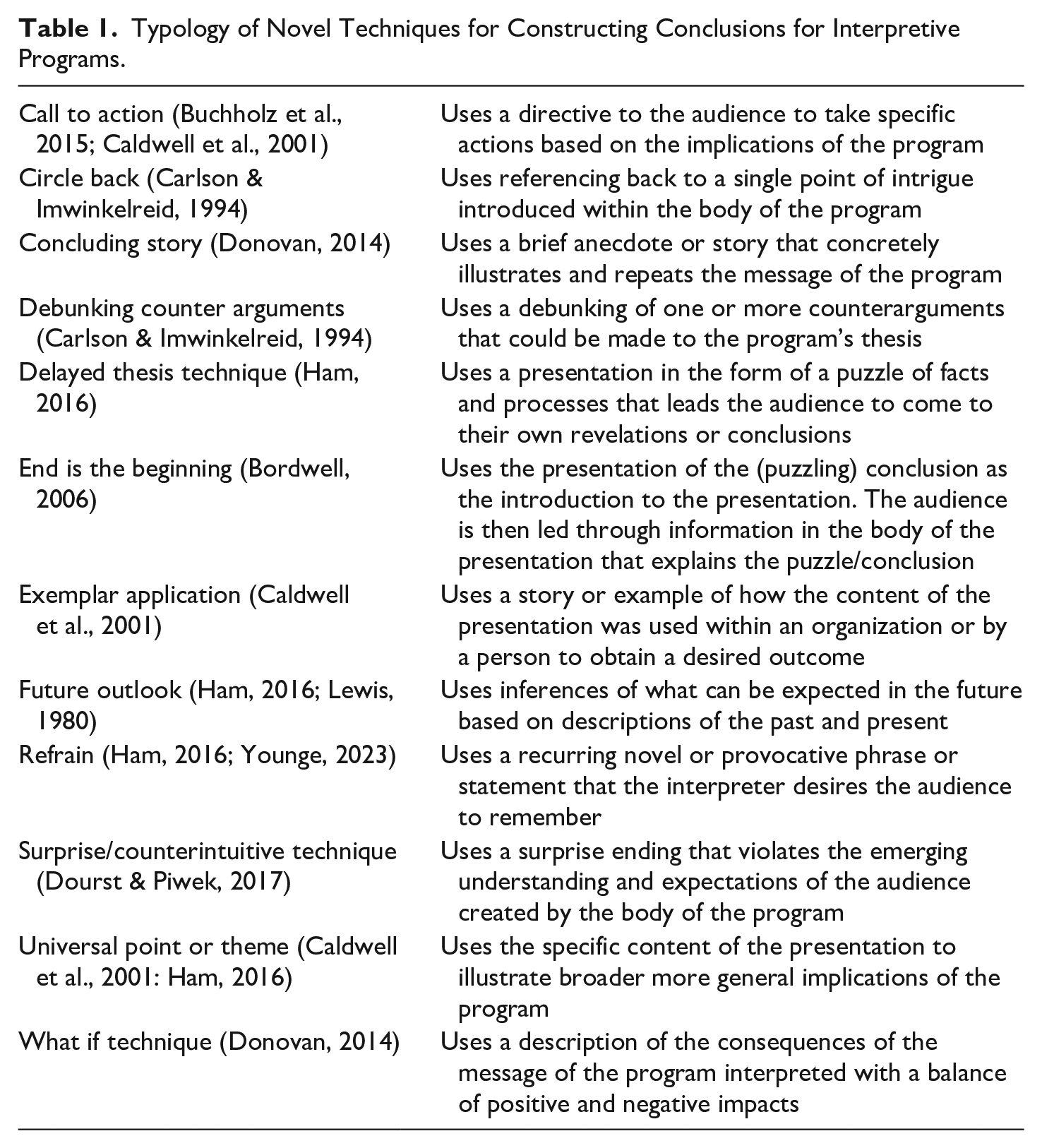
Some interpretive presentations take the form of a narrative or story. The endings of books and movies may be examined for strategies for experimenting with the structure of conclusions (Mishler, 1995). A program might end with a resolution or be unresolved. An unresolved conclusion should be more provocative and evoke the Zeigrnik effect, but not always. Interpreters could borrow from the style of movies that “begin with the ending,” presenting the conclusion at the beginning of the program and leading the audience through the history of how the topic came to be (Bordwell, 2006). Additionally, a conclusion could combine or use multiples of the strategies in the typology in a single conclusion
Conclusion
Viewing an interpretive program as an isolated experience with effects independent from previous or future experiences seems naïve. Greater and more rapid progress in helping persons and society develop a love and understanding of heritage resources may occur when interpretive programs consistently provoke after-the-program ruminations and activities. Given that most interpretive experiences occur in the leisure sector, interpretive experiences must provoke future engagement rather than compel future engagement as is more typical of work or school settings. The role of the ending of interpretive presentations as critical to motivating future and ongoing engagement. The presence and strategic nature of the conclusion of an interpretive program is likely to play a disproportionate role in whether audience members are provoked to further rumination, exploration, or action. Yet it seems axiomatic that not all conclusions are equally effective. Some designs of conclusions take a the-issue-is-settled approach while others are more open ended—less final. We suspect the latter type is more strategic for interpretive programs.
Additional theoretical and empirical evaluations are needed to understand the relevancy of the arguments made in this article. There are undoubtedly more theoretically relevant underpinnings for the role of conclusions. Testing different designs of conclusions on immediate outcomes of a program is feasible. Establishing the long-term decades long transactional role of any single interpretive program in ongoing socialization processes that lead to persons identifying with and caring about heritage resources is difficult at best. Additionally, narrative parsing of other components of interpretive programs (introductions, transitions, motifs, illustrations, etc.) can provide further guidance to interpreters of ways to provocatively design programs.
Footnotes
Declaration of Conflicting Interests
The author(s) declared no potential conflicts of interest with respect to the research, authorship, and/or publication of this article.
Funding
The author(s) received no financial support for the research, authorship, and/or publication of this article.