




Abstract
Person-led guided tours play an important role in museums’ educational programs. With this scoping review, we take a critical look at existing knowledge based on empirically-based primary studies to shed light on the practices of person-led guided tours in museums, focusing on the tour leader and his/her work practice. Our review included 39 peer-reviewed papers from 1978 to 2018. Results indicate that the research landscape is scattered across different disciplines. We specified three main research topics (docent training, professionalism/expertise, tour performance) to which the reviewed papers could be assigned and made cross-references between studies. Consequently, the review reveals the very complex practice of person-led guided tours in museums. Our review closes with the discussion of implications for practice and further research, with the intention of advancing multidisciplinary empirical research on the guiding practice in museums and person-led museum guided tours.
Introduction
Museums educate diverse audiences by providing a variety of programs (American Alliance of Museums [AAM], 2005; Deutscher Museumsbund e.V. & Bundesverband Museumspädagogik e.V., 2008), for example offerings for people with dementia, creative workshops for children, audio/multimedia guides, fun and educational activities for families, lectures, etc. However, the most popular and most prevalent educational programs are person-led guided tours, especially those for adults (Grinder & McCoy, 1985; Horn, 1980; Institut für Museumsforschung, 2008, 2018; Rodehn, 2017; Sachatello-Sawyer et al., 2002). Guided tours fulfill the key functions of delivering information and interpretive content, while mediating (enjoyable) interaction between visitors and artifacts or exhibitions (Tinio et al., 2010; Tran & King, 2007) within a prescribed amount of time and with “clear goals and objectives” (Gough-DiJulio, 1994, p. 14, referring to Grinder & McCoy, 1985; also Nettke, 2010). 1 The tour guide is of key importance in this context (Ferguson et al., 2016; Grenier, 2011), for it is, in general, they who decide on the course/order of actions, that is the route, mobile and stationary phases, and objects that are discussed (De Stefani & Mondada, 2014; Nettke, 2010). The aim is not only to impart knowledge but also to foster visitors’ “emotional and intellectual connections [. . .] [with] the meanings inherent in the [objects]” (National Association for Interpretation (NAI), 2007, p. 6). Thus, the success of a tour depends on the interrelation between the guide, the visitors, and the setting or artifacts (De Stefani & Mondada, 2014; Matthes, 2013; Nuissl et al., 1987).
Given this, it’s not surprising, that a further need for substantive research on the expertise, practices, and pedagogy of persons conducting tours, and “the impact of the tour on the individual museum visitor” (Tinio et al., 2010, p. 38) has been expressed (Best, 2012; Grenier, 2011; Neill, 2010b; Powell Flanders, 1979; Rayward & Twidale, 1999; Tran & King, 2009). However, no one has thus far conducted a literature review regarding the practice of person-led guided tours in museums. This paper closes this gap by presenting a scoping review which systematically maps the research done on the practices of person-led guided tours in museums, with a focus on the tour leader and his/her work practice, following recommendations by Tricco et al. (2018, PRISMA-ScR 2 ; see also von Elm et al., 2019).
The overall aim of this scoping review is to provide insight, based on empirical research, into what is known about the practice of guided tours given by professional museum guides (expert docents) in museums of various types, across the globe, between 1978 and 2018. We want to identify who and what was studied, how research about the tours was conducted (methodological approach), and what knowledge this research produced. The analysis includes the following: (1) bibliometric information, (2) study context, (3) research objective, (4) research topic, (5) methods, and (6) main findings.
We suggest that a deeper understanding of the practice of guided tours, and specifically the practice of docents, contributes to the development of, and discussion about, museum education practice and its professionalization. This knowledge could provide a basis for future museum practice and research directions, as well as for effective docent training programs, and can thereby contribute to an extension of (professional) museum education practice.
Methods
Protocol and registration
The final review protocol 3 for this search was registered with the Open Science Framework on 19 December 2019 (https://osf.io/ta7gu/) and can be found in the rubric “Files: Archive of OSF Storage.”
Eligibility criteria
We analyzed empirical papers published in German and English peer-reviewed journals, limiting them to those concerning guided tours for visitors older than 10 years. The decision to limit our analysis to peer-reviewed journals was taken in order to achieve an understanding of the current nature and state of existing verifiable evidence that contributes to “the maturity and sophistication of a field” (Chen et al., 2018, p. 59). The age restriction was put in place because educational museum programs for (very) young children differ dramatically from programs for older audiences. In addition, by adhering to the concept of the museum as described by the International Councils of Museums (ICOM, 2001) statutes (Article 2) and ICOM (2007) (Article 3), we have ensured a broad coverage of museums, furthering our insight into the state of the research.
To be included in the review, papers must have been published between 1978 and 2018. It is only since the 1960s in the United States (Bailey, 2006a) and the 1970s in Germany, that museum education was recognized as an important and distinct (professional) field (Noschka-Roos, 2012). Therefore, little research exists prior to 1970 (especially on adult museum programs, Sachatello-Sawyer & Fellenz, 2000; also Horn, 1979; Nichols 1984/2016). What does exist is often difficult to access or cannot be found in databases (Teasdale & Fruin, 2017).
Another challenge to identifying literature is: The definitions of tours and designations for the person who conducts tours differ not only between disciplines (e.g., adult vs. child education, social vs. educational science), museum types and contexts (e.g., cultural vs. tourism studies), but also between different responsibilities within informal/free-choice learning settings (e.g., museum educator, docent, interpreter, tour guide, facilitator, see e.g., Falk & Dierking, 2013; NAI, 2007). This results in a “profusion and, as a result, a confusion of terms used” (Trencher et al., 1976, p. 51). 4 The persons who conduct guided tours also differ with regard to their educational background, expertise, attitudes, opinions (see Tran, 2008b), and employment status (e.g., volunteer, employee). In our literature search, we took this diversity into account (see keywords, Section “Information Source”) in order to be able to find all relevant studies, regardless of either the title of the person who conducted the guidance or their employment status. We will subsequently use “docent” to refer to volunteers or paid people who guide groups of visitors in a museum (exhibition), giving primarily verbal information face-to-face (see Schep et al., 2018a, p. 18) to provide visitors with oral “firsthand experience” (Van Winkle, 2012, p. 46), knowledge, and/or stories about the museum’s objects (Stone, 1997). Hence, in this paper, the term “guided tour” refers to “a structured or semi-structured activity with an educational [and informative] intent” (Castle, 2002, p. 1), that typically lasts 30 to 60 minutes and guides a group through the museum led by a docent (Neill, 2010a; Stone, 1997).
Qualitative, quantitative as well as mixed-method studies were included in the review. To maintain this focus, we followed Chen et al.’s (2018) definition of empirical research (p. 61): “published papers based on evidence from direct or indirect observation or experience of some aspects of [. . .] [person-led guided tours in museums], typically the collection and analysis of primary data. This included field-based studies [and] surveys [. . .].” We also excluded journal papers on audio guides and other kinds of non-personal guided tours (e.g., Eghbal-Azar et al., 2016; Schwan et al., 2018), and any kinds of tour guides from cultural tourism settings other than museums (e.g., caves, national parks). Furthermore, we excluded gray literature, book chapters or entries, practical/practice handbooks and guidelines, theoretical and practical reports, as well as conference proceedings (see also “Limitations”).
Information Source
When undertaking a previous literature search accompanying a larger research project funded by the Deutsche Forschungsgemeinschaft (DFG, German Research Foundation), we were confronted with the same challenges reported by Teasdale and Fruin (2017, pp. 489–490): The main body of museum science literature relevant for our project could not be fully and directly accessed in German or English research databases. During the search process, it became evident that a search based only on databases accessible to the authors was not adequate, as it produced a large amount of redundant data while failing to cover all contributions relevant for our review (e.g., contributions before 1990 are missing). We therefore carried out a hand search for relevant museum journals (journal-specific search) as well as snowball sampling. From February to August 2019, the literature search for articles was performed using the reference management program Citavi.
The following journals were included: Curator – The Museum Journal (Curator), Visitor Studies, Journal of Museum Education (JME) (formerly known as Roundtable Reports [1973–1984]), Museum Management and Curatorship (MMC), Poetics – Journal of Empirical Research on Culture (Poetics), the Media and the Arts, Museum and Society (Leister University), Journal of Interpretation Research (JIR), and Standbein Spielbein [Support leg Free leg]. The museum educational journal Standbein Spielbein is the only non-peer-reviewed journal included in the search and was only used for snowballing.
We searched for German as well as English terms according to the language of the respective journal. Keywords were developed based on the previous literature search. We used only the Boolean operator AND, and no complex AND/OR-combinations. Because of the ambiguous meaning of the translated keywords we chose similar terms instead of a one-to-one translation. The order of the English and German keywords (presented in the following) corresponds to the order used in the respective literature search.
The English keywords used for the literature search are/were: museum tour(s), guided tour(s), guided museum tour(s), gallery tour(s), museum teaching, docent guided tour(s), tour guiding, docent-led museum tour(s), docent-led tour(s), educator(s), museum educator(s), museum docent(s), docent(s), docent-led, museum guide(s), gallery educator(s), tour guide(s), facilitator(s), interpreter(s), museum teacher(s), front-line museum educator(s), front-line educator(s), museum education, museum AND adult education, adult AND museum AND tour, adult AND museum AND guide, and guide(s).
German keywords included: Museumsführung(en), Musemsgespräch(e), Führung(en) UND Museum, Bildgespräch(e), personale Vermittlung, Museumsmoderation, Peer-to-Peer Führung(en), Kuratorenführung(en), Museumsbegleitung, Museumspädagoge(n), Museumspädagogin, Museumsmitarbeiter/in, Museumsmoderator/in, Moderator UND Museum, Führungspersonal, Dozent UND Museum, Dozentin UND Museum, Dozenten UND Museum, Führer UND Museum, Führerin UND Museum, Museumspädagogik UND Erwachsene, Museumspädagogik UND Erwachsenenbildung, Vermittlung UND Museum, Führung UND Museum, Führungspersonal UND Museum, and Museumsbesuch UND Führung.
In addition to a comprehensive literature search in the journals mentioned above, the German electronic bibliographic database “FIS-Bildung” (“The German Education Index”) was also analyzed. FIS-Bildung was selected for the German scientific field/discussion, as the majority of the journals have an English or American background. Furthermore, because searching for primary studies using one electronic database and hand journal search might not be sufficient, we scanned the reference lists of all relevant records. References marked with an asterisk (“*”) indicate studies included in the scoping review. We also scanned some museum educational handbooks, interpretation manuals (providing valuable implications for practice), and gray literature to maximize the scope of our literature search (reference sampling) and ensure that no relevant articles were missed (a list of these can be found in the reference list). References marked with an addition sign (“+”) indicate additionally screened literature to find relevant studies. The literature search is based on an iterative process. In total, the search resulted in 13,326 records. Removing duplications 5684 unique records remained.
Sources
Our review procedure is summarized in a flow diagram (see Figure 1). First all duplicated records were identified and removed using Citavi function “Display Duplicates.” After that the first author scanned the records and deleted any records which did not fulfill the publication date criterion (1978–2018), as well as those without author/editor statements, and those where it is clear from the title that the main focus is not person-led guided tours (n = 4980).
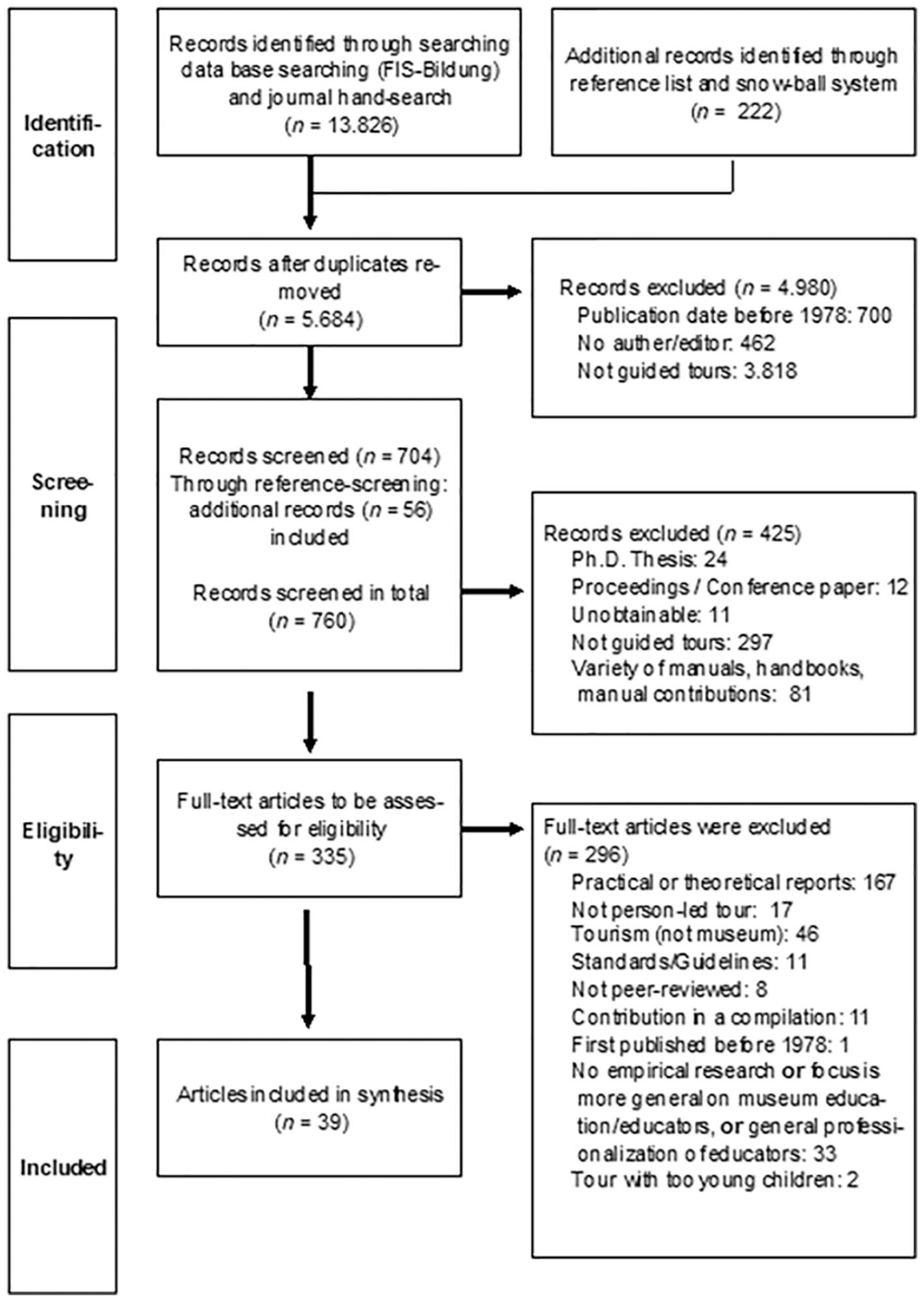
Flow diagram of search strategy showing the numbers of included and excluded papers.
Subsequently, all 760 records identified were screened via searches, evaluating the titles and abstracts against the topic of this review and categorizing them with respect to their publication type (e.g., journal, book chapter) and kind of tour (e.g., docent-led guided tour, audio guide). In all, 425 records were excluded, leaving 335 eligible full-text articles to be retrieved and assessed for their actual relevance. However, at this stage, some abstracts were ambiguous, and it was not always obvious whether the content was based on an empirical study and/or whether the focus was person-led guided tours in museums with people older than 10 years (cf. Dybå et al., 2007, p. 230). Thus, all articles that indicated that their topic was guided tours were included in a detailed eligibility screening. Of these 335 detailed screened articles, 296 were finally excluded (see Figure 1).
There are two instances where two papers refer to the same study. However, as the papers were published in different journals and different years and partly reported different results or aspects of the studies, we included both as separate records (see Table 1). In the following presentation of the analysis, these papers are treated independently. Consequently, in all following figures and tables, the counts are based on the number of reviewed papers, not the number of studies respectively.
Bibliometric Information and Study Context (Number of Museums in Brackets) of the 39 Reviewed Papers on Guided Tours in Museums (1978–2018).
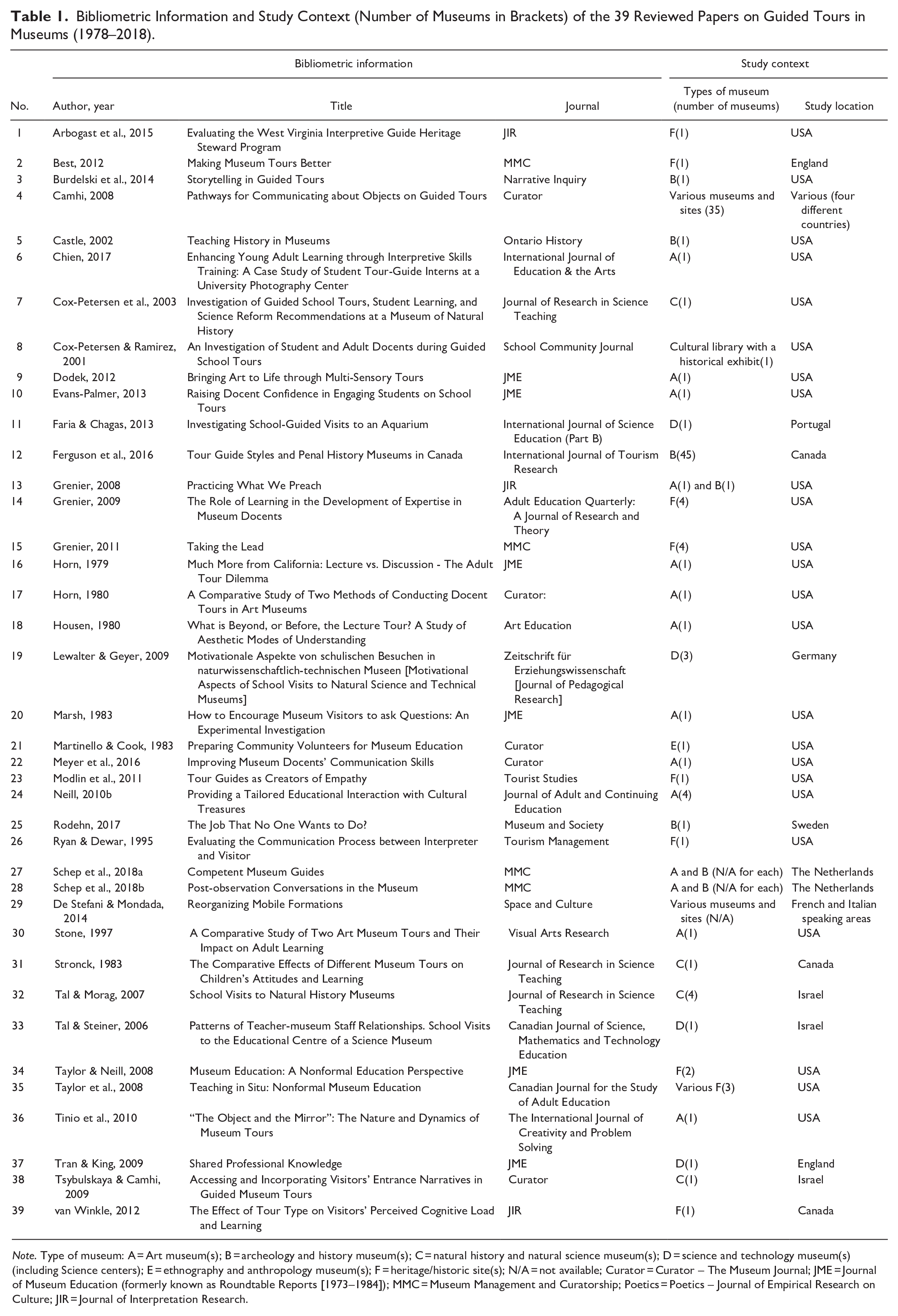
Note. Type of museum: A = Art museum(s); B = archeology and history museum(s); C = natural history and natural science museum(s); D = science and technology museum(s) (including Science centers); E = ethnography and anthropology museum(s); F = heritage/historic site(s); N/A = not available; Curator = Curator – The Museum Journal; JME = Journal of Museum Education (formerly known as Roundtable Reports [1973–1984]); MMC = Museum Management and Curatorship; Poetics = Poetics – Journal of Empirical Research on Culture; JIR = Journal of Interpretation Research.
Data charting process
In order to extract, analyze, and evaluate all necessary information from the studies, all papers identified as potentially relevant for this review and the underlying research question were carefully read, entered as individual cases in a clear, comprehensive, and standardized data-charting form, and coded by the first author. The data items, which had to be derived by a clear coding decision (especially methodological approach, and main research topic), were also independently charted by the second author. Any coding doubts and any disagreements were resolved consensually through discussion from both authors.
Data items
The following study characteristics were recorded: (1) bibliometric information, (2) study context, (3) research objective, (4) research topic, (5) methods, and (6) main findings. In detail, the characteristics comprises the following data items: author, year, and journal of publication (bibliometric information); museum type(s) and study location (study context); research aim and/or question (research objective); methodological approach, study design, evaluation method, data collection method, study data used, existence of sample description (methods); as well as main findings (main findings).
The summary of the charting data form and the description of the other queried data elements can be found in the Supplemental Table A.1 (or they will become clear through the presentation of results, see Section “Results”).
We classified museum types using the European Group on Museum Statistics (EGMUS) (n.d) scheme. 5 In addition, we have included a cluster “Heritage/Historic Sites,” as we did not find these institutions in the EGMUS classification. If categorization was not possible, the kind of institute was named in a simplified form.
Based on the literature (Flanders & Flanders, 1976; Grinder & McCoy, 1998), we identified three main research topics: (1) Docent Training, (2) Professionalism/Expertise, and (3) Tour Performance. The paper was categorized as “docent training” if the research study considered the effects of docent training programs and/or training activities (Flanders & Flanders, 1976). The paper was categorized as “professionalism/expertise” if it focussed on the nature of museum docents’ professional expertise (Bailey, 2006a, 2006b; Grenier, 2009, 2011), their role, identity, and/or attitudes (Bailey, 2006a, 2006b). “Tour performance” was used as a category for papers whose study objectives were focussed on the tour itself, in terms of content, the manner in which it was conducted, the effects of the tour’s interpretive approaches/techniques, and other factors that influence a tour performance (Flanders & Flanders, 1976; Grinder & McCoy, 1998). The assignment always referred to as the main—superordinate—topic.
Summary of results
All studies are alphabetically ordered both in Table 1 of section “Characteristics of reviewed publications” and in Supplemental Table A.2 of Section “Results of individual sources of evidence”. When presenting the Section “Synthesis of results” we grouped the studies according to the main research topic.
Results
Characteristics of Reviewed Publications
A full list of the 39 empirical articles is included in the reference list. References marked with an asterisk (“*”) indicate studies included in the scoping review. A summary of the bibliometric information as well as the study context is presented in the following table (Table 1).
Journal publication
Of the 39 reviewed publications about person-led guided tours in museums, 15 (38.5%) were published in specific museum journals. Figure 2 presents the total number of papers published in Journal of Museum Education (n = 6, 15.4%), in Curator (n = 5, 12.8%), as well as in MMC (n = 4, 10.3%) in comparison to the number of empirical papers in other journals. Surprisingly no relevant paper was found for review in Visitor Studies, which, besides Curator, is one of the major peer-reviewed museum journals. Three papers (7.7%) were published in the JIR and one (2.6%) in the journal Museum and Society. Five papers (12.8%) were published in science education- and science teaching-related journals (e.g., Journal of Research in Science Teaching). Four empirically-based publications (10.3%) were published in journals of adult education and pedagogical research (e.g., Journal of Adult and Continuing Education). Journals of art and art education published the same number of empirical papers on guided tours in museums as journals of tourism (each: n = 3, 7.7%) (e.g., Art Education, International Journal of Tourism Research). Finally, five journals each published one article included in this review (n = 5, 12.8%) (e.g., The International Journal of Creativity and Problem Solving).
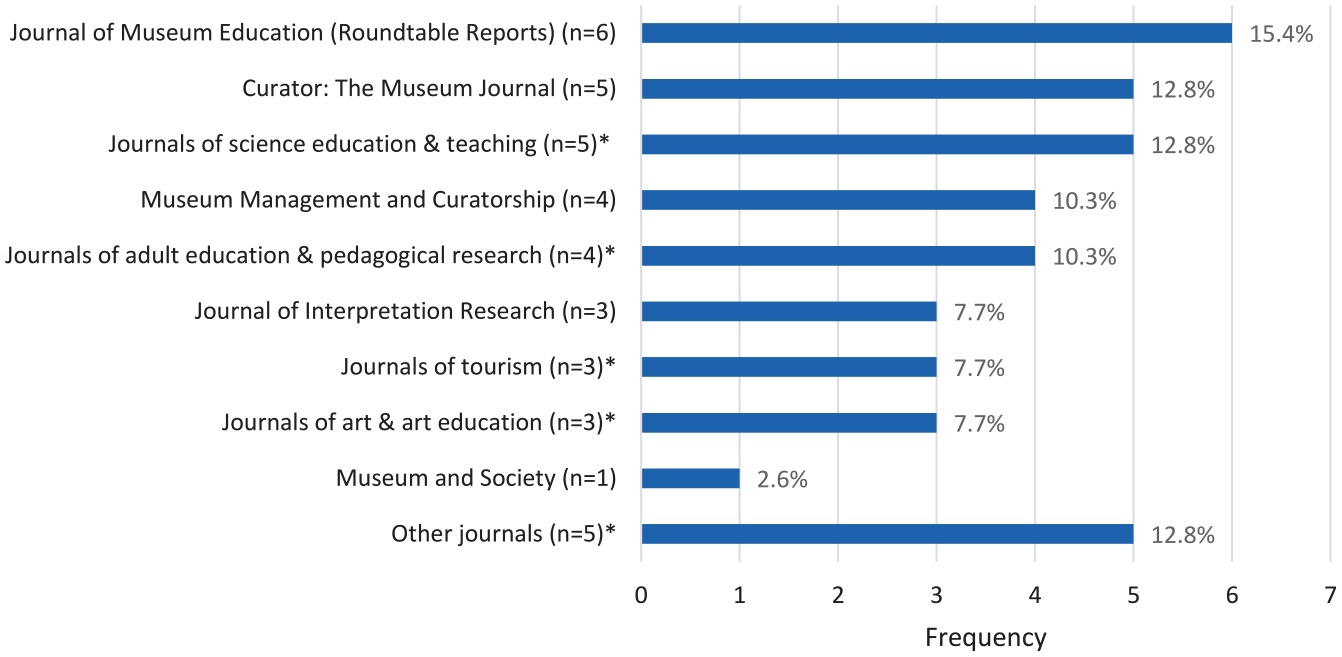
Frequency and percentage of total 39 reviewed papers presented per journal or journal type respectively.
Year of publication
Figure 3 summarizes the years of the reviewed publications. No papers included in this study were published between 1984 and 1994. Apart from that, the results show that the reviewed papers are spread from 1979 to 2018, with a larger proportion of papers published in the 2000s, especially since 2008.
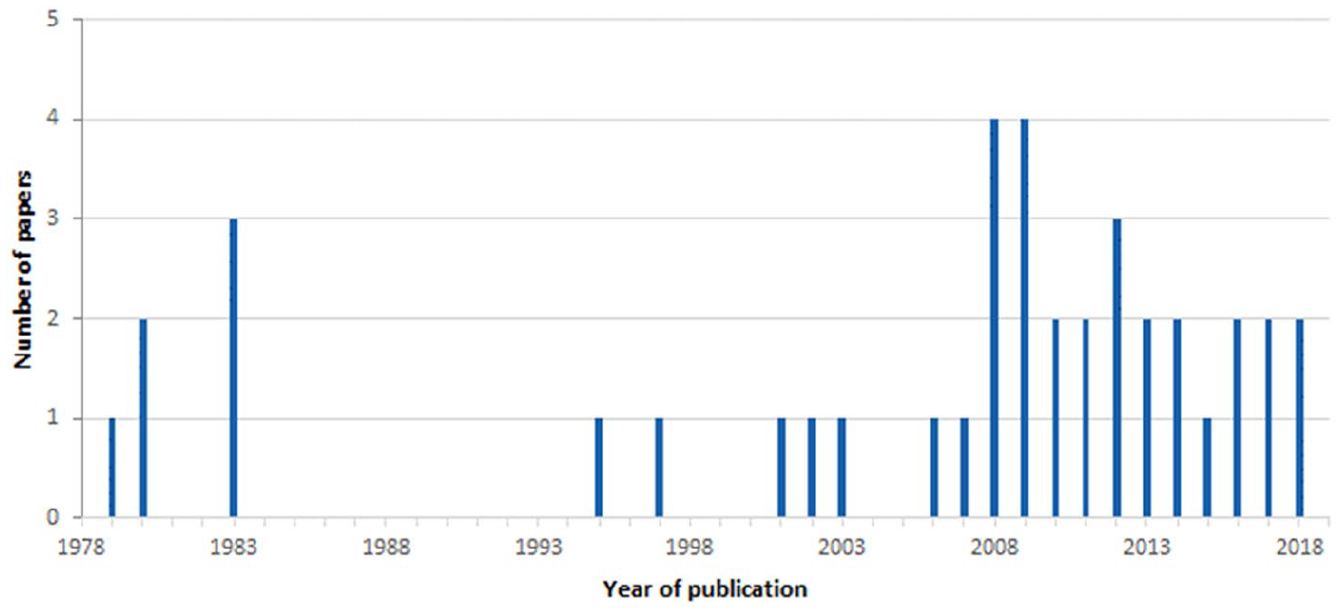
Year of publication of reviewed papers (n = 39) on guided tours in museums (1978–2018).
Type of museum
The largest proportion of papers (n = 11, 28.2%) were on studies conducted solely in art museums, followed by papers with studies from heritage/historic sites (n = 8, 20.5%) (see Figure 4). Three additional papers (7.7%) reported on studies that were conducted in both art museums and (archeology and) history museums. Four papers report from science and technology museums (including science centers), in archeology and history museums as well as in natural history and natural science museums (n = 4, 10.3% each).
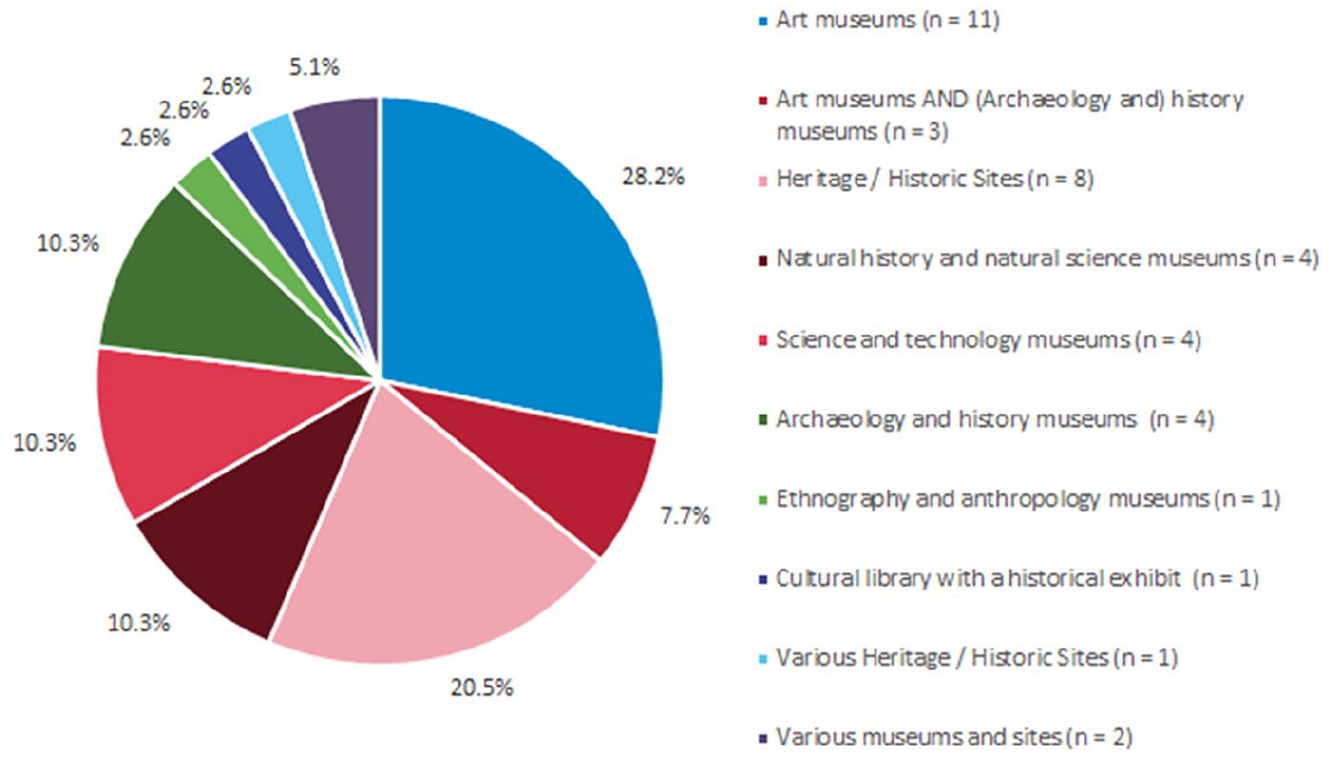
Type of museum(s) in which studies (n = 39) were carried out on guided tours in museums (1978–2018).
The majority of the papers (n = 27, 69.2%) reported on studies where data was collected in only one type of museum and/or only in a single museum (see Table 1). Furthermore, most papers (n = 24, 61.5%) were based on studies conducted in the USA with the remaining studies scattered across various countries (see Table 1).
Main research topic(s)
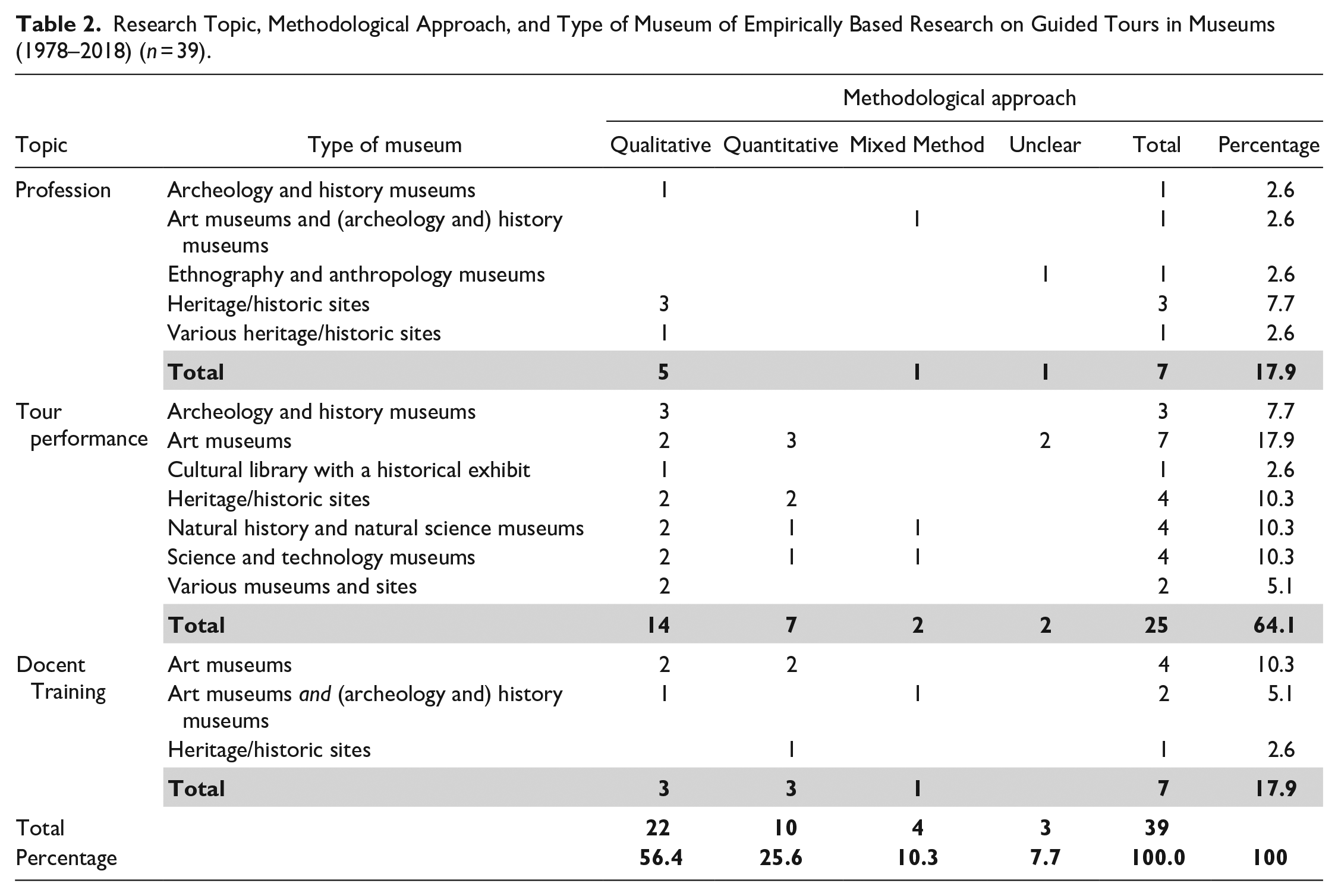
Almost two-thirds of the reviewed papers (n = 25, 64.1%) address “tour performance” as a topic (see Table 2). The remaining papers are distributed equally between the main topics “professionalism/expertise” (n = 7, 17.9%) and “docent training” (n = 7, 17.9%).
Research Topic, Methodological Approach, and Type of Museum of Empirically Based Research on Guided Tours in Museums (1978–2018) (n = 39).
Methodological approach and data collection methods
Analysis revealed that more than half of the studies (n = 22, 56.4%) were qualitative in nature. Almost one quarter (n = 10, 25.6%) were quantitative, and 10.3% (n = 4) used a mixed-method approach. In three studies (7.7%), the methodological approach was unclear (see Table 2).
Most studies with a quantitative approach had a (quasi-)experimental design (see Supplemental Table A.2). In contrast, the study design of the qualitative studies varied. The recorded designs address, for example, case studies, field research, naturalistic inquiries, and basic interpretive approaches. However, some methodological descriptions were incomplete; as a result, a clear categorization was not possible. Therefore, the study design for some studies was recorded as “not available” (N/A).
The most commonly used methods for data collection in the described qualitative studies are (video) observations, (semi-structured) interviews, and analyses of documents and training material (see Supplemental Table A.2). In mixed-method studies, a variety of methods have been used, most commonly structured observations and questionnaire-based surveys. Quantitative studies are predominantly questionnaire-based.
Also, it was difficult to ascertain the qualitative analysis approach (e.g., constant comparative method or open-ended, focused, and/or collaborative coding). Almost one-third of these studies were recorded as “not available” (N/A). Quantitative studies primarily used inferential statistics (see Supplemental Table A.2).
Study data
Regarding studies on the topic “docent training” (n = 7), most collected data came from the docents (“guides”) doing the training. As a rule, other data was also collected from the tours themselves, from the training, or from other sources (see Supplemental Table A.3). Studies on the topic of “professionalism/expertise” (n = 7) were almost exclusively based on (at least) two types of data (e.g., tours and guides). For studies on the third topic “tour performance” (n = 25) data resources were more diverse (see Supplemental Table A.3). More than half of the studies used data from tour participants. From these 16 studies, nine studies used different types of data in addition to participants’ data. The remaining studies on the topic of “tour performance” used only single data resources (see Supplemental Table A.3).
Overall, almost 50% of the papers reviewed (n = 18, 46.2%) present data from the docents (“guides”). Only a small proportion of studies collect comprehensive data from the guided tours, the visitors and the docents (n = 3, 7.7%). Nine papers (23.1%) focus on school tours and/or school students.
Existence of sociodemographic sample description
The majority of papers (n = 18, 46.2%) lack a sociodemographic description of the sample and/or the tour participants (observation studies). Only one third (n = 12, 30.8%) of all reviewed papers provided sociodemographic sample descriptions. In the remaining nine papers (23.1%), the sociodemographic sample descriptions were incomplete, reporting only one single sociodemographic aspect (e.g., gender) of the study participants (see Supplemental Table A.2).
Results of individual sources of evidence
Due to the number of papers analyzed, the results of individual sources of evidence are provided in the Supplemental Table A.2. The synthesis of these results is presented below.
Synthesis of results
The results are organized by the main topics of “docent training,” “professionalism/expertise,” and “tour performance” (as outlined in Section “Data Charting Process”).
Some papers also contain secondary findings that can be linked to another main topic. Therefore, secondary findings from individual studies can sometimes be found under a different heading.
Docent training
All studies focussing on “docent training” were conducted solely in art or cultural-historical museums/settings. The majority of these studies focused “on training for a specific technique or delivery method that can be applied to practice” (Grenier, 2008, p. 8–9; also Arbogast et al., 2015; Marsh, 1983).
In summary, most of the studies on docent training programs and/or training activities for persons who conduct guided tours (“docent training”) indicated positive effects. Coaching methods (e.g., questioning) and training skills (e.g., clear speech, appropriate language) seem to improve the performance of the docents (Arbogast et al., 2015; Marsh, 1983; Meyer et al., 2016). Only one study investigated the long-term effect of docent training. This study revealed that clear speech training showed lasting effects (Meyer et al., 2016). Moreover, training on interpretive skills also had effects on other life areas (Chien, 2017). Training could also help docents to overcome subjectively-perceived weaknesses (Evans-Palmer, 2013). Grenier’s (2008) study indicates that the training approaches for docents are mostly based on direct instruction or lecturing, although the espoused theories of education of the museum and of museum educators 6 who train may be different. This can lead “to an inconsistency between [training] talk and action” (Grenier, 2008, p. 12). Moreover, post-observation conversations between docents and museum educators seem to benefit from a self- and external evaluation (sheet) of guiding competencies as a common basis for discussion (Schep et al., 2018b).
Professionalism/expertise
Excluding the paper of Martinello and Cook (1983), all papers on “professionalism/expertise” were published in the 2000s. The majority of papers were linked to heritage/historic sites and history museums (e.g., Rodehn, 2017; Schep et al., 2018a). In sum, the underlying studies focus on influencing factors that challenge the tour performance/practice (e.g., Rodehn, 2017), the nature of guided tours (e.g., Best, 2012), required skills, knowledge components, or competencies (e.g., Schep et al., 2018a), and the development of docent expertise (e.g., Grenier, 2009, 2011).
The reviewed papers on “professionalism/expertise” showed that the guiding practice is a complex and difficult one (e.g., Grenier, 2009, 2011; Martinello & Cook, 1983; Taylor et al., 2008; Tran & King, 2009), with various factors interrelating during a tour. The non-formal learning context (e.g., group size, time constraint, richness of a particular site), the participating visitors, the perspective of the docent, his/her teaching beliefs and concepts, as well as the guiding practice (e.g., used teaching techniques) shape and influence a tour (e.g., Martinello & Cook, 1983; Rodehn, 2017; Taylor & Neill, 2008; Taylor et al., 2008). Taylor and Neill (2008) and Taylor et al. (2008) identified three interrelated themes which, besides teaching approach, influence the teaching of adults in non-formal settings like museums (Taylor & Neill, 2008, p. 27ff.): (1) power of teaching in situ, (2) significance of free-choice, and (3) time limitations of museum tours. Other reviewed papers have supported that these three themes shape tour practice for both adults and students (e.g., regarding “power of teaching in situ”: Best, 2012; Schep et al., 2018a; regarding “free-choice”: Tinio et al., 2010, and regarding “time limitations”: Best, 2012).
Several of the reviewed papers investigated the question of competencies that tour guides need or that distinguish docent expertise (e.g., Grenier, 2009, 2011; Martinello & Cook, 1983; Rodehn, 2017; Schep et al., 2018a; Taylor et al., 2008). The majority of these papers agree that a variety of knowledge and competencies, as well as intuition are required (e.g., Grenier, 2009, 2011; Rodehn, 2017; Schep et al., 2018a). Some of these requirements find their counterparts in four different roles fulfilled by docents during a tour: “[1] finding ways to get to know your audience (visitors) [diligent host], [2] developing the skill of storytelling [storyteller], [3] balancing didactic presentations in concert with a questioning dialog [proud steward], and [4] promoting fun to help ensure an enjoyable educational experience [promoter of fun]” (Taylor & Neill, 2008, p. 30). The degree of differentiation of competencies and competency models varies across the reviewed papers—especially between the studies of Grenier (2009, 2011), and Schep et al. (2018a, Schep, 2019). However, there are competencies and characteristics that are unanimously identified as central, such as adaptability (e.g., Grenier, 2011; Martinello & Cook, 1983), communication skills (e.g., Grenier, 2009, 2011; Schep et al., 2018a), and flexibility (e.g., Martinello & Cook, 1983; Schep et al., 2018a).
Furthermore, it seemed that formal training by the museum is necessary but not sufficient to become an expert docent (Grenier, 2009). Therefore, self-directed learning, as well as training programs “that go beyond traditional training[s]” are important too (Grenier, 2011, p. 349; also Bailey, 2006b). The study from Modlin et al. (2011), for example, confirmed that some docents use self-directed learning (e.g., content knowledge) to improve their performance, a fact that Grenier (2009, 2011), Bailey (2006b), and Schep et al. (2018a) also deemed necessary to becoming an expert docent.
Tour performance
Studies on “tour performance” were linked with more varied types of museums, with the largest number of papers being linked to art museums (e.g., Dodek, 2012; Neill, 2010b). Four papers are linked to natural history and natural science museums (e.g., Cox-Petersen et al., 2003; Stronck, 1983), and three papers each investigated archeology and history museums (e.g., Burdelski et al., 2014) and heritage/historic sites (e.g., Best, 2012; Van Winkle, 2012). A limited number of the studies took place in science and technology museums (including science centers) (e.g., Faria & Chagas, 2013), a cultural library with a historical exhibit (Cox-Petersen & Ramirez, 2001) or in a variety of museums and sites (“various”) (Camhi, 2008).
In sum, the underlying studies focus on factors that influence and shape a tour (e.g., Camhi, 2008; Tran & King, 2009), the effects of interpretive techniques and/or tour performance (e.g., Horn, 1979), the utilization of different methods (e.g., Burdelski et al., 2014), movements of a guided group (De Stefani & Mondada, 2014), and what visitors want and what constitutes a good tour for them (Housen, 1980).
Docents and general guiding practice
Docents take on different roles (e.g., by refining Bryon’s (2012) typology of tourism guides, Ferguson et al., 2016; other roles see Castle, 2002; Taylor et al., 2008), depending on their own understanding of the nature of the discipline and the goals and pedagogy of the museum. These different roles coincide with varying engagement of tour participants or rather tour guide styles (e.g., Ferguson et al., 2016). Studies also showed that different docents use different types of communication practice in different “types of tours” (Burdelski et al., 2014, p. 342) and that docents don’t use methods such as storytelling arbitrarily (Burdelski et al., 2014). Thus, why, how, and in what manner docents conduct tours provides insight, not only into their content knowledge and their understanding of the nature of the discipline (Castle, 2002), but also into the philosophy and goals of the museum (Ferguson et al., 2016). In general guided tours are “a constant state of becoming – something particularly evident in the relation to the visitors but also to the exhibitions” (Rodehn, 2017, p. 10). This complex guiding practice is interconnected and informed by six knowledge components (context, choice, content, objects, theories of learning, and talk), which form the basis of docents’ practice, following the work of Tran and King (2009, p. 157ff.).
Docents and teachers
Several studies (Martinello & Cook, 1983; Tal & Morag, 2007; Tal & Steiner, 2006) suggest that teachers who accompany students on field trips rarely interact and communicate with docents; they typically take a passive role in the experience—even if this does not correspond to the expectations of the docents. This suggests that rapport between docents and teachers could be improved by clear communication before the museum visit.
Interpretive approaches and methods, and its impacts
Some studies on “tour performance” examined the effect of interpretive techniques/approaches and/or tour performance, thus addressing “tour outcomes, [and] the effects on visitors” (Flanders & Flanders, 1976, p. 201). Person-led guided tours can be more lecture-based or more inquiry/discussion-based (Grinder & McCoy, 1985, 1998). Several studies suggest that more active interpretive (and/or participatory) techniques improve attention (Housen, 1980), increase satisfaction (e.g., Horn, 1979), positive attitudes toward museums (Stronck, 1983), enjoyment (Horn, 1979, 1980), and reduce drop-out rates (Housen, 1980). However, in sum, the reviewed studies could not clearly confirm that inquiry/discussion-based tours enabled more elaborate learning or retention of information than less didactic approaches (e.g., Cox-Petersen et al., 2003; Stone, 1997). One study showed that more structured tours foster greater cognitive recall, even if they produced fewer positive attitudes toward museums (Stronck, 1983). Another suggested that, if improved, the docents’ communication skills will foster better cognitive recall. However, the attempt to correlate docents’ values from a modified communication scale with the visitors’ retention rate did not yield the hoped-for results (Ryan & Dewar, 1995). A third study even showed that more lecture-based tours do not negatively affect situational interest of participants (Lewalter & Geyer, 2009), supporting that structured approaches do promote learning. Thus, depending on the goal, more lecture-based guided tours seemed to be a valid approach.
Despite these inconclusive findings regarding the techniques/approaches, the majority of studies show that inquiry/discussion-based tours are enjoyed more than lecture-based tours (e.g., Cox-Petersen & Ramirez, 2001), but visitors—young and old—found both interpretive approaches satisfying (e.g., Cox-Petersen et al., 2003; Horn, 1979, 1980; Stone, 1997). 7 While group size was not an influential factor for tours with adults (Horn, 1979, 1980), it was for tours with students (Martinello & Cook, 1983). But even for adults, group composition was also shown to influence the process, performance, and quality of an inquiry/discussion tour (Horn, 1979, 1980).
It also seems that the visitor’s experience of multi-sensory tours could lead to forming stronger initial impressions (Dodek, 2012).
Moreover, docents adapt their engagement strategies and interpretive approaches by assessing the characteristics of the group and the social dynamic—their personal context (Falk & Dierking, 2013) and non-verbal behavior—and establishing rapport during a tour (Neill, 2010b; Tran & King, 2009). This responsiveness is expressed in the fact that guides adapt their tour to visitors’ needs and interests (Best, 2012; also Martinello & Cook, 1983; Rodehn, 2017), encourage visitors to ask questions on a tour (Taylor et al., 2008), and use “narrative” (Taylor et al., 2008, p. 31) in order to engage visitors and make tours more accessible for them (Best, 2012; Neill, 2010b; also Grenier, 2009; Schep et al., 2018a; Taylor et al., 2008). Using responsiveness and increasing relevance is also supported by the studies of Tsybulskaya and Camhi (2009), showing the positive effect of incorporating visitors’ entrance narratives, and Dodek (2012), showing stronger initial memories when a connection was made to visitors’ experiences (similar Lewalter & Geyer, 2009; Tinio et al., 2010). Also, affective connections are seen as providing great opportunities for tours to develop interest on objects and foster conversations (Tran & King, 2009); however, a study in plantation house museums showed that visitors were seldom emotionally engaged (Modlin et al., 2011).
Camhi (2008) derived six different pathways of communication for engaging visitors. However, other studies on “tour performance” addressing interpretive methods (e.g., questioning strategies, storytelling, learning from objects, audio-visuals) showed different results regarding the active engagement of tour participants. These studies pointed out that tours with students used unfamiliar high-level vocabulary (Tal & Morag, 2007) and/or were structured, mostly lecture-based, and guide-focused with few opportunities to actively engage (e.g., Faria & Chagas, 2013; Tal & Morag, 2007), meaning less interaction/discussion between the docent, visitors, and accompanying teachers (Cox-Petersen et al., 2003). Consequently, engaging strategies mostly cover closed-ended and/or simple knowledge questions (Martinello & Cook, 1983; Tal & Morag, 2007). Although, some studies on “docent training” showed that the use of specific types of questions (e.g., interpretive) and other communication skills (e.g., wait-time) could encourage visitors to actively engage in a tour (e.g., Chien, 2017; Marsh, 1983), some authors suggest this depends on existing docent training that focuses primarily on delivering content rather than pedagogical knowledge (e.g., Cox-Petersen et al., 2003).
Movements of a guided group
De Stefani and Mondada (2014), at least, give insight into the reasons why, and ways in which, the reorientation and movements of a guided group take place during a tour. Their results showed that participating visitors could not only shape the tour with four possible “category-bound activities” (De Stefanie & Mondada, 2014, p. 161), but could also indirectly question the rights and obligations of a docent. This is the case when one visitor acts as a “guide” providing information about an object to some participants, although the rest of the group is focusing on another section of the exhibit. For De Stefani and Mondada (2014), this “competing action” questions the epistemic authority of the guide and leads to “a disalignment of the guide and the group” (p. 173).
Visitors’ perspectives
The motives for participating in a guided tour are diverse (Tinio et al., 2010). Social interactions (with other participants) seemed less important for the visitors than the presence of a “live” tour guide, the imparting of knowledge (Tinio et al., 2010, also Taylor et al., 2008) and the extent to which the tour connects with their lives and experiences (Tinio et al., 2010, p. 49; also Dodek, 2012; Lewalter & Geyer, 2009). Tinio et al. (2010) also revealed that visitors appreciate the tension between freedom—to participate and to attend—and structure—getting a thoughtful overview of an exhibition also Taylor & Neill, 2008; Taylor et al., 2008). Moreover, different types of visitors seem to prefer different kinds of interpretive approaches (Housen, 1980), thus fostering the uniqueness of tours which are as unique as the individual docents who lead them (e.g., Burdelski et al., 2014; Horn, 1979; Tal & Morag, 2007; Tsybulskaya & Camhi, 2009). Horn (1979, 1980), Tal and Morag (2007), and Cox-Petersen and Ramirez (2001) agree that, from the visitors’ viewpoint, the guide plays a critical role, with his/her personality, enthusiasm, engagement, and presentation style play a major part in the success of a tour, especially when overcoming the non-captive nature of the experience by holding attention, increasing engagement, and fostering a positive experience (e.g., Housen, 1980; Taylor & Neill, 2008; Taylor et al., 2008; Tinio et al., 2010).
Finally, and in contrast to an audio tour, docent-led tours seem to be less cognitively demanding of the visitors’ (Van Winkle, 2012).
Discussion
Summary of evidence
(General) summary
The goal of this scoping review was to provide insight into what is empirically known about the practice of person-led guided tours in museums. We identified 39 relevant papers published in a variety of peer-reviewed journals of different disciplines between 1978 and 2018, with a larger proportion of papers published in the 2000s.
Our findings indicate that studies in natural history and natural science museums, science and technology museums (including science centers), and ethnography and anthropology museums, were rare in comparison to studies in art museums or at heritage/historic sites. If a study was conducted in a natural history or natural science museum, or a science and technology museum, it was mostly school class visits that were investigated. This is possibly because museums might see adults as the “‘default’ visitor[s]” (Hohenstein & Moussouri, 2018, p. 77) and/or that the significance of science education has increased in the last decades (European Commission, 2015). The majority of studies collected data in one type of museum and/or only in a single museum, mostly in the USA, with the rest spanning a range of countries. Only a small proportion of studies collected comprehensive data from the guided tours (process, performance), the visitors, and the docents, due to the fact that most studies were aimed at investigating single aspects of a guided tour.
As outlined in Section “Data Charting Process,” we identified three main topics on which research and thus empirical knowledge exists, with the majority of reviewed papers addressing the way in which tours are conducted, tour practice (and its effects), and/or happenings of guided tours (topic “tour performance”).
We found that when it comes to the topic of “professionalism/expertise,” only art and cultural-historical museums/settings were covered, with the studies conducted or published in the 2000s. Thus, though it seems to be an emerging research field, research on this topic is still underdeveloped. This fact is supported by the assumption of some scholars that museum education is still in the process of professionalization (Kristinsdóttir, 2017; Schep et al., 2018b; Tran, 2008a).
Moreover, the three main research topics were investigated with a variety of data collection methods and study and research designs, whereas some methods’ aspects were insufficiently described in some papers (see “Limitations”). Even if studies examined similar topics and themes, the survey instruments, the sample (adults vs. students), and type of museums differ, which could influence both the knowledge and pedagogy needed, and the interpretive approach or methods used in a tour, as well as the tour performance itself (e.g., Castle, 2002; Schep et al., 2018a; Taylor & Neill, 2008; Taylor et al., 2008). These aspects must be considered when evaluating and discussing the results across the three topics, as is done below.
Discussion
In section “Synthesis of Results,” an overall picture of the existing studies and relationships found between the studies were made, as some papers contained (secondary) findings that could be linked to a topic other than the assigned main topic, and as some results supported the results of another study (e.g., the importance of communication skills and that they could be trained, and the factors that influence guided tours, such as lack of time). Some additional points based on the comparison of the findings are discussed below. These include the interpretive approach of guided tours, the importance of the guide him-/herself, and important aspects and open questions regarding the factors that shape docents’ respective guiding practices.
Both lecture and inquiry/discussion approaches are used as interpretive techniques in guided tours. Although asking engaging questions are important for successful tours (Marsh, 1983), simple (closed-end/factual) questions (Faria & Chagas, 2013; Tal & Morag, 2007) and more lecture-based approaches seem to predominate. The following explanations for this discovery are discussed in the reviewed papers: (1) time constraints (Martinello & Cook, 1981, 1983; Taylor & Neill, 2008), (2) the need to cover “a great deal of content” (Tal & Morag, 2007, p. 763; Horn, 1979), (3) the way the tour guides are trained (Horn, 1979, 1980, also DePrizio, 2016 nearly 40 years later; Cox-Petersen et al., 2003 for guided tours for students), and (4) the interrelationship between the “power of teaching in situ,” the “significance of free-choice of the visitors,” and “time limitations of museum tours” (Taylor & Neill, 2008; Taylor et al., 2008). Regarding explanation (3), the findings of Ferguson et al. (2016) seem to support this hypothesis, showing that in some cases the docent’s style could reflect the way in which he/she had learned to be a museum guide. Grenier (2008) even revealed that docent training sessions are mostly lecture-based (see also Camhi, 2008; Cox-Petersen et al., 2003), even if the espoused theories (and philosophies) of museum educators teaching docents show a more inquiry/discussion-based approach. And indeed, there exists extensive practitioner literature and trade publications on techniques of tour guiding that underline “the importance of connecting with the tour visitors” (Tsybulskaya & Camhi, 2009, p. 83; also Cunningham, 2004; Grinder & McCoy, 1985, 1998; Johnson et al., 2017; Minneapolis Institute of Art, 2019; National Docent Symposium Council, 2017). Question and interaction skills, such as using museum education to involve visitors (e.g., Weinland & Bennett, 1977), could be found early in training (e.g., Martinello & Cook, 1981, 1983). However, it should be noted that several studies found that active-involvement techniques are increasingly being used especially for adult visitors (Best, 2012; Neill, 2010b; Rodehn, 2017; Taylor & Neill, 2008; Taylor et al., 2008).
As tours—especially for students—are guide-centered, and lecture-based (Faria & Chagas, 2013; Martinello & Cook, 1983; Tal & Morag, 2007), they primarily promote cognitive learning (Stronck, 1983) and are fairly successful (Cox-Petersen et al., 2003). Nevertheless, visitors are satisfied with and enjoy both inquiry/discussion- and lecture-based (i.e., more structured) guided tours (e.g., Camhi, 2008; Horn, 1979, 1980; Stronck, 1983). One possible explanation for this could be the docent him-/herself and his/her expertise, enthusiasm, and personality (Tal & Morag, 2007; Tinio et al., 2010). Besides, both types of tours are effective in imparting knowledge (Stone, 1997), which is both something that visitors expect from docent-led guided tours (Tinio et al., 2010), and something that is emphasized, with regard to professionalism, as an important qualification of expert docents (e.g., Tsybulskaya & Camhi, 2009; content knowledge, Grenier, 2009, 2011). Thus, the docent him/herself seemed to be one of the most critical factors for the success of a tour (Cox-Petersen & Ramirez, 2001; Tal & Morag, 2007; Tinio et al., 2010; Powell & Stern, 2013; Tsai et al., 2016), a fact already noted by Horn (1979, 1980).
Another aspect that seems worth mentioning is that some of the studies indicate that depending on what a tour wants to achieve, certain interpretative approaches seem more appropriate (Cox-Petersen & Ramirez, 2001; Dodek, 2012; Stone, 1997; Stronck, 1983). A lecture-based approach might be best when regurgitating and imparting knowledge, and facts are the focus. However, focusing on a high level of cognition requires different ways of engaging visitors (Stronck, 1983). Affective, emotional, and/or inspirational reactions are more difficult to achieve with a lecture-based approach.
Besides the relevance of the docent him-/herself in making guided tours enjoyable and meaningful (e.g., Cox-Petersen et al., 2003), the context and the interrelation between a variety of factors (such as participating visitors, group size and composition, time constraints) are found to be equally critical for the performance and success of a guided tour (Best, 2012; Rodehn, 2017; Taylor & Neill, 2008; Taylor et al., 2008). Nevertheless, the relevance of some aspects is inconclusive. For example, and in contrast to Horn (1979, 1980) study with adult tour participants, Martinello and Cook (1983) showed that the group size clearly influenced the teaching techniques that were used on a tour with students. Because of the relevance of the context, Taylor and Neill (2008) recommend including the context in the evaluation of tour guiding practice, an idea which Flanders and Flanders proposed in 1976.
Taylor and Neill (2008, also Taylor et al., 2008) determined that docents require a number of strategies pertaining to their different roles, as described above. While reviewing the papers, we noticed that one might conclude that these strategies and roles can partly find their counterparts in the necessary docent characteristics and competencies pointed out by Grenier (2009, 2011) and Schep et al. (2018a). We also found parallels in the knowledge framework reported by Tran and King (2007) that “interconnect and inform the practices of museum educators” (pp. 157–158), and which resonate with the necessary critical knowledge, skills, and attitudes emphasized by Bailey (2006b). 8
High levels of adaptability and sensitivity regarding the participating visitors (e.g., Best, 2012; Grenier, 2009; Neill, 2010b) seem to be among the most critical factors of responsive expert docents. These abilities require the application of applying skills and (professional) knowledge as well as (quickly) assessing the participating visitors’ verbal and non-verbal behavior during a tour. However, these skills have not yet been sufficiently researched. More implications for further research are given in the “Conclusion.”
Limitations
There are some limitations associated with the methods of this scoping review. Firstly, practitioner texts and trade publications, conceptual or non-empirical papers (e.g., Barrett, 2008; Murphy, 2018; Rayward & Twidale, 1999; Sakofs, 1984; Uzelmeier, 2006; Wressnig, 1999) and publications in non-scholarly peer-reviewed journals (e.g., The Docent Educator, Museum News, Standbein Spielbein) are not included in the analysis. This exclusion also concerns edited books and gray literature such as (unpublished) dissertations or master theses (e.g., Best, 2008; Bleick, 1979, 1980; Krockover & Hauck, 1980; Nettke, 2010; Robinson, 2016; Sachatello-Sawyer et al., 2002; Schrübbers, 2013; Scott-Foss, 1994). Secondly, empirical papers on interpretation research and guided tours in tourism settings other than museums (e.g., caves, national parks, nature, and adventure guiding) are also excluded. These papers form an extensive research field requiring a separate (scoping) review. A critical review on tour-guiding research in the context of tourism can be found at Black et al. (2019) as well as Chen et al. (2018). Thirdly, this review does not include empirical articles about (science) museum educators and general museum education if they are not focussed on guided tours (e.g., Bailey, 2006b; Reid, 2013; Tran, 2007, 2008a; Williams, 1989; Zeller, 1984). Within the context of art education and science education, for example, a broad range of subject-specific education literature exists (e.g., McCoy, 1989; Burnham & Kai-Kee, 2011; Patrick, 2017; Williams, 1996). Fourthly, empirical studies with children younger than 10 years, as well as papers published before 1978, are also not included (e.g., Flanders & Flanders, 1976; Hofmann, 2015; Lehman, 1986). Finally, this review is limited to papers published in German- and English-language journals.
No relevant papers were found from the time between 1984 and 1994. However, this does not mean that there was no research during this period (e.g., research on tourism guides: Cohen, 1985; Geva & Goldman, 1991). In contrast to empirical studies in museums, many discussions within the practice appear during this time, indicating that museum education and the work of docents has been gradually professionalized (e.g., AAM, 1992; Alexander, 1989; Carlisle, 1988; Gartenhaus, 1991, 1994; Love, 1994; Pond, 1993; Regnier et al., 1994).
Regarding the reviewed papers, the following limitations must be considered: Some shortcomings, such as limited sample size, heterogeneity of participating tour guides, different conditions for the treatments, marginalizing of involved persons (one-sided data), missing control-group, or only partial observations of tours could be found. In addition, an incomplete methodical description and the lack of an adequate description of the sources of evidence by some papers led to a limited evaluation of some results. Furthermore, in some studies, the data charting process illustrates differences in the terms used for the person that conducts a tour, as well as a lack of clear descriptions of this person and his/her tasks/work. Finally, only a few studies give a more detailed specification or description of the term “guided tour.” In sum, the research field seems somewhat fragmented.
Implication for research
The results of this scoping review provide valuable initial insights for researchers and the (professional) guiding practice.
First, further research is needed to clarify current training practices and their effects on guiding practice/performance. The scoping review revealed that guided tours are unique and complex events (Grenier, 2009, 2011; Martinello & Cook, 1983; Rodehn, 2017; Tran & King, 2009) and that docents require a range of skills and competencies (e.g., Schep et al., 2018a) and adequate training (e.g., Grenier, 2011; Oleniczak, 2016). However, the adequacy of current docent training approaches is questionable (e.g., Bevan & Xanthoudaki, 2008; Castle, 2006; DePrizio, 2016; Grenier, 2008; Tran, 2008b). Research should focus on which factors (e.g., participating visitors, docent pedagogical knowledge) influence the interpretive methods used, the situation on site, and “what really happens during the course of a museum tour” (Tinio et al., 2010, p. 38). Taking into account the complex interaction and interplay between docent, guided visitors and context, as well as some of the research results (e.g., Marsh, 1983; Taylor & Neill, 2008) and the existing practitioner/training literature (e.g., Grinder & McCoy, 1985, 1998; National Docent Symposium Council, 2017), it is more likely that guided tours in museums are “a balance of lecture, questions, and response to visitor ideas” (Flanders & Flanders, 1976, p. 200).
Second, further research is needed into the docent competencies and training concepts found in different types of museums. The empirical evidence of “professionalism/expertise” and “docent training” is only based on studies in art and cultural-historical museums/settings. It could be helpful in this context to review and apply teacher training, communication, interpretation, and adult education research, for example, in order to ground the research theoretically and to develop effective training programs. There is a need for theoretically grounded research questions on “docent training” and “professionalism/expertise” that should go beyond a specific and limited topic with “the purpose of increasing knowledge that can be generalised [and applied] across a discipline” (Kelly, 2004, p. 62). Since the existing studies on “docent training” and “professionalism/expertise” are mainly based on data from museum experts, museum educators, and docents, the visitors’ perspectives should also be taken into account.
Third, further research is needed into the effectiveness and outcomes of tours on (individual) visitors (Tinio et al., 2010). The reviewed papers showed that different kinds of tours fulfilled different educational goals (Stone, 1997; Stronck, 1983) and that visitors are sensitive to different tour approaches (Housen, 1980; Van Winkle, 2012). Further research should go beyond mere evaluations, which generally relate only to evaluated specific programs and have a limited impact on museum studies as a whole and theory development in particular (Dudzinska-Przesmitzki & Grenier, 2010). In the course of such studies, it would seem necessary to explore what visitors expect and hope to gain from a person-led guided tour and what they expect from a docent. This would enhance the single study on the topic (Tinio et al., 2010).
Finally, further research is needed that delivers empirical, theoretically grounded knowledge “to explain and justify [. . .] [tour guiding] practice” (Mims, 1982 as cited in Zeller, 1984, p. 109). When taking into account the results of our literature search and the wide range of existing practitioner literature, guidelines, and training manuals 9 as well as the view of the existing museum associations and their resources (e.g., EdCom Resources from the AAM) and committees for museum education practice, 10 it seems that there is more practical than empirical knowledge (Grünewald Steiger, 2016; Specht, 2016). In order to narrow the gap between practice and empirical knowledge, museums and guides should approach research with their questions and vice versa.
In conclusion, we propose that a more theoretically grounded and more comprehensive research strategy is needed. This would systematically gather the often isolated/fragmented knowledge from different disciplines (e.g., museum education, tourism, cultural/heritage interpretation), and would better account for both different types of museums and other places where guiding (and interpretation) play a significant role.
Implications for practice
Several/Some key points about effective guiding practice that can be derived are:
(A) Docents should experience the didactic methods and interpretive approaches that they should/can apply in a tour in their trainings (Grenier, 2008; Horn, 1979). (B) Interpretive techniques that engage visitors and foster visitors’ satisfaction (Cox-Petersen & Ramirez, 2001) of a tour could be trained (e.g., Arbogast et al., 2015; Chien, 2017; Marsh, 1983; Meyer et al., 2016; Tsybulskaya & Camhi, 2009). (C) Teaching and fostering basic communication, inquiry/discussion and interpretation skills, and methods seem necessary to professionalize the field (e.g., Schep et al., 2018a, 2018b; Tran & King, 2009). (D) Formal, informal, and incidental learning makes an expert docent (e.g., Grenier, 2009; Horn, 1979). (E) Group size and tour participants that usually participate voluntarily have significant impact on tours (e.g., Best, 2012; De Stefani & Mondada, 2014; Tinio et al., 2010) and the outcomes derived from these tours. (F) The interaction between context, guide, and tour participants makes each tour unique (e.g., Best, 2012; Burdelski et al., 2014; De Stefani & Mondada, 2014; Ferguson et al., 2016; Tinio et al., 2010), but also complex (Neill, 2010b). (G) Different kinds of questions (and other discussion-based methods) play a significant role engaging visitors and fostering interaction (e.g., Burdelski et al., 2014; De Stefani & Mondada, 2014; Tal & Morag, 2007). (H) Discussion-based approaches, emotional engagement, multi-sensory approaches, and connections to the lives and (former) experiences of the visitors (can) enhance satisfaction, enjoyment, cognitive recall, and retain participants. (I) Different visitors prefer different kind of tours and have different needs, characteristics, and expectations. Thus, adaptability, responsiveness and sensitivity regarding the participating visitors, and flexibility are necessary and essential characteristics of an expert docent (e.g., Best, 2012; Grenier, 2009; Martinello & Cook, 1983; Neill, 2010b; Tran & King, 2009). Consequently, there is a need for adequate information about the participating visitors that has also been gleaned before a tour (Best, 2012; Martinello & Cook, 1983; Rodehn, 2017). (J) Depending on the goal of a tour or of a specific part of a tour and the desires of the participants, both, lecture-based and inquiry-/discussion-based approaches are effective and valid (Stone, 1997). (K) The most critical factor for the success of a tour and its performance is the docent (e.g., Castle, 2002): his/her personal characteristics and attributes such as enthusiasm, humor, content knowledge, sincerity, his/her (learning) beliefs, as well as his/her verbal and non-verbal behavior.
Supplemental Material
sj-pdf-1-jix-10.1177_10925872211065653 – Supplemental material for Empirical Knowledge About Person-Led Guided Tours in Museums: A Scoping Review
Supplemental material, sj-pdf-1-jix-10.1177_10925872211065653 for Empirical Knowledge About Person-Led Guided Tours in Museums: A Scoping Review by Inga Specht and Franziska Loreit in Journal of Interpretation Research
Footnotes
Acknowledgements
We would like to thank the library team of the DIE, especially Katharina Mühlens, for the support in obtaining literature, Josef Schrader, Martin Merkt, Johannes Wahl, and especially the reviewers and Robert Powell, for their constructive feedback, Shazia Siddiqui and Andrea C. Tricco for their methodological support, and  for proofreading our manuscript.
Declaration of Conflicting Interests
The author(s) declared no potential conflicts of interest with respect to the research, authorship, and/or publication of this article.
Funding
The author(s) disclosed receipt of the following financial support for the research, authorship, and/or publication of this article: Funded by the Deutsche Forschungsgemeinschaft (DFG, German Research Foundation)—Project number 398124321 (SP 1739/1-1).
Supplemental Material
Supplemental material for this article is available online.
Notes
Author Biographies
Inga Specht leads the department of visitor and educational research at the Leibniz Institute for the Analysis of Biodiversity, Museum Koenig, Bonn. Her research focuses on learning and visitor experiences in museums as well as visitor structures and motivations. The topic of her dissertation was conflicting information in (science) museums.Franziska Loreit is a research assistant and Ph. D. candidate at the German Institute for Adult Education - Leibniz Centre for Lifelong Learning. She studied educational science, sociology, and psychology with a focus on adult education. Her research focuses on person-led guided tours in museum and visitor experiences.
References
Supplementary Material
Please find the following supplemental material available below.
For Open Access articles published under a Creative Commons License, all supplemental material carries the same license as the article it is associated with.
For non-Open Access articles published, all supplemental material carries a non-exclusive license, and permission requests for re-use of supplemental material or any part of supplemental material shall be sent directly to the copyright owner as specified in the copyright notice associated with the article.
