




Abstract
Every year, millions of people visit parks and protected areas to view wildlife. Conflict between people and ungulates is prominent, and many incidents occur when people approach ungulates at proximities less than the National Park Service regulation of 25 yards. The purpose of this study was to test how wildlife viewing communication messages impact park visitors’ approach behavior. A survey and walking exercise were conducted with life-sized ungulate cutouts on a 100-yard transect in Grand Teton and Yellowstone National Parks to test the influence of three message frames (i.e., current NPS messaging, resource protection messaging, and a visitor experience message) on visitors’ approach behaviors. Park visitors overestimated proximity when given current park messaging. Additionally, the resource protection- and the visitor experience-framed messages led to more conservative wildlife approach compared to current park messaging. These results have practical applications for influencing visitors’ behaviors and reducing human-wildlife conflict through education and interpretation.
Keywords
Introduction
Viewing wildlife in parks and protected areas (PPA) can be an extraordinary, peak experience for many people. Not only is wildlife viewing becoming an increasingly popular nature-based recreational pursuit (Chirico et al., 2018; The Outdoor Foundation, 2017), people are motivated to visit PPA to have opportunities to view free-roaming, charismatic megafauna, which is an integral aspect of high-quality visitor experiences (Anderson et al., 2010; Hammitt et al., 1993; Lemelin & Smale, 2006; Manfredo, 2008; Skibins et al., 2012, 2016). Given the US National Park Services’ (NPS) commitment to the conservation of wildlife resources and their provisioning of unique opportunities to encounter wildlife in their native habitats, this makes national parks ideal wildlife viewing destinations (National Park Service, 2021b, 2021e).
The sustainable management of visitor use in PPA spaces must balance use and preservation of both experiential and ecological values. However, desires to be close to wildlife (i.e., experiential values) often stand at odds with wildlife protection efforts (i.e., ecological values). For instance, visitor satisfaction is related to motivations to be close to wildlife and to see them clearly (Hammitt et al., 1993; Pearce & Wilson, 1995; Schänzel & McIntosh, 2000; Verbos et al., 2018). This desire may lead to human-wildlife conflicts (HWC) that occur when people and wildlife are in closer proximity than regulations set by PPA managers (National Park Service, 2020a). Such inappropriate human behaviors threaten visitor safety (Penteriani et al., 2016), and anthropogenic disturbances can lead to deleterious impacts to wildlife (e.g., displacement, mortality, or disruption of breeding and reproduction) (Brown et al., 2012; Gunther et al., 2018).
Communication is one tool that can help align visitor behaviors with management objectives. However, very little research has been conducted on whether leveraging experiential values or ecological values in messaging might be most effective in aligning PPA visitor behaviors with management objectives (Abrams et al., 2020). Furthermore, there is a need for research assessing the effects of different message frames designed to reduce distance-related conflicts between people and wildlife in parks and protected areas. To address this need, this study compared the behavioral outcomes of three wildlife viewing safety communication messages. The messages were informed by current NPS wildlife viewing communications as well as message framing theory.
Literature Review
The premise of message framing theory is the idea that an issue can be seen from a multitude of perspectives. Framing is defined as the process by which people conceptualize or reorient the way they think about an issue (Chong & Druckman, 2007). A communication frame organizes one’s everyday reality by attaching meaning to the unfolding of events (Chong & Druckman, 2007; Gamson & Modigliani, 1989; Tuchman, 1978). Message framing effects studies have been used to address a variety of HWC, such as food attraction with coyotes (Lu, Siemer et al., 2016), rabies exposure with bats, (Lu, McComas et al., 2016), and rule adherence during a wildlife tour with gorillas (Gessa & Rothman, 2021). In the environmental communication literature, the effectiveness of message frames tends to be context-dependent (Kolandai-Matchett & Armoudian, 2020), and so research on message framing for reducing proximity-related conflicts between people and wildlife in PPA is warranted.
The NPS considers inappropriate wildlife approach noncompliant behavior. Messaging efforts designed to reduce noncompliant visitor behavior have typically focused on protecting natural resources (Marion et al., 2008; Winter, 2008). For example, the Leave No Trace program, which holds a Memorandum of Understanding with numerous federal land management agencies in the United States, aims to reduce recreation-related impacts through visitor education about how to recreate responsibly (Marion, 2014). The Seven Principles of Leave No Trace are distributed widely across PPA settings. Principle 6: Respect Wildlife provides guidance on minimizing disturbance to wildlife through safe viewing practices (Leave No Trace, 2021). Of note, these recommendations align with negative goal framing by focusing on how unsafe behaviors around wildlife can lead to consequences to both people (e.g., bites, scratches), as well as animals (e.g., stress, environmental damage). In the present study, we designed a resource protection frame (i.e., Message 1) to emphasize how failing to protect wildlife resources by approaching wildlife at unsafe distances creates deleterious impacts to people and wildlife.
The dual mandate legislated by the Organic Act of 1916 requires the NPS to protect natural resources while simultaneously provisioning opportunities for public use and enjoyment of those resources (National Park Service, 2021c). However, message framing that promotes the visitor experience has received comparatively less attention than that which focuses on the protection of natural resources. Recent research by Abrams et al. (2020) developed a wildlife safety communication campaign that focused on personal benefits to the visitor experience, framing the maintenance of safe distances from wildlife as desirable and beneficial (e.g., “A great experience starts with a little distance.”). This campaign highlighted the benefits accrued from viewing various wildlife species from a safe distance, as giving wildlife space also allows visitors to experience a view that is unique to national park settings. This was effective at Assateague Island National Seashore (i.e., wild horses), Rocky Mountain National Park (i.e., elk and mule deer), and Shenandoah National Park (i.e., white-tailed deer), with fewer visitors being observed within unsafe distances to wildlife in these parks following the implementation of the campaign. While the campaign was not effective with elk viewing behavior at Grand Canyon National Park, the authors noted that communication strategies might be limited in areas where habituated and food conditioned wildlife interact with visitors in developed areas. Overall, their study demonstrates the value of messaging that emphasizes how desired behaviors can benefit the visitor experience. In the present manuscript, we designed a visitor experience frame (i.e., Message 2) to highlight how maintaining safe distances benefits the wildlife viewing experience by refraining from scaring wildlife away.
Finally, current wildlife viewing messaging disseminated by the NPS aims to align visitor behaviors with management objectives by encouraging recreationists to maintain safe distances between themselves and wildlife with the use of visual cues. In the Greater Yellowstone Ecosystem (GYE), managers disperse communications that inform visitors to stay 25 yards, the equivalent of approximately two bus lengths, away from ungulates such as bison and elk (National Park Service, 2020a). These regulations are the same in both Grand Teton National Park and Yellowstone National Park, per each unit’s Superintendent’s Compendium (National Park Service, 2021d, 2022). Yet wildlife-caused injuries occur every year as people approach wildlife at inappropriately close distances (Cherry et al., 2018; Conover, 2019; National Park Service, 2020b; Penteriani et al., 2016). Little is known about whether NPS messages that include visual cues help visitors accurately estimate distances between themselves and wildlife (i.e., compliant behavior). In this study, we also employed a message incorporating this visual cue used by the NPS (i.e., Message 3).
This study tests three message frames on ungulate approach behavior in the Greater Yellowstone Ecosystem. The key research questions are:
Is there a difference in the distances GYE visitors maintain between themselves and wildlife cutouts across three message conditions (i.e., resource protection frame (Message 1), visitor experience frame (Message 2), and NPS visual cue of 25 yards/2 bus lengths (Message 3)) during a wildlife approach simulation?
Do current NPS messages that provide visual cues of 25 yards/2 bus lengths (i.e., Message 3) lead GYE visitors to accurate distance estimations during a wildlife approach simulation?
Methods
A message elicitation study was used to develop the visitor experience message frame (Message 1) and the resource protection frame (Message 2) that would be administered in the field. Researchers developed 16 messages to test, with eight options for the visitor experience frame and 8 options for the resource protection frame. A Qualtrics survey was administered to undergraduate students in the Recreation, Park and Tourism Management Department at Penn State University. Participants were asked to rate the persuasiveness of each message (1 = Not at all persuasive, 5 = Mildly persuasive, 9 = Very persuasive). They were also asked to rate how likely they would be to maintain safe distances from wildlife after reading each message (−4 = Less likely, 0 = No effect, 4 = More likely). Researchers assessed which message in each frame category had the highest persuasive and likelihood scores, using the results to select Message 1 and Message 2 for the field study. Additionally, a third message was included in the field study that was not tested in the message elicitation study. Message 3 provided the distance recommendation in the language used by both park units. For all three messages, language specific to the wildlife species of interest and the park where the intercept occurred was used.
Message 1: “[Wildlife species] are unpredictable and can cause serious injury by biting, kicking, or goring you. Animals that are provoked by people may need to be relocated or killed. When an animal changes its behavior in response to your presence, that means you’re too close. When you give wildlife the space they need to survive, you encourage their natural behaviors and also keep yourself safe. Please approach the [wildlife species] to the point at which you feel you can keep yourself and the animal safe, and then stop at that point.”
Message 2: “This park offers amazing opportunities to view natural wildlife behaviors in native habitats. However, when people disturb wildlife, they might flee, ruining your ability to enjoy and see them clearly. When you give wildlife space, it allows you to enjoy their natural behaviors. The best experience is one that allows you to truly appreciate the awe and wonder of nature. Please approach the [wildlife species] to the point at which you feel you can keep yourself and the animal safe, and then stop at that point.”
Message 3: “The National Park Service recommends you stay a minimum of 25 yards, the equivalent of two bus lengths, away from [wildlife species]. Please approach the [wildlife species] to the point that best represents the recommended distance.”
Study Sites
In the field study, data was collected in Grand Teton (GRTE) and Yellowstone National Parks (YELL), both of which are located within a portion of the GYE. The GYE encompasses 22 million acres across the states of Wyoming, Montana, and Idaho, and the region also includes sections of five national forests, three national wildlife refuges, as well as various Bureau of Land Management (BLM) holdings, and state, private, and tribal lands (National Park Service, 2020c). Since 2015, GRTE has seen over 3 million recreation visits annually, and YELL has over 4 million recreation visits nearly every year (National Park Service, 2021a). Additionally, the GYE is home to the largest free-roaming herd of wild bison in the U.S. and one of the largest elk herds in North America (National Park Service, 2020c). Given that millions of visitors to both parks share the landscape with numerous free-roaming wildlife, undesirable interactions between people and wildlife occur. Park managers are challenged by managing unsafe, close interactions that transpire when visitors approach wildlife at inappropriately close distances. NPS regulations prohibit people from approaching wildlife at any distance that disturbs or displaces wildlife (National Park Service, 2019). Safety guidelines recommend visitors stay 100 yards away from bears and wolves and at least 25 yards away from all other wildlife, including bison and elk (National Park Service, 2020a).
Conflict between people and ungulates is especially challenging. Olliff and Caslick (2003) identified bison as the most dangerous wildlife species in Yellowstone, as four people are injured by bison on average per year. Cherry et al. (2018) echo these findings in their review of law enforcement case incident records regarding bison-human incidents in Yellowstone from 2000 to 2015. During this time frame, an average of 3.2 million people visited the park each year, and the number of human injuries from bison encounters ranged from 0 to 5 persons per year. Bison incidents often occurred in areas of high visitor concentration, with the average proximity between people and bison prior to injury being 3.7 yards. The majority of visitors (80%) actively approached bison before they were injured, almost half (48%) were photographing bison, and over half (60%) approached in a group of three or more people. There is less descriptive information available on elk incidents in the GYE. However, a recent review of the number of wildlife-caused human fatalities, injuries, and illnesses in the United States reports that the number of people injured by elk following an attack is approximately three per year (Conover, 2019). In addition to human injury, the management of human-ungulate interactions in protected areas is also challenged by the habituation of ungulates, which has been linked to declines in migratory behavior, hyperabundant local populations, and habitat degradation (Found & St. Clair, 2016; Middleton et al., 2013; Walter et al., 2010).
Much of the previous human-bison interaction research has focused on YELL (Freeman et al., 2020; Miller & Freimund, 2018; Miller et al., 2018), while GRTE has been understudied. Furthermore, incidents between elk and people in Yellowstone are becoming increasingly concerning to managers, but little previous research has explored conflict in this context. Therefore, this study assesses visitor experiences and perceptions of bison viewing experiences in GRTE and elk viewing experiences in YELL. Researchers collected data from two GYE locations: Elk Ranch Flats in GRTE and Mammoth in YELL. NPS managers recommended these locations given the high visitation levels; furthermore, bison and elk presence are high in each respective park location. Therefore, the density of visitors and the species of interest made these sites ideal for the study of human-ungulate interactions.
Data Collection Procedures
The survey instrument was designed through a collaborative, iterative process between researchers and NPS staff. The questionnaire consisted of a pre- and post-survey plus a walking exercise. The survey instrument was designed as part of a larger study exploring distance-related human-wildlife conflicts in PPA, and so only a number of items relevant to the present study are analyzed in this manuscript. These include questions about visitation, wildlife encounters, and awareness of wildlife viewing distance regulations (i.e., pre-survey), as well as age, gender, language, residency, and encountering wildlife viewing communications on their trip (i.e., post-survey). Survey questions were vetted by the U.S. Federal Office of Management and Budget (OMB) in compliance with the Paperwork Reduction Act (OMB Control Number: 1024-0224). Early in the development process, the instrument was pretested to improve question wording, layout, and clarity. Before finalizing and deploying the survey instrument, it was field-tested with park visitors.
The sampling design, including sample locations selected in each park, was developed in consultation with park managers. Sampling was distributed across one site in GRTE (i.e., Elk Ranch Flats) and one site in YELL (i.e., Mammoth) over 2 months during the summer of 2021. Twelve days of sampling were allotted for data collection in each park, which were stratified by time of day (AM/PM), weekday or weekend, and message condition. In GRTE, AM shifts occurred from 7AM to 5PM, and PM shifts took place from 9AM to 7PM. The field season for GRTE spanned from June 15 to July 12. In YELL, AM shifts took place between 7AM to 3PM, and PM shifts from 9AM to 5PM, as the exceptionally high visitor turnover in Mammoth made it possible to achieve the desired sample size during slightly shorter shifts than those in GRTE. Data collection in YELL occurred from July 13 to August 8. In each park, message conditions were distributed such that each of the three conditions were allotted 4 days of data collection.
The research team employed visitor intercept surveys to sample potential respondents. Researchers used random sampling methods using a random number generator. At the beginning of their shift, they randomly generated three numbers between 0 and 60, resulting in the three times during each hour that they would intercept a visitor. Each potential respondent was approached and asked to complete an on-site survey regarding human-wildlife conflicts in the GYE. In GRTE, intercepts occurred in the grassy area in front of the fencing at Elk Ranch Flats next to the parking lot, and in YELL, data collection took place in Mammoth on the lawn in front of the Terrace Grill. Individuals or groups who were unwilling, unable, or refused to complete the full survey were asked if they would be willing to answer a question that would be used to check for non-response bias (i.e., Is this your first time visiting (park name)). If a group of more than one person was intercepted, only one person was selected from the group to participate. To avoid self-selection, the person with the most recent birthday was asked to complete the survey. Those who did not speak enough English (i.e., participants who indicated they were not able to complete the survey due to a language barrier) were excluded from participation.
All visitors agreeing to participate were asked to complete the survey (i.e., pre-survey, post-survey) and walking exercise. For those who accepted, a researcher first administered the pre-survey, asking the respondent to follow along using a paper copy while a researcher recorded their answers electronically via tablet computer. Following the completion of the pre-survey, participants proceeded with a walking exercise. Researchers checked the sample schedule at the start of their shift to determine which message condition to administer that day: Message 1 (i.e., resource protection), Message 2 (i.e., visitor experience), or Message 3 (i.e., NPS distance regulation). This allowed researchers to compare the performance of the three treatments. Participants read along with the message instructions while the researcher read the message out loud. After receiving the message, the participant walked a 100-yard transect toward a life-sized bison cutout (in GRTE) or a life-sized elk cutout (in YELL), and a range finder was used by the researcher to capture the distance they chose (Figure 1). Upon completion of the walking exercises, the post-survey was then administered. Survey items used language specific to the wildlife of interest and the park that the survey takes place in (i.e., bison in GRTE, elk in YELL).
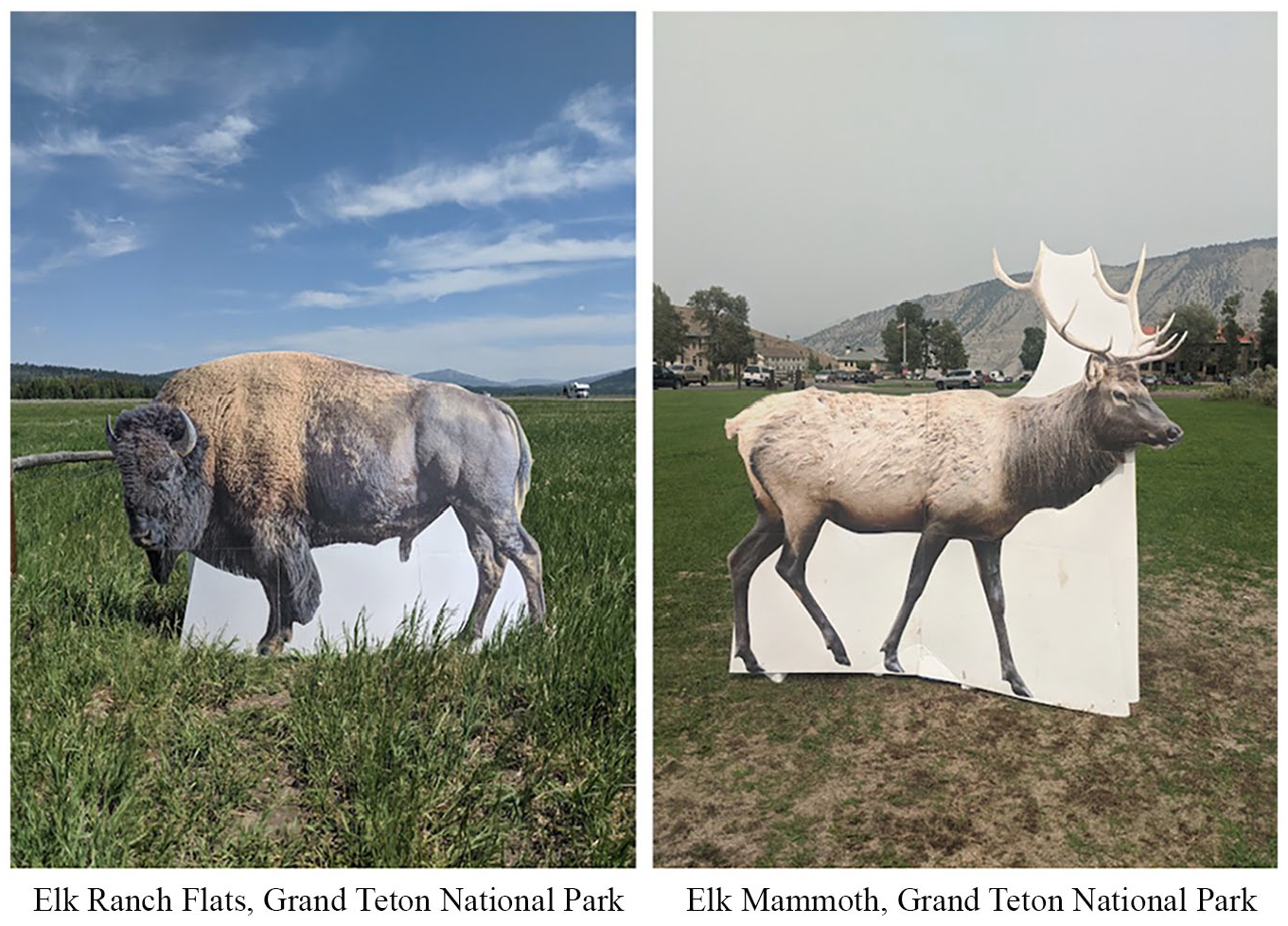
Life-size ungulate cutouts.
Analysis
Summary statistics are provided for sample characteristics. One-way ANOVAs were used to evaluate the effect of messages on distance maintained from ungulates on the transect. Separate one-way ANOVAs were conducted to evaluate this effect on bison viewing behavior in GRTE and elk viewing behavior in YELL. Bonferroni’s post-hoc tests were used to assess mean differences across groups. All analyses were conducted in SPSS.
Results
Sample
Researchers intercepted 576 park visitors in GRTE and 590 visitors in YELL during the sampling period. Visitors with language barriers and those under 18 were excluded from the study. From the eligible visitors intercepted in GRTE, 176 refused (30.8%) and 395 agreed to participate (69.2%); in YELL, 153 refused (26.3%) and 429 agreed to participate (73.7%). Non-response bias between respondents and non-respondents was also assessed by asking respondents if they were first-time visitors to the park. In GRTE, there was no significant difference between respondents and non-respondents, χ2 = 0.149, p = .699; df = 1; Cramer’s V = 0.016, p = .699. Similar results were found in YELL, χ2 = 0.20.885, p = .0.89; df = 1; Cramer’s V = 0.072, p = .089. The majority of respondents were first-time visitors to both GRTE (62.8%) and YELL (60.4%). In GRTE, the average participant was 45 years old, and in YELL, the average age was 42 years old. Approximately half of the participants identified as female in both parks (i.e., 50.0% in GRTE, 47.7% in YELL). Most respondents spoke English as their primary language (i.e., 90.9% in GRTE, 92.4% in YELL). All participants were permanent residents of the U.S. in GRTE (100.0%) and YELL (94.5%). Before their trip to GRTE, three-quarters (77.6%) had previously viewed bison. Many YELL respondents (60.2%) reported having viewed elk before their visit. On their trip to GRTE, most respondents (85.2%) reported having viewed bison. Similarly, the majority of respondents in YELL (84.5%) had viewed elk on their trip.
Awareness of Regulations
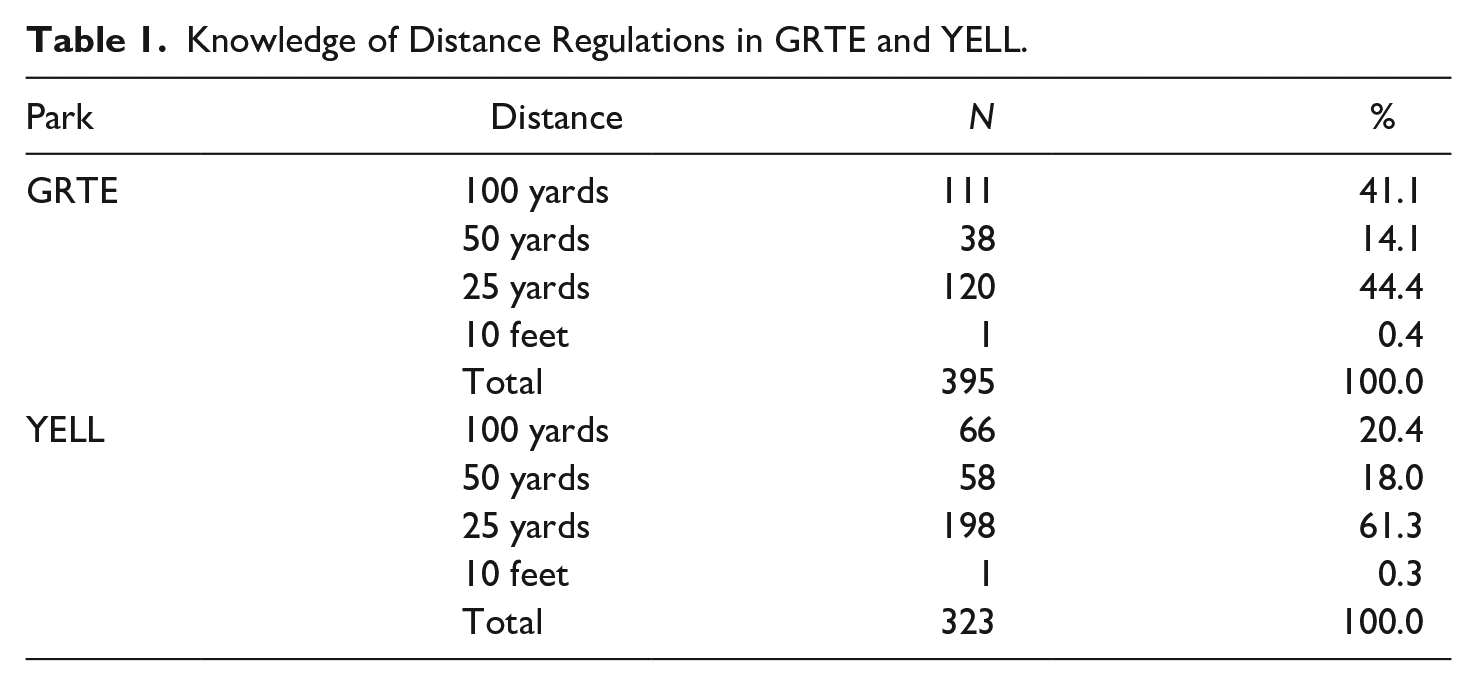
In both GRTE and YELL, park regulations state that visitors should maintain at least 25 yards from bison and elk. The majority of respondents were aware that there were regulations regarding the recommended distance individuals should be from bison in GRTE (84.5%) and elk in YELL (87.4%) (i.e., Are you aware that there are regulations regarding the recommended distance individuals should be from bison?). However, only 44.4% of respondents in GRTE selected the correct distance, and only 61.3% did so in YELL (Table 1) (i.e., How far is the recommended distance?). Additionally, participants were asked whether they had seen any messaging regarding safe distances from which to view wildlife during their visit (i.e., During this visit, have you seen any messaging regarding safe distances from which to view wildlife?). Most respondents in GRTE (70.5%) and YELL (86.2%) indicated they had. These descriptive statistics make it clear that although most participants reported being aware that the NPS regulates distances between people and wildlife, and are encountering messaging on their trip, these communication strategies are not translating to an assimilation of message content into visitors’ working knowledge about proper proximity-related behaviors.
Knowledge of Distance Regulations in GRTE and YELL.
Effect of Messages
To explore the effect of messages on the distances study participants chose to maintain from ungulates, one-way ANOVAs were conducted. In the following tables, superscripts indicate statistically significant mean differences. In GRTE, the effect of message condition on the distances study participants chose to maintain from the bison cutout was examined (Table 2). There was a statistically significant difference between message conditions, F(2, 337) = 67.928, p < .001, η2 = .287. The Eta-squared value indicated a large effect size. A Bonferroni’s post hoc test indicated that Message 1 and Message 2 were not significantly different from one another, but both messages were different from Message 3. Respondents walked approximately 66 yards away from bison cutout when given the NPS distance regulation. They stayed approximately 20 yards further away when given either of the communication messages.
One-Way ANOVA of the Effect of Messages on Bison Cutout Approach Distances in Grand Teton National Park.
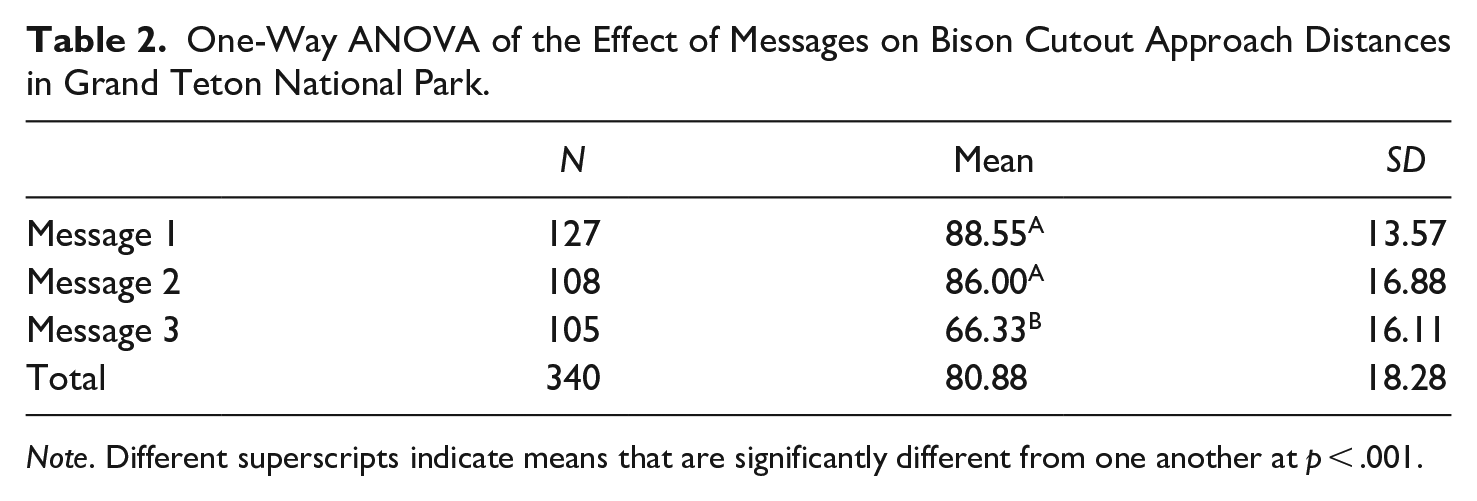
Note. Different superscripts indicate means that are significantly different from one another at p < .001.
In YELL, the effect of messages on distances respondents chose to maintain from the elk cutout was examined (Table 3). A statistically significant difference was found across the message conditions F(2, 380) = 31.371, p < .001, η2 = .142. The Eta-squared value indicated a large effect size. A Bonferroni’s post hoc test indicated that while Message 1 and Message 2 were not different from one another, they were significantly different than Message 3. In YELL, respondents maintained approximately 61 yards away from the elk cutout after receiving Message 3, yet maintained closer to 75 yards away following the visitor experience and resource protection messages.
One-Way ANOVA of the Effect of Messages on Elk Cutout Approach Distances in Yellowstone National Park.
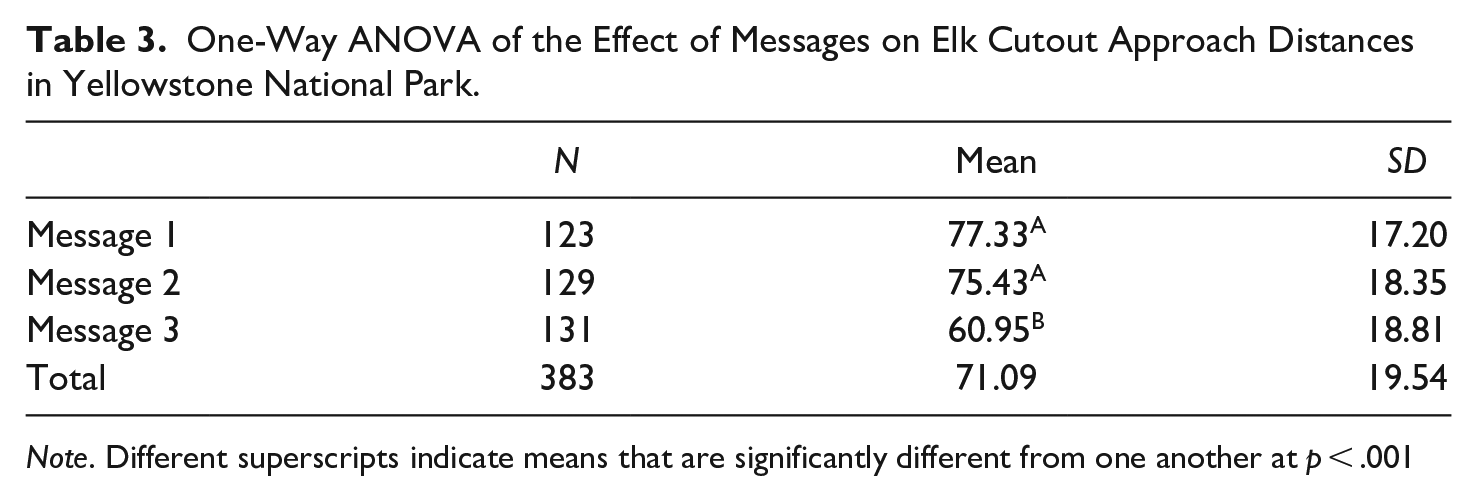
Note. Different superscripts indicate means that are significantly different from one another at p < .001
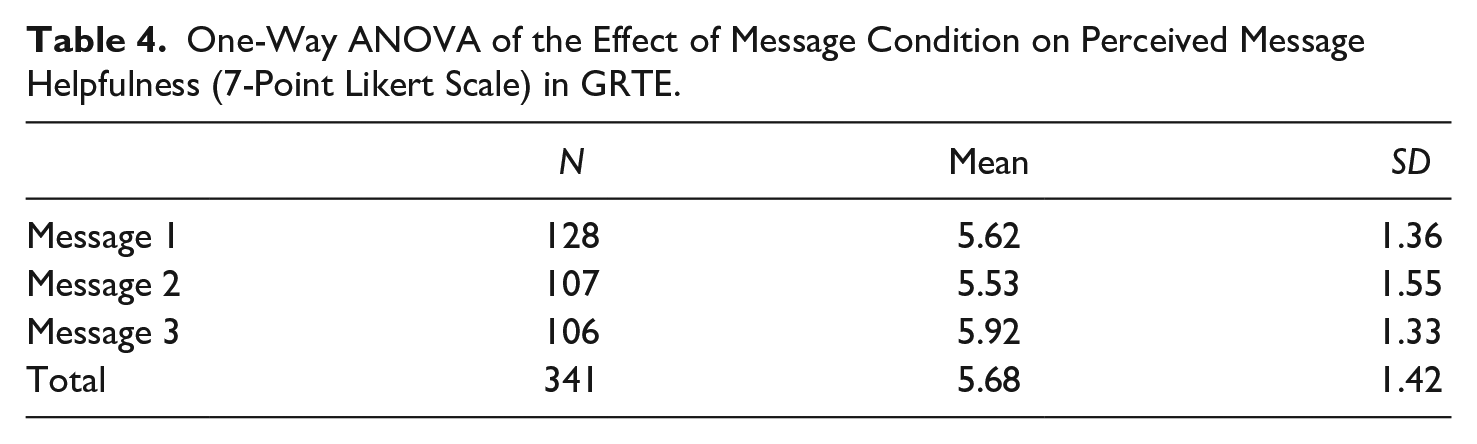
Participants in GRTE were also asked whether the message they received during the distance exercise was helpful in determining the safest distance they should maintain between themselves and bison. A one-way ANOVA was used to assess whether there were differences in responses across message conditions (Table 4). A statistically significant difference was not found across the message conditions, F(2, 338) = 2.173, p = .115, η2 = .013.
One-Way ANOVA of the Effect of Message Condition on Perceived Message Helpfulness (7-Point Likert Scale) in GRTE.
In YELL, respondents were also asked whether the message they received during the distance exercise was helpful in determining the safest distance they should maintain between themselves and elk. A one-way ANOVA was used to assess whether there were differences in responses across message conditions (Table 5). Although there was a statistically significant difference across message conditions, the effect size was small, and likely not practically meaningful, F(2, 379) = 5.832, p < .01, η2 = .030.
One-Way ANOVA of the Effect of Messages on Perceived Message Helpfulness (7-Point Likert Scale) in YELL.
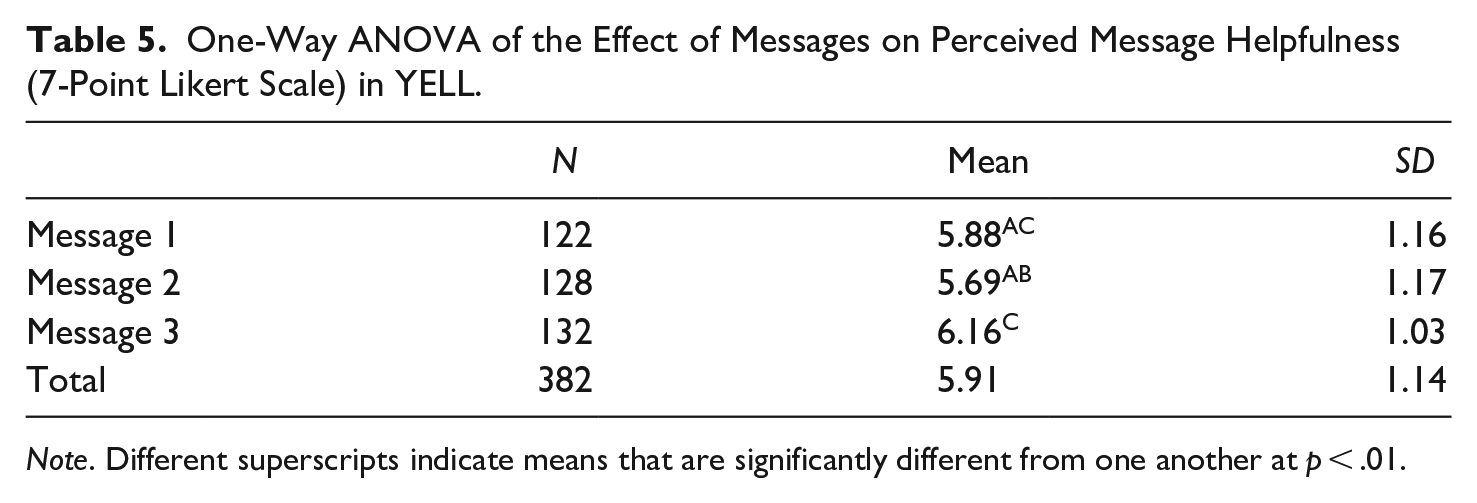
Note. Different superscripts indicate means that are significantly different from one another at p < .01.
Discussion
The purpose of this study was to test how different messaging frames about safe wildlife viewing behavior impacted park visitors’ proximity to life-like ungulate cutouts in the GYE. The efficacy of current NPS messaging was assessed for the accuracy of distance estimations people made between themselves and wildlife during a simulation (i.e., Message 3). Also, two message frames (i.e., Message 1—resource protection, Message 2—visitor experience) were compared to current messaging (i.e., Message 3) to determine how close study participants would approach ungulate cutouts based on message content. The results indicated that visitors were conservative in their approach behavior after receiving Message 3. Also, when given Message 1 or Message 2, participants stood even further back than when given the NPS distance regulation. The results of this study have practical applications for indirect management in the GYE and other PPA.
The findings from this research indicate that visitors were more conservative in terms of their proximity-related behavior than what current park messaging recommends. In the GYE, NPS wildlife distance regulations are provided with both a numerical distance and a visual proxy. Park visitors are told to maintain 25 yards, the equivalent of approximately two bus lengths, away from ungulates such as bison and elk (National Park Service, 2021d, 2022). When given this messaging during the distance exercise, however, study participants maintained an average of ~66 yards away from the bison cutout in GRTE and ~61 yards from the elk cutout in YELL, providing an additional ~40 to 45-yard buffer from the NPS regulation. Much attention in the distance-related HWC literature has been paid to understanding the relationship between norms and proximity (Cerri et al., 2019; Miller & Freimund, 2018), and whether visual cues paired with numerical distances included in safety campaigns lead to increased compliance with regulations (Abrams et al., 2020). Yet prior to the present study, an empirical understanding of whether current park messaging strategies actually lead to correct approximations has been missing from the current body of knowledge.
The visitor experience and resource protection message frames tested in the present study led to even more conservative wildlife approach behavior in study participants compared to current park messaging that employs visual cues. The results indicated no statistically significant difference between either Message 1 or Message 2 for both park samples, with participants in GRTE only approaching ~89 yards to the bison cut out, and participants in YELL approaching the elk cutout up to ~77 yards. Both of these message frames led to wildlife viewers maintaining a much wider berth compared to the visual cue message. Although there was no difference in the effect of either message on approach behavior on the study transect, the results suggest that current messaging could be amended to keep visitors at even safer distances from wildlife.
Message 1, which leveraged language that focused on resource protection, was effective at keeping study participants at safe distances during the viewing simulation. The language used in this message leveraged how unsafe viewing distances can lead to bodily harm to people which in turn causes detrimental impacts to wildlife through relocation, removal from the population, or behavior change. Previous research has also found resource protection language to be effective in addressing depreciative behaviors in PPA, such as protecting wildlife by refraining from feeding them (Marion et al., 2008) and protecting trees and vegetation by staying on trails (Winter, 2008). The present study answers the call previous researchers have made for more rigorous research that compares the differential effects that resource protection framing and visitor experience framing might have on wildlife viewing behavior (Abrams et al., 2020).
Furthermore, Message 2 relied on the personal benefits that could be accrued during wildlife viewing by maintaining safe distances from wildlife. This message frame focused on how safe viewing distances can provide opportunities to view wildlife without scaring them off, as the ability to wildlife clearly and experience their natural behaviors has previously been identified as an important aspect of the visitor experience (Hammitt et al., 1993; Pearce & Wilson, 1995; Schänzel & McIntosh, 2000; Verbos et al., 2018). In the environmental communication literature, message frames that focus on gains and benefits can be effective at increasing pro-environmental behavior (Kolandai-Matchett & Armoudian, 2020). In the context of viewing wildlife, Abrams et al. (2020) demonstrated the value of using personal benefit language that highlighted experiences people desired (e.g., capturing photos) with appropriate behavior (e.g., using a camera with zoom from far away). The present study extended this work by focusing on how maintaining distances would allow people to view natural behaviors without scaring wildlife away. The results suggest that leveraging positive benefits to the visitor experience in wildlife viewing safety communications can be equally as effective at encouraging appropriate viewing behaviors as resource protection language.
Conclusions
This manuscript fills a gap in the distance-related wildlife viewing literature by testing the efficacy of message framing that appeals to either of the values inherent with the NPS dual mandate. The findings are relevant to the sustainable management of wildlife viewing in PPA through education and interpretation. Several limitations should be taken into account when interpreting the results of this study. The message elicitation study was conducted with undergraduate students, which may not be a representative enough pilot sample for the PPA visitor population in the GYE. Additionally, during the field study, the message was read aloud to the participants while they followed along. Future research should test alternative message delivery channels, such as signage (Hall et al., 2010). The findings may not generalize to other wildlife species beyond bison or elk, or to other parks beyond GRTE and YELL. Future research should assess HWI with other species (e.g., bears) and in other PPA contexts (e.g., USDA Forest Service, BLM). Additionally, due to managerial interest and resource constraints, only one species was focused on in each park. Therefore, cross-park comparisons were not made, so future work could assess interactions with multiple species in each unit to account for the effect of this variable. Given that study participants were being watched by researchers while approaching cutouts along the transect, it is possible that social desirability bias affected the way participants behaved, and so the findings should be interpreted with caution. The study was only conducted with English-speaking participants. Furthermore, this study was conducted during the Covid-19 pandemic, and so international visitation was limited. Therefore, the results should be interpreted with these limitations in mind. Furthermore, although wildlife protection is typically emphasized in communication strategies, benefits to the visitor experience also appear to be relevant, and so understanding behavioral motivations should be tended to in future targeted communications research to ensure personal benefit framing is relevant to the audience of interest (Abrams et al., 2020).
Implications for Practice
Despite these limitations, this research provides many meaningful lessons for practitioners. Much of the previous research on proximity-related conflicts between wildlife viewers and wildlife has relied on visual-based normative methods (Cerri et al., 2019; Freeman et al., 2021; Miller & Freimund, 2018), which allows for an understanding of the visitor experience by presenting study participants with various resource or social conditions represented in a visual medium such as photographs, videos, or virtual reality and asking them to rate the acceptability of those visual representations (Gibson et al., 2014; Manning & Freimund, 2004). The present study overcomes certain limitations of this approach, as the transect exercise provided a measurement of behavior under experimental conditions, in situ, with park visitors. Rather than simply recording people’s perceptions of others’ behaviors represented through simulations, this accounts for the impact regulations have on visitor experiences and behaviors. Furthermore, whereas previous work could not control for whether visitors actually viewed communication materials prior to their viewing experience (Abrams et al., 2020), the study design assured that participants read along while message content was verbalized to them prior to the walking exercise. This study employed a novel, unique design that provides both survey and observational data relevant to the management of distance-related HWC in national parks which can be utilized in the creation of targeted communication strategies, educational materials, and interpretation programs designed to protect wildlife resources and promote visitor safety.
Supplemental Material
sj-docx-1-jix-10.1177_10925872231157596 – Supplemental material for The Impact of Message Framing on Wildlife Approach During Ungulate Viewing Experiences in the Greater Yellowstone Ecosystem
Supplemental material, sj-docx-1-jix-10.1177_10925872231157596 for The Impact of Message Framing on Wildlife Approach During Ungulate Viewing Experiences in the Greater Yellowstone Ecosystem by Stephanie Freeman, Brendan Derrick Taff, Ben Lawhon, Jacob A. Benfield, Melissa Kreye, Jennifer Newton, Lauren Miller and Peter Newman in Journal of Interpretation Research
Footnotes
Declaration of Conflicting Interests
The author(s) declared no potential conflicts of interest with respect to the research, authorship, and/or publication of this article.
Funding
The author(s) disclosed receipt of the following financial support for the research, authorship, and/or publication of this article: This work was supported by Leave No Trace, the UW-NPS Research Station, the Martin Professorship in the Department of Recreation, Park and Tourism Management at Penn State, and the Penn State LandscapeU National Science Foundation Research Traineeship.
Supplemental Material
Supplemental material for this article is available online.
Author Biographies
References
Supplementary Material
Please find the following supplemental material available below.
For Open Access articles published under a Creative Commons License, all supplemental material carries the same license as the article it is associated with.
For non-Open Access articles published, all supplemental material carries a non-exclusive license, and permission requests for re-use of supplemental material or any part of supplemental material shall be sent directly to the copyright owner as specified in the copyright notice associated with the article.
