



Abstract
Interpretation in protected natural areas can minimize visitors’ negative environmental impacts and encourage them to adopt sustainable practices at and beyond tourist sites. Despite this, interpretation has typically focussed on showcasing the specific features of natural areas rather than using these features as a resource for sustainability education more broadly. We argue that designing effective interpretation for complex issues such as sustainability is challenging and that new approaches may be needed. This paper reports on a front-end evaluation study that used online archival analysis and participant observation to assess the viability of an interpretive approach that requires no additional site hardening, is widely accessible, and focuses on fungi as a topic that can be easily connected to sustainability action beyond the site. Guidelines for developing effective interpretation in natural areas and practical implications of using this approach to link local places to global sustainability are also discussed.
Introduction
While tourism has been criticized for its negative impacts, especially in protected areas, it has also been championed as a way to enhance people’s commitment to adopting sustainable practices both at and beyond tourist sites (Ballantyne, Hughes, Lee, et al., 2018; Walker & Moscardo, 2014). This has become especially important given the growth and diversification of tourism markets in recent years. According to the World Bank (2022), in the decade leading up to 2020 international tourist departures almost doubled, reaching over two billion in 2019. Much of that rapid growth was driven by even higher growth in tourism from China, India and other countries in Asia and the Middle East (UNWTO, 2022). Such rapid growth in both numbers and diversity of tourists puts considerable pressure on many tourism systems, often resulting in widespread public concern and debate about the sustainability of tourism.
This paper defines sustainability according to contemporary views that link sustainability to wellbeing (Schaubroeck & Rugani, 2017; Shoeb-Ur-Rahman et al., 2020). Thus, sustainability is seen as an approach to human decision-making that seeks to preserve and enhance natural capital as well as make overall positive contributions to the human, social, cultural and political capital that support human wellbeing. Sustainability requires consideration of how to minimize or eliminate the negative impacts of our actions on the environment and local communities. Issues of social justice, ethics and inclusivity are also important. Using this framework, a sustainable tourist experience is one with the following features:
- includes only activities and infrastructure that support local community aspirations and has minimal or no negative impacts on the immediate surroundings;
- relies on supplies that are locally produced, recyclable, ethical and with low or no environmental impacts linked to their production;
- offers ethical and inclusive employment with good working conditions for staff;
- uses interpretation not just to encourage visitors to minimize their immediate impacts on the setting but to persuade them to engage in sustainable actions beyond the setting; and
- focuses attention on, and support for, visitors to either travel smaller distances or select more sustainable transport options to access the experience (Breiby et al., 2020).
In recent years there has been increasing and widespread discussion about the multiple dimensions of sustainability and the need for widespread change and action. This has resulted in pressures on many public agencies across the globe to adopt more sustainable practices, and to offer more public education and persuasive communication about on-site and post-visit sustainability actions (Ballantyne, Packer, Hughes, & Gill, 2018; Roberts et al., 2021). Interpretation in PNAs has, until recently, rarely overtly considered sustainability education that extends beyond the interpreted site. This is in part because of a longstanding focus on interpreting the site itself, and in part because sustainability education is a difficult task. Sustainability emerges from processes that are complex, distant, slow, long-term and cumulative. These are qualities that are very hard for humans to process (Markman, 2018). This presents challenges for interpreters, who are tasked with simultaneously creating an immediately rewarding experience, managing onsite visitor impacts and finding ways to link the special features of what they are interpreting to the larger sustainability agenda.
Concerns about sustainability are especially applicable to protected natural areas (PNAs). Prior to the COVID 19 pandemic, there was evidence of rapid and large-scale growth in global tourist visitation (Balmford et al., 2015). As COVID restrictions ease, PNAs are again under pressure. As an example, Kupfer et al. (2021) report a rapid rise in visitation to US National Parks after reopening, with numbers quickly rising beyond those recorded pre-COVID. Increases in PNA visitor numbers have mainly been attributed to a general post-pandemic shift in preferences toward nature-based activities. Accordingly, it is highly likely these pressures will increase as international travel returns (UNWTO, 2022).
In addition to higher volumes of tourists, natural areas are also attracting tourists with increasingly varied cultural backgrounds, different levels of experience with natural environments and in some cases, a lack of preparedness for outdoor recreational activities. Some of this diversity and inexperience can be attributed to widespread global migration over the last decade which has created more culturally diverse resident populations. In Australia, for example, nearly one-third of the population are recent immigrants. These are mainly drawn from China, India, the Philippines, Vietnam, South Africa, Italy, Malaysia and Sri Lanka (Australian Bureau of Statistics, 2019). The USA has experienced similar immigration patterns, with recent immigrants coming from Mexico, China, India, the Philippines, and El Salvador (Buddiman, 2020).
Although inexperienced, this large, growing and increasingly diverse audience does not arrive without expectations, many of which have been generated through their social media communities (Moscardo, 2022). The challenges of managing the negative impacts of visitors seeking to recreate images seen on social media platforms such as Instagram, TikTok, and WeChat are already evident in the popular media (Pearce & Moscardo, 2015). Detailed analysis and research into visitors’ use of mobile technologies in PNAs to connect to social media communities has only recently started to appear in the academic and practice literature (Conti & Heldt Cassel, 2020; Conti & Lexhagen, 2020; Lenzi et al., 2020; Tenkanen et al., 2017). This research predominantly focuses on visitors using images and information accessed prior to arriving in the PNA. With improvements to mobile phone coverage, this area of enquiry is now extending to include visitors’ access and use of social media platforms while in the PNA itself. What is clear from these studies is that visitors rely heavily on mobile technologies, especially for access to social media communities and that this reliance is critical to the way visitors connect to, understand and create their own meaningful personal experiences of nature and wildlife in PNAs. Staiff (2016) was an early commentator noting that in a digitally connected age, interpreters can no longer choose and control a single narrative about a site and its importance. Instead, they must learn to work with and negotiate this new digital, connected, visitor-driven approach to providing information about the places being visited.
Managing visitors in PNAs generally involves implementing a mixture of measures. These typically include imposing rules, regulations and fines; installing barriers and signs; offering various forms of interpretation; operating visitor centers; and building onsite facilities such as paved trails or boardwalks. For many years, the latter approach of managing large numbers of visitors through site hardening has been criticized as a costly management option that changes the nature of experience opportunities for all visitors (Buckley, 2011; Leung et al., 2018). More recently, increasing concerns about sustainability have prompted recommendations that PNA managers should consider the sustainability dimensions of not only site hardening, but all their visitor management approaches (Moscardo, 2017). Such discussions could include asking whether (and to what extent) extensive networks of trails, boardwalks and signs enhance the visitor experience and whether there might be equally effective yet less environmentally invasive approaches to managing visitors in fragile areas. Additionally, there have been calls for interpreters to draw explicit connections between sustainability issues at the site being visited and sustainability issues more broadly (Ardoin et al., 2015; Ballantyne, Hughes, Lee, et al., 2018; Moscardo, 2017).
This paper aims to provide initial insights into overcoming some of these challenges. It reports on a front-end evaluation study that used online archival analysis and participant observation to assess the viability of an interpretive approach focused on fungi that requires no additional site hardening, is accessible to a wide variety of visitors regardless of their cultural background or familiarity with nature-based activities and focuses on a topic that can be connected to sustainability action beyond the site. The locations used in part of the evaluation all had mobile phone coverage and therefore internet and social media access, allowing for the possibility to explore whether (and how) visitors used online resources and networks to enhance the interpretive experience. This front-end evaluation study is preliminary and exploratory and can be seen as a foundation for additional research, and for refining the interpretive methods.
Literature Review: Effective Interpretation for Sustainable Tourist Experiences in PNAs
Interpretation is commonly used by PNA managers to support their visitor management goals (Worboys et al., 2015), and is often a central part of, and critical to, tourist perceptions of a rewarding experience (Moscardo, 2017). Research suggests that rewarding nature-based experiences encourage tourists to be more connected to and concerned about nature, which in turn supports them behaving in more responsible ways to protect the visited environment (Moscardo, 2017). A review of the contemporary literature evaluating the effectiveness of interpretation for PNA management indicates two major issues of relevance to the present discussion—the challenges of designing interpretation that works for diverse audiences, especially audiences that are very different from interpreters; and the challenges of linking site specific interpretation to sustainability beyond the visit.
Nature interpretation has typically been designed within Western educational and nature-based values frameworks. Furthermore, interpretive practices are informed by studies examining tourists’ values, knowledge, expectations, activity preferences, learning styles and experiences. The underlying assumption is that differences between managers, interpreters and tourists on these key characteristics are minimal (Xu et al., 2013). But is this still the case? How do interpreters continue to engage and inspire audiences in an era of rapid and continual change? We argue that traditional western scientific approaches may have to be revised to accommodate new, different and diverse visitors; to harness the power of online, mobile and virtual technology; and to incorporate the rising interest in the use of stories in tourist experience design (Hughes & Moscardo, 2019; Staiff, 2016).
The second relevant issue is the need to link interpretation for a specific site to more general support for sustainability beyond that site. Sustainability is a vague and difficult concept to define (Daskolia & Kynigos, 2012) and not surprisingly, a difficult concept for people to grasp. Addressing sustainability requires balancing short-term benefits against long-term benefits; making individual sacrifices for a broad, and sometimes vague, communal good; and balancing individual and collective responsibility for action (Koger & Scott, 2016). Roberts et al.’s (2021) review of how US National Parks interpret climate change highlights many of the issues connected to this growing pressure on PNA interpreters.
In recent years, the focus on reducing on-site negative environmental impacts has broadened to include designing interpretive experiences to prompt long-term attitude and behavior change. Studies in zoos and aquariums by Ballantyne and colleagues offer insights into factors that encourage visitors to adopt conservation actions after their visit. These include designing activities that require visitors to reflect on the likely environmental impacts of their everyday behavior (Ballantyne, Packer, & Falk, 2011; Packer & Ballantyne, 2013); providing information and stories that engage visitors on an emotional level (Ballantyne, Packer, & Sutherland, 2011; Ballantyne & Packer, 2011); giving visitors post-visit support in the form of targeted learning materials, prompts and reminders (Hofman & Hughes, 2018; Hughes, 2011); and providing visitors with a choice of specific, manageable and local strategies for action (Ballantyne, Packer, Hughes, & Gill, 2018).
Table 1 provides a summary of the basic principles of interpretation based on models proposed by Tilden (1977), Ham (2013) and Moscardo (2017) and reviews of interpretation effectiveness provided by Black et al. (2019), Nowacki (2021) and Phipps (2010). Underlying these principles is a common core assumption that although interpreters, designers and site/attraction managers offer opportunities to have memorable and rewarding experiences, the outcomes of each visit belong to the individual visitor (Moscardo, 2017; Tilden, 1977).
Key Principles in Interpretive and Experience Design for Sustainability.
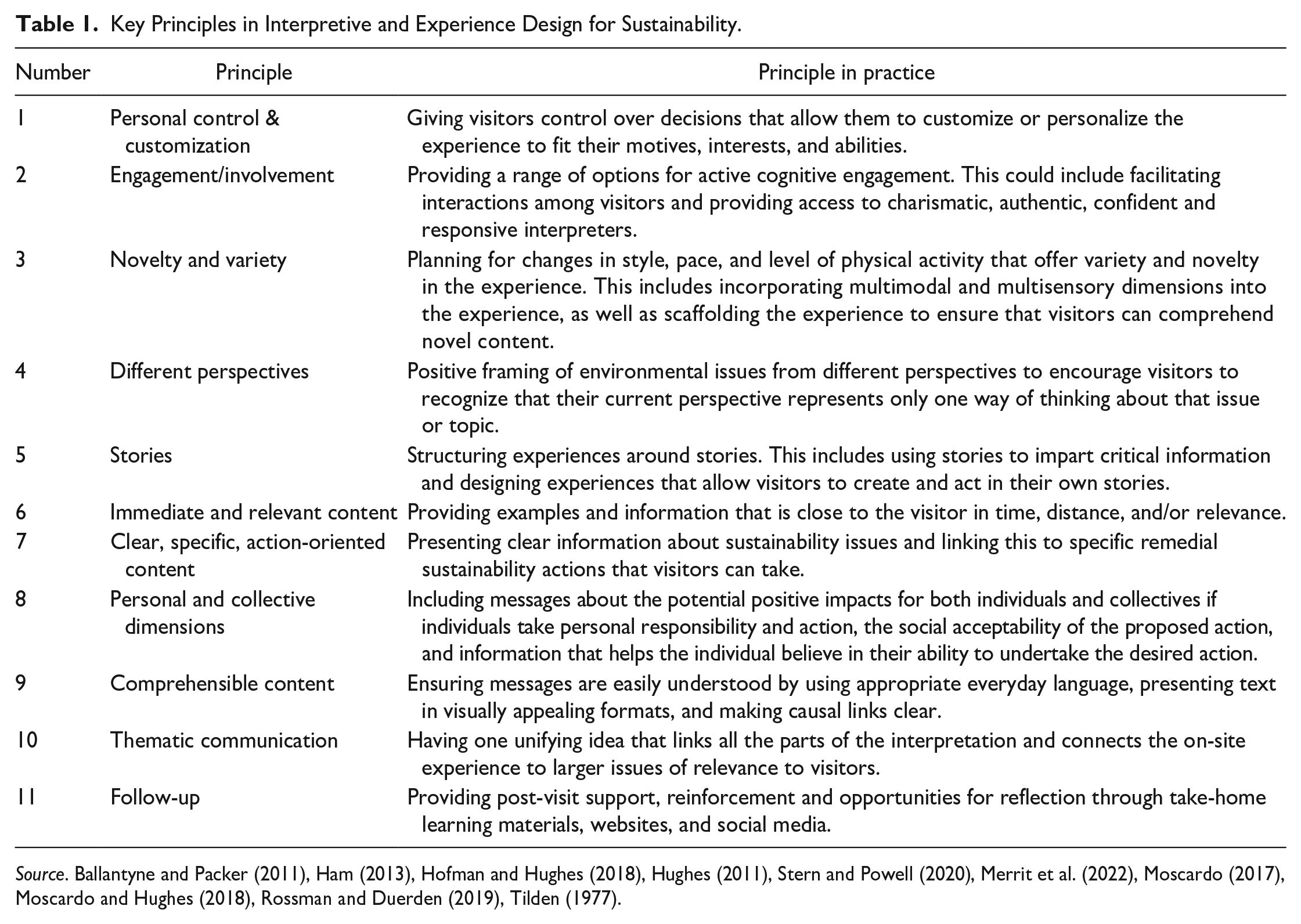
Principles one through to five encourage visitors to be mindful. Mindfulness refers to a state of active cognitive processing that is sometimes referred to as type 2, deep or slow thinking (Kahneman, 2011). The cognitive theory of mindfulness has also been demonstrated to be an important explanatory and guiding framework for explaining effective interpretation and rewarding visitor experiences (Moscardo, 2017; Rossman & Duerden, 2019). Principles 6 to 9 incorporate aspects of effective persuasive communication around sustainability and highlight that designing an engaging and rewarding experience is a necessary but not sufficient condition for imparting sustainability messages. What is also important is to choose content that encourages visitors to connect with issues on a personal level. Principles 10 and 11 relate to the effectiveness of imparting and reinforcing a specific conservation/or sustainability message.
In summary, visitors should be drawn into the environment, immersed in the experience and given a real insight into the wonders of nature. Such experiences should be augmented by interpretive elements that contain messages and activities designed to encourage visitors to reflect upon their current and future roles in protecting the natural environment. Interpreters also need to find ways to connect the environment being visited to the everyday lives of the visitors. This requires making the relevant sustainability issues close to visitors in time and space and providing suggestions for easily accomplished and socially acceptable actions visitors can take after they leave the site. The challenge is to provide these opportunities in a way that appeals to and engages large numbers of diverse and relatively inexperienced tourists without adding facilities and features that cause negative environmental impacts. The present paper reports on a study designed to explore the potential of fungi as an interpretive focus that could assist PNA managers to achieve these outcomes.
Why Fungi?
The authors have been working on variety of projects examining different aspects of the challenges interpreters face in sustainable management of tourists. Discussions with practitioners and heritage managers had identified the need to find new approaches to interpretation and/or new foci for interpretation that could address the issues listed in the previous sections. The authors were actively exploring alternative interpretative approaches when one of them participated in and observed an activity run by a mycologist as part of a conference held at an eco-resort adjacent to a protected rainforest area in Australia.
The mycologist gave a short presentation on fungi and their importance to rainforests and life on earth, then took the conference group on a short easy walk along a hardened trail into the adjacent national park. This was not meant to be an interpretive activity but rather an engagement and team building opportunity within the conference. The trail is promoted as a 30 min (1.2 km/0.75 miles) walk designed to give all visitors, regardless of their physical abilities and preparedness, an introduction to the rainforest of the region. Most visitors do the walk in 30 min or less, taking a few photographs at the one lookout at the midpoint of the walk. In this instance, the mycologist asked the conference group to focus on finding as many different fungi as possible. As a result, the group only covered about 15 m of the trail and spent nearly an hour searching for and photographing different fungi. The addition of a search for fungi transformed a relatively passive stroll in a scenic spot into a more engaging adventure using a very small portion of the trail.
The authors saw an opportunity to develop the mycologists’ team building exercise into an alternative interpretive activity that encourages greater cognitive engagement with the rainforest ecosystem and wider sustainability issues. Specifically, the authors wished to investigate whether searching for fungi could be developed as a tourist experience. They felt that developing a fungi-based trail would be timely given the recent release of several award-winning documentaries and books on fungi (Bone, 2021), as well as increasing coverage in news media of research exploring how fungi might be used to solve some of the problems that drive sustainability concerns (Hyde & Stadler, 2019). In summary, the authors were seeking a topic and context for conducting an evaluation that would ascertain whether a different structure/format of interpretive programing could achieve multiple goals. These include being minimally intrusive on the physical environment, encouraging audience engagement, linking a specific program focus to broader issues such as sustainability, and encouraging participants to adopt sustainable practices when they return to their homes/communities.
Fungi are an excellent focus for natured based interpretation—they are familiar to everyone, and because they exist in some form in a wide variety of environments, make for immediate and relevant content. Fungi are also core elements in natural systems and can easily demonstrate the concept of interdependence, two important features of sustainability education (Spinosa, 2008). Thus, fungi offer a tangible and meaningful link between the environment being visited and many everyday topics including medicine, food, composting, gardening, cultural traditions and stories. Not surprisingly, fungi are often used in elementary or primary school curricula on sustainability (cf. Belle & Tuszynska, 2020).
From an environmental education perspective, fungi can be linked to a range of sustainability actions such as recycling, composting, the breakdown of plastic for disposal, the replacement of plastic in packaging and other daily uses and rethinking manufacturing and construction to mimic nature (Aiduang et al., 2022; Bayer, 2019; Cowan et al., 2022; Sankhla et al., 2020; Temporiti et al., 2022). Fungi are generally easy to find in natural areas and often located near hardened trails. They are familiar to visitors from different cultures, offering an opportunity to find common ground for culturally diverse audiences. A simple search for fungi can create a multisensory, slower, more mindful experience that does not require much preparation, effort, or skills on the part of visitors. Furthermore, such activities draw visitors’ attention to lower layers of the rainforest or other parts of the environment that they may not have otherwise noticed.
Methods
Much published interpretation research is based on quantitative summative evaluation and explores the consequences and effectiveness of interpretation that has already been designed and implemented (He et al., 2022; Stern & Powell, 2020). This means research outcomes are likely to result in only minor, if any, changes to the interpretation in question. Front-end and/or formative evaluation appear less often in published research. There has also been little use of the elements of internet archival or netnographic methods in interpretation research. The present paper reports on a qualitative front-end evaluation of the potential of fungi-focused interpretive activities to engage, energize and inspire visitors from varying backgrounds. The study included two elements—an analysis of online commentary about existing PNA experiences linked to fungi and a qualitative participant observation study of visitors on three forest walks.
The Evaluation
The potential use of fungi as a focus for the design of engaging and sustainable visitor experiences was explored in two ways. First, we conducted a qualitative archival analysis of online reviews of walks in protected natural areas across a range of environments and locations. This analysis focused on identifying evidence of tourists’ interest in fungi. Second, we analyzed the experiences and reactions of visitors who had been asked to look for fungi on three short rainforest walks. Using an ethnographic approach, we combined in-situ participant observations and unstructured conversations to gain insights into how fungi-based interpretive activities impact on the visitor experience.
Qualitative Archival Analysis
The archival analysis (see Alexander et al., 2018, for an example of this type of research) was based on a search of TripAdvisor reviews and non-professional travel blogs using the key words fungi (and related terms such as mushrooms), nature (and related terms such as rainforest, forest, outdoors) and walks (and related terms such walking, hikes, hiking and wandering). Thirty reviews and blogs were randomly chosen from the search results and subjected to a thematic analysis following the guidelines of Flick (2018). As the thematic analysis progressed, each review/blog added new details and so more reviews and blogs were randomly selected until the analysis ceased to yield new themes or reached theoretical saturation (Flick, 2018). The final sample was made up of 54 reviews or blogs from 27 different locations across the USA, UK, Southeast Asia, and Australia and included both independent walks and experiences with guides. While many of the reviews related to rainforest walks, several included more open drier forests in different environments.
Ethnography of Three Fungi Focused Rainforest Walks
The second part of the evaluation sought to examine how tourists might react to being given explicit instructions that focused their attention on fungi. One of the authors who had tour guiding experience led three interpretive walks along rainforest walking trails in the Wet Tropics World Heritage rainforests of Northeastern Australia. Each was in a different location and type of rainforest. The walks were mostly level and on clearly marked and hardened trails in easily accessible locations popular with a wide range of visitors including locals and tourists. All three walks had interpretive signage at the trailhead with only limited signs along the walk itself. None of the signs discussed fungi. Walks varied in length—one was described as 20-min in duration, one as 40 min and the longest as 60 min.
In two of the three cases the author was accompanied by some family and friends. The author recruited additional participants in the parking areas near the trailhead by offering an opportunity for an impromptu walk with a local resident who knew the area well. Participants varied in previous experience with the type of environment, age, gender and travel groups, but all spoke English. Each group included a mixture of participants who had taken the walks previously and those who had never been on the walk before. At site 1 there were no family or friends, just the researcher and assistant; at site 2 there was one family member and eight additional participants in three groups; at site 3 there was one family member, a friend with two children and an additional 12 participants in seven groups.
Those walking the shortest trail were asked to treat the activity as a type of scavenger hunt and asked to find as many different fungi as possible without stepping off the path. This replicated the mycologist-led conference experience described earlier and was designed to encourage active engagement. Likewise, the group walking the 40-min trail were asked to look for fungi but additionally, to try to identify differences in the fungi’s appearance that were indicative of where they were found. The aim was to encourage active engagement and mindful reflection on the role of fungi in the rainforest. Visitors on the longest walk were tasked with using their smartphones to take creative and artistic photographs of the fungi they found. The rationale was that this activity would promote engagement, personalization, control and mindfulness, as well as provide insights into how the guided use of mobile technology could support interpretation.
In each case, the author had an assistant who observed and took notes during the walk and did not interact directly with the group. At the conclusion of each walk, the author explained to participants that the activity was part of a study exploring the use of fungi as an interpretive tool to focus people’s attention on rainforest environments. Participants were asked for feedback on their experiences which were recorded by the assistant. Many spontaneously offered to share their photographs. After each walk, the author and assistant compared and augmented their notes about how participants had responded.
Results and Discussion
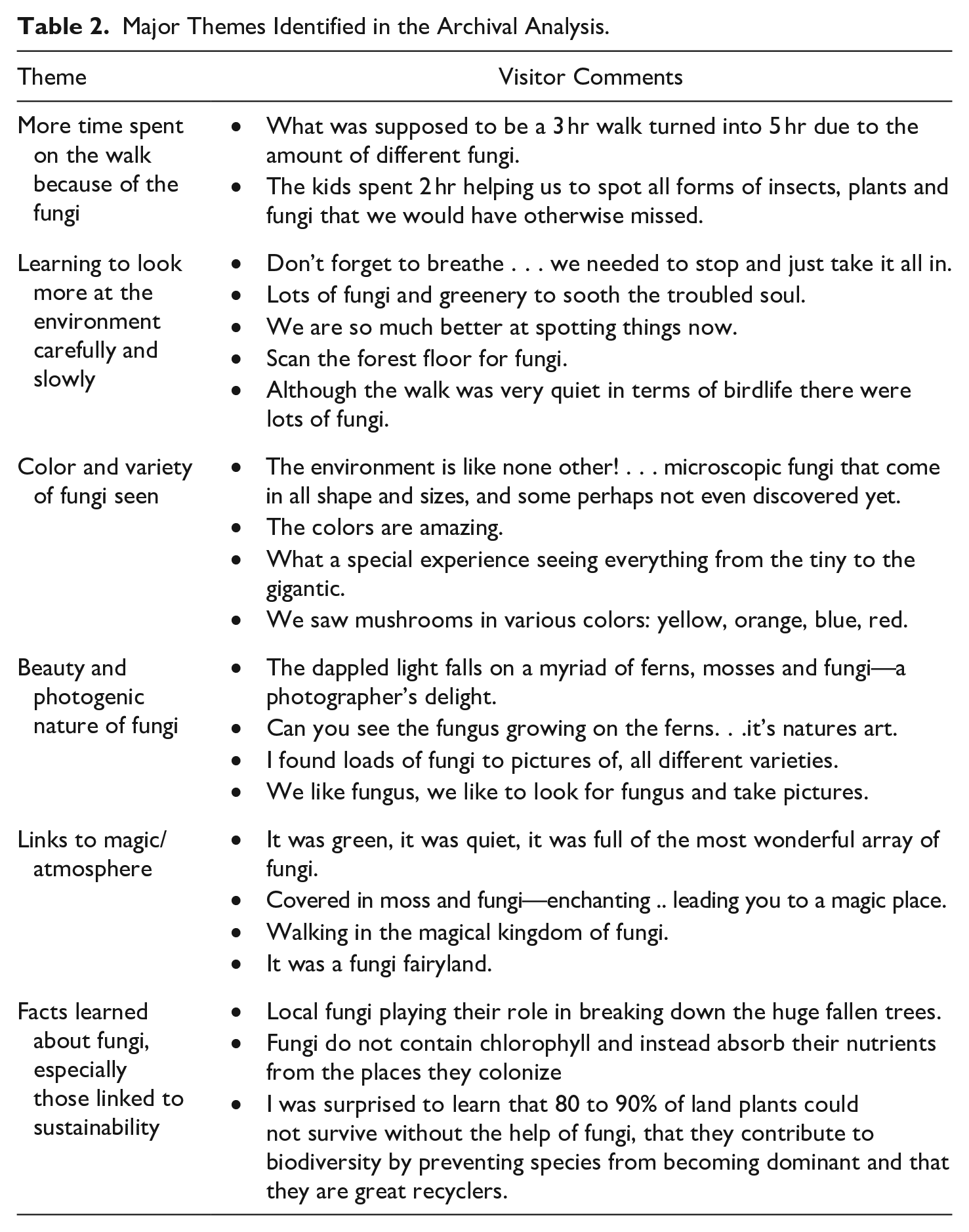
Six major themes emerged from the online archival analyzes of visitor comments and are listed in Table 2 with illustrative quotes. Overall, people were enthusiastic about seeing fungi, describing them as colorful, diverse, interesting, artistic, photogenic and magical. The photogenic nature of the fungi was evident in the large numbers of photographs of fungi that were included in the reviews and blogs, even in those where no mention of fungi was made in the text. Many visitors noted that searching for fungi stretched out the walk and helped them to slow down, to look more carefully at the environment and to see features such as plants and insects. Many also mentioned that the fungi they saw inspired them to seek more information about fungi. They reported facts and information about fungi that could be easily linked to sustainability education, such as mutually beneficial relationships, the interdependence of things in a larger system and recycling and regeneration.
Major Themes Identified in the Archival Analysis.
Observational notes taken on the three fungi-focused rainforest walks were subjected to a similar qualitative thematic analysis. This uncovered nine core themes that overlap substantially with those discovered in the archival analysis (see Table 3). It should be noted that the themes reflect the conversations, statements and actions of the visitors with no prompting, facilitating or encouragement from the interpreter/researcher. Interestingly, the interpretive activities prompted considerable social interaction, even among strangers.
Major Themes Identified from Observations of the Fungi Walk.
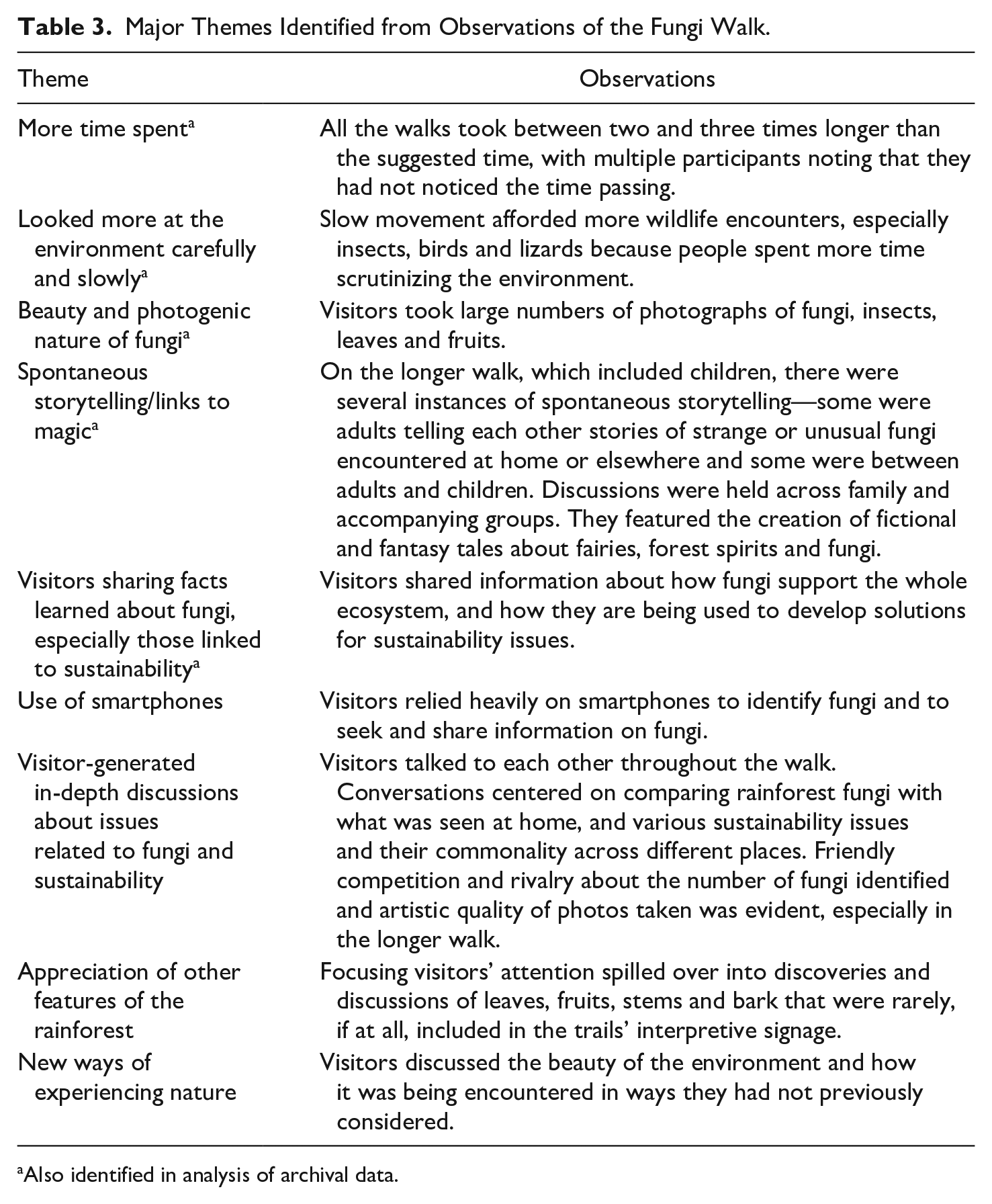
Also identified in analysis of archival data.
Conversations among visitors illustrated that storytelling enabled them to process information about different types of fungi and to identify ways in which fungi featured in their everyday lives. An example of group interaction highlights these outcomes. One child commented that “I love hunting mushrooms” and the response from a different group of visitors was the telling of a 1940s children’s story about mushrooms and fairies. This then resulted in a discussion in both groups of visitors about the appearance of fairy rings (circles of mushrooms often found in patches of lawn after rain) in home gardens. A discussion of why they might occur then promoted another visitor on the trail to use their phone to seek information on fairy rings, which in turn prompted a discussion about the mushrooms that appear in fairy rings being all connected to a single fungus underneath the soil. The original child then asked if these fairy ring mushrooms would be edible. The result was more internet searches on smart phones by several adults generating a discussion about how most mushrooms in the wild in Australia are not edible, adding that the fairy rings were more likely to appear in a patch where a tree had once been because trees depend on fungus under the ground. Finally, another child asked about whether mushrooms growing in compost bins/piles were edible prompting one more round of internet searching and discussion on why mushrooms emerge in compost, before all the visitors moved on to search for more fungi on the trail. It was also evident that visitors regularly used their smartphones to document their rainforest experience and to develop and create their own interpretation of the immediate environment.
The post-walk discussion and evaluations of these simple prototypical activities yielded surprisingly positive responses. Participants reported fascination with fungi, surprise at how many different and unusual fungi were in such a small space and a belief that searching for the fungi had enriched the experience. They also reported that the interpretive activities had encouraged them to reflect upon and seek more information about fungi, sustainability issues and environmentally-friendly actions. Many noted that they had felt a sense of accomplishment not usually associated with short walks in unfamiliar settings. Data obtained from both the blogs and the walks supported the value of the principles listed in Table 1.
Implications for Practice and Conclusions
This paper began by highlighting the challenges PNA managers face in managing tourism in a sustainable fashion and in using visitor experiences in PNAs to encourage sustainable action at and beyond the setting. More specifically, the evidence indicates that in many places, PNA managers are dealing with:
- significantly more tourists;
- diverse and inexperienced tourists who are culturally very different to themselves;
- tourists who may react and behave differently to previous cohorts;
- tourists who often use their mobile technology to access their social media communities for advice and guidance on how to visit PNAs;
- increasing pressure to offer rewarding and sustainable tourist experiences;
- scrutiny over the environmental impact of increased site hardening and interpretation that relies on build infrastructure; and
- expectations that experiences at the site will be both rewarding for visitors and support greater public awareness of, and commitment to, sustainability beyond the site.
The paper then suggested that using fungi as a focus for less physically intrusive and more engaging interpretation for visitors to PNAs might offer a solution to these challenges. Front-end evaluation confirmed the value of using fungi as a focus for interpretation about environmental sustainability in PNAs. Issues associated with sustainability such as re-use, recycling, renewal and regeneration can easily be interpreted through fungi. Perhaps more exciting, however, is the ability of fungi-based exercises to slow visitors down; to focus their attention on details they would otherwise miss; to limit the likelihood of visitors going off-path; and to provide engaging, meaningful and interactive experiences that require little if any modification of existing trails and infrastructure. This type of activity is especially useful for less prepared and less experienced visitors.
The results also highlighted how much visitors use their smartphones to access the wide range of information available online and to share information with others, features previously noted by Staiff (2016) and Hughes and Moscardo (2017). Our findings suggest that with directed use, these mobile/social technologies can significantly enhance onsite sustainability interpretation. While the present sample was predominantly English speaking, the use of mobile technologies also opens up the possibility of diverse audiences accessing information in their own language, again without the need to embed additional physical infrastructure into the setting.
Although preliminary, responses to these simple fungi-based interpretive experiences have practical implications at two levels. Firstly, at the level of specific fungi-based solution, the results indicate that simple activities focused on fungi are a viable option for encouraging diverse groups of visitors to explore the natural environment without having to venture beyond existing hardened areas or having to create new physical infrastructure. Because fungi include mushrooms, molds, mildew, rusts, and yeasts and are a dominant partner in lichens, they are found in many different forms in many different environments. This makes them familiar to virtually everyone, allowing for sustainable and rewarding experiences for increasingly culturally diverse audiences. There are extensive opportunities to develop interpretive activities that not only highlight the role of fungi in everyday life, but also provide insights into how fungi could help us address environmental problems. Thus, interpretation could focus on the role of fungi in food, gardening and medicine, and tell stories to demonstrate how fungi engage in common sustainability actions such as recycling, re-use, repair and regeneration. Such interpretation would require little, if any, additional on-site infrastructure and can be incorporated into many different environments.
There are 4 second-level, or more general practical implications that emerge from this study. The first is that the research reported here demonstrates it is possible to have immersive and engaging tourist experiences with very little overt interpretation. Widespread connectivity, which is likely to exist in some form everywhere on the planet in the foreseeable future, provides an alternative mode of interpretation that connects visitors to the relevant information. It has been noted by Staiff (2016) that visitors are already doing this for themselves. The second and related general implication is that interpreters may have to shift their core assumptions about who controls the interpretation being offered; the role of interpreters may become less about sharing information and more about supporting visitors through the process of discovery and co-creation. Third, the unexpected importance of fungi in inspiring artistic sentiments both in visual and storytelling dimensions challenges the dominant western scientific approach to interpretation. Our observations revealed that an artistic focus on the walks, whether prompted or not, generated both mindful and rewarding visitor experiences and an interest in learning scientific facts. This was clearly evident in the use of mobile devices to search for facts about the fungi being discovered. This suggests that the common approach of focusing on science to interpret natural environments may need rethinking.
The fourth implication is that we may need to reimagine themes for nature-based interpretation. Much nature-based interpretation relies heavily on the physical features, including the fauna and flora, of the environment being visited. Interpretation often stresses how rare, unique and special it is. It also relies heavily on views of what interpretation should be. Often, the kinds of nature-based experiences considered acceptable are embedded in more affluent, Euro-American worldviews. While the visitors sampled in the present evaluation were not especially culturally diverse, they did come from a range of socio-economic and educational backgrounds. The ability to link fungi to everyday experiences of a diverse range of visitors and to prompt creative expression is arguably an additional strength of this approach.
Our findings suggest that PNA interpreters and managers need to consider how their sites can introduce and/or demonstrate concepts that help visitors understand sustainability more broadly and clearly link interpretive activities to everyday sustainability actions that visitors can do at home. A common mantra in discussions of sustainability is the need to think globally but act locally. We suggest that interpreters face the reverse and harder challenge: they need to get people to think locally and then act globally.
Footnotes
Declaration of Conflicting Interests
The author(s) declared no potential conflicts of interest with respect to the research, authorship, and/or publication of this article.
Funding
The author(s) received no financial support for the research, authorship, and/or publication of this article.