



Abstract
This paper investigates why it is so hard for engineering-based inclusive innovation (EII) to fit in mainstream scaling frameworks. Can new transdisciplinary design approaches build trajectories that are more inclusive and environmentally sustainable? There are a range of constraints on EII. These include the poverty of those who might benefit most, but also institutional barriers to the inclusion of some actors with knowledge and experience of scaling innovations towards the mainstream. This paper presents a review of the extant literature on conceptual understanding of scaling EIIs and a set of case studies of attempts to scale and mainstream innovations. We have gathered data from and analysed scaling-up case studies from different sectors and geographies. The paper advocates for the advantages of evolutionary approaches to development engineering that take account of institutional variety to bridge gaps in static, neo-classical and one-size-fits-all approaches of conventional frameworks for scaling. We propose the EII Scaling (EIIS) framework, incorporating an evolutionary, transdisciplinary approach to innovation that enables engagement with the complexities and challenges of scaling and delivering EII. We also illustrate that the engineering innovations not replicated on a large scale have not necessarily failed, as one size fits all does not apply to the scaling up of EIIs.
Keywords
Introduction
Engineering for Development (E4D) links global development and engineering by building solutions for societal challenges for people who are generally left out of the development process (Robbins et al., 2017). Previously, E4D was considered a marginal and ‘appropriate’ solution that failed to integrate into the mainstream economy and society. It was argued that E4D represents a significant effort by well-meaning, talented, and hard-working individuals and teams that have designed and built prototypes to address poverty and inequality, but these efforts have failed to gain widespread adoption, remaining utopian and often forgotten.
However, our previous research analysing Research Excellence Framework (REF) 2014 cases of E4D highlights the beginnings of scale-up and integration of socially and institutionally aware engineering in complex and uncertain environments to solve pressing societal challenges (Robbins et al., 2020). Building on the work of E4D, this paper focuses on conceptualising what scale means in the context of engineering-based inclusive innovation (EII). We define EII as the serious application of science and engineering to address societal challenges and achieve real-world impact, thereby promoting sustainable and inclusive development, emphasising that it is more than just a technofix.
Scaling up is generally associated with expanding interventions or innovations into new contexts to ensure the broader societal impact of innovation. We review a key scaling framework in E4D literature (Madon et al., 2023) to demonstrate how the underlying assumptions of scaling frameworks can significantly affect the scope and effectiveness of the scaling strategies. However, such standard market assumptions and approaches often fail to capture the nuances of scaling engineering-based innovations (Smith, 2014), particularly the unique challenges and opportunities specific to each context.
To illustrate this point empirically, we employ exploratory case studies from diverse sectors and geographies to identify key variables. We then analyse different variables identified, using both frameworks based on assumptions of standard economics and ones based on an evolutionary economic perspective, to develop a comprehensive understanding of effective scaling strategies in different contexts. Based on the case study analysis, we argue that a transdisciplinary approach to innovation is needed to fully comprehend the scaling up of EII. These insights led us to develop an Engineering Inclusive Innovation Scaling (EIIS) framework based on principles of evolutionary approaches as an agile approach for scaling of EIIs in varied contexts.
The paper has six sections. Section 2 reviews extant literature to develop conceptual underpinnings of scaling EII, frameworks and their underlying assumptions. Section 3 provides an overview of research methods. We use case studies from different sectors and geographies employing a multi-methods approach, and their role in shaping our overarching approach for the conceptual framework on scaling EII. Section 4 follows up with case studies from previous work (Robbins et al., 2020) alongside recent cases across sectors and geographies. The case studies discussed are high-tech engineering solutions - not merely cheaper alternatives - designed with an understanding of institutional contexts, exhibiting signs of scalability by involving various actors, networks, and communities to address societal challenges in local settings. Section 5 presents a working definition of the EIIS framework, which emphasises that scaling-up strategies in different sectors and geographies are not one-size-fits-all and go beyond standard approaches of replication and wider adoption. Section 6 concludes by highlighting how the EIIS framework is a step toward agile frameworks to theorise scale and guide policies for EII across sectors and geographies.
Conceptual Underpinnings of Scaling up EII
Scaling is associated with expanding interventions/innovations into new contexts and is crucial in ensuring a broader societal impact of innovation. Various research areas delve into scaling including social innovation (Moore et al., 2015; Morais-Da-Silva et al., 2016; Pittz & Intindola, 2021), pro-poor initiatives focusing on the bottom of the pyramid and inclusive innovation (Foster & Heeks, 2013; Ramani et al., 2012; Sánchez Rodríguez et al., 2021; Smith, 2014) and development engineering (Madon et al., 2023). Our focus is primarily on framing scaling in EII, the innovations that use engineering to drive social change. In this section, we review a recent framework (Madon et al., 2023) in development engineering literature for scaling EII based on theories and methods of standard development economics and social sciences in engineering practice.
A Key Framework to Scale in Development Engineering
Madon et al. (2023, p. 70) define development engineering as a ‘process of discovering and characterising a problem and then developing a generalisable technological solution—one that can address the challenge at scale’. Integrating theories and methods from development economics and social sciences with engineering practice, Madon and colleagues advocate co-design of engineering advances with social and economic innovations for real-world impact. Given that several well-meaning engineering innovations fail when implemented in the real world, they propose a practical framework for designing scalable technologies that solve developmental challenges which involve iterative activities - innovation, implementation, evaluation, and adaptation – that enable researchers to anticipate and design scalable solutions for common challenges associated with technology for development (ibid). Further, they posit that scaling up involves taking an innovation that has positively impacted a limited number of users during the evaluation stage, modifying it to reach a larger number of users, and expanding its reach to users in new geographic locations. It is based on the premise that development engineering is closely linked to the recent use of randomised controlled trials (RCTs) in public policy to address poverty, focusing on technological innovation as a tool for achieving sustainable development. To operationalise this framework, they describe ‘hypothesised constraints’, ‘common’ for many ‘developing countries and low-resource communities’ (ibid):
Market constraints, e.g., lack of insurance markets, capital constraints, missing information, high transport costs and shallow markets, labour market failures, etc. Institutional constraints, e.g., intermediaries, weak contracting environment, high transaction costs, principal-agent problems within government and citizens, and asymmetric information. Behavioural/ social norms, e.g., cognitive bias, intra-household bargaining, social norms, etc.
Further, the authors describe the means to overcome these constraints as ‘diagnostic and design tools’ to understand the user base and explain why technologies that work in developed settings may fail when applied to a new setting (ibid).
However, despite offering a clean framework emphasising the ‘iterative’ and ‘non-linear’ nature of engineering for developmental challenges, we suggest that this is not enough.
Limitations of Using a Microeconomic Lens to Theorise Scaling Up of EII
Frameworks based on static and neoclassical assumptions are impractical when studying scaling strategies for real-world innovation efforts. We discuss some of the reasons:
Representation of constraints faced by low-middle income countries (LMICs) or low-resource communities as uniform and common is misleading, given the diversities within and among them. Moreover, market constraints overlook that the availability and accessibility of technologies are affected by factors beyond pricing and income, which such frameworks state are the main factors of uncertainty for poor people. For instance, it is important to focus on vertical inequalities (considering the population as a whole) and horizontal inequalities (within sub-groups, like gender, ethnicities, etc.) (Cozzens & Kaplinsky, 2009). Although Madon et al. (2023) acknowledging the broader context and challenges of adopting a top-down approach for innovation, the hypothesised constraints present a siloed discussion, which is difficult to apply to complex developmental challenges. We argue that a broader discussion is needed, focusing on the significant role of LMICs as both consumers and producers of innovation. This approach is necessary to recognise that LMICs are more than just an end market in global value chains (Horner, 2022). The framework Madon et al. (2023) posits 'design requirements’ as a manual for 'development engineers’, who are assumed to be the principal actors responsible for innovation in low-income countries. Assuming that a 'development engineer’ can observe market constraints and user behaviour to develop a suitable solution fails to acknowledge the complexities of the innovation process. In doing so, it undermines the plurality of actors and institutional variety that enables knowledge exchange, technological learning, and adoption. These are captured in evolutionary approaches to study the innovation process. E.g. the seminal work of Nelson and Sidney (1982), Dosi (1982), Freeman (1982, 1987), Lundvall (2007), Dosi and Nelson (1994), highlight that innovation is an evolutionary and dynamic process which involves co-evolution of actors, knowledge, technologies, and institutions.
Therefore, while microeconomic principles have been widely used to study firm-level or industry-level dynamics, they do not capture the complex dynamics through which engineering innovations evolve.
To some extent, frameworks such as those proposed by Madon et al. (2023) discuss the need to evaluate and implement scaling-up efforts to achieve success, e.g., using business models for the long-term sustainability of scale-ups that rely on market processes; navigating the political economy of institutions, government regulations, legal challenges, and the role of civil society with government partners. However, a comprehensive discussion on the complexity or unpredictability of the broader system and the actors that impact scaling is missing (Paina & Peters, 2012). As a result, it does not provide the focus and depth required to analyse technological changes and the power dynamics, values and struggles for influence and conflicting interests associated with the scaling process. Ramani et al. (2012, p. 684) also emphasise the importance of identification, involvement, and communication of actors specific to each sector to operationalise the scaling and diffusion process based on a study on effective delivery platforms from field practices of sanitation entrepreneurs in India: ‘…market-oriented or ‘market delivered’ innovation does not mean that the end-user effectuates all transactions associated with the diffusion through markets. Behind a market delivery, there is a complex network of actors comprising financiers, facilitators, service providers and field staff, the last interacting most closely with the target community.’ Strategies and initiatives based on a static framework tend to focus on quantity rather than quality, overlooking important points of contention around the direction and nature of innovation (Smith, 2014). The lens of scale may vary in different framings; using an example from grassroots innovations, Smith (2014)
1
argues 'one size fits all’ approach does not work in theorising scaling strategies due to concerns of the traditional market-driven approach to scaling up inclusive innovation: 'grassroot innovators and their networks are concerned about the form, depth, and scope of inclusion in innovation; they are creating spaces for experimenting with new forms of innovation process.'
Limitations of Alternative Approaches to Scaling Inclusive Innovations
Scholars have used concepts from other disciplines, such as psychology, experimental research, and biology, to bridge the challenges with the assumptions of neoclassical economics. For instance, the framework proposed by Madon et al. (2023), inspired by RCTs, suggests utilising technological innovation as a tool for achieving sustainable development. Previously, RCTs on educational outcomes in Kenya (Glewwe et al., 2004, 2009); and a series of RCTs by Banerjee and Duflo in India (e.g., Banerjee et al., 2007; Banerjee & Duflo, 2009) were used to identify the complexity of developmental challenges in small, iterative interventions to identify what works in specific contexts. Indeed, RCTs have significantly changed the practice of development economics in recent decades by breaking broader development challenges into smaller and manageable topics, which can be rigorously investigated using field experiments. However, their scalability is often debated due to concerns that results achieved in controlled environments may not generalise in diverse contexts (e.g., Deaton & Cartright, 2018). Additionally, varying levels of cognitive and institutional capacities often hinder the effectiveness of RCT-validated interventions due to bounded rationality (Simon, 1955), which affects both design and implementation. This critique of the rationality postulate in neoclassical economics has informed advances in psychology and behavioural economics (Kahneman, 2003; Kahneman & Tversky, 1979; Thaler & Sunstein, 2008), which suggests that different choice architectures have the potential for behavioural change. The effectiveness of ‘nudges’ also depends on context-specific cognitive, social, and institutional dynamics, which reinforce the importance of moving beyond one-size-fits-all models.
Economists such as Rodrik (2007) have long argued for context-specific development, emphasising that countries require unique pathways suited to their circumstances, as one-size-fits-all models are too simplistic for the complexities in growth theories. Rodrik's body of work exemplifies a pragmatic amalgamation of neoclassical approaches and evolutionary, quoting from one of his interviews (World Economics Association, 2013, p. 9): ‘I would say I am pretty conventional and mainstream on methods, but generally much more heterodox on policy conclusions.’ However, it does not involve much discussion on scale and technologies that lead to social change. On the other hand, the evolutionary approach added historical relevance, aligning more closely with the development of technologies and providing a more realistic analysis of innovation in practice. E.g. a range of neo-Schumpeterian scholars, such as Nelson and Winter (1973), adapted the concept of natural selection from biology to develop an evolutionary theory of business behaviour. They challenged the neoclassical assumptions of profit maximisation and market equilibrium, arguing these were inadequate for analysing technological innovation and the dynamics of competition among firms (ibid).
The discussion on the limitations of neoclassical and scaling-up approaches shows that these approaches have failed to provide solutions for the scaling up of EIIs. It highlights a need for a framework that can provide ways to engage with the complexity of issues associated with socially inclusive innovations. We argue that these limitations showcase a need for a multipronged framework that goes beyond a heavy reliance on microeconomic depictions of developmental issues and market failure-based framings. To fill this research gap, we examine various examples to explore different approaches in the global development literature, which can serve as a starting point for identifying a framework to study scaling-up strategies of EII.
Research Methodology
We engage with challenges associated with developing a framework for scaling up EII by proposing a novel co-evolutionary approach, drawing on diverse frameworks such as socio-technical systems and systems of innovation. We adopt a sequential approach to identify some key variables of scaling up from different sectors and geographies for our new framework.
We employ a case study approach, which allows us to conduct an exploratory study of new and emerging processes (Yin, 2018). We analyse six case studies of EII of different sectors and geographies to conduct an in-depth examination of real-world situations.
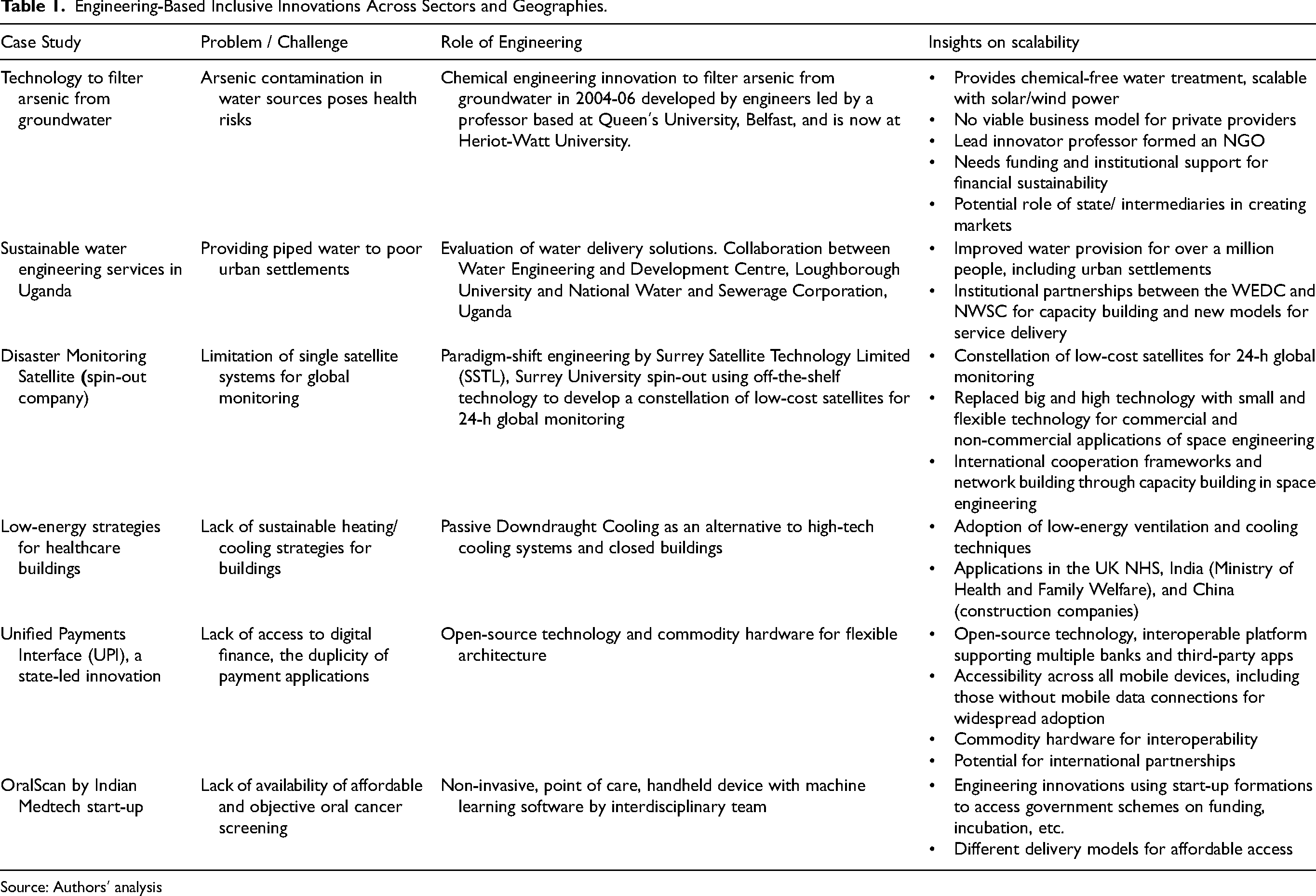
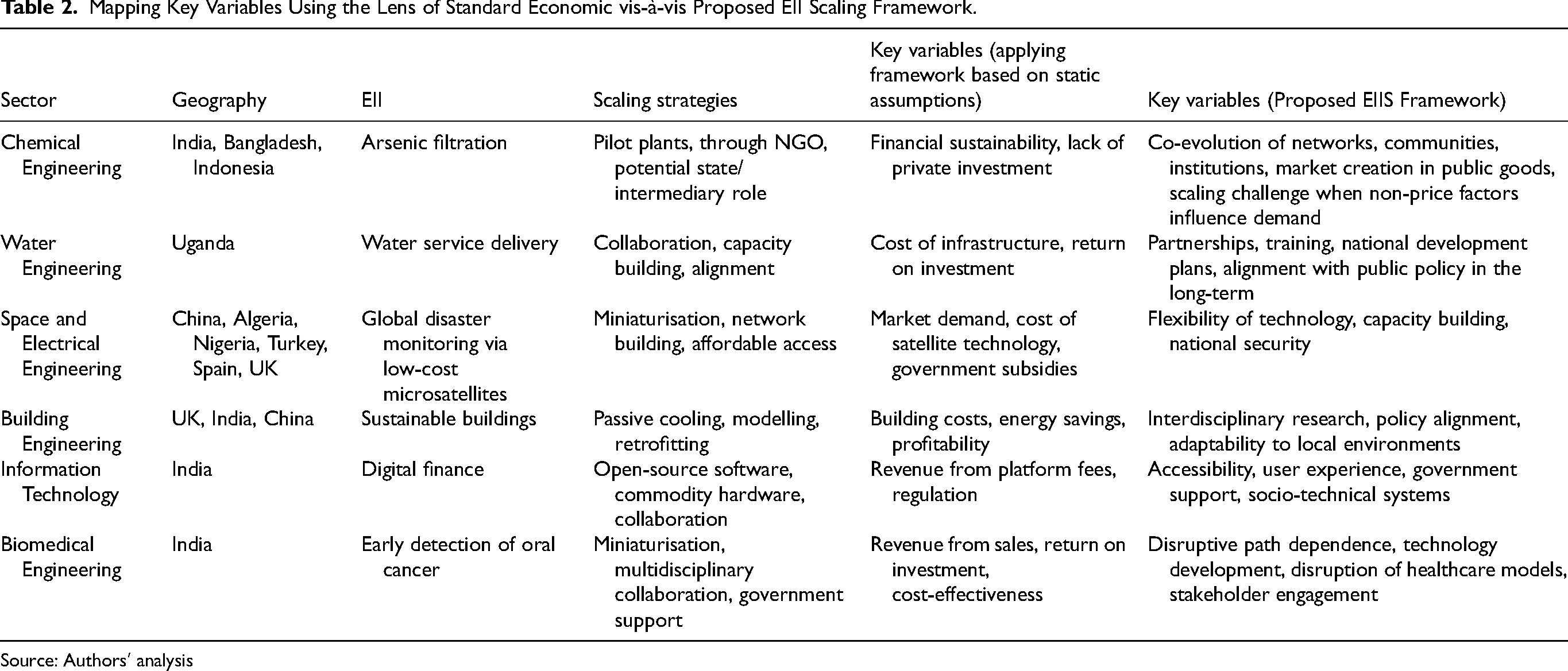
The case studies were selected to showcase scenarios in different sectors and geographies where engineering is used to innovate for social change. For robustness, we used a multi-method data collection approach, drawing on qualitative interviews for REF impact case studies from our previous research (Robbins et al., 2020), fieldwork on AI-based medical technologies (Joshi, 2023), and secondary data from government reports, industry reports and newspapers. The 6 case studies are selected to analyse different scaling strategies opted by EII in different sectors and geographies, all aiming to solve pressing global development challenges. The rationale of these case studies is to gain broad insights for scalability (see Table 1 in section 4) and to make initial observations on using a framework based on static economic assumptions compared to one informed by evolutionary insights (see Table 2 in section 5).
Engineering-Based Inclusive Innovations Across Sectors and Geographies.
Source: Authors’ analysis
Mapping Key Variables Using the Lens of Standard Economic vis-à-vis Proposed EII Scaling Framework.
Source: Authors’ analysis
To analyse the empirical case studies, we created codes based on the elements of conceptual frameworks for static framings of scale (for instance, Madon et al., 2023) and for evolutionary insights we used elements of sectoral systems of innovation approach which combines actors and networks, knowledge and technologies, which are shaped by institutions (such as, Malerba, 2002, 2005). We used analytical techniques, such as pattern-matching (Yin, 2018), to unpack the variables for the proposed EII framework. We use the analyses as the starting point for developing a working approach to the dynamic and agile framework, which can be applied to different contexts to study scaling strategies of EII that aim to address key developmental challenges across countries.
Case Studies of Different Scaling-up Strategies Across Sectors and Geographies
In this section, we analyse six cases of EII scaling-up strategies in a wide variety of sectors and regions. Table 1 frames the developmental challenge, the dominant role of engineering and its impact, and the insights gained on how engineering innovations can be scaled up.
These cases involve the framing of problems and challenges, the role of engineering, and the desired societal impact. We identify how key indicators and metrics influencing their conceptions and adoption differ in different sectors and geographies, offering scenario building and exploring the meaning of scales in EII. Together, these cases illustrate the need to analyse the complexities of good design, requiring collaboration between various cross-disciplinary design processes and practices.
Filtering Arsenic from Groundwater
A cross-disciplinary team of Indian and European engineers, led by a professor based at Queen's University Belfast (now working at Heriot-Watt University), developed a novel process to filter arsenic from groundwater (Queen’s University Belfast, 2014). Their work involved utilising chemical engineering knowledge for arsenic remediation to address the toxicity of non-piped water. One key scoping breakthrough was the successful implementation of pilot plants in three countries, bringing learning to improve the technology. The key constraint for the success of this approach hinges on financial sustainability for scale-up (Robbins et al., 2020). The engineers attempt to fund the investment by charging users of decontaminated water an affordable fee, while acknowledging that water should be provided free to low-income users. There is no incentive or business model to attract private service delivery institutions because once the plant has been built and installed, there is nothing to sell. The approach to scale, in this case, provides insights into the challenges of scaling public goods (drinking water) and emphasises the potentially crucial role of state/intermediaries in demand generation, capacity building, and creating new markets.
Water Engineering Improves Water Service Delivery in Underserved Areas
The principal challenges of providing piped water to poor, informal, urban settlements in developing countries are twofold: financial and budgetary constraints and water quality issues. The National Water and Sewerage Corporation (NWSC), Uganda's largest water authority, provides potable water and sewerage services in urban towns on a financially viable basis. The Water Engineering and Development Centre (WEDC) and the National Water Supply and Sanitation Corporation (NWSC) collaborate to provide sustainable engineering services. They have conducted surveys, interviews, and focus groups to understand user needs and evaluate delivery solutions for water through pipes, resulting in sustainable transdisciplinary design of scaled-up water services (Robbins et al., 2020). Scaling depends on:
Long term transnational collaboration (since 1988) that resulted in new models to extend and improve water service delivery to underserved areas. Over time, NWSC and WEDC have built a shared discourse of water engineering networks. A Memorandum of Understanding (MoU) between NWSC and includes NWSC sponsorship of staff to pursue MSc degrees in Water & Waste Engineering, Water and Environmental Management, and Sanitation. These in-person training programmes in the UK and Uganda, together with self-study distance learning, add to the capacity development of employees and organisational sustainability. NWSC's corporate plan for 2021–2024 aligns with Uganda's national development plan (2021–2025), which identifies NWSC as a key actor building improved urban safe water and waste management services and associated infrastructure in Uganda (National Planning Authority, 2020).
Space and Electrical Engineering to Improve Global Disaster Monitoring:
Surrey Satellite Technology Limited (SSTL), Surrey University's spin-out company, designed and built earth observation (EO) microsatellites, low-cost yet highly capable small satellites and imaging sensors using the latest ‘commercial-off-the-shelf’ technologies and devices to create the international Disaster Monitoring Constellation (DMC). DMC presents new insights from the design reconfiguration of existing products. DMC represents transdisciplinary design through constellation building and miniaturisation in electronics, with strong socio-economic components, to design low-cost satellite technology for developing countries (Robbins et al., 2020). The case presents an evolutionary style of knowledge generation from engineering practice, with room for learning from error as opposed to risk-averse military models of satellite development. DMC International Imaging (DMCii), a commercial imaging SSTL subsidiary, was formed to coordinate first-generation microsatellites and stimulate EO applications. It is the only company in the world that finances its own EO satellites without government subsidies. The case strongly emphasises three key aspects for scaling up activities:
redesigning away from big and rigid technology towards small and flexible technology, network building through transdisciplinary capacity building in space engineering for China, Algeria, Nigeria, Turkey, Spain, and the UK affordable access to space technology for developing countries to improve disaster monitoring worldwide. design cognisance of factors external to technology deployment: such as national security and regulations for space technologies.
Paradigm-Changing Building Engineering for Sustainable Buildings:
The transdisciplinary engineering innovation, in this case, substitutes passive cooling (or heating) of hospital designs in place of high-tech air conditioning systems and closed buildings. It depends on the evolution of existing knowledge using new practices and strong networks of research, development, and use. Two transdisciplinary networks collaborated in design innovation: modelling of air flows in buildings and analysis of water and air usage by the team of professors at Cambridge, Institute for Energy & Environmental Flows and colleagues from the BP Institute; data collection and modelling of temperature, humidity, and airflow behaviour over extended periods by co-investigators at Loughborough University. This approach has resulted in viable retrofit adaptation schemes for recurring building types, showing potential for significant energy and carbon emission savings. The research has led to environmental design proposals for various clinical and non-clinical spaces, with ventilation and energy performance modelled and scaled in the UK, India and China (Robbins et al., 2020; University of Cambridge, 2021):
A 200-bed hospital for the National Health Service (UK) A prototype 200–300 bed hospital is being developed by the Indian Ministry of Health and Family Welfare, led by its Chief Architect. Healthcare organisations and stakeholders in China's Hot Summer-Cold Winter region are responding to the government's carbon reduction policy. The interdisciplinary research from the UK and China focuses on addressing challenges in increasing existing stock's resilience. Proposals for new forms of scaling that showcase adapting China's existing building stock, over 9 billion square metres, without constructing new buildings.
State-led System-Wide Engineering Innovation to Enhance Access to Digital Finance:
The Unified Payments Interface (UPI) platform, developed by the National Payments Corporation of India (NPCI), standardises payment platforms in India, allowing real-time fund transfers between bank accounts through a single mobile application (NPCI, n.d.). It merges various banking features, fund routing, and payments into one platform. UPI ID (a virtual payment address) enables cashless payments across various applications and wallets. NPCI launched a pilot in April 2016 with 21 member banks, subsequently expanding to more banks and third-party payment service provider apps. These apps pay NPCI a platform fee to utilise the UPI infrastructure. As of February 2024, the UPI ecosystem supports over 550 partner banks and third-party payment service provider apps, making it an attractive model for other countries (NPCI, n.d.). The success of this state-led innovation results from a range of scaling strategies that are generalisable to other EIIs:
Utilising open-source software like Java, TDB, and Cassandra, enabling easy customisation and integration with mobile devices, and a convenient user interface. Opting for commodity hardware, not a private cloud, allowed enhanced scalability through interoperability and reduced cost and dependency on specific vendors. Collaboration with banks ensured seamless functionality across multiple mobile banking apps and third-party UPI-compliant apps, increasing user accessibility. Accessibility across all mobile devices, including those without mobile data connections, ensured widespread adoption, particularly in remote and rural areas. Regulation by the Reserve Bank of India ensured compliance, promoting safe banking practices and tech diplomacy efforts by exporting UPI architecture.
AI-Based MedTech Innovation for Early Detection of Oral Cancer:
Oral cancer is a leading cause of death in India. The current screening technique, visual inspection, often fails to detect oral potentially malignant lesions (OPMLs) in their early stages. Conventional oral examination often leads to multiple biopsies, increased expense, and false-negative reports, causing delays in diagnosis and treatment. An entrepreneur physicist, applied principles of physics to biomedical engineering to find screening modalities for oral and cervical cancer screening. The technology was a culmination of 20–25 years of knowledge exchange and multiple transdisciplinary collaborations of the entrepreneur physicist, with researchers, dentists, and biomedical engineers (Narayanan et al., 2021). These efforts resulted in scientific and instrumentation breakthroughs to screen and detect oral cancer by miniaturising the instrument product design. Research efforts were institutionalised by incubating OralScan, under the start-up company Sascan Meditech, using early-stage support from government programmes. OralScan is a handheld device with proprietary machine learning-based software that assists in screening and guiding the surgeon in taking a biopsy from the most appropriate site (ibid). After multicentric clinical trials in Indian hospitals, it received approvals from Indian regulators, got an Indian patent, filed for a patent in the USA, and obtained a CE mark (compliance with EU safety, health and environmental requirements). The driving principle for scaling this innovation case has been to reach as many people as possible. To achieve this, Sascan leverages technology to disrupt delivery models in various ways (Joshi, 2023):
A direct sale model is a one-time investment for hospitals and laboratories without additional consumable costs. pay-per-use model for diagnostic chains and small clinics. large screening camps and demand creation efforts by engaging key stakeholders.
Since cancer screening is an underserved area in India case, both in terms of public and private interventions, this case presented insights into demand generation and the creation of new markets by innovative approaches in delivery.
In summary, the case study scenarios illustrate scaling strategies are not always about spreading use or replication. They require a co-evolutionary trajectory of networks, communities, and institutions in sectors that lead to broader developments and the adoption of technologies for societal impact. Given the diverse approaches and objectives to scaling up in literature and case studies highlighted in Sections 3 and 4, we propose adopting an agile evolutionary framework sensitive to institutions and contexts in different sectors and geographies. Together, the cases analysed suggest that evolutionary theory can be used to frame ways of improving scaling strategies. They suggest that innovations can designed to be scaled in different ways. They also suggest that efforts to bridge disciplinary diversity can be successful in building new knowledge that can problem-solve seemingly intractable challenges of pro-poor engineering innovation.
A Multipronged Approach to Scaling Up of EII: An Engineering Inclusive Innovation Scaling (EIIS) Framework
In this section, we propose the EIIS framework as an approach that captures the complexities associated with the scaling of EII, which are not captured by neoclassical assumptions. In doing so, we build on recent work in the inclusive innovation literature that has provided a step forward in understanding scaling strategies as a more complex and diverse process than simply wider ‘diffusion’ of the product (Breaugh et al., 2021; Moore et al., 2015). Focusing on wider dimensions for scaling inclusive innovations, such as within the context of complex adaptive systems (CAS), by examining interactions among agents inside and outside the system to identify and address the root causes of exclusion or discrimination in the scaling process (Paina & Peters, 2012). For instance, a more dynamic and systematic approach to scaling that considers marginalised groups and anticipates, addresses, and assesses the extent to which scaling is inclusive by focusing on phases, directions, and inclusions (Sánchez Rodríguez et al., 2021):
generic pathways of the five scaling phases comprise identifying, planning, implementing, learning, and adapting. four directions of scaling: up (changes in laws, policies, institutions, or norms), down (resource allocation to support implementation), in (ensuring organisations can deliver good practices required) and out (geographically replicating or broadening the range or scope of good practices). multiple inclusive actions across the phases and all directions ensure that marginalised groups are not left behind.
In proposing EIIS as a scaling-up framework, we argue that a co-evolutionary framework has the potential to emphasise the dynamic and interconnected nature of scaling strategies, considering the interactions between networks, communities, and institutions in shaping the trajectory of EII and its adoption.
From the case study scenarios, we suggest that evolutionary standpoints are a starting point in our working definition to understand the broader context of innovation in engineering fields, especially in social or developmental contexts. An evolutionary approach provides a realistic and dynamic way of understanding the innovation process compared to neoclassical models that treat technology as exogenous (Edquist, 2011). It also emphasises that context-specific problem-solving innovations do not exist in isolation. This requires investments and consistent policy measures that drive capacity for innovation in both industrial and social goals. Studies show that institutions and public and non-public actors/organisations co-evolve to support capacities for dynamic innovation systems that cater to local needs (Srinivas, 2012; Wield et al., 2017). Additionally, power relations and hegemonic discourse bring a political economy dimension to the innovation process that requires a co-evolutionary understanding of the complex planning process, institutional change, and historical characteristics rather than being narrowly confined to economic or innovation policies (Cozzens & Kaplinsky, 2009).
The above insights brought forth by evolutionary approaches are crucial in introducing an engineering innovation for developmental challenges that substantially differ from a standard product launch. This point is pivotal for engineering innovations with no apparent market, such as arsenic removal technologies. The arsenic removal plant has not been replicated on a large scale, which does not mean it has failed. In the Indian cases, engineering innovations supported by universities are not taking the traditional pathways of starting with a ‘pilot’ and scaling up by fitting into value chains. The innovators opt for start-up formation, then react, learn and evolve within the larger ecosystem of institutional support for ‘start-ups’, for instance, through Start-up India 2 (an initiative to support startup firms by the Department for Promotion of Industry and Internal Trade, Government of India) and Make in India 3 (Government of India policies promoting local manufacturing in different sectors) policies. Start-up formation helped innovators institutionalise access to funding, incubators and accelerators, government programmes and schemes, and eventually, policy recognition.
In Table 2, we further illustrate our point by identifying key variables using standard economic approaches, as well as the proposed EII framework derived from the scaling strategies discussed in the case studies.
We present variables identified in case studies using both a static/microeconomic perspective and our proposed EII scaling framework based on evolutionary approaches to demonstrate how different lenses lead to different scaling strategies and their implications for policy and research in sustainability. The insights from Table 2 confirm our critique of using a microeconomic lens in Section 2. Engineering is a complex field that cannot be reduced to simply applying scientific principles led by research and development. Static ‘market failure’ approaches are ineffective as the diversity of engineering knowledge and practices makes it impossible to have a single concept of E4D. Based on the above insights, our working EII framework or heuristic combines different variables to investigate scaling up strategies which are sensitive to the complexities of the broader systems:
variables that appreciate the dynamic nature of the innovation process, using insights from innovation systems; variables can help identify factors to generate demand and create new markets in sectors where it is not possible (e.g Ramani et al., 2012).
There have also been some studies demonstrating the relevance of a larger ecosystem to achieve objectives of scale. In the context of Argentina, Bortz and Thomas (2017) demonstrated that scaling up research and development (R&D)-intensive technologies and promoting local development is not just about replicating a product but creating a comprehensive system to build a socio-technical adequacy. To illustrate this argument, they used heuristic tools from constructivist approaches to the Sociology of Technology (Rip, 1995), evolutionary conceptualisations of technological change (Lundvall, 2007), and a ‘backwards mapping’ approach to policy analysis (Elmore, 1985). Another study highlights the merit of framing scaling within a wider sociotechnical context. It combines the multi-level perspectives (MLP) from the sustainability transitions literature and the Ladder of Inclusivity (LII) from the inclusive innovation literature to identify key aspects that drive rapid transition in socio-technical systems (Onsongo & Schot, 2017). Combining these frameworks, researchers show how multiple pressures from different levels oriented towards social inclusion motivate regime actors to act towards a common goal of M-Pesa's success in Kenya (ibid).
The proposed EIIS framework views scaling as a dynamic process that involves continuous adaptation and learning, focusing on sustainable impact. In particular, variables identified using an EII approach, based on evolutionary approaches, consider social, institutional, and technological dynamics beyond traditional economic variables, such as market demand and cost. Most cases in Table 2 relate to the delivery of public goods, particularly those addressing public health or environmental issues. The standard economic principles usually focus on market failures while reviewing public goods. However, the case studies show that solutions without visible markets (e.g., arsenic filtration) often have different scaling objectives and require different scaling strategies. Using evolutionary approaches for EII also enables asking questions pertinent to policymaking, such as path dependence and policy approaches that provide recognition to disruptive technologies. For example, this includes government recognition of MedTech innovation for cancer detection, an area traditionally dominated by large firms and multinational corporations (MNCs).
Our analysis resonates beyond discussions concerning the role of E4D and conceptions of EIIs. At a broader level, the case studies posit the recent growth in debates about industrialisation and the global economy. Although large-scale, capital-intensive mega projects still proliferate, there has perhaps been a shift to a less ‘productionist’ industrialisation. Service-led and consumer-led industrialisation is on the rise. The old debates on green vs growth, tomorrow's technology vs today's consumption, and so on are changing so that arguments are emerging strongly that green does not contradict growth and investment-led belt-tightening is not the only way to grow an industrial economy. The work that links health to industrial systems, fossil fuels to renewables, and local and shorter supply chains during COVID and post-COVID crises may be in their early days. However, the changes we have studied and the institutional variety they illuminate seem to fit close to these potential changes in the global economy and society.
Conclusion
The paper presents different framings and meanings of ‘scaling up’ EIIs and the implications for mainstreaming these innovations in society. Instead of adopting a generic approach to scale, we draw attention to the multiplicities of framings and how they influence scale and its impact. We also argue that the current foci of scale-up in development engineering studies are based on frameworks that use economic assumptions with a restricted perspective on actors, factors, and knowledge. We emphasise the significance of diverse engineering design frameworks. We highlight the need for an agile framework to study the scaling up of EII with variables, including network building, socio-economic and political influences, institutional support, capacity creation and demand-generating mechanisms, which have a strong role in scaling strategies.
To capture scaling strategies in different sectors and geographies, we use case study scenarios. We demonstrate that one-size-fits-all does not apply to scaling strategies for EII in different sectors and geographies. Scaling is not always widespread use or replication but a co-evolutionary trajectory of networks, communities, and institutions in sectors that have led to broader developments and the adoption of technologies for societal impact. Innovations in different sectors highlight the importance of identifying the different aspects of sectoral systems of innovations, including knowledge and technologies, actors and networks, and institutional scale-up. Using these insights from the case studies, we propose EIIS as a scaling framework which incorporates insights from evolutionary approaches. This approach allows us to map the coevolution of technologies with actors, knowledge, networks, and institutional paradigms, e.g., by creating a matrix. To better understand scaling, it also allows for the incorporation of variables that explain effective demand, value, and the political economy of innovation. This approach facilitates the bifurcation of the diffusion process for scaling up, while also discussing the delivery mechanism, enabling a deeper exploration of efficiency, effectiveness, sustainability, and social equity measures. In our future research, we intend to test this working definition using empirical data from wider sectors. These insights are likely to inform a broader range of variables for the framework, enabling better delivery models, value chain advancements, and the decolonisation of development engineering by breaking away from ‘cookie-cutter’ models.
Footnotes
Acknowledgements
We are grateful for the funds from the Open Societal Challenges, The Open University to conduct this research. We also thank the comments and feedback of the reviewers and participants of the 31st International Conference on Transdisciplinary Engineering (2024), in an earlier version of this paper.

Funding
We are grateful for the funds from the Open Societal Challenges, The Open University to conduct this research.
Declaration of Conflicting Interests
The authors declared no potential conflicts of interest with respect to the research, authorship, and/or publication of this article.