The Expert Panel for Cosmetic Ingredient Safety (Panel) first published a safety assessment of Sodium Dehydroacetate and Dehydroacetic Acid in 1985. The Panel previously concluded that Sodium Dehydroacetate and Dehydroacetic Acid are safe as used in the present practices of use and concentration, as stated in that report. Upon re-review in 2003, the Panel reaffirmed the original conclusion, as published in 2006. The Panel reviewed updated frequency and concentration of use data again in 2023, in addition to any newly available, relevant safety data. Considering this information, as well as the information provided in the original safety assessment and the prior re-review document, the Panel reaffirmed the 1985 conclusion.
The Expert Panel for Cosmetic Ingredient Safety (Panel) first published the Final Report on the Safety Assessment of Sodium Dehydroacetate and Dehydroacetic Acid in 1985.1 The Panel concluded that Sodium Dehydroacetate and Dehydroacetic Acid are safe as used in the present practices of use and concentration, as stated in that report. Upon re-review in 2003, the Panel reaffirmed the original conclusion, as published in 2006.2
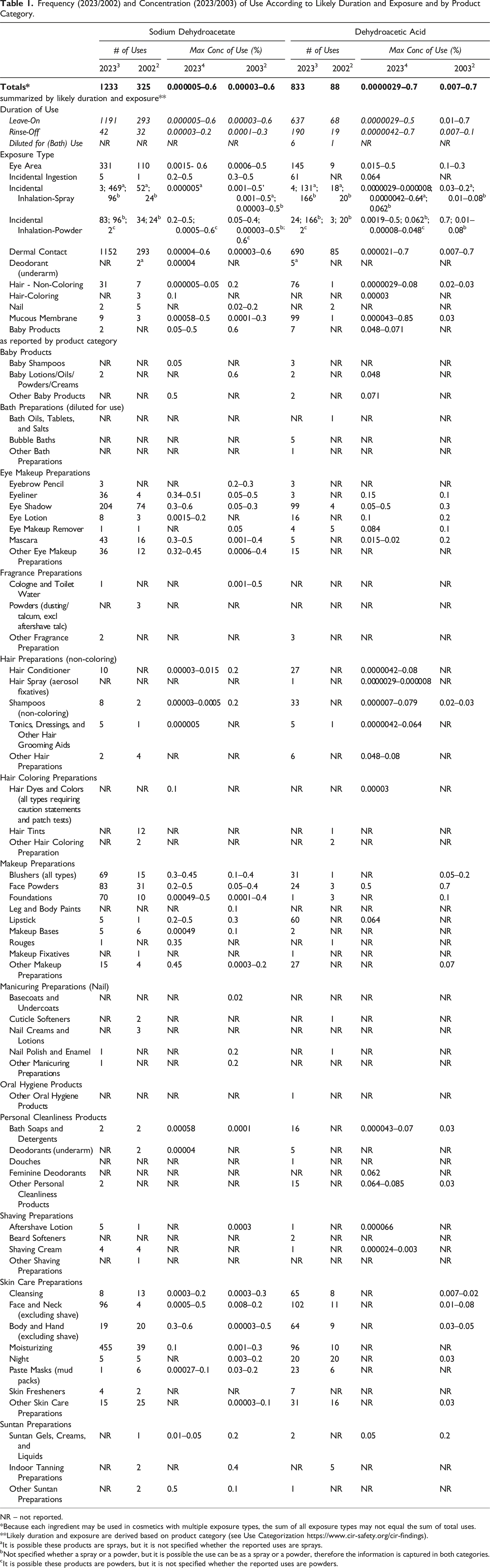
Because it had been at least 15 years since the prior re-review was published, in accordance with Cosmetic Ingredient Review (CIR) Procedures, the Panel again determined whether the safety assessment should be reopened. At the September 2023 meeting, the Panel considered updated 2023 information regarding product types and ingredient use frequencies as reported in the US Food and Drug Administration (FDA) Voluntary Cosmetic Registration Program (VCRP) database3 and maximum use concentrations provided in response to the survey conducted by the Personal Care Products Council.4 According to 2023 FDA VCRP data, the number of uses of both Sodium Dehydroacetate and Dehydroacetic Acid have increased significantly since the previous re-review. Sodium Dehydroacetate and Dehydroacetic Acid were previously reported to be used in 325 and 88 formulations in 2002, respectively, and are now reported to be used in 1233 and 833 formulations, respectively. The 2023 reported concentrations of use for both ingredients (maximum concentrations of 0.6% for Sodium Dehydroacetate and 0.7% for Dehydroacetic Acid) are the same maximum concentrations as reported in 2003. The cumulative frequency and concentrations of use data are presented in Table 1.
Frequency (2023/2002) and Concentration (2023/2003) of Use According to Likely Duration and Exposure and by Product Category.
aIt is possible these products are sprays, but it is not specified whether the reported uses are sprays.
bNot specified whether a spray or a powder, but it is possible the use can be as a spray or a powder, therefore the information is captured in both categories.
cIt is possible these products are powders, but it is not specified whether the reported uses are powders.
In July 2023, an extensive search of the world’s literature was performed for studies dated 2000 forward, and new data were found.5-17 The Panel noted the cases of hypersensitivity followed by topical application of creams containing Sodium Dehydroacetate (test article cream reported to contain 3% Sodium Dehydroacetate in one study). Concern was mitigated due to the minimal number of case reports, in comparison to the widespread use of these ingredients, and low concentrations of use. In addition, the Panel noted the photoisomerization study, and determined that these ingredients are not likely to cause phototoxicity/photosensitization at concentrations used in cosmetics, as supported by the existing negative phototoxicity/photosensitization data present in the original report.
In summary, the Panel reviewed 2023 frequency and concentration of use data, in addition to any newly available, relevant safety data. Considering this information, as well as the information provided in the original safety assessment and the prior re-review document, the Panel reaffirmed the 1985 conclusion. The Panel discussed the possibility for these ingredients to be used in cosmetic products which may be incidentally inhaled. A detailed discussion and summary of the Panel’s approach to evaluating incidental inhalation exposures to ingredients in cosmetic products is available at https://www.cir-safety.org/cir-findings.
Footnotes
Author’s Note
Unpublished sources cited in this report are available from the Director, Cosmetic Ingredient Review, 555 13th St., NW, Suite 300W, Washington, DC 20004, USA.
Author Contributions
The articles in this supplement were sponsored by the Cosmetic Ingredient Review.
Declaration of Conflicting Interest
The author(s) declared no potential conflicts of interest with respect to the research, authorship, and/or publication of this article.
Funding
The author(s) disclosed receipt of the following financial support for the research, authorship, and/or publication of this article: The articles in this supplement were sponsored by the Cosmetic Ingredient Review. The Cosmetic Ingredient Review is financially supported by the Personal Care Products Council.
References
1.
AndersenFA, ed. Final report on the Safety Assessment of Sodium Dehydroacetate and Dehydroacetic Acid. J Am Coll Toxicol. 1985;4(3):123-159.
US Food and Drug Administration (FDA) Center for Food Safety & Applied Nutrition (CFSAN). 2023. Voluntary Cosmetic Registration Program - Frequency of Use of Cosmetic Ingredients. (Obtained under the Freedom of Information Act from CFSAN; requested as “Frequency of Use Data” January 4, 2023; received February 2, 2023). College Park, MD.
4.
Personal Care Products Council. Concentration of use by FDA product category: Sodium Dehydroacetate and Dehydroacetic Acid. (Unpublished data submitted by Personal Care Products Council on February 23, 2023). 2023.
5.
DuHJTongGHNingJY, et al.A repeated dose 28-day oral toxicity study of sodium dehydroacetate (DHA-S) in Wistar rats. Regul Toxicol Pharmacol. 2023;137:105313.
6.
ZhangYYingDLiuH, et al.Serum pharmacokinetics and coagulation aberration induced by sodium dehydroacetate in male and female Wistar rats. Sci Rep. 2017;7:46210.
7.
ChenXHaoFZhangM, et al.Sex metabolic differences and effects on blood coagulation among rats exposed to sodium dehydroacetate. Front Pharmacol. 2021;12:727084.
8.
FangJLiuHBZhiY, et al.Subchronic oral toxicity evaluation of sodium dehydroacetate: a 90-day repeated dose study in rats. Biomed Environ Sci. 2022;35(4):296-311.
9.
ZeigerEAndersonBHaworthSLawlorTMortelmansKSpeckW. Salmonella mutagenicity tests: III. Results from the testing of 255 chemicals. Environ Mutagen. 1987;9(Suppl 9):1-109.
IzawaTNakayamaKUchidaNNojimaK. Photoreactivities of the antiseptics dehydroacetic acid and sodium dehydroacetate used in cosmetics. Chem Pharm Bull (Tokyo). 2018;66(5):581-584.
12.
FotiCBonamonteDConservaA, et al.Allergic and photoallergic contact dermatitis from ketoprofen: evaluation of cross-reactivities by a combination of photopatch testing and computerized conformational analysis. Curr Pharm Des. 2008;14(27):2833-2839.
13.
FotiCAntelmiAGuidaSRomitaPBonamonteD. Sodium dehydroacetate: an emerging allergen. Dermatitis. 2012;23(5):243.
14.
MilpiedBColletEGenillierNViganM. Allergic contact dermatitis caused by sodium dehydroacetate, not hyaluronic acid, in Ialuset® cream. Contact Dermatitis. 2011;65(6):359-361.
15.
ValoisAWatonJAvenel-AudranM, et al.Contact sensitization to modern dressings: a multicentre study on 354 patients with chronic leg ulcers. Contact Dermatitis. 2015;72(2):90-96.
16.
CanavezAde OliveiraPCGIsaacVLBSchuckDCLorenciniM. Integrated approaches to testing and assessment as a tool for the hazard assessment and risk characterization of cosmetic preservatives. J Appl Toxicol. 2021;41(10):1687-1699.