



Abstract
The Expert Panel for Cosmetic Ingredient Safety reviewed updated information that has become available since their original assessment from 2003, along with updated information regarding product types, and frequency and concentrations of use, and reaffirmed their original conclusion that Triacetin is safe as a cosmetic ingredient in the practices of use and concentration as described in this report.
Current and Historical Frequency and Concentration of Use of Triacetin According to Duration and Exposure.
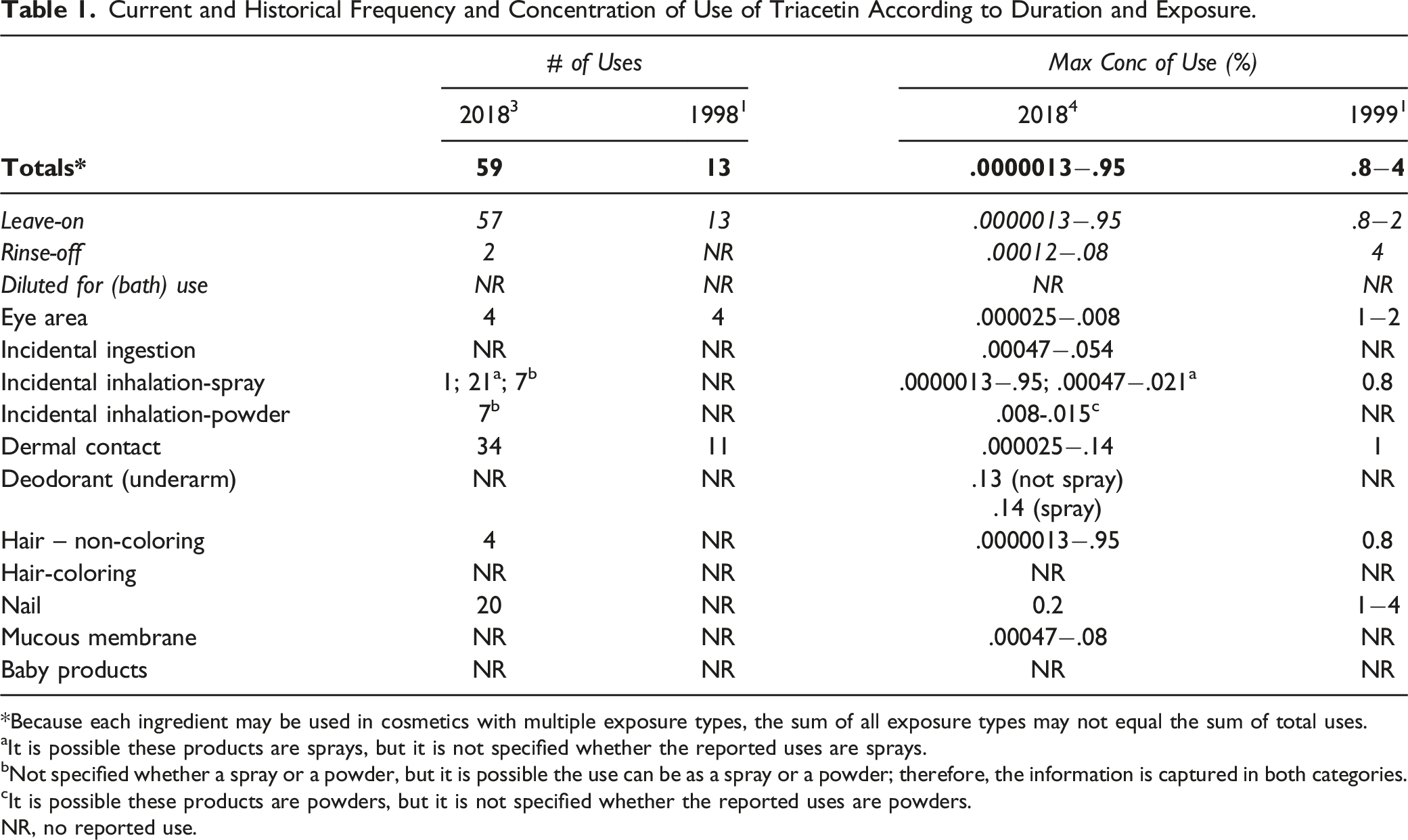
*Because each ingredient may be used in cosmetics with multiple exposure types, the sum of all exposure types may not equal the sum of total uses.
aIt is possible these products are sprays, but it is not specified whether the reported uses are sprays.
bNot specified whether a spray or a powder, but it is possible the use can be as a spray or a powder; therefore, the information is captured in both categories.
cIt is possible these products are powders, but it is not specified whether the reported uses are powders.
NR, no reported use.
The reported frequency of use of Triacetin in cosmetics has increased slightly since safety was originally reviewed; 13 uses were reported in 1998, and 59 uses were reported in 2018. However, the maximum use concentrations have decreased, from 2% in leave-on and 4% in rinse-off formulations to .95% in leave-on and .08% in rinse-off formulations.
Developmental and reproductive toxicity data were absent in the original assessment. However, the Expert Panel found that because Triacetin is hydrolyzed to glycerol and acetic acid, neither of which is a developmental toxin, Triacetin did not present a risk of developmental or reproductive toxicity. The developmental/reproductive toxicity screening test that is now available confirmed the Expert Panel’s conclusion. In a study in which 12 rats/sex received doses of 0 (vehicle; distilled water), 40, 200, and 1000 mg/kg bw/day Triacetin by gavage (males for 44 days from 2 weeks prior to mating and females for 41-48 days from 14 days before mating to day 3 postpartum), no maternal toxicity was observed, and there were no fetotoxic or developmental effects. Both the maternal and developmental no-observable-adverse-effect-level (NOAEL) was established as 1000 mg/kg bw/day.
Also, during its original review, the Expert Panel recognized the FDA affirmation of glycerides, including Triacetin, as a generally recognized as safe (GRAS) human food ingredient. This GRAS status was supportive of the overall safety of this ingredient.
Footnotes
Author Notes
Unpublished sources cited in this report are available from the Director, Cosmetic Ingredient Review, 1620 L Street, NW, Suite 1200, Washington, DC 20036, USA.
Author Contributions
The articles in this supplement were sponsored by the Cosmetic Ingredient Review.
Declaration of Conflicting Interest
The author(s) declared the following potential conflicts of interest with respect to the research, authorship, and/or publication of this article: The articles in this supplement were sponsored by the Cosmetic Ingredient Review.
Funding
The author(s) disclosed receipt of the following financial support for the research, authorship, and/or publication of this article: The articles in this supplement were sponsored by the Cosmetic Ingredient Review. The Cosmetic Ingredient Review is financially supported by the Personal Care Products Council.