




Abstract
The Expert Panel for Cosmetic Ingredient Safety reviewed updated information that has become available since their original assessment from 1982, along with updated information regarding product types, and frequency and concentrations of use, and reaffirmed their original conclusion that Polyamino Sugar Condensate is safe for topical application to humans in the practices of use and concentration as described in this report.
The Expert Panel for Cosmetic Ingredient Safety (Panel) first published the Final Report of the Safety Assessment of Polyamino Sugar Condensate in 1982. 1 The Panel concluded that on the basis of the available animal data and limited human experience presented in the report, in the present practices of use and concentration, Polyamino Sugar Condensate is safe for topical application to humans. Upon re-review in 2002/2003, the Panel reaffirmed the original conclusion, as published in 2005. 2
Frequency and Concentration of Use (2022/2001) According to Likely Duration and Exposure by Product Category.
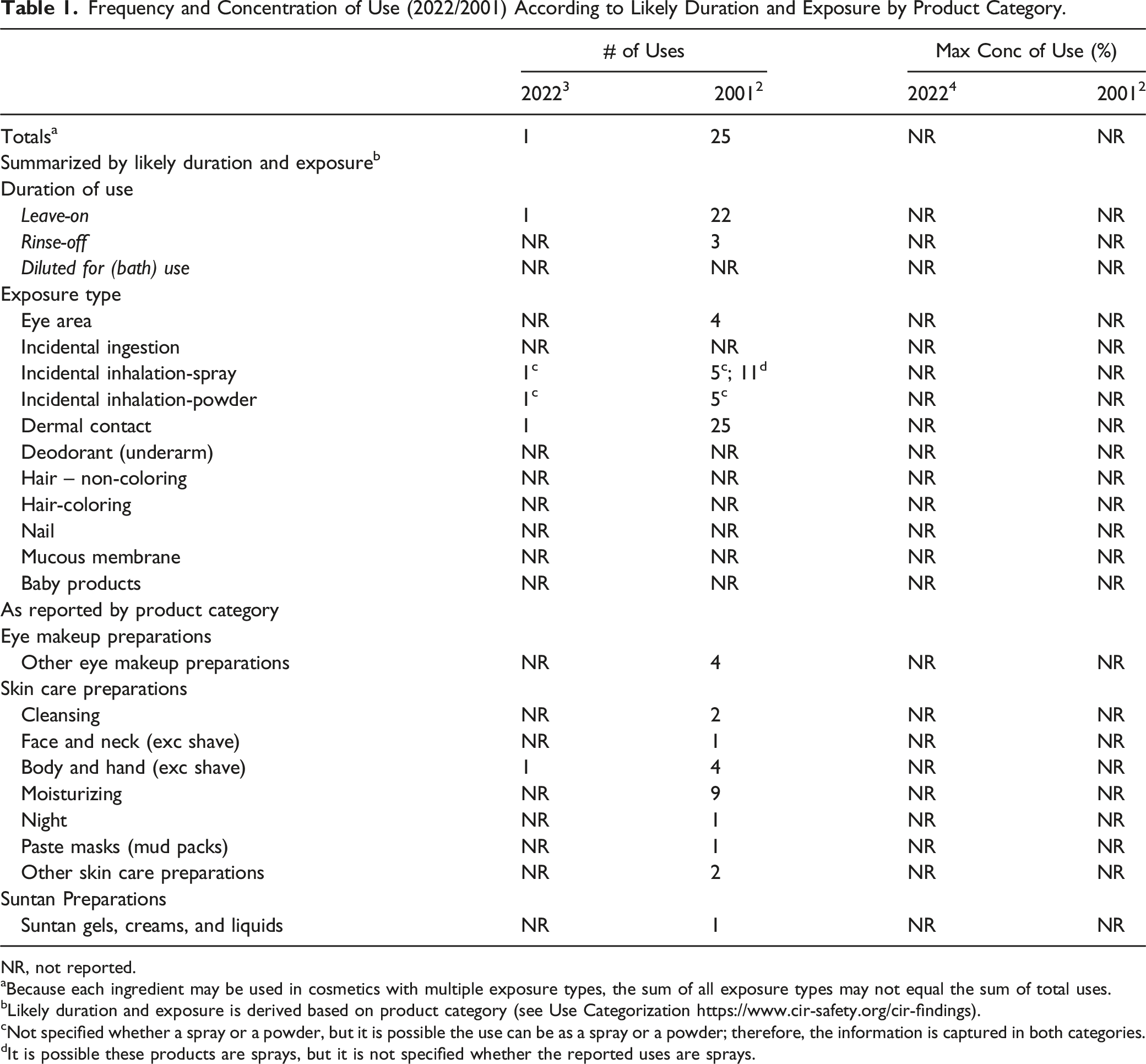
NR, not reported.
aBecause each ingredient may be used in cosmetics with multiple exposure types, the sum of all exposure types may not equal the sum of total uses.
bLikely duration and exposure is derived based on product category (see Use Categorization https://www.cir-safety.org/cir-findings).
Not specified whether a spray or a powder, but it is possible the use can be as a spray or a powder; therefore, the information is captured in both categories.
dIt is possible these products are sprays, but it is not specified whether the reported uses are sprays.
In January 2023, an extensive search of the world’s literature was performed for studies dated 2000 forward. No relevant new data were found.
In summary, the Panel reviewed 2022 frequency and concentration of use data and noted the lack of any new, available, relevant safety data. Considering this information, as well as the information provided in the original safety assessment and the prior re-review document, the Panel reaffirmed the 1982 conclusion. The Panel discussed the possibility for this ingredient to be used in cosmetic products which may be incidentally inhaled. A detailed discussion and summary of the Panel’s approach to evaluating incidental inhalation exposures to ingredients in cosmetic products is available at https://www.cir-safety.org/cir-findings.
Footnotes
Author's Note
Unpublished sources cited in this report are available from the Director, Cosmetic Ingredient Review, 1620 L Street, NW, Suite 1200, Washington, DC 20036, USA.
Author Contributions
The articles in this supplement were sponsored by the Cosmetic Ingredient Review.
Declaration of Conflicting Interest
The author(s) declared the following potential conflicts of interest with respect to the research, authorship, and/or publication of this article: The articles in this supplement were sponsored by the Cosmetic Ingredient Review.
Funding
The author(s) disclosed receipt of the following financial support for the research, authorship, and/or publication of this article: The articles in this supplement were sponsored by the Cosmetic Ingredient Review. The Cosmetic Ingredient Review is financially supported by the Personal Care Products Council.