




Abstract
Acute poisoning is a serious health problem that is associated with high mortality. Management of acute poisoning cases in the critical care settings is the biggest challenge due to the difficulty in identification of poison involved. Immediate information about the poisoning and its management is crucial in the early diagnosis, treatment, and in the prevention of poisoning complications. Poison information resources, such as various poison apps and databases, are essential for the retrieval of updated and quick information on poisoning. Through provision of information to the public and to health care professionals, apps and databases play a significant role in the management of poisoning cases.
Introduction
Poisoning is a significant public health problem all over the world. 1 Acute poisoning is a major cause for visits to emergency departments and calls to poison information centers throughout the world. 2 Poison is a substance that causes damage or injury to the body and endangers one’s life due to its exposure by means of ingestion, inhalation, or contact. 3 The annual incidence of unintentional acute poisoning cases exceeds 1 million. Additional 2 million intentional poisoning cases (mainly suicide attempts) has been estimated. Among more than 220 000 intentional and unintentional deaths which occur from acute poisoning, suicide account for 91% approximately. 4 Intentional or accidental exposure to household products, pharmaceuticals, toxic plants and contaminated food and occupational exposure to industrial chemicals and pesticides all contribute to poisoning. 5 In India, the most commonly used poisoning agents are pesticides. 6 About 99% of deaths are due to pesticide poisoning, although only 20% of the world’s agrochemicals are used by developing countries. 7 The death rate due to poisoning in developed countries is 1% to 2%, whereas in India, it ranges between 15% and 30%. 8 According to WHO reports, in 2012, approximately 193 460 people died throughout the world due to accidental poisoning. 1
Kaale et al. reported that a major challenge faced by physicians is identification of the poison. This was due to the lack of awareness or reluctance of the patients’ representatives to report the substance consumed, and often the patients are lethargic, unconscious, or in coma, making it difficult for the physicians to acquire information from them and to choose the appropriate antidote. 9 Jesslin et al., conducted a retrospective and prospective study to evaluate the prevalence and death incidences because of poisoning. The study found that the reasons for death due to poisoning are mainly due to late admission to the hospital, inappropriate management, and lack of information about the poison consumed and its antidote. 6 Amit Sharma et al., conducted a study regarding the importance of Poison Information Centre and role of a pharmacist in the identification of poison. The purpose of the study was to support health care professionals in the identification and management of poisoning. According to the study, information about identification of poisoning by products, such as household products, corrosive chemicals, industrial chemicals, poisonous plants, animal toxins, and look-alike products may help in the management of poisoning. 10 A retrospective study by Batra et al. was conducted to assess the nature, pattern, and magnitude of the morbidity and death due to poisonings in a district of Maharashtra for a period of 5 years. This study concluded that a thorough understanding about the nature and magnitude of the poisoning cases is essential not only for early diagnosis and treatment but also for establishing new, and assessing the old, preventive measures. 11 A study conducted by Ponampalam in Singapore to assess the physicians need for drug and poison information showed the necessity for enhanced drug and poison information resources. 12
Most of the animal bite wounds in the United States are by dogs and cats. Each year, 800 000 Americans look for medicinal attention for dog bites: 386 000 need treatment in an emergency department. Human bite wounds are the third driving reason for all bite wounds found in hospital emergency crisis offices representing 3.6% to 23% of all bite wounds. 13 Snakebite mortality is strongly connected with destitution and poor investment in health by national governments. Snakebite prevention action activities and community education programs exist on a little limited scale. 14 Around 5.4 million snake bites occur every year globally, causing 1.8 to 2.7 million cases of envenomation. It is considered that these result in the mortality of 81 000–138 000 people in a year and 400 000 with permanent disabilities. 15 Scorpion envenomation is a significant issue in the southwestern United States and all through Mexico. An expected 5,000 deaths happen every year from scorpion stings worldwide. 13 Poison information resources play an important role by providing information to health-care professionals as well as general public in the management of poisoning cases, including bites, and are essential for the quick retrieval of updated information. Users in many countries have access to databases specific to the products available in their country. 16
Examples of the Poison Apps Available
Resources for the General Public and Health-Care Professionals
Poisoning—first aid for children
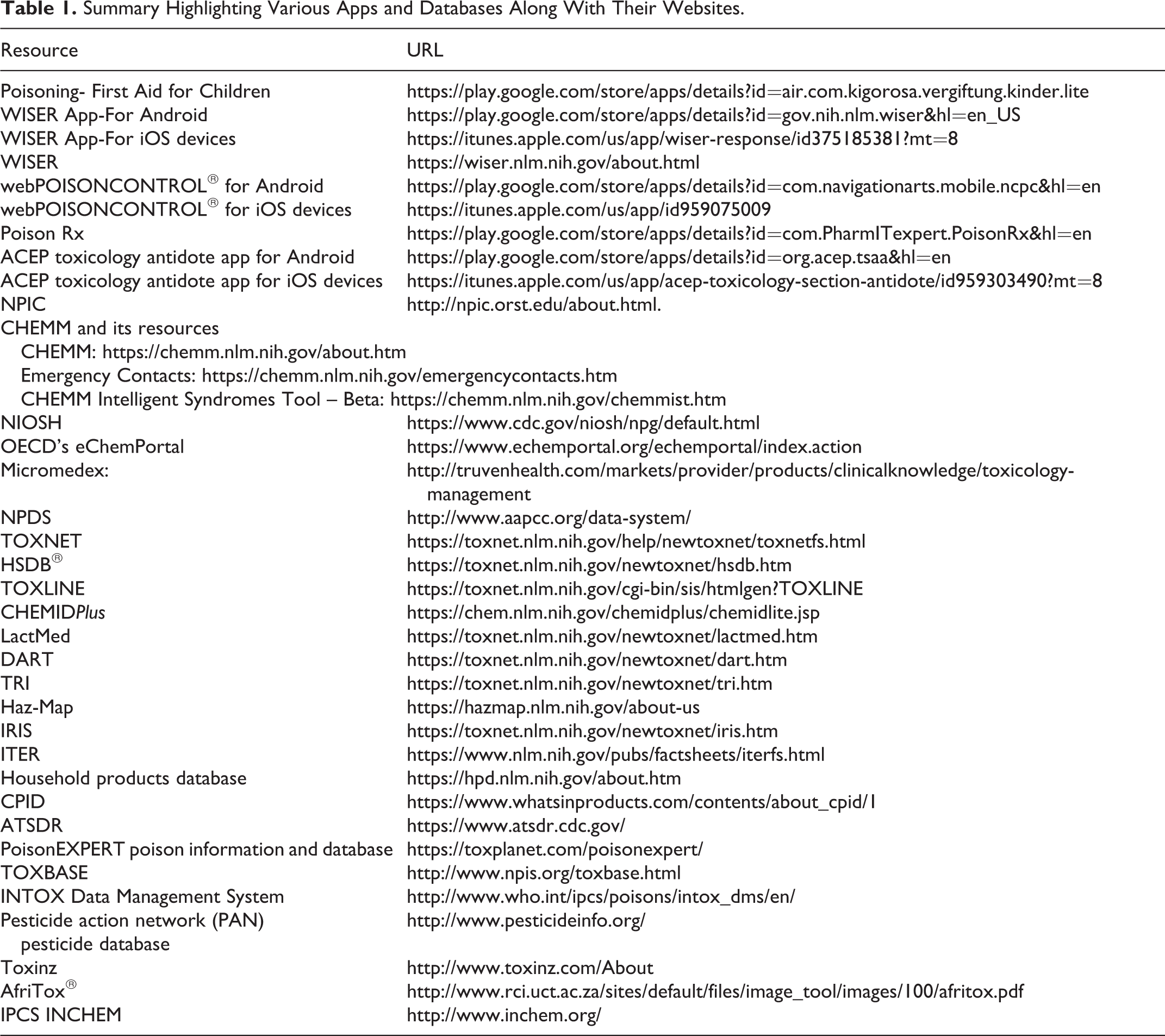
This poisoning app contains mainly first aid information for treating children (summarized in Table 1). The full version contains more than 500 poisoning emergencies. It helps to find the poison quickly and gives information about its harmful effects and symptoms. It contains data regarding classes of poisons including cosmetics, animal or insect bites, drugs, nicotine, medications, plants, household products, and chemicals. It includes search tool for images of plants, tips for prevention of poisoning. Poisoning—First Aid for Children App includes the WHO-issued phone numbers covering over 80 nations throughout the world. Through this selection, the app will save the correct numbers and can connect appropriately in case of emergency. 17
Summary Highlighting Various Apps and Databases Along With Their Websites.
Wireless Information System for Emergency Responders
Wireless Information System for Emergency Responders (WISER) is a system developed by the National Library of Medicine (NLM) and is intended to help emergency responders during incidents of exposure to hazardous materials. It provides information on hazardous materials, including information on physical characteristics, substance identification, human health information, and treatment options. It is accessible as an application on MS Windows PCs, Apple’s iOS devices, Google Android, and BlackBerry devices which can be downloaded for free. WebWISER is also available and can function with web browser. It provides access to NLM’s Hazardous Substances Database (HSDB) and Chemical Hazards Emergency Medical Management (CHEMM) content. The main feature of WISER is identifying the unknown substance based on signs and symptoms, physical properties of the substance, and so on and provides guidance on quick measures necessary to save lives and the environment. User profiles allow users to identify their role at the scene of an incident so that the most appropriate information for the particular job can be accessed quickly. The present functional version of WISER provides substance identification capabilities on over 460 substances from the HSDB. 18
webPOISONCONTROL®
This mobile app provides expert help with possible poisoning cases. It enables users to decide if an exposure is poisonous and if it requires medical attention. It is a US-focused tool that is available online and as an app. The age, substance involved, amount taken, weight of the poisoned patient, and time since the exposure are entered to get quick recommendations on treatment options. Based on the information you enter, this app will tell what symptoms to expect and when to call Poison Control or go to an emergency room. A barcode reader allows the user to scan the product instead of typing for the product name. 19
Resources For Health Care Professionals
Poison Rx
Poison Rx was developed by PharmITexpert in Kuala Lipis Hospital (Pahang, Malaysia) and provides quick reference on management of poisoning and antidotes for health-care professionals. It also provides instant guidance on administration and dilution of antidotes and provides information on availability of antivenom across all health-care facilities in Malaysia. 20
American College of Emergency Physicians toxicology antidote app
The American College of Emergency Physicians (ACEP) app was created by the toxicological section of the ACEP. It is a resource essential for emergency care providers to allow quick access to dosing regimens for various medications and antidotes for common poisoning encountered in emergency settings. 21
Example of Poison Databases Available For General Public and Health-Care Professionals
National Pesticide Information Center
National Pesticide Information Center (NPIC) is a collaborative contract between US Environmental Protection Agency (EPA) and Oregon State University. Fact sheets are designed by NPIC to answer questions commonly asked by the general public about pesticides. National Pesticide Information Center provides information about pesticides to make people aware regarding the use of pesticides. 22
Chemical Hazards Emergency Medical Management
Chemical Hazards Emergency Medical Management (CHEMM) is a comprehensive, easy to use, web-based resource that allows first responders, first receivers, and other health-care professionals to plan, respond to, recover from, and ease the effects of mass-casualty incidents involving chemicals. 23 There are multiple different resources available within CHEMM.
Chemical Hazards Emergency Medical Management intelligent syndromes tool—beta
This part of CHEMM is a prototype decision support tool started by specialists in medicine and emergency response as a support for recognizing the chemical which the patient exhibited in a mass casualty incident. Toxidromes are clearly recognized with only a few observations and CHEMM intelligent syndromes tool—beta (CHEMM-IST) helps users identify the likely toxidrome by asking users a series of questions. Since CHEMM-IST is presently in the beta phase of development, it should not be used for patient care. This tool is planned for use by basic life support and advanced life support providers as well as hospital first receivers. The focus of CHEMM-IST is only on extreme cases, and CHEMM-IST presumes that the patient has only inhaled the chemical and has not deposited on the skin. 24
Emergency contacts
The emergency contacts web page of CHEMM is also very useful where the emergency contact has been provided to the general public and health-care professionals in case of exposure to a hazardous agent. Links to the additional resources are provided to the public, health-care professionals, and medical/hospital providers. 25
The National Institute for Occupational Safety and Health Pocket Guide to chemical hazards
The National Institute for Occupational Safety and Health (NIOSH) Pocket Guide advises employers, workers, and occupational health professionals regarding the chemicals and their risks of the workplace. It provides general industrial hygiene instructions for several chemicals or their classes. The NIOSH Pocket Guide provides key information for chemicals or substance groupings found in workplaces. It provides 4 versions of the NPG: print, online, PDF, and mobile web app. 26
Organisation for Economic Co-operation and Development eChemPortal
Organisation for Economic Co-operation and Development OECD’s eChemPortal provides free public access to information on physical and chemical properties, ecotoxicity, environmental fate and behavior, and toxicity. eChemPortal permits looking for reports and datasets simultaneously through chemical name and CAS number, chemical property, and Globally Harmonized System (GHS) of Classification and Labelling of Chemicals . It also provides exposure and use information on chemicals. 27
Micromedex
Micromedex 2.0 is a collection of evidenced-based clinical references powered by Truven Health Analytics, part of the IBM Watson Health. Micromedex Toxicology Management is a comprehensive source of toxicology data for recognizing and managing toxicological exposures. Used in all US American Association of Poison Control Centers, (AAPCC)-certified Poison Control Centers, and emergency divisions worldwide, Micromedex Toxicology management provides point-of-care resources on hundreds of thousands of commercial, pharmaceutical, and biological agents, containing more than 1,000 detailed management and treatment protocols. 28
Resources for Health-Care Professionals
National poison data system
National poison data system (NPDS) is managed by American Association of Poison Control Centers (AAPCC). The AAPCC works with all of the 55 poison control centers in the United States to track poisonings and their sources. The NPDS consists of data from human poison exposure case phone calls. Poison Help calls are supervised by health-care experts who have undergone specialized toxicology training. A remarkable feature of poison control center case management is the usage of follow-up calls to monitor case progress and medical outcome, which has brought about a strong and comprehensive information set. National poison data system contains around 62 million exposure case records and product-specific data on more than 420 000 products. All AAPCC members poison centers upload data to NPDS every 8 minutes. Data from NPDS can be used to provide solutions to questions regarding exposure and use of potentially harmful substances. With this data, injury patterns can be identified, rates of death can be reviewed, safety data can be analyzed before injuries and deaths occur, and postmarket surveillance of newly approved products, product safety can be monitored. 29 Annual reports of the AAPCC are published in major biomedical journals. 30
Toxicology Data Network
Toxicology Data Network (TOXNET) is a collection of databases that include chemicals and medications, environmental health diseases, occupational safety and health, poisoning, risk assessment, regulations, and toxicology. A mobile version of TOXNET is available. 31
Different databases within TOXNET
Hazardous Substances Data Bank
Hazardous Substances Data Bank (HSDB) is a toxicology data report on the US National Library of Medicine’s (NLM) TOXNET. It contains data on industrial hygiene, human exposure, crisis handling methods, regulatory requirements, environmental fate, and other fields. All the information is referenced and obtained from government records, books, scientific reports, and specific primary journals. It is evaluated by the experts committee in the vital topic fields within the data bank’s scope. Hazardous substances data bank is arranged into over 5,800 discrete chemical records. It is accessible freely, via TOXNET. Users can search by chemical name, Chemical Abstract Service (CAS) Registry Number, or subject terms. 32
Toxicology Literature Online
Toxicology Literature Online (TOXLINE) is a database containing bibliographic records including a collection of references from journals and other sources. It includes references regarding the physiological, biochemical, toxicological, and pharmacological actions of drugs and other chemicals. The majority of the citations contain abstracts or indexing terms and CAS registry numbers. 33
CHEMIDPlus
CHEMMIDPlus is another feature of TOXNET that includes the names and structures of more than 400 000 chemicals. It includes links to NLM and various other databases, along with links to federal, state, and international companies. With ChemIDPlus Lite, searches are based on name or registry. 34
Drugs and Lactation Database
Drugs and Lactation Database (LactMed) includes data on drugs and some other chemicals that may be harmful to infants. It consists of information regarding the amount of those substances in breast milk and blood of the infant and possible consequences for the nursing infant. Recommended alternatives to such drugs are given, wherever necessary. All information is obtained from the scientific literature and is cited. 35
Developmental and Reproductive Toxicology Database
Developmental and Reproductive Toxicology Database (DART) provides over 400 000 journal references, including teratology and other developmental and reproductive effects. It is sponsored by the US EPA, the National Institute of Environmental Health Sciences, the National Center for Toxicological Research of the US Food and Drug Administration, and the NLM. 36
Toxics release inventory
Toxics release inventory (TRI) is a service of the US EPA, and it is a set of openly accessible databases on releases of certain chemicals as well as their management as waste. Starting with the 1987 reporting year, data from TRI include water, air, land, and underground injection releases, as well as transport to waste sites. Source reduction and data regarding recycling are also included in agreement with the Pollution Prevention Act of 1990. The TRI may be searched based on chemical name or chemical name fragment, CAS registry numbers, and/or name of the company, state, city, and county code. 37
Haz-Map
Haz-Map is an occupational health database mainly for health-care and safety professionals and for users looking for information on the harmful consequences of exposures to chemical and biological agents. In this database, chronic occupational diseases are connected to both jobs and industries, while acute and infectious diseases are connected only to jobs. Cancers are not related to jobs, industries, or findings.
The sources of data for Haz-Map are journal articles, textbooks, the Documentation of the Threshold Limit Values (published by ACGIH), and NLM’s HSDB. 38
Integrated risk information system
Integrated risk information system consists of information regarding the assessment of threat to health including hazard recognition and dose–response assessments. It includes descriptive and quantitative information associated with cancer and noncancer health consequences that may be due to the subjection to various substances in the environment. Integrated risk information system data are assessed by US EPA scientists and represents US EPA consensus. 39
International Toxicity Estimates for Risk
International Toxicity Estimates for Risk contains information regarding the assessment of health risks. It is organized by Toxicology Excellence for Risk Assessment and includes information from Agency for Toxic Substances & Disease Registry, Health Canada, and National Institute for Public Health and the Environment. It provides contrast charts of international hazard evaluation and describes contrast in risk values obtained by various organizations. Search is based on chemical or chemical name fragment, CAS registry number, and/or subject terms. It is accessible free of charge. 40
Household products database
The Household Products Database of the National Library of Medicine database links more than 18 000 user brands to health hazards from safety data sheets issued by manufacturers and permits the users to search products by their chemical constituents. Information in this database is from a vast array of public outlets, including brand labels and safety data sheets when available from manufacturers and manufacturers’ websites. 41
The Household Products Database of the National Library of Medicine is based on the Consumer Product Information Database, which currently connects more than 20 000 user brands to health effects and is intended to educate consumers about chemical ingredients in household items.Customers use the database to recognize the chemicals in items they presently use or plan to buy, determine the health impacts of product formulations, avoid brands with certain ingredients, view safety data sheets, and obtain contact data for manufacturers. In addition to the benefits to consumers, this database is useful to the Public Health Service and other government agencies, manufacturers and physicians, health-care providers, and hospital emergency room personnel. The database is a significant asset that doctors use to recognize the chemicals in products used by patients, to decide the health impacts of product ingredients, contact to the producer’s crisis health line, and access brand particular first-aid data. 42
The Agency for Toxic Substances and Disease Registry
Agency for Toxic Substances and Disease Registry is based in Atlanta, Georgia (USA), and is an allied public health agency of the US Department of Health and Human Services. It safeguards societies from dangerous health effects associated with exposure to natural and man-made hazardous materials. 40 Agency for Toxic Substances and Disease Registry medical management guidelines for chemical agents contain information on human health effects and management guidance for certain agents and can also serve as a quick training for front line care providers. 43
PoisonEXPERT poison information and database
PoisonEXPERT is powered by Toxplanet and is based in Cornelius, North Carolina (USA). PoisonEXPERT provides access to content from TOXINZ, a database that provides current, brief, and reliable information on the management of chronic and acute exposure to hazardous substances and its signs and symptoms. It contains over 3,500 monographs on more than 4,600 industrial chemicals. It is fully referenced with direct links to PubMed. PoisonEXPERT includes medical treatment protocols, signs and symptoms of exposures, advanced and basic life support, chronic and acute exposure assessment, and human reproductive toxicology. 44
TOXBASE
TOXBASE is the clinical toxicology database of the National Poison Information Service (NPIS). It is the first-line resource for UK health-care professionals. It is coordinated by the Edinburgh Unit, with recommendations by all 4 NPIS Units. It delivers information about diagnosis, treatment, and management of patients exposed to various chemicals, pharmaceuticals, plants, and animals. TOXBASE contains 17 200 entries of data along with information on poisoning in pregnancy, chemical incidents, antidotes, anti-venoms, and other education activities. TOXBASE is freely accessible for UK National Health Service (NHS) departments, and it is accessible by subscription outside the UK NHS. The TOXBASE mobile app is also available for Apple and Android devices.
National Poison Information Service ensures that TOXBASE remains updated and relevant. A total of 5,000 product entries are entered and revised every year. Appropriate commercial users pay an annual subscription, and for other non-NHS users, access may be allowed subject to UK Health Protection Agency approval. TOXBASE is not accessible to the public. 45
INTOX Data Management System
INTOX Data Management System is a multilingual software system especially designed for poison information centers. It enables a poison center to assemble 3 integrated databases for enquiries, substances, and products.
To determine the likely clinical effect and most suitable patient management, the INTOX data management system can quickly retrieve the essential information regarding the substance and its effects. Presently it is available in English, French, Portuguese, Spanish, and a Chinese version is under development. INTOX can be searched by chemical name, plant, fungal, or animal scientific name or family name, product name, common name, CAS registry number, or other identification number, class of chemical, use to which a product is put, and/or clinical effects. Users must pay annual subscription to access INTOX data management system. 46
Pesticide action network pesticide database
The pesticide action network database provides toxicity and regulatory details for pesticides. Website and database are updated by Pesticide Action Network North America. Search options include Chemical search, Product search, Product diagnostics, or aquatic ecotoxicity. By using the Chemical search page, one can search for individual chemical constituents. Search is based on name of chemicals, CAS number, United States Environmental Protection Agency (US EPA) PC Code, or California Department of Pesticide Regulation Chem Code. It also allows searching by category of chemicals to detect pesticides that meet specific criteria such as type of toxicity, chemical class, regulatory category, and more. Through Product search, one can search the product by US product name, registration number, or category of the product such as its use type, warning label, physical appearance, and manufacturing company. Pesticide poisoning diagnostic tool is designed mainly to help health-care professionals identify, manage and report pesticide-related illnesses. Here, one can identify the poison by searching observed symptoms, crop, pesticide type, or geographic area. Search for ecotoxicity allows searching the data by species, chemical, or effect. 47
Toxinz
Toxinz is a poison information database containing current, information on the management of poisoning from more than 200 000 chemical products, pharmaceuticals, and hazardous plants and animals. It is used in hospital emergency, intensive care, and pharmacy environments. Access to TOXINZ is by annual paid subscription. 48
AfriTox
AfriTox is a software system developed by the Red Cross Children’s Hospital Poisons Information Centre. It helps physicians in South Africa to handle poisoning cases in children and adults. It includes data on more than 40 000 potential poisons along with their management. It has a special focus on South African product names, plants and poisonous animals with images to help identify them. It supports the Poisons Emergency Telephone Service at the Red Cross and furnishes information at over 30 treatment centers all over South Africa. AfriTox is available both online and offline on laptops, PCs, and smart phones. Private hospitals or organizations can access through an annual fee, whereas for state hospitals, it is freely available. 49
International Programme on Chemical Safety INCHEM
International Programme on Chemical Safety (IPCS) INCHEM is a database for those dealing with the safe use and management of chemicals. It was created in collaboration with the IPCS and the Canadian Centre for Occupational Health and Safety. It allows quick access to globally peer-reviewed chemical safety related information used worldwide. It provides data from various intergovernmental companies whose aim is to aid in the management of chemicals. It provides instant and easy ingress to many full-text reports on hazards and management of chemicals. It provides information on identity, physical and chemical properties, analytical methods, human and environmental exposure sources, environmental transport, distribution and transformation, effects on laboratory animals and in vitro test systems, effects on humans other organisms, kinetics and metabolism, human health hazards, prevention and protection, emergency action, hazards for the environment and their prevention, current regulations, guidelines and standards. It contains Concise International Chemical Assessment Document, Environmental Health Criteria monographs, Harmonization Project Publications, Health and Safety Guides, International Agency for Research on Cancer, International Chemical Safety Cards, IPCS/CEC Evaluation of Antidotes Series, Joint Expert Committee on Food Additives-Monographs and evaluations, KemI-Riskline, Screening Information Data Set for High Production Volume Chemicals, Poison Information Monographs, and UK Poison Information Documents. 50
Conclusion
Poisoning apps and databases can help physicians in identifying poisons as quickly as possible and following the best course of treatment. There has not been much information available in the literature regarding the various poisoning databases and apps available in the different countries. This article tried to focus on the information regarding various poisoning databases and apps which can help physicians to refer in the emergency settings thereby providing the management. Summary highlighting various apps and databases along with their websites is given in Table 1.
Footnotes
Author Contributions
Pooja Poojari substantially contributed to conception, design, acquisition, and analysis. Girish Thunga contributed to conception and acquisition. Sreedharan Nair contributed to design. Vijayanarayana Kunhikatta contributed to analysis. Mahadev Rao contributed to interpretation. All authors drafted and critically revised the manuscript. All authors gave final approval and agree to be accountable for all aspects of the work ensuring integrity and accuracy.
Declaration of Conflicting Interests
The author(s) declared no potential conflicts of interest with respect to the research, authorship, and/or publication of this article.
Funding
The author(s) received no financial support for the research, authorship, and/or publication of this article.