



Abstract

The field and science of toxicology recently lost a giant, Dr John Doull.
While we are taught as toxicology students that Paracelsus is regarded as the first toxicologist, based on the interpretation of one of his statements which became one of the basic principles of toxicology, namely that “the dose makes the poison,” clearly John Doull should be regarded as the father of modern toxicology.
Dr Doull was a highly regarded professor of toxicology at the University of Kansas Medical Center and the founding editor, with Louis Casarett, of Toxicology: The Basic Science of Poisons. I am fortunate to have a copy of the unnumbered first edition of this text as a result of the closing of a local library and an invitation to “take whatever you want.” It is hard to know exactly how many copies of the textbook, with the eighth edition published in 2013 and the ninth edition rumored to be in production, have been published and sold. In addition to Dr Doull’s major contributions to toxicology education, he was also an advocate and ambassador for the field and received many recognitions for these accomplishments, including the Society of Toxicology (SOT) Merit and Founders Awards. He was a founding member of both SOT and the American Board of Toxicology (ABT); he served as SOT President in 1986-1987 and as a member of the original ABT Board.
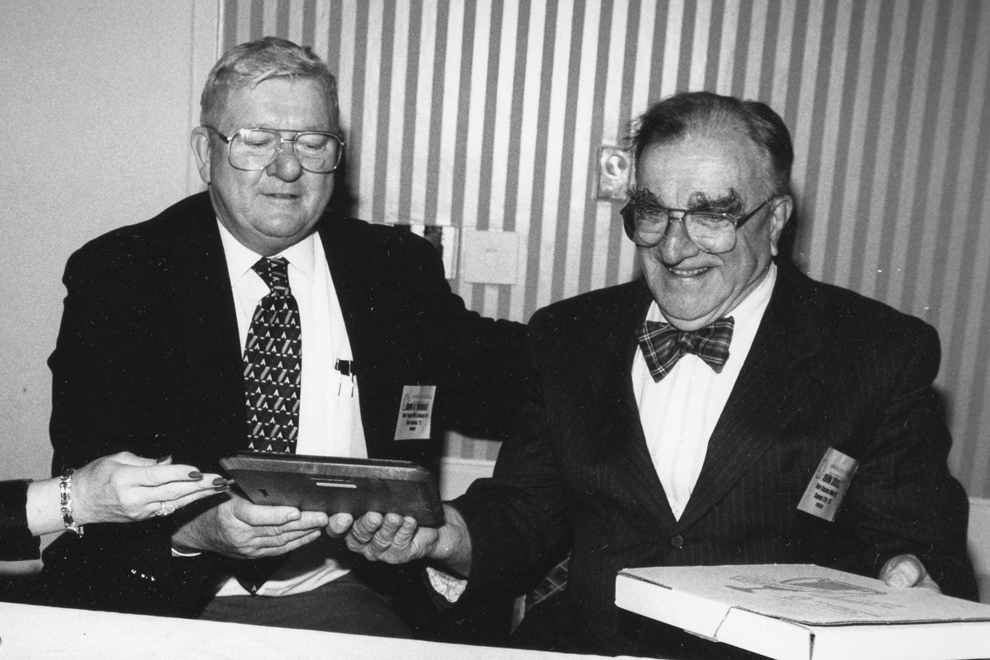
The American College of Toxicology (ACT) honored Dr Doull with its Distinguished Service Award in 1996, pictured below (right), with ACT Past President John Thomas. Although he never formally joined as a member of ACT, he was nonetheless considered part of the ACT family by virtue of this 1996 award, and upon hearing of his passing, ACT Council and members reacted with sadness and the “we need to do something” sentiment to honor Dr Doull’s life.
The ACT circulated a message about the availability of a blog site for members to post pictures or comments about their personal interactions with John Doull. We have also commissioned a tribute article from an individual who knew him well, which, along with other blog comments, will be published in our July-August issue of International Journal of Toxicology.
However, in this issue, I would like to share with you the very touching comments of Tracey Zoetis, our current ACT president: Every toxicologist has a “John Doull” story. In fact, no one becomes a toxicologist without speaking his name. For decades, required reading has been a book better known by its authors names, Casarett and Doull, than by its actual title, “The Basic Science of Poisons.” John Doull will be remembered as a giant in the field of toxicology, a distinguished scientist, preeminent expert, and patient teacher. My personal John Doull story is one of encouragement and affirmation. Early in my career, Dr Doull and I were asked to serve on a panel of experts to discuss a compound associated with bladder tumors in rats. I admit I was star struck in a nerdy kind of way to meet Dr Doull, much less to serve alongside him on this distinguished panel. Dr Doull and I were the only toxicologists on the multidisciplinary panel. I had no idea what I could possibly contribute to the discussion when I was sitting next to this renowned expert. I was feeling a bit uneasy because with 12 years of experience in toxicology, I was the least experienced and least credentialed person in the room. The meeting began and quickly escalated into a lively discussion to determine relevance of the finding to humans. We studied the type of tumor, the incidence, and the concurrent and historical controls. We looked at what was happening beyond the maximum tolerated dose, debated the statistical methods used to evaluate rare and common tumors, and mused over possible mechanisms of the observed effects. At one point in the meeting, I questioned the design and execution of the study: Was survival sufficient to ascertain carcinogenic potential? How frequently were the animals dosed? How were sections of the bladder collected, processed, and evaluated? What do we know about the mechanism of the tumorigenicity in this species and strain? How often were the animals handled? Dr Doull stopped me at the animal handling question. I awkwardly explained that rats void urine when they are handled so I was curious about the frequency of handling, in case that could have impacted exposure to local tissues. He pointed at me and exclaimed to the panel: “Now that’s your toxicologist!” I thought I might faint. After the meeting, he encouraged me to continue my professional growth in the field of toxicology. He explained the importance of championing a scientifically sound study design and technically competent study execution. However, the most memorable advice I received from Dr Doull was to have the courage to share your thoughts because there will be a time in any toxicologist’s career when communicating the outcome of a study will take courage. I needed a dose of courage that day, and John Doull’s affirmation of my participation in that meeting was just what the doctor ordered.
Tracey and I look forward to seeing you all at the ACT Annual Meeting in November in Palm Springs, California. Don’t forget—abstracts are due July 1!