




Abstract
The Cosmetic Ingredient Review Expert Panel (CIR Panel) reviewed the safety of hydroxypropyl bis(N-Hydroxyethyl-p-Phenylenediamine) HCl, which functions as an oxidative hair dye ingredient. The Panel considered relevant animal and human data provided in this safety assessment and concluded that hydroxypropyl bis(N-hydroxyethyl-p-phenylenediamine) HCl is safe for use in oxidative hair dye formulations as described in this safety assessment.
Keywords
Introduction
This report addresses the safety of the oxidative hair dye hydroxypropyl bis(N-hydroxyethyl-p-phenylenediamine) HCl as used in hair dye products.
Chemistry
Definition and Structure/Physical and Chemical Properties
Physical and chemical properties of hydroxypropyl bis(N-hydroxyethyl-p-phenylenediamine) HCl are found in Table 1. 1 Hydroxypropyl bis(N-hydroxyethyl-p-phenylenediamine) HCl (as shown in Figure 1) is a substituted, dimeric aromatic amine salt. The logKow at 20°C of this hair dye ingredient is -5.
Physical and Chemical Properties of Hydroxypropyl Bis(N-hydroxyethyl-p-phenylenediamine) HCl.
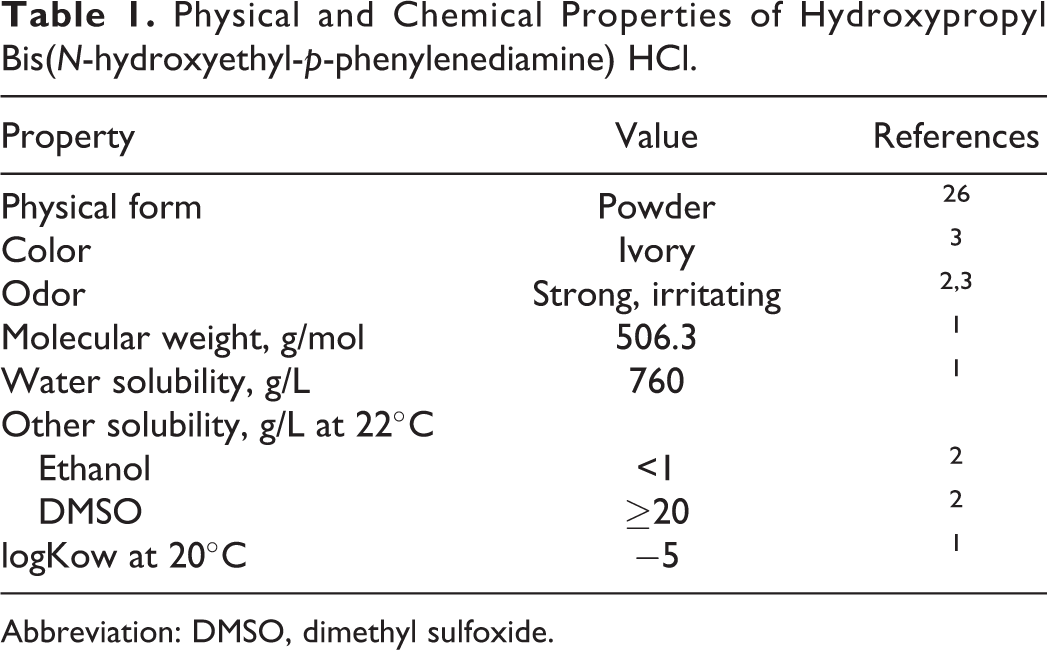
Abbreviation: DMSO, dimethyl sulfoxide.
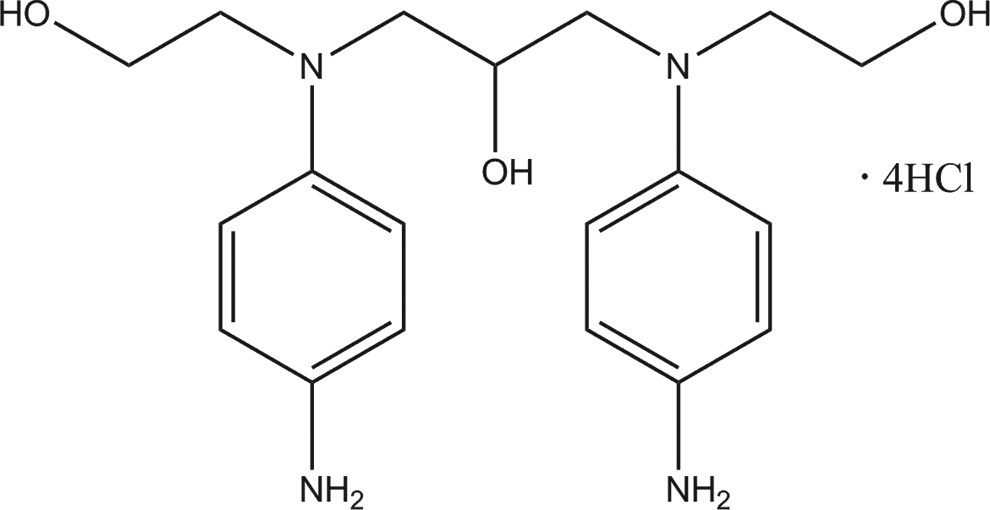
Structure of hydroxypropyl bis(N-hydroxyethyl-p-phenylenediamine) hydrochloride.
Ultraviolet light absorption was reported in the range of 200 to 400 nm (0.01 g/L in deionized water) with a peak at 258 nm 2 ; there is a smaller peak at 302 nm. In the visible range of 350 to 800 nm (10 g/L in deionized water), there was a peak at 415.5 nm and a smaller peak at 570 nm.
Impurities
Studies submitted to the Scientific Committee on Consumer Safety report the purity of hydroxypropyl bis(N-hydroxyethyl-p-phenylenediamine) HCl to range from 94.6% to 99.8%. 3 The impurities include 2-phenylamino-ethanol (<200 μg/g), 1,3-bis[(2-hydroxyethyl)-(4-nitrosophenyl)amino]propan-2-ol (<100 μg/g), and 1,3-bis[(2-hydroxyethyl)phenylamino]propan-2-ol (<100 μg/g), all at levels below the detection limits.
Use
Cosmetic
Data on ingredient usage are provided by industry to the Food and Drug Administration (FDA) Voluntary Cosmetic Registration Program. 4 A survey was conducted by the Personal Care Products Council (the Council) of the maximum use concentrations for this ingredient. 5 Hydroxypropyl bis(N-hydroxyethyl-p-phenylenediamine) HCl was reported to be used in 75 hair dyes and colors at a highest maximum concentration of 0.28%.
A 2000 published opinion by the Scientific Committee on Cosmetic Products and Non-Food Products Intended for Consumers on hydroxypropyl bis(N-hydroxyethyl-p-phenylenediamine) HCl stated that this hair dye may be used up to 3.0% (before mixing with hydrogen peroxide for application), as long as the final concentration applied by the consumer does not exceed 1.5%. 6 Europe’s Scientific Committee on Consumer Products concluded that hydroxypropyl bis(N-hydroxyethyl-p-phenylenediamine) HCl is safe at a maximum concentration on the head of 0.4%. 6 European regulations state that after mixing under oxidative conditions, the maximum concentration applied to hair must not exceed 0.4% (as tetrahydrochloride). 7
Hair Dye Caution Statement—FDA Labeling
Hydroxypropyl bis(N-hydroxyethyl-p-phenylenediamine) HCl is considered a coal tar hair dye, for which regulations require caution statements and instructions regarding patch tests if they are to be exempt from certain adulteration and color additive provisions of the Federal Food, Drug, and Cosmetic Act. In order to be exempt, the following caution statement must be displayed on all coal tar hair dye products:
Caution—This product contains ingredients that may cause skin irritation on certain individuals, and a preliminary test according to accompanying directions should be made. This product must not be used for dyeing the eyelashes or eyebrows; to do so may cause blindness.
Product labels shall also bear a caution statement and patch test instructions for determining whether the product causes skin irritation. The CIR Panel recommends that an open patch test be applied and evaluated by the beautician and/or consumer for sensitization 48 hours after application of the test material and prior to the use of a hair dye formulation.
Thyssen et al 8 concluded, however, that, in its present form, the hair dye self-test has severe limitations. The authors warned that if the use of a hair dye self-test to predict contact sensitization becomes widespread, there is severe risk that a tool has been marketed that may cause morbidity in European consumers. In an accompanying editorial, An Goossens, on behalf of the European Society of Contact Dermatitis (ESCD), asserted that industry is focusing on predicting the risks from exposure to hair dyes by having millions of European consumers perform a self-test prior to each hair dyeing and stated that it is the opinion of the ESCD that attention must be given to reducing the risks of serious allergic reactions by improving the safety of the products themselves. 9
Toxicokinetics
Absorption, Distribution, Metabolism, and Excretion
Dermal/percutaneous
14C-Hydroxypropyl bis(N-hydroxyethyl-p-phenylenediamine) HCl (25 mg/kg in water) administered to the clipped skin of Wistar Han rats for 30 minutes was primarily recovered in the application site wash and the dressing (males, 94.2% ± 3.91%; females, 96.86% ± 2.96%). 10 Recovery in urine and feces was <1%. Recovery in the skin (dermis and epidermis) was <0.2%. Of the small amount that was absorbed, most of the radioactivity was eliminated in the feces (>80%) within 72 hours. There were no gender differences in the results.
When applied to human skin for 30 minutes in a diffusion cell, <0.2% of the radioactivity of a hair dye product (20 mg/cm2) containing 14C radiolabeled hydroxypropyl bis(N-hydroxyethyl-p-phenylenediamine) HCl (3.67% ± 0.25%) mixed with either hydrogen peroxide or water (1:1) was recovered in the receptor cell. 11 The receptor fluids were sampled at 0, 0.5, and 1 hour, then every hour up to 24 hours. Most of the dye was recovered from the skin surface (hydrogen peroxide, 93.9% ± 2.7%; water, 98.2% ± 4.0%). The stratum corneum contained 1.78% ± 0.87% and 1.32% ± 0.96% of the dye, and the epidermis/dermis contained 0.55% ± 0.33% and 1.85% ± 1.68%, respectively.
In an application to human skin for 30 minutes in a diffusion cell, ∼0.01% of a 14C radiolabeled hair dye (14.0 μL in water; ∼20 mg/cm2) containing hydroxypropyl bis(N-hydroxyethyl-p-phenylenediamine) HCl (0.34%, 0.8%) mixed with either hydrogen peroxide or water was recovered in the receptor cell. 1 Samples were collected from the receptor cell at 0.5 and 1 hour, then hourly after that. Most of the dye was recovered from the skin surface (recovery of hydrogen peroxide mixture, 98.31% ± 2.68%; water mixture, 98.72% ± 2.27%). The epidermis/dermis contained 0.90% ± 0.92% and 0.80% ± 0.77% of the applied dye, respectively.
When applied to heat-separated human abdominal or breast epidermis in a Franz diffusion cell (n = 7), 0.004% (in the absence of hair) and 0.005% (in the presence of hair) of the administered dose was present in the receptor cell. 3 Hydroxypropyl bis(N-hydroxyethyl-p-phenylenediamine) HCl (3.3% in a formulation containing 0.64% p-aminophenol and then mixed 1:1 with hydrogen peroxide for a final concentration of 1.65%; 40 mg) was applied to the skin for 30 minutes, with or without finely chopped bleached hair. Samples were measured by high-performance liquid chromatography.
Oral
When 14C-hydroxypropyl bis(N-hydroxyethyl-p-phenylenediamine) HCl was orally administered to Wistar Han rats, the mean plasma total radioactivity levels increased from time 0 until the concentration reached C max (1558 ± 157 ng Eq/g for males and 1678 ± 540 ng Eq/g for females) at 1 hour (males) or 2 hours (females) and then decreased until the time of the last quantifiable samples at 6 hours (281 ± 15 ng Eq/g) or 8 hours (224 ±53 ng Eq/g), respectively. 12 Blood samples (n = 3/sex/time point) were collected at 0, 1, 2, 4, 6, 8, 24, 48, and 72 hours after treatment.
Other rats (n = 3/sex) were weighed, and urine/feces/cage wash was collected for 0 to 6 hours and 6 to 24 hours, then every 24 hours up to 168 hours. Following oral gavage of the isotope-labeled mixture at 100 mg/kg, most of the radioactivity was eliminated in the summed urine and feces within 24 hours (90.7% and 72.9%, respectively), >95% of which was in the feces. The mean total cumulative excretion of the radioactive dose in the summed excreta over the 168-hour period was 98.3% ± 2.7% and 96.3% ± 3.4% for the males and females, respectively. A mean of 2.5% ± 0.3% and 95.4% ± 2.5% of the test substance was eliminated in the urine and feces, respectively (3.7% ± 0.3% for the males and 88.6% ± 9.3% for the females). The cage contained <5% of the test substance for both sexes. 12
Toxicological Studies
Acute Toxicity
Dermal—nonhuman
The median lethal dose LD50 for hydroxypropyl bis(N-hydroxyethyl-p-phenylenediamine) HCl was > 2000 mg/kg (the maximum dose tested) for Sprague Dawley rats (n = 5/sex). 13 One rat had a slight decrease in spontaneous activity at 4 and 6 hours after treatment.
Oral—nonhuman
The oral LD50 of hydroxypropyl bis(N-hydroxyethyl-p-phenylenediamine) HCl was reported to be 2186 mg/kg (95% confidence interval: 1797-2965) for Sprague Dawley rats (n = 5 females, 5/sex for 2000 mg/kg group). 14 The fasted rats were administered the test substance (1100, 1600, 2000, 2600 mg/kg in water; 10 mL/kg). No deaths occurred in the 1100 and 1600 mg/kg female groups. In the 2000 mg/kg group, 2 of 5 females and 3 of 5 males died. In the 2600 mg/kg group, 4 of 5 females died. Except for 2 animals which died on day 3, all deaths occurred within 30 minutes of treatment. Hypoactivity, sedation, piloerection, and dyspnea were observed in both sexes. Males exhibited lateral decubitus. The first signs were observed at 30 minutes after treatment. For those that did not die, recovery was complete on day 7 for the females and day 5 for the males.
Wistar HanIbm—WIST (SPF) rats (n = 2) exhibited eyelid closure, apathy, and a reduction of spontaneous activity when orally administered 1500 mg/kg hydroxypropyl bis(N-hydroxyethyl-p-phenylenediamine) HCl. 15 At 2000 mg/kg, there was eyelid closure, apathy, abdominal position, and a reduction of spontaneous activity, and 1 death was observed.
Repeated-Dose Toxicity
Oral—Nonhuman
In a range-finding study in which Sprague Dawley rats (number not provided) were orally administered hydroxypropyl bis(N-hydroxyethyl-p-phenylenediamine) HCl (50, 200, 800 mg/kg/d) for 2 weeks, the rats in the high-dose group exhibited a slight decrease in body weight gains, mean serum glucose, and total protein levels. 16,17 A dose of 800 mg/kg/d resulted in ptyalism and signs of poor clinical condition in both sexes, slightly lower body weight gain in males (−11% compared to controls), lower serum glucose (−26%), and higher mean triglyceride (× 1.5) levels in males, and in the kidneys, minimal to slight brownish pigment in the tubular epithelium and slightly higher incidence and severity of tubular dilatation in both sexes. The mid-dose group had a slight decrease in serum glucose levels. There were no effects observed in the low-dose group.
The oral no observed adverse effect level (NOAEL) for hydroxypropyl bis(N-hydroxyethyl-p-phenylenediamine) HCl was 25 mg/kg/d when administered to rats for 13 weeks. 17 The test substance (25, 100, 400 mg/kg/d in water) was administered to Sprague Dawley rats (n = 10/sex) by gavage; the rats were then killed and necropsied. There were no clinical signs in the low-dose group.
There was ptyalism, loud breathing, regurgitation, pink urine, brown-colored tails, and/or brown or black feces were observed in the mid- and high-dose groups from week 4. One male from each of the mid- and high-dose groups died; aspiration pneumonia due to regurgitation was considered a contributing factor. Body weights and feed consumption were similar to controls. Opacification of the lens was observed in 1 female in the high-dose group. Females in the high-dose group had higher activated partial thromboplastin time, and higher serum urea and creatinine levels were observed in females in the mid- and high-dose groups. Urinalyses and macroscopic examination of tissues were unremarkable. Microscopic examination revealed tubular basophilia in the kidneys of the males in the high-dose group, and many of the organs and tissues had a brownish pigmentation, probably from the color of the test material.
Reproductive and Developmental Toxicity
The NOAEL for reproductive and developmental toxicity was >800 mg/kg/d for female Crl CD (SD) BR Sprague Dawley rats (n = 25) orally administered hydroxypropyl bis(N-hydroxyethyl-p-phenylenediamine) HCl (50, 200, 800 mg/kg/d in water on days 6-15 of pregnancy). 16 On day 20, the dams were killed and necropsied. Colored urine was observed in 1 dam in the low-dose group and all the dams in the mid- and high-dose groups, and there were no clinical signs. The necropsies were unremarkable. The mean numbers of corpora lutea, implantation sites, postimplantation loss, live fetuses, the sex ratios, and fetal body weights were similar to controls. There were no treatment-related anomalies in the fetuses.
Genotoxicity
In Vitro
Hydroxypropyl bis(N-hydroxyethyl-p-phenylenediamine) HCl (312.5, 625, 1250, 2500, 5000 μg/plate with metabolic activation; 62.5, 125, 250, 500, 1000 μg/plate without) was not mutagenic to Salmonella typhimurium (strains TA98, TA100, TA1535, TA1537) and Escherichia coli (strain WP2uvrA), except for weak mutagenic activity observed (2.2-fold increase in revertant colonies) at 5000 μg/plate with metabolic action in the TA100 strain. 18 When tests with metabolic activation (except for 125, 250, 500, 1000, 2000 μg/plate doses) and without metabolic activation (at all concentrations) were repeated, results were the same as the first assay for both.
In a mammalian cytogenetic assay using Chinese hamster ovary (CHO) cells, hydroxypropyl bis(N-hydroxyethyl-p-phenylenediamine) HCl (30, 100, 300, 1000, 3000, 5000 μg/mL with metabolic activation; 12.5, 25, 50, 100, 150 μg/mL without) did not induce an increase in aberrant cell frequency with or without metabolic activation, with the exception of 100 μg/mL without metabolic activation. 19
When this assay was repeated (125, 250, 500, 750, 1000 μg/mL with metabolic activation; 12.5, 25, 50, 75, 100 μg/mL without), the test substance did not induce an increase in aberrant cell frequency with metabolic activation. 19 However, without metabolic activation, the test substance increased the incidence of cells with structural chromosome aberrations at 75 μg/mL. In each case, the positive findings in the without metabolic activation group were not observed at a higher dose level.
In Vivo
In an unscheduled DNA synthesis (UDS) assay of hydroxypropyl bis(N-hydroxyethyl-p-phenylenediamine) HCl (150, 1500 mg/kg in distilled water; 10 mL/kg) using Wistar HanIbm: WIST (SPF) rats (n = 4), there was no induction of UDS in the hepatocytes of the treated rats. 15 The hepatic samples were collected at 2 hours (1500 mg/kg) and 16 hours (150 and 1500 mg/kg) after the rats were administered a single oral dose of the test substance. The hepatocytes were cultured and the cells examined for UDS.
In a micronucleus test, hydroxypropyl bis(N-hydroxyethyl-p-phenylenediamine) HCl (375, 750, 1500 mg/kg/d) orally administered for 2 days to Swiss OF1 mice (n = 5/sex) did not induce damage to the chromosomes or the mitotic apparatus of the bone marrow cells of the mice. 20
In a micronucleus test, hydroxypropyl bis(N-hydroxyethyl-p-phenylenediamine) HCl (500, 1000, 2000 mg/kg/d) orally administered for 2 days to Sprague Dawley rats (n = 5/sex) did not induce damage of the chromosomes or the mitotic apparatus of the bone marrow cells of the rats. 21
Carcinogenicity
No published carcinogenicity studies were discovered through a literature search, and no additional data were submitted.
Irritation and Sensitization
Irritation
Dermal—nonhuman
Hydroxypropyl bis(N-hydroxyethyl-p-phenylenediamine) HCl (10% in purified water; 0.05 mL) was not irritating in a repeated application irritation test using Dunkin-Hartley guinea pigs (n = 3/sex). 22 The test substance was administered to the clipped skin daily for 14 days. The guinea pigs were killed and the test site examined microscopically. There were no clinical signs. There was a very slight erythema on all guinea pigs on day 9 and on 2 of the guinea pigs on days 10 and 15. Almost all of the animals had dry skin at the test site. There was a slight black coloration of the skin starting on days 3 and 4 that could have masked very slight erythema.
Hydroxypropyl bis(N-hydroxyethyl-p-phenylenediamine) HCl (5% in distilled water; 0.05 mL) was not irritating in a patch test using New Zealand White rabbits (n = 3). 23 The test substance was administered to clipped skin under semiocclusion for 4 hours and observed at 1, 24, 48, and 72 hours and then daily up to day 9. No skin reactions were observed in 1 rabbit. Very slight or well-defined erythema was observed at 24 or 72 hours after treatment in the other 2 rabbits. No edema was observed. There was dryness of the skin observed on days 5 to 8 in 1 rabbit. Mean scores over 24, 48, and 72 hours for each animal were 0.0, 1.7, and 0.3 of 4 for erythema and 0.0 for edema.
Hydroxypropyl bis(N-hydroxyethyl-p-phenylenediamine) HCl (100% dampened with water; 500 mg) was an irritant in male New Zealand White rabbits. 24 The test substance was administered to clipped skin under occlusion for 3 minutes (n = 1), 1 hour (n = 1), and 4 hours (n = 3). After 3 minutes, erythema (masked by a black coloration of the test site) was observed and persisted up to day 10. Slight edema was noted 1 hour after removal of the dressing. After 1 hour, slight to severe erythema was observed on days 1 to 11. Severe to slight edema was observed on days 1 to 6. After 4 hours, erythema (masked by a black coloration of the test site) persisted up to day 15. Slight to severe edema was observed on days 1 to 5 in 2 rabbits. The third rabbit had slight edema 1 hour after removal of the dressing. The mean scores over 24, 48, and 72 hours for individual rabbits were 0.0, 2.7, and 3.3 of a possible 4 for edema. Because of the skin coloration by treatment with the test substance, erythema could not be scored.
Hydroxypropyl bis(N-hydroxyethyl-p-phenylenediamine) HCl (0.5 g in 0.5 mL distilled water) had a primary irritation index of 3.4 when administered to the intact and abraded clipped skin of New Zealand White rabbits (n = 3). 25 Slight to well-defined erythema and slight to severe edema were observed.
Ocular
Hydroxypropyl bis(N-hydroxyethyl-p-phenylenediamine) HCl (100% as provided; 0.1 mL) caused opalescent corneal opacity, iridial inflammation, and severe conjunctival irritation as well as sloughing of the cornea, hemorrhage, and a pale appearance of the nictitating membrane when administered to the eye of 1 New Zealand White rabbit. 26
In a repeat of the above experiment (100 mg; n = 1), the test material caused severe ocular reactions including severe to marked chemosis, slight to moderate conjunctival redness, iris lesions, and moderate to marked corneal opacity. Neovascularization of the cornea was observed at 72 hours. 3
Hydroxypropyl bis(N-hydroxyethyl-p-phenylenediamine) HCl (5% in water; 0.1 mL) was not an ocular irritant in New Zealand White rabbits (n = 3). 27 The eyes were not rinsed and were observed at 1, 24, 48, and 72 hours after administration.
Sensitization
Dermal—Nonhuman
In a Buehler test, hydroxypropyl bis(N-hydroxyethyl-p-phenylenediamine) HCl (50% in distilled water; 0.5 mL) administered to the clipped skin of Dunkin-Hartley guinea pigs (n = 10/sex) did not induce sensitization when challenged (5% and 20%). 28 During the induction period, slight to very slight cutaneous reactions were observed in 8 of 20 guinea pigs.
In a guinea pig maximization assay using Dunkin-Hartley guinea pigs (n = 10), hydroxypropyl bis(N-hydroxyethyl-p-phenylenediamine) HCl (0.1% in a sterile isotonic aqueous NaCl solution; 0.5 mL) administered by subcutaneous injections did not induce sensitization when challenged at 25% administered in a dermal patch. 29
In a Magnusson-Kligman maximization test using Dunkin-Hartley guinea pigs (n = 10/sex), hydroxypropyl bis(N-hydroxyethyl-p-phenylenediamine) HCl (1% in sterile isotonic saline), administered by intradermal injections and challenged at 50% with a dermal patch, was classified as a sensitizer. 30 At 24 hours, very slight, well-defined, and marked erythema were observed in 2 of 20, 11 of 20, and 7 of 20 guinea pigs, respectively. There was also slight edema observed in 11 guinea pigs and severe edema in 1 animal. Dryness of the skin was observed in 9 of 20 guinea pigs. Very slight black coloration of the skin was observed in 3 guinea pigs. At 48 hours, very slight, well-defined, marked, and severe erythema were noted in 1 of 20, 4 of 20, 1 of 20, and 2 of 20 guinea pigs, respectively. Crust formation was observed in 3 guinea pigs. Dryness of the skin was observed in 14 of 20 guinea pigs. The dryness was severe enough to mask the evaluation of erythema in 5 of 20 treatment sites. Very slight to slight black coloration of the skin was observed in 5 guinea pigs. The very slight erythema in 2 guinea pigs, which did not persist at the 48-hour reading, was attributed to a possible slight irritant reaction. All of the other skin lesions were attributed to a sensitization effect.
Phototoxicity
Dermal administration of hydroxypropyl bis(N-hydroxyethyl-p-phenylenediamine) HCl (10% in purified water; 0.2 mL) to Dunkin-Hartley guinea pigs (n = 10) did not cause phototoxicity or photosensitization when exposed to UVA or UVB lamp light. 31 For the phototoxicity assay, the test substance was gently massaged into the shaved backs of the guinea pigs, and 30 minutes later, they were irradiated by UVB (312 nm), then UVA (365 nm). For the photosensitization assay, the guinea pigs were administered the test substance and irradiated 6 more times. After a 20-day rest, the test substance was administered and the test sites were irradiated again (left flank UVA, right flank UVB). The test sites were scored for reactions at 1, 6, 24, and 48 hours after application.
Hair Dye Epidemiology
Hydroxypropyl bis(N-hydroxyethyl-p-phenylenediamine) HCl is an oxidative hair dye ingredient. Although the safety of individual hair dye ingredients are not addressed in epidemiology studies that seek to determine links, if any, between hair dye use and disease, such studies do provide broad information. Currently available epidemiology studies provided insufficient evidence to support a causal association between personal hair dye use and a variety of tumors and cancers. A detailed summary of the available hair dye epidemiology data is available at http://www.cir-safety.org/cir-findings.
Summary
Hydroxypropyl bis(N-hydroxyethyl-p-phenylenediamine) HCl is an oxidative hair dye with 75 uses in hair dyes and colors reported to the FDA, with a maximum use concentration of 0.28% based on an industry survey.
The European Commission established a limit of 0.4% hydroxypropyl bis(N-hydroxyethyl-p-phenylenediamine) HCl when used as an oxidative hair dye.
Less than 1% of the radioactivity of [14C]hydroxypropyl bis(N-hydroxyethyl-p-phenylenediamine) HCl was recovered in the urine and feces when dermally applied to the skin of rats. Less than 0.2% of the dye in water or hydrogen peroxide was recovered in the receptor cells using human skin. Most of the orally administered test substance was eliminated through urine and feces and cleared from the blood of rats within 6 to 8 hours.
The dermal LD50 was >2000 mg/kg for rats. The oral LD50 for rats was estimated to be 2186 mg/kg.
The oral NOAEL for hydroxypropyl bis(N-hydroxyethyl-p-phenylenediamine) HCl was 25 mg/kg/d for 13 weeks for rats.
The NOAEL for reproductive and developmental toxicity was >800 mg/kg/d orally administered to rats on gestation days 6 to 15.
Hydroxypropyl bis(N-hydroxyethyl-p-phenylenediamine) HCl was not genotoxic to either S typhimurium or E coli in an Ames test or in a mammalian cytogenetic assay using CHO cells. The test substance was not genotoxic in an UDS assay and 2 micronucleus tests.
Hydroxypropyl bis(N-hydroxyethyl-p-phenylenediamine) HCl was not irritating to guinea pigs at concentrations up to 10% and rabbits up to 5%. It was severely irritating to rabbits at 100%. Hydroxypropyl bis(N-hydroxyethyl-p-phenylenediamine) HCl was a severe ocular irritant in rabbits at 100% but was not an irritant at 5%.
Hydroxypropyl bis(N-hydroxyethyl-p-phenylenediamine) HCl was not sensitizing to guinea pigs at concentrations up to 50% when applied dermally; however, when applied by intradermal injection, the test substance was sensitizing at 1%.
Hydroxypropyl bis(N-hydroxyethyl-p-phenylenediamine) HCl was not phototoxic at 10% with concomitant exposure to either UVA or UVB light. The hair dye was not photosensitizing.
Currently available epidemiology studies provided insufficient evidence to support a causal association between personal hair dye use and a variety of tumors and cancers.
Discussion
The Panel noted the minimal penetration of hydroxypropyl bis(N-hydroxyethyl-p-phenylenediamine) HCl through the skin and the lack of local or systemic toxicity seen at levels used in hair dyes. A lack of genotoxicity was demonstrated and this ingredient was not irritating or sensitizing.
The Panel noted that even though there was a small absorbance peak in the UVB range in the absorbance spectrum of this ingredient, a lack of phototoxicity and photosensitization was demonstrated.
The Panel recognized that hydroxypropyl bis(N-hydroxyethyl-p-phenylenediamine) HCl functions as a hair dye ingredient and that hair dye products that contain this coal tar hair dye are exempt from certain adulteration and color additive provisions of the Federal Food, Drug, and Cosmetic Act, when the label bears a caution statement and patch test instructions for determining whether the product causes skin irritation. The Panel expects that following this procedure will prospectively identify individuals who would have an irritation/sensitization reaction and allow them to avoid exposures. The Panel concerns that such self-testing might induce sensitization but concluded that this alone was not a sufficient basis for changing the current caution statement and patch test instructions to consumers at this time.
In considering hair dye epidemiology data, the CIR Panel concluded that the available epidemiology studies are insufficient to conclude that there is a causal relationship between hair dye use and cancer or other toxicological end points, based on lack of strength of the associations and inconsistency of findings.
The Panel noted that the use of oxidative hair dye formulations involves exposure to precursors and coupling agents as well as to their reaction products. Exposures to the precursors and couplers are low (they are consumed in the color-forming reaction), and the exposures to reaction products are even lower (they are adsorbed into the hair shaft itself and physically retained there). Therefore, it was the consensus of the Panel that the safety assessments of oxidative hair dyes are primarily determined by the toxicological evaluation of the ingredients (ie, precursors and coupling agents), more than by the reaction products formed during use, and not at all by reaction intermediates.
Conclusion
The Panel concluded that hydroxypropyl bis(N-hydroxyethyl-p-phenylenediamine) HCl is safe in cosmetics in the present practices of use and concentration for use in oxidative hair dye formulations.
Footnotes
Authors’ Note
Unpublished sources cited in this report are available from the Director, Cosmetic Ingredient Review, Suite 1200, 1620L Street, NW, Washington, DC 20036, USA.
Author Contributions
L. Becker drafted the manuscript. All authors contributed to conception and design, contributed to acquisition, analysis, and interpretation, critically revised the manuscript, gave final approval, and agree to be accountable for all aspects of work ensuring integrity and accuracy.
Declaration of Conflicting Interests
The author(s) declared no potential conflicts of interest with respect to the research, authorship, and/or publication of this article.
Funding
The author(s) disclosed receipt of the following financial support for the research, authorship, and/or publication of this article: The articles in this supplement were sponsored by the Cosmetic Ingredient Review. The Cosmetic Ingredient Review is financially supported by the Personal Care Products Council.