




Abstract
Arsenic compounds can increase production of reactive oxygen species. Reactive oxygen species can induce double-strand breaks in DNA, which is a cause of chromosome aberrations (CAs). This study was conducted to determine the association between arsenic exposure and polymorphisms of genes involved in detoxification (glutathione S-transferase T1 [GSTT1], glutathione S-transferase M1 [GSTM1], glutathione S-transferase O2 [GSTO2], catalase [CAT], and NAD(P)H quinone oxidoreductase1 [NQO1]) as well as nonhomologous end joining DNA repair genes (XRCC4, XRCC5, and XRCC6) with induction of chromosomal aberrations. The participants consisted of 123 healthy males who were genotyped using polymerase chain reaction-based methods. Primary cultures of whole blood were treated with sodium arsenite (NaAsO2; iAs(III); at final concentration 1 µmol/L), mitomycin C (at final concentration 60 ηg/mL; as positive control), or untreated. For each culture, mitotic index (MI), chromatid breaks (CBs), CAs, and total percentage of aberrant cells were determined. The levels of CB and percentage of aberrant cells were significantly higher in the TT genotype of CAT (C-262T polymorphism) than the CC genotype. The CB value in samples with GSTM1 active genotype was significantly higher than the null genotype. The MI in samples with TT genotype of NQO1 (C609T polymorphism) was significantly higher than MI in samples having CC and CT genotypes. There was no association between MI, CB, CA, and percentage of aberrant cells and polymorphisms of XRCC4, XRCC5, and XRCC6.
Introduction
Arsenic is a toxic metalloid widely distributed in food, water, air, and soil. 1 Genotoxic effects of arsenic have been reported in vitro in mammalian cells and in vivo in laboratory animals and humans. 2 Studies have shown that the frequency of chromosomal aberration indices varies among individuals after exposure to arsenic. 3,4 Additionally, individuals exposed to arsenic exhibit different responses in either in vivo 5,6 or in vitro studies. 7 Treatment with arsenic compounds can increase production of reactive oxygen species (ROS) 8 and induce oxidative stress. 9,10 Reactive oxygen species can induce double-strand breaks of DNA, 11 which is a cause of chromosomal aberrations. 12 -14
The enzymes encoded by antioxidant genes such as glutathione S-transferase M1 (GSTM1; a member of class mu of GST; OMIM: 138350), glutathione S-transferase T1 (GSTT1; a member of class theta of GST; OMIM: 600436), glutathione S-transferase O2 (GSTO2; a member of class omega of GST; OMIM: 612314), catalase (CAT; OMIM: 115500), and NAD(P)H quinone oxidoreductase 1 (NQO1; OMIM: 125860) can affect susceptibility to oxidative stress. 15 -21 Genetic polymorphisms in genes encoding GSTM1 and GSTT1 have been well defined. 15,22 The GSTM1-0 (GSTM1 null) and GSTT1-0 (GSTT1 null) alleles represent deletions of GSTM1 and GSTT1 genes, respectively. The functional consequences of homozygosity for the GSTM1 and GSTT1 null alleles (null genotypes) are obvious in terms of enzyme activity: no gene, no enzyme, and no activity.
The human GSTO2 has an N142D polymorphism (rs156697), which causes a decrease in the stability of enzyme. 18,23 A C/T polymorphism located 262 bp upstream to the CAT transcription site (C-262T, rs1001179) has been described. 24 The T allele is associated with the lower levels of red blood cell CAT activity 24,25 which may increase ROS formation and oxidative stress.
Nonhomologous end joining (NHEJ) is the prominent DNA repair system in humans. The NHEJ pathway includes several essential repair proteins, including x-ray repair complementing defective repair in Chinese hamster cells 4 (XRCC4, OMIM: 194363), XRCC5 (Ku80, OMIM: 194364), and XRCC6 (Ku70, OMIM: 152690). 26,27 Genetic polymorphisms in NHEJ genes influence DNA repair capacity. 28 -32 The I/D polymorphism of intron 3 of XRCC4 may alter the normal expression and/or the protein function of XRCC4. 32 There are a variable number of tandem repeats of a 21-bp polymorphism (VNTR, rs6147172) in the promoter region of XRCC5, which affect gene expression. 33,34 It is well established that fewer tandem repeats is associated with increased levels of XRCC5 messenger RNA. 34 It has been reported that the XRCC6 promoter T-991C (rs5751129) polymorphism is associated with susceptibility to different multifactorial diseases. 29
Taken together, we hypothesize that polymorphisms in genes involved in the detoxification and the NHEJ DNA repair pathways might be involved in induction of chromosomal aberrations due to arsenic exposure.
Material and Method
The present study consisted of 123 healthy males between the ages of 19 and 47 years (mean ± standard deviation: 30.38 ± 6.24). The participants had no history of smoking or drinking alcohol, were not on medication, and had no history of diagnosed cancers, schizophrenia, bipolar disorder, and epilepsy or neuropathy. Written informed consent was obtained from each volunteer, and the study was approved by the institutional review board at our university.
Peripheral blood samples were obtained by venipuncture and collected in 2 separate tubes, one of them containing sodium heparin and the other one containing EDTA. Heparinated blood samples were used for primary culture, and the blood samples with EDTA were stored at −20°C for genotyping.
For primary cultures, triplicate 400 µL whole blood samples were inoculated into 5 mL of RPMI-1640 medium which contained 15% fetal bovin serum and 100 µL phytohamagglutinin (GIBCO, USA, Cat. No. 10576-015) in sterile (volume 10 mL) screw cap tubes. After 24 hours of incubation in a humid incubator 37°C and 5% CO2, the first tube was inoculated with sodium arsenite (NaAsO2; iAs(III); at final concentration 1 µmol/L), the second tube with mitomycin C (MMC; at final concentration 60 ηg/mL), and the third tube with no additives. After 72 hours of culture (48 hours of treatment), tubes were treated with colchicine (0.05 µg/mL; Fluka, USA) for 1 hour. Cells were then harvested by centrifugation, treated with a hypotonic solution (0.075 mol/L KCl) for 30 minutes at 37°C, and fixed 3 times in cold Carnoy fixative (3 vol of methanol:1 vol of acetic acid) for 10 minutes. Cells were resuspended in fresh fixative and dropped onto glass slides, and chromosomes were stained with Giemsa as standard cytogenetic procedures.
To avoid bias in the assessment of the slides, slides were scored by an individual who was blind to genotype and treatment conditions. To determine mitotic index (MI), number of metaphase figures were calculated in 1000 blast cells for each culture and expressed as a percentage. For each culture, 100 metaphases were randomly scored for chromatid breaks (CBs), dicentric, triradial, and quadraradial chromosomes as chromosome aberrations (CAs). Thereafter, total percentage of aberrant cells was calculated.
Genomic DNA for polymerase chain reaction was isolated from whole blood using the thawed blood samples. 35 The genotypic analysis for the GSTO2 (A424G), CAT (C-262T), GSTT1 (null/active), GSTM1 (null/active), NQO1 (C609T) XRCC4 (ins/del in the introns 3), XRCC5 (VNTR in the promoter region), and XRCC6 (T-991C) polymorphisms were determined as reported previously. 19,30,36 -38 Evaluation of polymorphisms and laboratory quality control were the same as that reported previously. 37 The alleles of the VNTR in the promoter region of the XRCC5 gene were divided into 2 groups, low repeated alleles (0 and 1 repeat), and high repeated alleles (2 and 3 repeats), which were designated as L and H alleles, respectively.
A chi-square (χ2) test was performed to determine whether distributions of the genotypes of the study polymorphisms were in Hardy-Weinberg equilibrium. Effect of iAs(III) on cytogenetic variation was analyzed using paired samples t-test. Analysis of cytogenetic variation between different genotypes was carried out by 1-way analysis of variance followed by Duncan test or by independent 2 samples t-test (for GSTT1 and GSTM1 polymorphisms). Data analysis was performed using the SPSS (version 16; SPSS Inc, Chicago, Illinois). A probability of P < 0.05 was considered statistically significant. All statistical tests were 2 sided.
Results
The genotypic frequencies of the polymorphisms of A424G GSTO2 (P = 0.08), C-262T CAT (P = 0.40), C609T NQO1 (P = 0.84), I/D XRCC4 (P = 0.10), VNTR XRCC5 (P = 0.80), and T-991C XRCC6 (P = 0.419) in our study patients were consistent with the Hardy-Weinberg equilibrium.
Cytogenetic effects of iAs(III) and MMC in comparison with each other and with negative control are indicated in Table 1. The comparisons include MI, CB, CA, and percentage of aberrant cells.
Cytogenetic Changes After Treatment With iAs(III) and MMC Compared to Negative Control.

Abbreviations: MMC, mitomycin C.
In MMC treatment, significant differences for MI, CB, and CA were observed when compared with the negative control. In the case of iAs(III) treatment, MI significantly decreased in comparison with the negative control. However, the level of CB, CA, and percentage of aberrant cells significantly increased in iAs(III) treatment compared with the negative control.
Considering the GSTO2, CAT, NQO1, GSTM1, and GSTT1 polymorphisms, the effects of iAs(III) treatment on chromosomal indices are summarized in Table 2. The level of CB and percentage of aberrant cells in individuals having TT genotype of CAT which treated with iAs(III) were significantly higher than those with the CC genotype. Mitotic index in samples with TT genotype of NQO1 was significantly higher than MI in samples with CC and CT genotypes. The CB in samples with the null genotype of GSTM1 was significantly lower than samples with the active genotype.
Cytogenetic Effects of iAs(III) With Respect to GSTO2, CAT, NQO1, GSTM1, and GSTT1 Polymorphisms.
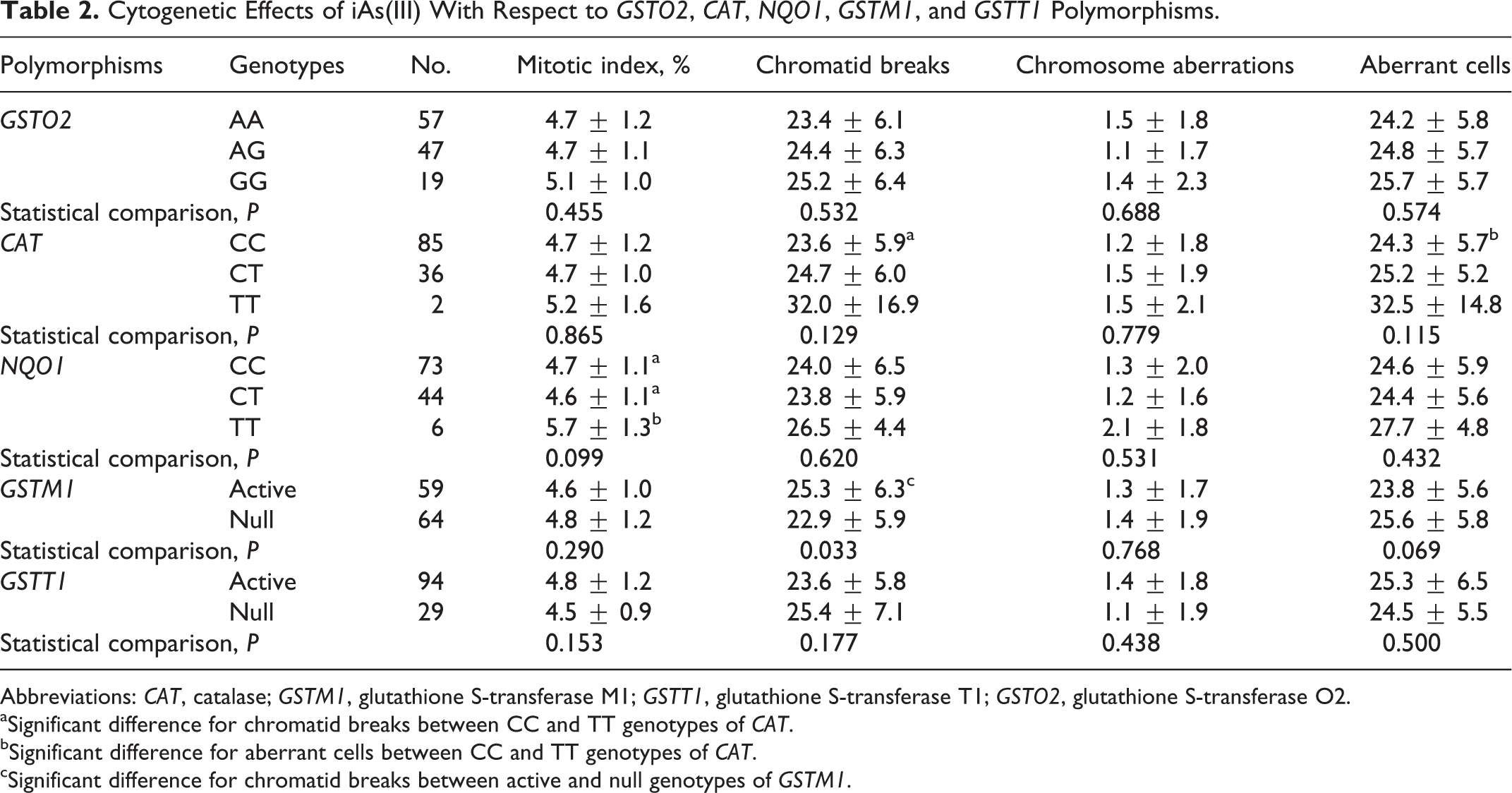
Abbreviations: CAT, catalase; GSTM1, glutathione S-transferase M1; GSTT1, glutathione S-transferase T1; GSTO2, glutathione S-transferase O2.
aSignificant difference for chromatid breaks between CC and TT genotypes of CAT.
bSignificant difference for aberrant cells between CC and TT genotypes of CAT.
cSignificant difference for chromatid breaks between active and null genotypes of GSTM1.
Considering XRCC4, XRCC5, and XRCC6 polymorphisms, cytogenetic effects of iAs(III) treatment are summarized in Table 3. The present study revealed that there was no significant association between MI, CB, CA, and percentage of aberrant cells and polymorphisms of XRCC4, XRCC5, and XRCC6.
Cytogenetic Effects of iAs(III) With Respect to XRCC4, XRCC5, and XRCC6 Polymorphisms.
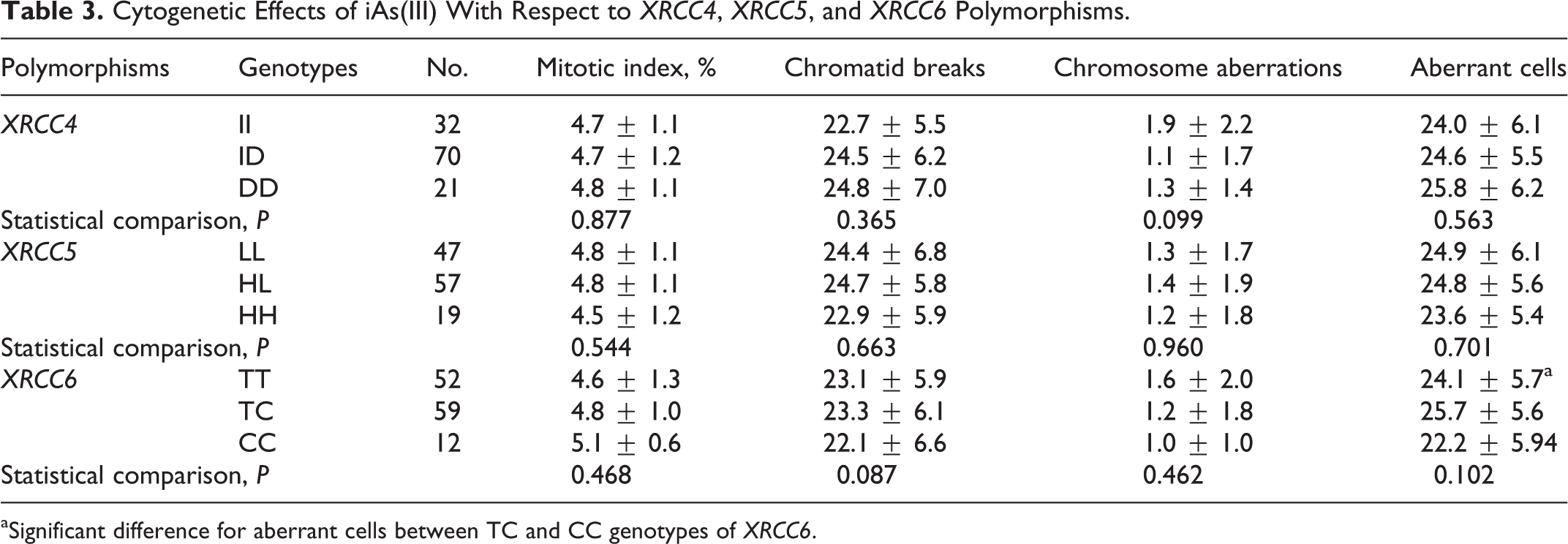
aSignificant difference for aberrant cells between TC and CC genotypes of XRCC6.
Discussion
Cytogenetic assessments revealed that the MI and CB values in samples treated with iAs(III) are significantly higher than those in MMC treatment. This is consistent with previous reports. 39,40
Arsenic biotransformation in persons having the A allele of the GSTO2 is reported to be significantly more effective, compared to those having the common genotype. 6 Moreover, it has been shown that GSTO2 is involved in metabolism of methylarsonate, MMA(V), to methylarsonous acid, MMA(III). 41 Furthermore, trivalent methylated arsenic is more genotoxic for human lymphocytes than iAs(III). 3 Taken together, we hypothesized that the polymorphism of GSTO2 might be involved in the level of chromosomal aberrations after cells exposed to iAs(III). However, the present study did not support our hypothesis.
Catalase activity in patients with the TT genotype of C-262T polymorphism is reported to be significantly reduced. 36 In our study, we found that the TT genotype of CAT C-262T polymorphism can induce susceptibility of individuals to clastogenic effects of iAs(III).
It has been reported that CAs induced by air pollution are associated with the GSTM1 polymorphism. 42 Women with the GSTM1 null genotype excreted a significantly higher amount of arsenic as monomethylarsonate than women with the active genotype. 43 At present we cannot explain our present finding, on the association between active genotype of GSTM1 and increase of CBs. The present study showed that there was no association between XRCC4, XRCC5, and XRCC6 polymorphisms and chromosomal aberrations induced by sodium arsenite (Table 3).
It should be noted that relatively small sample size and potential false-positive findings as a result of multiple comparisons are main limitations of the present study. In summary, the present study showed that the polymorphisms of NQO1, CAT, and GSTM1 are involved in modulation effect of sodium arsenite on chromosomal aberration indices.
Footnotes
Acknowledgments
The authors are indebted to the participants for their close cooperation.
Author Contributions
Fatemeh Azizian-Farsani and Gholamreza Rafiei contributed to design, acquisition, and analysis, drafted the article, gave final approval, and agreed to be accountable for all aspects of work ensuring integrity and accuracy. Mostafa Saadat contributed to conception and design, analysis, and interpretation, drafted the article, critically revised the article, gave final approval, and agreed to be accountable for all aspects of work ensuring integrity and accuracy. Fatemeh Azizian-Farsani and Gholamreza Rafiei have equal contributions in the study.
Declaration of Conflicting Interests
The author(s) declared no potential conflicts of interest with respect to the research, authorship, and/or publication of this article.
Funding
The author(s) disclosed receipt of the following financial support for the research, authorship, and/or publication of this article: This study was supported by Shiraz University.