




Abstract
Risk assessment methods have evolved over time to become better at evaluating risks associated with single chemical exposures, yet are limited in evaluating risks faced by communities with exposures to a range of chemical hazards via multiple routes. Recognizing the need to identify better approaches to assess disparate impacts facing certain populations due to environmental pollution, the authors evaluated activities within the Office of Environmental Health Hazard Assessment (in California’s Environmental Protection Agency) that had begun addressing these concerns by moving beyond standard risk assessment practices. On the basis of these examples, the authors identify 4 overarching principles to guide community assessments and explore how their application can improve these assessments. More work is needed in several areas, including developing information on exposure differences due to cultural practices, lifestyle patterns, and other factors; developing methods to recognize and take into account increased susceptibility; developing tools for assessing cumulative impacts; and improving communication with communities.
As government agencies, academic researchers, policy makers, and communities have begun to recognize that certain populations may experience disparate burdens from environmental pollution, 1 efforts have been undertaken to identify appropriate approaches to addressing this issue. 2-5 In addition, a need to better engage affected communities has been identified; for example, the Institute of Medicine (IOM) 1 recommended that “citizens from the affected population in communities of concern should be actively recruited to participate in the design and execution of research,” noting that “[a] collaborative community response to environmental risks will help detect, limit, and prevent environmental insults and their harmful health effects.” The current risk assessment approach used by the Office of Environmental Health Hazard Assessment (OEHHA) in the California Environmental Protection Agency, as well as by other state and federal agencies, is technically complex and data intensive yet may fail to address issues of disparate exposure and risk. The purpose of the work described in this article was to evaluate existing risk assessment approaches and identify principles that could help OEHHA improve the evaluation of chemical hazards in communities. The need for improved assessment of environmental exposures in communities that are disparately affected by pollution drove this effort, but the principles apply to the evaluation of environmental hazards in any community. Case studies drawn from current and past OEHHA activities served as a basis for developing these principles. After a brief overview of environmental justice and its critiques of risk assessment, we briefly summarize the risk assessment process and its limitations, including the ways in which it has been evolving with respect to addressing environmental justice issues, to provide a context for the principles we developed. These principles are aimed at improving how agencies approach the evaluation of chemical hazards in communities.
Environmental Justice
“Environmental justice” (EJ) is a phrase used to describe efforts to address the disparate impacts of exposure to environmental pollution found in some communities. Ten years ago, the IOM 1 acknowledged widespread and growing concern “that the broad array of environmental burdens and hazards are being borne disproportionately by lower-income communities and by racial and ethnic minorities.” Examples of early studies that examined the occurrence of disparate exposure and risks and found evidence that racial minorities and people with low income levels in the United States experience higher exposure to pollutants include work focused on communities residing near hazardous waste sites 6 and those with occupational exposures. 7 More recent work has addressed topics such as exposure to traffic-related air pollution 8 and residence in areas near facilities releasing toxic air contaminants. 9,10 Heavily affected populations also tend to be more vulnerable due to factors, such as low socioeconomic status and limited access to quality health care, that independently lead to poorer health status. 1,11 Recent work 4,12 looking at the factors contributing to this vulnerability provides promising areas for future research.
The US federal government began to investigate the potential for disparate exposures more than 20 years ago. 13 The US Environmental Protection Agency (EPA) has undertaken several EJ initiatives during the past 2 decades, 14,15 including recent efforts to present a systematic approach to responding to situations where disparate exposure to environmental harms and risks may be occurring. 16 In a related effort, the US EPA has also developed a framework for evaluating cumulative risks, 2,3 to begin to address a topic of great interest in communities affected by many sources and types of environmental pollution.
In California, the need to address EJ issues was first directly acknowledged in the early 1990s within the California Comparative Risk Project (CCRP). 17 The CCRP included an EJ subcommittee that brought issues to the larger comparative risk effort, including recommendations regarding ways to set environmental priorities that reflected an environmental justice and pollution prevention perspective. Following the passage of legislation in California in 1999 and 2000 designed to bring EJ considerations more fully into state operations, the California Environmental Protection Agency (Cal/EPA) began a concerted effort to address EJ in the activities of all of its boards and departments. Cal/EPA’s efforts include the development of an agency-wide strategy “to identify and address any gaps in existing programs, policies, and activities that may impede the achievement of environmental justice.” 18 The project described in this article was undertaken by OEHHA as part of this larger effort.
Environmental justice advocates have criticized risk assessment practices for failure to address the needs of heavily affected communities. Corburn 15 summarizes the critiques, which include a concern about risk assessment’s focus on single sources and related failure to address the multiple hazards facing these communities; the limited approach of standard risk assessment due to its emphasis on cancer, which is perceived to be ignoring the broader range of pollution-related health impacts experienced in these communities; and the exclusion of the people in the community and their local knowledge from the assessment of health impacts they face. Corburn 15 also notes the perceived effect of these failings is to “underestimat[e] the magnitude of risks for low-income populations and people of color and systematically exclud[e] these populations from the risk characterization discourse.” One goal of our work was to find examples of activities within OEHHA that had begun addressing these concerns by moving beyond standard risk assessment practices.
OEHHA Evaluates Chemical Hazards
The standard risk assessment approach was originally developed primarily to quantify the risk of individual pollutants in a single medium (eg, tolerances for pesticides in food; standards for contaminants in drinking water; limits on carcinogens such as benzene in air emissions). Government agencies have begun to develop methods for moving beyond this limited approach, as awareness of the need for reform has become widespread, 19 including the consideration of cumulative risks. 2,3 The urgency for improvements in risk assessment practice is felt most strongly by those concerned with exposures in the most heavily affected communities. 15 The imperative to find ways to better address these communities' needs has driven OEHHA to search for principles to guide our activities.
OEHHA’s role in Cal/EPA is to evaluate hazards associated with exposure to toxic substances. Much of OEHHA’s work focuses on specific chemicals (such as those that cause cancer or reproductive toxicity) and the hazards they pose within a particular medium (such as toxic air contaminants or drinking water pollutants), rather than on community-specific exposure scenarios. These chemical-specific risk assessments are generally used by risk managers within Cal/EPA and local agencies to set regulatory control levels or to establish other risk management strategies, usually applied to a specific exposure medium. Risk assessment methods used by OEHHA and other government agencies have been developed over many years. National risk assessment guidelines in the United States have been published on evaluating carcinogenicity, 20-22 developmental 23 and reproductive toxicity, 24 exposure assessment, 25 and other topics. Practices have evolved to make use of increasing information available on hazards associated with exposure to toxic chemicals. The standard risk assessment process includes 4 steps: hazard identification, dose-response assessment, exposure assessment, and risk characterization. 26 Agencies do not usually explicitly take into account the potential for increased exposure or susceptibility of subpopulations, although this has been changing. 22,27,28
A major limitation of the standard risk assessment process is that it includes the public primarily at the end of the process, during the risk characterization stage, at which point the scientific effort has been largely completed. This approach is in contrast to what has been recommended by the National Academy of Sciences, 29 that risk characterization incorporate the perspectives of interested and affected parties “from the earliest phases of the effort to understand the risks.” The aim of such an inclusive approach to risk communication is sometimes misunderstood by risk assessors as intended to persuade stakeholders that the process will be fair and unbiased because of the “objective” scientific methods used. However, the true purpose of involving the public is to improve the quality and the relevance of risk assessments, as well as ultimately to improve the decision making they are meant to inform, 30 by finding ways to incorporate public input earlier in the process, for example, to help reframe the problem when necessary.
Components of the risk assessment process in California have been specified in legislation (see Table 1 ), to some extent to address concerns about providing opportunities for public input. These include requirements to solicit and incorporate public comments (eg, Toxic Air Contaminants Act; Air Toxics “Hotspots” Act) and hold public workshops (eg, Air Toxics “Hotspots” Act; Risk Assessment Practices Review). Requirements for independent scientific peer review processes have been included in certain programs (eg, Toxic Air Contaminants Act; Proposition 65). Most recently, legislation passed in 1999 requires all Cal/EPA to “conduct its programs, policies, and activities that substantially affect human health or the environment in a manner that ensures the fair treatment of people of all races, cultures, and income levels, including minority populations and low-income populations of the state” (SB 115, Solis, Chapter 690, Statutes of 1999). Because of this, Cal/EPA, with OEHHA in the lead, is attempting to find ways to identify and address disparate impacts within the risk assessment process. In particular, we are developing a framework to analyze cumulative impacts, and one purpose of the framework is to inform the risk assessment process.
Major California Environmental Legislation Affecting Risk Assessment
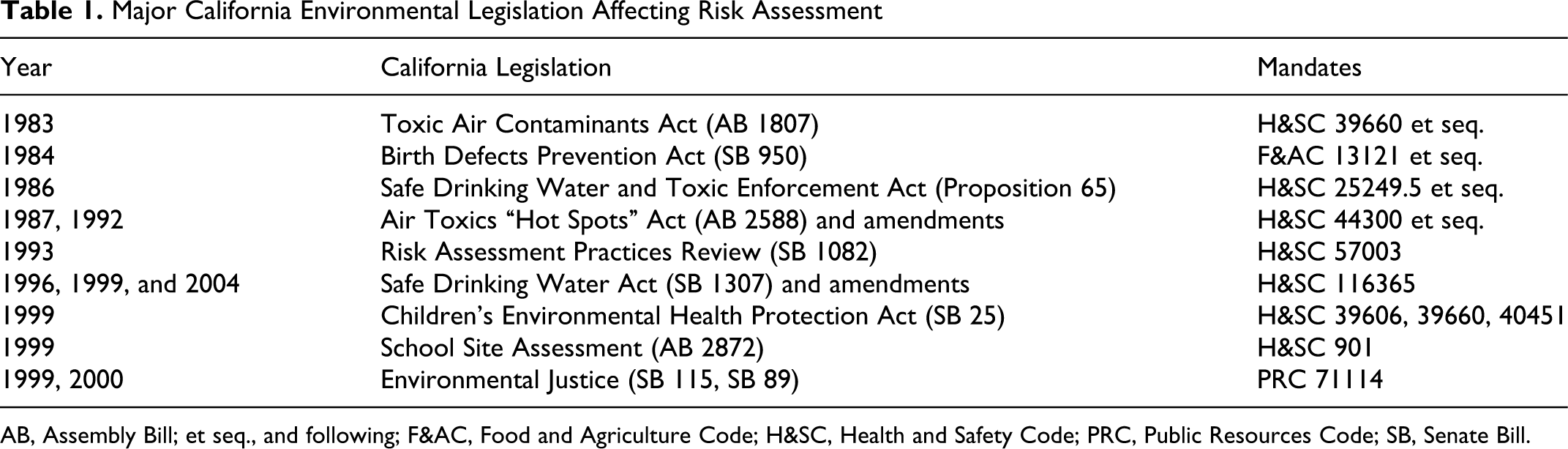
AB, Assembly Bill; et seq., and following; F&AC, Food and Agriculture Code; H&SC, Health and Safety Code; PRC, Public Resources Code; SB, Senate Bill.
With improvements in both scientific understanding of health effects as well as computing technology, risk assessment methods have continued to change over time. Efforts to account for multiple pollutants by adding those with similar effects (eg, Hazard Index approach) 20,25,31 and to consider multiple routes by adding exposures or source contribution factors 32 are two such changes. Risk assessment practices have also evolved to address sensitive subpopulations by revising uncertainty factors for kinetics or susceptibility. 27 Although these efforts are intended to improve the scientific validity of results, they also have the effect of producing a more complicated product to explain to the public, a public that has generally been excluded from the process until the risk assessment is completed. Furthermore, the process is slow and painstaking and ultimately is not able to address the hundreds to thousands of chemicals (eg, 79 120 existing chemicals on the Toxic Substances Control Act inventory as of August 1, 2001, according to the US EPA) 3 whose toxicity needs to be evaluated because of use and potential exposure in occupational and public settings. The US Government Accountability Office 33 reported that the US EPA’s Integrated Risk Information System (IRIS) contains the US EPA’s “scientific position on the potential human health effects of exposure to more than 540 chemicals” and noted that IRIS “is at serious risk of becoming obsolete because [US] EPA has not been able to … decrease its backlog of 70 ongoing assessments—a total of 4 were completed in fiscal years 2006 and 2007.” Consequently, a new approach needs to be developed to fully assess the impacts of exposure to toxic chemicals in a community. This assessment should be paired with efforts to establish two-way relationships with communities, educate communities about their risks, and provide advice and support that enables them to reduce those risks.
Review of OEHHA Case Studies
In evaluating OEHHA’s programs with respect to the need to address environmental justice, we considered whether the standard risk assessment process adequately protects disparately affected populations and how our hazard evaluation practices might need to change to ensure fair treatment of all people. We looked for examples of approaches that went beyond standard risk assessment to address needs of disparately affected communities. We identified the need for basic principles to guide community-based assessments.
To begin, we met with OEHHA staff to identify projects in which efforts had been made to address specific communities with disparate exposures to and impacts from toxic substances, ultimately meeting with staff of approximately half of the programs in OEHHA during the summer of 2005. For these meetings, we developed a standard set of questions to guide the discussion of EJ-related activities. For a subset of these activities, we gathered detailed information on the communities involved, the exposure sources and chemical hazards faced by these communities, and the actions that had been undertaken by OEHHA. Involvement of other agencies or groups was also discussed when relevant. A key question was directed at understanding what variations in or departures from standard risk assessment approaches were common to these activities addressing disparately exposed communities.
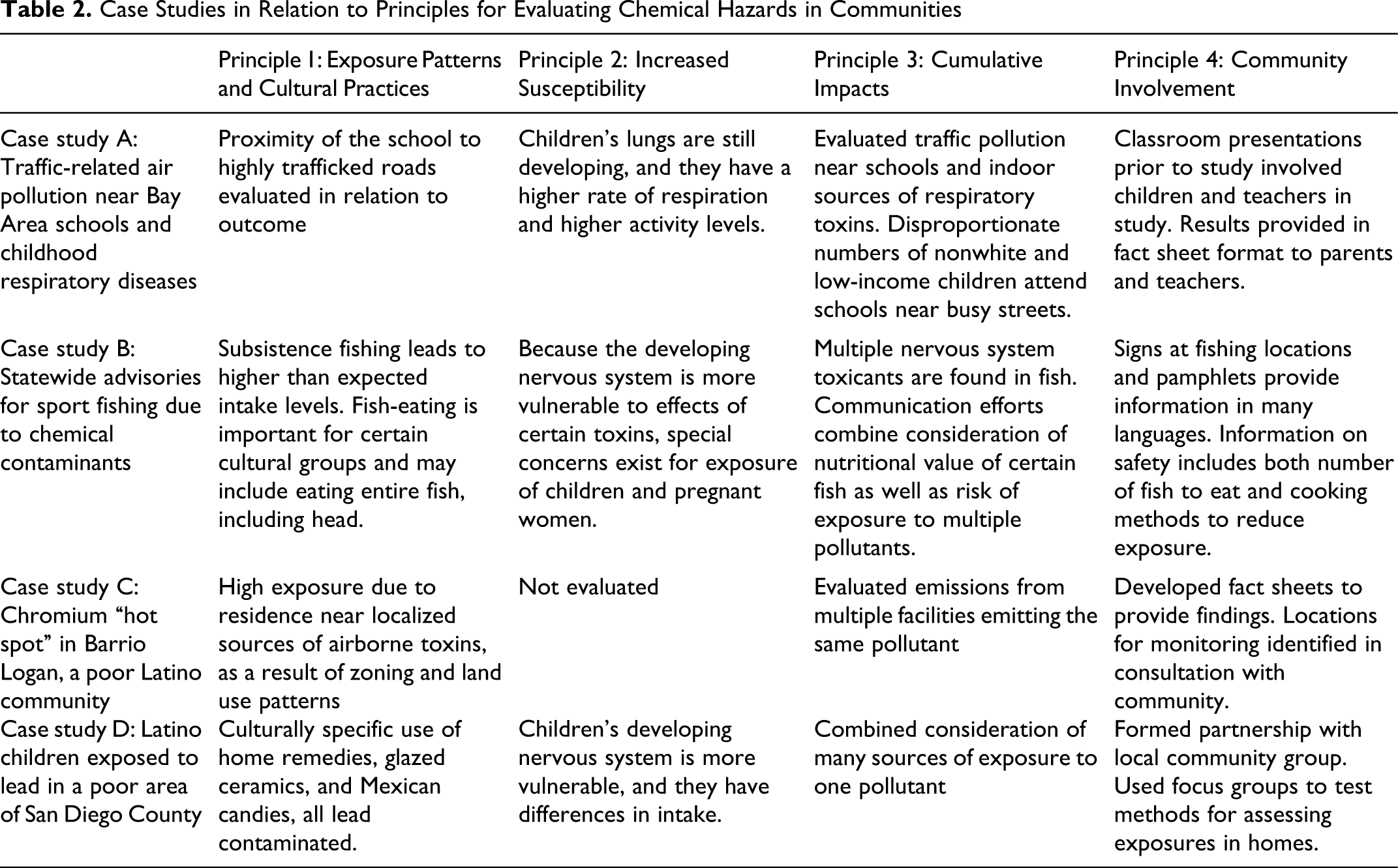
Examples were identified of approaches to community risk assessment that appeared to address issues related to EJ concerns. Part of our motivation was to evaluate the extent to which OEHHA’s current approach was addressing EJ concerns; at the same time, we intended to learn from our successes the approaches that might be useful in other contexts. From these activities, we identified 4 case studies that presented a range of community types (eg, Latino children and a Latino community in San Diego, Bay Area schoolchildren, sport fishers), exposure sources (eg, candy and traditional medicines, “hotspot” air pollution, traffic-related air pollution, contaminated fish), and public health impacts from chemical exposures (eg, asthma exacerbation, cancer, neurological effects). Case study details and their relation to the identified principles are shown in Table 2 .
Case Studies in Relation to Principles for Evaluating Chemical Hazards in Communities
Case Study A: Traffic and Schools
The East Bay Children’s Respiratory Health Study 34 explored the relationship between exposure to mobile source air pollutants and respiratory symptoms. The Kim et al 34 study included 1100 students from neighborhood schools at varying distances from a busy traffic corridor in Alameda County, California, an urban area with high traffic density but good regional air quality. Mobile source air pollutants were measured at school sites over several seasons to determine longer term averaged exposures. Information on students' respiratory health status, demographics, and home environment factors was obtained by parental questionnaire and used to adjust for exposure to indoor air pollutants in the homes of participants as potential confounders. Neighborhood schools closer to freeways had increased levels of traffic-related air pollution. Associations between asthma and bronchitis symptoms and levels of multiple air pollutants, including nitrous oxides and black carbon, were observed. In a companion study, 8 OEHHA scientists found that a disproportionate number of California students who attended schools within 150 meters of a high traffic roadway were economically disadvantaged and nonwhite. As a result of these and other studies on the health effects of proximity to traffic, the California legislature enacted a bill to limit placement of new school sites close to freeways or busy traffic corridors (SB 352, Escutia, Chapter 668, Statutes of 2004). The California Air Resources Board (ARB) also used information from this and other studies to develop a land use guidance document 35 for local policy makers recommending avoiding sensitive land uses near high traffic corridors. In a follow-up study, 36 investigators found associations between current asthma and residential proximity to traffic for these children; those with the highest risks were children whose homes were within 75 meters of a freeway.
Departures from standard risk assessment were seen in 3 aspects of this case study. First, the investigators considered exposure to a complex mixture, traffic-related toxics in air, and its association with respiratory outcomes in the children and also took into account exposure to indoor air pollutants in the homes of participants by adjusting for these as potential confounders. They identified adverse health outcomes associated with proximity to busy roads, despite the region’s compliance with air quality standards. Second, investigators engaged students and their teachers prior to data collection by making presentations in classrooms and increasing the interest in the study itself. This early engagement increased study participation and helped OEHHA to identify the need for follow-up activities to help disseminate the results of the study, such as the development of fact sheets for parents and teachers on traffic-related air pollution and children’s health. 37 Finally, the finding in the companion study 8 that many students in schools located near busy roads were economically disadvantaged and nonwhite suggests that adequately addressing the risks from traffic-related air pollution may involve assessing the presence of other stressors contributing to the adverse effects.
Case Study B: Sport Fishing Advisories
Chemical contamination of fish and shellfish is a widespread problem throughout the United States and varies by the body of water and fish species. Fish and shellfish species caught by sport fishers in California most commonly contain significant levels of methyl mercury; less frequently found at levels of concern are polychlorinated biphenyls (PCBs) and dioxins, and occasionally pesticides such as chlordane, DDT, and dieldrin. 38 The state of California issues sport fish health advisories recommending restricted consumption of fish and shellfish species from specified bodies of water. OEHHA has developed advisories that take into account the beneficial value of the specific fish species as well as the toxicity of the contaminants. Members of racial minority groups (eg, southeast Asians) are often the major sport fishers, and for some low-income groups, subsistence fishing may provide the major protein source in their diets. The practice in certain Asian groups of eating the entire fish, including the head, raises concerns about the adequacy of intake estimates that are based on mainstream cooking practices. OEHHA has developed signs and pamphlets in several languages providing advice on reducing risk from chemical contaminants in fish caught by sport fishers, including methods of preparing fish to reduce exposure. 38
Several approaches taken in this case study appear to depart from standard risk assessment to address concerns of low-income and minority communities. First, because intake estimates based on standard assumptions of the amount of fish consumed by sport fishers may underestimate exposures that some groups suffer due to fishing for subsistence and cooking practices, advisories are designed to convey information to help individuals make appropriate choices based on their actual fish-eating habits. For example, guidance considers the beneficial value of the fish species and provides information on how to remove the most contaminated portions of the fish, in addition to the number and size of fish that are safe to eat. Second, advisories include special recommendations for intake by young children and pregnant women due to their increased vulnerability. Third, the advisory and risk communication efforts consider the combined effects of exposure to multiple developmental toxicants (eg, methyl mercury and PCBs). Finally, outreach on sport fishing advisories takes place in multiple languages, addressing the need in California to communicate directly to groups who may otherwise lack information on which fish are safe to eat and on methods for reducing harmful exposures from fish consumption.
Case Study C: Chromium Hotspot in San Diego
Barrio Logan is a community in the city of San Diego that is predominately low income and Latino. The ARB chose Barrio Logan as a site for a new project aimed at determining whether local fixed-area air monitoring provided values representative of children’s exposure. The community, which has strong concerns about its environmental conditions, provided input to the project. The project included a microscale monitoring project intended to evaluate whether a stationary source could be responsible for a localized air pollution hot spot. Initial monitoring found air concentrations of hexavalent chromium in the ambient air in Barrio Logan that would result in cancer risks much higher than those in San Diego as a whole (147 per million in the community vs 19 per million in the city as a whole, for a 70-year exposure). 39,40 Community input was instrumental in the choice to monitor hexavalent chromium in the vicinity of 2 chrome-plating shops in a residential area. Elevated hexavalent chromium levels were found in close proximity to these plating shops. As a result of extensive monitoring performed both inside the plating shops and in the neighborhood around the shops to characterize the extent of the plume and the source of hexavalent chromium, one of the shops was identified as the source of the problem and was shut down. Because of the air monitoring results from this project, the ARB began the process of revising the standard for control of hexavalent chromium from decorative chrome-plating shops.
Much of this case study follows a standard risk assessment approach. Important departures, however, were community involvement in the process of locating monitors for the microscale study and the evaluation of emissions from multiple facilities simultaneously. Although the standard assessment approach is to evaluate each facility separately, community involvement led to the discovery of significant cumulative localized air pollution, due to locals' knowledge of the presence of multiple co-located facilities emitting hexavalent chromium. A rapid reduction in harmful emissions followed the air monitoring effort. The collaborative effort between agencies and Barrio Logan residents helped to build trust; little trust had existed prior to the project’s initiation.
Case Study D: Latino Children’s Lead Exposure
Elevated blood lead levels (greater than 10 micrograms per deciliter) in children are known to be associated with significant impacts on their neurodevelopment. Latino children in San Diego County, California, face a disproportionate burden of elevated lead exposures: although they account for 40% of the population of children in the county, 41 Latino children comprise 82% of the children with documented elevated blood lead levels. 42 Lead exposure sources found in this community include some that are atypical of the sources affecting other low-income communities. These include certain Mexican candies, a particular type of ceramic pottery used to serve food, and traditional Mexican home remedies. 43 These occur in addition to the more common sources of lead exposure (paint from older housing, contaminated soil, and contaminated drinking water). 42,43 The study, 44 partially funded by OEHHA, tested different sources of lead in the homes of 166 at-risk children in San Diego County and carried out in-home phlebotomy to test blood lead levels. Results of the exposure study will identify the most common pathways of lead exposure among Latino children with elevated blood lead levels.
Several aspects of this case study depart from standard approaches to risk assessment. If an assessment was to consider only typical sources of lead exposure to young children, important contributions made by other sources in this community would be missed and potentially left unaddressed. The disproportionately high percentage of affected children within this community suggests other nonstandard factors contribute to their lead exposure. Traditional cultural practices (ceramics used in food preparation, home remedies) and intake of a specialized food item (certain Mexican candies) add substantially to these children’s exposure to lead. 43 We verified this using the LeadSpread model 45 that we modified to include candy intake and found that 1 ounce of contaminated candy per day over 3 months will add about 2.4 micrograms of lead per deciliter of blood to the existing blood level caused by other exposures. 46 Local community groups were asked to become involved in the design of the study; these groups had already established trust with the community. This case study also included community input in advance of data collection efforts, through the use of focus group testing; this led to improved methods of collecting data on exposure sources in the homes of community members.
Identifying General Principles
We developed 4 overarching principles for assessing community impacts, drawing from the case studies with a focus on factors that appeared to influence the success of the effort, as summarized in Table 2. Our goal was to identify principles that might guide future efforts to improve community assessments. Table 3 displays the 4 principles in summary form.
Principles for Evaluating Chemical Hazards in Communities

The intent of the first principle is to focus attention on exposure patterns or cultural practices that have the potential to lead to disparate exposure in certain communities and would not be adequately assessed using default approaches. Methods for identifying those who may experience disparate exposure are not well developed, partly due to the focus of standard exposure assessment on single chemicals, single exposure routes, and specific sources. 5,47 For example, in case study D, culturally specific practices contributed to excessive lead exposure in these children. If only typical sources were considered, important exposures might be missed, and information provided to risk managers and residents might ignore critical sources. Another example of the first principle comes from the sport fishing advisory activities, case study B. Intake estimates based on standard assumptions of the amount of fish consumed by sport fishers may underestimate exposures that some low-income groups suffer due to fishing for subsistence. In addition, the practice in certain Asian groups of eating the entire fish has been recognized as an avenue for increased exposure to pollutants, as these are found at higher concentrations in fatty tissues. 38 Without consideration of these patterns or practices, higher risks faced by certain groups would be missed.
The second principle involves identifying subgroups that may be particularly sensitive or susceptible to the effects of an environmental contaminant. One important subgroup of the population with higher sensitivity to many pollutants is the young. Exposure of infants and children may lead to higher risks than would be predicted from risk assessments based on adults. 48,49 Even in the case of drinking water standards, which are generally developed to protect sensitive subpopulations, the point of departure is usually based on studies in mature animals or adults. 49 Increased susceptibility due to both biological and nonbiological factors has been proposed as a contributor to environmental health disparities. 4 Factors such as substandard housing, limited health infrastructure, and increased exposure to highways and manufacturing zones, for example, may contribute to psychosocial stress that “weaken[s] the body’s ability to defend against external challenges.” 4 Both individual-level and community-level vulnerability factors need to be better understood with respect to their contributions to the impacts of exposure to environmental contaminants. 12,50
The sport fishing advisory activities provide an example of the second principle in action. Common pollutants found in fish are toxic to the developing nervous system. Because of this increased vulnerability, advisories include special recommendations for intake by young children and pregnant women. Case study D, which looked at sources of lead exposure faced by poor Latino children in San Diego, provides an example of a population with increased susceptibility, as poor nutritional status may increase lead uptake in exposed children. 51,52 However, the case study itself did not address issues related to nutritional status. Recognizing increased susceptibility is only a first step; methods for taking differential susceptibility into account also need further development.
The third principle, acknowledging the importance of cumulative impacts, although simply stated, is not simple to address. However, work is under way at both the state and federal levels to develop guidance and methodologies for assessing cumulative impacts. The US EPA has published a framework for cumulative risk assessment. 3 These assessments differ from the standard risk assessments in 4 ways. 5 (1) They focus on the combined effects of more than one agent or stressor, (2) “there is increased focus on the specific populations potentially affected rather than on hypothetical receptors,” 3 (3) they do not have to be quantitative, and (4) they broaden “the spectrum of environmental agents and stressors being assessed beyond the traditional, nearly exclusive focus on chemicals.” 5 OEHHA has examined existing risk assessment approaches to evaluate their adequacy for assessing cumulative risks 53 and considered possible new approaches for addressing early-in-life sensitivity and changing exposure patterns in cumulative risk assessment. 54 OEHHA has completed work on early life sensitivity to carcinogens and adopted new methods as part of the guidelines for Air Toxics Hot Spots. 28 OEHHA is also developing guidance for addressing cumulative impacts. 55
The case studies we examined do not present any completed effort to address cumulative impacts but do provide approaches to aspects of this issue. Case study A considered respiratory outcomes in children in relation to exposures both at school and at home to air pollutants. Despite compliance on the regional level to air quality standards and local monitoring data suggesting chemical-specific compliance to standards, traffic-related exposures were associated with adverse effects. Further assessment of the cumulative risks posed by exposure to the pollutants in these mixtures is currently limited by the lack of sufficient understanding about interactive mechanisms of toxicity. 47 The companion study’s 8 finding of a disproportionate number of low-income and minority populations being located near busy roads supports a concern for exposure disparities. The sport fishing advisories (case study B) considered the potential for cumulative effects of exposure to multiple developmental toxicants (methyl mercury and PCBs) while also taking into account the beneficial aspects of fish consumption.
The fourth principle, that value can be added to an assessment’s results by reaching out to affected groups, especially when the community can be involved at an early point in the process, is illustrated by all 4 case studies we examined. The traffic study (case study A) engaged the community early on, prior to data collection, and identified the need for fact sheets about the study results to be developed and distributed. Outreach on sport fishing advisories (case study B) takes place in multiple languages, addressing the need in California to communicate directly to affected groups. The communication strategies put into practice lessons learned from earlier efforts that examined the effectiveness of different methods of outreach to these sport fishers. 56 In Barrio Logan (case study C), community involvement and the collaborative effort between agencies and the community helped to establish a basis not only for this intervention on chromium hot spots but also for future work in this highly affected area. The study of lead-exposed children (case study D) included focus group testing prior to data collection, which improved the methods used to collect information on in-home exposure sources. The blood lead testing participation rate was substantially higher in this study than for similar underserved groups, and the use of in-home phlebotomy was an important contributor to the project’s success. 44 Its success may also be partially due to the involvement of trusted local community groups in the design of the study and its implementation, which may have increased acceptance by participants of blood lead testing of their children.
Discussion
Evaluating hazards in a community setting poses unique challenges. These include the potential presence of multiple chemical exposures and the need to consider how chemicals and other factors may interact to affect health. Information may be needed but lacking on the toxicity of mixtures, specific population vulnerabilities, and interactions between various stressors. Residents may feel excluded from and distrusting of agency efforts. Standard risk assessment methods have failed to adequately address these concerns, and new approaches are needed. 19 We developed principles intended to help OEHHA and other similar agencies begin to address these issues.
The need for more work in several areas, to enable the principles to be put into action most effectively, is already apparent. These include the following: Information on potential differences in exposures based on cultural practices and lifestyle patterns and other factors needs to be developed. Data gaps need to be identified. Methods need to be identified to recognize and take into account increased susceptibility to health impacts from chemical exposures when it occurs. Tools and methods need to be developed for assessing cumulative impacts and communicating the results of such assessments. Better ways to establish two-way relationships with communities need to be explored, to address community concerns about the hazard assessment process and to improve its results. Efforts should be made to provide avenues for community members to assist in identifying problems and collecting relevant information.
All of these efforts are aimed at improving the extent to which OEHHA’s programs address environmental justice.
There are limitations to the approach we have developed. Because the principles were drawn from present and past OEHHA activities, efforts that are outside the range of these activities are not reflected in the principles. For example, as an organization focused on evaluating the hazards of toxic chemicals, considerations that might relate more to socioeconomic factors (as opposed to chemical issues) were rarely part of the undertaking. Because our primary role is that of evaluating hazards, rather than controlling or reducing them, activities that generally take place as part of risk management agencies' efforts may not be reflected in these principles. However, to the extent that these principles can be put into practice, additional information will be incorporated into risk assessments to, for example, capture community exposure patterns and susceptibilities and address cumulative impacts. By providing risk assessments that go beyond their usual limitations (eg, to a single media or single chemical), agency scientists can help risk managers to take a more comprehensive approach to addressing the environmental health problems facing communities. As this approach becomes better understood and accepted, it could lead to the development of a new scientific paradigm, moving from a chemical-specific to a community-specific focus for risk management activities.
Another limitation of the approach is that it does not address a basic obstacle faced by OEHHA scientists when they begin working on a chemical or other assessment: identifying the communities that might be most affected by the chemical(s) and appropriate contacts within such communities. OEHHA’s responsibilities are usually chemical specific, and few resources are available to find affected communities, let alone to conduct adequate outreach efforts. In addition, when a community has been identified, community members often lack resources to be able to interact effectively with OEHHA or other government agencies. Given the long-lasting nature of many of the pollutant issues faced by communities in California, it may be more effective and efficient for resources to be made available to build capacity within the communities themselves. Examples of such capacity building include: training local leaders on relevant issues to help them to be more effective in bringing local knowledge and concerns into the risk assessment process; supplying grant money to support community organizations' activities, such as hiring their own technical consultants to review risk assessments, conduct monitoring of air, water, or soil contaminants, or survey residents' exposure or health conditions; and developing and maintaining relationships between government agencies and community leaders, to build trust and good communication channels, leading to improved information sharing and quicker regulatory action to address problems.
A strength of our approach is the development of practical principles, drawn from real-world examples. These principles provide a starting point for changes OEHHA can make not only to fully integrate environmental justice into its programs but also to better evaluate the hazard and impact of multiple exposures on a community. The results of the study suggest that a standard risk assessment approach may not adequately evaluate the impacts of exposures to toxic chemicals faced by certain communities. These principles may prove useful to others who intend to improve their efforts to address affected communities.
Footnotes
Acknowledgments
The work done by OEHHA staff and others who contributed to the activities described as case studies in this article made this project possible. For their assistance explaining the case studies to us, we are especially grateful to Janice Kim, MD, Robert Blaisdell, PhD, Kathryn Dowling, PhD, and Margy Gassel, PhD, all of OEHHA at the time this work was undertaken. Adam Akullian, a student at Brown University during his work with us, made vital contributions to this project. Disclaimer: The views expressed are those of the authors and do not represent official policies of the State of California.
The author(s) declared no conflicts of interests with respect to the authorship and/or publication of this article.
The author(s) received no financial support for the research and/or authorship of this article.