



Abstract
While physical activity and greater body appreciation are protective for adolescent health, these factors experience reductions during adolescence. Nature exposure, like spending time in natural environments, can provide benefits for health, but its link with body appreciation has not been investigated in adolescents, and results are mixed for physical activity, as prior literature largely lacks objective, individual-level measures. Guided by the Psychophysiological Stress Recovery Theory, the objectives of the present study are to investigate the daily associations among nature exposure, body appreciation, and moderate-to-vigorous intensity physical activity (MVPA) with objective and individual-level measures and whether gender moderates these associations among adolescents in the Pacific Northwest. Two hundred and seventeen participants were recruited to download a phone app for nature exposure, complete the three-item Body Appreciation Scale-2, and wear accelerometers for 7 days. Covariate-adjusted multilevel linear regressions and moderation results suggest that daily nature exposure was positively associated with daily MVPA but not with daily body appreciation. As the first study to objectively measure continuous and individual-level nature exposure and MVPA among adolescents, findings help clarify previously mixed literature reliant on self-report and proxy measures. Findings provide strong support for the integration of nature with adolescent physical activity interventions, but further research is needed regarding body appreciation.
Background
Physical activity (PA) is essential for adolescent health (Anderson & Durstine, 2019; Dale et al., 2019; Piercy et al., 2018). Engaging in regular PA is also associated with improved academic outcomes (Singh et al., 2012). However, most U.S. adolescents (80%), ages 12–17 years, are insufficiently active (Piercy et al., 2018) with decreasing PA participation levels as they age into and through adolescence (Katzmarzyk et al., 2017). The prevalence of insufficient PA underscores the need for PA-promoting strategies in this population.
Nature Exposure
Exposure to nature and natural elements (i.e., green space) is associated with better health outcomes (Yang et al., 2021) and behaviors, including more frequent PA across a week and greater total minutes of moderate-to-vigorous intensity physical activity (MVPA) across age groups (Fyfe-Johnson et al., 2021; Yang et al., 2021). However, most studies exploring the link between nature exposure and PA in pediatric samples were cross-sectional and focused on younger children (<12 years old). Among adolescent samples, findings are inconsistent on the association between nature exposure and PA. For example, distance to urban green space from home has (Queralt & Molina-García, 2019) and has not (Bringolf-Isler et al., 2014) been associated with MVPA among adolescents. In addition, greater distance from urban green spaces (e.g., parks and greenways) was associated with lower frequency of PA (Akpınar & Cankurt, 2016) but not with changes in leisure-time PA throughout adolescence (Magalhães et al., 2017). The variability in findings may be in part due to the measurements for nature exposure and PA (Browning et al., 2024). Many studies utilize self-report measures (Fyfe-Johnson et al., 2021), which are associated with greater risk of recall bias than objective measures (Prince et al., 2008). Other studies use community-level proxies (i.e., neighborhood greenness) for nature exposure that more effectively capture opportunity for exposure but not actual exposure (Fyfe-Johnson et al., 2021). No studies have simultaneously assessed nature exposure and PA at the individual level using objective, continuous measures among adolescents. Such measures could clarify the literature by addressing common imprecisions and biases associated with previous measurements (Prince et al., 2008).
Body Image and Body Appreciation
Adolescence is also associated with worsening body image (Bucchianeri et al., 2013; Frisén et al., 2015), linked to poor health outcomes such as anxiety and depression (Ramos et al., 2019) and increased inflammation biomarkers such as C-reactive protein and tumor necrosis factor-α (Černelič-Bizjak & Jenko-Pražnikar, 2014). Body dissatisfaction, having negative thoughts and feelings toward one’s body, is also a barrier to PA participation (Finne et al., 2011). Body appreciation, a component of positive body image, is defined as holding favorable views toward, accepting, and respecting one’s body while rejecting the unrealistic thin-ideal portrayed by media (Avalos et al., 2005). Boys report higher body appreciation than girls, and gender differences in body appreciation are greatest during adolescence (He et al., 2020). Few studies have examined the relationship between body appreciation and PA among adolescents; none include objectively measured PA. One study that investigated this relationship with self-reported PA found adolescent girls with greater body appreciation were more likely to participate in PA and sports a year later compared to girls with lower body appreciation (Andrew et al., 2016). In a qualitative study including 30 adolescents with high levels of body satisfaction, a construct similar to body appreciation, 93% of participants reported being physically active and participating in similar activities for over 3 years (Frisén & Holmqvist, 2010).
According to the Psychophysiological Stress Recovery Theory (Ulrich, 1983), nature exposure may shift awareness away from hedonistic views such as focusing on one’s appearance and toward eudemonic views of well-being such as feeling more connected to the larger ecosystem. Increases in body appreciation have been observed after exposure to natural environments in various countries and cultures (Swami et al., 2020). Thus, nature exposure may help enhance individuals’ body appreciation, which could, subsequently, support engagement in PA. However, such associations between nature exposure and body appreciation are unknown among adolescents.
The objectives of the present study are to investigate the daily associations among nature exposure, body appreciation, and MVPA and whether gender moderates these associations among adolescents in the Pacific Northwest. Based on prior research and guided by the Psychophysiological Stress Recovery Theory (Ulrich, 1983), it is hypothesized that nature exposure (Queralt & Molina-García, 2019; van Lier et al., 2017) and body appreciation (Andrew et al., 2016) will be positively associated with MVPA and nature exposure will be positively associated with body appreciation (Swami et al., 2016; Ulrich, 1983) while adjusting for age, gender, race and ethnicity, body mass index (BMI) percentile, eligibility for free or reduced-price lunch, physical disability status, seasonal allergies, connectedness to nature, and self-esteem. Gender is hypothesized to moderate these associations with stronger associations among boys (Belcher et al., 2010; He et al., 2020).
Method
Recruitment
Participants were recruited from the Eugene/Springfield area in Oregon, USA, between May and October 2023, with most (78%) recruited during the summer months outside of school (June to early September). This region is part of the Pacific Northwest, rich in natural elements (e.g., forests, rivers), and is internationally known for sports, specifically track and field. Recruitment materials mentioned nature and PA and occurred via mailed postcards, flyers posted at local businesses, and social media posts by research staff. In-person recruitment occurred outside a sport-focused community-based organization, with large foot traffic during the summer months, and word of mouth among adolescents and their families. Eligibility was determined by parent report via an electronic screening survey. Eligible adolescents were any adolescent that met the criteria: (1) 12–17 years old, (2) had a smartphone, and (3) were able to read and understand English at a 5th grade level. Research staff contacted those deemed eligible by the screening survey to schedule an enrollment visit. At the visit, the parent reviewed the consent form while the adolescent reviewed the assent form, both via an iPad. To indicate consent, parents typed their name and selected the option button that read, “I consent to have my teen participate in this study.” To indicate assent, adolescents typed their name and selected the option button that read, “I agree to participate in this study”. The University of Oregon’s Institutional Review Board approved all study procedures.
Immediately after enrollment, participants installed the free phone application “NatureDose™” onto their smartphones and were fitted with an accelerometer. At this visit, participants also completed a one-time online survey on a study iPad to assess demographic characteristics and psychosocial variables. At the end of the visit, participants were instructed to go about as they normally would for the next seven days. Each evening during the study, participants received a personalized Qualtrics link via text message to complete a brief, online survey on their phone. Participants could earn up to $100 in Visa gift cards for completing study tasks.
Measures
Nature Exposure
NatureDose objectively assessed daily, individual-level, continuous nature exposure (in minutes). NatureDose was created by NatureQuant, LLC to passively assess daily time indoors, outdoors, and in proximity to nature (Browning et al., 2024; NatureQuant, 2024). NatureDose runs in the background using phone location services to calculate relative exposure to natural elements with a patented algorithm (#12,4457,468). Within a given 1-km radius, the app uses the NatureScore™ dataset and process information (e.g., geographic information system, satellite infrared measurements, tree canopies, park data, and features) to determine if participants are inside or outside and their exposure to natural elements (e.g., green/blue space, residential nature). The NatureScore dataset estimates the quantity and quality of nature and environmental conditions at a given location (Browning et al., 2024). Participants receive full-time credit for nature exposure if the app determines that they are in a natural setting (e.g., park, river) and partial time credit if they are not in a natural setting. No NatureDose is provided if the individual is traveling in a car, train, or other form of motorized transportation, exclusive of e-bikes or e-scooters. Participants enabled location services for NatureDose and were instructed to keep their phone nearby during the study. Instructions on interacting with the app (e.g., check daily minutes in nature or set a nature time goal) were minimal and agnostic. They were neither encouraged to interact with the app nor to avoid it. The hope was that it would foster the least interaction with the app and minimize potential effects of the tool as an intervention rather than strictly as a measurement tool. Excluding an outlier participant who spent 20 minutes interacting with the app over the 7-day study period, the average participants interacted with the app was less than a minute (M = 0.84 minutes ± 1.68). NatureDose has been shown to be a feasible monitoring tool for nature exposure (Vermeesch et al., 2022) and has been validated against the Normalized Difference Vegetation Index (Klompmaker et al., 2023).
Body Appreciation
Participants completed the short-form three-item Body Appreciation Scale-2 (Tylka et al., 2022) via a Qualtrics link that was texted to their phone each evening. The three items are “I respect my body,” “I feel love for my body,” and “I appreciate the different and unique characteristics of my body.” Items are scored on a five-point Likert-type scale from 1 (Never) to 5 (Always), summed, and averaged for a total body appreciation score for each day. Short-form scores strongly correlate with the long form of the same survey and demonstrate construct validity, and the items demonstrate a unidimensional factor structure, gender invariance, and good estimated internal consistency (Tylka et al., 2022). In the current sample, Cronbach’s alphas were .85 for all participants, .83 for cisgender boys, and .87 for cisgender girls.
Physical Activity
To assess daily MVPA, ActiGraph GT3X+ accelerometers were worn on the non-dominant wrist and have been validated among adolescents (Crouter et al., 2015). Participants were informed to always wear the accelerometer except during water activities (e.g., swimming). Accelerometry data were collected at 10-second epochs and 100 Hz. Wear-time was validated with the Choi Wear Time validation algorithm set as a minimum wear of 10 hours a day (Choi et al., 2011). Cut points from previous work among 8- to 15-year-olds were used (Crouter et al., 2015). Participants’ raw accelerometry data were transformed into 5-second epochs for this method.
Demographic Characteristics
Demographic characteristics were age (Katzmarzyk et al., 2017), gender (Farooq et al., 2020), race and ethnicity (Belcher et al., 2010), BMI percentile (Belcher et al., 2010), eligibility for free or reduced-price school lunch (Belcher et al., 2010), physical disability status (Carlon et al., 2013), and seasonal allergies (Fyfe-Johnson et al., 2021). Height and weight were also self-reported to calculate BMI percentile with the Centers for Disease Control and Prevention (2022) child and teen BMI calculator. Connectedness to nature (Mayer & Frantz, 2004) and self-esteem (Rosenberg, 1979) were assessed as covariates due to prior support as a potential mechanism in the association between nature exposure and body appreciation (Swami et al., 2016). Gender also served as a hypothesized moderator in the second research question.
Statistical Analysis
Analyses were conducted in RStudio Version 4.2.2 (R Core Team, 2013). Descriptive statistics were performed on all study variables. Little’s Missing Completely at Random Test (Little, 1988) was conducted to investigate patterns of missing data. Given a moderate degree of missing data (Buhi et al., 2008), multiple imputation was used with the mitml package (Grund et al., 2023) using 50,000 burn-in and 5,000 iterations with 100 imputed datasets, per recommendations (Grund et al., 2016). Non-cisgender participants were removed from analyses due to small case counts (n = 15).
Multilevel linear regressions were estimated to assess daily associations among nature exposure, body appreciation, and MVPA. Three separate models (i.e., Models 1–3) were conducted with nature exposure, body appreciation, and MVPA included as random intercepts in their respective models to account for the nested structure of daily observations within participants. Covariates were included as fixed effects, as they had a single, constant value for each participant. Moderation analyses were conducted to assess if daily associations differed by gender. Similar to the multilevel regression models, nature exposure, body appreciation, and MVPA served as random effects. Nature exposure and body appreciation were grand mean centered prior to integrating interaction terms into their respective models. Interaction terms, gender*nature exposure and gender*body appreciation, were created and entered into Models 1a and 2a, and Model 3a, respectively. Robust standard errors were calculated for models with heteroscedasticity.
Results
Participants
Participants (n = 202) averaged 14.3 years (±1.6), were mostly non-Hispanic White (80%), and over half identified as a cisgender girl (54%). Over half did not qualify for free or reduced-price lunch (54%), and most did not have a physical disability (96%) or experience seasonal allergies (67%; Table 1).
Characteristics of Participants by Gender.
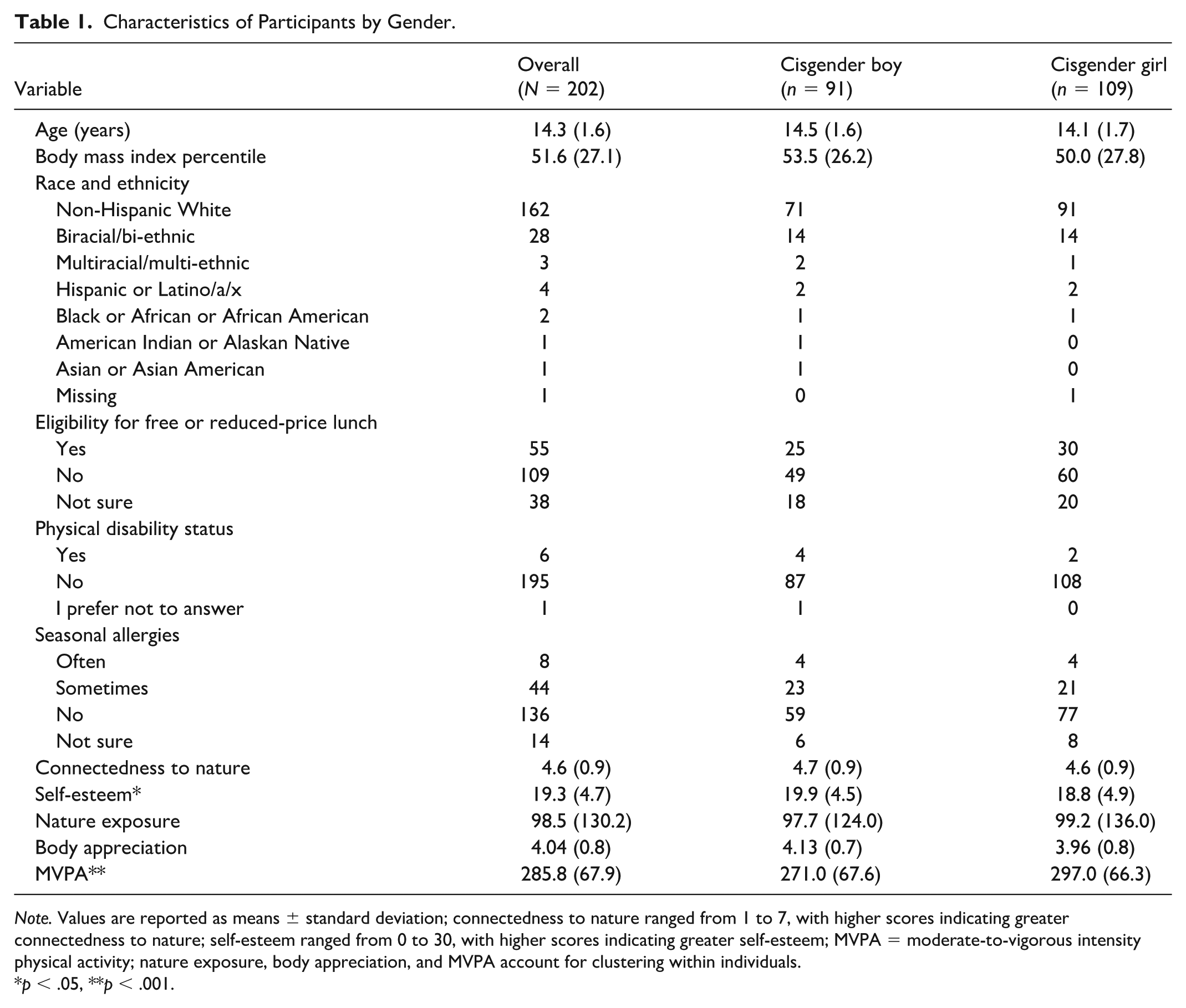
Note. Values are reported as means ± standard deviation; connectedness to nature ranged from 1 to 7, with higher scores indicating greater connectedness to nature; self-esteem ranged from 0 to 30, with higher scores indicating greater self-esteem; MVPA = moderate-to-vigorous intensity physical activity; nature exposure, body appreciation, and MVPA account for clustering within individuals.
p < .05, **p < .001.
Participants were removed from analyses who did not have nature exposure (n = 3) or MVPA (n = 4) data. These data were missing due to accelerometer malfunctions (e.g., accelerometer battery died after the first day) or improper app installation, which were discovered when the devices were checked at the second study visit. The final analytic sample had a possible 1,365 observation days, with almost all participants having at least 4 days’ worth of data for key study variables (90%+). Participant between-group averages of daily time in MVPA were 285.8 minutes (±68.0). Average daily nature exposure was 98.5 minutes (±130.2), and participants averaged 4.04 (±0.8) on daily body appreciation (possible range: 1–5).
Preliminary Results
Aside from nature exposure, study variables were normally distributed (George & Mallery, 2010). Detailed figures for distributions of daily MVPA and participants’ average daily MVPA (within-group) over the week are provided as Supplemental Online Information Figures 1 and 2. Nature exposure was zero-inflated and positively skewed, thus transformed (i.e., log(x+1)). Only MVPA (p < .001) and self-esteem (p < .05) were significantly different between groups, being greater among girls. There was poor cluster reliability with nature exposure and MVPA (intraclass correlations = 0.44), while body appreciation demonstrated excellent cluster reliability (0.92). Missing data were missing completely at random, p = .95 (Little, 1988).
Hypothesis-Testing Results
After adjusting for age, gender, race and ethnicity, BMI, eligibility for free or reduced-price lunch, physical disability status, seasonal allergies, connectedness to nature, and self-esteem, there was a significant, positive within-person association between daily nature exposure and MVPA, 9.71 (p < .001). The significant random slope (p < .01) indicated the within-person nature exposure effect on MVPA varied across adolescents. The effect size was small-to-medium (ƒ2 = .05). There were no significant associations between nature exposure and body appreciation (p = .52) or between body appreciation and MVPA (p = .78; Table 2). Gender did not moderate the association between nature exposure and MVPA (p = .17) nor did it significantly moderate the associations between nature exposure and body appreciation (p = .71) or between body appreciation and MVPA (p = .61; Table 3).
Multilevel Linear Regressions Between Nature Exposure, Body Appreciation, and MVPA.
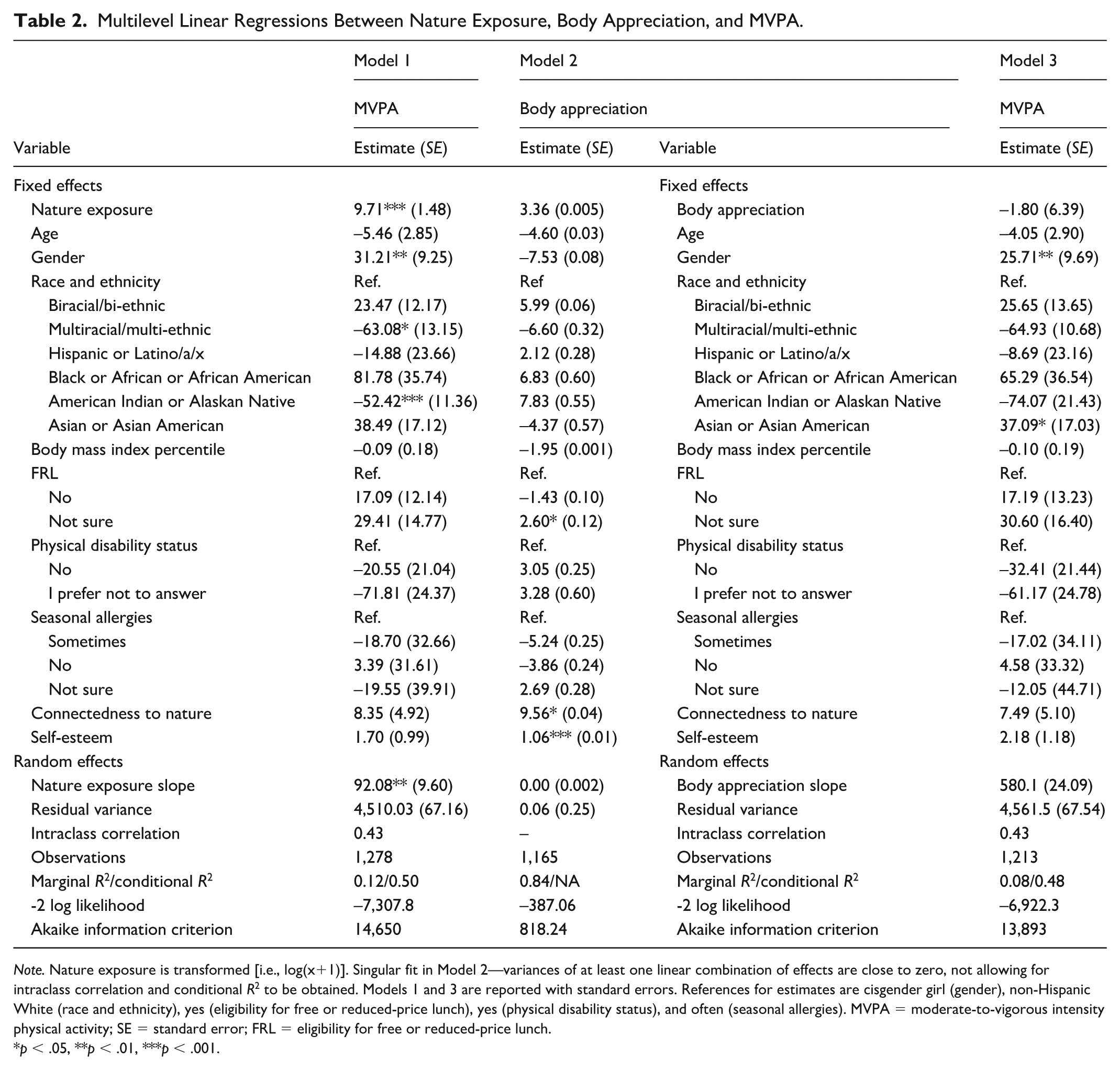
Note. Nature exposure is transformed [i.e., log(x+1)]. Singular fit in Model 2—variances of at least one linear combination of effects are close to zero, not allowing for intraclass correlation and conditional R2 to be obtained. Models 1 and 3 are reported with standard errors. References for estimates are cisgender girl (gender), non-Hispanic White (race and ethnicity), yes (eligibility for free or reduced-price lunch), yes (physical disability status), and often (seasonal allergies). MVPA = moderate-to-vigorous intensity physical activity; SE = standard error; FRL = eligibility for free or reduced-price lunch.
p < .05, **p < .01, ***p < .001.
Associations Among Nature Exposure, Body Appreciation, and MVPA by Gender.
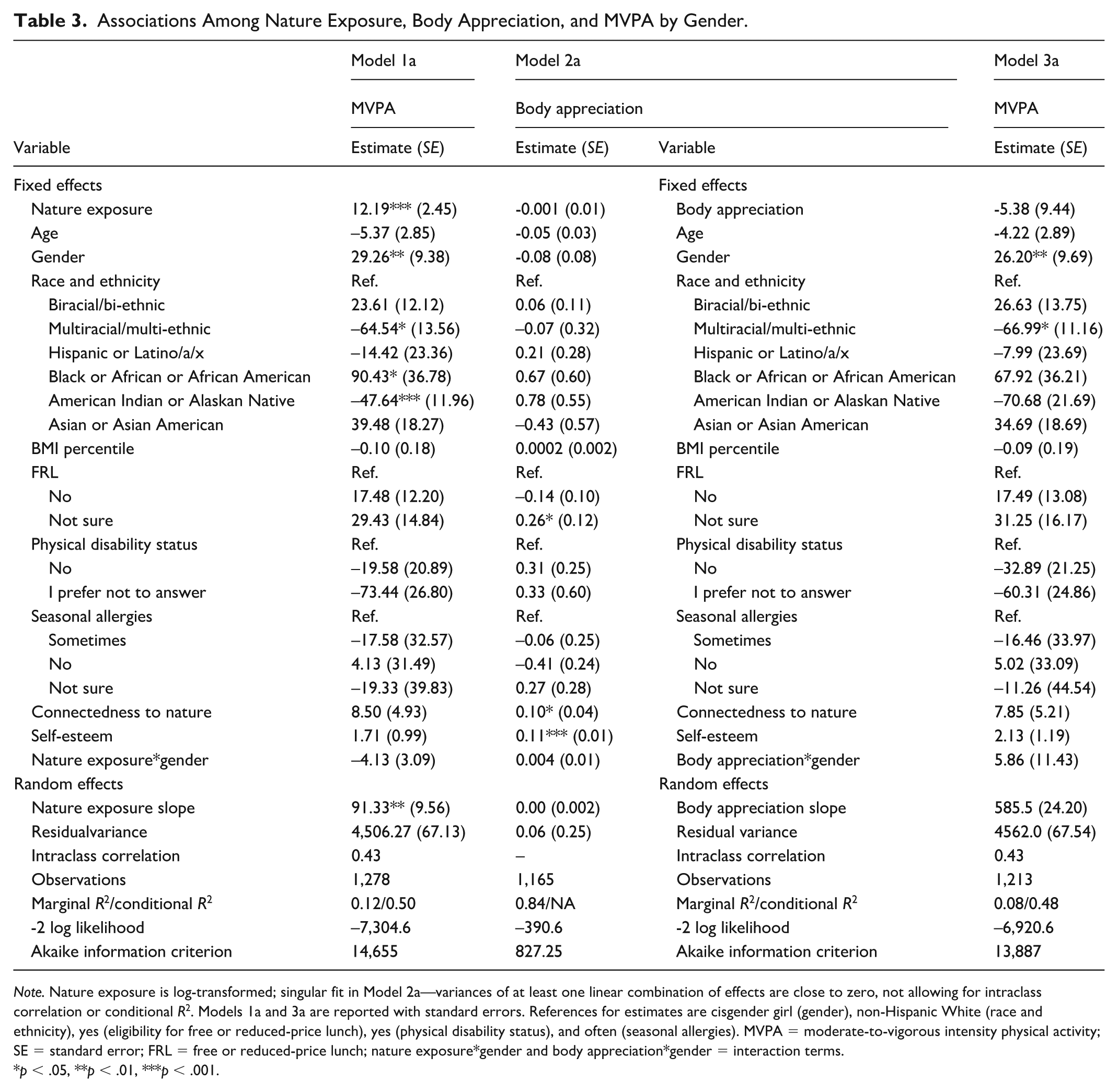
Note. Nature exposure is log-transformed; singular fit in Model 2a—variances of at least one linear combination of effects are close to zero, not allowing for intraclass correlation or conditional R2. Models 1a and 3a are reported with standard errors. References for estimates are cisgender girl (gender), non-Hispanic White (race and ethnicity), yes (eligibility for free or reduced-price lunch), yes (physical disability status), and often (seasonal allergies). MVPA = moderate-to-vigorous intensity physical activity; SE = standard error; FRL = free or reduced-price lunch; nature exposure*gender and body appreciation*gender = interaction terms.
p < .05, **p < .01, ***p < .001.
Discussion
The present study is the first to confirm a positive association between nature exposure and MVPA among adolescents using objective, continuous, individual-level measures. The poor cluster reliability with nature exposure and MVPA (0.44) suggests individuals’ daily scores for these variables were no more similar to each other than to other participants. This provides evidence that adolescents exhibit unique day-to-day patterns of health behaviors, and there is a need to monitor activity over a continued period and not at one or two points. The direction of the association is in line with the study hypothesis; increased daily nature exposure is associated with increased daily MVPA. This finding aligns with some previous literature among adolescents using self-reported (van Lier et al., 2017) and objective, proxy measures for nature exposure (Queralt & Molina-García, 2019) but extends the empirical understanding to a sample of active adolescents. In adjacent literature among elite athletes, interviews about their lived experiences identified themes of connectivity to nature and positive attitudes toward the natural environment, finding nature to be a restorative space helpful for coping (e.g., emotion regulation; MacIntyre et al., 2019). These findings are consistent with the present study’s positive nature exposure-MVPA link among active adolescents. Interventions promoting adolescents’ PA could prioritize time in natural settings like parks and trails (Evans et al., 2020; Zarr et al., 2022), as time spent in nature is not only linked to more PA, but engaging in PA outdoors is also linked to more positive psychological and physical health outcomes compared to PA indoors (Boere et al., 2023; Noseworthy et al., 2023).
The generalizability of study findings is limited to active adolescents. Recruiting a sample of adolescents engaging in high levels of PA was unintentional, yet participants spent a large amount of time in daily MVPA (see Supplemental Online Information), with only 6% of the daily observations falling below the recommended 60 minutes of MVPA (Piercy et al., 2018). A re-evaluation of the accelerometer data confirmed the MVPA results. The active sample was likely due to the study location and several of the recruitment methods. Specifically, as recruitment flyers mentioned nature and PA, it may have fostered selection bias such that adolescents who were interested in nature and/or PA were more likely to enroll. Also, the recruitment and study visit site occurred outside a youth sports organization, making the study more visible to those in PA-focused summer camps and sports programs. Recruitment via word-of-mouth also led to clusters of adolescents from several sports teams (e.g., soccer, track) enrolling. Future studies should expand on the nature exposure-MVPA link with objective, continuous, and individual-level measures using recruitment strategies that promote engagement by adolescents that better represent the 80% of adolescents who are not meeting the PA guidelines (Piercy et al., 2018).
Participants also spent an average of an hour and a half in nature each day. More than half (54%) of all study days included at least 30 minutes in nature, 38% with at least one hour, and 22% with more than two hours. One study among rural-dwelling adolescents found similar results of self-reported daily nature exposure (Larson et al., 2019). That sample spent more time in nature overall, with 70% having at least 30 minutes and 40% with more than two hours (Larson et al., 2019). A study utilizing NatureDose among college students found an average of 25 minutes a day spent in nature (Vermeesch et al., 2022), roughly three and a half times less than the current younger sample. While the study of college students did not report MVPA, participants averaged about 8000 steps a day, classified as “somewhat active” per step-based estimates (Tudor-Locke & Bassett, 2004). The present study’s active sample may explain the higher time in nature, given the positive association between time in nature and MVPA found in the current study and others (Fyfe-Johnson et al., 2021; Yang et al., 2021). In addition, the current study was conducted during the summer, and warmer seasons are linked to more time outdoors among youth (Larouche et al., 2023). The urban/suburban study setting may also have contributed to greater nature time, as lower urbanization is related to greater frequency and duration of time in nature (Cox et al., 2018). The study location is also generally dense in nature (e.g., forests, rivers, green valleys). For example, NatureDose gives a “Nature Rich” score to the study visit site, such that a modest effort may be needed to immerse in nature opportunities (NatureQuant, 2026). How findings might compare to areas with a lower greenery density is needed.
Contrary to the hypothesis, nature exposure was not associated with body appreciation. This finding contrasts with prior research among adults who self-reported increases in body appreciation after nature exposure (Swami et al., 2020). Perhaps the current sample, with higher-than-average body appreciation (Andrew et al., 2016; Jankauskiene et al., 2020; Urke et al., 2021), had a potential ceiling effect where nature exposure may no longer have improved body appreciation. Studies should reassess this association with adolescents who experience lower body appreciation, as they may receive greater benefits from nature exposure or nature-based PA. Another possible explanation for the finding is that nature exposure, when objectively measured, is not as important to body appreciation as other factors, such as weight teasing and peers speaking negatively of their own bodies (Littleton & Ollendick, 2003).
Also contrary to the hypothesis, body appreciation was not associated with MVPA. This finding is inconsistent with prior work in a prospective study among adolescent girls (Andrew et al., 2016). The current study is the first to test the body appreciation-to-MVPA association on a day-to-day basis among adolescents, assessing the potential variability of body appreciation with MVPA. The current study also measured objective MVPA over 7 days instead of self-reported total PA after one year (Andrew et al., 2016), which may have contributed to the distinct finding. Body appreciation values did not tend to fluctuate over the course of a week, demonstrating it was more of a trait characteristic than a state characteristic. To confirm this finding, future research should consider studies better equipped to capture potential variability. Ecological momentary assessments, as previously done for body satisfaction and affect, could be utilized (Stevens & Griffiths, 2020). Furthermore, collecting body appreciation in longitudinal studies across months may better provide information about its potential for variability. In addition, the high volume of MVPA among participants could have resulted in null findings of this investigation. Future research with other subsets of adolescents should examine the link between body appreciation and MVPA. For example, transgender adolescents report lower body appreciation (Moolchaem et al., 2015) and face increased barriers to PA compared to cisgender adolescents (Lightner et al., 2024); thus, the relationship between body appreciation and PA necessitates greater attention.
Finally, extensive support exists for gender differences in body appreciation (He et al., 2020) and PA engagement (Belcher et al., 2010). Contrary to the extant findings and hypotheses, gender did not moderate the daily associations among nature exposure, body appreciation, and MVPA. The novel and null findings for gender differences among active adolescents are promising and support the positive link between nature exposure and MVPA. Despite girls in the current study engaging in significantly more MVPA than boys (297 vs. 271 min/day), activity was high relative to average MVPA in other adolescent studies (Belcher et al., 2010; Farooq et al., 2020).
The current study has several strengths. It is the first to measure concurrent objective, continuous, and individual-level nature exposure and MVPA among adolescents. The study design allowed multiple days of data collection as opposed to a snapshot in time. The study sample had a near even split for cisgender representativeness and was fairly distributed across age categories. In addition, while previous nature studies have not covaried for seasonal allergies in their analyses, which can impact individuals’ nature exposure and health (Fyfe-Johnson et al., 2021), the current study did.
This study also has limitations, mainly lack of generalizability to less active or largely sedentary adolescents, as previously discussed. The sample also largely consisted of non-Hispanic White and cisgender adolescents, prohibiting investigations into potential racial and ethnic differences and limiting additional gender investigations. Finally, NatureDose is a phone application, limiting the study to smartphone users who had to carry their phones with them to capture data, perhaps inconvenient for those who like to disconnect from technology when in the outdoors.
Implications for Practice
Interventions that aim to promote PA among adolescents should consider the potential benefits of utilizing natural settings. The increased internal validity of findings provides strong support regardless of gender. Those aiming to improve adolescents’ body appreciation might consider targeting factors aside from nature exposure, such as self-efficacy, for greater effect. However, further research is needed to better understand the relationship between nature exposure and body appreciation for adolescent health.
Conclusion
As the first study to objectively and continuously measure individual-level nature exposure and MVPA among adolescents, findings help clarify previously mixed literature reliant on self-report and proxy measures. Specifically, findings show daily nature exposure is positively associated with daily MVPA among active adolescents, and this link did not differ between girls and boys. PA interventions among this age group should consider incorporating time in nature. In addition, among active adolescents, body appreciation may not be an important factor when considering the links with objectively measured nature exposure and MVPA.
Supplemental Material
sj-docx-1-heb-10.1177_10901981261437118 – Supplemental material for Examining Daily Associations of Nature Exposure, Body Appreciation, and Physical Activity Among Adolescents
Supplemental material, sj-docx-1-heb-10.1177_10901981261437118 for Examining Daily Associations of Nature Exposure, Body Appreciation, and Physical Activity Among Adolescents by Esmeralda Castro, Zachary S. Farley, Nichole R. Kelly, Nicole R. Giuliani, Christopher T. Minson, Jeremy J. Pomeroy and Elizabeth L. Budd in Health Education & Behavior
Footnotes
Acknowledgements
The authors thank Chris Bailey at NatureQuant, LLC; Kidsports; and especially our study participants.
ORCID iDs

Funding
The authors disclosed receipt of the following financial support for the research, authorship, and/or publication of this article: This work was supported by the University of Oregon’s Office of the Vice President for Research and Innovation and the University of Oregon’s Sport and Wellness Initiative.
Declaration of Conflicting of Interests
The authors declared the following potential conflicts of interest with respect to the research, authorship, and/or publication of this article: Dr. C.T.M. has a financial interest in NatureQuant, LLC. He did not take part in data collection, interactions with research participants, data analyses, or reporting of data.
Supplemental Material
Supplemental material for this article is available online.