




Abstract
Dating and relationship violence (DRV) and gender-based violence (GBV) among children and young people incur a high cost to individuals and society. School-based interventions present an opportunity to prevent DRV and GBV early in individuals’ lives. However, with school resources under pressure, policymakers require guidance on the economics of implementing interventions. As part of a large systematic review funded by the National Institute for Health and Care Research (NIHR), we searched for economic evaluations and costing studies of school-based interventions for DRV and GBV. No formal economic evaluations were identified. Seven studies reporting costs, cost savings, or resource use for eight interventions were identified. The largest costs of implementing interventions were related to staff training and salaries but savings could be made by implementing interventions on a large scale. The potential cost savings of avoided DRV and GBV far outweighed the costs of implementation.
Introduction
Dating and relationship violence (DRV) and gender-based violence (GBV) are highly prevalent among high-school-age children, experience with which has been shown to predict lifetime perpetration and victimization (Costa et al., 2015). Between a quarter and a third of adolescents experience violence within a relationship, including physical, sexual, and psychological abuse, although much higher rates have been reported in high-risk groups (Taquette & Monteiro, 2019; Young et al., 2021). GBV is also common in schools and includes sexual harassment, homophobic and transphobic bullying, and sexual assaults (Ofsted, 2021). Both victims and perpetrators experience negative effects of DRV and GBV, including mental health difficulties, low self-esteem, risky sexual behavior (Taquette & Monteiro, 2019), victims may be more likely to experience DRV and GBV as adults (Costa et al., 2015), and there may be life-changing consequences for perpetrators who enter the legal system. DRV and GBV are therefore significant public health concerns, with costly impacts for both individuals and society. Annual costs for DRV and GBV within the United Kingdom have been estimated at £66 billion and £37 billion, respectively (European Institute for Gender Equality, 2021; Oliver et al., 2019), with the majority of costs caused by the physical and mental health consequences for victims and their impact on productivity.
A large number of interventions to reduce and prevent DRV and GBV have been developed for implementation within the school setting. In the United Kingdom, state-funded schools are now required to incorporate teaching about DRV and GBV within school curricula, and educators are considering the optimum intervention content and delivery to meet the needs of students. As part of a large, nationally funded evidence synthesis project, we systematically reviewed the evidence for any intervention delivered within the school setting aimed at preventing DRV and GBV. Within this, we sought evidence for the cost-effectiveness of school-based interventions and the costs and resource use needed to implement them, as this information will be useful to policy- and decision makers. This report presents the findings of the economic outcomes reported by included studies.
Method
An NIHR-funded systematic literature review (SLR) was conducted to assess and synthesize evidence on school-based interventions for DRV and GBV (PROSPERO: CRD42020190463). This review included a broad range of evidence including the identification of economic evaluations and studies reporting cost data (including cost savings) and resource use data.
Search Strategy
A single search was conducted to identify all evidence types for the NIHR-funded SLR. Literature searches were conducted in July 2020 and updated in June 2021. We searched 21 databases, two trial registers, and various gray literature sources without any limit on time or study design. A range of supplementary search methods, including forward and backward citation chasing, and searches for first and last authors of included studies, were used to find additional studies. Details of literature sources and search strategies are provided in Appendix A.
Selection Criteria
Publications reporting cost-effectiveness evaluations, cost savings, and cost and resource use data associated with interventions for DRV and/or GBV were included. Relevant study designs included both randomized controlled trials (RCTs) and observational studies. Relevant interventions were those implemented within the school setting (including out of school hours, provided these were conducted with school cohorts) and either partially or wholly aimed at changing DRV or GBV outcomes. No limit was placed on the geographical location of studies. Records identified through literature searches were screened for relevance by two reviewers at both title/abstract and full-text level.
Outcomes
Outcomes included any cost or resource use data associated with a relevant intervention, including those required during training or implementation. Costs (savings) associated with intervention effectiveness were also included. Data were extracted in the currencies and units in which they were reported. Data extraction was conducted by one reviewer, and all extractions were reviewed by a second reviewer. Included studies were narratively synthesized.
Impact Statement
This systematic review has identified the most current knowledge about costs and resource use needs of school-based interventions for dating and relationship violence (DRV) and gender-based violence (GBV) and provides learnings about how savings may be made in their implementation. While no formal economic evaluations of school-based interventions for DRV and GBV have yet been conducted, the evidence suggests that interventions that reduce the incidence of violent events may save more money than they require to implement.
Results
Included Studies
Following de-duplication, the full review search identified 40,160 records that were screened on title and abstract, and 788 records were screened on full text. Seven studies (Bush et al., 2018; Cissner & Ayoub, 2014; Crooks et al., 2017; Jones et al., 2021; Luo et al., 2020; Meiksin et al., 2020; Wolfe et al., 2009) reporting cost and/or resource use data for eight interventions were identified. The review did not identify any studies that included a formal evaluation of the cost-effectiveness of interventions. A PRISMA diagram for the review is provided in the supplementary material.
Five (Bush et al., 2018; Cissner & Ayoub, 2014; Jones et al., 2021; Meiksin et al., 2020; Wolfe et al., 2009) of the included studies were based on RCTs, and two studies (Crooks et al., 2017; Luo et al., 2020) were based on observational case studies of the intervention. All seven studies involved students between 11 and 17 years of age and all were conducted in the school setting. Four studies (Bush et al., 2018; Cissner & Ayoub, 2014; Jones et al., 2021; Luo et al., 2020) were conducted in the United States, two studies (Crooks et al., 2017; Wolfe et al., 2009) were conducted in Canada, and one study (Meiksin et al., 2020) was conducted in the United Kingdom. One study reported results for two interventions (Luo et al., 2020).
An overview of the included studies is provided in Table 1. Because studies were primarily descriptive and were not “full” economic evaluations, we did not undertake formal appraisal, but we did note variations in methods across studies and consider where these may have affected outcomes.
Overview of Included Studies.
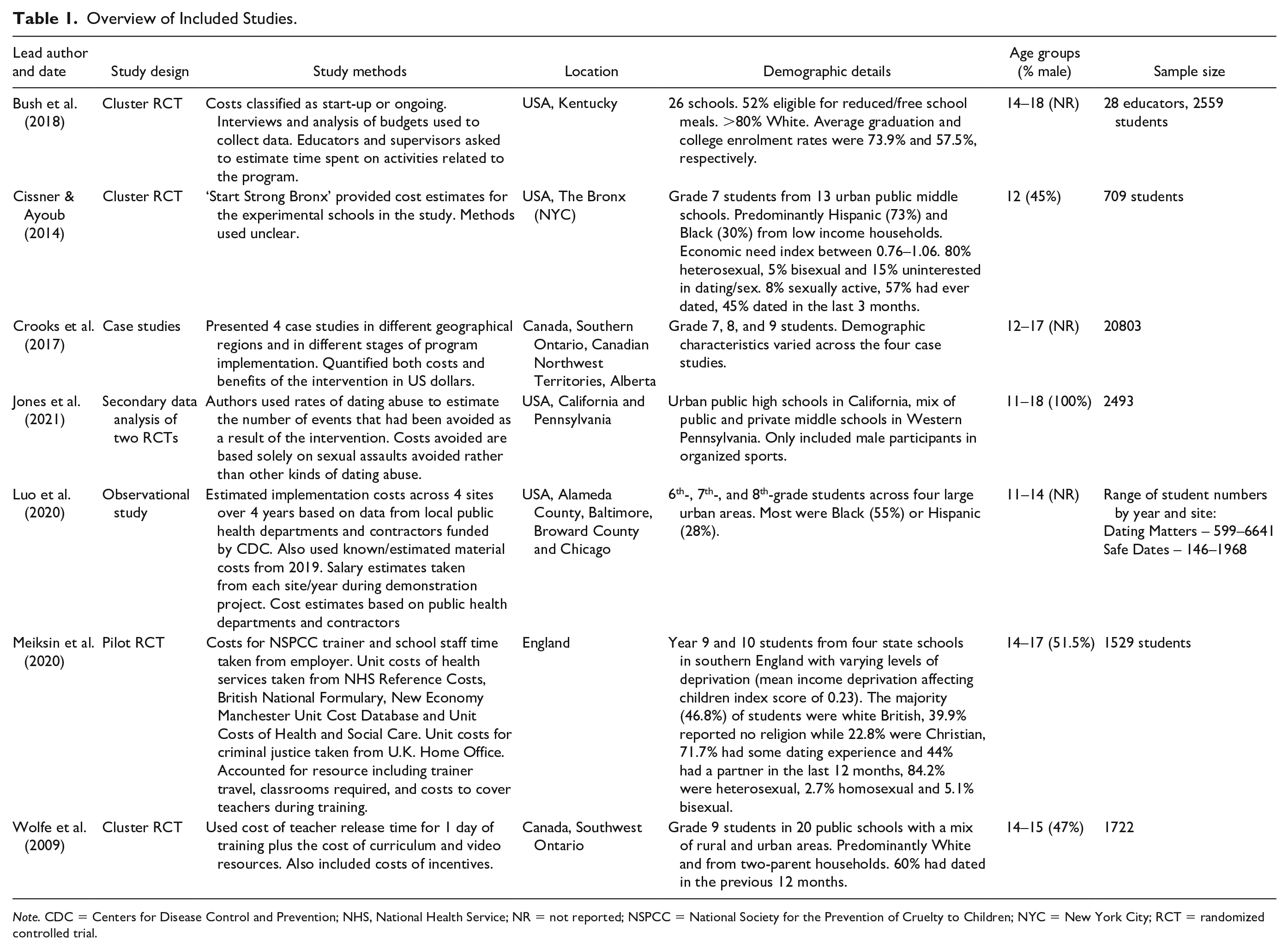
Note. CDC = Centers for Disease Control and Prevention; NHS, National Health Service; NR = not reported; NSPCC = National Society for the Prevention of Cruelty to Children; NYC = New York City; RCT = randomized controlled trial.
Interventions Evaluated
A brief overview of the interventions evaluated is provided in the supplementary material. Four interventions targeted DRV (Crooks et al., 2017; Luo et al., 2020; Wolfe et al., 2009), and four interventions (Bush et al., 2018; Cissner & Ayoub, 2014; Jones et al., 2021; Meiksin et al., 2020) targeted both DRV and GBV. One intervention was evaluated in more than one study (The Fourth R, n = 2; Crooks et al., 2017; Wolfe et al., 2009). Five of the interventions were facilitated by teachers, one (Jones et al., 2021) by athletic coaches, and one (Bush et al., 2018) by staff from a rape crisis center. The majority of the interventions involved teaching students within classroom settings (Cissner & Ayoub, 2014; Crooks et al., 2017; Luo et al., 2020; Meiksin et al., 2020; Wolfe et al., 2009) or teaching delivered within alternative settings (e.g., athletic coaching sessions [Jones et al., 2021]) and methods (e.g., peer delivery [Bush et al., 2018]). Interventions all required some degree of training for those delivering the intervention. Several interventions included additional components, including facilitating role-play (Bush et al., 2018; Crooks et al., 2017; Wolfe et al., 2009), digital materials (Crooks et al., 2017; Luo et al., 2020; Meiksin et al., 2020; Wolfe et al., 2009), and handouts (Crooks et al., 2017; Wolfe et al., 2009). Three of the interventions also included information or training for parents of the student participants. The follow-up duration of the studies varied from 15 months to 4 years.
Results of Included Studies
The results are presented in Table 2. Six (Bush et al., 2018; Cissner & Ayoub, 2014; Crooks et al., 2017; Luo et al., 2020; Meiksin et al., 2020; Wolfe et al., 2009) studies reported the costs and resource use associated with their respective interventions, and two studies (Crooks et al., 2017; Jones et al., 2021) reported cost savings from the estimated reduction in DRV predicted by the efficacy of the intervention within the evaluation.
Costs and Resource Use Reported by Included Studies.
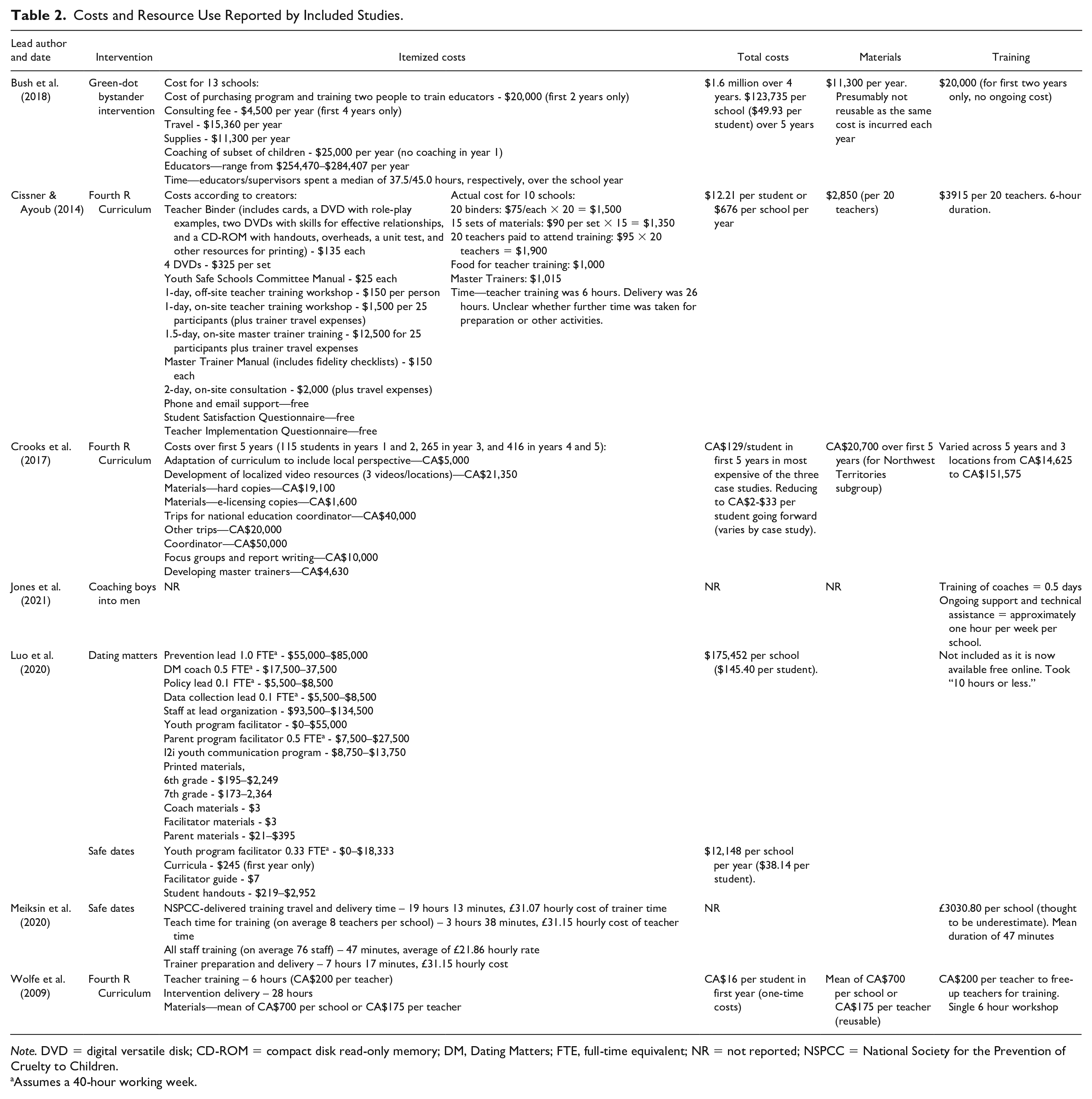
Note. DVD = digital versatile disk; CD-ROM = compact disk read-only memory; DM, Dating Matters; FTE, full-time equivalent; NR = not reported; NSPCC = National Society for the Prevention of Cruelty to Children.
Assumes a 40-hour working week.
Cost and Resource Use of Included Interventions
The total cost of interventions, where reported, ranged from US$12 to $145 per student. Staff costs for delivering the intervention (either training school staff or else hiring external teams to deliver) were generally the highest cost, and variation in the involvement and training of staff was a major driver of differences in costs between studies. Several studies noted one-off material costs that would be incurred in the first year of implementation, which would result in lower costs in subsequent years and once the costs of staff training were accounted for. However, re-training staff or training new staff in schools with a high staff turnover continued to be a significant driver of costs. It was generally more expensive to hire external staff than train internal staff.
Materials, such as handouts, DVDs, and course manuals, were costly. Not all studies reported whether materials were reusable in subsequent years of the intervention, although Crooks et al. (2017) reported that freely accessible materials that schools were able to print themselves were associated with a reduction in costs. Adapting materials to suit local contexts was particularly expensive, one study (Crooks et al., 2017) reported this to cost CA$26,350. One of the interventions evaluated, Project Respect (Meiksin et al., 2020), involved a change at the school level, including a review of school policies and increased monitoring of students by school staff, and did not show an accompanying increase in costs compared with other interventions.
Two studies (Bush et al., 2018; Crooks et al., 2017) demonstrated that intervention costs per student can be reduced where they can be shared across a larger number of students. Crooks et al. (2017) found that costs were increased as a result of smaller class sizes and the distribution of schools over a larger geographical area. Similarly, Bush et al. (2018) reported that while costs to implement Green Dot over the first 5 years were $1.6 million for 13 schools (i.e., $123,000 per school), the cost of subsequently adding another school was $25,510 as there would be no start-up costs.
Cost Savings of Interventions
Crooks et al. (2017) estimated savings of CA$32 per student for reduced physical dating violence, and CA$1,978 per student in avoided costs of violent delinquency in the long term after receiving the Fourth R intervention. Jones et al. (2021) estimated that the implementation of Coaching Boys into Men avoided 85 dating abuse incidents in high school students and 49 in middle school students over the course of 3 months. Across 1000 students, this was considered to result in estimated savings of $2.5 million, or $2,500 per student.
Discussion
High-quality economic data for school-based interventions are crucial for guiding educational policy, particularly in state-funded schools where budgets are tightly controlled and policymakers are required to justify the opportunity costs of spending. However, despite the comprehensive literature search strategy used, this systematic review did not identify any cost-effectiveness evaluations of school-based interventions for DRV or GBV. As part of the broader review, 68 RCTs and 108 observational studies evaluating DRV or GBV interventions were identified, but only a handful of these studies reported any cost or resource-use data.
As with evaluations of other school-based interventions (e.g., for physical activity policy [Lane et al., 2022]), the largest cost of interventions related to staff costs, including training and/or hiring of external organizations to deliver interventions. Costs were shown to increase in settings where staff turnover is high due to the need to re-train staff, and costs were shown to reduce where these could be shared among a larger group of students. This means that in comparison, interventions targeting “high-risk” students could be more costly to implement, and to date, there is relatively little evidence on the effectiveness of such an approach.
Provided that the costs of diverting school staff away from other responsibilities are manageable, it is likely that interventions delivered “in-house” will be less costly, as the costs of training staff will be shared over multiple years of implementation. There may also be broader benefits of school staff delivering the intervention, for example, their greater familiarity with students may help with intervention delivery (Luo et al., 2020), and staff knowledge may translate to other areas of their role in schools.
Increasing the scale of interventions, to broader age groups or across multiple schools, may also lead to cost savings through shared staff training and the reuse of materials. The diffuse benefits of interventions for DRV and GBV, for example, through ongoing transmission of knowledge, may also be greater with wider implementation (Cissner & Ayoub, 2014). However, it is common for the developers of interventions to encourage schools to adopt interventions according to the age, baseline risk, and cultural background of students. This may limit the ease with which resources are shared by schools, and one study in the review showed that the costs of adapting interventions to cultural contexts may significantly increase costs (Crooks et al., 2017).
The costs of implementing school-based interventions for DRV may ultimately be justified if these are able to reduce the number of DRV incidents. While estimates of cost savings may be somewhat unreliable when the longer-term effectiveness for reducing DRV and GBV incidents is lacking, there are substantial cost and health benefits to reducing these incidents. Such events are highly costly due to the costs they present to law enforcement agencies and the costs incurred to society through their impact on people’s health and employment (Walby, 2009). When delivered within the school context, interventions for DRV and GBV may result in higher cost savings over students’ lifetimes than those implemented in adults later in life. Cost savings of interventions will largely benefit budgets for sectors outside of education, and therefore policymakers may wish to consider the onward benefits of spending on DRV and GBV prevention within schools.
The findings of this review are limited by the paucity of studies that have evaluated costs associated with school-based interventions for DRV and GBV, and by the variability in units and categorization of reported costs, which limits comparison. It is also possible that the findings may have limited generalizability beyond the settings in which the included studies took place, for example, to low- and middle-income countries, where no evidence was identified.
Nevertheless, the studies presented herein provide various key learnings for the costs of interventions for DRV and GBV. Decision makers should consider the potential staffing costs for implementing interventions, and how collaborations with other schools and districts may increase feasibility. Education policy toward reducing violence in schools may also consider the potential value of long-term reductions in costs associated with violence in other public sectors. Economic evaluations of interventions found to be effective in reducing violence behavior are needed and would make a stronger case for schools to adopt interventions for DRV and GBV.
Supplemental Material
sj-docx-1-heb-10.1177_10901981221138064 – Supplemental material for Systematic Review of the Economics of School-Based Interventions for Dating Violence and Gender-Based Violence
Supplemental material, sj-docx-1-heb-10.1177_10901981221138064 for Systematic Review of the Economics of School-Based Interventions for Dating Violence and Gender-Based Violence by Fraizer Kiff, Naomi Shaw, Noreen Orr, Andrew. J. Rizzo, Annah Chollet, Honor Young, Emma Rigby, Ann Hagell, Vashti Berry, Chris Bonell, G. J. Melendez-Torres and Caroline Farmer in Health Education & Behavior
Footnotes
Declaration of Conflicting Interests
The author(s) declared the following potential conflicts of interest with respect to the research, authorship, and/or publication of this article: G. J. Melendez-Torres, Honor Young and Chris Bonell, were co-authors of one study included in this review.
Funding
The author(s) disclosed receipt of the following financial support for the research, authorship, and/or publication of this article: This review was funded by a NIHR grant (ref: NIHR130144). For the purpose of open access, the author has applied a CC BY public copyright licence to any Author Accepted Manuscript version arising.

References
Supplementary Material
Please find the following supplemental material available below.
For Open Access articles published under a Creative Commons License, all supplemental material carries the same license as the article it is associated with.
For non-Open Access articles published, all supplemental material carries a non-exclusive license, and permission requests for re-use of supplemental material or any part of supplemental material shall be sent directly to the copyright owner as specified in the copyright notice associated with the article.
