




Abstract
Anonymous reporting systems (ARS) have been widely implemented in schools across the United States as a violence prevention strategy. The current study systematically reviewed the published literature on ARS in U.S. schools (including public and private k-12 schools, colleges, and universities) over the past 25 years to examine the effectiveness of ARS as a school safety and violence prevention strategy. We conducted a comprehensive literature search which identified just four studies pertaining to ARS in schools. Of note, only one of these studies was published in a peer-reviewed journal. Results from this systematic review point to the need for more empirical studies on the effectiveness of ARS as a violence prevention strategy. Findings from this review also highlight the wide variation across schools in the type of ARS used, the mode of implementation, and associated educational and training components. This review is a first step in documenting an evidence-base for ARS which will be useful in guiding educators and policymakers about best practices for the use of ARS in schools.
Impact Statement
Anonymous reporting systems (ARS) have been used as a violence prevention strategy in schools by providing a means for individuals within a school community to safely and securely report information about potential violence or concerns about mental health, for example, through an anonymous hotline or reporting app. Despite widespread implementation of ARS in schools, as well as mandates for reporting systems in schools in 21 states, there is limited evidence on the effectiveness of ARS for school violence prevention, and information about best practices for ARS implementation is lacking. This systematic review aims to summarize the current research on the effectiveness of ARS as a school safety and violence prevention strategy, which is an important step in building an evidence-base to guide schools and policymakers about best practices.
School violence, including acts of aggression, bullying, victimization, weapon carrying, and weapon use, continues to be an issue of great concern in the United States. High-profile violent attacks such as those that occurred at Columbine in 1999, Sandy Hook Elementary School in 2012, and Marjorie Stoneman Douglas in 2017 have led to a heightened focus on school safety and violence prevention. Several violence prevention strategies have been implemented and evaluated, including bullying prevention efforts (Espelage, 2016; Espelage & Horne, 2008), enhanced punishments for violent behavior (Madfis, 2016), zero-tolerance policies for weapons or other criminal behavior (Brady, 2002; Losinski et al., 2014), and increased security and monitoring systems in school buildings (Addington, 2009). However, many prevention strategies have the unintended effect of reinforcing the “code of silence” among students (Price & Khubchandani, 2019; Schwartz et al., 2016), keeping school personnel in the dark about early signs of potential violent behavior (Booth et al., 2011; Rocque, 2012).
Strategies that help address a code of silence can be a vital part of a school violence prevention plan. Anonymous reporting systems (ARS) are one such strategy. As of 2020, 21 states in the United States have mandated some form of anonymous or confidential reporting system to be implemented in schools as a violence prevention strategy (U.S. Department of Health and Human Services, 2020). The majority of these mandated reporting systems are fully anonymous (19 states), meaning that the reporter’s identifying information is not collected nor revealed under any circumstances. Confidential reporting systems (mandated by two states) may collect a reporter’s name or other identifying information but restrict the release of this information to third parties (with the exception of law enforcement). Evidence from past (and thwarted) violent school attacks suggests that the majority of perpetrators of school violence make their plans known to at least one other individual, oftentimes a friend or classmate (Alathari et al., 2019). In a zero-tolerance school, students may be less likely to report such information if they are concerned about disciplinary action for being associated with a potential perpetrator (such as suspension, expulsion, or criminal prosecution), punishment for their friend, sibling or partner, or being identified as a snitch and being ostracized by peers (e.g., Brank et al., 2007). Reporting systems (both anonymous and confidential) may reduce these concerns and encourage students to come forward with information, allowing schools to address issues before they escalate to violence.
The current study works from a broad definition of school violence (e.g., Benbenishty & Astor, 2005; Henry, 2000), which encompasses overt acts of physical aggression, bullying, and weapons carrying, as well as forms of relational aggression such as exclusion or teasing. Under this broad definition of school violence, school violence prevention includes more than just preparing for a violent event (such as in an active-shooter lockdown drill) or preventing students from bringing weapons to campus. It also includes paying attention to factors such as student mental health, stress, isolation, and changes in behavior. Furthermore, school violence is not limited to violence perpetrated by students on school grounds. The school and community are highly linked, and violence that begins in one context can spill over into the other (Benbenishty & Astor, 2005; Laub & Lauritsen, 1998).
Given the broad nature of school violence, ARS are likely to play a multifaceted role in school violence prevention. First, information about a planned attack or imminent threat can be reported through an ARS, allowing school administration and law enforcement to act prior to the event being carried out. In this way, ARS play a direct role in violence prevention. Second, ARS may provide a route for schools to address the precursors to school violence. For example, students can report a concern about a classmate’s mental health, parents can report about a concerning change in their child’s behavior, or youth can report about their own experiences of victimization. By addressing less extreme but more frequent acts of (and precursors to) school violence, in addition to directly preventing large-scale instances of violence, ARS have the potential to play a critical role in school violence prevention.
Despite their promise, there has been limited research on the use of ARS in school settings. More research has been done on the use of anonymous and confidential reporting systems in domains such as medicine, aviation, and finance. This literature suggests that anonymous and confidential reporting systems are effective for promoting workplace safety, compliance, and ethical behavior among employees (e.g., Frank et al., 2017; O’Leary & Chappell, 1996). Less is known about whether reporting systems are similarly effective as a violence prevention strategy in school settings. Efforts to summarize what we know about the effectiveness of school-based ARS are an important step in building an evidence-base to guide schools and policymakers about best practices. Thus, we conducted a systematic review of ARS research with the goals to (1) characterize existing research on the use of reporting systems in educational contexts for reducing school-based violence; (2) identify empirical studies on the effectiveness of ARS at reducing violence; and (3) identify areas for future research on ARS. For the purpose of the current review, we include both confidential and anonymous reporting systems.
Method
Search Strategy
We systematically reviewed the published literature on anonymous reporting systems (ARS) in educational settings in the United States over the past 25 years. The time frame (1995–2020) was chosen to capture the few years prior to the Columbine attacks and the years since, as violent school attacks have remained an issue of concern. The protocol for this review was informed by the Preferred Reporting Items for Systematic Reviews and Meta-Analysis (PRISMA) guidelines to search research databases, screen published studies, apply inclusion and exclusion criteria, and select relevant literature for review.
We performed a comprehensive electronic search of publications using the following databases: ERIC, Medline, SCOPUS, PsycInfo, PsycArticles, Social Sciences Abstracts, Social Sciences Full Text, Education Abstracts, Education Full Text, and Criminal Justice Abstracts. We restricted our search to English-only articles and collected all database results published in the past 25 years (1995–2020). Search terms addressed the main concepts of the search strategy: (anonymous OR confidential OR private) and (reporting OR hotline OR tipline) AND (safety OR prevention OR violence OR aggression OR bullying OR climate) AND (school). At the conclusion of the full-text review, we reviewed the reference lists of included articles to identify any additional articles for inclusion.
Inclusion and Exclusion Criteria
We included articles that report on school-based anonymous reporting systems (ARS) in educational settings, including public and private k-12 schools, colleges, and universities. To be included in this review, articles must have described the implementation of a school-based reporting system (anonymous or confidential), such as a hotline, tipline, mobile app, or other mode for students to report tips. The reporting system must be related to school safety or violence prevention, which is broadly conceptualized to include weapon use, threats or incidents of physical violence, bullying, and concerns about mental health (e.g., suicide threats, self-harm). Peer-reviewed articles, as well as dissertations and gray literature of reports not published in the academic literature, were included in the current review.
Following these inclusion criteria, we excluded articles that (1) did not examine a confidential or anonymous reporting system; (2) examined the effect of ARS in another context aside from K-12 schools and/or colleges and universities (e.g., in the medical context); (3) used a reporting system for a purpose not geared toward school safety and violence prevention (e.g., an anonymous reporting system for academic cheating); (4) were conducted in a juvenile detention center, after school program, or online program; (5) were not published in English; and (6) were meta-analyses, systematic reviews, editorials, opinion pieces, or commentaries.
Study Selection
We used Covidence, an online platform, to manage screening and selection of articles. Each title and abstract was independently screened by two reviewers to determine whether the study fit our criteria. Full-text screening was completed for relevant articles to determine whether the paper should be included in the final analysis. After reviewing the full texts, the research team developed criteria and procedures for what information to extract from the included studies. Two members of the study team performed the initial extraction of information, and a third reviewed these results to establish quality and accuracy of the information. At each step, the research team met to discuss any discrepancies until a unanimous decision was reached regarding inclusion or exclusion of a particular study.
Our initial search identified 457 articles, of which 422 were excluded during the initial title/abstract screening because they did not fit at least one inclusion criterion noted above. After the initial abstract screening, full-text review was completed for the remaining 35 studies. We excluded 31 of the full-text review articles because they did not provide information about the implementation or usage of an ARS, or were editorial or opinion pieces. Four articles met the criteria for inclusion in the current review. These articles include one empirical article published in a peer-reviewed journal and three dissertations.
Data Extraction
The final data extraction included the following information: name and type of ARS, study context, usage data (i.e., number and types of tips reported), protocol for responding to tips, evaluations of effectiveness, and education and training on the ARS. Areas for future research based on the findings from each study were also identified by the author team.
Results
A summary of the data extracted from the four studies in our review can be found in Table 1 and is described in detail below.
Summary of Results From Data Extraction on Anonymous Reporting Systems in Schools.
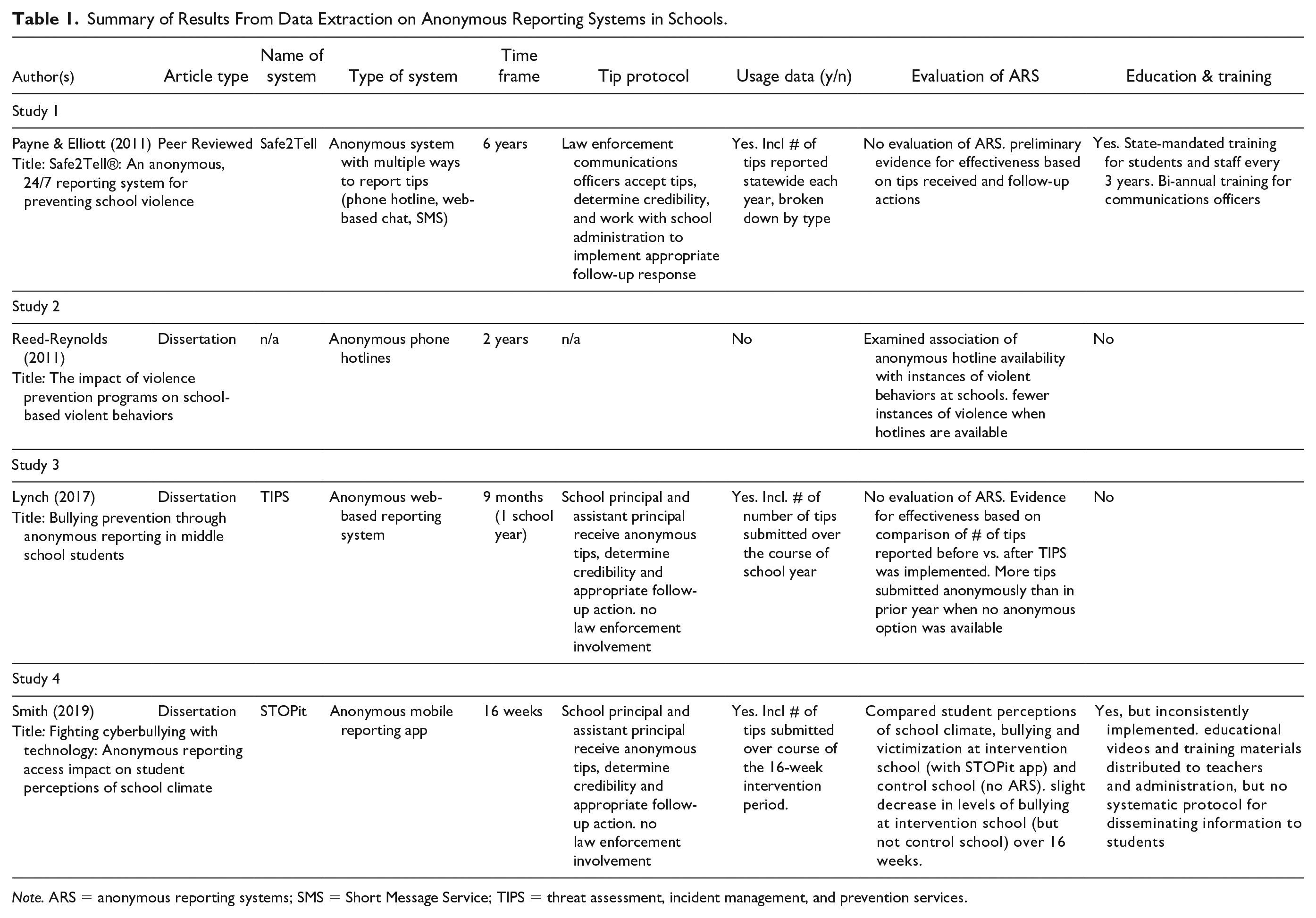
Note. ARS = anonymous reporting systems; SMS = Short Message Service; TIPS = threat assessment, incident management, and prevention services.
Study 1
Payne and Elliott (2011) is the only peer-reviewed publication on ARS we identified. This article describes the implementation of a state-mandated ARS, called Safe2Tell.
Type of System
The Safe2Tell system is an anonymous system with multiple ways for reporting tips, including a phone hotline as well as a web-based chat and a Short Message Service (SMS) feature. The anonymity of callers is legally protected under the 2007 Safe2Tell act, meaning that calls cannot be traced and information garnered through the system will not be included in case files or public school records.
Timeframe & Study Setting
Payne and Elliott (2011) include data from 6 years of the Safe2Tell system, which was implemented on a statewide basis in the state of Colorado in 2003. To be accredited with the CO Department of Education, all schools (public and private) must participate in the Safe2Tell Program. Thus, the analysis includes information gathered from all accredited schools within the state, including public and private schools in urban, rural, and suburban districts.
Usage Data
Payne and Elliott (2011) include usage data from 6 years of the Safe2Tell system. From 2004 to 2010, there were 8,905 calls to the tipline and 2,961 reports were deemed credible. Among the 2,961 credible reports, bullying was the most frequently reported (26.4% of tips reported), followed by drug and alcohol incidents (16.6% of tips), threats of violence (12.2% of tips), harassment reports (7.3% of tips), reports of guns or weapons (7.1% of tips), incidents of sexual misconduct (6.9% of tips), reports of child abuse (6.3% of tips), physical assaults (4.7% of tips), fights (3.7% of tips), self-injury incidents (3.4% of tips), gang-related incidents (1.7% of tips), acts of vandalism (1.4% of tips), thefts (1.3% of tips), incidents of domestic violence (<1% of tips), reports of sexting (<1% of tips), and events of animal cruelty (<1% of tips). Furthermore, more than 75% of credible reported incidents resulted in an intervention, leading to 415 formal investigations, 359 counseling referrals, 298 prevention/intervention plans, 324 suicide interventions, 312 school disciplinary actions, 74 arrests, and 28 prevented school attacks.
Protocol for Responding
When an individual calls the Safe2Tell hotline, the tip is received by a trained law enforcement officer. Officers who work with Safe2Tell receive training every 2 years to ensure they are up to date on school policies and procedures. Quality control is ensured through monthly test calls. This is a unique feature of the Safe2Tell system and ensures that all tips are handled in a similar manner and are adequately followed up on by each communications officer.
Education & Training
The Safe2Tell system is supplemented by a robust educational and training component. At each school, students, teachers, and the community are educated on how and when to use the Safe2Tell system. Payne and Elliott (2011) note that promotion of the Safe2Tell system through advertising and education is key to raising awareness of the system and encouraging its use; if students, teachers, and the community are aware of how and when to use the tipline, they are more likely to share important information that can aid in violence prevention.
Evidence for Effectiveness
The data gathered from 6 years of the Safe2Tell system seem to indicate that the program has been successful in preventing violence and promoting school safety, based on the number of interventions enacted in response to tips and the number of prevented school attacks. Systematic evaluations of the program are still lacking, and whether the Safe2Tell system is associated with declines in school violence over time or increases in students’ sense of safety at school cannot be determined from Payne and Elliott (2011).
Areas for Future Research
Payne and Elliott (2011) called for a systematic evaluation of the Safe2Tell system that does not just examine effects a year at a time but follows the effects over time. The analysis conducted by Payne and Elliott (2011) aggregates tips across all schools and districts across the state of Colorado. A future study that takes into consideration the size of the school, whether it was an elementary, middle, or high school, the school setting (i.e., urban or rural), and the demographics of the school, is important for further elucidating the effect of the ARS.
Study 2
Reed-Reynolds (2011) conducted a secondary data analysis of the National School Survey on Crime and Safety (National Center for Education Statistics, 2020) to assess the effectiveness of various violence prevention programs in schools. Reed-Reynolds (2011) did not describe a specific ARS but rather evaluated anonymous hotlines as a general strategy for violence prevention.
Type of System
Reed-Reynolds (2011) examined anonymous hotlines as a component of violence prevention programs in schools. Anonymous hotlines refer to phone lines that allow students, staff, and community members to report threats of violence and concerns about safety. No identifying information is collected or reported from the individuals who report tips using the anonymous hotline.
Timeframe and Study Setting
Reed-Reynolds (2011) used 2 years of data (2005–2006) from the National School Survey on Crime and Safety (National Center for Education Statistics, 2020) which is a nationally representative cross-sectional survey of about 4,800 public elementary and secondary schools in the United States.
Evidence for Effectiveness
Anonymous hotlines were found to be associated with fewer school-based violent behaviors (correlation = −.15) and had the strongest effect compared with any other type of prevention strategy. When all components of violence prevention programs were aggregated, violence prevention programs as a whole did not have a statistically significant effect on violent behaviors. With a correlational design, Reed-Reynolds (2011) did not examine the effect of potential covariates on the association of school violence prevention strategies with school-based violent behaviors. For example, it could be the case that schools with anonymous hotlines/tiplines tend to be located in more highly resourced districts, and the availability of resources could explain (at least in part) the lower levels of violent behaviors at these schools.
Area for Future Research
Results from Reed-Reynolds (2011) indicate that anonymous hotlines may be particularly effective at promoting school safety and reducing violent behaviors compared with other components of violence prevention programs. Future research using a regression analysis that controls for multiple variables would be informative. Furthermore, there was no information about contextual support for the anonymous hotline, such as educational or training components for students and school staff. Finally, with a cross-sectional design, Reed-Reynolds (2011) could not elucidate effects over time of anonymous hotlines on school violence prevention, which highlights the need for longitudinal studies.
Study 3
Lynch (2017) reported on the implementation, usage, and effectiveness of the TIPS (threat assessment, incident management, and prevention services) system, which is an ARS geared toward bullying prevention in schools.
Type of System
The TIPS system is a web-based, anonymous reporting system which allows students to submit tips about threats of violence, incidents of bullying, and concerns about mental health and safety anonymously through a website chat system.
Timeframe & Study Setting
The TIPS system was implemented at the beginning of the 2014 school year in one middle school in the Midwestern United States. The school was situated in a rural area and served a majority-White student population. Lynch (2017) used data from a subsample of 52 sixth and seventh grade students at the school (~50% female, ages 11–13).
Usage Data
After the ARS was implemented, the school received a greater number of reports of bullying compared with the prior school year. However, the number of reports was quite low overall, with 4 tips being submitted after ARS implementation compared with 1 tip in the prior school year.
Protocol for Responding
Students access the TIPS website through a computer or smartphone and submit tips anonymously over the internet. The school principal and assistant principal receive this anonymous information through the web platform and determine the appropriate follow-up action. Law enforcement is not involved in responding to the tips unless requested by school administrators.
Evidence for Effectiveness
A greater number of students reported tips about bullying after the TIPS system was implemented at the school compared with the prior year when no anonymous option for reporting was available to students, suggesting the ARS may encourage more reporting. However, one mixed finding relevant to the effectiveness of the TIPS system was that about half of students said they would still prefer to submit a bullying report face-to-face rather than anonymously despite the availability of an anonymous system.
Areas for Future Research
The findings from Lynch (2017) were somewhat encouraging, but limited due to several study design issues including the small, relatively homogeneous sample, the lack of a control school, and the overall low number of tips submitted (4 total). A future evaluation of the TIPS system that spans multiple years and includes all students at the school would provide more detailed information about how students use the system and provide more evidence for its effectiveness.
Study 4
Smith (2019) described the implementation, usage, and effectiveness of the STOPit Anonymous Reporting System for bullying prevention at one middle school located in the Midwestern United States.
Type of System
The STOPit app is an anonymous reporting system that students download on their devices as a mobile app. The app instantly connects students anonymously with school administration through a chat feature.
Timeframe & Study Setting
The STOPit evaluation was conducted over the course of 16 weeks in a suburban school district in the United States. Two middle schools serving Grades 6 to 8 participated in the study. The intervention school received the STOPit app and associated training materials, while the control school (matched on academic and demographic characteristics) did not receive the STOPit system. Students at both the intervention and control school completed a survey that assessed levels of bullying, victimization, and school climate at the beginning of the study and at the conclusion of the 16-week intervention period.
Protocol for Responding
The STOPit system is self-contained within the school, and tips are forwarded directly to the principal through the mobile platform. School administration is responsible for determining the credibility of each tip and enacting the appropriate response.
Usage Data
Only 1 tip was submitted via the STOPit app at the intervention school over the course of the study. Follow-up focus groups revealed that the majority of students were unaware that the app was available and were unclear on the purpose of the app. Furthermore, the author reported a general lack of awareness and buy-in around the STOPit app among teachers and staff.
Education & Training
Education and training materials, such as videos and flyers, were developed and provided by the creators of the STOPit app. The researcher provided all training materials to the teachers and administrators, and these were intended to be disseminated to students on a regular basis throughout the intervention period to encourage usage of the system and troubleshoot any issues. However, results from the follow-up focus groups indicated that these materials were not shown to students on a consistent basis, resulting in some students’ not being aware of the system or how to use it.
Evidence for Effectiveness
Results from the student survey post-intervention suggested a slight decrease in instances of bullying at the intervention school, but not at the control school. This is encouraging and may suggest the STOPit provides a means for violence prevention. Interestingly, no difference was found between the treatment school and control school in student perceptions of school climate before or after the implementation of the STOPit system.
Areas for Future Research
Design issues, such as the small sample-size and short 16-week intervention period, limit the conclusions that can be drawn from this evaluation. Expanding the evaluation of the STOPit system beyond this short time frame is an important step for evaluating this system.
Discussion
This systematic review reveals a significant gap in the literature and highlights the need for more research on ARS in schools. Our search identified just four empirical articles on ARS in schools, and only one of these studies was published in a peer-reviewed journal (Payne & Elliott, 2011). While calls for empirical studies that examine effects of ARS longitudinally were made a decade ago (Payne & Elliott, 2011), we did not find a single study that provided rigorous evaluation data, such as utilizing a randomized controlled experimental design or longitudinal pre/post tests for long-term effects. Given wide implementation and mandates at the state level for reporting systems of some kind, systematic evaluation of ARS is vital to inform best practices, identify implementation issues, promote acceptability of ARS among students, and determine if these systems work to reduce school and youth violence. Such research will inform policy and practice by elucidating what features of ARS make it more or less effective in a given context, for which populations and in what settings it may be most or least effective, and whether school-wide training in using the system will increase its use and effectiveness. In fact, we have such wide gaps in our knowledge that any systematic and well designed studies regarding ARS would be informative and help build our science for school violence prevention.
The current review also points to the need for more research studying the relative effectiveness of different tip management/triage strategies and law enforcement involvement in school-based ARS. The Safe2Tell system (Payne & Elliott, 2011) involves law enforcement throughout the whole process. In contrast, the TIPS system (Lynch, 2017) and STOPit app (Smith, 2019) are managed by school administrators, and law enforcement is not involved in any aspect of the process unless requested. Whether such differences in tip management matter for the effect of ARS in violence prevention is an important area for future study. When tips go to a law enforcement officer outside of the school, such as in Safe2Tell (Payne & Elliott, 2011), students may feel that the tip is more likely to be taken seriously and that their identity will be protected. Interestingly, Lynch (2017) and Smith (2019) reported very low overall usage of the ARS as well as a lack of buy-in on behalf of students and teachers. Whether and how tip management protocol relates to usage of ARS is an important area for future study.
The four studies identified in our review describe anonymous reporting systems, but only one system (Safe2Tell; Payne & Elliott, 2011) is supported by legislation protecting the anonymity of informants. Studies examining whether legal protection for anonymity fosters greater use of ARS and helps break the “code of silence” in schools is an important next step (e.g., Stone & Isaacs, 2002; Wylie et al., 2010). If students know that their reports are anonymous and their information is legally protected, they may be more likely to submit sensitive information that can aid in violence prevention. Relatedly, it is important to consider the distinction between anonymous and confidential reporting systems in their implications for reporting behavior and tip follow-up. A fully anonymous reporting system may encourage more reporting by reducing the psychological tax and stress associated with reporting. However, if the responders do not have any access to identifying information from the informant, this could hinder the ability to adequately follow up on the tip and respond in a timely manner. Furthermore, complete anonymity may increase the rate of prank calls on a system, since individuals know their information could not be tracked. Such issues may not arise with a confidential reporting system, which requires some identifying information to be disclosed so investigators can follow up on the tip. However, individuals may be less likely to report an incident or a concern if they must disclose identifying information. Whether the benefits of anonymity (or confidentiality) outweigh the potential drawbacks is an important area for future study.
While the studies included in our review shed light on the potential effectiveness of ARS, design limitations prevent generalization of the findings to different school contexts and student populations. Lynch (2017) was conducted in a rural school with a majority-White student population. Whether the ARS would have similar effects on students’ reporting in an urban context with a more diverse group of students is unclear. Similarly, both Lynch (2017) and Smith (2019) were carried out in the middle school context, but did not examine whether and how ARS would operate in the elementary or high school context. Payne and Elliott (2011) included a broad sample of schools throughout the state of Colorado, but did not examine associations of ARS with actual instances of school violence or students’ perceptions of school safety or school climate. Thus, studies examining the effect of an ARS across multiple school contexts with a diverse population are warranted.
Our results highlight the variation in types of ARS and training/education associated with the implementation of different ARS. A standardized training and education component of ARS that is used across multiple districts in the state (such as with the Safe2Tell system in Colorado) may be an effective means for implementing an ARS. Research that examines if training in the system for both school personnel and students would be a way to speed up the use of the systems and increase the types of early signs to be reported that may be most effective for prevention. Furthermore, due to the time and efforts needed from school personnel for the implementation, research that can pay attention to which resources would help the sustainability of these programs would be valuable.
Finally, it is important for future research to consider the role of families and communities as they relate to ARS implementation and school safety. Reporting systems are intended to provide a means for all individuals within a school community to report information safely and securely. Working from a Whole School Whole Child framework, it stands that the training, education, and promotion associated with a school-based ARS must extend beyond the school building to include not just school staff and students, but outreach to parents and community members as well. Fostering connections between parents, community members, and school personnel and building a culture where individuals feel safe to come forward with information is an important first step. Future studies are needed that examine the role that families and communities can play in the effective implementation of school-based ARS for school safety and violence prevention.
Implications for Practice
As the findings from this systematic review indicate, we have very little guidance for best practices on ARS implementation in schools. Although limited, research suggests that ARS may comprise an important piece of school safety practice by providing an outlet for individuals to come forward with information about potential school violence and threats, or concerns about a students’ mental health or behavior. School health educators can play a key role in helping train school staff to effectively implement ARS. School health educators may also play a pivotal role in helping researchers evaluate the effectiveness of ARS at their schools.
By providing a safe space for all students to report concerns about themselves or peers, ARS may also play a role in supporting equity in schools. Systems of injustice play out in school contexts, and often our strategies for preventing school violence further contribute to the problem (e.g., Henry, 2000; Thompkins, 2000). For example, the increased militarization of school security practices (e.g., metal detectors, drug-sniffing dogs, lockdown drills) and authoritarian discipline practices such as zero-tolerance policies, perpetuate a system where youth of color are often marginalized (e.g., Henry, 2000; Saltman & Gabbard, 2010). Furthermore, youth who are the victim of violence or harassment on the behalf of teachers or school administrators may feel as though there is no way for them to speak up about their experience. ARS provide a means for all individuals—students, teachers, parents, and administrators—to anonymously voice their concerns or come forward with information. Such information may aid in the direct prevention of a violent school attack, or may aid in a peer receiving mental health services or another form of intervention. The success of an ARS at addressing inequity depends, in part, on remaining vigilant about equitable treatment in how reports are handled. Training on issues of unconscious bias related to ARS may be an important component. School health practitioners may be integral in training school staff to provide fair and equitable responses to all tips received through the ARS.
Conclusion
Our review revealed a significantly limited body of knowledge about ARS systems despite the fact that more than 20 states require schools to include some type of anonymous reporting system for students and the larger school community. This is a woeful state of affairs that needs to be rectified especially because these systems may be an important component of any school violence prevention program. Our review also revealed that a consistent protocol for the implementation of ARS is lacking, which limits our ability to determine evidence-based best practices for implementation. Finally, we need research that includes a broader range of schools that represent different types of settings (e.g., rural-urban, large-small, middle-high) and students served (e.g., demographics) to help identify where and with whom we could improve utilization and the circumstances where ARS may be most effective in preventing violence.
Footnotes
Declaration of Conflicting Interests
The author(s) declared no potential conflicts of interest with respect to the research, authorship, and/or publication of this article.
Funding
The author(s) received no financial support for the research, authorship, and/or publication of this article.
