



Abstract
Key Points
There is currently ambiguity in the reporting of sex and gender in dance medicine and science research, leading to potential difficulties applying any evidence-based recommendations to the dance population.
Male dancers are under-represented in dance medicine and science research with very few male-only studies, and mixed-sex papers weighted heavily towards female participants.
Dance medicine and science researchers should adhere more closely to Sex and Gender Equity in Research (SAGER) guidelines within both the body of the research and study titles.
Introduction
Sex and gender imbalances in sports and exercise medicine literature have been widely discussed1-4 with calls for a more balanced ratio of male and female athletes in the literature. 5 Analysis of 1382 articles from three of the top-ranked sports science journals between January 2011 and August 2013 identified that females were under-represented across all journals with a total of 39% of participants being female, and 61% male. 1 A replication study completed a decade later revealed an increase in the number of female participants (52.25% of all participants studied), however a decrease in male only and female only studies. 4 Importantly there was also an increase in mixed-sex studies which may suggest more between-sex comparisons within studies, there does however remain a disparity in the number of male and female participants in sports and exercise science research.
It has been suggested that this imbalance in participants is partly due to the higher prevalence of male participation in sports, 1 although female participation is increasing.4,6 That said, there also remains a lack of female representation amongst team physicians 6 and a lack of access to sports science and medical provision for female athletes. 3
Differences in physiological parameters and injury pathology that impact training demands have been noted between sexes, with differences noted in concussion, 7 ACL injuries7,8 and subjective impact of the menstrual cycle on athletic performance. 9 However, research on the impact of menstrual cycle phases is currently inconclusive and shows inconsistent results in aspects such as quantitative measurement of fitness parameters including aerobic capacity.9,10 These morphological differences all have implications for the way in which we train and treat athletes and much more research is required to do so effectively. 3 It is therefore imperative that the research that is utilised by coaches, teachers and medical teams when working with athletes and dancers is also reflective of these differences.
Historically, medical and sports and exercise medicine research has avoided using female participants, partly due to the fluctuations in female hormones both through the menstrual cycle but also across the lifespan through puberty, adulthood and menopause. 11 Although there are also hormonal responses to training for males, their testosterone levels remain relatively consistent day to day in comparison to the fluctuations of oestrogen and progesterone in females. 12 However, more long-term declines in hormones such as in testosterone as a result of overtraining or declines in oestrogen during menopause, may have a greater impact on performance. 13 Despite the potential implications of these fluctuations on exercise response and athletic performance, there has been a reluctance to include females in sports and exercise research due to the complexity of methodological considerations and potential difficulties interpreting the heterogenic data. 11
Additionally lack of clarity in some research papers as to whether the authors were reporting sex or gender has made comparison and understanding of the implications of sex and gender in relation to the research question and clinical application difficult to understand. Recently Sex and Gender Equity in Research (SAGER) guidelines 14 have been developed for authors, journal editors, publishers and reviewers of scientific papers to standardise sex and gender reporting. The authors recommend that journal editors, particularly those publishing original research, should include these guidelines in their instructions to authors as well as encouraging editors and reviewers to utilise them during the peer-review process. These SAGER guidelines aim to ensure accurate use of the terms to avoid ambiguity, or conflation of terms and constructs. 14 The implementation of this across some scientific journals has begun to address ambiguity in research but challenges remain when reviewing historical publications.
Dance, conversely to sport, is predominantly female-populated,15 -18 although men tend to dominate higher, decision-making positions in the sector including choreographers and managers.16,19 Dance Data Project reported that United States venue programming consists of 35% female choreographic work and that women represent 43% of board leadership, including artistic and executive directors. 20 Despite advances in understanding gender identity in society and sports, gender-normative ideologies continue to persist in dance.21,22
At present there is an overlap in the presentation of dance medicine and science and sports medicine research, with some dance related studies published in sports journals. As a growing field of research, particularly since 2007, 17 publications such as the Journal of Dance Medicine and Science rank as the most relevant sources, however, dance science still lacks its own defined category of citation index, and the most commonly cited and high source impact dance science papers remain within non-dance science specific journals. 17 It should be noted that the high level of citations in these sources may be due to time accumulation 17 and it is therefore likely that this will continue to shift over time with a potential increase in the citation ranking of dance medicine and science specific journals. However, at present dance science research remains intertwined with sports science research and journal publications.
An understanding of the prevalence of research in male and female dancers across all of these sources is important to ensure there is sufficient evidence-based research to draw upon to inform teaching, training and clinical practice for both sexes. No research to date has investigated the sex or gender ratio in dance medicine and science participants. This could be beneficial for the training of student and professional dancers as well as the development of future research to address these gaps and inform training and research guidelines in dance medicine and science.
The aim of this research was therefore to quantify the total number and ratio of male: female participants in a sample of highly ranked (by citation) peer-reviewed dance medicine and science research by way of a cross-sectional preliminary study.
Methodology
Articles in four major journals utilised for Dance Medicine and Science research were studied from January 2023 to December 2025 inclusive. The methodology sought to replicate that utilised by Costello et al 1 and Ose et al 4 in their study of sports science papers. Both articles utilised the “Sport Science” category of the Thomson Reuters science citation index in order to select the top-ranking journals, however there is currently no equivalent “Dance Science” category available in the index, therefore this study drew upon the recent bibliometric analysis of research in dance medicine and science by Brown-Appenzeller et al. 17 The authors analysed dance medicine and science research between 2007 and 2024, a period of significant growth in this sector, and provided a number of performance indicators including most cited sources. Accordingly, the Journal of Dance Medicine and Science (JDMS), American Journal of Sport Medicine (AJSM), British Journal of Sport Medicine (BJSM) and Medical Problems of Performing Artists (MPPA) were selected based on this citation ranking. 17
Similar to Costello et al 1 and Ose et al 4 only articles allocated to a volume and issue during a 3 – year window of January 2023 and December 2025 inclusive were included, fast track/online first articles that had not yet been allocated to a specific volume or issue were not included in the data. Articles were included if they specified dance, regardless of genre. Due to the focus on training implications of dance medicine and science research on dancers in training and professional dancers, papers focused on dance for health were excluded. Editorials, systematic reviews, scoping reviews, meta-analysis, commentaries, position or consensus statements, letters to editors, book reviews, PhD awards and studies that did not report the participant numbers, sex or gender of the participants or where sex or gender participant numbers were unclear were not included in the analysis. All studies were screened and reviewed by the researcher. Figure 1 outlines the retrieval and screening process for these papers. The number of participants included in the study were extracted, with the number of participants per sex or gender recorded as stated by the study’s authors. For inclusion purposes authors must have stated the number or percentage of participants in at least one sex or gender. Due to ambiguity of participants in some papers all data was amalgamated, therefore including both sex and gender.
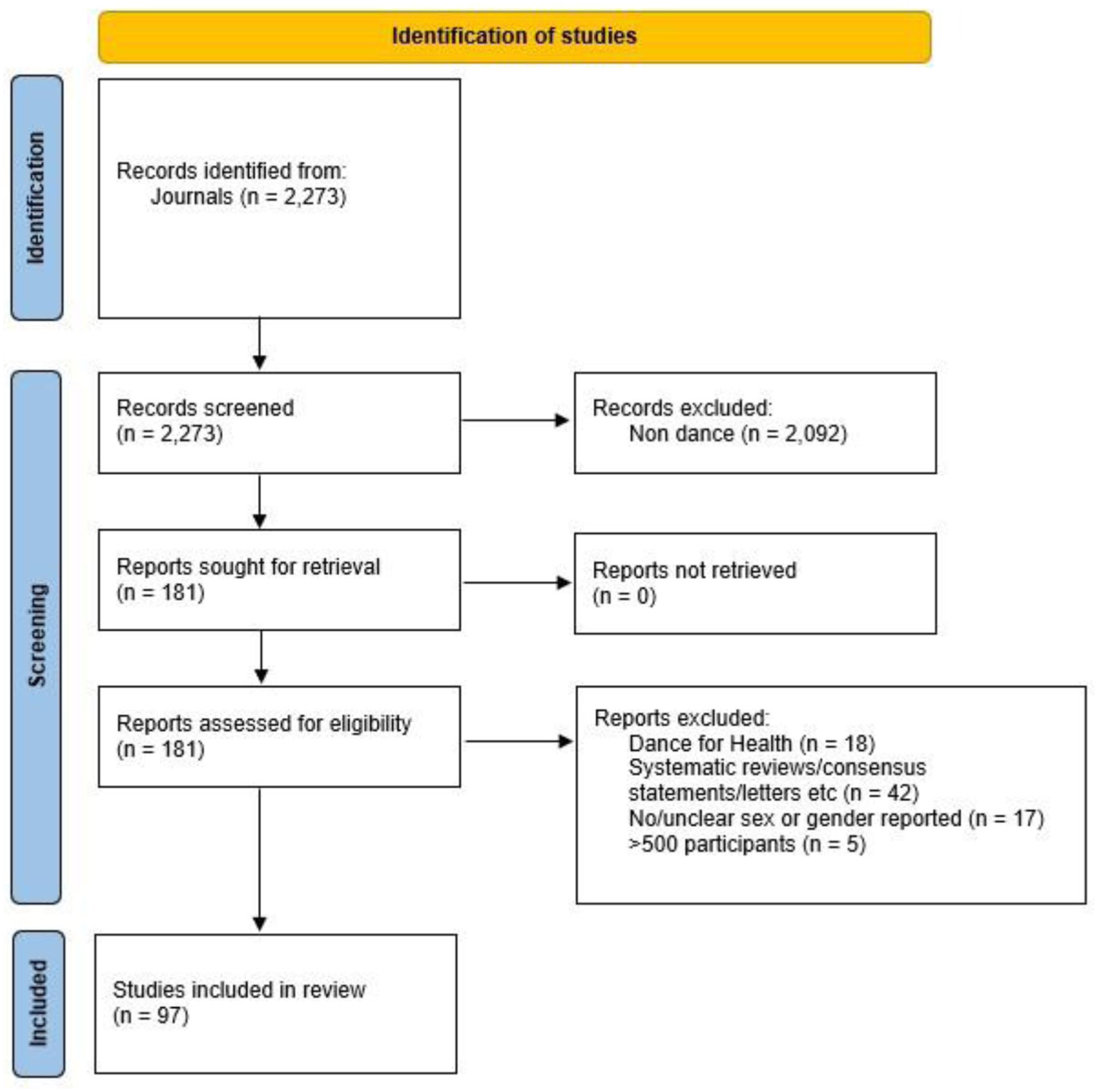
PRISMA flow diagram of the identification, screening and retrieval process.
For sports medicine journals including American Journal of Sport Medicine and British Journal of Sport Medicine, a search was carried out for dance related articles utilising search terms Danc* OR Dancing OR Dance within January 2023 to December 2025 issues and then both abstract and full article visually checked by the researcher for dance participants prior to inclusion. All participants including non-dancers utilised as control groups in these studies were included in the data collection. Non-dancer controls were included as the outcomes of these papers have implications for dance training practices and thus the total participant numbers impact upon these results and recommendations.
Included studies were assessed for total number of participants, proportion of male, female and transgender participants and whether studies were male only, female only or mixed-sex. There are no human participants in this article and informed consent was therefore not required.
Operational Definitions of Sex and Gender
Participant sex or gender was extracted from the studies as stated by the authors, however the majority of papers simply stated male and/or female but did not explicitly state whether this was in relation to gender or sex. Only one paper reported transgender participants. As such, definitive categorisation was not possible and thus data was amalgamated into male, female and transgender which subsequently resulted in a mixture of both sex and gender in the data set.
Statistical Analysis
An unequal expected hypothesis chi-square with weighting derived from journal n contribution and total count of sex identification was used to compare sex and gender counts across all four journals with P ≤ .05 considered as statistically significant. This was followed by Cramer’s V correlation to measure the association and a Pearson residual post hoc test to further understand the contributing factors to any significant differences. Expected cell counts were derived from the observed values based on the null hypothesis that all variables are independent. All statistical analysis was completed in Jamovi. 23
Results
Across all four journals from 2023 to 2025 there were a total of 104 studies with 93 587 participants. Of those 46 895 (50.11%) were female participants, 46 686 (49.89%) were male and six (0.01%) transgender (Table 1). Due to several large-scale sports medicine epidemiology studies in BJSM and AJSM with very small dancer numbers, a secondary analysis was carried out after removing studies with >500 participants which may have skewed the dance medicine and science data. This accounted for five large studies from BJSM and two from AJSM, removing a total of 86 373 participants (41 487 female and 44 886 male). Full journal listings and participant counts can be found in the research data files. Following this analysis there were a total of 97 studies with 7214 participants; 5408 (74.97%) female, 1800 (24.95%) male and six (0.08%) transgender (Table 2). Due to the reporting methods of many of the studies it was not always possible to differentiate between sex or gender in the reported numbers.
Journal Data from 2023 to 2025 for All Studies Investigated.

Abbreviations: JDMS, Journal of Dance Medicine and Science; BJSM, British Journal of Sports Medicine; AJSM, American Journal of Sports Medicine; MPPA, Medical Problems of Performing Artists.
Journal Data from 2023 to 2025 with Removal of Studies with >500 Participants.
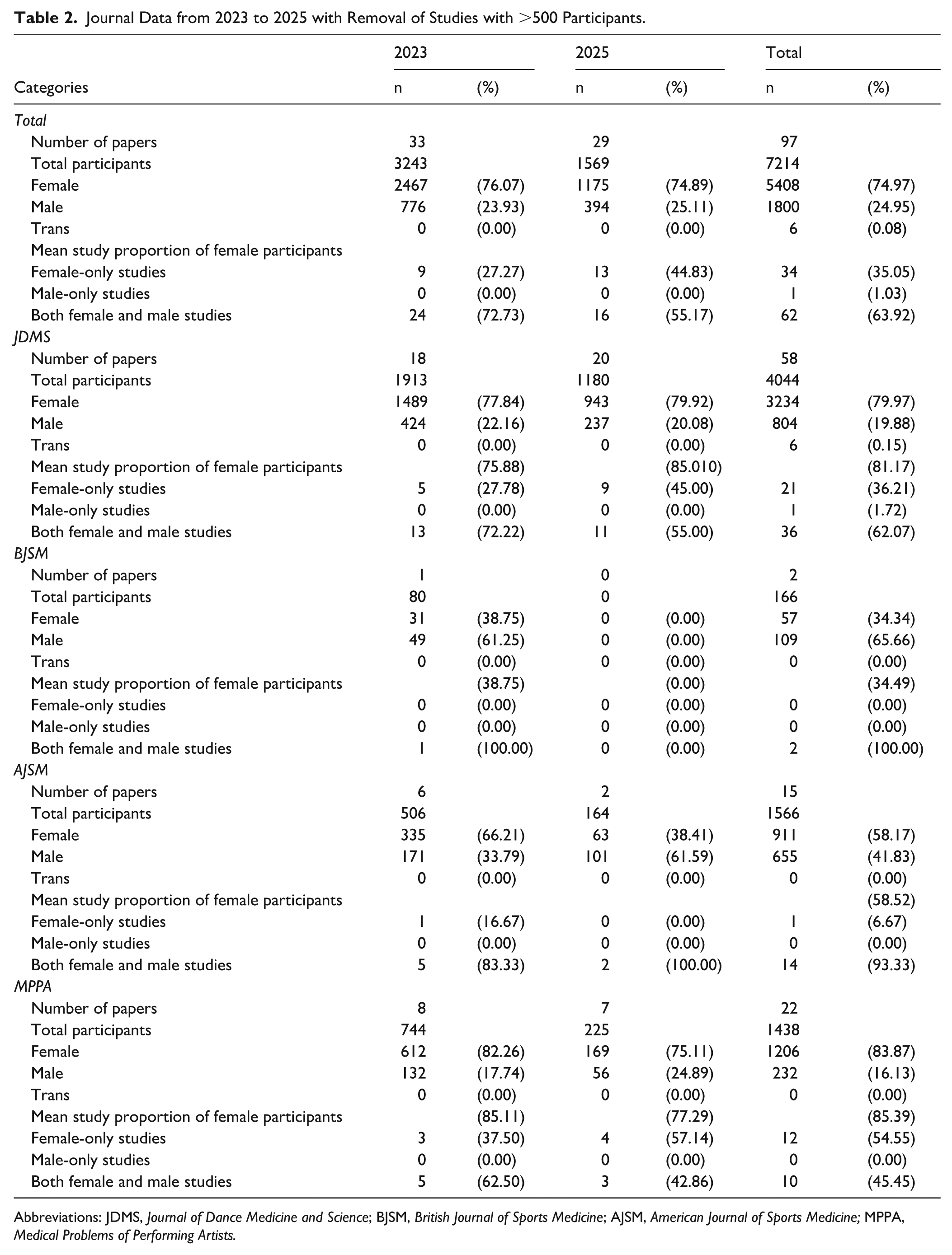
Abbreviations: JDMS, Journal of Dance Medicine and Science; BJSM, British Journal of Sports Medicine; AJSM, American Journal of Sports Medicine; MPPA, Medical Problems of Performing Artists.
Utilising the data from the secondary analysis (Table 2), of the studies included here 34 (35.05%) were female-only studies, 1 (1.03%) was male-only and 62 (63.92%) were mixed studies. JDMS, BJSM, AJSM and MPPA included 36.21%, 0.00%, 6.67% and 54.55% female only studies respectively.
Chi-square results for analysis with all data extracted (Table 1) showed a significant association between sex and journal χ2 (df = 6, N = 93 587) = 2369, P < .001, V = 0.11 indicating a small effect size. Chi squared results based on the secondary analysis showed a significant association between sex and journal χ2 (df = 6, N = 7214), = 504, P < .001, V = 0.19 indicating a small to medium association. Inspection of Pearson residuals indicates that participant sex distributions differed across journals, with sports medicine journals contributing disproportionately to the observed deviation from independence. Contingency tables including expected cell counts are available in the Supplemental Files.
Discussion
To my knowledge this is the first study to investigate the sex and gender distribution and reporting practices of participants in dance medicine and science research. Although Brown-Appenzeller et al 17 looked at authorship gender in dance medicine and science research, and numerous articles have sought to discuss the gender balance in the dance sector in general and within dance leadership, 24 none has investigated the current participant demographic in this domain and whether it is indeed reflective of the dance sector. Therefore, this cross-sectional preliminary study of the available dance medicine and science research data between 2023 and 2025 provides an insight into the current participant data trends and demographic reporting practices.
Whilst the lack of female participants in sports exercise and medicine (SEM) research has been well documented, it appears the opposite is true of dance medicine and science research, with a significant lack of male participants and almost no male-only research. As argued in SEM studies, the research must be reflective of the population of that sector in order to provide evidence-based and appropriate training recommendations. The sports sector has sought to increase female participation and subsequently increase the visibility of female athletes in the research, strengthening sex and gender reporting, and advocating for the use of specific menstrual-status criteria in research design.4,14
Due to lower numbers of male dancers than female dancers across the sector, 26.4% male and 73.6% female in the USA in 2023,18,25 researchers often find difficulty in recruiting enough male participants for statistical analysis, thus some papers stated that the male participants were removed from data analysis due to the low power. 26 This however also means that skills that are often associated with the male dancer such as jumping in ballet, where men have been shown to have a higher rate of jumps than their female counterparts, 27 are carried out on predominantly female participants. 28 These results are then potentially used to inform training across all dancers which may be problematic, particularly in relation to kinetic and kinematic studies due to the known physiological and biomechanical differences in the Q-angle and subsequently lower limb kinematics between males and females 29 that could impact landing mechanics. However, the subject matter and research question of papers in relation to sex or gender was not investigated in depth in this study and therefore requires further examination to understand trends and participant selection.
The analysis presented here explored two sports medicine journals, one journal whose dominant remit is dance medicine and science research and one that incorporates performing arts medicine research. Even with large epidemiological studies removed, the balance of male and female participants was more equal in sports medicine journals, as noted by Ose et al 4 in their recent replication study. The Journal of Dance Medicine and Science saw a greater discrepancy in sex-ratio with 79.9% of participants being female and only 1 male-only study across the 3 years. This male-only study cited higher prevalence of lower back injuries in males than females and a lack of research into men’s perceptions of lower back pain despite equivalent research in female dancers, as the reasoning for their single sex study. 30 Likewise Medical Problems of Performing Artists published articles with a total of 83.87% female participants and no male-only studies. Although these figures represent significant disparity in the balance of male and female participants, it must be noted that very few journal articles specified if they were reporting biological sex or gender, thus this data is subsequently a mixture of gender-based and sex-based data and therefore results must be viewed with caution. Only one paper reported any transgender participants, 31 relating to perceptions of strength training in circus and dance students with strength training spaces often remaining heavily gendered. The subject of inquiry in a research article may sometimes necessitate discussion of the topic in relation to biological sex, and at other times may require discussion of gender, however it must be explicitly clear which is being spoken to. Although this was the only paper to explicitly state transgender participants this does not necessarily mean that they were the only ones that identified as transgender amongst all of the participants studied, but may be as a result of ambiguity in reporting.
The implementation of the SAGER guidelines 14 in scientific journal submission guidelines aims to address these discrepancies in the reporting of participant demographics, avoiding ambiguity in data. Some journals such as BJSM make these requirements explicitly clear in the author submission guidelines, requesting authors to provide an Equality, Diversity and Inclusion (EDI) statement that addresses these points amongst others, and that there is clarity in the study title and demographics to avoid ambiguity and generalisation of results. Other journals including AJSM, MPPA and JDMS adhere to the SAGER guidelines by way of their policies, however this is not made explicitly clear in the submission guidelines for authors and therefore cannot be guaranteed to have been followed unless addressed at peer review stage. These discrepancies can also be seen in the generalised titles of articles that refer to “ballet dancers” or “dancers” when they are specifically investigating only female dancers. This can lead to misrepresentation of results and generalisation of training design and implementation. SAGER guidelines specify that if only one sex or gender is included within a study, that the title and the abstract of this paper must specify the sex or gender of the participants for avoidance of ambiguity, 14 therefore it is recommended that dance medicine and science research adheres more rigorously to these guidelines to provide clarity in study titles. This also addresses the normalisation of dance being a female activity, and as such the presumption that a dance research paper without an explicit title will be focused on females. It instead asks us as researchers to normalise specificity in reporting dance genre and the sex and/or gender of the participants from title through to conclusion.
Notwithstanding this however, it is clear there is a lack of representation of male dancers in the existing dance medicine and science research with only one male-only study across all journals throughout the 3 years examined. Males also accounted for only 24.95% of all participants across this time frame, and thus training recommendations as a result of these studies should be interpreted with caution.
Similar to the efforts in sports to increase female participation, there are many male focused activities to encourage participation in dance with many dance schools hosting male only auditions and workshops. This may begin to address the lack of male participants in dance medicine and science research, but headway must also be made in reporting standards and visibility of male dancers in the research.
Limitations
There are a number of limitations to this preliminary study of participant sex and gender distribution in dance medicine and science research, namely related to the lack of prior reporting guidelines for research relating to sex and gender equity. The majority of papers included in this study did not explicitly state whether they were reporting biological sex, or self-reported gender and thus the data presented here potentially contains a mixture of both. Furthermore, not all participants disclosed sex or gender.
As noted in the methodology, there is currently no “dance science” category in the Thomson Reuters science citation index and only two journals whose specific remit is the field of dance medicine and science. The citation rank therefore utilised in the methodology by Brown-Appenzeller et al 17 included two sports medicine journals in 2nd and 3rd ranking. Subsequently these journals were included in the analysis, albeit with large epidemiological studies removed from the secondary analysis. However, their remit as a sports medicine journal will have an impact upon participant gender distribution as previously outlined by Ose et al 4 and Costello et al. 1 Additionally, journals articles sourced from predominantly sports medicine journals stated that the participants had participated in dance or that dancing was the mechanism for injury, but it wasn’t clear if they were professional dancers, dancers in training or recreational dancers.
Practical and Clinical Applications and Implications
The data presented here provides a preliminary insight into the current sex and gender distribution in dance medicine and science research and current reporting practices. Unclear sex and gender reporting across research causes ambiguity around results making it difficult for this information to be applied into practice effectively. Improved adherence to SAGER guidelines will allow clinicians, healthcare practitioners and coaches to implement guidance from current research with greater confidence.
Although the data available appears to mirror the current gender balance in dance, no conclusive data on the dance population is currently available to fully substantiate this. However, limited data available for male dancers also means that caution should be taken when applying the results of studies to male dancers.
Conclusion
This is the first study to investigate the sex and gender distribution of participants in dance medicine and science research. The preliminary outcomes of the cross-sectional study highlight a discrepancy in the explicit reporting of sex or gender within dance medicine and science research, subsequent relevance of study titles and thus applicability of results, therefore making it difficult to distinguish clear participant sex and gender distribution. It is proposed that dance medicine and science researchers adhere more closely to the SAGER guidelines and that clear and accurate reporting of sex and gender is reviewed in detail during peer review processes, alongside evaluation of the appropriateness of article titles. These guidelines should be made explicitly clear in the submission guidelines rather than hidden within policy documents. Furthermore, it is imperative that male dancers are visible in dance medicine and science research as well as the resulting training recommendations. A greater understanding of the gender balance of the dance workforce in quantified data will enable researchers to ensure that studies are reflective of this specific population. This will help to ensure that training recommendations are appropriate for the populations they are being applied to.
Supplemental Material
sj-xlsx-1-dmj-10.1177_1089313X261442323 – Supplemental material for Sex and Gender Reporting and Participant Distribution in Dance Medicine and Science Research from 2023 to 2025
Supplemental material, sj-xlsx-1-dmj-10.1177_1089313X261442323 for Sex and Gender Reporting and Participant Distribution in Dance Medicine and Science Research from 2023 to 2025 by Claire Farmer in Journal of Dance Medicine & Science
Supplemental Material
sj-xlsx-2-dmj-10.1177_1089313X261442323 – Supplemental material for Sex and Gender Reporting and Participant Distribution in Dance Medicine and Science Research from 2023 to 2025
Supplemental material, sj-xlsx-2-dmj-10.1177_1089313X261442323 for Sex and Gender Reporting and Participant Distribution in Dance Medicine and Science Research from 2023 to 2025 by Claire Farmer in Journal of Dance Medicine & Science
Supplemental Material
sj-xlsx-3-dmj-10.1177_1089313X261442323 – Supplemental material for Sex and Gender Reporting and Participant Distribution in Dance Medicine and Science Research from 2023 to 2025
Supplemental material, sj-xlsx-3-dmj-10.1177_1089313X261442323 for Sex and Gender Reporting and Participant Distribution in Dance Medicine and Science Research from 2023 to 2025 by Claire Farmer in Journal of Dance Medicine & Science
Supplemental Material
sj-xlsx-4-dmj-10.1177_1089313X261442323 – Supplemental material for Sex and Gender Reporting and Participant Distribution in Dance Medicine and Science Research from 2023 to 2025
Supplemental material, sj-xlsx-4-dmj-10.1177_1089313X261442323 for Sex and Gender Reporting and Participant Distribution in Dance Medicine and Science Research from 2023 to 2025 by Claire Farmer in Journal of Dance Medicine & Science
Footnotes

Ethical Considerations
There are no human participants in this article as information was sourced through existing publications and thus ethical approval was not required.
Consent to Participate
There are no human participants in this article as information was sourced through existing publications and thus consent to participate was not required.
Funding
The author received no financial support for the research, authorship, and/or publication of this article.
Declaration of Conflicting Interests
The author declared no potential conflicts of interest with respect to the research, authorship, and/or publication of this article.
Supplemental Material
Supplemental material for this article is available online.
References
Supplementary Material
Please find the following supplemental material available below.
For Open Access articles published under a Creative Commons License, all supplemental material carries the same license as the article it is associated with.
For non-Open Access articles published, all supplemental material carries a non-exclusive license, and permission requests for re-use of supplemental material or any part of supplemental material shall be sent directly to the copyright owner as specified in the copyright notice associated with the article.
