



Abstract
Introduction:
Research postulates that dance has the potential to encourage individual expression, develop interpersonal skills and reduce avoidance behaviours in autistic children. This study aimed to investigate the impact of South Asian Dance on engagement, independent movement and social skills in this population.
Methods:
Fifteen autistic children (8.14 ± 1.14 years) from a special educational needs and disabilities school in London, UK, their parents and teachers participated in this collaborative, mixed methods study. Children participated in weekly dance classes throughout spring and summer terms. Data was collected via the Strengths and Difficulties Questionnaire for parents and teachers and observational notes from dance artists.
Findings:
Content analysis of observational notes suggested an improvement in focus and engagement for most learners alongside improvements in range of motion, independent movement and reduction of avoidance behaviours. SDQ results were similar to previous studies in autistic children and higher than general population normative data, particularly in hyperactivity and peer problems.
Conclusions:
Due to the heterogeneity of results and children’s experiences within the dance activity, broad assumptions about impact are difficult. Individual improvements were noted for many learners in engagement, independent movement, range of motion and co-ordination as well as a reduction in avoidance behaviours. This study adds to developing research into dance for autistic children, providing a unique focus on South Asian Dance forms which may provide a wealth of new creative movement vocabulary for teachers and parents.
Keywords
Key Points
A person-centred approach that considers individual contextual factors can help to better understand the potential impact of dance for autistic children.
Weekly dance classes influenced by South Asian dance forms helped to improve engagement, independent movement, and movement capabilities for many learners as perceived by the artist teaching the sessions.
Involvement of key stakeholders including teachers, parents and dance artists can help design dance programmes that have a wider ranging impact into the child’s life beyond the dance class.
Introduction
Autism spectrum disorder (ASD) can be classified as a neurodevelopmental condition that can impact upon a child’s cognitive, social and adaptive skills.1,2 Currently the National Autistic Society suggests that there are approximately 700 000 autistic adults and children in the UK, 3 equating to more than one in 100 people living with the condition which can include compulsions, echolalia, motor stereotypes, comorbid psychiatric disorders and difficulties with social and emotional behaviour including empathy, social understanding, aggression and non-compliance. 4 It has also been suggested that perceptions of pain or the ability to communicate pain is also reduced or not taken seriously, and thus the physical health needs of neurodivergent young people may be overlooked. 5
ASD is a condition with unique strengths and challenges and those diagnosed with it may face reduced wellbeing due to difficulties with social interactions and communication. 6 Recent research has focused on social cognition and the importance of experiential knowledge in order to develop interpersonal interactions. 7
Multiple studies have evidenced the benefit of complementary therapies and interventions for children with ASD including speech-language therapy, occupational therapy, behavioural therapy, and psychosocial therapy. However, the cost of such interventions from an early age is often extremely expensive for families as they require highly trained specialists and one-to-one support.4,8 Furthermore, empirical results from these types of interventions have varying degrees of support. 2 The impact of ASD can be felt throughout the family as caring for a child with the condition can be challenging and time-consuming. As a result, parents often seek additional support through external interventions to support their children. 6
There is a need to look at other more cost-effective therapies to help individuals with ASD cope better with their symptoms. Modes of exercise including arts-based activities such as dance could be a useful tool in helping to manage symptoms and improve social interactions and communication, but in a cost-effective way with minimal or no equipment needed.
Physical activity (PA) has been suggested as an appropriate therapeutic activity for autistic children with studies demonstrating how physical exertion can lead to reduced problematic behaviours and increased appropriate behaviour, as well improvements in locomotor skills, muscular strength and endurance. 2 A systematic review 4 evidenced how exercise appears to benefit children with ASD by reducing stereotypic behaviours and improving social-emotional functioning while also referencing research that demonstrates activities such as jogging may be useful for cognition and attention. 9 However, the authors 4 point to some key methodological challenges in the field including a large variability in the types of interventions as well as the frequency, duration, intensity, and dosage, therefore making it difficult to fully understand the varying benefits of exercise and PA for autistic children. In addition, there has been much discussion as to the benefits and drawbacks of group-based interventions versus individual based activities. 2 Although counterintuitive, greater improvements were seen in social behaviours when children experienced individual-based interventions, perhaps due to a reduction in unpredictable events by others, which may induce feelings of stress. 2
In addition to the benefits of PA including reduced risk of obesity and reduction of maladaptive behaviours, improvements to motor skills have been positively linked with social skills. 2 Dance incorporates fine motor skills, particularly when focusing on mudras (hand gestures) in South Asian Dance. It could therefore be posited that the combination of PA and fine motor control seen in dance interventions, may foster benefits in social skills, reduction of stereotypical behaviours as well as improvements to physical health and wellbeing.
Over the past 20 years, research has seen an interest in dance as a complementary therapy for autistic children. Whilst most interventions seek to imbue socially acceptable norms and modes of communication on the children or focus on problems rather than enhancing their strengths, 6 dance by its nature encourages individual expression through bodily movement and thus may provide autistic children with another avenue to communicate and develop interpersonal skills. 10 A systematic review by DeJesus et al 1 found dance to have a positive effect on ASD symptoms including social involvement, body awareness, communication and behaviour, however with fewer studies focusing on dance in comparison to other forms of PA such as martial arts, further research is required. 2
Several studies and systematic reviews have been conducted over the past decade looking at how dance therapy, or Dance Movement Psychotherapy (DMP) as it is known in the UK, may be of benefit to autistic individuals.1,11-13 These studies have found dance therapy can improve “negative symptoms, social interaction, and empathy of individuals with ASD” (p. 2). 8 However, in connection to limitations discussed above regarding exercise interventions, research has noted similar methodological challenges with a large variability in frequency and duration of classes as well as a wide range of different measurements and scales being used to assess variables.
Whilst the benefits of mirroring and other DMP techniques that emphasise kinaesthetic empathy have been stated as beneficial, the value of these techniques has been largely anecdotal. 6 Additionally, although DMP has been the main focal point for many studies in the field looking at dance for autism, there has been a lack of research focusing on dance as an artistic, and joyous practice for this group of people. Recent literature has clearly distinguished between DMP and Dance for Health (DfH) contexts with the latter defined as providing a “holistic, evidence-based activity for the individual to manage and adapt to physical, mental, and social health changes. In DfH sessions, trained teaching artists engage people as dancers, rather than patients, in joyful, interactive, artistic practice”. 14 There is a need to look more broadly at how different cultural and community dance practices can potentially benefit autistic children and help improve quality of life.
The aim of this research was to understand the potential impact of dance and movement classes influenced by South Asian Dance forms including Kathak, Bharatanatyam, Odissi and Bollywood for autistic children. The research focused specifically on the impact of these dance forms in relation to engagement, independent movement (ability to carry out actions without the need for physical assistance to move the body), and social skills. As far as the authors are aware this is the first research to investigate these specific dance genres in relation to Autism. Furthermore, the article advocates for a collaborative research design that focuses on the individual and their experiences and progressions within the dance setting.
Methods
Research Design
This study employed an arts-based and mixed methods approach with some of the research team embedded within the dancing sessions (teachers and dance artists), gaining rich information about participant experience, as is often seen in arts-based research approaches. 15 A co-created approach was taken, involving all stakeholders including teachers, parents and dance artists in the design and delivery of the project. Recent DfH research has advocated for collaborative approaches whereby dance artists, researchers, and if possible, participants are included in the development of the design as well as the research questions.16,17 This collaborative research can ensure that the work is both meaningful and relevant to those participating in the dancing as well as others who are invested in the work. An important methodological consideration for this research was to take a person-centred approach to understanding individual progressions and from this, look for trends in the data based on those unique, individual journeys. Research team training and meetings were established with dance artists and dance organisation staff ahead of the research design. Here dance artists shared their own practice and how they currently worked with the children in the schools to collaboratively establish a way that research could be conducted that would not interfere with the children’s experience of the dance activity. The team also discussed and agreed upon desired outcomes of the dance classes and areas of interest such as co-ordination and communication. Alongside this the research team met with parents and teachers at the school to understand what information would be useful to parents and how the research might inform activities and behaviours they experience with their child at home. Discussions with parents centred around the importance of a two-way dialogue rather than the research being placed upon their child. This not only aided buy-in to the research but ensured that it centred the child and their family in the research. Only once these meetings had taken place were research aims established and shared, however the research remained iterative in nature to ensure any rich learnings were not lost. The dance artists formed part of the research team and in order to avoid too much impact upon the participants, they collected field observations, thus avoiding the introduction of too many new people into the children’s dance space. The project took a reflexive approach via a continual dialogue between the lead researchers and dance artists throughout, ensuring the project was able to adapt according to the team’s feedback and the experiences of the participants.
A pilot study was completed in 2023 that trialled some methodologies for data collection. Utilising feedback from the dance artists and teachers these were then amended and honed to the final methodology outlined below.
Participants
Seventeen children were recruited from a special educational needs and disabilities (SEND) school in London, UK. To recruit children for the study, parental consent was required and therefore there was a need to initially engage with the parents to garner interest. Coffee mornings were set up at the school to allow time for the researchers to meet parents, discuss the research aims and objectives, and answer any questions before signing up to the research.
One child left the school during data collection, and one had no data collected for them, leaving fifteen learners for data analysis. These learners were aged 8.14 ± 1.14 years in January 2024. Data collection took place across spring (January-April 2024) and summer (April-July 2024) terms. Participants had been taking part in the dance classes prior to data collection and were therefore already familiar with some of the dance activities. All data was gathered through a wider team of individuals already close to the learners including staff, parents, and the dance artist. Participant information sheets were provided to parents via email and at coffee mornings where the study was also verbally explained. A short video was also sent to parents/guardians explaining the nature of the research alongside the written information if they could not attend an in-person coffee morning. Parents/guardians were encouraged to go through this information with their child in a way that best suited their ability and understanding and then parents/guardians completed a consent form on behalf of the child. Teachers completed an informed consent form as part of their first online questionnaire response. Ethical approval was granted by Middlesex University Arts and Creative Industries ethics committee (Approval Number 21934) on November 29, 2022.
Dance Intervention
The participants took part in weekly dance classes throughout the spring and summer 2024 school terms. The sessions were approximately 10 to 15 minutes in length with some dancing in small groups of 2 to 4 learners and others working 1:1 dependent on their needs. These classes were informed by practices including Kathak, Bharatanatyam, Bollywood, Odissi and Yoga, incorporating rhythm, fine motor skills via mudras (hand gestures), and communication of emotions through abhinaya (facial expressions). The sessions often included warm up exercises that focused on mobilising the joints, rhythm work, and coordination of arms and legs. The activity progressed to movements that encourage use of space as well as changing of speed and directions and generally the sessions incorporated some partner work where the learners danced with either the dance artist or a supporting staff member.
Strengths and Difficulties Questionnaire
Teachers and parents completed the Strengths and Difficulties Questionnaire (SDQ) 18 (T4-17 and P4-17) at the beginning of the spring term (January 2024), and again (T4-17 FOLLOWUP and P4-17 FOLLOWUP) at the end of summer term (July 2024). Questionnaires were administered online via survey monkey and emails were sent directly by the researchers to all parents and teachers with the relevant links. Follow up emails were sent to all parents and teachers to encourage completion of the questionnaire. SDQ is a widely used screening tool that aims to measure psychosocial problems and strengths in children and youths through a multi-informant approach. 19 The questionnaire consists of 25 items divided into five subscales; emotional symptoms, conduct problems, hyperactivity/inattention, peer relationship problems and prosocial behaviour.18,19 Participants scored statements such as “Easily distracted, concentration wanders”, “Rather solitary, tends to play alone”, “Often has temper tantrums or hot tempers” on a scale of Not True, Somewhat True or Certainly True. This was scored on a scale of 0 to 2, with scores for some statements such as “Thinks things out before acting” reversed giving each subscale a total potential score of 10. Higher scores indicate higher levels of psychopathology (with the exception of the prosocial behaviour scale). A total difficulties score was calculated by summing all subscales except the prosocial score to give a score out of 40.
Artist Logs
Recent literature has argued for the inclusion of tacit, embodied knowledge in DfH research design and methodology noting that those who are embedded within the practice, dancing alongside research participants, are gaining rich, contextual information that is not gained through other objective means. 17 In the present study, the dance artist leading the sessions had an embodied understanding of the learners in the dance context and therefore brought to the study a rich knowledge and insight into their individual progressions. As a result, the dance artist working with the learners completed an online log at the end of each day at the school via survey monkey. They were provided with specific prompts (listed below) and free text boxes to complete these reflections:
How engaged was the learner in today’s session (eye contact, focus).
Did the learner require physical contact in order to engage in the dance activity?
Experiences of note (open question allowing artist to expand on individual observations and progressions).
The specific focus of the first two prompts were developed through pilot research and watching early video footage of the dance classes. Many of the learners struggled with engagement and tended to become distracted or demonstrate avoidance behaviours such as running around the space, climbing on furniture or falling to the ground. Additionally, some learners would, at times, sit in stillness and not move their body even when verbally instructed to move, requiring physical support and guidance through the movement. As such, it was important that the dance artist provided feedback on these aspects and whether or not assistance was required to engage or physically move each learner.
Analysis
A combination of inductive and deductive forms of content analysis were utilised as a means to systematically draw out overarching patterns in the artist feedback. An initial thorough review of the feedback took place and key words were pulled out from the text. All text was then coded based on these key words and common patterns were drawn from the coded text that were discussed and reviewed between the researchers.
The strengths and difficulties questionnaire (SDQ) was analysed through descriptive statistics in relation to UK normative data. 20 Due to the heterogeneity of the participants and lack of complete data sets per participant, statistical analysis was not appropriate for this data set.
Results
Response rates to the strengths and difficulties questionnaire were higher amongst teachers with 75% (N = 12) for January and 94% (N = 15) in July, compared with parent response rates of 50% (N = 8) for January and 13% (N = 2) for July. In January, 31% (N = 5) were completed by both parent and teacher, and 13% (N = 2) in July. This lower response rate from parents compared with teachers reflects earlier research by Salomone et al 21 who recorded a 48.6% response rate for teachers, 6.8% for parents and 44.6% for both, albeit with a much greater overall sample size of 615 participants. Both teachers and parents received reminder prompts to complete the surveys, with teachers also receiving additional prompts from the assistant headteacher which may have resulted in the higher adherence.
The SDQ can be further broken down into subscales of emotional symptoms, conduct problems, hyperactivity/inattention, peer relationship problems and prosocial behaviour. Table 1 displays descriptive statistics for these subscales. The greatest scores in the present study occurred under the hyperactivity and peer problems subcategories, however scores were consistently greater than UK population normative data 20 and in line with measures amongst other autistic young people in the Pan London Autism Schools Network (PLASN) study. 21
Descriptive Statistics for Strengths and Difficulties Questionnaire Subscales.
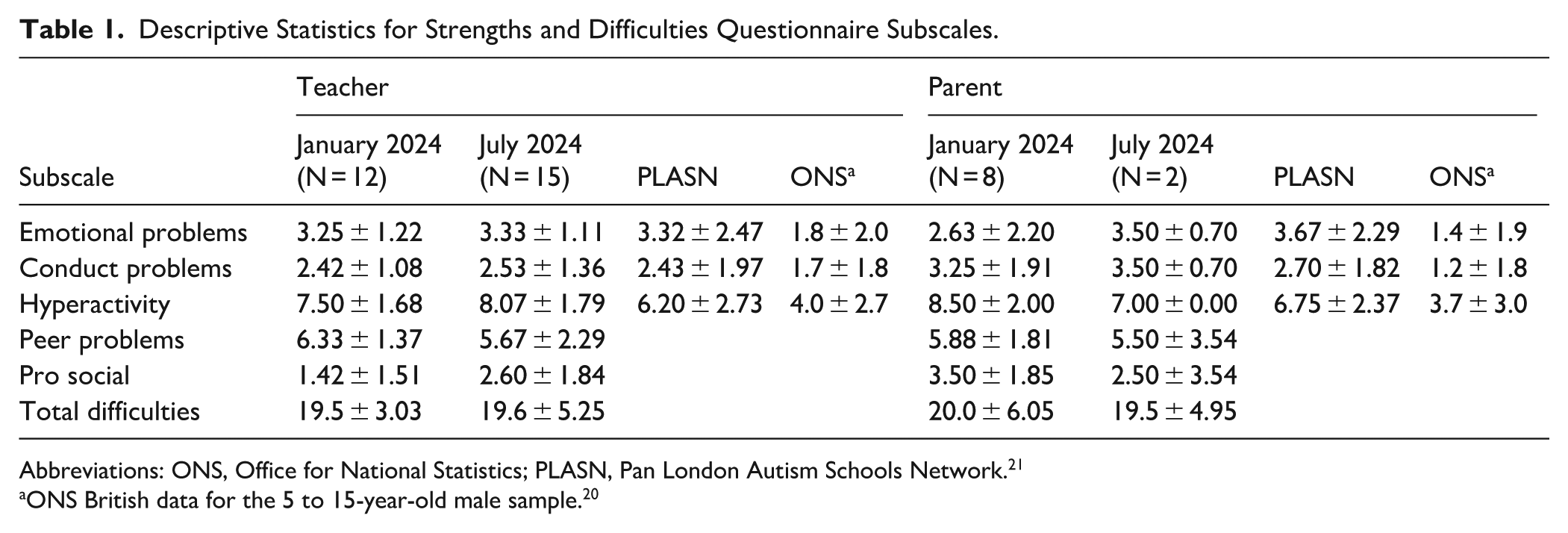
Abbreviations: ONS, Office for National Statistics; PLASN, Pan London Autism Schools Network. 21
ONS British data for the 5 to 15-year-old male sample. 20
Dance Artist Reflective Logs and Content Analysis
The dance artist working within the school provided detailed and regular logs with complete adherence throughout the academic year. This provided a rich overview of the young people’s experience of their dance classes. The below points outline the key patterns that emerged through the content analysis:
Engagement and focus improved but fluctuated for many learners and were dependent upon other personal and environmental contextual factors (emotions, avoidance behaviours, other peers, different dance spaces, noise level).
Engagement and focus improved when the dance artist remained flexible in approach and adapted to the individual learner (reducing volume of music, moving from group to 1:1 lessons, moving at a faster pace with quick changes or moving and speaking more calmly to match the learners needs).
Independency in movement improved for many and this led to a wider movement vocabulary with learners being able to attempt and demonstrate many different actions without the need for physical support.
Many participants improved in their ability to fully and accurately demonstrate the movements. Bilateral Coordination improved for some learners however this only happened when engagement and focus were consistently good.
Some learners experienced reduced levels of avoidance behaviours during the dance sessions (less running around, trying to escape the room, climbing on furniture, or picking up unrelated objects).
Partner work appeared to help improve levels of engagement for many learners. Some became more confident, leading partnered movement, and were more willingly dancing with other support staff or the dance artist.
Figure 1 provides further clarification regarding exactly how many learners saw improvements in specific coded areas based on the artist feedback.
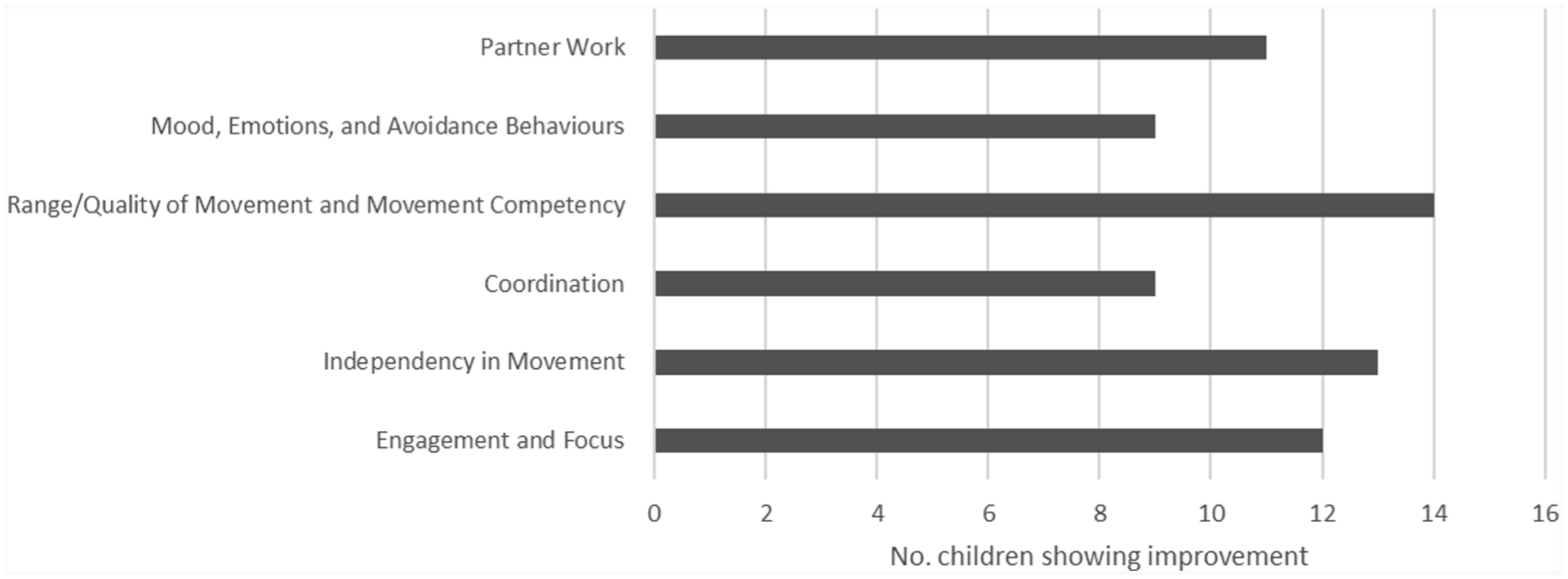
Overview of improvements in coded areas.
Improvements in range/quality of movement and movement competency from the majority (14) of learners can be seen with many learners demonstrating improved range of motion in the dance specific movements included in the sessions that encourage overhead reaching and full extension of the limbs. Many of the learners (12) also saw improvements in engagement and focus as well as in their independence in movement (13).
Analysis demonstrated that approximately half of the learners saw improvements in their bilateral coordination. However, developments in coordination as well as improvements in movement competency were reliant upon good levels of engagement and focus.
Notes from the dance artist demonstrated how partner work often helped learners to engage better with the dance material and further helped learners to develop movement confidence as they would sometimes lead the partnered movement or begin to partner with other people, such as different members of staff or the dance artist. Furthermore, some learners became better able to verbally and physically remember and demonstrate movements that they enjoyed doing without the need for prompting.
Adherence to completing the logs was 100%, with the dance artist able to provide detailed and consistent feedback for the learners across these two terms of dancing. It is thought that a combination of frequent communication between the researchers, host institution and the dance artist encouraged the strong adherence, however it is also due to circumstance and the space and time that the artist had to give to the project during those months. The ability of the artist to continue providing such rich and detailed data across a longer time period is a consideration for further longitudinal work.
Discussion
Dance provides a combination of movement and music, aiding children with rhythmic motor coordination, social interaction, acoustic stimulation, balance and memory, affection and emotions. 22 It has also been suggested that improvements in motor control are linked with improved social skills and reduction of stereotypical behaviours. 2 The results to date from this preliminary study indicate that dancing led to individual improvements in co-ordination, range of motion, independence of movement, focus and engagement. However, due to the nature of this study and the inability to control multiple variables in their school environment, causality cannot be confirmed in relation to the dance activity.
Research has noted motor impairments in autistic children with substantial deficits in basic motor control skills including poor postural control, difficulty with bilateral co-ordination, object control, and visuo-motor integration skills. 23 Therefore, a focus on the development of these motor skills can have significant impact on the child’s quality of life. The biggest perceived improvements in dance class as noted by the dance artist were observed in range of motion and movement competency. Difficulties with utilising full range of motion, particularly in relation to elbow extension and shoulder flexion, were noted by the dance artist and thus incorporated into the class objectives. Improving range of motion can have significant real-life application in relation to activities that can be challenging for autistic children such as toileting and maintaining personal hygiene, as well as reaching objects at a height such as a high shelf or cupboard. 24
Regarding independent movement, as the dance artist encouraged the learners to expand their movement vocabulary and push beyond what they are normally asked to do in their everyday lives, they appeared to be growing more aware of their physical capability and were better able to accomplish these movements independently without as much need for physical support. Franciane dos Santos Silveira et al 25 reiterate the importance of interventions that focus on the achievement of functional independence and quality of life improvement noting that clinical features of autism can increase the level of functional dependence requiring “greater demand for parental care and professional interventions” (p. 284). 25
Physical activity has been shown to improve cognition skills in pre-school children, particularly in relation to attention, memory and behaviour 26 with improvements in motor skills also positively linked with social skills. 2 Over the course of the study, reductions in avoidance behaviour can be seen in the children, as well as greater focus and engagement in the dance activity. However, focus often fluctuated week on week for learners depending on their general mood and emotions on that day as well as other contextual factors such as the environment, objects/furniture in the surrounding space, noise level and distraction from other learners. The dance artist continually made adjustments and used tools to help guide engagement and focus back into the space during times of distraction. For instance, when learners were sensitive to noise, the dance artist would reduce the music volume and adjust her voice to encourage a calm space. Furthermore, when the artist sensed that the learner(s) needed to continually move around the room to remain engaged, she would adjust the material accordingly to match what the learner needed, sometimes even moving to the floor if the learner was falling to the ground. The ability of the artist to remain flexible and adapt in the moment resulted in gradual diminishing of avoidance behaviours and greater engagement and focus across time, again highlighting the importance of individualised and responsive classes. Furthermore, the children attended dance classes either individually or as a group activity, and this was adapted depending on the dance artist’s observations of their progress. In some instances, a child became distracted or distressed by other learners in the room and was therefore moved to a 1:1 class to enable better engagement and reduce emotional distress. As noted by Sefen et al, 2 learning in a 1:1 environment actually helped to improve social skills, perhaps due to decreased stress levels in relation to other learners. It is therefore important that dance interventions are adapted to the needs of the individual.
If the learners were not engaging well or demonstrated avoidance behaviours such as trying to run around the room, pick up objects, or leave the room, they were not as likely to develop aspects such as coordination, quality and range of movement or movement competency. This suggests a developmental approach to dance or exercise activities for autistic children, with a focus on engagement and focus in the preliminary stages, moving to rhythm and coordination at later stages.
A multi-informant approach to the use of the SDQ has been recommended, most commonly including teachers and parents, providing an overview of psychometric properties, however interpretation of the subscale values should be treated with caution as they have demonstrated weaker reliability and validity. 19 The results of the SDQ reflect the findings of Salomone et al 21 who focused on the subcategories of emotional problems, conduct problems and hyperactivity and found both parent and teacher results to be higher than the UK wide population survey. The results of these subscales can also be categorised into a three-band categorisation of “Normal”, “Borderline” and “abnormal” with the latter being defined as the top 10% of a UK based population survey. 20 In addition to the similarities with Salomone et al 21 our results showed parent and teacher scores for the subcategories of peer problems and pro-social fall into the abnormal score.
Although the results of the SDQ substantiate the need for further support for these learners due to these higher scores, the results of the strengths and difficulties questionnaire do not provide enough detail of the individualised journey of each learner. As is apparent from the heterogeneity of these results, progress was not always linear for these learners. Examining the mean of a group of autistic learners masks the fluctuations in these subcategories for individuals across time, however does provide an opportunity to compare these results with previous studies in autistic populations and UK wide population data. It was hoped that gathering perceptions of the children’s strengths and difficulties from parents and teachers across time would demonstrate adaptations to certain behaviours as a result of the dancing, however it is clear from the results that these alterations may currently be short-term as the dancing is integrated into their school life and as such results may fluctuate across time. Despite apparent differences in perceptions between parents and teachers, these findings are common amongst previous SDQ studies19,21 and underline the importance of garnering these measures from various individuals involved in different areas of the child’s life. These results may also be impacted by current circumstances for the individual such as the learning environment, family or changes to medication which are not apparent through these results. For example, one learner changed medication mid-term which impacted upon their focus and levels of hyperactivity whilst they became accustomed to their medication. It was however not within the scope of this study to gather data relating to individualised medication plans. Small sample sizes due to response rate also render statistical analysis difficult due to low power and therefore providing any meaningful statistical analysis. It may be that greater longitudinal data is required to see change over time in relation to behaviours in this population.
However, individualised, qualitative analysis of an autistic child’s journey is imperative for designing interventions and learning strategies that seek to develop the child’s pre-curriculum behaviour, engagement and social skills, and centre the child’s needs and experiences. Although perceived as “gold-standard”, it should be acknowledged that randomised control trials, particularly those that move autistic children to unfamiliar settings for analysis, may not be appropriate for this population, nor truly represent the autistic children’s experience due to the alteration to their familiar daily structure and amalgamation of results in a heterogeneous population. Here we advocate for detailed case studies that investigate on a more granular level, the arts activities and learning environments that allow autistic children to thrive.
Methodological Challenges
The nature of this research posed some methodological challenges, laying research into an existing learning environment with an attempt to avoid the research from impacting on the dance activity and thus the learners’ experience of dancing. As the learners had been dancing prior to the start of data collection it is therefore possible that the notable change happened mainly in the term before data collection when the dance artist first started working with the learners. As a result, we may have not captured some useful change and benefit that took place earlier in their dancing journeys.
The SDQ requests the respondent to complete the survey reflecting on the previous 6 months in the first instance, and over the previous month in the follow-up questionnaire. However, responses were submitted across multiple weeks from both teachers and parents due to busy schedules, and there were many incomplete or non-submissions, particularly from the parents. While the researchers were able to connect directly with the parents via email to ask for their support in completing the questionnaires, it could be that these emails were one of many coming from the school and therefore were ‘lost in the mix’. Furthermore, busy schedules and family life are considerations for future research that wishes to rely on parent involvement for data collection purposes. Teachers on the other hand also received prompts from the assistant headteacher and may have therefore felt more of a duty to complete the survey as part of their job role. Additionally, teachers initially attempted to reflect only on the learner’s dance class despite not being present, rather than their behaviour more widely across the school day. Emails were subsequently sent to teachers to remind them that the aim was to reflect on the learners in the school setting outside of the dance class.
Conclusions
Due to the nature of this research within an existing educational environment and fluctuations in participant circumstances and behaviour, this research took an iterative approach to research design. Perceived improvements have been noted in coordination of arms and legs (homolateral and contralateral movement), range of movement vocabulary, movement quality and competency, extension of limbs and independence in movement. Many of these movements are also linked to daily activities that the children may struggle with such as toileting, twisting, reaching to pick things up. These are important considerations when designing a movement-based intervention for autistic children, as well as the ability to adapt each class to the individual’s needs.
Results of the SDQ indicate similar levels of difficulties in relation to areas such as hyperactivity, peer problems and emotion problems, but also reveal significant variance in results that may mask fluctuations in the child’s development. These results highlight the non-linear progress of autistic children, rendering measurement of improvement difficult over short time periods.
Implications
As autism and the dance classes are experienced differently by each individual, generalising findings through statistical methods would not be appropriate. Instead, each learner needs to be considered at an individual level to ascertain the impact and potential benefits of participating in a dance-based intervention. As such, broad statements pertaining to the outcomes of an intervention must be considered with caution when viewing results across literature in this field.
Further research with this group of participants will focus on the generalisation of these skills developed within the dance class into other real-world settings including curriculum classes and home life. It is recommended that future research further investigate the individualised nature of autistic learners’ experience of dancing in relation to their own unique diagnosis as well as developing longitudinal data that provides a clearer picture of progressions and regressions of these learners over time. This in turn can lead to child specific interventions to elicit the most beneficial results for that child.
Footnotes
Acknowledgements
We would like to thank Georgia Cornwell (dance artist) for her invaluable work during this project, and to the school staff for supporting the project, particularly the Assistant Headteacher for his work implementing the research.

Ethical Considerations
Ethical approval was granted by Middlesex University Arts and Creative Industries ethics committee (Approval Number 21934) on November 29, 2022.
Funding
The authors disclosed receipt of the following financial support for the research, authorship, and/or publication of this article: This work was supported by the Paul Hamlyn Foundation (Grant Number 22584/37870).
Declaration of Conflicting Interests
The authors declared the following potential conflicts of interest with respect to the research, authorship, and/or publication of this article: This research is funded by the Paul Hamlyn Foundation and both researchers have received payment from this grant via Akademi South Asian Dance for their work on the project.