




Abstract
Key Points
A pilot 6-week MAC program was delivered to examine the efficacy of a mindfulness intervention between a treatment and control group of professional ballet dancers.
No group differences were found on quantitative mindfulness measures. However, interview data supports mindfulness techniques to be integrated into ballet programs because dancers stated they value mindfulness training and practice.
It is recommended that a full-powered RCT is conducted to further evaluate the impact of mindfulness on professional ballet dancers.
Introduction
To enhance physiological and psychological performance readiness and recovery, psychological skills training (PST) techniques have been previously adopted in dance 1 and sport, 2 including goal setting, mental rehearsal, arousal control, self-talk, and precompetitive routines. 3 To potentially influence physiological and psychological states on a continuum of athletic functioning, mindfulness approaches have gained traction.3 -10 The primary focus of Mindfulness-Acceptance-Commitment (MAC) intervention models is to stimulate a modified relationship with internal states (such as cognitions, emotions, and physiological events), in contrast to most forms of PST interventions that directly aim to change dysfunctional thoughts and emotions. 11
Studies evaluating the efficacy of MAC intervention have reported symptom improvements in conditions such as anxiety and depression12 -14 and effectiveness in symptom reduction and improved emotional functioning for chronic pain.13,15 In sport specifically, MAC protocols have demonstrated reductions in negative psychological symptoms, emotional distress and improved sport performance,16,17 decreased rumination and increased self-regulation leading to better coping capacity, 17 reduced experiences of burnout, 18 and decreased injury risk. 19
For enhancing performance and psychological well-being in athletes, a theoretical and empirically supported acceptance-based behavioral intervention was developed: Mindfulness-Acceptance-Commitment. MAC encompasses a number of techniques and experiential exercises to assist athletes to develop a willingness to engage in behaviors consistent with their personal values and is the most prevalent acceptance-based approach adopted in sport.4,6 -8,20 When displaying a high level of mindfulness, athletes are theorized to be able to redirect their focus of attention toward thoughts and behaviors that benefit performance by acknowledging and accepting the presence of external stimuli, bodily sensations, emotional reactions, and cognitions, without overreacting to them.6,7 Evaluations by soccer players who completed MAC training showed that 76% of the players had started to think more about their abilities to select what behaviors they should perform to achieve their goals (eg, to perform well in soccer). 21 Furthermore, the same players recorded that they had learned how to relax and had increased their abilities by 81% to focus during longer periods than they did before the MAC program. These responses add further insight into the potential benefits and application of MAC for ongoing research and implementation with athletes to potentially enhance well-being and performance.
In dance, a 9-week mindfulness-meditation acceptance-based program was delivered to all students undertaking full-time University dance training (N = 106), with an aim to assist students in the further development of performance psychology skills. 9 An upward trend in levels of mindfulness awareness was identified; however, the results were not significant. Qualitative feedback indicated that participation in the mindfulness program and the development of the associated mental skills resulted in positive performance and personal outcomes. 9 Moyle 9 contended that further mindfulness and dance research is required to identify benefits for both performance enhancement and general health and well-being for dancers, and to assist in expanding the literature in performance settings. This research has been presented at a conference and published as a book chapter, 9 yet no results have been published as a peer reviewed paper. To the best of our knowledge, literature examining the effectiveness of a mindfulness intervention in dance and professional ballet has not been published and warrants exploration.
Dancers are taught to increase awareness of proprioceptive sensations from muscles, balance, and posture to guide and coordinate complex movements. However, it appears that awareness, acknowledgement and acceptance of psychological health, and holistic well-being is less familiar to dancers. 22 To further enhance awareness of holistic well-being and acceptance of wellness states, it was recommended that strategies such as mindfulness be trialled in professional ballet. 22 The current study explored the effects of a mindfulness intervention with a MAC group and a control group (who were provided with education sessions only). The aim of this study was to investigate the effectiveness of the MAC 6 approach. This was achieved by measuring awareness, non-judgement, refocusing, and action and acceptance measurements pre-and-post intervention. In addition, interviews were undertaken to gain further depth and insight into the dancers’ experiences.
Method
Participants
Sixteen professional ballet dancers (14 women and 2 men), employed at a national ballet company, volunteered for the study. Participants were aged between 19 and 35 years (M = 25 years, SD = 4.88), and their number of years of experience as a professional ballet dancer ranged from 1 to 16 years (M = 6.87, SD = 4.75 years). Ranks in the company included Principal Artist (1), Senior Artist (1), Soloist (4), Coryphee (3), and Corps De Ballet (7). Participants were excluded from the study if they had participated in a mindfulness program in the last 12 months, such as yoga or on a smart phone app, to ensure that a dancer had not received any form of recent mindfulness training.
Procedure
Ethics approval was granted by the University Human Ethics Committee (ID number HEC19093) which required the research team to inform participants (via a Participant Information Statement) that their identity and data remained confidential and anonymous. The project was registered via the Australian and New Zealand Clinical Trials Registry (Universal trial number: U1111-1231-8905).
Participants provided written consent and were randomly allocated using randomization software to one of two groups: (1) Intervention: MAC (n = 8) or (2) wait-list education control group (n = 8). The education material was developed in consultation with a ballet company medical practitioner and provided to both groups. Session topics were relevant to ballet and performance (See Table 1) and chosen to ensure that there was no overlap between the topics relevant for mindfulness training (eg, concentration, relaxation, self-regulation). The mindfulness material was adopted from the MAC manual 6 including audio mindfulness practical exercises. Table 1 outlines the content of the sessions and adaptations from the MAC model. Further, each session ran for 30-minutes instead of the proposed 45-60-minutes duration.
Description of the Topics for the Intervention and Control Group Sessions.
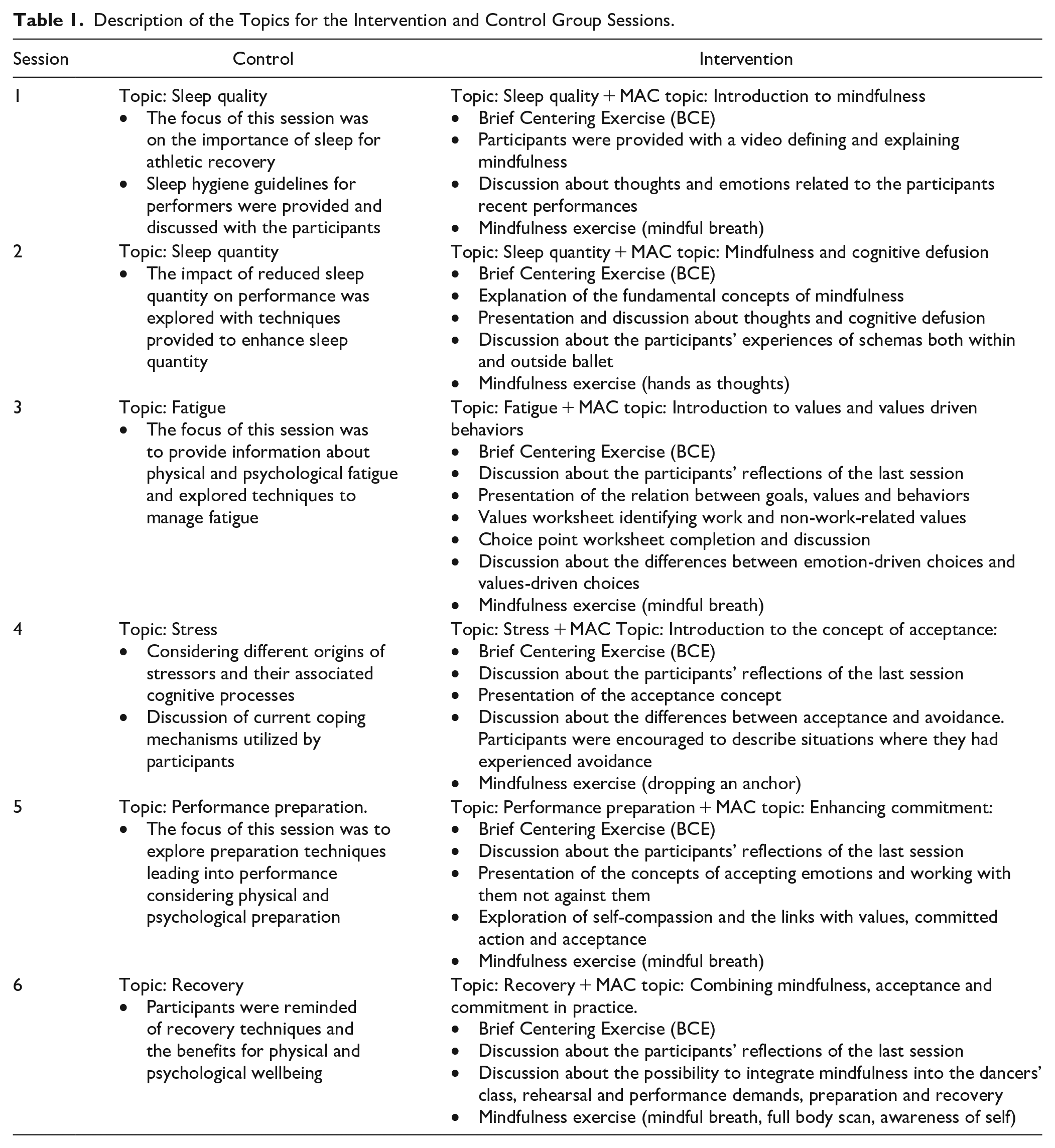
All sessions were directed by an accredited instructor (a member of the research team) in acceptance commitment therapy who had experience delivering mindfulness education to dancers and injured workers (including both physical and psychological injuries). The instructor was excluded from data analyses to reduce bias on the results. Participants in the intervention group met once per week, for 30-minutes with the instructor, for a six-week period. The control group met on an alternate day (one day per week), for 20-minutes, over a six-week period (see Table 1 which shows the contents of each program session for the control group and intervention group). If a participant was unable to attend their allotted group session, the instructor met with them individually, and took them through the exact same group content that they had missed in a private meeting room. Therefore, all participants across both groups completed every session.
Data was collected at week 1 after randomization from both the control groups and intervention groups. To obtain intervention data, participants completed the Mindfulness Inventory for Sport (MIS) 23 and the Acceptance Action Questionnaire (AAQ-II) 24 on two separate occasions at weeks one and 6 of the intervention. Dancers were asked to independently reflect on the sessions to share in an interview.
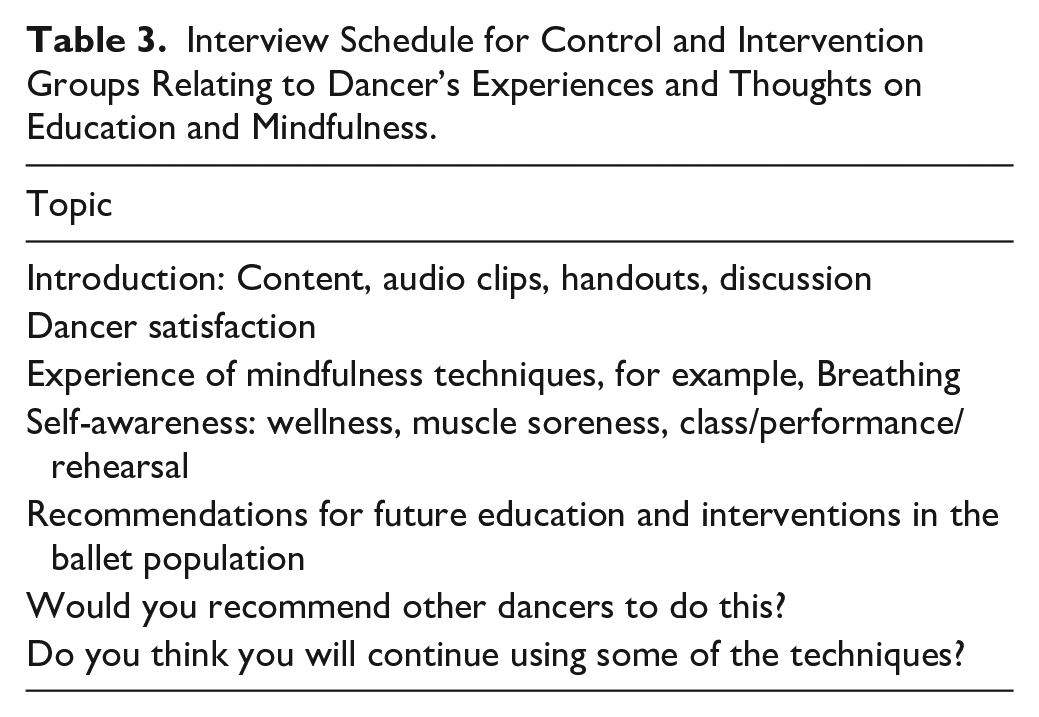
All participants (N = 16) completed one semi-structured interview, within a two-week period after the final MAC session, in-person in a private room so that the participant and interviewer were not interrupted by other dancers. The interview included questions about their experiences of the sessions, recommendations for further development and how they felt the program contributed to their professional and personal lives (refer to Table 3 for interview question guide). Interview data were transcribed by the primary researcher and analyzed using thematic analysis. 25 After the interviews were completed, the MAC sessions were offered to the eight waitlisted participants who all accepted the invitation to complete it.
Measures
The Mindfulness Inventory for Sport
The MIS is a 15-item questionnaire which assesses dimensions of awareness, re-focusing, and nonjudgement. Each item is measured on a 6-point Likert scale where 1 = not at all 3 = sometimes and 6 = very much. The MIS comprises three subscales: (i) awareness (items 1-5) (total score range 5-30); (ii) non-judgemental thought (items 6-10, reverse scored) (total score range 5-30); and (iii) re-focusing (items 11-15) (total score range 5-30). The awareness subscale assesses an athletes’ ability to be cognizant of their thoughts, emotions, and physiological responses. The non-judgment subscale assesses the attitude adopted toward the scenario. The refocusing subscale assesses an individual’s ability to quickly regulate attention toward goal-related cues.
The MIS demonstrates acceptable reliability (ω ≥ .7), strong test-retest reliability (.43 ≤ r ≤ .61) 23 and acceptable internal consistency for each of the subscales awareness: α = .77, non-judgmental: α = .78, refocusing: α = .77. 23
It has been recommended that sport research measure dispositional mindfulness using an instrument developed specifically for athletes17,23,26 as this is the first study to use this scale in dance and professional ballet.
The Acceptance Action Questionnaire
The AAQ-II is a 10-item measure that assesses an individual’s psychological flexibility, which is the act of being intentionally receptive and open to experiences, and to engage in behaviors consistent with valued life directions. 24 Each item is rated on a Likert scale ranging from 1 = never true to 7 = always true (total score range 10-70). All 10 items are summed to form a global index score. The AAQ-II is frequently used in both clinical psychology 27 and mindfulness- and acceptance-based research 16 . Reliability of the AAQ-II is high; .84, and adequate 3- and 12-month test–retest reliability of .81 and .79, respectively. 24 The AAQ-II also demonstrates adequate internal consistency levels (Cronbach’s alphas) ranging from .80 to .90. 5 The AAQ-II is a frequently used measure of psychological inflexibility. 28
Statistical analysis
Data were entered into statistical software SPSS v25 (IBM) on a Windows 10 platform. Questionnaire items were summed to obtain scale scores for awareness, non-judgement, re-focusing, and acceptance and action. Prior to analyses, data were screened for outliers via Box Plots using a criterion of ±2.5 standard deviations from the mean - no outliers were identified. Data was checked for assumptions of normality using Shapiro-Wilk test, all tests were P > .05.
For each variable, a single-factor between subjects’ analysis of covariance (ANCOVA) was used to analyze the intervention effect by comparing the post-intervention scores between the intervention and control groups, controlling for pre-intervention score at week 1. The magnitude of group differences was interpreted using partial η 2 and 95% confidence intervals. 29 This approach is consistent with athlete mindfulness research with similar sample sizes. 3 The magnitude of the effect size was interpreted using Cohen (1988) where a small partial η 2 was interpreted as 0.01, medium 0.06 and large 0.14.
To check whether non-significant results were due to a lack of statistical power, post hoc power analyses were conducted with power (1−β) set at .80 (80%) and α = .05, two-tailed. 30
Qualitative analysis
The interview material was analyzed using thematic analysis, a method for identifying, analyzing, and reporting patterns (themes) within the data. 31 Each interview was transcribed manually by the lead researcher, followed by manual thematic analysis generating codes and themes. Thematic analysis involves searching across a data set to find repeated patterns of meaning. Thematic analysis is widely used as it offers researchers analytic tools to make sense of data. 25 The analysis of the data adhered to the 6-phase guideline which includes: (1) familiarization (immersing one’s self in the data to become familiar with the data); (2) generating initial codes (a systematic and rigorous process to make sense of the information that will be coded); (3) theme development (organizing codes into meaningful themes); (4) reviewing/refining themes (reviewing the themes); (5) defining and naming themes (developing a rich analysis of the data represented by the final themes); and (6) write up (compiling, developing and editing existing analytic writing).25,31 The lead researcher completed three iterations of the codes and themes prior to review, consensus and consolidation by a second researcher from the team who is experienced in qualitative research.
Results
Quantitative Data
Descriptive statistics, means and standard deviations of the Mindfulness Inventory for Sport and Acceptance Action Questionnaire Scores for intervention and control groups are presented in Table 2. A description of the intervention and control sessions can be found in Table 1.
Descriptive Statistics for the Mindfulness Inventory for Sport and the Acceptance Action Questionnaire for Intervention and Control Groups.
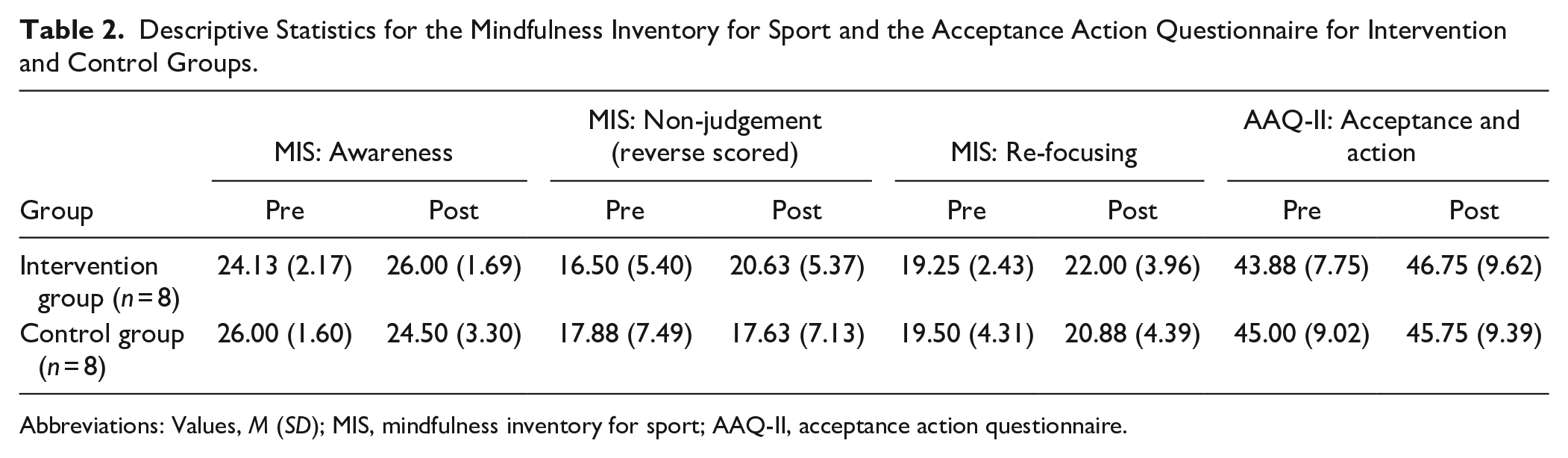
Abbreviations: Values, M (SD); MIS, mindfulness inventory for sport; AAQ-II, acceptance action questionnaire.
The following section analyses the results of the intervention effect by comparing the pre-and-post intervention scores between groups for the MIS subscales and AAQ-II.
Non-Judgement Subscale
A 1-Way ANCOVA was conducted to analyze the post-intervention non-judgment scores between groups. After controlling for pre-intervention score, no difference was found in the way dancers critically judge their own performance, F(1, 13) = 3.35, P = .09, η 2 = .21, 95% CI [0.00, 0.50].
Group sample sizes of n = 8 and n = 8 achieved 26% power with post intervention difference detected as 3.0. Adjusting for the pre intervention score using an ANCOVA test, a pre and post score correlation of .69 was found with a significance level (alpha) of .05.
Re-Focusing Subscale
A 1-Way ANCOVA revealed no difference between groups at post-test about how dancers refocus their attention from performance, F(1, 13) = 0.12, P = .75, η 2 = .009, 95% CI intervention [0.00, 0.25].
Group sample sizes of n = 8 and n = 8 achieved 11% power with post intervention difference detected as 1.1. Adjusting for the pre intervention score using an ANCOVA test, a pre and post score correlation of .66 was found with a significance level (alpha) of .05.
Awareness Subscale
After conducting a 1-Way ANCOVA, no difference was found between the way dancers maintained awareness of their thoughts, feelings, and emotions, F(1, 13) = 1.16, P = .30, η 2 = .08, 95% CI [0.00, 0.38].
Group sample sizes of n = 8 and n = 8 achieved 21% power with post intervention difference detected as 1.5. Adjusting for the pre intervention score using an ANCOVA test, a pre and post score correlation of −.09 was found with a significance level (alpha) of .05.
Acceptance and Action Questionnaire
A 1-Way ANCOVA was conducted on scores from the AAQ-II. No difference was found at post-test between the two ballet dancer groups about how open they are toward experiences, F(1, 13) = .34, P = .57, η 2 = .03, 95% CI intervention [0.00, 0.29] (Table 1).
Group sample sizes of n = 8 and n = 8 achieved 6% power with post intervention difference detected as 1.0. Adjusting for the pre intervention score using an ANCOVA test, a pre and post score correlation of .73 was found with a significance level (alpha) of .05.
Qualitative Data
Table 3 describes the topics of questions used to interview the dancers.
Interview Schedule for Control and Intervention Groups Relating to Dancer’s Experiences and Thoughts on Education and Mindfulness.
The following three themes were extracted from the participant interview data: 1. Education: a good place to begin; 2. Mindfulness: experiences, perceptions and benefits; and 3. Implementing the MAC program: in class and beyond.
Education: a Good Place to Begin
Fourteen dancers, across both the MAC and control groups suggested that the psychoeducation that both groups received was “not really anything new, but good to go over” and that the environment enabled them to talk about key points and reflect amongst their peers. PowerPoint information slides were reported to be beneficial for some dancers who struggled to retain information without a visual representation of the information. Ten dancers reflected that the information and slides reinforced topics discussed by the company medical team.
Mindfulness: Experiences, Perceptions and Benefits
All dancers who participated in the mindfulness sessions reported that their experience was “beneficial,” “insightful,” “valuable” and enabled them to feel “calm and refreshed before class.” Dancers appreciated the dedicated time to the practise of mindfulness stating that, “it didn’t really feel like an effort, it was a really helpful session to go to.” The sessions assisted dancers to “name” certain concepts such as “noticing self” that encouraged greater self-awareness and connection with self.
After each session, dancers were asked to independently reflect on their experiences and how they were then able to translate these experiences into practice throughout class and their working day. Dancers were asked to take note of their reflections and share these reflections in the interviews if they felt comfortable to do so. “I focused on little mindful things, like in the studio being able to have different ways to calm myself and different ways to find focus and feel grounded was good” (Participant 1). The mindfulness sessions enhanced dancers’ awareness of mental health. For example, “I’ve always figured mental health is important, along with physical health and I think those sessions and listening to how work effects other people as well was good, and to notice mental health is important” (Participant 4).
The inclusion of practical components and short audio meditations were reported to be “enlightening” and “interesting” to dancers as this enabled them to get a “feel for mindfulness” without feeling overwhelmed. The sessions encouraged dancers to engage with their surroundings, to be more aware, and acknowledge thoughts and feelings, and dancers discussed that this practice “takes you out of autopilot, so it’s been good to try and break that and become more self-aware” (Participant 5).
Additionally, dancers suggested that ongoing, regular sessions, especially when working interstate could be “really beneficial.” It has been identified that dancers have extensive daily, weekly and monthly work demands, and it was reported that if mindfulness sessions were scheduled regularly it would help to remind dancers to focus on their mental health. “In the future, to entwine the sessions into the company would be beneficial to then also be tailored to what is coming up, for example performances, auditions, travel periods” (Participant 2). Although dancers reported the sessions were valuable, they advised their ability to dedicate time to mindfulness ongoing would be challenging.
Peer Interactions: MAC Program Encouraging Conversations and Support
When reflecting on the composition of the sessions, dancers reported that the group environment felt “safe, reassuring and kind,” with one dancer stating: “it was nice to hear you are on the same track as everyone else, to hear they are going through similar things was good” (Participant 3). It was reported that the group sessions encouraged and enabled conversations around work, the environment and pressures and helped to normalize the experiences discussed. Dancers also considered the potential benefits of individual sessions for more tailored strategies and discussions, such as “being able to hear other people’s opinions was great, but it would also be great to have one-on-one with you and I did (as this dancer had missed a group session), which was really great because the focus was on each other and there was a lot to gain from having that attention” (Participant 6). Another dancer suggested that individual sessions could be offered to enhance personal development and growth holistically. Although the group sessions encouraged collaborative discussion, the sessions also encouraged dancers to reflect on their personal experiences.
Implementing the MAC Program: In Class and Beyond
Dancers discussed being more aware of and paying more attention to their senses such as sights and sounds, and listening to mindfulness apps between sessions. Breathing techniques, observing self, unhooking techniques, reflecting on values and focusing on the present moment were elements that resonated with dancers. “I used self-kindness like we were talking about. I loved the ‘hands as thoughts’ strategy, even yesterday in class I noticed that if you allow yourself to open up, you can really see things that are around you and in front of you” (Participant 7).
Dancers further discussed how they implemented mindfulness strategies and tuned into their senses, noticing the sound of the music and tuning into all of the instruments when standing side stage. “Sometimes the atmosphere is really nerve-wrecking because you see lights and see people. So, I really liked the strategies provided for side stage and taking it all in, this really clicked for me” (Participant 7). When reflecting on the performance itself, one dancer discussed how the sessions and the strategies helped to enhance their focus and their experiences during a performance. For example: “Focusing through mindfulness I have noticed that I am more focused throughout my performance, I think that is because I have been able to lower my nerves and not be anticipating in my mind, just being present and focus on the moment and what I have to do there and then” (Participant 5).
Another dancer reflected on their experiences implementing mindfulness post-performance: “In more stressful situations, after a show, I meditated for 5-minutes, and it really grounded me because I was getting really worked up. I was quite anxious afterwards, but the mindfulness sessions really reminded me to feel the floor and breathe. I think any workplace should have this, especially in performance where there is adrenaline and heightened states. Every night we go from the high and then try to switch off and lie down and sleep can be hard” (Participant 7).
Dancers also reflected on the use of mindfulness outside of performance settings and the impact regular practice may have on their holistic well-being. One dancer stated that she had previously considered trialling mindfulness when she felt stressed. However, following the sessions she reflected on the importance of practizing mindfulness in different psychological states to further enhance the skills and utilization. For example: “since being educated and trying mindfulness strategies when I am calm, I have noticed when I feel really stressed that I can manage these emotions better because of the preparation and prior practice” (Participant 6). Another dancer supported this notion of ongoing practice of mindfulness indicating that being mindful is more achievable when you’re “not completely highly strung.” “The more you use it and practice it, the more it becomes natural and then a tool to use when you become heightened and stressed” (Participant 1).
Two dancers were not as confident they would utilize mindfulness techniques as they have engaged with sport psychologists who have assisted with previous issues and concerns. For example, “I think the material is good, I don’t know how applicable it would be for me to use. I think for me, I have seen the sports psych several times and that’s been much more beneficial because I have much more specific things that I want to address and talk about” (Participant 8). Another dancer also reflected on the generic nature of the sessions stating that: “I think it was kind of more like a blanket, maybe a bit too general. I thought the resources were good, so from a practical point of view it was good. I think more specific strategies for each individual would be more productive for dancers’ specific needs” (Participant 2).
Discussion
Summary and Discussion of Quantitative Findings
The aim of this study was to explore the effectiveness of a pilot 6-week mindfulness intervention with professional ballet dancers. While no significant differences were identified in pre-and post-scores between a MAC treatment and control group of dancers, trends were noted that warrant further investigation into the effectiveness of mindfulness in ballet. These data were supported with participant interviews as another method to evaluate the program. A discussion of the quantitative and qualitative results and their implications is presented below.
Summary and Discussion of Quantitative Findings
Results of the statistical analyses showed no difference between groups on the MIS and AAQ-II measures. Despite this, there were patterns from the data that are noteworthy. A decrease in non-judgement scores, a small increase in levels of refocusing, and an upward trend in levels of acceptance and action for the MAC group between pre- and post-intervention were identified. These findings are promising from the perspective that dancers in the MAC group may have begun to adopt a non-judgmental attitude toward their cognitions and emotions based on questionnaire responses post mindfulness intervention. However, to detect if there is a statistical change in awareness, non-judgment, refocusing and acceptance and action scores with mindfulness intervention in dance, further intervention research is required.
The MAC group showed a small (but non-significant) improvement in mindfulness ratings similar to findings in previous studies.3,32 However, the results in the current study are not entirely comparable to earlier studies, as Goodman and colleagues 32 did not use an active control group and tested MAC in combination with Hatha yoga. Most interventions examining mindfulness and acceptance-based effects have used inactive controls, making it difficult to detect unique mindfulness effects from the effect of attention.
Changes in the AAQ-II questionnaire pre-and post-intervention suggest an increase in the acceptance of cognitions, emotions, and physical sensations. In the current study however, these were not statistically significant and as such, we cannot infer anything further from this relationship. Gross and colleagues 16 found changes in the AAQ-II between post-intervention and one-month follow up suggesting that changes in psychological flexibility may not be captured in the initial post-intervention questionnaires. A 1-month post-intervention questionnaire was not administered in the current study due to dancer’s extensive work commitments; however, this could be incorporated into further research to examine both initial and longer-term intervention impacts of mindfulness practice. Additionally, other MAC studies3,32 did not use mindfulness questionnaires specifically designed for athletes, which differs from the current study that adopted valid athlete mindfulness questionnaires.
Summary and Discussion of Qualitative Findings
Dancers were interviewed to help guide future designs for the potential embodiment of mindfulness practice into ballet and dance companies. Although no significant differences were found between pre- and post- intervention, the qualitative data provides insight into the possible effectiveness of MAC for ballet dancers and offers direction for further enhancement and considerations for future research. Through semi-structured interviews, dancers discussed overall positive experiences of the mindfulness sessions and applied concepts to their professional and personal lives. Dancers reported noticing they were better able to manage stress because of the mindfulness practice and were able to calm themselves, focus and feel grounded in class and performance. Dancers suggested that regular mindfulness sessions entwined into schedules and tailored to upcoming performances, auditions and travels would be beneficial.
Study Strengths
The 6-week MAC program implemented with professional ballet dancers extends research into the potential effectiveness of mindfulness practice in dance. To our knowledge, this is the first published pilot study examining MAC’s effectiveness when compared to an active control in professional ballet.
To accurately explore the effects of mindfulness techniques, it has been recommended that research studies use an active control group with meaningful content, to enable and encourage participants to discuss benefits and issues of relevance. 33 As such, an active control, receiving meaningful educational material relevant to professional ballet was implemented into the present study to control for the effect of attention as both the MAC and control groups received comparable amounts of time with the same instructor.
Study Limitations
The current study has provided insight regarding mindfulness in professional ballet; however, the findings should be considered within the context of several limitations. First, the underpowered sample size and restricted number of sessions limits the interpretation of the effectiveness of the mindfulness intervention compared to education alone. The sample size was too small to ascertain if a significant effect existed between pre and post scores and limits the ability to judge the effectiveness of the intervention. An increased sample size may help to detect if there is a difference in awareness, non-judgment, refocusing and acceptance, and action scores with mindfulness intervention in dance. Second, the mindfulness data were self-reported, thus susceptible to individual interpretation. Third, Zhang and colleagues 26 reported that direct-worded items instead of reverse-worded acceptance items used in questionnaires may be more appropriate for athletes. The MIS and AAQ-II used in the current study both included reverse-scored items that may have been misinterpreted and may have contaminated scores rather than preventing response bias. Fourth, in the current study, no performance data or observations from medical or artistic staff were recorded to identify possible performance enhancement through mindfulness practice. It is recommended that performance measures (such as dancer self-reflection and artistic and medical staff observations) and outcomes (such as perceived and observed performance quality) be incorporated into future mindfulness research to explore MAC’s effectiveness in enhancing performance in professional ballet.
Implications
Research in dance and mindfulness has tended to explore dance as a means of meditational therapy, as opposed to mindfulness as a mechanism for performance enhancement. 35 Exploring a mindfulness intervention in a dance setting, Moyle 36 also failed to identify statistically significant findings in a 9-week mindfulness program, however reported an upward trend in levels of mindfulness awareness in dance students. Further exploration of the effects of mindfulness practice for professional and personal wellbeing is therefore required to provide a greater depth of understanding of mindfulness practice for dancer’s preparation, performance, and recovery and to expand on the current study’s preliminary findings.
The implementation of an ongoing mindfulness practice may be challenging for dancers and dance companies. In the current study, the MAC program was reduced slightly from 7 sessions to 6 to align with the dancer’s availability, and each session ran for 30-minutes instead of the proposed 45-60-minutes duration. Dancers were still provided with all aspects of the MAC program, however as the intended length of MAC was reduced slightly participants consequently may not have been able to reflect on the concepts discussed with as much depth and consideration. Nevertheless, research has yet to clearly identify the most effective doses of mindfulness practice to achieve optimal results. 16 It has been suggested that intervention periods of mindfulness practice longer than 4 weeks have a larger impact on an athlete’s personal development, with intervention periods ranging between 5 37 and 8 weeks. 6 Similarly, the Australian Football League (AFL) have reported one of the biggest challenges in engaging players in mindfulness and well-being interventions is time. 38 The AFL Players’ Association have subsequently sought to creatively weave mindfulness, as part of a broader well-being strategy, into player support. This has been achieved by highlighting and working with influential players and coach ambassadors who are willing to talk about their mindfulness practice and subsequent impact on their life and sporting performance, and dance could follow a similar trajectory. To enhance engagement in mindfulness practice in ballet companies, the effectiveness of tailored one-on-one and group mindfulness sessions should also be explored.
Conclusion
The findings of this pilot intervention study did not reach significance possibly due to the underpowered sample size, limiting the interpretation of the findings. It is recommended that a larger, fully powered RCT to determine the impact of mindfulness on professional ballet dancers be investigated. Dancers in the current study provided valuable responses to enhance the effectiveness of mindfulness interventions in ballet. Recommendations such as dedicated time to practice, flexibility in the delivery of the techniques, and individualized content has provided key insights for the development of further mindfulness research studies in dance and sport, and for ongoing utilization and adaptation by companies and sporting organizations. Ultimately, mindfulness practice has been found to be effective when participants persist and engage in the intervention 26 and prolonged exposure and longitudinal examination of mindfulness outcomes is warranted.
Footnotes
Acknowledgements
We would like to thank the dancers who participated in the study for volunteering their time to this research project and offering valuable insights.
Declaration of Conflicting Interests
The author(s) declared no potential conflicts of interest with respect to the research, authorship, and/or publication of this article.
Funding
The author(s) received no financial support for the research, authorship, and/or publication of this article.
