



Abstract
The present article advances a perspective on crisis migration and its effects on crisis migrants’ identities within their destination cultural contexts. It integrates insights from the literature on crisis migration and acculturation, framing it as a process of cultural identity expansion and transformation. The article reviews the challenges associated with crisis migration and how these challenges can interfere with cultural identity expansion and transformation. Key challenges enumerated here include traumatic events occurring before migration, family separation, sudden and unplanned departures from the country of origin, downward economic mobility in the destination country or region, and culturally stressful experiences. It advances predictions regarding how each of these challenges may interfere with the identity expansion and transformation that underlies acculturation, post-migration adjustment, and mental health. The article concludes with a proposed research agenda for evaluating and advancing the perspective presented.
International migration has reached the highest numbers in recent history, with nearly 300 million people currently residing in a country other than where they were born (McAuliffe & Oucho, 2024). The number of international migrants has more than doubled since 1990, owing to increased opportunities to study or work abroad, greater ease of international travel, changes in migration policies in many countries, and an accelerating rate of natural (e.g., hurricanes) and human-made (e.g., wars) disasters that have displaced large numbers of people (Steiner, 2023). As the 21st century progresses, additional accelerations in migration are expected for all these reasons—particularly due to crisis events that are expected to become more frequent and intense.
Although international migrants originate from a variety of countries, nearly half reside in only 10 destination countries—and 20% (60 million) reside in the United States alone (Moslimani & Passel, 2024). Seven of the top 10 migrant-receiving countries are in the Global North—a term referring to developed, industrialized, technologically advanced nations with stable governments and economies. These seven Global North countries are the United States, Germany, the United Kingdom, Australia, Canada, France, and Spain. The other countries in the Top 10 are Russia, Saudi Arabia, and the United Arab Emirates.
Migrants to Global North countries generally originate from the Global South—a broad label for developing countries widely considered to be on the margins of global politics (Hogan & Patrick, 2024). Specifically, migration to Global North countries often comes from Latin America, the Caribbean, South and Southeast Asia, Africa, and the Middle East (Steiner, 2023). For example, migrants to the United States and Canada predominantly come from Latin America and Asia; migration to the United Kingdom largely originates from former British colonies such as India, Pakistan, and Jamaica; migrants to France primarily originate from its former colonies in Africa, Southeast Asia, and the Caribbean; and migrants to Germany originate largely from Middle Eastern countries such as Turkey, Iraq, Syria, and Afghanistan. This migration from Global South to Global North countries involves a “cultural clash” because many Global North countries are primarily individualistic (involving a primary focus on one’s own needs and desires) whereas many Global South countries are primarily collectivistic (involving a primary focus on the needs and desires of one’s family, clan, or other social group) (Gelfand et al., 2011). As a result, many Global South migrants in Global North countries are often faced with navigating incompatibilities between their collectivist-oriented heritage belief systems and the more individualist-oriented belief systems that characterize their destination countries’ cultural contexts (Schwartz et al., 2018). As we note below, this reconciliation represents part of what Berry (2005) and others have framed as acculturation. (Destination cultural contexts may change as a result of receiving migrants, but this change is often slower to occur (Berry, 2006)).
The present article examines the extent to which a specific type of migration—crisis migration—is associated with impairments to the identity expansion and transformation that often occurs following arrival in a new country or region. The article is organized into three main sections. First, we define crisis migration, highlighting how it differs from voluntary immigration and subsumes some refugees and asylum seekers. Second, we outline connections between crisis migration and identity, discussing the concept of identity, its expansion and transformation through migration, and how crisis migration can hinder this process. The article concludes with a set of empirical questions and recommendations for testing and advancing the proposed perspective.
Crisis Migration
Berry (2017) enumerates at least three types of (assumedly) permanent international migrants: voluntary immigrants, refugees, and asylum seekers. Voluntary immigrants relocate to pursue education, work, family reunification, curiosity, or other similar motives. Refugees are resettled by governments or aid agencies, generally as a way of moving them out of active war zones. Asylum seekers flee their homelands because of fear of persecution, injury, or death, and migrate to countries that they hope will admit them and provide them with refugee status. McAdam (2014) introduced a fourth category—crisis migrants. McAdam proposes crisis migration as referring to individuals fleeing wars, invasions, national collapses caused by repressive and dictatorial governments, severe hurricanes or earthquakes, or other crisis events that have rendered one’s homeland unlivable (see Ertanir et al., 2023; Vos et al., 2023, for reviews).
McAdam’s conceptualization does not clarify whether the crisis migration category subsumes refugees, asylum seekers, individuals receiving temporary protected status, and undocumented migrants fleeing difficult or unlivable conditions or events. Building on McAdam’s work, as well as the categories introduced by Berry (2017) and others, we propose two general, superordinate types of migration—enhancement migration and crisis migration. Enhancement migration refers to people who relocate to pursue work, educational opportunities, family reunification, or curiosity (Berry, 2017; Tartakovsky & Schwartz, 2001). Enhancement migrants can enter the destination country with a work, educational, or other visa—or they can enter without authorization. Indeed, many undocumented migrants relocate to more affluent countries so that they can work and send money back to their families in their countries of origin (see Weber & Massey, 2023, for an example).
As noted above, crisis migration refers to people who are displaced by natural or human disasters or extremely adverse conditions—such as hurricanes, earthquakes, droughts, religious persecution, civil wars, or governmental collapses. The heading of crisis migration therefore subsumes refugees, asylum seekers, and people receiving temporary protected status—as well as undocumented migrants fleeing crushing poverty, food scarcity, domestic abuse, or other conditions that do not qualify them for refugee or asylum status in their destination countries. However, following Salas-Wright et al. (2024b), we propose degrees of crisis migration, defined based on the extent of the four crisis migration indicators empirically identified by Salas-Wright et al.—danger (high likelihood of harm from treacherous conditions created by the crisis), desperation (a strong desire to leave the country or region in any way possible), hardship (lack of food, water, shelter, or other basic necessities), and unplanned departure (having to leave on a moment’s notice, or without having time to plan). Accordingly, rather than debating whether or not certain groups of refugees, asylum seekers, temporary protected status holders, and undocumented migrants are crisis migrants, we would argue that a more productive conversation would be around identifying (1) the degrees of danger, desperation, and hardship that prompted the unplanned departure and (2) the number of people impacted at once. These factors will likely impact how migrants adjust to their destination country, as well as the ways in which host nationals (people in the destination country or region who are not migrants and are not from migrant families) will receive and react to a given migrant group (Schwartz et al., in press).
Individuals reporting greater perceptions of danger, desperation, hardship, and unplanned departure are most likely to be report impaired mental health (C. P. Salas-Wright et al., 2024). Similarly, the number of people impacted by a given crisis will also affect the rate at which crisis migrants will be able to adjust to the new context. More severe crises are likely to displace hundreds of thousands or millions of people—and host nationals are likely to react defensively to such large numbers of people arriving in their country or region (Coenders et al., 2008). Examples of severe crises that impact a massive number of people at once include Hurricane Maria in Puerto Rico, the Russian invasion of Ukraine, and the societal collapse in Venezuela. Smaller refugee and asylum seeker populations—such as Coptic Christians fleeing persecution from other Egyptians (Philips, 2023)—would still be classified as crisis migration, but as a more moderate form. See Figure 1. Enhancement versus crisis migration. Note. TPS = temporary protected Status.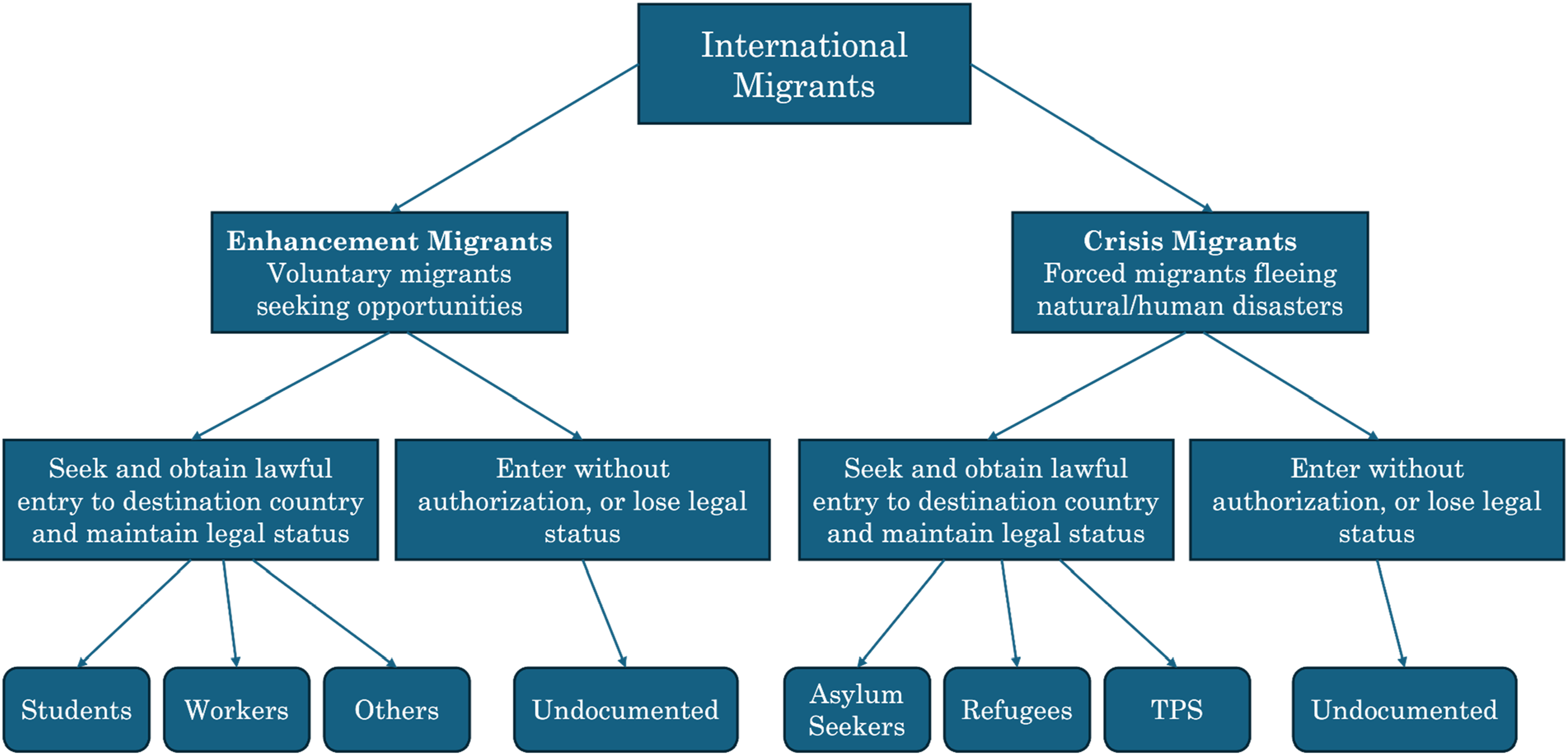
This approach to crisis migration allows us to examine both the commonalities and the heterogeneity within these populations, particularly regarding identity processes. Much as “Latino” serves as an umbrella term for diverse populations with distinct experiences, “crisis migrant” provides a unifying category while also acknowledging important variations in experiences and identity trajectories. Although legal definitions such as “refugee” or “asylum seeker” reflect governmental and policy-oriented classifications focused primarily on administrative processing and legal rights, the psychological concept of “crisis migrant” supersedes these narrower legal frameworks. Legal classifications primarily serve to determine what countries should do with migrants based on their intentions, motivations, and circumstances of departure, rather than addressing the psychological processes inherent in forced displacement. Within the broader crisis migration category, refugees, asylum seekers, undocumented migrants fleeing crisis situations or events, and people receiving temporary protected status likely differ markedly in social reception, economic opportunities, and physical and psychological security. Others enter their destination countries without authorization, often because there is no legal mode of entry available to them (e.g., extreme poverty and domestic abuse generally do not represent valid asylum claims in many destination countries). This heterogeneity within the superordinate crisis migrant category is valuable for understanding diverse identity processes rather than treating each migrant type in isolation.
Another marker of crisis migration—which underlies the identity disruptions, expansions, and reconfigurations discussed in this article—is the sudden and largely unplanned departure precipitated by the crisis events or conditions (Salas-Wright et al., 2024a). The immediacy and urgency of leaving creates distinctive psychological impacts that shape how crisis migrants perceive both their homeland and destination country. Those fleeing immediate dangers such as bombings or hurricanes may experience their departure as a traumatic rupture rather than as a planned transition, leading to what Lijtmaer (2022) refers to as traumatic nostalgia. In contrast to enhancement migrants who may maintain idealized views of their homeland while preparing for departure, crisis migrants often witness the devastation or deterioration of their homeland firsthand. These experiences may complicate crisis migrants’ ability to maintain a coherent sense of cultural identity tied to their place of origin. Additionally, the speed of departure likely affects how crisis migrants initially relate to their destination countries—often arriving with minimal psychological preparation for cultural immersion and potentially viewing their new location as a temporary refuge rather than as a permanent home. These characteristics create common challenges for identity development across different crisis migrant groups, even as specific experiences may vary based on factors such as the nature of the crisis, how migrants are received in their destination countries, and individual characteristics.
By adopting such a nuanced conceptualization of crisis migration, we can develop a comprehensive understanding of how crisis migration affects identity formation across different contexts and populations. This framework allows researchers to examine how various subgroups of crisis migrants might experience unique identity challenges while sharing certain fundamental experiences related to sudden displacement, trauma, family separation, and post-migration adaptation.
Some crisis migrants relocate to nearby countries, whereas others settle in faraway countries. Severe instances of crisis often prompt migrants to undertake perilous journeys involving crossing large bodies of water or dangerous stretches of land. Many Syrians fleeing their country’s civil war had to cross through Turkey and multiple Eastern European countries on their way to Germany or Sweden, and some of the countries that these crisis migrants passed through attempted to block or imprison them (Arsenijević et al., 2017). Many Venezuelans fleeing the collapse of their country have crossed the Darién Gap, a 66-mile (106 km) stretch of sparsely populated jungle between Colombia and Panama, on their way to the United States (Naranjo et al., 2023). Other Venezuelans have undertaken long, arduous journeys on foot to other South American countries. Many African migrants have drowned while trying to cross the Mediterranean Sea in makeshift boats (Albahari, 2015).
Leaving on a moment’s notice, and having to undertake a dangerous journey to one’s eventual destination, suggests that one will only be able to bring those possessions that one can carry. For example, crossing the Darién Gap involves avoiding mudslides, torrential rainstorms, wild animals, and drug smugglers (Naranjo et al., 2023), making it nearly impossible to carry anything larger than a backpack. Similar challenges face Ukrainians walking to the Polish border, Syrians crossing multiple countries to reach Western Europe, or Libyans crossing the Mediterranean Sea toward Italy or Spain. As a result, unlike many enhancement migrants, most crisis migrants arrive at their destinations with many unmet physical, psychological, and daily-living needs (Ertanir et al., 2023). They are also likely to experience severe mental health challenges attributable to pre-migration, migration, and post-migration experiences (Giordano et al., 2019; Vukčević Marković et al., 2023). Crisis migrants often flee suddenly with little preparation, may lack legal pathways for protection, and generally arrive without arranged housing, work, or support systems in their new communities. These additional challenges that crisis migrants face may lead to difficulties in the kind of identity expansion and transformation that migrants must undergo during and following their migration.
Crisis Migration and Identity
Moving to another country is one of the most disruptive transitions on which an individual can embark. People are likely to be immersed within a new cultural stream; may have to learn (or become more proficient in) a new language; and will have to become accustomed to new cultural mores such as how neighbors greet each other, how and when meals are eaten, how and when people work and engage in leisure activities, and how children and adolescents socialize with one another (Demes & Geeraert, 2014). Indeed, the constructs of psychological and sociocultural adaptation were introduced by Ward and Kennedy (1994) to index how migrants were adjusting to their new environments. Psychological adaptation indexes how happy one is in one’s new community, whereas sociocultural adaptation refers to how comfortable one is with the physical climate, ways of relating to other people, and the general pace and flow of life in the new country and community.
The concept of culture shock (Ward et al., 2020) refers to the sudden realization among migrants and travelers that life is at least somewhat different in the destination country or region than it was in one’s country or region of origin. Examples might include contrasts between very modest dress styles in Syria and acceptance of public nudity in Germany, or between extreme deference to parental authority in China and children openly challenging and defying their parents in the United States. One could imagine the reaction of Middle Eastern migrants to clothing-optional European beaches, or of South Asian migrant parents to the sight of American teenagers being openly disrespectful to their parents. Migrants and host nationals may both engage in ethnocentrism (Aspernäs et al., 2023), whereby they may implicitly (or explicitly) believe that their cultural background is the norm—and such ethnocentrism may contribute to culture shock and threat perceptions. In some cases—such as devout Muslims migrating to secular European societies—each party may view the other as threatening, immoral, or oppressive (Scalvini, 2016).
Crisis migration compounds the normative challenges of adapting to a new context. Mental health problems, which often arise in response to crisis events or conditions, traumatic migration journeys, and ambivalent or hostile receptions in the destination country or region, can complicate migrants’ ability to adapt upon and following arrival (Phillimore, 2011). For example, as compared to those who arrived before the 2022 Russian invasion, Ukrainian migrants who arrived in the United States following the invasion scored significantly higher on depressive symptoms, anxiety, and post-traumatic stress (Alpysbekova, Cisco, Vo, et al., 2024). These post-invasion migrants also reported significantly lower optimism (as an index of expectations for success in the new cultural context) compared to their pre-migration counterparts. Similarly, compared to those Hurricane Maria migrants who did not experience severe pre-migration storm trauma or post-migration cultural stress, Puerto Rican Hurricane Maria survivors who fled to the U.S. mainland following the storm and reported greater storm trauma and cultural stress also reported elevated levels of anxiety, depression, and post-traumatic stress (Montero-Zamora, Salas-Wright et al., 2023). Mixed-method evidence (Pineros-Leano et al., 2024) suggests that greater pre-migration trauma and post-migration cultural stress often interfered with Hurricane Maria survivors’ adjustment to the continental United States. Vos et al., 2023 found that experiences of discrimination in Colombia or the United States significantly predicted post-traumatic stress symptoms and screening diagnoses among Venezuelan crisis migrants. These results, involving three different crisis migrant groups, suggest that the crisis migration experience complicates adaptation and adjustment in the destination country or region.
Before embarking on our review of identity challenges among crisis migrant populations, we should state that the majority of migrants—including crisis migrants—are not traumatized and do not experience elevated mental health challenges following migration (for reviews, see Cobb et al., 2019; Ertanir et al., 2023). That is, although hurricanes, earthquakes, wars, invasions, and national collapses may introduce considerable challenges, such challenges do not necessarily equate to trauma for everyone who experiences them. There may be a number of intrapersonal and contextual assets that help crisis migrants to manage difficult or challenging events. For example, Duque et al. (2025) found that optimism and collective efficacy (embeddedness within a supportive neighborhood or community) protected against post-traumatic stress symptoms over time among a sample of Puerto Rican Hurricane Maria survivors on the U.S. mainland.
We should also note that there is an existing literature on identity among refugees and asylum seekers (Douglas, 2010; Groen et al., 2019; Kirkwood et al., 2015). Some of this literature may be informative in developing a perspective on identity expansion and transformation among crisis migrants. For example, Groen et al. (2019) focus on ways in which cultural identity confusion resulting from trauma and disruption can pose risk for mental health problems among refugees and asylum seekers. Dagg and Haugaard (2016) outline how refugees and asylum seekers must make sense of their forced—and unplanned—transitions from their countries of origin to their destination countries, including negotiating their status as “outsiders” and their unfamiliarity with the “way things work” in their new countries of residence. These principles surely apply to various degrees of crisis migration as well.
However, the often large-scale nature of crisis migration introduces additional identity challenges. In severe instances, the crisis events or conditions may have fundamentally transformed the migrants’ country or region of origin—such as Ukrainian cities being devastated by Russian bombs, Venezuela’s economy and social fabric collapsing under Nicolás Maduro’s rule, or Puerto Rican towns being destroyed during and after Hurricane Maria. Because of the scope and magnitude of the crisis that they are fleeing, crisis migrants may realize that their countries or regions of origin might never return to what they remember. Lijtmaer (2022), adopting a psychodynamic viewpoint, argues that this realization leads to a sense of traumatic nostalgia among many crisis migrant populations.
As a result, it is essential for the identity literature to distinguish between crisis migrants and enhancement migrants, as well as across degrees of crisis migration severity. Assuming that all migrants face the same identity issues likely overlooks the devastating impacts that forced migration, especially migration triggered by the most severe crisis events and conditions—such as civil wars, invasions, national collapses, and major natural disasters—exerts on migrant adjustment.
So, how does crisis migration relate to identity among crisis migrant individuals and families? To answer this question, we must review three primary strands of literature—(a) identity as a social and cultural phenomenon, (b) acculturation as a potential identity expansion and transformation, and (c) how crisis migration can interfere with this expansion and transformation. Put differently, we must define what identity is, explicate how it may be changed through migration, and lay out how these changes may be more difficult for some crisis migrant individuals and families. In the next subsections we define what identity is, coin the term identity expansion and transformation, and outline how crisis migration can compromise this identity process that most migrants must navigate.
What is Identity?
The term identity spans across several different literatures and levels of analysis (Vignoles et al., 2011)—including work on individual meaning-making, group affiliations, and social roles, among other areas. Broadly, identity represents the answer to the questions who am I? or who are we? Who am I as a person, as a parent, or as a worker? Who are we as a family, as a country, or as an ethnic or religious group? Identity also refers both to the contents of these self-definitions and to the processes through which they are constructed.
At the individual level, identity indexes the set of personal, relational, and societal commitments that one has enacted. Deciding to become a doctor, endorsing atheism, and identifying as politically conservative represent individual identity components. Being a husband or mother represents a set of relational identity commitments. Being a Venezuelan, a Christian, or a Hispanic American serve as examples of cultural or societal level identity components.
Importantly, the roles that one adopts (e.g., mother and community leader) help to position oneself within society (Stryker, 2008). Within a given society, social and relational roles such as spouse, parent, neighbor, religious leader, and professional carry specific meanings. In many Global South countries, the distribution of power within heterosexual marital relationships where is often unequal with husbands exerting authority over their wives considered normative, whereas similar behavior by wives toward their husbands may be perceived as problematic. Global North countries are more likely to maintain (or at least aspire to) egalitarianism between women and men—such that the roles of “husband” and “wife” are likely to carry different meanings in Global North versus Global South contexts. Indeed, in many Global North settings, couples cohabitate and raise children without being married (Cherlin, 2021; Schnor & Jalovaara, 2020), whereas marriage tends to be far more institutionalized in the parts of the Global South (Yu, 2024). As a result, family roles are very much tied to the specific cultural context in which one resides.
Other approaches to identity also suggest that different identity components may be influenced by cultural contexts and forces to different extents. For example, Schwartz et al. (2006) distinguish between personal and cultural identity among migrants. These authors argue that cultural identity changes as a result of adapting to a new cultural context, whereas personal identity helps to stabilize migrants as they undergo this transition. As noted above, personal identity refers to goals, beliefs, and relationship choices. Cultural identity refers to behaviors, values, and group identifications that are associated with specific cultural contexts—such as language use, dietary habits, prioritizing the needs of the individual over the group (individualism) or vice versa (collectivism), racial, ethnic, and national identifications. Subsequent cross-sectional (Schwartz et al., 2013) and longitudinal (Meca et al., 2017) research has indicated that personal and cultural identity indices are closely related to one another—thereby suggesting that variables related to cultural practices, values, and group identifications (i.e., acculturation; Berry, 2005) may also be viewed as markers of identity.
Acculturation as Identity Expansion and Transformation
Berry (2005) and others have defined acculturation as the change that takes place when migrant and host national groups interact within a destination cultural context. Although destination cultural contexts are also transformed over the long term as a result of contact with migrants (Kunst et al., 2021), much of the focus of acculturation theory and research has centered on how individual migrants—and migrant groups—adjust culturally following arrival in the destination country or region (Berry, 2017). Given that culture shock is a natural part of the acculturation process, the resulting incompatibilities between one’s cultural heritage and the destination cultural stream can prompt migrants to develop strategies for navigating between these two systems. Berry proposed that such adaptation involves acquiring (or not) the destination cultural stream and retaining (or not) one’s cultural heritage. Meta-analytic work (Abu-Rayya et al., 2023; Nguyen & Benet-Martínez, 2013) suggests that migrants who both acquire the destination cultural stream and retain their cultural heritage tend to be most favorably adjusted (but see Bierwiaczonek & Kunst, 2021, who provide evidence for a limited association of acculturation with adjustment outcomes).
Schwartz et al. (2010) extended Berry’s model to apply to three cultural domains—practices (e.g., language, food, peer associations), values (e.g., individualism and collectivism), and identifications (e.g., ethnic and national identity). As a result, acculturation—and cultural identity more broadly—consists of six components: heritage-cultural practices, heritage-cultural values, heritage-cultural identifications, destination-cultural practices, destination-cultural values, and destination-cultural identifications. Empirical work (Lee et al., 2020; Schwartz et al., 2015) has suggested that each of these components changes in different ways, and that changes in each of these components may have different predictors, correlates, and outcomes.
Especially among young migrants, biculturalism—strongly endorsing both one’s heritage and destination cultural streams—tends to be the most common approach to acculturation (Berry et al., 2006; Schwartz & Zamboanga, 2008). More than half of the adolescents (Berry et al.) and college students (Schwartz & Zamboanga) in these samples were classified as bicultural. Biculturalism is important for overall identity development (Meca et al., 2019), in that the individual is grounded within both cultural streams and is able to integrate components from these streams with one another. Indeed, especially within the identifications domain, biculturalism may facilitate well-being and protect against symptoms of depression and anxiety (Schwartz et al., 2019).
So, in essence, acculturation represents shifts, and often expansions, in cultural identity among migrants. Because language serves as a transmitter of culturally related ideas and messages (Ramírez-Esparza et al., 2020), acquiring a new language following migration may help expand one’s sense of identity – although formal language instruction may be expensive, time-consuming, or difficult to find. Acquiring the destination-cultural language(s) allows migrants to develop close relationships with host nationals, which may also expand the migrants’ identities. Including the destination country within one’s sense of cultural identity (e.g., seeing oneself as German as well as Syrian, or as American as well as Korean) represents an expansion of one’s sense of self. Indeed, Tadmor and Tetlock (2006) found that migrants identifying as bicultural were more effective at perspective-taking and analyzing complex situations.
Here we coin the term identity expansion and transformation to refer to the ways in which international migration and contact with host nationals leads migrants to broaden their sense of cultural identity to include destination-cultural practices, values, and group memberships alongside those associated with their cultural heritage. Migrants may express pride in identifying with two different cultures and showcasing that by adopting practices or languages from both cultures. This sense of identity expansion and transformation likely involves increasing levels of biculturalism—but the extent of this biculturalism will likely vary across migrants, migrant groups, and destination countries and regions.
Our concept of identity expansion and transformation is similar to, but not redundant with, the concept of identity integration (see Syed & McLean, 2016, for a review). Identity integration refers to the convergence of different aspects of self into a coherent and workable whole, the relative absence of (or resolution of) conflicts among different roles or commitments that one has enacted, assumed, or been assigned. As such, identity integration represents a convergence among aspects of one’s identity. On the other hand, identity expansion and transformation represents a broadening of one’s identity to include additional cultural elements associated with the destination country or region.
It is important to note that the focus of identity theory and research is not necessarily limited to any specific age range. Developmental perspectives on identity do generally attend to adolescence and early adulthood (Kroger, 2006). However, many other views of identity—including narrative approaches that trace the development of one’s sense of self through autobiographical reasoning and approaches that focus on attachments to groups—do not focus on any specific age periods (Vignoles et al., 2011). The identity expansion and transformation approach to migration suggested by Schwartz et al. (2006) attends to the experiences of migrants across age groups. Indeed, cultural identity, as an index of endorsement of behaviors, values, and identifications reflective of one’s heritage and destination cultural streams, applies to migrants of all ages. As a result, adolescent and young adult migrants may be faced with more identity work, because they are faced with both personal and cultural identity issues (Schwartz et al., 2008). However, migrants of all ages likely experience at least some of the cultural identity expansion and transformation that often accompanies migration.
With that said, however, there are likely important differences across age groups in terms of how personal and cultural identity processes are likely to operate. Consider the example of migrant families where parents and children arrive together (or arrive separately but within a reasonably short interval of time). Cultural plasticity likely allows youth to adapt and expand their identities most completely—such as speaking the destination language without an accent and becoming bicultural (Berry et al., 2006). On the other hand, parents—and similarly aged adults—are more likely to adopt a separated approach where they retain their cultural heritage and engage with the destination cultural system in a fairly limited way. They may be more likely to prefer to speak their heritage language and to associate with peers from their heritage country or region (Portes & Rumbaut, 2014). These age-group differences can create cultural gaps, called differential acculturation, within families, which in some cases can compromise family relationships and lead to impaired quality of life for parents and/or youth (Telzer, 2011).
Of course, the extent of identity expansion and transformation is likely to vary from one migrant individual, migrant group, and destination context to the next, but our working assumption is that at least some identity expansion and transformation will occur in most, if not all, migrants. In the remainder of this article, we focus on the migration-related factors and experiences that can encourage or interfere with identity expansion and transformation among crisis migrants. That is, one of our objectives in the present article is to adapt Schwartz et al.’s (2006) identity expansion and transformation framework for use specifically with crisis migrant populations.
How Does Crisis Migration Interfere with Healthy Identity Expansion and Transformation?
Although cultural adjustment and identity expansion and transformation often occur following migration for enhancement migrants, there is reason to expect that this identity expansion and transformation process would not proceed nearly as smoothly for crisis migrants. Here, we discuss five primary reasons for such difficulties in identity expansion and transformation—traumatic experiences; sudden and unplanned departures; family separations; downward social-economic mobility; and cultural stress occurring following arrival in the destination country.
Traumatic Experiences
It stands to reason that pre-migration crisis events, along with perilous migration journeys, may also complicate the identity expansion and transformation process. People who lose their homes or are threatened with death prior to departure, and then must cross dangerous stretches of land or bodies of water, may be more concerned with survival than with identity issues (Vasey et al., 2016). Further, many crisis migrants live in “third” countries, or in makeshift camps, sometimes for months or years, before making their way to the ultimate destination country or region. Venezuelans who had been living in Colombia may decide to move on to the United States (Rueda, 2024). Ukrainians who migrated to Poland might then choose to go to Germany or the United States. Syrians who spent time in Turkey or Jordan may decide to move on to Sweden or Germany. This kind of residential instability may add additional layers to solving the question “who am I?” especially considering that many of us define who we are in relation to where we are from and where we live now. Identity literature suggests that having to reconcile a greater number of elements into one’s sense of self may complicate the process of developing a coherent identity (Côté, 2019). Although little empirical work has examined this issue, it stands to reason that this additional identity work may be most prominent for migrants who lived in third countries for months or years (as opposed to simply “passing through”).
Although not all crisis migrants are traumatized by events occurring prior to their departure from their countries of origin and during their migration journeys, those who are traumatized may have trouble reconciling and expanding their sense of identity following arrival in their destination countries or regions. Indeed, Muldoon et al. (2020) argue that traumatic experiences can undermine one’s identification with important social groups. As applied to crisis migration, trauma occurring in the country or region of origin can increase the difficulty involved in retaining a sense of positive identification with that country or region. It is possible, for example, that some Venezuelans fleeing the collapse of their country under the Maduro government might experience discomfort with their Venezuelan identities. Afghan crisis migrants could potentially feel the same way about the Taliban re-takeover of their country, and about what it means to be Afghan in light of this repressive and dictatorial regime. In these cases, one’s identity may be transformed, but the extent of expansion (including both heritage and destination cultural identities) may depend on the person’s comfort with the country from which they emigrated.
One might suspect that such dissociation might be less likely to occur in cases where a severe crisis has happened to one’s country or region—such as the Russian invasion of Ukraine or Hurricane Maria in Puerto Rico. However, other complications may arise, such as migrants being blamed for leaving rather than staying and helping in the recovery or defense efforts. For example, Alpysbekova, Cisco, Ertanir et al. (2024) found that some Ukrainians in the United States—especially those experiencing post-migration cultural and family-economic stress—reported feeling guilty, as well as being criticized by family members and friends still in Ukraine, for leaving the country amid the war against Russia. We do not know whether this sense of guilt would complicate the identity expansion and transformation that generally occurs following migration. However, we know from the personal identity literature that identity conflicts and confusion often interfere with one’s ability to establish oneself (e.g., for young adults seeking to enter full adulthood) (Schwartz et al., 2011). Ukrainians who feel guilty about leaving Ukraine may therefore experience difficulties in including the United States (or Poland, Germany, or the United Kingdom) within their sense of cultural identity. In this regard, crisis migration and associated traumatic experiences may undermine identification not only with the migrants’ country of origin, but also with their destination country.
Even for those individuals who have experienced trauma, the ways in which the trauma is processed and interpreted help to determine whether the traumatic events will contribute positively or negatively to one’s sense of identity. Merrill et al. (2016), for example, found that reinterpreting traumatic events as opportunities for growth may enhance one’s sense of identity, whereas continuing to view these events as harmful and unfair is more likely to result in identity confusion, conflict, and distress (see also Marin & Shkreli, 2019). Several years after the storm, some Puerto Rican Hurricane Maria survivors reframed the hurricane as an opportunity that had propelled them to start a new life on the U.S. mainland (García et al., 2024). On the other hand, people who viewed the storm as a curse were far less happy and less likely to integrate the continental United States into their cultural sense of self. Of course, in cases where the destination country or region provides support for crisis migrants, it may be easier for them to view life in the destination country or region as an opportunity rather than as a burden.
There may be a third option—a trauma-centered identity (see Waterman, 2020, for a review). The person’s sense of self is reorganized to focus on the trauma and on the context in which it occurred. Such identities may be self-enhancing, distressing, or some of each. For example, a Hurricane Maria survivor in Florida might focus her life on raising awareness about climate change, improving Puerto Rico’s infrastructure, and hurricane preparedness; or a Venezuelan migrant might dedicate his life to opposing the Maduro government from afar. One could easily imagine ways in which these trauma-centered identities could both (a) help to solidify the person’s identity and (b) produce identity conflicts and distress.
Family Separations
In some cases, families may be separated during crisis migrant journeys. Some youth may be compelled to migrate on their own without family members due to the cost of travel or to immigration laws being more sympathetic to minors than to adults, among other reasons (see Maioli et al., 2021, for a review). Unaccompanied minors tend to come from countries with high levels of violence, human rights violations, and economic instability—most notably parts of Central America, the Middle East, and Sub-Saharan Africa (Menjívar & Perreira, 2019). Children may need to depart on their own because of the extreme dangerousness in their home communities and the lack of adequate financial resources for their families to come with them. Lorenzen (2017) found that Central American unaccompanied minors generally migrated for multiple reasons, including escaping violence, extreme poverty, lack of educational opportunities, and a desire to reunify with family members in the United States. These youth depart without certainty that they will see their parents, siblings, or other close family members again—in many cases, they are placed with family members or family friends, whom they may or may not know well, upon reaching the destination country. Such new family arrangements may be uncomfortable for the youth, for the caregivers, or both (Migliorini et al., 2022). Adjusting to a new country while living with unfamiliar adults—after potentially experiencing difficult or traumatic experiences during the migration journey, may be challenging for youth. Caring for a child or adolescent whom the caregiver does not know well may be challenging for the caregiver as well.
In other cases, crisis migrant families migrate in stages—one or both parents may move first to establish a household and secure work, and then send for the children (and the other parent, if that parent stayed behind with the children) (Suărez-Orozco et al., 2002). These arrangements can negatively impact parent–child relationships and can lead to increased family conflict after the children and parents are reunited (Zentgraf & Chinchilla, 2012). Parents and children have also been separated at the United States/Mexico border, and such separations often create distress (depressive symptoms, anxiety, and post-traumatic stress) for these children (MacLean et al., 2020). If family members cannot be located, these children are likely to become wards of the state—likely creating additional trauma and distress for them.
Family separations can occur even when parents and youth migrate together. In most cases, at least some extended family members—aunts, uncles, cousins, and grandparents—are left behind in the country or region of origin. In many Global South contexts, extended family members represent an extremely important part of family life, sometimes even living in the same house with parents and children (Falicov, 2013). Although keeping in touch with these family members following migration is associated with well-being and mental health among migrants (Pineros-Leano et al., 2023), it stands to reason that “something is lost” when those family members are no longer physically close.
In some cases where crises are especially severe, adult crisis migrants may resettle where they can and hope that their children and adult family members can join them at some point. Miller et al. (2018) found that Great Lakes African, Iraqi, and Afghan crisis migrant adults in the United States who were separated from one or more family members reported significantly greater symptoms of depression, anxiety, and post-traumatic stress compared to crisis migrant adults who were not separated from family members. However, these crisis migrant adults indicated that they had little choice other than to leave their homelands.
What effects do these family separations have on identity expansion and transformation among crisis migrant youth and adults? Little research has addressed this question directly, but general family relationship principles likely provide suggestions. Prior work has found that positive family relationships promote the development of a coherent sense of identity and reduce identity conflict and confusion (Schwartz et al., 2005, 2009). On the other hand, preoccupation with family problems (including migration-related family separations) is likely to interfere with the development of a positive sense of identity in the new cultural context.
Sudden and Unplanned Departures
By definition, crisis migration, especially the most severe cases, involves having to leave one’s homeland at a moment’s notice (Salas-Wright et al., 2024b). In cases where the crisis occurs suddenly—such as invasions or natural disasters—conditions often deteriorate quickly and without warning. For instance, when Russia invaded Ukraine in February 2022, many neighborhoods were destroyed almost immediately, forcing residents to flee. Similarly, when Hurricane Maria struck Puerto Rico in September 2017, many communities were destroyed, much of the island was cut off from access to power and clean water for months, and hundreds of thousands of people fled the island. In both cases, the crisis literally emerged overnight—although some advance warning was available. Within a few days, entire neighborhoods and towns became unlivable.
Other crises, such as those in Venezuela and Afghanistan, represent ongoing challenges rather than sudden deterioration. Venezuela`s social and economic collapse escalated following the death of President Hugo Chávez in March 2013, after which Nicolás Maduro assumed the presidency. Large-scale emigration began in 2014, and by 2022, over 25% of the population had fled the country (Salas-Wright et al., 2022). Similarly, Afghanistan experienced a great deal of conflict, beginning with the Taliban`s rule from 1996 to 2001 and continuing during the U.S. military occupation (Nojumi, 2016). The Taliban’s return to power in August 2021 represented another chapter in the country’s ongoing crisis, rather than an entirely new or unexpected event (Bogaert, 2022).
What motivates people to migrate from a context where the crisis is ongoing rather than sudden and acute? In some cases, a tipping point, such as acute food insecurity, the imprisonment or death of a family member or close friend, or a similar event, may compel migration (Lindley, 2014). In other cases, individuals or families may wait for favorable opportunities to leave their home countries (Steiner, 2023). Although some planning may occur, it is often far less deliberate and stable compared to preparations of enhancement immigrants, who typically have the time to arrange housing, employment, and education. As a result, the disruptions to migrants’ identities, as well as the difficulties associated with identity expansion and transformation, are likely to be far more acute for crisis migrants than for enhancement immigrants—regardless of whether the crisis they are fleeing is sudden or ongoing.
Downward Career Identity and Economic Mobility
Many formally educated migrants experience downward career identity and economic mobility upon arriving in their destination countries (Ressia et al., 2017). Global South migrants may not have access to the formal education needed to compete successfully for high-paying jobs in Global North countries, and differences in certification requirements may also leave Global South migrants at a disadvantage in terms of employment. Nurses may start working as nurses’ aides, or doctors may have to work as physician’s assistants. Professions such as law, healthcare, and accounting, which are strongly tied to the legal and financial structures within a given country, may not translate well—such that people who worked as attorneys or accountants in their countries of origin may have to find other lines of work in their destination countries or regions. Similar patterns may occur in law enforcement, education, and service occupations (Panichella et al., 2021).
Crisis migrants may experience even greater downward economic mobility than enhancement immigrants, in part because they do not have the resources or opportunities to obtain certifications and acquire language skills that are necessary for working in a given profession in their destination country or region. Nedelman (2017) uses the example of crisis-migrant doctors working as taxi or Uber drivers. In the United States, for example, most foreign medical degrees are not recognized by the American Medical Association or by state licensing boards—and many crisis migrants, regardless of their educational background, arrive with little money, and with urgent needs such as food and housing. Because foreign doctors must receive additional training before they can practice medicine in the United States (American Medical Association, n.d.), crisis-migrant doctors who do not have the time or resources to obtain such training may have to pursue work that is easier to obtain and that does not require degrees or licensure. Indeed, the need to meet living expenses often requires many crisis-migrants to seek and work in the most available jobs soon after arrival, regardless of the occupations or degrees they acquired in their home countries.
Because career is an important dimension of identity (Skorikov & Vondracek, 2011), it is possible that such severe downward career mobility among crisis migrants who hold professional degrees from their home countries may produce identity confusion or conflicts. Crisis migrants, especially those who worked in professional occupations in their home countries, may particularly struggle to adapt to working in low-paying jobs in their destination countries or regions. As a result, such downward economic mobility may disrupt and devastate one’s self-esteem, mental health, and well-being, and may ultimately affect one’s identity expansion and transformation. It may also be difficult to identify with a country that does not allow one to work in the profession in which one was trained and experienced.
Post-Migration Cultural Stressors and Mental Health Challenges
Another way in which especially severe instances of crisis migration can interfere with the identity expansion and transformation process involves the cultural stressors that crisis migrants may experience in their new homelands. Indeed, severe crises are most likely to precipitate large crisis migration waves, and mass migration is likely to be associated with especially defensive reactions among host nationals (Coenders et al., 2008; Schwartz, Duque, et al., 2024). Host nationals may view the arrival of hundreds of thousands (or millions) of people from the same cultural backgrounds within a short amount of time as a major threat to their communities and to their nation as a whole. These host national reactions may give rise to discriminatory experiences, a negative context of reception, language difficulties, and other culturally stressful events and perceptions (Schwartz et al., in press). Even in cases where overt discrimination does not occur, migrants can still experience cold and unwelcoming treatment from host nationals. Migrants may be passed over during the hiring process, may be ignored by peers, and may not be offered other types of opportunities (Portes, 2016). Because their migration was not planned, crisis migrants may not have arrived with the language skills necessary to communicate effectively with host nationals. Assimilative pressures and lack of support for newcomers may also disadvantage crisis migrants as they seek to reestablish their lives in the destination country or region. It is important for countries and regions (e.g., states and provinces) to establish policies that help crisis migrants to gain the skills and knowledge they need to compete successfully for career opportunities—as well as to address social inequalities that may impair crisis migrants’ changes of success in their new homelands (Makarova & Birman, 2015).
Many crisis migrants cross into their destination countries without authorization because their urgency and dire conditions do not permit them to request and wait for a visa, or to apply for asylum and wait months or years for a decision. As a result, their status in the destination country is often tenuous and can be affected by policy changes, new presidential or prime-ministerial administrations, and changes in public sentiment. As a result, cultural stressors may include “tough” immigration policies enacted to reduce undocumented migration, temporary protected status policies that do not provide a path to citizenship and that must be renewed periodically (or else they will expire), and exclusionary rhetoric from political leaders (Montero-Zamora, Vos, et al., 2023). “Tough” immigration policies, such as jailing or prosecuting people who cross national borders without permission or deporting undocumented migrants without warning, represent a vehicle for host nationals to translate defensive beliefs into law (Mukherjee et al., 2018). Such policies can be devastating for migrants, as the migrants must live in constant fear and anxiety for their safety and that of their family members (Garcini et al., 2023). Although temporary protected status is intended to provide crisis migrants with a safe place to live while their home countries are too dangerous to return to, the time-limited and amorphous character of this status is associated with increased levels of depression, anxiety, and post-traumatic stress (Li et al., 2016; Steel et al., 2006). For example, in the United States, the Biden administration issued temporary protected status for Venezuelan, Ukrainian, and Lebanese nationals, but this status is set to expire during the second Trump administration, and there is no guarantee that it will be renewed. Exclusionary anti-migrant rhetoric from political leaders can cause considerable distress for migrants because it understandably engenders fears that the rhetoric may be translated into actions that are harmful to migrants (Roche et al., 2020).
Cultural stressors have been shown to interfere with identity development (Grigsby et al., 2018; Schwartz, Cobb, et al., 2024). Being excluded and discriminated against may disrupt migrants’ attempts to consider how they fit into both their cultural heritage and the destination cultural context. Further, the rejection-disidentification perspective (Jasinskaja-Lahti et al., 2009) suggests that migrants are unlikely to identify with (and include within their cultural identities) a cultural context and stream that rejects and excludes them. Cultural stressors might therefore serve as impediments to identity expansion and transformation among crisis migrants.
An additional consideration vis-à-vis post-migration cultural identity expansion and transformation involves the potential intersection between crisis experiences and cultural stress. Although pre-migration traumatic events and post-migration cultural stressors might be conceptualized as separate sets of phenomena, research with two crisis migrant groups in the Continental United States—Puerto Rican Hurricane Maria survivors and Ukrainian war migrants—has suggested that traumatic experiences occurring prior to migration are significantly linked with cultural stressors occurring in the destination country or region. Schwartz, Montero-Zamora et al. (2024) found that Hurricane Maria survivors who had experienced more life-threatening storm damage and more property destruction during the storm tended to report more experiences of discrimination, a worse context of reception, and more language-related problems on the U.S. mainland. Alpysbekova, Cisco, Ertanir, et al. (2024) found a strong correlation between exposure to war-related violence (e.g., watching people be killed and having one’s home destroyed) in Ukraine prior to migration and reports of discrimination, negative context of reception, and language-related stress in the United States.
An important question, then, concerns why this correlation emerged within two quite different crisis migrant populations—one displaced by a major hurricane and the other displaced by an invasion. One possibility might involve trauma theorizing, where experiencing a major crisis event destabilizes the person’s sense of psychological equilibrium, thereby leading the person to perceive potentially ambiguous events in the destination country or region (such as being ignored by a neighbor or having one’s accent misunderstood by a store clerk) as culturally stressful (see Schwartz, Montero-Zamora et al., 2024, for further discussion). At a more social-ecological level, the concept of social vulnerability (Clark-Ginsberg et al., 2023) suggests that poorer and less educated people, who often live in less stable structures and have less access to advanced education, may experience more devastating effects of disasters and may face more difficulties recovering—regardless of whether they migrate away from the epicenter of the disaster. To the extent to which this explanation is accurate, mental health problems—and perhaps low well-being—may help to account for the link between pre-migration crisis experiences and post-migration cultural stress. Having one’s home destroyed (whether by a hurricane or by a bomb), and having to leave one’s country of origin without much notice, may increase symptoms of depression, anxiety, and post-traumatic stress (Alpysbekova, Cisco, Vo, et al., 2024; Scaramutti et al., 2019). In turn, these symptoms may lead crisis migrants to perceive cultural stress following migration, interfering with their ability to develop or establish a sense of identity (Scott et al., 2014).
Key Empirical Questions
Having laid out our theoretical perspective and assumptions regarding the ways in which crisis migration can impact identity development and expansion, we conclude the present article with an empirical agenda for testing and evaluating the ideas proposed. Although we outline seven research directions here, we recognize that there are surely many others worth exploring.
First, although some studies (e.g., Meca et al., 2017) have examined the interplay between personal and cultural identity among migrant populations, relatively little research has focused specifically on crisis migrants. How do personal identity, and especially cultural identity, evolve over time among crisis migrant adults and youth? Does cultural identity expand to include components of the destination culture while retaining aspects of one’s cultural heritage? How do these processes unfold, and do they operate similarly or differently across crisis migrant groups and across more versus less severe instances of crisis migration? Furthermore, how does this cultural identity expansion and transformation intersect with other components of identity, such as relationships, goals, and beliefs?
Second, what roles do family and economic/career transitions play in the identity expansion and transformation process among crisis migrants? How do family separations influence the ways in which parents and youth adapt and expand their cultural identities to include aspects of the destination culture? Similarly, how does downward economic mobility (such as doctors becoming Uber drivers) impact this process? If these circumstances improve—such as families being reunited or migrants receiving certifications to work in the fields and professions where they are trained and experienced—does this advancement subsequently promote identity expansion and transformation?
Third, how do crisis experiences and cultural stressors (including anti-migrant sentiments in the destination country or region) constrain or impair the identity expansion and transformation process? Does the rejection-disidentification effect, where rejection or exclusion from a destination cultural context leads migrants to disengage from it, directly impair identity expansion and transformation? Are there moderating variables that influence the extent to which this effect disrupts identity expansion and transformation? Additionally, do specific crisis experiences hinder identity expansion and transformation, and if so, what are the mediating mechanisms through which this effect occurs?
Fourth, given the potential for crisis migrants to reframe their experiences as opportunities for growth rather than as trauma, does such autobiographical reasoning predict cultural identity expansion and transformation? Does autobiographical reasoning also protect against the deleterious effects of crisis exposure? If so, how can this reasoning be facilitated and encouraged? Would this approach be effective across crisis migrant groups, and for both adults and youth?
Fifth, is identity expansion and transformation more difficult for crisis migrants ages 10–25 than for their adult counterparts because there is already so much identity development occurring during the adolescent and early adult years, and because adding more identity challenges might be daunting? Alternatively, are crisis migrants ages 10–25 more easily able to engage in cultural identity expansion and transformation because they are already developmentally immersed in identity work? There are plausible arguments for both of these possibilities. On the one hand, adding more domains of identity work might increase the possibility of overwhelming young people and compromising their mental health. On the other hand, however, adolescents and emerging/young adults understand their identity transformations more than children do, and they are developmentally able to adapt to a new language and new cultural practices more smoothly than adults can.
Sixth, considering the mental health burdens faced by many crisis migrants, what treatment approaches could improve their mental health while facilitating identity expansion and transformation toward biculturalism and integration into the destination culture? Would these strategies need to be culturally tailored in emphasizing family relationships (such as differences in acculturation between parents and children) for some migrant groups? If so, how should this tailoring be implemented?
Seventh, what policy changes would be needed to promote healthy identity expansion and transformation among crisis migrant populations? Examples may include adjusting immigration policies in destination countries to accommodate people fleeing crises (rather than labeling them as undocumented, arresting them, and deporting them from the country), as well as creating pathways for crisis migrants to work in fields and professions for which they are educated and trained. To facilitate integration and education of crisis migrant youth, schools likely need to create programs to help these youth to adjust to their new cultural environment and to resume their education as closely as possible to where they left off in their countries of origin (Makarova & Birman, 2016).
Conclusion
In summary, the present article has traced the concept of crisis migration, situating it within the broader migration phenomenon and identifying how crisis migrants are distinct from enhancement migrants. We reviewed the construct of acculturation, emphasizing how it involves changes in cultural identity, which can be framed as identity expansion and transformation. Additionally, we examined how the experiences, stressors, and obstacles associated with crisis migration may interfere with the identity expansion and transformation process, potentially preventing crisis migrants from integrating into the destination cultural context. Finally, we proposed directions for future empirical work to evaluate the ideas presented here. We hope this article inspires additional work on the intersection of crisis migration and identity.
Footnotes
Declaration of Conflicting Interests
The author(s) declared no potential conflicts of interest with respect to the research, authorship, and/or publication of this article.
Funding
The author(s) disclosed receipt of the following financial support for the research, authorship, and/or publication of this article: Preparation of this article was supported by Grant MD015920 from the National Institute on Minority Health and Health Disparities.
