



Abstract
This paper draws on key assertions within critical-developmental psychology to examine how generalised representations of concepts about child development are articulated in scholarship about the care of unaccompanied minors. When unaccompanied minors migrate to a new country to claim asylum, they encounter a range of different professionals whose perspectives on their care can be influenced by their professional roles, the immigration system under which they operate, their personal values, and media representations. In this paper, we argue that in addition to these factors, practitioners are influenced by generalised representations of child development more broadly. We conducted a qualitative evidence synthesis of 53 empirical papers comprising European samples of practitioners working across six sectors. Using critical-developmental theoretical assertions about innocence, vulnerability and risk, demarcations between childhood and adulthood, and the ‘othering’ of diverse childhoods, the analysis focused on three themes: (1) contaminated childhoods, (2) citizens of the future, and (3) children on the periphery. We argue that developmental psychology can play an important part in delivering to practitioners critically reflexive practices on how framings of child development can be used to improve the care of unaccompanied minors.
Introduction
In this paper, we draw on key theoretical arguments from critical-developmental psychology to examine how adults who work with unaccompanied minors 1 draw on generalised representations of child development, and childhood more broadly, in ways that impact the care of unaccompanied minors. We define unaccompanied minors as children under 18 years of age, who have migrated internationally without their parents or primary legal guardian(s). Unaccompanied minors may have travelled on their own or were accompanied by non-kin adults and other children (Bhabha & Young, 1999).
When unaccompanied minors who travel across national borders to claim asylum make themselves known to the State, they encounter a wide range of adults whose job it is to oversee their care. Key figures include social workers, foster care workers, immigration lawyers, immigration and border force agents, educators, NGO’s and charity workers, and healthcare professionals. The literature gathered from both unaccompanied minors and the practitioners who work with them, suggests they enter into a difficult and complex set of relationships. Previous research has found that the treatment of unaccompanied minors by the adults they encounter can range significantly in form and approach (Devenney, 2019; Kohli, 2006). This might be reflected in the type of role the adults are undertaking, their own personal values around young people’s care, their reception to negative media representations around migration and the potentially variable conditions they face if working under harsh or hostile immigration regimes (Heidbrink, 2014; Humphries, 2004; Rosen & Crafter, 2018b; Wright, 2014). In this paper, we argue that in addition to these aspects, adults are influenced by generalised representations about child development and conceptualisations of childhood. Previous scholars have argued that developmental psychology has been a powerful influence on how policy and practice is framed (Tatlow-Golden & Montgomery, 2021), which might, in turn, influence or inform how care is provided to unaccompanied minors.
To make this examination, we undertook a qualitative evidence synthesis that included 53 papers involving six key sectors of adult professionals and practitioners. The papers were drawn from the fields of social care, healthcare, legal rights, education, NGO/charity and coaching, from across Europe, but limited to papers published in the English language. In doing so, this review systematically examines: how are prominent generalised representations of children’s development and childhood articulated in scholarship about professional practice in the care of unaccompanied minors? This knowledge is important because if we are to improve care practices for unaccompanied minors, it is vital that we understand how perspectives on children and childhood inform policy and practice across a range of sectors.
Unaccompanied Minors, the Rights Arena, and Their Care
By the end of 2015, it was estimated that 31 million children were living outside their country of birth and of that number, 11 million were child refugees or asylum-seekers (Unicef, 2016). By the end of 2018, the number of child refugees displaced by war or conflict increased to 13 million (You et al., 2020). In 2022, there were 42,000 applications for asylum by unaccompanied minors across European Union + countries (EUAA, 2023). It has been widely reported that many countries operate under stringent, punitive, and adversarial immigration regimes that negatively impact unaccompanied minors crossing national borders (Clayton & Willis, 2019; Heidbrink, 2013, 2014; Rosen et al., 2023).
It has long been understood that there is a lack of coherence in the legal and rights protections offered either within Europe or across the globe (Menjívar & Perreira, 2019; Stalford, 2018). The rights of the child as captured in the 1989 United Nations Conventions of the Rights of the Child (UNCRC) is widely acknowledged as a key framework for recognising children’s rights to both care provision and protections by nation states (UNCRC, 1989). In reality, the ways in which legal protections for children are operationalised vary across borders, including across European Union (EU) and EU + territories. Overall, what is repeatedly argued in the migration literature, is that nations universally operate on the basis of deterring and controlling migration, rather than facilitation (Heidbrink, 2021). Children are not exempt from border practices. Migration scholars have argued that borders are about more than physical or material barriers such as fences or lines on a map, but reflective of discourses and practices that are used to exclude certain groups, including children, through the use of border guards, immigration officials and social care practitioners (Clayton & Willis, 2019; Spyrou & Christou, 2014). Although Article 3 of the UNCRC establishes that the best interests of the child should be a primary consideration, De Graeve (2015) argues that care systems for unaccompanied minors contradict this principle and operate in ‘two rhythms’ for unaccompanied minors; indecisive about whether to stimulate their integration into a host society or keep them apart for a swift return (p. 85). This ‘paranoid back and forth’ (Lems, 2020, p. 411) is a common feature of the peculiarities of immigration regimes and social care practices of individual countries (Adonteng-Kissi, 2021; Allsopp & Chase, 2019).
The significant rise in the number of unaccompanied minors coming into Europe from 2015 onwards led to a greater scrutiny in how international and national organisations were caring for unaccompanied minors’ needs (Migliorini et al., 2022). On the one hand, there was an emphasis on unaccompanied minors’ universal rights, but on the other hand, localised institutional care services operated a system of separating unaccompanied minors from traditional care services, leading to a reduction in quality (Derluyn, 2018). In terms of the broad scholarly literature on unaccompanied minors, key preoccupations include the study of legal and policy implications, the negative psychological consequences of migration on children, and a long-standing and persistent focus on children’s age claims and age assessments (Salmerón-Manzano & Manzano-Agugliaro, 2019). It is the predominant focus on young people’s age and how notions of normative development and maturation within the immigration system are wielded that is particularly relevant to this paper, due to its influence on everyday care practices and its connection with socially constructed representations of childhood (Sørsveen & Ursin, 2021). Scholars within the child migration field have argued that problematic age assessment - used to challenge children’s age claims - are prioritised over everyday care, ultimately undermining the ability to provide effective care to unaccompanied minors (Hedlund & Christin, 2015; Kenny & Loughry, 2018). Furthermore, contestations around representations of children’s physical and mental maturity has created a wider ‘culture of disbelief’ about young people’s claims about their age, leading to those adults being less attentive to ‘care’ (Tomko Dennler, 2018).
The Role of Adults in the Lives of Unaccompanied Minors
When unaccompanied minors arrive to a new country and seek to claim asylum, they enter into a complex set of welfare, social care, and immigration systems. These systems vary from country to country, but key adults can include social workers, foster cares, reception, and asylum centre workers, residential care or semi-independent accommodation care workers, guardians, immigration lawyers and legal teams, asylum officials, border force agents, healthcare professionals, mental health practitioners, teachers, translators, NGO organisations, and more. The involvement of adults in unaccompanied minors’ lives is a complex tapestry of support and tensions. At the policy level, Derluyn (2018) argues that the explicit recognition of unaccompanied minors in the Convention on the Rights of the Child led to an expansion of separated care services, introducing specific challenges for professionals. First and foremost, age assessment has become the primary criterion for determining the allocation of care services. Additionally, the status of being a minor or child is often intertwined with – and sometimes conflicts with – the immigration status of being a refugee or foreigner, leading to distinct practice regimes. Derluyn highlights that professionals must also navigate additional vulnerabilities, including mental health challenges and the absence of parental support. At the practice level, practitioners working with unaccompanied minors might be impacted by a number of factors in their capacities to provide care. These include the kinds of roles they hold (e.g. social worker, immigration lawyer), their level of responsibility (e.g. frontline worker, managerial level), sociopolitical and economical contexts (e.g. austerity, open borders policies), national and local immigration policy and practice regimes (e.g. municipality or local authority differences), personal values around immigration (e.g. beliefs about deservingness), and their receptiveness to wider media representations (e.g. hostile news reports) (Crafter et al., 2021). We further propose that generalised representations about the child and childhood are also interwoven into policies and practices relating to the care of unaccompanied minors.
Theorizing the Child and Childhood: A View from Critical-Developmental Psychology
Researchers who study children and childhood come from a range of disciplinary fields, such as critical-developmental psychology, childhood studies, and sociology of childhood. They have argued that generalised representations of the child and concepts of childhood more broadly, are influential in framing policy and practice (Crawley, 2007; O’Dell et al., 2018; Tatlow-Golden & Montgomery, 2021). In taking up research about children, we are not only describing what children are like but also open-up questions about what ‘a child’ is, and what constitutes ‘childhood’ (Burman, 2008; Crafter et al., 2019; Palmary & Mahati, 2015; Woodhead, 1999).
Taking the perspective that the boundaries of childhood are socially constructed, critical approaches to childhood scholarship argues that, although it is important to look at maturational and biological shifts in development, there are certain meanings attached to the social category of ‘childhood’ which are historically and culturally variable around the world (Burman, 2016; Crafter et al., 2019; O’Dell et al., 2018). In the child migration literature, it is argued that ideals about contemporary childhoods reflect western representations of childhood as a time of play, family, education, innocence, and vulnerability (Sørsveen & Ursin, 2021). In the case of unaccompanied minors, the ideals of ‘childhood’ come into conflict with the framing of the ‘refugee’ or ‘asylum-seeker’, with the credibility of their childhood status being called into question (Ballucci & Ghebrai, 2023). Developmental psychology has a part to play in this wider picture, because of the powerful and important ways that it influences professional discourse, practice, and policy decision-making (Cheney, 2019; Tatlow-Golden & Montgomery, 2021).
Critical-developmental psychology grew out of the turn to social constructionism and in answer to a critique that mainstream developmental psychology created a set of universally experienced, normative, age-graded stages in the steady transition to adulthood (Crafter et al., 2019; Hendry & Kloep, 2010; O’Dell et al., 2018). Whilst this has been helpful in assessing when children might have particular physical, social, emotional, or cognitive needs, critical-developmentalists have argued that the creation of a representation of the ‘normal’ child, has set an ideal against which all other children are viewed (Kessen, 1979). In other words, age-related categorisations ‘benchmark’ normative expectations against which (all) children should be measured (Crafter et al., 2019; O’Dell et al., 2018). As Burman (2016) argued, the child as an object of scientific gaze created ‘The normal child, the ideal type, distilled from the comparative scores of age-graded populations, is therefore a fiction or myth’ (p. 20). Critical-developmental psychology therefore, argues children are not fixed ‘objects’ but are complex and multifaceted products of the historical, social, and cultural contexts in which they are situated (Woodhead, 1999). Critical-developmental psychologists seek to deconstruct some of their own assumptions of their ‘knowledge’ about ‘the child’, and with some alignment with feminist psychology, seek to shed light on the child as a political subject of marginalisation and difference (Burman, 2015; O’Dell et al., 2018).
In the context of discussing the lives of unaccompanied minors, there are three assertions within critical-developmental that are particularly salient. The first assertion is that under the auspices of the ‘normal’ childhood, there exists a tenacious naturalised representation of childhood as a time of innocence, vulnerability and protection, which reflects an a-historical ‘fantasy of the western child imagined in internal child rights regimes’ (Palmary & Mahati, 2015, p. 347). For example, children who are raped on their migration journey, and who may have obvious physical manifestations of this sexual experience through pregnancy, can be treated negatively and with distrust by adults, because they no longer reflect the image of the idealised childhood (Crawley, 2011; Palmary & Mahati, 2015). If the ideal representation of childhood is one free from sexual knowledge, what is the counter-point for the child who has been abused? Some authors have argued that the polemical to the ‘innocent’ child is the ‘risky’ child, which leads to a moral panic amongst society, community, family, and adult practitioners who are responsible for their care (Robinson, 2013).
Following-on from this point, the second assertion within the critical-developmental psychology scholarship is that there is a social representation of childhood which values a clear developmental demarcation between the world of adults and the world of children (Kloep & Hendry, 2014). The demarcation is emblematic of the steady transition to adulthood, usually complete at 18 years of age, when adulthood is fully realised (Crafter et al., 2019). Until that point, children and young people are framed within developmental theorizing as dependent upon adults who are responsible for their careful tending. Caregiving is overwhelmingly constructed as the domain of adults, usually mothers, with children as receivers of care, and focused predominantly on kindship care (Athan & Reel, 2015; Mercer, 2011). Developmental psychology is a large field of study, incorporating a range of perspectives. However, there exists a persistent mainstream model that depicts children’s maturational life through the steady move from dependence on adults to independence in adulthood (Hogan, 2005). This does not reflect the story of culturally and historically diverse childhoods, where every day social practices such as cooking for family, childhood roles, and responsibilities such as family care, and developmental goals such as an appropriate age to undertake paid work, vary, and shift (Greenfield, 2009; Rogoff, 2003; Rogoff et al., 2014). Unaccompanied minors, for example, in travelling without kin across national borders, often engage in everyday activities that would normally be associated with adulthood (Otto, 2020). The consequences for those children who are deemed to ‘mature prematurely’ can be conversely negative. As Lee writes (2001): It is precisely the figure of the child set inappropriately to adult tasks, the dependent betrayed by adults, the dependent whose interests are not respected by adults in power and authority, that can offend us when considering child soldiers, child labourers and child prostitution (Lee, p. 31)
One criticism levelled at developmental psychology, is that in seeking ‘universal’ laws of child development, the subjective experience, meanings, and lived experiences of children’s lives is neglected (Hogan, 2005).
The third assertion relates to the way representations of the child and childhood are viewed through the ‘naturalised’ framings of children as vulnerable and in need of protection, which presents a danger to children and young people who experience varied forms of ‘difference’ (O’Dell et al., 2018). Scholars in the wider critical-developmental psychology arena argue that treating children as passive recipients of the vagaries of the adult world risks individualising and pathologizing young people with different or challenging childhood experiences. For example, children who live in households with domestic violence are described as ‘witnesses’ who are ‘exposed’ to domestic violence, which Callaghan et al. (2018) argue, strips children of their capacity to resist or manage the violence. Children who kill, either through parricide, school shootings, or as child soldiers, are either constructed as victims or threats, whilst the complexity of their lives leading up to and during the critical incidence is lost (Holt, 2018). In other words, the child who experiences adversity no longer counts as innocent, and instead of being protected, are in a doubled bind of being treated as an ‘other’ to the idealised child. In child migration research, particularly that which reflects children’s move from the so-called global south into western territories such as Europe, it is argued that the cultural priorities of the ‘global north’ entrench an ‘othering’ of children who sit outside of the demarcation boundaries. Burman (2016) argued that dominant developmental constructions of the child acted as a colonial signifier for ‘civilisation’, positioning children of ‘third world’ countries in need of ‘cultural patronage’, or to extend the argument further, to discourses of the ‘un-civilised child’ (Burman, 2016, p. 77). What O’Dell et al. (2018) calls transgressive trajectories of normative development are managed by silencing children, downplaying their roles as sociopolitical beings (Crawley, 2011) or moving them into particular spaces or border territories (Spyrou & Christou, 2014).
This paper seeks to bring together empirical scholarship involving professional adults who work with unaccompanied minors and critical-developmental theorizing to answer the following question: How are prominent generalised representations of children’s development and childhood articulated in scholarship about professional practice in the care of unaccompanied minors? Understanding how generalised representations of children and childhood shape adults’ practices across various sectors is crucial for improving the care of unaccompanied minors.
Method
A qualitative evidence approach (QES) was used to bring together findings from primary qualitative research in a systematic way. A QES approach is used with the aim of going beyond a summary of individual findings enabled by traditional literature reviews to produce wider and potentially more powerful explanations (Flemming & Noyes, 2021; Thorne et al., 2004; Walsh & Downe, 2005). The authors cited here also note, which is relevant to this topic, that QES enables researchers to establish a greater understanding of issues that are often ‘of a subtle or sensitive nature’ (Flemming & Noyes, 2021, p. 1).
Search Strategy
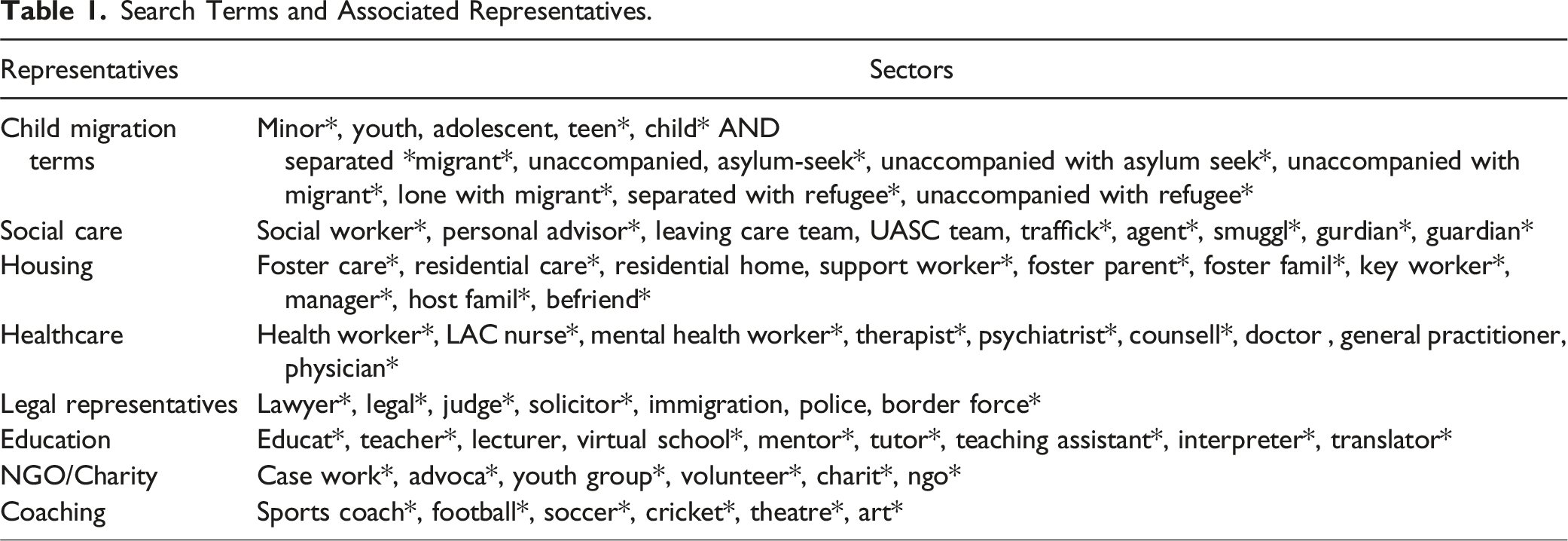
Search Terms and Associated Representatives.
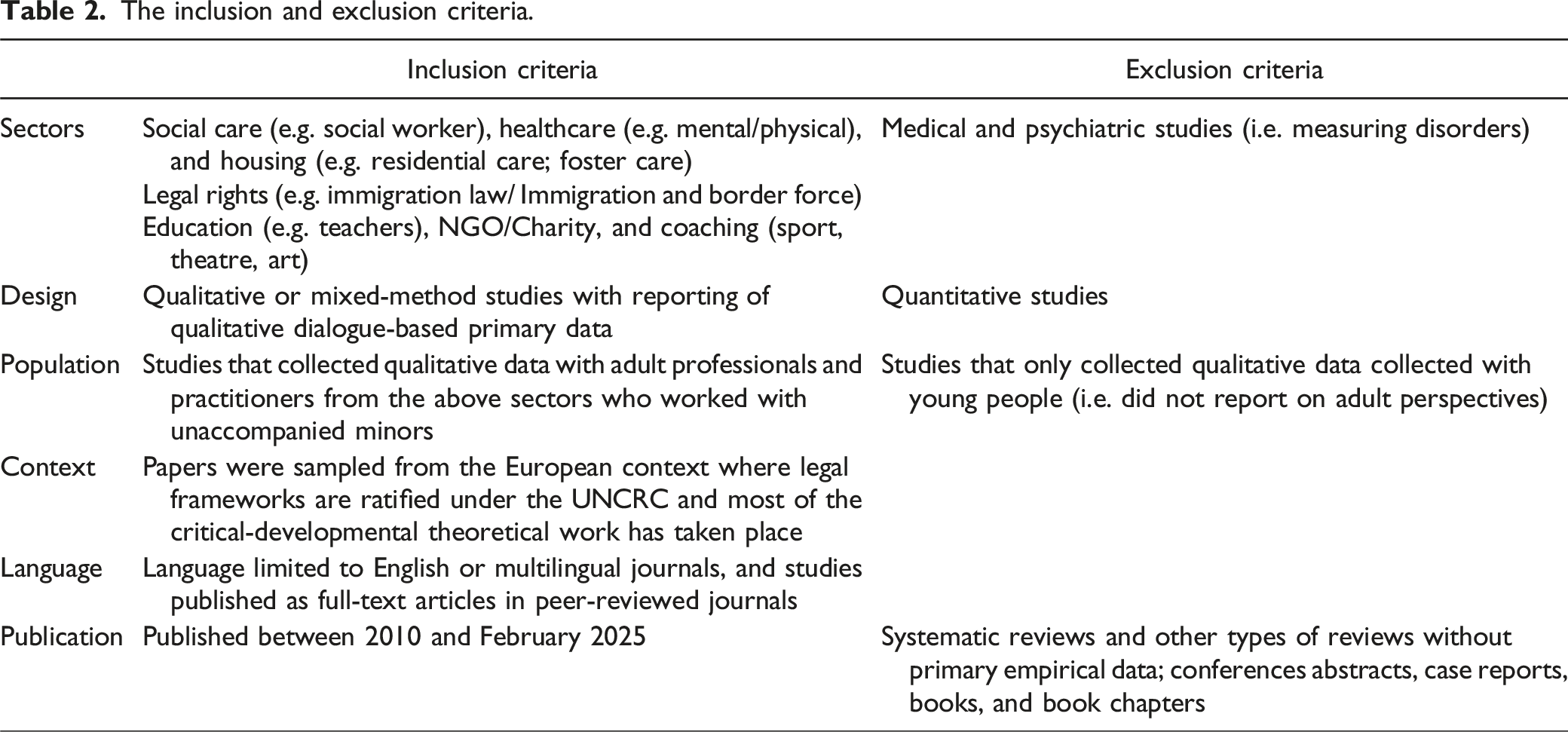
The inclusion and exclusion criteria.
Study Selection
Table 2 shows the inclusion and exclusion criteria. Our inclusion criteria covered the six key sectors of adult professionals and practitioners who are most involved in the care of unaccompanied minors. Two pilot searches were conducted to test the search terms in January 2021 and March 2022, using key articles expected to meet our inclusion criteria and minor changes were made before a final review of the papers took place in February 2025. Results were downloaded into the software package Covidence and papers were initially screened by title and abstract before the full paper was downloaded (see Figure 1). PRISMA flow char.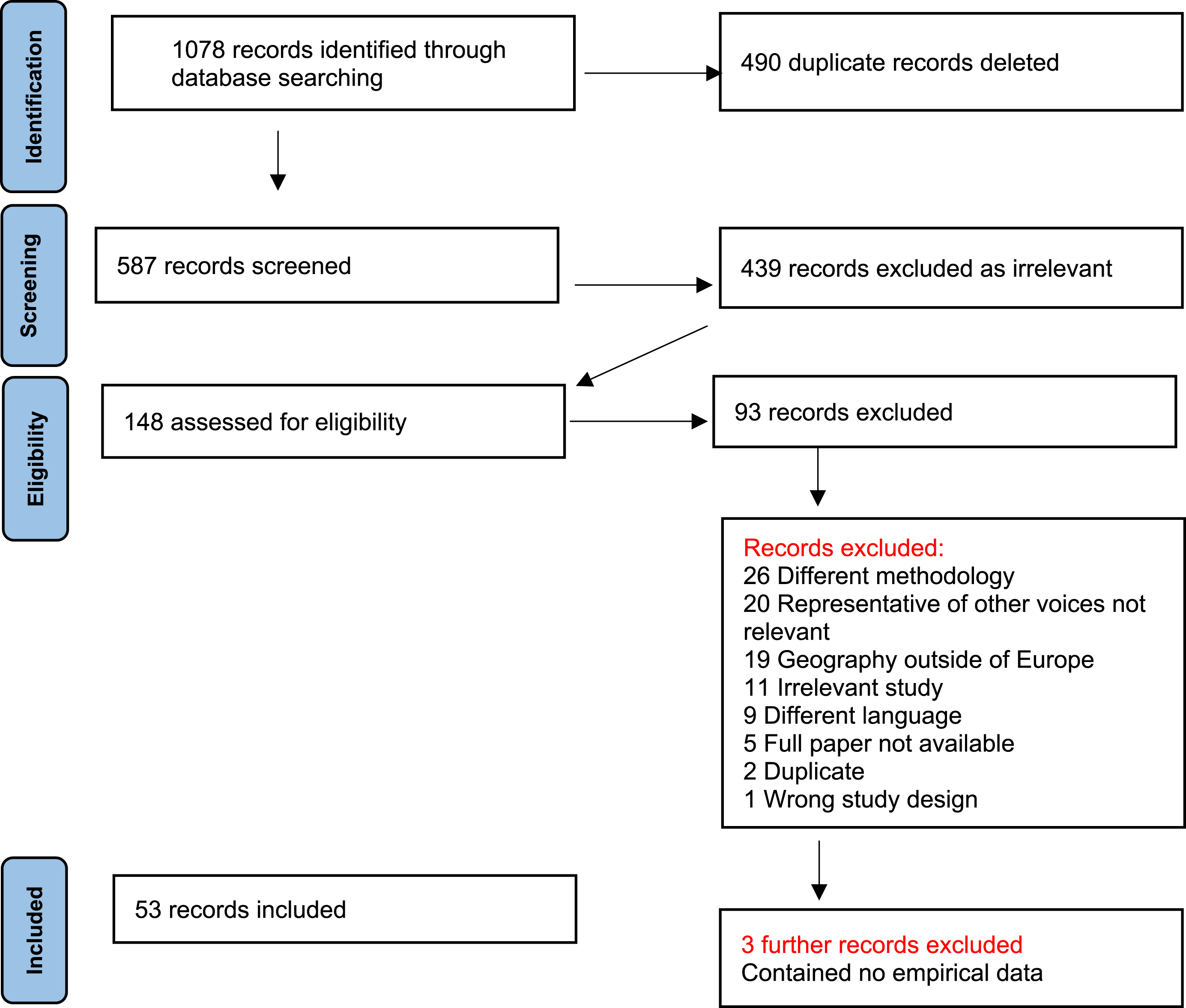
The rationale to begin the searches in 2010 relates to the significant rise in the number of unaccompanied minors entering the European Union from the summer of 2015 onwards; almost quadrupling from 13,8000 in 2013 to 96,000 by 2015 (Menjívar & Perreira, 2019). We sought to predate the significant rise in associated research publications around child refugees and asylum that followed from this movement (Salmerón-Manzano & Manzano-Agugliaro, 2019)
The process for identifying relevant papers is shown in the PRISMA diagram in Figure 1. The screening for eligibility were undertaken by the lead author and a researcher.
Characteristics of the Papers Included in the Meta-Synthesis.

Analytic Strategy and the Authors’ Positioning
The papers were analysed using a reflexive thematic analysis (RTA) which Braun and Clarke (2021) note refers not to a singular approach, but rather to a cluster of sometimes conflicting approaches, divergent both in procedure and underlying philosophy, but which share an interest in capturing patterns in data' (p. 333). We used a combination of deductive and inductive forms of thematic coding in that we approached our analysis with the theoretical assertions described above in mind. Namely, assertions about innocence, vulnerability and risk, demarcations between childhood and adulthood, and the ‘othering’ of diverse childhoods. However, we coded inductively through the lens of a critical-constructionist epistemology that sought meaning-making in the ‘data’. We did not treat the data as objective realities but social constructions which give meaning to generalised representations of children’s development and childhood. The team read a subset of six papers and individually coded and reported their analysis. We subsequently met across three intensive analysis meetings to discuss, amend, and refine those codes until consensus was reached. Similarities were accepted and differences were reflected on, and discussed with our theoretical approach in mind (see Figure 2). To be clear, we were not seeking coding reliability but engaged in a reflexive interpretive discussion for sense-making purposes. Later, refinements and amendments to the codes and themes were made by the first author as she read the remaining papers. The analytic themes and their related codes.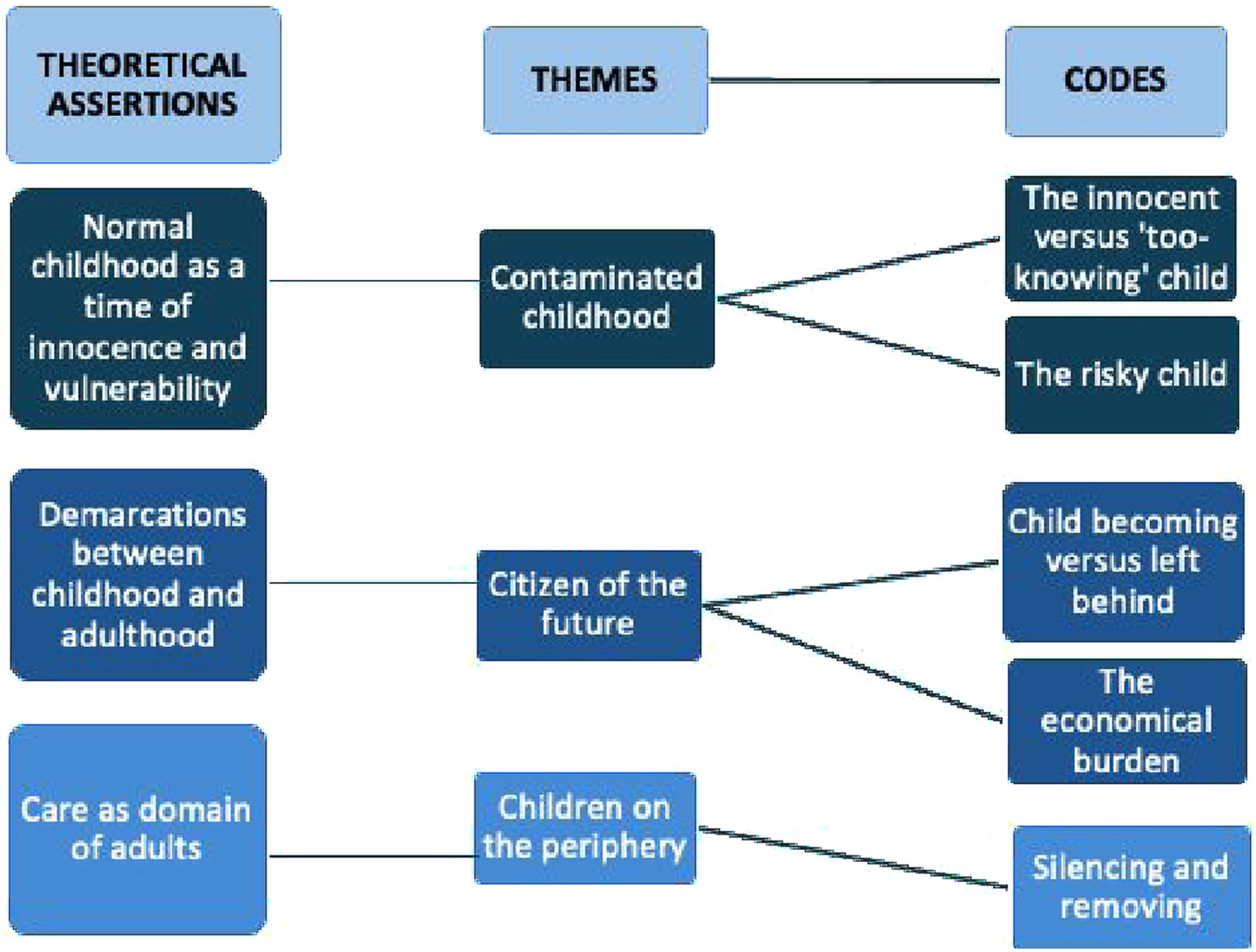
We put ‘data’ in inverted commas because we have the added complication of analysing at the levels of
Our analysis is a RTA because we have conducted our thematic analysis with ‘theoretical knowingness and transparency’ (Braun & Clarke, 2019, p. 594) accepting that the subjective skills of the researchers are brought to bear on the analytic process and conceptualised as a resource for knowledge production and meaning (Byrne, 2022). The team was comprised of four authors who were each affiliated with the Children Caring on the Move (CCoM) study (Economic and Social Research Council, ES/S00/980/1). The first author was the Principal Investigator on the Children Caring on the Move study (CCoM) and is a critical-developmental psychologist who has expertise in working with unaccompanied minors and children who language broker. She analysed the full papers according to the theoretically informed codes and themes. She was born in the United Kingdom. The second author was a Co-Investigator on the CCoM project and has expertise in foster care, evidence synthesis and is also a foster carer in her own home. She is born outside of the United Kingdom. She was responsible for creating and reviewing the search string and reviewed a small-sub-sample of papers for initial codes and themes. We were aided in the initial screening and reviewing of the sub-sample of papers by Ravi Kohli who was a Co-Investigator on the CCoM project who is a qualified social worker and academic. He describes himself as being an immigrant to the United Kingdom. The Post Doctoral Research Associate on the CCoM project had expertise in migration care chains and political economy of care analysis. She ran the search using the search string, uploaded the papers in Covidence, screened titles and abstracts, and collated the full papers. She also contributed to the initial screening and reviewing of the sub-sample of papers. She was born outside of the United Kingdom. All team members were located in the United Kingdom at the time of the study.
It should be noted that the theoretical assertions presented are highly interrelated and have been analytically separated as an illustrative device. As discussed above, the participants’ data in the primary study are the
Results
Contaminated Childhoods
This theme links to the conceptual issue raised by critical-developmental psychologists and indeed, critical childhoods scholars more widely, that childhood is idealized as a time of innocence, vulnerability, and protection. And yet, immigrant childhoods shine a spotlight on how heterogeneous children’s experiences of growing up may be (Orellana et al., 2001). Somewhat ironically, children are noticed the most when they step outside the bounds of what are considered appropriate ways of being and behaving (Crafter, 2023). The theme ‘contaminated childhoods’ reflects the threat to childhood innocence present in the discourses of practitioners, policy, and media representations of unaccompanied minors (Rosen & Crafter, 2018a; 2018b). If the normative assumption is that the ideal childhood is a time of innocence under the auspices of adult protection, it raises the question about what the counter positioning might be of children who are unaccompanied minors, travelling without kin, whose experiences place them in ‘adult-like’ situations. Having been ‘made aware’ of the more negative aspects of adulthood, it is their ‘too-knowing’ status that positions them as ‘risky’ – a threat to the ideals of the innocent child, a threat to the State for crossing into their borders and in some cases, a threat to other children. It is important to note then, that the ‘too-knowing’ child and the ‘risky’ child are interconnected.
The Innocent Versus the ‘Too-Knowing’ Child
For unaccompanied minors’ the chronological age of 18 years acts as a significant boundary marker between childhood and adulthood. So much so, that the social care and welfare assistances considered important for vulnerable children are, in many cases, suddenly and drastically withdrawn from one day to the next (Mishra et al., 2020). In terms of generalised representations of child development these boundaries are indistinct and fuzzy in practice. The discourses around the ‘too-knowing’ and the ‘innocent’ child are a good example. The perspectives of adults shown in some of these papers suggests they oscillated between protecting unaccompanied minors’ innocence because of their childhood status whilst treating them as ‘too-knowing’ because of their immigration status. Having been ‘made aware’ of adult-like issues through difficult migratory experiences, coupled with some entrenched systemic limitations for their care, led to some ambiguous treatment by adult professionals. In a study on sexual abuse and exploitation of unaccompanied minor children in Greece, some of those interviewed were explicit about the contradictions and ambiguities on the treatment of unaccompanied minors (Digidiki & Bhabha, 2018). One stakeholder told an interviewer ‘I have escorted unaccompanied children under the age of 15 to the park and I have seen older people approaching children in a suspicious way. Older children can leave the center without escorts. I don’t want to think what can happen to these children who walk around the city without the protection of escorts’ (first order construct, p. 116). Here, 15 years of age seemed to exist as a nebulous boundary between younger and, more innocent, children who are ‘escorted’ and so-called older children who become knowing of a world where anything ‘can happen’. As such, the child moves from a space of protection, into someone potentially contaminated by risk. Digidiki and Bhabha (2018) further argue that despite the young people’s resilience garnered on migration journeys, the system thwarts their efforts of autonomy which in turn, forces them into ‘too-knowing’ situations. Entering into a long and monotonous asylum process created barriers for accessing work and education, which led unaccompanied minors to be ‘routinely denied the opportunity to contribution meaningfully to the definition of their own future’ (second order construct, p. 117). Instead, they would turn to other financial and sometimes risky resources, such as sex work or illegal activity. As one psychologist the authors interviewed argued, in light of systemic failures, the children pursued whatever they thought best for them, leading them to ‘gravitate toward their own exploitation’ (first order construct, p. 117). The necessities of survival have a secondary consequence in the wider discourse about unaccompanied minors – moving the dial from the innocent child to risky child.
The ambiguous character of the boundary between the innocent and the too-knowing unaccompanied minor can perhaps be exemplified by the creation of the term ‘adult minor’ coined by Otto (2020) to depict the blurred borders between adulthood and childhood negotiated by young refugees and care workers in a state care facility in Malta. Otto argued that the care workers in her study created ‘shifting and oscillating self- and other positions’ (second order construct, p. 14), which placed the young people ambivalently as too mature, and at other times, too immature. For example, through the lens of age, care workers were described as seeing elaborate cooking as suspicious because the activity was perceived as a signifier of adulthood. One young refugee, Keyse, felt she was judged for using her money to buy books and is quoted in the paper as saying ‘They were surprised when they realised that always I sit in a corner and try to study…Angelica [a care worker] said to me that she thinks that refugees don’t buy books, but usually that we buy only new shirts and cigarettes’ (first order construct, p. 12). Otto argued this evidenced how staff ‘infantilised and racialised the young refugees and implicitly encouraged them to behave in a certain (childlike or ‘Somali’) manner’ (second order construct, p. 12). Equally, Otto reports that young people were sometimes denied support when they requested it (e.g. such as help finding a school) because they were deemed competent enough to manage alone.
Despite these indistinct boundaries showing themselves in practice, the State stringently uses 18 years of age to judge the shift between childhood and adulthood. The child representationally sits in a vicious lose-lose cycle where their lived experience transgresses ideals around children’s knowledge of the world but by virtue of becoming ‘too-knowing’ are framed as manipulating the system by attempting to seem younger (Basic & Matsuda, 2020). This is not a new finding, but remains a powerful thread through the discourses and representations of professionals reported in research spanning from 2010 to 2025 (the parameters of this literature search). Sørsveen and Ursin (2021), in their small interview-based case study with Norwegian Immigration Authorities point to the explicit invocation of normative assumptions about age through visual mapping of bodies, as one participant is quoted as saying ‘…does [the applicant] have a fully developed deep voice and course beard growth, hand-wrinkles, right?’ (first order construct, p. 204). Sørsveen & Ursin argue that meaning is ascribed to bodies and physical appearance that correspond to developmental understandings of what a body should look like at any given age, despite significant evidence showing that pubertal development varies widely depending on personal, cultural, and environmental factors. The authors detail quotes from their participants where instances of young people trying to make themselves look small were seen as manipulating immigration age assessors. The authors write ‘When applicants have had responsibilities that are seen as ‘un-childlike’ in a western society, their age is adjusted up’ (second order construct, p. 206). The authors make the case that Western ideals that demarcate the child-like body and the adult body was the conduit through which a ‘true’ childhood was understood by immigration authorities, situating young people along a spectrum between ‘at risk’ and ‘risky’’ (second order construct, p. 205).
The Risky Child
The ‘too-knowing’ child is framed as presenting a risk to other children, adults, and the nation State. In many of the papers, adult professionals were explicitly aware that immigration status and childhood status create competing and incompatible demands in ways that are known to be detrimental to unaccompanied young migrants. For example, in a study set in Greece, young people’s urgency to earn money to support themselves, send remittances home or pay off debt, arguably sat in direct contravention to dominant Western understandings of appropriate childhood activity (Kovner et al., 2021). As described above, children must be active and enterprising in order to survive and support themselves and their family, but also risk being positioned negatively because they lack the qualities of the innocent and dependent child-in-need. One quote from a Migration Officer, spoke to the way age-related shifts in perceptions of unaccompanied minors moved from a vulnerable discourse to a risky threat discourse: ‘The attitude towards the minors can range from sympathy and empathy, and as they grow older, they are perceived as a potential security threat, youth that will join criminal networks’ (first order construct, p. 13).
Sexual activity in childhood invoked in the discourses of adults a sense that the young people’s childhood had been contaminated by adult knowledge and concerns. However, rather than generating sympathy, thinking of children using their bodies as survival strategies was described as too painful for adults to examine, which led to a double exclusion; one because of their immigration status and another because of their sexual ‘knowingness’ (Digidiki & Bhabha, 2018). Returning to the study on sexual abuse and exploitation in detention centres in Greece, Digidiki and Bhabha’s (2018) interviewees, who included stakeholders working in large humanitarian organisations, psychologists, medical doctors, Government officials, and human rights lawyers, claimed that ‘child protection services and policymakers tend to maintain a “studied blindness” toward migrant children’s needs and rights beyond basic survival’ (second order construct, p. 117).
The risky unaccompanied minor as representative of a violent threat was also present. In a paper based in the United Kingdom, foster carers who had previously fostered citizen children but had not yet taken-in unaccompanied young migrants were influenced by negative media representations (Rogers et al., 2018). When six foster carers were interviewed in a focus group about why they didn’t foster unaccompanied minors, images of risk were foreground. One said ‘I am not racist by no means, but I just got something up in my head that all these children or so called children trying to come over here, I refuse to foster any of them, because I have just got it up here in my head that they will be up in their bedroom making bombs’ (first order construct, p. 110). The foster carers’ views softened when shown images, taken by the children, relating to their everyday lives, including playing in parks and on swings. This altered the foster carers views, which was seen positively by the authors. However, it can also be argued that this relied on presenting images of the ultimate performance of the ideal innocent childhood – playing on a swing. This suggests that in order to be fostered, unaccompanied young migrants must be able to ‘perform’ childhood in order to be accepted.
Citizens of the Future
This theme links to the conceptual issue of the demarcation between childhood and adulthood as emblematic of the steady transition to becoming an adult. Critical approaches to childhood have long highlighted the challenges associated with viewing children from a predominantly developmental (and often Western/Global North) perspective of ‘becomings’ rather than people in-the-now (see e.g. Lee, 2001; Mayall, 2000). In other words, there is a ‘future focus’ in the normalised framing of children and young people whereby they are dependent on adults until they reach an appropriate level of maturity and competence to be considered ready for an independent adulthood (O’Dell et al., 2018). The ideas associated with ideal maturational milestones were a strong thread through a number of papers in this review. However, these discourses played out in complex ways amongst the professionals when the discussion is about unaccompanied minors. The 'child becoming versus left behind' signifies how unaccompanied young people are caught in a juxtaposition between having to prove they will be a good contributing citizen in the future whilst also being framed as developmentally ‘behind’ their citizen peers and an ‘economical burden’ in the present.
Child ‘Becoming’ Versus Left Behind
When the citizen of the future is the dominant framing of the child in the present, this arguably under-emphasises concerns in the present. If some children are said to start their life at a lower rung of the social ladder than their more privileged peers, then unaccompanied minors, in metaphorical terms, seem to begin their climb in the basement. In their study with frontline workers in schools and accommodation centres in Sweden, Espersson and Westrup (2020) argue that the adults in their sample tried to provide the young people with hope for the future, whilst simultaneously anticipating and building-in failure or avoiding cruel optimism. One interviewee is quoted as saying ‘You really have to remind them the whole time that, in Swedish culture, you’re behind’ (first person construct, p. 120). Espersson and Westrup noted that school staff recognised that unaccompanied minors arrive in Sweden with a very varied educational history whilst simultaneously downplaying the young people’s dreams and goals, and detailing an overriding trajectory of limited pre-migration education which would inevitably lead to poor educational futures and poor job prospects. These authors did not specifically analyse this in relation to normalised developmental maturation but we would argue suggests an assumed disruption based on immigration status. As one frontline worker said ‘Even if they’d been 14 on arriving here, they still wouldn’t have had time to get into upper secondary school. So, for many of them, it probably looks as if they’ll have to do adult education, combined with some form of internship. If they’re lucky, and if they like their job practice, they might get a job’ (first order construct, p. 121)
Policies and practices that are fragmented or parsed out amongst different sector professionals seem to be either designed for future-oriented failure or the inevitable consequence of attempting to work in broken systems. It is difficult to understand the cause and effect but in reality, is likely to be cyclical. For example, in Italy, Migliarini and Cioè-Peña (2022) discuss how young people’s ‘illiteracy’ led educators to limit their time and attention towards young people whilst simultaneously proposing that it was the system which created the problems. In this context, educational services were described by the participants as fragmented, lacking in resources and monitoring mechanisms. Asylum-seeking and refugee children were encouraged to join adult education courses for learning Italian, rather than mainstream public schools. The authors argue that ‘While the purpose is to assimilate to the culture and society, the centres do not offer adequate opportunities for migrant and refugee children to socialize and interact with Italians. Thus, they further marginalise migrant children under the guise of assimilating them into Italian society’ (second order construct, p. 12). In England, unaccompanied minors were reported as being vulnerable to not being able to access mainstream education. Like in Italy, practice varied greatly, with some local areas incorporating young people into mainstream schools and others focused on language learning only, through community colleges (Ott & O’Higgins, 2019). Some schools were reported as resisting taking-on older teenage unaccompanied migrants by delaying the processing of paperwork until young people aged out after 18 years of age, or having stringent intake dates so a young person might be left without a school placement. These systematic barriers could have a significant effect on possibilities for the future.
The Economical Child
For unaccompanied minors, discussions about the 'becoming child' of the future could be linked to their status as a good or bad economical or financial investment. Unlike the framing of the ‘priceless’ child (Zelizer, 1994), who in developmental terms is worthy of long-term investment during the transition to adulthood; unaccompanied minors asylum status means they may be repatriated after they turn 18 years of age and their claim fails. Therefore, they are assessed in terms of whether they are financially worth the investment and their short-term prospects. More unique to unaccompanied minors, professional discourses featured additional emphasis on looking after finances and securing their legal status. Whilst futurism is a common aspect of developmentally-dominant ideals about childhood, and serve an important purpose in the transition to adulthood, for unaccompanied young migrants this is stringently tied to the measurability of ‘successful outcomes’. Meloni and Humphris (2019), who conducted a study with a range of professionals in the United Kingdom, argue that discourses frequently focused on the notion of a ‘bad investment’ through the discussion of successful outcomes represented by future contributions to society. As one social worker put it ‘You know you have made a difference if you can really see your role in the outcomes for a looked after child…what I want is for them to become a successful adult’ (first order construct, p. 3252). The authors describe how, when things were going well, social workers felt proud. However, when outcomes were negative, blame shifted to the young person in an individualized manner. One local authority manager explained ‘You have spent three years of money on a case, it has sat in the property doing bugger all and you have stopped accommodation and you have spent forty thousand pounds on it and you haven’t rationalized the aspect of return from a statutory perspective’ (first order construct, p. 3253). Off the back of this quote these authors argue that ‘By referring to a young person as ‘a case’ and ‘implying that ‘it’ is a waste of both time and money, he clearly reproduces neo-liberal narrative around cost-efficiency’ (second order construct, p. 3253). In other words, the unaccompanied minor is portrayed as an unstable developmental and economic investment. Unlike citizen-children, their uncertain future lowers the perceived priority of investing in their developmental needs. A similar point is made by Lems (2020) in a study with Swiss teachers working with unaccompanied minors. One interviewee addressed the class and lamented about the perceived lack of progress amongst the students telling them ‘With quite a few of you I have the feeling that you haven’t made any progress. It’s like you haven’t moved forward at all since you arrived in Switzerland. It’s like you don’t want to learn anything, as if you are just sitting off your time here’ (first order construct, p. 416). The author went on to say the teacher was ‘Tapping into a familiar Swiss narrative of refugees as lazy good-for-nothings who are just sitting off their time on taxpayer’s money’ and rather find fault in a difficult system ‘searched the fault in the students themselves’ (second order construct, p. 416–417).
In one study in this review, based in the United Kingdom, the author discusses how packages of support for unaccompanied migrants were available but strongly dictated by the relationship with their social worker or personal advisor 2 . As a consequence, the young person needed to prove they were ‘aspirational’ and therefore more deserving (Devenney, 2019). Although stability and consistency are often regarded as hallmarks of an ideal childhood, these accounts suggest that such considerations were given little priority when it came to unaccompanied minors. Instead, perceptions of their economic deservingness – or burden, depending on the perspective – took precedence.
Children on the Periphery
This theme links the conceptual assertations proposed in the introduction that representations of the ideal childhood position children with diverse experiences in ‘othered’ ways. Until relatively recently, social constructions of the ideal childhood centred around the western, white, heterosexual, nuclear family (Orellana et al., 2001). Whilst it is clearly the case that there are many non-traditional and diverse families, the illusion of the ideal childhood remains a fiction against which ‘other’ children are judged. Unaccompanied minors are outside of this ideal then, sitting on the periphery of a normative social representation because 1. They come from a different place and are carrying the normative expectations of a different culture; 2. Through the trials of migration have adopted or created new developmental norms for themselves and 3. As previously discussed, may have endured ‘adult-like’ experiences, which might be framed as abnormal, perhaps even pathological. We coded this sense of othering as ‘silencing and removing’ young people through a variety of negative everyday practices and immigration initiatives. This included physically moving young people to spaces and places that can impinge on their interaction with mainstream society.
Silencing and Removing
Unaccompanied minors often arrive into new nation states with a variety of intersecting challenges relating to disruption to their education (as noted above), mental health challenges, language barriers, the fact they do not reside with biological kin and moreover, have travelled alone across borders. A number of authors in this review drew attention to systemic discrepancies in support for unaccompanied minors, including programs that are originally designed to be supportive but instead position unaccompanied minors as a social problem. Different types of residential care provision provide one interesting example. Across Europe, different nation states have developed their own mechanisms for housing unaccompanied minors. They include foster care (Mörgen & Rieker, 2022), residential care (Basic & Matsuda, 2020; Omland et al., 2021), reception or detention centres (Digidiki & Bhabha, 2018; Galloway et al., 2015), and semi-independent or unregulated accommodation (e.g. hostels, hotels) (Humphris & Sigona, 2019). The pros and cons of these different forms of residential care have been hotly debated. In some cases, the authors argue that some forms of residential care actively isolate young people and place them on the ‘periphery’ of their community or society. In the United Kingdom, for example, there has been a rise in the development of private for-profit residential accommodation which specifically cater for unaccompanied young migrants. Whilst this enables young people to be together and support one another, others argue it separates children from wider society, and provides the state with greater powers of surveillance and easier access to young people for deportations and age-based forced removals. In a study by Humphris and Sigona (2019) housing support workers witnessed Home Office immigration officials entering accommodation for deportation purposes. One said ‘It was horrendous…Yes I mean he was in tears, kind of begged me to stop them, but I couldn’t really do anything’ and in the same quote they added ‘We can’t hide them or stop them from coming into our house, stop the Home Office from coming to our houses. It is a very difficult position to be in’ (first order construct, p. 325). A similar argument was made about residential care in Sweden (Sundqvist et al., 2016) where social workers sought to distance themselves from the Swedish Migration Board because of repatriation activities ‘I assume my responsibility and have not taken it as my responsibility to care about how the police do their job’ (first order construct, p. 911). However, repatriation activities still occurred (i.e. forced removals) regardless of social workers or legal guardians knowledge.
Social relationships, such as the care connections through friendship, were rarely taken into account in immigration policy initiatives. In other words, decisions about where to place children for different forms of housing were not always taken seriously or as something that would only temporarily affect young people (Omland & Andenas, 2020; Rosen et al., 2021). Rosen et al. (2021) detail the negative consequences of the National Transfer Scheme in the United Kingdom, which is a Government initiative to ensure a more ‘even distribution of caring responsibilities across the country’ 3 . In practice, this led to separating groups of friends who undertook migration journeys together, resulting in a significant emotional toll. This quote from a staff member at an advocacy organisation who witnessed this separation describes how ‘They were all being taken apart, literally being dragged apart, screaming, holding hands with their friends saying, I’m never going to see you again’ (first order construct, p. 1655). Within developmental psychology, socialising, and friendship would be perceived as an central feature of childhood. However, within immigration regimes and practices, these factors are often overlooked in decision-making about children’s care.
Spaces and places are key demarcations for young people’s ‘othered’ status and this most acutely plays out in spaces such as asylum courts, refugee camps, and residential care in deprived neighbourhoods, where young people rarely venture beyond their own tight borders within large cities (Moberg Stephenson & Källström, 2020). As one young unaccompanied minor reports in their study ‘I feel comfortable because I’m familiar, I go to school [in this area] and I live [here] too, and I know many [people] who can help. I do not know any other place’ (first order construct, p. 745). Overall, many of these spaces are decidedly not designed for children in mind. Digidiki and Bhabha (2018) describe how vulnerable children in refugee camps are forced to live with the adult population. Some camps created ‘safe zones’ in response to concerns for children’s safety and fears of sexual exploitation. However, the authors’ informants told them that space was limited, which excluded some young people and even then, facilities lacked the provision of basic security. This begs a question about which children might represent the most deserving or underserving of being in, or out, of the safe zone.
It is notable that when problems occur for unaccompanied migrants, it is often the young people who are forced to move or make the change. In their study of residential care in Sweden, which caters for young people with wartime experience, positive stories of empathy as support amongst the personnel were also accompanied with examples of belittlement and abuse (Basic & Matsuda, 2020). In one example of a violent episode by a member of staff, an interviewee described how both the staff member and the young person were removed from the care home. One study based in Greece details the unofficial practice of ‘pushbacks’ by police officials which are well-known to social workers, lawyers, and other professionals from non-governmental organisations interviewed in this study. In some cases this meant police officials did not register the children and in one extreme example cited by the authors, the young people were placed back into a dinghy and pushed back out to sea (Kovner et al., 2021). One social worker described how police officers visiting detention centres assumed they are in protective custody because of criminal activity ‘It’s very difficult for children to understand the whole concept of protective custody – being treated like criminals and then being told they are not’ (first order construct, p. 9). In these examples, it is notable that young people are often forced, or feel they have no choice, but to move across spaces and places.
In the legal context of immigration and asylum appeals in the United Kingdom, Campbell (2020) found that other intersecting vulnerabilities, such as the young person having learning difficulties, were ignored during asylum appeals. In contradiction, lawyers had the power to seek minutia detail from young people regarding their migration decisions, which young people found difficult to recall. Overall, these kinds of practices minimise young people’s ability to understand what is happening to them and in turn, exert any kind of agency over their lives and means they exist on the edge of unpredictable possibilities. Their existence on the edge of the periphery suggests that unaccompanied minors are constantly engaged in a marginal existence where problems are either not attended to, or only occur in bursts, and not necessarily in a positive way.
Discussion
To our knowledge, our review is the first study to provide an in-depth analysis of how generalised representations of children’s development and childhood be articulated in scholarship about professional practice with unaccompanied minors. We drew on theorizing from critical-developmental psychology and took as our foundation, the idea that generalised representations of children’s development and childhood that are socially constructed, and imbued with sense-making about what a ‘normalised’ or ideal childhood might look like (Burman, 2016; O'Dell, 2015; O’Dell et al., 2018). These centre around a set of universally experienced, normative, and aged-graded benchmarks, against which children are judged. We drew on three interconnected assertions from the critical-developmental theoretical arena to support our analytic points. The first assertion is that there is a naturalised representation of childhood as a time of innocence, vulnerability and protection. The polemical to the innocent child is the risky child (Robinson, 2013). The second assertion was that representations of child development and childhood suggest a clear demarcation between childhood and adulthood in the steady transition to adulthood, which is not reflexive of the lived experiences of many children, including unaccompanied minors (Crafter et al., 2019). This links to the final assertion relevant to this paper, which is that those who experience childhood difference are ‘othered’ in ways that risks pathologizing them and decontextualising their lives (Burman, 2006).
We report on three highly interconnected themes. The first theme ‘contaminated childhood’ suggested that adults working with unaccompanied minors sometimes positioned children as the counterpoint to the idealised, innocent child, because their migration experiences set them up as ‘too knowing’ or risky. This theme laid bare the fuzzy boundaries in practices exercised by professionals. It is well accepted that age assessments centring on 18 years of age can negatively impact on young people’s access to child-oriented care services (Allsopp & Chase, 2019). However, this review showed that in reality there could be a further breaking-down of representations of age by creating another category of the younger child and older child (Otto, 2020). These kinds of practices show that the delineation between perceptions of the innocent to the risky is not clear-cut and sometimes led to ‘older children’ being placed in precarious positions. The distance between the vulnerable discourse to the threat discourse could be rapid and used as a test for denying young people services or supporting practitioners own cultures of disbelief. Whilst any suggestion of sexual activity in childhood is usually seen as a key transgression for the ideal childhood, in the case of unaccompanied young people it has been used as a weapon by the state to reject age assessment claims (Crawley, 2011), which in turn, deprived unaccompanied minors of additional services usually provided to children. Equally, the fact that they had migrated alone led some practitioners to represent unaccompanied minors as ‘more mature’ and therefore, in less need of support with major tasks like registering with a school (Otto, 2020). In other instances, the ‘too-knowing’ unaccompanied minor was also presented as a risk, not just to other children but also to the nation state (Digidiki & Bhabha, 2018).
Our second theme ‘citizens of the future’ linked to the critical-developmental theorizing about the clear demarcation between childhood and adulthood. This reflects a framing of children as being in a process of ‘becoming’, rather than an autonomous being positioned as a bearer of their own rights (Lee, 2001; Qvortrup, 2004). Unaccompanied minors are inevitably judged by what counts as a successful outcome as a future citizen. Of course, all children are to some extent benchmarked on outcomes compared to their same-aged peers, mostly through the education system. However, unaccompanied minors are double benchmarked by being judged against the success of their citizen peers but also judged by a set of societal expectations for the kind of contributing citizen they should become. This analysis shows that unaccompanied minors face greater barriers because they are thought to start from a position of the ‘left behind’, and often struggle to access high quality resources and provisions that can be cut-off in their transition journey by the vagaries systems that stymie their progress (Espersson & Westrup, 2020). Moreover, in the present and the future, the discourses by adults surround their transitions to successful adulthood are linked economical or marketized terms (Humphris & Sigona, 2019).
The final theme of ‘children on the periphery’ linked to the assertion that children who experience a form of ‘difference’ in their childhood risk being ‘othered’ because they transgress the norms of the idealised childhood. We argued this is done through ‘silencing and removing’ either symbolically in the way they were represented and discussed or physically, by placing them in ‘othered’ places and spaces away from mainstream society (Sundqvist et al., 2016). Silencing can take a number of forms, such as deportation raids on residential care, or giving little discussion or advice about legal counsel during asylum appeals (Campbell, 2020). Physical spaces and places could also enact a form of silencing as some of the authors in this review talked about placing unaccompanied on the outer edges of cities (Moberg Stephenson & Källström, 2020), removing young people from parks and residential care, breaking up friendships, or treating them with suspicion (Rosen et al., 2021) and in one extreme example, pushing children back out to sea in boats (Kovner et al., 2021).
Limitations
This review has provided valuable insights into how concepts and ideas from the field of developmental psychology have become interwoven through the discourses and practices of practitioners working with unaccompanied minors. It does, however, have some limitations that can be considered methodological. Methodologically, our inclusion criterion was quite wide for a qualitative meta-synthesis, but we deliberately cast a wider net on the variations across sectors in our review. Previous synthesis reviews either focused predominantly on social work and/or foster care, or mental health, and very few focused on the role of adults. Although our analysis did not seek to do a comparative analysis of the different sectors in terms of particular social representations of children’s development and childhood, our thematic analysis suggests they appear across all the sectors included in this review. Similarly, following our reviewers’ suggestions, we limited the range of countries to Europe to reflect the nuanced differences in terms of the immigration regimes, policies, and practices for working with unaccompanied minors. Equally, it could be argued that generalised representations of child development and childhood are dominant in other countries, either relating to similar histories of child protection movements or through the influence of colonialism, which another paper for the future.
Conclusions
This paper has provided an extensive qualitative evidence synthesis of scholarship about practice of the care of unaccompanied minors. Through a theoretical lens of critical-developmental psychology, we wanted to examine the generalised representations of children’s development and childhood from across six key sectors in the European context. Our findings suggest that generalised representations of children and childhood are drawn-on by adult practitioners as a form of sense-making about the lives and lived experience of unaccompanied minors. We argue that these are enfolded into other influential aspects such as their roles and responsibilities, wider socio-political and economic agendas, immigration regimes, personal values, and media representations (Crafter et al., 2021). We have shown in this review that there can be negative consequences in the use of generalised representations of children and childhood, which directly impact on the care decisions and practices affecting unaccompanied minors. Moreover, this literature review has shown that they have remained a consistent and fairly intractable presence in the practice-based work with unaccompanied for over a decade and across several sectors. This has led us to ask: Is the answer to provide a better understanding of developmentalism aimed at a range of practitioners? If so, what kind of developmentalism are we going to communicate? How do developmental psychologists avoid communicating the pitfalls of the idealised childhood discourses that this review has shown can sometimes work against children living in diverse situations? Could ideas from critical-developmental psychology help practitioners re-focus the prism of their practice?
Firstly, we argue that by taking an interdisciplinary examination of this field across a range of sectors, developmental psychology has much to offer in helping to advocate for marginalised children like unaccompanied minors. Most markedly, by providing a better understanding of children’s development through training and awareness-raising. However, we suggest that more importance should be assigned to the word ‘critical,’ in the field of developmental psychology and shared across disciplinary boundaries, particularly with social work. Notwithstanding the excellent seminal work of key critical-developmental psychologists, some of whom are cited within this paper (see e.g. Burman, 2016; O'Dell et al., 2018), work in the field of critical-developmental psychology has arguably been slowing down. Whereas other areas of critical approaches to psychology, such as critical-health psychology, appear to be flourishing in ways that can be truly impactful (Locke, 2022). By communicating a critical-developmental psychology approach to children’s development to practitioners, we have potential to improve understandings of diverse maturational development, to view children as socio-politically, historically, and socioculturally situated. To this end, members of the Children Caring on the Move team have created a reflexive online training course aimed at social care practitioners, which could be widely expanded to other sectors 4 .
Secondly, we propose that in communicating critical-developmental understandings of children and childhood, we will enable a deeper mindfulness and reflection in challenging concepts that are misappropriated in ways that inadvertently, or sometimes deliberately, disadvantage children. Adults ‘careful tending’ of the developing child discourse breaks down when the lens of focus is on the unaccompanied migrating child. Instead, they become the marketized object and the developmentally ‘out-of-sync’. Either too mature, not mature enough, too behind, or too advanced. We could go a step further to say there remains significant work to be done by ensuring that developmentally oriented notions get deployed, harnessed, and implemented in ethical ways in the world of practice. Our own team have begun to make small, but hopefully impactful steps in this direction in the United Kingdom, through the evidence-informed online reflective training for social care practitioners (Crafter & Prokopiou, 2023).
Thirdly, this raising-awareness work goes far beyond the impact on unaccompanied minors. There are numerous examples of children’s lived experiences that transgress into adult territory across the global north and the global south – young carers, child language brokers, child workers, and children who experience child sexual abuse, are just a few examples. Like unaccompanied minors, many children with diverse or different life experiences can find that generalised representations of viewing childhood can significantly, and sometimes deliberately, work against them. We argue that critical-developmental psychology can play an important part in delivering to practitioners across a variety of sectors, critically reflexive practice on how framings of children development and childhood can be used to improve their care.
Footnotes
Acknowledgements
We would like to thank Professor Ravi Kohli and Dr Sayani Mitra for their support with early discussions about this paper. I would like to thank Beverley Collins for her support collating and organising article information. We would also like to thank the Economic and Social Research Council (ES/S001980/1) for funding our project, Children Caring on the Move.
Declaration of Conflicting Interests
The author(s) declared no potential conflicts of interest with respect to the research, authorship, and/or publication of this article.
Funding
The author(s) disclosed receipt of the following financial support for the research, authorship, and/or publication of this article: This work was supported by the Economic and Social Research Council; ES/S001980/1
