




Abstract
This article proposes a sketch of a new theory of wisdom based on the tree of philosophy (TOP) model. It is argued that philosophy—love of wisdom—has developed branches over the millennia that reflect the different aspects of thought and action that need to be considered in a comprehensive theory of wisdom. Although there is not a full consensus on what these branches are, the TOP usually has as branches, at minimum, metaphysics—including epistemology and ontology—and ethics, logic, aesthetics, hermeneutics, and axiology. Each of these branches is considered, and its implications for a philosophically based theory of wisdom are considered. Whereas some other theories of wisdom attempt to synthesize recent psychological attempts to understand wisdom, the TOP theory attempts to synthesize the contribution of millennia of philosophical inquiry.
Keywords
Who is wise, and why? This article proposes a sketch of what is here called the TOP (tree of philosophy) theory to address this question. Philosophy means, literally, “love of wisdom.” In a sense, then, philosophy provides a discipline seeking understanding of wisdom with roots stretching back to ancient times, not only in the West (e.g., Socrates, Plato, and Aristotle), but also in the East (e.g., Confucius, Mencius, and Dong Zhongshu) (Kidd, 2017; Kraemer, 2011; Moore, 2019). The presentation of the new theory here is referred to as a “sketch” because a full discussion of the TOP would take more space than a journal article could possibly afford.
The TOP theory is based on the assumption, not used in previous theories of wisdom, that the organization of philosophy—love of wisdom—that has evolved over literally thousands of years is not a matter of happenstance and is not merely circumstantial. Rather, it represents a long-term, trial-and-error learning process that provides a conceptual and taxonomic basis for understanding the nature of wisdom. The longevity in the development of the TOP does not mean it is inherently valid; rather, this longevity suggests that the TOP has heuristic value, which is about the best one can hope for in the organization of knowledge, given that there is no one “right” organization. Although there is no one “tree” of philosophy that represents a total consensus as to its branches, this article presents one tree that is representative of many such trees.
One way of finding out who is wise is to ask people. When participants in a research study were asked to nominate wise individuals, the top five individuals were, in order, Gandhi, Confucius, Jesus Christ, Martin Luther King, and Socrates (Paulhus et al., 2002). Although the study was done more than two decades ago, the list still might seem to be quite reasonable.
A more recent study, which focused primarily on wisdom (Weststrate et al., 2016), came up with a related list—in descending order from the top: Mahatma Gandhi, Jesus Christ, Abraham Lincoln, Martin Luther King Jr., Winston Churchill, Thomas Jefferson, Socrates, Albert Einstein, Mother Teresa, Barack Obama, King Solomon, Benjamin Franklin, and Nelson Mandela. Many of these individuals had serious problems in their own personal lives (e.g., extramarital affairs, maltreatment of a spouse, and failures in care of others), showing that general wisdom can be, and often is quite different from personal wisdom in one’s own life (Ferrari & Weststrate, 2013).
Weststrate et al. (2016) further found that two dimensions seemed to underlie the nominations: rationally guided versus emotionally guided wisdom and pragmatic versus transcendent wisdom. Three clusters of wise people were labeled practical, philosophical, and benevolent.
These results suggest that wisdom is not a single thing. For example, Staudinger (2019) and Gluck and Bluck (2013) made a distinction, mentioned above, between general wisdom, which applies throughout a variety of situations in life, and personal wisdom, which applies to one’s own life. Many others have made variations of this argument (Ferrari & Weststrate, 2013). In Book VI of Aristotle’s Nicomachean Ethics, a distinction is made among: Sophia, which is found in those who seek a contemplative life in search of truth; Phronesis, the practical wisdom shown by statesmen and legislators; and Episteme, found in people who seek to understand the world from a scientific point of view. Aristotle also spokes of the importance of “techne” (skill) and “nous” (intellect).
There are diverse views. Kraemer (2011) discovered at least 6 themes related to wisdom in the Platonic Dialogues (Plato, 2007). Moore (2019) identified 10 distinct meanings of philosophia in Aristotle (1984), including an exercise of cleverness, leisurely study, the desire to know, the pursuit of fundamental explanation, and an historically extended discipline.
In recent years, a number of different theories of wisdom have been proposed (see recent reviews in Sternberg & Glück, 2022a, 2022b; Sternberg & Karami, 2021). There have been different approaches to how one can formulate a theory of wisdom.
Some Extant Theories of Wisdom
There are a number of theories and theories of wisdom (see also Glück & Weststrate, 2022; Grossmann et al., 2020; Zhang et al., 2022). These theories differ in their content and on the basis of which they were proposed.
Personal-Characteristic Theories: Who a Person Is
One way of proposing a theory of wisdom, at least in psychology, is essentially stipulative with respect to personal characteristics. A scholar reviews the literature on wisdom and perhaps draws as well on their life experience, and then stipulates what they believe wisdom to be in terms of personal characteristics.
Examples of Personal-Characteristic Theories
Personal-characteristic theories attempt to describe who is wise and what they are like. Using multidimensional scaling techniques, Sternberg (1985b) analyzed laypeople’s conceptions, or so-called “implicit theories,” of wisdom. His analysis produced six factors: reasoning abilities, sagacity, learning from ideas and environment, judgment, expeditious use of information, and perspicacity.
Explicit theories are theories proposed by experts in a field. One of the earliest and well-known examples of using this approach was based on the notion that wisdom is essentially knowledge of the pragmatics of life. In particular, the late Paul Baltes and his colleagues (Baltes & Smith, 2008; Baltes & Staudinger, 1993, 2000) proposed the “Berlin wisdom paradigm,” which stipulates that wisdom comprises five essential elements: factual knowledge, procedural knowledge, lifespan contextualism, relativism of values, and awareness and management of uncertainty.
Monika Ardelt (2003, 2004) and Ardelt et al. (2018) suggested that the Berlin paradigm is too cognitively based. Ardelt proposed instead that wisdom incorporates three fundamental kinds of processes—cognitive (as in the Berlin paradigm), but also reflective (metacognitive) and affective. This view is similar to one proposed earlier by Clayton and Birren (1980). Gluck and Bluck (2013) proposed what they called the MORE theory of wisdom—
Potential Advantages of Personal-Characteristic Theories
Personal-characteristic theories have been relatively popular as bases for understanding wisdom. First, they enable one, at least in theory, to identify who is wise, in varying degrees. Second, they tend to be the kind of theories that lead themselves most easily to producing measures—the measures of the alleged traits that constitute wisdom. Third, they are simple, or at least, uncomplicated: They provide a fairly straightforward list of things to look for in a person who might be labeled as wise.
Potential Challenges of Personal-Characteristic Theories
Like all kinds of theories, personal-characteristic theories pose potential challenges. First, the theories, in the end, reflect the theoretical or even ideological preferences of a particular theorist or group of theorists. For example, Paul Baltes viewed wisdom as a kind of expertise in the pragmatics of life (e.g., Baltes & Staudinger, 2000)—how does one live and what does it all mean? This is a reasonable conception, but it represents one person’s conception. Another expert, for example, Monika Ardelt (2003), believed Baltes’s theory to be too exclusively cognitive and expertise-based.
Second, it is not entirely clear how such a conception of wisdom can be disconfirmed. One can make plausibility arguments one way or another, but when there is no clear criterion against which to construct-validate conceptions of wisdom, how does one decide which expert is correct? One can correlate different tests of wisdom against each other, such as the Situated Wise Reasoning Test (SWIS—Brienza et al., 2018) and the Self-Assessed Wisdom Scale (SAWS—Webster, 2003). This correlational procedure is used for tests of intelligence in the intelligence literature, but how does one know that any of the tests measure wisdom (or intelligence, for that matter)? And real-world behaviors are not always easily characterized as wise or not. It is not clear how the theories can be falsified—what set of empirical results would show them to be invalid, as opposed to, say, less heuristically useful or paradigmatically acceptable to a particular set of psychologists or other behavioral scientists?
Third, people can have traits but not express them in action. Someone could have the traits of a wise person, but never actually act on them. Would a person who scores highly on a test of wisdom but who never acts wisely legitimately considered to be wise?
In a way, the theories considered here are like psychometric theories of intelligence (e.g., Carroll, 1993; Cattell, 1971), in that they define wisdom in terms of the characteristics of a person. A different approach starts not with the characteristics of the person, but rather with what the person does.
Process-Based Theories: What a Person Does
A process-based theory looks at what a person does rather than who the person is. Rather than being trait-based, it is cognitively-based. How does a wise person think and act?
Example of a Process-Based Theory
Robert J. Sternberg (1998, 2019b) has proposed a balance theory of wisdom. According to this theory, the essence of wisdom is that it involves the seeking of a common good. Thus, wisdom inheres in what a person does, not in who a person is. In particular, the wise person seeks a common good by balancing intrapersonal (their own), interpersonal (others’), and larger (community, state, national, international, global, and universal) interests; over the long-term as well as the short-term; through the infusion of positive ethical values; by adapting to, shaping, and selecting environments. In this theory, wise people know what they know, but also what they do not know, what they can know, and what they cannot know, given the current state of knowledge (a point of view shared with Swartwood & Tiberius, 2019). The balance theory now can be seen as a subset of the TOP theory of wisdom. That is, it is that part of the TOP theory that deals with processing toward the wise goal of achieving a common good. Thus, the TOP theory supersedes the balance theory.
The process-based point of view is related to the information-processing view of intelligence, which emphasizes how people process information to be intelligent—in other words, it is what they do that makes them intelligent (Conway & Kovacs, 2020; Ellingsen & Engle, 2020; Engle, 2018; Nettelbeck et al., 2020; Sternberg, 1985a). On this view, intelligence is not a trait but rather an effective way of processing information that a person may exhibit more or less consistently.
Potential Advantages of Process-Based Theories
A process-based theory has several advantages. First, it characterizes what people do rather than merely who they allegedly are. Second, it enables one to evaluate actions as wise or not, in the case of the balance theory, in terms of whether the actions help to achieve a common good by balancing one’s own, others’, and higher interests. Third, it is testable in terms of whether actions alleged to help achieve a common good actually do achieve objectively better outcomes, on average, for all parties to a conflict or other situation drawing upon wisdom.
Potential Challenges of a Process-Based Theory
A process-based theory, like a trait-based theory, has challenges.
First, the theory describes processes by which wise judgments are made and wise behavior is enacted, but it does not specify who is likely to make the judgments or enact the behavior. Part of a psychological theory, one might think, would be to identify the people most, or at least, more likely to think and act wisely.
Second, it is far easier to talk about seeking a common good, or balancing interests, than it is to specify in any particular situation what the common good is or what would constitute a balancing of interests. If two or more people disagree about what constitutes a common good, how would one know who is right?
Third, a process theory might need to separate process from the question of who is wise. For example, someone might act in a way that does indeed achieve something approaching a common good, but does that mean they are wise as a person? They may have gotten to the common good by being lucky, or by listening to someone else, or by some kind of analytical process that bypasses important human values.
Synthetic Theories: Combining What Other Scholars Have Proposed
Another approach to formulating a theory of wisdom is to look at what other scholars have said and then to combine their ideas in some way to come up with a new synthesis. The creativity, then, is in the synthesis of ideas (Sternberg et al., 2003). Consider three examples of synthetic theories.
Examples of Synthetic Theories
Karami et al. (2020) proposed a Polyhedron Theory of Wisdom (PMW). Its elements are knowledge; reflectivity and self-regulation; pro-social behaviors and moral maturity; openness and tolerance; sound judgment and creativity; and dynamic balance and synthesis. Additionally, Grossmann et al. (2020) have proposed a “common” theory of wisdom, which combines aspects of previous theories—balance of viewpoints, epistemic humility, context adaptability, and multiple perspectives. Another integrative theory has been proposed by Glück and Weststrate (2022). According to this theory, noncognitive components of wisdom (which include an exploratory orientation, concern for others, and emotion regulation) moderate the effect of cognitive components of wisdom (knowledge, metacognitive capacities, and self-reflection) to produce wise behavior.
Proposed Potential Advantages of Synthetic Theories
Synthetic theories have several advantages. First, synthetic theories can be more comprehensive in the aspects of wisdom they consider than are either trait-based or process-based theories. Second, they combine the features of both trait- and process-based theories, so they can display the best features of each. Third, they allow the theorist to highlight the interactions of processes with traits—how processes potentially can express wisdom differently in persons with different traits.
Potential Challenges of Synthetic Theories
Synthetic theories have many advantages, and yet they also have potential challenges. First, they can be no better or broader than the perspectives they synthesize. For example, the trait and process theories described above are all psychological and hence represent wisdom as viewed from the perspective of (modern Western) psychology, which tends, for example, to emphasize the individual and to deemphasize social forces, which are more the province of sociology and other fields. Second, if the syntheses are based on existing trait and process theories, those theories often represent particular perspectives, even within a discipline, such as Euro-American perspective of the late 20th and early 21st centuries. The perspectives may be culturally or temporally limited by their provenance. Third, the perspectives, or at least those that have arisen through psychology, seem largely to ignore the perspectives that have arisen over the millennia through a different discipline that is particularly oriented toward the study of wisdom, namely, philosophy.
Philosophical Perspectives on Wisdom
The Stanford Encyclopedia of Philosophy provides some of the major philosophical perspectives on wisdom (Ryan, 2020). Here are some of the major ones.
Epistemic Humility Theory
One perspective, tracing back to Plato in The Apology (20e–23c), is that of epistemic humility (Ryan, 1996), also included in the Grossmann et al. (2020) psychologically based theory. In The Apology, the Oracle at Delphi describes Socrates as the wisest person, but Socrates believes himself to know very little. Talking to people in a variety of life pursuits, Socrates discovers that they know far less than they claim to know—perhaps an earlier version of the Dunning-Kruger (Kruger & Dunning, 1999) effect, whereby those who claim to know the most, know the least. On this theory, any self-report measure of wisdom is likely to be flawed, as those who rate themselves higher might thereby be seen not as wiser, but rather, as less wise. Truly wise people, like Socrates, rarely consider themselves to be wise.
Epistemic humility is almost certainly essential, or necessary for wisdom. At the same time, it is not sufficient. Someone could be epistemically humble because they have little intellectually to offer. Moreover, epistemic humility, while an ingredient of wisdom, is not the only ingredient. For example, a person could be epistemically humble but in the absence of any orientation toward the common good or of compassion or caring for others, might be viewed as less than wise.
Epistemic-Accuracy Theory
A second philosophically based view of wisdom is epistemic-accuracy theory (Ryan, 2020), whereby people are wise to the extent that they know what they know and what they do not know (see also Sternberg, 1998, who argued that wise people know what they know, what they do not know, what they can know, and what they cannot know, at a given time and place). However, one can almost never know for sure what one does and does not know. We are always limited by the knowledge available at a given time and place.
Most physicians apparently once believed in miasma theory, according to which diseases are the result of unhealthy or polluted vapors that can arising from the ground or from various kinds of decomposed material (Tulchinsky et al., 2023). The physicians thought they “knew” how diseases are caused, but they didn’t. Similarly, Newton’s laws of motion seemed sufficient until relativity theory came along. Hence, a variant of epistemic-accuracy theory allows that one can be wise in the belief one knows something so long as there is sufficient justification for that belief.
Epistemic accuracy, like epistemic humility, is arguably necessary but not sufficient for wisdom. Someone could be epistemically accurate, but as was noted above, in the absence of a concern for the common good, for other people, and for the fate of the less fortunate of the world, it is perhaps difficult to label an individual as wise. A single characteristic does not magically make a person wise.
Wisdom as Knowledge Theory
A third philosophically based theory is that wise people are knowledgeable (Ryan, 2020). This is a position consistent with that of the sixteenth-century philosopher, Juan Luis Vives (https://plato.stanford.edu/entries/vives/). Wise people obviously do not know everything but are highly knowledgeable about the domains in which they need knowledge to make judgments during their lives. This view derives from the work of Plato in The Republic, Aristotle in the Nichomachean Ethics VI, and modern philosophers as well, such as Kekes, 2020; Nozick, 1989; Tiberius, 2008. These views can be divided at least into three categories: having at one’s command a lot of factual knowledge (Nozick), knowing how to live well and within one’s limits (Tiberius), and knowing the Good (Kekes). The last refers to knowledge of what is right, what is good, and what benefit humankind.
Wise people must be knowledgeable, but to be knowledgeable is not sufficient for wisdom, because so many people use their knowledge poorly, selfishly, or simply do not use it at all. As Sternberg (2022) has suggested, in the end, what matters most is not the particular knowledge or gifts one has available, but rather how the resources are deployed. If someone uses their knowledge for bad or immoral purposes, the knowledge has certainly not made them wise in thought or action.
Rationality Theory
Rationality theory (Ryan, 2012) takes into account not only knowledge, but also, rational thinking with that knowledge. In particular, a wise person is broadly knowledgeable, has justifiable and justified views on how to live in a rational way, is committed to living rationally, and has very few unjustified beliefs. This view is perhaps highly related to that of Stanovich (2009, 2021), and Stanovich and West (2000). Stanovich has made rational thinking the centerpiece of his research on human cognition. He has argued that rationality is different from intelligence, and that people can be intelligent but nevertheless think in an irrational way. Rather, rationality is an expertise one develops, utilizing one’ abilities (Sternberg & Grigorenko, 2003). In an age of widely believed rampant misinformation and disinformation, this view would seem to have a great deal of plausibility.
Rationality theory makes sense, especially in a world were so many people seem to have a deficit of rational thinking, regardless of their IQ (Stanovich, 2021). The problem with this as a theory of wisdom is that few real-world problems can be solved on the basis of rationality alone. One needs to take into account people’s emotions, and the emotional consequences both of one’s arguments and of how one presents those arguments. As anyone who has held any type of leadership position knows, leadership initiatives often fail not because they lack a rational basis, but rather because they generate an unfavorable emotional response on the part of followers and interested others (Northouse, 2021).
Hybrid Theory
A hybrid theory would combine elements of the theories described above, for example, arguing that a wise person is knowledgeable but also knows what they know and do not know, and is appropriately intellectually humble. But even hybrid theories can generate critiques, as, for example, the critique of (Whitcomb, 2010) that many wise people in fact do not live well. They often suffer and may even be imprisoned.
The TOP Theory of Wisdom
The tree of philosophy (TOP) theory used here is shown in Figure 1. It represents what seems to be a broad although not complete consensus of how philosophy has evolved over the millennia. The Tree of Philosophy. Branches are of roughly equal relevance to wisdom and are in no particular order.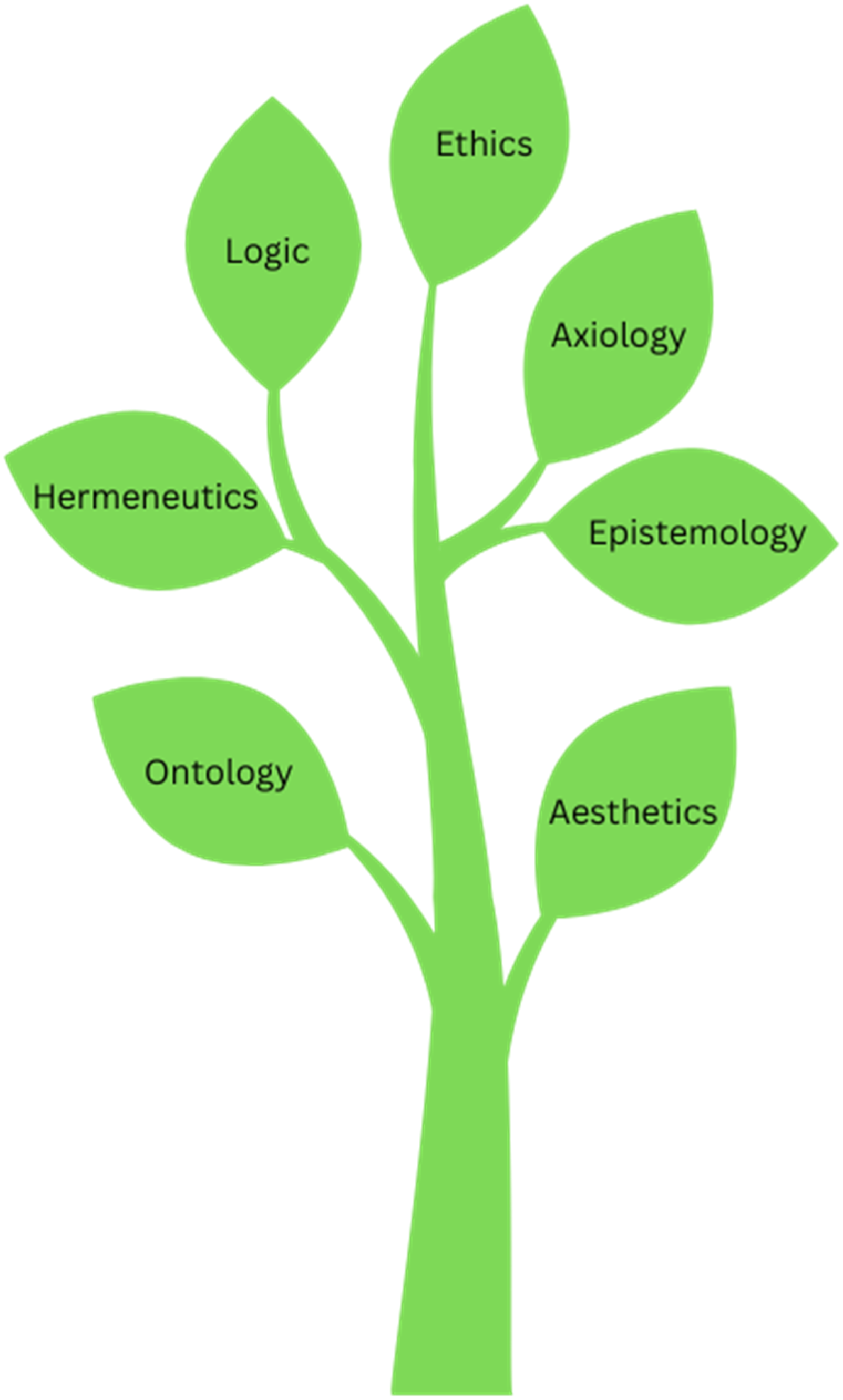
The TOP theory takes the branches of this tree and suggests that each branch helps us understand one or more elements that comprise wisdom—that the tree is itself a valid model for understanding the nature of wisdom. In this way, rather than synthesizing the (recent) theories of psychological or other wisdom theorists in a given time and place, as have Karami et al. (2020), Grossmann et al. (2020), and Glück and Weststrate (2022), the theory synthesizes the thinking regarding the nature of wisdom of several thousands of years of philosophy. At the same time, for any branch of philosophy, there is no one unique interpretation of its implications for wisdom, so there is no unique theory that derives from these branches of philosophy.
Descartes described philosophy as a tree “whose roots are metaphysics, whose trunk is physics, and whose branches, emerging from the trunk, are all the other sciences, which may be reduced to the three principal ones, namely, medicine, mechanics, and morality… … by morality I understand the highest and most perfect morality which presupposes a complete knowledge of the other sciences and is the ultimate degree of wisdom” (AT IXB 14/CSM I 186) (cited in Ariew, 1992, p. 101).
The TOP has evolved over time to characterize different branches of philosophy, and there are many different trees (which can be found in a Google search of “tree of philosophy”), but no one seems to have claimed that any one tree is definitive, any more than any one organization of the field of psychology or any other field is definitive. Rather, the different trees represent (usually slightly) different folk conceptions, or implicit theories, of how philosophy is organized. Different introductory textbooks (e.g., Kaye, 2021; Perry et al., 2021; Sullivan, 1992) organize philosophy in somewhat different ways, but the same is true for many other fields as well. For example, introductory-psychology books, like introductory philosophy books, have some commonalities and some differences. For example, a field in which the author of this article has worked, human intelligence, comprises a chapter in some introductory-psychology books (e.g., Kalat, 2021) but not in others (Plotnik & Kouyoumdjian, 2013), even though both textbooks have the same publisher. Some departments of psychology have divisions on individual differences (e.g., University of Edinburgh); others incorporate individual differences into the various substantive fields (e.g., Yale University, where individual differences are studied in the context of fields such as personality or individual differences in cognition).
Although in both philosophy and psychology and, no doubt, other fields, there are some differences in how theorists, researchers, and textbook authors divide up the field, the core does not differ so much. The TOP used in this article captures much of that core. That is, however a textbook or other book on philosophy might be organized, it is extremely likely to cover topics such as epistemology, ontology, ethics, and others of the branches in the tree upon which this article is based.
Worth mentioning perhaps is that the concept of a tree has long held a certain unique place in philosophical discussions of wisdom and enlightenment. For example, Siddhartha Gautama, who became the Buddha, allegedly gained enlightenment and received wisdom while sitting under a tree that has come to be called the “Bodhi tree” (tree of awakening).
Fundamental Principles of Wisdom
I now review the various branches of philosophy, and what they might suggest about the nature of wisdom. The theory, therefore, derives from the organization of philosophy as a discipline, rather than the organization of a particular theorist’s thoughts. This does not mean that the disciplinary organization is necessarily better—rather, just that it has survived over a long period of time as a useful organizational heuristic. In other words, the motivating principle behind the TOP theory is that millennia of philosophy—love of wisdom—provide a potentially more comprehensive and nearly veridical basis for understanding what should be included in a theory of wisdom than do a handful or two of modern Western psychological theorists of wisdom.
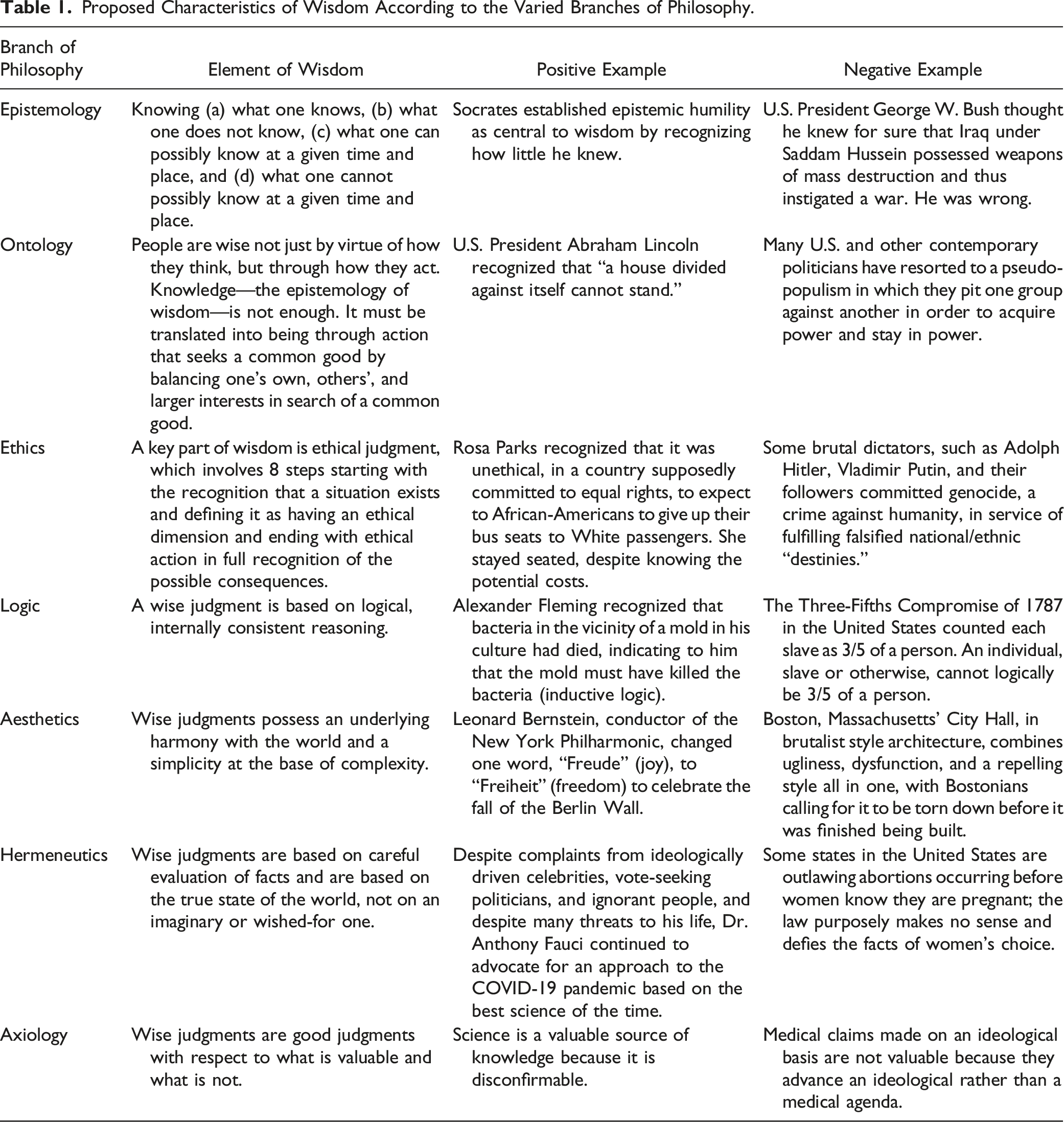
Proposed Characteristics of Wisdom According to the Varied Branches of Philosophy.
Metaphysics
Metaphysics is a branch of philosophy that involved with the first origins of, and the fundamental nature of reality (https://www.oed.com/search/dictionary/?scope=Entries&q=metaphysics). To be wise, one clearly must have some grasp, preferably a very good grasp, of the fundamental nature of reality, or at least, reality as humanity knows it. Metaphysics has two major branches.
Epistemology
Epistemology is the branch of philosophy that deals with the nature of knowledge, especially concerning its limits and the bases for its validity (https://www.oed.com/search/dictionary/?scope=Entries&q=epistemology). Epistemology helps delineate the limitations and boundaries of one’s own knowledge. It is in knowing (a) what one knows, (b) what one does not know, (c) what one can possibly know at a given time and place, and (d) what one cannot possibly know at a given time and place (see Sternberg, 1998). It concerns what Grossmann et al. (2020) and others have referred to as “intellectual humility.” Wise people recognize their own limitations and the limitations of their knowledge, and generally, the wiser they become, the more limitations they recognize. They represent almost the opposite of the Dunning-Kruger effect (Kruger & Dunning, 1999), discussed earlier, whereby the most incompetent people tend to view themselves as the most competent. Wisdom is different from some other kinds of human abilities in the epistemological context in which it operates.
First, there are almost never clearly right and wrong answers. Nothing is black and white but rather problems and their solutions present themselves in varying shades of gray. Often, however, people want certainty, even the false certainty provided by unscrupulous politicians and other leaders. And they may be socialized through schooling and standardized testing to expect problems to have one correct answer and then a field of incorrect answers. The idea that a problem might not have a “correct” answer may be off-putting to those who have accustomed themselves to “correct” answers, based on the format of so many exams and other tests.
Second, wisdom-based problems are never multiple-choice. As we write, the United States is struggling with the problem of what to do with demagogues. Republicans and Democrats seem to be at each other’s throats. For sure, no one will present a multiple-choice solution to this thorny problem, with one correct answer and the others incorrect. Thorny real-world problems have an infinite number of solutions, not just the 4 or 5 of a multiple-choice item.
Third, wisdom-based problems are ill-structured. They do not have a clear and certainly not a unique path to solution. They often are a mess, and the available solutions may be messy as well. In this respect, they are the opposite of many school problems.
There are other epistemologically based differences between problems requiring wisdom and problems requiring the more academically based skills that many school problems require. For example, wisdom-based problems are emotionally laden, with emotions often getting in the way of wise responses. They are often for high stakes and mistakes can be costly.
Wisdom-based problems are richly contextualized and often require a great deal of tacit knowledge that one learns only from life experience. Whereas the academic problems that flourish in schools are based largely only formal knowledge, wisdom-based problems require this kind of tacit knowledge as well—what one needs to know that often is not explicitly taught and that may not even be verbalized (Polanyi, 1976; Sternberg et al., 1995). Because tacit knowledge is typically acquired from experience, one ideally needs some life background to have it. Thus, wisdom could not possibly be some kind of inborn trait. But not everyone learns from experience, so experience is necessary but never sufficient for the development or wisdom. A problem arises when, with newly minted graduates of business schools, law schools, medical schools, or whatever, graduates believe that their formal knowledge is somehow a substitute for, or even superior to, tacit knowledge. Such a view is likely to render one susceptible to unwise behavior. The problem is not that the schools do not identify and develop intelligent people, or even intelligent people who can apply their intelligence (Sternberg et al., 2008). The problem is that they do not sufficiently, or at all, identify and develop wisdom in their students.
It is perhaps disconcerting that a recent analysis found that the amount of instruction in basal readers for the early years of school that draws upon wisdom-based content declined monotonically from 1900 to 2000 (Sternberg, 2019a). Why might wisdom-based teaching have declined? Perhaps because people, more and more, think it should be taught at home or in religious school or in anyplace besides the school. Perhaps that, in turn, is because standardized tests have crowded out wisdom-based content. Perhaps it is because wisdom-based content makes teachers and administrators uncomfortable: It can be an open invitation to complaints from certain parents or ideological groups. But, for sure, its prevalence in schools has decreased.
The spread of misinformation and disinformation—an anti-epistemology of sorts—is not merely an everyday annoyance without consequences. Rather, this anti-epistemology is resulting in the spread of ignorance, false beliefs in the veridicality of our knowledge, and undermining of democracy (Colomina et al., 2021). The rantings of modern-day pseudo-populists attempt to blur the distinctions between truth and knowledge, fact and ideology. If society does not take advantage of an epistemology—and understanding of knowledge and truth—that has developed since ancient times, it will put itself at enormous risk to undermine the program of thousands of years.
Ontology
Ontology is a branch of metaphysics dealing with the nature of being or existence (https://www.oed.com/search/dictionary/?scope=Entries&q=ontology). Ontology studies both being and ways of being. It is perhaps useful to note that “being” refers to an active verb—what it means to be and to live a human life. The ontology of one’s life is not about a set of static traits, but rather about the way one lives that life—one’s being in the world. In wisdom, one’s being is not just through oneself or just through others, but rather through finding how to balance the needs of oneself with the needs of others and with higher order needs, such as of society and of the world. Except perhaps for a hermit, people always live in connection with and interdependence on others In one account of wisdom (Sternberg, 1998, 2019b), described above, the wise way of being is by thinking through and then acting in ways that help to achieve a common good. One achieves a common good by balancing one’s own, others’, and larger interests, over the long-term as well as the short-term, through the infusion of positive ethical values.
On this view, an essential element of the ontology of wisdom is that being is expressed through good action, not just through ideas or thoughts or good intentions. People are wise not just by virtue of how they think, but through how they act. Knowledge—the epistemology of wisdom—is not enough. The knowledge must be translated into being through action that seeks a common good by balancing one’s own, others’, and larger interests over the long- as well as the short-term. There is no paper-and-pencil test that will adequately measure wisdom as a whole, because people can say anything—the greater challenge is in how they act.
Glück and Weststrate (2022) list many other characteristics of wise individuals, which can be summarized as “gaining an unbiased understanding of the problem,” “thinking about the problem and possible solutions,” and “suggesting/implementing solutions” (Table 1, p. 345). But to the extent that the ontological perspective emphasizes being, not just the potential to be, what matters is what one does in particular situations—and that something is achieving a common good. Achieving a common good involves compassion, caring, empathy, open-mindedness, reflection, tolerance, and appreciation of other viewpoints, but these characteristics must be put into action, not just remain as “latent traits.” The characteristics listed by Glück and Weststrate and others can help people get to that common good.
On this view, psychological theories of wisdom, and some philosophical ones, end up as incomplete because they are solely about thinking or perhaps feeling or both, but not about action. A person could describe themselves as compassionate, provide compassionate responses in a situational-judgment test, but then lack compassion when they perceive their own interests as being threatened. People may feel compassion toward the poor, but such compassion, on this view, would not be part of wisdom unless it were somehow expressed in action. In my own country, the United States, the compassion for the unfortunate often stops when individuals need to see them, or for the individuals, worse, interact with the unfortunate. What has made people like Malala Yousafzai, Greta Thunberg, Mother Teresa, Martin Luther King, Mahatma Gandhi, and Nelson Mandela wise is not that they felt compassion, but rather, that they translated their compassion from the world of “believing in” to the world of being—into action.
Of course, much the same could be—and has been—said for other characteristics, such as intelligence and creativity (Sternberg, 2021d). It is one thing to get high scores on tests of intelligence or creativity. It is quite another to translate these abilities into action.
One could, of course, view thinking rather than action as a suitable endpoint for evaluating wisdom. But wisdom, like intelligence and creativity, inheres in an interaction among a person, the tasks that person confronts, and the environmental contexts in which the tasks are encountered. Wisdom is not truly wisdom until it comes into being—until it is enacted (Sternberg et al., 2023).
Ethics
Ethics is the branch of philosophy that deals with moral principles and the construction of a system based on such principles (https://www.oed.com/search/dictionary/?scope=Entries&q=ethics).
Wisdom, in turn, seeks a common good through the application of positive ethical values. One might argue that what is considered “ethical” can vary from one sociocultural context to another. Yet, there are certain ethical values that appear to transcend sociocultural boundaries—honesty, sincerity, compassion, mutual trust, fairness, kindness, loyalty, among others (Chowkase, 2022; Sternberg, 1998). A wise person brings these values to the solution of interpersonal, interorganizational, international, and other kinds of problems of disagreements and outright conflicts. Experience does not necessarily bring good ethical judgment with it. The more managers are socialized into a business context, the less moral awareness they tend to have (Jordan, 2009).
Intelligence of the kind measured by intelligence tests draws upon certain values. For example, individuals typically are expected to work on their own without outside help; to put in their best effort on a test that may seem to some, purposeless; to provide the best answer to the test questions of which they are capable; and to work on the test within a given time frame. But these are not the ethical values that are needed to solve major problems in the world, such as disputes between individuals, countries, and cultures. We need the ethical values embedded in wisdom to solve problems of greater consequence than those found on traditional tests of intelligence.
Ethical reasoning is not merely a matter of recognizing right from wrong. Rather, it is a multi-step process (Sternberg, 2012). Often, people may view ethical judgments as simple matters—something is right or wrong. But on the view presented here, real-world ethical judgments often are fraught and very much involve wisdom. Ethical reasoning as translated into action goes through eight steps, which may be executed iteratively: 1. Recognize that an event has transpired to which one needs to react in some way. To act or react ethically, one must recognize that there is an event to react to. For example, national governments that are severely abusive of their own people, such as North Korea or Myanmar, often attempt to shut down communications inside, but especially to and from outside the country to prevent citizens from knowing how they are being abused, and to prevent other countries from recognizing that severe abuse is occurring. Regrettably, when other countries discover that even genocide is occurring, as in Rwanda, they often fail to act or even to recognize the situation, leading to tragedy. 2. Define the event that one has recognized as having an ethical dimension. It is one thing to recognize that something out of the ordinary is happening and another thing to define it as having an ethical dimension. For example, when Governor of Florida Ron DeSantis referred to the invasion of Ukraine as a “territorial dispute” (Garcia, 2023), he removed any ethical dimension from the invasion. Countries, of course, have disputes all the time. They do not usually commit genocide, as is Russia, to get their way (International Court of Justice, 2023). 3. Decide that the ethical dimension is significant to oneself or to others. One may view an event as having an ethical dimension, and yet dismiss it as insignificant. For example, one may see someone jaywalk, which is an ethical violation (and certainly a legal one) that can expose both drivers and pedestrians to danger, but most people would give it little, if any thought. Perhaps more seriously, many people in 2023, for example, seem to view presidential candidate Donald Trump as having made ethical lapses, but they have viewed them as insignificant with regard to his presidential run, often after adjusting their ethical and moral beliefs to fit with Trump’s behavior (Dolan, 2022; Kidd & Vitriol, 2021). 4. Take personal responsibility for generating an ethical solution to the problem. At times, we recognize that an ethical judgment is required in a situation, but we do not take personal responsibility for that decision. For example, the Russian invasion of Ukraine may have crossed an ethical boundary, but whose problem is it? Much of the global South in the world has decided it is none of their business (Klyszcz, 2023)—they have chosen not to get involved, just as the world, for the most part, punted during the genocide in Rwanda (Holocaust and Genocide Studies, n.d.). There were many reasons for the failure to take responsibility: past foreign involvements that went poorly, fears of popular dissent in the countries, fears of retaliation, and economic costs, among others. There are always reasons, valid or invalid, for standing on the sidelines in ethical conundrums. 5. Figure out what abstract ethical rule(s) might apply to the problem. A reason that countries, and individuals, sometime fail to get involve in ethical transgressions is that, in the end, they have trouble figuring out exactly what the ethical violation is. And sometimes, what is considered an ethical violation at one time or in one place is not considered as such at another time or in another place. For example, slavery today is seen as a major ethical violation by almost everyone, but this was not the case 200 years ago, at least in the United States. Monuments erected to slaveholders and other racists are being torn down all around the world (New York Times, 2020). 6. Decide how these abstract ethical rules actually apply to the problem so as to suggest a concrete solution. Even if one can decide on an ethical rule, it often is challenging to decide how to apply the rule. For example, it presumably would feel fair to many people to say today that racists and slaveholders should not be honored or have societies named after them. But how does one apply that rule? The Audubon Society, dedicated to birds and other objects of naturalist fascination, has received criticism for keeping its name, given that John James Audubon was a slaveholder (Chappell, 2023). Is it ethical for the Audubon Society to keep its name? Can one judge the behavior of people in the past by present standards? And does it matter that the behavior was in the past? It is often hard to know exactly how to apply ethical rules. Should George Washington, first president of the United States and a slaveholder, be stripped of the many honors that have been bestowed upon him, including having his portrait on the U.S. 25c coin and on the U.S. dollar bill? How about Thomas Jefferson, who fathered children with a slave, Sally Hemings? 7. Prepare to counteract contextual forces that might lead one not to act in an ethical manner. One of the most challenging steps in rendering ethical judgments or making ethical decisions is planning for the potential consequences. Whistleblowers, for example, are often punished for their whistleblowing (Wharton Staff, 2019). In some cases, such as that of Julian Assange, a whistleblower is adjudged by a judicial body to have committed a crime (BBC, 2019, November 19). But many times, one is fired or disciplined for blowing the whistle in what would appear to be an ethically legitimate way in which, if there is a crime, it is on the part of those who are punishing the whistleblower (OECD, 2017). Acting ethically may have great costs. For example, in the current Russian dictatorship, telling the truth about the war in Ukraine can and does result in a 15-year prison term (Gilbert, 2022). Being ethical can come with grave costs, not just in Russia, and many people want to weigh the risks before taking them. 8. Act. Perhaps the hardest step in the ethical decision-making sequence is acting ethically based on one’s ethical judgment. Given that acting ethically often comes with high costs, many people decide not to do it. In Nazi Germany, it was apparent that the situation in the concentration camps was horrific (Ezard, 2001, February 17). But doing anything risked one’s being internment in such a camp, with the bad death that was likely to follow. In most cases, death probably is not the cost of acting ethically. But in an age of Twitter mobs, many people just do not want to take the risk. They know the ethical course of action; they do not act upon that knowledge.
Logic
Logic deals with modes of argumentation, what constitutes logical argumentation, and what constitute better or worse arguments(https://www.oed.com/search/dictionary/?scope=Entries&q=logic).
Psychologists know that people’s thoughts are not fully cognitively consistent (Abelson et al., 1968; Festinger & Carlsmith, 1959). Some cognitive dissonance is part of being human. But being human, as philosophers have pointed out for millennia, also requires moderation—some kind of Middle Way (Confucius) or Golden Mean (Aristotle). If one places no limits on internal inconsistency, one quickly becomes unable or unwilling to think rationally, or both.
Many contemporary conspiracy theories cross the border to nightmarish levels of cognitive inconsistency. Even high-IQ people may believe in fake news and outlandish conspiracy theories—indeed, they may be more likely to believe them than are others (Robson, 2019, 2021). Why? First, because they convince themselves that someone as smart as they are would not make a foolish mistake in what they believe. Second, because they can use their intelligence to rationalize their beliefs, even foolish ones (Sternberg, 2004). Third, because their high level of abstract intelligence does not necessarily imply sophisticated knowledge of the world. Fourth, because people can be intelligent but not good rational thinkers (Stanovich, 2009, 2021). In other words, what would appear to be protection against flawed thinking actually can inadvertently encourage such thinking. One cannot be wise if one allows one’s thinking to be logically flawed or otherwise lacking in internal coherence.
Most wisdom-based problems cannot be solved by logic alone. But people can miss wise solutions to problems because they commit so-called “informal logical fallacies”—failed arguments in the natural language of everyday life. Learning about these fallacies can prevent one from lapsing into the traps that prevent people from attaining wise solutions to their problems and those of others. Examples of these informal logical fallacies include:
The sunk-cost fallacy (also called “digging oneself deeper into a hole” or “throwing good money after bad”). One makes a mistake, but because one has invested so many resources into the mistake, one digs in deeper and makes the consequences of the mistake even worse than they otherwise might have been. The false-dilemma fallacy (also called “false dichotomy”) arises when two options for solving a problem are presented as both mutually exclusive and exhaustive. The appeal-to-authority fallacy occurs when something is claimed to be true because an expert or an alleged expert says it is. The fallacy of begging the question occurs when the premises of an argument assume that the proposed conclusion is true.
The importance of logic underscores the importance of the philosophical theories that emphasize the centrality of rational thinking to wisdom (e.g., Ryan, 2012). If one thinks illogically, whether in term of formal or of informal logic, it is difficult, perhaps impossible to reach wise decisions.
Aesthetics
Aesthetics is the branch of philosophy that deals with the nature of beauty and with the principles underlying how one determines what is more or less beautiful (https://www.oed.com/search/dictionary/?scope=Entries&q=aesthetics).
The study of creativity long has been linked to the study of aesthetics, and indeed, one well-known scientific journal is entitled Psychology of Aesthetics, Creativity, and the Arts. But an aesthetic applies as well to wisdom. Wise solutions have a beauty of their own that transcends the beauty of solutions that benefit some parties at the expense of others, or of solutions that are imposed by force and even violence. Taste in problems and solutions matters—what are the problems worth studying and what are aesthetic solutions to such problems (Getzels & Csikszentmihalyi, 1976; Zuckerman, 1977)? What is a solution of beauty that all stakeholders can contemplate and say has done justice to everyone involved?
The notion that aesthetics plays an important role in wisdom is more an Eastern one than a Western one. For example, Misra et al. (2000) have stated that “the experiential, psychological and social characteristics of wise people are seen to situate them in harmony with rest of the world” (p. 1). This notion is related to Sternberg’s (2021c) subsequent concept of adaptive intelligence, which emphasizes the importance of acting in ways that achieve harmony with the world and that serve to build it rather to destroy it. In a similar vein, Yang, 2001 studied Taiwanese Chinese people’s conceptions of wisdom and found as factors: (a) competencies and knowledge, (b) benevolence and compassion, (c) openness and profundity, and (d) modesty and unobtrusiveness. The competencies and knowledge factor is relevant to Baltes’s notion of wisdom as knowledge of the pragmatics of life (Baltes & Staudinger, 2000). Benevolence and compassion are relevant to the empathy of the MORE theory, as discussed above (Glück & Bluck, 2013; see also Chowkase, 2022). The openness and profundity factor is similar to sagacity and perspicacity (Karami & Ghahremani, 2016, 2017), and learning from ideas and environment in the implicit-theory factor obtained by Sternberg (1985b). The modesty factor is relevant to Western notion of intellectual humility (Grossmann et al., 2020). The aesthetic of wisdom seems to be one of simplicity and harmony in the complexity of everyday life—that, at some level, the universe has a beauty that we can understand through science, or indeed, through the art.
The brutal invasion of Ukraine by Russia shows extremely well the opposite of wisdom—toxicity (Sternberg, 2018). It is an attempt by a colonialist, revanchist power to impose a solution that seeks good only for itself, at whatever cost. It is based on an unending series of lies imposed on its own population by force and threat of prison for questioning the lies. It considers the interests of no one except those in power in Russia, and perhaps only of Vladimir Putin. It is an imposed regime, with no aesthetic beauty and only brutality and ugliness, much like the German invasions and genocides of the 20th century.
The invasion shows an example of what Hannah Arendt (1963) referred to as the “banality of evil”—government employees, but also ordinary citizens, engaged in, condoning, or simply ignoring evil acts because they do what they are told to do and do not do what they are told not to do. They think about their own advantage and leave it to others to worry about being wise or thinking about the common good.
Toxicity also can be introduced into science by permitting only certain kinds of studies—those favoring a particular paradigm—to be published. It also can be introduced into the arts, for example, by the kind of hostile architecture that pushes away people of limited means. For example, anti-homeless spikes are sometimes introduced to make flat surfaces uncomfortable or even impossible to sleep on; or benches can contain armrests that ensure no one can ever lie down on the benches.
Hermeneutics
Hermeneutics is the branch of philosophy that deals with interpretation, theories of interpretation, and more generally, with how we go about interpreting things (https://www.oed.com/search/dictionary/?scope=Entries&q=hermeneutics).
Hermeneutics involves methods of interpreting events and ideas in a manner that is truthful and that does justice to them. Intellectual integrity is the attempt to interpret events in ways that are veridical and that make sense. In today’s world, that is not always an easy task. Intellectual integrity has two parts: seeking internal coherence and seeking external correspondence of thought and action to external reality. Intellectual integrity requires knowing what is real and what is not, and caring about which is which (Sternberg, 2021b; Sternberg & Lubart, 2022).
The element of wisdom relevant here is the seeking of external correspondence. One can think wisely only if the input about which one thinks is veridical with respect to the world, or at least, with respect to what we can know of the world. Too often, especially today, people believe what they want to believe about the world, rather than what is true (Gorman & Gorman, 2016). Whole media networks are based on feeding people what they want to hear rather than upon what is true, as the recent Dominion versus Fox News lawsuit revealed in the United States (Pierce, 2023), but as has always been true and still is true of propaganda networks, public or private.
Consider, for example, the various conspiracy theories surrounding George Soros, the Hungarian financier. Many, arguably all of them are ridiculous. Wikipedia provides a partial list of such conspiracy theories (https://en.wikipedia.org/wiki/George_Soros_conspiracy_theories). If even a fair number of them were true, Soros would be spending most of his time, or perhaps more time than there is available during a day, sowing plots rather than doing his job of investing money. But Soros is Jewish, and many of the conspiracy theories concerning him stem, perhaps predictably, from old stereotypes about Jews (see, e.g., Keen, 1986; Rhodes, 1993). Stereotypes about Jews, as well as about members of varied religions, ethnicities, and races, have been believed by people of all levels of conventional intelligence. Some White Southerners, in the United States, for example, once owned slaves, and could only do so by accepting ugly stereotypes about what was possible and even right for them in life.
Axiology
Axiology is the “study of the nature of value and valuation, and of the kinds of things that are valuable” (Oxford Languages, n.d.). Axiology is crucial to wisdom because it studies what has value to human beings, to other species, and to anything, including the future of the world. Why, for example, is science valuable? Philosophers have different views, but a prevalent one is that science is valuable because its assertions are empirically disconfirmable (Popper, 2014), and hence, it is self-correcting. Any system of knowledge can lead to errors—but few correct themselves. For example, claims by celebrities or politicians about health-related issues are not valuable because those making the claims have little or, usually, no knowledge about what they are talking about, any more than health professionals would necessarily have any expertise in knowing what to do to get elected to a political office.
This essay has made many axiological claims without justifying them. For example, it has claimed, in showing examples of wisdom, that democracy is better than dictatorship. Is it better? In a liberal democracy, all members of the state are allowed to choose their own representatives. The representatives have an incentive, although an imperfect one, to serve the common good to maximize their chances of being elected and, hopefully, of doing good. In theory, at least, governments serve the people. In a dictatorship, the government serves the dictator. All power is concentrated in his or her hands, and although there may be some incentive to serve the people, it generally becomes weaker over time as the dictator tries to ensure his continued power. In modern times—in the obvious dictatorships, such as Russia, China, Belarus, and Venezuela—to name a few, power has been concentrated in one person’s hands and human rights have suffered. Do they have to? There have been benevolent dictators, but they rarely stay benevolent (Kleinfeld, 2014; Stockman, 2023). Over time, the benevolence disintegrates, the dictatorship remains, and people’s freedoms start to disappear.
Wisdom, from an axiological point of view, requires careful evaluation of the value system underlying one’s judgments. Principles come from the core of wisdom—seeking a common good by balancing diverse interests, over the long- as well as the short-term (Grossmann et al., 2020; Sternberg, 1998). If someone claims to be wise, but also seeks, because of their self- or other-perceived wisdom, absolute power, watch out! Plato’s concept of unrestrained philosopher kings, proposed in The Republic, however nice it may have sounded to Plato in theory, has never worked out well in practice (de Nicolay, 2022).
What Makes the TOP a Theory?
Theories generally serve descriptive, predictive, heuristic, and, where possible, explanatory purposes (Sternberg, 1995).
First, most theories of wisdom, as described earlier (e.g., Ardelt, 2003; Baltes & Staudinger, 2000; Glück & Weststrate, 2022; Grossmann et al., 2020; Karami et al., 2020; Sternberg, 1998), serve a descriptive function in characterizing the necessary and sometimes characteristic attributes of wise people. The current theory does so as well. The theories differ in the specified attributes in part because of where those attributes originate. In most cases, the attributes are based on some synthesis with modification of previous theories (e.g., Glück & Weststrate, 2022; Grossmann et al., 2020; Karami et al., 2020). In the case of the TOP theory, the attributes are derived from the TOP.
Second, the theories, including this one, make a similar set of predictions. Consider two examples. First, if people were to rate the wisdom of responses to a given problematic situation or class of situations, they would rate higher the responses of people who had more of the attributes, or higher levels of them, than they would rate the responses of individuals with fewer of the attributes, or lower levels of them. Second, if people were to rate other people (e.g., in the studies cited above by Paulhus et al., 2002; Weststrate et al., 2016), they would rate higher individuals who have more, or higher levels of these attributes, than they would rate individuals who have fewer or lower levels of the attributes.
Third, the heuristic value of all the theories lies in guiding future research in some directions rather than others. For example, Sternberg’s (1998) balance theory leads toward research on the formulation and attainment of a common good by balancing interests over the long- and short-terms. In contrast, the theory of Baltes and Staudinger (2000) steers future researchers toward what the authors referred to as knowledge about the pragmatics of life. The tree of philosophy theory attempts to steer future researchers broadly toward a holistic approach to wisdom, arguing, in effect, that the reason why wisdom is so hard to display in daily life, and that there are so few obvious exemplars, is that being wise requires so many dispositions, skills, and attitudes.
Finally, the theories are all, in at least some respects, explanatory. For example, all the theories explain, at some level, why intelligence is necessary but not sufficient for wisdom. Wisdom requires the knowledge and analytical thinking skills that are critical to intelligence (e.g., Carroll, 1993; Cattell, 1971; Ceci, 1996), but also complex dispositions, judgmental and metacognitive skills as well as attitudes that are not part and parcel of most contemporary theories of intelligence (see Sternberg, 2003, 2022). The theories also explain why a substantial level of creativity is necessary but not sufficient for wisdom. Novelty and usefulness (Runco & Jaeger, 2012) are important for wisdom, but they can be put to negative and even toxic uses that are anything but wise. Thus, all of the theories, including the TOP, have explanatory value.
The theories differ in their specific claims, and these differences not only distinguish the theories, but ultimately, will distinguish their construct and empirical validity. Eventually, it may be possible more definitively to choose among them than is currently possible. By that time, there may well be new, and hopefully better theories.
The various branches of philosophy that serve as the basis for the TOP theory might seem, at times, to be at odds with each other (Glaveanu, 2023). But these odds represent the seeming inconsistencies that wise people need to manage in their daily lives. People need to find a synthesis to integrate the seeming dialectics of our lives (Hegel, 1807/1931). For example, ontology concerns being, often viewed as objective, whereas hermeneutics concerns interpretations, which are certainly subjective. But in life, people constantly must deal with their subjective interpretations of objective events. As Kant (1781/2008) observed, we never can know things in themselves, only our perceptions of them. Ontology thus is always subject, in a way, to hermeneutics. Falsified stories about reality can be part of everyday discourse, and we all need to recognize them for what they are to live wisely.
Cynical politicians often try to convince people of their deliberately falsified and distorted stories about reality. People show wisdom when they replace these manipulated stories about reality with more nearly veridical ones. Unfortunately, people often just accept what they hear, sometimes with disastrous results, as with the invention by Vladimir Putin of a false history of Russia to justify the 2022 invasion of Ukraine.
How Do Extant Theories Compare under the TOP Theory?
When one seeks to characterize extant theories in terms of TOP theory, it is always possible to argue—especially in a philosophical debate—exactly which characteristics are to be found in which theories—which are explicit, which are implied, and which are simply missing. However, considering the theories as a whole, the elements that seem best covered are: 1. Epistemology: knowing, in a given situation (a) what one knows about a judgment-base problem at hand, (b) what one does not know about the problem, (c) what one can possibly know about the problem at a given time and place, and (d) what one cannot possibly know about the problem at a given time and place; understanding one’s own and others’ knowledge, both in terms of what is known and what yet needs to be known. 2. Ontology: action that seeks a common good by balancing one’s own, others’, and larger interests in search of a common good; translating thought into action that is compassionate, caring, and resonant with the needs of others and of the world. 3. Axiology: wise judgments are good judgments with respect to what is valuable to oneself and others, and what is not; the theories emphasize value relativism and how what some individuals and groups view as valuable or self-evident may differ from what other groups view as valuable and self-evident.
Where the theories are not as consistently strong is with respect to other elements of the TOP theory. They may mention or discuss these elements, but do not deal with them fully. 1. Ethics: doing the right thing based on moral principles, such as of honesty, fairness, respect, trustworthiness, caring for others, and responsibility. For some theorists of wisdom (e.g., Glück & Weststrate, 2022), ethics gets folded into a common-good orientation. But ethical reasoning entails more (Sternberg, 2012). One does not just arrive at a common-good orientation. One needs to recognize the existence of the problem requiring good judgment, view it as self-relevant, view it as sufficiently important to be worth one’s while, figure out what ethical principle or principles apply, figure out how to apply them, be prepared for opposition to ethical action, and then act.
Actions that are ethical and actions that achieve a common good are not necessarily the same. Consider why.
Suppose someone had the chance to shoot and kill Adolf Hitler when it was clear he was a murderer but before he became responsible for many millions of murders. One knew that no judicial proceeding would take place against him in Nazi Germany. Shooting and killing him in the absence of a trial would probably not be ethical, but it would be for the common good (assuming one believes saving millions of people the horror of a gruesome death for their religion, ethnicity, or disability status helps to achieve a common good).
As an example, in contrast, suppose a lawyer represents and gets off a serial killer on a technicality. The lawyer would be acting ethically under the U.S. system of jurisprudence, but his legal success probably would not be for the common good—when, as expected, the serial killer starts killing again but does not get caught again.
These are extreme examples that show that ethical actions and actions toward common good may or may not be the same. Simply subsuming ethics under the common good does not fully represent the important role of ethics in wisdom.
The questions raised by ethics are legion. What is ethical? Why? Is it ethical for everyone, everywhere, at every time? Who decides? A complete theory of wisdom will deal with these questions. 2. Logic: Logical reasoning may be viewed more as the purview of intelligence than of wisdom. But few theories of intelligence even cover deductive logical reasoning, instead covering inductive reasoning, such as analogical reasoning—even going back to one of the earliest theories, that of Spearman (1923, 1927). There are many different kinds of logic (deductive, inductive, fuzzy, and informal). Most of the logic used in wise thinking is probably informal and serves prevention of informal logical fallacies that, on their surface, appear appealing, but that are mistaken. They are reviewed in various sources (e.g., Sternberg et al., 2008; Walton, 2008). Some of them are discussed earlier in this article. Much of the foolish unrest in the United States and other countries today—belief in outlandish conspiracy theories; belief in empty, stale promises of authoritarian leaders or would-be leaders; belief in the supernatural—stems from failures in informal logic. Oddly, schooling seems to have little effect on informal logical reasoning, in that many believers, or at least promoters of these theories, are well-educated individuals. A number of Nazi leaders, most notably Josef Mengele, had doctoral degrees. The distinguished University of Heidelberg willingly fired its Jewish professors during the Nazi period (Carmon, 2017). Informal logical, or what Stanovich and colleagues refer to as “rational thinking” (Stanovich, 2009; Stanovich et al., 2013; Stanovich & West, 2000), ought to be a centerpiece in theories of wisdom. It is not. The United States is at a point where lack of logical thinking may tear it apart. It needs to do better. 3. Aesthetics: Aesthetics has always been closely linked to creativity. For example, as mentioned earlier, there is a journal on the Psychology of Aesthetics, Creativity, and the Arts, and the International Association of Empirical Aesthetics and its associated journal support work on creativity. This support is probably in part because creativity has historically been associated with the arts. Implicit theories of wisdom, intelligence, and creativity find a lower association between wisdom and creativity than between intelligence and creativity (Sternberg, 1985b). This difference in levels of association is, according to the TOP theory, a mistake.
Creativity, historically, has been defined in terms of novelty and effectiveness (Runco & Jaeger, 2012). The reduced relation of creativity to wisdom is perhaps because, whereas tests of intelligence and of wisdom tend to have either right and wrong or better and worse answers from the standpoint of truth and logic, creativity tests do not. The burgeoning literature on dark creativity—harmful and even toxic uses of creativity—suggests that perhaps the conventional perspective is too narrow (e.g., Cropley et al., 2010; James & Taylor, 2010; Kapoor & Kaufman, 2022). Recently, Sternberg, 2021a has proposed a construct of transformational creativity, which is the deployment of creativity toward a common good. There is a pressing need to do what has been done insufficiently before, namely, to link creativity with wisdom, and to recognize that creativity in the absence of wisdom can be and has been a very negative force in society. 4. Hermeneutics: Hermeneutics is concerned with wise judgments as based on careful evaluation of facts that are based on the true state of the world, not on an imaginary or wished-for one. They are real facts, not “alternative ones.” Sternberg (2021b) has suggested that two hermeneutic processes are essential for intelligence, but also for creativity and wisdom. The two processes are establishing external correspondence with the world and internal coherence with other facts and ideas. In a world rife with conspiracy theories, half-baked rumors from social media that millions of people just accept as true because they read them somewhere, and outright lies spread by cynical leaders who know better but purposely lie to attain their own ends, theories of wisdom need to be more attentive to the question of what is true and what is established and what is not. Many people today accept as “knowledge” information that is not true, and the increasing use of AI to manufacture propaganda, has made it increasingly difficult to distinguish truth from fiction and honesty from dishonesty. But one cannot make wise decisions on the basis of what only appears to be true if it is not carefully examined. To be wise, people need much more rigorously to test their knowledge and beliefs for external correspondence to the world and for internal coherence of their knowledge and ideas.
Conclusions
The TOP theory of wisdom leaves us with the notion that a wise solution to a problem: (a) derives from extensive formal and tacit knowledge and the application of appropriate converging operations to this knowledge; (b) based on an intellectually humble recognition and acceptance of what one can and cannot know at a given time and place, as well as of what is knowable and what is not; (c) with the knowledge rationally and ethically deployed in the service of a common good to balance one’s own, others’, and both short- and long-term interests; (d) producing an internally consistent and, to the extent possible, an aesthetically pleasing solution that is consistent with the external state of the world as well as we can know it. This statement, although complex, captures the various elements of the TOP theory.
Other scholars, of course, have come up with different definitions (see Fischer, 2015), such as that wisdom is “explanatory knowledge of the fundamental truths of living well – an orienting knowledge about what is good and right” (Fischer, p. 73). The definition proposed in this article says nothing about living well, for the simple reason that so many wise people have chosen to sacrifice living well for the sake of not just knowing what is good and right but also doing it. There are prisoners of conscience throughout the world, especially in dictatorships, who do not live well by any reasonable standard, but made their choice to be wise rather than to live well.
The TOP theory of wisdom is somewhat comprehensive because it is guided by the organization of the discipline of philosophy, in which wisdom was first formally studied and has been studied for millennia—at least since the ancient times of Plato and Aristotle in the West and since even early times in the East. Confucius, for example, is estimated to have been born more than a century before Plato, and almost a century before Socrates. Philosophy might therefore give a broader sweep in terms of what to include in a theory of wisdom than psychological theories proposed in Western countries in the late 20th or early 21st century.
The TOP theory draws upon metaphysics—epistemology and ontology—ethics, logic, aesthetics, hermeneutics, and axiology. These are not the only branches that might be considered as central to philosophy. Some trees of philosophy include, for example, philosophy of science or philosophy of politics, but some of these other branches tend to be applications of philosophy to specific disciplines rather than broad branches of philosophy. Including politics, for example, would place emphasis on practical wisdom (e.g., Schwartz & Sharpe, 2011). Nevertheless, it is a matter for debate what the branches to be included in a theory of wisdom should be. Moreover, a given branch’s contribution to the study of wisdom does not provide a unique one-to-one mapping. Indeed, had particular philosophers been used as a basis for understanding wisdom, rather than the organization of the field, the resulting conception might be very different.
The TOP model provides categories, but the categories specify the range a theory of wisdom might cover, not its exact content. Any branch’s contribution can be interpreted in various ways, including but not limited to the ones included in this essay. The advantage of breadth, such as that provided by the TOP theory, is that it draws very broadly on philosophical contributions to the nature of wisdom. The disadvantage is that its breadth will make the theory more challenging to test in the future, to the extent one might wish to develop measures and construct-validate them.
That said, the TOP theory, because it draws on philosophy at least as much as it draws on psychology, at least of the psychometric and information-processing varieties, is not the kind of trait-based theory that tends to emerge in psychological research on wisdom. There is less emphasis on “Who is wise?” and more on how wisdom acts as a system of thought leading to action. Thus, this theory might be better conceived of as a systems-based theory rather than as a trait-based theory, process-based theory, or a synthetic theory that combines elements of each. On this view, a person is not wise in and of themselves but rather is wise in an interactive context of a person facing a given set of tasks in a particular environmental context or set of contexts (Sternberg et al., 2023). Some scholars have debated whether wisdom is more nearly domain-general or domain-specific. Wisdom is neither domain-general nor domain-specific. It is interactive and may not even consistently manifest itself in any specific domain, depending on the context in which the problems in the domain are presented.
Wisdom is different from other psychological constructs, in part, because it is not purely a psychological construct. It emerges from people’s behavior in confronting tasks in sets of situations. These situations differ for different people, and hence, people’s wisdom develops differently (Brienza & Grossmann, 2017; Oakes et al., 2019). People in different cultures may have different conceptions of wisdom, but these conceptions are culturally bound. One’s hope with a philosophically based theory is that its elements, although not necessarily how they are manifested in behavior, would transcend specific cultural or temporal contexts.
How does one test a theory such as the TOP? My research group and I are currently involved in three tests of the theory, although they will take quite a while to carry out. Others could do similar studies. They derive in part from traditional implicit-theories studies (e.g., Sternberg, 1985b).
The first study is to present a list of attributes associated with wisdom that (1) derive from the TOP theory, (2) derive from theories of wisdom other than the TOP theory, and (3) are desirable attributes but are not ones that are associated with wisdom. Participants (students taking courses in the behavioral sciences) are asked to rate, in one group, (a) the importance of each attribute for wisdom or (b) the characteristicness of each attribute in a wise person. The prediction is that the highest ratings of importance and characteristicness will be, on average, highest for the first group (1) of attributes and lowest for the third group (3).
A second planned study with the same predictions is like the first one, except that the participants will be professionals who study wisdom. The participants will thus bring to the study knowledge about wisdom that the first group does not possess.
A third planned study will present depictions of individuals and ask participants to rate how wise they are. The idea is to relate the theory to concretely described individuals. All descriptions will be the same length but will differ in how many of the characteristics derive from the TOP theory. The descriptions will be half male, and half female, between subjects, with the same descriptions used for both male and female depicted individuals to see whether there is any difference in ratings, either as a main effect or in interaction with participant sex. But the main goal will be to test the prediction that the more of the descriptions that are wise according to the TOP theory, the higher the ratings of wisdom will be.
If schools were to teach seriously for wisdom, they would need to teach some philosophy and also some psychology, but they would need as well to teach some history, some sociology, and some political science because wisdom is emergent not just from an individual, but also from various kinds of collectivities. Teaching for wisdom can and has been done successfully (Bruya & Ardelt, 2018). Teaching for wisdom in ordinary classrooms might mean (Ferrari & Kim, 2019; Sternberg & Hagen, 2019): 1. Teaching students about the nature of wisdom, theories of wisdom, and empirical results regarding wisdom; 2. Asking students whom they consider to be wise, and why; 3. Asking students whom they consider to be unwise, and why; 4. Analyzing how wise role models have solved judgment and conflict problems; 5. Presenting students with real-world problems and asking them how they would suggest solving these problems in a way that would encourage a common good, over the long- as well as the short-term, by ethically balancing competing interests.
There is a widespread notion of the wisdom of crowds (Surowiecki, 2005), but if history has taught us anything, it is that crowds are often unwise. The United States has a history of crowd-instigated lynching (NAACP, n.d.), and other countries have histories of pogroms, massacres, and genocides committed by crowds that might astonish even Thomas Hobbes, author of Leviathan.
Wisdom may manifest itself in different ways, depending upon the culture in which it is considered. In a collective culture, there may be a more natural emphasis on seeking a common—that is, collective good (e.g., Yang, 2001). And yet, no particular form of culture guarantees an easy route to wisdom. Individualistic cultures may work against wisdom by promoting individual goods over collective ones. But collectivistic cultures may seek the common good of their particular culture—or particular constituent ethnicities or socially constructed races—rather than a good that transcends people like them.
Wisdom can be developed, but it will not be much developed in the kinds of curricula elementary, secondary, and tertiary education employ now (Ferrari & Kim, 2019; Sternberg & Hagen, 2019). To teach for wisdom, schools will need to focus much more on how knowledge is used and less on simply teaching the knowledge. As the landscape of AI contributions to the world changes, the importance of use and misuse of knowledge inevitably will become much more important—if only to ensure that the AI contributions are closer to a dream than a nightmare.
The world desperately needs wisdom in its leaders. At the moment, it is not easy to point out wise leaders. People seem reluctant to elect them and often to keep them, and at times, prefer toxic leaders to wise ones (Kellerman, 2004; Lipman-Blumen, 2006; Örtenblad, 2021). If the world is to survive in livable form, we should do better. We must do better.
Footnotes
Acknowledgements
I am grateful to Andy Parra-Martinez, Arezoo Soleimani-Dashtaki, Rui Wang, and Wynne Willams-Ceci for comments on an earlier version of the manuscript.
Declaration of conflicting interests
The author(s) declared no potential conflicts of interest with respect to the research, authorship, and/or publication of this article.
Funding
The author(s) received no financial support for the research, authorship, and/or publication of this article.
