



Abstract
This article reviews conceptual and empirical issues on the developmental prevention of prejudice in childhood and adolescence. Developmental prejudice prevention is defined as interventions that intentionally change and promote intergroup attitudes and behavior by systematically recognizing theories and empirical results on the development of prejudice in young people. After presenting a general conception of designing evidence-based interventions, we will discuss the application of this model in the field of developmental prejudice prevention. This includes the legitimation, a developmental concept of change, and the derivation of intervention content and implementation. Finally, we summarized recent evaluations results by reviewing meta-analytical evidence of programs and discuss important issues of future research and practice.
Introduction
Prejudiced attitudes and behavior as the underlying psychological characteristics of racism and xenophobia are not just found in adulthood. In recent years, several comprehensive surveys have revealed how significant proportions of young people also show strong devaluations of outgroup members based on nationality, race, ethnicity, and other social group characteristics. For example, a recent Germany-wide survey of more than 6000 youths (Goede et al., 2020) showed that about 14–20% endorsed xenophobic items (e.g., I feel like a stranger in my own country because of all the foreign people). Furthermore, 5–7% had anti-Semitic (e.g., Jewish people have too much influence in the world); 17–30% Islamophobic (e.g., terror and violence are an inherent part of the Islam); and 8–16%, negative attitudes toward asylum seekers (e.g., Refugees only want to profit from our economic prosperity). Although these numbers are based partially on single items on the attitude level with sometimes low reliability, other youth surveys largely confirm these data. For example, Lavric et al. (2019) found a rate of 25% of young people in south-east European countries who agreed that there are too many immigrants/refugees living in their countries with 34% of respondents wanting only native people in their country.
Whereas these results already give a clear indication that prejudice, racism, and xenophobia are probably a major problem throughout the world, prejudiced attitudes can also lead to more severe behavioral problems such as hate crimes and violent extremism (Beelmann, 2020; Cheng et al., 2013). Routine statistics on hate crimes show increases in nearly all countries in recent years (see hate crime statistics of the OSCE, https://hatecrime.osce.org). For example, in 2019, the Federal Bureau of Investigation (2019) registered 7314 cases of severe hate crimes in the United States with 60% of these crimes being based on ethnicity and 15% of perpetrators being under the age of 18. In addition, several recent reviews and meta-analyses have shown that prejudice and related measures assessing, for example, the superiority of the ingroup or negative intergroup emotions are strong predictors of extremism and the use of political violence (Emmelkamp et al., 2020; Jahnke et al., 2021; Wolfowicz et al., 2020).
Against this background, interventions against prejudice in childhood and adolescence can be considered as one of the most necessary societal investments to reduce not only the manifold negative consequences for victims (e.g., Major & Vick, 2005; Priest et al., 2013; Weeks & Sullivan, 2019) but also the effects of prejudice and discrimination on the political climate in society. Overall, such interventions designed to reduce prejudice have a long and diverse tradition (Oskamp, 2000). Historically, the idea of preventing prejudice is based on the integrative school system movement (Schofield & Hausmann, 2004) and the seminal publication of Allport (1954) on the nature of prejudice. In the last 30 years, diverse concepts have been developed including contact interventions, diversity and multicultural trainings, media campaigns, and school-based educational and social learning programs (Beelmann & Lutterbach, 2020). However, although these approaches have delivered sound knowledge on effective intervention approaches and strengthened our understanding of how to reduce prejudice and promote intergroup relations, most of these concepts and programs focus on reducing prejudice in students and adults and are not preventive in a narrower sense—that is, they do not aim to generally avoid the growth of prejudice over the course of development from childhood to adulthood. In addition, only a few programs systematically integrate developmental knowledge when creating prevention measures and exercises. For example, age differences in prejudice formation indicate that prevention measures should be age appropriate in terms of what they should address at different ages (see Raabe & Beelmann, 2011). This is especially true in light of the major advances in developmental research on prejudice over the last decade (Crocetti et al., in press).
The term developmental intervention has its roots in applied developmental and prevention science, positive youth development, and a lifelong developmental perspective (Lerner et al., 2005). It refers to measures or programs designed to promote positive development or to prevent a phenomenon based on tested developmental theories and empirical knowledge about normal and deviant developmental processes from birth to adulthood (Kurtines et al., 2008). For prejudice prevention, this includes: • Considering age differences and stabilities in prejudice development (level and rank-order stability) • Relying on causal developmental factors that have an impact on prejudice development (risk factors) or buffer against prejudice formation (protective factors) • Developmental theories of prejudice explaining intraindividual differences and interindividual differences within intraindividual change—that is, developmental differences depending on moderators (e.g., gender, relevant subgroups, and social context) and mediators (e.g., cognitive development and identity development) that promote or buffer prejudice. • General developmental principles and theories delivering an understanding of developmental processes and dynamics. • Considering a perspective of individual change as well on social and societal change and social policy perspective.
This chapter will review conceptual and strategic deliberations on the scientific foundation and development of efficacious and practically relevant psychological interventions in general and developmental prevention of prejudice in particular. In more concrete terms, we first introduce a general model for constructing scientifically based developmental interventions and then discuss the current status of developmental prejudice prevention in light of this model. Second, we turn to future challenges by outlining several important issues for further research and practice.
A Theoretical Model for the Scientific Foundation of Psychological Interventions
Throughout this article, we shall use the term psychological intervention as a superordinate term incorporating different levels of psychological activities such as preventive, therapeutic, or rehabilitative measures. In this conceptualization, psychological interventions (including developmental interventions) can be defined as professional activities designed to intentionally change human cognitions, emotions, or behavior by using psychological means based on scientific knowledge (Wilson et al., 2014) with the long-term objectives on promoting human development, education, and health.
In line with this definition, the need to justify psychological interventions—particularly through outcome evidence—has long been discussed. Evidence is understood as the confirmed existence of goal-related significant effects of an intervention through systematic empirical studies taking randomized control trials as their gold standard. Although this concept has been widely accepted within the scientific community (American Psychological Association, 2014), it nonetheless raises at least two fundamental problems: First, the term evidence-based has yet to be conceptualized clearly, and there are no unified or widely accepted standards (Beelmann et al., 2018). In general, an intervention program is typically considered to be evidence-based when it has been confirmed positively within randomized or at least high-quality quasi-experiments. However, what is meant exactly by positive results or what precisely are the conditions under which interventions can be rated as evidence-based is discussable and sometimes at risk of biased interpretation. For example, a series of meta-analyses have revealed a high variation of intervention outcomes ranging from zero or even negative to highly positive effect sizes depending on the specific outcome criteria (e.g., Beelmann et al., 2021; Beelmann & Lösel, 2021). Which results should than be the basis for evaluating whether or not a certain program should be granted an evidence-based status? Some program developers are satisfied with one significant outcome; others call for more sophisticated methodological and outcome standards (see, e.g., Flay et al., 2005; Gottfredson et al., 2015). Thus, in intervention research, evidence-based is not an exactly defined and concrete position, but more of a perspective that is taken to justify interventions on the basis of sound empirical outcome studies.
Second, and even more importantly, the concept of evidence-based interventions is limited mostly to empirical studies on the outcomes of interventions. However, this neglects other sources of evidence that are important for the basis on which to design interventions such as theories and empirical research on the nature and development of a phenomenon as we found it, for example, in preventing antisocial behavior and crime (Bliesener, Beelmann, & Stemmler, 2011). Thus, scientific results and evidence should be used to construct and develop interventions systematically and not only a posteriori based on positive evaluation results. For this reason, we propose an extended and more general model for the scientific foundation of evidence-based psychological interventions (see Figure 1). A model for developing scientifically-based intervention.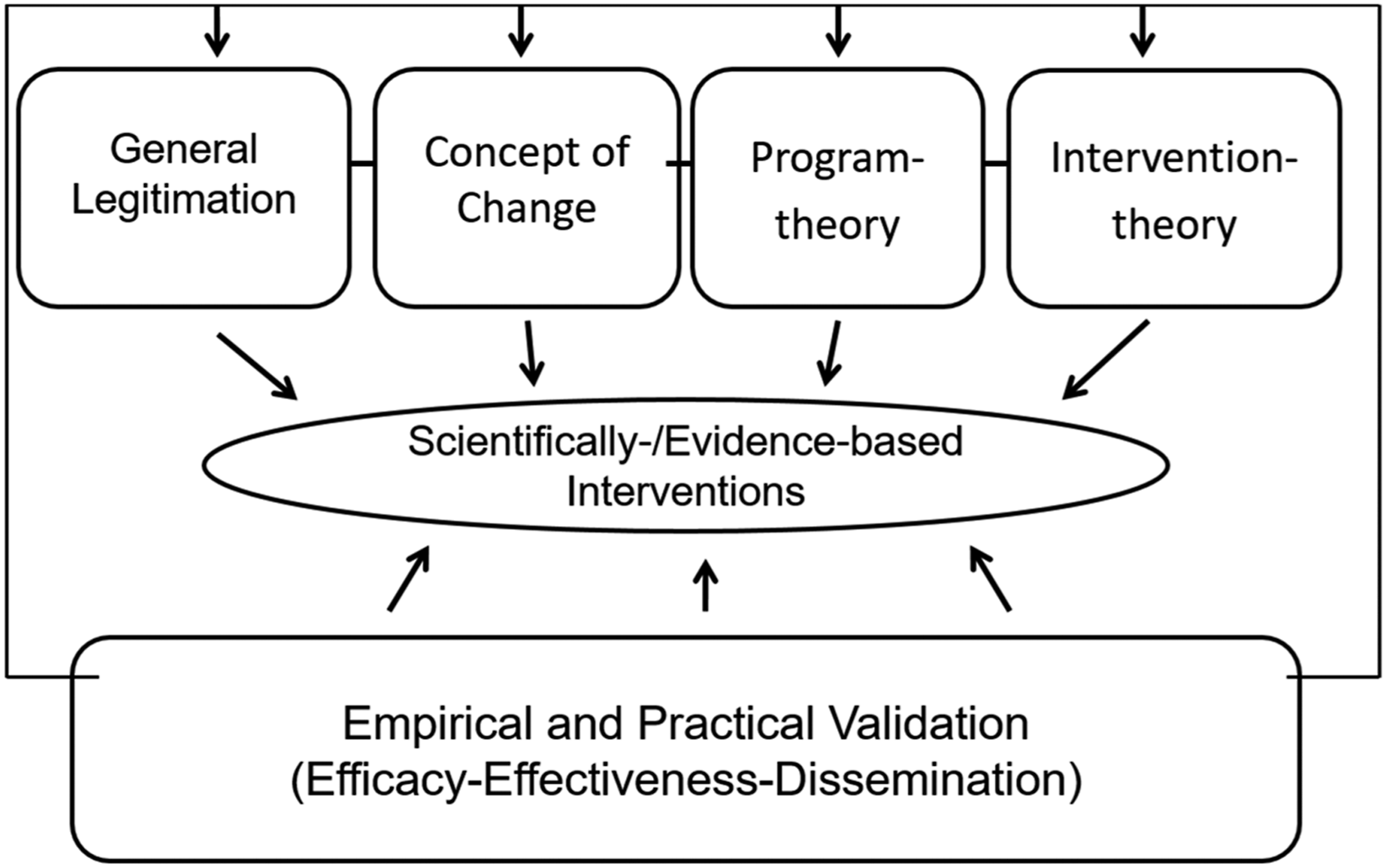
In general, we assume that at least five interrelated steps have to be taken into account before placing an intervention on a comprehensive scientific foundation: These are (1) a legitimation of the intervention’s credentials; (2) a concept of change based on human developmental principles or principles of human behavior change; (3) a program theory underlying the intervention`s specific content or aims; (4) an intervention theory underlying its administration and conduct; and (5) an empirical and practical validation by assessing its efficacy, effectiveness, and successful dissemination (see Figure 1). These aspects will now be illustrated for the example of the developmental prevention of prejudice, racism, and xenophobia.
Legitimation of the intervention´s credentials
Several prerequisites or core requirements have to be met before starting to construct any new intervention/program or preventive initiative that will meet the criteria of being scientifically founded. At least three basic questions have to be answered for its general legitimation. Initially, basic arguments have to be brought forward formulating a definable problem or concern that needs to be addressed. One should bear in mind that psychological interventions are operations to change human development that mostly intend to exert a long-term influence on human biographies. This illustrates that a sound justification will be necessary for substantial and normative reasons. In the present case, this means defining prejudice (or what to prevent) and presenting prevalence rates and consequences of prejudice, racism, and xenophobia that show the presence of significant problems that need to be addressed by psychological interventions. According to the data presented in the introduction, no one would really question the need for such an inquiry. It should, however, be remembered that there are no exact thresholds for problem prevalence rates that precisely indicate a need for psychological interventions. For example, we know that young children at age 4 show some differences between in- and outgroup evaluations that could be understood as prejudice (Pauker et al., 2016; Raabe & Beelmann, 2011). However, should we then aim to prevent that kind of ingroup–outgroup attitude difference? Or should we prevent only specific forms of prejudice—for example, only those manifestations that contain direct harm for others? And what would be the threshold for a difference between a “normal” and a “problematic” level or form of prejudice? Hence, researchers and program developers must clearly justify each new program by drawing on empirical data indicating the seriousness of a problem within the society.
In addition to epidemiological data, a reliable prognosis of developmental trajectories is needed (e.g., relatively sound assumptions on what will happen without an intervention). In the present case, this means a developmental prognosis on the stability of prejudice. Particularly for preventive measures, their legitimization depends largely on what would happen in the case of no intervention because preventive action relates to events to be avoided in the future and is naturally initiated during a stage in which no problem is present. Consequentially, it is necessary to justify theoretically why an (early) prevention should lower the probability of a negative event in the future. Therefore, data on the prevalence of a problem need to be supplemented with reports on its stability and perhaps its successive exacerbation over the course of development. Correspondingly, measures of developmental prejudice prevention must be justified not only by a high risk of prejudice, racism, or xenophobia but also by the fact that these have developmental precursors and that the stability of prejudice is relatively high. Indeed, although there is still a paucity of longitudinal research in the field of prejudice (Raabe & Beelmann, 2011), recent developmental studies reveal high levels of stability especially in adolescence (Crocetti et al., in press).
A second requirement for the general justification of psychological interventions is the selection of an appropriate intervention approach. Individual (i.e., psychosocial and educational) models of intervention are one, but usually not the only approach to preventing or treating a given problem. At least in part, there are also nonpsychological alternatives such as legal, sociopolitical, or security policy measures that may well contribute to solving the problem more efficiently. A sound scientific foundation for a specific psychological intervention has to outline right from the start why the psychosocial processes involved should be addressed, and which are the factors that will impede a developmental or behavioral problem. For example, if deficits in empathy and perspective taking play a central role in the development and maintenance of prejudice (Finlay & Stephan, 2000; Miklikowska, 2018), then interventions should clearly have a psychological character in order to address these mechanisms appropriately. Generally speaking, when starting to construct programs, it will be necessary to explain what kind of processes are involved in a given problem and which variables should be influenced (i.e., which goals one wants to attain). In the end, only systematic empirical research will be able to say which intervention approach might be the most effective one. However, when developing new intervention measures in the area of developmental prejudice prevention, it is necessary to explain a priori why the intended target variables should influence the prejudice status or further prejudice development.
A related strategic issue is the choice of a specific prevention strategy or prevention type. The concrete question is whether a specific program should follow a universal or a targeted prevention strategy (Costello, 2016; Offord, 2000). For a well-constructed measure, this should also be determined a priori and decided on the basis of systematic scientific knowledge. Unfortunately, this decision and a factually based choice are not self-evident but depend on results of comparative evaluations and a series of more fundamental considerations. According to Offord (2000), one disadvantage of universal prevention strategies lies in the difficulty of convincing the general public of the utility of measures that have relatively high costs because they should reach all members of a defined population. In addition, these primarily address those clients who are at the lowest risk for a deviant development. Selected or targeted preventive strategies, in contrast, are usually better adapted to the specific needs of certain target groups. However, an appropriate selection requires specific knowledge on the existence of risk factors and corresponding selection procedures. Moreover, selection processes may trigger stigmatization effects that universal strategies can, in turn, avoid. Hence, selection of an appropriate prevention strategy requires a series of reflections. For example, given a high prevalence rate and the intention to change society’s attitudes toward a social problem, large-scale, nationwide, universal prevention programs will be a better choice. However, under well-known risk conditions and an easy selection process, a more focused targeted prevention model will be better. Nonetheless, in the field of developmental prejudice prevention, the question regarding which prevention strategy to apply is hardly ever raised explicitly in empirical research. Therefore, which prevention strategy is more appropriate is still an open question. Moreover, it may well also apply to further conceptual issues such as the age at onset (see below). Indeed, new prevention programs clearly need such strategic reflections as a necessary part of the planning stage.
Third, because any type of intervention aims to change human behavior and development, its objectives and aims also have to be reflected from a normative standpoint. This precondition is only easy to meet at first glance, because there will be a far-reaching consensus on such intervention goals as “reducing prejudice and discrimination”—at least among informed and well-educated people. However, norms and values cannot be derived from scientific theories or empirical results. They have to come from normative models of how to shape human development optimally as well as from normative models in general. Therefore, the normative basis of intervention goals has to be specified not only for ethical reasons but also from a pragmatic outcome standpoint. For example, several studies have shown that the implementation quality and the effectiveness of school-based programs depend on a series of factors including provider, program, and school and community characteristics (e.g., Payne & Eckert, 2010). For this reason, it must be in the genuine interest of program developers or administrators to expose any existing normative differences in preventive goals and to minimize these through discussion. Perhaps the question of norms and values is not as salient in the area of developmental prejudice prevention as in intervention research in general. Indeed, not too many people within democratic societies will probably object to the prevention of prejudice from a normative standpoint. But one has to bear in mind that there are also strong populist and right-wing political movements in the United States and Europe that constantly agitate with negative portrayals of refugees and foreigners. Such people will probably argue against the necessity of antiprejudice prevention. In addition, normative discrepancies or conflicts between individuals or groups involved in the prevention program (e.g., user, program developer, evaluator, or funding provider) mostly become relevant in situations in which there is a need to decide between intervention alternatives (i.e., when resources are limited). For example, imagine that one would probably be forced to decide whether to carry out a prejudice prevention program for, one could say, obesity—also a relevant problem within Western societies. Or, even more generally, should limited resources be invested in either traffic infrastructure or prejudice prevention? These examples show that efficacious interventions need to have at least a basic agreement between all parties involved regarding the normative premises underlying the programs and measures and the basic significance of the targeted problems. And although the impact of these normative and value-related questions cannot be determined exactly, their importance should not be underestimated, especially when implementing interventions within the social welfare system. Therefore, it is important to make norms and values transparent and to seek agreement among all those involved before starting any new intervention initiative.
Concept of change based on human developmental principles and principles of human behavior change
As stated above, the general aim of psychosocial interventions is to affect (change) human behavior and development. In pursuing this aim, interventions can generally profit greatly from theories of human development, because they deliver a fundamental understanding of the principles by which humans develop and how intraindividual changes occur. In other words, theories on human development describe and explain exactly those processes that interventions want to initiate. Therefore, general developmental theories or principles—regardless of whether they are based on transactional (Sameroff, 2009), ecological (Bronfenbrenner, 1992), or dynamic-contextual (Lerner, 2002) models—have a major heuristic value when specifying the design and goals of intervention measures (see Bond & Hauf, 2004). Within this rationale, developmental theories should deliver a global orientation regarding the principles of prevention and intervention. For example, the work of Bronfenbrenner (1992) has shown that human development cannot be detached from the social context conceived as a conglomerate of micro-, meso-, and macrosystems that impact in various ways on human developmental dynamics and, accordingly, have implications for intervention concepts. For example, if someone tries to intervene on the individual microlevel, then changes will be quite unlikely if there are negative impacts on higher order systems (on the meso- or macrolevel). For instance, a social training program for children is probably ineffective if there are high risks on the family level (e.g., child abuse); or an individual contact intervention (bringing together natives and migrants) to reduce prejudice will be relatively ineffective if macrolevel risks (e.g., strong societal conflicts between social groups) overlap the intentions of this program.
On the other hand, programs on the individual level will have a higher probability of achieving change in individuals because they focus more directly on the target group. Hence, intervention concepts must take into account developmental processes at different contextual levels and—if possible—operate on the level that includes the most dynamic risk factor for the problem under consideration. In addition, the transition to a new ecosystem (e.g., from preschool to elementary school) is conceived not only as an outcome of developmental processes but also as a starting point for new developments (Bronfenbrenner, 1992). These assumptions have a number of consequences especially for the concept of developmental prevention—for example, the use of ecological transitions as phases of heightened responsiveness or higher sensitivity to external stimuli comparable with either critical live events and developmental tasks or so-called “windows of opportunity” (Masten et al., 2009). These thoughts show that taking the idea that the development of human behavior is characterized by complex interaction processes as a theoretical guideline also provides a particularly appropriate approach to developmental prejudice prevention as the principle of developmental and ecological fit.
A further look at developmental theories reveals that they deliver important principles not only for selecting a general intervention approach but also for conducting interventions by revealing the close ties between developmental theory and the principles for implementing prevention programs. Developmental scientists such as Vygotsky (1978) have outlined the ways in which human development is related to social interaction with a competent partner who is located in the zone of proximal development. The latter is defined as the next stage of development that a child or person has to attain (see Vygotsky, 1978). Thus, according to this concept, interventions need to be oriented toward the developmental level of the target group and they should intervene on their developmental level. Moreover, such an approach indicates that development might be promoted most effectively when the social partner (administrator) interacts on the developmental level of the target while looking forward to and anticipating the next higher developmental stage. Even though Vygotsky (1978) developed this principle in the context of cognitive development, it can also serve as a basic heuristic for all activities aiming to promote youth development. For intervention research, this principle can be extended to the principle of dosed deviation from the developmental status quo. This proposes that all types of interventions should be related significantly to the current developmental level of the target group while, at the same time, referring to the next expected step in changing attitudes and behavior. For example, if someone had a high manifestation of prejudice against other nationalities, it would seem advisable not to start by trying to change his or her exaggerated social identity status based on nationality, but perhaps, first, to prepare opportunities to get in contact with people from other nationalities that he or she would otherwise avoid. However, this dose deviation from the developmental status quo principle can affect the shape of intervention in additional ways: for example, in its orientation toward the current learning level, attention to (perhaps limited) developmental opportunities within the social context, design of age-appropriate intervention materials, and so forth. A central precondition of an intervention oriented toward this principle of dosed deviation from the status quo is a systematic and supervisory assessment of the actual developmental or psychological status and a regular reflection on change, learning, and developmental processes during the intervention. What seems to be a complex instruction is probably easy to carry out by gathering some indicators during the intervention process—at least in the negative case. A developmentally appropriate intervention in line with the zone of proximal development and the principle of dosed deviation from the status quo would lead to a high motivation and collaboration in the target group. If these indicators are negative, one would have to anticipate bad implementation scores or implementation problems (e.g., low attendance and participation rate, low readiness for change, high resistance to the program, or behavior changes leading up to dropout from the intervention). Hence, if administrators notice these problems, it is highly probable that there will be a need for a fundamental reorientation of the content, the provision, or the implementation conditions of the intervention. If, in contrast, these indicators are favorable, it can be assumed that the administration and conduct of the program have been constructed in line with the developmental requirements according to the dosed deviation principle.
Alongside these ontogenetic perspectives on change, intervention research has delivered models for processes of actual changes to attitudes and behavior during the intervention. These stem mostly from health and clinical psychology. For example, Prochaska et al. (2015) have proposed a transtheoretical stage model of change ranging from the motivation to change up to the internalizing of new behavior. In this model, intervention planning has to be tailored to fit these different stages of change by applying different methods for individuals at different stages of change. As a result, one necessary step in program planning seems to be to proactively consider which preconditions are present and to construct program administration in line with these deliberations. Others have developed more complex action-oriented models (Schwarzer, 2008; Zhang et al., 2019) that place the precursors of intentions (e.g., self-efficacy) and maintenance of behavior at the center of durable behavior change. Although these models have been tested merely within health research in adulthood and without adopting any developmental perspective, they nevertheless give an impression of what needs to be considered when wanting to initiate new attitudes and behavior or to change unfavorable ones.
Up to now, however, such general thoughts on general ontogenetic developmental dynamics and current behavior change have been channeled only implicitly into the construction of developmental prejudice prevention programs. For example, most prejudice researchers would immediately confirm that the development of intergroup attitudes and behavior depends largely on the social context (Bar-Tal & Teichman, 2005; Brown, 2010; Miklikowska et al., 2019; Nesdale et al., 2005; Thijs & Verkuyten, 2014). However, most programs for children and adolescents do not integrate the broader context (families, peers, school, community, and services) into the intervention. In addition, when it comes to the macrocontext of development (e.g., changing societal factors such as important social norms or values), developmental prejudice prevention programs often lack clear connections regarding how they relate to them. These and other examples show that when it comes to basing prevention programs on general developmental principles, there is still some scope for further attention and improvement. Nonetheless, although the orientation toward general developmental models is promising, it also has its limitations. The most important is that developmental deliberations reveal little about the concrete content of an intervention (i.e., what exactly should be promoted or changed), but more about broad conceptual orientations (e.g., the onset and focus, the contexts, and the underlying conditions of an intervention). However, any developmentally well-founded program should be organized according to these principles; or, in other words, it should at least not contradict the principles of human development and behavior change.
A program theory underlying the intervention’s content
Regarding the scientific foundation of interventions, one essential pillar is deriving the specific content of a program (i.e., the specific aim or What should be changed) from evidence-based theories and empirical research. The central question is which competencies should be promoted or what needs to be changed in order to prevent or treat a specific problem. In general, several information sources could be used to derive the specific aims of an intervention: (a) causal risk and protective factors, (b) developmental models or etiological theories on the problem under consideration, and (c) results from evaluation research in the field.
With regard to developmental prejudice prevention, findings from developmental research on the onset, manifestations, and explanations of prejudice within human development as well as the results of corresponding prevention research are of decisive importance when determining the targets to address. Fortunately, research on the development of prejudice has made major progress in recent decades. Researchers now have decisive knowledge on age differences from cross-sectional but recently also from several longitudinal studies (Crocetti et al., in press; Raabe & Beelmann, 2011) as well as information on underlying developmental factors and several developmental theories on prejudice (Levy & Killen, 2008). Thus, there are meaningful evidence-based information sources that should be used to construct programs for prejudice prevention. For example, several social-cognitive factors such as deficits in classification skills, perspective taking, and empathy have been shown to correlate consistently and positively with the level of prejudice at different ages (Bigler & Liben, 2007; Miklikowska, 2018). Others have shown that high identification with the ingroup leads to higher prejudice (Nesdale, 2004); or that the development of values such as equity and fairness can buffer against prejudice, discrimination, and social exclusion (Rutland & Killen, 2015).
It is immediately clear that indications for designing the content of prevention measures can be derived from knowledge on the effects of such risk and protective factors. However, although these are important results when selecting program content, they do suggest that it is relatively easy to derive intervention aims from correlational (risk and protective) factors. There are, however, several derivation problems. For example, prevention programs should not refer to developmental risk factors per se but to risk factors that are currently operating within the target group. For example, in a meta-analysis of correlational studies, we have shown that the relation between social-cognitive factors and prejudice is most negative within the age group of 7–10 years. In other age groups, we found lower (11–18 years) or even positive correlations (age 4–7 years) between social-cognitive abilities and prejudice (Beelmann, 2021). Thus, the aims of a program should not refer to risk factors per se but to those that are operating at a certain point or period in development. In addition, deriving intervention content from protective factors makes more sense heuristically than deriving it from risk factors because the definition and empirical confirmation of protective factors in the sense of resilience imply the buffering of a risk status and therefore reflect a mediational process to counter prejudice that an intervention would intend to initiate (Rutter, 2012). Risk factors, on the other side, are simply defined via a covariation and do not necessarily include a causal mechanism. Finally, substantial considerations should be made against the background of the target group’s current developmental processes. For example, changes are probably easier to bring about if natural developmental processes take place at the same time as interventions are being implemented (Masten et al., 2009). This principle holds for risk factors as well as for protective factors. For example, if you want to foster the development of a coherent identity, it seems advisable to intervene within adolescence or emerging adulthood because of the high developmental dynamics and responsiveness within these ages due to an increased in-depth identity exploration (Crocetti, 2018). In addition to the heuristic function of risk and protective factors, several developmental models of prejudice have been established and deliver more complex and integrated knowledge on the dynamics of prejudice development. For example, Bigler and Liben (2007) have proposed a social-cognitive model of prejudice development in which it is assumed that the development of social categorization and of essential beliefs regarding its importance arise in interaction with the specific social context that has delivered the social categories along with their meaning and evaluation. According to this model, prevention measures should integrate important caregivers who are responsible for the transmission of social categories, social norms, and values—and who do this especially at young ages.
In contrast, Nesdale (2004) has pointed out that the development of national and ethnic prejudice depends on the early development of identity up to the age of 10. His social identity development theory proposes that early identification with the ingroup, social norms, and the perception of intergroup threat by members of social outgroups play a crucial role in early prejudice development. Thus, if one were to derive prevention aims from this model, programs should include exercises on the identification and the perception of intergroup threat.
A further model has been developed by Melanie Killen and Adam Rutland (Killen et al., 2016; Killen & Rutland, 2011. They connect the development of prejudice with moral development. Based on social-cognitive domain theory (Smetana, 2013), these authors have proposed a model in which intergroup attitudes and behavior (including prejudice) depend on moral cognitions regarding fairness, equity, and justice in different moral domains (moral, conventional, and individual) during moral development. It is therefore important for prevention measures not only to promote these values in the sense of right or wrong but also to look simultaneously at conventions in the social context along with individual preferences (Killen & Verkuyten, 2017).
These and other models depicting prejudice development should not be seen as competing alternatives but more as complementary theories that discuss different developmental factors and processes at different ages. However, they give a clear indication regarding what to address in programs designed to prevent prejudice during childhood and adolescence by embedding the prevention model into a broader concept of prejudice development. Therefore, these models will be more useful than single risk and protective factors when it comes to conceptualizing preventive interventions.
Finally, prior results of prevention research can give a better impression on what works and what does not work. For example, a meta-analysis by Beelmann and Heinemann (2014) has revealed that programs promoting empathy and perspective taking produce the highest effect sizes, whereas training in classification skills or reorganizing social categorization—although frequently recommended—is not that effective. Hence, the evidence-based construction of developmental prejudice prevention programs has several important information sources that should be used when designing new and probably better programs.
An intervention theory for the administration and conduct of an intervention
For a scientifically based construction of prevention, it is not enough to just consider substantial aspects of interventions (the program theory). A series of aspects have to be considered that are relevant for the concrete provision, administration, conduct, or, in more general terms, the implementation—that is, aspects addressing the “HOW” of an intervention or the intervention theory. With these two dimensions (program and intervention theory), intervention strategies can be differentiated according to whether they are scientifically based in terms of their content and their implementation (see Figure 2). For example, if an intervention is not well founded in terms of it is content and implementation (e.g., someone intervenes based simply on his or her personal experience), one could name it unreflected. An academic intervention style is characterized by a sound scientific foundation of the content (e.g., aims that are linked to a tested etiological theory) but has no clear and reasoned concept of implementation (e.g., no reasoned length or methods used). A practical style consists of a sound implementation concept (e.g., an attractive program offer to the target group) without a convincing description and justification of the aims of the intervention. Finally, a professional style is preferable to other strategies because the probability of effects will be greater if both dimensions have a sound scientific foundation (i.e., the content and implementation dimension is based on rigor scientific knowledge). Intervention styles according to the type of foundation (+ = highly scientifically- based, − = low scientifically-based).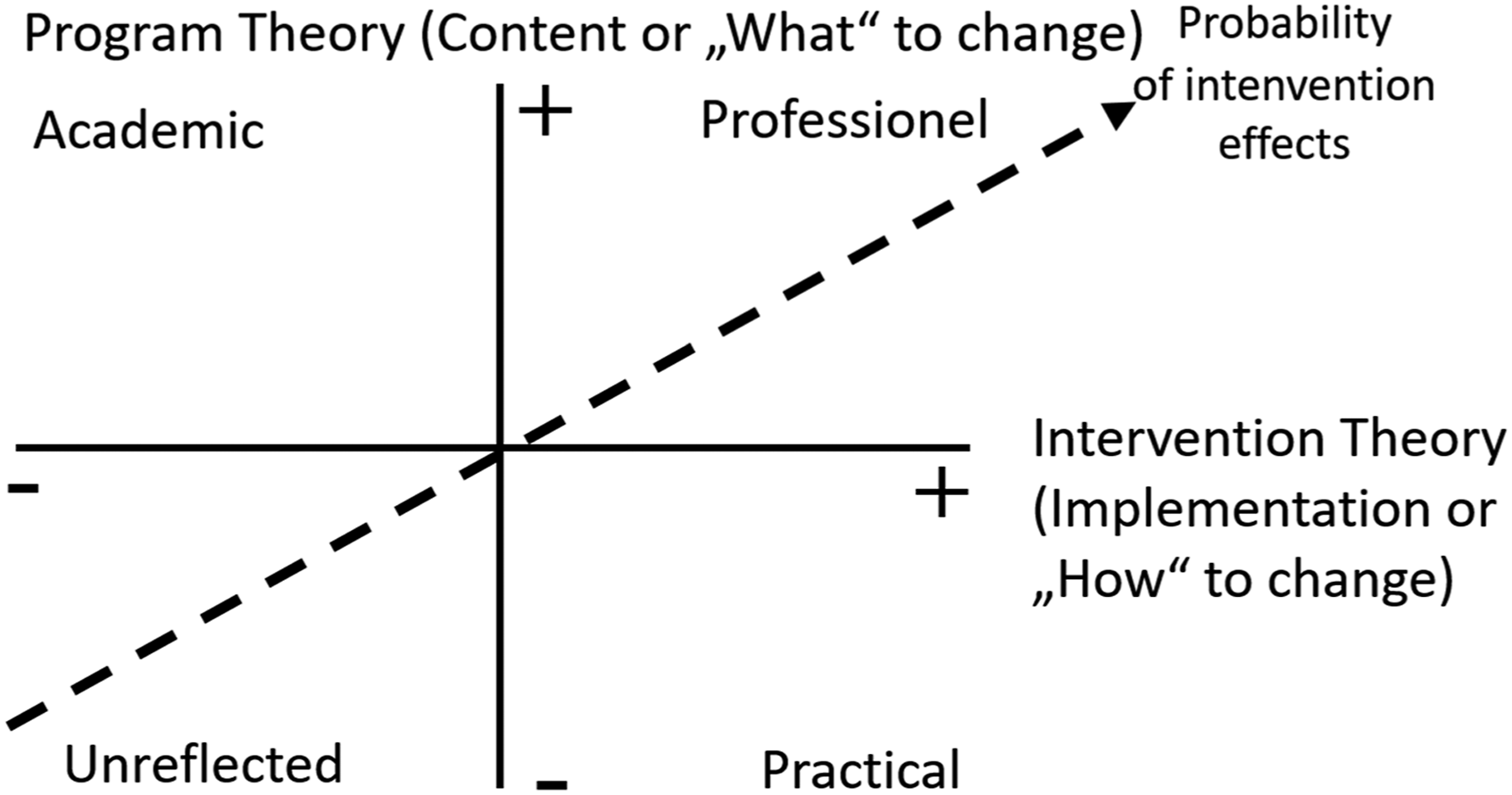
Four interrelated domains of such an intervention theory can be differentiated: (1) the provision and the necessary starting conditions; (2) the intensity or dosage; (3) the structure, didactics, and intervention methods; and (4) the necessary contextual conditions of an intervention. Taken together, these domains characterize the educational dimension of intervention planning that should be based on sound implementation and outcome research. This is particularly relevant for implementing the concepts in real-world settings and guaranteeing positive outcomes in a wide range of dissemination contexts (see, e.g., Ghate, 2016; Payne et al., 2006). All four domains lead to several important questions: (1) Provision and necessary starting conditions. The initial issue addresses the optimal starting conditions—especially how the intervention is to be offered to the target group, what are the necessary professional competencies for administrators, and what are the preconditions on the side of the target group. In general, the provision of interventions has been discussed under the heading of barriers to treatment. One general observation is that it is typically not easy to motivate what are especially at-risk groups to participate in intervention programs. Therefore, a sound program has to specify how the target groups should be contacted, how to offer the program, and how to ensure participation continues over the course of the intervention. In some fields (e.g., parenting interventions, see Weisenmuller & Hilton, 2021), these aspects have been discussed intensively. For example, Reyno and McGrath (2006) have shown that there are numerous reasons why parents do not take advantage of such programs or drop out of them (e.g., lack of childcare during the sessions and lack of insight into the existence of parenting problems). Although it is clear that such problems relate to the conditions under which programs are run (see below), they also address the necessary motivational preconditions for participation and behavior change. In addition, the selection of at-risk groups bears the risk of stigmatization especially in-school settings (e.g., Gronholm et al., 2018). Prejudice prevention programs mostly ignore these questions, although one can expect that especially risk groups that already have high prejudice values will generally be less motivated to participate in a psychosocial program aiming to reduce their prejudice. Hence, this shows the importance of thinking about the preconditions for entering every program and possibly building up arrangements to establish these entry preconditions and increase willingness to participate.
Another important dimension is the competencies of the program administrator. Intervention developers have to decide who is going to administer their program (e.g., whether it should be given only as written materials, or conducted by specialists and teachers) and, second, which professional abilities and training the person or group administering the program should possess. Unfortunately, implementation and outcome research deliver no clear picture as to whether there is a special group of administrators whose work is most effective. In most prevention meta-analyses, it is the program developers or their staff who usually obtain higher effects. However, it seems unclear whether this is due to a general reporting bias (e.g., conflict of interest) or a higher implementation quality due to better professional qualities compared to other administrator groups (see e.g., Beelmann & Raabe, 2009). In addition, whereas some meta-analyses on prejudice prevention have found, for example, lower effect sizes for teachers (Ülger et al., 2018), others cannot confirm this result (Beelmann & Heinemann, 2014; Kalinoski et al., 2013). In general, both prevention science and practical implementation knowledge indicate that administrators should be taught the special theoretical grounding and necessary implementation conditions for each specific program (Meyers et al., 2012). Therefore, it is considered necessary to train administrators and give regular program support during the application to ensure implementation quality. (2) Intensity or dosage. One aspect of interventions that is a major concern for planning and, finally, for the costs of a program is its intensity or dosage. Basically, one can conceive of different models ranging from one-event or one-shot interventions across short-term interventions up to measures that accompany developmental periods or last several years. In addition, of course, intermittent concepts (e.g., programs with booster sessions) are also conceivable. In general, programs can vary in terms of not only the total amount of time but also the number, duration, and frequency of sessions; and these variations should correspond ideally to the aims of the prevention, the capacities of the target group, considerations on implementation, and, of course, available resources.
Unfortunately, once again, although intensity is a very important issue when it comes to the outcomes and costs of programs, there is still no clear indication as to precisely which intensity a program should have for the most effective prejudice prevention. Within their meta-analysis of school-based programs, Ülger et al. (2018) did at least find that one-session interventions are not very useful. Beelmann and Heinemann’s meta-analysis (2014), in contrast, found no relationship between intensity (in terms of the number of sessions and their duration) and effectiveness, perhaps because the variation between the studies they integrated was rather low. McGregor (1993) found the unexpected finding that less treatment time in antiracist teaching was more conducive to prejudice reduction. In addition, in a number of evaluations (e.g., on contact interventions), it is even difficult to specify the intervention intensity. Regrettably, the intuitive premise that a greater intensity will be followed by a stronger effect cannot be assumed—as results in other prevention fields also indicate (Beelmann & Raabe, 2009; Sandler et al., 2014). One reason for inconsistent findings on intensity might well lie in its relation to participant motivation. It is conceivable that more intensive programs are basically necessary and would potentially lead to better outcomes, but that the length of such programs leads to greater difficulties due to declining participant motivation. Hence, there is still a major need for more research on the issue of intensity. At best, one can assume that some intensity—that is, some amount of new experiences—is necessary to prevent or change prejudiced attitudes and behavior. (3) Structure, didactics, and intervention methods. Alongside the pure quantity dimension, variations in intervention structure, didactics, and methods are particularly significant. This addresses, for example, the structuring of interventions according to different phases (e.g., warm-up phase and booster exercises), the type of administration (e.g., open vs. structured; frontal vs. interactive vs. self-directed; and group vs. individual), the sequence of intervention units (e.g., successive vs. modular), and, finally, the selection of educational and psychological methods (e.g., pure information transfer, role play exercises, games, group discussions, problem-solving practice, or in vivo training). Even such a short list immediately reveals the wide range of options for constructing programs. Finally, depending on the different administration models, methods, and target groups, programs also need to select and develop the necessary materials to conduct the program in an optimal way (e.g., program manual and work materials).
Research on these intervention aspects is also sparse. One exception can be made in the case of intervention methods. A number of effective psychological methods have been developed and documented in recent years under the heading of intervention kernels (Embry & Biglan, 2008). However, there are yet again only a few indications regarding the use of different methods within prejudice research such as role playing (McGregor, 1993) or the intensive literature on cooperative learning methods (Johnson & Johnson, 1989; Slavin & Cooper, 1999). In general, Aboud et al. (2012) have argued that all features of the intervention have to be developmentally appropriate for certain target groups. But what exactly is that expected to be? Within practical contexts, these requirements are often guided by plausibility, individual experiences, or by trial and error. A sound program design, in contrast, takes at least the existing research findings into account. For example, both an active administrator who guides concrete exercises as well as curriculum-based programs seem to be more effective than group discussions and printed materials (Beelmann & Heinemann, 2014; Kalinoski et al., 2013). In addition, prejudice research and interventions are also widely influenced by the contact literature. Contact and its optimal conditions are in themselves intervention methods (and not primarily a content), and research on the effects of diverse contact experiences—both experimental and correctional—clearly indicates that this method is efficacious in preventing and reducing prejudice (see below). However, in summary, although some aspects can be outlined already, there is a need for more research on the best structure, didactics, and methods to use in developmental prejudice prevention, especially with respect to the target group’s developmental level. (4) Necessary contextual conditions of interventions. Finally, of course, all interventions including prevention measures are conducted not within empty spaces, but, at best, within defined settings under planned conditions. This makes it necessary to specify the conditions for a successful program implementation (e.g., necessary personnel and materials) and the institutional contexts in which that program should be carried out. Such specifications are naturally significant for delivering prevention programs within a social welfare system and should already be taken into account when developing a program. Good framing conditions should range from political and financial support for conducting programs up to the provision of rooms and materials, a supportive social context, sustainability of conditions, and much more (Meyers et al., 2012). Unfortunately, these dimensions of prejudice prevention programs have yet to be discussed intensively. Nonetheless, we know from prevention science and implementation research that these are necessary conditions if sustainable strategies are to be planned for nationwide delivery (Biglan, 2018; Ghate, 2016).
In sum, planning the provision, its administration, and the conduct of the prevention measures are at least as demanding as deriving the program’s content from tested theories and empirical research. Although there is some research on single aspects, research on these parameters is unfortunately quite unsystematic. For the field of developmental prejudice prevention, research on program parameters and their implications clearly reveals several desiderata for further research (see below).
Empirical and practical validation
A sound legitimation and a strong theoretical and empirical foundation of a program’s content and administration are only necessary but not sufficient conditions for effective interventions. Even well-founded concepts do not guarantee empirical and practical significance. Therefore, a final and crucial requirement for scientifically based interventions is indeed a systematic validation through evaluation research. According to Flay et al. (2005) and Gottfredson et al. (2015), a comprehensive evaluation of a scientifically based program has to contain at least three consecutive steps in gathering evidence: • confirmed efficacy in methodologically rigorous studies under optimal conditions, • confirmed effectiveness in representative practical settings, and • sound ideas and practical measures for disseminating the program in social welfare systems.
Results of reviews and meta-analyses on the prevention of prejudice in childhood and adolescence.
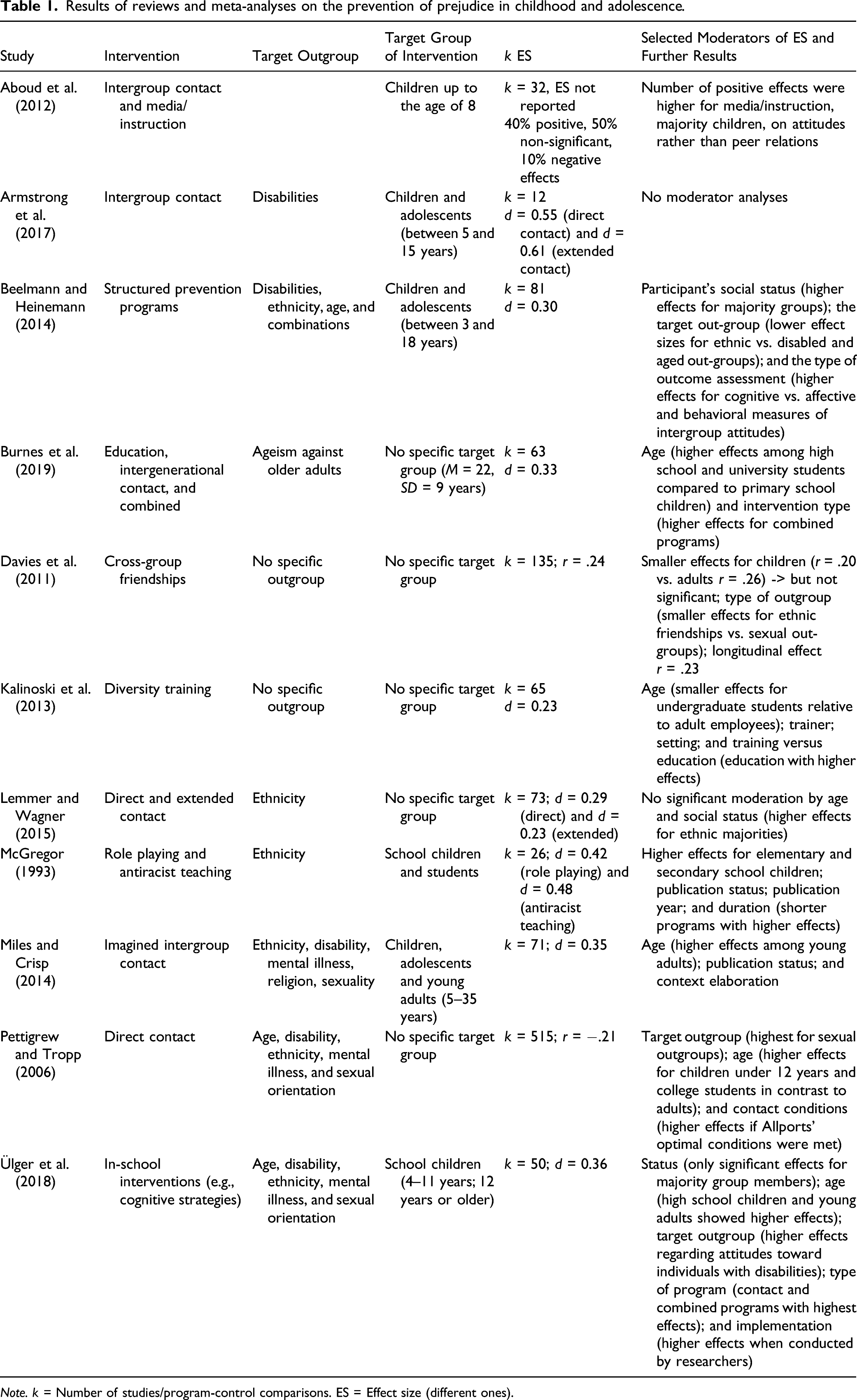
Note. k = Number of studies/program-control comparisons. ES = Effect size (different ones).
Overall, three different prevention approaches should be mentioned in detail. One of the most frequently evaluated and effective prejudice prevention approach stems from the contact hypothesis (Allport, 1954). Intergroup contact programs have been shown to reduce ethnic prejudice and other forms of negative outgroup evaluations among different social groups (such as majority and minority status groups), geographical contexts (such as conflict and nonconflict settings), and implementation strategies (such as direct, extended, or even imagined contact experiences), although effect sizes vary (Lemmer & Wagner, 2015; Miles & Crisp, 2014; Pettigrew & Tropp, 2006; Zhou et al., 2019). Overall, direct and extended types of intergroup contact significantly reduce prejudice among all age groups. However, Pettigrew and Tropp (2006) found that intergroup contact was stronger in relation to reduced prejudice levels among children under 12 years of age (r = −.24) and college students (r = −.23) compared to adults (r = −.20). In contrast, Davies et al. (2011) systematically integrated studies on cross-group friendships and their relationship to positive intergroup attitudes and found smaller effects for children (d = 0.20) compared to adults (d = 0.26). However, this difference was not significant. Furthermore, Miles and Crisp (2014) evaluated imagined intergroup contact programs and revealed that the mean effect (d = 0.35) of such programs was higher among children (d = 0.81) compared to adults (d = 0.32). We identified only one study that systematically integrated intergroup contact interventions focusing especially on children and adolescents. The meta-analysis by Armstrong et al. (2017) reported mean effect sizes for the effect of direct and extended contact programs on reducing prejudice against persons with disabilities. Overall, direct contact (d = 0.55) and extended contact (d = 0.61) reduced prejudice levels among children and adolescents between 5 and 15 years of age. Unfortunately, the meta-analyses did not present any moderation analyses at all.
In addition to intergroup contact prejudice prevention initiatives, a second group of antiprejudice programs are based on providing information and knowledge about social outgroups and imparting positive intergroup norms and values to reduce negative outgroup evaluations. For example, multicultural programs and diversity trainings have been evaluated extensively and have generally been evaluated positively in terms of reducing prejudice (Paluck, 2006; Paluck & Green, 2009; Stephan et al., 2004). A recent meta-analysis conducted by Bezrukova et al. (2016) summarized the effects of diversity programs based on 260 studies and found stable effects on cognitive learning (referring to how far participants acquire knowledge about cultural diversity) and behavioral learning (the development of participants’ skills in, e.g., situational judgments or objective behavior). However, effects on attitudinal/affective learning (changes in participants’ attitudes toward diversity and multicultural societies) and long-term effects were smaller and only significant for cognitive learning. Nonetheless, a meta-analysis by Kalinoski et al. (2013) revealed that mean effect sizes were significantly smaller for undergraduate students compared to adult employees on affective (attitudes toward diversity) and cognitive (knowledge on diversity) measures.
Other educational approaches such as antiracist teaching involving discussions on racial prejudice, discrimination, or stereotyping also have been effective in reducing prejudice among school children and students (McGregor, 1993). Additionally, Burnes et al. (2019) summarized 63 studies on the effectiveness of educational measures on prejudice against the elderly (ageism) and found a moderate mean effect size of d = 0.33 in promoting positive attitudes toward older people. Furthermore, a moderator analysis showed that effects on attitudes toward the elderly were stronger among high school (d = 0.36) and university students (d = 0.39) compared to elementary school children (d = 0.10), perhaps because the initial level of prejudice was lower in younger groups. Finally, we have some evidence that television based education such as the famous Sesame Street series had positive impact on children´s prejudice development (Cole et al., 2008; Graves, 1999; Persson & Musher-Eizenman, 2003), although these projects often have more and diverse objectives (e.g., promoting the cognitive development) and were based not only on educational measures but also on extended contact.
Besides intergroup contact programs and educational approaches, a third group of interventions to prevent or reduce prejudice places more emphasis on training and promoting those individual competencies that correlate systematically with negative outgroup evaluations and intolerant attitudes. In general, competence interventions are conceptualized as standardized training programs aiming to increase the skills of children and adolescents. Beelmann and Heinemann (2014) summarized the effectiveness of a variety of structured programs designed to promote individual competencies in reducing prejudice and improving intergroup attitudes in children and adolescents. The overall effect size for 45 studies on cognitive and social-cognitive training programs was moderate (d = 0.40). Trainings in perspective taking and empathy as well as in social skills yielded the strongest effects in terms of reduced levels of prejudice or improved attitudes toward outgroups (both d = 0.50), followed by trainings on moral development (d = 0.36), interventions promoting problem-solving skills (d = 0.20), and trainings in classification/social categorization (d = 0.16). Hence, individual training in perspective taking, empathy, and social skills seems to offer one of the best ways to reduce prejudice and discrimination in childhood and adolescence. This holds for a wide range of different program characteristics (duration, number of sessions, intensity rating, and trainer) or subject characteristics (age group and gender), and the overall effect size was also significant in follow-up data (d = 0.29). However, two variables systematically correlated with effect sizes: On the one hand, higher effects were found when the target outgroup consisted of persons with disabilities compared to ethnic outgroups. Second, studies with minority groups (e.g., in which they are the in-group and the intervention addresses prevention of prejudice against majority children) showed nonsignificant effect sizes and were far less effective than interventions with majority groups (e.g., addressing prejudice against minority children). In addition, the efficacy of structured programs varied depending on the type of outcome assessment, indicating higher effects for cognitive compared to affective or behavioral prejudice measures.
Ülger et al. (2018) conducted a second meta-analysis focusing on structured programs for school children. This quantitative review systematically evaluated 50 studies of in-school interventions on attitudes toward age, ethnic, religious, and handicapped outgroups. The overall mean effect size for the in-school antibias interventions was d = 0.36. Program outcomes were moderated by characteristics of participants, target outgroup, underlying theoretical orientations, and implementation-relevant characteristics. Again, higher effects were found among majority group members’ attitudes toward minority group members (d = 0.40) compared to minority group members’ attitudes toward majority group members (d = 0.23, nonsignificant effect). Furthermore, in-school interventions revealed stronger effects for middle- and high-school-aged children and adolescents (d = 0.52) compared to younger children or elementary school students (d = 0.30). When analyzing the variation of effect sizes of in-school antibias programs as a function of target outgroups, the review found that intervention effects were slightly higher when addressing attitudes toward individuals with disabilities (d = 0.43) compared to interventions addressing interethnic attitudes (d = 0.41). Regarding theoretical orientations, the analysis revealed that intergroup contact interventions (d = 0.46) and multifaceted approaches (d = 0.49) were far more effective than de-categorization or recategorization (d = 0.22) and interventions including education (d = 0.25, nonsignificant effect). However, categorization programs were highly effective in middle- and high-school-aged children. Finally, the study found that effects of in-school interventions were more effective when conducted by a researcher or research assistant (d = 0.53) compared to teachers (d = 0.20), and that interventions on the class level produce higher effects on outgroup attitudes for middle- and high-school children (d = 0.46) compared to a nonsignificant effect in younger children (d = 0.29).
In sum, meta-analytic research from the past decades has documented some evidence for the efficacy and effectiveness of prejudice prevention interventions specifically for children and adolescents. Moderator analyses show that the outcomes on reduced prejudice levels depend on various variables. Intergroup contact interventions as well as the promotion of individual skills have been shown to be especially effective among young children, but can also be applied to significantly reduce prejudice among adolescents and young adults. In contrast, the potential of diversity trainings and other education-based approaches seems to be particularly strong among adolescents and young adults. Furthermore, effects of prejudice prevention for children and adolescents vary depending on the prejudice dimension targeted and the target outgroup. In addition, the reviews on prejudice prevention for children and adolescents also found variations in effectiveness depending on the social status of the program’s target group. Thus, in conclusion, we have promising findings, but also some differential results, leading to future challenges of developmental prejudice prevention.
Further Development of Prevention Models and Concepts
The foremost task is to strengthen the “developmental” in developmental prejudice prevention. Naturally, the content of most existing prevention programs can be related meaningfully to findings from developmental research on prejudice. However, developmental theories and research have more to offer when it comes to designing a sound scientifically based prevention. We shall illustrate this by posing four questions addressing the choice of the target group (Who), the onset or the timing (When), the content and aims (What), and the type of administration and implementation (How).
Who: The first question deals with using findings from developmental research to select the target group. It has already been suggested that successful prevention efforts generally depend strongly on which development-related predictions can be confirmed empirically. Moreover, scientific knowledge on human development can improve prevention concepts further by delivering indications as to which concrete target group should be selected in terms of the changing agent (children, parents, peers, neighborhoods, and communities), gender, or risk status. The idea of offering different concepts for a specific problem based on different degrees of risk has a long tradition in prevention science (O´Connell et al., 2009) but has yet to be adopted to any great extent in prejudice prevention research. Indeed, identifying risk groups with a high probability of a progredient prejudice development and designing tailored programs are challenges that will lead to further advances in this field. However, as always, things are not that easy, because a risk status is generally not defined by single risk variables. For example, it has long been known in developmental science that risk factors have a cumulative impact (Jessor, 2016; Sameroff, 2009), and that the degree of risk represents a better selection criterion for prevention than any specific variable. Furthermore, developmental psychopathology (Cicchetti, 2016) has shown that it is not just the number of risks, but the relation between risk and protective factors that is decisive. The greater the mismatch between positive and negative developmental factors, the greater the risk of developmental problems. Hence, if a targeted prevention program is to be implemented, the selection of target groups should not be based on single risk factors (e.g., deficits in empathy) but on the degree of risk or, even better, on the risk factor—protective factor ratio. Changing selection procedures in this way could make a major contribution to the success of prevention as well.
A related issue is the delivery of programs for minority status groups or groups with low social status that seem to follow a different developmental pathway in prejudice (Raabe & Beelmann, 2011; see above). This is also a question of cultural adaptations or adaptations to the social context (see below) that have proven to be more successful than universal concepts (Beelmann et al., 2021; Sundell et al., 2016). Hence, it is crucial to take social and cultural characteristics and features of the specific target group into account and to implement prejudice prevention programs that are culturally sensitive (Castro et al., 2010; Castro & Yasui, 2017) or generally tailored to the target group (Killen et al., 2011; Malti et al., 2016).
A further issue is integrating the social context that has been identified as being important for prejudice development. For example, because prejudice development depends on the social norms within the social context of families and communities, it is necessary to think about programs that try to change these contextual influences—something that has been achieved already by the integrative school movement or in reconciliation programs. However, much more could be done such as work with parents, families, teachers, schools, communities, and even societies without just taking children and adolescents as the primary target group. This is especially true for conflictual social contexts, for example, during the so-called “refugee crisis” of 2015 in Europe and Germany when more than one million refugees from Syria, Afghanistan, and other countries came to Germany, thereby triggering a huge discussion on the right of asylum and the supposed negative consequences for the German social system.
When: Closely tied to the question of the target group is the question of the timing or the onset of developmental prevention programs. Some would assume that “the earlier the better” is a basic prevention principle. However, it is harder to specify the optimal time point within development for carrying out prevention programs than this statement would suggest. Various meta-analyses have revealed more positive relations between age and the efficacy of measures (e.g., Beelmann & Raabe, 2009; Sandler et al., 2014; Gottfredson et al., 2002). This result is due at least partially to confounds between age and the prevention strategy, because targeted prevention programs with fundamentally stronger effects are carried out primarily with older children and adolescents. Nonetheless, it is also possible that the concepts and contents of prevention programs are tied to cognitive and other preconditions that are to be found with more certainty in older children and adolescents (e.g., sufficient reading skills to participate in the exercises or advanced cognitive skills). For example, Garrard and Lipsey (2007) found that conflict-resolution programs are more appropriate for adolescents than for children. Hence, an advantage of early onset can be anticipated only when programs are conceived in a developmentally appropriate manner. Therefore, the resulting conclusion is not “the earlier the better,” but that developmental prevention programs should be “timely and developmentally appropriate.” In this context, Masten et al. (2009) have pointed to the need to pay more attention to normative developmental trajectories and set the timing of prevention measures according to “windows of opportunity” (i.e., to train skills when developmental changes within this domain are ongoing). For example, we have developed a successful prejudice prevention program for elementary school children aged 8–10 years (Beelmann, 2018) on the basis of results from a developmental meta-analysis that had shown a characteristic course of prejudice development in majority children that increases between age 5 and 7 and then decreases between 8 and 10 in line with their cognitive and social-cognitive development (Raabe & Beelmann, 2011). We avoided intervening earlier (e.g., at preschool age) because this would have meant working counter to the natural development of prejudice based on increasing social categorization skills (that are not per se a problem of social cognitive development). Such close ties between empirically confirmed developmental trajectories and the onset of prevention could be a key for strengthening future preventive efforts.
What: A core issue is the developmental appropriateness of the prevention content and aims. In general, prejudice prevention programs are—at least in part—relatively well defined in terms of social psychological and developmental theories of prejudice (Aboud et al., 2012). However, a clear area of further development lies in the orientation toward protective factors or—more generally—toward positive youth development that will buffer against prejudice development. For example, several authors have recommended a more positively pronounced prevention mentality oriented toward strengthening the “thriving” or “nurturing” (Biglan et al., 2012; Lerner, 2004) or the developmental assets (Scales & Leffert, 2004) of young people (e.g., their skills, relationships, and developmental opportunities). This orientation has also been transferred to the promotion of positive intergroup relations and tolerance by supporting the social-cognitive and moral development (Killen et al., 2011; Killen & Verkuyten, 2017; Tropp & Mallett, 2011). Therefore, an orientation toward the necessary skills and conditions for positive youth development should deliver a relatively new perspective in promoting intergroup attitudes and behavior that goes even further than the prevention of prejudice and discrimination.
In addition, new programs should also pay more attention to interactions between the What and the When because not all contents are necessary, and they could sometimes perhaps even be harmful over the course of development (Beelmann, 2021). Furthermore, programs will also reveal an interaction between the WHAT and the WHO, and this calls for specific concepts in certain social contexts or cultures. For example, early prevention of prejudice in low status groups may not need programs to address negative attitudes toward majority children, because their evaluation is quite favorable (Beelmann, 2021; Raabe & Beelmann, 2011; Steele et al., 2018). Instead, members of these groups should probably learn how to cope with and react to discriminative behavior and learn that not every majority member behaves negatively toward minority members, thereby learning to avoid generalizing negative attitudes and prejudices against majority members by increasing their own skills and individual differentiation.
How: Naturally, the program starting conditions, the program intensity, the intervention methods applied, and, finally, all options for program administration and conduct have to be developmentally appropriate. However, up to now, there still seems to be no systematic research engaged in testing whether or not the “HOW dimension” matches the developmental status of the target group. Hence, there is a need to learn more about these implementation issues because they finally decide over the success of a prevention program. We have already referred to the important work of Vygotsky (1978) and the principle of dosed deviation from the status quo. However, there are many more aspects to consider when conducting and implementing social programs including developmental prejudice prevention, although the most important are the program intensity and its temporal structure. For example, against the background of limited resources, the current lack of knowledge about the necessary dosage and intensity of measures is simply unacceptable, because of the tremendous implications this has for the cost of preventive strategies. Therefore, sound research on alternative intensities of programs (as well as on other parameters) is clearly needed for future promotion of developmental prevention.
In addition, all prevention research and initiatives will remain futile as long as prevention measures are not an integral part of a society’s social welfare and health system. Although preventive ideas play an important role in everyday discussions and deliberations on problems such as prejudice and discrimination, psychological and educational forms of prejudice prevention are still poorly implemented in North America, Europe, and elsewhere—even though researchers have long been trying to promote the transfer of scientific results into policymaking, social decision making, and practice (e.g., Bromme & Beelmann, 2018; Spoth et al., 2013). This is especially true when it comes to the transfer to special situations or areas such as contexts fraught with ethnic conflicts.
Beyond these aspects, there is a general need for a new generation of implementation and evaluation research. There are three particularly important issues here: First, additional long-term findings are essential, especially when it comes to justifying early types of developmental prejudice prevention. Second, there is a clear need for systematic research on alternative prevention concepts, strategies, onsets, and so forth as well as their different combinations. Up to now, knowledge on prevention alternatives stems almost exclusively from indirect comparisons within meta-analytical research. However, because confounds between various effect moderators are the norm in meta-analyses (see Lipsey, 2003), there is no alternative to high-quality individual research designs that compare different modes of prevention. Finally, as already stated, developmental prejudice prevention needs more research on implementing and disseminating programs. This also includes new assessments of implementation quality and its relation to a successful administration of programs in real-life settings and routine practice conditions.
Finally, there is a need to be fully aware of some general limits to individual (or psychological and educational) forms of prevention in general and within developmental prejudice prevention in particular. At the moment, very little is known about how to change these societal conditions systematically via interventions. However, knowledge is already available about the significance of societal factors that can scarcely be addressed through individual forms of prevention (Reiss, 2013; Wilkinson & Pickert, 2009). For prevention (including developmental prejudice prevention), this means that even applying the best individual prevention measures will fail to counter negative developmental dynamics when societal factors outweigh the impact of individual programs or at least seriously constrain their effects. Against this background, individual prevention measures need to be supplemented by working toward a societal system focused on social equality rather than social difference (as long as one continues to pursue the goal of preventing social and health-related problems in the population and this goal does not interfere with other goals such as obtaining the most favorable circumstances for capital gains). In view of the increasing gap between rich and poor to be observed on various parameters in all western societies, this would seem to be a cardinal problem impacting on the outcome and implementation of any prevention measures.
Footnotes
Declaration of Conflicting Interests
The author(s) declared no potential conflicts of interest with respect to the research, authorship, and/or publication of this article.
Funding
The author(s) disclosed receipt of the following financial support for the research, authorship, and/or publication of this article: This research was supported by a grant to the first author from the Prevention Council of Lower-Saxony, Hannover, Germany.
