




Abstract
The self is a multifaceted phenomenon that manifests in a complex configuration of character traits, roles, orientations, and other psychological components. The entity that is binding these subcomponents together has mostly eluded systematic enquiry. In an effort to approach this Gestalt-like whole in an empirical manner, we here introduce the concept of the “peripheral self”: the moments of growth and expansion where the current self grows beyond the horizon of already successful mastery. Over the course of 1 year, we have pursued an empirical first-person approach to explore this continuously shifting horizon of self-development. Our main result is a collection of signature qualities—“experiential echoes”—that demarcate the peripheral self as it advances from potentiality to conscious insight. We provide a roadmap for other researchers to follow up on this approach and relate our findings to the still sparse literature on what constitutes the overarching character of the self.
When we speak about the “self,” we typically refer to the range of character traits, relationships, roles, psychological orientations, and so on which come to expression in the particular configuration of an individual’s personality at a given point in time (Baumeister, 1998). These traits, relationships, orientations, and so on are not insular domains—instead, they branch off from a common root or potentiality which we suspect is of quite a universal nature because the self is presumably not limited to expressing itself in the particular configuration that is currently manifest as our personality. For instance, we may have become clinical psychologists—but there was in principle also the potential to pursue other careers, perhaps that of a social, developmental, forensic or organizational psychologist; or even that of a musician, a chemist or a physician. These careers may not (yet) have manifested and perhaps never will—but in principle, the potential to also take other directions and pursue other (professional) roles is there, although often impeded by outer and inner constraints (such as a given learning history). We have described this open potential that precedes the crystallizations into manifest biographical realizations or roles as the “activity” or “process” side of the self (Weger & Herbig, 2019). It has something of an overarching character that precedes and binds together the subcomponents of the self into a Gestalt-like whole. This “process” side is of a subtle and elusive nature compared to the more prominent representational “contents” of our self-schema (the representational or “content” side of the self). It is a state of becoming or being in potential rather than already constituting a manifest, crystallized expression (Witzenmann, 1983). Compared to the representational contents of cognition, this processual realm is often understood to be preconscious (Nisbett & Wilson, 1977). However, we are convinced it does not need to remain so—and that it can be made accessible to conscious insight with practice (Petitmengin et al., 2013). In the current article, we seek to approach this Gestalt-like whole by reflecting on it in a more theoretical manner to begin with and subsequently provide the results from an empirical expedition to substantiate our proposal.
Extending the Concept of the Self
The self has been a focus of psychological enquiry since the inception of the discipline more than a century ago. William James distinguished between the self as the observer (the I-self) and the self as the observed (the me-self), paralleling the distinction between the subject (the process) and the object (the content) of selfhood, as described above (James, 1890). He also argued for a trichotomic distinction between cognitive, affective, and volitional aspects of the self. Early contributions to the psychology of the self were also made by Rudolf Steiner who introduced empirical, first-person exercises to studying different facets of self (e.g., Steiner, 1923); by Franz Brentano who, in his Psychology from an Empirical Standpoint, called for a systematic inclusion of self-reflection or “inner perception” into the enquiry of psychological phenomena (Brentano, 1874); or by Sigmund Freud who had attended lectures by Brentano and worked on the psycho-pathological implications that the differentiation between levels of consciousness and layers of the self brought about. Later on, the protagonists of the Würzburg school continued to approach the self introspectively (Meyer et al., 2018), as did the Gestalt-Therapists. With the advent of behaviorism and the neuro-centered view, however, a qualitative phenomenology of the self receded more and more into the background of psychological theorizing, although some research in this direction is still ongoing (e.g., Zahavi, 2005). In this article, we wish to take up this phenomenological line and begin by proposing four extensions to the current understanding of the self.
Building on the concept of the self as a process or a potential, the first proposed extension relates to the fact that the self is an entity in constant metamorphosis, with new features continuously appearing into prominence and receding out of focus again. It is a constant cycle of increasing and decreasing, of birth and death—most obviously on a physiological level, where the “big” birth and the “big” death is interspersed by smaller “births” and “deaths,” such as the cycles of growth and degeneration, of disease and recovery, of sleep and wakefulness, of depolarization and repolarization along the nerve-fibers during an action potential, and so forth. More subtle but equally important is the cycle of birth and death on the level of the psychological self, such as the moments when something enters consciousness (e.g., because it captures our attention) or leaves it again (e.g., because of learning processes or habituation). An early instance of the psychological birth of the self is the moment when the young child, at the age of about 2, for the first time refers to herself as “I” instead of speaking in the third person. “Mary does not like it” becomes “I do not like it”; and “Pete wants to go” gives way to “I want to go.” Here, the self awakens to a more advanced self-referential capacity—it leaves its immersion within the social environment and is born into a more autonomous, individual sphere. Other stages in this psychological birthing process are the moments of the awakening moral compass; of new levels of cognitive mastery and perspective taking (Piaget, 1926); of experiencing the inner voice of conscience (Kohlberg et al., 1983); or of realizing that one can firmly rest on one’s own capacity of judgment and insight even when others are skeptical (Brentano, 1915/1930). This list is anecdotal and incomplete but, importantly, we suspect that this birthing process is not only limited to the young child or adolescent but can continue into adulthood and older age. There is in principle no limit to further and more advanced facets of the self being born throughout an individual’s biography.
While the early stages of this psychological birthing process appear to be a natural given and occur mostly without our conscious input during the normal trajectory of development, the later, more advanced stages seem to depend increasingly on deliberate, self-initiated effort (cf. self-regulation; meditative practice etc.) and on an active striving toward transformation. For this reason, they may be perceived as being not as common or universal as the initial, naturally occurring stages and may also be more erratic and difficult to research empirically. In the current project, we wish to take specifically these consciously initiated birthing-moments of the self into focus and enquire into them from an empirical point of view.
There is a second important extension: deliberate, self-initiated growth is not a one-way road but a breathing process and a cycle of metamorphosis in its own. In the same way in which processes of action and reception interdepend and moderate each other on a physiological level (cf. the action–perception cycle, illustrating how perception mediates action and action mediates perception, von Weizsäcker, 1985); and in the same way in which focused attention and open monitoring alternate in meditative or mindful practice on a psychological level (e.g., Zajonc, 2008), we suspect that self-growth is a process of transformation in which stages of deliberate activity alternate with stages of open receptiveness. During the active stage, the self imposes input. During the receptive stage, it receives it. This received input may become known to us in the form of an aftereffect or an experiential echo that resonates in response to our deliberate activity. It is not a mere reflection but an echo that is colored by the chromatics of its environment: feedback from others, emerging or vanishing opportunities as a result of our earlier actions, moments where “planted seeds” (e.g., attempts to make contact with somebody) begin to grow, sudden insights during the “incubation” period of problem solving where an insight emerges after a phase of unrelated thought (Reisberg, 2010); but also—and this we consider important—feelings that may set in as a response regarding what has occurred or what is imminent. We were particularly interested in these feeling-related or experiential echoes as the receptive side of the self. Note that such feelings are not only the results of preceding occurrences—they can also be precursors to upcoming events, for instance, to moments of self-growth that may subtly announce their imminent appearance.
Related to this is a third point. Psychologists (and scientists in general) typically search for causal factors in making sense of a phenomenon. A particular learning experience or a genetic predisposition, according to the conventional understanding, has triggered a particular mode of appearance. Hence, it is typically the causal antecedents that are studied and analyzed to understand their ensuing mode of appearance. In the human realm, however, not only causes matter—but also purposes (Lauenstein, 1999). To illustrate: I am not only a student of psychology as a result of having mastered my school-leaving examination but also to become a counselor. In understanding the self, it is hence important to not only look at what we have become but also at what we still can become. This capacity within us that still “can become” is the focus of the subsequent enquiry. We suppose it shines into the here and now through early precursors: experiential echoes from a future self still to be born into a manifest or conscious form.
There is a fourth extension to our understanding of the self. Already implied in the alternation between action and reception, input and echo is the distinction between an inside and an outside—a center and a periphery that enter into resonance. The human self—like any other entity—does not exist in isolation from its environment. On a physiological level, what is currently inside the boundary of our skin will soon be outside again and vice versa. This is evident from the cycles of breathing, food consumption, or water intake to name only a few. Psychologically, we are as closely interwoven with our environment. We learn from friends and family, allow ourselves to be inspired by them, resonate and socialize with others (cf. the interdependent self), benefit from empathy and compassion and draw respect and acknowledgment from the periphery. The center of the self thus does not make sense without the periphery of a (social) context. Note that there is no static boundary between the two. What is currently “outside” or in the periphery of our momentary state of being may soon be on the inside; and vice versa (cf. Schad, 2014; cf. Pereira, 2014; Weger et al., 2016).
To summarize our line of argument so far, we understand the self as an entity that is in constant metamorphosis, bearing the potential to be born or to wake up to new layers or dimensions of selfhood as our center enters into resonance with the periphery. What was previously beyond reach is gradually conquered or rather illuminated by the light of conscious insight and mastery, while other skills and dimensions of selfhood are released again into the periphery as they recede out of consciousness. Consider the lemniscate in Figure 1 as a synthesis of what we tried to illustrate so far. The outer side of the line on the right half (here standing for the unconscious periphery) crosses over through the fulcrum and subsequently becomes the inner side of the line on the left half (here standing for what has been born into the center of wakeful consciousness)—and vice versa. The outside unfolds into the inside and the inside unfolds into the outside. The border between center and periphery is not only permeable but also shifts as our level of mastery changes. What is currently still part of the unconscious periphery may soon be at the center and accessible to conscious insight. We suspect that the early indications of this process of becoming and being born into wakeful consciousness are the experiential echoes or afterimages (perhaps preimages would be a better word) that we hinted at earlier: they are at the intersection points of the continuously evolving lemniscate. They are the oculars to a periphery that is already becoming part of the center as the boundary between the conscious and the unconscious shifts. We were specifically interested in researching these experiential echoes or fulcrum moments as we suspected them to be of particular importance regarding the part of the self that is not yet manifest: the open-ended potential that has not yet crystallized into a given form (character trait) but is of a malleable, processual character. We call it the self in the periphery or for short, the peripheral self. As this part of the self is transient and in constant flux, our normal, reflective thinking (with its tendency to abbreviate and depend on static knowledge rather than on processual experiencing) is not well prepared to get acquainted with it. In attempting to look at the process, our thinking inevitably assumes an observatory, that is, an outsider’s perspective. A different kind of thinking is needed to become acquainted with the inside, that is, with the processual realm of the self.
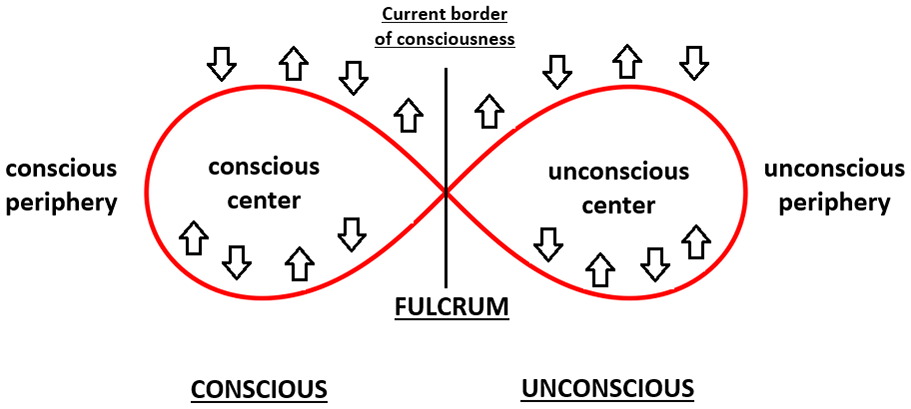
The conscious and the unconscious dimension of the self.
Immersive and Reflective Thinking
The normal mind-set out of which we conduct science is reflective thinking. This thinking has something of a bystander-quality as it thinks about the phenomena and allows a distanced view from “outside.” It is a common manner of thinking in everyday life, which—according to conventional understanding—is more about observing and describing rather than getting involved. But because of this bystander character, the reflective mind-set inevitably remains distanced and cemented in the subject–object divide between the self and the world; or between the self as an observer and the self as the observed (Weger, 2020). As a result of this observatory perspective, our relation to the self shifts from that of a holistic experience to that of a subject of enquiry with a range of features and facets that become distinguishable to reflective analysis, giving way to a more particularistic understanding of the self. The normal, reflective mind-set is hence not particularly well suited to study what we described as the processual character of the self—the Gestalt-like whole that binds the different subcomponents together.
In contrast to the reflective variant, the processual type of thinking steps out of the bystander character and enters the phenomenon, allowing the researcher to be at the living, immediate pulse of the experience. Where the reflective mind-set is representational, symbolic, abstract, and lifeless, the immersive mind-set is a “bath” in the breathing, saturated reality of the experience. We do not observe the process—we are the process. In contrast to the reflective or content-based mind-set, it is an immersive mind-set—but it is immersive without losing the capacity of witnessing what is happening. It is unusual, unfamiliar, effortful, and sometimes even frustrating, but we are convinced that we can train the mental muscles of the immersive mind-set as we have done in a range of other studies by now (Weger et al., 2016; Weger & Wagemann, 2015a, 2015b, 2018; Ziegler & Weger, 2018).
Both types of thinking are not mutually exclusive but complement each other. In the same way in which an outward form of participatory observation is by now a widely used research tool in the methodological repertoire of the social sciences (Döring & Bortz, 2015), we here use an inward form of participatory observation—introspective or immersive exploration—to research the processual nature of the self. Using such an immersive form of thinking, we were searching for the experiential echoes or fulcrum moments as oculars into a still unknown (unconscious) periphery of the self that is in transition to being born into its (consciously accessible) center.
Part I: Anecdotal Observation Phase
Our main query—researching the peripheral self via the experiential echoes or fulcrum moments described above—required a manner of thinking that was on a par with the immersive nature of the self: the Gestalt-like whole in its processual nature. More specifically, it required an immersive mind-set. Our query hence promised to be a complex and unusual endeavor: researching the immersive aspect of the self via an immersive type of thinking. But we had to start somewhere. During the first part of our enquiry, we took a more incidental approach to cultivating an immersive mind-set by taking a regular time out and cultivating a calm, quiet inner space. As we retreated from the regular turmoil of a busy lifestyle, we hoped that this quiet mind-set would allow us to uncover subtler, more elusive facets of self-experience. During these quiet moments, we sought to approach the peripheral self by invoking and immersing into experiences of ideal becoming and future potential, thereby hoping to extend the horizon of consciousness to layers of the peripheral self that were so far unattended to. We were looking for experiential echoes in response to this conscious activity—echoes that we expected to be colored by this peripheral self and that would hence reveal some of its chromatics as the horizon of conscious insight begins to shift toward hitherto unused or unattended layers of the self. We expected the immersive mind-set would initially be challenging to instantiate or uphold and hoped we might be able to advance and cultivate it so that it could become an increasingly suitable acre for research and allow for a gradually blossoming harvest as the expedition continued.
Method
Altogether, our study lasted approximately 12 months, of which Part 1 stretched over a period of 5 months (March to August 2018). During this time, we enquired into our research question on a regular basis. We would look for a quiet moment, typically at least 5 minutes, sometimes as long as 30 minutes and on average about 20 minutes. One of us practiced on an effectively daily basis throughout the year, typically in the morning, while the other attended to it more intermittently. The exercise was often embedded in other mental or physical exercises. Both authors are psychologists and have extensive meditative experience over several years and one of us gives workshops on it. For both authors, this particular question and the method of working on it was new. We met up once in the beginning to agree on our questions. We then had multiple telephone exchanges throughout the year to exchange our findings and, where necessary, to refine the question. One year later, in March 2019 (after Phase 2, see below), we came together again to finalize the report, which was drafted by the first author.
Our goal for those periods was to enter a quiet, open mind-set of a meditative quality (we were typically sitting with closed eyes) and look out for—or actively induce—experiential qualities that we would consider as being representative of the peripheral self: the self as a potential in the sense described above. We gave it different names and titles, depending on our own background but the core was that we were trying to enter qualities of ideal becoming and future potential. We were looking out for connecting points between center and periphery—fulcrum moments in which we were coming near to an ideal principle still in its infancy but already on the verge of entering consciousness. We sought to approach and enter these experiential qualities to the extent possible. We deliberately left it as vague as described here, hoping to sharpen and fine-tune our approach as we progressed. In this sense, our method of working can be described as being a form of heuristic enquiry (Douglas & Moustakas, 1985): a phenomenological research approach that seeks to establish meaning by searching for—and inviting—inspirations before entering a more systematic and reflective process (p. 53). Thus, we chose an explorative rather than an explanative manner of research—which is particularly useful in the early phases of scientific enquiry where the empirical basis of the data is still weak. This so-called context of discovery stands in contrast to the context of justification where theory testing is in the foreground (Hoyningen-Huene, 1987). Although our approach was explorative in nature, it was informed by our meditative background and by elements from different contemplative traditions: Christianity and Anthroposophy as well as Buddhism (which informed our selection of specific methodological techniques such as the balancing of focused attention and open monitoring, Zajonc, 2008).
We took note of emerging experiences in a diary. The reported observations were analyzed using interpretative phenomenological analysis (IPA; Smith, 1996; cf. Creswell & Creswell, 2018). IPA is a qualitative approach to data analysis in which progressively superordinate categories are identified in textual (often biographical) documents. The results are reported in the section below; at times they may be based on the reports of only one of us; however, we have included only those reports that both of us could resonate with in an effort to implement a preliminary form of intersubjective verification. Also note that in the process of finding superordinate categories, many details of what appeared to us to be of a more marginal nature were not included in our report.
Results
As a result of the phenomenological analysis, the following categories became particularly prominent:
Pondering Over Questions and Contextual Factors
Despite our experience with the immersive mind-set over the course of previous meditative practice, it was difficult to enter it initially. We found ourselves pondering over questions, hoping to pull clear-cut answers out of the immersive stream rather than stepping into it, letting go and becoming a resonance platform for experiences as they appeared. Typical questions during this expectation-driven mind-set were: Is there something like a peripheral self—is it an independent being, is it my own future potential—or is it just fantasy? How do I distinguish between something that is (part of) my own self—as opposed to someone else’s; or as opposed to an illusionary self? Is the capacity for intentional action a suitable indication of a self? In a sense, these questions were distractions that kept us in the reflective mind-set. Similarly distracting were experiences where we were occupied with the more conventional thoughts or feelings—ambition, embarrassment, tension, the hunger for action at the beginning of the day, and so on.
Immersing Into Tentative Qualities and Perspectives
While meandering through the loops of the reflective mind-set, a feeling of firmness would occasionally set in that we could not go on like this open-endedly. This was linked to a sense of active concentration and deliberate effort that was finally conducive to entering the immersive mind-set. We had to start somewhere. It did not make sense to be too unfocused. We therefore tuned this immersive mind-set toward specific qualities of ideal becoming and potential which we tentatively attributed to this peripheral self in our imagination, for instance dignity, patience, and benevolence, among others. We brought these qualities to life by making them an experiential reality and then exploring whether this activity produced an experiential echo that might be in resonance with our preliminary understanding of the potential self; or, if this was not the case, would allow us to refine our understanding of the self accordingly. Sometimes this worked; at other times it did not. Even when it worked, however, it was not always clear what the harvest was and whether it had anything to do with cultivating those inner experiences.
Feelings
And yet, in response to immersing into the qualities of ideal becoming, subtle feelings occasionally occurred—sometimes in close temporal proximity to our practice, at other times in no immediately evident connection. Those were the occurrences which we developed a particular interest in. They would sometimes (on about 10%–20%) show specific qualities. We list them here one after the other in sequence—but when occurring, they were more like waves in flow. Typically appearing in a subtle, elusive, and unimposing mode, these occurrences were quickly forgotten or overshadowed by more resounding feelings that occurred during the subsequent progression of the day. They were gentle, light-hearted, touching feelings, or experiential nuances, appearing like brief glimpses of an inner untouched space or sanctuary that comes about in freshly adorned colors illuminated by the light of consciousness. They provided a sense of protection and reassurance due to the immediate feeling that something within us exists that has not been and cannot be mudded up or polluted (only closed to further “visiting” for the time being). They were comparable to a birthday mood in the sense of being special for once, feeling accepted and receiving recognition merely by way of being oneself rather than performing or responding to requests from outside. There was the faint moment of feeling beheld—not in the sense of being scrutinized but in the sense of being held or understood. These feelings had an inner lightness and purity, a fluidity, and a youthful sparkle. They even encompassed a childish naivety—but one that was colored, perhaps even dignified by the perspective of the adult mind-set. They were ephemeral nuances that might easily go unnoticed when not looked out for. They had a quality of shyness and they might not set in to begin with when seeking to invoke them too vigorously.
Insights
While seeking to enter the immersive mind-set, we experimented with different perspectives—such as looking at our day from the periphery/from an outside point of view, thereby assessing our actions in what we expected would be a more balanced, impartial manner. In these moments of shifted perspective, routine (emotional) responses—such as anger or anxiety—were somewhat dissociated from their trigger as one began to realize that a given interpretation could also be framed in a new light. Due to our gradual insight into the ephemeral, elusive nature of the feelings described above, we could uncover the more imposing outburst of anger, grief, or anxiety as not being instances of the fulcrum moments or expressions of the peripheral self. We occasionally managed to challenge the more vigorous experiences and cast them in a more balanced light. Likewise, we could sometimes see through what appeared on the surface as an experience of grief and then recognize elements of selfishness within it. We might also become aware of the self-depreciating character of ruminations and repetitive thoughts. We realized that many of the normal feelings actually constrain us and cost energy (even the pleasurable ones). The experiences described above do not drain but nourish and provide energy while leaving one free. In a sense they constituted a scale of reference that allowed us to better perceive and assess our conventional feelings. We occasionally took a broader perspective on moral issues and there was the rare moment of spontaneously connecting to a welcoming and favorable attitude by others or an openness in a given situation, thereby seizing the opportunity or, as we called it, feeling carried by the genius of the moment.
In addition to inspiring new insights, the experiences at times also impacted on the motivational sphere, for instance by providing additional resolve to a decision we made or increasing the commitment to control impulses or emotions when a decision to exercise such self-control was not only witnessed by the “central” but also by the “peripheral” self.
Part II: Developing a Roadmap
In the preceding Part I, we used a heuristic approach to enquire into the peripheral self. We observed a range of experiential qualities that we consider to be the core outcome of the preliminary enquiry phase. At the same time, we also discovered that the success of our efforts to move forward from the reflective to the immersive mind-set was not predictable. We were often stuck in the reflective mind-set. In Part II, we hence sought to take a more systematic approach to entering the immersive mind-set. We hoped to move on from a heuristic approach to one of more deliberate enquiry. On the basis of our experiences from Part I, we decided to formulate a roadmap to study the peripheral self more systematically in Part II, seeking to explore our preliminary observations in greater detail but also giving others a chance to probe our approach more thoroughly. It was the following seven-step process.
Method
During the quiet moments of contemplative exercising, we worked on a series of seven steps as follows: (a) becoming wide: experiencing the whole body, ideally with closed eyes, noting what comes, expanding without losing our sense of being anchored in the physical body; (b) becoming awake: being present, accepting distortions without fighting them or letting oneself get carried away by them; (c) becoming tender: becoming soft in body and self—not actively seeking anything, instead admitting what comes; (d) experiencing warmth—both physiologically and psychologically. When steps (a) to (d) were at least partially successful, we would move on: (e) turning: gravitating away from the usual perspective anchored in the body and instead lifting oneself up to a space above and slightly behind the head; taking an elevated perspective; not merely imagining this but actively realizing it, even if only possible for a brief moment; (f) connecting to wisdom and warmth in the periphery as we enter a space of inner tranquility and seclusion from the distractions of a busy lifestyle. We now look out for the more subtle lights that appear on the inner horizon and become receptive for “atmospheric” (experiential) qualities that might begin to dawn in this inner space. We seek to be present in the new space above and behind the head and now relate inwardly to the realm of wisdom and warmth in the periphery; cultivating feelings of warmth and benevolence to the human being I am and that I now experience slightly below/before me. We also experimented with a more “down to earth” manner of this step, in case one might experience it as being too peculiar or esoteric. In this case, we would look upon ourselves (on our day) as though looking from the top of a mountain over the landscape underneath with a noncritical, benevolent eye; (g) enquiring: placing questions regarding momentary or upcoming challenges into this newly created space; looking out for new ideas or insights that might appear in resonance to these questions—during or after the exercise. Even seemingly irrelevant or unrelated observations were to be probed as to whether they were of significance regarding the question. Steps “(a) to (d)” are basic elements of psychotherapeutic treatment that the second author regularly uses in his practice. Step “(e)” was informed by a method of contemplative anthroposophic practice called “inner silence” in which the meditator looks at the panorama of his own being from an independent perspective (Steiner, 1904). It was also informed by the Buddhist technique of temporarily distancing oneself from the involvement in the daily demands of a busy life (cf. Zajonc, 2008). Step “(f)” was informed by techniques of mindfulness and loving kindness meditation (e.g., Kabat-Zinn, 2005). Step “(g)” was our own addition.
The approach describes a road of immersion to begin with (in particular steps (a)–(d)) and was intended to facilitate the immersive mind-set and enable a perspective from the point of view of the peripheral self. The other procedural and analysis-related aspects were similar to what has been described in Part I. The timeframe for conducting the exercise was from the second half of August 2018 to March 2019.
Results
Situational Factors
Entering a quiet mind-set and pursuing a contemplative exercise as described here is an effortful activity which requires deliberate initiative to begin with. To achieve it, it seemed important to be open-minded and to not strive for one particular outcome over another, as this channels and constrains the scope of observation. Feelings of anger, vanity, and ambition were counterproductive, likewise the readiness and motivation to get active and accomplish something (especially in the morning when the new day was still ahead); fatigue and alcohol consumption also hampered our efforts. Early on as we tried this new approach, it was unfamiliar, difficult, and particularly challenging.
Feelings
Of particular interest were once again feelings associated with our practice. To begin with, there were somewhat more normal feelings of wideness, warmth, and intensity. But there were also more gentle feelings—again, not of a regular nature—perhaps occurring on only about 15% of the time. They were characterized by one or more of the following: They deepened one’s receptive attention and were sometimes experienced as accumulating around and inspiring the heart region. They were once again not exhausting but nourishing feelings. They unfolded a mild joy, perhaps even a jubilation that inspired a gentle sense of vitality and readied one to briefly blossom. They had a child-like innocence and love for what came from outside—a reverence for nature, a joyfulness or the experience of briefly bathing in refreshing youthfulness. They were not childish but child-like, spring-like feelings that typically lasted for only a short while. They were mostly soft, gentle, ephemeral feelings, and at constant risk of being polluted by the profanity of the feelings of our “normal business” mode.
Despite their elusive, fleeting nature, it could be the case that they left something behind which was of a more sustaining quality because they sometimes spoke to the mental realm: a light-heartedness in the sense of bringing the realm of consciousness (the “light”) together with the realm of feelings (the “heart-edness”). They were at times something we might call insight-feelings, and it was this insight-quality that gave them a platform to shine beyond a mere momentary sparkle: the tail of the comet that stays on beyond the here and now of immediate experience. This insight nature did not only have a light-heartedness but also a mild sense of profoundness similar to the experience of feelings carried by an insight that has the inner firmness of an evident experience and cannot be derailed or challenged from outside. They could have a widening and deepening perspective, as if entering a room with a high ceiling. There was at times a sense of being moved or touched; of receiving and giving—an inner dialogue or precursor to a dialogue with an undiscovered inner sanctuary. They could be moments of awakening that might even inspire new confidence or courage for something that was challenging. Stage (f) in the roadmap described above appeared to be particularly instrumental in this process (entering a stream of wisdom and warmth from above and letting it shine in the form of benevolence toward the human being I am).
If trying to categorize these feelings, we would entitle these categories with four labels: innocence, colorfulness, light-hearted/insightfulness, and inwardly evident experiencing.
Insights
Once again, there were a number of insights and ideas. At one point, we were busy asking ourselves whether we could not somehow use the feelings to enquire into the realm that they were coming from, looking for a “handrail” that could guide us to their source. An unexpected insight, by contrast, was that these feelings did not lend themselves readily to being used as oculars toward an (unknown) source (i.e., toward what triggered them), but rather toward a destination (i.e., toward what might become possible through them). In particular, there was a new, reinvigorated interest in the phenomena of nature and an inspiration to look at the sense world in a more open, engaging, and light-hearted manner. Other insights related to how to deal with a challenging/difficult situation; or they came in the form of a momentary capacity to balance between the demands of other people and our own. They could also be related to a readiness to try something new, such as getting over a particular episode of grief or offense. There was the insight of how important a sense of mildness toward the being I am can be. We realized how the more self-indulgent feelings of pride and personal importance would displace the gentler experiences described above. The insights did not necessarily occur during the exercise. They could possibly also take place at an independent point in time, sporadically even in anticipation of the exercise, before beginning with it. There were also the insights not directed at a particular query: they came about as the resonance of a moment of evident experience that lasted and remained available as a faint recollection that something had occurred but that could not be further specified. It was remotely related to the experience that one has when waking up and realizing that one just had a dream. A particular mood that characterized the dream is still there while the content of the dream is gone. In the current case, however, there was no sleeping/dreaming involved.
Discussion
The self is a complex entity that is often described and researched in its subcomponents such as self-esteem, self-awareness, self-efficacy, self-regulation, and the like. The entity that is holding these subcomponents together has hardly been researched in psychological enquiry. In seeking to make a preliminary step in approaching this Gestalt-like whole, we pointed to a number of extensions and set out to explore what we called the peripheral self: the part of the self that is beyond the current horizon of conscious insight. The most notable harvest from this enquiry was the observation of the special type of feelings or experiential nuances that we reported above.
What made these feelings special was their innocence, their light-heartedness, and their colorful, inwardly evident nature. Conventional feelings are all too easily used toward self-indulgence: they are a means to their own, a state of being which is in itself the source of pleasure or displeasure. The experiential nuances observed here, by contrast, felt as though they were more than that. They appeared to be less important in their role as constituting a state of being and instead seemed more important in their role as being oculars, diagnostic instruments for an occurrence or phenomenon.
While feelings are a reality in their first-person experiential character, using them as oculars for something else can be a challenging endeavor because this “something else” goes beyond what is immediately given: interpretations are added and such interpretations are vulnerable to bias. And yet it is the point of scientific enquiry to make sense of data and to offer interpretations—and this is what we also wish to attempt in the following discussion. Before moving on, however, we propose a litmus test to assess whether a given feeling can be understood to be an ocular that conveys insights about others/other phenomena—or primarily about oneself. This litmus test comes in the form of four questions: (a) Are the feelings intrusive or do they let us free to be with them or not? (b) Can we discover something in those feelings that is informative mainly about how we feel regarding a phenomenon or person or do they tell us something new about the phenomenon or person proper? (c) Do they provide a stage for insight that proves (socially) constructive—perhaps not immediately, but at least in the midterm? (d) Connecting to the realm of thinking: are the experiences described here more closely related to feelings associated with a fuzzy type of thinking (e.g., mindwandering) or are they more closely related to feelings that we know from a more active or contemplative type of thinking? (Ziegler & Weger, 2018).
This being said, we would like to enquire into what the feelings reported above might tell us. Both of us associated these feelings with experiences of youthfulness. In fact, they seemed to inspire a sense of innocence and childhood. To some extent it was a surprise to us that such feelings would surface at this point in time. Both over 40 years old, many of the more typical feelings that occur in a busy life full of tight schedules and other challenges at this age tend to be of a more robust nature that attenuates or even undermines such gentle experiential nuances. What is more, we assume that such a vulnerable sphere cannot survive in isolation—where we suspect it would dry out or fade. It must have upheld a connection to a realm related to it from which it continues to be nourished. And there must be some capacity that shields this realm against being contaminated by the more coarse-natured feelings, as the feelings described here seem to have kept their purity. They do not appear to mingle.
In trying to make sense of this realm, we would like to return to the image of the lemniscate (see Figure 1). Recall that what is inside the line of this lemniscate on the left side transitions through the crossover (or fulcrum) and becomes the outside on the right-hand side. The inside (used as a symbol of the center of my currently awake self on the left-hand side) corresponds to the outside on the right half of the lemniscate (the territory of the as yet unconscious periphery). This as yet unconscious periphery must be of a more effused nature—the wide sphere of unformed, floating aspects of selfhood: the as yet unconscious feelings, thoughts, intentions—unformed qualities that are more potential rather than already manifest reality. Furthermore, if there is a periphery on the right-hand (unconscious) side, it implies that there must also be a center on that side. In the image of the lemniscate, the unconscious center on the right side would correspond to the periphery on the conscious left side of the border, that is, to the realm around me that I somehow connect to—perhaps in the form of emerging opportunities, words or gestures from other people and so on. Above, we referred to it as the “genius of the moment.” The “moment”-part of this description corresponds to the social or situational factors (i.e., the “outside” in the conscious realm). The “genius”-part, in this analogy, would then correspond to the “inside” of the unconscious realm (the right side of the lemniscate). It would be a kind of gravitational center that contours as an island in the middle of the more broadly distributed unconscious periphery—the open-ended potential that has not yet crystallized into a manifest form or trait. It is not my conscious “day”-center—but still a center to a periphery, namely to the periphery of those widely distributed, not yet manifest layers of my potential. Perhaps in this quality as a gravitational center, it even prevents this periphery of the unconscious self from “diffusing out” in an uncontrolled manner, that is, getting unfocused, diluted, and loosing connection with the upcoming goals; and, likewise, from “diffusing in” prematurely into the conscious center of daily wakefulness where it is not ready to be made sense of yet and may only create confusion or get “polluted” by the more coarse-grained feelings of everyday business. The unconscious center may only briefly sparkle into our subtly conscious feeling life in the form of the experiential echoes as it transfers over from the unconscious into the conscious realm at the fulcrum. There, in the conscious realm, it reaches us by way of what we meet and attend to in the outside world through encounters with other people, with nature and so on. Likewise, the unconscious periphery—our infinite, living and as yet unformed and unrealized potential—may briefly glow up in our our feeling life before condensing into the manifest or formed inside world of conscious thoughts, intentions, motives, strengths, weaknesses, and so on. These brief sparkles we understand as being the experiential echoes or fulcrum moments as described above—they may thus be considered oculars toward either an unconscious center or an unconscious periphery. We suspect there must be a way to distinguish the two—but this we have not disentangled yet. It is a moment where a new aspect of the self is born into consciousness. The term preconscious may therefore be more appropriate than the word unconscious. We also suspect the experiential echoes to occur “around” the crossover point—what happens as the crossover point itself awaits further research and specification.
Young children appear to have a natural connection to the “genius of the moment” via the bypath of relating to the conscious periphery—their environment—in an unpretentious manner. They live in the moment. They relate directly and in a natural manner to the periphery. They look at nature in awe. They trust the world and resonate with their parents. They imitate others and even look at themselves from the periphery early in their life: Mary does not like it; Pete wants to go. Reconnecting to this sense of resonance with the periphery is perhaps a means to also reconnect to what is sometimes called the inner child (e.g., Chopich & Paul, 1987)—or more precisely: to the light-hearted dimension of this inner child (the inner child may also have dark aspects—especially in the case of childhood trauma); and to reconnect—via this inner child in the conscious periphery—to the unconscious genius or gravitational center on the as yet unconscious side of the crossing-point. It is an entity that is complementary to my wakeful day-center—a “night-center” which seems to be difficult to positively nail with analytic concepts and which instead rather contours itself indirectly by delineating itself in the “space between.” In Gestalt psychological concepts, this process is called “reification”: a percept (a mental configuration) contours itself from a given sense input as a mental complement that is not per se available in the sense input. We suspect that in the same way in which a concept contours itself from the perceptual fragments of the sense input, the peripheral center gradually contours itself as an emerging Gestalt from the experiential echoes or fulcrum moments during which our unfolding potential briefly enters into conscious awareness. The center itself does not seem to become accessible to reflective waking consciousness. It is the immersive thinking mode that is better prepared to approach it.
As the conscious periphery connects to the unconscious center in the lemniscate, a better expression for the term “genius of the moment” might be the term “genius of the self.” Perhaps this genius of the self—the as yet unconscious center—is what scholars across the spiritual and contemplative traditions have referred to as the spiritual guard or the angel (Kollewijn, 2019; for an overview, see Klünker, 2007). However, it does not need to remain unconscious in principle. What was previously the peripheral view of the child—enjoying and delighting in what is there and ready to be conquered—may gradually become ennobled by the perspective of the adult mind-set that has now mastered a conscious center while still being able to look from outside and gradually even advance to uncover aspects of the as yet unconscious world. The elusive chromatics of this new perspective can only dawn in a quiet, contemplative mind-set where the brightness of a busy lifestyle recedes—in the same way in which the radiance of the sun must set for the subtle nuances of the more distant celestial bodies to become visible on the night-sky. It can also become evident in a light-hearted, gentle manner of attending toward our conscious periphery (for instance in the form of nature or our social environment).
We do not wish to leave the path of science. One may call our expedition and our conclusions speculation, as science can offer perhaps more parsimonious explanations for what we have described above. And indeed: parsimony is an important strategy to avoid the error of speculative or even superstitious thinking—to avoid what in the signal detection framework is called a false alarm. But the signal detection framework also knows another caliber of errors, namely omissions (or false rejections): the premature dismissal of a positively existing phenomenon. This error is equally problematic. Think of the problems that a slow admission of a potential hazard can entail: “Is this behavior potentially climate-damaging?” “Is this substance potentially carcinogenic?” If one remains chained within a previously existing thinking style, one risks that by the time when undeniable evidence has accrued, it is already too late to take necessary steps (Dietz, 1993). The error of false rejections is particularly problematic in the context of the psychology of the self because the phenomena discussed here are elusive and easily omitted when not deliberately attended to. But we can take measures to avoid such premature dismissal. In the same way in which the principle of parsimony shields us against committing the error of false alarms, we can shield ourselves against committing the error of false rejections via the principle of tentative affirmation (Weger, 2019): giving an unusual account at least the benefit of the doubt for the time being until sufficient evidence has accumulated to give it a more balanced vote. It is hence important to not dismiss an account prematurely, as long as there are reasons that warrant the benefit of the doubt. We hence call for this tentative affirmation also in the current case: The spiritual experiences in contemplative approaches, the widely consistent reports in near-death research, as well as the research regarding active thinking may be considered as being at least tentative pointers in the direction of such an inner sanctuary (cf. Cassol et al., 2018; Martial et al., 2020).
As noted, we experienced the realm of feeling as a gentle, light-hearted and colorful realm but it was ultimately the realm of feelings—though feelings related to active/meditative thinking. It was a meandering, fuzzy, vibrant, and formless realm. We suspect it does not need to remain a formless realm, however. And yet, identifying form requires reflection from outside. We would have to return to the reflective mind-set to discover form, continuity, and landmarks in this realm. But to return to this form-oriented mind-set we suspect we would not necessarily have to leave the immersive mind-set. We suspect that with more experience and practice, the immersive and reflective mind-set can merge and allow us to move on from the formless to the formed within the feeling- or experiential-realm: thinking feelings or feeling thoughts. The German–Austrian scholar Rudolf Steiner called this the “realm of intuition” (Steiner, 1904, 1924).
In the existing literature, there are already a number of terms regarding the entity under enquiry here—the possible, ideal, future, authentic, or intrinsic self, among others (Strohminger et al., 2017). Does it make sense to add another one—the peripheral self? A core addition here is that the peripheral self is an entity that is still across the horizon of consciousness; at a given moment of self-enquiry, it may not even be possible to describe or delineate it from other, already emerging facets of the self. Unlike Strohminger et al., however, and also unlike some more psychoanalytic forms of theorizing, we are convinced that this as yet preconscious realm can become accessible to the light—and the light-heartedness—of conscious experiencing. We believe the early precursors of these birth moments are the experiential echoes or fulcrum moments described above. As the horizon shifts, the formless begins to transition through to the realm of forms. It is in that realm that we can engage in reflective science. We would like to point out once more that while our main harvest in this article was the experiential feelings reported above, our “farming approach” was that of active thinking.
The approach described here has a number of broader implications, both methodologically and conceptually. Methodologically, it opens a door toward researching facets of psychological phenomena that remain inaccessible to the more classical forms of enquiry. For instance, while Strohminger et al. (2017) acknowledge the experiential reality of a true self, they also claim that its “radical subjectivity [. . .] prevent[s] the true self from being a scientific concept.” A similar position is taken by Metzinger (2009) who acknowledges that the experience of the self is an undeniable reality but that the “self does not exist” (p.1) as an ontological or empirical entity and hence cannot and should not be addressed scientifically. In our current account, by contrast, we take the opposite approach: we take the phenomenological given as the starting point and ask which modes of scientific enquiry are needed to make sense of the phenomena we observe? This methodological reversal—placing the primacy of content over the primacy of method—has implications for the study of any phenomenon that is of a first-person quality and can hence be addressed only partially from a third-person perspective: the qualia of attention or consciousness; the sense of certainty or evident experiencing; and others. We agree that these facets are inaccessible to the current form of scientific enquiry. But instead of making concepts/phenomena dependent on methods and concluding that the self, for instance, is not a scientific concept on the background of the methods used, we propose to make methods dependent on phenomena and ask how these methods can be extended to make the observable/experiential phenomenon accessible.
Our approach also has conceptual implications. It anchors the territory of the self not only within the individual but also includes what we have referred to as the conceptual periphery into the understanding of the self. Thus, in conceptual insight, we are not limited to our physical/biographical/individual center—but can in principle also resonate with the periphery. This periphery can be understood in an individual sense (our individual potential that is still waiting to be uncovered). It can also be understood in an interpersonal sense, as the individual is embedded in a social context. We consider the implications of this view to be of importance. At least since the time of Descartes, our world-view is framed in the coordinates of a subject–object divide (“I think, therefore I am” implies, in the context of the Principia Philosophiae, that I can question everything around me other than myself/my own thinking; the phenomena around me are thus of a secondary status relative to my unquestionable self). This understanding ultimately cements the self-other divide, as the self is ultimately seen as being in juxtaposition to the other (cf.: Schad, 2014). Such a view can be complemented with an understanding of the self that fluctuates between the center and its (social) context, as proposed here. Thus, the self is no longer in inevitable juxtaposition to (or competition with) the other but is on par with it. It is an understanding with manifold social and economic implications, which is why we see a consideration of the self in the periphery to be of eminent conceptual significance.
Conclusion
The self is an entity in constant metamorphosis—with unknown layers that include as yet hidden treasures still to be uncovered and developed. It may not be ideal to wait until an external opportunity emerges to uncover these treasures—because this may take a long time. We have hence experimented with an exploratory mode of enquiry to approach this untapped territory more deliberately. The harvest was an increased awareness of an inner kernel that we got to know from a different angle than is the case with our normal day-to-day thinking. We assume that this kernel is at the heart of what is sometimes referred to as the true self—the Gestalt-like entity that integrates the individual subcomponents of our self-schema into a coherent whole. Rather than assuming this true self to be a subject that eludes scientific enquiry, we have instead called for a mode of scientific enquiry that is capable of speaking to it. The immersive mode of thinking described here seems to us to be a useful instrument in this direction.
We call it the self in the periphery (or the peripheral self) because this term avoids the somewhat evaluative connotation of “true” versus “false” and instead implies perhaps a more inspiriting character: what is still in the periphery can be brought to the center of conscious insight and mastery. This is certainly a controversial understanding to begin with because the prevalent view in psychology is that it is largely impossible to access our preconscious life. Here, by contrast, our view is that there is no need to refrain from this endeavor; it is certainly an effortful journey, but one that in our view is well worth undertaking.
Footnotes
Acknowledgements
The authors would like to thank Cordula Falt for her feedback about this study.
Declaration of Conflicting Interests
The author(s) declared no potential conflicts of interest with respect to the research, authorship, and/or publication of this article.
Funding
The author(s) received no financial support for the research, authorship, and/or publication of this article.