




Abstract
This article examines the processes by which different dialogical positionalities are taken in the contact zone. The contact zone provides a framework for the consideration of potential confrontations and uncertainties during intercultural contacts between migrant children, their family, and another adult. The other adult is usually someone in a position of authority. For young people who language broker, managing the uncertainties and confrontations of conflictual situations highlighted three positionalities: (a) “conflict avoider,” (b) “the neutral or passive broker,” and (c) the “active broker.” The contact zone was a sphere of experience that opened up possibilities for agentic action as well as constraints. The contact zone had the potential to foreground different aspects of their status such as “the child,” “the immigrant,” or the second-language speaker. Equally, the young people took opportunities to utilize these statuses as part of their dialogical positionalities to get the best outcome for them and/or their families. We argue that further exploration of the contact zone within the framing of dialogical positionalities can enable better understanding of critical cultural-development childhoods.
Keywords
Introduction
In this article, we use the concept of “contact zones,” framed by a dialogical approach as conceptual and analytic tools (Hermans, 2001a, 2003; Pratt, 1991), for examining the different positionalities young people say they take as they navigate or manage difficult or conflictual situations, through the presentation of qualitative vignette interviews in the United Kingdom. Young people who language broker sometimes find themselves in a position of having to navigate and manage difficult or conflictual conversations between their family members and another adult, who is usually in a position of authority (Nash, 2017). Language brokering involves translating and interpreting for family members, members of the local community, and peers, following migration. It is often undertaken by children and young people within the family because they learn the local language rapidly on entering into the local school system in their new country. Language brokering that takes place with figures of authority predominantly occur in monolingual and often White public institutions and spaces (Brutt-Griffler & Varghese, 2004; Reynolds & Orellana, 2009), particularly in Western contexts. The language broker serves as both linguistic and cultural mediator in sociocultural contexts that may range from the benign to the hostile.
Child Language Brokering in a Hostile World
Broadly speaking, we follow an approach that conceptualizes language brokering as a socioculturally mediated practice (Vygotsky, 1978) . Therefore, language brokering is seen as a situated practice that involves the development of new skills, ongoing negotiation of cultural knowledge, and the development of new identities (Crafter et al., 2009; Orellana, 2009). The practice represents a set of nuanced activities that take place in a wide variety of settings such as banks, retail, health care, law, social care, government offices, and police (Dorner et al., 2007; Tse & McQuillan, 1995; Valdés, 2003). As a complex activity that is both contextually influenced and a socially situated communication process, there are a range of factors that can influence what kind of experiences a young person might have while language brokering (Kam et al., 2017). Factors such as the physical setting where the brokering occurs (e.g., hospital, school), the relational influences (e.g., the relationship between those communicating), the cultural setting (e.g., the values and norms associated with the setting), the type of task (e.g., the complexity of the language used), and the instrumental goals (e.g., accurately interpreting the message) all play a role (Kam & Lazarevic, 2014). In addition, language brokering influences one’s own identity, such as feelings of (in)competency, pride, and embarrassment. Equally though, it has been framed as a necessary and normal part of everyday family life in immigrant households (Bauer, 2016; Cline et al., 2010; Crafter et al., 2015; Orellana, 2009). It is not surprising then, that language brokering has the potential to place young people in difficult or conflictual situations.
It has been argued that languages are not distinct or bounded but a practice influenced by sociopolitical histories, cultures, and the mobilities of people (Blommaert & Rampton, 2011). But these mobilities also lead to new language challenges and barriers for immigrant children, their families, local institutions, the economy, and society. In the United Kingdom, for example, professional and public linguistic services have become limited, sporadic, and subject to long-standing austerity cuts. The sociopolitical context of post-“Brexit” Britain, has led to a wave of anti-immigrant sentiment (Ipsos MORI, 2012, 2018), which is arguably important for language brokers because it is a mediational activity that visibly marks out one’s “immigrant status” (Leinonen & Toivanen, 2014). The practice often occurs in very public “spheres of experience” (Zittoun & Grossen, 2012), where language brokers may be hyperaware of being on display, leaving the broker uncomfortable with the situation (Cline et al., 2014). The language broker and their family are confronted with a new set of goals to achieve, new people to meet in a range of different institutional contexts, and subsequent transformations of one’s own identity. New knowledge and skills are required, not just in terms of learning the local language, but in attempting to situate oneself in two cultures (Abreu & Hale, 2011) or even multiple cultures and subcultures (Guo, 2014). Language brokers often opt for communicating general sense making between the people they mediate for (Bauer, 2017) while attempting to manage varying levels of uncertainty.
Framing of an Immigrant Childhood
Immigrant childhoods are treated differently than childhoods of children whose families have settled for generations (Orellana, 2009). Critical–developmental psychology would argue that “childhood” is a social construct bound up with assumptions about a time of play, formal schooling, and socialization that place “other” childhoods as different or “non-normative” (O’Dell et al., 2018). Immigration has placed a spotlight on the large variations in everyday practices within families today (Rogoff, 2003). Language brokering transgresses some of the characteristics of the “normal” or “ideal” childhood because the move from dependency on adults to steadily increasing independence into early adulthood (Burman, 2008) is accelerated by added roles and responsibilities. Examples include having access to family finances and banking details (Morales & Hanson, 2005; Orellana, 2003), negotiating overdue rent payments with landlords (Kwon, 2014), talking to police in a domestic violence situation (Cline et al., 2014), and talking with government agencies such as welfare (Tse, 1996; Valenzuela, 1999).
This level of adult responsibility held by some child language brokers led to the suggestion that immigrant children become “parentified” (Weisskirch, 2007) or “surrogate parents” (Valenzuela, 1999). Such a perspective could be seen as accelerating the move to independence, a transgression of the “normal” childhood pattern. In a psychology dominated by the paradigm of “normative” developmental expectations, it is not surprising that attention has been focused toward the dichotomies of positive or negative mental health, risk factors, and behaviors (Crafter, Cline, & Prokopiou, 2017; Guan et al., 2014; Jones et al., 2012; Martinez et al., 2008; Rainey et al., 2014). This is in no way an attempt to lessen or undermine the potential negative impact that brokering may have on young people, but it is equally useful to frame our understanding of language brokering as a practice that takes into account or reflects a cultural approach to immigrant families (Rogoff, 2003). Although the term “brokerage” has the potential for an uncomfortable “economic” framing, child language brokering was a concept developed to emphasize the cultural, as well as linguistic, elements of this mediational practice (Kam & Lazarevic, 2014; Tse & McQuillan, 1995). It can be argued therefore, that for those who undertake language brokering for family, it is akin to the “pitching-in” activities associated with many migrant or indigenous communities (Rogoff et al., 2014) such as contributing to domestic work or the family business (Crafter et al., 2009; Hall & Sham, 2007). Language brokering focuses attention on the cultural meaning of an event, of which translating and interpreting will be only one, though not insignificant, part (Cline et al., 2010; Hall, 2004). Language brokering cannot be seen as a practice that is intrinsically good or bad for a child, but one that is subject to the flow of relational and situational contexts. To date, the positionalities that children and young people take to manage or deal with conflict and uncertainty during brokering situations have not been studied systematically. We take positionalities to be the “interstices of several borderlands” (Reynolds & Orellana, 2009, p. 211): as children, as translators and interpreters, as immigrants, as “not-quite-adults,” as self-and-other, and as self-in-society (Hermans & Gieser, 2012).
Uncertainty in the Contact Zone
The term “contact zone” was developed by Mary Pratt (1991) to “refer to social spaces where cultures meet, clash, and grapple with each other, often in contexts of highly asymmetrical relations of power” (p. 1). With a focus on the use of the literate arts in history, Pratt was interested in how travel writers “produced the world” through imperial contact between the colonized and the colonizer. For example, she discusses how the improvised languages of speakers from different nations, such as pidgins, were developed in the context of trade but were commonly regarded as chaotic and barbaric by European colonialists (Pratt, 1992). “Contact,” for Pratt, emphasizes how “subjects are constituted in and by their relations to each other” (p. 7). Translation then, as the index between self–other, is the dialogue that takes place in the “in-between” space—the contact zone (Kim, 2009). Such encounters often emphasize the “strangeness” between “us” and “them” (Banerjee, 2013), foregrounding ambiguities and uncertainties about self and other relationships (Morrissey, 2005).
The concept of the “contact zone” has also played a part in conceptual thinking within the realms of psychology. For Hermans (2001a), the contact zone is similarly focused on the meeting points between cultures, the “in-between” spaces, borne out of the complexity of a modern society of globalization that involves a mixing and moving of people (Hermans & Kempen, 1998). Where once, isolated groups or cultures were clear on the social, emotional, and practice rules within their contact zone (even if there was conflict), now intercultural contacts can act as inspiration, suppression, or silencers (Hermans & Gieser, 2012). These same authors suggest that these globalized and localized relationships give the interlocutors new feelings of uncertainty and raise questions about how people react to those uncertainties and ambiguities, what knowledge and skills they draw on to aid them, and how this influences their self–other identity positioning (Hermans & Kempen, 1998).
Child language brokers frequently find themselves in new and uncertain interactions with an outcome that is dependent on dialogue between themselves, their families, and another adult who is usually in a position of power and authority. Hermans (2001b) suggests that the changing circumstances of immigrants require a dialogic self–other relationship or multiplicity of the self that is made up on internal positions (e.g., “I” as a child language broker) and external positions (e.g., my family, my values), so that the self is seen as having an intense connection with the social world (Hermans & Gieser, 2012). He further adds, “In this conception, the I has the capability of moving from one spatial position to another in accordance with changes in situation and time. The I fluctuates among different and even opposed positions” (Hermans, 2003, p. 101). However, no studies have systematically investigated what kinds of positions child language brokers take when faced with uncertain and conflictual situations.
The following research question guides this article:
Research Context and Methodological Approach
The broad aim of the wider research project was to examine child language brokering as a space of cultural mediation and identity belonging and, in turn, to question how language brokering acts as a “cultural contact zone.” To answer these questions, we collected data using a combination of traditional qualitative social science methods (vignette interviews, observations, survey) and arts-based approaches (drama, podcast, and art workshops). This article is going to focus on the 29 vignette interviews (23 female, six male) with young people aged between 13 and 16 years from three schools in Greater London, United Kingdom.
It was important that our target schools contained a significant portion of pupils with English as an additional language (EAL), which would act as a signifier for the practice of child language brokering. 1 This study used purposive sampling to target schools that engaged an EAL coordinator, who is a school staff member who has a designated role in working with EAL pupils. Two of the EAL coordinators contacted the team following an advert that was placed in a “Young Interpreter newsletter” and one EAL coordinator had worked with the principal investigator on a previous project. Pupils in the school were initially invited to take part in a small survey about their language brokering activities. Respondents who reported that they brokered more than once a week were invited to take part in the interviews and/or arts-based workshops. Consequently, the makeup of our sample came from diverse backgrounds. Some of our young people had made singular and direct journeys from their home countries such as Poland, Bulgaria, Colombia, and Ecuador straight to England. Others had experienced a more complex transcultural journey, whereby they or their parents were born in countries such as Bangladesh, Mauritius, Sri Lanka, or Nigeria but spent considerable time in, say, Italy, before their current settlement in England. The majority of our sample arrived to England between the ages of 11 and 14 years.
The Vignette Interviews
The data analyzed in this article were individual vignette interviews, an approach that is appropriate for young people experiencing “non-normative” childhoods because of the following: (a) The story acts as a stimulus, thereby enabling the young person to reflect on both the substantive elements of the story and their own experience. Because our sample did not have English as their first language, it was felt that the story would make it easier for them to begin communicating about their own experience during an interview situation. (b) The method is proposed to be useful for ethically sensitive topics or potentially vulnerable participant groups because the research participant is able to control what personal information they disclose while still giving a personal viewpoint on the topic at hand (Barter & Renold, 2000; Kandemir & Budd, 2018). Evidence from previous projects had indicated child language brokers sometimes engage in difficult or sensitive situations, the evidence upon which this current research project was built (Crafter, Cline, Abreu, & O’Dell, 2017; Crafter, Cline, & Prokopiou, 2017). (c) The vignette approach is a useful way of exploring multiple ways of representing reality, which can involve dialogues between different identity positions (Crafter et al., 2015; O’Dell et al., 2012). This opens up explorations of self–other relationships, including that between their own position and that of the character in the story.
The four vignettes shown in Table 1 were all adapted from real experiences described by language brokers in previous studies (see Armstrong, 2013; García-Sánchez, 2014; Guo, 2014; Kwon, 2014). All four vignettes were designed to provide the respondent with some kind of difficult situation between adults, in which the language broker must negotiate or manage through their language brokering.
Four language brokering vignettes.
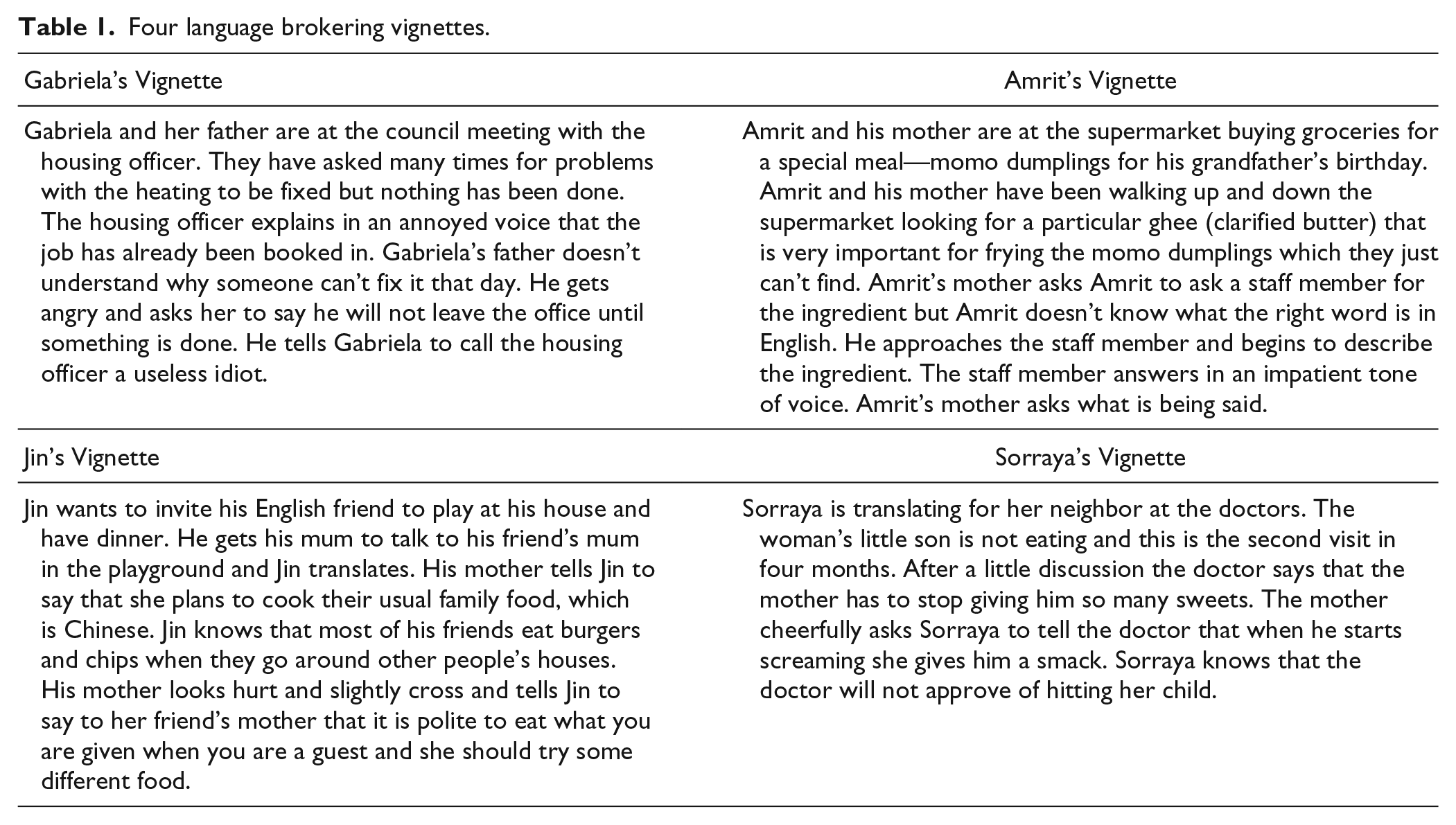
Each respondent was asked the following questions
What do you think is happening in this situation?
How would you describe the cultural misunderstanding that has occurred?
How do you think the child in the story would deal with it?
Role-play—Imagine you are in this situation. I am the housing officer and you are Gabriela. Interviewer says an impatient tone—“The job has already been booked in, you will have to wait.” What would you do/say?
Analyzing the Data
Following transcription, the text was interrogated first in relation to a system of categories across all the interviews and then a system of thematic domains were identified (Flick, 2014). Initially, three interviews were independently analyzed by two members of the team (the leader author and coauthor) and a colleague who was not involved in the wider research project. The coding categories were then cross-checked and, where there were high similarities among all the team members, these codes were agreed upon. Where there was high agreement among two team members, the codes were discussed and altered by consensus. Where individuals developed unique codes, the team compared them with other codes for similarities and amalgamated them, added them to the coding list, or abandoned them. Codes that shared related meanings were placed into themes. Once this framework was established, members of the team divided up the rest of the data set and applied the analysis, conferring, when necessary, if there were uncertainties. Following this, the thematic domain of “positionalities” was given a second-level analysis for exploring multivoicedness to explore inner–other relationships between the language broker, real people such as parents, generalized voices of officialdom, and the vignette character (Aveling et al., 2015). Specifically, this article focuses on the category of “managing conflict.” It is worth making clear at this juncture that we do not treat discussions of the vignette characters as a reflection of what really happens but rather as a means for exploring multivoicedness (Crafter et al., 2015; O’Dell et al., 2012). Equally, we make clear when respondents have directed their attention toward their own “real” experiences or when they are discussing their understandings of the vignette character.
Analysis
To manage conflictual or difficult situations, the respondents in our sample applied different translating positions to the characters in the vignette, or to themselves in real situations. There were three positionalities that we will discuss here: (a) conflict avoider, (b) neutral or passive broker, and (c) active broker. It is important to note at this juncture that these positionalities were not defined categories that the language broker adopted across all situations or contexts. Rather, they would move fluidly in and out of these different positionalities in ways that were dependent and reflexive of the situational context, the issue at stake, and the actors involved.
Positioning Self as a Conflict Avoider
The language brokers who took part in this study were conscious that they could affect or change the outcome of an exchange that had turned fractious. One of the ways they would execute this change was by finding strategies that could be deployed to avoid conflict. This usually fell along two lines: (a) tempering or changing the language to something less fractious or (b) withdrawing the self from the situation entirely. The first strategy was described the most often and usually in relation with the vignette character Gabriela, whose father wanted her to call the housing officer a “useless idiot.” For those brokers who would change the language, this was usually to avoid an escalation of conflict. When referring to her own positionality, Ania (Polish speaker) said “I always stay calm . . . I will be calm and then I can translate.” In some cases, the brokers’ decision to avoid using negative language was tactical, as they were aware that in situations with an authority figure, this would be unlikely to deliver the outcome needed for Gabriela and her father. As Daria (Romanian speaker) said “if she tells him that ‘useless idiot’ she will get ‘I can do nothing for you, bye.’”
Even in the face of explicit racist exchanges, language brokers would provide their own examples of the ways in which they positioned themselves as the “conflict avoider” in the contact zone, often doing the emotional labor on behalf of both parties of adults. Isabella (Spanish speaker) described a situation where a neighbor was unhappy that her family were celebrating a cultural event from their home country. Here, she describes how she de-escalated an argument between her neighbor and her mother: Because sometimes at my house we celebrate things, like a little party, it’s a typical thing from our country and they say “don’t do that because we don’t do this here.” So my mum just gets angry and she says her way to talk and she tells me to translate and I don’t want to be rude with the person. Sometimes I lie, I don’t say what she says. And I just be like “oh we are doing this for a moment, just let us because it’s what we do for our country and everything.” So sometimes it’s hard because you have to lie, I do lie sometimes, just don’t say exactly the words
This did have an impact on her relationship with her mother, however, as she told us “sometimes she thinks I’m on their side.” Clashes within the contact zone could heighten the tensions between parents and their children, which could also be associated with the hardships brought on by poor living situations, adding extra pressure. For example, Marina (Spanish speaker) described a situation where water had been pouring into the light fixtures in their flat. It had required repeated visits to the local housing office to get it fixed, which had led to her mother getting increasingly angry. After the problem returned for a second time, Marina told us . . . my mum was like shouting. She was angry with me. She was like “oh why didn’t you say, you could have just said something.” And I was like “I know but I already told them.” And my mum got angry and when my mum gets angry, I don’t like her to be shouting at me in front of people.
Marina described how she always tried to stay calm and to avoid her mother’s ire or a “public scene” would emphasize to her mother the positive aspects of each situation. More generally, our participants were very conscious of their child status during language brokering exchanges, and it was generally felt that one must try to avoid being rude to adults, if possible. Kokumo (Igbo/Italian speaker) felt that calling an “elder” a name was not appropriate.
Another conflict avoidance strategy was to use self-withdrawal approaches that might either take the form of physically removing oneself from the situation or remaining in the situation but not engaging with the discussion. As an example of the latter scenario, Jola (Polish speaker) described a situation where her dad was getting angry with another person. Rather than become involved, Jola sat in the corner quietly and let the exchange continue while her father attempted to incorporate some English words with his Polish. However, she was able to do this because her father had not wanted her to be drawn into the argument and had deliberately made sure she was not involved. Interestingly, self-withdrawal while being physically present was also shown to be a strategy used by immigrant children who were disengaged from the school (Abreu & Hale, 2009).
This was not the case for all of our sample, and there were some examples of total self-withdrawal when young people told us how they simply walked away from a situation. Dimitar (Bulgarian/Turkish speaker) found himself brokering between his parents and the police when a fake landlord took deposit money from the family for a property he did not own. They tried to track the man down and Dimitar was telling the police officer what had happened. When it became clear to his parents that Dimitar’s view of the situation did not quite match their own, his parents intervened in the situation and all the parties grew tense. Dimitar decided to leave and entirely withdrew from the situation: I was trying to explain to the police officer. And it got really tense and the police officer started getting annoyed. And my mom said “leave it I’ll just call some of our friends to come translate for us.” I said “I can do this” but she said “no you don’t know what happened” even though I was with them when all this happened . . . Why do you think in that situation the police officer was getting tense? I mean he could see that my parents weren’t from this country. And the apartment was really bad and he knew like, how should I put this, I don’t really know how to explain this but he didn’t want to speak to us because we weren’t English or something, pure white British. He didn’t want to understand what I was saying. He was awkward with my family. How old were you at this point? I was 14 What was he like towards you because you were quite younger? He wasn’t that annoyed with me, he was annoyed more with my parents. There were 4 or 5 people in the room and all of them were telling me what to say to the guy. And he was like just say “what you think happened.” I got really confused myself. It all sounds like a really busy conversation Oh God, I don’t want to relive that again . . . I just left the room and went to my friend’s house. I just gave up. I said do it yourself.
Scholars have argued that brokering in public spaces heightens stigmas, stereotypes, and racialized practices, which the language brokers navigate when they are translating (Nash, 2017; Reynolds & Orellana, 2009). Such encounters foreground for the young person their sense of “otherness” of the “other,” because of both their “immigrant” status and their “child” status. Hermans and Gieser (2012) describe this as a meta-position, whereby the self takes an “extra-positionality” of self-reflection, somewhat like a helicopter view of evaluating the self in relation to all the other positions in play. Dimitar is seeing the event through the position of the policeman more than his parents. He is hyperaware of the bad state of the flat “the apartment was really bad,” and that his use of a different language positions him and his family as not being “pure white British.” Foreign language speaking adds a new layer of visibility in the contact zone where in everyday encounters, the racialization of “othering” takes place (Leinonen & Toivanen, 2014), and that it is the language broker, whose role it is to culturally as well as linguistically mediate, who are most conscious of this positioning. Dimitar’s strategy for dealing with this, was to remove himself from the situation entirely.
Positioning the Self as a Neutral or Passive Broker
Child language brokers are often distinguished as different from professional translators and interpreters, not just because of their child status, but because they are known to influence the content of the discussion, thereby affecting the perceptions of the actors involved (Jones & Trickett, 2005; Tse & McQuillan, 1995). As evidenced above, the reason for altering messages could be to benefit family members and avoid conflict and embarrassment (Bauer, 2017; Hall & Sham, 2007; Kam & Lazarevic, 2014). In the context of conflict in the contact zone, language brokers in this study would sometimes adopt the position of a neutral or passive broker that is more akin to a professional translator. At these times, they saw themselves purely as the mouthpiece for their parent, and this also served as a mechanism for emotionally distancing themselves from the content of the conversation.
In Dimitar’s view of the vignette situation that Gabriela finds herself in, where there is a clash between her father and the housing officer, he suggests that she would take the position of the “middle man”: She’s like the middle man, she’s like the messenger or something. The housing officer is saying something in English and she is probably translating to her dad and her dad is making her say something in English back to the housing officer
Isabella recounted a real-life situation when she was around 13 or 14 years old and she was in a bank with her father, who momentarily forgot the pin number for his bank card. The person working in the bank called into question her father’s integrity because the person “didn’t believe my dad that it was his card,” which sowed doubts for Isabella too. In the end, he remembered the number, but not before “a lot of people came for information.” Isabella’s strategy for dealing with this was to describe her position as a neutral mouthpiece for her father: I remember I told them “I don’t know what’s happening, I’m just translating what my dad was saying.” On that time, I didn’t speak a lot like right now, so it was confusing for everyone.
The neutral or passive self-positioning undertaken in some of these situations enables the broker to diffuse tensions in the contact zone or pass over responsibility for the tension to the parent. For example, when Vasil (Bulgarian speaker) discussed the vignette story of Gabriela, he said she should listen to her father, not the person working for the housing office, because in relation to his own circumstances, “if someone gets in trouble or something, it’s gonna be my dad not me, so, yeah.” It was this positioning of his own “childhood” status in relation to his father that enabled him to manage with equanimity an argument with a local mechanic in a real-life conflict situation. His father was “saying some bad words” to the mechanic, and Vasil told us he “said them, but not in the way that he [his father] said it.” In the end, Vasil told the mechanic, I said to them, to the mechanic I said “my dad’s saying this I’m not saying that to you” and the mechanic said “ok, ok, I understand your dad” and yeah. He knows how like East European countries work [laughs slightly]
Vasil’s account reflects the fluidity of the positions that brokers might adopt within the course of a single interaction. He initially tries being the “conflict avoider” by talking to the mechanic but “not in the way” his father said it. When this did not de-escalate the situation, he moved toward the neutral positionality.
Tereza (Portuguese speaker) explained how treating her language brokering like “I’m just doing my job, I’m just translating” helped her to manage authoritative adults who were being rude. When she was 14 years old, Tereza went with her mother to try and get their boiler fixed. Reflecting on the vignette story of Gabriela, she was asked whether she ever said anything that was rude to a person in authority: Nah, I cannot, I just can’t say it. I’ll just be like, I’ll just try to explain it but some of them get rude so you just have to like put your point and explain them. I’m like “my mum said, it’s not me saying it, it’s her saying it” and she’s like “yes, she’s there.” But like, it will be sometimes, a bit embarrassed, a bit embarrassing sometimes So you’re protecting yourself basically, a little bit Yeah, cause they’re adults and I’m sixteen, I was fourteen at the time
The language Tereza uses to describe her language brokering practice as “just doing my job,” speaks to the way in which some young people frame this activity as an extension of the “normal” work of an immigrant childhood (Crafter, Cline, Abreu, & O’Dell, 2017; Orellana, 2003). However, this places Tereza in a quasi-adult position in ways that may not be shared by one or more of the adult parties in the contact zone. On the one hand, she is very conscious of her age status, “cause they’re adults,” but on the other hand, in this moment at least, she positions herself with the neutrality of a professional translator.
Positioning the Self as an Active Broker
There has been a long-standing debate within research on child language brokering, balanced with understandable discomfort, about the kind of advocacy or intermediary role that children and young people might play on behalf of their family (Cline et al., 2017; Orellana, 2009; Valdés, 2003). In her study with adults reflecting on their child language brokering experiences, Bauer (2017) describes brokers’ abilities to edit or censor information as a capacity for active agency, which may be enabled or constrained by the social context (Callaghan et al., 2018). In this study, there were frequent references to taking an active brokering role, wherein they rephrased conversations, made judgment calls about changes to content and meaning, assisted in regulating the emotions of those involved, or used their own cultural knowledge to navigate some of the perils or pitfalls of difficult conversations.
Valdés (2003) described language brokering as a form of giftedness, suggestive of a set of complex and strategic ways in which they managed conflict, or potential conflict, in the contact zone. For example, both Anca (Romanian speaker) and Tereza undertook prebrokering conversations when possible. Ahead of going to the doctors, Tereza would: . . . already have all the steps and all the points, everything I have to talk about so it doesn’t get that time of like “oh I have to translate her the question,” that takes too long
A number of brokers talked about situations that grew stressful because the adults were talking over each other and not giving space or time for the brokering to occur easily. Prebrokering conversations were a chance to minimize this stress by being very clear about what parents wanted their children to communicate head of time.
Changing the content of the dialogue was discussed in relation to all the vignette story scenarios. In the case of Amrit (the unpleasant shopkeeper and his mother) and Jin (the awkward organization of a play date), changing the dialogue was often done to protect the feelings of the parents in the situation. In the case of Amrit, some respondents said her son would tell her about the situation, so she could seek out a manager. Equally, the language broker might protect their parent from the conflict, which is the positionality given to the vignette character by Ania: . . . don’t think I would tell my mum what he is saying because it’s not very nice and your mums trying really hard to surprise your grandfather for his birthday. So you’re trying really hard and this someone is like spoiling everything so I don’t think I would tell my mum. I don’t think Amrit would tell his mum if the staff member was being rude just because it would spoil everything
In the case of Sorraya (at the doctors with a neighbor) and Jin (the awkward organization of a play date), the language broker becomes the moral arbiter of situation. That language brokers carry the moral responsibility, cultural knowledge, values, and norms of both cultures on behalf of themselves or their families is not new, though they have often centered on situations such as parent–teacher consultations (Bauer, 2013; Sánchez & Orellana, 2006).
Despite some of the tense relationships with parents discussed above, when language brokers felt their parent was under threat or being disrespected, some took an active role in reorganizing the adults around them. Isabella describes a situation at the doctors where she encountered a difficult receptionist: One time it was a woman and I didn’t know how to say that my mum was sick, she got a cold. And I didn’t know what to say what she needed. And the woman was saying “I don’t know what she needs so I can’t tell you.” She just told me to go away. Was this a doctor or a receptionist? A receptionist. I was like “no, I need to tell you because my mum is sick, she needs something.” I don’t like how some people don’t have patience for ones that who don’t speak fluently. And what did you do in that situation? What did you say? J: I just asked the woman for other people that they had time for me to express myself because I can’t. It’s also my fault that I couldn’t speak English. I just asked for other people . . . Someone who had time and not like her, she just talked to me in a way that was disturbing . . . When I’m trying to sort something out for my mum or my family I just want to do the right thing and find a solution for what they need. When people act rude with me because the way I talk and they don’t understand me, I just want to if there’s other people that could help me, I just want to find someone.
Isabella’s experience reflects the dialogic connection between the self and the social world, whereby the self fluctuates between different and opposed positions (Hermans & Gieser, 2012). On one hand, she knows that the lack of patience displayed by the receptionist sits firmly with the “other” and yet internalizes some of that responsibility to the self when she said “it’s also my fault that I couldn’t speak English.”
Discussion
Viewed from the perspective of a dialogical approach within the contact zone, this article has shown how child language brokers do find themselves in those “in-between” spaces where there is a potential for clashes borne out of the mixing and moving of people in a globalized world (Hermans & Kempen, 1998; Pratt, 1992). These spaces often reflect White public spaces of authority (Reynolds & Orellana, 2009) and are situated within a wider sociopolitical arena of anti-immigrant events that arguably make more visible the “otherness” or “strangeness” of the “us” and “them” (Banerjee, 2013; Leinonen & Toivanen, 2014). In their effort to accomplish the goals of their interaction, language brokers navigate the uncertainties of the contact zone by moving between different positionalities in self–other relationships. By being conflict avoiders, neutral brokers or active brokers in accordance with situation and time, they demonstrate the capacity for active agency. That said, we use “agency” advisedly (Spyrou et al., 2018), recognizing that these young people are constrained to act within a set of complex social relationships, expectations, and structural inequalities brought about by the poor provision of professional linguistic services.
The contact zone cannot be understood in isolation to the intercultural connections that offer up potential to “inspire” or “suppress” (Hermans & Gieser, 2012). In this instance, it is the complex intersection of the child status and the immigrant status that enables the children to take different positionalities. Like the joker in a pack of cards, where any positionalities can take on a different value (the child, the immigrant, the person of color, the poor person, the non-English speaker, the Eastern European), all positions can be potentially volatile, or useful. Their immigration status propels them into the eyes of the other as more “adult-like”—they are not only both child and adult but also neither child nor adult. They sit at the juncture of a “not-quite” this, or that. Equally though, although this makes their position in the contact zone uncertain, they also use it to their advantage. They can mobilize their foreignness to get an outcome, like Vasil providing a shared moment with the mechanic about “what those Eastern Europeans are like” while using this to get the outcome his father needs. When Dimitar decided to withdraw from a difficult situation, he pulls from his pack of cards his child status and teenagerhood—a teenager can walk out, because they are a teenager. Equally, a child may feel they have to stay, because they are a child, such as the case of Marina who stayed in situations despite her mother’s anger.
The contact zone has been conceptualized as a relational phenomenon with a strong spatial component, evidenced by the different formal institutional spaces the children inhabited as part of their language brokering. This analysis would support those conceptualizations as children often contended with complex negotiations with adults in formal institutions. Even in situations where a conflict avoider position was adopted, it could be at the expense of another relationship, such as the case of Isabella’s mother, who according to Isabella, interpreted her conflict avoidance strategy as “siding with the other party,” in this case, the neighbor. For those who already had tense relationships with their parents, brokering in the contact zone could heighten or accentuate the “grapple.” Marina is a good example of this, and her dislike of being “shouted at in public” would be something that most children would dislike, but is perhaps accentuated by being at a meeting point between cultures evidenced through the “audible” visibility of second language use (Guðjónsdóttir, 2014; Hermans, 2001a; Leinonen & Toivanen, 2014).
This analysis suggests that contact zone could be made up of different “spheres of experience,” where the language broker brings with them a set of activities and experiences, which incorporate associated representations and feelings that are linked to the social setting that may or may not be repeatedly recurring (Zittoun & Gillespie, 2016). For example, for Dimitar, the clash in the contact zone between his parents and the police officer was one of his first difficult encounters after migrating to the United Kingdom. He has no previous “sphere of experience” on which to draw in the contact zone. The experience heightened his awareness of his own “otherness.” He was in the process of being an active broker by providing his own narrative (somewhat problematically from a parental perspective) of the incidence, when he became very conscious of how bad the flat looked and the policeman’s rising disgruntlement, which he interpreted as a form of racism for “not being pure, white British.” In that space, he moved from the position of active broker to contact avoider by self-withdrawing from the situation. This is a phenomenological experience, but it is also about the material and symbolic setting.
The social settings enabled or constrained the positionalities that the young people had available to them within the contact zone. Kwon (2014) argues, for example, that race and class are resources that enable and constrain agency among young people who broker. The vignette situation of Gabriela and her father having to go through the housing office to get something fixed opened up a range of examples of poor living conditions or problematic situations for these young people and their families. First, in the United Kingdom, if you are provided social housing by the state, then you apply to your local authority to have anything fixed. This could be a source for annoyance for some of the families in this sample who came from countries where you could organize your own maintenance of your property, undoubtedly doubling their sense of frustration. The experience of Dimitar’s family handing over a large amount of money to a fake landlord must have been exceedingly distressing, on top of coping with moving to a new country.
There is also temporal component to the contact zone where time is intensified, precipitating different forms of action. Language brokering takes time because of the three-way conversation; yet, this could also be a cause of stress in the contact zone. Time for institutional appointments, such as at the doctor’s or the housing office, is often tight. Yet, this is compounded by adults talking over each other or dialogue taking on a discordant cultural value. When Tereza and Anca actively organized prebrokering conversations with their parents, they took precipitative action to manage the temporal elements of the contact zone. In changing the content of talk to protect parents’ feelings against racist remarks, brokers are reducing the potential duration of discomfort.
By foregrounding their child status in the eyes of the authoritative adult, they created distance from the conflict in the contact zone and yet, ironically, adopted a positionality that is more akin to a professional or community translator/interpreter. Being active brokers, while being aware of their child status, led them to develop an interesting set of goals and skills, such as the use of prebrokering conversations to manage the contact zone, or reorganizing the adults to fulfill the requirements of the situation when tensions begin to rise. Through applying the notion of the contact zone in relation to critical understandings of childhood, to the experiences of child language brokers, one can possibly become a little more aware of the process by which immigrant children manage public spheres of experience. Overall, the contact zone opens up possibilities for what is enabled or constrained, whereas exploring dialogical positionalities within the contact zone allows one to consider how young people navigate uncertainties in everyday interactions.
The theoretical discussions that have taken place here have potential significance for other kinds of contested or nonnormative childhood experiences. The “adultification” of young people that unsettles opinion about child language brokering is evident in other “non-normative” childhood experiences. For example, children experiencing domestic violence within their family transgress the innocence trope critiqued by critical psychologists. Such tropes, arguably, obscure the complex positionalities children take to cope with violence in the home. Albeit within the confines of a violent household, children find ways to express small but active resistances for coping (Callaghan et al., 2016). Similar points have been made about young carers, whose responsibilities in caring for adult family members position them as transgressing what it means to have a “normal” childhood (O’Dell et al., 2010). Such young people, who also include child language brokers, whose experiences or events position their childhood in contestation of the “norm” are conscious that their “sphere of experience” does not reflect widely held views in generalized society, or at least, Western/industrialized society. It seems that what is worth further exploration across these different childhood experiences is greater understanding of how the visibility of such practices affect young people at the intersection of the public and private spheres.
Footnotes
Acknowledgements
We are grateful to the young people and the schools for undertaking this research with us. We thank the project funders, the Arts and Humanities Research Council and Charles Forsdick, the Translating Cultures lead, for supporting this research. Our thanks also to the Culture and Social Psychology Research Collaboration at the Open University, and our anonymous reviewers, for all their very useful comments on our article.
Declaration of Conflicting Interests
The author(s) declared no potential conflicts of interest with respect to the research, authorship, and/or publication of this article.
Funding
The author(s) disclosed receipt of the following financial support for the research, authorship, and/or publication of this article: Arts and Humanities Research Council
