




Abstract
This paper examines new theoretical insights gained from drawing together participation action research (PAR), dialogical theorising of self-other relationships and the concept of care. We argue that dialogue is treated as an intrinsic element in PAR research but that the nature of the dialogue has been undertheorized and as such, dialogical self-other analysis had much to offer in providing new insights. To illustrate our argument we draw on data from an EU-funded participatory project (NEW ABC) in a secondary school in England with child language brokers. For one academic year, the team ran an arts-based after-school club, known as the ‘Young Translators Club’ which explored the social and emotional aspects of language brokering as a caring practice. Drawing on fieldnotes, and arts-based outputs with students, we examine the complex dialogical relationships that unfolded over time and the mechanisms by which PAR acted as a catalyst to close down and open-up dialogical relationships. In particular, we critically examine how disruptive dialogues from one group member influenced how the PAR activities unfolded and how other dialogues were stifled, resisted or made into new affordances.
Introduction
In this paper we seek to gain new theoretical insights from drawing together participatory action research, dialogical theorising of self-other relationships and the concept of care. The last decade has seen a significant rise in the number of studies using participatory action research (PAR), though fewer in psychology compared with other disciplines. PAR is a research approach that seeks to equalise power relationships by bringing together the academic research community with interested parties as co-researchers, to define and attempt to tackle a particular problem (Lenette, 2022, p. 133). It is argued that participatory research, and its associated approaches such as co-creation, are more than a methodology but rather a “theory of knowledge – that radically challenges who is an expert, what counts as knowledge and, therefore, by whom research questions and designs should be crafted” (Fine & Torre, 2019, p. 435). From its early inception, often attributed to Colombian sociologist and activist Fals Borda, PAR has intrinsically been considered an approach of ‘dialogue’ (Gutiérrez, 2016). However, the nature of this ‘dialogue’ has been under-theorised and we propose in this paper, that dialogical theorising under the auspices of a sociocultural approach, has something to contribute to this body of knowledge (Flewitt et al., 2018).
We add to the theoretical discussions about PAR and dialogical theorising, the concept of ‘care’. Care is important for two reasons. Firstly, because the wider study from which this paper is drawn, was a large pan-European project whose overarching aim was to improve the wellbeing and inclusion of migrant and refugee children and young people in education. Known as the NEW ABC 1 project, the study adopted the concept of ‘care’ as a key conceptual element underpinning the participatory activities across the whole study. Secondly, the concept of care has been less studied within sociocultural theorising. One exception includes a systematic comparison between Nel Nodding’s (Noddings, 1994) articulation of an approach to moral education that highlights the centrality of care and caring in human life, with the relational potentials realised through Vygotsky’s zone of proximal development (ZPD) (Tappan, 1998; Vygotsky, 1978). Tappan argued that the key components of dialogue in practice evidenced through Nodding’s care perspective can be can be seen as similar to intersubjective interactions within the ZPD. In both instances, the moral arbiters for the dialogue are the expert adults (i.e. a teacher). In PAR, emphasis is placed on expertise by experience and as such, foregrounds children’s contribution. In this paper we draw on empirical data from the participatory action project (referred to as a pilot action) that took place in England with young people in a secondary school. The pilot action focused on the social, emotional and wellbeing needs of child language brokers, who are children and young people who translate and interpret for peers, family and the community. We use this data to examine the relationship between dialogical theorising through the negotiation of self-other relationships, participatory action research with young people, and care.
Participator Action Research and a Dialogical Perspective
The principles and activities of participatory action research (PAR) have evolved over time to include some key features. One is that PAR seeks to involve academic researchers and other interested groups working together to examine a problematic situation and/or create actions to change it (Lenette, 2022). Often, through the active engagement of those with lived experience as co-researchers or co-creators, with a view that the knowledge generated, the outputs delivered upon, will improve their lives (Raynor, 2019). Another defining characteristic of PAR, is a quest to reduce the power inequalities between those doing the research and those ‘being researched’ by focusing on the needs, injustices and agendas of people with lived experiences, and working together to facilitate change (Wakeford & Sánchez Rodríguez, 2018). The methods associated with PAR often draw on narratives, storytelling and arts-based approaches. Or perhaps to put it another way, are highly oriented towards dialogue. Taking a perspective from within community psychology, Kidd et al. (2018) see PAR approaches as a counter-point to the culture of randomised control trials (RCTs) which are taken up enthusiastically across many areas of psychology. These authors argue that RCTs obscure the agendas, experiences and actions of interventions, whereas PAR seeks to made visible the historical, social, political and environmental context.
In the PAR literature, dialogue usually centres on the kinds of interactions between the academic researchers, the community co-researchers and the researched. At the heart of the dialogue is a breaking-up of the asymmetrical relationships between the researcher and the researched, often framed as a constant but necessary struggle for insightful change (Cockerham, 2023; Gutiérrez, 2016). For others, the potential of PAR is that it can forge a space for convivial dialogue, not just between the academic research teams and the community co-researchers, but amongst other interested parties within the research, who might not otherwise have had opportunity for interaction. For example, in their study on participatory theatre with migrant families living in hostile immigration environments, Kaptani et al. (2021) brought together migrant mothers with migrant girls (not related), all living in London. The authors argue that through participatory theatre performance the two groups found new ways to share intergenerational knowledge, whilst articulating their differences – as they state, “The workshops thus offered a space where they could experiment with and develop a repertoire of convivial modes of engagement among themselves and with the researchers” (p. 77). Therefore, whilst it is clear that dialogue is a centralising feature of PAR work that offers thoughtful ways to generate new knowledge and convivial engagement, we suggest that a theoretical contribution from dialogical perspectives provides a more in-depth analysis of the shifting and dynamic multiplicity of self-other relations, in the context of PAR. In particular, and underexamined, the role played by particular individuals within the wider group dynamics and how these influence, or are influenced by, PAR activities.
The emphasis on identity, our relationships with others, and power and action in PAR, has resonances with the contribution to dialogicality and multivoicedness that can be seen in the work of Bakhtin, Mead, James, as well as Vygotskian sociocultural theorising (Flewitt et al., 2018; Grossen & Salazar Orvig, 2011; Wertsch, 1998). More specifically, what draws dialogical perspectives together, notwithstanding epistemological differences and nuances, is the assumption that human minds “do not function in isolation but are mutually connected” (Marcová & Linell, 2014, p. xvii). Influenced by Bakhtin’s writing, one central concept to the dialogical perspective is the notion of alterity, whereby the ‘other,’ is viewed as an integral part of the self (Grossen & Salazar Orvig, 2011). Building on Salgado’s concept of the ‘other-in-the-self’ (Salgado & Ferreira, 2004), Marková makes a distinction between the external Alter and inner Alter (Marková, 2006). External Alter dialogue refers to actively speaking to ‘real’ people, whilst inner Alter refers to an internal dialogue with an internalised symbolic Other. Although dialogue might only involve two people “conversation is conceived as being penetrated by a number of visible or less visible Alters who communicate through the mouth of speakers” (Marková, 2006, p. 133). The Dialogical Self Theory perspective proposes that the relationship between the self and others can be theorised as a multiplicity of I-positions which, rather than being made up of one centrally organised core self (Gieser & Hermans, 2011), contains a variety of interacting positions. Scholars following this line of work describe the basic elements of these positions as ‘internal positions’ (e.g. ‘I’ as a language broker, ‘I’ as a student), ‘external positions’ (e.g. the imagined voice of my teacher, parent, or friend) and ‘outside’ positions (people or groups in the outside world (Hermans & Gieser, 2012; Raggatt, 2012).
In both PAR and Dialogical theorising, concepts of time and space play an important role. In PAR, emphasis is placed on how the activities and relationships between academic researchers and co-researchers shift over time, including movements in power imbalances and how these raise moment-by-moment ethical complexities (Banks et al., 2013). Less explored, are the dynamics between the co-researchers and the role that individuals can play in the dialogue. Dialogical perspectives, particularly through a lens of sociocultural theorising, see contexts of action create meaning-making and can be linked with the social and cultural resources that might develop and change over time. When confronted with a dialogue about the self, we are always positioning the self in the present, the past and potentially, an imagined future (Zittoun, 2014). With a Dialogical Self lens, Barresi (2012) evokes the notion of a meta-position, a process of reflecting on multiple I-positions and temporally extending a view of the self for future action. At the heart of PAR is a commitment to opening up to change and transformation. However, the PAR scholarship takes this further by arguing that the ability to do so is inexplicably linked with wider socio and geo-political limitations. In the NEW ABC project, we faced localised challenges relating to undertaking work within an educational setting, which we return to in the next section.
PAR, Young People, and Child Language Brokering in a Learning Context
Childhood scholars from the last two decades, particularly from within the children’s rights arena, have argued that children and young people have been both historically marginalised, and remain stubbornly subordinated, in research (Stalford & Lundy, 2020). This subsequently led to a wave of scholarship that discussed centring children’s ‘voices’ and a concern for ensuring child-focused research on issues that affect them (Spyrou, 2011). This rise may go some way to explain the increase in the use of PAR in research with children and young people, as a means to redress this inequality (Bradbury-Jones et al., 2018). Rather than research on children, PAR is said to go beyond simply providing data, to providing a mechanism of researching with and by children through involving them as co-researchers (Bishop, 2014; Flewitt et al., 2018). Another argument in favour of using PAR with children and young people is the potential for its flexibility and choice because the use of multiple methods, giving children a chance to represent, communicate and articulate their ideas. Typically, PAR with children uses a range of standard social science methods like interviewing, alongside other creative and arts-based approaches such as photovoice, digital storytelling, visual methods, walking interviews and much more (Lomax, 2018; Rogers et al., 2018). Even so, marginalised young people remain the most underrepresented within PAR research (Kidd et al., 2018).
The pilot action intervention described in this paper focused on a participatory action research project with child language brokers. These are children and young people from a migrant background who translate and interpret for family, peers and the community who do not speak the local language. Within the child language brokering (CLB) arena there is already a precedence for using ethnographic approaches (García-Sánchez, 2014; Orellana, 2009), arts-based methodologies (Iqbal et al., 2023; Toressi, 2017) and activism-based community engagement (Orellana, 2015). As far as we know, there are no other studies to date that have used PAR to examine child language brokering. Our specific interest for this study was the social, emotional and wellbeing impacts of child language brokering in a learning setting. The broader literature on the social and emotional impacts of CLB have presented a mixed picture with a wide array of associated emotions and behaviours (Ceccoli, 2020). Early work focused on the links between CLB and increased psychological stressors such as anxiety, depression and mental risk factors (Jones et al., 2012; Kam, 2011; Weisskirch & Alva, 2002). Research also showed positive social and emotional outcomes, including an increase in prosocial behaviours and empathetic concern (Guan et al., 2014), alongside a potential for strengthening the parent-child bond (Morales et al., 2012).
Scholarship in this field taking a sociocultural approach to CLB, propose a range of contextually influencing factors that need to be taken into account when studying CLB (Crafter, 2023; Orellana, 2009). School is an important context where a high rate of language brokering occurs. Previous literature on the role of child language brokering in school has focused on the impact on academic outcomes (Dorner et al., 2007), CLB in parent-teacher consultations (García-Sánchez et al., 2011), teachers and students perspectives on the advantages and disadvantages to CLB in schools (Crafter, Cline, & Prokopiou, 2017), young people’s reflections on CLB in schools (Crafter, Cline, Abreu, et al., 2017) and the implications for classroom interactions (Bayley et al., 2005; Coyoca & Lee, 2009). In the UK, there have been small but important attempts to provide intervention resources to support CLB in schools (see Cline et al., 2014; Council, 2018). On the whole, these schemes and guidance resources are aimed at providing practical support for smoother CLB interactions between parents, children and teachers, or advice for creating a peer mentoring system. We know of no intervention-style guidance focused on supporting the social and emotional aspects of CLB in schools.
Engaging in PAR research in schools shares some of the same challenges of conducting PAR research more generally, but also represents its own context-related obstacles. Schools are an institution with a series of defined rules, regimes, practices and ways of being that influence dialogical possibilities as much as the social actors within them influence or transform an institution (Grossen & Salazar Orvig, 2011). Adults in institutions can act as gatekeepers, for example by selecting children for studies who might be articulate or a ‘good’ representative for the school (Horgan, 2017). Gatekeeping practices might include sitting-in on meetings meant for children and researchers only or, concerns for wellbeing of children leading to their exclusion of the research (Lomax & Smith, 2024). Whilst this is sometimes done in the best interests of the child it has also been used as a means to control the process (Spyrou, 2011). In an integrative review on PAR research with children and young people, key outcomes included, increased confidence to feel they could make a change, increased personal responsibility and leadership roles, enhanced relationships with adults (fostered by change to power dynamic) and a sense of connectedness with local community (Shamrova & Cummings, 2017). However, school can be a site of potential tension between the pupils themselves and it is less clear from the literature how these might influence the ability to deliver a PAR project.
Concepts of Care and the Dialogical Self
Interwoven within the wider project detailed in this paper was the concept of care. There is a significant body of academic scholarship around the concept of care, though interestingly and perhaps surprisingly, less-so within the field of psychology. Taking a feminist approach to care, Fisher and Tronto (1990) and later Tronto (1993) laid down a moral and ethical approach to care which views it as an “activity that includes everything that we do to maintain, continue, and repair our ‘world’ so that we live in it as well as possible” (Fisher & Tronto, 1990, p. 40). Building on this work, the ethics of care framework incorporates five elements which include caring about (attentiveness), caring for (responsibility), caregiving (competence), care receiving (responsiveness) and caring with (solidarity). Care invariably involves some form of physical and emotional interaction that includes ‘caring for’ and being ‘cared for’ by someone else, though Bowlby (2012) points out that ‘caring about’ does not necessarily lead to ‘caring for’. Fundamentally though, through this theoretical lens, care can be considered highly dialogical and inter-relational.
From the field of human geography, the concept of care has been discussed in relation to a variety of important aspects or features. One, is that both formal and informal care relationships change across time and space and maybe subject to inequalities. One criticism levelled at the care literature is an assumption that care is often framed as something adults do for children and that children’s own role as carers can be downplayed. This is true of child language brokers, a practice that is sometimes framed as an inappropriate childhood activity rather than something children might do to contribute to everyday family life (Crafter & Iqbal, 2022; García-Sánchez, 2018). Care is a social, ethical and relational activity that involves unequal power relationships and negotiation, especially around class, gender and race (Raghuram, 2019). To understand our own and others’ caring practices, we draw on our memories, habits and understandings of normative behaviour.
Within the dialogical literature, there is a tangential connection with care through a discussion about empathy. Writing specifically within the context of the therapeutic relationship, Gieser and Hermans (2011) argue that in order to be empathetic it is necessary to decentralise the self in order to understand the multifaceted aspects of self-other relationships. PAR too, is promoted as a framework that is highly reflexive and as such, attentive to power dynamics, inequalities, diverse experiences and unique positionalities. In her paper on ethics, Lomax (2015) highlights how promoting dialogue in PAR through the creation of arts-based projects can lead to over-emphasis on being seen rather than ‘being heard’. In other words, how audiences dialogue with PAR outputs maybe antithetical to PAR’s intention to foreground and promote personal voices. Any engagement with participatory creative methods requires careful ethical reflection on how the stories and experiences of those who become part of the dissemination process retain their integrity and authenticity as narrated lived experiences.
Methodology
The project discussed in this paper was part of a large EU-funded pilot action called ‘NEW ABC: Networking the Educational World Across Boundaries for Community Building’. The wider study involved a consortium of 13 partners, across nine countries, all using participatory approaches and co-creation to improve the education of migrant children and young people. Detailed here, is a participatory intervention, known within the study as a pilot action, run by the team in the United Kingdom, which was specifically focused on child language brokers (CLBs). Our pilot action sought to focus on an underexplored aspect of CLB in schools, which is the role of young people’s social, cultural and emotional wellbeing. More specifically, the aim of the pilot action, named ‘Empowering Young Translators’ (EYT) was to produce participatory co-creative activities to: • Enhance young people’s social, cultural, and emotional well-being. • Better support young translators and multilingual students so they feel valued and understood within the wider school context. • Raise awareness of young translating as a caring activity through the production of learning resources and materials co-created with the young people.
Partner Organisation
This study took place in a large highly diverse secondary school in a town in the East Midlands of England, United Kingdom. At the time of research, the school was open to a little over 1200 young people, aged from 11–18 years of age. Compared with the national average (17.4%) the school had a high proportion of students officially registered with English as an Additional Language (56.2%) and was situated on the edge of a culturally diverse and socially deprived housing estate. The Office for Standards in Education, Children’s Services and Skills report for the school suggested that just over 40% of the students were born outside the UK (national average 13.8%). The school has a strong support system in place for teaching children English when they arrive, which is overseen by an English as Additional Language (EAL) coordinator. Newly arrived pupils needing English support are immersed in regular classrooms and occasionally removed for additional small-group support.
Research Process
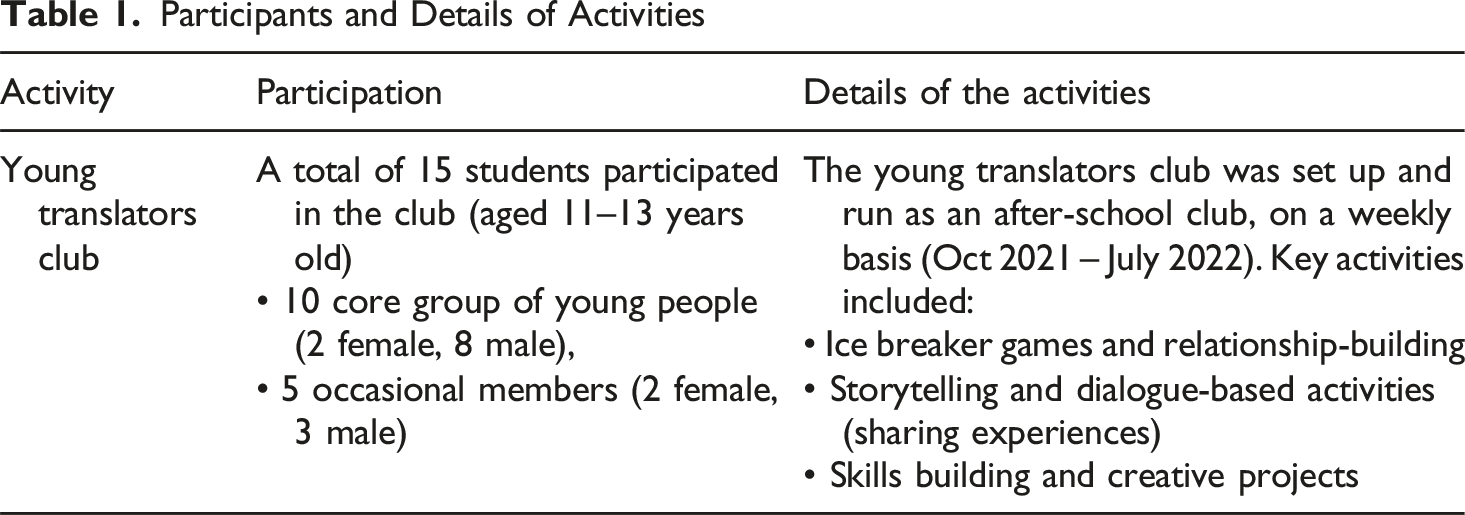
Participants and Details of Activities
The Young Translators Club
The implementation of the Young Translators Club was delivered in 24 arts-based workshops across the academic year between September 2021 and July 2022 with three follow-up ‘impact sessions’ in November of 2022. In the UK, schools usually start their school year at the beginning of September and the academic year runs until the end of July. There are three terms in a year and each one ends with a substantial holiday. The children break for two weeks in December for the Christmas holiday, for two weeks around the end of March for an Easter holiday and then again for around six weeks for the summer. During the middle of each term, the school is also closed for a week, which is known as ‘half term holiday’. In the context of our participatory research, these breaks are mentioned as part of our analysis. It is also relevant that our study took place during COVID-19. When we began, the children had just returned to school after a period of lockdown. There were restrictions in the school around where children could move and many large activities, such as year-group assemblies, remained online with young people watching them within their classrooms but through their laptops. We were unable to undertake Young Translator Club activities during the month of January 2022 due to Covid restrictions.
The activities in the Young Translators Club revolved around three types, which were (1) games and relationships building; (2) dialogues and sharing experiences and (3) skills building and creative projects. Every club session included games which helped build trust and rapport and when necessary, helped regain the young people’s attention when they needed a change. Dialogue and sharing experiences activities mainly occurred during the first 10 workshops and focused on key concepts or questions such as ‘who is a young translator’, “what is participatory research”, “what is safe and ethical research”, “what is care and non-care?”, “how young people feel about translating?”. These questions were shaped around creative activities such as mapping, drawing and photovoice, as examples.
The skills building and creative elements took place in the following 14 workshops and included the use of digital art, podcasts, website building and research skills (e.g. interviewing, ethics and consent). This became known as their ‘mini project’ and the club members wanted to showcase their creative work within their own school project website. An anonymised version has been redesigned and can be found here Young Translators Club. Working on a core project with various sub-activities supported a more structured and cohesive process of co-creation and collaboration, as led by young people themselves and driven by their needs, interests, and creativity workshops. The Club members reflected on the activities and skills they developed during the activities focused on dialogues and sharing experiences, and used these to transform, develop or re-imagine resource materials for wider use.
Throughout the duration of the Young Translators club, we engaged in constant evaluation activities. Part of this involved active and responsive listening to the young people’s preferences for the kinds of activities they enjoyed. There were also more feedback mechanisms like anonymous feedback cards, informal conversations at the end of each session, plus an end-of-year short interview. Club members further disseminated their work within the school by having a ‘final celebration’ event where teachers were invited to come to the club and see their work. In addition, a core group of six young people produced two key impact activities. Over three sessions (November 2022) students advised on the content, visual layout and production of an advice leaflet. They subsequently presented this leaflet and the project as a whole to the Senior Leadership Team in the school including senior management staff, teachers and administrative staff.
Research Team and Reflexivity
Like other PAR projects we recognised the power differences between the academic research team and the relationships between the young people and other school staff. We purposely had an interdisciplinary research team including psychology, visual anthropology/sociology and education studies (Sarah, Nelli and Eleni). Three out of the four members of our academic team are bilingual and two of these were regularly in the field as part of the Young Translators club. Being from a bilingual and migrant background served as an additional opportunity for conversation and rapport-building between the two researchers and young people. All team members who were in the field kept weekly activity and reflection logs as detailed fieldnotes. The Young Translators club conversations were recorded but used only for the purpose of writing-up fieldnotes. The UK team met twice-weekly. The first meeting enabled us to be responsive to the previous week’s Young Translators Club and to help us prepare for the next club. The second meeting was used to reflect on what had occurred during that week’s club. We were conscious that COVID-19 offered barriers for inclusion within the school and that our access to the young people (e.g. through assemblies) was restricted because so much of school-life moved online. In order to attempt to counteract this we invited students to create an Advisory Group, and they were able to offer us advice and suggestions for our interactions with students. In addition, the dynamics of the group were a constant source of reflection which forms part of the focus of the analysis in this paper.
Ethics
We received ethical clearance from Open University (HREC/3935/Crafter) which was reviewed and supported by Oxford Brookes University. In keeping with the ethical considerations central to PAR work, we engaged in ongoing consultation with our partner school around ethics. This included liaising with the Head Teacher and English as Additional Language coordinator on a regular basis. There were additional ethical commitments that we developed as part of our PAR commitments. We had a policy that we would not turn any child away at the door, although we made it clear that the club was aimed at bilingual/young translators. Only one monolingual child came and stayed for a whole session but did not return because of a conflict with choir practice. We were also aware that the children may not wish to fully participate in all aspects of the club and exercise their agency by coming and going across the year. We co-created with the children some ‘ethical ground rules’ which we returned to repeatedly over the year.
Analytic Process
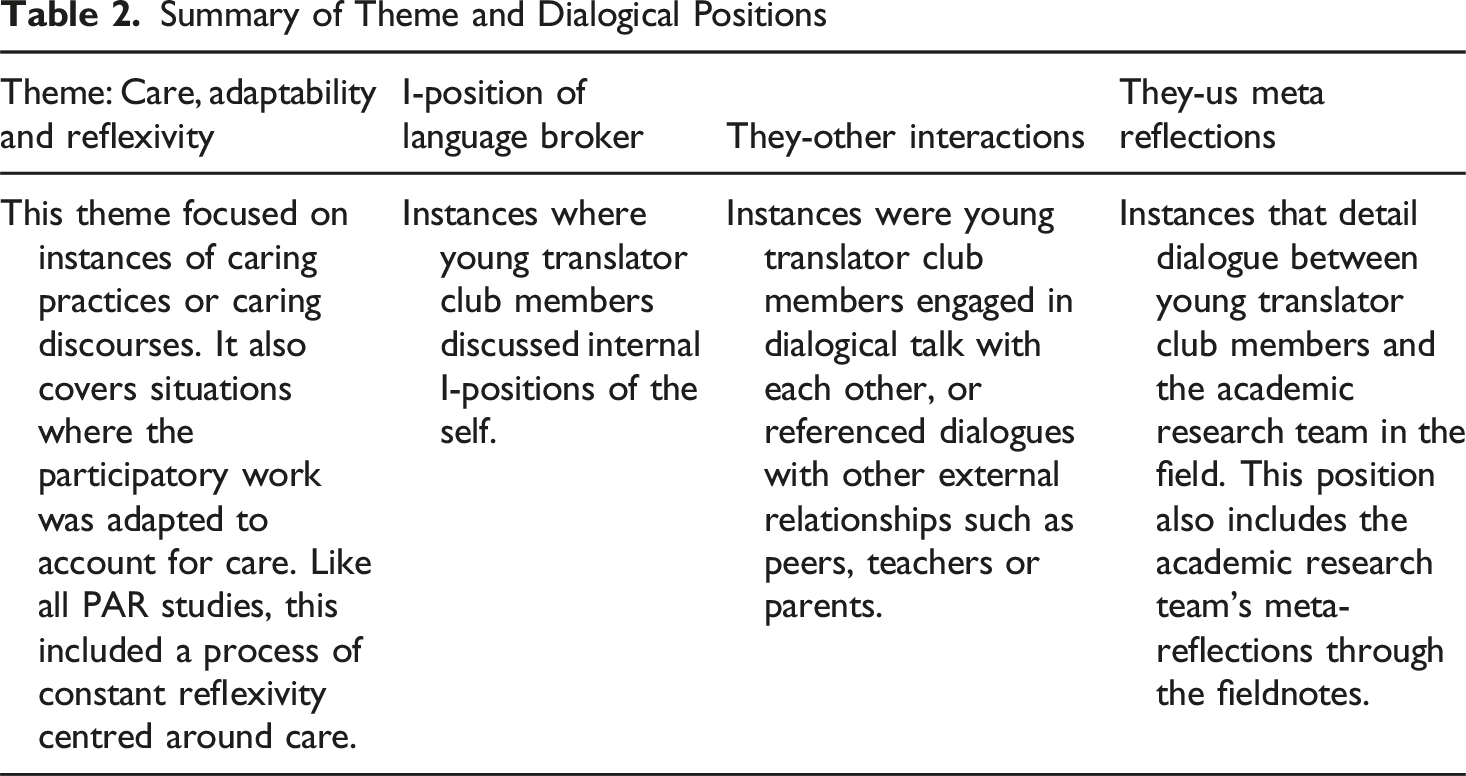
Summary of Theme and Dialogical Positions
The Analysis of Dialogic Positions Through PAR
Throughout our participatory study we had sought to capture young people’s understandings of social and emotional experiences of child language brokering through the conceptual lens of care. The Young Translators club and the dialogue and arts-based activities that took place within the club were the backbone of these explorations. As our relationships with the children grew and changed over time, so too did the complexity of the dialogical relationships between the young people, what they were willing to discuss about their language brokering, their relationships with each other and their relationships with us as the academic research team. Our efforts to continuously delve ever deeper into the meanings they associated with their language brokering practices through co-creation, were sometimes met with resistances and obfuscations. These were often centred around one young person, Balint, whose role within the club acted as a catalytic agent to trigger reactions in others. Never-the-less, over the slow passage of time and as the academic year progressed, the Young Translators Club became a microcosm of rich dialogic interactions. They increasingly engaged in complex negotiations in their relationships with each other and at times, enfolded the academic research team into those endeavours.
I-Positions of a Language Broker
In our participatory and arts-based activities with our Young Translators Club members, we initially struggled to find activities that led to meaningful and in-depth discussions about their I-positions around care. The young people showed no hesitation in talking about their multilingualism, language brokering and translating activity in general. However, during the early months of the Young Translators Club, it did not initially seem like the participatory activities would elicit in-depth personal stories between the young people and the academic research team during the co-creation process. The following activity might provide a clue into how the I-as-language-broker dialogue became stifled during the club. During the fourth session of the club, so very early into the relationships, we introduced a mapping activity that we hoped would act as a gateway to dialogue (depicted in Figure 1). The aim of the activity was to get to know the young people whilst learning about their language brokering relationships and practices. Here, the young people wrote on stickers who they translated for, where they translated, and how they felt about it. We wanted to explore the connections the young people make between relationships, context and feelings. Mapping activity to explore language brokering relationships and practices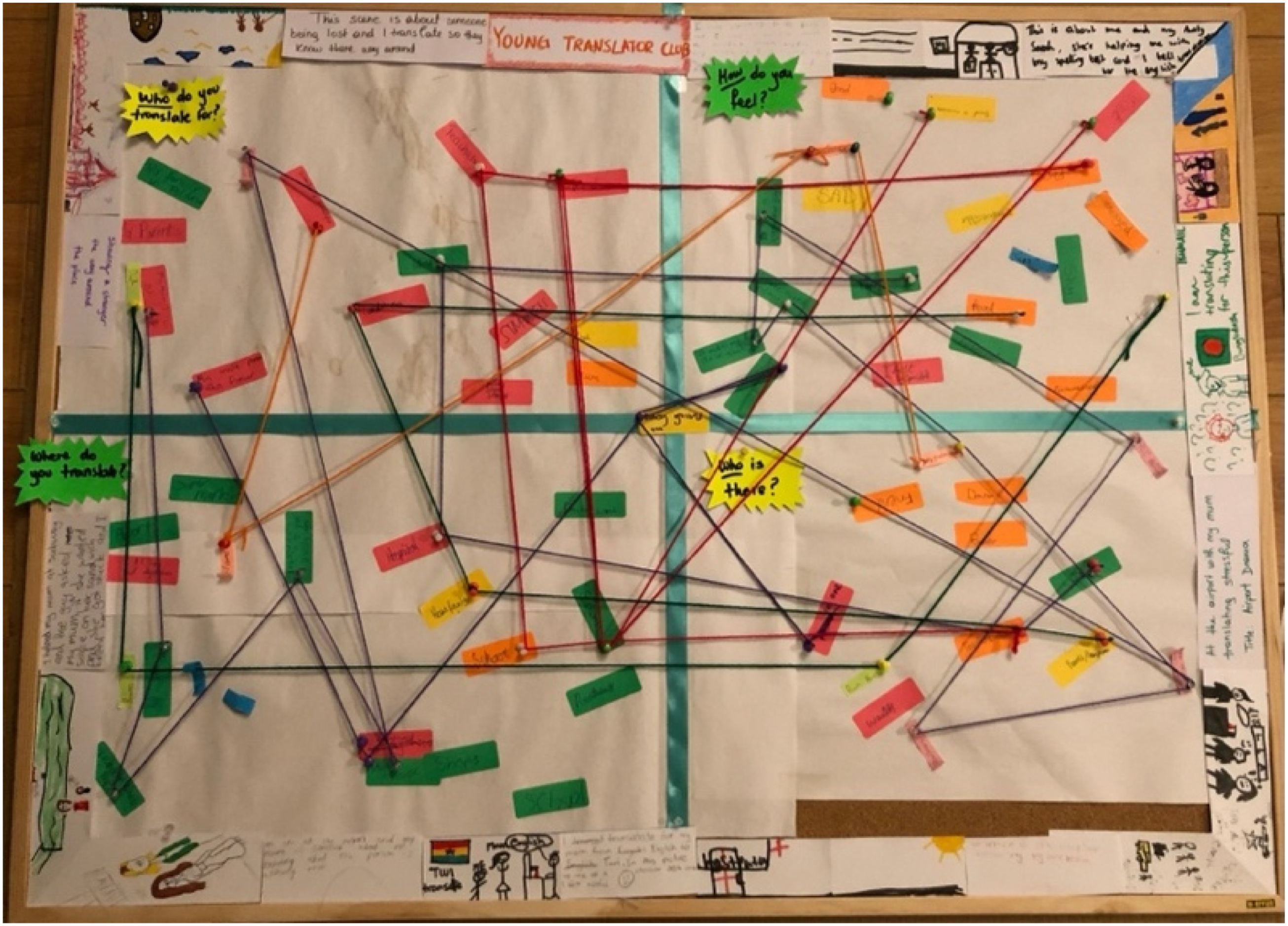
A pin was placed by each sticker and we used wool to make connections, hoping this would stimulate meaningful conversations. Unfortunately, deeper dialogues about those experiences remained elusive. At the start of the activity Irene chose her dad as the ‘who’ she translated for, but told us he called her ‘useless’ when she couldn’t find the right words in the supermarket. This led to an interruption from her friend Balint, telling the group he didn’t like her dad. Later in the session, Irene repeated the story of her dad calling her useless but once again, the opportunity to delve more deeply was stifled. In Sarah’s fieldnotes she wrote: Irene mentioned again how her dad called her ‘useless’ and Saad was surprised she was writing this down and I said it was fine to write these feelings. Nelli mentioned how they might write down how their feelings have changed about their translating. Saad said this was very true and he began to say a little about his Italian, because he has family in Italy. Sadly, Balint kept interrupting him and he lost his message (2nd November 2021)
Two things are of note here. The first, is that interruptions, disruptions and at times, disrespectful behaviour were significant in every club session, and often instigated by Balint’s presence. In line with participatory action research principles, we wanted to equalise the power imbalance between the young people and the academic research team and deliberately sought not to be ‘teacher-like’. As the club members played with the boundaries of their behaviour, one unintended consequence during earlier PAR sessions, was that the more rumbunctious interactions acted as a barrier to delving into deeper conversations. That said, and getting to the second point, Irene once again attempts to express herself. This in turn, along with Sarah and Nelli’s support, seems to give the green light to Saad to discuss his true feelings. He took the opportunity to tell challenging stories about his parents and peers. A further attempt to stymy the dialogue by Balint occurred. It was Saad’s friend Ajit, who re-stimulated a conversation about ‘how others make you feel’ which prompted a discussion from Saad about his I-as-embarrassed multilingual speaker, position: Ajit said something really interesting – he mentioned how someone might feel embarrassed because of the country they are from and how others make you feel. He said he didn’t feel that way himself, but some people might. Saad said he doesn’t like feeling embarrassed and he says that sometimes his parents talk about him to other parents (about his grades at school) and they think he doesn’t fully understand Bengali and he said he understands more than they know. He also said he speaks to people in Bengali at school and he says “I hate this so much, I hate this so much. Other people looking at me and laughing. What’s seriously your problem, I'm just speaking in another language and that”. Ajit agree that sometimes other people do laugh. Saad said he thought “Why are you doing that? (Sarah’s fieldnotes, 2nd November 2021)
Through Balint and his position in the wider group dynamics, it is possible to see how dialogue can act as disruptor or stifler of communication during PAR. Equally, an in-depth focus on the unfolding dialogue also figures acts of resistance from other club members. Irene tries to tell her story twice, and we get some early insight into how her father disrespected her young translating. Ajit also acts as a counter to Balint by re-stimulating the conversation and opening up a space to discuss the tensions in his relationships with family and peers (Crafter, Cline, & Prokopiou, 2017; Crafter & Iqbal, 2020). In interaction with members of the academic research team, he is given license to express those uncertainties and feelings and continues to do so, even in the face of disruptions by Balint. When research on PAR discusses inequalities and power imbalances in relationships, it is often described as happening between the researched and the researcher, or between adult and child. A deeper dialogical analysis and Balint’s ubiquitous role in the group shifts the lens to focus on between-club members dynamics.
They-Other Interactions
Although our fieldnotes from the Young Translators Club reflected a struggle to engage individual members in deep dialogue about care through participatory activities, the ‘they-other’ interactions among members deepened and intensified over time. During the early dialogues about young translating as a caring practice we attempted activities that tackled the question head-on. For example, during week 8 (7th December 2021), a dialogue session with the prompt ‘what does care or ‘non-care’ mean to you’? evoked concepts one might expect. Club members wrote down ‘caring for other’s’, ‘self-care’, ‘family’, ‘relationships’. Discussions about non-care ranged from affect-related phenomenon such as being disrespected and emotional forms of non-care such as silence, to mention of physical violence. We were unable to facilitate any further depth of discussion at this point.
Over time, the academic research team spent considerable time reflecting on how to draw the young people into deeper dialogue through PAR activities, so that they felt included in the club whilst simultaneously wrestling with respecting their boundaries for choosing their own level or type of engagement. The return to the club following their winter break and a short covid-19 lockdown appeared to act as a turning point for a deepening of their relationships with each other, and with us, the academic research team. We began to realise that the Young Translators Club was increasingly being used as a safe space to bring to the fore their friendship issues and dilemmas, including instances of racism, bullying and misogyny, often centred around Balint. Problems that had occurred during the school day spilled over, or perhaps laid dormant, until they came to the club. In other words, through the PAR activities over time, we moved beyond talking about care to enacting and engaging (or not) in care practices through dialogue and action.
This can be illustrated by an activity that took place towards the end of the academic year in session 22 (14th June 2022). Ordinarily, we had anything between 2 and 4 adults working with sub-groups of young people within the club in any given week. On this particular week, because of illness, only Sarah and another visiting academic from Spain, Marta, were available to run the club. Rather than continue with our usual activity, which at this time was the co-production of a Young Translators Club website the young people were developing, Sarah took half of the group to do the Rivers of Life activity. Using the technique developed by Moussa (2009), club members were asked to create a ‘River of Life.’ The River depicts key stages or experiences in their life with tributaries that could be created for positive experiences and rough waters could show difficult challenges. They were told the river could run straight, or twist with turning points. At the end, each person shares the story about their River. The dialogues are depicted as they occurred in time, and as such interweave back and forth, as they discuss their own experiences and the drawings of their maps.
The four young people (Irene, Anca, Alessandro and Balint) who did this activity were all friends from the same year group at school (12/13 years old). We already knew from previous incidences and discussions in the club, that the friends were close but issues around bullying surrounded Balint. While the friends begin to draw their maps, they engaged in some conversations. The data is presented in the order in which it flowed on the day to provide a sense of dialogical back-and-forth, including seemingly random interjections between the young people. Alessandro began by talking about his life in Ghana and his father who left them, prompting his mum to move to Italy. Balint mentioned his brother being born and how they were now “inseparable.” Alessandro questioned him “are you sure about that?” and Irene adds ‘Balint, are you sure?” and he smiles. This fairly gentle exchange seems to set the tone for the deeper discussions about their individual maps, which they each present to the group.
Balint discusses his map first and it contains very few details other than starting school or when his brother was born (Figure 2). Rivier’s of Life drawing by Balint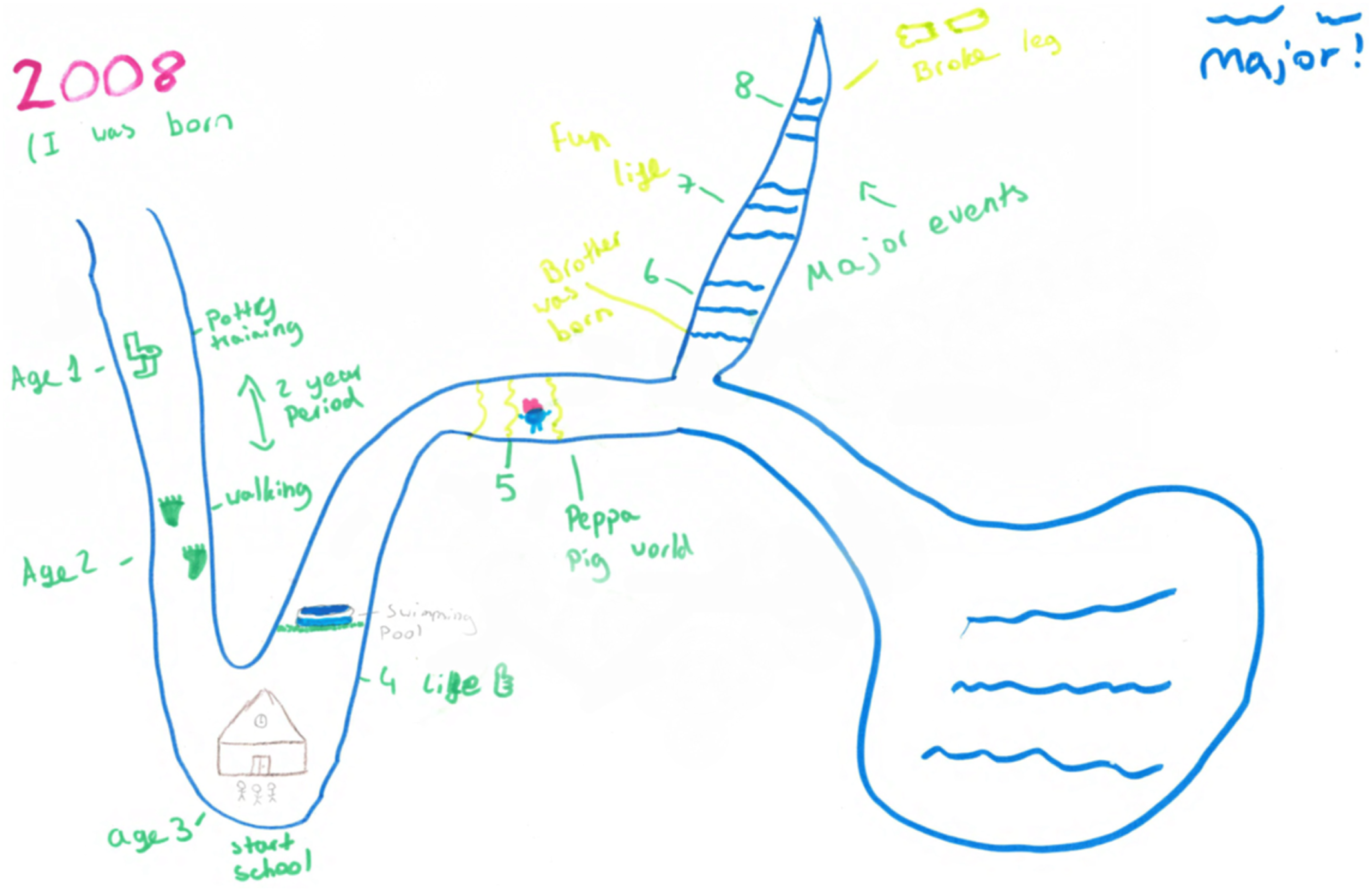
Anca presents her map next (Figure 3). She essentially drew a circle with bulbous ‘spikes’ coming off each one. The spikes represent times when she is bullied and the smooth bits are when she “calmed down”. She mentioned how she was born in 2008 and moved to England. She goes on “then I calmed down, then I got bullied, then I calmed down, then I got bullied number 2, then I learned English”. Balint mentions he was one of the ones who bullied her and she looks at him directly with a smile on her face and says “yes, you did actually”. She picks up “and then mispronunciation and then I was ok for now. And then I wasn’t.” ‘River of Life’ drawing by Anca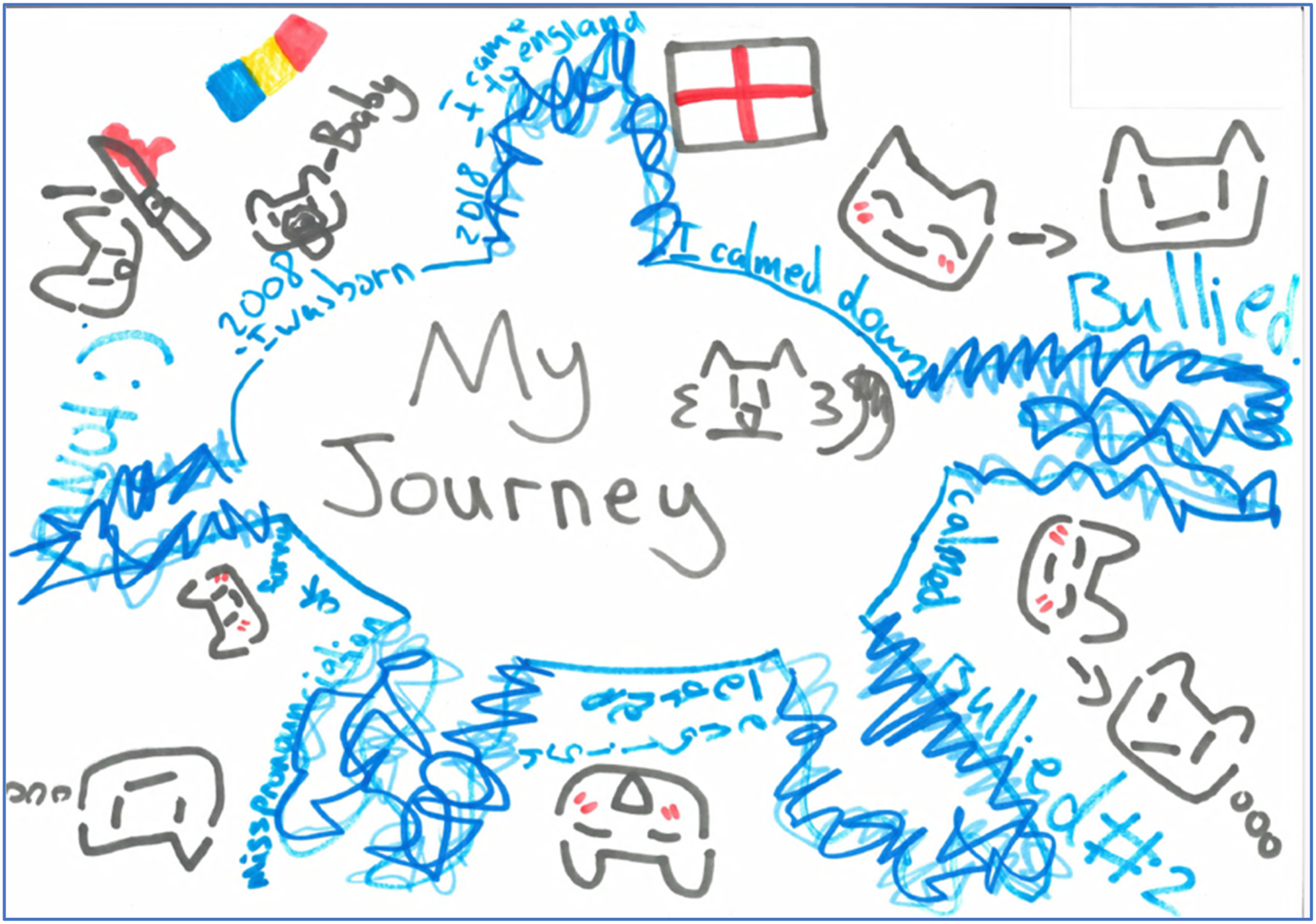
It is at this point that Irene picks up with Balint that she remembers him bullying someone called Luka. Balint asks “Luka?” and Irene said “you kept elbowing him in the neck and we kept asking you to stop and you were laughing.” Balint said “is this just me or do I not remember any of that”. He looks genuine. Alessandro tries to come in, to go next with his River. (Sarah’s fieldnotes 14th June 2022)
Two interesting aspects to note here. Anca’s life in England centres of episodes of bullying that are at least to some extent, focused on her language use in reference to ‘mispronunciation’. However, Balint’s interjection about being one of instigators of the bullying opens a space for Irene to bring up an old incidence (described above). In the context of PAR activities and from the young people’s perspectives, Anca’s descriptions of bullying are not distinct or neatly carved-out incidences. Rather, through the group’s dialogical flow, past experiences of bullying associated with language brokering meld and blend with the role of Balint, in the present.
Alessandro explains his River next, which focuses on his journey prior to coming to England (Figure 4). His map is quite simple, but his narrative told of deeper struggles. A significant part of his story centred on a broken arm that was poorly fixed in Ghana. His move to Italy was very difficult as he describes being “the only black person in my class”. When asked how he felt he said “it was racist” and described how he never got picked for Physical Education or had friends to play with. His future was focused on getting surgery to fix his arm and becoming a biologist. ‘Rivers of life’ drawing by Alessandro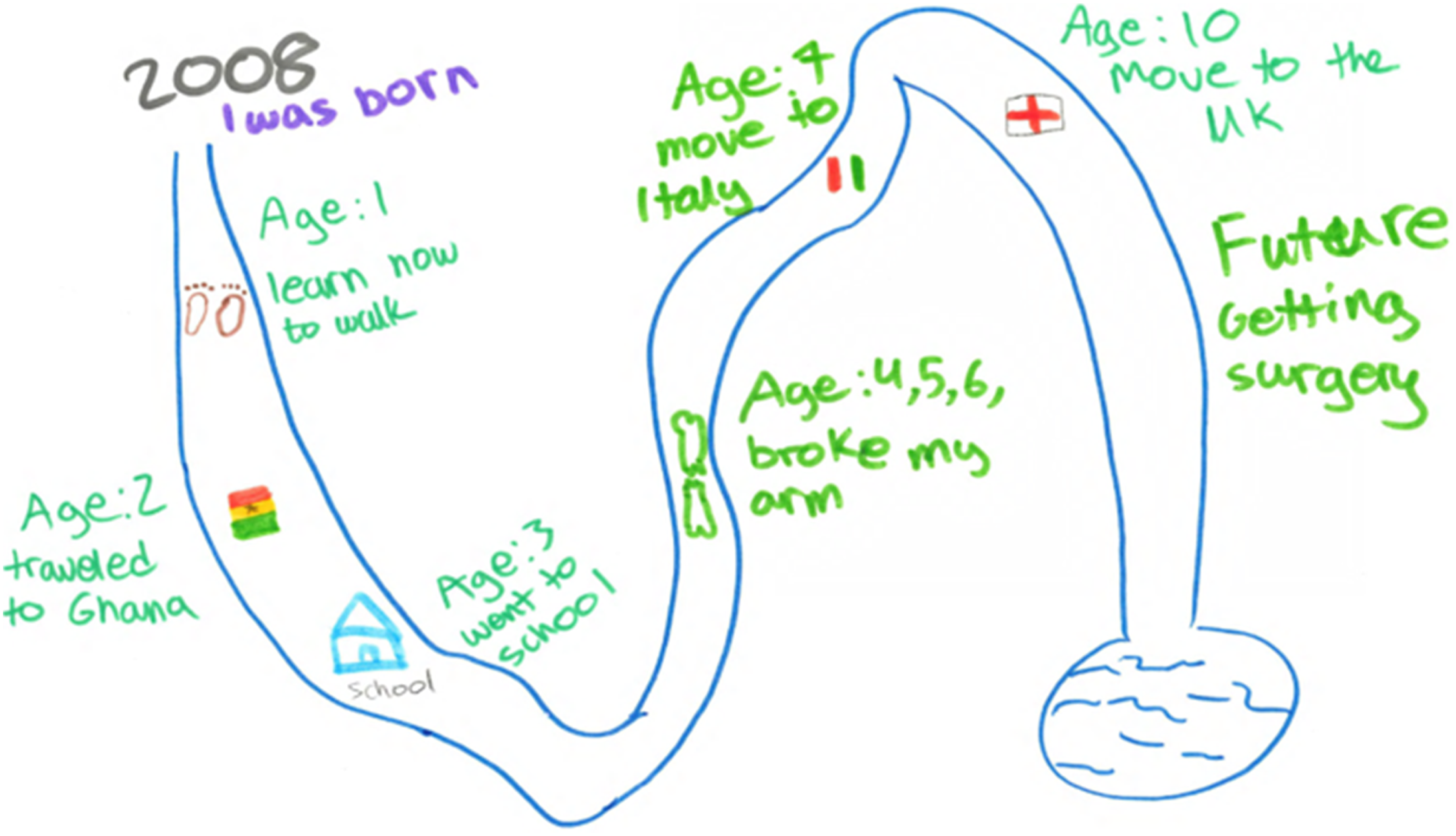
As Irene began her story Balint said ‘Irene’ in a silly voice. This pattern of interruption had become well understood by this point in the club and Sarah reminded him we had to listen respectfully. Irene described how she was four years old when she moved to England and had a tumultuous time moving houses until her dad moved out. A complex interaction then occurred between the group: Then I had to change schools because I was scared of my old teacher”. Balint said in a laughing voice “and you kept vomiting”. Irene gives him a dirty look and says “yeah. Then I got bullied at [name of primary school]” and Balint said “by who?” and she said pointedly “you”. Alessandro laughs and Balint continues to smile. I [Sarah] said “there’s a theme here Balint”. She carries on “I was really sad but then my dad came back” and Balint says “and left again” and she says “yeah”. I asked “how have you represented that, such as your dad coming and going and the bullying?” and she said “I used a flame and a waterfall. I brought it back by saying “so you were bullied by Balint at [name of primary school]” and Alessandro chimes [playfully] in “yeah, you bully” and then I said “but now you’re here and you have become good friends. What happened?”. She said “well, first he and my friend S are neighbours and I live 2 minutes away”. She went on to explain how her and S became good friends and Balint said he has known S for 9 years. S is a girl who comes to the school. S told Irene “he’s not that bad” and Balint says “and that I exist”. I suggested that Irene then gave him a chance and she said “yeah, we got into so many arguments by now”. Balint answers were something I couldn’t quite understand – something about Irene calling him a shit and she said “because you were taking pictures of my dad”. So, I suggested it is still a rocky relationship. She said “but we don’t hate each other I don’t think” and I said “it didn’t seem like it.” (Sarah’s fieldnotes 14th June 2022)
There are a range of I-positions evident through the storytelling of their ‘Rivers of life’. They detail the enduring ups and downs of I-as-being-bullied, I-as experiencing racism and precarious post-migration relationships with family members. These are overlayed with a complex interweaving of ‘they-other’ interactions between the club members, seemingly sparked by the Rivers of Life drawing task. Balint becomes the centre-piece of a past to present dialogue about his role in various bullying incidences. Equally, the tone of the dialogue is convivial and in the case of Irene, almost parental. There is a dynamic and ever-shifting relationship between friendship/solidarity (caring about him and also defending him) and in some cases antagonism e.g. calling him out directly and agreeing with others during disruptive behaviours.
They-Us Meta-Reflections
In the same way I-positions are evident during they-other interactions, so too did ‘they-us’ interactions between the club members and the academic research team unfold in the dialogic dynamics. In this section we provide some of the meta reflections from our fieldnotes relating to the ‘they-us’ dynamic. Much of this discussion also centres around Balint and the dynamics with his friendship group, Irene in particular. The pair were clearly friends and displayed acts of care and solidarity. They always arrived and left club together, even if one of them left early. They ensured they cycled to and from school together. They were both from the same migrant communit and had known each other since primary school. However, over time, it became clear that Irene was aware of ‘others’ responses to Balint and sometimes Irene sought to distance herself from some of his behaviours. She did this by enfolding the academic research team into their interactions, slowly, and over time.
Early-on in the club (session 4, 2nd November 2021) Balint began to test the academic research team’s boundaries with gendered jokes. These were directed at Nelli and Sarah, and in our informal conversation on the way back to our cars, reflected the discomfort felt by women everywhere when told a lewd ‘joke’. These and other behaviours had a secondary impact on Irene. These fieldnotes are from the fourth session during the early days of the Club: At one point Irene asked me if I was stressed and that I seemed stressed. She asked me this last week as well and I wondered if her question relates to Balint’s behaviour. This week I ducked the question and mentioned that last week I had a cold, and if any of them had this cold too? (Sarah’s fieldnotes 2nd November 2021)
Sarah later wrote in her reflections that she wasn’t sure why Irene had asked the question but got the sense Irene was testing how bothered Sarah might be about Balint’s behaviour. As time in the club progressed the dynamics of the group and Balint’s role in that, became an increasing topic of reflection. Irene would increasingly deflect from his disruptiveness and even align herself with the academic research team in acts of joint solidarity. In some ways this was quite a ‘mixed’ session; there was a lot of positivity around resuming the club as well as some disruptiveness occurring in waves. We had to ask the students to regroup sometimes and to ask for some quiet time when someone else was talking. Some members became a bit more restless throughout the session. Irene made some comments to Balint about ‘being disrespectful’ and looked at me apologetically. She also commented on how they will become ‘overheated’ during the summer. It feels like she sometimes has to assume the role of the ‘stabiliser’. (Nelli’s fieldnotes 22nd February 2022)
As the relationships developed across the Club, and our relationship developed with Irene, we entered into more discussions with her about how she managed the situation. She would often look one of us in the eye and roll her eyes in response to something said. Or make a point of telling us that Balint was ‘naughty’ with an apologetic tone. Since the academic research team were all female, it is perhaps not surprising that a sense of co-support developed with some of the female club members and Irene in particular.
Sometimes, the arts-based participatory activities were the mechanism through which problematic dialogues were realised. Irene, who was keen on digital art had offered to produce a logo for the Young Translators Club website, which the group were co-creating. Irene had shown three sketches to one of the academic research team members, Eleni, who expressed how impressed she was. Eleni also wrote in her fieldnotes: At the same time I noticed a drawing that Balint added on the logo she wanted to discard and realised it was gender inappropriate. I signed at her “what is that” she signed that it is silly stuff and I asked if she thinks I should raise it with him. She said that she didn’t, that it’s just silly and we should ignore and not bother with it. I agreed and said let’s ignore and move on with the next steps, as they had produced some great work. (Eleni’s fieldnotes 29th March 2022)
Irene had described how her drawing had been ruined by Balint: …who had drawn two figures, a boy and a girl and the girl’s figure had ‘no brain’ whereas the boy had a ‘big brain’. The woman’s chest area was also highlighted in blue. She explained that Balint had drawn this and pointed towards her chest. I asked her if she was okay and she said yes, she didn’t mind. Eleni also explained that they had spoken about it. Alessandro said ‘sexual abuse’ and left towards the front of the room. He was doing something with Anca, I think. I was again conscious of how our conversations around being respectful still seem to not fully reach certain club members. (Nelli’s fieldnotes, 29th March 2022)
Irene engaged in a significant amount of emotional labour and care, both on behalf of herself, for Balint, but also in solidarity with the research team. Her contribution to the co-created activities through her digital art were the catalyst for problematic interaction in the They-other sphere with Balint, and a dialogical mechanism for female solidarity between ‘They’ (club member) and ‘Us’ (academic research team).
Concluding Thoughts
The aim of this paper has been to gain new insights into the relationship between participatory action research, dialogical theorising of self-other relationships and the concept of care. We have argued that dialogue is treated as an intrinsic element in PAR research but that the nature of the dialogue has been undertheorized and as such, dialogical self-other analysis had much to offer in providing new insights. From the start of our empirical work we were deeply interested in finding new ways to access the social and emotional needs of a community who are under-researched in two ways: (1) because of their status as children and young people whose voices are not always foreground in research about their lives and (2) working with child language brokers, whose migratory history and translating and interpreting practices can go unnoticed. Participatory action research with arts-based methods (e.g. drawing, mapping, podcasting) provided the potential for equalising the research arena and foregrounding the young people’s experience. We have been asking: What can dialogical theorising contribute to the field of participatory action research and visa versa? What complexities does the concept of care add to the empirical fieldwork of a participatory action research study? What might be the challenges of incorporating PAR into a project with children and young people in a school context and how might a dialogical perspective deepen our understanding of the social and emotional needs of child language brokers?
The theoretical contribution to the literature in examining dialogical self-other relationships, participatory action research and care, are four-fold. Firstly, participatory action research offers potential catalysts for dialogue but dialogical theorising shines a spotlight on the complex interplay between our young people’s I-positions, their relationships with each other and their relationship with us, the academic research team. In the Young Translators Club, our early fieldnotes consistently reflected a sense that the academic research team felt frustrated that meaningful dialogue with the young people were difficult to achieve. I-positions were present but seemingly stifled by the dynamics of the group and the role of Balint, in particular. On the one hand, we have shown how there was an inhibiting or silencing effect which might be akin to what Valsiner and Cabell (2012) describe as taboo positions. They argue that I-positions are the cultivators and regulators of the self. These dynamic self-systems are also regulated by the external Alter, which in this instance were the stymieing of conversations through the dynamics of the group. Equally, this dynamic began to shift over months of time and here is arguably how PAR helps to expose the more complex view of the complete person.
This takes us to our second contribution, which is the importance of time as it unfolded during the participatory actions in the Young Translators Club. The concept of time has been a pertinent discussion in scholarship on PAR, which tends to focus on data over time and the shifting dynamics of the community researchers and academic research teams involved (Mreiwed et al., 2024). Dialogical theorising has tended to focus on time through the lens of changes in the self between the past, present and future (Zittoun, 2014). We argue that in bringing both aspects of time together, there is valuable insight to be gained by looking at how activities unfolded and their relationship with the impacts on group dynamics. Our attempts to avoid reproducing a teacher-like relationships and empowering the children to democratise their relationships with us, created what some of them described in their feedback to us as a “safe space” where they could talk about experiences that may be taboo (such as bullying). Perhaps as a result, tensions in the relationships from other areas of school and home life spilt over into the Young Translators Club because it created an opportunity for supported dialogue. A dialogical analysis helped us to see their intertwined and unfolding I-positions and they-other relationships in a new light. Conversations that seemed stymied, sometimes to the academic research team’s frustration, were opened up at a later point of the young people’s choosing.
This leads to our third contribution. When participatory action research is slow in time, the dialogical boundaries between I-positions, they-other and they-us are shown to be amorphous. To enable the analytics, dialogical-self research, usually through interviews, attempt to tease out the distinct dialogical elements (Aveling et al., 2015; Gillespie & Cornish, 2010). Perhaps a combination of PAR or the use of fieldnotes as a key documentary form of evidence, made this very challenging. Arguably, the reliance on fieldnotes for the club activities is a weakness of the study as a whole. Equally though, it is this challenge that enabled us to gain a deeper understanding of the enfolding nature of the relationships between the club members (they-other) analysis and their relationships to us, the academic team, (they-us) relationships. Balint’s role as a catalytic trigger for many other dialogues, actions and tensions are clear through the fieldnotes. However, a dialogical self analysis of this data helps shed light on how PAR activities became a catalyst for other members to question, resist or pursue meaningful dialogue.
Our fourth contribution is the introduction of the concept of care. As far as we are aware, we are the first authors to examine the ethics of care framework alongside dialogical self-other theorising. In participatory action research the concept of ‘care’ is often invoked. Partly, this is because working with marginalised communities is a central instigator for the use of PAR in the first place. It is also the reason why researchers are ‘careful’ in their approaches to work co-productively with their participants (Brannelly & Barnes, 2022; Lomax, 2015). PAR oriented research requires ongoing and thoughtful consideration of relationship-based ethics that resonates well with an ethics of care framework which foregrounds ethical responsibility to care during the research process (Banks et al., 2013).
By combining dialogical theorising, participatory action research and the concept of care we have gained deeper reflexive insights into the how the young people participated in activities and how this participation changed over time. As co-researchers the young people articulated complex dialogical relationships in ways that took time to emerge but might also have been the product of the safe space offered by the Young Translators Club. The academic research team, became enfolded in those dynamics, shifting between ‘teacher-like’ positions in initial stages to a multiplicity of positions such as challenger, mediator, co-carer and a figure of solidarity in later stages.
Footnotes
Acknowledgements
The authors wish to thank Rachele Antonini, the NEW ABC project coordinator, for her contribution to the concept and design of project, Eleni Stamou for her contribution to the UK field work, and Marta Arumi Ribas for her support with club activities during her time as a Visiting Scholar. We also extend our thanks to all the children, young people, educators and other stakeholders who participated in the NEW ABC pilot actions.

Ethical Considerations
The NEW ABC ethical protocol - In compliance with National law and internal regulation of each Beneficiaries, the collection and processing of personal data related to the project activities was carried out after the approval of the competent Ethics Committee of each Beneficiaries. In the UK, approval was gained from The Open University Human Research Ethics Committee (HREC/3935/Crafter and supported by Oxford Brookes University. The NEW ABC project was also provided with ethical oversight by the External Ethics Board appointed by the Consortium.
Funding
The authors disclosed receipt of the following financial support for the research, authorship, and/or publication of this article: NEW-ABC - “Networking the Educational World: Across Boundaries for Community building” has received funding from the European Union’s Horizon 2020 research and innovation programme under grant agreement NO 101004640.
Declaration of Conflicting Interests
The authors declared no potential conflicts of interest with respect to the research, authorship, and/or publication of this article.
Data Availability Statement
The NEW ABC seeks to make research data openly available, whenever possible, in order to allow dissemination, validation and re-use of research results. Each dataset is deposited via individual institutional repositories compatible with OpenAIRE.
Disclaimer
The views and opinions expressed in this paper are the sole responsibility of the authors and do not necessarily reflect the views of the European Commission.