



Abstract
Academic Abstract
Active inference is an integrative theoretical framework that models the nervous system as a statistical engine for predicting and regulating sensory input. Within this framework, perception and behavior work toward the same imperative: minimizing uncertainty. The current article extends this approach to the inferences social agents make about themselves as both subjects and objects of experience. The resulting model conceptualizes “The Game of Self” as a continuous Bayesian updating of episodic and semantic self-representations in order to reduce self-related uncertainty. The model proposes a bidirectional predictive loop that evolves over time—semantic representations of identity guide the construction of episodic experience, while those experiences, in turn, shape semantic self-categorization. In both directions, the self-representations that emerge through active inference are those with the highest posterior probabilities given situational evidence. The article explores how episodic and semantic self-representations are continuously shaped by a dynamic and adaptive process of Bayesian inference.
Public Abstract
Who am I? What am I feeling? What should I do? These are fundamental questions that people ask themselves throughout their lives—and the answers can shape everything from small decisions to major life changes. But how do we come to know ourselves in the face of social and personal uncertainty? This article examines how the brain uses statistical modeling to make sense of identity and experience in an uncertain world. It introduces the concept of “The Game of Self”—an ongoing cycle between who we think we are and what we’re experiencing. Our beliefs about who we are shape what we experience, and our experiences shape who we think we are. In each moment, our sense of self is the brain’s best statistical guess about our current identity and lived experience. This framework offers new ways to think about selfhood—not as fixed, but as adaptive and responsive.
Keywords
Introduction
Over the past 2 decades, there has been a growing wave of interest in predictive approaches to mind and behavior (Bubic et al., 2010; Clark, 2013, 2015; Hohwy, 2013). These frameworks model living systems as statistical agents that continuously generate and revise inferences about the world around them. A central focus within this literature is active inference, which treats perception and behavior as expressions of a statistical (and biological) imperative to improve predictive accuracy (Friston et al., 2017; Sajid et al., 2021). Researchers have fruitfully applied this framework to a wide range of topics, including emotion (Barrett, 2017), perception (Parr et al., 2019), self-regulation (Pezzulo et al., 2018), and learning (Friston et al., 2016)—treating them all as inference challenges. Its combination of mathematical grounding, analytical precision, and broad scope make active inference a compelling candidate for an integrative theoretical foundation for the brain and behavioral sciences (Pezzulo et al., 2024).
This article extends the active inference framework to the study of selfhood, proposing that the self can be understood as an ongoing inferential process. Long considered a core concept in Western philosophy of mind and modern psychological theory, the self is often viewed as both the epistemic and moral center of each individual, as well as the basis of experience, judgment, and desire (Murray, 1993; Seigel, 2005; Taylor, 1992). It plays a foundational role in personality psychology, where different characteristics of the self are mapped across trait dimensions (Roberts & Yoon, 2022); in relational dynamics, where horizons of interpersonal possibilities are shaped by self-representations (Andersen & Chen, 2002; Gergen & Gergen, 1988); and in intergroup relations, where community engagement is driven by identification with a collective self (Abrams & Hogg, 1990; Brewer, 1991). Developmental perspectives likewise emphasize how various dimensions of selfhood shift over time (Demo, 1992). Given its centrality across the social and behavioral sciences (Baumeister, 2010), advancing our understanding of self-related processes could have wide-reaching theoretical implications.
To illustrate how the self can be framed as an inference problem, consider the task faced by a predictive brain. As a statistical engine, the brain’s job is to detect patterns in sensory input, generating a model of the world and the best way to act within it (Swanson, 2003). Now imagine that this brain exists in a social environment populated by other predictive agents who interact with and make predictions about each other. To navigate that world effectively, each agent must not only predict external events, but also how it will be perceived by other brains. In other words, it must model itself as a social object.
Now consider the same brain living inside of a person named Brian. As a predictive and self-aware agent, Brian’s brain must continuously infer how to think, feel, and act like “Brian.” Most of the time, Brian is unaware of the inferences that his brain is making about his own selfhood—he experiences their outputs, not the inference process itself. Still, his self-understanding shifts over time, as his brain updates its model of who Brian is based on new experiences. To behave in socially coherent ways, Brian’s brain must repeatedly ask: “What kind of person am I?” and “What kind of person should I act like right now?” It may infer that it should enact a more conscientious version of Brian in the morning while he is getting the kids ready for school, a more open-minded and reflective one during a walk in the park, a more relaxed and care-free one while listening to music, and a more anxious one when he feels increased pressure at work. These moment-to-moment fluctuations in personality, identity, and experience, varied as they are, can be understood as the outputs of a predictive brain attempting to behave as it expects Brian would. From this perspective, acting like a person is a deeply complex and sophisticated statistical challenge.
The current article advances a process model, rooted in active inference, of how the brain attempts to resolve this ongoing challenge of selfhood. The resulting framework describes “The Game of Self” as the inferential process by which an agent learns about and reinforces its own identity and experience. The first section of the article, “Survival as Statistics and Self-Organization,” introduces active inference as an analytic framework for understanding how nervous systems adapt to their environments through predictive learning. The second section, “The Game of Life: Evolution as Predictive Modeling,” embeds this framework in evolutionary theory and applies it to personality variation, reframing personality states as dynamic predictions about situational demands. The third section, “Emergence of Self-Awareness and Identity,” explores how complementary representations of episodic experience and semantic identity improve the prediction of interpersonal outcomes. The final section, “The Game of Self: Active Inference of Experience and Identity,” presents an active inference model of selfhood, emphasizing the bidirectional relationship between experience and identity based on the dual encoding of episodic and semantic self-representations. The paper concludes with a discussion of novel implications for research on personality, identity, and the self as a predictive process.
Before proceeding, it should be noted that the “game” metaphor was chosen to highlight the computational, structured, rule-bound, and evaluative nature of self-construction under active inference. As will be elaborated below, agents continually select among possible actions, update their expectations, and negotiate constraints imposed by their bodies, histories, and social environments. This iterative process—of choosing behavioral policies, receiving feedback, and revising one’s generative model—resembles a sequential decision problem with uncertain outcomes and context-specific notions of success. In this sense, the metaphor echoes formal constructions such as Conway’s Game of Life, where stable patterns can emerge from simple, rule-governed interactions (Gardner, 1970). Framing self-construction as a “game” therefore foregrounds the strategic, dynamic, and socially scaffolded character of self-modeling, where success or failure, as reflected in the frequency and magnitude of an agent’s prediction errors, can have important personal consequences. At the same time, the emphasis on formal rules and statistical optimization highlights the computational focus of the framework.
Survival as Statistics and Self-Organization
Every living system, from the simplest bacteria to the most sophisticated of mammals, shares a common existential imperative: maintain functional integrity or cease to exist. Erwin Schrödinger famously captured the essence of life’s struggle as a battle against entropy, the inevitable drift toward disorder described in the second law of thermodynamics (Schrödinger, 1944). Because entropy tends to increase over time, no living thing can afford to be at rest for long; it must continuously strive to gather energy and regulate its inner equilibrium. This regulation, or homeostasis (Cannon, 1929), relies on biochemical feedback loops that restore preferred ranges for temperature, pH, hydration, and nutrients (e.g., sweating to cool down an overheated body). More broadly, living beings function as self-organizing systems that strive for internal balance amid external entropy and uncertainty (Prigogine & Stengers, 1997). If an organism fails to maintain homeostasis, its internal processes will be compromised, and its survival will be at risk.
While some homeostatic responses are simply reactive—triggered only after internal states deviate from set points (e.g., blood glucose falls below set point, triggering hunger)—more complex organisms tend to rely on allostasis, a strategy of proactively adjusting physiological dynamics to better respond to an anticipated stressor (McEwen & Wingfield, 2003). For instance, an animal that anticipates danger may show a faster heart rate and increased cortisol release even before the threat materializes, allowing it to be prepared for strategic responses like fighting or fleeing. This pro-active regulation enhances survival by enabling the organism to stay ahead of environmental challenges, defending and preserving homeostasis before disruption occurs (McEwen, 1998).
For allostasis to work effectively, however, the organism must be able to predict future events (Sterling, 2012). Indeed, the more accurately that an organism can anticipate future states, the more effectively it can deploy self-protective measures. In contrast, incorrect predictions about future states can lead to maladaptive actions—such as approaching a threat instead of avoiding it—that undermine internal equilibrium. In this way, allostasis depends on statistical learning: without a reliable internal model of environmental regularities, the organism cannot anticipate how its sensory inputs are likely to evolve, nor prepare itself for impending events.
Building on this view, some have argued that the basic function of a nervous system is to help an organism infer the most adaptive response to sensory input (Swanson, 2003). In this account, the brain operates as a statistical engine, encoding recurring sensory patterns and rewiring neural connections between sensory inputs and motor outputs to optimize behavior over time. One influential version of this idea is the Bayesian brain hypothesis, which posits that the brain functions as a probabilistic inference machine that implements (approximate) Bayesian learning (Doya et al., 2007; Friston, 2012; Kersten et al., 2004). In this framework, every perceptual or behavioral response reflects the brain’s best statistical guess about the hidden causes of its sensory experiences.
Bayesian inference is grounded in Bayes’ theorem, a formal framework for updating probabilistic beliefs in response to new evidence (Van De Schoot et al., 2021). At its core, the idea is straightforward: begin with an initial belief (the prior), encounter new evidence, and revise that belief (producing a posterior) based on how likely the evidence would be if the belief were true (the likelihood) and how unsurprising the evidence is overall (the marginal probability). This process allows beliefs to evolve over time through experience, supporting a statistically grounded and cumulative form of learning.
Put formally, Bayes’ theorem describes how to compute the posterior probability of a hypothesis A given observed evidence B: [P(A|B) = P(A) * P(B|A)/P(B)]. In this equation: P(A) is the prior probability, or the initial belief in A (e.g., “it’s raining”); P(B|A) is the likelihood, 1 or the probability of observing the evidence B (e.g., “hearing raindrops”) if A were true; P(B) is the marginal probability, representing how likely the evidence is across all possible hypotheses—regardless of whether A is true. P(A|B) is the resulting posterior probability, the revised belief in A after accounting for the new evidence. This formulation gives more weight to surprising evidence (low P[B]) and less to unsurprising evidence (high P[B]), ensuring that highly unexpected evidence exerts more influence on beliefs, while common or predictable evidence leads to more modest updates. Crucially, this process ensures continuity in learning—today’s posterior becomes tomorrow’s prior—allowing the system to refine its beliefs through ongoing inference.
An agent that follows the rules of Bayesian updating will make optimal use of their sensory inputs, refining beliefs efficiently and coherently over time. In contrast, an agent that fails to update in this way—neglecting prior information or misinterpreting new evidence—will behave inconsistently and irrationally when faced with uncertainty. Given that an organism’s existence hinges on accurately predicting and responding to future states, the ability to learn from experience would be under strong evolutionary pressure (Pezzulo et al., 2021). At the individual level, a Bayesian agent develops a progressively refined internal model of the world by updating beliefs in light of new observations. This evolving model helps the agent anticipate patterns in the environment and act to maintain homeostatic balance (Vilares & Kording, 2011).
One illustration of the Bayesian brain in action comes from research on visual perception. In this context, the brain must infer the most likely causes of sensory input by combining incoming data with prior beliefs. The resulting posterior belief—the brain’s best guess given both prior expectations and current evidence—forms the basis of perceptual experience (Kersten et al., 2004; Knill et al., 1996; Rao et al., 2002). For instance, when faced with ambiguous input—such as a distant shape on the horizon—the brain tries to differentiate the ambiguous figure by weighing different interpretations based on their likelihoods. Is it a ship? Is it an island? If a foghorn is heard, the evidence shifts the balance of probabilities, increasing the likelihood of the “ship” interpretation and changing the perceptual experience accordingly.
In effect, the external world is treated as a hidden cause in a Bayesian model, and perception is the process of inferring the most likely interpretation for available sensory input. This idea builds on Helmholtz’ prescient observation that perception requires unconscious inference, such that sensory signals are automatically interpreted in relation to previous experience (Westheimer, 2008). His “likelihood principle” introduced the notion that perception functions as a form of statistical pattern matching, in which brains select the most probable interpretation of ambiguous input. Over time, with repeated experience, these perceptual inferences converge on the most frequently encountered sensory patterns.
An important aspect of Bayesian inference—unlike what is found in frequentist statistical approaches—is that it always incorporates prior beliefs into the reasoning process or predictive equation. As a result, inference does not begin from scratch with each new observation; instead, it involves the continual refining of existing beliefs. In the context of perception, this means agents do not passively receive sensory information and then interpret it—they are constantly anticipating what is likely to be encountered next. Consequently, an agent’s prior beliefs and expectations actively shape the perception of incoming sensory data, influencing what is consciously experienced (Gilbert & Li, 2013).
Neuroscientific models of the Bayesian brain often adopt a predictive coding framework to explain how statistical inference is implemented (Clark, 2013; Friston & Kiebel, 2009). These predictive frameworks operate differently from traditional models of perception, in which there is a feedforward flow of sensory information through a neural hierarchy of pattern detectors, each one encoding a different set of input features. In predictive approaches, the brain begins with a statistical model of expected sensory input, which is then compared with actual sensory input (Rauss et al., 2011). Rather than passing the sensory input data itself up the neural hierarchy, it is only the prediction error, or discrepancy between the expected and observed inputs, that is relayed upwards under predictive coding. These prediction errors provide sensory feedback that restructures the agent’s predictive model, increasing their capacity for organizing adaptive responses.
One advantage of Bayesian inference is that it yields not only a single best-fitting estimate (like a point estimate or p-value) but a posterior distribution for the parameter of interest—a probability distribution of possible values of the hidden parameter, informed by both prior beliefs and observed data. The amount of uncertainty in a Bayesian prediction is quantified by the spread of the posterior distribution (i.e., the variance in continuous cases), reflecting uncertainty about the hidden state or parameter given the data and prior. This is analogous to the standard error in frequentist statistics, which quantifies uncertainty around a single parameter estimate. Bayesian inferences are considered to have high precision—that is, a strong, high-confidence belief—when the posterior distribution has a low variance, meaning there is a tighter distribution of probabilities around a smaller number of outcomes, reflecting the agent’s certainty about its inferences. In contrast, when the posterior distribution is wide and flat (high variance), the estimate has low precision, reflecting greater uncertainty. This matters tremendously for perception because the relative precision of priors and sensory input determines their weighted influence. Strong, highly certain (high precision) priors resist change unless met with compelling evidence; highly precise sensory data, by contrast, can override prior beliefs and reshape the agent’s internal model (Yon & Frith, 2021).
Active Inference
An influential extension of predictive coding is the active inference framework (Friston et al., 2017; Parr et al., 2022). Like other Bayesian models, active inference treats the brain as a predictive system that updates its internal model of the world through probabilistic inference. However, active inference goes a step further by integrating action selection into the inferential loop. An active agent must choose between an array of behavioral policies—temporally extended action plans that guide behavior. Policy selection can therefore be framed as inference: the agent evaluates which policies are most likely to realize preferred outcomes and improve predictive accuracy by reducing uncertainty. This means that each behavioral policy has a prior probability associated with it, which reflects an agent’s default tendency to select certain action plans (e.g., habits or dispositions). As situational cues are observed, the agent assigns a posterior probability to each policy, reflecting predictions about the best behavioral options in a given moment. The same process of Bayesian inference is thus used to optimize policy selection in light of statistical evidence. In the context of policy selection, high precision reflects more decisive behavioral inferences, where the optimal behavior is well-defined. Low precision, on the other hand, reflects greater uncertainty and increased behavioral flexibility (Friston et al., 2016). Rather than passively registering sensory input, the agent is understood to be playing an active role in shaping its experiences—enacting behaviors that are expected to reduce uncertainty and bring sensory input in line with its predictions.
Central to active inference is the Free Energy Principle, which states that any adaptive system that maintains its boundaries over time can be described as minimizing an information-theoretic quantity called variational free energy (Friston, 2009). This quantity serves as an upper bound on statistical surprise or prediction error (Friston, 2012; Parr et al., 2022). Intuitively, free energy measures the mismatch between an agent’s generative model and the sensory data it encounters, such that lower variational free energy corresponds to less surprising, more predictable patterns of input. Variational free energy is minimized during perception as the system makes inferences about the hidden causes of sensory input, and during learning as the agent updates its beliefs in light of new evidence. Expected free energy is minimized during action planning when the chosen behavioral policies are inferred to be the most useful and informative.
Variational free-energy methods were popularized by Richard Feynman, who extended earlier work to show how a variational bound could be used to turn otherwise intractable path integrals in quantum mechanics into relatively simple optimization problems (Feynman, 1972). These ideas were later abstracted into the broader statistical notion of variational inference, a computational approach commonly used in machine learning to approximate Bayesian inference when exact solutions are too complex to compute (Fox & Roberts, 2012; Tzikas et al., 2008). Instead of calculating the full marginal likelihood, variational methods optimize the Evidence Lower Bound (ELBO), which serves as a tractable proxy of the lower limit for the marginal likelihood. The resulting posterior distribution is similarly approximated by q(x), a distribution that minimizes the divergence from the true posterior. In practice, models with higher ELBO are considered to better explain the observed data, and this principle underlies perceptual and learning updates in active inference.
By choosing actions that are expected to make future observations easier to predict under the model (i.e., to maximize an expected evidence bound such as the ELBO, and thereby minimizing expected free energy), agents in active inference strive to maintain familiar and predictable patterns of sensory input. More specifically, they act in ways that confirm their prior beliefs—a process that aligns prediction with desired outcomes because, in this framework, prior beliefs also encode the agent’s needs and preferences. For example, all warm-blooded animals hold a prior belief that their body temperature should remain within a desirable range. If a person anticipates cold weather, bringing a coat would help ensure the validity of their prior expectation (and desire) of staying warm. In this way, action serves two purposes: refining the agent’s predictive model and maintaining preferred internal states—an adaptive strategy known as predictive allostasis.
When prediction errors do arise (i.e., when the world violates the agent’s expectations), the agent finds itself in an unexpected situation, and both perception and action provide complementary strategies for reducing uncertainty. On the perceptual side, the agent can revise its internal model to better fit the incoming sensory data, updating beliefs through Bayesian inference. On the behavioral side, the agent can take actions that alter the environment to bring sensory input in line with its expectations. In both cases, the goal is the same: to reduce the discrepancy between predicted and actual input by either changing the mind or changing the world, thereby increasing the marginal likelihood of encountered data.
In this framework, perception and action are two sides of the same coin: both strive to reduce uncertainty by maximizing evidence for the agent’s internal model of the world. This is why agents in active inference are described as self-evidencing: they choose actions that are expected to validate their prior beliefs (Hohwy, 2016). In this view, actions can be construed as behavioral hypotheses about the hidden causes of sensory input and the agent’s capacity to influence them. Observing the outcomes of these actions provides feedback—analogous to gathering sensory evidence—that either confirms or disconfirms those hypotheses. Over time, this perception-action loop supports a dynamic learning process in which behavioral policies are continuously optimized to improve predictive accuracy, adapt to environmental contingencies, and maintain homeostatic balance.
At the center of this process is the agent’s generative model—a structured set of statistical expectations about how the world works and how sensory states are likely to unfold. This model is built and refined over time through repeated cycles of behavioral hypotheses and sensory feedback, gradually forming a predictive map of environmental regularities and controllable outcomes. The agent derives both its prior expectations and likelihood estimates from this generative model. As prediction errors arise and beliefs are updated following surprising sensory data, the generative model itself evolves, becoming better tuned to the agent’s context and more effective at predicting future events. Importantly, within active inference, it is variation in these generative models—not in the learning algorithm itself—that accounts for individual differences across agents, as everyone is thought to follow the same basic Bayesian process of sampling, acting, and learning (Parr et al., 2022).
A key concept within active inference is the Markov blanket, which defines the boundary between an agent and its environment (Hipólito et al., 2021; Kirchhoff et al., 2018). The Markov blanket includes the specific set of variables—such as sensory inputs and motor outputs—that mediate interactions between internal states and the external world. These variables are the only channels through which the agent can be influenced by, or exert influence on, its surroundings. For example, if an agent is trying to determine if it is in danger, its Markov blanket might include an array of visual or auditory cues and bodily sensations that signal the probability of threat. Once these variables are accounted for, all other factors are treated as conditionally independent and thus irrelevant to inference. This boundary simplifies reasoning and decision-making by focusing attention only on the information that is directly relevant for updating beliefs or guiding action.
A common critique against uncertainty-minimization frameworks is the so-called “dark room problem” (Friston et al., 2012; Sun & Firestone, 2020), which argues that the best way to minimize prediction error is to enter into a state of sensory deprivation where there is no sensory input to explain in the first place. The formalisms of active inference, however, demonstrate that minimizing surprise, which is the degree to which a sensory state is unexpected, often requires the pursuit of novelty, which is the degree to which a sensory state is unfamiliar (Barto et al., 2013; Schwartenbeck et al., 2013). Efforts to minimize long-term prediction errors under active inference can thus promote curiosity or epistemic novelty-seeking, compelling agents to gather new information about how best to move toward their adaptive goals (Attias, 2003; Botvinick & Toussaint, 2012; Schmidhuber, 2010). Indeed, the formula for minimizing expected free energy during action selection reflects a combination of pragmatic utility and epistemic utility. While pragmatic utility is analogous to traditional goal-directed estimates of value, epistemic utility is quantified as the information gain as a result of an action (Friston et al., 2015). The result is a natural balance between instrumental goal-directed behavior and exploratory information gathering. Importantly, although exploratory behaviors can lead the agent into novel circumstances, this is still done in the service of long-term uncertainty reduction.
Active inference is intended to be a domain-general framework, applicable not only across different types of agents but also across multiple levels of analysis. It has been used to model everything from low-level motor control (Pezzulo et al., 2018) to language production (Vasil et al., 2020), collective behavior in ant colonies (Friedman et al., 2021), and even the emergence of human culture and epistemic communities (Albarracin et al., 2022; Constant et al., 2019; Kastel et al., 2023). This versatility is made possible by the hierarchical structure of Bayesian inference, which allows agents to integrate prior knowledge at varying levels of abstraction. For example, an agent can learn both from immediate sensory input (e.g., “it’s starting to rain”) and from longer-term regularities (e.g., “it often rains when it’s cloudy”). The same underlying statistical computations can guide simple behaviors, like reaching for a phone, and complex ones, like designing a research laboratory. In both cases, the agent begins with a prior expectation about a desired outcome and evaluates different actions based on how effectively they are expected to achieve it. Feedback flows bidirectionally across the Bayesian hierarchy, allowing learning at lower levels to inform higher-level expectations, and vice versa, enabling adaptive behavior across time, domains, and levels of abstraction (Pezzulo et al., 2018).
The Game of Life: Evolution as Predictive Modeling
A multi-level statistical worldview allows agents to represent environmental contingencies efficiently, using sparse coding to prioritize relevant information. In doing so, a Bayesian agent can expand the range of situations it is resilient against, selecting actions via its generative model that help maintain desired homeostatic states—that is, actions that generate sensory evidence for those states. From this perspective, all living systems function as Bayesian agents, differing only in the structure of their generative models and prior expectations. The game of life, in this framing, is ultimately the game of statistics.
This view is echoed in models that integrate statistical learning frameworks with evolutionary theory. One prominent example is the Hierarchically Mechanistic Mind (HMM), a theory of brain function that integrates active inference with evolutionary systems theory (Badcock, Friston, Ramstead, et al., 2019). The key idea is that an agent’s generative model doesn’t arise in isolation, but rather is shaped by the pressures of evolutionary selection. In other words, the ability to model sensory states and select adaptive behaviors is not just useful, it is essential for survival—literally a life-or-death issue. Organisms whose brains can reorganize in response to environmental change are most likely to survive. Importantly, HMM extends this logic to both ontogeny and phylogeny, treating evolution itself as a form of statistical learning. Species evolve not only by random chance, but rather through the favoring of phenotypes that are better at predicting and exploiting their ecological contexts (Webb, 2007). In this view, natural selection is itself a variational free energy minimizing process (Da Costa et al., 2020). Each phenotype serves as a statistical model of the environment, with fitness levels reflected in the strength of model evidence (i.e., how often their predictions are accurate). Natural selection then performs the role of Bayesian model selection, eliminating those phenotypes that failed to adequately adapt to their environments (Frank, 2012; Sella & Hirsh, 2005).
This process of statistical evolution is partly guided by adaptive priors—basic assumptions about the world that are shaped by evolution and hard-coded into the genome. These priors serve as innate biases, steering the learning process in ways that enhance fitness (Badcock, 2024), building on reliable patterns from ancestral environments. For instance, humans possess a variety of useful innate biases, such as expecting light to come from above when interpreting visual scenes (Series & Seitz, 2013), expecting fairness and reciprocity in social interactions (Bogdan et al., 2023), and being predisposed to recognize speech patterns (Pettito, 2005). Adaptive priors can also reflect homeostatic needs, such as maintaining appropriate levels of energy, temperature, hydration, or oxygen (Badcock, Friston, & Ramstead, 2019). These instinctive expectations are not arbitrary—they are evolution’s way of embedding useful predictions into the organism’s operating system.
From a Bayesian perspective, evolution can be seen as a form of generative modeling that plays out over long periods of time. The innate priors of unsuccessful phenotypes are selected out (extinction), while those of successful phenotypes are passed on to future generations. Each phenotype can be understood as a constellation of built-in expectations—an implicit map of the organism’s needs and the environments they are most likely to encounter. These statistical expectations are transmitted not only through Darwinian selection (via adaptive genes), but also through more flexible Lamarckian processes, such as passing on epigenetic profiles that are influenced by recent experiences. Over time, this process guides biological systems toward those that can reliably maintain predictable sensory states within a given environmental niche. Organisms that fail to predict and manage their sensory states are unlikely to survive.
Evolution and Personality
It is against this backdrop of strategically relevant predictive dynamics that the evolution of personality can be understood. Broadly speaking, personality refers to the characteristic patterns of affect, cognition, and behavior that define how an agent responds to the world (Roberts & Yoon, 2022). While all organisms must adapt to their environments, personality differences reflect variation in how they do so. Critically, these characteristic response patterns involve strategic tradeoffs: a trait that is beneficial in one context may be costly in another. For example, high threat sensitivity is adaptive in dangerous environments, but counterproductive in safe ones. The fact that personality variability exists across all human populations—as well as in many other species—suggests that no single personality profile is universally optimal (Maestripieri & Boutwell, 2022; Nettle, 2006). If there were such a thing as a globally advantageous personality, natural selection would have driven the entire population toward this behavioral ideal. Instead, we see a diverse range of personalities, each representing a distinct behavioral strategy, partially encoded in the organism’s genetic makeup (Wolf et al., 2007).
Human personality is most commonly described using the five-factor model, which captures individual differences across five basic trait dimensions (John & Srivastava, 1999). The first, extraversion, reflects variability in social engagement and reward-seeking—introverts tend to find the same events less rewarding than extraverts (Ashton et al., 2002). Agreeableness captures the degree to which a person is empathetic and affiliative versus aggressive or antisocial (W. Graziano & Eisenberg, 1997). Conscientiousness reflects patterns of self-control, organization, and responsibility, in contrast to laziness, disorganization, and irresponsibility (Roberts et al., 2005). Neuroticism is associated with sensitivity to threat and negative emotion, with higher levels linked to increased negative affect, emotional reactivity, and concern for safety (Barlow et al., 2014). Finally, openness/intellect distinguishes people who are creative, open-minded, and intellectually flexible from those who are more conventional, cognitively rigid, and unimaginative (DeYoung, 2014).
The five-factor framework originated as a descriptive model of how trait-related words and personality descriptions cluster in natural language and self-report data (John & Srivastava, 1999). Interestingly, the same basic factor structure tends to emerge across different languages and cultures (McCrae et al., 2005), though there is some variation in how traits are expressed or organized (Thalmayer et al., 2025). Furthermore, these dimensions are not unique to humans—similar variation across these basic temperament patterns has been observed in other animal species. For example, a dog who is more reward-sensitive will act like an “extraverted” dog, while one who is more threat-sensitive will act in a “neurotic” way (Gosling & John, 1999). Of all the basic traits, Conscientiousness seems to be the most uniquely human, with analogues observed in chimpanzees but not in other species (Gosling, 2008).
While the five-factor model was developed as a descriptive framework, other theories attempt to explain why personality traits exist and how they evolved. One such model is Cybernetic Big Five Theory (CB5T), which views personality as a self-regulatory system that pursues survival goals (DeYoung, 2015). In this view, each trait reflects variability in a brain system that evolved to solve a specific adaptive problem. For instance, CB5T argues that the function of extraversion is to promote behavioral exploration and engagement with rewards, which is linked to the sensitivity of the brain’s dopaminergic reward system (Depue & Collins, 1999). Neuroticism, meanwhile, facilitates defensive responses to uncertainty, threat, and punishment, and is rooted in the brain’s stress response system (Ormel et al., 2013). Each trait dimension—and underlying brain system—evolved to prioritize responses to a particular category of adaptive challenge. From this perspective, personality is not simply random variation in behavioral tendencies but instead reflects how organisms allocate attention and energy toward a finite set of common adaptive challenges.
This perspective aligns with findings from animal models of personality, which suggest that humans face many of the same core adaptive challenges as other species, such as securing resources, avoiding harm, and forming social connections. Because genetic factors account for a large portion of personality variance (Vukasović & Bratko, 2015), specific personality configurations can be seen as evolved strategies for survival, each focusing the organism’s perception, motivation, and behavior toward a particular set of adaptive problems. In this way, a given trait profile reflects a kind of motivational specialization: a strategic orientation toward specific types of stimuli that have historically shaped fitness.
This model can be integrated into the broader evolutionary story as a form of adaptation through statistical prediction. Building on the HMM framework introduced earlier, each personality trait can be conceptualized as an adaptive prior—an evolved expectation that guides perception, behavior, and learning. For example, a highly agreeable person may have an adaptive prior (or evolved preference) that cooperation and social harmony are usually beneficial strategies. The expectation for social harmony thus shapes how agreeable people perceive the world (e.g., seeing others as generally well-intentioned) and how they act within it (e.g., choosing behaviors that maintain or increase harmony). Their moment-to-moment experience is thus filtered through the lens of this evolved prediction. Furthermore, these expectations for a co-operative social environment promote the alignment and generalized synchronization of interacting agents’ predictive models, helping to facilitate the social harmony that was expected in the first place (Isomura et al., 2019; Kaufmann et al., 2021). Variation in trait agreeableness, then, can be understood as reflecting differences in the precision (or subjective certainty) of this prior belief in social harmony. People who are highly Agreeable place greater weight on this expectation—both in how they interpret social cues and in how they choose to respond. When the prior is highly precise (and thus more salient), it exerts stronger top-down influence over perception and action, making prosocial interpretations and behaviors more likely (Yon & Frith, 2021). In this way, higher trait agreeableness reflects not only a preference for social harmony, but a motivational system finely tuned to expect and prioritize it across contexts. The evolutionary logic here is that agreeable individuals likely descend from ancestors who succeeded using a behavioral strategy of empathy and cooperation. In effect, high levels of agreeableness reflect a phylogenetic prediction that prosocial behavior tends to pay off. When that prediction aligns with the environment—for instance, in a trusting relationship or collaborative group—the strategy works well. But if the environment is hostile or exploitative, a strong orientation toward cooperation could backfire. Agents with strong priors for social harmony could find themselves at a strategic disadvantage, potentially being taken advantage of or struggling to assert their needs (Matz & Gladstone, 2020). Other personality traits follow the same basic logic: each one serves as an adaptive prior that biases perception and behavior towards producing evidence for its own adaptive validity. In this way, inherited personality profiles function as evolved predictions about how to handle recurring motivational challenges (DeYoung, 2015).
Personality Traits and States
Although personality psychology initially began as the study of stable traits that differentiate one person from another, there has been a growing recognition that the momentary expression of personality can also shift within individuals. These short-term fluctuations—known as personality states—reflect how relatively stable traits are expressed by a single individual across different situations (Fleeson, 2001; Jayawickreme et al., 2019). While trait-level personality tends to be relatively stable over time, state-level personality can fluctuate dramatically across contexts. For instance, someone who is generally extroverted might act more reserved in a quiet library. Thus, while their overall trait extraversion may be relatively high, their moment-to-moment behavior adapts to fit the setting (Fleeson, 2004). This flexibility is an important feature of personality because it allows people to express a wide range of personality states, depending on the situational context. Crucially, such shifts in personality state do not imply that the underlying trait levels have changed; they reflect context-sensitive deployment of a relatively stable dispositional system.
To reconcile this within-person variability with more stable between-person differences, researchers often model an individual’s global personality as a density distribution of personality states. In this view, an individual’s trait level is equivalent to the average strength of that personality state across many situations (Fleeson & Gallagher, 2009). So, while personality states fluctuate from one context to another, people still differ in how frequently or intensely they express those states. A highly extraverted person, for example, will tend to show extraversion across a wider range of situations than a more introverted person. Both individuals are capable of enacting introverted and extraverted personality states, but their probability of doing so is predictably tied to their underlying personality traits.
If personality traits reflect broad, long-term variation in the baseline precision of adaptive priors for trait-relevant outcomes (e.g., a general preference for order), then personality states reflect momentary, context-dependent shifts in that precision (e.g., a current preference for order in a messy room). A person’s trait standing can be thought of as a long-term, partly genetic prediction about the most adaptive life strategy overall, while state personality reflects a more immediate prediction about what matters most right now. Should the agent focus on seeking rewards? Avoiding threats? Building relationships? Maintaining control? From a predictive processing standpoint, the personality state expressed in a given moment represents the agent’s best guess about how to prioritize competing motivational goals (i.e., adaptive priors) in that specific context. State personality is thus a motivational posture based on predictions about the current situation.
Critically, selecting the most appropriate personality state for a given situation requires active inference, following the same process of Bayesian learning described above. Imagine an agent who starts with a set of inherited adaptive priors that shape its dispositional expectations and preferences. When they enter a new context, these priors influence how they perceive and respond to sensory input. But as positive or negative environmental feedback is received, the agent must update these expectations based on situational cues (i.e., which sensory patterns signal safety, threat, reward, or social opportunity). Over time, the agent develops a generative model—a kind of statistical map linking patterns of cues to the personality states that have proven effective in the past. Importantly, this mapping of personality states to situational cues does not require self-awareness or theory of mind; it is a basic learning process, guided by reinforcement (i.e., which behaviors work, and in what kinds of situations). Trait-level tendencies thus become fine-tuned to context, allowing different aspects of personality to be expressed in response to distinct sensory configurations. This aligns with the social-cognitive perspective that views personality traits as goal systems (e.g., for reward, safety, affiliation) that are selectively activated by situational affordances (Fleeson, 2007; Tett et al., 2021).
From an active inference point of view, the “ideal” personality profile for a given situation is constantly being inferred and updated in response to sensory feedback. There is thus a dynamic interplay between the agent’s personality states—conceived of here as fluctuating levels in the precision of adaptive priors—and the situational cues that trigger them. Once a particular personality state profile is activated, it influences how the agent perceives the environment and selects actions, steering behavior toward the realization of trait-related goals. This creates a flexible behavioral system that can dynamically prioritize motivational concerns as situations change, while still being anchored by broader trait-level priors that guide and constrain how states evolve. Because this process often unfolds outside of conscious awareness, it makes sense to think of it as a form of implicit personality, where distinct trait systems are engaged or disengaged outside of the agent’s explicit awareness (Rauthmann, 2017).
This predictive model of selfhood also aligns with, and extends, classic social-cognitive theories of personality. For example, Kelly’s personal construct theory depicts individuals as “personal scientists” who develop idiosyncratic systems of constructs to anticipate and interpret events in their lives (Kelly, 1955). Rotter’s social learning approach similarly characterizes behavior as a function of generalized expectancies and reinforcement values, including beliefs about the controllability of outcomes (Rotter, 1966). Mischel’s cognitive-affective processing system, meanwhile, describes personality in terms of stable networks of cognitive and affective units that generate characteristic “if-then” patterns of situation-behavior contingencies (Mischel & Shoda, 1995). Epstein’s cognitive-experiential self-theory, in turn, portrays the self as an implicit theory that integrates experiential and rational processing to maintain coherence and predictability (Epstein, 1998). In active inference terms, these traditions can be reinterpreted as early articulations of agents equipped with generative models that encode expectations about situations, outcomes, and one’s own likely responses. What active inference adds to these classic frameworks is a computational formalism for how such expectations are learned, updated, and expressed in action through the minimization of expected uncertainty and prediction error over time. In this sense, traits and identities are not alternatives to these social-cognitive accounts, but instead are emergent summaries of the prediction-action cycles that they describe.
State Personality as Pragmatic Perception
A key idea in active inference is that perception does not strive to paint a perfectly accurate picture of the world; instead, it is geared toward helping agents realize their prior beliefs in ways that support survival and well-being. In this sense, perception is fundamentally pragmatic, working toward the ultimate goal of supporting adaptive behavior (Linson et al., 2018). Perceptual systems do not evolve to detect every detail, but to extract the kinds of information needed to guide adaptive behavior (Geisler & Diehl, 2003). This aligns with the philosophical tradition of Pragmatism, which emphasizes that the personal meaning of an event is functionally equivalent to the implications it has for action (Engel et al., 2013; James, 1907). For example, when you see a low battery icon on your phone, its pragmatic meaning is clear: go plug it in. Perception, then, is less about asking “what’s happening now?” and more about “what should I do?”
Seen in this way, shifts in state personality can be understood as the output of an agent’s pragmatic sense-making process. Take, for example, the pragmatic significance of situational cues that signal the potential for reward. Because reward cues afford approach behaviors, they also invite a shift toward a more extraverted personality state. Similarly, cues that signal co-operative intent or trustworthiness in others may nudge the agent toward increased state agreeableness. In general, any situational cue that triggers a change in state personality can be understood as carrying pragmatic significance—its personal meaning lies in how it prompts the agent to adapt its behavior.
In this sense, changes in state personality reflect a form of pragmatic situation perception. The degree to which each personality system is activated in a given moment corresponds to the agent’s perceptions of what kinds of behaviors the situation affords. Sensory input that does not influence state personality can be pragmatically ignored, as it holds little or no personal significance or functional implications. In contrast, sensory cues that prompt a change in behavior—by altering state personality—carry high functional significance and adaptive value. Consequently, perceptual experience is organized around the structure of personality systems, with each trait dimension serving as a functional frame for perception. Thus, each situation can be pragmatically defined in terms of the opportunities it offers for engaging specific personality processes, such as seeking rewards, avoiding threats, connecting with others, maintaining order, or gaining new insights (Parrigon et al., 2017; Rauthmann et al., 2014; Rauthmann & Sherman, 2018).
In turn, these affordances are functionally reflected in the shifts in state personality that follow a situational encounter. In the strongest version of this argument, all perceptual and behavioral experiences can be traced back to one or more basic domains of adaptive concern, each regulated by an evolved personality system. That said, not all adaptive priors fall within the bounds of personality variation—some, like the regulation of hydration or body temperature, are universal needs that will guide behavior in similar ways across individuals.
A major advantage of using state personality as a pragmatic foundation for perception and behavior is that it facilitates inter-agent communication and shared understanding. Because the basic structure of personality appears to be consistent across cultures, even people who speak different languages can relate through a shared set of motivational concerns and adaptive priors (McCrae & Costa, 1997; Yamagata et al., 2006). While cultural symbols and practices may differ, humans still inherit a common horizon of pragmatic personal meanings from shared human ancestry. Thanks in part to the mirror neuron system, humans are wired to internalize each other’s affective states, greatly enhancing our capacity to recognize motivational intent and coordinate behavior (Decety et al., 2012; Meltzoff & Decety, 2003).
Emergence of Self-Awareness and Identity
The basic personality dynamics described above are effective for achieving pragmatic adaptation in physical and simple social contexts. However, successfully minimizing uncertainty in the highly complex human social world—where prediction errors often originate from the intentions and expectations of other agents—requires a fundamental structural transformation in the generative model. The capacity to model oneself explicitly as a social object is the critical adaptive step that enables the robust prediction and regulation of co-constructed interactions (Lehmann et al., 2024). The emergence of self-awareness and identity, therefore, is driven by the imperative to maintain predictive accuracy in the face of increasingly complex interpersonal uncertainty. In the sections that follow, the basic predictive framework is extended to incorporate the pivotal role that self-awareness plays in shaping human personality. But first, it is worth considering what it would be like for an agent to have a dynamic personality structure without any concept of self.
Personality Without Personhood: Society Without a Self
The epistemic centrality of the self makes it difficult to imagine what life would be like without it. To help with this exercise, imagine how the statistical mapping of personality states to environmental cues might work for “self-unaware humans”—individuals who have no self-awareness. These humans would lack internal self-representations and thus wouldn’t experience themselves as constituent parts of any situation. While they could still have emotional reactions to the world around them, they would not be able to reflect on those feelings. As seen in children who haven’t yet developed an explicit sense of self, they would lack self-conscious emotions like pride, guilt, and shame, and with that, motives for social desirability (Tracy et al., 2007). Self-regulation and self-control in general would also be diminished, as there would be no drive to maintain a preferred self-state (though they would still try to maintain desired sensory states). A self-unaware human would also be more stimulus-bound, reacting to environmental changes based on statistical regularities, but without the ability to imagine counterfactual experiences or alternative emotional outcomes. Finally, the self-unaware human would be unable to recognize the selves of others—perceiving them as complex sensory objects, but not as persons.
Despite these limitations, fairly complex personality dynamics could still emerge in this scenario. As each agent begins to associate other agents with distinct sets of behavioral affordances, social behavior becomes increasingly nuanced. Although these agents wouldn’t have access to the concept of personhood—with its implication of subjectivity—they could still learn to adopt different behavioral predictions for each individual they encounter, or even for categories of individuals who share perceptual features. This aligns with social cognitive frameworks that argue that social perception follows the same basic structure as object perception: a probabilistic mapping of sensory features to object categories (Stolier & Freeman, 2017). In this way, even an agent without self-awareness can adaptively prepare for social encounters by pre-emptively adopting the personality state predicted to be most useful. Building on the pragmatic framework introduced earlier, the adaptive significance of encountering another agent can be understood as the shift in personality states that their presence elicits. A similar logic can apply to social categories, such that the pragmatic significance of encountering a member of a particular social group is reflected in the changes in state personality that follow.
Dynamically adjusting one’s personality states in anticipation of social interactions is a valuable strategy for navigating an uncertain social landscape. However, because social interactions are inherently co-constructed, they are difficult to predict without some notion of selfhood or agency. Shared adaptive priors and the mirror neuron system may allow for an embodied understanding of others’ current affective states, but without self-awareness, an agent could never reflect on the causes of those states. Similarly, it would struggle to anticipate how others might respond to it, or how it might respond to social input. Given that evolution can be seen as a game of competitive predictions (Webb, 2007), anything that improves the ability to predict social behavior has clear adaptive value. The increasingly complex social environment of early humans likely helped to stimulate the development of social cognitive capacities, which in turn supported the formation of even larger social networks (Byrne & Bates, 2007; Dunbar, 2008). It is with this in mind that the emergence of self-representation can be examined as a powerful strategy for improving predictions of sensory states, especially in social contexts.
Representation of Self as Subject and Object
Human social interaction is fundamentally dynamic and participatory: one person’s actions influence another’s perceptions and actions (Lehmann et al., 2024; Schilbach et al., 2013). Without self-awareness, however, neither agent understands how they are being perceived by the other, making it difficult to regulate or predict social interactions. This situation is dramatically improved when individuals begin to represent themselves as perceptual objects in each other’s worlds, making inferences about how they are most likely to appear to one another (Cooley, 1902). By recognizing oneself as a social object, the contours of self-experience begin to emerge. Critically, this shift marks a structural transformation in cognition: once a self-concept is established, all experience becomes interpreted through its lens (Nelson & Fivush, 2004). What was once a stream of sensory data tied to pragmatic action is reorganized around a sense of self. The agent now perceives the world through a new organizational framework—no longer simply perceiving the world, but perceiving itself as a perspectival subject within it, engaging with a variety of other perspectival agents (Morin, 2011).
William James (1890) famously highlighted the duality of selfhood in his distinction between the self as object (“Me”) and the self as subject (“I”). The self as object includes any perceptual characteristics that are interpreted as being self-related. This is often referred to as the empirical self because it draws on accumulated self-images, or sensory impressions of one’s own being. These self-images can span sensory modalities, such as visual (“what do I look like?”), auditory (“what do I sound like?”), and interoceptive domains (“what does my body feel like?”). In contrast, the “I,” or self as subject, emphasizes the fact that the individual is the experiential locus of ongoing perception. The subjective self can thus be equated with the perspectival and phenomenal experience of the agent—that is, what the world is like from their point of view (Legrand, 2007; Metzinger, 2003). As will be seen below, the subjective and objective aspects of the self can be regarded as the basis of personal experience and identity, respectively.
Prior to the emergence of self-awareness, neither the “I” nor the “Me” is represented by the agent. While there are early precursors of the self in very young human children, an explicit concept of the self typically doesn’t begin to emerge until around 18 to 24 months (Southgate, 2024). Most models of self-development in children emphasize the critical role played by social interactions, especially early experiences with caregivers who mirror an infant’s facial expressions (Meltzoff & Decety, 2003). These interactions enable the statistical association between interoceptive sensations (i.e., somatic feelings) and perceptual images of how the body appears when it feels those sensations. A sufficiently large corpus of social interactions in which subjective feelings are associated with the behavioral reactions of others supports the formation of a generative model linking inner sensations with outer appearances. As a result of this generative model, it becomes possible to employ a theory of mind as an extension of these statistical learning processes (Jara-Ettinger, 2019). In this context, another agent’s subjective experience is treated as a hidden state that influences their physical appearance. The inferential challenge is then to identify the experiential state (e.g., happiness) that is most likely associated with someone’s outward appearance (e.g., smiling). When applying this same generative model in reverse, the agent can likewise infer how they most likely appear to others based on their own inner experience (Cooley, 1902; Mead, 1934).
Within a predictive processing framework, both objective and subjective self-aspects can be understood as the output of a perceptual inference or modeling process (Metzinger, 2003). The key self-related questions to be answered by the predictive brain in any given moment are thus: “Who am I?” and “What am I experiencing?” Incorporating this form of self-awareness into an agent’s generative model changes the way incoming sensory data is perceived. The agent no longer simply experiences the world, but instead represents itself as an agent who is experiencing the world (M. S. A. Graziano, 2013). That is, the very notion of agentic experience becomes part of the statistical model for predicting sensory states. One of the most important consequences of nesting sensory input within an agent’s subjective experience is that it becomes possible to form autobiographical memories, which reflect encoded information about the self (M. A. Conway & Pleydell-Pearce, 2000). The following sections review the two main varieties of autobiographical memory that are enabled by self-representation, namely autobiographical-episodic memories and autobiographical-semantic memories (Klein, 2013).
Personal Experience and the Episodic Self
Episodic memory is defined as the ability to recall specific personal experiences tied to a particular place and time (Tulving, 2002). In contrast to semantic or perceptual memory, which could in principle operate without a self-concept, episodic memories are tied to an agent’s self-awareness. Indeed, when introducing his model of episodic memory, Tulving defined it as a form of autonoetic consciousness, which allows an agent to remember their experiences over time as personally encountered events (Wheeler et al., 1997). Developmentally, episodic memory tends to emerge in 2- to 4-year-old children (Perner & Ruffman, 1995), around the same time that an explicit self-concept begins to form, although episodic-like precursors are observed as early as 6 to 12 months of age (Behm et al., 2025). Following the emergence of autobiographical-episodic memory systems, the ongoing flow of sensory experience becomes re-interpreted as the flow of personal experience. In this sense, we can think of episodic memories as reflecting patterns of sensory input that are event-specific and tied to a particular agent’s point of view.
Importantly, the episodic system is not only involved in remembering past experiences but is also implicated in the construction of personal experience more generally (Hassabis & Maguire, 2007). For example, the episodic memory system has been associated with prospective memory, in which an agent simulates the possible sensory experiences that could result from a given scenario (Schacter et al., 2017). In this case, there is no prior experience being recalled, but rather an imaginative construction of a future event. The same system also appears to support perspective-taking, in which another agent’s subjective experience is imagined (Gaesser, 2020). According to simulation views of theory of mind, episodic systems are used to simulate and vicariously experience what other agents are predicted to be experiencing (Keysers & Gazzola, 2007). Episodic networks are similarly used in constructing experiential scenes when engaging with narrative texts, allowing the audience to imagine the subjective sensory experiences of the protagonist (Mar, 2004; Zwaan et al., 1995). Collectively, these findings suggest that episodic memory is the primary basis for the subjective experience of sensory events, such that the ongoing flow of phenomenal experience can be equated with the flow of events encoded in episodic memory (Behrendt, 2013).
Personal Identity and the Semantic Self
In contrast to autobiographical-episodic memory, which encodes the subjective experience of a personal event, autobiographical-semantic memory encodes factual information about the self that is often stored verbally (Klein, 2013). For example, an episodic memory of attending a concert would include the most salient sensory impressions experienced by the agent in those moments, while a semantic memory of the same event would capture the abstract knowledge that a concert was attended. Semantic knowledge of the self is activated anytime an individual is asked to describe themselves verbally, such as when completing a personality questionnaire. These verbal self-descriptions involve the conceptual mapping of the self as a social object, utilizing the concepts available in one’s semantic horizons (John et al., 1988). Indeed, the self-concept can only be apprehended in terms of available semantics, because these semantic structures are the same ones that are used to interpret all perceptual experience. Such a perspective is consistent with social cognitive models that operationalize the self-concept as a network of associations between the self and a variety of other semantic attributes (Greenwald & Banaji, 1995; Kihlstrom & Klein, 1994).
While the episodic self-encodes the agent’s subjective experiences, the semantic self-encodes the meanings that are attributed to that agent. In this respect, it reflects the general process of person perception, which can be applied to any social agent (Liberman et al., 2017). This process involves a probabilistic inference of the type of person that an individual is based on their perceptual cues (Freeman & Ambady, 2011). It thus extends perceptual inference into the social domain, with the goal of inferring the most likely identity of the social target (whether the target is the self or another person). In effect, the semantic self can be conceived as the output of a social categorization process, in which agents are defined by the identity categories to which they belong (Macrae & Bodenhausen, 2000; Turner et al., 1987). In this respect, the semantic self is equivalent to an individual’s identity, as understood in the social identity approach, which attributes identity membership through a social categorization process (Hornsey, 2008).
It is important to note that self-perception (mediated by semantic categorization) is necessarily constrained by the semantic categories that are available to an agent. Having a word to describe a particular group identity, for example, dramatically enhances the salience of that social group (Rhodes & Baron, 2019). Accordingly, social cognitive processes (sorting social objects into semantic identity categories) are constrained by the available words for describing people (Semin, 2001). As a result, each agent will have an idiosyncratic semantic network of self-descriptions for representing the self and others.
In principle, the structure of each person’s semantic network of self-descriptive terms is equivalent to their implicit personality theory—the framework they use to interpret personality states in themselves and others (Borkenau, 1992). Consequently, the possible states that a self can be perceived as having will be bound by the possible semantic categories available to describe it. This idea can be considered an inversion of the culture-level lexical hypothesis of personality, which argues that important personality characteristics will become encoded in trait-descriptive language (Saucier & Goldberg, 1996). Here, we see the opposite at the individual level: the trait-descriptive language that an agent has been exposed to will determine their perception of personality. Every time an agent learns a new way of describing someone’s self-state, they become better able to perceive those differences in themselves and others. Clinical and computational research on alexithymia supports this idea, showing that reliable inferences about one’s internal state develop in tandem with a vocabulary of emotional experiences (Duquette, 2020; R. Smith et al., 2019). Impoverished affective vocabularies, in contrast, limit the perception of emotional episodes (Lane et al., 2015). Despite the potential for highly idiosyncratic semantic models of personality and selfhood, it is worth noting that people living in the same cultural environment will be exposed to many of the same self-descriptive phrases. Accordingly, there should be some convergence in implicit personality theories across agents, based on exposure to a shared language of self.
Finally, it should be noted that the pragmatic meaning of a given self-description or identity is the set of behavioral implications that it affords. An identity category can thus be pragmatically understood through its instantiation in a specific configuration of personality states. For instance, the pragmatic meaning of being a lawyer may be construed as acting with high intellect and low agreeableness, while the pragmatic meaning of being a kindergarten teacher may be viewed as acting with high levels of agreeableness and conscientiousness. Regardless of the specific content of an identity stereotype, for it to carry pragmatic meaning at all, it must have a unique configuration of personality states associated with it, as these are the basic categories of personhood. In the absence of a pragmatic grounding in distinct personality states, the behavior of an agent with a given identity would be indistinguishable from that of someone who does not hold the identity.
Interactions Between Episodic and Semantic Selves
The distinction between episodic and semantic memory was initially supported by their apparent dissociation in patients with damage to their medial temporal lobes, who could learn new semantic facts but were unable to encode new episodic events (Tulving, 2002). Nonetheless, there is a growing body of research suggesting that these two systems work together (Greenberg & Verfaellie, 2010; Renoult et al., 2019). An example of this interaction is the process of semanticization, in which recurring patterns from personal experience become encoded into a semantic structure (Gentry & Buckner, 2024; Renoult et al., 2012). For instance, when asked a novel question about themselves (e.g., “Are you extraverted?”), a person may reflect on relevant episodic experiences to determine whether the description is appropriate. Subsequent answers to the same question, however, need not rely as much on episodic recall, as the information has already been encoded in semantic memory as personal identity (Klein et al., 1996).
It is also noteworthy that episodic memories first begin to emerge in children at 2 to 3 years of age, coinciding with a dramatic expansion in linguistic abilities (Fivush & Nelson, 2004). This is also when self-awareness and theory of mind tend to emerge, suggesting a joint maturation of verbal and social cognitive abilities (Garfield et al., 2001). A large body of literature suggests that the development of autobiographical memory is scaffolded by caregivers who provide verbal descriptions as an organizing frame for representing personal experience as a linear stream of events (Nelson, 2003). Similarly, the capacity for theory of mind appears to be augmented by exposure to mental state words that describe a person’s experience (Ruffman et al., 2002). Greater exposure to fictional worlds that describe personal experiences is likewise associated with improved theory of mind (Mar & Oatley, 2008). The more exposure an agent has to semantic and perceptual representations of selfhood, the broader their capacity to recognize and anticipate experiential self-states in themselves and others (J. R. Conway et al., 2019).
More generally, the ability to construct meaningful episodic representations depends on semantic knowledge about the perceptual objects that were encountered (Irish & Piguet, 2013). Imagine, for example, what episodic experience would be like for an individual lacking a semantic concept of selfhood. It is difficult to see how such a person could represent their subjective experience in the absence of the basic self-awareness that is afforded by the semantic concept of the self. To the extent that episodic experiences are truly autonoetic in nature (i.e., embedded with a knowledge of oneself as an agent), they cannot exist in the same way without a self-concept. In other words, the episodic experience of selfhood could not emerge unless selfhood had first been encoded semantically.
The Game of Self: Active Inference of Experience and Identity
The dynamic interaction of episodic and semantic networks enables two important social cognitive abilities. On the one hand, it enables inferences about the episodic experiences that are most likely to be felt by those with a given identity (as operationalized by the semantic structure of the self). This is equivalent to the process of mentalizing or perspective-taking, where observable cues and prior beliefs are leveraged to imagine what another person is experiencing (Zhang et al., 2025). On the other hand, it also enables semantic inferences about the identities that are most likely implicated in a given episodic experience. This is equivalent to the process of self-perception or self-reflection, whereby semantic knowledge about the self can be extracted from subjective experiences (Renoult et al., 2012). Taken together, these inferential mechanisms substantially enhance the prediction of social behavior for both self and others, establishing a dynamic statistical interplay between the encoding of experience and identity (Tamir & Thornton, 2018).
While the game of life may ultimately be the game of statistics, a predictive mind in a social world must learn to play the Game of Self (see Figure 1 for an overview of the proposed generative model linking identity and experience). To effectively predict and control its sensory states, a social agent must also learn to predict and manage its self-representations. The sections below elaborate on this framework, describing how the mechanisms of active inference guide the dynamic evolution of the self-model.
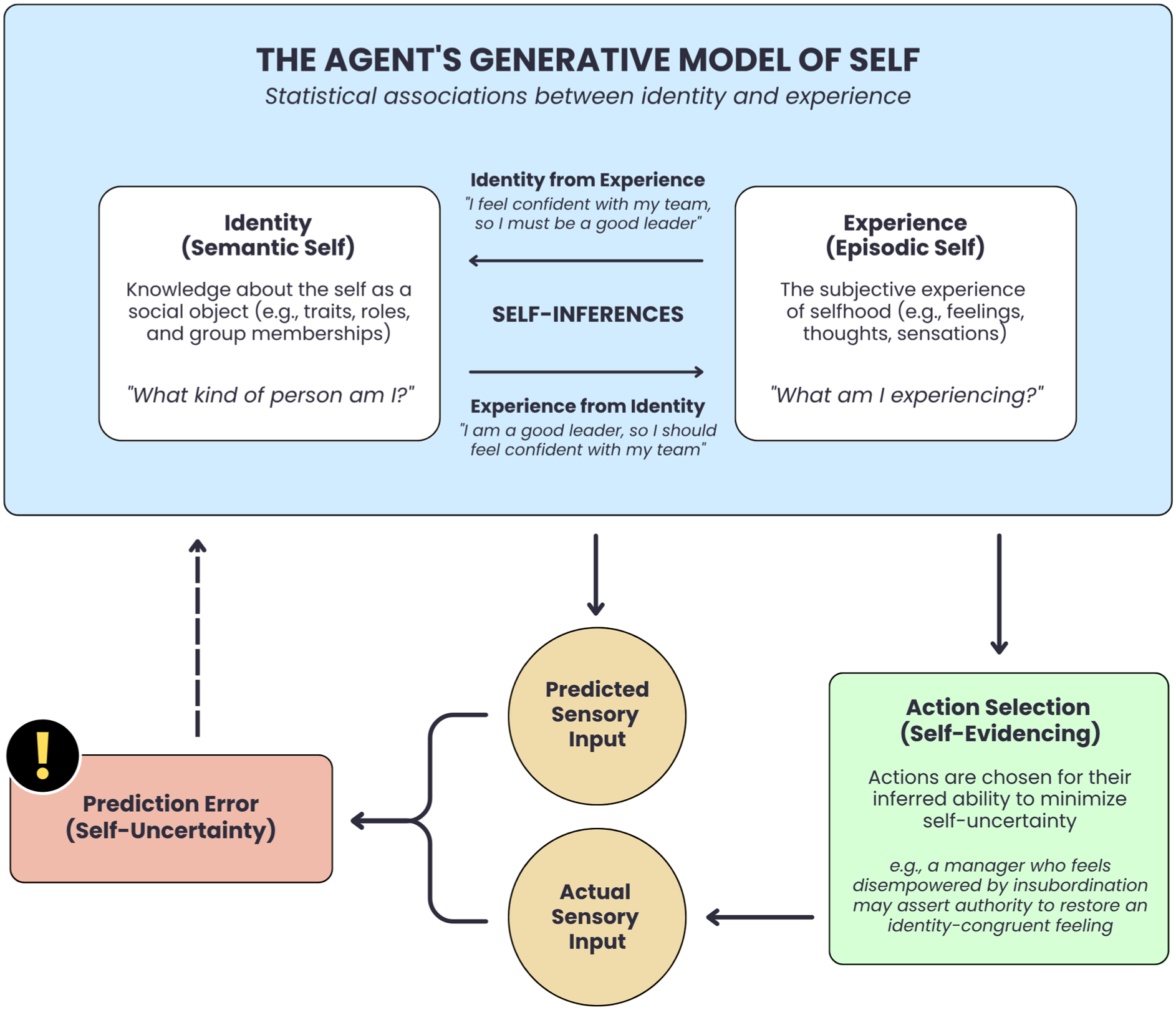
The game of self: A schematic overview.
Hierarchical Self-Inference Across Temporal Abstraction
Although the present framework emphasizes a bidirectional inferential loop between episodic experience and semantic identity, this loop is naturally realized within a hierarchical generative model of the self. Episodic self-representations can be understood as relatively fast-changing inferences about the contents of experience (e.g., perceptual construal, affect, and interoceptive state), whereas semantic self-representations encode slower-changing beliefs that summarize regularities across episodes (e.g., traits, roles, and identity categories). In hierarchical terms, semantic self-beliefs provide higher-level constraints that shape how sensory evidence is experienced, while episodic prediction errors provide evidence that can gradually update semantic self-descriptions over time.
This hierarchical framing clarifies how the same inferential architecture supports both directions of the statistical loop. In one direction, agents infer which semantic self-categories best explain their current and recent episodes. In the other direction, agents use semantic self-beliefs to infer their most likely experiences in a given situation. Episodic and semantic selves, although dissociable, function as adjacent levels of a single generative model that exchanges constraints and errors across timescales and representational domains.
Inferring Identity from Experience
An active inference approach to identity is aimed toward answering the question, “Who am I?” or “What kind of person do I seem to be?” While the answer to this question may seem obvious to some, the fact that identity cannot be directly observed implies that it must be inferred amidst uncertainty (Rigoli, 2025). In Jamesian terms, inferences must be made about the “Me,” or objective self, based on the available information, updating these self-images in response to sensory feedback. Framed another way, the challenge of identity inference is the challenge of applying available semantic frameworks to the self—determining which identity categories most likely apply to one’s characteristics.
Conceptualizing identity as a form of Bayesian inference involves treating the relative “activation” of a given identity category as the probability that it currently applies to the self. The prior probability of these identities reflects their strength or baseline accessibility before entering into a situation (Turner et al., 1987), while the posterior probability captures any changes in identity activation as a result of that situation (Moutoussis et al., 2014). For example, a person may have an almost 100% prior probability of their demographic identity category memberships (e.g., sex, race, age), based on a lifetime of repeated exposure that doesn’t change much from moment to moment (Fiske & Neuberg, 1990). Other identities may be less clear and accordingly have lower associated prior expectations. For example, a young professor who feels a sense of imposter syndrome may adopt only a 55% prior probability for the validity of their professorial identity (Bravata et al., 2020). Upon receiving positive feedback from colleagues, mentors, and students, the strength of this identity could increase to a 65% posterior probability, evolving with experience over time. A Bayesian approach would thus define a given person’s situationally-informed identity activation as a vector of posterior probabilities over the set of possible identity categories represented in their social cognitive model.
Transforming prior identities into posterior identities involves combining them with the likelihood function, which reflects the agent’s subjective probability that the current sensory input would occur if a given identity were in fact true. These likelihoods are derived from a generative model of the self, as described above, which tracks the expected associations between episodic events and the semantic description of agents who experience those events. For example, an agent may have learned that someone with a leader identity is highly likely to feel confident and empowered when speaking with their team (Offermann et al., 1994). The stronger this expectation, the higher the likelihood value assigned to the belief that a leader should feel confident.
Suppose that a junior manager enters into a team meeting with a prior probability of their leader identity being 90%, only to find that a subordinate acts in a way that undermines their authority, producing feelings of disempowerment and low confidence. If their generative model predicts only a 5% likelihood that a true leader would experience these feelings and a 60% likelihood that a non-leader would experience these feelings, they will be felt as identity-incongruent and therefore identity threatening (Wu et al., 2023). Following Bayes’ theorem, we can multiply the prior probability with the likelihood to obtain the joint probability that both the identity and experience are true (i.e., there is a 4.5% chance that the agent has the identity of a leader, while still feeling disempowered). A traditional Bayesian analysis would then divide this amount by the marginal probability, which is the probability of feeling disempowered across both leader and non-leader identities. In the case of binary outcomes (i.e., holding an identity or not holding an identity), the marginal probability is fairly easy to calculate as the sum of the joint probabilities of feeling disempowered while being a leader (.05 × .90 = .045) and feeling disempowered while being a non-leader (.60 × .10 = .06), leading to a 10.5% chance of feeling disempowered regardless of one’s leader status. Dividing the joint probability of feeling disempowered while being a leader (.045) by the marginal probability of disempowerment feelings (.105) yields the posterior probability of being a leader given one’s feeling of disempowerment (42.9%). The experience of insubordination thus had a strong impact on the manager’s leader identity, reducing it from a 90% subjective probability of being a leader to a 42.9% subjective probability of being a leader. A variational Bayesian approach, as employed in active inference, would arrive at a similar conclusion, but would do so by approximating the posterior distribution that minimizes variational free energy instead of calculating it directly with the marginal likelihood (Fox & Roberts, 2012).
It should be noted that the Bayesian updating just described reflects only one half of the active inference process, focusing on the updating of perceptual beliefs in light of sensory evidence. In this case, the uncertainty around the self is reduced entirely at a perceptual level, such that identity beliefs are altered to conform with sensory data (i.e., “I am feeling disempowered, so I must not be a leader”). An alternative approach is to alter the data itself, taking actions to restore the experiential states that were predicted based on one’s leader identity. In particular, action selection is guided by the attempt to minimize expected free energy, which means taking behavioral steps to eliminate any identity-incongruent experiences. For example, the young manager may act to assert their authority by reprimanding the insubordinate employee, thereby restoring their own experiential state to the identity-congruent feeling of empowerment.
While the example above focuses on a role-based identity (being a leader), the same framework extends to social or personal identities. For example, an individual may identify with having high levels of trait intellect and would use this prior identity prediction when entering into new situations. Their generative self-model would specify the episodic experiences that are most likely to be felt by someone with high intellect (e.g., apparent ease in cognitive processing and comprehension). Episodic experiences could then either support or contradict pre-existing personal identity beliefs (e.g., having trouble understanding a complex argument would function as contradictory evidence for one’s identity). Personal identity is then updated through Bayesian learning, combining prior beliefs with the identity implications of a given experience (e.g., “maybe I’m not as smart as I thought”). Finally, actions are taken to minimize self-uncertainty, maximizing evidence about one’s identity status (e.g., engaging in another cognitive challenge or seeking out downward social comparisons).
Active inference’s emphasis on choosing behaviors that maximize self-evidence, or the validity of one’s model, is particularly relevant to identity formation. It implies that almost every action is implicitly aimed at confirming one’s identity. Choosing the action that minimizes expected free energy in this context is equivalent to choosing the action that has the strongest association with one’s prior identity beliefs. Active inference thus imbues prior identity beliefs with an inherent desire for conformity, such that the agent will strive to conform to the expectations of their self-image. This is consistent with the notion of self-stereotyping in the social identity literature, where self-categorization into a particular identity category induces normative pressure to conform to group stereotypes (Van Veelen et al., 2016). In both cases, the experience of personal uncertainty motivates conformity to a particular identity prototype (Hogg, 2000; McGregor et al., 2001). Active inference provides more process detail, however, as it frames identity conformity as an inference problem of finding the behaviors (and personality states) that are most likely to convey one’s identity status.
Self-regulation toward identity-congruent outcomes naturally follows from the encoding of identity norms into behavioral priors (Oyserman, 2007). In active inference terms, these can be expressed as context-conditioned priors over policies—expectations about the actions that “someone like me” tends to select in similar situations. These prior expectations become the (continuously updated) identity template that the agent attempts to imitate, inferring what someone with that particular identity is most likely to do in each new situation. By representing its own possible self-states, and then making Bayesian predictions about their probabilities, the agent gains the ability to anticipate and shape how its identity is perceived, both internally and socially. This enables a dramatic increase in social organizational complexity, facilitating encultured identity performances aligned with social roles and norms (Albarracin & Poirier, 2022; Burke & Reitzes, 1981). As a result, division of labor becomes possible, along with specialization into various personality profiles (Durkheim, 1893). In short, much of organized society becomes possible only as a result of identity formation in the Game of Self.
It is important to note that a person’s identity is an inherently interpersonal construct (Carr, 2021). As in classic symbolic interactionist models of self and society, the most powerful identity cues are those encountered during social interactions (Carter & Fuller, 2016). Specifically, other people’s reactions to an agent are used to infer how the agent is most likely experienced by them (Baldwin, 1997; Mead, 1934). For this reason, impression management and the strategic presentation of selfhood are essential for navigating social life predictably, as these strategies help to minimize self-uncertainty in the face of social feedback. Accordingly, one’s identity status must be communicated effectively to others in order to elicit the desired social outcomes (Gollwitzer, 1986). The idea that agents constantly infer the best way to express their identities is consistent with dramaturgical approaches to the self, which depict social interaction as a series of identity performances (Goffman, 1959; Hare & Blumberg, 1988). Indeed, an active inference view of identity suggests that agents are quite literally acting as themselves, choosing behaviors that are expected to be most identity-congruent and, therefore, most communicative of their inferred identities.
Inferring Experience from Identity
A hierarchical generative model linking semantic descriptions of selfhood with episodic experiences of selfhood can also be used to perform the reverse inference—namely, the prediction of the most likely experiential state an agent would have in a given situation based on their semantic identity categorization. In Jamesian terms, the basic inference challenge is to guess the most likely state of the “I” (the subjective, experiencing self) from the apparent state of the “Me” (the objective, descriptive self). This reverse inference is functionally important because it allows the contours of an experience to be guided by self-knowledge. Imagine, for example, that someone attends a baseball game and sees the home team score a game-winning grand slam. What is the pragmatic significance of this event for the agent? What is the appropriate emotional and physiological response? To answer these questions effectively, the agent must be aware of their own identity as a fan of the home or away team. Without such information, it is impossible to anticipate how the team’s victory is likely to be perceived and experienced. More generally, inferring the personal significance of most events requires some representation of identity that can be used as a reference point for interpreting and evaluating sensory input (Reynolds & Subasic, 2016; Sui & Humphreys, 2015).
Modeling episodic experience within a Bayesian framework involves assigning prior probabilities to each dimension of experiential variation (Clark, 2018). These dimensions include the full spectrum of possible perceptual states that an agent can adopt (Clark et al., 2019). This includes not only perceptions of the external state of the world (exteroception), but also perceptions of the internal state of the body (interoception). The content of an episodic experience can thus be defined as the sum of all perceptual inferences in a given moment (i.e., “what is happening in the world and in my body?”). Critically, many of these perceptual elements will not be considered relevant to the “gist” or summary of an event’s most defining features (Oliva, 2005). With repeated exposure to similar situations, the brain is able to categorize events more effectively, extracting the core elements that are statistically most predictive of a given type of episode. This categorization of experience parallels the process of semanticization, in which conceptual categories emerge from statistical regularities in experience (Altmann, 2017). Once established, these semantic categories are used to structure perceptual experiences (Hemmer & Persaud, 2014; Tompary & Thompson-Schill, 2021).
Consider, for example, the learning of emotion categories (Barrett, 2017). An agent may experience a distinct pattern of somatosensory activation whenever they fail to achieve a desired outcome, but may not yet have a concept or label to identify or describe those sensations (Hoemann et al., 2020). With exposure to social environments and self-descriptive language, however, they may come to associate their recurring somatosensory feeling with the concept of “frustration.” This semantic labelling and categorization of somatic experience facilitates subsequent episodic inferences, which can now incorporate the feeling of frustration as a stereotyped category of possible experience. Armed with the semantic concept of frustration, the agent can better anticipate the probability of feeling frustrated in response to various situational contingencies (Thornton & Tamir, 2017). Because emotion concepts, like all concepts, must be localized in a semantic network, it becomes possible to associate them with identity categories (e.g., “kids are likely to feel frustrated when they don’t get their way”). The learned associations between identity characteristics and experiential states constitute the generative model for inferring an agent’s most likely experiences based on beliefs about their identity.
This inference of the most likely self-experiences from available self-descriptions is the essence of the mentalizing process involved in theory of mind and perspective-taking (Koster-Hale & Saxe, 2013). The more information we have about a person’s objective self-state (e.g., their bodily posture, social group membership, personality profile, and the situational factors impinging upon them), the more accurate our predictions about their subjective self-state (e.g., their emotional state and perceptual construal of an event). While theory of mind is often framed as inferences about other people’s experiential states, the same mechanisms are implicated in the brain’s construction of its own episodic experience, where self-knowledge is used as the semantic framework for interpreting sensory input.
The impact of self-knowledge on the encoding of experiential states is also evident in the literature on mental time travel and self-projection (Buckner & Carroll, 2007; Schacter et al., 2012). An agent can imagine, for example, what it would feel like in a possible future if their identity status were to change, such as by losing a job, starting a new relationship, or achieving international celebrity. In each case, the most likely experiential consequences are inferred from the hypothetical changes in identity. From a predictive processing perspective, this imaginative simulation is driven by changing the input parameters of a generative self-model (i.e., the identity and situational characteristics) and then simulating the experiential states that are predicted to result.
As an example of this Bayesian process, consider an agent who enters a situation with prior beliefs about their subjective experience (e.g., a 70% prior probability that “I am feeling angry”). Upon encountering a salient social cue that highlights some aspect of their identity, their momentary self-beliefs are altered (e.g., “I am an agreeable person”). Their generative self-model specifies the likelihood of a given identity based on their subjective experience (e.g., a 10% probability of being an agreeable person given the experience of anger, and a 50% probability of being an agreeable person given the absence of anger). The prior experiential probabilities are then multiplied by the likelihood, yielding a joint probability of 7% that the agent feels angry and is also an agreeable person. The marginal probability of this agreeable identity is then calculated as the sum of the joint probabilities of feeling angry while being an agreeable person (.70 × .10 = .07) and not feeling angry while being an agreeable person (.30 × .50 = .15), resulting in a 22% chance of being an agreeable person regardless of their anger levels. The joint probability of feeling angry while being agreeable (7%) can then be divided by the marginal probability of being agreeable regardless of feeling (22%) to obtain the posterior probability of feeling angry given one’s identity as an agreeable person (31.8%). Being reminded of one’s agreeable identity thus leads to a restructuring of experiential inferences, substantially lowering (though not eliminating) the posterior probability of feeling angry from 70% to 31.8%. The agent then takes actions that minimize self-uncertainty, maximizing evidence about their self-experience (e.g., engaging in pro-social interactions). Once again, this example uses exact Bayesian inference, but the variational Bayesian estimates based on minimizing free energy will approximate the same posterior probabilities (Fox & Roberts, 2012).
The inference of episodic experience from semantic identity is particularly interesting given the dynamic nature of self-categorization processes. Specifically, any given self can be categorized across a wide array of identity dimensions, including gender, race, age, personality, religion, occupation, interests, and nationality, among others (Kang & Bodenhausen, 2015). The relative salience of these various identity categories fluctuates continuously with environmental cues, such that, for example, a woman’s gender identity may become salient in a room full of men, while her cultural identity may become salient while traveling abroad (Hong et al., 2000). A large body of research demonstrates that identities can be selectively activated through statistically associated cues, resulting in a continuously fluctuating identity state (Morris et al., 2015). These fluctuations are consistent with the predictive framework presented above, where one’s current identity state emerges from the posterior probability of an ongoing inference process. As identity inferences change from moment to moment, however, an active inference approach to the self suggests that the agent’s episodic experience will also shift with the changing landscape of identity beliefs. In each case, the statistical challenge is inferring the phenomenal experience of selfhood that is most likely given a particular set of identity beliefs.
Balancing Self-Integration: Precision, Conformity, and Authenticity
As outlined in the past two sections, applying a predictive framework to the self suggests that there is an ongoing dialogue between episodic representations of personal experience and semantic representations of personal identity. The basic adaptive challenge for any agent with self-awareness is thus to minimize self-uncertainty by balancing these complementary self-representations, all while maintaining the self within the preferred boundaries of any inherited adaptive priors. Given the complexity of the world, however, experience and identity often fail to converge neatly at any given moment (Hirsh & Kang, 2016). This occurs whenever the agent’s current identity state (its posterior over identity categories) has a low likelihood given its current experiential state (its posterior over experiential contents), or vice versa.
Active inference attempts to minimize these conflicts by guiding agents toward statistically coherent self-representations. Importantly, this move toward self-coherence can involve changes on either side of the predictive equation—identity or experience. An experiential state that conflicts with one’s semantic identity can thus be resolved either through an updated semantic model of the self (changing semantic self-beliefs), or through an updated experiential model of the self (changing episodic self-beliefs). The decision of whether to update the semantic or episodic model will be determined by the relative precision (i.e., the subjective certainty) of their associated beliefs. Some identity categories are applied so frequently and vary so minimally across situations that their associated priors are inferred to possess a high degree of precision. For example, a person who has trained and competed as an athlete for most of their life may have a highly precise identity centered on discipline and physical competence (Miscenko & Day, 2016). If they encounter an ambiguous experience that contradicts this identity—such as a performance setback or an injury that challenges their sense of control—they are likely to take action to align their experiential state with their self-image, perhaps by reframing the situation in terms of resilience or focusing on recovery and future improvement.
In contrast, another person may have a more diffuse sense of identity, marked by low precision (high uncertainty) and a wide range of possible self-images (Campbell et al., 1996). If such a person encounters a surprising but vivid emotional experience, they are more likely to update their semantic self-concept to accommodate it. For instance, someone who has never strongly identified as being an activist might attend a protest, feel deeply moved by the collective energy and sense of purpose, and emerge with a stronger sense of political identity. In the proposed framework, the relative precision among different aspects of identity and experience thus quantitatively guides the balance between changing semantic descriptions of the self and changing perceptual encoding of episodic experience. In practical terms, the model implies that agents “should” revise their trait-level self-concepts when three conditions coincide: (1) experiences repeatedly diverge from identity-based predictions in a systematic direction; (2) those experiences are encoded with high precision (e.g., through unambiguous feedback, strong affect, or social consensus); and (3) the resulting prediction errors generalize across situations rather than remaining tightly bound to a single context. When these conditions hold, maintaining the existing semantic self-concept becomes a worse predictor of future experience than adopting a revised trait model, and active inference favors changing the identity prior over trying to reinterpret self-incongruent experiences.
To illustrate this concept more concretely, consider someone with a well-established identity as a confident public speaker—someone who has given dozens of talks and consistently received positive feedback. This identity has high precision due to repeated reinforcement over time. One day, during a keynote address, they experience an unexpected surge of anxiety—sweaty palms, stumbling over words, a racing heart. This episodic experience is incongruent with their “confident speaker” identity. To reduce this prediction error—the mismatch between their identity and experience—the agent has two basic options. If their identity model is more precise, they are likely to reinterpret the episode as an anomaly (e.g., “I didn’t sleep well last night” or “That lighting was distracting”). This response updates the episodic self-model to preserve a stable identity. Conversely, if the identity is less precise because they’re relatively new to public speaking, they may instead revise their self-concept, concluding, “Maybe I’m not actually a confident speaker,” thereby updating the semantic self-model.
Similarly, the action an agent chooses in each situation is the one that is expected to minimize free energy and most effectively improve statistical prediction. In this context, minimizing the largest amount of expected free energy is equivalent to reducing the largest amount of personal uncertainty in the integrated self-model. When identity uncertainty is highest, an agent will tend to select actions that maximally evidence its identity, in order to reduce uncertainty in the integrated self-model. In the extreme, this looks like total identity conformity, where experiential states are subordinated to the expectations of an idealized identity prototype. In psychodynamic terms, we might say that any emotional experiences that conflict with social expectations will be repressed or silenced (Erdelyi, 2006). When experiential uncertainty is highest, the same inferential logic implies that actions will instead be chosen to maximally evidence one’s experiential state. In the extreme, this looks like the total acceptance of one’s experienced reality, and a rejection of any semantic categories that fail to cohere with this experience. This could be considered a form of authenticity, where inner feelings are embraced as the true reality, and any conflicting identity categories or self-images are abandoned as inaccurate (Sedikides & Schlegel, 2024). In between these two extremes, a dynamic equilibrium is achieved through the alternating elaboration of both forms of self-representation. The result is a constant dialectic of selfhood, integrating semantic and episodic self-representations into a coherent generative model of self that strives to predict its own states.
This continuous interaction between episodic and semantic self-representations is aligned with contemporary models of narrative identity, defined as story-like structures in which people link memories of past events, their present sense of self, and their expectations for the future into a relatively coherent personal life story (McAdams, 2021). On this view, autobiographical reasoning—the practice of drawing explicit connections between particular episodes and more general self-understandings—plays a central role in weaving episodic memories into a coherent sense of self that extends over longer time-scales (Habermas & Bluck, 2000; Lilgendahl & McAdams, 2011; McLean et al., 2007). In the present framework, such autobiographical reasoning can be understood as a form of active self-inference: agents selectively update either their semantic self-model (e.g., “I am a good person”) or their encoding of specific episodes (e.g., construing an ethical transgression as a result of situational factors) so as to minimize self-related prediction error. In doing so, they effectively adjust both the content and precision of higher-level self-related priors. Over time, the repeated application of these updates yields characteristic narrative patterns—such as redemptive versus contamination sequences, or themes of growth versus stagnation—that reflect the higher-level priors governing how new episodes are interpreted and integrated into the life story (Hirsh et al., 2013; McAdams et al., 2004). Major reorientations or “turning points” in these life stories (McLean & Pratt, 2006) can be understood as adaptive strategies for minimizing self-uncertainty in response to high-precision prediction errors.
The same logic applies when an agent’s generative model of the self is used to infer the experiential and semantic self-states of another agent during social interaction. When the inferred experiential state of another agent conflicts with inferences about its identity state, actions will be taken to reduce uncertainty. If the first agent has strongly held beliefs about the second agent’s identity, they will pursue actions that reduce uncertainty about the second agent’s experiential state (e.g., asking “how are you feeling?”). If the evidence for the second agent’s experiential state is highly precise, however, such as following an elaborate emotional display, the semantic categorization of the second agent’s identity is more likely to be updated (e.g., when the semantic content of an identity stereotype changes with conflicting experience; Crisp & Hewstone, 2007). Building a coherent model of selfhood through active inference thus maximally leverages statistical information to infer another agent’s most likely experiential state and most likely identity. Consequently, a generative model of self that is trained on one’s social environment will not only improve the prediction of one’s own self-states but also the prediction of other agents’ self-states.
Nonetheless, the pursuit of self-coherence may be an endless challenge. As the agent experiences new situations in a complex social environment, old identities may become poor predictors of new experiences, and old experiences may become poor predictors of new identities. Combining this temporal perspective with the complexity and scale of episodic and semantic self-models, there is always likely to be some degree of self-uncertainty, but it is the agent’s adaptive imperative to minimize this uncertainty if it wishes to function as an agent at all.
These theoretical claims yield a set of testable hypotheses that can be organized into four broad categories: (1) bidirectional inference hypotheses (identity → experience; experience → identity); (2) uncertainty reduction hypotheses (model updating; action selection); (3) self-projection and simulation hypotheses (future simulation; dynamic identity shifts); and (4) social inference hypotheses (predicting others; reducing social uncertainty). These hypotheses are outlined in Table 1, illustrating how an active inference model of the self generates specific, testable predictions about identity dynamics in real-world contexts. By framing identity as a product of ongoing Bayesian inference—sensitive to both internal experience and external social cues—this framework provides a unified lens for understanding how people interpret, express, and regulate who they are. These mechanisms not only help explain stability and change in personal identity but also offer a generative platform for future empirical research across the social and behavioral sciences.
The Game of Self in Action: Core Hypotheses Linking Identity, Experience, and Inference.
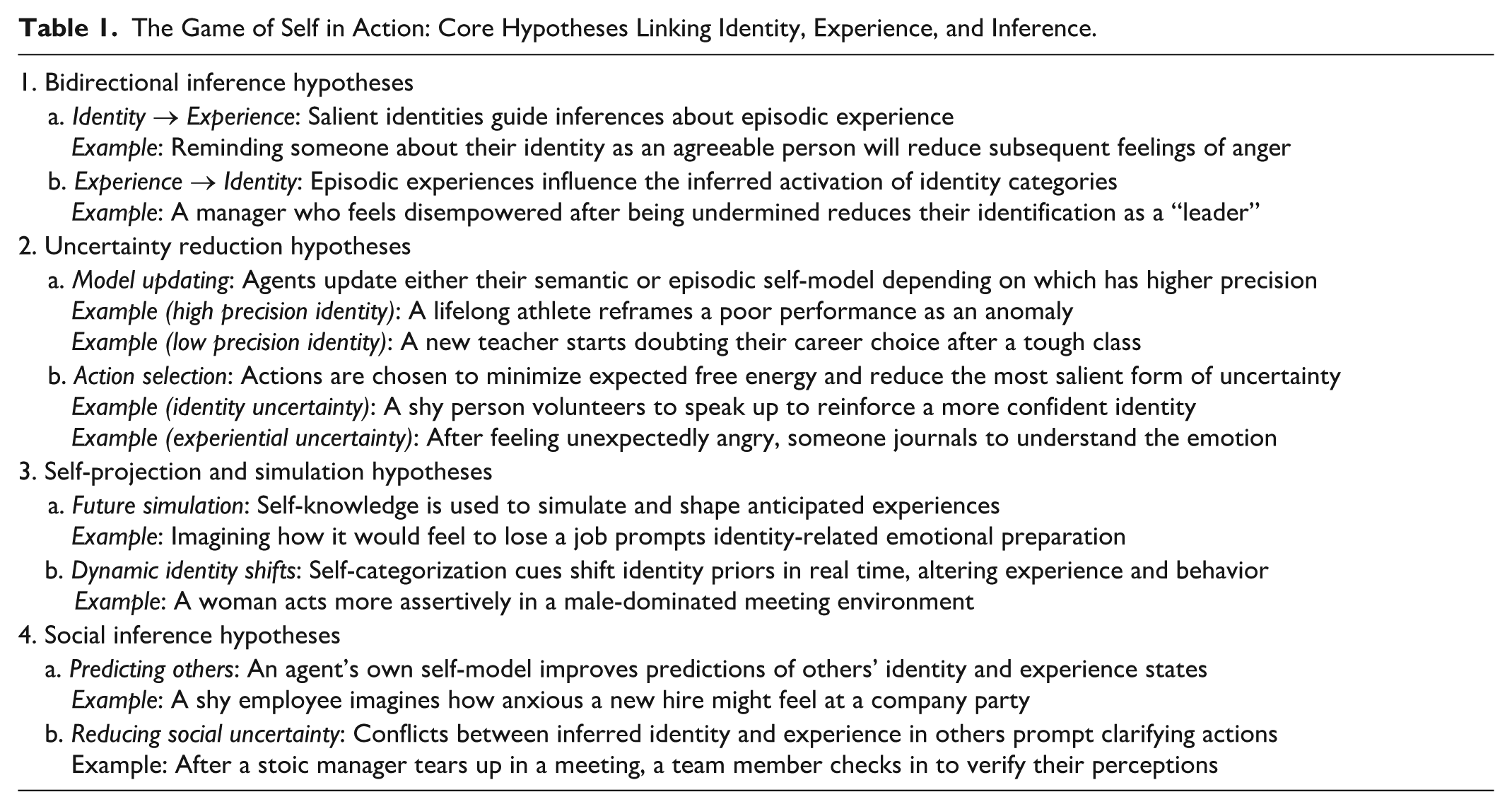
General Discussion
Active inference provides an integrative theoretical approach for modeling an agent’s interactions with the world around it (Parr et al., 2022). Leveraging the analytical framework of variational Bayes, it views perception and behavior as the output of an ongoing inference problem. Effective resolution of these inference problems results in the adaptive coupling of sensorimotor patterns to environmental contingencies, maximizing the chance of keeping the agent within its desired homeostatic range. Conversely, a failure to accurately model and predict sensory input will lead to epistemic and behavioral uncertainty, undermining effective goal pursuit (Hirsh et al., 2012). Statistical learning is thus a necessary strategy in the game of life, with the agent’s continued survival hanging in the balance.
This article outlines a set of core hypotheses about the dynamic relationship between self-identity and experience—both personal and social. It proposes that identity shapes experience and, in turn, experience updates identity, resulting in a continuous loop of bidirectional inference. It also emphasizes the role of uncertainty reduction, suggesting that agents update their self-models or select actions to resolve predictive errors and restore self-concept coherence. The framework further highlights how self-knowledge supports future simulation, and how social cues can dynamically shift identity priors in real time. Finally, it extends these principles to social inference, proposing that the self-model aids in predicting the identity and experiential states of others, particularly when those states conflict.
To survive in a social ecology, a predictive agent must learn to play the Game of Self. Each social interaction becomes an opportunity to infer and manage the aspects of identity that are perceived by others, using shared semantic frameworks to shape self-representation. At the same time, agents rely on those inferred identities to structure their experiential predictions, generating episodic experiences that feel identity-congruent. The resulting cycle of self-inference involves a recursive loop between inferred experiences and identities. As the agent learns to describe itself in new ways, its episodic horizons expand, making room for new categories of experience. These novel experiences, in turn, invite fresh semantic elaboration. The emergence of selfhood over time is reflected in this ongoing dialogue—or computation—of self.
Conceptualizing the self as a dynamic and predictive process governed by the principles of active inference leads to a wide range of methodological and theoretical implications, several of which are outlined below as starting points for future research and application.
Methodological Implications
Viewed through this lens, the active inference framework suggests several concrete directions for empirical work on personality and identity. Rather than proposing a single new measure, it invites a shift in how self-related constructs are operationalized and combined. The discussion below highlights three broad implications: (1) the value of contextualized and distributional assessment of traits and identities; (2) the joint assessment of semantic and episodic self-representations; and (3) the explicit probing of individuals’ generative models, including their temporal dynamics and sensorimotor foundations.
Contextualized and Distributional Assessment of Traits and Identities
Broadly, the present framework suggests that self-related measurement, including the assessment of personality and identity in the self and others, should focus on the key elements of the active inference process: an agent’s generative model and prior expectations. Prior expectations in this context reflect the subjective probability that an identity category or trait characteristic defines the self. These probabilities fluctuate with situational features, allowing different aspects of the self to be felt with more or less precision from one moment to the next. Such expectations operate at multiple hierarchical levels and unfold over both immediate and extended timescales.
While current assessment relies heavily on decontextualized Likert-scale ratings of global traits (Toomela, 2025), a more detailed measurement of the self would involve eliciting self-assessments across a variety of hypothetical experiential episodes. This methodological shift derives from the notion that personality involves context-sensitive priors whose precision varies with situational cues. For example, a person could be asked to rate how they expect their personality state to be in a job interview or while spending time with friends. The result would be a multi-faceted and distributional view of the self across situational contexts, rather than a single aggregate score abstracted from all experience (Fleeson, 2001). Beyond enriching description, repeating self-assessments across scenarios enables the testing of more dynamic hypotheses—for instance, that patterns of within-person context-sensitivity (e.g., how sharply a given trait ramps up or down across situations) may be more useful for predicting adaptation to life transitions than mean trait levels alone.
A closely related methodological implication is the importance of assessing uncertainty or precision around the activation of a given personality state. Although common practice when assessing personality (or social identity) is to have participants endorse a single Likert score, this eliminates the full probability distribution of possible selves that are being considered by the generative model. As a result, it is impossible to know the uncertainty that a person feels around a given self-description without repeated measurement. An alternative to this approach is to adopt a more Bayesian measurement strategy, where participants rate the relative likelihood of each possible response (Douven, 2018). Rather than choosing the single best response option (e.g., 1–5) that describes someone’s agreement with a statement (e.g., “I talk a lot at parties”), the full probability distribution would be measured. For example, someone might rate themselves as having a 20% probability of talking a lot at parties, a 30% probability of being fairly quiet, and a 50% chance of saying nothing at all. By assessing the full range of possible outcomes, the relative precision of different aspects of the self can be directly measured and compared. The present model makes three specific empirical predictions about these distributions: self-aspects with the greatest uncertainty should be (1) the most easily changed through learning, (2) the biggest sources of stress for the self-system, and (3) the most likely targets of deliberate action and attention. Each of these predictions can be tested directly by combining distributional self-ratings with longitudinal assessments of personality change, affective well-being, and motivated behavior.
The same principles apply when inferring the traits or identities of others, such that measurement across real or imagined situational contexts will provide a broader and more nuanced view of person perception dynamics (E. R. Smith & Collins, 2009). This could be particularly relevant to employee evaluation practices that rely on peer-rated trait assessments (Connelly & Ones, 2010), where the model predicts incremental validity from probing specific identity-relevant contexts. Accordingly, greater contextualization of semantic self-identification during assessment should improve predictive validity (Shaffer & Postlethwaite, 2012).
Joint Assessment of Semantic and Episodic Self-Representations
Although many personality assessments rely exclusively on semantic self-representations, the current framework also underscores the value of assessing episodic self-representations to truly understand a person’s selfhood (McAdams, 1995). Indeed, the semantic self of abstracted personality traits or other self-descriptions is only half of the necessary duality of self. Assessing an agent’s lived episodic experience is best done through self-produced narratives, where the agent has the opportunity to semanticize its episodic experience through shared reflection. This sharing of the self-narrative with others is particularly important, as it is only through communication that the self can be co-represented in a shared meaning system that guides social interaction (McLean, 2008).
While this qualitative assessment of self-experience is inherently valuable as an expression of selfhood in its own right, it may also have useful predictive elements. For example, the self-coherence of one’s personal narrative is predictive of their well-being (Adler et al., 2016; Waters & Fivush, 2015). Other analytic approaches to narrative assessment are likely to yield a broad variety of statistical relationships. While semantic self-assessments have a long history and many useful applications, algorithmic approaches to narrative content may significantly enhance their capacity for predicting self-related outcomes (Yeung et al., 2022). Within the present framework, such narrative indicators can be interpreted as indirect measures of parameters in the generative self-model—for example, coherence as evidence for a particular configuration of high-level priors, thematic patterns as summaries of which identity-related hypotheses are most strongly endorsed, and redemptive or contamination sequences as reflections of expectations about how negative states typically resolve. Quantitative narrative analyses thus provide a natural complement to trait questionnaires by probing the structure and precision of life-story priors rather than only their point-estimate summaries.
Probing Generative Models, Temporal Dynamics, and Sensorimotor Foundations
An active inference view of selfhood highlights the importance of assessing an individual’s internal generative model of the self. This model reflects the continuously updated associations between episodic elements and semantic categories. Anchoring semantic self-assessments to episodic scenarios, as suggested above, provides a window into an agent’s generative model. For example, prompting someone to imagine themselves in a high-stakes job interview—versus at a casual dinner with friends—will activate distinct episodic simulations, leading to different self-ratings on traits like assertiveness or agreeableness. These shifting responses reveal the statistical associations embedded in the individual’s generative model of self. The specific traits that change from one imagined context to the next can be used to define the pragmatic contours of an agent’s situational categories, along with the self-states that are predicted to emerge. This, in turn, may help to identify where a given person’s self-related prediction errors are most likely to originate.
This framework offers a compelling empirical strategy for uncovering the structure of the generative self-model. Specifically, it suggests that changes in state personality can be used as indicators of how semantic identity cues are encoded and used within episodic contexts. Researchers could probe this idea experimentally by manipulating the salience of semantic self-representations (e.g., personality feedback, contextual cuing, changes in imagined audiences). Observing how someone’s experiential state (e.g., their affective or personality state) changes in response to these identity manipulations implicitly reveals the structure of the generative model. It can thus be used to measure group attitudes and identity stereotypes, where changes in personality state following real or imagined interactions with a member of a given identity category reflect predictive stereotypes. Similarly, relational dynamics may be usefully modelled as the change in personality states that each partner causes in the other through a shared tuning of self-expectations (cf. Neyer et al., 2014).
More broadly, this predictive framework suggests that repeated assessments of identity and personality states across time and context can be especially informative. Since the self is continually updated through recursive inference, studying the temporal dynamics of these inferences is likely to yield several insights. Experience sampling methodologies are particularly well-suited to studying changes in selfhood over time, as they allow repeated self-assessments throughout a person’s daily life (Conner et al., 2009). Combining these methods with computational approaches to personality and identity change is a promising avenue for future research (Kuper et al., 2021). For instance, tracking shifts in identity precision or self-related affect across settings (e.g., home, work, social contexts) can reveal how the generative self-model adapts in real time. If the temporal patterns in an agent’s self-related expectations and generative model of selfhood can be modelled accurately, it would be easier to forecast the evolution of the self across different experiential scenarios.
At the same time, it should be emphasized that the present framework does not require personality assessment to become intractably complex or to sample every conceivable situation. The goal of situationally tailored measurement is not exhaustive coverage, but the strategic use of a modest set of informative contexts—whether imagined scenarios, narrative prompts, or a small number of everyday episodes—as probes on the underlying generative model. For example, a study could present participants with 8 to 10 carefully chosen scenarios (e.g., evaluative vs. affiliative, rewarding vs. threatening, etc.) and ask them to provide distributional ratings of their expected personality states. What these designs add over traditional trait measures is more detailed information about how trait-relevant expectations are tuned to specific classes of situations (e.g., work settings vs. close relationships) and how identity cues shape state personality expression. In this sense, the methodological implication is a shift in emphasis—from treating situations as nuisance variance to treating them as structured inputs that can reveal the person-specific contours of the self-model.
Finally, the active inference approach raises an additional question that can be asked of any given agent: What sensory patterns does it treat as valid indicators of the current episodic or semantic state of the self? The self-inferences that an agent makes must ultimately be grounded in the configuration of its Markov blanket (i.e., the content of its sensory and active states). Part of an agent’s generative model is the association between sensory content and the self-related inferences that it affords. Mapping self-related concepts in terms of their sensorimotor instantiation will provide a more nuanced understanding of an agent’s perception of selfhood. For example, one could examine the cues that an agent uses to infer conscientiousness (or any other semantic self-description) in the self or others (Jackson et al., 2010). Similarly, researchers could examine the episodic content that best defines the subjective feeling of being extraverted, or of belonging to a given identity category. In other words, the current model highlights the importance of assessing an agent’s implicit personality theory (Borkenau, 1992)—the internal structure it uses to represent character traits. While some cues will be shared across agents living in a common cultural context, the idiosyncratic nature of self-inference suggests that each agent will have its own unique framework for perceiving and enacting selfhood (as depicted in its generative model). Knowing the sensorimotor foundations of this model enables a more accurate prediction of the inferences an agent will make in a given situational context.
Theoretical Implications
On a theoretical level, situating episodic and semantic self-representation within an active inference framework lays the foundation for a broader integration of self-related processes across neural and behavioral domains. By framing the self as a hierarchical generative model governed by the Free Energy Principle—which demonstrates mathematically that biological systems must minimize uncertainty to remain viable (Friston, 2009)—the present account treats many familiar constructs in personality and self-research (e.g., traits, motives, narratives, identities) as different parameterizations of the same underlying inferential architecture. In this sense, variational Bayesian inference is not only a flexible modeling tool but a shared computational language in which disparate theories of the self can be expressed, compared, and combined. Grounding psychological processes in the logic of statistical prediction and uncertainty minimization links phenomena as diverse as perception, decision-making, personality, and social identity within a single set of equations, rather than a loose family of metaphors. This scaffolding supports theoretical convergence across psychological subfields and, crucially, promotes the development of mechanistic models that yield precise, quantitative predictions about identity dynamics, advancing the pursuit of a unified behavioral science (Parr et al., 2022).
In this context, the predictive model of the self provides an integrative framework for conceptualizing a variety of self-related research topics. The study of personal and social identity, self-concept formation, self-assessment of personality traits, and self-perception more broadly are all brought together within a model of active self-inference rather than being treated as parallel literatures. This framework likewise accommodates the dynamics of person perception and the use of stereotyped group expectations in social cognition, by viewing these as inferences about others’ likely self-states as predicted by one’s generative model. The study of self-regulation is also informed by an active inference approach, as the self-evidencing tendencies of predictive agents naturally lead them to act dynamically in order to maintain prior self-expectations (Hohwy, 2016). The decision about whether to engage self-control in a given context can likewise be construed as a behavioral inference with varying degrees of precision (Berkman et al., 2017; Pezzulo et al., 2018). Even interpersonal relationships can be viewed as involving inferences about the appropriate persona to adopt during interaction, with attachment insecurity marked by low precision inferences about the social bond (Niehuis et al., 2016). Evaluative preferences—such as attitudes, moral beliefs, and values—can be understood not only as outputs of a self-inferential process, but also as stabilizing constraints within the generative model of the self. Anchored in prior expectations and continuously updated through sensory input, these preferences guide behavior and shape how the agent interprets new experiences. This reconceptualization yields novel empirical predictions—for instance, that experimentally perturbing identity-related priors (e.g., via feedback, role assignments, or cultural primes) should simultaneously shift self-regulation, person perception, and social identification in coordinated ways, because all are implemented within the same generative architecture.
The present framework aligns in many respects with ideas from Neo-Socioanalytic Theory and the TESSERA framework, which offer powerful accounts of personality continuity and change across the life course (Roberts & Nickel, 2017; Roberts & Wood, 2006). Neo-Socioanalytic Theory maps the major units of personality (traits, motives, abilities, narratives) and emphasizes how personality is maintained or changed through trait-consistent patterns of experience over time. Specifically, it outlines how patterns of cumulative continuity (traits getting more stable with time) and corresponsive development (traits being reinforced by trait-congruent experiences) can emerge through social investment and niche-picking. The TESSERA framework, in turn, zooms in on short-term processes, describing how repeated sequences of triggering situations, expectancies, state expressions, and reactions can, under the right conditions, accumulate into lasting personality change (Wrzus & Roberts, 2017).
What the Game of Self framework adds is a single, explicitly generative architecture in which traits, motives, states, roles, and narratives are all cast as priors and likelihood mappings operating at different temporal and hierarchical scales. In doing so, it offers a computational instantiation of several principles articulated in these frameworks, enabling simulation and more precise, testable predictions about when repeated state patterns should accumulate into durable changes in trait self-concepts. The framework thus offers a formal process account that can be used to model and forecast the developmental trajectories implied by Neo-Socioanalytic and TESSERA-style descriptions. From an active inference perspective, traits correspond to relatively stable priors about one’s own typical states and behaviors, while state expressions and self-reflective reactions correspond to posterior inferences updated in response to the prediction errors generated by TESSERA-like episodes. This mapping allows factors that are only implicit in Neo-Socioanalytic and TESSERA accounts—such as the relative precision of trait beliefs, situational feedback, and identity commitments—to be treated as formal parameters that determine whether incongruent self-experiences will be assimilated to existing self-beliefs or trigger genuine changes in self-perception.
In formal terms, a trait-level update becomes warranted when, given an agent’s history of prediction errors, the long-term expected free energy is lower under a revised self-description than under continued reinterpretation of self-discrepant events (i.e., it better explains and predicts the ongoing pattern of experience). In such cases, clinging to the old self-concept would generate more cumulative prediction error than adopting a better calibrated one. The same inferential logic explains not only why people select and shape environments that confirm who they already take themselves to be but also when they will deliberately sample disconfirming contexts (e.g., during identity exploration) to reduce uncertainty about possible future selves. These additional commitments distinguish the present model from existing frameworks by specifying, in principle, which combinations of trait precision, feedback structure, and identity investment should produce stability versus change. On this view, the processes emphasized in Neo-Socioanalytic and TESSERA—such as cumulative continuity, corresponsive development, niche-picking, and plasticity—can be understood as outcomes of a single inferential mechanism. Framing these dynamics in terms of active inference provides a computational account of why the same environmental regularities should sometimes stabilize and sometimes transform the self, depending on the structure of the evidence and the precision of the relevant priors. As a result, the framework yields more precise, testable predictions about the conditions under which life experiences will reshape identity.
It has been observed, for example, that transitions into full-time employment are associated with systematic increases in traits like conscientiousness (Bühler et al., 2024; Roberts et al., 2008), whereas many retirement transitions are less uniform and more heterogeneous. From an active inference perspective, these life transitions differ in whether they generate prediction errors that are repeated and systematic, encoded with high precision, and generalized across situations rather than being context-bound. More highly structured roles—such as the transition into full-time employment—supply dense, repeated feedback about reliability, timeliness, and self-control. By contrast, many retirement transitions are less tightly scripted and more heterogeneous, providing weaker and more variable prediction errors about obligation and performance, and thus less uniform pressure to revise trait beliefs. Constructs such as the scriptedness and normativeness of a role transition (Neyer et al., 2014) can be understood here as describing the strength, structure, and sharedness of the priors attached to particular roles. Importantly, this formulation predicts not only differences in mean-level trait change, but also differences in the certainty (precision) of trait self-beliefs—highly scripted transitions should yield faster reductions in uncertainty and more uniform updating than loosely scripted transitions.
An active inference approach to selfhood also offers a principled way to connect trait, motivational, and narrative approaches to personality (McAdams et al., 2004). In McAdams’ three-level (actor–agent–author) framework, personality can be described at multiple layers: dispositional traits (actor), characteristic adaptations, such as goals and personal projects (agent), and narrative identity as reflected in a life story (McAdams, 2021; McAdams & Pals, 2006). From an active inference perspective, these domains can be interpreted as complementary aspects of a single self-model operating over different timescales: trait representations summarize regularities in how a person tends to think, feel, and behave; characteristic adaptations organize context-sensitive striving and role-based patterns across sequences of episodes; and narrative identity integrates autobiographical episodes into a coherent account of how the self has developed across longer life chapters. In this hierarchical view, self-narratives function as high-level beliefs that guide how new episodes are interpreted and encoded in memory, while remaining open to revision when prediction errors recur across episodes (Bouizegarene et al., 2024).
Autobiographical reasoning can be viewed as a key mechanism through which people update their semantic self-model and/or re-interpret specific episodes in ways that reduce persistent self-related prediction error (Habermas, 2011; Lilgendahl & McAdams, 2011; McLean et al., 2007; McLean & Fournier, 2008; Singer & Bluck, 2001). For example, someone who consistently interprets past setbacks through a “resilient” identity lens may build a coherent personal narrative of overcoming adversity that buffers them against hardship (Ramasubramanian et al., 2022). A person with a more fragile or uncertain identity, however, might construct a disjointed or self-critical narrative in response to similar events and may find it harder to sustain personal growth (Harrison et al., 2025; McAdams, 2013; Miller et al., 2022). Because narrative identity is treated here as a set of high-level priors over life trajectories (Bouizegarene et al., 2024), this framework implies new hypotheses—for instance, that interventions that selectively reduce the precision of self-critical storylines (e.g., through counterfactual simulations or alternative narrative framings) should make it easier for agents to adopt redemptive or growth-oriented interpretations of future events.
More concretely, these priors specify expectations about typical life trajectories—for example, whether adverse events are more likely to culminate in growth or in further decline—and about which roles one is most likely to occupy across contexts. Beyond changing the content of these priors, autobiographical reasoning also functions to tune their precision: rigid, overconfident narratives resist updating in the face of disconfirming episodes, whereas more flexible narratives entertain a wider range of possible future trajectories. In this framing, narrative coherence corresponds analogously to model evidence for a given life story—how well a particular configuration of high-level beliefs compresses and anticipates a wide array of episodic outcomes while minimizing residual “surprise.” Both insufficient and excessive coherence may therefore be problematic, reflecting underfit (fragmented, low-evidence stories) or overfit (overly rigid stories that exclude important aspects of experience) at the narrative level.
The same formalism also highlights the social and cultural embedding of narrative identity. Because generative models become coupled across agents through social interactions, personal life stories are developed and maintained in continuous dialogue with shared cultural narratives, institutional scripts, and the expectations of significant others (Albarracin et al., 2022; Constant et al., 2019; McLean & Syed, 2016; Veissière et al., 2020). On this view, people do not merely recount stories after the fact; they selectively sample environments, relationships, and projects that carry high epistemic value for key self-relevant hypotheses, effectively “testing” alternative identity commitments over time. Difficulties in narrative change can then be understood as reflecting the high precision typically assigned to entrenched life-story priors, the extensive body of past experience that appears to support them, and the potential desynchronization from valued communities that a revised narrative might entail (McLean, 2024). An explicit treatment of these processes within an active inference framework may help to clarify why some identities remain rigid in the face of counterevidence, why others reorganize rapidly during developmental or transitional periods, and how interventions that shift narrative priors or their precision could support more adaptive patterns of selfhood.
The present model also integrates well with the theory of mind as a form of mental state inference (Koster-Hale & Saxe, 2013). Empathy and perspective-taking can be reframed as the process of inferring an agent’s episodic state from the available identity cues. Critically, the inferences that an agent makes about the experiences of other agents will depend on its own generative model of selfhood. This is consistent with simulation-based models of perspective-taking, in which agents use their own episodic experience as a platform for imagining the experiences of others (Keysers & Gazzola, 2007). In the present view, this simulation involves inferring the most likely experiential state associated with a given target’s apparent identity state.
Framing the self as a predictive process also reshapes how psychopathology can be conceptualized. Specifically, active inference proposes that all agents are pursuing the same basic goal of minimizing variational free energy. Understanding psychopathology within this framework involves identifying the maladaptive priors that generate harmful or rigid self-predictions (Badcock & Davey, 2024). For example, personality disorders have been conceptualized as resulting from extreme personality scores that limit behavioral flexibility (Monaghan & Bizumic, 2023). In the present context, these can be viewed as highly precise self-inferences that minimize or prevent adaptive variation across circumstances (Sterna et al., 2024). Similarly, a maladaptive generative model, such as believing that even the smallest mistakes are indicative of moral failure, could lead to harmful inferences that unnecessarily disrupt well-being (Hubatka & Řiháček, 2025).
Finally, viewing selfhood through the lens of active inference has theoretical implications for understanding broader cultural processes as emergent properties of many different agents (Veissière et al., 2020). On the one hand, cultural practices can be viewed as providing a common ground for prior expectations, such that agents who participate in a cultural environment will tend to converge on shared episodic and semantic frameworks for categorizing experience and identity (Shteynberg et al., 2020). At the same time, each agent’s idiosyncratic generative model will result in a slightly different construal of identity norms. This allows for both cultural stability and creativity, as each agent enacts what it believes to be the most identity-congruent behaviors available. Inferences about collective identity and experience (Shteynberg et al., 2022), along with their behavioral implications, can thus be modelled using the same Bayesian principles that govern individual self-inference.
In sum, while active inference provides a general theory of adaptive behavior, its application to selfhood offers especially fertile ground for integration across psychological levels of explanation. By framing the self as a generative model that links semantic identity to episodic experience, this approach captures how self-representations are inferred, enacted, and revised across time and context. In doing so, it unifies a wide range of research traditions—spanning personality, motivation, narrative, social identity, and culture—within a single predictive framework. The model not only explains how the self is shaped by expectation and experience but also how it evolves through development, relationships, and collective life. In this way, a predictive model of self contributes meaningfully to the larger goal of a unified behavioral science—one that integrates the richness of human experience with the rigor of computational explanation.
Constraints on Generality Statement
The Game of Self framework emphasizes each individual agent as the epistemic center of a Bayesian learning process. This view of the self as the locus of all experience and knowledge emerges from the Western philosophical tradition. Nonetheless, the analytic framework of active inference and Bayesian learning is intended as a culture-general mathematical description of statistical learning for adaptive systems, rather than as a theory of any particular cultural model of personhood. While I argue that the basic process by which self-representations emerge is likely to be widespread or even universal, I recognize that this claim reflects my own standpoint and that it may privilege individualistic conceptions of agency. Scholars working in other cultural and intellectual traditions may see important ways to amend, extend, or qualify the framework so that it better accommodates relational, communal, or non-individual conceptions of selfhood. While there is a focus on the Five Factor Model of personality as an integrative taxonomy of personality states, the framework can function just as well when using more culturally contextualized trait taxonomies and semantic descriptions of selfhood.
Citation Statement
The research cited in this article is drawn from a diverse array of disciplinary perspectives, including personality and social psychology, social and cognitive development, computational neuroscience, statistical analysis, artificial intelligence, and philosophy of mind. Geographically, the cited work was produced by scholars from countries across the globe, including Australia, Austria, Canada, China, Croatia, the Czech Republic, England, France, Germany, Italy, Japan, Romania, Spain, Switzerland, the Netherlands, Ukraine, and the United States. The cited authors themselves, meanwhile, come from an equally diverse range of cultural backgrounds, featuring researchers who are Algerian, American, British, Canadian, Chinese, Croatian, Czech, Dutch, Ewe, Finnish, French, German, Greek, Indian, Italian, Japanese, Pakistani, Portuguese, Romanian, Russian, Spanish, Sri Lankan, Swiss, Ukrainian, and Vietnamese. There is nonetheless a relative lack of citations from regions that are typically under-represented in the personality and cognitive science literatures, including much of Africa, Latin America, South Asia, and parts of East and Southeast Asia.
Positionality Statement
As a social and personality psychologist with an interest in linking human experience to underlying neural and cognitive mechanisms, I have approached the topic of self-representation from a process perspective. As a result, I am less focused on the details of any particular identity, placing more emphasis on the general dynamics by which self-representations are inferred. My interest in integrative theoretical modeling, combined with the belief that the richness of human experience can be usefully analyzed scientifically, has drawn me toward the active inference framework as a platform for understanding the self. These commitments reflect my training and institutional context within a trait- and mechanism-focused wing of the field, and they are not neutral: they make me especially attentive to questions about prediction, uncertainty, and system dynamics, and less attuned—at least in this article—to historically situated aspects of identity.
Critically, although I seek to discover shared patterns in human experience, I do not approach the self from a reductionistic perspective. The formalisms of active inference provide a useful explanatory framework for describing changing patterns of self-representation over time; they do not, however, capture the particular content of any person’s lived experience or identity, nor do they exhaust the ways different cultures may conceive of persons and selves. Despite being governed by statistical mechanics, the self thus remains open-ended, with all of its creativity and complexity left to discover and define. It is this balance between mechanistic universalism and idiographic, culturally-situated possibility that I find most appealing about the framework.
Conclusion
Nearly 300 years ago, David Hume introduced his skeptical critique of the self, rejecting the notion of a permanent and unchanging identity (Hume, 1739). In its place, he saw only a constant flux of sensory impressions and ideas that were loosely bound together in memory. He nonetheless viewed the self as a necessary illusion, providing a cognitive framework for interpreting experience and enabling social interaction. An active inference approach to selfhood embraces this critique, detailing the mechanisms by which self-representations are inferred from a generative model, enacted through behavioral self-evidencing, and updated through Bayesian learning. While the experiences and identities that result from this inferential process may be transient, context-bound, and at times incoherent, they nonetheless provide the essential foundation of a social agent’s epistemic structure. Even if the Game of Self is nothing more than a sophisticated guessing game, it is nonetheless one of our most powerful tools for navigating an uncertain world, shaping how we learn, connect, and make sense of who we are.
Footnotes

Funding
The author received no financial support for the research, authorship, and/or publication of this article.
Declaration of Conflicting Interests
The author declared no potential conflicts of interest with respect to the research, authorship, and/or publication of this article.