



Abstract
Victims commonly respond to experienced wrongdoing by punishing or forgiving the transgressor. While much research has looked at predictors and immediate consequences of these post-transgression responses, comparably less research has addressed the conditions under which punishment or forgiveness have positive or negative downstream consequences on the victim–transgressor relationship. Drawing from research on Social Value Orientation (SVO), we argue that both forgiveness and punishment can be rooted in either prosocial (i.e., relationship- or other-oriented), individualistic (i.e., self-oriented), or competitive (i.e., harm-oriented) motives pursued by the victim. Furthermore, we posit that downstream consequences of forgiveness and punishment crucially depend on how the transgressor interprets the victim’s response. The novel motive-attribution framework presented here highlights the importance of alignment between a victim’s motives and a transgressor’s motive attributions underlying post-transgression responses. This framework thus contributes to a better understanding of positive and negative dynamics following post-transgression interactions.
When people feel that they have been victimized at the hands of another individual, they often respond by punishing or by forgiving the transgressor. As the two dominant responses to victimization, much has been written about punishment and forgiveness, accompanied by a large and still growing body of research investigating the antecedents and consequences of these responses. Indeed, the social-psychological literature is rife with original studies, meta-analyses, and reviews about forgiveness and revenge. But despite the breadth of knowledge about when and why individuals punish or forgive, we still lack an understanding of the conditions under which punishment and forgiveness have positive or negative consequences. Psychological research and theory typically understands forgiveness as having positive consequences, and punishment as having negative consequences—but there are stand-out examples that diverge from these general trends, and unfortunately we lack a theoretically grounded organizing framework for understanding when and why various consequences might occur.
In the present article, we present such an integrative framework. We argue that victim post-transgression responses—punishment, forgiveness, withdrawal, and so on—may reflect either prosocial (i.e., relationship- or other-oriented), individualistic (i.e., self-oriented), or competitive (i.e., harm-oriented) motivations: Even negatively characterized responses like punishment may be motivated by prosocial considerations, and even positively characterized responses like forgiveness could reflect an attempt to demean its recipient and/or benefit the self. Centrally, we argue that whether a post-transgression response has positive (e.g., reconciliation) or negative consequences (i.e., conflict escalation) depends not only on the victim’s actual motives but also on the presumed motives to which a transgressor attributes the victim’s response. We advance the idea that such a motive-attribution perspective on punishment and forgiveness can broaden our understanding of post-transgression interactions and their downstream consequences.
Forgiveness and Punishment
Classic texts on forgiveness and punishment 1 have often conceptualized these two victim responses as antagonistic and fundamentally incompatible with each other. For instance, Enright and colleagues have defined forgiveness as “ . . . a willingness to abandon one’s right to resentment, negative judgment, and indifferent behavior toward one who unjustly injures us, while fostering the undeserved qualities of compassion, generosity, and even love toward him or her” (Enright et al., 1998, pp. 46–47). Other scholars define forgiveness as “the reduction in avoidance motivation and revenge motivation following an interpersonal offense” (McCullough et al., 1998, p. 1587); that is, as an intraindividual process in which the victim “ . . . gradually replaces negative emotions (e.g., anger, avoidance, revenge) toward transgressors with positive, other-oriented emotions (e.g., empathy, sympathy, compassion)” (Van Tongeren et al., 2015, p. 48; see also McCullough et al., 1997, 2010; Worthington, 2005). According to this classic and influential perspective, retributive desires denote a state of “unforgiveness,” which must be overcome to proceed toward a state of forgiveness (for a newer, more nuanced conceptualization of forgiveness and punishment, see Strelan, 2018).
In line with the common dichotomous conceptualization, researchers have argued that punishment and forgiveness have fundamentally different downstream consequences. Forgiveness can increase victims’ positive affect and psychological well-being (Bono et al., 2008; Karremans et al., 2003; Riek & Mania, 2012), life satisfaction (van Oyen Witvliet & Luna, 2018), and a sense of meaning in life (Van Tongeren et al., 2015), and it can reduce anxiety, stress, and depression (Larkin et al., 2015). Conversely, withholding forgiveness can result in social backlash toward unforgiving victims (Gromet & Okimoto, 2014). By contrast, the consequences of punishment are often discussed in a less rosy light. Some research suggests that punishing transgressors may be less satisfying than punishers hope it would be (Carlsmith et al., 2008), that angry rumination and persistent revenge fantasies can deteriorate victims’ well-being and life satisfaction (McCullough et al., 2001; Ysseldyk et al., 2007), and that taking revenge can elicit “bittersweet” feelings among avengers (Eadeh et al., 2017), with accompanying feelings of shame and regret (Boon et al., 2011; Yoshimura, 2007).
However, it seems too simplistic to conclude that punishment only makes things worse while forgiveness makes things better. First, research on revenge and punishment suggests that punishing others can be satisfying to the extent that the transgressor understands the message implied in a punitive response (Funk et al., 2014; Gollwitzer & Denzler, 2009; Gollwitzer et al., 2011, 2014); it can increase victims’ self-esteem (Zdaniuk & Bobocel, 2012), reestablish a sense of power (Strelan et al., 2017; Twardawski et al., in press), and make victims feel respected by their social group (Okimoto & Wenzel, 2010). Interpersonally, punishment can reaffirm shared values violated by the offense, offering the offender the opportunity to show penance and reestablish his or her membership in the moral community (Okimoto et al., 2012; Okimoto & Wenzel, 2009). Building on these findings, recent research suggests that punishment and forgiveness may actually have similar hedonic benefits for the victim (Strelan et al., 2020): They are both empowering (at least when the offender clearly intended to harm the victim), they both reduce negative affect, and they both improve victims’ well-being. In addition, both responses were positively correlated in an autobiographical recall study (Strelan et al., 2020; Study 2), corroborating the notion that punishment and forgiveness are not irreconcilable opposites, but can rather go hand in hand; and that, in the aftermath of an offense, victims may oscillate between the two responses (McCullough et al., 2003).
Other research suggests that forgiveness can sometimes have adverse consequences. For instance, several studies have shown that victims in marital conflicts became less satisfied with their relationship to the extent that they were more forgiving (McNulty, 2008, 2010, 2011). Forgiveness can also sometimes reduce one’s self-respect (“doormat effect”; Luchies et al., 2010) or lead others to avoid self-righteous forgivers (G. S. Adams et al., 2015). Despite growing evidence that forgiveness does not always produce positive outcomes and punishment does not always produce negative ones, to date there is no overarching theoretical framework explaining these common exceptions.
Forgiveness as a Post-Transgression Response
Experiencing Versus Expressing Forgiveness
To understand when and why forgiveness can sometimes have undesirable consequences, it helps to differentiate between the experience of forgiveness and the expression of forgiveness (see also “emotional” vs. “decisional” forgiveness; Worthington et al., 2007). The experience of forgiveness has been described as a prosocial or benevolent attitude toward the transgressor, a willingness to heal a relationship rather than to hurt it further, and positive emotions toward the transgressor (i.e., compassion, generosity, love; see Enright et al., 1998). This is often captured in the way that forgiveness is measured. The commonly used TRIM scale (“Transgression-Related Interpersonal Motivations” scale; McCullough et al., 1998, 2006) assesses behavioral intentions associated with avoidance, revenge, and benevolence motivation, which align with the underlying attitudes and intentions of the forgiver.
The expression of forgiveness, by contrast, refers to an observable response, the behavior that the victim shows, either directly (for instance, by saying the words “I forgive you”) or—probably more often—indirectly (by nodding one’s head, smiling, or offering a handshake; see D. L. Kelley, 1998; Scobie & Scobie, 1998). Needless to say, there are many different ways of communicating forgiveness (e.g., McCullough, 2008), and the consequences of forgiveness depend strongly on how exactly it is communicated (e.g., Exline & Baumeister, 2000; Waldron & Kelley, 2005) and, as we will discuss in more detail later, how it is perceived and interpreted by the recipient.
Importantly, expressing forgiveness does not necessarily reflect a genuine intent to forgive. Saying “That’s OK” without really meaning it has been coined “pseudo-forgiveness” (Enright, 2001), “hollow forgiveness” (Baumeister et al., 1998) or “selfish forgiveness” (Mooney et al., 2016). Such misalignment between experiencing and expressing forgiveness is not healing at all, it rather makes things worse (e.g., Enright et al., 1989). Supporting this notion, Mooney et al. (2016; Study 3) manipulated the reason for being forgiven in a vignette study and found that selfish forgiveness—the explicit expression of forgiveness, yet for reasons that only benefit the forgiver—reduced transgressors’ willingness to reconcile with the victim.
In a cleverly designed lab study, Kelln and Ellard (1999) provided further evidence for the notion that being forgiven may be an ambiguous experience. Participants arrived at the lab and learned that their task was to interact with an ostensibly complex and expensive piece of technical equipment. Suddenly, the apparatus signaled a technical failure, which, according to the experimenter’s assessment, must have been caused by improper use. Depending on the experimental condition, the experimenter either expressed forgiveness (by saying “don’t worry about it—that’s okay”) or not. Next, the researchers measured participants’ willingness to help the experimenter in a subsequent task as well as their liking for the experiment (and the experimenter). Interestingly, being forgiven increased participants’ willingness to comply with the experimenter’s request for help, but also decreased their liking for the experimenter relative to not being forgiven. In a similar vein, G. S. Adams et al. (2015) showed that, in the absence of perceived wrongdoing, being forgiven made participants want to avoid the forgiver. These findings suggest that being forgiven can sometimes be an unpleasant experience for transgressors, and that reconciliation is not always a guaranteed outcome of forgiveness.
Perceiving Forgiveness
Forgiveness researchers have repeatedly stressed that the mere expression of forgiveness is not doing the job: the forgiver has to mean it; his or her intentions need to be truthfully geared toward healing the relationship (Baumeister et al., 1998; Mooney et al., 2016). However, intentions and motives are internal states; they are not directly observable to outside parties. Thus, when transgressors receive a forgiveness message from the victim, their only information is that message and how it has been communicated. Particularly given the potential for an unexpected mismatch between the offense and the forgiving response, transgressors will likely try to infer motives from the victim’s behavior, searching for cues that help to make accurate inferences (Lind, 2001). This inference is, basically, an attribution process.
Before outlining the social-cognitive dynamics driving this attribution process in detail, we suggest a taxonomy of potential goal-directed victim motives. This taxonomy is drawn from research on Social Value Orientation (SVO)—a concept developed to describe which goals individuals pursue in social interactions (Messick & McClintock, 1968; Van Lange, 1999; Van Lange & Kuhlman, 1994). SVO has been used to explain individual behavior in interdependence situations, that is, situations in which an individual’s outcome depends not only on their own actions and choices but also on the choices that other individuals make (H. H. Kelley & Thibaut, 1978). Post-transgression interactions between victim and transgressor are examples of such interdependence situations: The likelihood that the victim–transgressor relationship either heals or breaks depends not only on victims’ post-transgression actions and choices but also on how transgressors interpret these actions and respond to them (G. S. Adams, 2016; Braun & Gollwitzer, 2016; Martin et al., 2019).
Research on SVO posits a three-category typology of individuals’ orientations in an interdependence situation (see Deutsch, 1960): cooperation, individualism, and competition. Cooperation means maximizing the joint (collective) outcome of all individuals involved in a situation and striving for equality; individualism means maximizing one’s own individual outcome with little or no regard for others’ outcomes; and competition means maximizing the difference between one’s own and others’ payoff, that is, increasing one’s relative advantage over others (Van Lange, 1999).
We believe that this taxonomy is also useful to categorize victims’ motives underlying their post-transgression responses, such as forgiveness. First, forgiveness may reflect an intent to heal the relationship even at the expense of maximizing one’s individual outcome (i.e., sacrificing vengeful desires for the sake of repairing the relationship)—a truly cooperative or prosocial orientation in SVO terms (Van Lange, 1999), also labeled “relationship-oriented,” “other-focused,” or “inclusive” in the forgiveness literature (see Finkel et al., 2002; McCullough, 2008; Strelan, 2018; Strelan et al., 2013). 2
Second, forgiveness may reflect an individualistic orientation, such as trying to evade being sanctioned for violating a forgiveness norm, trying to manage one’s mood, to protect one’s ideal self, to regain social status or a sense of personal control, and so on (Baskin & Enright, 2004; Exline et al., 2003; Strelan & Covic, 2006; Strelan et al., 2013; Takada & Ohbuchi, 2013; Wenzel & Okimoto, 2012; Worthington & Scherer, 2004). Notably, such individualistic or “self-oriented” forgiveness aims at maximizing the victim’s outcomes without taking any consequences for the transgressor into account.
Finally, forgiveness may reflect a competitive orientation: By forgiving, the victim can assume a position of moral superiority, refusing to be drawn to the low moral level of the transgressor (Wenzel & Okimoto, 2012) or making the transgressor feel indebted (Kelln & Ellard, 1999). In intergroup contexts, treating offenders from a low-status outgroup more leniently than ingroup offenders may reflect an ingroup’s strategy to display their generosity and, thus, to cement the status differential between the ingroup and the outgroup (“patronizing leniency”; Braun & Gollwitzer, 2012, 2016). Relatedly, forgiveness may be expressed with the intent to “devaluate the attacker” (Heider, 1958, p. 269), to induce shame and guilt, or to threaten the transgressor’s self-esteem and social status (Exline & Baumeister, 2000). On the surface, such competitive or “harm-oriented” forgiveness may look like a conciliatory gesture, but it is actually nothing more than a subtle form of revenge. This is what Oscar Wilde (1854–1900) meant when he (allegedly) said, “Always forgive your enemies—nothing annoys them so much.” Not surprisingly, only genuine forgiveness is rooted in prosocial motives, while “hollow” or selfish forgiveness (i.e., expressing forgiveness without meaning it) reflects individualistic or competitive motives (Takada & Ohbuchi, 2013; see also Strelan et al., 2013).
Punishment as a Post-Transgression Response
We reasoned that forgiveness may reflect prosocial, individualistic, or competitive motives pursued by the victim. The same is true for punishment. First, punishment may reflect egoistic motives (an individualistic orientation in SVO terms): victims might punish for the sake of reducing negative affect (Bushman et al., 2001 but see Gollwitzer & Bushman, 2012), to regain a sense of power and status (Elshout et al., 2015; Strelan et al., 2014, 2020; Wenzel et al., 2008), to boost their self-esteem (Zdaniuk & Bobocel, 2012), or to fulfill a “culture of honor” norm (Nisbett & Cohen, 1996).
Second, punishment may reflect a competitive orientation (in SVO terms): By punishing the transgressor, victims may simply aim at making the transgressor suffer (e.g., Baumeister et al., 1995; Fitness, 2001; Yoshimura, 2007), in line with the idea that people are intuitive retributivists who punish in accordance with the “eye for an eye” principle (Aharoni & Fridlund, 2012; Carlsmith & Darley, 2008; see also Eder et al., 2020; Gollwitzer et al., 2016). Likewise, punishment may aim at denigrating the transgressor, reducing their status/power, or demonstrating self-righteousness (i.e., “moralistic punishment”; Jordan & Rand, 2020; Kurzban et al., 2007; Nelissen, 2008). Notably, these motives are “competitive” because they do not necessarily imply an orientation toward maximizing one’s own outcomes (as with individualistic motives), but rather an orientation toward minimizing the transgressor’s outcomes and/or maximizing the difference between one’s own and the transgressor’s outcomes.
Third, punishment can also be rooted in prosocial motives, that is, carried out with the goal to benefit and educate the transgressor or to improve their relationship with the victim and within the larger community. For instance, parents may punish for the sake of advancing their child’s moral compass; teachers punish students’ norm violations to establish normative consensus in the classroom (Reyna & Weiner, 2001; Twardawski et al., 2020); and even the criminal justice system claims to punish offenders for the sake of reforming and reintegrating them into the community (e.g., Rothman, 1971). According to Fitness and Peterson (2008), punishment is also the dominant response in marital transgressions, even healthy and durable ones. Research on reactions to interpersonal transgressions outside of close relationships also shows that victims often punish with the intent to reeducate the transgressor and effect a moral change in them (Funk et al., 2014; Miller, 2001) or to reestablish a consensus over violated norms in the community (Duff, 2001; Feinberg, 1965; Okimoto & Wenzel, 2009; Vidmar, 2001; Wenzel et al., 2008; Wenzel & Thielmann, 2006). Finally, the notion of “reintegrative shaming” (Braithwaite, 1989) implies that a punitive response can communicate disapproval of the act while, at the same time, communicate respect for the transgressor: What is punished is the act, not the person. Although reintegrative shaming is usually an element of restorative justice procedures, it can also be an element of retributive procedures (Daly, 2013; Duff, 2003). These examples show that punitive responses can (and, probably, often do) reflect prosocial motives.
Other Post-Transgression Responses
Although the focus of the current article targets punishment and forgiveness, there is a broader range of victim responses to which the trichotomous motive typology can be applied. First, withdrawal, while often implying an absence of punishment or forgiveness, is characterized as a passive reaction and/or avoidance of the transgression and the transgressor (McCullough et al., 1998, 2006). Just like forgiveness and punishment, withdrawal may reflect prosocial motives (by giving the transgressor time to provide an apology, or by giving all parties the time to cool off, i.e., forbearance; see McCullough et al., 2003), individualistic motives (i.e., avoiding the transgressor to reduce or suppress any negative cognition or emotions related to the victimization experience), or competitive motives (e.g., the “silent treatment”; Williams et al., 1998).
Second, moral criticism (such as blaming or confronting the transgressor—without necessarily punishing him or her) can be rooted in any of the three mentioned motives. In the context of restorative procedures, moral criticism may reflect a genuine attempt to repair the relationship (McGeer, 2012; Walker, 2006), which is most likely to be effective when it is delivered in a thoughtful, respectful, nonemotionalized fashion (Malle et al., 2014). However, moral criticism may also reflect an individualistic motive (i.e., demonstrating the blamer’s moral righteousness) or even a competitive motive (i.e., social exclusion; Kurzban & Leary, 2001). Just as punishment, forgiveness, or withdrawal, moral criticism is principally ambiguous with regard to the motives underlying it, which is why moral criticism often exacerbates rather than solves a conflict (Dersley & Wootton, 2000; Laforest, 2002). Third, seeking compensation can also have mixed motives. While conceptualized as self-interested (i.e., individualistic)—that is, instrumental in alleviating the harm done by the transgression (Mullen & Okimoto, 2015)—seeking compensation may also reflect prosocial (i.e., an opportunity for the offender to symbolically “make-up” for the harm done to the victim and/or community; Okimoto, 2008) or competitive motives (e.g., “compensatory retaliation”; Van Prooijen, 2010).
These alternative victim responses are relatively understudied and thus require further research. Nonetheless, the motives underlying such behaviors correspond to the three social value orientations; thus, these varying responses should also be applicable to our proposed integrative framework. In the present article, we focus on punishment and forgiveness—the “big two” post-transgression responses that have received most attention in the literature so far.
Attributing Victim Responses to Underlying Motives
As we argue above, forgiveness and punishment are principally ambiguous with regard to their underlying motives, requiring their recipients to infer these motives from the victim’s behavior and other available contextual cues (Pronin, 2008). Therefore, a transgressor’s interpretation of those behaviors must go through an attribution process as they attempt to infer meaning (i.e., motives, feelings, goals) from the victim’s forgiving or punitive response. From an attribution theory perspective, they go through a process of “attributional identification” (Trope, 1988) where the perceiver attempts to understand and categorize a particular behavior.
Interestingly, despite broad recognition that attribution processes are critical to the assignment of blame and punishment (e.g., Alicke, 2000; Guglielmo & Malle, 2017), the literature has offered limited empirical analysis of how such attributions affect reactions to punishment and forgiveness. This oversight likely stems from the common conceptualization of punishment and forgiveness as unilateral responses from victims to their offenders (e.g., Enright & Human Development Study Group, 1996; Wenzel & Okimoto, 2016); as such, research has not offered explicit investigations to understand subsequent motive attributions made by their recipients (i.e., how they are perceived). Apologies, however, are typically considered to be the first step in a dyadic process (e.g., Tavuchis, 1991); thus, motive inferences have been thoroughly investigated in contexts where transgressors offer an apology to the victim. Just as expressing forgiveness or punishing the transgressor, offering an apology is an ambiguous action: transgressors who apologize may feel truly sorry and remorseful, or they may simply be trying to avoid punishment (see Mu & Bobocel, 2019). A brief review of this work is therefore useful in offering learnings for the current focus on motive attributions in reaction to punishment and forgiveness.
To correctly assess whether or not an apology is sincere, victims take contextual cues (e.g., the exact wording of the apology; nonverbal signals accompanying the apology) into account and weigh the apology against what had actually happened (Takaku, 2001). For instance, victims often perceive an apology as a sincere expression of remorse only if it comes with additional elements, such as an admission of the damage done and an offer to make amends (Bottom et al., 2002; Carlisle et al., 2012; Schmitt et al., 2004). Motive attributions also follow from contextual cues, where an apology is less effective if the offense was particularly morally severe (Ohbuchi et al., 1989) or clearly intentional (Struthers, Eaton, Santelli, et al., 2008). Perceivers’ personality characteristics also play a role: People who are dispositionally suspicious (e.g., high in victim sensitivity; see Gollwitzer et al., 2005) are more likely to attribute an apology offered by their partner to ulterior (i.e., egoistic) motives rather than to genuine remorse, explaining why they are generally less likely to forgive their partner (Gerlach, Agroskin, & Denissen, 2012; Gerlach, Allemand, et al., 2012). Thus, although offering an apology generally increases victims’ willingness to forgive (Fehr et al., 2010), an apology must be perceived as sincere to be accepted. Indeed, perceived insincerity of an apology signals a higher risk of exploitation (Burnette et al., 2012) and is often the strongest predictor of unforgiveness (Schumann, 2012; Wenzel et al., 2017).
We argue that the same psychological mechanism operates in the context of attributing motives underlying victims’ post-transgression responses. Specifically, the extent to which being forgiven or punished paths the way to reconciliation depends on how the transgressor interprets the victim’s post-transgression response. Drawing again on the rich literature on Social Value Orientations, we posit that the trichotomous motive taxonomy introduced earlier to categorize victims’ motives for punishing or forgiving the transgressor—prosocial, individualistic, competitive—can also be used to categorize transgressors’ motive attributions (e.g., Klapwijk & Van Lange, 2009). Moreover, further drawing on established models of attribution and person perception, we specify a variety of influences that might shape those attributions, including features of the response itself, the context in which the events occurred, and preexisting beliefs about why people do the things they do (Trope & Gaunt, 2007).
Motive Attributions for Forgiveness Responses
One criterion for assessing the specific motives underlying a victim’s expression of forgiveness is the appropriateness of this act of forgiveness in the light of what actually happened. For instance, being forgiven for actions that one might consider harmless may evoke feelings of shame, humiliation, and resentment (Exline & Baumeister, 2000; Struthers, Eaton, Shirvani, et al., 2008). More specifically, if people doubt that they actually did anything wrong, they are more likely to attribute a forgiveness response to sinister motives (G. S. Adams et al., 2015). Such sinister attributions may include assumptions such as “S/he only wants to feel morally superior”; “S/he wants to make a favorable impression on others” (i.e., individualistic motives), or “S/he only wants to make me feel bad and guilty”; “This is his or her way of taking revenge against me”; and so on (i.e., competitive motives). And such attributions may be correct: victims who forgive do indeed make a good impression on observers (M. M. Adams, 1991; Di Donato et al., 2014) because expressing forgiveness is more socially accepted than taking revenge (Exline et al., 2003).
Motive attributions also matter in the context of unearned forgiveness. On one hand, transgressors who can be confident that the “injustice gap” has been closed for the victim (possibly via punishment or apology/amends) may be more likely to perceive an expression of forgiveness as sincere and rooted in a prosocial motive. Conversely, being forgiven despite a wide “injustice gap” (with an absence of punishment or apology/amends; see Worthington, 2006) may come as a surprise, leading transgressors to wonder what the forgiver actually intends to achieve and whether the forgiveness expression is sincere, giving rise to suspicion that malice (i.e., competitive motives) may be disguised as compassion. Alternatively, unearned forgiveness may be attributed to individualistic motives, such as an unwillingness or inability to punish (Exline et al., 2003), a lack of power, or a fear of further victimization. Ironically, this implies that being punished may even increase the likelihood that transgressors interpret a subsequently expressed forgiveness as sincere (e.g., Fitness & Peterson, 2008).
Motive Attributions for Punishment Responses
Just as any post-transgression response, punishment is ambiguous with regard to the victim’s underlying motives. As with forgiveness and apologetic behavior, punished transgressors try to infer a punisher’s motives from their response—stated differently, the victim/punisher and the transgressor engage in a “recursive mental state inference” process (Cushman et al., in press; Sarin et al., 2021). And, critically, the results of this inference process have important downstream consequences for the victim–transgressor relationship.
One cue that transgressors likely use to infer the victim’s motives underlying a punitive response is how the punishment has been justified or framed. For instance, justifying punishment economically, that is, as mere financial compensation for a perceived harm (“I punish you because you owe me”), may lead transgressors to attribute the punishment to individualistic rather than to prosocial motives. In this case, punishment will not have the desired consequences on the transgressor (Mulder, 2009, 2018). By contrast, justifying punishment deontologically (“I punish you because what you did was wrong”) may be more likely to invite prosocial motive attributions: It conveys that punishment is morally warranted irrespective of how much suffering it imposes on the transgressor or any benefits that it may bring to the victim. Therefore, punishment framed deontologically instead of economically may be more effective in teaching transgressors a lesson and effecting “moral change” (see Kurz et al., 2014). Supporting this theorizing, legal philosophers have argued that framing punishment as serving higher moral imperatives even conveys a message of social inclusion: As long as a transgressor deserves the punishment, he or she is considered a valued member of the community (cf. Hegel, 1821/2017). The notion of “reintegrative shaming” that we discussed earlier picks up explicitly on this notion (see Braithwaite, 1989). Thus, a retributive message underlying punishment may well reflect prosocial motives pursued by the victim, and, thus, be interpreted as such by the transgressor.
The proposition that retributive punishment can be rooted in prosocial motives is surprising at first glance. Intuitively, one might think that prosocial motives are much better reflected by a punitive response that is framed in a deterrent fashion (“I punish you because I want to stop you from doing this [again]”). Recent research, however, speaks against this intuition. For instance, Mooijman et al. (2017) report a set of studies showing that framing a sanction in a deontological fashion leads to more rule compliance than framing it in a deterrent fashion. In their studies, participants were team members whose team leader imposed a sanctioning system that was either framed in a deontological or a deterrent fashion. Notably, participants in the latter condition felt less trusted by their team leader than those in the former condition. In other words, the deterrence frame seemed to suggest that the team leader did not really believe in their moral integrity. Notably, perceived distrust mediated the effect of framing on norm compliance in Mooijman et al.’s (2017) studies. This research clearly shows that a deterrence frame does not always result in attributions of punishment motives as being prosocial—such a frame can sometimes have the opposite effect.
Motive attributions for punishment do not only depend on how the punishment is justified; they also depend on how the punitive message itself is communicated. Relational justice models (e.g., Tyler & Lind, 1992) argue that the degree to which people are treated fairly and respectfully by authorities (e.g., the police, the court, the government) shapes a transgressor’s reaction to decisions made by these authorities, even if those decisions are unfavorable (e.g., a guilty verdict and a punishment). Supporting this claim, a growing number of empirical findings show that perceptions of being treated fairly by the criminal justice system do indeed have an effect on transgressors’ trust in the system and its agents (Grootelaar & van den Bos, 2018) as well as on recidivism rates (e.g., Paternoster et al., 1997). Fair treatment by an authority signals respect, social inclusion, and social esteem, which, in turn, fosters trust in authorities and a willingness to follow rules and comply with societal norms (Tyler, 2006; Tyler & Degoey, 1995). Applying this line of research to our present analysis suggests that transgressors use the degree of procedurally fair treatment by authorities as a “heuristic” to reduce attributional uncertainty (Lind, 2001; Van den Bos et al., 2001). More precisely, transgressors who were treated fairly and respectfully are more likely to attribute punishment to prosocial rather than to individualistic or competitive motives (Grootelaar & van den Bos, 2018). This may also be true for imprisoned offenders. Legal scholars have only recently begun to consider the conditions shaping prisoners’ understanding and interpretation of their punishment (i.e., its presumed purpose) (e.g., Schinkel, 2014; Sexton, 2015). In sum, transgressors who are punished may use and interpret cues that convey information on the punisher’s motives, including how the punishment was framed or justified (cf. Mooijman et al., 2017), or whether it was communicated with fairness and respect (Tyler & Lind, 1992).
Interestingly, the notion that punishment can have different consequences depending on how it is interpreted by the transgressor has not received much attention in the psychological literature so far (for recent exceptions, see Cushman et al., in press; Sarin et al., 2021). This is somewhat ironic given that the transgressor’s own motives have been a significant focus in the punishment literature (see Darley & Pittman, 2003; McGraw, 1987). It thus stands to reason that, when trying to understand how transgressors respond to punishment (e.g., moral self-reform, apologies, amends, etc.), their attributions about the punisher’s motives play an important role.
(Mis)Alignment Between Actual and Presumed Motives
Our motive-attribution approach implies that the victim’s actual motives and the motives to which a victim’s response is attributed can be more or less aligned with each other: A victim’s response may be rooted in genuinely prosocial motives, but the transgressor may, for some reason, attribute it to individualistic or competitive motives, or vice versa. This idea is graphically depicted in Figure 1. The vertical axis spans victims’ actual motives; the horizontal axis spans transgressors’ attributed victim motives. Figure 1 suggests that, irrespective of whether the victim forgives or punishes the transgressor, reconciliation is only likely if the victim’s response is both rooted in and attributed to prosocial motives (i.e., the upper left corner of the two-dimensional space that results). Victim behavior that is correctly attributed to individualistic or competitive motives, by contrast, will lead to an escalation of the conflict (i.e., lower right corner of the space)—The conflict literature is clear that harm attributions often lead to tit-for-tat responses and spirals of incivility (see Andersson & Pearson, 1999), exacerbated by growing distrust between the involved parties (Cohen & Insko, 2008).
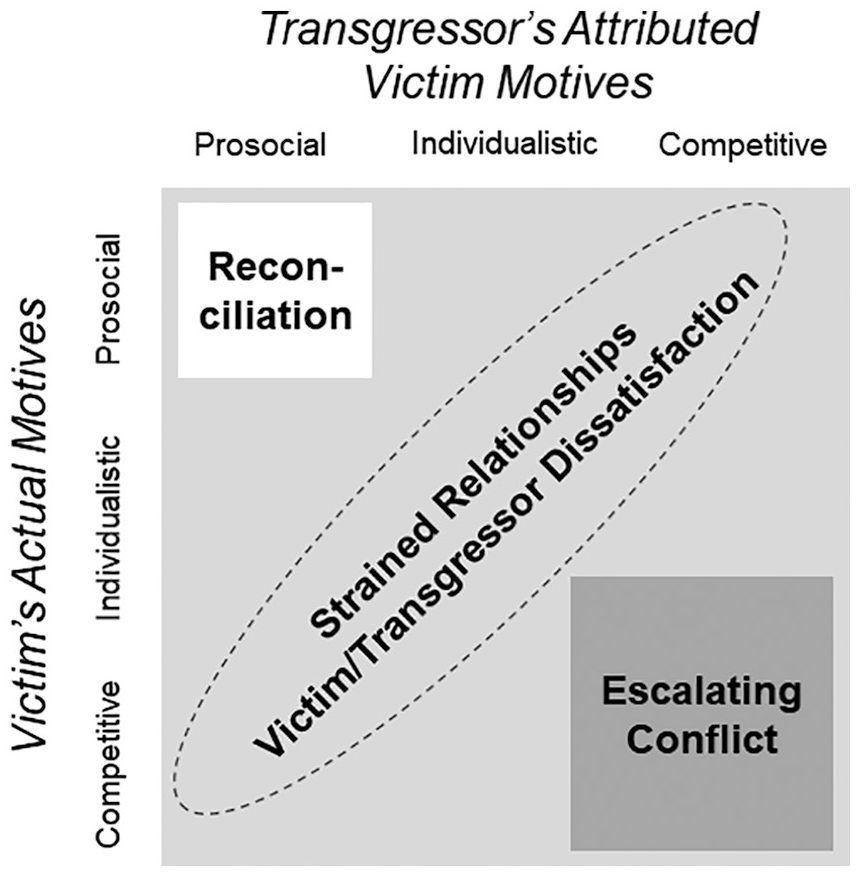
Victims’ actual motives underlying their post-transgression response and transgressors’ interpretations of this response (i.e., attributed motives) can be more or less aligned versus misaligned.
The remaining combinations will also fail to promote reconciliation, likely leading to dissatisfaction on both sides (“strained relationships”). According to our model (and supported by the empirical research reviewed above), transgressors who perceive a victim’s act of forgiveness as individualistic or even competitive will continue to distrust that victim; while the benevolent victim may be frustrated that their compassion seems to be unappreciated and unreciprocated. Likewise, expressions of “hollow,” “selfish,” or other forms of pseudo-forgiveness will unlikely have positive downstream consequences for the victim–transgressor relationship (e.g., Takada & Ohbuchi, 2013; Wenzel & Okimoto, 2012), even though the transgressor may (falsely) attribute the victim’s forgiveness response to prosocial motives.
The relevance of this argument becomes particularly apparent when we look at key forgiveness outcomes. One of the critical interpersonal goals of forgiveness is reconciliation—defined succinctly as relationship repair (e.g., Okimoto & Wenzel, 2014)—which can only be achieved if the forgiveness response is actually rooted in prosocial motives (i.e., “genuine forgiveness”) and if the forgiveness is attributed to prosocial motives by the transgressor. Our review and discussion reveals that reconciliation not only requires that victims extend forgiveness with sincerity; reconciliation also requires that transgressors perceive that sentiment to be sincere and respond accordingly (e.g., Wenzel et al., 2021). In other words, the forgiver often expects some reaction from the transgressor and will be dissatisfied if that reaction is not received, as it is indicative of a failure to achieve their intended goals. So, forgiveness alone is not a guarantee for reconciliation, but rather requires a dyadic dynamic in interaction with the transgressor. Notably, given that the ongoing conflict is already likely to have sparked distrust, transgressors may frequently feel skeptical about the genuineness of a forgiveness expression, making reconciliation less likely to occur than research on forgiveness may suggest.
Although we have talked a lot about reconciliation (as one positive potential outcome of forgiveness), there are a number of other relevant outcomes that may be lost when there is a misalignment between forgivers’ actual motives and transgressors’ inferred motives. Another key interpersonal outcome of forgiveness is a renewed consensus over the values violated by the offense (Wenzel & Okimoto, 2010, 2012), which enables the trust and shared identity that underpins effective reconciliation (Karremans & Van Lange, 2008). Value consensus between victim and transgressor, as a dyadic process of moral repair (see Wenzel et al., 2021), is likely to be lost if the transgressor does not perceive the victim’s forgiveness as a prosocial effort to rebuild the relationship. If forgiveness is attributed to individualistic or competitive motives (e.g., to the victim’s attempt to take the moral high ground or to denigrate the transgressor), transgressors may be less likely to engage constructively with the victim or respect the values at stake moving forward. Research on procedural justice has shown that feeling disrespected by the criminal justice system typically diminishes a transgressor’s willingness to trust authorities and engage productively with the community (Lind & Tyler, 1998; Tyler, 2006). This is probably because procedurally unfair treatment (e.g., by the police) increases transgressors’ inferences of malevolent intent, whereas fair procedures are more likely to trigger attributions that authorities are genuinely interested in reintegrating the transgressor into the community.
In addition to these interpersonal outcomes, there may also be value in exploring the intra-personal consequences that follow from this model, both for the forgiving or punishing victim and for the recipient transgressor. Indeed, much of the literature focuses on the experience of forgiveness as it positively affects a victim’s well-being (e.g., van Oyen Witvliet & Luna, 2018). However, these positive personal benefits for the victim may most likely be lost when the transgressor falsely attributes the forgiveness response to individualistic or competitive motives and (re)acts in accordance with such an attribution. Research on both punishment and on moral criticism has shown how strongly the transgressor’s reaction after being punished or confronted affects the victim’s well-being (Funk et al., 2014; Gollwitzer et al., 2011; Laforest, 2002; Malle et al., 2014). The same is likely to be true for victims expressing forgiveness.
Finally, misalignment may have psychological consequences for the transgressor. For instance, research on offender apologies suggest that they can actually be harmful to victims if judged as insincere (Schumann, 2012; Wenzel et al., 2017). Likewise, the receipt of forgiveness might have similarly damaging effects on the transgressor if it is believed to be competitive or individualistic. This motive attribution is also likely to affect a transgressor’s process of self-forgiveness—the transformation of transgressor emotions and motives away from self-punishment and self-condemnation toward self-benevolence and self-compassion (Hall & Fincham, 2005). Self-forgiveness follows closely from conciliatory victim behavior and is a key antecedent to transgressors’ proactive engagement in reconciliation (Carpenter et al., 2014; Woodyatt & Wenzel, 2013). In sum, the promise of forgiveness as helping to “move on” from the transgression may be lost if forgiveness is being attributed to victims’ individualistic or competitive motives.
What Shapes Motive Attributions?
Motive attributions are construed more or less spontaneously from salient features of the behavior itself (e.g., Macrae & Bodenhausen, 2001; Newman & Uleman, 1993). However, motive attributions are also highly context dependent (e.g., Higgins, 1996; Trope, 1988; Wyer & Srull, 1981) and subject to a variety of different social-cognitive biases (e.g., Kunda et al., 1997), especially when contextual information is sparse (e.g., Vuolevi & Van Lange, 2010, 2012). Previous research has looked at motive attributions for the transgression itself, and this research clearly echoes the broader attribution literature, showing that motive attributions are prone to idiosyncratic biases on either side. Victims, for instance, are more likely than transgressors to perceive the transgression as more intentional (G. S. Adams & Inesi, 2016), more severe (Baumeister et al., 1990), and more immoral (Kearns & Fincham, 2005). Transgressors, by contrast, perceive their actions as less blameworthy than victims do (Zechmeister & Romero, 2002). As a consequence, victims and transgressors often differ in what they think should be done to restore justice: Transgressors tend to think that the victim’s moral outrage and their demand for punishment (or restitution) is unjustified (Baumeister et al., 1990), while victims underestimate how guilty transgressors feel for what they have done (G. S. Adams & Inesi, 2016; for a review, see G. S. Adams, 2016).
This research shows how severely biased interpersonal perceptions and motive attributions can be when judging a transgression. Here, we argue that biased perceptions and motive attributions apply not only to the transgression itself but also to post-transgression events. In the following, we discuss factors that shape motive attributions and that cause such attributional biases. To provide some structure to this discussion, we draw upon a long tradition of research on motive attributions (e.g., Trope & Gaunt, 2007), which points to three “content” categories that influence the outcome of an attribution process: (a) behavioral information—how the victim exactly responds to a transgression (henceforth “response characteristics”), (b) situational information—the context in which this response occurs (“context characteristics”), and (c) perceivers’ preexisting beliefs regarding other people’s motives. In addition, the attribution process is strongly influenced by information processing characteristics, such as the motivational or cognitive resources available in a situation or the salience of alternative interpretations (see Trope & Gaunt, 2007). To reduce unnecessary complexity, we will not discuss these information processing characteristics in detail, but rather focus on the three “content” categories mentioned above.
To summarize our reasoning up front, we hypothesize that both response characteristics and context characteristics form transgressors’ judgments about whether a victim’s response is considered appropriate, and these appropriateness perceptions, in turn, predict whether a post-transgression response is attributed to either prosocial, individualistic, or competitive motives. In addition, motive attributions are affected by (c) transgressors’ preexisting beliefs (as well as by information processing characteristics, as briefly mentioned above, but not discussed in more detail here). The structural model that results from our reasoning is displayed in Figure 2. In the following, we will explain this model and the specific predictions that follow from it in more detail, and we offer preliminary evidence from the existing literature that supports our predictions.
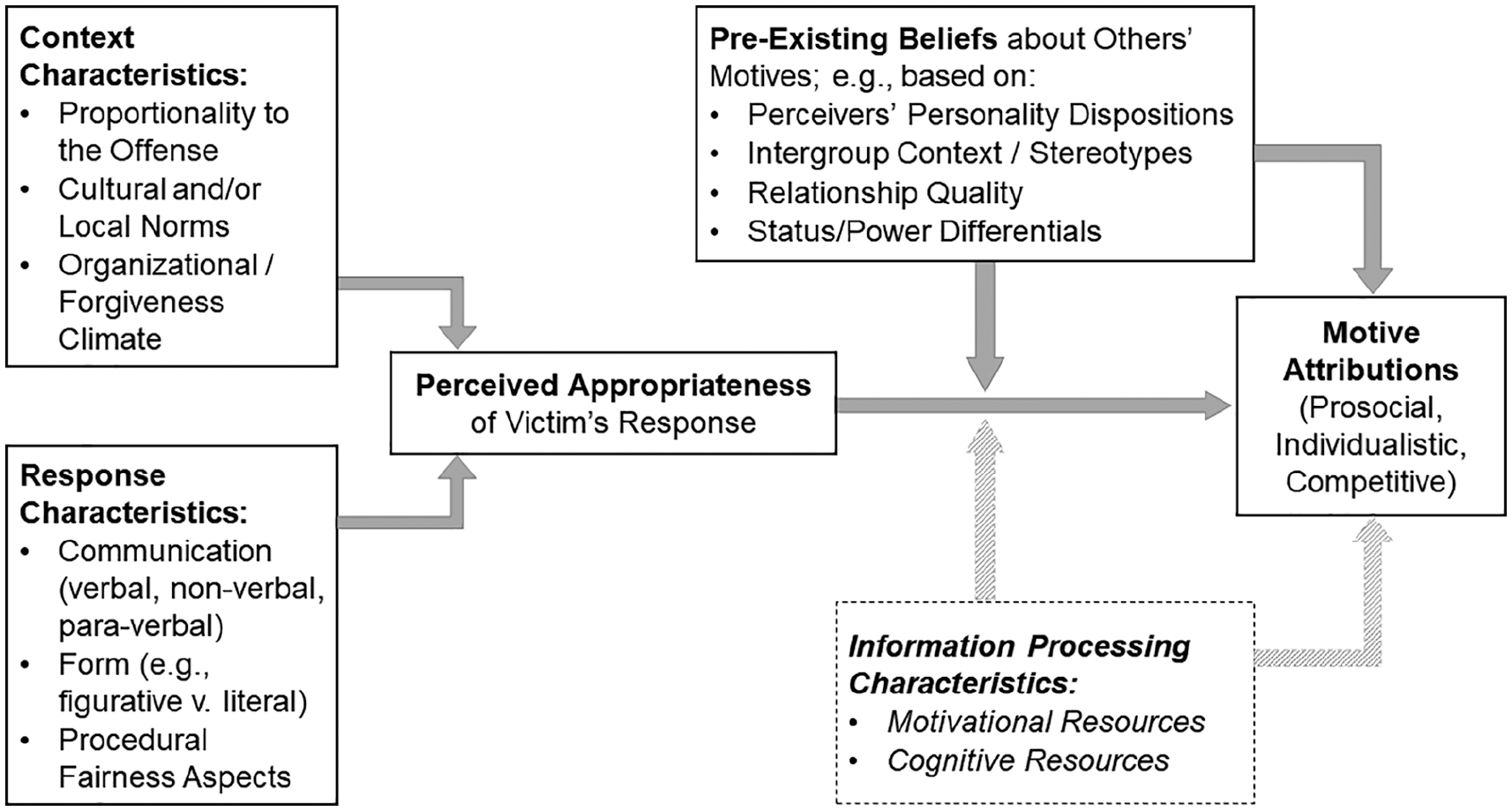
Model predicting transgressors’ motive attributions from perceived appropriateness of the victim’s post-transgression response, preexisting beliefs about others’ motives, and information processing characteristics (which are not discussed in this article and, thus, appear shaded here).
Perceived Appropriateness of Victim’s Response
Justice responses are well understood to be subjective judgments (Deutsch, 1975); hence the adage that justice is in the eye of the beholder. This inherent ambiguity means that evaluations of justice actions are heavily influenced by normative beliefs about what is appropriate or “morally right” and, therefore, to be expected within a given context (Elster, 1990; Tripp et al., 2007). Behavior that violates such expectations is experienced as normatively inappropriate and likely to trigger a sense-making process to reconcile the apparent incongruity (e.g., Jennings et al., 2016), which also shapes the outcome of an attribution process. Thus, it follows that transgressors judge the appropriateness of a victim’s post-transgression response by taking both the response itself and the context in which it occurs into account (Trope & Gaunt, 2007).
Context characteristics
As noted before, victims can respond to a transgression in several ways (punishment, forgiveness, withdrawal, forbearance, confrontation, blaming, seeking compensation, asking for apology, etc.). Importantly, each of these responses may sometimes be considered appropriate, but other times not. For instance, more severe transgressions usually call for harsher punishment (e.g., Gromet & Darley, 2006). Thus, a transgressor’s intuitive recognition that severe offenses require proportionally severe punishments means that their receipt of undeserved forgiveness may arouse skepticism. Specifically, in their attempt to make sense of the unexpected forgiveness response, transgressors may perceive the victim as too weak to punish (Baumeister et al., 1998; Exline et al., 2003), uncommitted to the relationship (McNulty & Russell, 2016), or incompetent—especially when the transgression was severe and/or when it occurred more than once (Di Donato et al., 2014)—which, in turn, escalates the conflict rather than resolving it (see McNulty, 2010, 2011; Russell et al., 2018). Furthermore, punishment that does not “fit the crime” (Tripp et al., 2002) or that is perceived as overblown and exaggerated in comparison to the transgression will raise suspicion and render prosocial attributions unlikely (Baumeister et al., 1990). In sum, the perceived proportionality of a victim’s post-transgression response to the offense itself is an important cue that shapes transgressors’ judgments regarding the appropriateness of the victim’s response and, thus, motive attributions.
Second, cultural and/or local norms prescribe whether a transgression calls for punishment or for forgiveness, and what appropriate punishment (or forgiveness) should look like exactly. For instance, norm violations are more likely to be punished in “tight” as compared with “loose” cultures (Gelfand et al., 2011), so forgiveness may be a more surprising response in “tight” cultures, triggering suspicious attributions about being forgiven. Likewise, cultural contexts in which personal retaliation is considered a signal of strength (such as in “honor” cultures; see Nisbett & Cohen, 1996), a forgiveness response is likely to be perceived as a sign of weakness instead of being attributed to prosocial motives. Finally, in high-power distance cultures, where power is distributed more asymmetrically than in low-power distance cultures, personal retaliation is considered less appropriate, giving rise to competitive attributions (e.g., Jackson et al., 2019; Sell et al., 2009).
That said, victim responses that are in line with cultural or local prescriptive norms do not necessarily result in prosocial motive attributions. For instance, in situations in which there is a strong cultural or local norm to avoid conflicts in general (e.g., Leung, 1988), forgiveness responses may, paradoxically, be attributed to individualistic motives (i.e., avoiding sanctions for violating the norm; see Takada & Ohbuchi, 2013) rather than to the victim’s genuine willingness to heal a relationship. Echoing this reasoning, research on apology norms shows that the increasing frequency of a conciliatory act (and the implied pressure to conform to that norm) enhances the expectation of that behavior, while also reducing its perceived sincerity and thus diminishing the likelihood of subsequent reconciliation (Okimoto et al., 2015).
Related to the concept of cultural/local norms, when a victim’s response occurs within a positive organizational climate it is more likely to be encoded from a “trust mindset” than from a “distrust mindset” (Mayo, 2015), and, thus, attributed to prosocial motives; whereas that same response would more likely be attributed to individualistic or competitive motives in a toxic climate, where “distrust mindsets” are more common. Thus, the normative (organizational) context may shape how forgiving (or punitive) responses are interpreted (Mooijman et al., 2015). Notably, this applies not only to “task groups” (i.e., organizational groups and teams) but also to “affinity groups” (e.g., groups of friends, sports teams, etc.): Perceived group cohesiveness and a positive group climate make prosocial attributions in friendship groups more likely in general.
More specific to the forgiveness phenomenon, Fehr and Gelfand (2012) have proposed the concept of a “forgiveness climate,” defined as “the shared perception that empathic, benevolent responses to conflict from victims and offenders are rewarded, supported, and expected in the organization” (Fehr & Gelfand, 2012, p. 666). In their model, they advance evidence for the argument that contextual features (e.g., leadership style, restorative practices, organizational values) shape the sense-making process of the involved parties, resulting in more or less constructive post-transgression engagement. This sense-making mechanism parallels our current argument that one party’s motive attribution for the other party’s actions is a critical determinant of reconciliation (see Figure 1).
Response characteristics
The perceived appropriateness of a victim’s post-transgression response depends not only on context characteristics, as discussed above, but also on how the response is communicated. For instance, the effects of forgiveness are contingent on how the forgiveness is expressed verbally (Waldron & Kelley, 2005) and whether nonverbal expressions are congruent versus incongruent with this verbal expression (D. L. Kelley, 1998). More specifically, forgiveness expressed with a splash of irony or hostility—for instance, in an exaggerated tone, in “figurative speech,” or accompanied by an incongruent gesture or facial expression—is more likely attributed to individualistic or competitive motives (even if the victim’s true motives are prosocial). This echoes research on reactions to apologizers, which are similarly influenced by nonverbal cues (e.g., Hornsey et al., 2020). In sum, forgiveness responses are most likely attributed to prosocial motives if the verbal expression of forgiveness matches the nonverbal expression.
With punitive responses, things are different: Delivering the punishment with a wink or communicating disapproval with a splash of benign irony (“figurative punishment”; see Cushman et al., in press) may be more likely attributed to prosocial motives than “literal punishment” (i.e., condemnation of the act and imposition of costs on the transgressor). Sarin et al. (2021) compared these different forms of punishment with regard to how they are perceived from a neutral (third-party) perspective. The contexts they used were mundane and the transgressions were relatively minor; in one story, for instance, a roommate tends to leave her dirty dishes in the sink without cleaning up. In the “figurative punishment” condition, another roommate buys a brand-new kitchen sponge and bottle of dish soap and drapes these items on the culprit’s pillow with a ribbon around them and a tag saying “Love, your roommates.” Sarin et al. (2021) demonstrated that such “figurative” forms of punishment are perceived as less destructive, yet as equally effective compared with less ambiguous “literal” forms of punishment. These findings are in line with our theorizing: Punishment that imposes costs on the transgressor is more likely attributed to competitive motives, while punishment that (implicitly or explicitly) communicates a disapproval of the act without imposing costs on the transgressor has a better chance of being attributed to prosocial motives.
Finally, as discussed above, any post-transgression response can be communicated in a more or less procedurally fair manner. For instance, court sentences that are delivered in a fair and respectful fashion lead to higher trust and legitimacy appraisals, as well as more normative compliance in the future (Grootelaar & van den Bos, 2018; Tyler, 2006). In a related vein, assigning punishment (or forgiveness) inconsistently across different transgressors for the same norm violation will likely trigger skepticism as to the punisher’s motives (e.g., Bennett, 1998; Van Prooijen et al., 2008). This is true both for punitive as well as for forgiving responses: Learning that one has been treated more favorably than others may, on one hand, be nice because it maximizes one’s individual self-interest. On the other hand, transgressors may suspect that such favorable treatment is rooted in ulterior motives (e.g., making the transgressor feel indebted) or reflect a form of benevolent discrimination (e.g., Dutton, 1973) or “patronizing leniency” (Braun & Gollwitzer, 2012, 2016).
Preexisting Beliefs About Other People’s Motives
The effect of appropriateness perceptions on motive attributions is likely moderated by preexisting beliefs about other people’s motives (or “a priori causal models of behavior”; see Trope & Gaunt, 2007). In addition, preexisting beliefs may also influence motive attributions directly, irrespective of appropriateness judgments. These preexisting beliefs can be based on a number of factors, four of which are discussed in the following.
Perceivers’ personality dispositions
First, personality characteristics may lead transgressors to view a victim’s forgiveness (or punishment) as more likely to be prosocial, or conversely, more likely to be individualistic or competitive in nature. For example, generalized trust (e.g., Molden & Finkel, 2010) should affect the likelihood of attributing victim responses to prosocial motives—even if these responses may appear unexpected or even inappropriate. Similarly, beliefs about human nature (Wrightsman, 1991) that paint people as naturally generous are likely to increase prosocial attributions, while beliefs that people are fundamentally self-interested will increase individualistic attributions (Miller & Ratner, 1996; Vuolevi & Van Lange, 2010, 2012). By contrast, transgressors high in victim sensitivity, a personality trait that reflects people’s anxious expectation of being exploited (Gollwitzer et al., 2012, 2013; Gollwitzer & Rothmund, 2009), may attribute victims’ post-transgression behaviors more to individualistic than to prosocial motives (e.g., Gerlach, Agroskin, & Denissen, 2012). In a similar vein, research on Social Value Orientations has repeatedly shown that perceivers’ SVO predicts their motive attributions of an interaction partner’s behavior (i.e., assuming that the other party’s motives are similar to one’s own motives). For example, “prosocials” are more sensitive to contextual information about an interaction partner’s honesty than “individualists” or “competitors” (De Bruin & Van Lange, 1999; Van Lange & Kuhlman, 1994) and are more likely to cooperate based on their expectations that their interaction partner will cooperate as well (see Pletzer et al., 2018, for a meta-analysis). This suggests that prosocial transgressors should be more likely to interpret a victim’s post-transgression response as prosocially motivated, at least if this response is considered appropriate.
Intergroup context/stereotypes
Attributions about a victim’s motives might be derived from preexisting (or presumed) knowledge or categorical information about the victim: information about the victim belonging to an in- or outgroup, or being a member of a specifically stereotyped group, can shape transgressors’ motive attributions. This influence might be direct; for example, stereotypes of male agency (versus female patiency) lead perceivers to assume men are the aggressor in a conflict (Reynolds et al., 2020) and, thus, may also lead to an assumption of more competitive motives underlying a man’s (versus woman’s) act of forgiveness—a direct influence of gender on perceived motive. However, categorical stereotypes might also moderate the effect of appropriateness judgments on motive attributions. For instance, conciliatory actions that stereotypically define the group to which the victim belongs (e.g., a religious group in which forgiving is a strong prescriptive norm) may be attributed more to individualistic motives (i.e., the avoidance of sanctions for violating the group norm) than to truly prosocial motives, even though these conciliatory actions are considered appropriate (e.g., Okimoto et al., 2015).
Relationship quality
Attributing victim responses to individualistic or competitive motives may be more likely when the transgressor barely knows the victim. By contrast, attributing victim responses to prosocial motives is more likely to occur in healthy, long-term, and highly interdependent relationships (of course, long-term relationships can also be unhealthy; see McNulty, 2010, 2011). In healthy relationships, victims’ experiences and expressions are more likely to be aligned with prosocial motives (Fincham et al., 2002), which is also likely reflected in a transgressor’s attribution of the victim’s post-transgression response to prosocial motives. This also implies that transgressors are less likely to misattribute a victim’s response due to a higher level of mutual empathy (Fehr et al., 2010) in healthy relationships.
Status/power differentials
Finally, victims’ absolute and relative status and power as well as power/status differentials between victim and transgressor are likely to shape transgressors’ motive attributions regarding victims’ post-transgression behaviors. This is because status/power differentials can constrain victims’ post-transgression responses considerably (e.g., Aquino et al., 2001). Transgressors are often well aware of these differentials and the constraints they imply. Thus, status/power differentials are likely taken into account when transgressors interpret the victim’s post-transgression behavior. More precisely, being forgiven by a victim who has a lower relative status may be attributed to the victim’s inability to take revenge, while being forgiven by a victim who as a high absolute status may be attributed to role-based constraints (which is consistent with Aquino et al.’s, 2001, findings). In both cases, a forgiving response is likely to be interpreted as “pseudo-forgiveness” and, thus, to individualistic motives. Notably, the extent to which such status differentials shape motive attributions is likely to be influenced by context characteristics, such as the presence of third parties (Kim et al., 1998) or the broader organizational climate (Aquino et al., 2006; Tripp et al., 2007).
Discussion and Outlook
Forgiveness and punishment as well as any other post-transgression response can have a variety of downstream consequences for the victim, the transgressor, and their mutual relationship. The motive-attribution framework presented in this article aims to improve our understanding, psychological explanation, and prediction of these downstream consequences. Specifically, three central empirical hypotheses can be deducted from our theorizing:
Motives underlying a victim’s post-transgression response can be categorized as prosocial (i.e., relationship- and/or other-oriented), individualistic (i.e., self-oriented), or competitive (i.e., harm-oriented).
Transgressors attribute a post-transgression response to any of these three motives. The result of this motive attribution process depends on (a) the extent to which a post-transgression response is considered appropriate in a given context, (b) on transgressors’ preexisting beliefs regarding other people’s motives, and (c) on information processing characteristics (which we have not discussed in detail here).
Any post-transgression response will only have positive downstream consequences (e.g., reconciliation) if (a) it is prosocially motivated and (b) interpreted as such.
While the research reviewed in this article is largely in line with our motive-attribution model, further empirical work is nonetheless necessary to corroborate its central tenets directly and to clarify open questions. First, while we have argued that our three-fold categorization of victim motives and transgressors’ attributions to those victim motives (i.e., prosocial, individualistic, competitive) is conceptually plausible and consistent with research (e.g., Klapwijk & Van Lange, 2009), we do not argue that this taxonomy applies equally well to all conflict situations. For instance, in situations marked by less interdependence between the involved parties (e.g., one passenger forgiving another passenger for jumping the queue at a ticket counter), motive attributions may follow a simpler (e.g., malevolent vs. benevolent motives) structure than in situations such as marital conflicts, which are richer with regard to the pieces of information that both conflict parties have about each other. Similarly, the contextual features reviewed earlier may determine specific patterns of inferred motives; in a climate or culture where status and power are the paramount values defining interpersonal relationships, such inferences may be more narrowly oriented toward individualistic and competitive motives. Future research should look at the structure of these motive attributions and the extent to which this structure systematically differs between contexts in more detail.
Second, future research may try to estimate how often and in which contexts potential misalignments between victim motives and transgressors’ attributions actually occur. We have speculated that such misalignments are less likely to occur in stable and healthy relationships where empathy processes are engaged (see above), while they are more likely to occur in anonymous and/or toxic social environments. Related, it is also valuable to further distinguish between the main effects of victim prosociality and transgressor attributions of prosociality, versus the importance of their (mis)alignment (i.e., the interactive effect). We have argued for the interactive pattern, whereby a prosocial motive is most likely to promote constructive outcomes when it is perceived as prosocial, and prosocial attributions can only promote constructive outcomes if the original motive was actually prosocial. The research reviewed above provides evidence for interdependence between the two parties involved in a conflict; that the reactions of one party are contingent on attributions of the other party’s intentions. For example, the belief that the offender has learned from his or her experience increases victim satisfaction with punishment (Funk et al., 2014); and the belief that a victim feels forgiving aids offenders’ process of self-forgiveness (Hall & Fincham, 2008). However, this conclusion relies largely on static evaluations of single-party responses; we still lack “in the wild” evidence of the dynamic interplay between parties that would be valuable to bolster the ecological validity and robustness of these patterns (see Wenzel et al., 2021).
Third, future research might want to compare second-party to third-party situations. For instance, the very same punitive response may be interpreted differently by the transgressor depending on whether they were punished by the victims themselves (i.e., second-party punishment) or by another person or authority (i.e., third-party punishment; cf. Goeschl & Jarke, 2016). Thus, the conditions under which second-party punishment is attributed to prosocial, individualistic, or competitive motives may be different from the conditions under which third-party punishment is attributed to these (or other) motives. Similarly, a transgressor’s motive attributions following (rarely studied) third-party forgiveness is likely to be different compared with when such forgiveness is expressed by the victim himself or herself.
Fourth, the current state of our model may be criticized for being too static and for failing to take dynamic processes into account. Both motives and attributions may change over time. While a victim’s punitive response may be spontaneously and intuitively attributed to competitive or individualistic motives at the beginning, this inference may become more prosocial over time (e.g., depending on the frequency and quality of victim–offender interactions; see Wenzel et al., 2021). And, building on research showing that punishment can sometimes even facilitate forgiveness because it closes the “injustice gap” for the victim (Strelan et al., 2017, 2020; Wenzel & Okimoto, 2014), it is reasonable to assume that punitive motives do shift over time: from delivering transgressors their “just deserts” to an intention to resolve the conflict, heal the relationship, and make the transgressor a better person. If this is true and motives change over time, then motive attributions should catch up with these changes. The question is whether, how, and when they do so.
Conclusion
While we often assume (or hope for) positive consequences of forgiveness like renewed trust and reconciliation, victim forgiveness that is interpreted as self-serving (i.e., individualistic) or even meant to denigrate the transgressor (i.e., competitive) will instead elicit negative consequences, placing further strain on the victim–transgressor relationship and escalating the conflict. Likewise, punitive responses that are attributed to competitive or individualistic motives will likely have no positive impact on the transgressor, while punishment that is prosocial and interpreted as such by the transgressor can close the injustice gap and have relationship-benefiting downstream consequences. Looking at post-transgression responses from such a motive-attribution perspective can contribute to a better understanding of these consequences for victims, transgressors, and their mutual relationship.
Footnotes
Acknowledgements
We thank Melissa de Vel-Palumbo, Mathias Twardawski, and Michael Wenzel for helpful comments on an earlier draft of this paper.
Declaration of Conflicting Interests
The author(s) declared no potential conflicts of interest with respect to the research, authorship, and/or publication of this article.
Funding
The author(s) disclosed receipt of the following financial support for the research, authorship, and/or publication of this article: This research was partly supported by a grant from the Australian Research Council, DP190102283.
